




Abstract
This article examines the preservation of structural properties in epistemic and doxastic logic, with a particular focus on action model logic and the dynamics of group belief. Two central questions guide the analysis: (a) which frame conditions remain invariant under the execution of epistemic actions? and (b) do group conditions—properties allowing groups to be modeled as unified agents—persist after such actions? The study further explores specific subclasses of epistemic actions, including public announcements and unconditional actions, highlighting their distinctive preservation features. These findings contribute to a deeper understanding of the logical foundations of epistemic and doxastic reasoning, particularly within dynamic multi-agent frameworks.
Introduction
Epistemic and doxastic logic serve as foundational frameworks for modeling knowledge and belief, employing Kripke models to represent agents’ uncertainty across possible worlds (Fagin et al., 1995; Hintikka, 1962; Meyer & van der Hoek, 1995). Within this paradigm, three canonical notions of group belief emerge: mutual belief, common belief, and distributed belief.
1
Specifically, each individual
While the properties of frames in modal logic are extensively studied, their preservation under group operations in epistemic and doxastic logic raises important and subtle questions. Recent work indicates that frame conditions are not necessarily preserved when moving from individual to group-level uncertainty (Ågotnes & Wáng, 2020, 2021). For instance, starting from a KD45 frame—defined by seriality, transitivity, and Euclidicity—the resulting frames for mutual, common, and distributed uncertainty differ significantly. Specifically, mutual uncertainty preserves only seriality, common uncertainty yields KD4 properties (seriality and transitivity, potentially losing Euclidicity), and distributed uncertainty yields K45 properties (transitivity and Euclidicity, potentially losing seriality). Consequently, none of these derived group-level notions fully retain the original KD45 conditions that characterize individual belief. By contrast, S5 frames, characterized by equivalence relations, preserve their defining properties across mutual, common, and distributed uncertainty.
This article extends the analysis of frame and group conditions to the setting of action model logic, also known as dynamic epistemic logic, a prominent framework for analyzing the logical dynamics of epistemic and doxastic scenarios (Baltag & Moss, 2004; Baltag et al., 1998; van Ditmarsch et al., 2007). Our investigation centers around two primary research questions: Which frame conditions are preserved under epistemic actions? Specifically, when epistemic actions transform a model satisfying certain frame conditions, does the resulting model retain these conditions? This question is addressed in Section 3.1, with a generalized result provided in Section 3.2. Are the three group conditions—mutual, common, and distributed—preserved under epistemic actions? This question is analyzed in Section 3.3.
Public announcement logic (Plaza, 1989), a well-known sublogic of action model logic, studies a restricted class of epistemic actions—public announcements. While public announcements behave similarly to general actions regarding frame condition preservation, they diverge in their preservation of group conditions, a contrast explored in Section 4.1. Additionally, in Section 4.2, we identify another special class of actions—unconditional actions, i.e., actions without preconditions—which exhibit distinct preservation properties diverging from both general actions and public announcements. Notably, seriality—a frame condition corresponding syntactically to the consistency of beliefs—is typically not preserved under public announcements. Unconditional actions, however, do preserve seriality.
These findings carry implications for the development and application of action model logic, as we discuss in the concluding section.
This section introduces key definitions and conventions used throughout the article. We present the definitions of epistemic frames, models, actions, execution of actions, and the language and semantics of action model logic. We also introduce standard frame and group conditions from modal logic, generalized appropriately to action models.
A countably infinite set of propositional atoms, denoted
Extended Frames, Models, and Actions
We start by introducing generalized definitions that extend classical Kripke structures.
A frame is a pair
For convenience, we write
A model is a triple
Given a language
Classical structures from the epistemic logic literature emerge naturally as special cases of our definitions:
(a) A standard Kripke frame
(b) A pseudo model Fagin et al. (1992); Wáng and Ågotnes (2013) is also a model by the above definition. It differs from a Kripke model by treating distributed relations
The base language—the language of classical multi-agent epistemic logic—is denoted by


Semantics
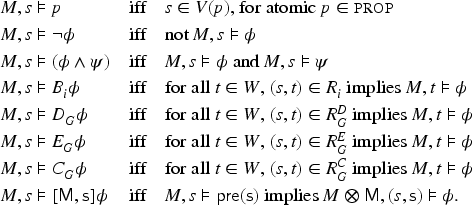
This subsection briefly recalls the standard semantics of action model logic (AML) (Baltag & Moss, 2004; Baltag et al., 1998; van Ditmarsch et al., 2007). Although semantic interpretations are not strictly necessary for the analysis of preservation of frame and group conditions, the following summary provides a concise overview of AML’s semantic framework and may facilitate a broader understanding of the logical context.
Given a pointed model
Action Execution
Two types of action execution are defined: the generalized
Let Domain of states: Accessibility relations: for each agent Valuation: for each proposition
It is possible that the resulting model is empty (
The
(action execution)
Consider agents Individual relations: Collective Valuation: Individual uncertainty relations: Group relations (which are collective): Precondition:
Next, consider an action
The model Illustration of a model, an action, and their executions.
Executing action Domain: Relations: Valuation:
The classical (

This subsection recalls standard frame conditions from modal logic and introduces group conditions, which specify how group uncertainty relations are derived from individual ones. A frame
Serial ( Reflexive ( Transitive ( Symmetric ( Euclidean (
Intersective ( Unioned ( Transitive-unioned ( Collective: intersective, unioned and transitive-unioned.
If a frame
Let
These notations naturally extend to models
Given sets of conditions The pair The pair
characterization of Kripke and pseudo frames
The special types of frames introduced in Remark A frame is a Kripke frame if any only if it is collective (i.e., intersective, unioned, and transitive-unioned); A frame is a pseudo frame if and only if it is unioned and transitive-unioned.
Preservation of Frame Conditions
This section investigates the preservation of standard frame conditions under classical (
Let
closure
Let For every frame For every condition
It can be verified that the closure is unique and well-defined for any subset of 
Table 1 summarizes our preservation results. For given condition subsets
Preservation of Frame Conditions Under Classical (
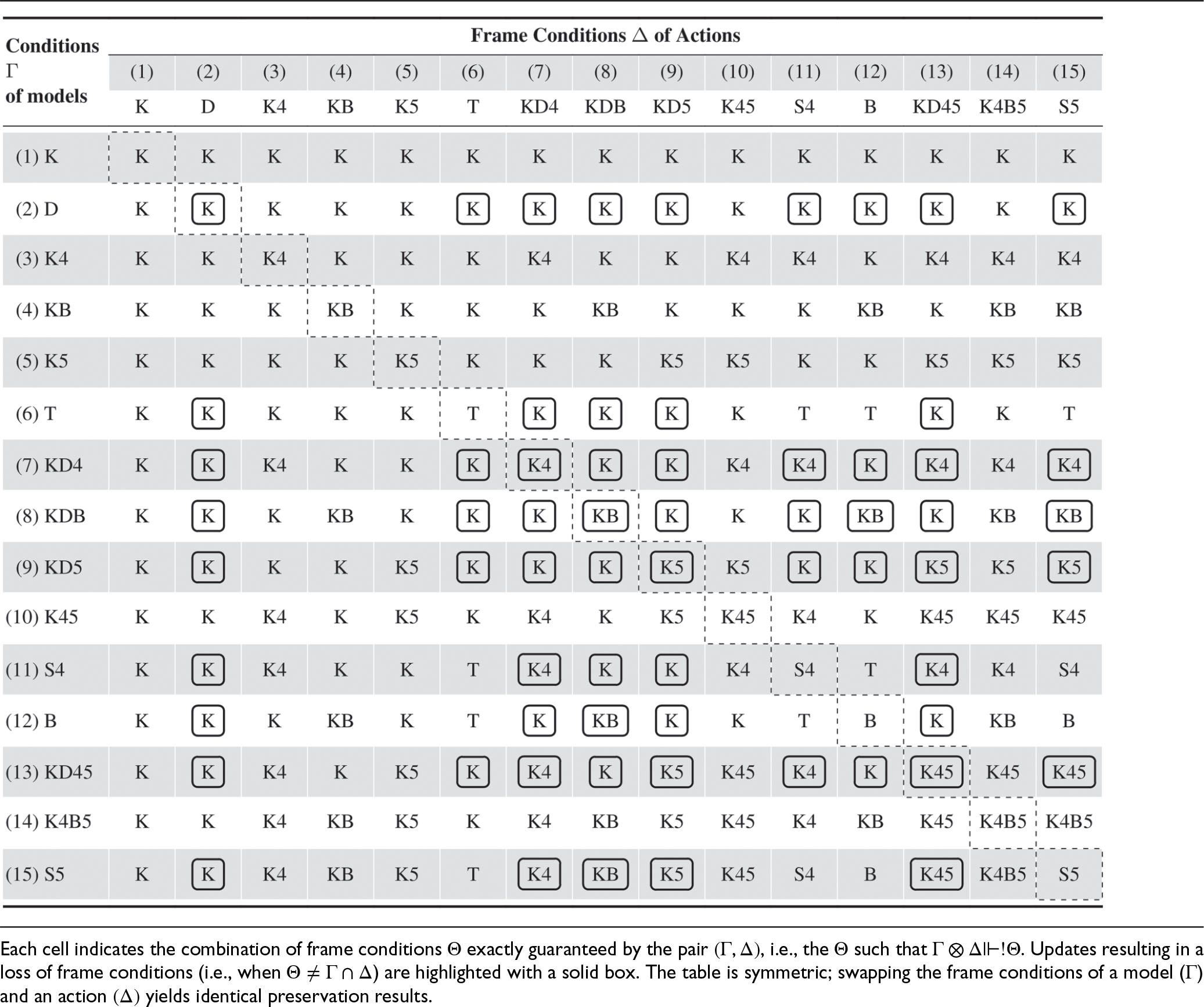
The rest of this section provides general theorems and lemmas justifying the preservation results summarized in Table 1. Although each cell in Table 1 could, in principle, be individually verified, such an approach would require checking 225 cases. Instead, the following general results efficiently cover multiple cases simultaneously.
Let For every model If If
(a) follows directly from the definitions of frame conditions and the construction of the
(b) Consider the cases
(c) follows immediately from (a) and the definition of closure: if
(d) Suppose
Suppose
One can verify that either
Otherwise, suppose
We have either
Let
First of all, we have the following immediate results:

Suppose
Otherwise
In summary, classical (
Lemma 5(a, b) plays a crucial role in establishing the preservation of frame conditions. It suggests two fundamental principles: Preservation of shared properties: Action execution does not eliminate the frame conditions Prevention of new properties: Action execution does not generate new frame conditions from the set
While Lemma 5(a) is restricted to four frame conditions (
Let
Suppose
Theorem 7 significantly extends the scope of preservation beyond Lemma 5(a). Examples of other Horn clause properties that are modally definable include:
All these are Horn clauses as well. Theorem 7 tells us that they are preserved in the same way as the four frame properties are.
On the other hand, the second principle—that action execution cannot generate new conditions (Lemma 5(b))—does not hold in general for all frame properties. Consider the following counterexample. Let
To formalize when this generation of new properties is impossible, we introduce weak irreflexivity: a frame
Let
The proof proceeds by contraposition, showing that if
Case 1 (
Case 2 (
Theorem 8 generalizes Lemma 5(b), establishing that classical action execution cannot introduce new frame conditions, provided weak irreflexivity is excluded.
Section 3.1 studied the preservation of individual frame conditions under classical (
Groups often behave as collective agents, exhibiting unified epistemic or doxastic behaviors analogous to single individuals. For example, the head or representative of an organization frequently speaks on behalf of the entire organization as a collective agent. Technically, groups can also be treated exactly like individuals. For instance, completeness proofs for logics involving distributed knowledge commonly introduce pseudo-structures in which groups behave precisely as individual agents (Fagin et al., 1992; Wáng & Ågotnes, 2013). Here, this idea of collective agency is extended from distributed knowledge to all three group modalities mentioned above.
Thus, the following preservation questions arise naturally. Given a model Is intersectivity preserved under action execution? Formally, if Is unionedness preserved under action execution? Formally, if Is transitive-unionedness preserved under action execution? Formally, if
An immediate corollary follows from the above definitions and questions: if all three preservation questions have affirmative answers, then the generalized (
The rest of this section systematically investigate these group-condition preservation questions. The analysis proceeds case-by-case, depending on the frame conditions satisfied by the original model
The following preservation results hold for group conditions under action execution: Intersectivity is preserved under action execution. Formally, for every model Unionedness is not guaranteed to be preserved under action execution, regardless of the considered class of frames.
7
Formally, for every pair of subsets Transitive-unionedness is also not guaranteed to be preserved under action execution, regardless of the considered class of frames. Formally, for every
(a) Let
(b) Let
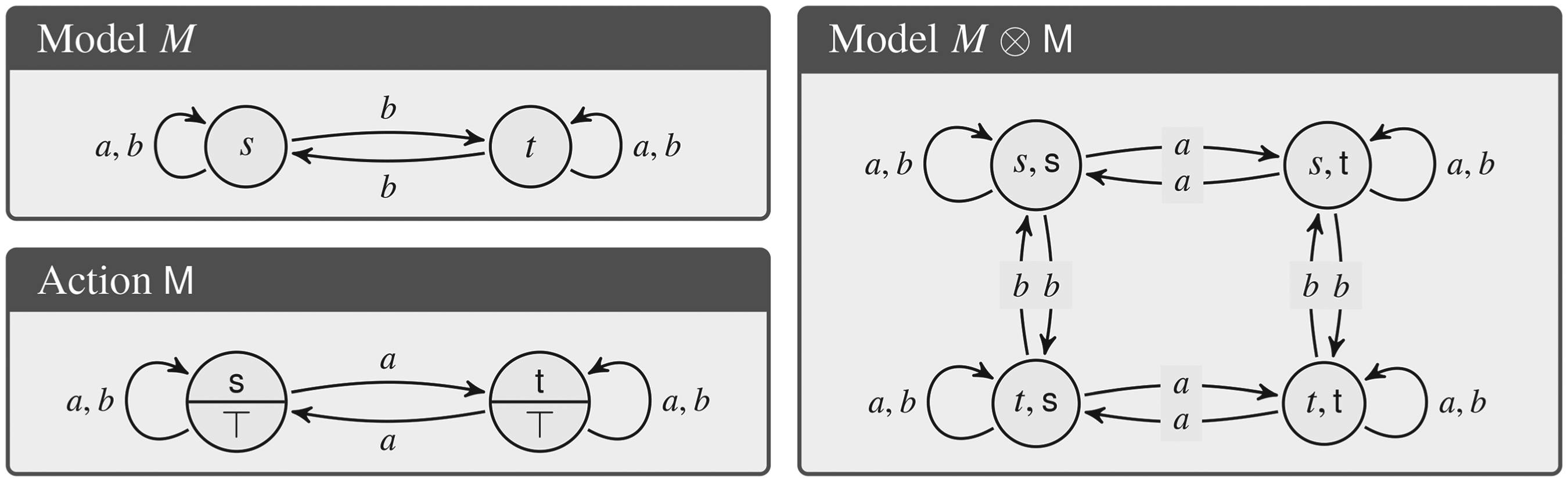
Thus,
(c) The model
These results are summarized in the first column of Table 2.
Preservation of Group Conditions Under Action Execution.
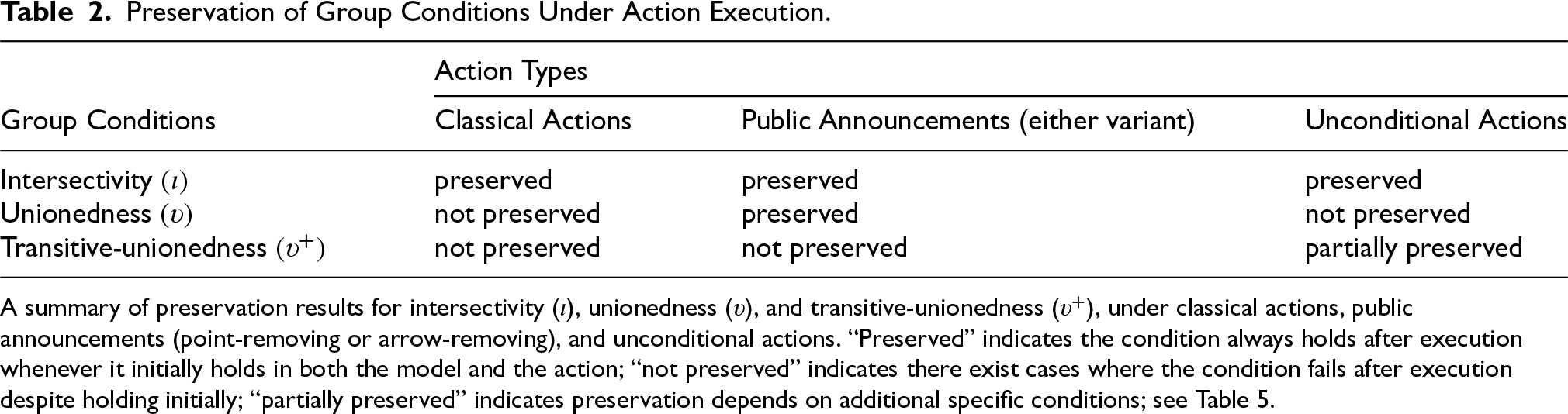
A summary of preservation results for intersectivity (
Public Announcements
A point-removing public announcement (Plaza, 1989) constitutes a specialized action that alters a model’s states and, consequently, its uncertainty relations. An alternative formulation, termed an arrow-removing public announcement (Gerbrandy, 1999; Gerbrandy & Groeneveld, 1997), interprets the announcement as a process that contracts the uncertainty relations within the model. These concepts are formalized as follows.
public announcements
Let
The point-removing public announcement of
The arrow-removing public announcement of
Both variants capture the effect of a public announcement of
This subsection examines the preservation of frame conditions and group conditions under these two types of public announcements. The class of all point-removing public announcements is treated as satisfying a specific set of frame conditions, denoted
The analysis addresses two key questions: For any set of frame conditions For any set of frame conditions
The results, summarized in Table 3, reveal distinct patterns: point-removing public announcements align with the preservation behavior of S5 actions, maintaining properties like reflexivity and symmetry where applicable, while arrow-removing public announcements mirror the properties of KD45 actions, preserving transitivity and Euclidicity but not necessarily seriality.
Preservation of Frame Conditions Under Public Announcements.
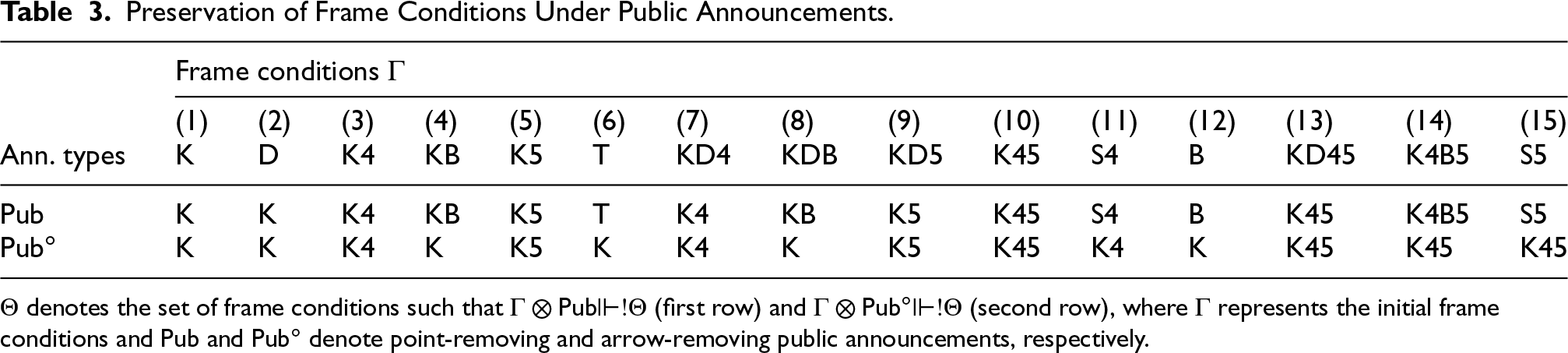
Explicit proofs for the preservation of these frame conditions under point-removing and arrow-removing public announcements are not provided here. However, such proofs can be readily derived by adapting the arguments presented in Section 3.1 with minor modifications.
The following theorem addresses the preservation of group conditions under public announcements, with results compared to other action types in Table 2.
Intersectivity is preserved under public announcements. For any model Unionedness is preserved under public announcements. For any model Transitive-unionedness is not preserved under public announcements. For any set of frame conditions
(a) The preservation of intersectivity follows directly from Theorem 9(a).
(b) To establish unionedness, consider a model
(c) For point-removing public announcements, the proof of Theorem 9(c) also works here, since the action
Prior sections have demonstrated that actions preserve only specific frame and group conditions, a phenomenon that extends to public announcements, a particular class of actions. Various action types can be designed with different preservation properties for group conditions. This section introduces unconditional actions, a subtype executable without preconditions, and establishes that this subtype yields unique preservation results.
(
- and
-types action execution)
Let
The
For a model If
For notational convenience, a variant of the “guarantee” concept (cf. Section 2.5) is introduced tailored to unconditional actions.
Let We write We write
We first study the preservation of frame conditions under unconditional actions. The result is given in Table 4 which follows from Theorem 16 given below.
Preservation of Frame Conditions Under Execution of Unconditional Actions (
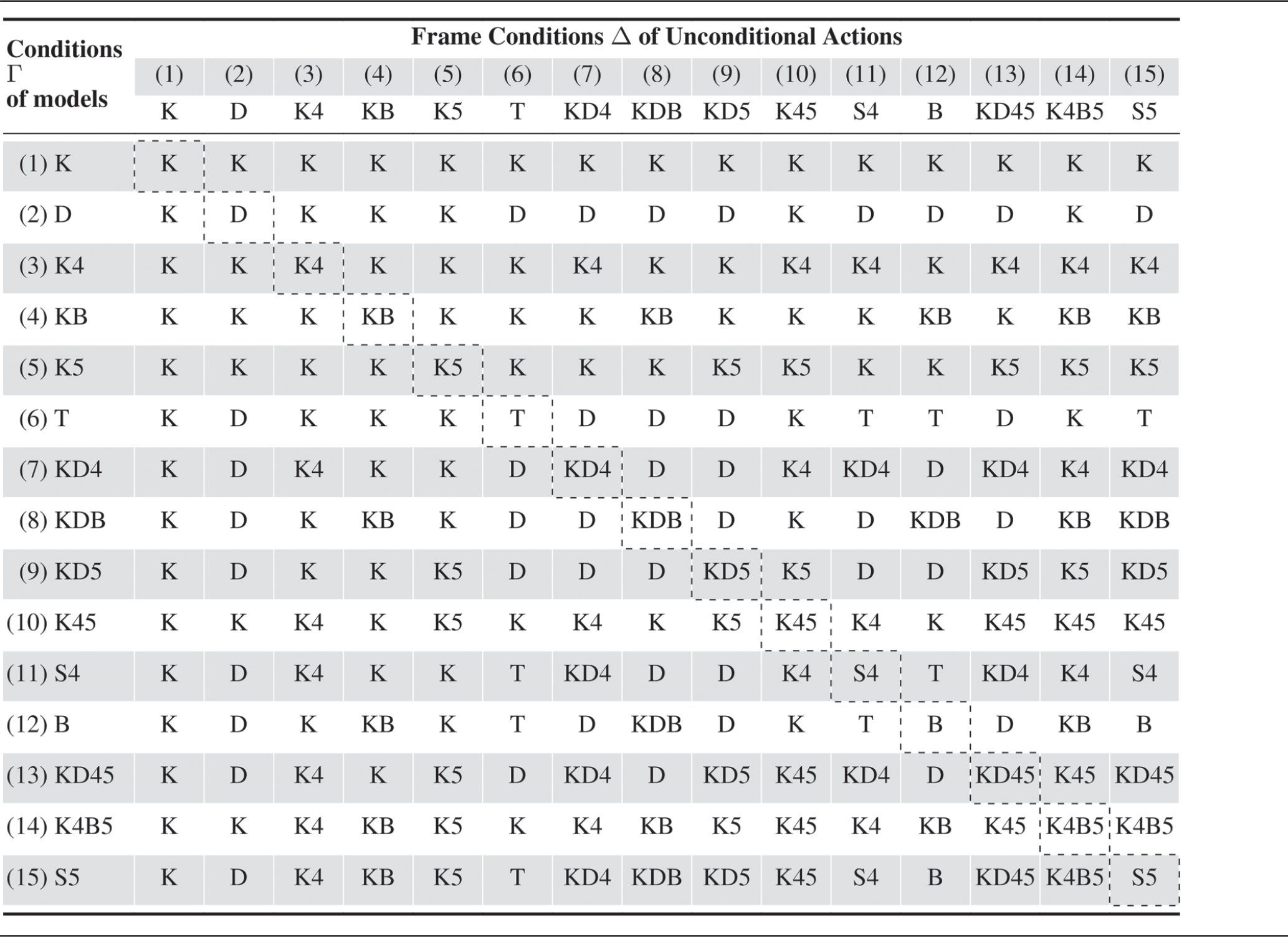
Given frame conditions For any model If
(a) Let
Statement (b) can be shown in a similar way to the proof of Lemma 5(b).
For any frame conditions
For any model
We now come to the preservation of group conditions. The result is presented in Theorems 18 and 19, and summarized in Tables 2 and 5.
Preservation of Transitive-Unionedness Under the Execution of Unconditional Actions (i.e., For Each
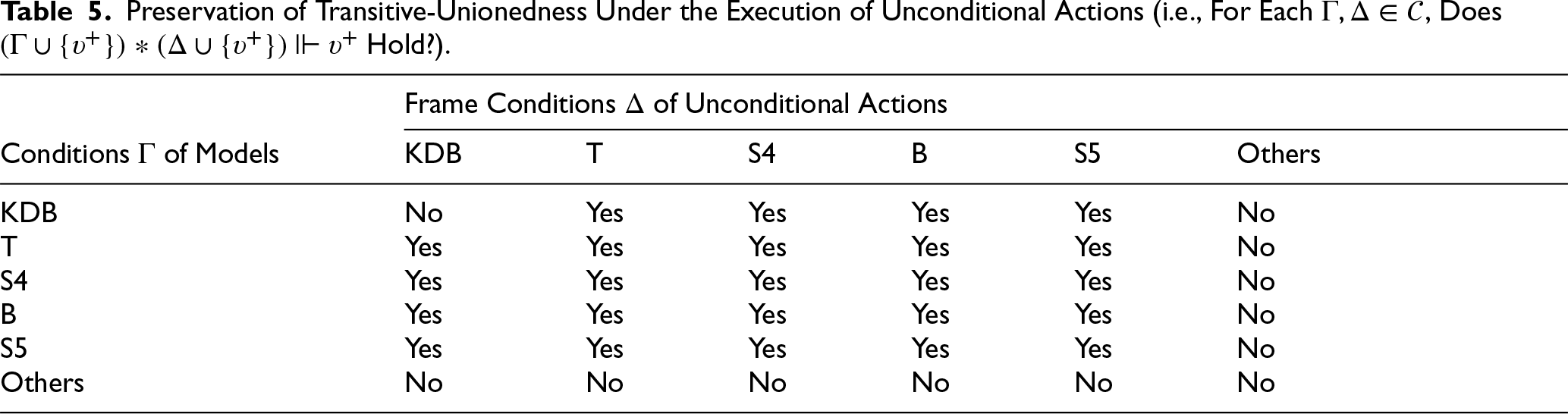
Let
(a) Suppose
(b) Given a model
(c) We start by similar argument to the proof of statement (b). We need to show
Statement (d) can be shown by similar argument to that of statement (c).
Intersectivity is preserved under unconditional actions. That is, for any model Unionedness is not preserved under unconditional actions. That is, for any
Statement (a) follows from Theorem 9(a) and Definition 12. For statement (b), we can reuse the proof of Theorem 9(b), where the action constructed is in fact an unconditional action, and the statement follows from Definition 12.
Given frame conditions If If If In all other cases,
Statements (a–c) follow from Lemmas 17(b–d), respectively. We show statement (d). The exceptions can be divided into the following subcases, by first negating the condition of statement (a):
(d1)
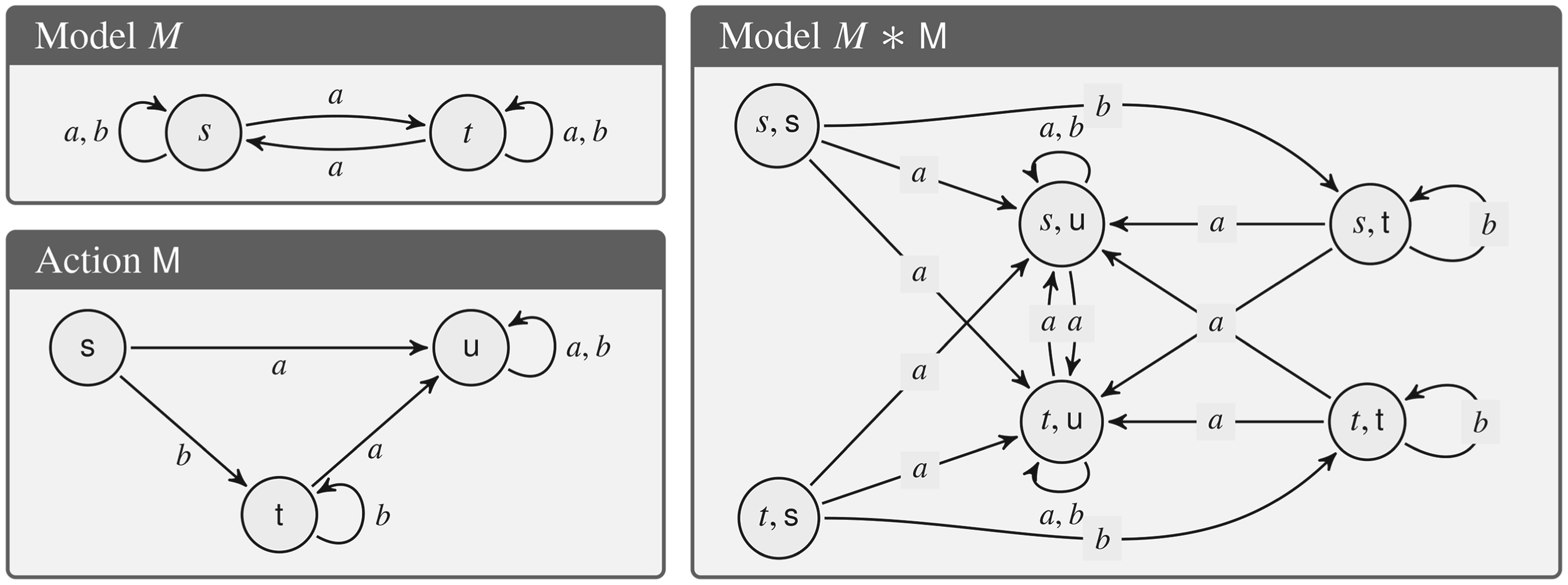
It can be verified that
Case for
(d2)
(d3)
This study has systematically explored frame and group conditions within the framework of action model logic (AML), yielding several key insights:
(a) Compatibility of frame conditions: Defining actions with frame conditions distinct from those of the model proves counterproductive, as the resulting model retains only the frame conditions shared by both. For example, when modeling knowledge with S5 frames, employing S5 action models is recommended to ensure consistency, aligning with established practices (van Ditmarsch et al., 2007).
(b) Preservation of frame conditions under action execution: Not all frame conditions persist under classical action execution. Seriality, in particular, is not preserved in frames lacking reflexivity. This to a certain extent supports the view that AML is better suited for epistemic logic, which typically assumes reflexivity (e.g., S4, S5), than for doxastic logic, which often relies on seriality without reflexivity (e.g., KD45). When modeling belief with KD45 frames, action execution yields only K45 properties, complicating the representation of belief dynamics. This is, of course, well-known in the dynamic epistemic logic community, having, e.g., been pointed out by Aucher (2008), and other types of models, such as plausibility models (Baltag & Smets, 2016), that to a certain extent avoids the problem have been introduced. Public announcements exhibit similar preservation limitations, whereas unconditional actions perform notably better, preserving exactly the frame conditions present before execution. However, this situation is a direct consequence of the fundamental assumption in dynamic epistemic logics that the new information (whether it is a public announcement or a partial observation of a more complex event) is automatically believed: if the agent can have consistent but wrong beliefs, it follows immediately that her beliefs might become inconsistent after receiving new (even potentially true) information, reflecting a situation where the agent has discovered that either her old beliefs were wrong or the new information is, or both. It is a classic problem in belief revision (Alchourrón et al., 1985) that accepting new truths without adjusting prior assumptions can create logical problems, and potential solutions include resolving inconsistencies syntactically (say, in the way of Alchourrón et al., 1985) or semantically (as in Lindqvist et al., 2023). The goal of this article has been to point out when and where such situations can occur, and when they can not.
(c) Preservation of group conditions under action execution: General actions align with group conditions tied to distributed belief but fail to preserve those associated with mutual or common belief. Unconditional actions show partial preservation of transitive-unionedness, though their overall preservation advantage remains modest. In contrast, public announcements demonstrate compatibility with mutual belief, highlighting a distinct preservation profile.
On one hand, AML excels in preserving most frame condition classes—particularly K, S4, and S5—under action execution, making it robust for certain epistemic contexts. However, challenges arise with frame conditions defined by existential formulas, such as seriality. Action execution retains successors only when they exist in both the original model and the action, forming a conjunctive requirement. Since existential quantifiers do not distribute over conjunctions, counterexamples emerge: a successor may exist in the model and another in the action, yet no single witness satisfies both, resulting in the loss of seriality post-execution. This issue extends to other epistemic frame conditions expressed existentially. For instance, the .2 axiom
Plenty of opportunities present themselves for future work. Regarding belief updates (say, for KD45 models and actions) and the problem with seriality discussed above, while the result of the execution of a KD45 action on a KD45 model might be a K45 model without seriality, reflecting a situation where the combination of an agent’s existing beliefs and the new information is inconsistent, this does not happen for all KD45 actions. An interesting question, then, is: are there any actions that always preserve seriality after action execution? We have in fact already seen a class of such actions: the unconditional actions (Section 4.2). However, their use is relatively limited. It would be interesting to find other subclasses that makes sense in modeling beliefs and belief revision. We can in fact point out one such (broader) class, which we can call coherent actions, that will ensure that beliefs are always consistent after action execution. Given a model
We can then observe that seriality is preserved under coherent actions—the following can be shown
9
: For any model For any sets
While this works technically, it is, first, somewhat unsatisfactory in the sense that coherence is a property not of an action but of an action relative to a given model—the same action might be coherent in one model but not in another. Second, the practical relevance of coherent actions is not immediately obvious, and we leave finding interesting and practically relevant classes of seriality-preserving actions, possibly including classes of coherent actions, for future work.
Conversely, taking “natural” classes of action models, such as different variants of (semi-)private announcements, as starting points and mapping out their preservation properties is also of interest for future work. Also of interest is looking at other, perhaps less standard, notions of group belief and knowledge, such as somebody-knows (Ågotnes & Wáng, 2021), cautious and bold distributed belief (Lindqvist et al., 2023, 2024) and graded distributed belief (Lorini & Rozplokhas, 2025), as well as at other types of belief models such as plausibility models (Baltag & Smets, 2016) or evidence models and topological models (Baltag et al., 2022; Moss & Parikh, 1992; Özgün, 2017).
Footnotes
Acknowledgments
The authors thank the anonymous reviewers for their valuable comments. They are particularly indebted to the reviewer who proposed extending their results to Horn clauses; this suggestion formed the basis for the first part of Section 3.2.

Funding
The authors disclosed receipt of the following financial support for the research, authorship, and/or publication of this article: The first and second authors acknowledge funding support from the MOE (China) Project of Humanities and Social Sciences (No. 24YJA72040002). The third author acknowledges support from Major Project of National Social Science Foundation of China (Grant No. 24&ZD227).
Conflicting Interests
The authors declared no potential conflicts of interest with respect to the research, authorship, and/or publication of this article.