




Abstract
Model-based reasoning has been a highly active and vital area of artificial intelligence research, utilizing logic and other formal approaches to detect and identify faults in various systems, ranging from ordinary hardware to software. European researchers have always been very active in this research community. In this paper, we outline and discuss these activities. In particular, we discuss the contributions of European researchers to the field, considering foundations, algorithms, and applications. We specifically identify subareas of model-based diagnosis that European researchers have strongly driven. Furthermore, we introduce facts and figures behind the research field, focusing on its flagship event, DX, where about two-thirds of all contributions come from authors with a European affiliation. In conclusion, the analysis reveals substantial contributions from European research, both qualitatively and quantitatively.
Introduction
Artificial intelligence (AI) has consistently developed methodologies and techniques that enable the automation of tasks such as scheduling, configuration, or diagnosis. These techniques, while theoretical, are of great practical interest, aiming to increase efficiency and reduce costs. In this paper, we discuss the historical perspective of a particular methodology, that is, model-based diagnosis. In particular, we focus on researchers affiliated with European universities and research institutions, as well as their contributions to the field. Although the basic concepts and ideas originate from the U.S. and Canada, as seen in Davis et al. (1982), Davis (1984), de Kleer and Williams (1987), Reiter (1987), and de Kleer et al. (1990), there has been substantial work by European researchers in this field over the past 30 years that warrants a detailed discussion.
The objective of the paper is to illustrate the vast impact of European research and justify it both qualitatively and quantitatively. For the former, we examine past papers of European researchers, which we define more strictly as those published by researchers affiliated with a European organization. The reason for this restriction is that it may not be possible to identify the nationality of a particular researcher, as some individuals hold more than one nationality. For those European researchers, we introduce their contributions categorized by modeling, algorithms, and application areas. For application areas, we have a particular focus on the application of model-based diagnosis to software fault localization, as European researchers have founded and driven this area for the past few decades. However, there are other areas, such as the automotive industry, where European researchers have made significant contributions. For characterizing and discussing the quantitative impact, we consider the leading scientific event of model-based diagnosis, that is, the International Workshop on Principles of Diagnosis (DX), which has been a conference since 2024 with a slightly modified name, that is, International Conference on Principles of Diagnosis and Resilient Systems, but keeping the same abbreviation.
To make the paper easily accessible to readers unfamiliar with the underlying concepts and ideas of model-based diagnosis, we further discuss the foundations and illustrate the basic ideas. For this purpose, we use a two-bulb electric circuit comprising a battery
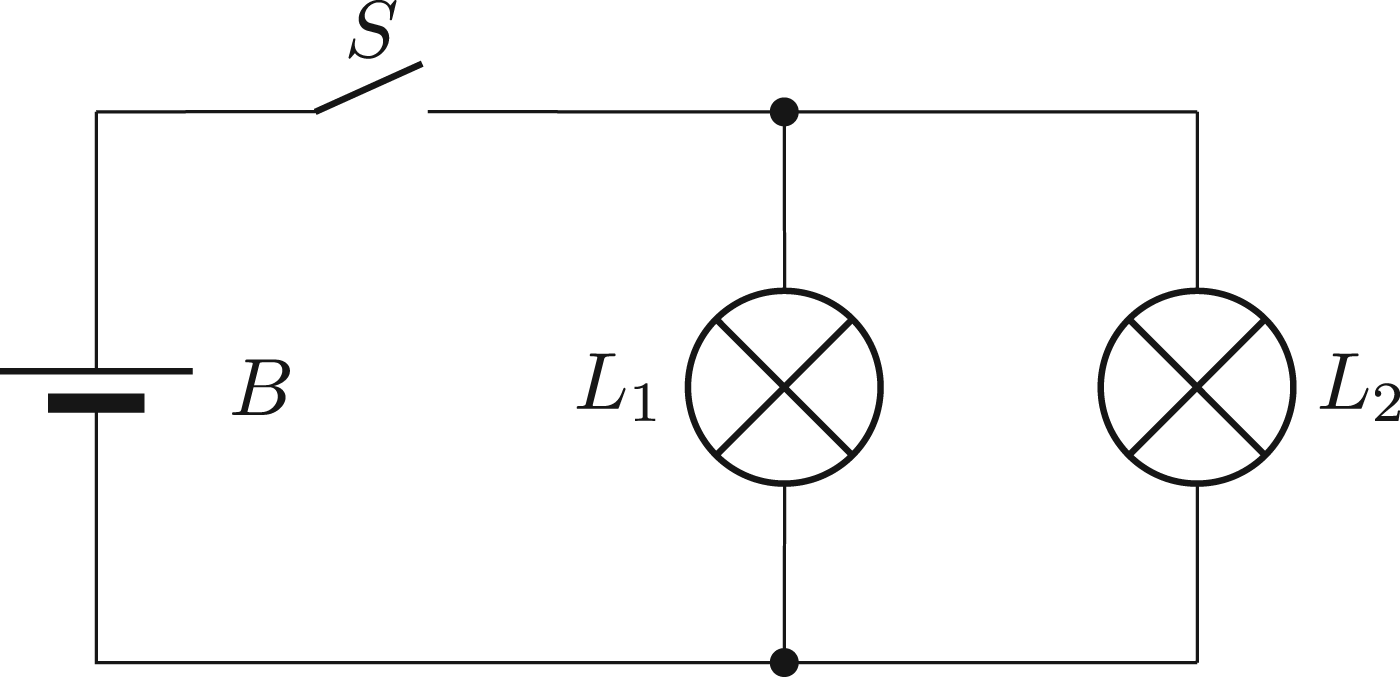
A simple electric circuit comprising bulbs, a switch, and a battery.
In contrast to other previous work on diagnosis, which mainly relies on explicitly representing diagnostic knowledge in the form of rules, model-based diagnosis relies on structure and behavior models of a system. Whereas classical rule-based systems, for example, Buchanan and Shortliffe (1984), Hooper (1988), Retti et al. (1987), and Jackson (1986), state knowledge used to infer root causes in the form “symptom
It is worth noting that rule-based systems, that is, expert systems, have been successfully used in industry. However, they also have some issues that cause higher maintenance costs. This includes the requirement to modify substantial parts of the ruleset for each system, as well as for each system change. In contrast, model-based reasoning enables the use of component models in arbitrary systems without modification. Hence, model-based diagnosis is a solution to the problem of higher maintenance costs associated with rule-based systems. Moreover, stating the behavior of components can be considered easier than deriving rules from symptoms to causes. Additionally, component-oriented models can be combined into reusable libraries that can be easily modified and adapted to new systems or devices, provided that they are based on context-independent modeling.
This paper extends our previous paper (Wotawa, 2024) that was published at the Workshop on the History of Artificial Intelligence in Europe. We substantially extended the paper by adding a more detailed discussion on the qualitative impact of European research and outlining the historical timeline of mainly European researchers on software fault localization based on models. The paper has a clear European focus, showcasing the pioneering activities of European researchers. Furthermore, the paper aims to highlight the significance and impact of European research in this field, providing a comparative and critical analysis. The paper also has limitations: (i) We focus purely on the classical model-based diagnosis area, which is well-represented considering the DX workshop series. There are other fields, which are also at least partially driven by European researchers dealing with model-based diagnosis, that is, process control, with their particular conferences. (ii) There have always been numerous publications at the leading AI conferences, such as IJCAI, AAAI, or ECAI, dealing with model-based diagnosis. Some of them have been discussed at DX workshops, but not all. Hence, the quantitative part may be too biased toward DX contributions. (iii) The paper’s qualitative content may also be biased because the paper does not rely on structured reviews, mapping studies, or similar methods. This is because the paper’s objective is to present European contributions in a reasonable manner. We hope that the paper serves as a starting point for further research, summarizing the contributions of an exciting scientific area that still has considerable potential for additional applications and theoretical developments.
We structure the paper as follows. We start outlining the basic definitions of model-based reasoning using the two-bulb circuit as an illustrative example in the foundations section. Afterward, we discuss the main contributions of European researchers in this field, focusing on modeling, algorithms, and application areas. Furthermore, we present the facts and figures of model-based research, focusing on the DX workshop and conference series, followed by a section that discusses the obtained findings, considering both qualitative and quantitative results. Finally, we give an overview of current European research in this field and conclude the paper.
In this section, we briefly outline the different methodologies of model-based diagnosis and use the two bulbs example from Figure 1 to illustrate the concepts. For more information and more recent papers introducing model-based diagnosis, we refer the interested reader to Wotawa (2019, 2020).
We start discussing consistency-based diagnosis and follow—more or less—Reiter’s basic definitions (see Reiter, 1987). Note that in the literature, consistency-based diagnosis is often referred to as model-based diagnosis. However, for clarity, we distinguish consistency-based diagnosis from abductive diagnosis in this paper.
For consistency-based diagnosis, we start by defining a diagnosis system, which comprises a set of components and a system description.
Diagnosis System
A tuple
For our running example from Figure 1, the diagnosis system
The components
The system description
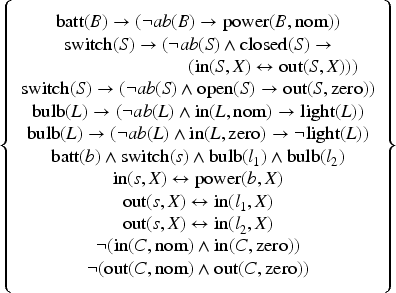
The first part describes the behavior of the components, specifically the battery, which, when functioning correctly, provides nominal power. If closed, the switch transfers the available power from the input to its output. If it is open, then there is no power at the output. If the bulb is working and has nominal power on its input, it will produce light. Otherwise, there is no light. The final part of the system description introduces the components and their interconnections.
When we have certain information, such as the switch is closed, but no bulb is lit, we are interested in the causes behind this unexpected behavior. In consistency-based diagnosis, we set the values of the
Diagnosis
Let
For example, let us assume the observations
Computing diagnoses can, in the simplest case, be done by selecting an arbitrary subset of
Conflict
Let
Note that theorem provers often can easily return conflicts. However, more recently, alternative approaches to working without conflict have been introduced. It is further worth noting that Greiner et al. (1989) corrected Reiter’s hitting-set algorithm. It is worth noting that the classical consistency-based modeling approach only considers the correct behavior of components. No behavior in case of a fault needs to be specified.
The second diagnosis methodology is abductive diagnosis, which originates from Poole (1989) and was strongly driven by European researchers. Friedrich et al. (1990a) introduced the concepts and ideas behind abductive diagnosis, illustrating its importance in light of the reasoning applied by doctors. Substantial contributions also come from Torasso and colleagues, for example, see Torasso et al. (1995).
We start by defining abductive diagnosis, considering a corresponding diagnosis system.
Abductive Diagnosis System
A pair
The idea behind abductive reasoning is to search for hypotheses that allow us to derive conclusions from given observations. Hence, a model
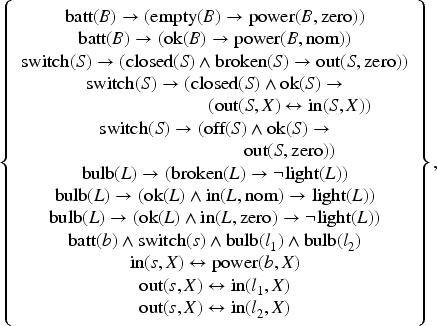

Note that in this model, we capture both the correct and the incorrect behavior. Moreover, we allow rules that are not in Horn clause form. In the original article by Friedrich et al., the authors rely on horn clauses and the formulation of faulty behavior.
We are now able to define abductive diagnosis as follows:
Abductive Diagnosis
Given an abductive diagnosis problem
An abductive diagnosis for the observation
Note that abductive diagnosis and consistency-based diagnosis share similarities and can be formally related. Console and colleagues (see Console et al., 1991; Console & Torasso, 1990) provided the foundations, essentially stating that introducing modeling of faulty behavior in consistency-based diagnosis enables the computation of the same diagnoses as abductive reasoning, and vice versa.
After discussing the basic foundations, we provide an overview of other contributions of European researchers to model-based diagnosis in the next section.
Contributions
We categorize the contributions into four parts: modeling, algorithms, ordinary applications, and software debugging. We decided to split the applications into two sections: a general discussion of ordinary applications of model-based diagnosis and software debugging. Model-based diagnosis initially focused on hardware fault detection and localization, rather than considering software. It is worth noting that the application of model-based diagnosis to software fault localization has also garnered attention in software engineering research, demonstrating its broader applicability. Of course, the intention is not to leave the impression that model-based diagnosis is the most prominent application of model-based diagnosis. On the contrary, there have always been more substantial contributions in other application areas. We focus on software fault localization because European researchers initiated it, and to provide one more detailed analysis of one application area. It may serve as a starting point for achieving similar results in other model-based diagnosis application areas.
For all four of the mentioned parts, we report substantial contributions of European researchers to the body of knowledge in model-based reasoning.
Modeling
Modeling for model-based diagnosis is not a simple task, which may be one reason for the not-so-widespread use of model-based diagnosis in applications. The quality of models determines the diagnostic capabilities, and therefore, developing the right models for specific systems is of utmost importance. This is particularly evident considering the model used for consistency-based diagnosis of the two-bulb circuit (as shown in Figure 1) introduced in Section 2. Let us take the model
Struss and Dressler (1989b) identified this problem and provided a solution. In particular, the authors suggested introducing fault modes with their corresponding models. For this example, adding a rule
Besides the work on improving modeling to avoid the computation of unexpected diagnoses, there have been substantial contributions to the use of abstraction for modeling. Obviously, the models used do not necessarily capture the real physical behavior of components and systems in terms of precise numbers of physical quantities. On the contrary, we want to have models that are abstract enough to guarantee a faster computation of diagnosis, but not compromise the quality of diagnosis, that is, not being able to distinguish between different important diagnoses or not identifying more or less potential root causes. Early work in this direction includes Gallanti et al. (1989), Struss (1991), and Mozetič (1991). The latter considers constructing models hierarchically to improve the overall diagnosis time. It is worth noting that the ideas have also been used by Canadian colleagues (Autio & Reiter, 1998), who came up with a formalized theory. The use of structural properties, such as hierarchies of models, has also been applied for diagnosing knowledge bases (see Felfernig et al., 2000b). Sachenbacher and Struss (2003, 2005) presented a more general theory of abstraction for diagnosis, aiming at finding abstractions of the data domain such that diagnoses can still be discriminated optimally. It is worth noting that we can distinguish structural abstraction from model abstraction. Whereas the former summarizes parts of the structure into supercomponents, the latter utilizes different abstractions of the domain to simplify the models. Mozetič (1991) and Autio and Reiter (1998) fall into the category of structural abstraction, whereas the other papers can be assigned to the class of model abstraction.
Another area of modeling where European researchers have dedicated a lot of activities and papers includes the use of finite automata and similar concepts for diagnosis. First work include Largouët and Cordier (2000). Rozé and Cordier (2002) presented an approach for diagnosing discrete event systems. Grastien et al. (2005) continued this work and provided an incremental diagnosis approach. Other works going in this direction include Pencolé and Cordier (2005), Guillou et al. (2008), Lamperti and Zanella (2002, 2003, 2006), and Lamperti et al. (2023, 2020).
Other papers deal with establishing relationships to other diagnosis methods, for example, Cordier et al. (2000) or Cordier et al. (2004), consider other characterizations of models, for example, diagnosability (Bertoglio et al., 2019; Gougam et al., 2017; Pencolé, 2004; Schumann & Pencolé, 2007; Zanella, 2017) or self-healability (Cordier et al., 2008), and integrate repair into diagnosis (Felfernig et al., 2013; Friedrich et al., 1992; Friedrich & Nejdl, 1992; Thiébaux et al., 2013). All these papers extend the understanding of the capabilities and the foundations of model-based diagnosis substantially leading to new ideas, contributions, and application areas.
Algorithms
At the beginning of model-based diagnosis, and in particular, consistency-based diagnosis, two algorithms have been considered. de Kleer and Williams (1987) utilized truth maintenance systems such as the ATMS (see de Kleer, 1986) for diagnosis, where European researchers such as Struss (1988) and Struss and Dressler (1989a) have contributed their extensions and improvements, making wrong observations subject to diagnosis as well as exploiting default reasoning to compute preferences in checking diagnostic hypotheses. The other algorithms have been based on the hitting-set computation from Reiter and colleagues (see Greiner et al., 1989; Reiter, 1987). Several European researchers suggested improvements of hitting-set algorithms, for example, Wotawa (2001b), Pill and Quaritsch (2015), and Felfernig et al. (2012). Fröhlich and Nejdl (1997) suggested another diagnosis algorithm that utilizes handling of assumptions during the diagnosis process more efficiently and provided an experimental evaluation.
More recently, researchers have provided algorithms that utilize theorem provers directly for computing diagnoses without the need for hitting-set computations, for example, Nica and Wotawa (2012), Felfernig et al. (2018), and Le et al. (2023). Those algorithms perform very well, showing that the improvement of SAT solving helps enable its use in other areas such as diagnosis. For a detailed comparison of several hitting sets and direct diagnosis algorithms, we refer to Nica et al. (2013). It is worth noting that, similarly, European researchers considered advanced reasoning methods such as disjunctive logic programming (Eiter et al., 1999) and later answer set programming (ASP) for diagnosis (Bayerkuhnlein & Wolter, 2024; Wotawa & Kaufmann, 2022).
Another category of diagnosis algorithms utilizes structural knowledge for diagnosis. Based on the work of Fattah and Dechter (1995), providing a diagnosis algorithm for tree-structured systems, Stumptner and Wotawa (1997, 2001) provided another algorithm for such systems, which provided a different optimization principle leading to improved results for several examples. Moreover, the authors also considered the application and provided further information on how to integrate such algorithms for system diagnosis (see Stumptner & Wotawa, 2003). Later, Sachenbacher and Williams (2004) showed that the algorithms of Fattah and Dechter and Stumptner and Wotawa can be generalized, considering diagnosis as a semiring-based constraint optimization problem.
Note that there are some tools available for implementing diagnosis algorithms. When utilizing ASP for diagnosis, there is clingo. 1 The original DLV system considered by Eiter et al. (1999) is also available. 2 Moreover, there is a Webpage 3 allowing the use of model-based diagnosis for restricted Java programs. Hence, there is no need to provide a separate model, but only a program and a test case.
Applications
European researchers have been making significant contributions to application-oriented work on model-based reasoning in various fields. In the following, we summarize some contributions in particular areas. It is worth noting that the discussion is somewhat limited and may not adequately acknowledge the significant contributions of European researchers to the application of model-based diagnosis, which has long been of great interest to them. This is particularly evident considering the European Union (EU) projects and initiatives mentioned in this paper.
We start with mobile and autonomous systems. Early work includes onboard diagnosis (OBD) for cars, for example, Malik and Struss (1996), Malik et al. (1996), Sachenbacher et al. (2000), Cascio et al. (1999), and Console et al. (2003). To bring these approaches into practice, some authors also provided papers dealing with the development process and required adaptations, for example, Milde et al. (2000) and Picardi et al. (2002). For a summary of work dealing with the application of model-based diagnosis in the automotive domain, we refer to Struss and Price (2004).
In autonomous systems, and in particular robotics, Hofbaur et al. (2007) introduced the use of model-based diagnosis to implement a smart control for mobile robots in case of faults. Other work includes Steinbauer and Wotawa (2009).
Another important application domain is infrastructure and, in particular, communication and other supply networks. Several papers described the application of model-based reasoning for telecommunication systems, for example, Rozé and Cordier (2002) and Pencolé and Cordier (2005). For power supply networks, the early work of Beschta et al. (1993), Pfau and Nejdl (1991), and Thiébaux et al. (2013) is worth mentioning.
European researchers have applied model-based reasoning to address environmental issues. Here, we mention pioneering work by Heller and Struss (1996, 1997, 1998). Struss (1998) discussed the importance of model-based reasoning for the environmental domain. It is worth noting that this application domain cannot be solved using component-oriented models and consistency-based diagnosis, because such systems do not comprise a fixed set of components in an invariant structure but consist of a set of interacting processes varying over time. Disturbances are usually not due to faults of the components involved, but to unexpected actors and interactions.
It is further worth noting that European research activities have always addressed real-world problems and applications and were funded by the European Union, for example, diagnosis of gas turbines (EU projects TIGER and SHEBA), vehicle model-based diagnosis, which involved major European car companies and led to OBD on real cars that was demonstrated at IJCAI-99, and IDD, which promoted diagnosis integration into the design process. Moreover, work on OBD for trucks was promoted in Sweden (see Pernestål et al., 2012). Another area of applications includes work on the automated generation of failure-mode-and-effects analysis (FMEA) tables. FMEAs are very important, especially in the context of safety-critical systems. The AUTAS project aimed to develop a model-based FMEA, involving several aerospace companies. Similar work includes AutoSteve (see Price, 1997), an FMEA tool developed by the University of Aberystwyth, which was deployed at Ford and Jaguar.
For more information regarding foundations behind applications and the applications of model-based diagnosis, we refer the interested reader to Struss (2008). In this chapter, Peter Struss discusses all details of modeling, the principles behind application scenarios, and the applications themselves.
Model-Based Software Debugging
Software debugging, for example, the detection, localization, and correction of faults (or bugs) in programs, has always been a difficult task in software development. Until today, debugging has been carried out manually with little tool support. In many cases, printf or any other means for obtaining observations from program executions are the main tools of support. Because manual debugging is costly, (partial) automation of debugging has been a topic of research for a long time, starting with Shapiro (1983) and Weiser (1982, 1984). In this section, we discuss the use of model-based diagnosis for locating bugs in programs, which is not that straightforward. The original idea of model-based diagnosis is to use an
The first paper dealing with the application of model-based diagnosis to debugging was Console et al. (1993). In this paper, the authors focus on logic programs, similar to the original work of Shapiro (1983), which can be seen as the starting point of the research field of automated and algorithmic debugging. Console et al. (1993) showed that model-based diagnosis improves (Shapiro, 1983). It is worth noting that authors from Canada, that is, Bond and Pagurek (1994) and Bond (1994), improved the work of Console et al. (1993). Independent of Console et al. (1993), there is other research work utilizing model-based diagnosis for software fault localization. In 1994, Liver (1994) proposed manually constructed models to be used for debugging. This work differs from the original work of Console et al. (1993) in that the original paper utilizes the programs directly and in an automated manner for locating faults. Whereas Liver (1994) requires the formulation of some specification knowledge to obtain a logical model.
It is worth noting that Console et al. (1993) provide the basis for utilizing debuggers of knowledge-based systems. Felfernig et al. (2000a, 2004) used similar ideas to come up with a model-based approach for fault localization in configuration knowledge bases. Later Felfernig et al. (2009) improved the work by also considering repair, in addition to fault localization. Shchekotykhin et al. (2012) reported on the debugging of general ontologies. Besides logic programs, several papers have demonstrated the applicability of model-based diagnosis for various programming languages and paradigms. Stumptner and Wotawa (1999) demonstrated that these techniques can be applied to functional programs. In Stumpter and Wotawa’s paper, the authors illustrate the basic foundations using a simplified functional programming language. To our knowledge, no further research has been conducted in this direction. This is different in the case of imperative programming languages, that is, programming languages comprising assignments and a program flow. Mateis et al. (2000) and Mayer et al. (2002a, 2002b) applied model-based diagnosis to a subset of Java. The models consider statements and expressions, and use a constraint representation for formalizing the models. There is more recent work by Wotawa et al. (2012). In contrast to previous work, which models loops as a single component where the behavior is defined by its condition and subblock, the latest models utilize techniques from compiler construction, that is, the static single assignment form, for modeling. Such a representation is appealing because it only requires simplified conditional and assignment statements.
Besides classical imperative programming languages, there is also plenty of work considering hardware description languages such as VHDL or Verilog for debugging automation, see Friedrich et al. (1996, 1999), Wotawa (2002a), Peischl and Wotawa (2006), and Peischl et al. (2008). The authors provided different models, ranging from simple dependency-based to more complex constraint models, which capture the sequential and concurrent behavior of hardware description language programs.
Most recently, model-based diagnosis has also been applied to niche programming languages. Abreu et al. (2015) and Jannach et al. (2019) utilized constraints for modeling spreadsheets to be used for fault location. Spreadsheets are of particular interest because their underlying syntax and semantics remain relatively stable. Moreover, such languages are examples of end-user programming languages, that is, languages used by users who are typically not educated in program development. Hence, any debugging support is highly recommended.
It is worth noting that there is also work on combining model-based reasoning models, for example, Hofer et al. (2017), or combining debugging methods, for example, Hofer and Wotawa (2012), and also to establish connections to other debugging approaches such as program mutations (see Wotawa, 2001a) or program slicing (Wotawa, 2002b). The latter is particularly interesting because it shows that abstract models considering data dependencies provide the same solutions as static program slicing for debugging. Challenges such as the handling of loops utilizing program abstraction were also addressed (Mayer & Stumptner, 2004).
Note that software engineering also recognizes the use of model-based diagnosis in software debugging. Wong et al. (2016) provided a survey on different techniques and methodologies for debugging. The survey reveals that papers dealing with model-based diagnosis account for almost the same percentage of papers as program slicing (i.e., 19% vs. 20%), both of which are surpassed by spectrum-based fault localization, which has a share of 35% of the papers. Hence, model-based debugging is an essential subfield of software fault localization with mainly European contributions. In Figure 2, we summarize the most important contributions to model-based debugging over time, distinguishing programming languages and affiliation of authors. It is worth noting that most of the reported research work on model-based debugging has been funded by national funding authorities, that is, the Austrian Science Fund (FWF) in the case of Austria.
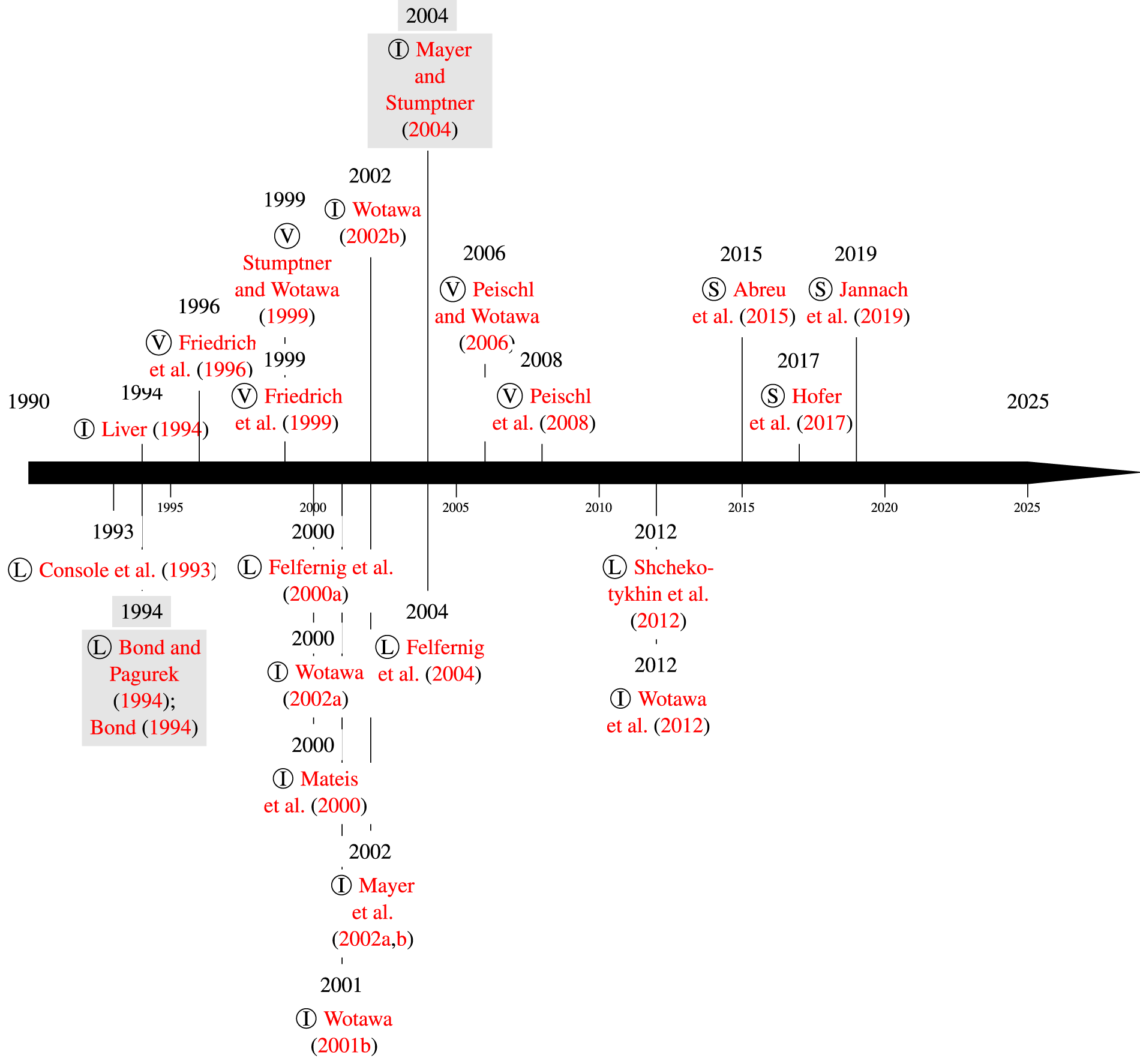
The history of model-based software debugging. We distinguish the programming languages (L…Logic, V…VHDL or Verilog (hardware description languages), F…functional, I…imperative, S…spreadsheets) and mark non-European authorships in gray.
After discussing the qualitative impact of European researchers on model-based diagnosis, we focus on the quantitative aspects in this section. For this purpose, we consider the main event for the exchange of ideas, methods, algorithms, and applications of model-based diagnosis, which is the International Workshop on Principles of Diagnosis that the community abbreviates as DX. The workshop series started in 1989 in Paris, France, which is also an indicator of the importance of European researchers in this domain. It is worth noting that the Paris workshop is considered the 0th event and not the first. The first official DX workshop was in Stanford, California, one year later.
DX workshops have been carried out on an annual basis without exception. In 2020, the year the COVID-19 pandemic began, the DX workshop was conducted online rather than in person. Table 1 shows all DX workshops from the beginning of the DX workshop series. There, DX-20 has the location USA because of the original intention and the affiliation of the main organizers. Originally, DX workshops had no formal organizational structure until 2023, when a steering committee was introduced. Before the workshop, participants selected the next location in a business meeting during the event. The task of the steering committee, currently headed by Ingo Pill, includes selecting the next locations and professionalizing the organization. A first step in this direction was taken in 2024 when the steering committee changed DX to a conference and also its name to the International Conference on Principles of Diagnosis and Resilient Systems, retaining the abbreviation. In addition, it was decided to make the proceedings formal and publicly available. Before the DX proceedings were considered, workshop notes mainly limited availability to the DX participants. 4
The DX Workshops and Their Locations. Note that in 2024, DX Changed its Name to the International Conference on Principles of Diagnosis and Resilient Systems.
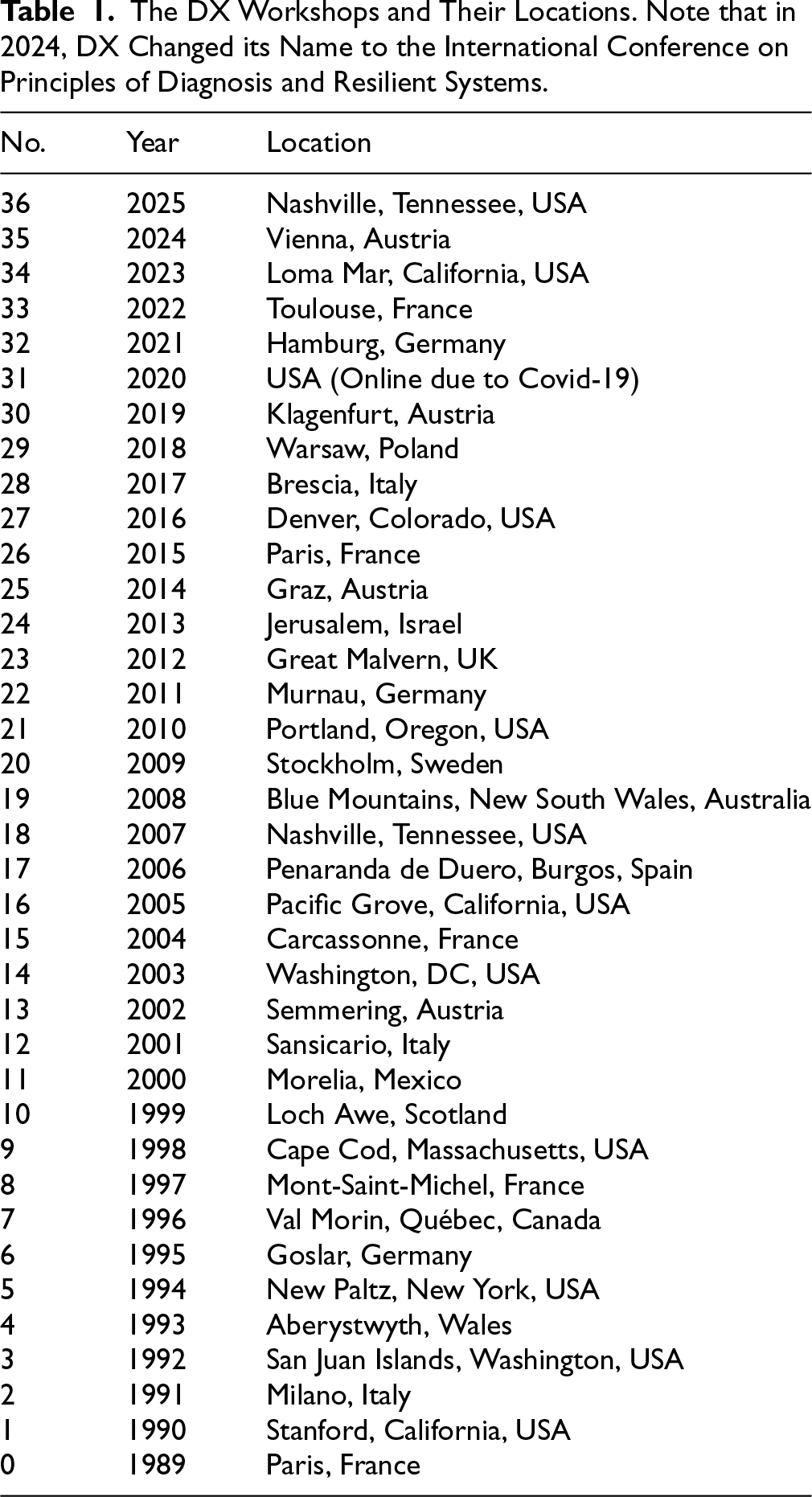
The DX Workshops and Their Locations. Note that in 2024, DX Changed its Name to the International Conference on Principles of Diagnosis and Resilient Systems.
Of the 36 DX workshops/conferences, 20 took place in Europe, 12 in the USA, and four in other locations. More than 50% of the workshops have been carried out in Europe, whereas only one-third have been in the USA. Hence, it seems that more European researchers are available to organize the community’s workshops and conferences. This European dominance is also visible in the current steering committee of DX, comprising Ingo Pill (Austria) as the head, and the following members in alphabetical order: Gautam Biswas (USA), Johan de Kleer (USA), Meir Kalech (Israel), Oliver Niggemann (Germany), Louise Travé-Massuyès (France), Franz Wotawa (Austria), Marina Zanella (Italy), where five out of eight members are from Europe. Although these figures indicate a dominance of European researchers in the domain of model-based diagnosis, the question is whether this dominance is justified. For this purpose, we analyze the distributions of contributions of authors with a European affiliation at DX. The supremacy of European authors would explain the influence on the organization of the DX series and also highlight the importance of European research in this domain.
For analyzing the contributions of researchers to DX according to their affiliation, 5 we counted the published papers in the proceedings, where we do not distinguish regular papers, poster papers, tool papers, or similar paper types. We do not consider invited talks with corresponding papers. The reason for not distinguishing between different paper categories is that for some DX events, no indication of paper type is given. Unfortunately, not all proceedings are available anymore. Before 1996, web pages were not used. Several web pages are no longer available, and not all papers are available from existing web pages. Hence, in several cases, it was necessary to consult the list of accepted papers or the workshop schedule to identify the authors. Because in many instances such lists do not include affiliations, the mapping of the countries was done using available information and experience. Hence, in these cases, the reported results might not be accurate. However, we expect only minor deviations.
In Table 2, we summarize the obtained findings. For the years for which we do not have direct access to the papers, we indicate inaccuracies using a (*). It is worth noting that we utilized the Internet Archive Wayback Machine (https://web.archive.org) and links to the DX workshops when the original web pages were no longer accessible. Unfortunately, we were unable to locate all the requested information. Therefore, the table is not complete, and further investigations are necessary. However, we do not expect significant deviations for the missing years.
Number of Papers and Percentage of Contributions of European and Other Researchers Over the Years. Note That not all Proceedings Were Available. A (*) in a Year Indicates That the Analysis was Carried out Using Only a Table of Authors and not the Paper to Verify the Authors’ Affiliations.
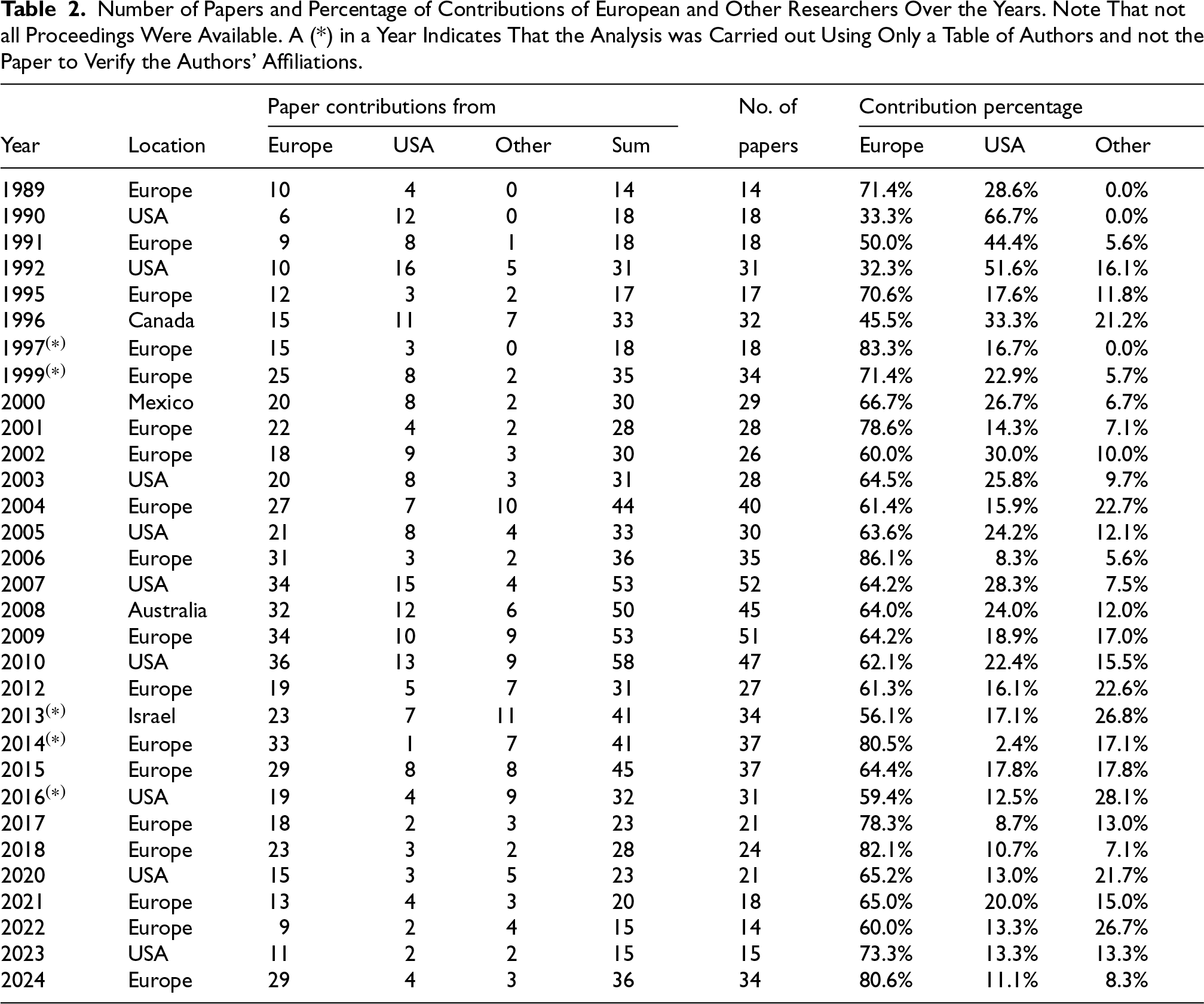
The counting of contributions reported in Table 2 based on affiliation was performed as follows. Whenever there were authors from Europe, the USA, or other countries outside Europe and the USA, we counted them separately. In such a case, a paper is assigned to all contributing countries, not just one. This is the reason why the sum of paper contributions is larger or equivalent to the number of papers published at a particular DX workshop or conference. The table also includes the contributions as a percentage, considering the sum of contributions rather than the number of published papers, to ensure that the sum of percentages equals 100.
What we see from Table 2 is the following: The number of papers and, straightforwardly, the contribution percentage of researchers with European affiliation is, with three exceptions, higher than that from the USA or other countries. This is clearly visible in Figure 3, which depicts the histogram of the contribution percentage for all workshops. There are only three workshops (1990, 1992, and 1996) where contributions from European researchers do not reach 50%. On average, European researchers account for 67.4% contributions, which is slightly more than two-thirds. There is an influence on the DX location on the number of contributions. If the DX workshop or conference were in Europe, the average contribution percentage is 70.2%. If the location were elsewhere, this percentage drops to 57.7%. Such figures are reasonable because visiting scientific events for European researchers is more costly for events outside Europe due to travel expenses.
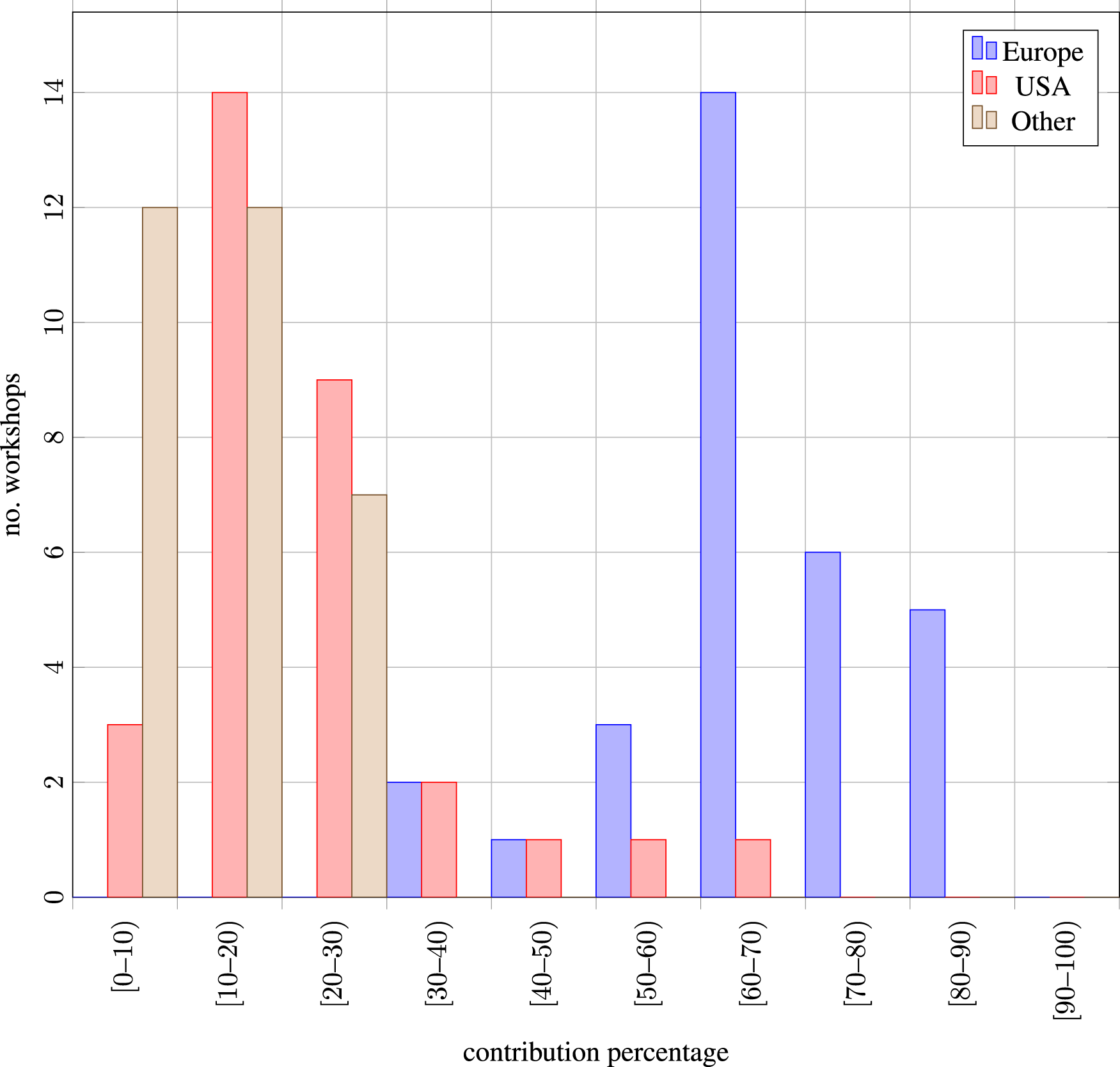
Histogram of the contribution percentage of researchers with a European, US, or other affiliation.
Hence, researchers with a European affiliation consistently make up the majority of contributions published at DX workshops and conferences after 2000.
Besides the European perspective, it is also of interest to examine the performance of the DX workshops/conferences series, as measured by the number of accepted papers. The DX community has consistently been an active participant in research on AI and, in particular, knowledge-based systems. Due to its specialized nature, there is only a fraction of researchers from AI working on diagnosis methodologies. In the past, the number of papers presented at DX has ranged from 14 to 52. Figure 4, which depicts the number of papers presented over the years, shows a consistent time span from 2007 to 2010, with 45 to 52 papers always being presented. Afterwards, there has been a decline, and the papers dropped to 14, making DX a smaller event. However, with the changes to DX becoming a conference in 2024 with formal proceedings and an extended scope, we see an increased number of papers again. From a philosophical perspective, such a rise and a decline of scientific fields seems to be a possible explanation (Kuhn, 1962), considering that a particular methodology may not be able to solve all challenges, causing researchers to change paradigms and scientific topics. Another aspect worth discussing is the fact that researchers working in a field retire without providing enough offspring to keep the field operational. Moreover, the peak of papers between 2007 and 2010 might also have been caused by other factors, such as the availability of funding during this time span or earlier, which could have led to an increase in research interest.
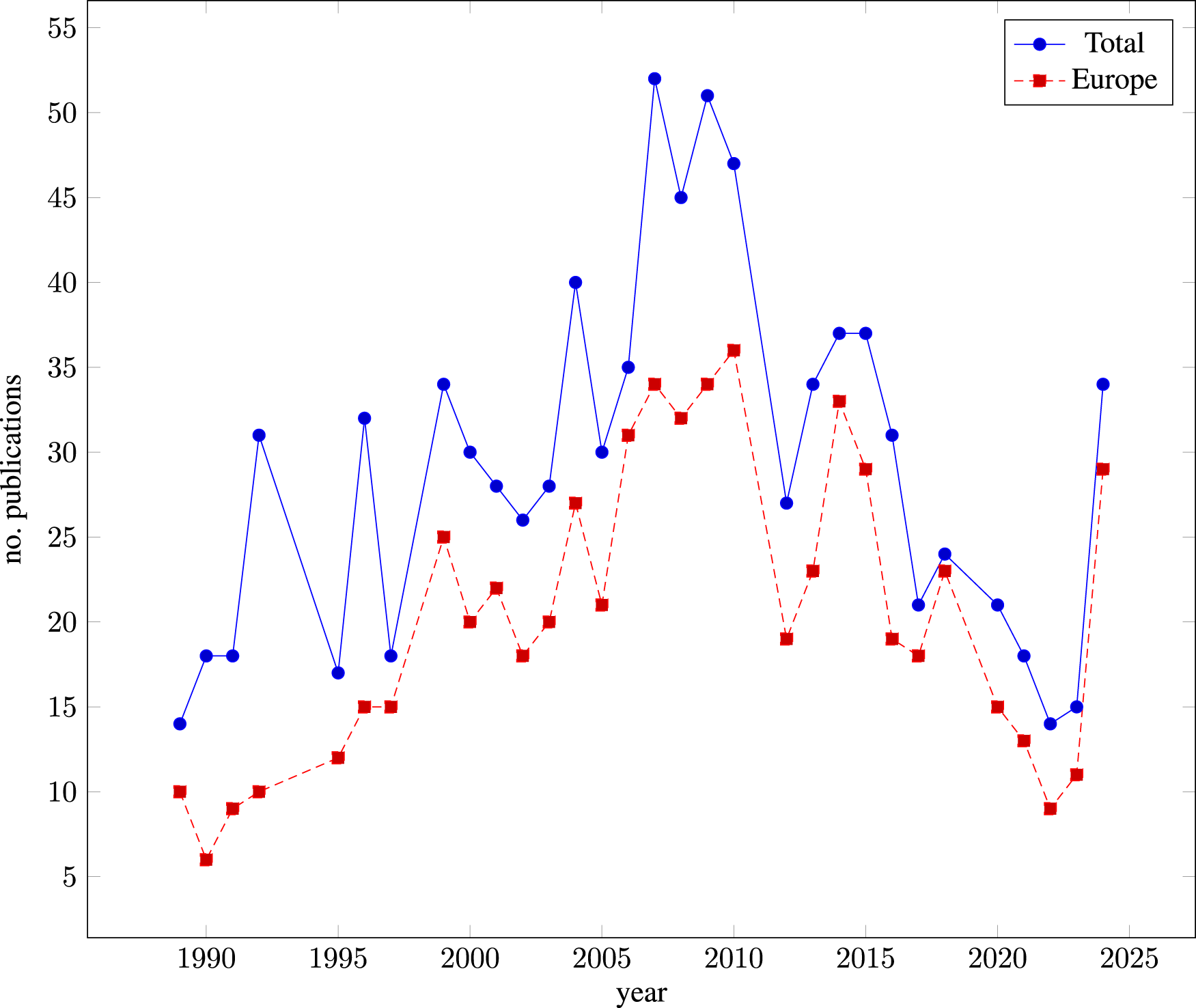
The total number of papers (regular papers, poster presentation papers, and tool papers) and the papers of European researchers published at DX over the years.
Indeed, several projects were funded by the European Union at the end of the last century and the beginning of the new one. The largest funded network aiming at bringing together (mainly) European researchers and practitioners interested in model-based reasoning was Monet (1997 to the end of 2000), followed by its successor Monet2 (2003 to 2005). Both projects were carried out successfully. Both networks ultimately had more than 80 organizational members, with almost 25% industrial participation. Monet2 developed an infrastructure repository (Multimedia Information Repository) containing more than 2,380 publication records and 500 PDFs, which was a valuable resource but is unfortunately no longer available. Both networks facilitated numerous collaborations among European researchers in model-based diagnosis, resulting in numerous project applications and funded research projects. In addition, Monet2 conducted annual Summer Schools on Model-based reasoning, which helped attract young researchers to the field. The effect, to some extent, is also visible in the number of papers published at DX, where there is an average increase in European contributions from 2000 to 2010, followed by a decline until 2023, and then another increase in 2024.
From the discussions in the previous part, we can summarize the following findings: Researchers with a European Affiliation have a big share of valuable contributions to model-based diagnosis. This is particularly evident considering the number of articles published at the DX workshop/conference series, where European researchers account for approximately two-thirds of all published and peer-reviewed papers. Many of these papers have also been published at the leading AI conferences such as IJCAI, AAAI, or ECAI. In addition, this paper also discusses the importance of European contributions to model-based diagnosis. The contributions include essential work in the subarea of modeling (e.g., considering fault models and physical impossibilities or integrating diagnosis and repair), algorithms (e.g., novel diagnosis algorithm with improved overall performance), and application areas (e.g., work in the automotive domain and software debugging). In summary, European researchers contributed substantially both quantitatively and qualitatively. Given the discussion in the preceding item and considering the mentioned publications, it is evident that several European researchers have significantly contributed to shaping the research field of model-based diagnosis. There are research areas in model-based diagnosis that European research activities have driven mainly. One important subarea is Bridge, which we have not discussed in detail in this paper. It was part of MONEET 2 and aimed at bringing together model-based diagnosis and diagnosis driven mainly by control engineering (called fault diagnosis and identification, which exploits numerical models). Here, research work includes providing foundations and a new modeling paradigm. Another subarea is debugging, that is, fault detection, localization, and repair of software. For debugging, European researchers suggested the use of model-based reasoning and also provided most of the papers dealing with various programming languages and paradigms. Although there have been successful projects, the impact of research in model-based diagnosis on real-world applications is limited. There have been companies founded that provide valuable contributions to practice. However, the use is—more or less—restricted to niches, which might always be the case for diagnosis applications. This is not a significant problem because diagnosis itself is a niche task primarily carried out by maintenance personnel or medical doctors, with exceptions such as on-board diagnostics or self-healing systems. It is also worth mentioning that there might be method-related reasons for preventing widespread use and practical applications. In model-based diagnosis, we require a model, but modeling is difficult, time-consuming, and costly. Hence, there is a need to support modeling and integrate it into development processes. Indeed, projects such as Monet and Monet2, as well as others, provided initial discussions on these topics. For example, in Monet2, subgroups address application areas such as the automotive industry, also suggesting a way to overcome the problems mentioned earlier. The availability and access to knowledge on the World Wide Web are strongly influenced by time. Many information resources are no longer accessible. Even projects such as the Internet Archive WayBack Machine provide only incomplete information. Hence, there is a need for open archives that ideally exist for an extended period to provide services similar to those of official libraries.
Hence, from the available information outlined in this paper, it is evident that European research contributed substantially to the model-based diagnosis. From personal experience, we can state that research funding is essential, including European Union-funded projects such as Monet and Monet2, but also national funding. Without the latter, work on applying model-based diagnosis to fault localization in programs has hardly been carried out as efficiently. It is also important to mention that the national funding in the case of Austria relies on applications without specific calls and is devoted to foundational research. Such bottom-up funding is essential for establishing new research fields, such as model-based debugging. Top-down funding, such as most of the funding provided by the European Union, is less suitable because novel research areas are often not identified until after calls for applications are developed. However, top-down funding is a good choice for promoting promising research fields and bringing research closer to industrial applications. The stability of funding and the European university system, where professors have the freedom to conduct research and access resources that do not depend on external funding applications, have a positive impact on research. This is also evident in the provided data for model-based diagnosis, where many contributions have come from similar groups over the past 30 years. This is also true for the USA and other countries whenever such stability can be achieved.
It is worth noting that the presented view on model-based diagnosis is a subjective one that does not encompass all areas and publications related to model-based diagnosis. Due to the limited availability of information, there are also some uncertainties associated with the given figures and statistics. However, in any case, we do not believe that these uncertainties have a severe impact on the findings obtained and discussed in this paper.
Conclusions
In this paper, we summarize the contributions of European researchers working on foundations and applications of model-based diagnosis, which has always been an essential subfield of AI. The discussed content provides evidence that the European research community has provided many new insights into the body of knowledge on model-based diagnosis, both from a qualitative and quantitative perspective. For the former, we discuss the main contributions of European researchers over more than 40 years. For the latter, we considered the paper statistics of the flagship event in model-based diagnosis, namely the International Workshop on Principles of Diagnosis (DX), which was renamed in 2024 to the International Conference on Principles of Diagnosis and Resilient Systems, with formal proceedings. Furthermore, we discussed the research area of software debugging based on models, such as one example, in more detail, showing that it is dominated by European research. Furthermore, we discussed some reasons behind the success of European researchers in model-based diagnosis, and we provide a summary of the obtained findings. Future research should close existing gaps, that is, by improving statistics and analysis to strengthen the conclusions obtained, and consider the relationships among European researchers working in model-based diagnosis in greater detail, for example, to identify common successors, dependencies, and collaborators. This paper may serve as a starting point for such further historical analysis of an important research field.
Footnotes

Funding
The author disclosed receipt of the following financial support for the research, authorship, and/or publication of this article: The work described in this paper is funded by the FWF Cluster of Excellence Bilateral AI under contract number 10.55776/COE12.
Declaration of Conflicting Interests
The author declared no potential conflicts of interest with respect to the research, authorship, and/or publication of this article.