Rational closure, as introduced by Lehmann or via Pearl’s system Z, exhibits desirable characteristics of nonmonotonic inference relations. The property (RC Extension), formalizing that an inductive inference operator extends rational closure, has recently been investigated for basic defeasible entailment relations. In this article, we explore (RC Extension) for more general classes of inference relations. We semantically characterize (RC Extension) for preferential inference relations in general by a specific type of preferential models. Then we focus on operators that can be represented with strict partial orders (SPOs) on possible worlds and characterize SPO-representable inductive inference operators. We show that for SPO-representable inference operators, (RC Extension) is semantically characterized by refinements of the Z-rank relation on possible worlds. Finally, we explore several examples of inference operators satisfying (RC Extension) and their interrelationships.
Research in the field of non-monotonic reasoning often deals with inferences that can be drawn from a set of given defeasible rules. The resulting inference relations are then assessed in terms of broadly accepted axiomatic properties, like system P (Kraus et al., 1990). Beyond the inference relations, the seminal papers (Lehmann, 1989; Pearl, 1990) put the role of the belief base into the focus of reasoning methods, proposing closure operations for reasoning from defeasible rule bases that have inspired many other works on non-monotonic reasoning since then. In particular, rational closure (RC) (Lehmann, 1989) (or equivalently system Z (Pearl, 1990)) is an inductive inference operator that can be characterized by a certain closure of a belief base under system P and rational monotony (RM) (Kraus et al., 1990; Makinson & Gärdenfors, 1989) and exhibit desirable properties.
Every inference relation satisfying system P and (RM) is induced by a ranked model (or equivalently by a total preorder (TPO) on worlds) (Lehmann & Magidor, 1992). An inference relation satisfying system P is called preferential and is induced by a preferential model (Kraus et al., 1990). Obviously, preferential models are more general than ranked models as they can also represent inference relations not complying with (RM).
Both system P and (RM) have their benefits and drawbacks:
System P is generally seen as a kind of gold standard which a non-monotonic inference relation should fulfill. However, inference only with the axioms of system P (p-entailment) is very skeptical because it takes all preferential models of a belief base into account. Therefore, system P on its own is often perceived to be too weak for drawing informative inferences.
If , the postulate (RM) licences the entailment for every as long as from we cannot defeasibly entail the negation of . Therefore, because no other condition on is required, (RM) is often perceived to be too strong.
Thus, one would expect inference operators to comply with system P while possibly licensing additional conditional entailments. However, the additional entailments should be restricted to defeasible inferences and should avoid adding inferences of the form . Note that causes all models of to be completely infeasible, thus expressing that is not a defeasible but a strict belief. The postulate (Classic Preservation) (Casini et al., 2019) requires that the inductive inference operator licenses an entailment of the form only if , that is, if it is a p-entailment.
The postulate (RC Extension) (Casini et al., 2019) restricts the closure under (RM) to the belief base and thus makes a difference between beliefs explicitly given in and implicit beliefs derived from by nonmonotonic entailment. This distinction between explicit and implicit beliefs perfectly fits the basic idea of inductive inference operators (Kern-Isberner et al., 2020), which map a belief base to a complete inference relation induced by . Inference relations satisfying (RM), classic preservation (CP), and (RC Extension) can be semantically characterized by ranked models that are rank preserving with respect to the Z-ranking (Casini et al., 2019).
In this article, we explore the field of inference relations involving system P respectively (RM) as limiting characterizations, and extend the work started in Casini et al. (2019) by dropping the rather strong requirement of (RM). Instead, we consider more general classes of so-called RCP inductive inference operators, that is, inductive inference operators satisfying (RC Extension) and (Classic Preservation). For RCP inductive inference operators that satisfy system P (RCP preferential inductive inference operators) we show that these are characterized by Z-rank refining preferential models, where Z-rank refining is a newly introduced adaption of rank preserving to preferential models. The intuition of Z-rank refining is that the preferential model respects and possibly refines the structure on worlds that is induced by Z-ranking functions .
While preferential models are more general than TPOs, they are also more complex. Between the class of preferential inference relations and the class of inference relations induced by TPOs there is the class of inductive inference operators induced by strict partial orders (SPOs) on worlds. SPOs on worlds are more expressive than TPOs but less complex than preferential models: for example, for signatures of size there are 75 TPOs, 219 SPOs, and 485 (non-equivalent) preferential models on the four -worlds (Beierle & Haldimann, 2022; Beierle et al., 2021b, 2023). Thus, to fill the gap between TPOs and preferential models we also consider the class of RCP inductive inference operators induced by SPOs on worlds, called RCP SPO-representable inductive inference operators. We show that RCP SPO-representable inductive inference operators are characterized by Z-rank refining SPOs on worlds. Furthermore, we investigate inference relations induced by SPOs on formulas and show that such inductive inference operators satisfy RCP if they are based on Z-rank refining SPOs on formulas. Thus, our work extends (Casini et al., 2019) in different directions, in particular by providing characterization theorems for different classes of RCP inductive inference operators.
Finally, we illustrate the characterization results of this article by applying them to multiple inference operators from the literature that extend (RC); this includes system W (Komo & Beierle, 2020, 2022), some of its approximations (Haldimann & Beierle, 2023), and the closure of relevant closure (Casini et al., 2014) under system P. By applying the results of this article to these inference operators, we obtain some interesting insights into their semantic properties. To summarize, the main contributions of this article are:
A characterization theorem showing that RCP preferential inductive inference operators can be characterized by Z-rank refining preferential models.
Introduction of the class of SPO-representable inductive inference operators, which prove to be central within a map of inductive inference operators.
A characterization theorem showing that RCP SPO-representable inductive inference operators can be characterized by Z-rank refining SPOs on formulas.
Illustration of the characterization results by applying them to RCP preferential and RCP SPO-representable inductive inference operators from literature.
This article is a revised and largely extended version of our conference paper presented at the 18th Edition of the European Conference on Logics in Artificial Intelligence (JELIA 2023) (Haldimann et al., 2023b). In particular, we added full proofs for all propositions and theorems that were not part of the conference paper. Furthermore, we added Section 7 that explores different RCP inductive inference operators from literature.
After recalling preliminaries of conditional logic (Section 2) and non-monotonic reasoning (Section 3), we introduce RCP preferential and SPO representable inductive inference operators (Section 4 and 5) and prove corresponding characterizations in Section 6. In Section 7 we apply our results to examples of RCP inductive inference operators from the literature before we conclude and point out future work in Section 8.
Conditional Logic
A (propositional) signature is a finite set of propositional variables. Assuming an underlying signature , we denote the resulting propositional language by . Usually, we denote elements of signatures with lowercase letters and formulas with uppercase letters . We may denote a conjunction by and a negation by for brevity of notation. The set of interpretations over the underlying signature is denoted as . Interpretations are also called worlds and is called the universe. An interpretation is a model of a formula if holds in , denoted as . The set of models of a formula (over a signature ) is denoted as or short as . A formula entails a formula if . By slight abuse of notation we sometimes interpret worlds as the corresponding complete conjunction of all elements in the signature in either positive or negated form.
A conditional connects two formulas and represents the rule “If then usually ”, where is called the antecedent and the consequent of the conditional. The conditional language is denoted as . A finite set of conditionals is called a belief base.
We use a three-valued semantics of conditionals in this article (de Finetti, 1937): for a world a conditional is either verified by if , falsified by if , or not applicable to if . Popular models for belief bases are ranking functions (also called ordinal conditional functions, OCFs) (Spohn, 1988) and total preorders (TPOs) on (Darwiche & Pearl, 1997).
An OCF maps worlds to a rank such that at least one world has rank 0, that is, . The intuition is that worlds with lower ranks are more plausible than worlds with higher ranks; worlds with rank are considered infeasible. OCFs are lifted to formulas by mapping a formula to the smallest rank of a model of , or to if has no models. An OCF is a model of a conditional , denoted as , if ; is a model of a belief base , denoted as , if it is a model of every conditional in . A belief base is called (strongly) consistent if there exists at least one ranking function with and , that is, if there is at least one ranking function modeling that considers all worlds feasible. This notion of consistency is used in many approaches, for example, in Goldszmidt and Pearl (1996) while in, for example, Casini et al., 2019; Giordano et al., 2015 a more relaxed notion of consistency is used. The latter is characterized precisely by the notion of weak consistency introduced in Haldimann et al. (2023a) which is obtained by dropping the condition , that is, a belief base is weakly consistent if there exists at least one ranking function with .
Defeasible Entailment
Having the ability to answer conditional questions of the form does entail ? enables an agent to draw appropriate conclusions in different situations. The set of conditional beliefs the agent can draw is formally captured by a binary relation on propositional formulas with representing that (defeasibly) entails ; this relation is called an inference or entailment relation. As we consider defeasible or non-monotonic entailment, it is possible that there are formulas with both and : given more specific information the agent might revoke a conclusion that she drew based on more general information.
There are different sets of properties for inference relations suggested in the literature. A preferential inference relation is an inference relation satisfying the following set of postulates called system P (Adams, 1975; Kraus et al., 1990), which is often considered as the minimal requirement for inference relations:
(REF)Reflexivity for all it holds that
(LLE)Left Logical Equivalence and imply
(RW)Right Weakening and imply
(CM)Cautious Monotony and imply
(CUT) and imply
(OR) and imply
Beyond system P, another axiom has been proposed that seems to be desirable in general, and is also satisfied by Rational Closure (or system Z Pearl, 1990):
(RM)Rational Monotony and imply
Besides ranking functions, preferential models are another kind of models for conditionals that are useful to represent preferential inference relations.
Let be a triple consisting of a set of states, a function mapping states to interpretations, and a SPO on .
For and we denote by sA; and we define . We say is a preferential model if for any and either is minimal in or there is a such that is minimal in and (smoothness condition).
Note that the smoothness condition is automatically satisfied for finite sets of states. A preferential model induces an inference relation by iff .
One result from Kraus et al. (1990) states that preferential models characterize preferential entailment relations: every inference relation induced by a preferential model is preferential, and for every preferential inference relation there is a preferential model with . Two preferential models , are called equivalent if they induce the same inference relation, that is, if .
Inductive inference is the process of completing a given belief base to an inference relation, formally defined by the concept of inductive inference operators.
An inductive inference operator is a mapping that maps each belief base to an inference relation such that direct inference (DI) and trivial vacuity (TV) are fulfilled, that is,
(DI) if then , and
(TV) if and then .
We can define p-entailment (Kraus et al., 1990) as an inductive inference operator.
p-entailment
Let be a belief base and be formulas. p-entails with respect to , denoted as , if for every preferential model of . P-entailment is the inductive inference operator mapping each to .
In the context of conditional beliefs, a conditional of the form or an entailment expresses a strict belief in the sense that every -world is considered to be impossible. The following postulate (Classic Preservation) formalizes that an inference relation treats strict beliefs in the same way as p-entailment.
Postulate 1 (Classic Preservation) An inference relation satisfies (Classic Preservation) (Casini et al., 2019) w.r.t. a belief base if for all , iff .
An inductive inference operator satisfies (Classic Preservation) if every is mapped to an inference relation satisfying (Classic Preservation) w.r.t. .
We are now ready to formally define the first two subclasses of inductive inference operators that we will use in this article (for an overview over all classes of inductive inference operators considered here, see Figure 1 on page 16).
Relationships Among the Classes of Inductive Inference Operators Considered in Sections 5 and 6. Indicates That is a Proper Subclass of .
preferential inductive inference operator if every inference relation in the image of satisfies system P;
basic defeasible inductive inference operator, for short BD-inductive inference operator, if every inference relation in the image of satisfies system P, rational monotony (RM), and (Classic Preservation).
The original definition of BD-inductive inference operator is based on the notion of basic defeasible entailment relations (Casini et al., 2019) (short BD-entailment relations) which satisfy system P and rational monotony (RM) and, additionally, direct inference (DI) and (Classic Preservation) with respect to a belief base .
BD-entailment relations can be characterized in many different ways. For instance, an inference relation is a BD-entailment relation with respect to a belief base iff there is a ranked model of inducing , or equivalently iff there is a rank function that is a model of and induces (Casini et al., 2019, Theorem 1). BD-entailment relations can also be characterized by ranking functions. The inference relation induced by a ranking function is defined by
Note that the condition in (1) ensures that system P’s axiom (REF) is satisfied for . Exploiting the relationship between ranked models and ranking functions, it is easy to show that is a BD-entailment relation with respect to iff there is a ranking function with that induces .
System Z is a BD-inductive inference operator that is defined based on the Z-partition of a belief base (Pearl, 1990). Here we use an extended version of system Z that also covers belief bases that are only weakly consistent and that was shown to be equivalent to rational closure (Lehmann, 1989) in Goldszmidt and Pearl (1990).
(extended) Z-partition
A conditional is tolerated by if there exists a world such that verifies and does not falsify any conditional in , that is, and .
The (extended) Z-partition of a belief base is the ordered partition of that is constructed by letting be the inclusion maximal subset of that is tolerated by until . The set is the remaining set of conditionals that contains no conditional which is tolerated by .
It is well-known that the construction of is successful with iff is strongly consistent, and because the are chosen inclusion-maximal, the Z-partition is unique (Pearl, 1990).
Also, it holds that has iff .
(extended) system Z
Let be a belief base with . If satisfies , then let for any . Otherwise, the (extended) Z-ranking function is defined as follows. For a world , if one of the conditionals in is applicable to define . Otherwise, let be the last partition in that contains a conditional falsified by . Then let . If does not falsify any conditional in , then let .
(Extended) system Z maps to the inference relation induced by .
For a belief base with and a formula we have iff .
If then because system Z captures p-entailment. Following Lehmann and Magidor (1992, Lemma 30), it is only if . By looking at (1) we see that iff .
Extending Rational Closure
In Casini et al. (2019), the authors explored BD-inductive inference relations that extend the rational closure (i.e. the system Z inference relation) of a belief base. This property of a belief base is formally defined by (RC Extension).
Postulate 2 (RC Extension) An inference relation satisfies (RC Extension) (Casini et al., 2019) with respect to a belief base if for all , implies .
An inductive inference operator satisfies (RC Extension) if every is mapped to an inference relation satisfying (RC Extension) with respect to .
This formulation of (RC Extension) uses the fact that rational closure and system Z coincide. In Casini et al. (2019) the BD-inductive inference relations satisfying (RC Extension) are called rational defeasible entailment relations and are characterized in different ways, among them the following: an inference relation is a rational defeasible entailment relation (with respect to a belief base ) iff it is induced by some base rank preserving ranked model of , or equivalently iff it is induced by some base rank preserving rank function that is a model of .
In this article we apply (RC Extension) to inductive inference operators in general.
RCP inductive inference operator
An RCP inductive inference operator is an inductive inference operator satisfying (RC Extension) and (Classic Preservation).
As BD-inductive inference operators satisfy (Classic Preservation) by definition, BD-inductive inference operators satisfying (RC Extension) are RCP.
Similar to the results in Casini et al. (2019) we can provide model-based characterizations of RCP inductive inference operators. For preferential inference operators we identify the following property which we will show to characterize RCP preferential inductive inference operators.
Z-rank refining
A preferential model is called Z-rank refining (with respect to a belief base ) if and additionally implies that for every there is an s.t. for any . A preferential model for with is said to be Z-rank refining if and only if .
Building on the result from Kraus et al. (1990) that preferential inference relations are characterized by preferential models, we can show that RCP preferential inductive inference operators are characterized by Z-rank refining preferential models. For every inference relation satisfying (Classic Preservation) and (RC Extension) there is a Z-rank refining preferential model inducing this inference relation. In the other direction, every Z-rank refining preferential model induces an inference relation satisfying (Classic Preservation) and (RC Extension).
(1.) If is a preferential inference relation satisfying (Classic Preservation) and (RC Extension) w.r.t. a belief base , then every preferential model inducing is Z-rank refining with respect to .
(2.) If a preferential model is Z-rank refining with respect to a belief base , then the inference relation induced by it satisfies (Classic Preservation) and (RC Extension) with respect to .
Ad (1.): Let be a preferential inference relation satisfying (Classic Preservation) and (RC Extension) w.r.t. a belief base , and let be a preferential model inducing . For the proposition can be easily verified. For the remainder of the proof assume that . It holds that iff . Because satisfies (Classic Preservation), this is the case iff . This happens iff . Therefore, .
Let with . Then . Because satisfies (RC Extension), we have . It must hold that , that is, . The states in cannot be minimal in . Therefore, for every there is an with .
Ad (2.): Let be Z-rank refining with respect to . For we have , and the proposition can be easily verified. Assume for the remainder of the proof that .
For we have that iff , that is, iff for all . As is Z-rank refining, this happens iff which is equivalent to . Therefore, satisfies (Classic Preservation) with respect to .
Let with . For we have for any formula , in this case the proposition holds. Now assume that . Choose arbitrarily. We have to show that satisfies . Towards a contradiction assume that . Then we have that . Because there must be an with . As is Z-rank refining, there has to be an with . Because we have . This contradicts the minimality of . Hence, satisfies . Because was chosen arbitrarily we have , and thus satisfies (RC Extension) with respect to .
From Theorem 1 we get the following characterization of RCP preferential inductive inference operators.
RCP preferential
An inductive inference operator is RCP iff it maps each belief base to an inference relation that is induced by a preferential model that is Z-rank refining with respect to .
The proof of Theorem 2 is a direct consequence of Theorem 1.
Entailment Based on SPOs
Preferential models are not the only structures that can model belief bases and entail an inference relation. Sometimes it is sufficient to consider a SPO, that is, a transitive and irreflexive binary relation, on the possible worlds to induce an inference relation. For example system W (Komo & Beierle, 2022) is an inductive inference operator defined based on SPOs on worlds.
Note that we allow an SPO to order only a subset of all worlds in . This supports expressing beliefs of the form , that is, strictly holds, by choosing . The worlds in are called feasible.
SPO on worlds
An SPO on worlds (over ) is an SPO on a set of feasible worlds, denoted as . A full SPO on worlds is an SPO on worlds s.t. , that is, if all possible worlds are feasible.
An SPO on worlds on models a conditional , denoted as , if for any feasible there is a feasible with . We say models a belief base if models every conditional in , in this case is also called an SPO model of .
The inference relation induced by an SPO on worlds is defined by
The SPOs on worlds are defined on a subset of to allow modeling belief bases that force some worlds to be completely implausible. If we consider only strongly consistent belief bases we only need full SPOs on worlds.
has a full SPO model iff it is strongly consistent.
If a belief base is strongly consistent then there is a ranking function with and . The SPO on worlds induced by iff over is a full SPO model of .
If a belief base has a full SPO model of we can define a ranking function as follows. Let . Then let until . Define for for . It holds that entails . As is a full SPO on worlds without infeasible worlds we have that implies for . Therefore, and is strongly consistent.
Let and let be the full SPO on worlds defined by . Then we have, for example, and .
Equation (2) enables us to introduce a new class of inductive inference operators.
SPO-representable inductive inference operator
An inference relation is SPO-representable if there is an SPO on worlds inducing .
An SPO-representable inductive inference operator is an inductive inference operator s.t. every in the image of is an SPO-representable inference relation.
An SPO-representable inductive inference operator can alternatively be written as a mapping that maps each belief base to an SPO on worlds . The induced inference relation is obtained from as in (2). Then (DI) and (TV) amount to and .
For every SPO on worlds, there is an equivalent preferential model on the respective subset of worlds.
Let be an SPO on worlds with . The preferential model induces the inference relation .
Let . We have iff , the latter being equivalent to . For , we have both and ; the lemma holds. For the remainder of the proof assume .
If , then for every there is an such that . Therefore, a minimal feasible model of cannot be a feasible model of and is hence a model of . Thus, .
If , then any is not minimal in . Using the smoothness condition, there must be a minimal with . The world is a feasible model of and . Therefore .
Therefore, every SPO-representable inference relation is a preferential inference relation and every SPO-representable inductive inference operator is a preferential inductive inference operator. This implies that every SPO-representable inductive inference operator extends p-entailment, that is, for a belief base , and formulas we have that implies .
Because not every preferential inference relation is induced by an SPO on worlds, the inference relations induced by SPOs on worlds form a proper subclass of all preferential inference relations.
There are preferential inference relations that are not SPO-representable.
Consider the inference relation induced by the preferential model with , , and . Towards a contradiction, assume that is induced by an SPO on worlds . We observe that holds exactly for the world , therefore must be the set of feasible worlds for . By checking that and we can see that and must be incomparable in . Similarly, we can conclude that and as well as and must be incomparable in . Therefore, must be the empty SPO over . But allows for the non-trivial inference which contradicts that is induced by an empty SPO on worlds.
BD-inference relations are a subclass of SPO-representable inference relations. The reverse is not true in general because there are SPO-representable inference relations that are not BD-inference relations.
Every basic defeasible inference relation is an SPO-representable inference relation.
A ranked interpretation is a ranking function satisfying the following convexity property: For every with , and , it holds that .
For every basic defeasible inference relation there is a ranked model inducing this inference relation according to Casini et al. (2019, Theorem 1). induces an ordering over by iff . This ordering is an SPO on worlds inducing .
There are inference relations that are SPO-representable but not basic defeasible.
Let be the full SPO on worlds over defined by .
The inference relation induced by is (obviously) SPO-representable but it violates (RM): for we have and but not . Therefore, is not a basic defeasible inference relation.
Now we present a property that characterizes SPO-representable inference relations. The following Proposition 3 is based on the representation result for injective preferential models in Freund (1993, Theorem 4.13) and the observation that injective preferential models are equivalent to SPOs on worlds for our setting of a finite logical language. An injective preferential model is a preferential model such that is injective.
An inference relation is SPO-representable iff it is preferential and satisfies that, for any and ,
We first show that is SPO-representable iff it is representable by an injective model.
For direction , assume that is SPO-representable, that is, there is an SPO on worlds such that . According to Proposition 1, is an injective model inducing the same inference relation. For direction , assume that there is an injective model inducing . As is injective, we can obtain an equivalent model by replacing every state by and defining by iff . We have that , meaning that is an SPO on worlds over inducing .
Applying Freund (1993, Theorem 4.13) yields that is SPO-representable iff it is a preferential inference relation satisfying (3).
Requiring the function in a preferential model to be injective means that for any world there is at most one state mapping to it. This allows to identify each state with the world . By considering the set of feasible worlds we can see that an injective preferential model is equivalent to an SPO on the set .
Consider the inference relation from the proof of Lemma 3. We can verify that this inference relation violates the condition (3) for , , and . It is and and and therefore .
To obtain a model of a belief base, instead of considering an SPO on worlds we could also consider an SPO on formulas. To support expression of strict beliefs, the SPO may order only a subset of all formulas in ; the formulas in are called feasible. If then it is strictly believed that holds.
SPO on formulas
An SPO on formulas is an SPO on a set of feasible formulas that satisfies
syntax independence, that is, for with and it holds that
iff and iff
plausibility preservation, that is, for with it holds that
and implies .
The set of feasible formulas of an SPO on formulas is denoted as . An SPO on formulas is a full SPO on formulas if , that is, if all consistent formulas are feasible. An SPO on formulas models a conditional , denoted as , if is not feasible or if . We say models a belief base if models every conditional in .
Thus, to rule out models that are too obscure, an SPO on formulas requires that equivalent formulas have the same position in the SPO and that the logical entailments of a formula may not be considered less plausible than itself.
Analogously to in Equation (2), the inference relation induced by a SPO on formulas is defined by
Let be the full SPO on formulas defined by if and . We have .
An SPO on worlds induces an equivalent SPO on formulas.
SPO on formulas induced by an SPO on worlds
Let be an SPO on worlds. The SPO on formulas over induced by is defined by, for any formulas ,
Let be an SPO on worlds and the SPO on formulas induced by . For we have that iff .
Let . For and the definitions of (Definition 9) and (Definitions 11 and 12) coincide.
For we have both and . For and we have and .
In all cases we have iff .
With Proposition 4 and (2) and (4) we can see that iff . This entails that for every SPO on worlds there is an SPO on formulas that induces the same inference relation. Lemma 5 states that the reverse is not true.
There are SPOs on formulas that induce an inference relation that is not SPO-representable.
Consider the SPO on formulas with and
iff and or .
Towards a contradiction, let us assume that there is an SPO on worlds for . We observe that holds exactly for the world , therefore must be the set of feasible worlds for . By checking that and we can see that and must be incomparable in . Similarly, we can conclude that and as well as and must be incomparable in . Therefore, must be the empty SPO over . But allows for the non-trivial inference which contradicts that is induced by an empty SPO on worlds.
Let us summarize the relations between the class of SPO-representable inductive inference operators and other classes of inference operators. Every BD-inductive inference operator is SPO-representable, and every SPO-representable inductive inference operator is preferential and can be induced by an SPO on formulas. The reverse of none of these statements is true. An overview over these classes of inference operators is given in Figure 1.
RCP SPO-Representable Inference
After introducing SPO-representable inductive inference operators in the previous section, in this section we consider RCP SPO-representable inductive inference operators, that is, SPO-representable inductive inference operators that satisfy (RC Extension) and (Classic Preservation).
Just as Z-rank refining preferential models characterize RCP preferential inductive inference operators, we can characterize RCP SPO-representable inductive inference operators with Z-rank refining SPOs on worlds.
Z-rank refining
An SPO on worlds with is called Z-rank refining (with respect to a belief base ) if and additionally implies for any . For with the only Z-rank refining SPO on worlds is defined to be with .
While Definition 13 for Z-rank refining SPOs on worlds deviates from Definition 8 for Z-rank refining preferential models, they both formulate the same idea that the structure on worlds induced by the Z-ranking function is preserved and possibly refined.
(1.) Let be an inference relation. If satisfies (Classic Preservation) and (RC Extension) w.r.t. then every SPO on worlds inducing is Z-rank refining w.r.t. . (2.) Let be an SPO on worlds and be the inference relation induced by it. If is Z-rank refining then satisfies (Classic Preservation) and (RC Extension).
Ad (1.): Let be an inference relation satisfying (Classic Preservation) and (RC Extension) w.r.t. and be an SPO on worlds inducing . For the proposition can be easily verified. Assume for the remainder of the proof that . Let . It holds that iff . Because satisfies (Classic Preservation), this is the case iff . This happens iff , that is, .
Let such that . In this case . As satisfies (RC Extension), we have . As and are feasible, this entails .
Ad (2.): Let be a Z-rank refining SPO on worlds and be the inference relation induced by it. For the proposition can be easily verified. Assume for the remainder of the proof that .
For we have that iff , that is, iff for all . As is Z-rank refining, this happens iff which is equivalent to . Therefore, satisfies (Classic Preservation) w.r.t. .
Let such that . If there are no feasible models of as is Z-rank refining. Therefore, . Otherwise, this implies that .
Let . For any feasible it holds that . Because is Z-rank refining, we have that for any feasible . Therefore, .
From Theorem 3 we obtain the following characterization of RCP SPO-representable inductive inference operators.
RCP SPO-representable
Let be an SPO-representable inductive inference operator. is RCP iff for each belief base the inference relation is induced by a SPO on worlds that is Z-rank refining with respect to .
As every SPO-representable inductive inference operator is preferential we have that every RCP SPO-representable inductive inference operator is an RCP preferential inductive inference operator. Similarly, every RCP BD-inductive inference operator is an RCP SPO-representable inductive inference operator. The reverse of these statements is not true, as observed by the Lemmas 6 and 7.
There are RCP preferential inductive inference operators that are not RCP SPO-representable inductive inference operators.
Consider an RCP preferential inductive inference operator that maps to the inference relation induced by the preferential model presented in the proof of Lemma 3; this mapping violates neither (RC Extension) nor (Classic Preservation) as is Z-rank refining with respect to . As shown in the proof of Lemma 3, is not SPO-representable.
There are RCP SPO-representable inductive inference operators that are not RCP basic defeasible inductive inference operators.
Consider a rational SPO-representable inductive inference operator that maps to the inference relation induced by the SPO presented in the proof of Lemma 4; this mapping violates neither (RC Extension) nor (Classic Preservation). As shown in the proof of Lemma 4, violates (RM). Therefore, is not a basic defeasible inference operator.
Finally, we can extend the notion of Z-rank refining to SPOs on formulas, and we can show its connection to RCP inductive inference operators that map each belief base to an inference relation induced by some SPO on formulas.
Z-rank refining
An SPO on formulas with is called Z-rank refining (with respect to a belief base ) if and additionally implies for any . For with the only Z-rank refining SPO on formulas is defined to be with .
While Definition 13 describes preserving the structure on worlds induced by Z-ranking functions, Definition 14 describes preserving the structure on formulas that is induced by Z-ranking functions. Note that Z-rank refining SPOs on worlds always induce Z-rank refining SPOs on formulas.
Let be an SPO on worlds, be the SPO on formulas induced by , and a belief base. Then is Z-rank refining iff is Z-rank refining (each with respect to ).
Let and . For the lemma can be easily verified. Assume for the remainder of the proof that .
Direction : Let be Z-rank refining with respect to . By Definition 12 a formula is in iff . Because is Z-rank refining we have that , and hence iff there is a model of with finite rank, which is the case iff . Therefore, .
Let with . This implies that there is at least one world in as is Z-rank refining. Let . For any it holds that . Because is Z-rank refining, we have that for any . Therefore, .
Direction : Let be Z-rank refining with respect to . For any world , we have that iff where we consider as a formula on the right side of the “iff”. Because is Z-rank refining, iff which is the case iff considered as world has finite rank. Hence, .
Let be worlds such that . In this case it is interpreting as formulas. As is Z-rank refining, it holds that . This entails (with worlds considered as interpretations again).
Theorem 5 implies that every RCP SPO-representable inference operator maps belief bases to inference relations that can be obtained from Z-rank refining SPOs on formulas. The reverse is not true in general: not every Z-rank refining SPO on formulas induces an SPO-representable inference relation.
Let be an RCP SPO-representable inductive inference operator. For every there is a Z-rank refining SPO on formulas inducing .
Let be an RCP SPO-representable inductive inference operator and be a belief base. With Theorem 4 we have that there is a Z-rank refining SPO on worlds inducing . With Theorem 5 it follows that the SPO on formulas induced by is Z-rank refining.
Not every Z-rank refining SPO on formulas induces an SPO-representable inference relation.
Consider the SPO on formulas in the proof of Lemma 5. is Z-rank refining with respect to , but does not induce an SPO-representable inference relation.
We can show that Z-rank refining SPOs on formulas induce inference relations satisfying (Classic Preservation) and (RC Extension). In the other direction we have that if an SPOs on formulas induces an inference relation that satisfies (Classic Preservation) and (RC Extension) then it must be Z-rank refining, provided that , implies . This additional assumption is necessary as information about entailments, as provided by (RC Extension), can only be translated to information about formulas with disjoint sets of models. The additional assumption allows connecting formulas that share models.
Let be an SPO on formulas, be the inference relation induced by , and let be a belief base.
If is Z-rank refining with respect to then satisfies (Classic Preservation) and (RC Extension) with respect to .
If additionally satisfies that for , it holds that implies , then satisfying (Classic Preservation) and (RC Extension) with respect to implies that is Z-rank refining with respect to .
Let be an SPO on formulas and let be a belief base. For the proposition can be easily verified. Assume for the remainder of the proof that .
Part (1.): Let be Z-rank refining with respect to . Let . We have iff . As is Z-rank refining, this is the case iff , which happens iff . Hence, (Classic Preservation) holds.
Let with . If then is not feasible as is Z-rank refining. Therefore, . Otherwise, it follows that . As is Z-rank refining, this implies that is not feasible or that . In both cases . Therefore, (RC Extension) holds.
Part (2.): Let satisfy (Classic Preservation) and (RC Extension). Let . We have iff . As satisfies (Classic Preservation), this happens iff , which is the case iff .
Let with . This implies ; and we have . As satisfies (RC Extension) we have that . Because and are feasible, we have that is feasible. This in combination with yields that which is equivalent to . We have either and therefore or and therefore because .
Theorem 6 shows that an inductive inference operator mapping a belief base to an inference relation induced by a Z-rank refining SPO on formulas is RCP.
Instances of RC Extending Inference Operators
Naturally, rational BD-inductive inference operators like lexicographic inference (Lehmann, 1995) are examples of RCP SPO-representable inductive inference operators because they are based on TPOs and every TPO is also an SPO. In this section we will show some examples of RC extending inference operators that do not satisfy (RM) and thus make use of the more general characterizations introduced in this article.
System W (Komo & Beierle, 2020, 2022) is an example of an RCP SPO-representable inductive inference operator that is not a BD-inductive inference operator. In addition to the Z-partition of a belief base , system W also takes into account the structural information which conditionals are falsified. The definition of system W is based on a binary relation called a preferred structure on worlds over that is assigned to every belief base . Here, we use an extended version of system W introduced in Haldimann et al. (2023a) that also covers weakly consistent belief bases.
Let be a belief base and be formulas. Then is a system W inference from , denoted , if for every there is a feasible such that .
Multipreference-closure (short MP-closure) is an inference method developed for the description logic with typicality introduced in Giordano and Gliozzi (2018). MP-closure was adapted for reasoning with conditionals based on propositional logic in (Giordano & Gliozzi, 2021).
While system W and MP-closure were developed independently in different contexts and defined using distinct approaches, it is interesting that it has been shown that MP-closure for propositional conditionals coincides with system W both for strongly consistent belief bases (Haldimann & Beierle, 2022a) and weakly consistent belief bases (Haldimann et al., 2023a).
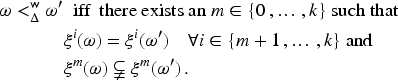
Another example of an SPO representable inference operator, inspired by system W, uses the following modified SPO to obtain an inference relation from a belief base (Haldimann & Beierle, 2023; Tönnies, 2022).
,
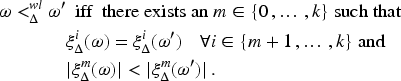
Let be a belief base with the Z-partition . Let . We define the relation by
The inductive inference operator is defined by iff for every there is an such that .
The inductive inference operator is defined via a SPO on worlds and thus satisfies system P (Haldimann & Beierle, 2023); furthermore it satisfies (Classic Preservation). captures and strictly extends system W and thus also c-inference and system Z while being captured and strictly extended by lexicographic inference (Haldimann & Beierle, 2023).
Again, we can use Theorem 2 to conclude that for every the SPO must be Z-rank refining with respect to . By analyzing the construction of we can verify that this is indeed the case.
As system W was the first inference operator shown to extend both rational closure and c-inference, in search of approximations of system W the idea of combining inference operators by their union was introduced (Haldimann & Beierle, 2023).
Let and be inductive inference operators. The union of and , denoted by is the mapping with .
This means that for any we have iff or (with as in Definition 18). Note that this operator does not ensure the inheritance of the properties of the involved inference operators in any way. The only guarantee it gives is that the union of two inductive inference operators yields again an inductive inference operator (Haldimann & Beierle, 2023). This means that the union of inference operators may have unwanted properties. For example, if and , then for the resulting operator it holds that , , and . Uniting inference operators also does not preserve the compliance with system P postulates. Consider the union
of c-inference and system Z. By definition, is the smallest inductive inference operator to capture system Z and c-inference. However, is not preferential, that is, it does not comply with the postulates of system P (Haldimann & Beierle, 2023).
If an inductive inference operator fails to satisfy a (set of) postulate(s), compliance with these postulates can possibly be achieved by adding additional pairs to the inference relations induced by .
Let be an inductive inference operator. Let be a set of postulates for inductive inference operators. An inductive inference operator is a closure of under if and satisfies . is a minimal closure of under if it is a closure of under , and if there is no closure of under such that for every .
For any inductive inference operator there is a unique minimal closure of under system P (Haldimann & Beierle, 2023). As the result of naively combining system Z and c-inference does not satisfy system P, we consider the minimal closure of under system P, denoted as
To better understand it would be useful to have a semantic characterization of it, but to the best of our knowledge no such characterization is known. However, there are at least some things we can infer. By construction, satisfies system P, (RC Extension), and (Classic Preservation). Thus, it is an RCP preferential inference operator. By Theorem 1 we know that for every , the inference relation is induced by a Z-rank refining preferential model. In fact, all preferential models inducing must be Z-rank refining. While this is far from a semantic characterization, it is a starting point for further research on the semantics of this inference operator.
Relevant closure (Casini et al., 2014) is an inference operator that was introduced as strengthening of rational closure. To decide if is entailed, it takes into account what conditionals are relevant for making the antecedent exceptional. While the original definition of propositional conditionals is given for defeasible DL inclusions, we can translate it to the setting of propositional conditionals used in this article.
Let be a belief base and . The formula is exceptional for a set of conditionals if every model of falsifies at least one conditional in . A set is a justification for with respect to if is exceptional for , but is not exceptional for every . denotes the set of all justifications of with respect to .
Using justifications, relevant closure is defined by a modified version of the syntactic characterization of rational closure.
Let be a belief base with the Z-partition , and let . Let . For a set of conditionals let denote the set of material implications corresponding to the conditionals in .
Let be the minimal number for which is satisfiable. Then is in the (basic) relevant closure of , denoted , if . If no such exists, that is, if is unsatisfiable, then we define to hold as well.
Let be a belief base over . The corresponding tolerance partition is with , , and . Consider the query “does entail ?” The only justification for is ; therefore . We can check that
Because we have that .
Relevant closure strictly extends rational closure. It is known that relevant closure does not comply with system P in some cases, specifically it violates (OR) and (CM) (Casini et al., 2014) which is a major drawback. To fix this, we can consider the minimal closure of relevant closure under system P, denoted by
This preferential version of relevant closure is only defined by a syntactic construction, and it would be interesting to understand it through a semantic characterization. The properties of are subject to investigation in future work. But we know that extends rational closure, and that it satisfies system P by construction. We can also observe that satisfies classic preservation. From this we can conclude by Theorem 1 that for every , the inference relation is induced by a Z-rank refining preferential model.
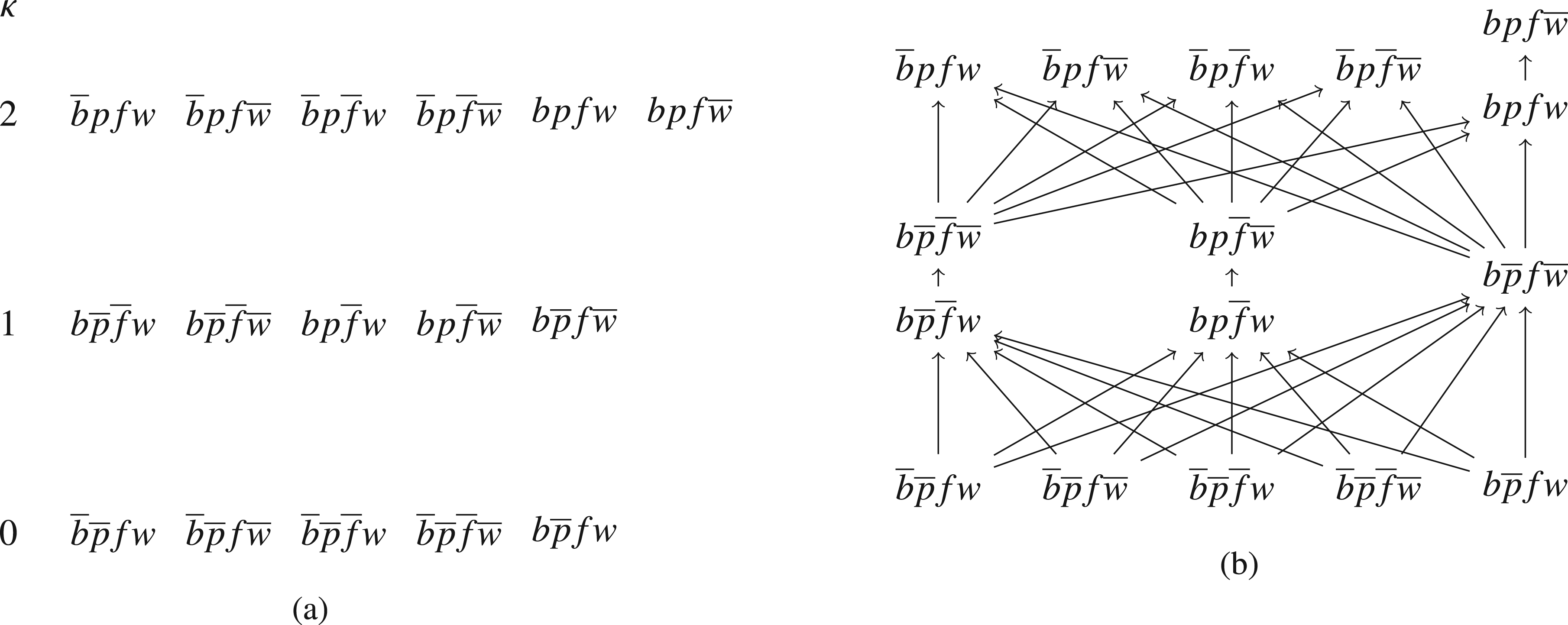
Consider the belief base from Example 4. The Z-ranking function induced by is illustrated in Figure 2(a), and a preferential model inducing is illustrated in Figure 2(b), with states in being labelled by the worlds they are mapped to by . We can see that is Z-rank refining with respect to .
Z-ranking Function and a Preferential Model of From Example 5. (a) Z-ranking Function of and (b) Order of the Z-rank Refining Preferential Model Inducing .
Because relevant closure is strictly extended by lexicographic inference (Casini et al., 2014), which is preferential, we know that is extended by lexicographic inference. The relations among the inductive inference operators in this section are illustrated in Figure 3.
Overview Over Relationships Among the Inductive Inference Operators Considered in This Article. An Arrow Indicates That Inductive Inference Operator is Captured by and that is Strictly Extended by for Some Belief Bases.
Conclusions and Future Work
In this article, we investigated RCP inductive inference operators, that is, inductive inference operators satisfying (RC Extension) and (Classic Preservation). Doing this we focused on SPO-representable inference relations, that is, inference relations that can be obtained from SPOs on worlds. We showed that this class of inductive inference operators is a subclass of preferential inductive inference operators and a superclass of basic defeasible inductive inference operators. We provided characterization theorems for RCP preferential and RCP SPO-representable inductive inference operators using the newly introduced property ‘Z-rank refining’ for preferential models and SPOs on worlds. Finally, we investigated instances of RCP inductive inference operators and applied our characterization results to them. Future work includes to further investigate instances of RCP inductive inference operators. Characterizing relevant closure semantically and establishing its relationship to inference operators like system W is of special interest to us, but we are also interested in implementing and evaluating these inference operators empirically, for example, on basis of the reasoning platform InfOCF (Beierle et al., 2024; Kutsch & Beierle, 2021).
Footnotes
ORCID iDs
Jonas Haldimann
Thomas Meyer
Gabriele Kern-Isberner
Christoph Beierle
Funding
This work is based on the research supported in part by the National Research Foundation of South Africa (Reference No: SAI240823262612). The work reported here was supported by the Deutsche Forschungsgemeinschaft (DFG, German Research Foundation) – 512363537, grant BE 1700/12-1 awarded to Christoph Beierle. The authors acknowledge TU Wien Bibliothek for financial support through its Open Access Funding Programme.
Competing Interest
The authors declared no potential conflicts of interest with respect to the research, authorship, and/or publication of this article.
References
1.
AdamsE. W. (1975). The logic of conditionals: An application of probability to deductive logic. Synthese Library. Springer Science+Business Media.
2.
BeierleC.EichhornC.Kern-IsbernerG. (2016). Skeptical inference based on c-representations and its characterization as a constraint satisfaction problem. In M. Gyssens & G. Simari (Eds.), Foundations of information and knowledge systems—9th International symposium, FoIKS 2016, Linz, Austria, March 7–11, 2016. Proceedings, LNCS (Vol. 9616, pp. 65–82). Springer. https://doi.org/10.1007/978-3-319-30024-5_4
3.
BeierleC.EichhornC.Kern-IsbernerG.KutschS. (2021a). Properties and interrelationships of skeptical, weakly skeptical, and credulous inference induced by classes of minimal models. Artificial Intelligence, 297, 103489. https://doi.org/10.1016/j.artint.2021.103489
4.
BeierleC.HaldimannJ. (2022). Normal forms of conditional belief bases respecting inductive inference. In F. Keshtkar & M. Franklin (Eds.), Proceedings of the thirty-fifth international florida artificial intelligence research society conference (FLAIRS), Hutchinson Island, FL, USA, May 15–18, 2022. https://doi.org/10.32473/flairs.v35i.130661
5.
BeierleC.HaldimannJ.KutschS. (2021b). A complete map of conditional knowledge bases in different normal forms and their induced system P inference relations over small signatures. In E. Bell & F. Keshtkar (Eds.), Proceedings of the thirty-fourth international florida artificial intelligence research society conference, North Miami Beach, FL, USA, May 17–19, 2021. https://doi.org/10.32473/flairs.v34i1.128467
6.
BeierleC.HaldimannJ.SaninA.SchwarzerL.SpangA.SpiegelL.von BergM. (2024). Scaling up reasoning from conditional belief bases. In S. Destercke, M. V. Martinez, & G. Sanfilippo (Eds.), Scalable uncertainty management - 16th International conference, SUM 2024, Palermo, Italy, November 27–29, 2024, Proceedings, LNCS (Vol. 15350, pp. 29–44). Springer. https://doi.org/10.1007/978-3-031-76235-2_3
7.
BeierleC.HaldimannJ.SchwarzerL. (2023). Observational equivalence of conditional belief bases. In S. A. Chun & M. Franklin (Eds.), Proceedings of the thirty-sixth International Florida Artificial Intelligence Research Society conference. https://doi.org/10.32473/flairs.36.133269
8.
BenferhatS.CayrolC.DuboisD.LangJ.PradeH. (1993). Inconsistency management and prioritized syntax-based entailment. In Proc. IJCAI’93 (Vol. 1, pp. 640–647). San Francisco, CA, USA: Morgan Kaufmann Publishers.
9.
CasiniG.MeyerT.MoodleyK.NortjeR. (2014). Relevant closure: A new form of defeasible reasoning for description logics. In E. Fermé & J. Leite (Eds.), Logics in artificial intelligence—14th European conference, JELIA 2014, Funchal, Madeira, Portugal, September 24–26, 2014. Proceedings, Lecture Notes in Computer Science (Vol. 8761, pp. 92–106). Springer. https://doi.org/10.1007/978-3-319-11558-0_7
10.
CasiniG.MeyerT.VarzinczakI. (2019). Taking defeasible entailment beyond rational closure. In F. Calimeri, N. Leone & M. Manna (Eds.), Logics in artificial intelligence—16th European conference, JELIA 2019, Rende, Italy, May 7–11, 2019, Proceedings, LNCS (Vol. 11468, pp. 182–197). Springer.
11.
DarwicheA.PearlJ. (1997). On the logic of iterated belief revision. Artificial Intelligence, 89(1-2), 1–29.
12.
de FinettiB. (1937). La prévision, ses lois logiques et ses sources subjectives. Annales de l’Institut Henri Poincarè, 7(1), 1–68.
GiordanoL.GliozziV. (2018). Reasoning about multiple aspects in DLs: Semantics and closure construction. CoRR abs/1801.07161. http://arxiv.org/abs/1801.07161.
GiordanoL.GliozziV.OlivettiN.PozzatoG. L. (2015). Semantic characterization of rational closure: From propositional logic to description logics. Artificial Intelligence, 226, 1–33. https://doi.org/10.1016/j.artint.2015.05.001
17.
GoldszmidtM.PearlJ. (1990). On the relation between rational closure and system-z. In Proceedings of the third international workshop on nonmonotonic reasoning, May 31–June 3, 1990 (pp. 130–140).
18.
GoldszmidtM.PearlJ. (1996). Qualitative probabilities for default reasoning, belief revision, and causal modeling. Artificial Intelligence, 84, 57–112.
19.
HaldimannJ.BeierleC. (2022a). Characterizing multipreference closure with system W. In F. D. de Saint-Cyr, M. Öztürk-Escoffier, & N Potyka (Eds.), Scalable Uncertainty Management - 15th International conference (SUM) 2022, Paris, France, October 17–19, 2022, Proceedings, Lecture Notes in Computer Science (Vol. 13562, pp. 79–91). Springer. https://doi.org/10.1007/978-3-031-18843-5_6
20.
HaldimannJ.BeierleC. (2022b). Inference with system W satisfies syntax splitting. In G. Kern-Isberner, G. Lakemeyer, & T. Meyer (Eds.), Proceedings of the 19th international conference on principles of knowledge representation and reasoning, KR 2022, Haifa, Israel, July 31–August 5, 2022 (pp. 405–409). https://doi.org/10.24963/kr.2022/41
21.
HaldimannJ.BeierleC. (2022c). Properties of system W and its relationships to other inductive inference operators. In I. Varzinczak (Ed.), Foundations of information and knowledge systems - 12th International Symposium, FoIKS 2022, Helsinki, Finland, June 20–23, 2022, Proceedings, LNCS (Vol. 13388, pp. 206–225). Springer. https://doi.org/10.1007/978-3-031-11321-5_12
22.
HaldimannJ.BeierleC. (2023). Approximations of system W between c-inference, system Z, and lexicographic inference. In Z. Bouraoui, S. Jabbour, & S. Vesic (Eds.), Symbolic and quantitative approaches to reasoning with uncertainty—17th European Conference, ECSQARU 2023, Arras, France, September 19–22, 2023, Proceedings, LNCS (Vol. 14294, pp. 185–197). Springer.
23.
HaldimannJ.BeierleC.Kern-IsbernerG.MeyerT. (2023a). Conditionals, infeasible worlds, and reasoning with system W. The International FLAIRS Conference Proceedings, 36(1). https://doi.org/10.32473/flairs.36.133268
24.
HaldimannJ. P.MeyerT.Kern-IsbernerG.BeierleC. (2023b). Rational closure extension in SPO representable inductive inference operators. In S. Gaggl, M. V. Martinez, & M. Ortiz (Eds.), Logics in artificial intelligence 18th European conference, JELIA 2023, Dresden, Germany, September 20–22, 2023, Proceedings, LNCS (Vol. 12678, pp. 561–576). Springer. https://doi.org/10.1007/978-3-031-43619-2_38
25.
HeyninckJ.Kern-IsbernerG.MeyerT.HaldimannJ. P.BeierleC. (2023). Conditional syntax splitting for non-monotonic inference operators. In B. Williams, Y. Chen, & J. Neville (Eds.), Proceedings of the 37th AAAI conference on artificial intelligence (Vol. 37, pp. 6416–6424). https://doi.org/10.1609/aaai.v37i5.25789
26.
Kern-IsbernerG.BeierleC.BrewkaG. (2020). Syntax splitting relevance independence: New postulates for nonmonotonic reasoning from conditional belief bases. In D. Calvanese, E. Erdem, & M. Thielscher (Eds.), Principles of knowledge representation and reasoning: Proceedings of the 17th International conference, KR 2020 (pp. 560–571). IJCAI Organization. https://doi.org/10.24963/kr.2020/56
27.
KomoC.BeierleC. (2020). Nonmonotonic inferences with qualitative conditionals based on preferred structures on worlds. In U. Schmid, F. Klügl, & D. Wolter (Eds.), KI 2020: Advances in artificial intelligence—43rd German conference on AI, Bamberg, Germany, September 21–25, 2020, Proceedings, LNCS (Vol. 12325, pp. 102–115). Springer. https://doi.org/10.1007/978-3-030-58285-2_8
28.
KomoC.BeierleC. (2022). Nonmonotonic reasoning from conditional knowledge bases with system W. Annals of Mathematics and Artificial Intelligence, 90(1), 107–144. https://doi.org/10.1007/s10472-021-09777-9
KutschS.BeierleC. (2021). InfOCF-Web: An online tool for nonmonotonic reasoning with conditionals and ranking functions. In Z. Zhou (Ed.), Proceedings of the thirtieth international joint conference on artificial intelligence (IJCAI) 2021 (pp. 4996–4999). ijcai.org. https://doi.org/10.24963/ijcai.2021/711
31.
LehmannD. (1989). What does a conditional knowledge base entail? In R. J. Brachman, H. J. Levesque, & R. Reiter (Eds.), Proceedings of the 1st international conference on principles of knowledge representation and reasoning (KR’89). Toronto, Canada, May 15–18, 1989 (pp. 212–222). Morgan Kaufmann.
32.
LehmannD. (1995). Another perspective on default reasoning. Annals of Mathematics and Artificial Intelligence, 15(1), 61–82. https://doi.org/10.1007/BF01535841
33.
LehmannD.MagidorM. (1992). What does a conditional knowledge base entail?Artificial Intelligence, 55, 1–60.
34.
MakinsonD.GärdenforsP. (1989). Relations between the logic of theory change and nonmonotonic logic. In A. Fuhrmann & M. Morreau (Eds.), The logic of theory change, workshop, konstanz, FRG, October 13–15, 1989, Proceedings, Lecture Notes in Computer Science (Vol. 465, pp. 185–205). Springer. https://doi.org/10.1007/BFb0018421
35.
PearlJ. (1990). System Z: A natural ordering of defaults with tractable applications to nonmonotonic reasoning. In R. Parikh (Ed.), Proceedings of the 3rd conference on Theoretical aspects of reasoning about knowledge (TARK1990) (pp. 121–135). San Francisco, CA, USA: Morgan Kaufmann Publishers Inc.
36.
SpohnW. (1988). Ordinal conditional functions: A dynamic theory of epistemic states. In W. Harper & B. Skyrms (Eds.), Causation in decision, belief change, and statistics, II (pp. 105–134). Kluwer Academic Publishers.
37.
TönniesD. (2022). Implementierung Und Empirische untersuchung Lexikographischer inferenz Für Das Nichtmonotone schließen. Bachelor thesis, FernUniversität in Hagen, Germany (in German).




 A; and we define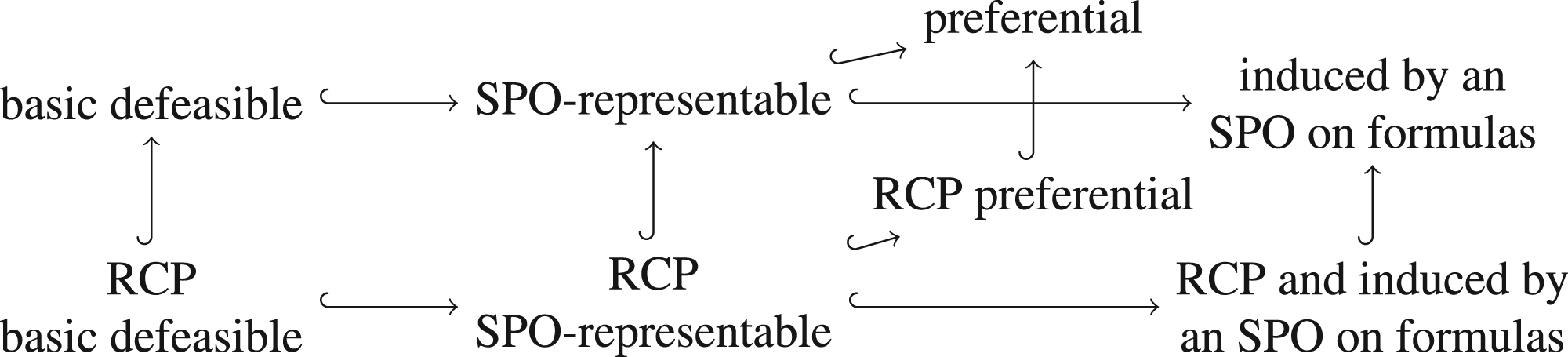





 is the mapping