




Abstract
Violent forms of discipline (VFD) used in homes and schools to correct children’s behaviour have significant long-term consequences, leading to their prohibition in most countries. This study focused on understanding school children’s perspectives on VFD. A community-based cross-sectional study surveyed 16 to 19-year-olds using random sampling. Out of 1130 participants, 60.7% reported experiencing violent punishment at least once during a school term. Physical punishment was most common (64.5%), followed by psychological methods (27.1%). Interestingly, 85% of students were aware of their rights under the child’s charter, and all knew emergency contact numbers. An overwhelming 86.3% preferred alternative disciplinary methods, believing VFD negatively impacts their future development. Participants with better knowledge supported legal measures against VFD (P < .05). The differences in prevalence when compared to other studies indicate that cultural background might influence acceptance of such practices. These findings underscore the importance of promoting non-violent disciplinary strategies to safeguard children’s well-being and development.
Introduction
School students are disciplined to follow certain rules and strategies to manage student behaviour in schools so that self-discipline is ensured later in life. Discipline can be preventive, corrective, or supportive. Teachers use various forms of corrective punishments which are negative and positive. Negative forms range from physical to psychological. Corporal punishment (CP) or a Violent Form of Discipline (VFD) in the form of physical or psychological punishment is a method where an adult deliberately inflicts pain upon a child in response to a child’s unacceptable behaviour to instil discipline. The long-term aim is to prevent the recurrence of bad behaviour and be consistent with the adult’s expectations. 1 The physical pain inflicted ranges from slapping to severe forms like flogging, beatings, and burning. Other forms of physical punishment are sit-ups with ears pulled and arms crossed, kneeling, and standing on the bench in the classroom. Psychological forms of violence can be bullying, intimidation and repression. These VFDs have short and long term consequences. It is advocated now to use non-violent forms of discipline through healthy classroom management strategies. This is a positive form of a nurturance behaviour of the teacher and the student where the change in behaviour or discipline is brought about by using charts, rewards, time out, and removal of privileges. 2
Violent forms of punishment in the name of “discipline” continue in homes, schools, childcare institutions, and juvenile detention centres. 3 Legal protection is given to children to protect them from CP/VFD and to ensure human rights. Almost 95% of the world’s total child population lives in countries that lack a legal system to protect children and 29.3% live in South Asia. Nearly 55.7% of children live in countries that have no law to protect children from corporal punishment and 50.0% of them live in South Asia. 4
In the first large scale study of corporal punishment in Sri Lankan schools in 2017, 948 students and 450 teachers were interviewed across 6 Sri Lankan districts. Nearly 80.4% of students reported high levels of corporal punishment, having experienced at least 1 episode of corporal punishment in the past term. 2
Boys are beaten with more force when compared to girls as it is felt boys are stronger and more aggressive. 5 Hence, the knowledge and perception of various forms of punishment may vary between boys and girls.
Both children and adults believe that VFDs are an effective way of discipline, 6 but many studies have shown the opposite by showing the detrimental effects of VFD. 7 Some of them are poor academic performance, low level of class participation, avoiding school, or dropping out for fear of getting beaten, declining self-worth or self-esteem and fear of teachers and school.8,9 Prospective and long-term research has concluded that spanking fails to change the child’s behaviour but can cause long-term damage. 10 Physically abused children have an increased chance of developing depression, becoming more aggressive, behaving antisocially and developing anxiety. A study done in Sri Lanka in 2008 also showed that parental corporal punishment is associated with psychological harm in children, which is enhanced by other forms of violence in a child’s life.11,12
Global Initiative to end corporal punishment has been helping to mobilise and support nations to change their laws and social attitudes. 13 Sri Lanka expressed its commitment to prohibit corporal punishment at home and schools in July 2006, which was reiterated in 2017. Even though the instruction was adopted by a government circular, it has not been confirmed through the enactment of legislation.14,15 National Child Protection Authority (NCPA) actively campaigns to eliminate corporal punishment and operates a child helpline (1929) for reporting abuse. The Ministry of Education regularly issues instructions to schools promoting non-violent disciplinary methods and encourages the creation of child-friendly school environments. Parents tend to approve and accept punishments by the teachers as a way to prevent misbehaviour and failure in schools. 16
Reporting and maintaining data on corporal punishment is crucial for initiating preventive strategies. VFDs are likely to be under-reported as the victims are afraid of repercussions. 17
21 Unconfirmed reports say that most of the schools still practice VFDs and conventionally believe that mild violent forms of discipline are acceptable and necessary to discipline children. 18 There are few studies done regarding the prevalence of VFD, but very few regarding the knowledge and perception among school children. Knowledge regarding VFD is vital to understanding the importance and the long-term detrimental effects.19 -22
We conducted this study among school children to see the knowledge, perception, and actions the students would take towards VFD. The objective of this study was to identify the prevalence of VFD, factors that influence VFD, their knowledge, its long-term effect on their well-being, and their perception of VFD.
Materials and Methods
Setting
A community based cross sectional descriptive study was done among 16 to 19 year old students studying in both private and government schools in the Jaffna district, Sri Lanka. The study period was from July to August 2018. The sample size was calculated using the expected proportion of children experiencing corporal punishment being 50% with a 95% confidence interval. The cluster design effect (DE) was considered as 1.8, with a non-response rate of 5% and the adjusted sample size was 1100. 19
Sampling
Stratified proportionate random sampling was done, and 10 schools in the district of Jaffna were selected using a recently updated list of secondary schools in the district of Jaffna with a probability proportionate to the student population size. The selected 10 schools had all the streams representing Maths, science, arts, commerce, and information technology. Each stream had a minimum of 2 classrooms to a maximum of 5 classrooms. One class in each stream was selected randomly. A total of 20 students were randomly selected from 1 class as a cluster. A total of 58 clusters were chosen to achieve the sample size. This study is limited to 16 to 18-year-old adolescents and cannot be generalised as younger age groups were not considered.
Study Tool
An anonymous pre-tested and standardised self-administered questionnaire was used. The questionnaire was developed specifically for this study using the existing Parent-Child Conflict Tactics Scales. 23 The validity was assessed by a field test which was conducted with 10 experts in the field of child abuse to measure the content validity. The questionnaire was modified as per the expert’s suggestions, and the modified version was used as the study tool. Part A considered the demographic details, Part B assessed the knowledge component of the participants and Part C checked the perception of VFD. The students were asked to report on the previous school term that is, period between 2 holidays. To assess the knowledge, questions regarding types of corporal punishments, the reason for the punishment, and the legal implications were checked. A set of 17 items that had correct and incorrect responses were used, and each correct response was awarded +1. A score ≥12 was considered good knowledge. This score was determined by the questions that the students must know by the expert panel over several discussions. and the internal consistency was satisfactory with a Cronbach alpha of .72, Part C checked the perception of the participants on violent forms of discipline, The perception was checked with 22 items which recorded the response on the Likert scale, and the responses were recorded as “strongly agree” or “agree,” or “Neutral” or “disagree,” or “strongly disagree.” Depending on whether it was a proper perception or not, scores from 1 to 5 were allocated to each item. Reverse scoring was awarded for the negative responses. A score of “0” was given for “don’t know”/ “can’t say.” The internal consistency was satisfactory with a Cronbach alpha of .75. Part D of the questionnaire checked the preferred method of discipline and the outcome of violent forms of discipline in those who received it. Trained investigators went to the schools to administer the questionnaire. A pilot study was conducted in a group of 20 students in a different district, and the tool was further validated. The tool used to collect data was specifically designed and not a standard tool, but validated for this study; hence there may be a reporting bias among the participants.
Data Analysis
Data was analysed by using Statistical Package for Social Sciences (SPSS) version 22.0. Responses were expressed as percentages and Chi-square test for significance of difference among proportions was calculated. Cronbach alpha was used to assess the reliability of the scores. The data was described using frequencies and percentages. One-way ANOVA was used to compare the means of the scores for perception and knowledge. P value of <.05 was considered as statistically significant.
Ethical Approval and Informed Consent
Ethical approval was obtained from the Faculty of Medicine, University of Jaffna Sri Lanka Ethics Review Committee (J/ERC/16/72/NDR/0143), and permission was obtained from the Provincial ministry of education, zonal directors, and school principals.
Ethical principles were followed throughout the research. The information was provided both verbally and in writing, and consent was obtained. Participants were assured that they could discontinue the study at any time that suited them. Informed consent was obtained from the parents by giving the consent form on a previous visit, and consent was obtained from the students. Personal information remained confidential, and assurances of non-publicity were obtained.
Results
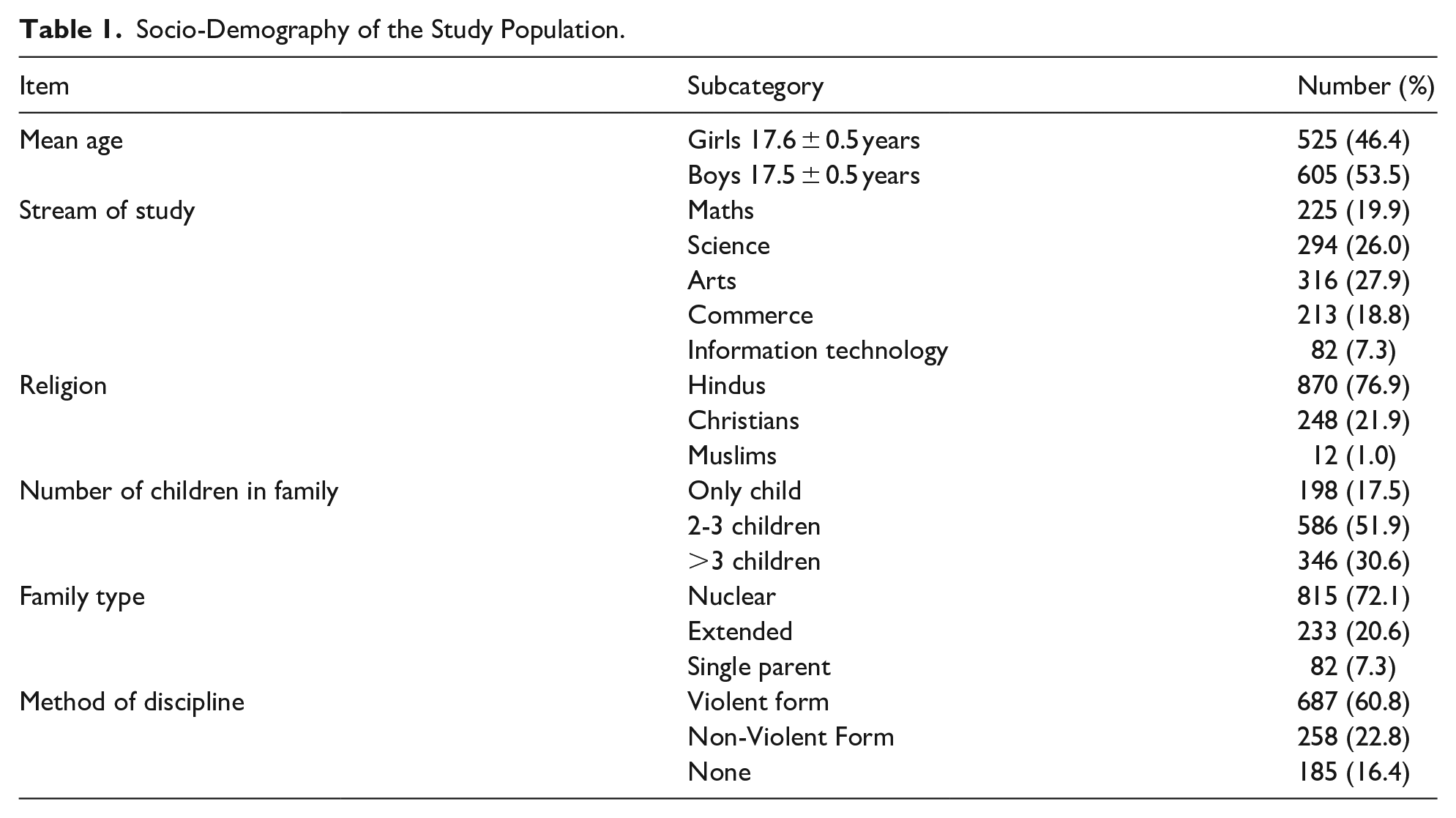
A total population of 1130 was recruited to the study, with a response rate of 97.4%. The majority were boys (53.5%) and the mean age was 17.58 ± 0.5 years (Table 1). Nearly 60.7% (687) had experienced at least 1 episode of punishment either at home or school during a school term. Physical type alone was experienced by 64.5% (n = 443) followed by psychological alone was seen in 27.1% (n = 186) and both forms in 8.4% (n = 58). Table 2 describes the number of incidences, the reason for VFD, and the type of VFD the child received. There was no significant relationship between age, sex, stream of study, family type, and number of siblings to the incidences of VFD (P value > .05).
Socio-Demography of the Study Population.
Violent Forms of Discipline Experienced by the Students (n = 687).

Academic related: making mistakes, not reading/writing, not doing home work, low marks.
Discipline related: coming late, absent, fighting with others, damage to property, being noisy.
Behaviour related: stealing, not getting permission to go out, telling lies.
The common form of physical VFD was standing outside class for a long time which was experienced by 91.2% (n = 404). The common form of psychological VFD was shouting, yelling, and using inappropriate language (99.4%). The non-violent forms of discipline were received by 258 (22.8%) and the common form was explaining by 70.9%. The various forms of physical, psychological, and non-violent methods are described in Table 3.
Instances of Strategies of Punishment.

The mean score for the knowledge component was 11.43 ± 3.1 in girls and 10.9 ± 3.5 in boys which had a significant difference. When considering the individual knowledge factors nearly 85% of the students knew the child’s right charter and nearly all the children knew the emergency contact number to dial if harm occurred to them. A significant difference is seen in the knowledge components between girls and boys. Table 4 describes the components of knowledge.
Knowledge Regarding Corporal Punishment.

A total of 38.2% (n = 432) of the participants agree while 27.1% (n = 306) disagree that VFD promotes future perpetrators to commit child abuse. Nearly 70.4% (n = 796) of the participants disagreed with the statement “violent forms of discipline are psychologically beneficial,” and 45.9% (n = 519) agreed that VFD is associated with an increase in delinquent and antisocial behaviours in childhood. It was noted that students marked either strongly agree or agree in 60.7% (n = 686) to “violent forms of discipline disgraces you,” 57.9%(n = 654) to “violent forms of discipline cause too much pain and has a detrimental effect,” 45.6% (n = 515 ) to “increases the antisocial and illegal behaviour,” 56.7% (n = 641) to aggressive behaviour and 38.3% (n = 50) to increases conflicts in the family and leads to gender-based violence (Table 5).
Perception of Violent Forms of Discipline.
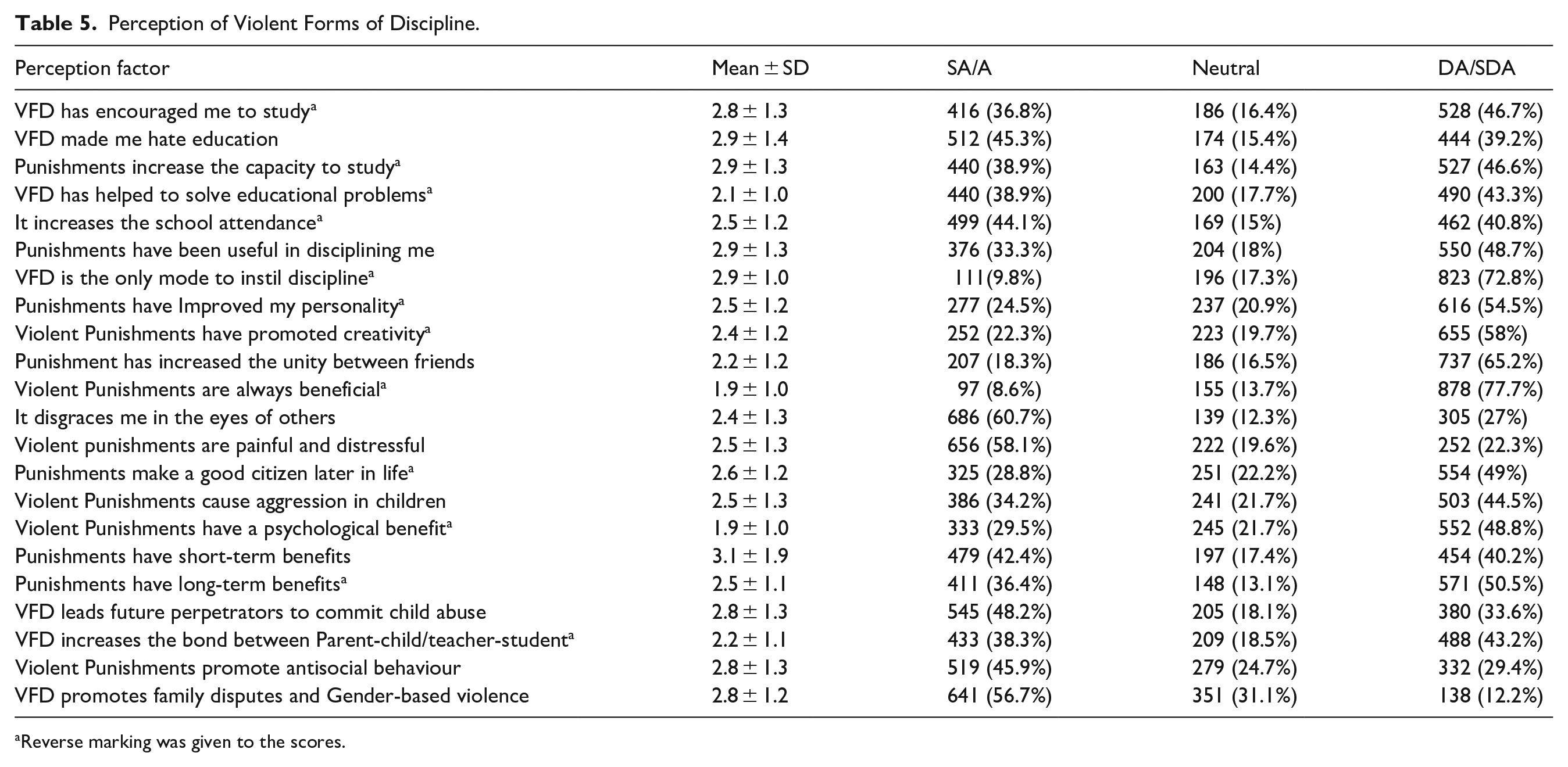
Reverse marking was given to the scores.
A majority (86.3%, N = 976) preferred an alternative way of discipline and felt corporal punishment had a detrimental effect on their future development (89.5%, N = 1012). 31.8% (n = 359) said it was a method used to discipline students and reluctantly accepted it. Nearly 79.6% (n = 900) answered yes to “Will you take legal actions against violent forms of discipline” and 50.5% (n = 571) supported complete prohibition of corporal punishment.
Participants with good knowledge favoured legal action, supported the complete prohibition of VFD, and felt it had a detrimental effect on their future. (Table 6) The favoured method of discipline reported by the students was getting extra homework (58%; n = 655), after school class (38%, n = 429), cleaning the school and playgrounds (23%, n = 260), removal of privileges (29%, n = 328) and when the teacher/parent explained and gave advice (47%), n = 531). The outcome of the children who experienced VFD 12% (n = 82) of the children received medical treatment following an injury, 60.4% (n = 415) said it did not change or affect them, 18.6% (n = 128) said it changed their behaviour, and 9.0% (n = 62) said it affected them psychologically as they felt sad and rejected.
Analysis of Perceived Actions and the Knowledge Scores.

Discussion
Teachers and parents use various tactics to discipline and correct behaviour in children. Despite having legal implications against corporal punishment, schools in the northern part still use it to discipline children. The violence experienced by the children leads to long-term psychological problems and may lead to criminal behaviour in adult life.7,24 In this study, physical and psychological punishments have been predominant compared to non-violent discipline. Nearly 65% have reported having the experience of violent forms of discipline in our study which is also similar to a study from India (2015) which showed 65% and a study from Sri Lanka (2017) stated nearly 80% have experienced it.9,25 A possible explanation is provided for the general reduction, attributed to a fear of mitigation, along with a consideration of methodological differences, particularly in the age groups analysed in both studies.
Sri Lankan schools strive to showcase their educational and extra-curricular achievements, potentially contributing to significant stress among teachers and parents, which may affect children. This stress and resulting anxiety could prompt adults to resort to physically and psychologically detrimental approaches to enhance children’s performance. 26 Studies done in India have demonstrated that violent forms of discipline commonly occur in poor socio-economic backgrounds, but our study did not reveal this.4,9
The most frequent VFD is the physical form seen in 64.5% of the population. The downward trend from 80% mentioned in the previous Sri Lankan Study (DeSilva H, 2017) is promising as the Sustainable developmental goal is to end violence against children by 2030. 15 The psychological form of violence was experienced in 27.1% when compared to the previous study (DeSilva H, 2017) it was seen in 72.5%.
Nearly 36% of the students have experienced VFD at least once during the school term and 7% have experienced it daily. Of the various modes, a common one was standing outside for long periods (91.2%) followed by slapping on the cheek (82.8%) and asking to kneel (76.7%). Similar types of injuries have been seen in other studies. Most of the children encountered the punishments in school but 27.5% experienced VFD both at home and school. Similar results were seen in other studies.10,20
Psychological aggression towards the children was noted in 27.1% and calling by names was the commonest (20.8%). When compared to other studies this seems to be low and it may be that the student’s perception of psychological trauma may be different in different study populations and countries. 22 Acceptance of children being yelled at or called out names like “lazy” is accepted as normal in this cultural context. This may also contribute to the low incidence of psychological aggression.
The knowledge regarding violent forms of discipline was good in 40% of the girls and 35% of the boys. The easy access to social media and the web may have contributed to good knowledge and girls generally being more disciplined were better aware of violent forms of discipline than boys. According to the American Psychological Association girls have made higher grades than boys throughout their school years and are more systematic in their learning hence they have higher scores in the knowledge component too.24,25
VFD is known to cause negative effects like physical injuries, poor academic performances, school dropouts, low self-esteem, and fear of school and teachers. 26 In our study, the short-term harm of physical injury was seen in 7.3%. Despite these effects, VFD is still advocated by children as our study also revealed that 31.8% (n = 359) accepted VFD despite being aware of its detrimental effects.
Nearly 53.8% of the students strongly agreed or agreed that violent forms of punishment disgraced them. Forty-seven percent of the participants said that violent forms of discipline made them hate school and studies. Some students (45.8%) felt VFDs encouraged to learn. This may be supported by the cultural belief that the teacher or the parent does this for their betterment. Violence in this culture is accepted and thereby violent forms of discipline become acceptable to many. Violence in adults like war, homicide, combative sports, and witnessing violence characterises a culture of violence. Violent forms of punishment may be part of this general culture of violence. 27
The action to overcome violent forms of discipline was promising as most (86.4%) preferred an alternative method of discipline despite 31.8% accepting violent forms of discipline as a mode of discipline. Students with good knowledge and a positive attitude regarding VFD had a clearer plan of action. This shows a promising outlook towards the future. To shape desirable behaviour in students and correct misbehaviour disciplinary strategies rather than punishment strategies are required. 26
The power dynamics of adults and the cultural acceptability of VFD must be abolished, and alternative approaches must be encouraged. Some of the alternative approaches are non-violent discipline, effective communication, and conflict resolution. 7 When Positive discipline is inculcated it promotes appropriate behaviour. Teachers should be trained on alternatives to corporal punishments in schools to stop the menace of punishing children and making the schools safe. A significant decrease in the use of physical violence was seen in a study done among teachers after a 5-day training on effective discipline strategies. 28
A study done in Malatya on violent parenting behaviour showed psychological punishment was the most common method, while nonviolent discipline was less used. Discipline practices were significantly associated with the mother’s education, family income, child’s gender, and age. This may also reflect on our study conducted in schools and practices accepted as normal by the teachers. 29 We propose to do further studies in the community to assess the community’s understanding of violent forms of discipline.
Conclusion
The use of corporal punishment is widespread with physical harm being common. The knowledge regarding prevention of VFD was satisfactory but a change in perception is needed among the school students attending secondary schools in the Northern Province.
Footnotes
List of Abbreviations
VFD: Violent Forms of Discipline: CP: Corporal Punishment, WHO: World Health Organisation, GCE A/L: General Certificate of Education Advanced Level, UNICEF: United Nations Childrens’ Fund.

Ethical Considerations
Ethical approval was obtained from the Ethics Review Committee of the institution (J/ERC/16/72/NDR/0143) and permission was sought from the Provincial Educational ministry and relevant zonal directors.
Consent to Participate
An eligible sample of participants was informed and written informed consent from the parent or guardian and accent from the students were obtained. Participants received instructions for opting out of the survey.
Author Contributions
MGS—Designed and developed the protocol, monitored data collection, reviewed, and revised the manuscript and approved the final document, AA—Data collection, analysis and approved the final manuscript, AV—Data Collection, manuscript preparation and approved the final manuscript, SA—Data collection, manuscript preparation and approved the final manuscript. All Authors read and approved the final manuscript prior to submission.
Funding
The author(s) received no financial support for the research, authorship, and/or publication of this article.
Declaration of Conflicting Interests
The author(s) declared no potential conflicts of interest with respect to the research, authorship, and/or publication of this article.
Data Availability Statement
The data in this study is available from the corresponding author on request.