




Abstract
Anxiety disorders are prevalent among adolescents and significantly impair social and academic functioning. It should be identified early to avoid detrimental effects. This study aimed to validate and assess the reliability of the Indonesian SCARED Child Version for detecting anxiety disorders in Indonesian adolescents. The SCARED Child Version was translated into an Indonesian version according to the standard cross-cultural adaptation method. Reliability was tested with internal consistency test on 123 adolescents aged 12 to 18 years old in Jakarta, which obtained Cronbach’s alpha value for SCARED-41 items of .927, and .741 for SCARED-5 items. The content validity test was carried out through a qualitative relevance assessment involving 9 experts and the results showed an average Content-Validity-Index for items of 0.94, Content-Validity-Ratio of 0.88, and Validity-Index for scales of 0.94. The Indonesian version of the SCARED Child Version has good reliability and validity for the early detection of anxiety disorders among Indonesian adolescent.
Introduction
Anxiety is a common phenomenon in adolescents; however, if it persists and impairs social or academic functioning, it may be considered an anxiety disorder. 1 In children and adolescents, it may occur at various age stages and is one of the most common mental health disorders. 2 According to the Global Burden of Disease Study, the prevalence of anxiety disorders in the age group 5 to 17 years worldwide is 3.2%. 3 In Indonesia, according to the Indonesia-National Adolescent Mental Health Survey, anxiety is the most common problem among Indonesian adolescents, with a prevalence of 26.7%, while anxiety disorders are experienced by 3.7% of adolescents in Indonesia. 4
Untreated anxiety disorders may have serious consequences for children’s future, especially in social and academic functioning.2,5 -7 Disturbed social functions, such as difficulty building relationships with family and peers. Meanwhile, in the academic field, anxiety disorders can cause school avoidance, low attendance rates, decreased academic performance, and the potential to cause school discontinuation. 2 During the COVID-19 pandemic, anxiety in children and adolescents was also reported to have increased, along with increased parental anxiety regarding economic conditions, work, media coverage of the COVID-19 virus, loss of family members, and reduced socialization with the surrounding environment. 8 Furthermore, anxiety in adolescents presents with a high level of comorbidity, including comorbidity with other anxiety disorders and with other psychiatric disorders. One of the earliest forms of mental health disorders to develop in life is anxiety disorders. Specific phobias and separation anxiety disorder typically emerge before the age of 10, whereas social anxiety disorder predominantly develops during early adolescence. It is typically comorbid with depression, mood disorder, and externalizing disorder in relation to other psychiatric disorders. 9 A variable number of future mental disorders, including anxiety disorders, mood disorders, and the risk of concurrent or future eating disorders, are also predicted by anxiety disorders in younger individuals.9,10
Early identification of anxiety disorders is critical due to their chronic and enduring nature. 11 The ability of primary health-care physicians to identify anxiety disorders and distinguish them from concerns or fears that are momentary in nature is critical for adolescents.5,11,12 Primary health-care physicians serve as the initial point of contact for the timely identification of anxiety disorders, impart psychoeducation to parents, and make psychiatric referrals. Nonetheless, in children and adolescents, interview skills or mental status examinations conducted for a limited duration of time may result in the underdiagnosis of anxiety disorders and subsequent postponement of treatment adolescents. 5 By promptly identifying and effectively managing anxiety disorders, it is anticipated that adverse consequences, including relapses and the development of secondary psychopathology like substance addiction or depression, can be prevented. 11
For early detection of anxiety disorders in children and adolescents, one of the self-report questionnaires is the Screen for Child Anxiety and Related Emotional Disorders (SCARED) Child Version. The SCARED Child Version is appropriate for children and adolescents between the ages of 8 and 18. Five subscales of anxiety disorders—generalized anxiety disorder, separation anxiety disorder, panic disorder, social phobia, and school phobia—are evaluated via the 41 items comprising this questionnaire. A condensed version of the SCARED questionnaire consisting of 5 items was also available. 13 This subset was designed to facilitate the administration of this questionnaire to adolescents in the community for screening purposes. In healthcare facilities, SCARED Child Version is helpful for physicians and psychiatrists for the identification of anxiety disorders, particularly in adolescents who are at risk to developing anxiety. Currently, the SCARED Child Version has been translated and validated in Indonesia for young children in the second to sixth grades of primary school. 14 Nevertheless, the validity of this tool in the Indonesian adolescent population remains unexplored, despite the fact that anxiety is one of the most common issues among adolescents. The primary objective of this study was to develop a valid and dependable Indonesian adaptation of the SCARED Child Version and the subset of 5-Item Version (SCARED 5-C) for use with adolescents in Indonesia.
Method
A cross-cultural adaptation research was conducted with mental health experts in Indonesia, while a reliability study was conducted in middle and high schools located in Jakarta. The accumulation of research data occurred between March and April of 2023.
Sample
The participants for the validity research comprised Indonesian adolescents between the ages of 12 and 18 (middle school and high school students) who possessed the literacy skills necessary to write in Indonesian. In addition, specialists in the domain of community and adolescent mental health were enlisted to assess the questionnaire’s content validity in Indonesian language. All participants have consented to partake in this research through written statements.
Research Procedures
Stage I: Translation
The SCARED Child Version questionnaire was developed by Dr. Boris Birmaher in 1999. 11 Permission was obtained from Dr. Boris Birmaher to translate the questionnaire into Bahasa Indonesia. The translation of this questionnaire was conducted following the method recommended for cross-cultural adaptation (Figure 1). 15 Two registered translators translated the SCARED Child Version into Indonesian with the consent of the questionnaire’s copyright holder.

Stages of cross-cultural adaptation conducted.
Stage II: Synthesis
Experts in the field of mental health reviewed the translated materials to confirm that the Indonesian version of the questionnaire was suitable for use. They ensured that the translated instrument had a good cultural or semantic equivalence compared to the original instrument.
Stage III: Back-translation
A back-translation into the source language (English) was performed by an impartial translator who lacked prior knowledge of the SCARED Child Version survey. The original copyright holder of the SCARED Child Version was provided with the back-translation results and a comparison was made between the new translation results and the original SCARED Child Version to ensure that the new translation results are identical to the content of the original SCARED Child Version.
Stage IV: Committee review
The content validity evaluation of the Indonesian version of the SCARED Child Version was conducted by 9 experts, 7 child and adolescent psychiatrists, 1 psychologist, and 1 community psychiatrist. Every expert evaluated every item in the Indonesian SCARED Child Version in order to determine its semantic, cultural, and conceptual equivalence and appropriateness for its respective domain.
Stage V: Pretesting
Prior to conducting the validity and reliability test, a pretest was conducted on 10 subjects who met the inclusion criteria completed the Indonesian version of the SCARED Child Version questionnaire. This was done to identify any challenges that may have arisen during the questionnaire completion process and to ensure that the subjects comprehended the instructions and items. The purpose of gathering the trial results was to enhance the phrasing of this questionnaire.
Questionnaire Validity and Reliability Test
A reliability assessment and content validity test analysis were conducted in middle and high schools through the distribution of the SCARED Child Version in Indonesian to the student body. The final Indonesian version of the SCARED Child Version underwent qualitative relevance assessment for each item by a panel of 9 child and adolescent mental health specialists.
Data Analysis
The internal consistency and reliability of the SCARED Child Version and SCARED 5-C were evaluated using the Cronbach’s alpha (values > .70 were considered evidence of satisfactory internal consistency 16 and the Intraclass Correlation Coefficient (ICC, values ≥ .90 were considered evidence of stability. 17 Content validity test analysis was done to obtain Content Validity Index for Items (I-CVI), Validity Index for Scales (S-CVI), and Content Validity Ratio (CVR) values. All statistical analyses were performed using the Statistical Package for the Social Sciences (SPSS) software version 26 to test validity and reliability of the questionnaire. Additionally, descriptive demographic information (age, gender, and educational attainment) regarding the research subjects is provided.
Ethical Approval and Informed Consent
The Ethical Committee of a public university granted ethical approval for this research under the number KET-647/UN2.F1/ETIK/PPM/00/02/2022. Written informed consent was obtained from the parents or guardians of the participants.
Results
Demographic Characteristics
The study was carried out at educational institutions that comprise both public and private secondary schools, in addition to public and private middle schools. A total of 126 pupils were selected at random; however, 3 subjects were omitted as a result of incomplete responses (Table 1).
Demographic Data of the Subjects.

Pre-Testing
While there were no issues identified with the filling procedure, the subject provided feedback suggesting that the word order for item 21 be revised. Following consultations with subject matter experts, a consensus was reached to modify the sentence from “Saya khawatir mengenai semua hal berjalan lancar untuk saya” (I am concerned that everything is falling into place) to “Saya khawatir mengenai kelancaran semua hal untuk saya” (I worry that everything is going smoothly for me) and retains the intended meaning of the initial sentence.
Reliability
The reliability of the Indonesian version of the SCARED Child Version was assessed using an internal consistency reliability test. The Cronbach’s alpha value for this version was .927 (P < .001). The findings suggest that the Indonesian iteration of the SCARED Child Version possesses favorable internal consistency reliability values, and every item is effectively incorporated into the overall questionnaire. The correlation strength (rs) values for each item and the total score per questionnaire domain range from .378 to .774, indicating a moderate to strong and directly proportional relationship between the 2 variables. According to the results presented in Table 2, the panic disorder domain exhibits the highest internal consistency reliability value (Cronbach’s alpha = .857, P < .001). Conversely, the separation anxiety disorder domain demonstrates the lowest internal consistency reliability value (Cronbach’s alpha = 0698, P < .001). The dimensions of generalized anxiety disorder, social phobia, and significant school avoidance symptoms have attained a high level of internal consistency, as indicated by Cronbach’s alpha values of .799, .849, and .725, respectively (P < .001). Based on the ICC value of 0.928 (95% CI: 0.908-0.945, P < .001) for the Indonesian version of the SCARED Child Version, this questionnaire demonstrates exceptional reliability (Table 3).
Reliability and Internal Consistency of SCARED-C41 Indonesian Version.

Intraclass Correlation Coefficient (ICC) of the Indonesian Version of SCARED Child Version and the SCARED Child Version 5-Item.

Two-way random effects model, consistency definition.
Furthermore, an assessment of the SCARED Child Version 5-item (SCARED 5-C)’s internal consistency reliability yielded a Cronbach’s alpha value of .741 and ICC value of .741 (95% CI: 0.660-0.807, P < .001), indicating satisfactory levels of reliability.
Questionnaire Validity Test
Content validity
With the exception of items 4 and 5, the analysis revealed that the Indonesian version of the I-CVI SCARED Child Version yielded significant results (>0.79) for every item (Table 4). The researcher reaffirmed with the domain experts the items’ suitability with respect to the assessed domain. The domain experts agreed that the sentences in items 4 and 5 remained pertinent to the domain under evaluation; therefore, items 4 and 5 were maintained in the Indonesian version of the SCARED Child Version. Based on the Lawshe Table, the cut point value for CVR involving 9 experts was 0.78 points. Five items, namely items 4, 5, 15, 20, and 41 (Table 5), were acquired with CVR values below 0.78 points, in accordance with the established cutoff. With respect to items 15, 20, and 41, the experts determined that while they adequately described the respective domains, they also had the potential to represent a broader domain, specifically generalized anxiety disorders. Therefore, these 3 items were maintained in the Indonesian iteration of the SCARED Child Version because they were deemed relevant to the domain they evaluated.
Content Validity Evaluation of the Indonesian Version of SCARED Child Version.
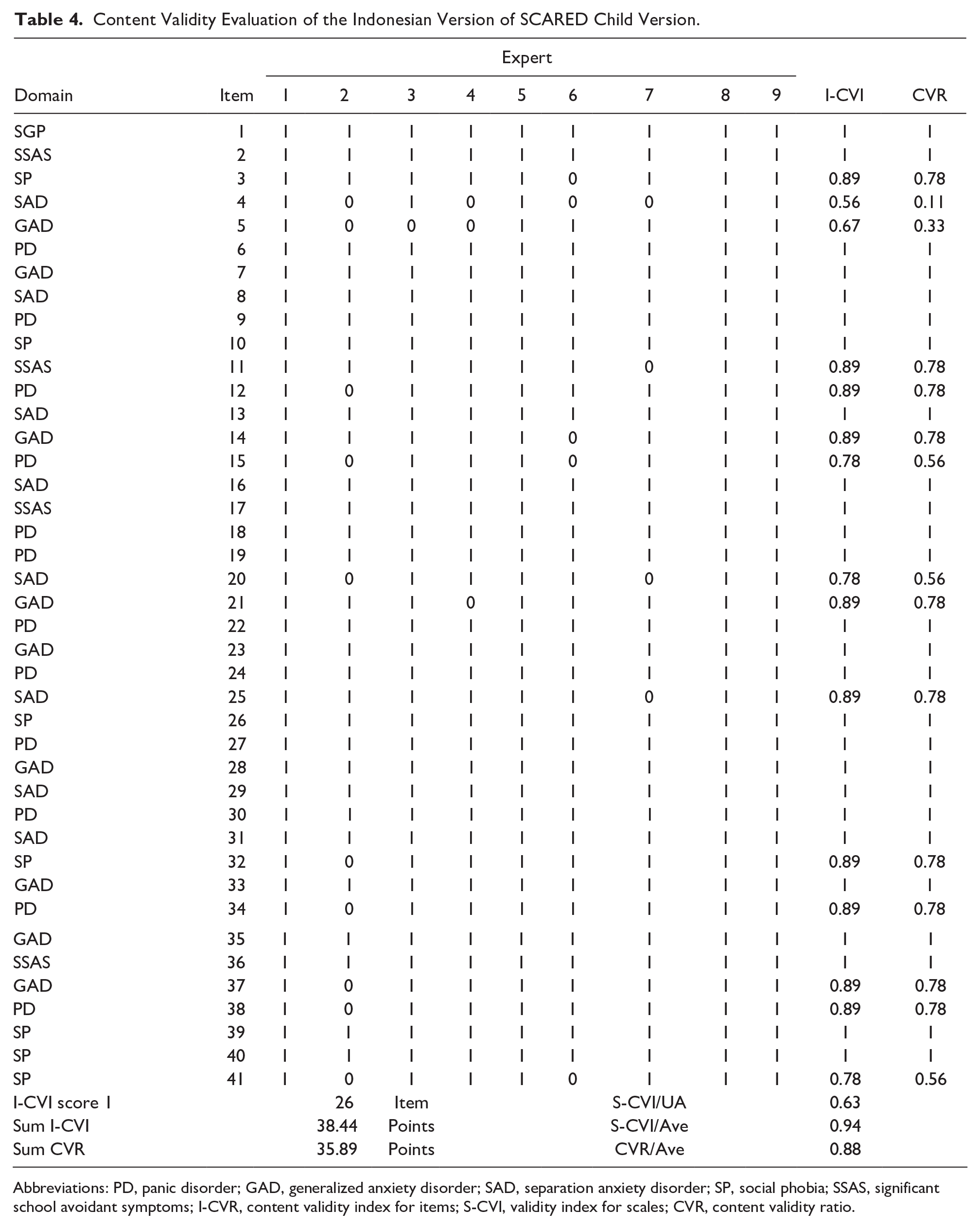
Abbreviations: PD, panic disorder; GAD, generalized anxiety disorder; SAD, separation anxiety disorder; SP, social phobia; SSAS, significant school avoidant symptoms; I-CVR, content validity index for items; S-CVI, validity index for scales; CVR, content validity ratio.
Item with I-CVI and CVR Value Below the Preserved Cut-off in the Indonesian Version of SCARED Child Version.

Discussion
The original SCARED Child Version is a self-administered questionnaire to screen anxiety disorders in children and adolescents. Self-administered questionnaires are the most direct measures for assessing the internal and subjective aspects of anxiety, and their design eliminates interpreter bias. Additionally, self-reports are a time-efficient method for identifying adolescents at risk who may require further psychiatric evaluation in primary health care settings. 18 There is an immediate need for a screening instrument for anxiety disorders among Indonesian adolescents, as these are the most prevalent mental disorders among this population at present. 4 As far as the researchers are aware, no SCARED Child Version studies in other nations have utilized I-CVI, S-CVI, or CVR assessments to evaluate content validity. A Sri Lankan study was identified as 1 that examined the content validity of the SCARED Child Version (SCARED Child Sinhala Version). A content validity assessment was conducted on the SCARED Child Sinhala Version by a multidisciplinary team comprising of 2 pediatricians, 2 education specialists, 4 child psychiatrists, 2 clinical psychologists, and 2 community physicians. The purpose of conducting the content validity test was to evaluate 3 key aspects: the applicability of each item in the assessment of anxiety disorders, the appropriateness of the sentences employed, and the compatibility with the local cultural context. The content validity test of the SCARED Child Sinhala Version yielded the finding that all 41 items were maintained. 19 The preliminary findings of the internal consistency reliability assessment indicated that the Indonesian version of the SCARED Child Version exhibited a total Cronbach’s alpha value of .93. The value indicates a high degree of internal consistency reliability, indicating that all queries are effectively integrated into the questionnaire. Comparing the internal consistency value of the Indonesian version of the SCARED Child Version to that of the original questionnaire study (0.90) and to studies conducted in other countries that examined comparable samples of student communities in schools or clinical populations like psychiatric clinics, both versions demonstrate comparable reliability (Table 6).13,14,18 -28
Reliability and Internal Consistency of SCARED Child Version in Other Languages.

The internal consistency value of the Indonesian version of the SCARED Child Version, which consists of 5 domains, varied between 0.698 and 0.857, according to this study. The following values represent the most severe conditions in that order: separation anxiety disorder (0.689), social phobia (0.849), generalized anxiety disorder (0.799), and significant school avoidance symptoms (0.725). The meta-analysis study found that the SCARED Child Version achieved its lowest internal consistency score in the domain of substantial school avoidance symptoms. 29 In contrast, the present study obtained its lowest score in the domain of separation anxiety disorder. The domain of separation anxiety disorder also exhibits the least consistent internal consistency in research conducted in other nations, specifically in Thailand and South Korea,25,28 where Cronbach’s alpha values are .641 and .780, respectively. An analysis of the internal consistency values of items within the domain of separation anxiety disorder reveals that item 8 (“I follow my mother or father wherever they go”) in the SCARED Child Version, translated into Indonesian, Thai, and Korean, exhibits the lowest value at 0.378, 0.193, and 0.530, respectively. One potential explanation for this phenomenon could be the influence of age differences among the subjects of the research. Subjects who met the inclusion criteria and were at least 12 years old at the time of the studies conducted in Indonesia and South Korea were classified as adolescents. The median age of the research subjects in the Indonesian iteration of the SCARED Child Version was 16 years. This value is significantly greater than the mean age of research participants in other nations. Opportunities for peer interaction and independence tend to increase during adolescence, in contrast to cohorts of children who are more likely to rely on their parents or family. The absence of a sample representing a specific age group of children in this research may have led to a discrepancy in the internal consistency value of item 8 within the domain of separation anxiety disorder.
Limitation
The study’s scope is limited to Jakarta, Indonesia, adolescents in middle and high school, aged 12 to 18 years. This research was not conducted in younger participants or in rural settings, in which future studies are recommended. To facilitate the community’s utilization of the Indonesian version of the SCARED Child Version, the following course of action could be to distribute a user manual for the questionnaire.
Conclusion
The reliability and validity of the Indonesian iterations of the SCARED Child Version and the SCARED Child Version 5-Item in identifying anxiety disorders among adolescents are both satisfactory. Additional research to ascertain the cut-off value for the Indonesian iteration of the SCARED Child Version, which is grounded in established benchmarks like the Diagnostic and Statistical Manual of Mental Disorders 5 (DSM-5) or Guidelines for the Classification and Diagnosis of Mental Disorders III (PPDGJ-III) which is a translation from International Classification of Diseases 10th Version (ICD-10), is required.
Supplemental Material
sj-docx-1-gph-10.1177_30502225251319877 – Supplemental material for Cross-cultural Adaptation, Reliability and Validity Tests of Screen for Child Anxiety and Related Emotional Disorders (SCARED) Child Version and SCARED-5-items in Indonesian Adolescents
Supplemental material, sj-docx-1-gph-10.1177_30502225251319877 for Cross-cultural Adaptation, Reliability and Validity Tests of Screen for Child Anxiety and Related Emotional Disorders (SCARED) Child Version and SCARED-5-items in Indonesian Adolescents by Fransiska Kaligis, Inez Cassandra, Hervita Diatri, Tjhin Wiguna and Eva Suarthana in Sage Open Pediatrics
Footnotes
Acknowledgements
We would like to extend our gratitude to the junior and senior high school students who took part in this research.
Authors’ Note
Inez Cassandra is also affilaited to Cipto Mangunkusumo General Hospital, Jakarta, Indonesia.
Author Contributions
FK: contributed to conception and design; contributed to acquisition, analysis, and interpretation; drafted manuscript; critically revised manuscript; gave final approval; agrees to be accountable for all aspects of work ensuring itegrity and accuracy. IC: contributed to design; contributed to acquisition and analysis; drafted manuscript; critically revised manuscript; gave final approval; agrees to be accountable for all aspects of work ensuring itegrity and accuracy. HD: contributed to design; contributed to analysis and interpretation; critically revised manuscript; gave final approval; agrees to be accountable for all aspects of work ensuring itegrity and accuracy. TW: contributed to conception; contributed to interpretation; critically revised manuscript; gave final approval; agrees to be accountable for all aspects of work ensuring itegrity and accuracy. ES: contributed to interpretation; critically revised manuscript; gave final approval; agrees to be accountable for all aspects of work ensuring itegrity and accuracy.
Data Availability
Data will be available upon reasonable request from the corresponding author.
Declaration of Conflicting Interests
The author(s) declared no potential conflicts of interest with respect to the research, authorship, and/or publication of this article.
Funding
The author(s) disclosed receipt of the following financial support for the research, authorship, and/or publication of this article: This study was funded by PUTI Pascasarjana Grant from (NKB-67/UN2.RST/HKP.05.00/2024).
Ethical Consideration
The Ethical Committee granted approval for this research under the number KET-647/UN2.F1/ETIK/PPM/00/02/2022.
Consent for Publication
It is not applicable.

Supplemental Material
Supplemental material for this article is available online.
References
Supplementary Material
Please find the following supplemental material available below.
For Open Access articles published under a Creative Commons License, all supplemental material carries the same license as the article it is associated with.
For non-Open Access articles published, all supplemental material carries a non-exclusive license, and permission requests for re-use of supplemental material or any part of supplemental material shall be sent directly to the copyright owner as specified in the copyright notice associated with the article.
