




Abstract
To commemorate the 30th anniversary of the Indian Association of Aesthetic Surgeons (IAAPS) and the launch of its first journal, the International Journal of Aesthetic Surgery, this article chronicles the association’s history. It details the challenging early years, including the resistance faced in establishing aesthetic surgery as a recognised speciality, and acknowledges the pioneers who laid the groundwork. The article then follows the IAAPS’s evolution, from adopting its constitution and expanding its leadership to establishing its annual AESURG conferences, forging international collaborations and culminating in the launch of this journal. This chronological account highlights the IAAPS’s instrumental role in shaping the academic landscape of aesthetic surgery in India.
Keywords
Introduction: The Concept
Aesthetics has been integral to human life for millennia. The ancient Vedas celebrate a wide spectrum of aesthetic expression, from the melodies of music and the rhythm of poetry to the grandeur of architecture and the art of personal adornment or ‘shringar’. Even the surgical arts have a long history: Sushruta’s pre-Christian era texts, documenting rhinoplasties and other restorative procedures, continue to remain an important reference even today.
The development of modern surgical science was significantly accelerated by the exigencies of the World Wars, with subsequent advancements occurring at an unprecedented pace. In 1957, the Association of Plastic Surgeons of India (APSI) was established in Nagpur, the initial inspiration being provided by Dr Harold Gillies visit. Dr R. N. Cooper of Bombay assumed the presidency of the newly formed association.
Aesthetic surgery’s emergence as a recognised subspeciality is a relatively recent development, spanning roughly one generation. Older plastic surgeons looked down upon aesthetic surgery, as they focused on reconstructive procedures, driven by India’s healthcare priorities at the time, which emphasised treating burns, trauma, cancer and congenital deformities. However, as peacetime spending increased and the middle class began demanding more cosmetic procedures, younger plastic surgeons too became restless and advocated for the formal recognition, consolidation and development of aesthetic surgery.
Crystallisation
The latter part of the 1980s witnessed a growing awareness of aesthetic surgery in India. This growing interest was further fuelled by the International Confederation of Plastic, Reconstructive and Aesthetic Surgery (IPRAS) conference held in New Delhi in 1987. Dr Suresh Gupta served as chairman of the event, which provided a significant platform for showcasing advancements in the field. In 1989, the very first workshop for aesthetic surgery was organised by APSI President, Prof. S. N. Sharma at Association of Plastic Surgeons of India Conference (APSICON) at Baroda, with Dr Arumugam as faculty from the United States of America. This was the first time that the modality of liposuction was introduced to this country.
During APSICON 1990 at Pune, Dr Suresh Gupta presented a proposal advocating for the creation of an aesthetic surgery chapter within the APSI. However, this proposal was rejected by a senior stalwart of the APSI member whose work focused primarily on leprosy treatment. This rejection delayed the formal organisation of aesthetic surgery for several years. Nevertheless, the underlying need for a dedicated group persisted, restlessness simmered and the movement for recognition continued to gain momentum.
The Formative Years
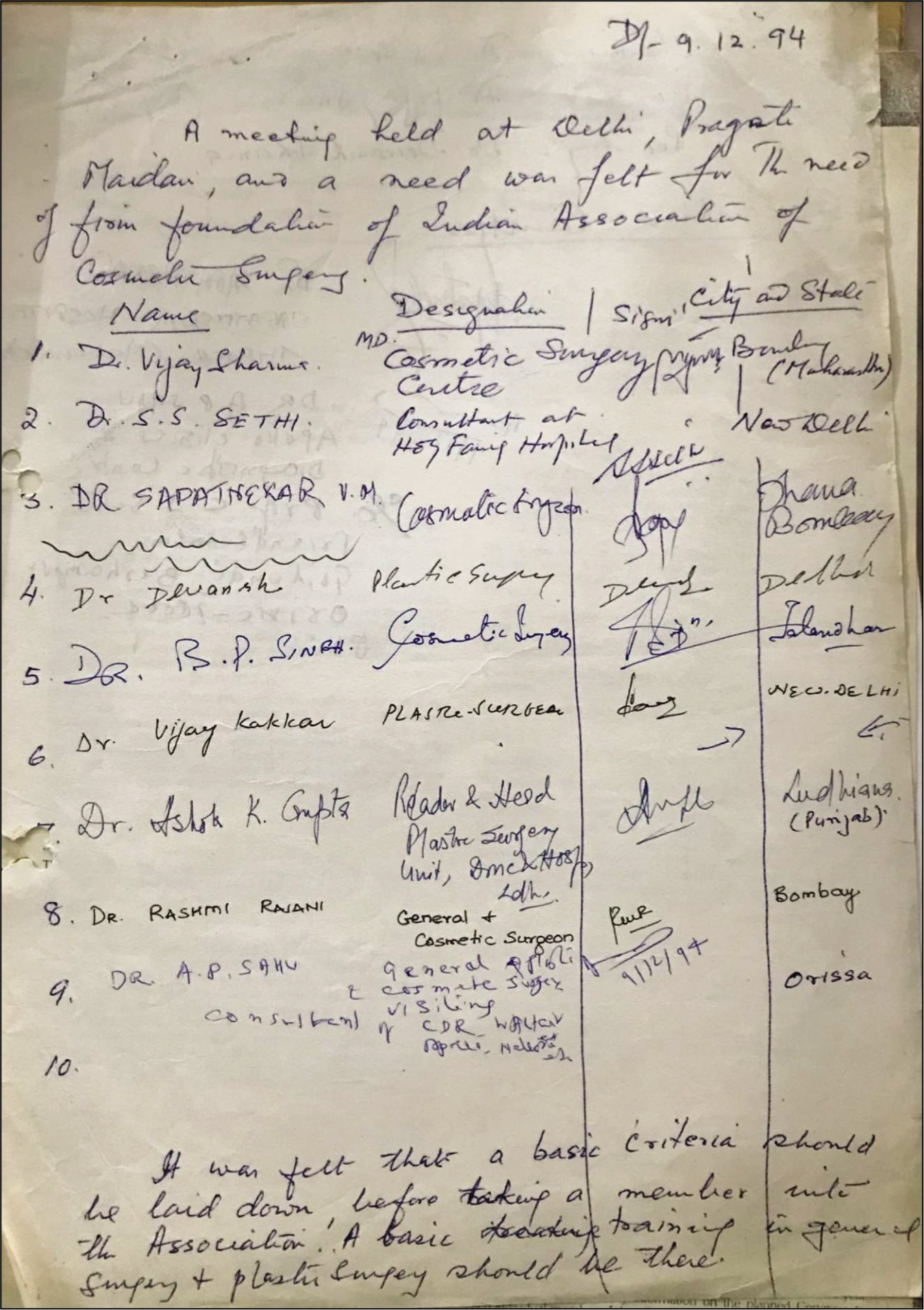
On the eve of 9 December 1994, for the first time, a group of pioneering surgeons, who dared to dream big, collected during the Third International Multi-Faculty Medical Conference (of Plastic Surgeons and Dermatologists) at Pragati Maidan, New Delhi, hosted by Dr Padam Singhvi. A small meeting was called on the sides, attended by Dr S. S. Sethi (New Delhi), Dr Devansh Sharma (New Delhi), Dr Ashok K. Gupta (DMC Ludhiana), Dr B. P. Singh (Jalandhar) and Dr Vijay Kakkar (New Delhi) who later continued as members of the IAAPS, besides some others who were not even plastic surgeons (Figure 1). A need was felt to create a separate association that would have its emphasis on training plastic surgeons about aesthetic plastic surgery. A working committee was created consisting of Chairman Dr S. S. Sethi (New. Delhi) and Secretary Dr Devansh Sharma (New Delhi). The formation of the society in accordance with the Indian Societies Act was entrusted to both to decide on the memorandum of association, name of the association, admission criteria, etc.
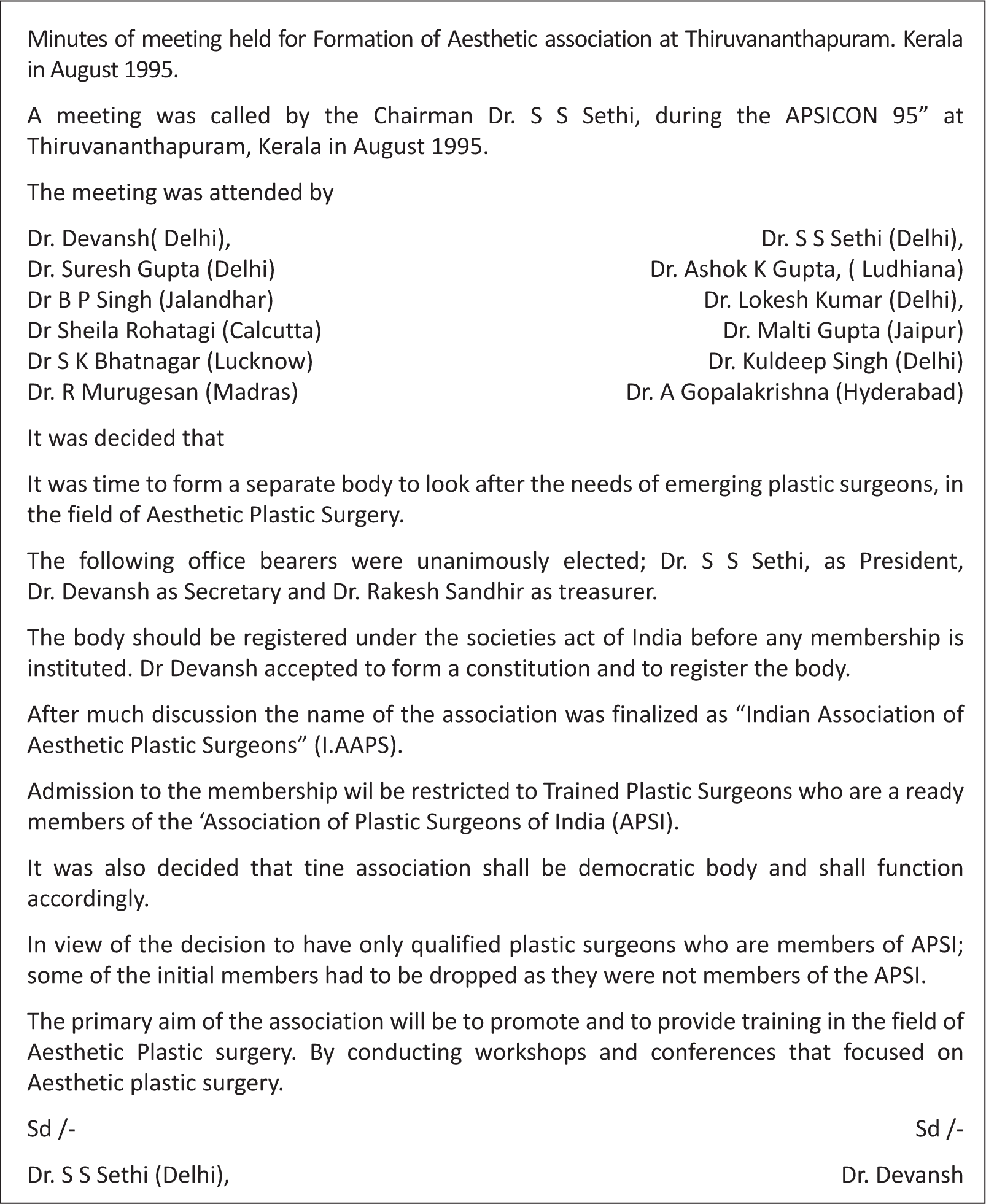
In August 1995 (Figure 2), during the APSICON at Trivandrum, it was finalised that the name of the association shall be the ‘Indian Association of Aesthetic Plastic Surgeons’ (IAAPS), and only qualified plastic surgeons, that too, members of the APSI, shall be inducted as members. The meeting was a formal formation of the association, and the signatories to the same were the following attendees from the country’s seven different States, including Dr S. S. Sethi (New Delhi), Dr Devansh (New Delhi), Dr Rakesh Sandhir (New Delhi), Dr Suresh Gupta (New Delhi), Dr Vimla Rajan (New Delhi), Dr Lokesh Kumar (New Delhi), Dr Kuldeep Singh (New Delhi), Dr Shiela Rohatagi (Calcutta), Dr Malti Gupta (Jaipur), Dr S. K. Bhatnagar (Lucknow), Dr R. Murugesan (Madras), Dr A. Gopalakrishna (Hyderabad), Dr Ashok K. Gupta (Ludhiana) and Dr B. P. Singh ( Jalandhar).
Consolidation of IAAPS
Dr S. S. Sethi became the founder president, Dr Devansh the secretary and Dr Rakesh Sandhir the treasurer in the very first executive.
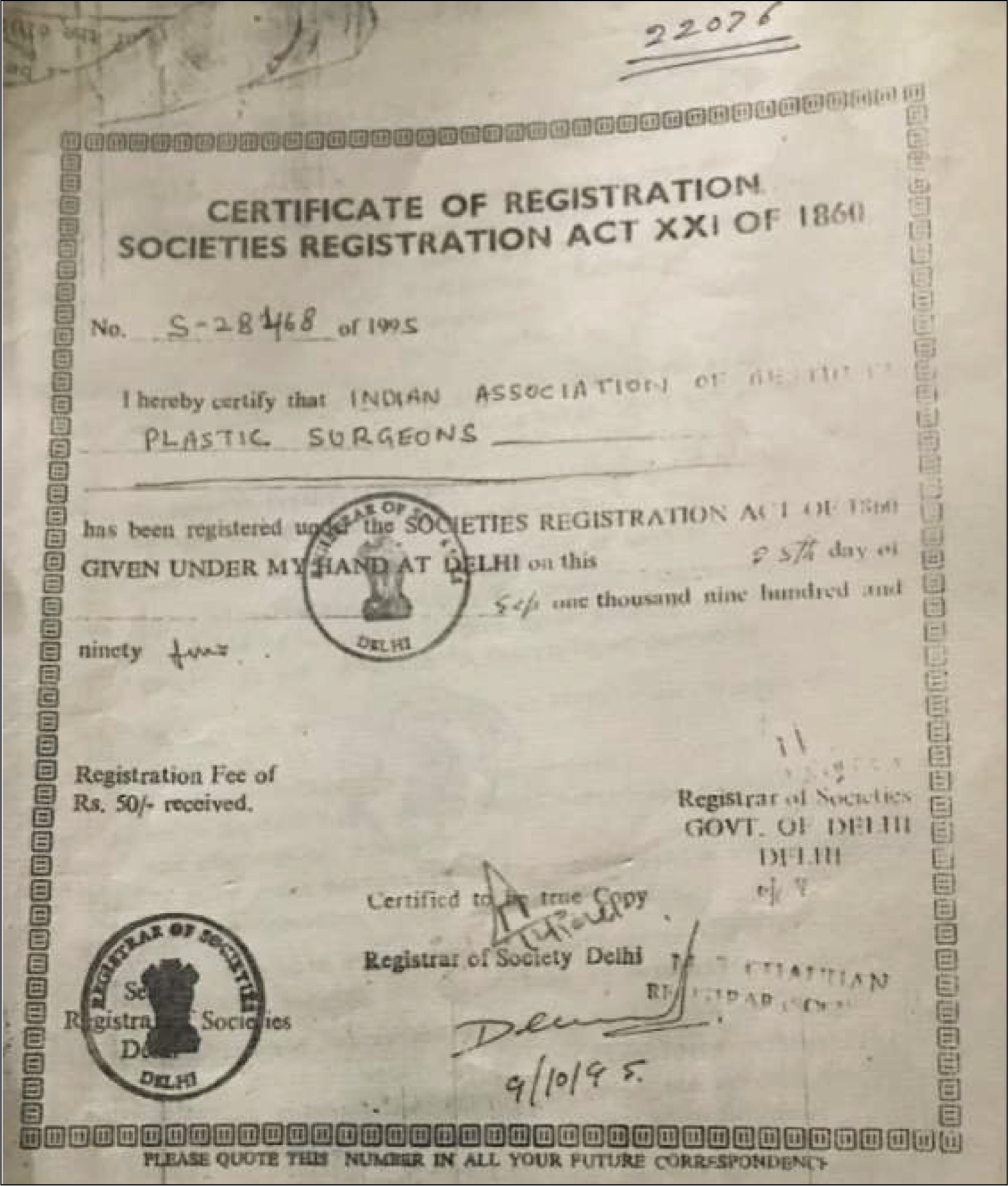
By the next month, on 28 September 1995, the Association was registered officially at the Delhi Office of the Registrar of Firms and Societies (S-28468, 1995; Figure 3).
Dr S. S. Sethi remained the Founding President for 5 years, from 1995 to 2000. These were the initial struggle years for IAAPS.
In 1996, the first workshop was held under the aegis of IAAPS, at Hyderabad, organised by Dr Ashok Gopalakrishna at the Apollo Hospital. This was a singularly unique and imaginative concept and, to date, one of its kind. Emphasis was given to understanding the human form. From an art perspective, artists who were experts in drawing faces gave lectures on facial aesthetics, including facial parameters based on Leonardo da Vinci. Even a hands-on workshop on clay moulding and sculpting was conducted. Another workshop on photography emphasised face touch-ups, lighting and glamour photography.
The second event was a live surgery workshop, held at the Apollo Hospital (New Delhi), on 9 and 10 October 1996. One case of facelift with superficial musculo-aponeurotic system (SMAS) and two cases of rhinoplasty were demonstrated, by the visiting faculty Dr Ian T. Jackson (USA) and Dr K. S. Bhangoo (USA). The highlight was it being the first-ever live demonstration of face lift (SMAS surgery), in the history of plastic surgery in India.
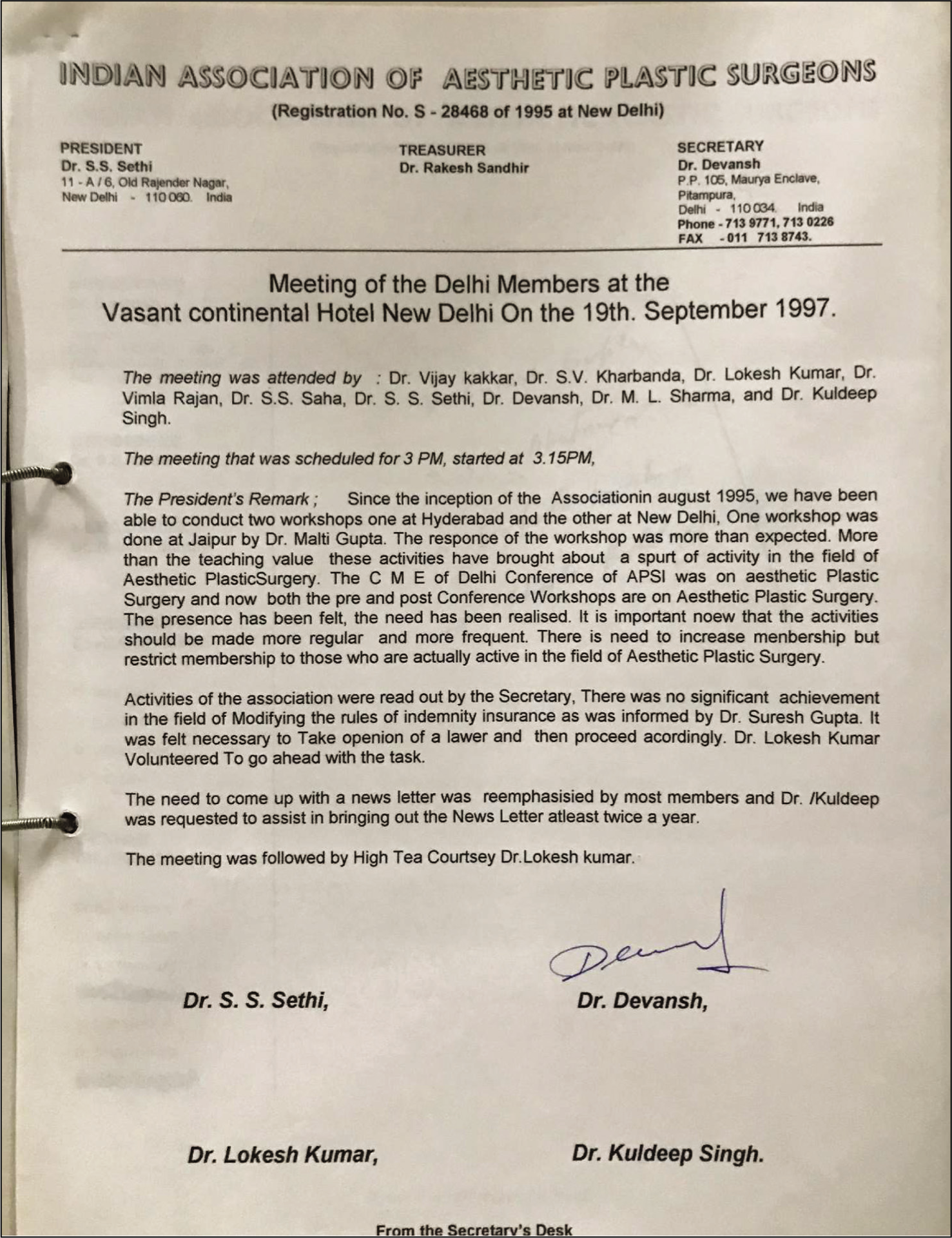
Another workshop was conducted under Dr Malti Gupta at Jaipur, in 1997. By this time, a lot of interest had developed in the subspeciality across the whole group of plastic surgeons. As a result, at the Delhi Conference of APSICON in 1997, both pre- and post-conference workshops were on aesthetic surgery. The response to both was more than expected. The presence of aesthetic surgery was being felt, and its need and importance were now being finally realised (Figure 4).
Membership during these early days was given after scrutiny of the aesthetic surgery workload and experience, and not to any and every plastic surgeon. For memberships, applications remained in waiting for long. At the Goa APSICON, in 1999, a General Body Meeting (GBM) held in a hotel room had only seven members of IAAPS. In the early years, the association was considered a bastion of the Delhi group of plastic surgeons. But gradually, as some stalwarts like Dr Davar, Dr Narendra Pandeya, Admiral J. C. Sharma and Dr Murugesan, etc., joined the association, it easily became a pan-India association.
In the year 2001, Dr S. S. Sethi ended his term. A democratic setup, bound by association rules and regulations, had crystalised by this time, and a new team under the presidentship of Dr Suresh Gupta took over for the next 2 years, with Dr Lokesh Kumar as the next secretary and Dr Kuldeep Singh as the next treasurer. Dr Suresh Gupta gave the association its magnificent Khajuraho figurine logo. These were the momentum years. Regular workshops were held at Sir Ganga Ram Hospital, New Delhi, in 2001, and at Apollo Hospitals, Chennai, in 2002.
The relationship between IAAPS and APSI remained a point of contention for many years, with persistent attempts to merge IAAPS into APSI as a chapter. Several factors contributed to this desire for integration. Organising independent meetings proved challenging due to limited budgets, difficulties in securing suitable venues and the relatively small number of faculty with expertise in aesthetic surgery. Despite these pressures, the distinct legal structures of the two associations, evidenced by their separate constitutions and registrations, ultimately and thankfully, prevented the merger.
In 2003, a workshop was held by Dr Ashok Gupta in Mumbai, with Dr Woffles Wu, Dr Vakis Kontoes and Dr Panfilov as faculty. This year was an introduction to the non-surgical modalities in cosmetic practice with a focus on neurotoxins and lasers. Dr Ashok Gupta was also the National Secretary of the ISAPS when he became the President of IAAPS. Based on the positive feedback of the 2003 workshop from the foreign faculty, an alliance was forged, the Education Foundation of the ISAPS supported and conducted a joint instructional course in association with IAAPS, at Jaipur in 2004, thus lending the association further credibility and recognition on the international arena. Ever since, in most years, the ISAPS has been an accompaniment of the annual National Conferences of IAAPS, which has since remained a Global Alliance member of the ISAPS.
In 2005, a conference was held at Dayanand Medical College (DMC), Ludhiana, on body sculpting and implants. Another workshop in 2006 at Sir Ganga Ram Hospital (New Delhi) was held with Dr Yves Gerard Illouz, the father of liposuction, as faculty, besides Dr James G. Hoehn (New York), Secretary General IPRAS. In 2005 again, another event was held at the same venue with Dr Bacci, Dr Abdul Reda Lari (Kuwait) and Dr Moris Topaz (Israel) as faculty. Incidentally, both the latter were made and to date continue as Honorary Overseas Members of the IAAPS.
AESURG and Growth of IAAPS
In 2006, the IAAPS shifted its focus from smaller workshops to larger annual conferences, incorporating general body meetings into these events. Dr Manoj Khanna led the way with the first such conference in February 2006, though organised in collaboration with the Association of Plastic Surgeons of West Bengal. The following year, in 2007, Dr Rakesh Kalra (the author), volunteered to organise the first truly independent, fully autonomous IAAPS conference in Mussoorie, at which time the designation ‘AESURG’ coined by him was adopted for the association’s annual conferences.
AESURG, in the ensuing years, combined academics, cultural programmes, administrative work, elections and change of guard. Both the above-mentioned conferences were held during the Presidentship of Dr Devansh Sharma. The trend for exotic locations continued now with presidents organising the same: Dr Lokesh Kumar at Agra and Khajuraho in 2008 and 2009, Dr K. Ramachandran at Port Blair and Poovar in 2010 and 2011 and Dr Murugesan at Kodaikanal and Mahabalipuram in 2012 and 2013. Dr Satish Arolkar organised the IAAPS at Nasik and Neemrana in 2014 and 2015, the last one witnessing the first-ever live webinar for IAAPS by Dr Al Aly.
The financial health of the IAAPS became more robust with savings from these conferences, which were at this stage relegated to fund orations of the future.
Several key changes were implemented within the IAAPS around this time. Membership policies became more inclusive, with associate memberships extended to plastic surgery residents and the elimination of the prerequisite for a minimum number of meeting/conference attendances. The previously stringent membership approval process, overseen by a small committee of senior members only, was democratised and transferred to a vote by the general body at annual meetings. Additionally, the presidential term was reduced from 2 years to 1 year, a change driven by a desire among many deserving senior members to lead the association. This shorter term fostered broadening opportunities, a more dynamic leadership and facilitated greater organisational progress.
AESURG came back to Kolkata under Dr Manoj Khanna in 2016, to Gangtok in 2017 under Dr Anup Dhir, Udaipur in 2018 under Dr Kuldeep Singh and Lonavala in 2019 under Dr Neeta Patel. Next, the AESURG went to the high seas, for the first time ever, on an exotic cruise out of Mumbai under Dr L. D. Dhami in 2020. The timing of this conference proved fortuitous, as it narrowly avoided the global spread of COVID-19, which subsequently impacted Dr Rakesh Kalra’s term and prevented an in-person AESURG in 2021.
The pandemic, however, became an unexpected catalyst for innovation. The IAAPS pivoted to online platforms, hosting a surge of academic activities, including video meetings, live Instagram sessions and webinars under the banner of ‘Aesthetic Paathshala’. This new format also facilitated the IAAPS’s Silver Jubilee celebration and its first online elections. During this period, the association relaxed its membership criteria, eliminating the requirement of prior APSI membership and leading to a surge in applications. The increased use of online platforms, particularly Zoom meetings, sowed the seeds of alliances, fostering collaborations between the IAAPS and numerous national aesthetic surgery organisations worldwide.
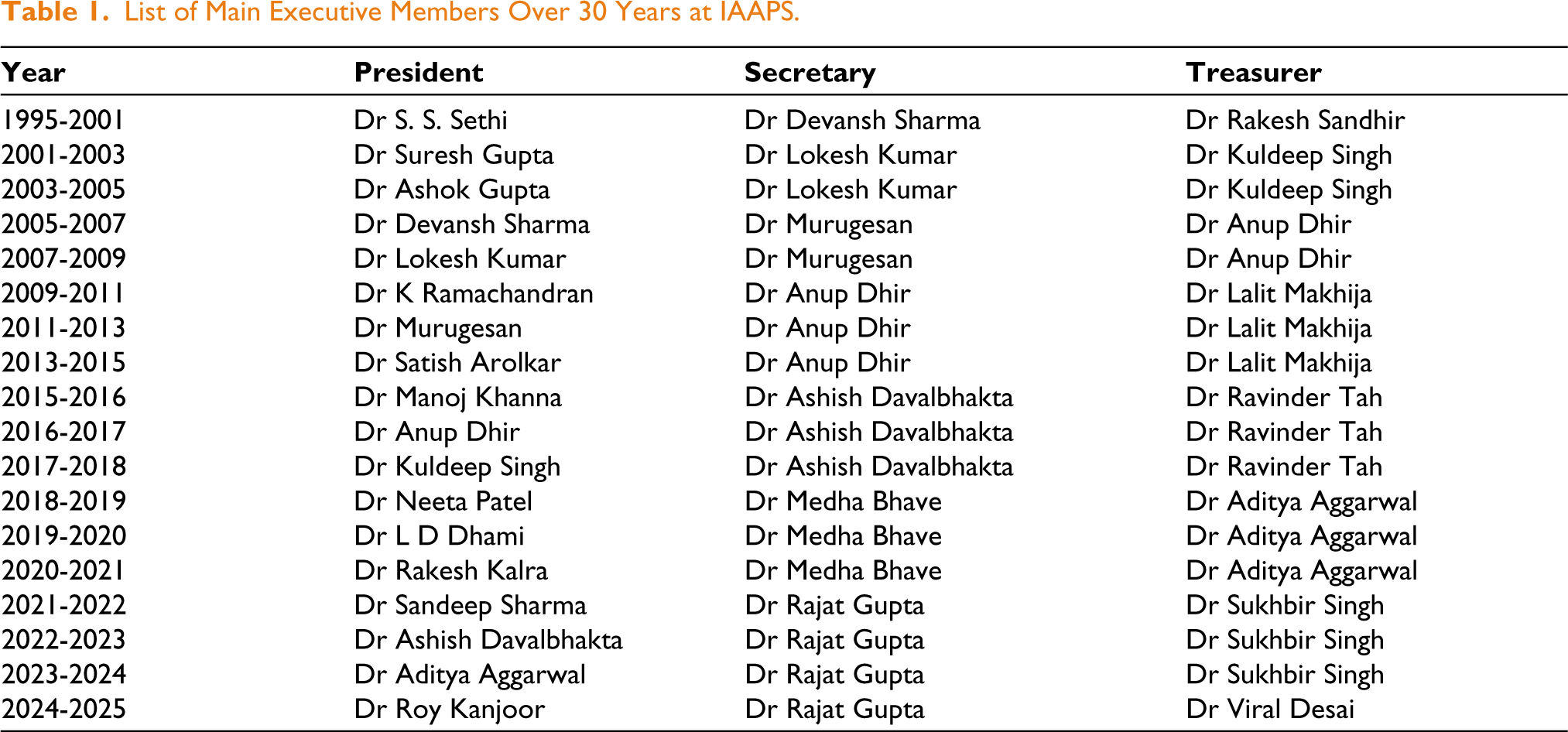
List of Main Executive Members Over 30 Years at IAAPS.
All such activities increased multi-fold with the normalisation of the pandemic by the coming year, which also saw a huge revival of interest in personal attendance, breaking all records at AESURG 22 at Goa under Dr Sandeep Sharma. From there once again, there was no looking back. AESURG 23 happened under Dr Ashish Davalbhakta at Aambey Valley City, Lonavala, AESURG 24 under Dr Adiya Agarwal at Gurugram, NCR and now, at the time of this publication, AESURG 25 is scheduled at Coimbatore and Ooty under Dr Roy Kanjoor. Each has been getting better and better, vying with the previous one in terms of serious academics, foreign participation, class trade exhibitions, spirited cultural activities, delicious cuisines and more. With each passing event, one is left wondering how the next one will surpass this one at all, but each coming year dispels such scepticism.
Spreading Wings
The quality of instruction within educational institutions has undergone a notable improvement, attributable in large measure to the contributions of faculty with a strong interest in aesthetics. Post-residency training opportunities for aspiring aesthetic surgeons have likewise expanded, with fellowships now offered at private centres accredited by the IAAPS under its ‘Gurukul’ programme. A wide array of educational resources, including free or subsidised webinars, workshops and hands-on training sessions, is readily accessible. The IAAPS further demonstrates its commitment to education through dedicated faculty outreach initiatives and the conferral of honorary overseas memberships upon distinguished international faculty.
The IAAPS is committed to protecting the public by promoting ethical aesthetic practice. Its outreach efforts include active engagement on social media (Instagram, Facebook and YouTube), a comprehensive website (
IAAPS has laid claim to various surgical procedures by publishing its own syllabus, which is so comprehensive that the same has been incorporated by all academic departments across the country offering DNB or MCh courses.
The IAAPS proactively supports its members through legal assistance, negotiated indemnity insurance and intervention in individual practice matters. Furthermore, it champions fair trade practices within the industry and provides advocacy and guidance to members dealing with vendor issues.
Those from a previous generation can attest to the challenges of learning aesthetic surgery in its early days. Medical colleges offered no formal instruction, textbooks were scarce and specialised instruments were simply not available. It was a slow, often frustrating, process of self-education only. On the other hand, the IAAPS has now played a crucial role in the remarkable growth of aesthetic surgery. This progress, now evident in a thriving 1200-plus-member association, reflects the contributions of many dedicated teams over time.
The launch of its academic mouthpiece, the International Journal of Aesthetic Surgery, marks a significant milestone for the IAAPS, promising a bright future. The association is poised for a quantum jump in its growth in the next 30 years, far surpassing the progress made in its first three decades.
Conclusion
This history, a journey into the past, is a tribute to those who carried us forward, those who charted the course of aesthetic surgery and a remembrance of those who now live only in our memories.
George Santayana’s famous words—‘Those who cannot remember the past are condemned to repeat it’—underscore the importance of understanding history to prepare for the future.
The association’s success is a testament to the vision and dedicated efforts of its past members, and those Executive Members at the helm of affairs (Table 1). These established rich traditions ensure the smooth operation and continued success of its activities, maintain effective governance and drive ongoing progress. With such a strong foundation and robust heritage, the association is well-poised for sustained growth and a bright future.
Footnotes
Declaration of Conflicting Interests
The author declared no potential conflicts of interest concerning the research, authorship and/or publication of this article.
Funding
The author received no financial support for the research, authorship and/or publication of this article.