



Abstract

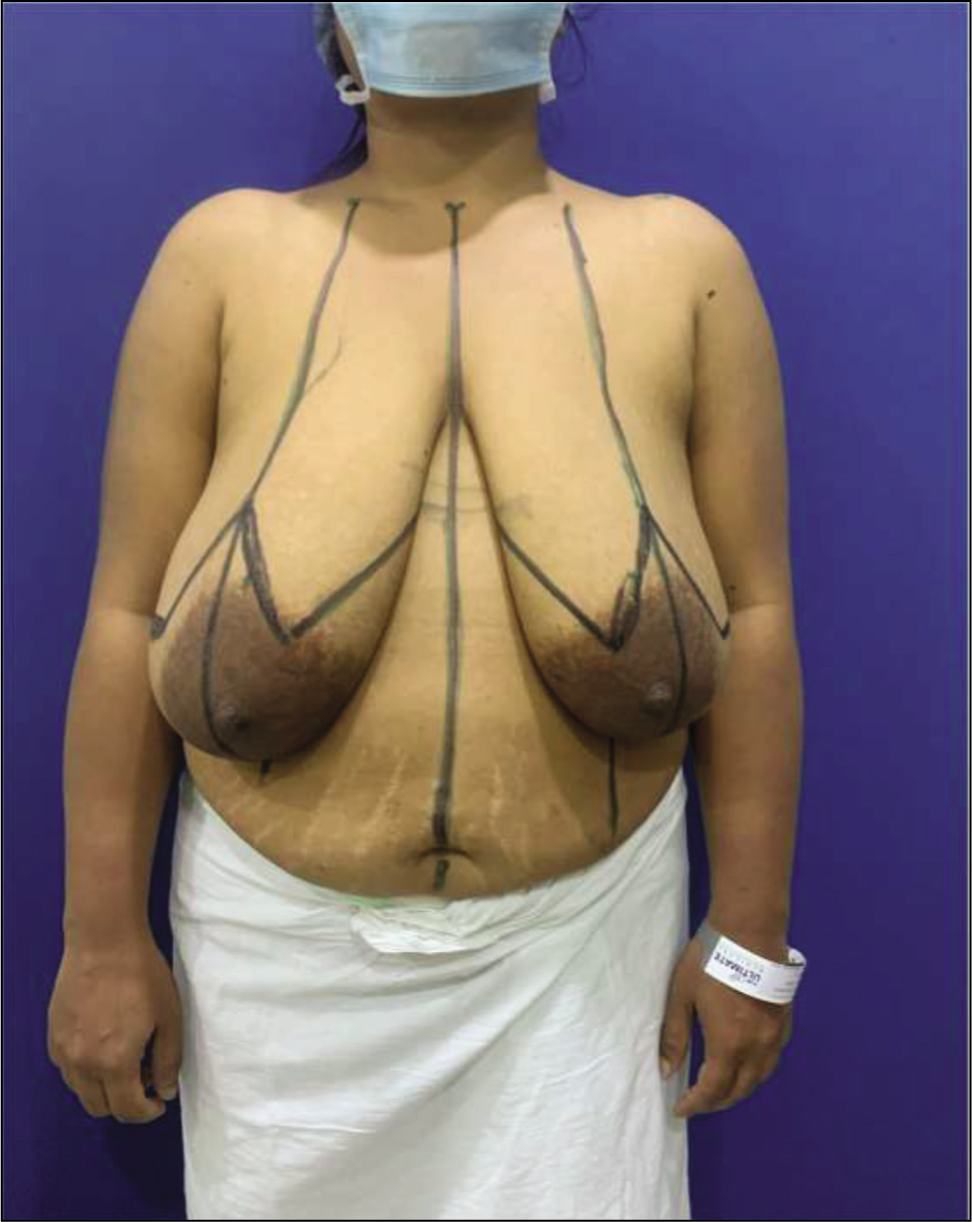
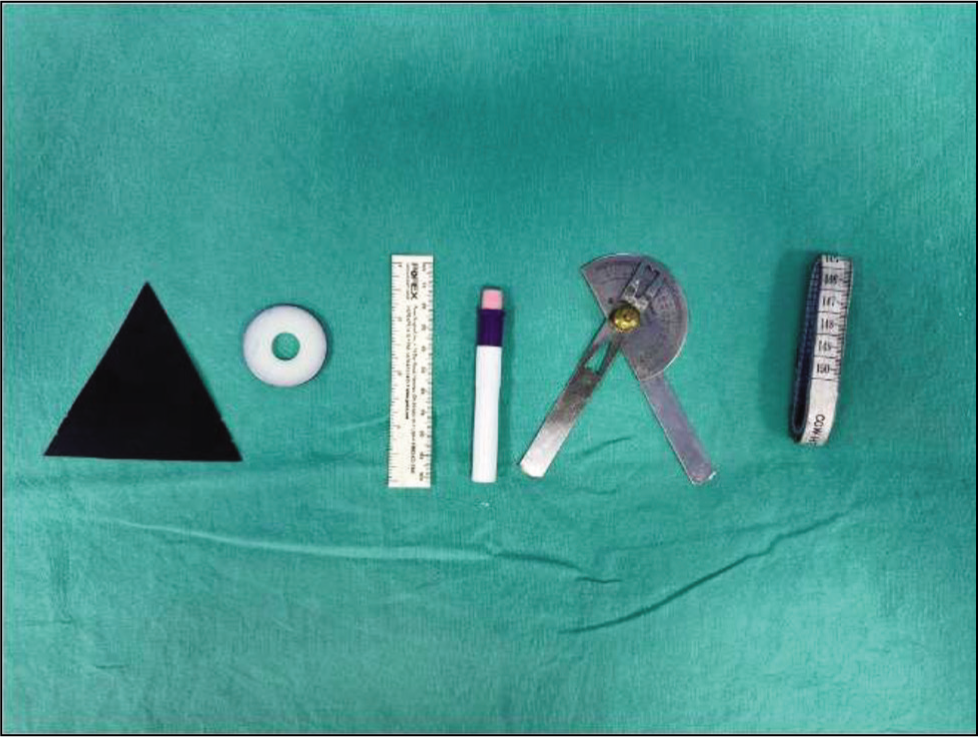
Reduction mammoplasty can be performed by variety of technique with various pedicle orientations resulting in two types of scars—short scar and inverted T scar. Inverted T technique is diverse and can be applied in majority. Original inverted T technique by Robert Wise 1 has undergone numerous modifications over the years. The classic inverted T pattern had vertical and horizontal limbs with a keyhole pattern at the apex for insetting nipple areola complex. I have adopted a variation of it which has made my marking simple and easy with consistent good results. First the sternal midline is delineated. Then the breast meridian is delineated bilaterally bisecting the midline of breast. Any pre-existing asymmetric position of the NAC (Nipple Areola Complex) can be corrected by centering the nipple along the breast meridian and measuring distance from sternal midline and sternal notch. Inframammary fold is delineated and ideal nipple position is marked based on it with free hand. Now I use an isosceles triangle (9cm) template made up of X ray plate (Figure 2). I keep the apex of the template at the marked nipple position bisecting the marked breast meridian. Vertical limb is defined by marking lowest two points of the template on either side of breast meridian. Horizontal limb is marked by drawing a line from inferior point of both vertical limbs to lateral and medial limits of inframammary fold (Figure 1). Keyhole pattern is drawn centering on apex of the triangle. Angle of the triangle at the apex can be modified (50° to 70°) depending upon the width of breast. Even the length of vertical limb can be adjusted (8cm to 9cm) depending upon volume of breast. This approach actually eliminates the guesswork of marking medial and lateral pillars of the breast by moving breast to different sides manually during marking. I find this marking method very simple, easy to replicate and it has produced consistent and good results in my series of reduction mammoplasty.
Complete Inverted T Marking
X ray Template and Other Materials for Measurement and Marking
Footnotes
Acknowledgements
The author acknowledges the patient for her understanding about the technology and the implant.
Declaration of Conflicting Interests
The author declared no potential conflicts of interest with respect to the research, authorship and/or publication of this article.
Ethical Considerations
Ethical committee approval was not required as the principle of the technique is an established one and published in Text Book (Peter C Neligan 4th Edition Chapter 9).
Funding
The author received no financial support for the research, author-ship and/or publication of this article.