




Abstract
Introduction:
Botulinum toxin injections have gained popularity in cosmetic surgery for enhancing shoulder aesthetics. This systematic review explores the effectiveness and safety of Botulinum toxin injections in contouring the trapezius muscle.
Objectives:
To assess the efficacy and safety of Botulinum toxin in shaping the contour of the trapezius muscle for shoulder aesthetics.
Methods:
We systematically reviewed peer-reviewed articles, clinical trials and case studies. Inclusion criteria included studies reporting the use of Botulinum toxin for trapezius contouring. Data were extracted using PRISMA guidelines.
Results:
Our review included nine studies. Botulinum toxin injections in the trapezius muscle were effective to variable extents in enhancing shoulder aesthetics in all 121 (100%) cases. Primarily mild and transient adverse events, such as temporary weakness or discomfort at the injection site, were reported in 13 (10.7%) cases.
Discussion:
The findings suggest that Botulinum toxin type A can be a valuable tool for changing the trapezius contour for improved shoulder aesthetics. The adverse events reported in the literature were generally mild and transient, indicating a favourable safety profile. Further research is needed to address limitations and optimise injection techniques.
Conclusion:
Botulinum toxin type A injections show promise in contouring the trapezius muscle for improved shoulder aesthetics. Further research should focus on refining injection protocols, standardising outcome measures and addressing safety concerns to maximise the benefits of this procedure for patients seeking shoulder enhancement.
Abbreviations
BoNT-A: Botulinum toxin A
GAIS: Global Aesthetic Improvement Scale
PRISMA: Preferred Reporting Items for Systematic Reviews and Meta-Analyses
Introduction
Over the past few decades, Botulinum toxin has emerged as a versatile tool in aesthetic medicine, revolutionising how patients and practitioners approach aesthetic enhancements. This neurotoxin, renowned for its ability to temporarily paralyse targeted muscles, has found widespread use in reducing facial wrinkles and fine lines, effectively turning back the clock on ageing skin. However, the applications of Botulinum toxin extend beyond the face, with potential implications for other aspects of cosmetic enhancement. Despite the growing popularity of Botulinum toxin injections for cosmetic purposes, there is limited research on its effectiveness and safety in contouring the shoulder by targeting the trapezius muscle. While much attention has been directed towards facial rejuvenation, the aesthetics of the shoulder area have received comparatively less focus despite their significant contribution to overall body aesthetics. This gap in the literature underscores the importance of investigating the efficacy and safety of Botulinum toxin injections in enhancing shoulder aesthetics.
This study aims to fill this research gap by systematically reviewing the existing literature, shedding light on the role of Botulinum toxin in enhancing shoulder aesthetics and addressing the need for evidence-based guidance in this specialised area of cosmetic medicine. By synthesising available evidence, this review aims to provide valuable insights into the efficacy and safety of Botulinum toxin injections for trapezius muscle contouring.
Methodology
Literature Search
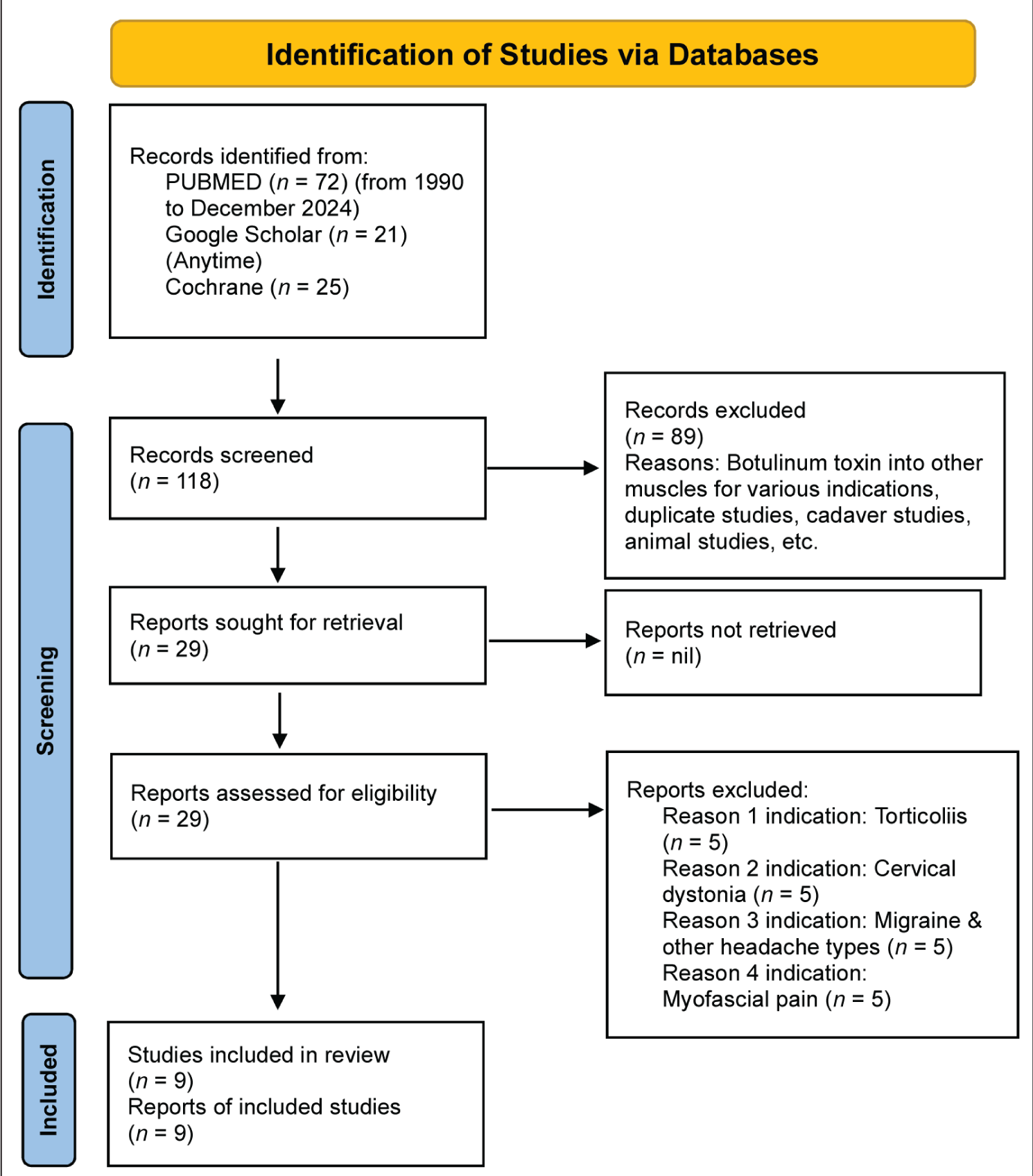
In order to enhance the robustness and comprehensiveness of this systematic review, an expanded search strategy was implemented to include a broader range of databases and sources like PubMed, Google Scholar and Cochrane Library to capture a more diverse set of studies on Botulinum toxin injections for trapezius muscle contouring (Figure 1). Grey literature, conference proceedings and consultation with experts in the field were also utilised to identify relevant unpublished or ongoing studies. The search included articles published up to 31 December 2024 and encompassed studies involving Botulinum toxin injections in the trapezius muscle. The search strategy used a combination of keywords and Medical Subject Headings (MeSH) terms, including ‘Botulinum toxin’, ‘Trapezius muscle’, ‘shoulder aesthetics’ and related terms. Boolean operators (AND, OR) were used to refine search results.
Inclusion and Exclusion Criteria
Inclusion and exclusion criteria were clearly defined and justified to ensure transparency in the selection process. Articles considered for inclusion were required to be published in peer-reviewed journals, encompass studies involving Botulinum toxin injections in the trapezius muscle, and be available in English. Studies failing to meet the defined inclusion criteria or lacking relevance to the specific focus of this systematic review were excluded from consideration.
Study Selection
By specifying the population, intervention, outcomes and study design criteria in alignment with the research objectives, the selection process was guided by a structured framework that aimed to encompass all relevant literature in this specialised area of cosmetic medicine. The initial search yielded twenty-nine articles showing the use of Botulinum toxin A in trapezius for various clinical and aesthetic indications. Out of these, nine articles were finally selected for inclusion in the study. Two independent reviewers (KMK and AB) screened these articles to assess their relevance to the research question. Any reviewer discrepancies were resolved through discussion or consultation with a third reviewer (TP).
Data Extraction
Systematic extraction of data from the selected articles was performed. The extracted information included study characteristics such as title, authors, publication year and study design. Additionally, patient characteristics, intervention details (Botulinum toxin type, dosage) and outcomes (changes in trapezius muscle contour, patient satisfaction, adverse events) were systematically collected.
Data Synthesis and Analysis
A narrative synthesis of the findings from the selected studies was conducted. The results were summarised with a focus on the effectiveness and safety of Botulinum toxin injections in trapezius contouring.
Reporting Guidelines
This systematic review uses the Preferred Reporting Items for Systematic Reviews and Meta-Analyses (PRISMA) guidelines in order to ensure transparency and rigour in reporting the findings.
Results
Study Selection
Twenty-nine articles were initially identified through a literature search from PubMed and Google Scholar. Nine studies were included in this systematic review after screening for relevance and applying inclusion and exclusion criteria. These nine studies involved 121 cases of Botulinum toxin injections in the trapezius muscle for aesthetic purposes.
Dosage and Duration
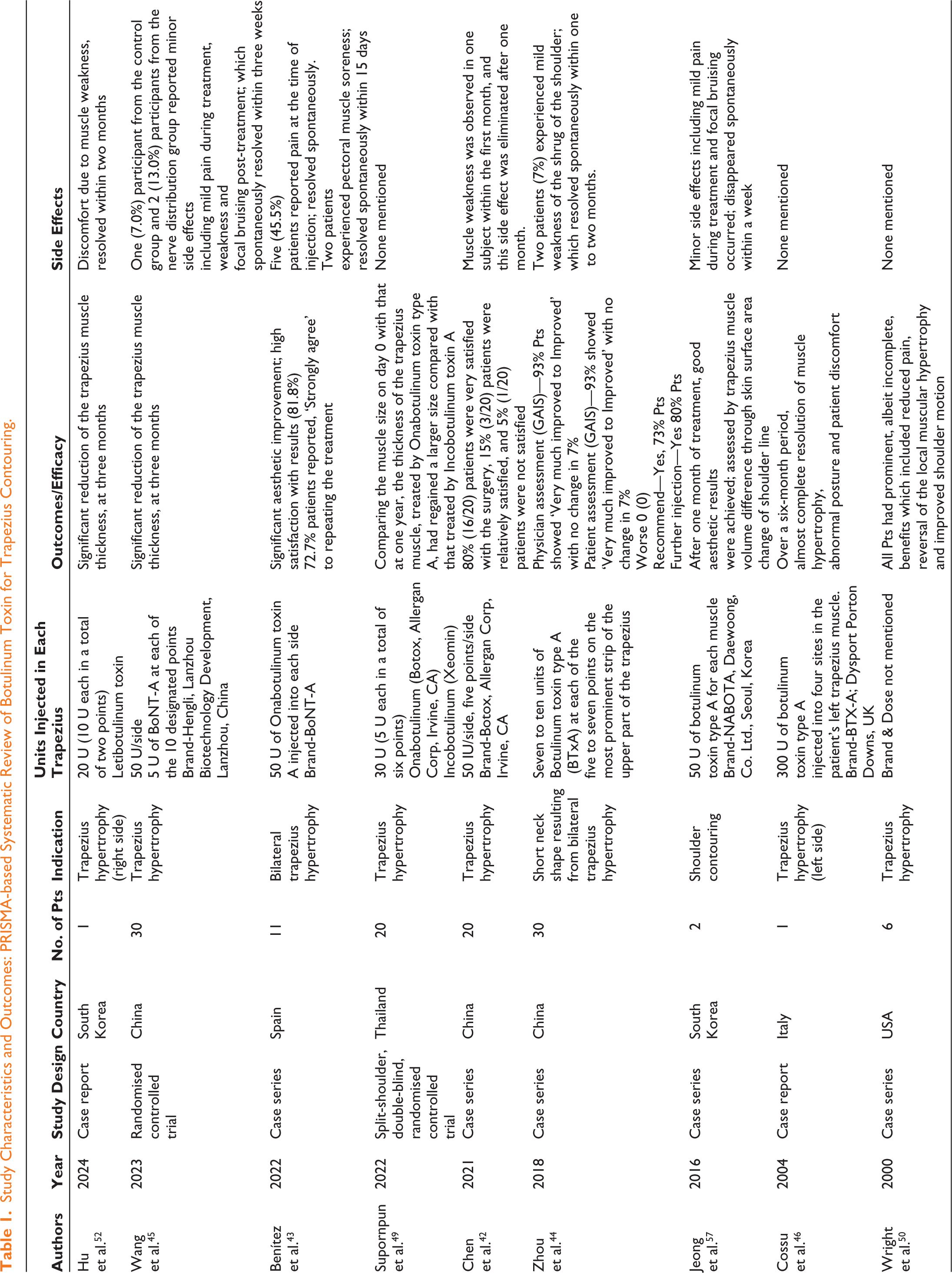
The dosage of Botulinum toxin used in these studies for trapezius contouring ranged from 20 U to 50 U on each side. The duration of the observed effects varied but was generally consistent, with results lasting approximately four to five months following injection.
Adverse Events
Among the 121 cases reviewed across all studies, 13 patients (10.7%) reported experiencing mild weakness in the trapezius muscle after Botulinum toxin injection. This weakness was generally noted some days after the procedure and typically improved within one to two months. No severe or long-lasting adverse events were reported across the included studies. Detailed analysis is shown in Table 1.
Study Characteristics and Outcomes: PRISMA-based Systematic Review of Botulinum Toxin for Trapezius Contouring.
Effectiveness
The studies consistently reported positive outcomes regarding trapezius muscle contouring for shoulder aesthetics. In most cases, patients exhibited improved shoulder aesthetics, reduced muscle bulk and improved contour following Botulinum toxin injections.
Patient Satisfaction
Although specific data on patient satisfaction were not consistently reported in all studies, some of them suggested high patient satisfaction with the aesthetic results achieved through trapezius contouring using Botulinum toxin.
Summary of Key Findings
This systematic review of nine studies, comprising 121 cases, indicates that Botulinum toxin injections in the trapezius muscle are an effective and well-tolerated method for contouring the shoulder. The dosage range of 20-50 U per side resulted in aesthetically pleasing outcomes that typically lasted four to five months. Mild weakness, a transient side effect, was reported by a small percentage of patients but generally resolved within one to two months. The findings suggest that Botulinum toxin can be a safe and valuable tool in enhancing shoulder aesthetics through trapezius muscle contouring.
Discussion
The Botulinum toxin type A injection in trapezius is well known due to its successful clinical use for disorders such as myofascial pain syndromes,1–7 migraine,8–16 and other headache types17–23 and cranial-cervical dystonia.24–37
The trapezius muscle in humans can be divided into three distinct parts, which can be contracted separately. This separation reflects the fact that, in our ancestors, the trapezius complex actually included three distinct muscles, which can still be seen in many modern mammals. 38 During human evolution, these three muscles fused into a single trapezius muscle: The superior part, which consists of descending fibres with occipital and lateral third clavicular attachments, might reach the lateral portion of the scapula. Therefore, apart from elevating the scapula, the superior head can laterally rotate the scapula, as well as indirectly contribute to the abduction of the arm; the middle part, which comprises transverse fibres with vertebral, acromial and scapular spine attachments and thus retracts the scapula; and the inferior part, which consists of ascending fibres with vertebral and scapular spine C7 to T12 attachments and inserts near the medial end of the scapular spine, depressing the scapula. 39
The trapezius muscle may exhibit variations in its development, including partial or complete absence, reduction in attachment points and asymmetry between the left and right sides. 40 Some researchers have suggested a possible connection between the trapezius muscle and torticollis. The trapezius muscle also plays a significant role in neck and shoulder aesthetics and contouring due to its size, location and influence on the upper body’s appearance. 41
Botulinum toxin A injections in the trapezius muscle for shoulder aesthetics is a novel application that has recently gained attention. This procedure aims to improve the appearance of the shoulders by altering the shape and contour, resulting in a more aesthetically pleasing silhouette. The concept of ‘Barbie Botox’ refers to Botulinum toxin A injections in the trapezius to achieve a particular aesthetic ideal, often associated with the slender and toned physique epitomised by the Barbie doll. The Barbie-inspired Trapezius Botulinum toxin or term ‘Trap Tox’, also known as Neck Toning or Shoulder Slimming, refers to injecting Botulinum toxin into the trapezius muscles, causing a reduction in motor function of the trapezius, leading to muscular atrophy and volume loss, thus potentially creating a more graceful, elongated, smoother and slender neck appearance. However, only some studies have reported about the Botulinum toxin injection methods for trapezius hypertrophy.33,42–50
In this systematic review, we examined the role of Botulinum toxin in contouring the trapezius muscle for shoulder aesthetics, drawing upon nine studies that collectively involved 121 cases. Our analysis sheds light on the effectiveness, safety and potential implications of this innovative approach.
The findings of our review consistently demonstrate the effectiveness of Botulinum toxin injections in achieving the desired contour of the trapezius muscle for improved shoulder aesthetics. Across the included studies, patients exhibited noticeable reductions in muscle bulk and improved shoulder aesthetics following the injections. This outcome aligns with Botulinum toxin’s well-established mechanism, temporarily paralysing the targeted muscle by inhibiting acetylcholine release at the neuromuscular junction. 51 As a result, muscle contractions are reduced, leading to muscle atrophy and a smoother, more aesthetically pleasing appearance.
For body contouring, 100 U of Botulinum toxin are dissolved in a total volume of 5 mL, which includes 4.8 mL of normal saline and 0.2 mL of epi-lidocaine, resulting in a concentration of 2 U/0.1 mL. The larger reconstitution volume facilitates the effective diffusion of Botulinum toxin into the expansive muscles. Adding 0.2 mL of epi-lidocaine (1:100,000 epinephrine) slows the rapid movement of Botulinum toxin into the systemic circulation due to the muscle’s dense vascular network. Typically, procedures use a 30-gauge needle that is 0.5 inches (1.25 cm) long. 52
The dosage range of 20-50 U on each side was notably effective in achieving the desired outcomes, with the effects lasting approximately four to five months. This duration aligns with the typical longevity of Botulinum toxin effects observed in other aesthetic and therapeutic applications. The short-lived nature of the muscle paralysis allows for reversibility, providing patients with the flexibility to maintain or adjust their shoulder aesthetics as desired.
A study done for shoulder line contouring reported a widening of neck-shoulder angle from 116° to 122° after two months of 50 U (divided over 10 points) of BoNT-A injection into each side of the trapezius. 53 The importance of placing Botulinum toxin directly into the NMJ region of a muscle has been emphasised since injections placed only 5 mm away from the NMJ caused a 50% decrease in paralysis. 54 It is recommended that the Botulinum toxin injections should be placed between 60.0% and 80.0% distance of a reference line extending from the most lateral point of external occipital protuberance extending to the most lateral point of the acromion. 55
It is essential to standardise the injection procedures in order to improve the therapeutic effects, especially the locating method for injection sites. In order to deliver the drug appropriately, Botulinum toxin type A injections have been carried out under the guidance of an ultrasound scanner. 42 The thicknesses of the trapezius muscle were measured at various locations using the ultrasound scanner to locate the thickest point of the trapezius, followed by labelling the other four points around the first point with a distance of 2 cm. 42
When administering Botulinum toxin, each segmented area of the upper trapezius muscle should be the target site. The most intricate pattern of injection is found laterally in the neckline contour. For accurate targeting, imaginary lines extending from the neckline’s lateral edge to the clavicular border are utilised when viewed from the front. The injection focus should be on these designated areas. The recommendation is to inject into the medial half, as the lateral half presents a risk of harming the accessory spinal nerve, which enters at this point. One of the studies implemented 20 U of Letibotulinum toxin, with each injection delivering 10 U. 52
Several studies described the intramuscular nerve branching and the pattern of the perforating branch of the accessory nerve in the trapezius muscle, providing essential information for botulinum neurotoxin injection. The nerve distribution method was more effective than the conventional injection method in reducing the trapezius muscle thickness, shoulder area proportion and shoulder angle at three months and showed longer-lasting effects. 45
In another study, a modified Sihler’s staining method was conducted on specimens of the superior trapezius, totalling 16 specimens, to identify optimal injection sites. The neural distribution exhibited the most extensive branching patterns within the horizontal section (between 1/5 and 2/5) and vertical section (between 2/4 and 4/4) of the superior trapezius muscle. 56
One key concern in any medical procedure, including aesthetic treatments, is safety. Our review found that using Botulinum toxin for trapezius contouring demonstrated a favourable safety profile. The reported adverse events were primarily mild and transient, with 13 patients (10.7%) experiencing mild weakness in the trapezius muscle. Significantly, this weakness improved within one to three months without any long-term or severe complications reported.
According to recommended dose ranges for Botulinum toxin for cervical dystonia, spasticity and myofascial pain, an injection of no more than 100 U per shoulder is recommended. After 50 U injection in each shoulder, injection of additional Botulinum toxin on the more hypertrophic side is recommended. 57 Neck muscle weakness and diffusion of Botulinum toxin to the origin of the deltoid muscle, which may inhibit shoulder joint extension, can be avoided by injection at predefined points. 44
In clinical applications, the injection site is confined to the upper portion connecting the neck (C7, spinous process of vertebra prominence) and shoulders (acromion). The main trunk of the accessory nerve is distributed from the foramen ovale down to the trapezius and sternocleidomastoid muscle, while the perforating branch innervated descendant part of the trapezius muscle about 2 cm medial to the trapezius muscle. Injury to this nerve can cause shoulder muscle wasting, scapula winging and weakness of shoulder abduction and external rotation. Therefore, considering nerve distribution and homogenous outcome, injection points were designed at the middle area of an imaginary line from the C7 to the acromion process; the interval between each point of the injection was 1 inch. 49
There will be a sense of breakthrough when the needle pierces into the muscles. Importantly, caution should be exercised to avoid the apex of the lung, which is located 2-3 cm above the medial part of the clavicle. 44
Different Botulinum toxin preparations may have relevant clinical implications in safety, efficacy and duration of action since the dosing and product performance of the different BoNTAs are not interchangeable. 43
It is essential to note that the transient weakness observed is a known and expected side effect of Botulinum toxin injections. The reversible nature of this effect provides a safety net for patients, allowing them to regain normal muscle function as the toxin’s effects wear off. Nonetheless, proper patient counselling and informed consent are paramount to managing expectations and addressing any concerns regarding potential adverse events.
Beyond the clinical outcomes, patient satisfaction is an essential factor in assessing the success of any aesthetic procedure. While specific data on patient satisfaction were not consistently reported across the included studies, anecdotal evidence suggests a high level of contentment among patients who underwent trapezius contouring with Botulinum toxin. Patients typically expressed satisfaction with the aesthetic results, highlighting their positive impact on their self-esteem and body image.
A 5-point Likert scale (strongly disagree, disagree, neither agree nor disagree, agree and strongly agree) has been used to evaluate the patient’s satisfaction. The scale consists of two questions: Are you satisfied with the treatment results? Would you repeat the treatment? 43
Aesthetic correction has been scored using the Global Aesthetic Improvement Scale (GAIS), a 5-point scale for rating the aesthetic appearance of the neck. The rating categories were grouped as ‘1—worse’, ‘2—no change’, ‘3—improved’, ‘4—much improved’ and ‘5—very much improved’. 44
The implications of our findings are significant for both patients and practitioners in the field of cosmetic medicine. Trapezius contouring using Botulinum toxin injections offers a minimally invasive and temporary solution for individuals seeking to enhance their shoulder aesthetics. This approach provides patients with an alternative to surgical interventions, reducing the associated risks, downtime and scarring.
Moreover, the relatively short duration of the effects allows patients to experiment with different aesthetics and make adjustments over time, providing a dynamic and personalised approach to shoulder contouring. Practitioners can leverage this flexibility to tailor treatment plans to individual patient preferences and needs.
Limitations and Future Directions
While this systematic review provides valuable insights into the use of Botulinum toxin injections for trapezius contouring, it is important to acknowledge certain limitations that may impact the generalizability and depth of the findings. The limited number of studies included in this review underscores the need for further research in this specialised area of cosmetic medicine. Future studies should aim to conduct well-designed randomised controlled trials or comparative studies with larger sample sizes to strengthen the evidence base and enhance the reliability of conclusions. Additionally, the variability in study designs, injection techniques and outcome measures across the included studies may introduce potential biases and limit the comparability of results. Addressing these methodological inconsistencies through the adoption of standardised protocols, outcome measures and reporting guidelines specific to trapezius contouring with Botulinum toxin will be crucial in advancing the field and facilitating more robust evidence synthesis. Furthermore, exploring long-term outcomes, patient-reported outcomes and comparative effectiveness with other cosmetic interventions can provide a more comprehensive understanding of the efficacy, safety and patient satisfaction associated with this cosmetic procedure. By addressing these limitations and focusing on these future research directions, the field of trapezius contouring with Botulinum toxin can continue to evolve and refine its clinical applications in cosmetic medicine.
Conclusion and Recommendations
In conclusion, the findings of this systematic review highlight the potential of Botulinum toxin injections in contouring the trapezius muscle for enhanced shoulder aesthetics. The safety profile is favourable, with transient weakness as the primary adverse event. Patient satisfaction is generally high and the temporary nature of the effects allows for flexibility and personalised treatment plans. The researchers and practitioners in the field of cosmetic medicine are encouraged to prioritise the standardisation of outcome measures, injection techniques and reporting guidelines to improve comparability across studies and enhance evidence synthesis. Future research endeavours should focus on conducting well-designed randomised controlled trials with larger sample sizes, standardised protocols and more extended follow-up periods to strengthen the evidence base and address methodological inconsistencies.
Additionally, exploring patient-reported outcomes, long-term effects and comparative effectiveness with other cosmetic interventions can provide a more comprehensive understanding of the benefits and limitations of trapezius contouring with Botulinum toxin. Practitioners are advised to adopt a patient-centred approach, prioritise safety and ensure informed consent while delivering personalised treatment plans tailored to individual preferences and needs. By embracing these recommendations and advancing research efforts in trapezius contouring with Botulinum toxin, the field can continue to evolve, optimise clinical outcomes and enhance patient satisfaction in the realm of cosmetic shoulder aesthetics.
Footnotes
Contributors
Each author has contributed sufficiently meeting all the criteria as mentioned in author guidelines.
Declaration of Conflicting Interests
The authors declared no potential conflicts of interest with respect to the research, authorship and/or publication of this article.
Ethical Considerations
Ethical approval was not needed for this systematic review, as it involved analysing existing published data and did not directly involve human subjects.
Funding
The authors received no financial support for the research, authorship and/or publication of this article.