




Abstract
Background
Research funding is essential for surgeon-scientists, yet securing National Institutes of Health (NIH) grants has become increasingly difficult. Societal and foundational organizations, including the American Association of Hand Surgery (AAHS), American Foundation for Surgery of the Hand (AFSH), Orthopedic Research and Education Foundation (OREF), and Plastic Surgery Foundation (PSF), offer early-career funding opportunities. The effectiveness of these awards in driving research productivity and subsequent federal funding, however, remains unclear.
Methods
A retrospective review was performed of grants awarded for hand, upper extremity, and peripheral nerve research from 2000-2020 (AAHS and AFSH) and 2012-2020 (OREF and PSF). Recipient information was extracted from publicly available databases. Conversions to publications, national/international conference presentations, and subsequent NIH funding were assessed within a 3-year window. PubMed, Scopus, Google Scholar, and conference archives were queried. Odds ratios were calculated to compare outcomes across specialties.
Results
A total of 476 grants were analyzed, representing over $9.9 million in funding. Publication conversion rates were highest among PSF recipients (65%) and lowest among OREF (37%). Conference presentation rates were greatest for AAHS (43%) and PSF (36%). Subsequent NIH funding was achieved by fewer than 15% of recipients overall: PSF (15%), AAHS (14%), AFSH (8%), and OREF (7%). Orthopedic-trained recipients demonstrated higher likelihood of NIH funding (OR range 1.36-2.8), while plastic surgery–trained recipients showed greater likelihood of publication productivity (OR range 1.2-3.9).
Conclusion
Societal and foundational grants play a critical role in supporting early-career surgeon-scientists, yet conversion to publications, conference presentations, and especially NIH funding remains low. Among the funding bodies, PSF and AAHS grants demonstrated the highest return on investment. Strategies to enhance mentorship, accountability, and resource allocation may improve downstream research productivity and strengthen the pathway toward sustained federal funding.
Introduction
Surgeons have a long history of contributing meaningfully to basic science, translational, and clinical research. For many surgeons-scientists, advancing the fundamental understanding of surgical disease remains a core mission of academic practice. However, securing research funding continues to represent a major barrier to sustained scientific productivity. Extensive evidence demonstrates that funding is a critical driver of innovation, project completion, and dissemination of scientific work. 1 Despite this, the cost of conducting research has steadily increased, while competition for federal funding, particularly from the National Institutes of Health (NIH), has intensified.1,2
Although total NIH funding increased during the early 21st century, the proportion allocated to surgical research declined by approximately 27% between 2007 and 2014.3-5 Prior surveys of academic surgeons have consistently identified significant difficulty obtaining extramural funding as a central obstacle to maintaining active research programs. 4 In response, alternative funding mechanisms have expanded, including society-based and foundation-sponsored grants intended to support early-stage, pilot, and career development research efforts. 3
Within hand and upper extremity surgery, multiple professional societies and foundations provide such support, including the American Association of Hand Surgery (AAHS), the American Foundation for Surgery of the Hand (AFSH), the Orthopedic Research and Education Foundation (OREF), and the Plastic Surgery Foundation (PSF). These awards—ranging from $5000 to $300,000—are designed to facilitate research training, generate preliminary data, and establish a foundation for future extramural funding, often from the NIH.
Despite the prevalence of these funding mechanisms, limited data exist regarding their downstream academic impact.6-8 Defining a meaningful return on investment requires evaluating whether funded projects translate into traditional markers of scholarly productivity, such as peer-reviewed publications and national or international conference presentations, as well as subsequent success in securing larger extramural grants. Accordingly, the primary aim of this study was to evaluate the return on investment of AAHS, AFSH, OREF, and PSF grants by comparing rates of conversion to publications, conference presentations, and subsequent NIH funding across these organizations. We hypothesized that societal and foundational grants would demonstrate modest overall conversion rates, with measurable differences in academic return across funding organizations.
Methods
Study Design
Grants Reviewed From Specific Societies and Foundations.

National and International Conferences on the Hand, Upper Extremity, and Peripheral Nerve.

Although restricting all analyses to a uniform 2012-2020 timeframe would improve temporal comparability, doing so would substantially reduce the sample size for AAHS and AFSH and limit the ability to assess longer-term grant conversion trends. Therefore, we elected to include all available historical data while applying consistent outcome definitions across organizations.
Because this study relied exclusively on publicly available information and did not involve human subjects or identifiable private data, institutional review board approval was not required.
In the second phase, we evaluated conversion of funded grants into (1) peer-reviewed publications, (2) national or international conference presentations, and (3) subsequent NIH funding. A 3-year post-award window was selected to assess early academic productivity, as this interval allows sufficient time for project completion, data analysis, manuscript preparation, peer review, and initial dissemination, while minimizing attribution of unrelated downstream work to the original grant.6,9
Publications were identified through searches of PubMed, Scopus, and Google Scholar conducted in March 2023 using recipient name, institutional affiliation, and grant title keywords. All peer-reviewed publications related to the awarded grant topic were included regardless of journal impact factor, indexing status, or open-access designation. This inclusive approach was intentionally chosen to capture overall scholarly productivity, particularly for early-career investigators and pilot studies, rather than restrict outcomes to high-impact journals.
Conference presentations were identified through review of abstract archives from national and international meetings relevant to hand, upper extremity, and peripheral nerve research (Tables 1 and 2). These meetings were selected based on specialty relevance, prior literature examining research dissemination in surgical subspecialties, and author consensus. Presentations delivered at meetings outside this predefined list may not have been captured, as many conferences do not maintain comprehensive or searchable abstract archives.
Subsequent NIH funding was assessed using the NIH RePORTER database (https://reporter.nih.gov/) by searching recipient names for funded grants awarded after the society or foundation grant.
Statistical Analysis
Descriptive statistical analyses were performed to summarize grant characteristics and academic outcomes. Relative proportions and descriptive ratios were used to compare publication presentation, and NIH funding outcomes across funding organizations and recipient specialties. Given the retrospective design, reliance on publicly available data, and small subgroup sizes, no formal inferential statistical testing or multivariable modeling was performed. Accordingly, no confidence intervals or P-values are reported, and findings are intended to be descriptive rather than inferential.
Results
Across all 4 funding organizations, rates of conversion to publications, conference presentations, and subsequent NIH funding have varied by society (Figures 2-4). Publication and presentation rates were highest among PSF and AAHS recipients, whereas conversion to NIH funding remained uncommon across all organizations.
American Association of Hand Surgery
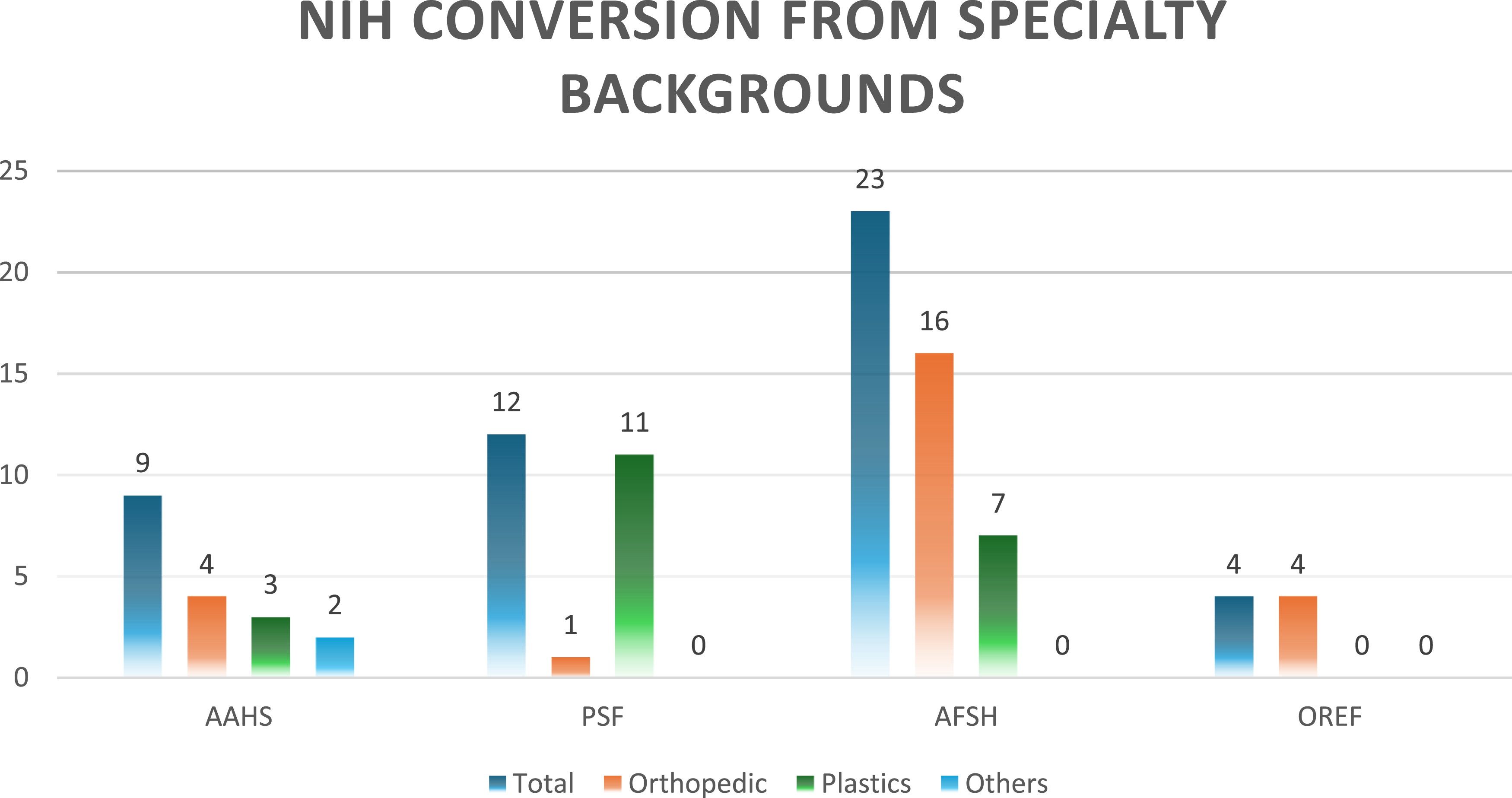
AAHS awarded 63 grants totaling $760,000. Recipient backgrounds included plastic surgery (38%), orthopedics (25%), and other disciplines (37%) (Figure 1). Thirty-two recipients (50%) published at least 1 manuscript related to their funded project, 27 (43%) presented at national or international meetings, and 9 (14%) subsequently obtained NIH funding (Figures 2-4). Of the AAHS recipients who later secured NIH funding, 44% were orthopedic-trained, 33% were plastic surgeons, and 22% had basic science backgrounds (Figure 5). Illustration of the distribution of the educational background of grant recipients. AAHS, American Association of Hand Surgery; AFSH, American Foundation for Surgery of the Hand; PSF, Plastic Surgery Foundation; OREF, Orthopedic Research and Education Foundation Illustration of the distribution of grant recipients who successfully published a manuscript. AAHS, American Association of Hand Surgery; AFSH, American Foundation for Surgery of the Hand; PSF, Plastic Surgery Foundation; OREF, Orthopedic Research and Education Foundation Illustration of the distribution of grant recipients who successfully presented at a national or international conference. AAHS, American Association of Hand Surgery; AFSH, American Foundation for Surgery of the Hand; PSF, Plastic Surgery Foundation; OREF, Orthopedic Research and Education Foundation Illustration of the distribution of grant recipients who successfully received further funding from the National Institutes of Health (NIH). AAHS, American Association of Hand Surgery; AFSH, American Foundation for Surgery of the Hand; PSF, Plastic Surgery Foundation; OREF, Orthopedic Research and Education Foundation Illustration of the distribution of the educational background of grant recipients who received further National Institutes of Health (NIH) funding. AAHS, American Association of Hand Surgery; AFSH, American Foundation for Surgery of the Hand; PSF, Plastic Surgery Foundation; OREF, Orthopedic Research and Education Foundation


American Foundation for Surgery of the Hand
AFSH awarded 278 grants totaling $5,485,000. Recipients were primarily plastic surgeons (63%) and orthopedic surgeons (32%) (Figure 1). Of these recipients, 146 (53%) published manuscripts, 108 (39%) presented their work at conferences, and 23 (8%) later secured NIH funding (Figures 2-4). Among AFSH recipients who later secured NIH funding, 70% were orthopedic-trained and 30% were plastic surgeons (Figure 5). Most NIH-funded recipients had initially received Basic Science Grants.
Orthopedic Research and Education Foundation
OREF awarded 54 grants totaling $1,680,000, all to orthopedic-trained investigators (Figure 1). Among these recipients, 20 (37%) published manuscripts, 14 (26%) presented at conferences, and 4 (7%) obtained subsequent NIH funding (Figures 2-4). Recipients who later secured NIH funding had received a range of OREF grant mechanisms, including Career Development and resident-focused awards.
Plastic Surgery Foundation (PSF) Grant Conversions
PSF awarded 81 grants totaling $2,060,000. Most recipients were plastic surgeons (83%) (Figure 1). Fifty-three recipients (65%) published manuscripts, 31 (36%) presented at conferences, and 12 (15%) subsequently obtained NIH funding (Figures 2-4). Of the NIH-funded PSF recipients, 92% were plastic surgeons (Figure 5). The most common initial awards among NIH-funded recipients included ASPN/PSF Research Grants and Pilot Research Grants.
Comparison of Society-based and Foundational Grants on NIH Conversion and Scholarly Output
When outcomes were compared across funding organizations, recipients of PSF grants demonstrated the highest overall rates of scholarly output and subsequent NIH funding, followed by recipients of AAHS grants. In contrast, OREF and AFSH grants demonstrated lower conversion rates to publications, conference presentations, and NIH funding.
Across all organizations, variability in return on investment was observed when examining the proportion of grant recipients who converted publications or conference presentations into subsequent NIH funding. PSF and AAHS demonstrated higher publication-to-NIH and presentation-to-NIH conversion proportions relative to OREF and AFSH recipients, suggesting differences in academic yield among societal and foundational funding mechanisms.
When stratified by specialty background, descriptive analyses suggested that orthopedic-trained recipients were more likely to obtain subsequent NIH funding following AAHS and AFSH grants, whereas plastic surgery–trained recipients were more likely to publish peer-manuscripts across AAHS, AFSH, and PSF grants. Patterns of conference presentation also varied by specialty and funding organization, with plastic surgeons demonstrating higher presentation rates among AAHS recipients, while orthopedic-trained recipients demonstrated slightly higher presentation rates among AFSH and PSF recipients. These findings are presented descriptively and are intended to illustrate observed trends rather than infer causal relationships.
Discussion
In this retrospective analysis of societal and foundational research grants in hand, upper extremity, and peripheral nerve research, conversion of funded projects to publications, conference presentations, and subsequent NIH funding was modest across all organizations. Publication and presentation rates were highest among PSF and AAHS recipients, whereas direct conversion to NIH funding occurred in fewer than 15% of grant recipients.
Importantly low rates of direct NIH conversion should be interpreted within the broader context of the federal funding landscape. NIH grants are highly competitive and are designed and are designed to support large, programmatic research efforts rather than discrete pilot projects. Many society- and foundation-funded awards—particularly resident, pilot, or early-career grants—are not intended to directly translate into NIH-funded programs. Accordingly, lower NIH conversion rates likely reflect differences in funding intent and scope rather than inefficiencies within the societal grant process. Still, it is also possible that various factors contribute, such as the need for additional funding to complete a project, lack of novelty, inadequate project rationale, and flaws in methodology. 10
An alternative framework for evaluating the impact of societal funding would be to assess the proportion of NIH-funded investigators in hand and peripheral nerve research who previously received society- or foundation-based grants. Such an approach may better capture the role of these awards as early-career catalysts within a broader funding trajectory. While this analysis was beyond the scope of the present study, it represents an important direction for future research.
Other studies have attempted to understand the relationship between specialty-specific foundation funding and NIH funding. For instance, in the field of otolaryngology, researchers have found that 39.6% full-time faculty members receiving a faculty grant from the American Academy of Otolaryngology-Head and Neck Surgery Foundation later received NIH funding. 11 When analyzing OREF grants, Hedge V et al found that the conversion rate to subsequent NIH finding was 22%, and 46% among those who specifically received the OREF Career Development Grant. 12 Our findings, however, revealed that recipients of OREF grant had a successful NIH conversion of 7%, with 25% of the recipients being Career Development Grant winners. It’s worthy to note that a difference amongst our findings is that in our study, we specifically screened for hand, upper extremity and nerve research, excluding other OREF-funded research that would have been included in the aforementioned study.
Our inclusive approach to outcome assessment captured all peer-reviewed publications and major specialty-relevant conference presentations rather than restricting outcomes by journal impact or meeting prestige. Although this strategy does not account for differences in publication visibility or citation impact, it provides a comprehensive assessment of early-stage scholarly productivity, particularly for junior investigators. Future studies incorporating bibliometric indices may further refine assessments of academic return on investment.
Limitations
This study has several limitations. First, its retrospective design and reliance on publicly available data may have resulted in incomplete capture of publications and presentations. Second, differing observation periods across funding organizations may influence comparisons, although consistent outcome definitions were applied. Third, many conferences do not maintain comprehensive or searchable abstract archives, likely resulting in underestimation of presentation rates. Fourth, not all data generated through society- and foundation-funded grants is intended for immediate publication or conference presentation. Many of these awards are designed to support feasibility testing, preliminary data collection, or methodological refinement that contributes to the development of larger, programmatic research efforts rather than standalone manuscripts. Consequently, publication and presentation rates may underestimate the broader academic value and downstream impact of these grants. Additionally, assessment of subsequent extramural funding was limited to NIH awards and did not include other federal or industry sources. Finally, most OREF grants require the principal investigator to have an orthopedic surgery background, which introduces specialty-specific bias when comparing outcomes across funding organizations. In contrast, PSF, AAHS, and AFSH grants are awarded to investigators from a broader range of surgical backgrounds. While this limits direct comparability, it reflects the current composition of the hand surgery workforce in the United States, where most practitioners are orthopedic-trained.
Conclusion
Societal and foundational grants in hand, upper extremity, and peripheral nerve research demonstrate modest conversion to publications, conference presentation, and subsequent NIH funding. These findings highlight the role of such awards as early-stage investments within a broader research funding pipeline and underscore the importance of continued evaluation of how best to structure and support investigator development in surgical subspecialties.
Footnotes

Funding
The authors disclosed receipt of the following financial support for the research, authorship, and/or publication of this article: This research was supported in part by Division of Hand Surgery, Montefiore Medical Center.
Declaration of Conflicting Interests
The authors declared the following potential conflicts of interest with respect to the research, authorship, and/or publication of this article: S.K.,MD is a committee member of the American Society for Surgery of the Hand (ASSH), a paid consultant and speaker for Integra LifeSciences, Inc, a paid consultant for Tissium, Inc., a stockholder and member of the medical advisory board for Reactiv, Inc., and a speaker for TriMed, Inc. The other authors declare no potential conflicts of interest with respect to the research, authorship, and/or publication of this article.
Copyright Transfer Form
The authors have transferred the rights of this manuscript to Montefiore Einstein Journal of Musculoskeletal Medicine and Surgery.