




Abstract
This editor perspective paper discusses participatory and codesign, outlining six research avenues for potential authors of Designing. These avenues are: Exploring how design participation is organized in new ways, contexts, and with different interested parties; Investigating the pragmatics of realworld deployments of participatory design forms and developing empirically grounded theories; Developing representational systems for codesign, examining their interactions and roles in the design process; Studies of how design activities by non-professionals integrate with professional design during use time; Examining codesign as a catalyst beyond traditional designable areas, such as transitional change, policy, and governance; and Investigating codesign in the educational realm, aiming to examine the design orientation and approaches that design schools adopt when tackling real-world problems involving all interested parties.
Keywords
In this paper, we reflect on several gaps in co-design and participatory design research, particularly regarding new forms, application domains, and representational systems. We aim to invite authors to share their insights by submitting papers to six different avenues where these concepts will be discussed and explained in detail.
The approaches that involve users and other stakeholders in design, planning, innovation, and social change are no longer fringe activities. They form a broad envelope that includes formalized public engagement initiatives, participatory design (PD) and codesign projects of all kinds, industry user involvement, and peer-to-peer communities in a variety of citizen domains (Simonsen and Robertson, 2013; Scrivener et al., 2000; Smith et al., 2025a; Botero and Saad-Sulonen, 2022; Von Hippel, 2006, 2016). This means that users’ participation in design, together with citizens’ own active designing—from here on called ‘design participation’—has become part and parcel of how contemporary design and innovation operate (Hyysalo et al., 2016a; Von Hippel, 2016; Hyysalo, 2025). They are further pursued in a range of different domains from healthcare and management to the cultural sector and environmental change.
The wide uptake of design participation continues to change the related research avenues (Hyysalo et al., 2016; Smith et al., 2025b). Open-source software and hardware and content communities such as Wikimedia, Linux, and MySQL have arguably taken democratically governed design further than any designer–user collaboration ever before, as all the design activities are carried in a communities of volunteers (e.g., Ardati, 2023; Benkler, 2006). The same goes for different hacking collectives, citizen science initiatives, and peer-to-peer design networks. Design communities and living labs “hosted” by companies and the public sector can pursue considerable depth and autonomy in design participation and the coproduction of services (e.g., Ansell and Torfing, 2014; Hyysalo et al., 2016b) similar to the wide variety of communal design engagements (Usenyuk-Kravchuk et al., 2022; Huyberchts et al., 2024). Design collaboration, also known as how designers work together, is a skill developed during their training (Boudhrâa et al., 2021; Sopher and Dorta, 2023). It allows designers to contribute more effectively to a design project, considering the design process as fundamentally social (Smulders et al., 2008; Kvan, 2000). However, today, it increasingly involves other actors as well.
This warrants a rethink regarding the roles of professional designers and others who carry out codesign
At the same time, democratic participation opportunities are just one of the substantive values of importance in almost any design project that seeks to make a difference in the real world. Raising it above other substantive values becomes increasingly problematic when design participation is pursued for substantive projects and changes (Friedman et al., 2013; Friedman and Hendry, 2019). This becomes accentuated when the prime concern is with the “non-humans,” animal or inanimate life (Poikolainen et al., 2025). In such cases, participation may justifiably become mere “means” or be just one aspect of the “mix of ends” being pursued (Friedman et al., 2002). Phrased more provocatively: privileging participation—as is the core of PD tradition (Simonsen and Robertson, 2013; Smith et al., 2025a)—over other substance values runs the risk of emphasizing “participation in participation” over affecting the issues and matters involved (Kelty, 2020).
Moreover, today’s design participation includes projects that are much larger than the relatively small-scale codesign and PD projects that remain the most prevalent. In large-scale projects that are to touch the lives of millions of people, the diversity in both preferred and attainable participations expands (e.g., Dalsgaard, 2012; Hyysalo and Hyysalo, 2018). Confining participation only to a select few who can participate intensively and invest time directly in design or make decisions runs the danger of lapsing into over-privileging those social groups if the less interested, more temporally fleeting, content-wise shallow, and less determining forms of participation are cut out because they are not qualified as “proper” enough participation (Fung, 2006; Hyysalo, 2025; cf. Arnstein, 1969; IAP, 2023).
These overall developments raise the first research avenue we want to highlight for Designing: how design participation is organized in new ways, contexts, and ends; and to what extent professional designers and other participants are involved.
There are today literally hundreds of different techniques and methods that have been used in codesign and PD projects (Muller and Kuhn, 1993; Muller and Druin, 2012) and considerably more in neighboring fields that could be adjusted for these ends (e.g., https://www.participedia.org/; https://www.peoplepowered.org/). Yet, as Barcham (2022) underscores, it is not the method nor technique per se but how it is deployed, adjusted, paired, and linked that makes design participation prosper or not in practice. There is an emerging cohort of studies, particularly at the intersection of design and science & technology studies (STS), that has focused on the “pragmatics” of design participation in messy real-world settings in terms of both real processes (not just idealized process schemata, manifestations, or wishful thinking) and real work that goes into realizing design participation—both of pivotal importance to whatever is eventually realized of the participation and from the participation of the people involved (e.g., Botero et al., 2020; Botero and Saad-Sulonen, 2022; Jensen and Petersen, 2016; Johnson et al., 2014; Steen, 2011). The mundane and strategic work involved has been best recognized as necessary parts of participatory “infrastructuring” (Büscher et al., 2009; Bødger et al., 2017) and “institutioning” (Hyubrechts et al., 2024) but in fact permeate all design participation efforts beyond academic confines (Botero et al., 2020; Hyysalo, 2025).
This raises the second research avenue for Designing: studies that look at the pragmatics of real-world deployments of participatory forms of design and the empirically grounded theory-building of these.
Key aspects that have allowed the ever-widening uptake of design participation are the advances in representations used for codesigning. Codesigning involves designing with people who are not professional designers. The key element is not only to gather information about users but also to gain insights from their different experiences, values, ways of collaborating, and visions to propose innovative ideas. By being included as co-authors in the codesign project, people care about the project results as their own. This fosters a sense of ownership in the design project, which eventually improves their responsibility as participants to engage in the creative process (Van Rijn H. & Stappers, 2008). The design representations created during the design process should not be considered equivalent to those produced by AI as a design companion. While we can eventually say we are co-creating with AI systems, we must consider how we feed those systems with representations, the rationale behind this, the model of designers’ cognition, and most importantly, the user for whom the system was designed—a virtual one? (Gu et al., 2025).
Designers’ representations are cognitive artifacts that externalize internal mental images through shared graphical and physical representations (Visser, 2006). Designers converse with and appreciate their mental images through representations. Designers see more in those sketches than when they were first created (Schön, 1992). During ideation, these sketches and even rough mock-ups are ill-structured: abstract, ambiguous, and inaccurate because the design concept is still in development (Goel, 1995, 1999). As the process progresses, internal images and external representations become more detailed (well-structured) and accurate (Goel, 1999; Goldschmidt, 2014). Alternatively, technical representations like perspectives, plans, and sections require training to create and understand the abstraction of certain codes that people not professionally trained in design might not comprehend.
Designers’ representations must also evolve beyond traditional design curricula to include the codesign of systems and services (Offenhuber and Mountford, 2023). Nowadays, physical models, including printed physical 3D sketches, allow haptic interactions, and when life-sized, they enable the perception of correct proportions, which is difficult to communicate with scale models or drawings (Islas-Muñoz and Dorta, 2024). Virtual reality can be an important tool for perceiving the correct scale of design proposals through immersion. However, in codesign, social immersion must be paramount, allowing active representation for every participant, such as through sketching (Dorta et al., 2016; Beaudry-Marchand et al., 2018) (Figure 1). During co-ideation, rough sketches and mock-ups form mediating representations that for long-term design collaboration can grow into boundary objects (Johnson et al., 2017a). When accompanied by an explanation, they represent what the participant desires. For that, rough materials are used without the predefined perception of certain elements, like construction toys (Peters et al., 2020). However, since people not trained in design often struggle to grasp the appropriate scale, pre-cut elements could facilitate easy manipulation of such physical mediating representations (Dorta et al., 2019) (Figure 2). Social immersion through 3D sketches in the Hyve-3D system (Photo NUS). Manipulation of physical mediated representations during the codesign of a library (Photo Telecom Paris).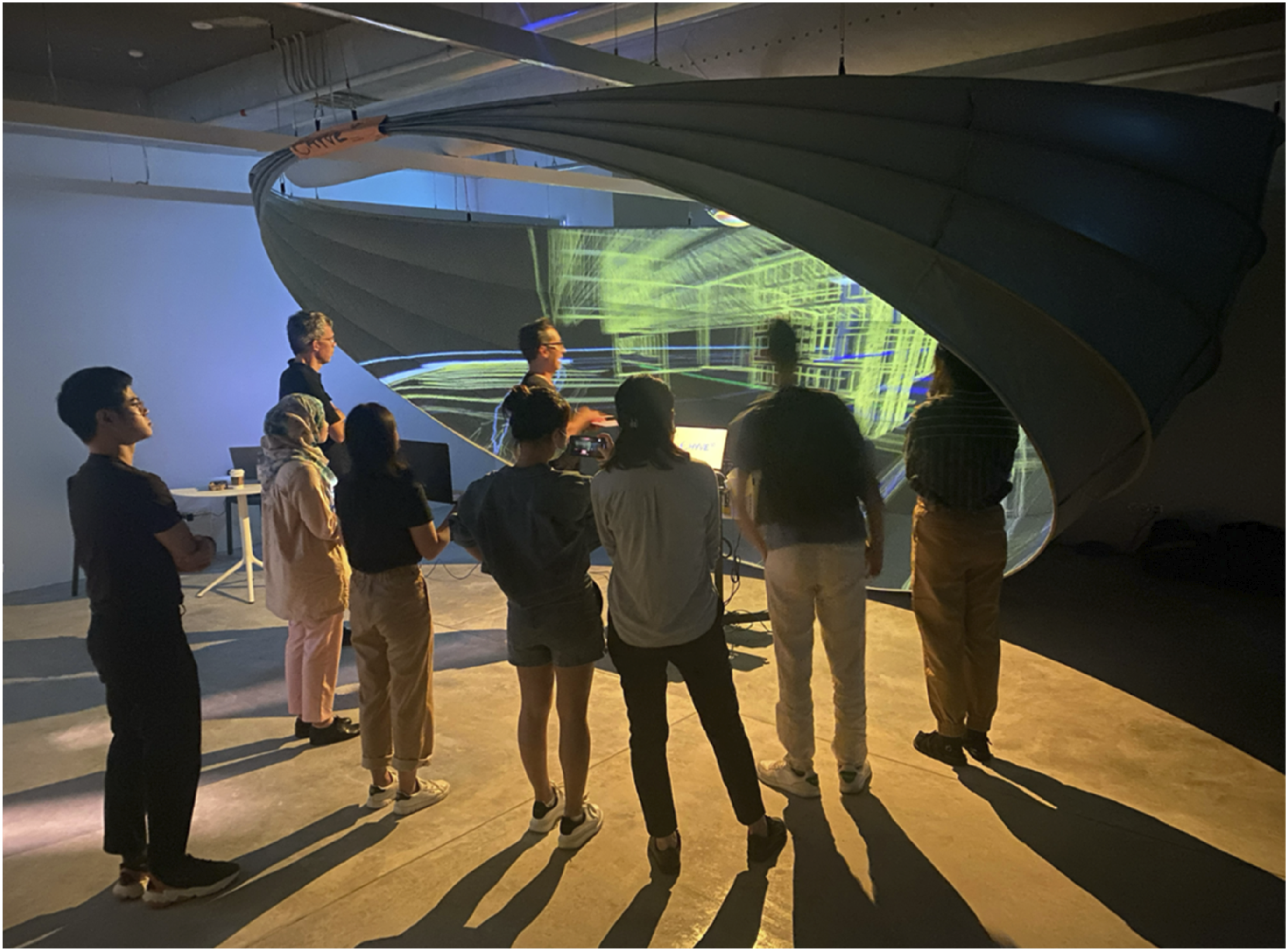
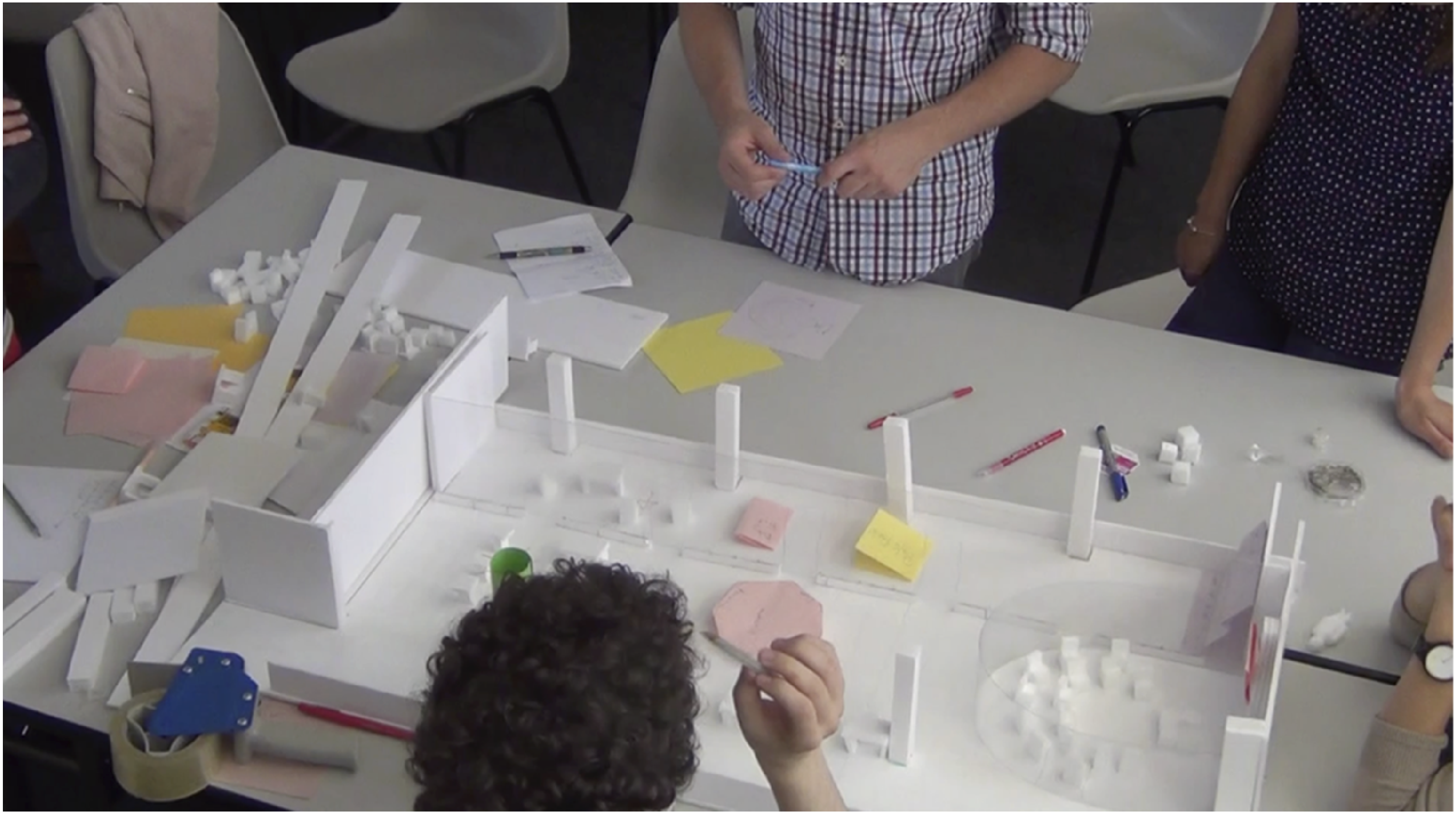
However, using photorealistic imagery like Gen-AI could hinder the co-ideation process by prematurely presenting accurate representations. Even the translation from 2D to 3D is done automatically. The vast iterative conversations necessary to transform ambiguous ideas into well-resolved final proposals are missed, with a direct jump to the final presentation level. For this reason, AI-generated images hold risks when relied on as codesign representations. The same phenomenon occurs with 3D-modeled renderings (Dorta et al., 2009). Each participant appreciates the proposed representation as it aligns with their own values and identity (Baha et al., 2020). Instead of a perfect representation where all design decisions have been made, such as those perfect renderings, the key is to convey adequate representations and representational systems that allow designing by both problem owners and designers to proceed (Muller and Druin, 2012).
Codesign organizers encourage participants to use words and small sketches (difficult to visualize) to represent their ideas and solutions (e.g., Johnson et al., 2017b). Brainstorming sessions are often used to generate many ideas, but during these sessions, participants who do not understand the principles of the design process can either fixate on some ideas (Jansson and Smith, 1991) or take away many conceptual ideas with different interpretations of words, creating completely different mental images that are not aligned (Bucciarelli, 2002). From the activity organizers’ point of view, they will be inspired by the participants’ conceptual ideas, particularly the discussion about the problem they addressed. Furthermore, the designers involved in this activity must author their work. When solutions are implemented, users are usually not recognized as creators; with their contributions being uncredited (Olsson, 2004).
While demonstrating to people not trained in design that an ideation technique like brainstorming is helpful, it is not enough to illustrate the key elements of design thinking. Designers employ various approaches, such as analogical reasoning (Bonnardel, 2000). How can we effectively teach this to people, enabling them to design? Designers speak while designing, allowing participants to be aware of the type of discourse they use during the codesign activity and exposing the internal mechanisms of designing (Dorta et al., 2011). Speaking allows people not trained in design to imitate designers’ reasoning, approach to design problems, and how they express design ideas (Sopher and Dorta, 2022). These design conversations also pace the process, handling the design problem without proposing design ideas. Participant will then propose both immature and mature design ideas to be negotiated (Bucciarelli, 2002) along with their corresponding representations (Dorta et al., 2011). As the conversation progresses, participants reduce verbal exchanges as decisions have been negotiated and focus more on representations. Aligning mental images facilitates the development of the final concept through these depictions. This baseline situation becomes different if the design partners hold considerable design skills, which is common to lead users and professionals in, for example, technical fields. The designing is then done on a more equal footing, and foremost, provides effective space as co-exploration becomes critical (Von Hippel, 2016; Hyysalo et al., 2014). The situation is rather different when codesigning with people with low design skillsets and who may even be afraid of designing. With such people, codesigners would want to create building blocks out of the core facets of the design situation so that designing becomes understandable, graspable, and less intimidating to carry design conversations and to make design decisions (Muller and Druin, 2012; Schuler and Namioka, 1993).
Thus, the third research avenue we advocate for Designing: the development of codesign representations and representational systems for codesign, the interactions around them, and the roles that they play in designing.
The last two decades have witnessed an expansion in the understanding of what it means to participate in designing and when this may happen. Collectors aside, people do not want a design but tools, services, and objects that allow them to get things done by suiting their everyday life or work practices, their settings, and their identities. Of course, some designs match the needs and preferences of some users “as designed,” and the fit of many has been greatly improved by human-centered design and UX. Yet the great diversity among adopters, contexts, and moments means that most designs do not outright match the needs of many users. People are able to use the designs nonetheless but only after “design in use”: active engagement and local designs in designed objects, uses, usage contexts, and meanings (Kohtala et al., 2020). These locally anchored design in use processes are then a precondition for the actual usability, utility, and appreciation of goods and services-in-practice (Alter, 2006; Berker et al., 2005; McLaughlin et al., 2002).
The design in use, in turn provides possibilities to shifting design into use time—designing done both by users and designers—as in the wave of natively digital goods and digital–physical manufacturing systems in which the production can proceed through evolutionary releases based on adjustable product/service architecture (Baldwin and Von Hippel, 2011; Vezzoli et al., 2017; Abel et al., 2011; Kohtala et al., 2020). When this is the case, the upfront design can be only a starting point (“minimum x” as in MVP, MLP, and so on) from which evolutionary designing begins.
This change allows codesign to expand in time from pre-design to design across continuous releases and to expand in space from a design of a single service or product to (additional) designs of parallel configurations at different customer sites. It further allows design participation to expand in diversity as adopters can do both low-level and extensive designing to many aspects of the system to suit their needs and preferences. At the extreme, users can take collective control of designing altogether, as we know from open-source and open design movements (Abel et al., 2011; Botero and Hyysalo, 2013; Kohtala et al., 2020; Botero and Saad-Sulonen, 2022; Von Hippel, 2016).
These developments present the fourth avenue of research we would welcome in Designing: studies of design activities conducted by those who are not design professionals during the use time and how they interrelate with professional design.
It has become evident that in many key societal sectors, single alternative design solutions, particularly those advancing more sustainable consumption, simply cannot compete against the inertia created by path dependencies that have resulted in “sociotechnical regimes” being built over decades by interlinkages in industry structures and production technologies, investment patterns, scientific bases, institutions and policies, market mechanisms, and cultures of consumption (Köhler et al., 2019). Yet, society-wide long-term changes are not “designable” per se, as they result from intertwined actions that span regulation, technology development, altered consumer practices, taxation, and new business creation. They require different types of actions by different types of actors. At the same time, designing representational systems and procedures for coordinating diverse actors to orchestrate hundreds of complementary actions presents a new avenue for codesign and sustainable design (Ceschin and Gaziulusoy 2019; Hyysalo et al., 2019a). Consequently, several authors have put forward program proposals such as designing for transitions (Ceschin and Gaziulusoy, 2019) and transition design (Irwin, 2015). Yet there are still few realized projects and tested approaches globally, such as the mid-range transition toolset and arenas that have rendered transition management processes more apt for addressing mid and short term goals and transition pathways. These tools have drawn from participatory design to create tools and templates that diverse citizen and expert participants can use in goal-setting and pathway formation. The tools have been thus far deployed in 16 different contexts, each lasting several months (Hyysalo et al., 2019b; Lähteenoja et al., 2023; Lukkarinen et al., 2025) (Figure 3). Mid-range transition arena and toolset in action (top) and example of one change pathway (bottom).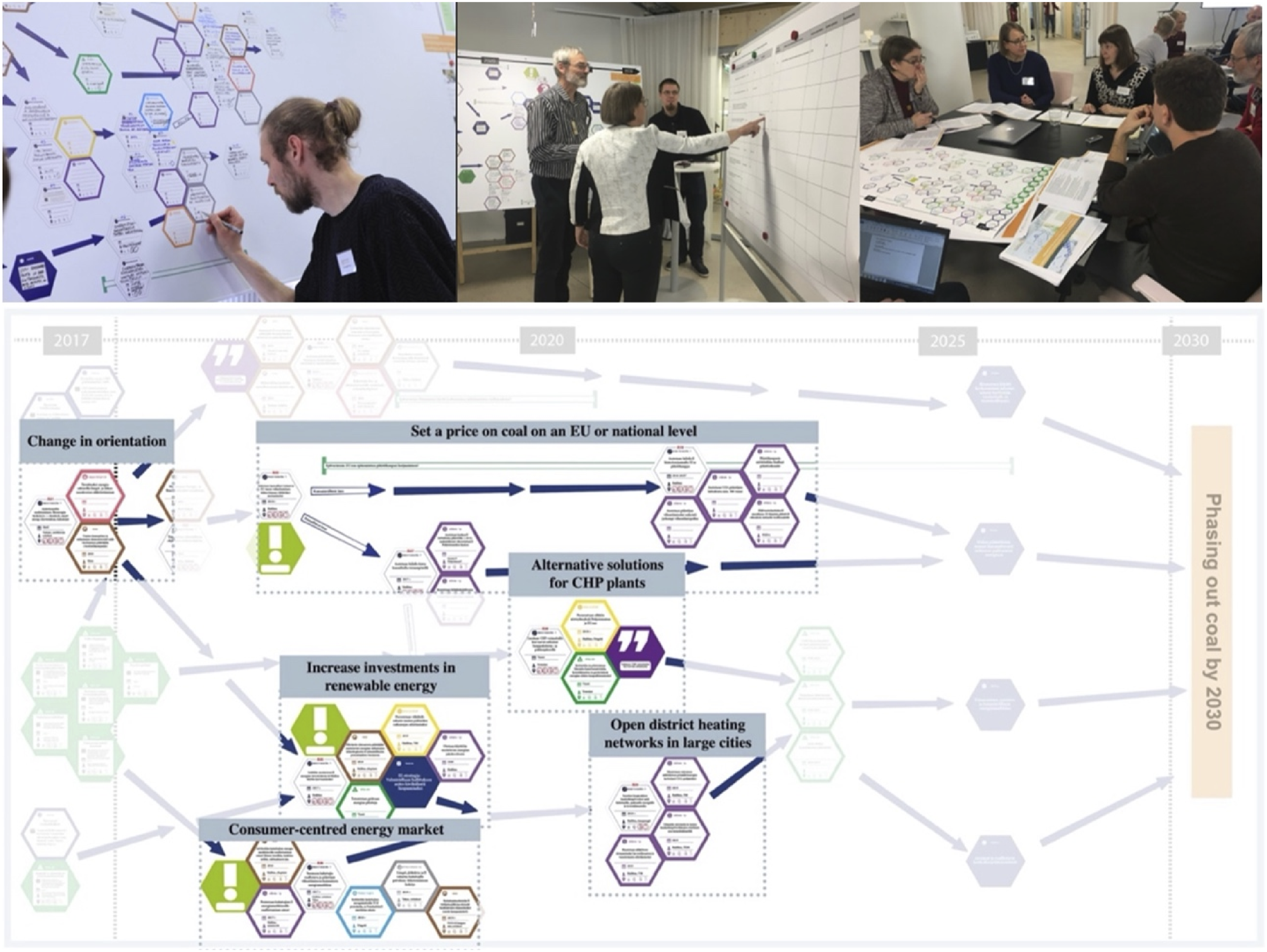
More generally, this expansion in the aims of design participation has taken design beyond designable matters—public deliberation, knowledge coproduction, and participatory culture creation—forming a sub-part of larger planning or reform processes (Bovaird and Loeffler, 2012), thus shifting codesigning for creating arrangements and spaces in the hopes that impacted people take ownership of them or otherwise make good use of designer efforts (Botero and Hyysalo, 2013; Hyysalo and Hyysalo, 2018).
The fifth avenue for research we thus highlight as important for Designing: the engagements in which codesign is used as a catalyst beyond areas traditionally thought of as being designable, such as codesign for transitional change, policy, and governance.
All the above insights hold importance for education for designing. When clients, users, or citizens are involved in the design process, current craft-based design schools continue to reveal significant shortcomings. During codesign activities, design practitioners use technical aspects and regulations to reinterpret the design provided by participants not trained in design (Scrivener et al., 2000). This process often alters the original ideas, leading to frustration. The designer must go beyond the role of facilitator in a codesign project (Örnekoğlu-Selçuk, 2023). Design education needs to adopt the codesign orientation rather than always viewing the designers as authors. In practice, design projects are executed by groups of colleagues—not always by a single individual—highlighting the shift from authoring projects to co-creation. The designers must perform designing with the participants in real-time, demonstrating their ability to design within the context of the users. This approach mirrors the design professors in the design studio, who demonstrate their tacit knowledge to the students to facilitate better transfer (Schön, 1985), illustrating their “knowing in action” through a design performance that can also be learned in design studios with professional practicioners. In codesigning, it is not only relevant to involve end-users, but it is also crucial to learn the mechanisms involved to better collaborate with other designers, students, and professors as a pedagogical strategy. Codesigning in design schools, like professional design studios (McDonnell, 2016), facilitates the transfer of tacit knowledge during training (Boudhraâa et al., 2021). Design schools should be like “clinics of codesign activity,” with citizens, private offices, and governments, among others, serving as “patients.” Together, they codesign and resolve important everyday issues while obtaining proper design education to address the complexity of current challenges.
This presents the sixth avenue of research we would like to see in Designing: studies of codesign in the educational realm. The aim of these studies is to change the design orientation and approach design schools to address real problems involving all interested parties.
Footnotes
Acknowledgment
We would like to thank Dr Rachael Luck, Dr Heather Wiltse and Dr. Peter Lloyd for their thoughtful comments and revision suggestions on the initial versions of this editorial perspective.

Funding
Sampsa Hyysalo has received funding for this work from the Strategic Reseach Council of Finland grant Material Democracy (365732).
Declaration of conflicting interests
The authors declared no potential conflicts of interest with respect to the research, authorship, and/or publication of this article.