




Abstract
Green urbanism is increasingly promoted as a pathway to sustainable and inclusive cities, yet its implementation in informal settlements remains highly contested in development policy and academic debates. This article examines how green urbanism is imagined, politicised, and contested within two informal settlements in Nairobi: Korogocho and Pumwani-Majengo. Drawing on 45 semi-structured interviews, six focus group discussions, and a review of policy documents, the study employs a mixed-methods approach rooted in Feminist Urban Political Ecology, Postcolonial Urbanism, and Travelling Models. Instead of assuming a unified global sustainability narrative, we demonstrate how international greening agendas are selectively interpreted, reworked, or resisted. Findings reveal that state-led greening initiatives, often aligned with global frameworks, can reinforce spatial inequality, displace low-income residents, and obscure colonial-era land injustices. Simultaneously, grassroots actors engage in context-specific greening practices such as urban farming and dumpsite reclamation, driven by survival and care, highlighting forms of environmental agency that challenge dominant models. This article advances debates in urban political ecology by offering a situated, empirically grounded analysis of how global green urbanism agendas are locally interpreted, reworked, and resisted within Nairobi's informal settlements. It demonstrates how grassroots actors in these spaces produce hybrid forms of urban sustainability that simultaneously challenge top-down technocratic planning and disrupt idealised, depoliticised narratives of community greening, foregrounding the everyday politics of survival, care, and justice.
Keywords
Introduction
Green urbanism is globally promoted as a pathway to sustainable and inclusive cities, yet its implementation in informal settlements, 1 a key feature of cities in the Global South, remains highly contested. What appears as a unified agenda is, in practice, fragmented and uneven, particularly within informal settlements, where its meaning and outcome vary sharply. As a framework for creating environmentally sustainable, resilient, and liveable cities (Anzilotti and Appavoo, 2025; Lehmann, 2010), its application in rapidly urbanising cities of the Global South is uneven. Within informal settlements, land tenure insecurity, policy contradictions, and socio-political exclusions fundamentally shape urban greening efforts (Kamjou et al., 2024; Muhoza and Zhou, 2024).
Green urbanism is a conceptual model for zero-emission and zero-waste urban design, seeking to transform and reengineer existing cities and regenerate the post-industrial city centre. It promotes the development of socially and environmentally sustainable cities (Lehmann, 2010). In this article, I focus on the urban greening aspects of green urbanism in Nairobi, Kenya. While the term ‘green urbanism’ is not commonly used in Kenya's policy or activist discourses, this article employs it as an analytical entry point. It refers to both state-led interventions and grassroots environmental practices. This conceptual stretching is deliberate: it enables the analysis of both institutional and everyday greening efforts within Nairobi's informal settlements and allows for a critical engagement with how global sustainability ideas are vernacularised in context.
Transnational narratives of urban greening, though often framed around biodiversity conservation, carbon sequestration, and climate resilience, reflect competing priorities that often reinforce inequality. These narratives often prioritise formal urban zones and fail to address social inequalities in informal contexts. Global frameworks such as the New Agenda (NUA) and the Global Green New Deal advocate for equitable access to green infrastructure, yet they overlook the governance challenges, land conflicts, and power struggles that define urban greening in informal settlements (African Union, 2020; Kamjou et al., 2024; Sverdlik et al., 2025). An inclusive model for these contexts would: (i) recognise informal, community-led greening efforts as legitimate planning tools; (ii) implement co-governance mechanisms that actively involve residents; and (iii) develop land tenure protections to prevent green gentrification 2 and displacement (Kim and Yang, 2023).
These measures are essential for rethinking urban greening, yet in Nairobi, their practical application remains limited. For instance, research on urban greening has focused on affluent neighbourhoods and formal planning zones, neglecting the unique dynamics within informal settlements (Makworo and Mireri, 2011; Myers, 2016). Although recent studies have examined the availability of green spaces in informal settlements and residents’ willingness to pay for them (Odhengo et al., 2024), they often fail to capture the everyday struggles of residents and the complex negotiations underpinning green urbanism. Moreover, research on green gentrification in the Global South remains underdeveloped, despite evidence that state-led greening initiatives can serve as mechanisms for land dispossession and spatial exclusion (Opanga and Guma, 2025).
These spatial inequalities are further compounded by gendered exclusions. Green urbanism in Pumwani-Majengo reinforces existing inequalities, as women, key to maintaining community waterpoints, are often excluded or exploited without consent, especially during the privatisation of green spaces. Similarly, youth-led environmental initiatives are dismissed as informal or unviable due to class bias. Their essential labour goes unrecognised in formal planning (Opanga and Guma, 2025). These dynamics reveal how supposedly neutral green urbanism is shaped by intersecting histories of class and gender oppression.
International frameworks promote urban sustainability through green corridors, parks, and rooftop gardens, yet these ideals frequently clash with the realities of urban poverty and exclusion. Global agendas such as Sustainable Development Goal (SDG) #11 and initiatives like the Bonn Challenge advocate for accessible green spaces for marginalised populations, but in practice, these objectives are not fully realised in informal settlements. Similarly, regional commitments such as the African Forest Landscape Restoration Initiative (AFR100) aim to promote urban resilience through green spaces, though their uneven implementation often leaves informal settlements excluded from these benefits (GoK, 2022; WWF, 2024).
In Kenya, national initiatives like the Jaza Miti campaign and policies such as the Nairobi Integrated Urban Development Master Plan (NIUPLAN) advocate for climate resilience and environmental conservation, yet green urbanism remains concentrated in middle- and upper-income areas (Kelbert, 2016; Sverdlik et al., 2025). The Nairobi Climate Action Plan (CAP) (2020–2050) promotes formal interventions such as afforestation, urban beautification, infrastructure retrofitting, and a Food Systems Strategy to protect ecological zones, reduce erosion, improve air quality, and enhance urban resilience. Yet these top-down approaches often overlook informal greening practices rooted in survival, care, and political agency.
In Nairobi's informal settlements, systemic neglect, land tenure insecurity, and high density create significant institutional, political, and social barriers (Bassett, 2020). Public green spaces are vulnerable to encroachment and are often repurposed for housing or economic activities. Consequently, while green spaces are promoted as instruments of resilience and inclusion, they can trigger green gentrification, displacing low-income residents under the guise of ecological improvement (Kamjou et al., 2024; Opanga and Guma, 2025; Temper et al., 2020). Governance fragmentation, economic interests, and colonial-era urban planning legacies further restrict land access in Nairobi (Njoh, 2009; Otiso, 2005).
Recent scholarship emphasises that sustainability agendas are not passively received but actively contested, reinterpreted, and resisted. Monte-Mór and Limonad (2023) call for a rethinking of spatial justice that integrates environmental and social concerns in the face of planetary threats. However, dominant greening models, shaped by frameworks such as SDG 11 and AFR100, privilege technocratic and aesthetic approaches rooted in formal planning, often marginalising informal settlements. These models frequently erase Indigenous ecological practices and overlook the gendered and racialised labour sustaining urban environments (Elmhirst, 2015; Nightingale, 2011). In Nairobi, Kimari (2023) demonstrates how such frameworks pathologise areas like Mathare as sites of ‘bad nature’, legitimising evictions under environmental pretexts.
Parallel dynamics are evident elsewhere: Gururani (2023) shows how restoration projects in India reproduce exclusions by abstracting ecological relations from agrarian and caste-based contexts. Infrastructure critiques reveal how green urbanism, when aligned with the ‘modern infrastructure ideal’, dismisses decentralised, labour-intensive, community-led efforts as unscalable (Lawhon et al., 2023). These studies underscore that sustainability is a contested political terrain shaped through negotiation and subversion. In Nairobi, residents creatively adapt global greening logics, forming hybrid practices that merge survival, care, and resistance. This article builds on such insights to argue that while international greening models claim to promote equity, they often reinforce exclusion but are also reworked from below by residents in informal settlements shaping alternative environmental futures (Gururani, 2023; Kimari, 2023; Lawhon et al., 2023; Monte-Mór and Limonad, 2023; Nightingale, 2011).
Through a comparative case study of Korogocho and Pumwani-Majengo, this article examines the interplay of political narratives and power struggles in shaping green urbanism. The analysis also considers how global green initiatives are reinterpreted, adapted, or resisted within these communities, highlighting the enduring impact of colonial legacies, policy contradictions, and historical land injustices. The remainder of the article is structured as follows: the methodology details the research design and data collection; the literature review contextualises urban greening in the Global South; the conceptual framework outlines the theoretical underpinnings; a historical overview of green urbanism in informal settlements is provided; and the results and conclusions synthesise the findings.
Materials and methods
This article compares Korogocho and Pumwani-Majengo to explore governance, community-led environmental responses, and ecological outcomes. These sites were chosen for their distinct socio-political histories, ongoing environmental challenges, and strategic location along the Nairobi River riparian zone – an area marked by land-use conflict and regulatory ambiguity. Key variables of comparison include governance structures, land tenure, evictions, stakeholder interests, and the contrasting environmental outcomes produced through both state-led and grassroots greening efforts. A mixed-methods approach, combining policy analysis, GIS spatial assessment, and qualitative fieldwork to examine the dynamics of urban greening in informal settlements, was employed. Secondary data included policy documents, news archives, journal articles, and reports from NGOs and government agencies. Primary data was collected through an exploratory case study design focused on the middle section of the Nairobi River, which experiences acute environmental pressure.
Fieldwork was conducted across two phases (June 2023–January 2024 and June–August 2024) using adaptive sampling. Participants included government officials (n = 7), NGO representatives (n = 5), private developers (n = 7), and informal settlement residents (n = 40). Data collection methods included six focus group discussions (with youth, women, elders, and displaced residents) and six life histories focused on eviction experiences. Semi-structured interviews explored policy implementation, land conflicts, and greening projects. Policy documents were thematically coded to identify contradictions between formal urban greening frameworks and grassroots realities. All data were analysed using Atlas Ti software.
Green urbanism dynamics in the Global South
Urban greening is increasingly referenced within international development agendas; however, its definition and implementation vary significantly across different contexts. As Rizzo et al. (2020), Weisser and Müller-Mahn (2014), and Roy (2012) argue, the global ‘green turn’ is fractured, territorialised, and strategically deployed. Its progress is unevenly distributed worldwide, creating stark contrasts between the Global North and the Global South. In New York and Berlin, for instance, robust governance systems, policy-driven initiatives, and strong institutional frameworks have fostered a more equitable distribution of green spaces (Bille et al., 2023; Lehmann, 2010). These cities, often characterised by well-established urban planning systems, benefit from significant investment in green infrastructure, ensuring that their green spaces are more accessible and equitably distributed among residents.
On the other hand, cities in the Global South face significant challenges, including governance weaknesses, rapid urbanisation, and underinvestment in green infrastructure. For instance, studies show that 49.6% of urban vegetation is browning, 3 while only 40.75% is greening, with a particular concentration of green infrastructure deficits in African cities, which are urbanising at a rate of 3.5% annually (African Development Bank, 2012; Li et al., 2025). Much of this urban growth occurs in informal settlements, where the combination of high tenure insecurity, inadequate infrastructure, and socio-economic marginalisation hinders the expansion of green spaces. These settlements are often excluded from formal green urbanism policies, further exacerbating disparities (Anderson et al., 2023).
The uneven distribution of green spaces is further complicated by the complex relationship between formal governance and informal practices. Informality in urban settlements should be perceived as a dynamic continuum that coexists with and complements formal systems. It refers to practices and spaces that function outside the established legal and planning frameworks yet play a crucial role in urban life by filling gaps left by formal systems. These informal spaces are flexible and adaptive, responding to local socio-economic, political, and environmental contexts. This understanding underscores the complexity of urbanisation, particularly in the Global South, where informal practices often evolve to meet the immediate needs of marginalised populations (Banks et al., 2019; Ngwenya and Cirolia, 2020; Roy, 2012).
Political and economic forces, particularly capitalist agendas, often shape urban greening initiatives, prioritising economic growth over equity and sustainability (Rossi and Wang, 2020). In Kenya, for example, overlapping urban greening laws have led to conflicting policies regarding riparian land use (Odote, 2019). Similarly, in Jakarta, Indonesia (Fluhrer et al., 2020) and San José, Costa Rica, institutional fragmentation has hindered green infrastructure planning systems, leaving informal settlements unaddressed (Fluhrer et al., 2020).
Climatic conditions add another layer of complexity, extreme heat and arid conditions limit vegetation growth in many developing countries. Research has shown that climate conditions account for up to 75% of the disparities in green space distribution, with precipitation alone contributing 65.2% to these differences (Li et al., 2025). Wealthier nations in the Global North with higher Human Development Index scores can allocate more resources to urban greening projects, a luxury that is often unavailable to rapidly urbanising regions in the Global South. Despite these challenges, informal settlements in the Global South have demonstrated significant resilience and innovation in the face of adversity.
Grassroots initiatives, such as urban farming, tree planting, and riverbank restoration, reflect a strong sense of community agency and a collective effort to reclaim and improve local environments, even in the absence of formal institutional support (Roy, 2005; Simone, 2004). However, these initiatives remain fragmented and often lack the necessary resources to scale up. Moreover, competing political interests frequently undermine the impact of grassroots efforts, creating a significant gap in understanding how these communities navigate and adapt to pressures such as green gentrification and broader socio-political dynamics (Gould and Lewis, 2016).
While existing literature on urban greening has extensively explored the environmental benefits and technical aspects of green infrastructure, it has neglected the political and social dimensions of these processes. Research on green urbanism tends to focus on the well-coordinated policies and funding mechanisms prevalent in the Global North, where urban green spaces benefit from robust institutional support. In contrast, the challenges faced by the Global South, marked by rapid and often unplanned urban growth and the expansion of informal settlements, remain underexplored. In many cities in the Global South, green spaces are concentrated in wealthier areas, leaving informal settlements underserved and deepening socio-economic disparities (Mensah, 2015; Muhoza and Zhou, 2024).
Urban greening initiatives are frequently driven by capitalist priorities that emphasise economic growth over environmental justice, often at the expense of marginalised communities (Rossi and Wang, 2020). The cases of Barcelona and Nairobi exemplify how such projects can reinforce land dispossession and social inequities (Anguelovski et al., 2018; Bulkeley et al., 2014; Holifield et al., 2009). In Nairobi, governance fragmentation, highlighted by contradictions between national and county planning frameworks, intensifies these challenges, a pattern echoed in other cities across the Global South (Mensah, 2015; Patel et al., 2017; Patterson et al., 2017).
Critical gaps remain in the literature regarding how informal settlements resist exclusionary green policies. Existing studies have focused on ecological benefits, technical infrastructure, and top-down governance frameworks, overlooking the importance of grassroots resistance and the role of governance in shaping green urbanism. This article addresses these gaps by examining green urbanism in Korogocho and Pumwani-Majengo through the lenses of Feminist Urban Political Ecology (FUPE), Postcolonial Urbanism, and the Travelling Concepts Framework. A combination of these frameworks critiques class-based exclusions, situates green gentrification within historical colonial land policies and explores how global sustainability frameworks like SDG 11 and AFR100 are locally reinterpreted, resisted and adapted in informal settlements.
Towards a conceptual framework for green urbanism in informal settlements
This article employs three interrelated theoretical frameworks (i) FUPE, (ii) the concept of travelling models and (iii) Postcolonial Urbanism, to critically analyse urban greening in Nairobi's informal settlements While FUPE critiques the class-based and gendered exclusions in urban greening policies, Postcolonial Urbanism situates these exclusions within the historical legacies of land dispossession and racialised urban planning. Meanwhile, the Travelling Models framework reveals how global sustainability narratives are selectively adapted and manipulated by state and private actors to justify evictions.
First, FUPE emphasises how everyday acts of care and resistance endure despite the invisibility of informal settlements in formal planning processes. Postcolonial Urbanism and the Travelling Concepts Framework further reveal how colonial land governance and global greening agendas, such as SDG 11 and AFR100, are reinterpreted through residents’ practices of adaptation, resistance, and care (Kimari, 2023; Monte-Mór and Limonad, 2023). Building on situated Urban Political Ecology (UPE) from the Global South, the paper challenges Eurocentric assumptions about infrastructure, governance, and ecological citizenship (Lawhon et al., 2014). It interrogates how greening intersects with fractured governance, racialised labour, and spatial exclusion (Bathla and Gururani, 2022; Gururani, 2023; Monte-Mór, 2007). While critiques of top-down greening highlight its technocratic and symbolic limitations (Nightingale, 2011; Rizzo et al., 2020), the article also considers how marginal or tokenistic interventions can be locally re-signified as meaningful tools of survival and agency (Kimari, 2019; Nightingale, 2011).
Recent scholarship underscores how green urbanism in the Global South is shaped by colonial legacies, socio-political exclusions, and fragmented governance (Monte-Mór and Limonad, 2023; Rizzo et al., 2020; Roy, 2012). In Nairobi, state-led greening projects have justified mass evictions in informal settlements along riparian zones, while community practices like urban farming and dumpsite reclamation remain marginalised in policy (Kimari, 2023). Feminist and postcolonial urban political ecologies expose how environmental knowledge, labour, and space are racialised, gendered, and historically structured (Elmhirst, 2015; Lawhon et al., 2023). This article critiques the performativity of state greening efforts without dismissing their potential entirely, acknowledging that even limited interventions can be reworked from below into critical urban-natural innovations (Kimari, 2019; Lawhon et al., 2023; Nightingale, 2011).
Postcolonial urbanism highlights how colonial planning entrenched spatial inequalities by reserving green spaces for European settlers and excluding Indigenous African communities – a legacy still evident today in cities like Nairobi (Miraftab, 2012; Njoh, 2007). Affluent areas retain formal green amenities, while informal settlements such as Korogocho and Pumwani-Majengo remain marginalised (Kimari, 2016). Contemporary greening efforts continue to reflect colonial land governance, denying low-income residents access to green spaces and enabling land expropriation through state-led projects (Baffoe and Roy, 2022; Khayesi and Wegulo, 2022). The Nairobi River Restoration Project exemplifies this dynamic by framing informal settlements as environmental threats and legitimising mass evictions in May 2024 – echoing colonial dispossession strategies (Miraftab, 2012; Odote, 2019).
Urban greening is thus a contested space shaped by tensions between global mandates and local informal practices (Cornea, 2019; Elias et al., 2021; Elmhirst, 2015; Prouse and Arefin, 2024; Rocheleau et al., 1996). In Nairobi, these tensions are seen in the displacement of women engaged in informal ecological labour like waterpoint management and gardening, whose roles are overlooked in formal planning (Elmhirst, 2015; Sundberg, 2017; Vigil, 2024). While state-led projects like the Nairobi River Restoration Program are often critiqued as symbolic, they produce mixed outcomes, displacing vulnerable groups while also enabling limited infrastructure improvements and awareness. These hybrid results underscore how state actions are locally interpreted, resisted, or appropriated, producing both intended and unintended consequences.
Thirdly, the concept of travelling models (Baffoe and Roy, 2022; Said, 1994; Weisser and Muller-Mahn, 2014) examines how global sustainability policies interact with local resistance and adaptation in informal settlements. It reveals the contradictions of internationally driven green urbanism, where policies like SDG 11 are resisted, transformed, or repurposed by local communities. This repurposing gives rise to a hybrid space in which imported models coexist uneasily with Indigenous greening practices, those grounded in local survival strategies and communal land care rather than institutional mandates. Lastly, Kimari's work on outlaw urbanism enriches this reading by illustrating how grassroots actors in Nairobi's outlaw spaces mobilise ecological labour not only for material benefit but also as a mode of resistance, memory, and community reclamation.
Greening strategies in Nairobi's informal settlements are not uniformly shaped by global frameworks; they reflect a hybrid terrain where externally imposed models such as SDG 11 and AFR100 coexist uneasily with Indigenous, community-driven practices rooted in survival, care, and land stewardship (WBGU, 2021). While some initiatives adapt global discourses, for instance, the repurposing of AFR100's afforestation goals into micro-forests and urban farms by youth groups in Korogocho, others emerge entirely from within communities and challenge top-down assumptions about innovation and sustainability (Callon, 1984; Zain et al., 2022). These localised forms of environmental agency, including dumpsite reclamation and women-led ecological care, often remain invisible within formal planning frameworks but play a critical role in shaping urban nature (Baffoe and Roy, 2022). As shown in Table 1, this article distinguishes between ‘travelling’ models driven by international and state actors, and ‘indigenous’ innovations rooted in local survival logics.
Indigenous and travelling urban greening models and their drivers.
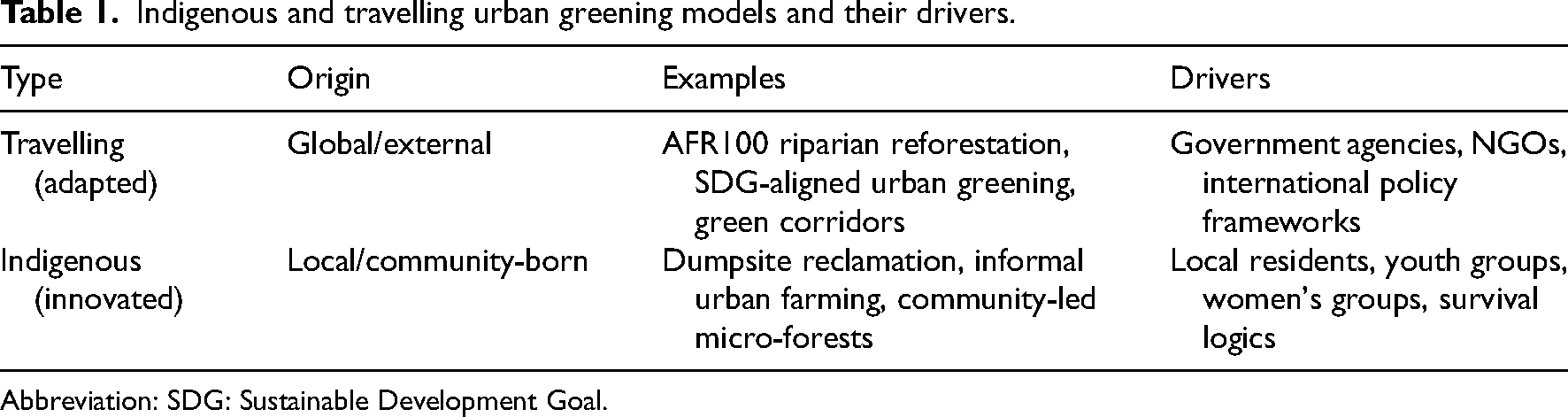
Abbreviation: SDG: Sustainable Development Goal.
While FUPE foregrounds the intersectional, gendered, and classed exclusions that shape both participation in and the impacts of local greening efforts, Postcolonial Urbanism situates these inequalities within deeper colonial legacies of land dispossession and spatial segregation. Travelling Models help trace how globally circulating green urbanism policies, such as those embedded in Nairobi Climate Action Plan (CAP), are selectively adapted, resisted, or reworked on the ground. Taken together, they allow us to unpack how Nairobi's formal green planning, such as the Nairobi Climate Action Plan (Nairobi City County Government, 2020), interacts with, and often overlooks, the survivalist, justice-oriented greening efforts of residents in outlawed spaces. This approach foregrounds not only the material and symbolic labour of greening from below but also the political contestations over whose visions of urban nature are legitimised, resourced, and made visible.
This hybridity reveals the disconnect between global sustainability narratives and the lived realities of informal settlements. Global frameworks, though presented under a unified banner, differ significantly in scope, tools, and political intent, making it essential to treat them as context dependent. Moreover, their failure to account for conditions such as land tenure insecurity undermines their effectiveness in marginalised urban spaces (Baffoe and Roy, 2022). Dominant greening models tend to be technocratic and exclusionary, whereas inclusive models centre informality, co-governance, and the ecological labour of women and youth as integral to sustainable urban futures. Residents of Pumwani-Majengo and Korogocho actively reinterpret and resist top-down green urbanism by asserting alternative ecological practices rooted in justice, inclusion, and everyday survival.
Background
Nairobi's urban landscape is shaped by colonial planning legacies, postcolonial governance failures, and rapid informal urbanisation, resulting in unequal distribution of green spaces. While affluent areas enjoy well-maintained parks and tree-lined streets, informal settlements suffer from environmental neglect and fragmented governance, reinforcing socio-political inequalities (Otiso, 2005). Despite Kenya's commitment to sustainability through initiatives like Vision 2030, the Jaza Miti campaign, and SDG 11, green urbanism in Nairobi remains a contested process. Critical debates focus on land tenure insecurity, socio-economic disparities, and policy contradictions that complicate efforts to expand urban green spaces in these marginalised areas (Myers, 2016; Njoh, 2009). Urban planning continues to favour elite districts, leaving settlements with limited environmental infrastructure and scant public investment (Makworo and Mireri, 2011; Shariff, 2021).
Although Nairobi's historical development has shaped the deep-rooted social and spatial inequalities seen today, contemporary discussions tend to focus more on current regulatory obstacles and conflicts over urban greening policies, rather than engaging with these historical causes directly. Pumwani-Majengo, depicted in Figure 1, was designated as Nairobi's only legal African settlement and is strategically located on a low-lying, swampy plain near the Nairobi River. This placement was intended to segregate African workers from European populations, but over time, rapid urban migration and neglect transformed the area into a slum-like environment with diminishing green spaces (Njoh, 2009; Otiso, 2005).
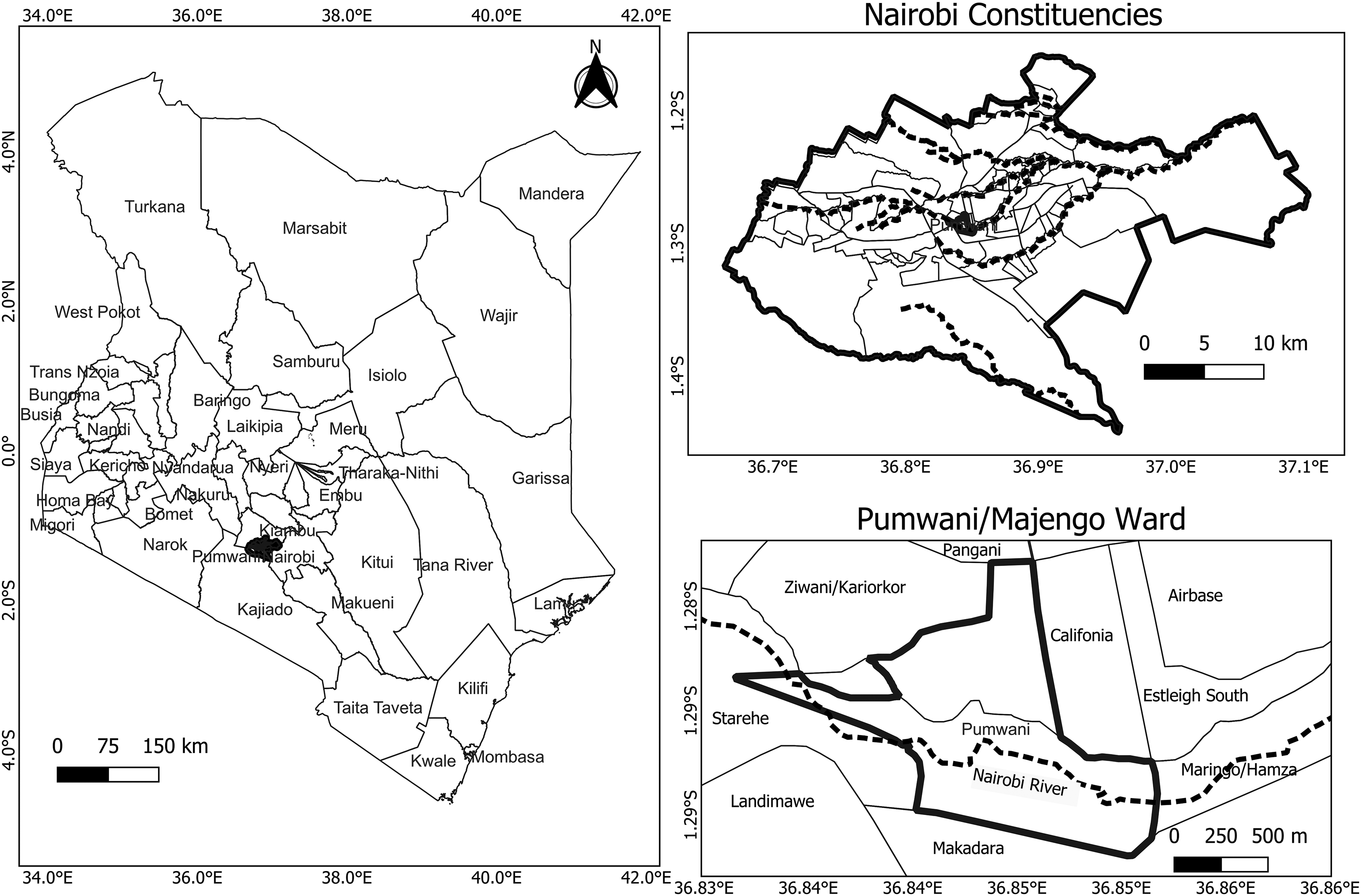
A map of Pumwani-Majengo informal settlement.
In contrast, Korogocho, shown in Figure 2, emerged in the 1970s as a quarry site and later became an informal settlement following the government's relocation of squatters from areas near the Nairobi Central Business District. Located near the Dandora Dumpsite, Nairobi's largest waste disposal site (Population Matters, 2024), Korogocho remains emblematic of the environmental and infrastructural deficits that afflict informal settlements. Both settlements have been excluded from mainstream urban greening initiatives – a reality that continues to reinforce environmental inequalities (Anderson et al., 2023). Since the COVID-19 pandemic, the government has made efforts to include these areas in greening projects, yet implementation remains fraught with controversy and sporadic enforcement.
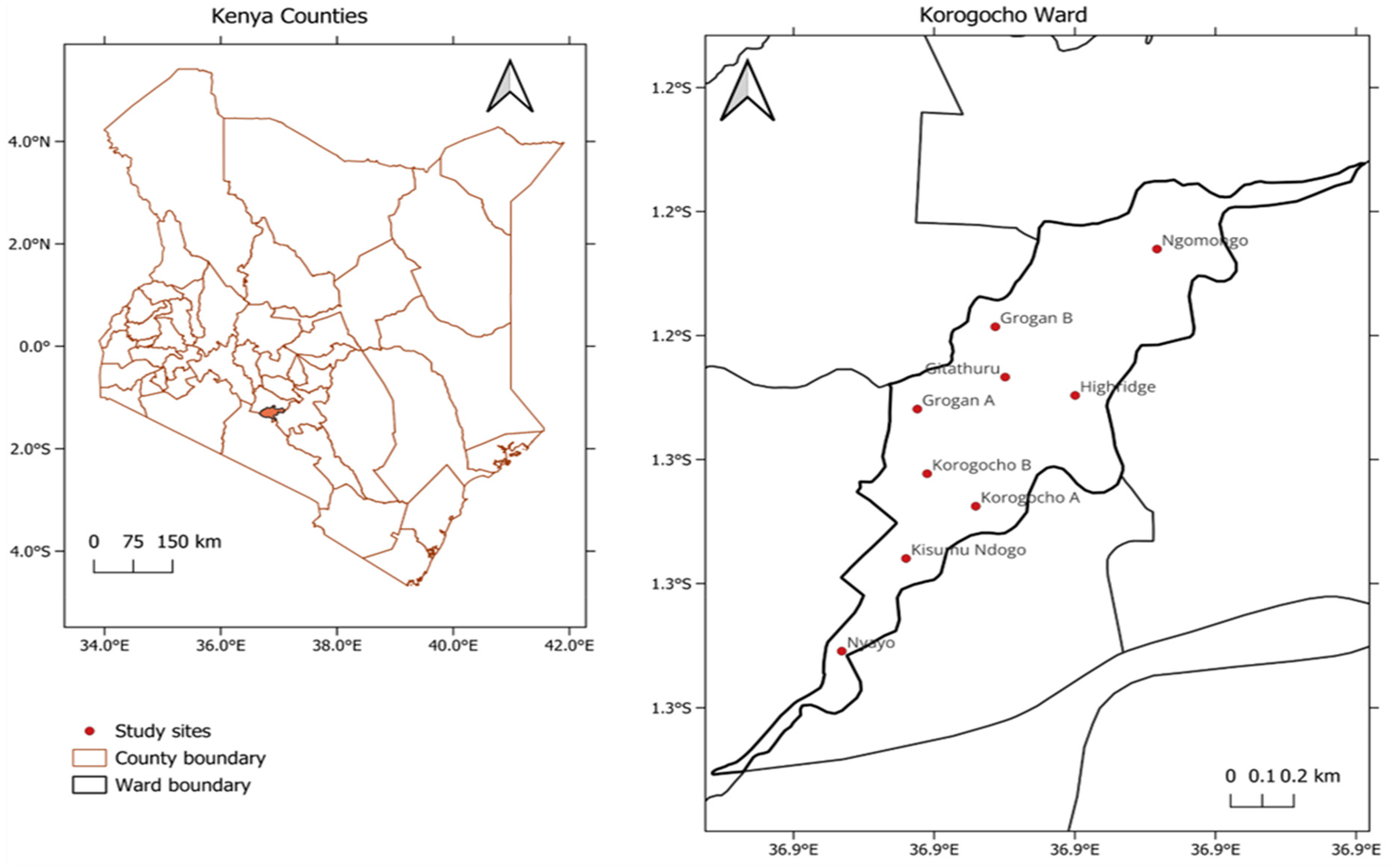
A map of Korogocho informal settlement.
Kenya's green urbanism has evolved through cyclical, state-led public work programs aimed at tackling youth unemployment, environmental degradation, and urban renewal in Nairobi's informal settlements. Early efforts like the 2009 Kazi Kwa Vijana (KKV) program 4 under President Kibaki engaged unemployed youth in environmental conservation and waste management but was undermined by weak oversight, politicisation, and inconsistent participation, resulting in minimal infrastructure improvements (Bassett, 2020). Building on KKV, the 2014 revamped National Youth Service integrated green infrastructure and slum upgrading into a national agenda, employing thousands of youths. Yet, corruption, elite capture, and disconnection from local governance limited its legitimacy and long-term impact (Bassett, 2020; Otiso, 2005).
The 2020 Kazi Mtaani program, 5 introduced amidst the COVID-19 crisis, marked a shift by directly engaging communities through cash-for-work activities like river de-silting and tree planting. Although more inclusive and contextually grounded, it still faced funding constraints, political interference, and doubts about sustainability post-emergency funding (Sverdlik et al., 2025). These programs collectively reveal a pattern: while periodically mobilising environmental action, they fail to institutionalise meaningful local participation or secure lasting greening outcomes. Their reactive, crisis-driven nature highlights the state's structural failure to adopt a proactive, inclusive approach to sustainable green urbanism in marginalised informal settlements.
Debates over urban greening in Nairobi are deeply entwined with the city's complex and often contradictory regulatory framework governing riparian land use. A patchwork of laws, including the Environmental Management and Coordination Act (EMCA) 2006, the Urban Areas and Cities Act (2011), and the Physical and Land Use Planning Act (2019), prescribe varying riparian buffer zones, ranging from 6 to 100 m, and employ inconsistent measurement criteria. These legal ambiguities create significant loopholes that enable land grabbing and facilitate the uneven enforcement of environmental regulations, allowing private developers and political elites to appropriate green spaces, often at the expense of residents in informal settlements (Mensah, 2015; Muhoza and Zhou, 2024; Mwathane, 2020; Odote, 2019). Compounding these issues are persistent multi-scalar tensions between national and county governments. Overlapping mandates and political rivalries, particularly in riparian land regulation and green infrastructure planning, undermine policy coherence and impede effective governance (Odote, 2019; Patel et al., 2017). In Nairobi, these intergovernmental frictions are evident in the contradictory implementation of urban greening agendas, which reflect deeper struggles over territorial authority and urban land control.
The intersection of urban greening and land dispossession has sparked concerns about green gentrification, where efforts to enhance environmental sustainability inadvertently drive real estate speculation and the displacement of low-income residents (Opanga and Guma, 2025). Comparisons with other Global South cities underscore this debate: in Cape Town, urban greening initiatives in historically marginalised areas have accelerated property price increases, pricing out long-term residents (Venter et al., 2020); in Lagos, waterfront greening projects have resulted in mass evictions along the Lagos Lagoon, raising serious questions about environmental justice (Adegun et al., 2024). In Nairobi, informal settlements, which house over 60% of the city's population (UN-Habitat, 2007), are characterised by high population densities, land tenure insecurity, and inadequate infrastructure. Attempts to integrate these areas into urban greening initiatives are inherently problematic, underscoring the need for differentiated approaches that recognise and address the unique challenges of informal urban spaces. These factors exacerbate socio-spatial inequalities as urban planning frameworks are implemented in a fragmented manner (Odote, 2019).
Amid these challenges, informal settlements have emerged as vibrant sites of grassroots greening activism. Community-led initiatives in Korogocho and Pumwani-Majengo illustrate how residents reclaim and repurpose urban spaces through activities such as tree planting, urban farming, and riverbank restoration. These bottom-up strategies reflect a broader trend observed in São Paulo, Kumasi, and Cape Town, where community-led greening efforts emerge in response to institutional neglect (Celentano et al., 2020). For example, similar initiatives in São Paulo have transformed abandoned lands into urban gardens, simultaneously improving food security and environmental sustainability (McDougall et al., 2018). Nairobi's urban governance framework, dominated by technocratic, top-down models, has historically marginalised these communities, limiting their participation in decision-making and policy implementation (Bassett, 2020; Jiménez-Aceituno et al., 2019).
Urban greening in Nairobi's informal settlements is a political process shaped by conflicting visions of sustainability. Dominant greening initiatives, often led by the state and NGOs, adhere to global frameworks such as SDG 11, AFR100, and the Bonn Challenge, which promote standardised metrics like canopy cover, carbon sequestration, and riparian buffers (Gururani, 2023; Nightingale, 2011). These frameworks favour formal aesthetics and technocratic planning while overlooking the spatial, legal, and social realities of informality (Monte-Mór and Limonad, 2023). In contrast, community-driven greening emerges through everyday acts of necessity and care. Women-managed waterpoint spaces in Pumwani-Majengo, youth-led micro-forests in Korogocho, and farming on reclaimed dumpsites demonstrate alternative models of land stewardship that centre survival, social cohesion, and ecological functionality (Elmhirst, 2015; Kimari, 2023). These grassroots practices contest dominant definitions of ‘green’ by advancing more relational, embedded, and socially responsive forms of urban sustainability (Lawhon et al., 2014, 2023).
These ideological tensions are illustrated in cases like the 2024 mass evictions from riparian zones, justified under the guise of environmental compliance (Wakhungu et al., 2024). Such interventions echo colonial logics of spatial exclusion, reinforcing critiques that greening often serves elite agendas rather than equitable transformation (Gururani, 2023; Monte-Mór, 2007). However, informal settlements are not passive recipients; they reinterpret global mandates to suit local needs. For instance, AFR100's reforestation targets are transformed into micro-forest projects on marginal land (Sverdlik et al., 2025). These practices reveal urban greening as a negotiated and contested field shaped by historical marginalisation and everyday resilience (Elmhirst, 2015; Gururani, 2023; Lawhon et al., 2014).
Negotiating green urbanism in Pumwani-Majengo and Korogocho
Green urbanism has become an issue in Nairobi's informal settlements. In the following section, we explore how it is shaped by colonial legacies, competing interests among government, NGOs, youth activists, private developers, and local communities, and policy paralysis, leading to spatial inequalities, exclusion, and the commodification of green spaces in Pumwani-Majengo and Korogocho.
The colonial roots of green urbanism in Korogocho and Pumwani-Majengo
Green urbanism in Nairobi is deeply entwined with colonial legacies that still shape land use, environmental access, and eviction patterns. During colonial rule (1899–1963), green spaces were set aside for Europeans, while African workers lived in crowded, poorly resourced areas. Despite modern interventions such as slum upgrading and conservation projects, spatial segregation, land dispossession, and governance fragmentation persist. Today, affluent neighbourhoods enjoy well-maintained green infrastructure, yet informal settlements like Pumwani-Majengo and Korogocho remain neglected and vulnerable to displacement.
A long-term Pumwani-Majengo resident stated, We have now lived on this land for over four generations, yet today we are being displaced under the guise of urban renewal. (Life history interview, resident, Pumwani-Majengo, December 2023)
Land speculation further compounds the crisis. Legal loopholes enable powerful interests to displace long-term residents. A community leader observed, Those claiming the land are not even the original owners but land grabbers … Some people have lived here for more than 40 years, but are still evicted. (Interview, Women Group Chairperson, Pumwani-Majengo, December 2023)
Korogocho's history also reflects this enduring marginalisation. Originally a quarry site, it later became a refuge for displaced populations relocated from central areas like Globe Cinema. One resident recounted, The government, through its planning policies, did not want people living close to town. Those living near the Globe Cinema were sent here. They built houses with whatever material they could find. (Life History Interview, Resident, Korogocho, August 2023)
Post-independence policies prioritised economic growth over addressing colonial injustices. This fostered ambiguous land tenure and private land accumulation. ‘Slum upgrading’ programs, initiated under figures like Tom Mboya, focused on housing improvements while neglecting the integration of green spaces (Interview, Resident, Pumwani-Majengo, July 2024). Additionally, from the 1970s onwards, land privatisation and political allocations exacerbated the scarcity of green spaces. Politically connected elites captured environmentally significant lands such as the riparian lands of the Nairobi River (Life History Interview, Resident, Pumwani-Majengo, July 2024).
These continuities illustrate how colonial legacies persist in modern urban governance, reinforcing spatial inequalities and marginalising informal settlements under the banner of green urbanism. These empirical observations align with global scholarship on postcolonial urban inequalities, which emphasises the persistence of colonial land policies in shaping contemporary urban landscapes (Ng’weno, 2018; Shariff, 2021). Studies of African cities reveal that independence did not dismantle colonial spatial hierarchies but instead adapted them to serve new elite interests (Bille et al., 2023; Zain et al., 2022). These insights expand the field of postcolonial urbanism by showing how green urbanism in Nairobi is not merely a sustainability initiative but a continuation of historical land struggles. This approach critiques the postcolonial discourse, which often assumes that independence resolved colonial injustices. Nairobi exemplifies how global sustainability ideals are localised without addressing the deep-seated land inequalities that persist.
Green urbanism from below in Korogocho and Pumwani Majengo
In Korogocho, a youth group has reclaimed a former dumpsite and crime zone along the Nairobi River, transforming it into a public park. This greening work emerged from a deliberate community response to violence, criminalisation, and environmental neglect. As one member noted, When we clean the river and plant trees, we’re also cleaning our name. (Interview, Youth group member, Korogocho, November 2023)
Additionally, the conversion of a dumping site into a community park, an initiative of young men and women, many with histories shaped by gang violence and police brutality, engages in ecological labour to assert their right to safety and belonging. They have integrated over 350 women, formerly involved in prostitution, into leadership and vocational training. This shows that gender justice is inseparable from environmental justice; their greening efforts challenge both material degradation and social criminalisation, reframing urban space through collective care and social transformation. The group's actions resist both physical degradation and the social stigmatisation of their settlement. Using bits of knowledge of riparian laws and lived experiences, it has successfully blocked elite land grabs. Their ecological labour offers a community-led alternative to top-down green urbanism.
Similarly, in Pumwani-Majengo, a self-help group comprising women, youth, and people with disabilities engages in river cleanup, tree planting, and recycled materials to prevent flooding of the river. In the absence of formal services and state neglect, their work stabilises the environment while also advancing inclusion and livelihood. They assert self-reliance and frame their efforts as an extension of Wangari Maathai's 6 environmental legacy. For example, when land speculators attempted to encroach on a reclaimed dumpsite, they organised riots to defend it (Interview, Youth group member, Pumwani-Majengo, January 2024). Thus, greening helps them assert their right to green spaces in a city that frequently denies their presence.
While both Korogocho and Pumwani-Majengo exemplify grassroots greening as a form of resistance, their distinct configurations of outlaw space reveal important differences: Korogocho's initiatives are shaped by post-conflict masculinised rehabilitation and strategic legal literacy, while Pumwani-Majengo foregrounds intergenerational care work and gender-inclusive ecological stewardship. Together, they offer complementary models of how marginalised communities navigate exclusion and assert environmental rights. These practices challenge elite-driven redevelopment and exclusionary environmental governance by centring the needs and voices of those sidelined in formal sustainability agendas. In both settlements, greening becomes a political strategy, asserting community presence, defending land, and reshaping the meaning of sustainability from below.
These cases exemplify what Lawhon et al. (2014) describe as situated urban political ecologies, emerging from the lived experiences of residents in outlawed spaces who resist technocratic and state-centric models. Their efforts reflect an alternative environmental rationality grounded in care, survival, refusal, and historical memory. They also illustrate the vernacularisation of global greening norms, which are selectively reinterpreted through Nairobi's complex socio-political terrain. Drawing on Kimari's (2022) notion of outlaw urbanism, these spaces are not merely informal; they are criminalised and structurally excluded by planning and legal regimes yet paradoxically serve as vital sites where new ecological futures are being imagined and enacted. It is in these outlaw spaces, often seen as ungovernable or undeserving, that residents build ecologies of endurance, reassert rights to nature, and contest the exclusionary logics of Nairobi's green urbanism.
Imagination versus reality in Korogocho and Pumwani-Majengo
In government-led initiatives, green urbanism is promoted as a path to ecological conservation and urban renewal. However, in Korogocho and Pumwani-Majengo, the vision sharply contrasts with reality. Top-down approaches have often led to forced evictions and the displacement of low-income communities under the guise of environmental restoration. In Pumwani-Majengo, one resident explained that evictions are disguised as environmental conservation (Interview, Resident, Pumwani-Majengo, January 2024). This rhetoric masks a harsh reality where residents face sudden removal with little legal recourse. In Korogocho, the situation is even more severe. A resident recalled that the government had given them 48 h to vacate their homes, which were destroyed by the military trucks the next day in trucks (Interview, Resident, Korogocho, June 2024). Such militarised evictions not only displace families but also reinforce deep power imbalances. Private business interests further complicate the picture.
Green urbanism projects are increasingly used to facilitate land privatisation. Private developers and politically connected actors increasingly seek to acquire prime land under green agendas (Interview, Government Official, January 2024). Additionally, in both informal settlements, .Informal power brokers, including local officials, often exploit regulatory grey zones to profit from the informal economy and land access. These practices epitomise a broader pattern of environmental dispossession.
Moreover, land and water resources are frequently commodified through informal deals and elite capture, with women and vulnerable groups disproportionately affected. NGOs and civil society envision green urbanism as a tool for social justice, yet many community members view their interventions with scepticism.
A resident in Pumwani-Majengo remarked: …NGOs operate based on their own agendas, not necessarily in the interest of the general population. (Interview, Resident, Pumwani-Majengo, December 2023)
A youth leader in Korogocho added: …most of these programs become a cash cow for NGOs. Once they get what they want, they are no longer interested in sustainability. (Interview, Youth Group Leader, Korogocho, October 2023)
Despite these challenges, youth activists and grassroots groups are championing bottom-up green urbanism. Their initiatives, urban farming and converting dumpsites into green spaces, offer hope for economic empowerment and environmental justice. However, financial constraints and exclusion from decision-making persist. Many youths have greening ideas, but they don’t have the money. (FGD, Participant 5, Korogocho, October 2023)
A participant in Pumwani-Majengo urged greater inclusion: I have never been involved in any of the activities, so involve us so that we can participate as well. (FGD, Participant 11, Pumwani-Majengo, July 2024)
Green urbanism in Nairobi's informal settlements reveals a critical disjuncture between inclusive global sustainability rhetoric and exclusionary on-the-ground implementation. In Korogocho and Pumwani-Majengo, youth-led green spaces represent hybrid greening practices that are subversive and strategic, reclaiming degraded land while tactically aligning with official narratives to gain visibility and access resources (Elmhirst, 2015; Kimari, 2023). These practices resist binary framings of co-optation versus resistance, instead operating within a grey zone that challenges exclusion while leveraging the symbolic capital of sustainability agendas (Bathla and Gururani, 2022; Lawhon et al., 2014). Such efforts often rely on invisibilised gendered and classed labour, which remains unrecognised within dominant environmental discourses (Elmhirst, 2015; Nightingale, 2011).
Urban greening has been co-opted by private developers for profit, hence green gentrification, and the displacement of low-income residents, particularly affecting women and marginalised groups (Muhoza and Zhou, 2024; Shariff, 2021; Sundberg, 2017). This disconnect between global ideals and local realities aligns with insights from FUPE (Cornea, 2019; Rocheleau et al., 1996), which foregrounds power, labour, and spatial justice. Moreover, it demonstrates that sustainability agendas are reshaped by local political economies rather than universally applied (Prouse and Arefin, 2024; Weisser and Müller-Mahn, 2014), challenging assumptions about the equity of global greening frameworks.
Performativity of green urbanism in informal settlements
Green urbanism in Nairobi's informal settlements has a highly performative character
7
; serving as a symbolic tool for political legitimacy rather than advancing true environmental justice. Government and elite stakeholders use greening initiatives to attract media attention, consolidate land control, and craft an image of conservation, while grassroots communities face exclusion and dispossession. A resident from Korogocho captured this disconnect: Media houses and politicians use our green space transformation activities to enhance their image … We get nothing but empty promises. (Interview, Resident, Korogocho, June 2023)
This sentiment reflects the symbolic nature of green projects that prioritise optics over tangible benefits. Field observations further reveal that circa 400,000 residents were forcibly evicted between May and July 2024 under the pretext of riparian land reclamation, while affluent estates on riparian zones remained intact (Wakhungu et al., 2024). Such data expose a double standard in environmental governance, privileging elite interests and reinforcing exclusionary practices. Additionally, participation in these initiatives also remains illusory. Intended ‘participatory mechanisms’ are often inaccessible to residents. As one environmental lawyer critiqued, When you tell people in informal settlements to write memoranda and submit via email, how many of those people have email or even the resources to visit a cybercafé? (Interview, Environmental Lawyer, September 2023)
This bureaucratic barrier not only limits meaningful engagement but also echoes global trends in tokenistic public participation. Private business interests add another layer to the performativity. A government official noted, Businesspeople, ironically, solar panel guys and even politicians, all want this land because it is prime…. (Interview, Government Official, January 2024)
In Pumwani-Majengo, one community member explained, Washerwomen are persuaded by land grabbers to move water points, making way for new buildings. (Interview, Community Member, Pumwani-Majengo, June 2024)
These quotes underscore the gap between performative promises and the lived reality of community exclusion. Similar trends are evident elsewhere: in Lagos, waterfront greening projects displaced over 30,000 residents (Adegun et al., 2024), and in Cape Town, renewal programs drove property value hikes that marginalised long-term residents (Venter et al., 2020). By contrast, grassroots initiatives in São Paulo, such as urban farming, demonstrate how local efforts can reclaim green spaces (McDougall et al., 2018). In Nairobi, the County Integrated Development Plan conflicts with the national Medium-Term Framework; this creates regulatory loopholes that enable elite capture of environmental initiatives (Odote, 2019; Patel et al., 2017; Patterson et al., 2017; Valencia et al., 2021).
These dynamics enrich theoretical frameworks, contributing to FUPE by deepening gendered and intersectional inequalities, to postcolonial urbanism by exposing persistent legacies of land dispossession, and to the concept of travelling models by showing that global sustainability agendas are reinterpreted through local governance failures, resulting in exclusionary green policies (Kelbert, 2016). While many state greening projects prioritise visibility and political branding, their symbolic dimensions sometimes intersect with or enable material improvements, albeit unevenly and often unintentionally.
Discrepancies in law enforcement
Weak enforcement mechanisms undermine existing legal protections, particularly in relation to land governance. Although relevant laws exist, their implementation remains inconsistent, enabling land grabbing and regulatory evasion. Moreover, governance conflicts complicate local accountability, as some land disputes are shaped by interests that operate beyond the county level and fall under national political influence (Interview, Resident, Korogocho, August 2023).
This reflects broader governance challenges, where weak institutions facilitate elite capture of public resources, perpetuating inequality, and exclusion. Additionally, land tenure policies designed to secure informal settlers’ rights are often manipulated by slum landlords and land cartels,
8
leading to further displacement. As an NGO representative explained: Land cartels, often disguised as slum landlords, exploit the regularisation process to displace the original settlers. (Interview, NGO Representative, June 2024)
This aligns with global trends where formalisation efforts, rather than protecting vulnerable communities, fuel land speculation and elite control, exacerbating housing insecurity. Moreover, government officials and politicians exploit legal ambiguities to allocate riparian land, parks, and open spaces to political loyalists. A Pumwani resident described how public land was systematically privatised: The regime at the time saw the allocation of riparian land along the Nairobi River to political loyalists. (Life History Interview, Resident, Pumwani-Majengo, July 2024)
This analysis differentiates between the legal and policy frameworks that promote urban greening – such as EMCA, NIUPLAN, and AFR100 – and their material execution, which in practice is shaped by local political interests, selective enforcement, and elite capture. Our findings thus extend critiques in urban political ecology by empirically illustrating how even well-intentioned environmental policies can be distorted through fragmented governance and patronage politics. This persistent lack of legal enforcement creates uncertainty for residents, reinforcing the precarious status of informal settlements and weakening efforts towards equitable urban sustainability.
Despite Kenya's robust legal frameworks on land tenure and environmental protection, weak enforcement paves the way for land grabbing and corruption (Odote, 2019). Politically connected elites exploit legal loopholes to manipulate land policies, displacing vulnerable communities while accumulating valuable urban property, a pattern consistent with global empirical observations of elite capture of public resources under the guise of sustainability (Temper et al., 2020). Similar selective enforcement practices observed in African and Latin American cities reveal how global sustainability models, when transplanted to local contexts, are reshaped by entrenched power dynamics, challenging the efficacy of travelling models (Bille et al., 2023). Exposing the intersection of gendered and socio-economic inequities with institutional weaknesses enriches FUPE and post-colonial urbanism discourses, illustrating how historical legacies and persistent power asymmetries continue to undermine equitable urban development.
Conclusions
This article examined how global and national visions of urban greening are negotiated in practice within two informal settlements in Nairobi, Korogocho and Pumwani-Majengo. The objective was to highlight the tension between global sustainability aspirations and the lived realities of marginalised communities and to reveal how historical and structural inequalities, rooted in colonial-era land dispossession, and entrenched socio-political power struggles, shape urban greening practices. In doing so, the article sought to interrogate why green urbanism, despite its promise of inclusivity and sustainability, benefits affluent areas while informal settlements remain sidelined.
Empirical observations in Korogocho and Pumwani-Majengo reveal that, first, colonial-era urban planning has left a lasting imprint on land distribution, perpetuating spatial inequalities that persist despite post-independence land reforms and slum upgrading initiatives. Second, the top-down nature of green urbanism initiatives, driven by political and economic interests, often leads to the appropriation of land for commercial gain, further deepening disparities. Third, although NGOs and grassroots actors leverage green urbanism as a tool for social justice and empowerment, their efforts are frequently constrained by financial dependencies, political suppression, and ongoing land conflicts. Finally, power dynamics between national and county governments contribute to policy paralysis, impeding the effective implementation of urban greening projects in these informal settlements.
This study contributes to debates on green urbanism by offering a situated analysis of how colonial legacies and socio-political struggles shape green initiatives in Nairobi's informal settlements. It demonstrates that sustainability projects, when implemented through exclusionary frameworks, can reinforce existing inequalities. Building on Global South UPE perspectives, the study shows that Nairobi's informal settlements are not peripheral to sustainability but central to its contestation and negotiation, echoing Monte-Mor's concept of the ‘extended urban fabric’. These findings affirm calls for a grounded urban political ecology that engages with informality, uneven enforcement, and racialised spatialities, as argued by Lawhon et al. (2014) and Gururani (2023).
Lastly, despite exclusionary policies, informal settlement residents actively contest top-down green urbanism, engaging in community-driven sustainability efforts that challenge elite narratives. However, these initiatives are undermined by financial precarity, weak institutional support, and policy contradictions. Our findings point to the need for urban greening strategies that are co-produced with local communities, historically conscious, and sensitive to the lived realities of informality. We further challenge the assumption that greening ideas are solely externally derived by showing how community-born innovations coexist with adapted global models, creating a hybrid green urbanism shaped by both resistance and invention. A deeper engagement with intersectionality, examining how gender, race, and class are encoded into Nairobi's green urbanism, reveals that without confronting these foundational inequities, sustainability projects risk reinforcing the very exclusions they seek to address.
Footnotes
Acknowledgements
The authors extend their sincere gratitude to the residents of Korogocho for their invaluable contributions and insights.

Ethical considerations
The authors went through an extensive ethics review process conducted by the Center for Development Research (ZEF) at the University of Bonn.
Consent to participate
Verbal consent was recorded before interviews began while written consent forms were filled and signed before interviews.
Consent for publication
We obtained both verbal and written informed consent to publish the data obtained.
Funding
The author disclosed receipt of the following financial support for the research, authorship, and/or publication of this article: This work was supported by the German Academic Exchange Service (DAAD) under the Development-Related Postgraduate Courses (EPOS) program.
Declaration of conflicting interests
The author declared no potential conflicts of interest with respect to the research, authorship, and/or publication of this article.
Data availability statement
Due to ethical, legal, and confidentiality considerations, the qualitative data underlying this study cannot be made publicly available. The dataset includes sensitive interview transcripts and field notes containing identifiable and potentially re-identifiable information about participants. To protect participant anonymity and uphold our ethical commitments, only selected excerpts essential for supporting the study's conclusions have been published within the article.