




Abstract
Aging populations face health challenges, and volunteering may improve health outcomes. This study investigated the relationship between volunteering, CD34+ hematopoietic stem cells, and health indicators in older adults. The sample included 91 participants aged 65 to 75, with 52 reporting prior volunteering involvement. Evaluations comprised the Geriatric Depression Scale (GDS), Mini-Mental State Examination, Clinical Dementia Rating scale, and Neuropsychiatric Inventory. Blood analyses measured CD34+ hematopoietic stem cells and CD34+ lymphocytes. Multiple linear regression assessed variations in CD34+ counts and related metrics among groups, adjusting for confounding factors. Volunteers exhibited enhanced cognitive functioning and lower depression levels compared to non-volunteers, as reflected in GDS scores of 4.29 ± 4.18 versus 8.26 ± 5.09 (p < .001). Furthermore, volunteers had notably elevated CD34+ stem cell and lymphocyte counts, suggesting volunteering positively influences this health marker. Participation in volunteer activities is linked to improved cognitive abilities, reduced depressive symptoms, and heightened CD34+ hematopoietic stem cell levels. Findings underscore the potential health benefits of volunteering for older adults, necessitating further investigation into the mechanisms and enduring effects of volunteerism on health, with CD34+ cell counts identified as a significant biomarker for cognitive and emotional health enhancements in this population.
Introduction
Health Benefits of Volunteering
Volunteering is associated with enhanced self-reported health and well-being in older adults. Evidence indicates that older adults who engage in volunteering demonstrate superior health outcomes, including decreased risks of hypertension and cardiovascular disease (Burr et al., 2011, 2016), improved cognitive abilities (Infurna et al., 2016), and reduced mortality rates (Anderson et al., 2014; Carr et al., 2015; Gil-Lacruz et al., 2020; E. S. Kim et al., 2020; Konrath et al., 2012; Luoh & Herzog, 2002; Musick et al., 1999; Oman et al., 1999). Participation in an environmental protection volunteering project was found to improve cognitive function, alleviate pain, and reduce blood pressure variability (Chen et al., 2023). Frequent engagement in environmental protection volunteering projects may reduce depression (Chen et al., 2023). The psychological benefits of volunteering may help mitigate limitations in daily activities and positively affect physical health (E. S. Kim et al., 2020; Weziak-Bialowolska et al., 2024). Volunteering also fosters social connections and physical activity, both of which are crucial for health improvement. These activities may further contribute to maintaining healthy levels of endothelial progenitor cells (EPCs), such as CD34+ cells (Carr et al., 2015; H. L. Yang et al., 2022).
Health Improvement Mechanism
Volunteering often involves physical activities that can increase overall physical activity levels, which is beneficial for cardiovascular health. For instance, high-intensity volunteering(over 200 hr per year) has been associated with lower risks of high blood pressure, a key cardiovascular risk factor (S. Kim et al., 2023). EPCs play a crucial role in maintaining endothelial integrity, supporting vascular function, and promoting postnatal neovascularization (Shantsila et al., 2007). Moreover, EPCs serve as valuable prognostic markers for predicting cardiovascular events in patients with coronary artery disease (Ross, 1993). A study reported an association between EPCs and cardiovascular disease and potential mechanisms underlying this association, including inflammation and regulation of the renin–angiotensin–aldosterone system (Shantsila et al., 2007). EPCs can predict the severity of depression, and the risk of cardiovascular disease, especially acute coronary syndrome, is highly correlated with the severity of depression (N. Yang et al., 2021).
Mechanisms Affecting CD34+ Cell Count
The effect of volunteering on CD34+ cell count has not been examined. Volunteering may indirectly enhance EPC levels through associated health benefits. Such activities can improve cardiovascular health, which is closely linked to EPC functionality (Carr et al., 2015). CD34+ EPCs are crucial for vascular health and are affected by aging and hypoxia (Chang et al., 2007). A direct correlation between volunteering and CD34+ cell count has not been established. EPC functionality must be preserved for cardiovascular health (Wu et al., 2018). CD34, a hematopoietic stem cell marker, is identified as a biomarker of EPCs, sometimes in conjunction with an endothelial marker protein, such as vascular endothelial growth factor receptor 2 (Lee & Poh, 2014).
A More Extensive Viewpoint
The relationship between volunteering and CD34+ levels in older adults remains inadequately understood, although volunteering is associated with health benefits that may affect EPC levels (Wu et al., 2018). Further research is needed to elucidate this specific correlation. The advantages of volunteering may differ among various demographics and settings, indicating the need for a customized strategy to encourage older adults to participate in volunteering (Erlinghagen & Hank, 2006; Frey et al., 2022). Understanding these factors can inform the development of effective health promotion initiatives and harness the potential of volunteering to enhance well-being in older adults. This study examined these relationships and explored the biological implications of volunteering on CD34+ cell count.
Assessment of Global/Cognitive Function
Mini-Mental State Examination (MMSE) staging is highly sensitive for detecting early stages of neurogenerative disorders, such as Alzheimer’s disease. The Geriatric Depression Scale (GDS-15) is a short-form screening tool used to assess depression in older adults (Sheikh & Yesavage, 1986). The Neuropsychiatric Inventory (NPI) and its questionnaire version (NPI-Q) have been widely used for evaluating neuropsychiatric symptoms in neurodegenerative disorders (Cummings, 2020; Kaufer et al., 2000). The Clinical Dementia Rating (CDR) scale is used to assess the severity of dementia through semistructured interviews conducted by a neurologist or psychologist with both the patient and a knowledgeable informant. CDR scale scores of 0 and 0.5 correspond to normal cognition and mild cognitive impairment or very mild dementia, respectively (Andersen et al., 1997; Shyu & Yip, 2001).
Volunteering is associated with low risks of cognitive impairment (Infurna et al., 2016) and depression (Anderson et al., 2014); however, various risk factors may affect its benefits. The present study identified these factors to guide the development of effective health promotion initiatives and use the potential of volunteering to improve well-being in older adults. In addition, this study examined the association between volunteering and a blood-based biomarker (i.e., CD34+ cell count). The findings of this study can offer valuable implications for both future psychological studies and clinical practice.
Method
We recruited healthy elderly people undergoing routine health check-ups and the mild cognitive decline from Dementia Care Center of northern Taiwan. This research concentrates on individuals who fulfill the criteria with CDR = 0.5 as research participants. This research concentrates on individuals aged 65 to 75 to gain a deeper insight into the elements affecting physical activity during the pivotal phase of aging. Given that this demographic typically signifies the transition between the onset of seniority and retirement, changes in lifestyle at this juncture will considerably impact health outcomes for the subsequent decade. We examined the CD34+ content in peripheral blood stem cells and its association with participation in health programs. A total of 91 participants were enrolled and categorized into two groups on the basis of their volunteering frequency: Group A (nonvolunteers, n = 39) and Group B (volunteers, n = 52). The participants were presently involved in charitable activities and categorized based on the traits of their primary volunteer involvement (Group A: Non-volunteers; Group B: Volunteers including (1. Environmental Conservation Volunteers, 2. Community Service Volunteers, 3. Medical Assistance Volunteers, 4. Other Volunteers) and the frequency of engagement in volunteer efforts (1. <1 day per week, 2. 1–2 days per week, 3. 3–5 days per week, 4. >5 days per week). In light of the relatively limited number of subjects within each category, non-volunteers (39 individuals) and those participating in volunteer efforts (52 individuals) (comprising 13 environmental preservation volunteers, 20 community support volunteers, 5 medical aid volunteers, and 14 other volunteers) were identified as the volunteers’ groups.
Exclusion Criteria
Exclusion criteria included known conditions such as arrhythmia, advanced cardiac problems, impaired cardiopulmonary, renal, or hepatic function, and reversible causes of dementia (e.g., Vitamin B12 deficiency, folic acid deficiency, brain tumors, hydronephrosis, thyroid dysfunction, and infections). Individuals with mental disorders or dementia accompanied by disability were also excluded.
Number of Recipients and Evaluation Items
We recruited 91 participants. Physicians assessed the participants by using the Geriatric Depression Scale, cognitive function tests (MMSE and CDR scale), the NPI, and blood samples to measure CD34+ stem cell levels.
Flow Cytometry Analysis of Quantity of Hematopoietic Stem Cells in Human Blood
All blood collection procedures were conducted in accordance with the guidelines established by the Institutional Review Board (IRB NO. 10-M-014). Human blood samples were collected in tubes containing EDTA-2Na. From each tube, 100 µL of blood was withdrawn and incubated with 5 µL of antihuman CD34-FITC antibodies (clone 4H11, catalog number 11-0349-42, Thermo Fisher Scientific, Waltham, MA, USA) and 5 µL of antihuman CD45-PE-Cy5 antibodies (clone HI30, catalog number 15-0459-42, Thermo Fisher Scientific). After 1-hr incubation at room temperature (22°C–25°C), 900 µL of red blood cell lysis solution (catalog number R7757, Sigma-Aldrich, St. Louis, MO, USA) was added to each sample and thoroughly mixed. The samples were stored at 4°C in the dark and analyzed using flow cytometry within 1 hr. Stained cells were analyzed using a BD Accuri C6 Plus flow cytometer (BD Biosciences, San Jose, CA, USA) with BD Accuri C6 Plus software. A total of 60,000 events were acquired per sample. The total CD34+ hematopoietic stem cell count was directly determined through flow cytometry and quantified following previously described methods (Gajkowska et al., 2006).
Statistical Analysis
All statistical analyses were performed using IBM SPSS Statistics version 26.0 (IBM, Armonk, NY, USA). Demographic, laboratory, and clinical data are summarized as frequencies with percentages for categorical variables and as means with standard deviations for continuous variables. Fisher’s exact test was used to compare differences in categorical data between participants with and without volunteering experience. For continuous data, the Mann–Whitney U test was used. Multiple linear regression analyses were conducted to compare differences in CD34+ hematopoietic stem cells and related indices between the groups with and without adjustment for potential confounding variables. To meet the normality requirements for the dependent variable, all indices were analyzed on a log scale. A p value of <.05 was considered statistically significant.
Results
A total of 91 individuals participated in the study, including 52 with volunteering experience. Table 1 presents the comparison of categorical characteristics between participants with and without volunteering experience. No significant differences were observed between the two groups in marital status, residence, or current occupational status (p = .538, 1.000, and .669, respectively). However, significantly more women and individuals with higher education levels were observed among participants with volunteering experience (p = .003 and .014, respectively). In addition, the prevalence rates of depression and mild cognitive impairment were significantly higher in participants without volunteering experience than in those with volunteering experience.
Characteristics of Participants (Categorical Variables).

Note. Unemployed: the participants were not currently working and not seeking employment, Waiting for employment: the participants were actively seeking job opportunities or awaiting a job offer.
Fisher’s exact test.
Table 2 presents the comparison of continuous characteristics between participants with and without volunteering experience. We noted no significant difference in age between the two groups (p = .165). However, significant differences were observed in cognitive function assessments; participants without volunteering experience scored higher on the GDS (8.26 ± 5.09 vs. 4.29 ± 4.18, p < .001), lower on the MMSE (24.21 ± 4.86 vs. 28.04 ± 2.67, p < .001), and higher on the CDR scale (0.45 ± 0.16 vs. 0.30 ± 0.25, p = .003) than did those with volunteering experience. Regarding neuropsychiatric status, participants without volunteering experience had significantly higher mean scores for total NPI, total NPI-Q, NPI-Severity, and NPI-Distress than did those with volunteering experience. Across all clinical symptom evaluations, including the GDS, MMSE, CDR scale, NPI, and NPI-Q, participants with volunteering experience demonstrated significantly better outcomes than did those without (all p < .005). Similar trends were observed in all CD34+ hematopoietic stem cell biomarkers, with participants with volunteering experience showing more favorable results.
Characteristics of Participants (Continuous Variables).

Note. MMSE = mini-mental status examination; CDR = clinical dementia rating; GDS = geriatric depression scale; PB = peripheral blood.
Mann–Whitney U test.
The results of multiple linear regression analyses comparing CD34+ hematopoietic stem cell biomarkers between participants with and without volunteering experience, adjusted for the effects of sex and education, are presented in Table 3. Initial results, without adjusting for other factors, indicated that the average logarithmic values of CD34+, CD34+ lymphocyte, and total CD34+ hematopoietic stem cell counts were .219, .218, and .218 units higher, respectively, in participants with volunteering experience than in those without volunteering experience (p = .003, .004, and .003, respectively). After adjusting for sex and education (Table 4), the average logarithmic values of CD34+, CD34+ lymphocyte, and total CD34+ hematopoietic stem cell counts in participants with volunteering experience remained significantly higher by .178, .188, and .177 units, respectively (p = .028, .025, and .028, respectively).
Comparing the Between Groups Differences in Logarithmic CD34+ Hematopoietic Stem Cell Levels Ignoring Other Factors’ Effects.

With volunteering experience versus without volunteering experience.
Comparing the Between Groups Differences in Logarithmic CD34+ Hematopoietic Stem Cell Levels After Adjusted for the Effects of Sex and Education.
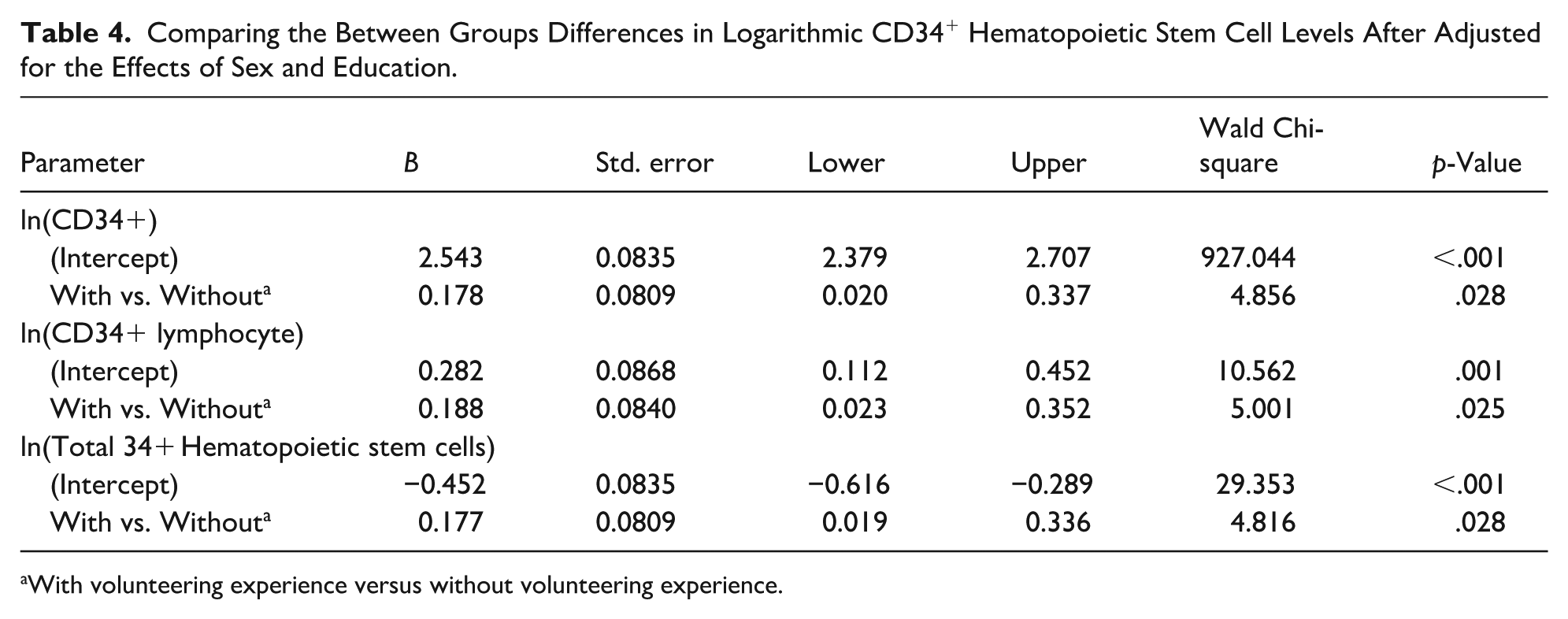
With volunteering experience versus without volunteering experience.
Discussion
This study examined how volunteering impacts health in older adults, focusing on CD34+ stem cells. Results showed volunteering is significantly association of cognitive function, lower depression score, and boosts CD34+ cell levels vital for vascular health. These findings align with other research highlighting social engagement’s health benefits for older adults, underscoring community involvement’s significance. A study found volunteering linked to increased physical activity and better physical functioning, crucial for health in later life (S. Kim et al., 2023). Additionally, our findings showed socioeconomic factors significantly influenced older adults’ volunteering participation. Supporting other studies, this research noted higher education levels correlated with more volunteering, suggesting targeted strategies could enhance participation and health benefits (Tang & Morrow-Howell, 2008). Volunteering offers older adults’ meaningful roles that foster purpose and identity, enhancing mental health, cognitive function, and possibly physiological health (Romero & Minkler, 2005; Warburton & Winterton, 2010). Engagement in volunteer programs can boost cognitive abilities, such as memory and verbal fluency, improving mental health and quality of life (van Zon et al., 2016). Aging reduces both the quantity and functionality of CD34+ stem cells essential for hematopoiesis and immune response (Los et al., 2018). Our findings indicated that volunteers had notably higher CD34+ counts than no volunteers, even after controlling for sex and education (Table 4). While volunteering may not directly influence CD34+ cells’ functionality, the health benefits associated with it could support healthy aging and stem cell function. Improvements in general health from volunteering may create a favorable environment for stem cell activity. Benefits include reduced stress and increase physical activity (Pillemer et al., 2010), both positively influencing stem cell function (Tower, 2012). Enhanced mental and physical health can alleviate stress and inflammation, which are crucial for stem cell health (Frodermann et al., 2019). This aligns with other studies showing older volunteers experience better mental health, evidenced by lower depression and improved cognitive function. Volunteers outperformed no volunteers on GDS, MMSE, and CDR assessments, highlighting social engagement’s role in reducing depressive symptoms and cognitive decline in older adults. Improved cognitive function scores among volunteers support previous research linking social participation to better cognitive health in older individuals, indicating community involvement prevents cognitive decline.
The study found that CD34+ stem cells are associated with volunteer activity. While volunteering’s mental benefits are clear, its impact on stem cell levels is less understood. Results showed that volunteers had more CD34+ cells, opening new research opportunities into volunteering’s health advantages. Analysis indicated that most volunteers were women with higher education, which could influence the findings’ applicability. In summary, the study supports known mental health benefits of volunteering for older adults and reveals its potential effects on stem cells. These results highlight the need for more research to fully grasp the health benefits of volunteering in older populations.
Strengths of the Study
This study used various assessment tools, including cognitive function tests (MMSE and CDR scale) and depression scales (GDS), offering a holistic evaluation of participants’ health status. The application of multiple linear regression analyses and appropriate statistical tests, such as the Mann–Whitney U test and Fisher’s exact test, enhanced the reliability of the findings by accounting for potential confounding variables. In addition, the inclusion of 91 participants, with 52 having volunteering experience, provided a robust sample size, further strengthening the validity of the results.
Limitations of the Study
The cross-sectional design of the study limits the ability to establish causality between volunteering and health outcomes. Longitudinal studies are required to determine whether volunteering directly improves health or if healthier individuals are more likely to engage in volunteering. In addition, participants who volunteer may inherently exhibit characteristics such as higher motivation or better baseline health, introducing potential “self-selection bias” that could skew the results. The lack of a control group that refrains from any social or lifestyle activities further complicates the ability to isolate the specific effects of volunteering from other contributing factors. Although this study revealed an association between volunteer service and physical and mental health indicators such as CD34 stem cell count, cognitive performance, and levels of depression through objective scientific evidence, the causal link between these factors certainly requires clarification in future investigations. In conclusion, although the study provides compelling evidence of the health benefits of volunteering among older adults, these limitations should be considered when interpreting the results. Future research should address these limitations to better understand mechanisms through which volunteering affects health in aging populations.
Conclusion
Participation in volunteering is associated with enhanced cognitive function, less depression, and higher CD34+ hematopoietic stem cell counts in older adults. These findings highlight the potential of volunteering as an effective strategy for promoting health and well-being in aging populations, emphasizing the need for further research to investigate underlying mechanisms and the long-term effects of these benefits on health outcomes.
Supplemental Material
sj-docx-1-ggm-10.1177_30495334251385836 – Supplemental material for Effects of Participation in Volunteer Activities on CD34+ Hematopoietic Stem Cells
Supplemental material, sj-docx-1-ggm-10.1177_30495334251385836 for Effects of Participation in Volunteer Activities on CD34+ Hematopoietic Stem Cells by Chuan-Hsin Chang, Chia-Chi Chen, Yue-Cune Chang, Cho Chen Hsieh, Chai Ching Lin and Jia-Fu Lee in Sage Open Aging
Footnotes
Acknowledgements
The authors would like to thank the study participants. This manuscript was edited by Wallace Academic Editing.

Ethical Considerations
The research was approved by the Taipei Tzu Chi Hospital Institutional Review Board (IRB NO. 10-M-014).
Consent to Participate
Participants were fully informed about the research and informed consent was obtained from all of them.
Author Contributions
Jia-Fu Lee contributed to Conceptualization, Formal analysis, Methodology, Supervision, Writing—review & editing. Chuan-Hsin Chang contributed to Formal analysis, Writing—original draft. Chia-Chi Chen supervised the assessment of the patients and data collection. Yue-Cune Chang undertook the statistical analysis, interpreted the results, and edited the manuscript. Cho-Chen Hsieh, and Chai-Ching Lin supervised laboratory technical guidance. All authors contributed to and approved the final manuscript.
Funding
The authors disclosed receipt of the following financial support for the research, authorship, and/or publication of this article: This research received funding from Dr. Power Stem Biomedical Group Co., Ltd for J.-F. Lee. The funder provided support in the form of salaries for authors (JFL) but did not influence study design, data collection, analysis, publication decisions, or manuscript preparation. Support was also provided by a grant from the Taipei Tzu Chi Hospital, Buddhist Tzu Chi Medical Foundation (TCRD-TPE-113-67; TCRD-TPE-113-43) for C.-H. Chang and J.-F. Lee. The specific contributions of this author are detailed in the “Credit author statement” section.
Declaration of Conflicting Interests
The authors declared the following potential conflicts of interest with respect to the research, authorship, and/or publication of this article: The sponsor Dr. Power Stem Biomedical Group Co., Ltd provided funding to conduct the study, only. The funder provided support in the form of salaries for authors (JFL) but did not have any additional role in the study design, data collection, and analysis, decision to publish, or preparation of the manuscript. This does not alter our adherence to AJPM policies on sharing data and materials.
Data Availability Statement
The data that supports the findings of this study are available in the supporting information of this article.
Supplemental Material
Supplemental material for this article is available online.
References
Supplementary Material
Please find the following supplemental material available below.
For Open Access articles published under a Creative Commons License, all supplemental material carries the same license as the article it is associated with.
For non-Open Access articles published, all supplemental material carries a non-exclusive license, and permission requests for re-use of supplemental material or any part of supplemental material shall be sent directly to the copyright owner as specified in the copyright notice associated with the article.
