




Abstract
Objective:
The research project aimed to examine the views and perspectives of community workers for older people with intellectual disabilities (≥50 years), with the aim of exploring and documenting the most important support needs in all Quality domains of life of their old patients with intellectual disabilities.
Methods:
N.113 participants are working as health professionals in the residential-care organizations for people with intellectual disabilities in Italy. A survey online on the QoL model was developed exploring following domains: Personal development, Self-determination, Interpersonal relationships, Social inclusion, Rights, Emotional well-being, Physical well-being, Material well-being and Existential well-being.
Results:
According to the participants, older people with intellectual disabilities experience support needs in all 8 examined QoL domains: all of them seemed high relevance. The support needs within the domains of emotional well-being, physical well-being, were rated as being of the greatest importance for this population, whereas those within the domains of personal develoment, existensial wellbeing, social inclusion were rated as being least important from almost invovled pofessionals.
Conclusions:
The increasing of longevity and applying lifestile medicine, the clinical and social community is detecting the need to support better and funciotnally that patients; the other part, the managing of people with intellectual disabilities experience in dedicated community could be impacted negatively to the age-related difficulties as well leading to augmentation and changes in their daily support needs.
Keywords
Introduction
Knowledge regarding the daily support needs of people with intellectual disabilities is limited, despite it being a relevant clinical area for providing adequate support. The life expectancy of people with intellectual disabilities has increased in recent decades (Shoostari et al., 2012). Several studies focused on chronic disease in aging; few researchers dealt with the physical and mental health in aging regarding to the patients with intellectual disabilities (Thalen et al., 2022). More people with intellectual disabilities are dealing with age-related difficulties; for example, they may experience declines in physical and/or cognitive abilities, substantial losses in their social networks, and encounter increasing limitations in their social contexts (Alftberg et al., 2021; Evenhuis et al., 2012; McCausland et al., 2016). Furthermore, due to premature aging and a higher prevalence of multiple chronic health disorders (e.g., respiratory diseases) and psychiatric disorders (psychotic disorders) in older people with intellectual disabilities compared to the general population of the same age, aging with intellectual disabilities is a complex process (Alftberg et al., 2019; WHO, 2018). These complex aging processes inevitably lead to increased changes in their support needs (Alftberg et al., 2019; Bigby, 2004). To implement compensatory strategies, it is necessary to understand the wide range of support needs of older people with intellectual disabilities and above all how to continue to provide adequate support as they age. Community staff therefore need to understand and adapt to the wide range of support needs of older people with intellectual disabilities (Baumbusch et al., 2015; Koch et al., 2025). However, research on the common daily support needs (e.g., self-determination, physical and emotional well-being, social inclusion) of older people with intellectual disabilities remains scarce (Albuquerque & Carvalho, 2020; Thalen et al., 2023). Previous studies have demonstrated the multiple and complex nature of the support needs of older people with intellectual disabilities and the significant challenges they pose for support staff, including the possible lack or need for specific knowledge and skills to support this population (Alftberg et al., 2019; Innes et al., 2012). With this context in mind, the present study aims to provide several important implications for improving clinical practice and add to existing knowledge. Although signs of aging are mainly associated with medical aspects and physical abilities (Alftberg et al., 2019), the present study focuses on support in other equally relevant QoL domains. The term “QoL domain” refers to the set of factors that make up personal well-being and therefore define the multidimensionality of a quality life. There are eight domains of QoL: (a) personal development, (b) self-determination, (c) interpersonal relationships, (d) social inclusion, (e) rights, (f) emotional well-being, (g) physical well-being, (h) existential well-being (Buntinx and Schalock, 2010).
Our overview of everyday and concrete support needs could be useful as a practical tool for implementing quality care services for older people with intellectual disabilities (de Leeuw et al., 2022; Sheerin et al., 2024). Furthermore, it could increase levels of awareness and knowledge to adequately respond to the different needs and signs of older people with intellectual disabilities.
The research project aimed to examine the views and perspectives of community workers for older people with intellectual disabilities (≥50 years), with the aim of exploring and documenting the most important support needs in all Quality domains of life of their patients.
Methods
Ethical Approval
This study was approved by the Institutional Review Board (IRB) of the Life, Health and Environmental Sciences, University of L’Aquila, Italy (Code 37589/2021). Signed informed consent based on Declaration of Helsinki was mandatory.
Participants
Participants were n. 113. All participants are working as health professionals in the residential-care organizations for people with intellectual disabilities in Italy with an average working experience of 10.3 years (SD = 6.8; range: 5–27). The assisted old people with intellectual disabilities were an average of 250 in the time. No further inclusion or exclusion criteria were applied. Participation in the study was voluntary. In Figure 1 the distribution of professionals:
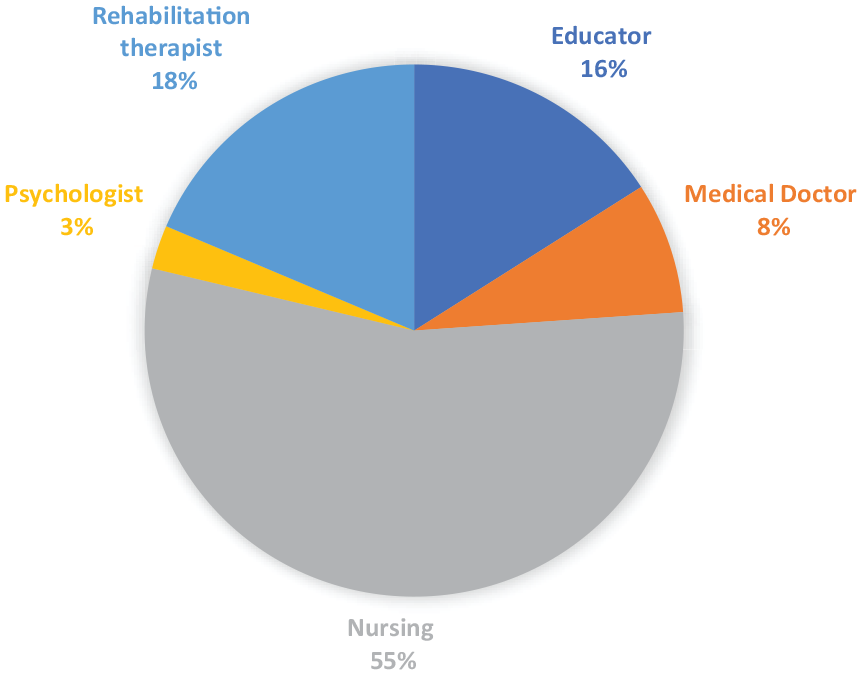
Distribution of professionals involved in the study.
Assessment
A survey online on the QoL model (Schalock et al., 2010) was developed (i.e., Personal development, Self-determination, Interpersonal relationships, Social inclusion, Rights, Emotional well-being, Physical well-being, Material well-being and Existential well-being). The survey consisted of three parts. First, in the qualitative part, participants were asked whether older people with intellectual disabilities in general experience a need for support in each of the nine QoL domains (see Table 1). Then, they were asked to mention the most important support needs that older people with intellectual disabilities experience within each QoL domain based on their own estimation. Finally, they rated the importance of each QoL domain for older people with intellectual disabilities more generally along a scale ranging from 1 (not important) to 10 (very important).
Quality-of-life (QoL) Comains and Core Indicators.

Schalock (2004) and Schepens et al. (2018).
The Survey is made up overall of n. 41 items. Contents of Survey was reported in Supplemental Materials (S1). The expected completion time of the Survey is 15 min. The link was sent via email to the support staff of the Life, Health and Environmental Sciences, University of L’Aquila, Italy.
Study Design
An observational (mixed-method) study was conducted involving health professionals working in residential-care organization. In the qualitative part, the support needs of older people with intellectual disabilities were explored and identified. The quantitative part of this study evaluated the importance of each QoL domain for older people with intellectual disabilities (Morse & Niehaus, 2009).
A sample size of 113 participants was estimated to provide a 95% confidence interval (CI), a power of 80%, and α-value = .05, taking account of an expected percentage of losses around 50% of participants. Sample size calculation was performed by using NCSS-PASS software. The survey was based on structured questions regarding the needs of older people with intellectual disabilities. In the quantitative part, descriptive statistics were performed by using Jamovi software to assess means, standard deviations, median, and range for the grades of importance (1–10) of each QoL domain according to the participants. The mean scores were used to rank the QoL domains by importance.
Results
Table 1 details the indicators applied in the Survey, the results of which will be the subject of statistical analyses.
According to the participants, older people with intellectual disabilities experience support needs in all 8 examined QoL domains: all of them seemed high relevance. An extensive overview of the support needs that the participants mentioned as being the most important within each domain is presented in Table 2.
Means, Medians and Standard Deviations for Each Quality of Life Domain.

Then, we elaborated data by professional categories involved in the study (Table 3).
QOL Domains Mean Values Distributed by Professionals.

In Supplemental Materials were reported the Survey Plot of mean values of QoL domains distributed by Professionals (S2).
The support needs within the domains of emotional well-being, physical well-being, were rated as being of the greatest importance for this population, whereas those within the domains of personal development, existensial wellbeing, social inclusion were rated as being least important (see Table 2) from almost professionals. Medical doctors considered social inclusion and right higher importance for need of patients; psychologists seemed more critical than other professional in all domanins. We processed the analyses considering the timing of working experience: data showed no difference among early (<2 years) and consolidated (<2 years) of working experience. Even. No gender difference has been emerged.
Discussion and Conclusion
Generally, literature addressed issues and topic regarding the patients with intellectual disability in developmental aging dealing with cognitive, emotional and personality disorders related to interventions. Few studies dealt the daily living of older patients with intellectual disorders and more focusing on Quality of Life and their needs.
The increasing of longevity and applying lifestyle medicine, the clinical and social community is detecting the need to support better and functionally that patients; the other part, the managing of people with intellectual disabilities experience in dedicated community could be impacted negatively to the age-related difficulties as well leading to augmentation and changes in their daily support needs (Alftberg et al., 2019; Bigby, 2004; Shoostari et al., 2012). The present study provides an overview of the most important common-daily support needs of older people with intellectual disabilities in Italian community, taking care of several knowledge perspective of 113 professionals.
In our knowledge, this overview is the first in Italian scenario and would be represent the early perspective to draw adapted caring systems in order to build a tailored support staff. The support needs identified, are related to the entire range of n. 8 QoL domains, and therefore consistent with the gerontologic concept of more possible positive aging (Fesko et al., 2012). Finding highlighted the positive aging implies that physical and mental and existential aspects enable older people to experience increased longevity, QoL while retaining their functional capabilities. Our reporting wanted to highlight the silent emerging topic regarding to the presence of support needs of older patient with intellectual disabilities. Investigations and social intervention should be tailored to favor the integration of prolonged rehabilitative treatments in lifelong improving the outcome of living in later life. Our exploration underlined the importance of each QOL domain for older people with intellectual disabilities. The ratings assigned by the several health professionals suggested that the support needs relating to emotional well-being, physical well-being, self-determination and interpersonal relationships as being the most important. The importance attached to support needs within the domain of physical wellbeing is not surprising, given that older people with intellectual disabilities experience greater physical health needs (e.g., a strong focus on medical and physical domains of life) confirming preview perspectives. In particular, older people with intellectual disabilities are likely to encounter emotional life events, due to age-related decline, loss of significant others, forced relocations and difficulties in maintaining their autonomy and self-determination (Hermans & Evenhuis, 2012; Perkins & Moran, 2010). Moreover, as the social networks of older people with intellectual disabilities shrink, their remaining interpersonal relationships become more important (McCausland et al., 2016). It is, therefore, understandable that the health professionals rated the support needs in these domains as valuable.
Supplemental Material
sj-docx-1-ggm-10.1177_30495334251330672 – Supplemental material for Progressive Needs of Patients with Intellectual Disabilities in Aging
Supplemental material, sj-docx-1-ggm-10.1177_30495334251330672 for Progressive Needs of Patients with Intellectual Disabilities in Aging by Dina Di Giacomo, Maria Antonietta Pompili, Federica Di Lucia and Alessandra Martelli in Sage Open Aging
Footnotes

References
Supplementary Material
Please find the following supplemental material available below.
For Open Access articles published under a Creative Commons License, all supplemental material carries the same license as the article it is associated with.
For non-Open Access articles published, all supplemental material carries a non-exclusive license, and permission requests for re-use of supplemental material or any part of supplemental material shall be sent directly to the copyright owner as specified in the copyright notice associated with the article.
