




Abstract
Most rural older adults tend to age in place, highlighting the need for further study on aging-in-place (AIP) challenges faced by this aging cohort using reliable data sources. This qualitative study explored the challenges rural older adults experience when AIP, based on the perspectives of rural service providers. Sixteen face-to-face interviews were conducted with service providers at their service sites using a semi-structured questionnaire. The voice-recorded interview data was transcribed, and inductive thematic analysis was applied to identify the providers’ perspectives. Five key themes emerged: housing support for aging, the need for transportation and avoiding isolation, staying healthy/medical care, finances and affordable living, and challenges in delivering services in rural communities. The study findings highlight educational needs for service providers, rural older adults, and their families, as well as opportunities to support AIP throughout the adult life continuum.
What This Paper Adds
This paper will contribute to understanding rural older adults’ AIP challenges, as evidenced by the service providers who directly interact with older adults in rural communities.
Applications of Study Findings
The study findings underscore the need for enhanced education programs targeting service providers, older adults, and their family members to ensure they are well informed about available resources and strategies for AIP.
The study findings also suggest the importance of education for future planning that begins before a person reaches older age.
Introduction
Most older persons residing in rural residential environments have a great desire to age in place (Housing Assistance Council, 2014). Yet, a concern is that rural communities may have limited access to, for example, housing, transportation, healthcare, and social services to support aging in place (AIP), compared to metro core communities (Rural Health Information Hub, 2019). Rural U.S. communities declined in population between 2006 and 2016, and growth remained close to zero (0.02%) between 2018 and 2019 (Cromartie, 2020). However, the population of rural older adult residents in these communities is increasing and is expected to continue to increase. Pendall et al. (2016) noted a 15% population growth in rural older adults from 2000 to 2010, with a 25% increase anticipated by 2040. Thus, attention is to be given to the rural aging cohort, and this emphasizes the need for a study on their AIP practice within rural communities.
AIP is affected by older adults’ residential environment, as found in multiple studies (e.g., Kwon et al., 2015; Lee et al., 2019). Over the decade, the majority of AIP studies in the field of housing employed quantitative research approaches to define factors affecting AIP by using inferential statistical analyses (e.g., Ahn et al., 2020; Kwon et al., 2015; Lee et al., 2021). During the past 20 years of housing research for older adults, qualitative data collection, such as verbal narratives from rural populations or those (e.g., service providers) who could provide insights regarding their community and target clients, were less visited, as proved by Hwang et al. (2019).
In 2018, the Housing Research team in the Department of Family and Consumer Sciences at North Carolina Agricultural and Technical State University (N.C. A&T) began a 3-year research project, “Aging in Place Indicators for Rural Seniors: Focusing on Residential Environment and Physical Activities” (Lee, 2018). Phase I of the project involved on-site visits and face-to-face interviews with service providers assisting older adults in rural communities. This approach was driven by the increasing emphasis on community-based services to help older adults safely remain in their homes (Siegler et al., 2015). Consequently, service providers in rural areas can offer valuable insights into supporting AIP for rural older adults. As part of this phase, this brief report aimed to identify the challenges of AIP from the service providers’ perspectives, offering insights into the residential environments of rural older adults. The evidence-based findings can contribute to the enhancement of informal and outreach education opportunities that support AIP for rural older adults in a practical and effective manner.
Methods
The sample included 16 rural service providers in North Carolina, who can provide their perceptions and experiences with rural older adults’ AIP challenges within rural communities. In this study, rural is defined as counties with an average population density of 250 people per square mile or less (NC Rural Center, 2024), and older adults are defined as those who are 55 years of age and older, based on the definition of senior center operation and program evaluation (NC Department of Health and Human Services [NCDHHS], 2021). A purposive sampling technique was used to identify and select research participants who provided a variety of perspectives on the study topic (Creswell & Clark, 2011). N.C. A&T Institutional Review Board approved the study (No. HS19-0049). For sample recruitment, first, the contact information on the website of rural aging service organizations (e.g., senior centers) was used to recruit interview participants for our study. After interviewing some of those service providers, snowball sampling from them was also sought to gain additional participants.
Between June 11, 2019, and March 5, 2020, a two-person team (one project principal investigator and one research associate) visited the service sites, which were about 1 hr by car from the researchers’ university campus to rural towns. The researchers conducted face-to-face interviews with 16 rural service providers, whose average working experience was 16 years (range: 1–40 years), including six senior center directors, three church leaders, and seven others (various agency directors and administrators) in five rural counties in NC. One research team member led each interview while the other member took notes during the interview. Semi-structured interview questions consisted of (a) closed-ended questions regarding the rural service provider’s profile and organization profile and (b) open-ended questions regarding the residential environment for rural aging residents and service/program features. Each interview took about 1 hr. This brief report focuses on responses to the specific interview question, which served as one central research question, “In your opinion, what is the biggest challenge or concern for rural seniors who are aging or want to age in place in (their) community?”
Interview responses were recorded as audio and transcribed for the qualitative data analysis. An inductive thematic analysis was used, which is the method used when reviewing extensive data to identify themes or patterns that are not pre-determined but are driven by the data (Braun & Clarke, 2006). To become familiar with the data, each researcher independently reviewed the transcripts to create initial codes that were organized into themes. Then, the researchers reviewed all transcripts again together to resolve differences in coding and themes, refined themes by defining and naming them, and selected the appropriate texts representing themes.
Findings
As noted, a key question on the rural service provider’s interview asked about their understanding of the challenges or concerns for rural older adults to age in place in their community. Many interviewees gave multiple responses. The responses were reviewed and grouped into 5 themes and 31 sub-themes of the challenges of AIP in rural areas (Table 1). Additionally, quotes from the service providers are included in Table 1 to support the themes and sub-themes identified. A review of the responses in each theme details the concerns and challenges of AIP (i.e., subthemes) in a rural area. Lack of support services (especially housing, transportation, and health care), isolation, and limited resources were critical issues repeatedly identified.
AIP Challenges or Concerns for Rural Older Adults: Responses from Service Providers (N = 16).
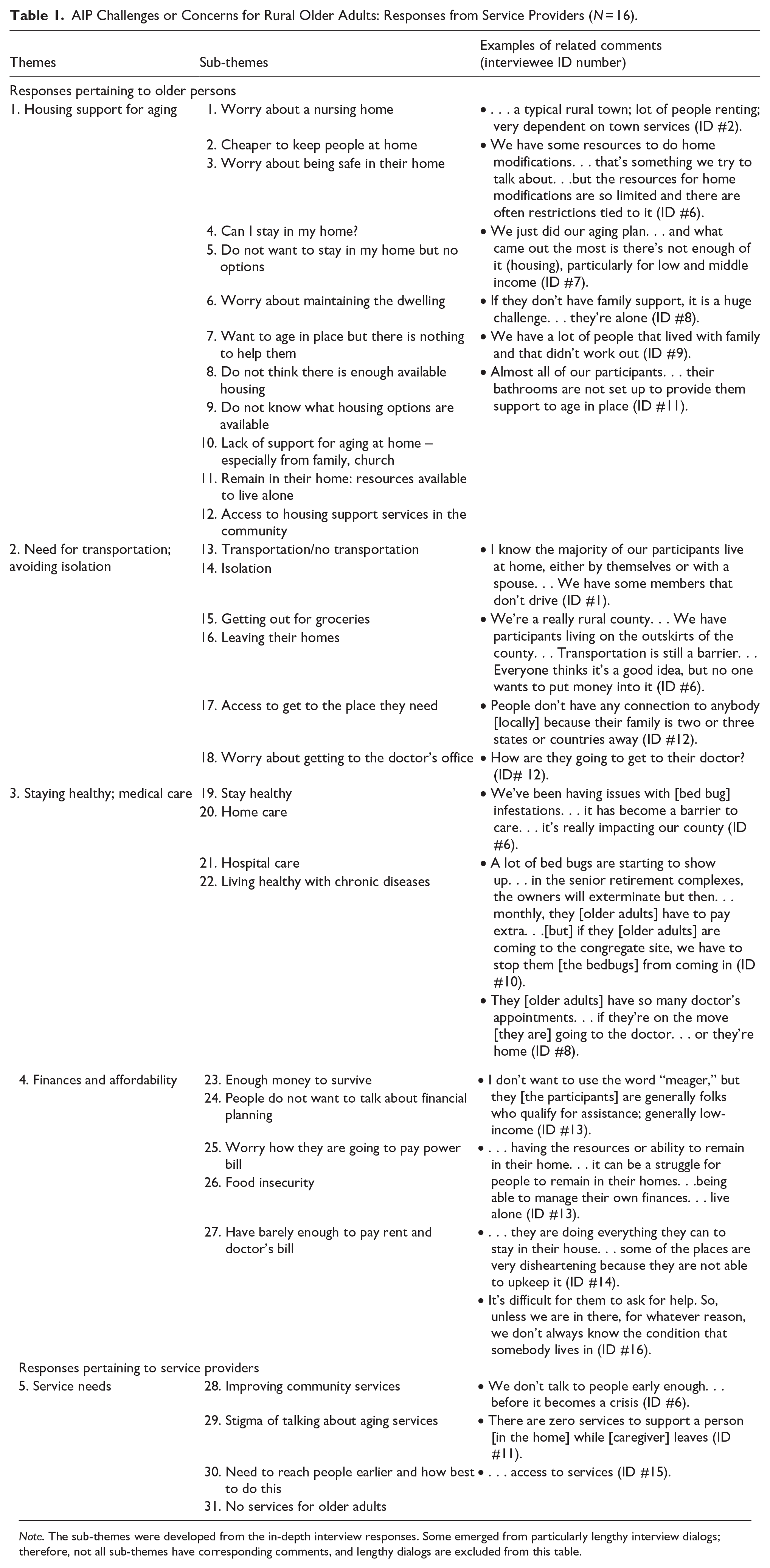
Note. The sub-themes were developed from the in-depth interview responses. Some emerged from particularly lengthy interview dialogs; therefore, not all sub-themes have corresponding comments, and lengthy dialogs are excluded from this table.
Four of the identified themes specifically pertained to older adults (themes 1–4), and one theme, service, pertained to service providers and their challenges on the job (theme 5).
Theme 1. Housing support for aging. Theme 1 was supported by 12 sub-themes, which are detailed in Table 1. This is the largest number of sub-themes for any theme. The sub-themes included concerns about overall AIP, the lack of alternative housing options, safety and maintenance in the home while aging, and family and community support for AIP. Service provider comments particularly highlighted issues of the need for appropriate (accessible) housing. As one service provider said, “Almost all of our participants. . . their bathrooms are not set up to provide them support to age in place” (ID #11).
Theme 2. Need for transportation and avoiding isolation. Theme 2 was supported by six sub-themes (Table 1). The sub-themes related to the need for transportation, especially for essentials such as medical appointments and grocery shopping. The comments from the service providers highlighted the concerns of transportation in a rural county and the limitations of living alone. One respondent addressed: “We’re a really rural county. . . We have participants living on the outskirts of the county. . . Transportation is still a barrier. . . Everyone thinks it’s a good idea, but no one wants to put money into it” (ID #6).
Theme 3. Staying healthy/medical care. Theme 3 was supported with four sub-themes (Table 1). Access to health services was an important concern. One service provider said, “They [older adults] have so many doctor’s appointments. . . if they’re on the move, [they are] going to the doctor. . . or they’re home” (ID #8). Also, healthy home conditions were discussed. Bed bugs were identified as a specific problem. “We’ve been having issues with [bed bug] infestations. . . it has become a barrier to care. . . it’s really impacting our county” (ID #6).
Theme 4. Finances and affordability. Theme 4 was supported with five sub-themes (Table 1). Paying bills and food insecurity were noted as specific concerns. Adequate income was tied to the ability to remain in their home. One service provider addressed: “. . . they are doing everything they can to stay in their house. . . some of the places are very disheartening because they are not able to upkeep it” (ID #14).
Theme 5. Service needs. Theme 5 pertained to service providers and was supported with four sub-themes. Overcoming the stigma of services for aging and reaching people earlier in the life span was noted. Additionally, the lack of service was also mentioned, as “There are zero services to support a person [in the home] while [caregiver] leaves” (ID #11).
Many of the identified challenges related to worry on the part of the older adults or their families on issues such as being safe in the home, maintaining their dwelling, having access to medical appointments and services, and having adequate income to meet expenses.
Additional Challenges
Although the focus of this article is the interview question pertaining to challenges, other concerns and challenges were found across the service provider interview responses. As anyone who has conducted face-to-face interviews knows, it can be hard to keep the conversation to the specific question. Of relevance to this article on potential educational needs, are challenges identified by the interviewees that also apply to aging issues in many rural communities:
Younger people leaving rural areas or not moving into the communities, leading to even more skewing of the population toward older persons.
Lack of, or limitations in, educational programs.
Lack of volunteers to implement program needs, including outreach education.
Lack of internet or broadband services to deliver programing (Note: This was an issue in the study, which was conducted before the COVID-19 pandemic made electronic communication even more critical).
Overall declining rural economy which introduces challenges to funding programs and/or services.
Discussion
The service providers interviewed had frequent and regular contact with older or aging adults in their rural communities. This gives credibility to their viewpoints on challenges to AIP. Also, they were particularly cognizant of the opportunities and limitations in their rural communities to support AIP.
The themes and sub-themes representing AIP challenges, presented in Table 1, provide a valuable starting point for identifying potential educational programs needed to assist older adults aging in rural communities. An important concept is that it takes planning to age in place—beginning early in an adult’s life. As one service provider respondent (ID #6) said: “We don’t talk to people early enough. . . before it becomes a crisis.” Therefore, AIP is a concept that needs to be included in many educational programs targeted to young and middle-aged adults, especially when considering housing and financial decisions. Another service provider respondent (ID #13) particularly noted the importance of “having the resources or ability to remain in their home (or) live alone.” This implies that an educational program on financial management and planning needs to include a component on long-term planning for aging. Or a seminar on homeownership needs to consider selecting a home to support future AIP.
Additionally, specific or key topics for educational programs targeted to rural older adults, were suggested by the findings from this study. These topics are numerous and include topics that focus on staying in one’s own home or AIP; family support for AIP; key issues for AIP in rural communities; financial planning and management for AIP; and what happens when AIP is no longer a viable option. Other topics suggested were more specific to the local area or community, such as alternative housing options to AIP; options for supportive living in the community, such as assisted living and nursing home facilities; transportation; available, accessible, and affordable health services; and home modification options for safety and security, including smart home technology (where broadband and internet are available).
Conclusion
AIP is a process, not a single event. For many older adults, AIP happens without necessarily making a specific decision or choice. One day, the realization begins that one is, in fact, AIP. This article considered a study of (rural) older adults, their needs to continue to age in place, and opportunities to address these needs through education in addition to services. However, it is important to emphasize that plans for successful AIP need to happen over the life continuum of adulthood. As people make life choices, about housing, lifestyle, and financial planning, AIP needs to be considered. These issues and questions need to be integrated into educational programs across a greater lifespan. This truly can help lead to successful AIP.
Future Studies
Suggested future studies are as follows:
Meta data analysis with government or organizations’ data to define current programs and services that are offered to rural older adults AIP. In particular, where are the educational gaps—and thus opportunities?
Additional data collected post-pandemic. Has this changed the needs of aging adults? Has this changed preferred information and assistance delivery methods?
Further comprehensive thematic analysis regarding AIP challenges for rural older adults by synthesizing responses to other interview questions alongside the synthesis presented in this report, which focuses solely on one interview question.
