




Abstract
Digital disruption brought forth by advanced technologies has changed the dynamics of work. New-age startups have developed that equip the workforce with emerging contemporary skills. This article attempts to assess the contributions that accrue to the corporate sector due to e-learning services provided by the edtech startups. The author took the top 10 corporate learning startups listed on the Tracxn website. Case studies listed on the startups’ website were utilized. The chosen research methodology is document analysis. The findings identified various challenges. The classroom-based methods are not able to engage the employees due to a lack of instant feedback and were more theoretical in nature. The onboarding process is very tiresome and error ridden. As a solution, the startups provided self-paced, bite-sized and experiential learning. The onboarding process was completely automated. Cloud cost was significantly reduced. Nonetheless, no evidence was found regarding improvements in learning outcomes of employees. A key limitation of the study is the lack of data to establish a causal relationship between the startups’ intervention and observed benefits.
Keywords
The digital disruption brought forth by advanced technologies has changed the dynamics of work. Monotonous tasks are replaced by automation while new job roles are increasingly emerging. In this event of ubiquitous change, the global workforce is expected to equip itself with skills that are the demand of the present-day job market. New-age startups have developed and equipped the workforce with emerging contemporary skills. The startups, through their unique pedagogy, not only offer hands-on training through simulations but also provide customized products to the corporate sector catering to their specific needs. This article’s attempt is to assess the benefits that accrue to corporate firms due to learning solutions provided by edtech startups.
Edtech startups provide different kinds of services. They provide learning management solutions to the corporate sector which facilitate them to author content, deliver lectures and seamlessly assess the performance of employees. They provide e-learning solutions with unique pedagogy, including action-based projects and bite-sized learning. They offer learning through digital games and simulations. Startups provide discovery platforms to the corporate sector to discover investors, tutors and experts in the field. They enable the interaction of mentors and mentees through dedicated online forums. They provide HR solutions and also on-demand business management applications. They also provide suite applications.
The Future of Jobs, 2023, report states that AI, cloud computing and big data will be adopted universally across organizations; in addition, the demand for unique cognitive skills, such as problem-solving, creative thinking and socio-emotional skills is on the upswing. A study on skill mismatch in the OECD countries has found that there is a mismatch between qualifications acquired by people and skills needed to perform the job (McGowan & Andrews, 2015). The employers have to hunt to find the right talent, and have to retrain and ‘develop people internally’ before they become functional (Manpower Group’s Talent Shortage survey, 2017). Continuing professional education startups, such as Simplilearn and Upgrad have sensed this void and are capitalizing on the $370 Bn worth of the global upskilling market (Inc42 BrandLabs, 2021).
E-learning enables the corporate sector to save millions of dollars in training. A corporate giant such as Motorola believes that there is a US $ 30 increase in productivity for every dollar spent on corporate training (Cheong, 2001). Given the evident benefits of e-learning to corporations, this article attempts to assess the contributions that accrue to the corporate sector due to e-learning and the various tangible and intangible benefits that it enjoys due to the services of edtech startups.
The article is organized as follows: First, relevant literature is reviewed. Then, the methodology is described and the findings are presented. Following the discussion, a tentative framework to assess the impact of edtech on the corporate sector is described. The article ends with a conclusion.
Literature Review
There is limited literature on the contributions of edtech startups to the corporate sector. Studies have been conducted in India to evaluate the edtech market and the efficacy of edtech products (Sampson et al., 2019). Nonetheless, such studies are far and few between. Given the scarcity of literature on the subject, the author relies on supplementary literature. The supplementary literature examines the contributions of ‘e-learning’ to the corporate sector. The author uses e-learning as the benefits provided by it would be similar to those provided by startups.
The author sets the background by describing various concepts of e-learning first, then assesses the effect of e-learning on diverse facets concerning the corporate sector.
Various Concepts of E-learning
With the rise of e-learning facilities, a plethora of different concepts have emerged. The all-encompassing concept, amongst them, is ‘e-learning’ which refers to learning delivered through the internet as well as electronic objects such as CD-ROM, video tapes, audio tapes and through satellite (Benson, 2002; Clark, 2002; Ellis, 2004). A subset of e-learning is ‘online learning’ which refers to learning delivered through internet technology (Oblinger et al., 2005). While online learning encompasses a broader category of educational activities conducted over the internet and different forms of instruction such as fully online courses and blended learning courses, ‘virtual learning’ may use advanced technology such as augmented reality and virtual reality to enhance the learning experience (Dillenbourg et al., 2002). ‘Virtual learning’ differs from ‘Virtual communities’ which include online spaces to share thoughts, interact and discuss. Virtual communities are much broader in scope and include social media platforms such as Facebook and Twitter, online forums, online gaming communities and professional networks. Mobile learning is more focused and refers to learning enabled by mobile technology such as handheld and portable devices (Hwang & Tsai, 2011).
A concept which is given admirable importance in training employees is ‘collaborative learning’. Under collaborative learning, learners learn in groups which facilitate interaction, discussion and sharing of experiences (Smith & MacGregor, 1992). Collaborative learning works on the principles of ‘constructivism’ which puts forth that people integrate new knowledge with their previously acquired experiences and learning takes place through successive construction. Edtech startups have formulated learning programmes which mirror the principles of constructivism such as learning in small groups and simulations resembling a café.
Having described various concepts of e-learning, the author now assesses the effect of e-learning on various elements concerning the corporate sector.
E-learning and Job Performance
Startups have used different forms of learning methods to train employees, prominent among them are game-based and action-oriented learning. Although a call for the assessment of outcomes of online learning has been resonating, there is less effort in this direction. The literature available on e-learning and the performance of employees is limited. Nonetheless, the literature puts forth that there is an inevitable leaning on online technologies (Kramer, 2007). Some studies have found significant differences in learning outcomes associated with classroom-based and e-learning instructor methods (Kulkarni, 2019) while others have observed no significant difference (David et al., 2012). With learning outcomes, companies also focus on fundamental elements such as meeting immediate objectives. Companies have specific objectives which are to be met through training programmes. The programmes are viewed as successful if the objectives are met. Usually, training programmes are introduced to meet the objectives and provide specific skills to people. It is of significance that this knowledge is transferred to the job. Phillips and Stone (2003) argue that there must be a transfer of knowledge and skills from the training to the job setting. It is of significance that what is learnt is transferred to the job. In some instances, employees are required to prepare action plan which is a document that shows how intended objectives will be achieved by candidate employees. The action plan is time-bound and makes employees more accountable.
Advantages of E-learning and Online Learning
Online learning is viewed as a ‘suitable, effective option’ (Rodriguez & Armellini, 2013) to deliver training in an organization. Online learning, by replacing instructor-led learning, enables companies to save substantial costs, improve labour productivity and boost employee retention (Grant & Danziger, 2005). In the literature, there are very few articles that examine ‘the implications and directions’ (Macpherson et al., 2004) of e-learning in the corporate environment. Much of the literature is focused on pedagogical and learning delivery issues (Macpherson et al., 2004). Cost advantages are one of the prominent issues discussed.
Pereira (2004) puts forth that the most important cost advantage to the corporate due to e-learning is in the area of cost avoidance. By transitioning to e-learning, companies save the following costs: (a) Accommodation costs for staff who have travelled to the training venue; (b) Travelling costs associated with travelling to the training venue; (c) The cost of the training venue (room hire); and (d) Instructor costs’ (Zornada, 2005). According to Training Magazine (1999), corporations save between 50% and 70% by replacing instructor-led training with electronic delivery (Weggen & Urdan, 2000). IBM saved US $ 200 million in 1999, in addition, provided five times the learning at one-third cost of the previous methods (Hall & LeCavalier, 2000). Using a blended learning approach, Ernst and Young reduced training costs by 35% (Hall & LeCavalier, 2000). Rockwell Collins was able to reduce 40% of the training costs with a mere 25% conversion to web-based training (Hall & LeCavalier, 2000). Cisco, having replaced classroom-only training, saved approx. $ 1.2 Million per annum in travel, accommodation and lost productivity (Hall & LeCavalier, 2000).
Evidence suggests that there are huge economic savings with e-learning. E-learning can be scaled up with a zero increase in the marginal cost. Indeed, corporations spend on setting up e-learning facilities but there is a pressing call to view such expenditures as beneficial as they develop strategic assets of the company—the human resource (Vincent & Ross, 2001).
Another advantage of e-learning which is much talked about in the literature is the flexibility in delivery. E-learning enables people to choose their convenient time and place to learn and lets them learn at their individual pace (Ashmalla et al., 2001; Childs et al., 2005; Grollman & Cannon, 2003; Shanker, 2007). E-learning considers differences in learning styles and offers learning through games and simulations. ‘Evidence suggests that e-learning is more efficient because learners gain knowledge, skills, and attitudes faster than through traditional instructor-led methods’ (Ruiz et al., 2006, p. 208).
In addition to the above benefits, a robust e-learning platform helps in the effective dissemination of knowledge and builds intellectual capital, which creates a sustained competitive advantage (Chandnani, 2003). Fierce global competition, technological advancements, changing demographic structure and the emergence of a knowledge-based economy compel organizations to train and retrain their workforce in novel ways (Weggen & Urdan, 2000). E-learning, through assisting companies in developing their workforce, contributes to creating competitive advantage. E-learning also facilitates multi-national companies to train a workforce which is geographically dispersed (Zornada, 2005). Fall in trade barriers and rapid technological advancements have led to the emergence of complex organizations which transcend national boundaries (Weggen & Urdan, 2000). These corporations employ workers with different cultural backgrounds and educational levels (Weggen & Urdan, 2000). E-learning enables companies to train workers spread across the global continent.
Another significant advantage of e-learning is that it has a high Return on Investment (ROI). Evidence suggests that e-learning significantly advances ROI. In his study of US businesses, Swanson (2001) suggests that 46% of the businesses, which implemented e-learning, were seeing a return on their investment, while 94% stated that they were expecting to see returns within two years. Hammond (2001) puts forth that 80% of the Fortune 500 companies, who were using or intending to use e-learning, expected a significant ROI.
E-learning has several advantages but at the same time, it may also promote innovation within the organization.
E-learning and Innovation
Although there is no direct association between the adoption of e-learning and innovation within an organization, evidence has found that e-learning is a crucial factor in fostering innovation. Individual learning is important for innovation. Knowledge flow, that is, the mechanism through which knowledge is dispersed in an organization is an essential part of individual learning which ultimately leads to organizational change (Crossan et al., 2011). The traditional ways in which knowledge flows persist are unidirectional, such as informal and formal training, and do not suffice the needs of the organization (Manuti et al., 2015). They do not take into account everyday experiences and evidence which keep an enterprise updated. Contemporary e-learning applications, being flexible and adaptive, keep organizations abreast of the latest changes and smoothly integrate knowledge into the procedures and processes of an organization (Giannakos et al., 2022). Organizations remain redundant when employees lack knowledge-related competencies and skills (El Kadiri et al., 2016). Individual learning is given a boost by e-learning applications which make integration of knowledge seamless.
AI, Personalization, Adaptive Learning, Skill Mismatch, Digital Divide and Data Privacy
Underscoring the importance of advanced tech, a study by EY and Nasscom 1 revealed that by 2022, around 46% of the workforce will be engaged in new jobs that do not exist today or will be engaged in jobs that have radically changed skill sets. According to the Future of Jobs report (World Economic Forum, 2023), more than 75% of companies are thinking of adopting advanced technologies such as AI and big data analytics in the next five years. Companies are strongly looking to upskill their workforce in the sphere of AI. Given that AI literacy has become a requisite, and that it helps in the personalization of content, AI will play a crucial role in corporate learning and the formation of intangible assets which would help companies maintain a competitive edge.
The academic literature puts forth that a noticeable proportion of market capitalization depends on the intangible attributes and assets of a company (Mckinsey, 2016). Nonetheless, the development of such intangible assets is thwarted due to stagnant corporate culture. Organizations often deliver standardized training to their employees presuming that employees are identical (Klinga, 2020). There is hardly a connection between learning activities within an organization and the endeavour of the L & D division so much so that the division is unaware of the skills that employees possess and those that are needed to perform a job (Klinga, 2020). The advent of AI bridges this gap by personalizing learning.
Personalization, through AI, has been provided a thrust by an increasing adoption of the software-as-a-service model and a transition towards knowledge-based civil society (Accenture, 2018). As witnessed in the case of Netflix which is able to make movies based on the viewing patterns of the customers (Hunt, 2015) and Amazon, which claims to have 35% of its sales through suggesting complementary products to its customers (Mangalindan, 2012), personalization has an immense potential to increase value for businesses (Klinga, 2020). Personalization is significant in the domain of corporate learning too. Personalization is one of the most important contributions of AI.
Personalization fosters adaptive learning. Today, education technologies enable the creation of unique pathways for each individual, with the application adapting to their abilities, skills, and performance. Such a type of learning is called ‘adaptive learning’ (Bughin et al., 2017). Adaptive learning offers numerous advantages for a variety of reasons. First, individuals need not sit for the lectures the topics of which are familiar to them. They can learn swiftly and at their own pace. They can engage more in content which they find interesting or do not have mastery in. Finally, learners can exercise complete control of their learning. The author shows in this article that adaptive learning is used in the domain of corporate learning.
Although AI and adaptive learning seem superior to the traditional instructor mode, concerns about the digital divide are echoing in the literature. Tech juggernaut companies will exploit the potential of AI sooner and in a better way than companies that lag (Klinga, 2020). The digital divide will also be visible within an organization between employees. Given that AI will automate technical and repetitive tasks, there will be a transition in job demand towards roles that require cognitive, creative, and social skills (Klinga, 2020). Nonetheless, experts argue that AI will not destroy jobs but rather shift the demand towards specific job categories.
Modern technologies facilitate the collection of a copious amount of data. Although data is meticulously gathered, efforts to secure it are frugal. In the e-learning sphere, diligent emphasis has been placed on instruction, its methods and their effectiveness, but needs related to privacy and data security have largely been ignored (El-Khatib et al., 2003). The General Data Protection Regulation (GDPR), in Article 25, puts forth that provisions for privacy must be considered in the design of the product (Alier et al., 2021) but the retailers of IT products fail to take this into account. The in-house enterprise systems are legacy software and are usually rigid (Ali & Zafar, 2017). For systems to serve various functions of an organization appropriately, the learning management system (LMS) and data security software must adequately mesh with the enterprise’s system (Ali & Zafar, 2017).
Given that there is a pervasive adoption of technologies in educational institutions, a large amount of data is available at the disposal of teachers and academic researchers. There have been urges to use the data to inform institutes’ management practices, improve pedagogy and develop tools for controlling behaviour (Alier et al., 2021). Often, these studies lack ethics and morality. In addition, there has been no evidence that tools informed by behaviour-related data can actually improve pedagogy (Guzmán-Valenzuela et al., 2021). Further, the availability of information has led to its commercial exploitation. There has been evidence of data leakage and improper use. In one instance, the presence of unit-level data affected future prospects of students as the data was linked with their profiles for a long period of time (Alier et al., 2021). Given the concerns, several suggestions have been made in the literature. At first, privacy aspects are to be considered in the design of the retail products. Employees must receive security training periodically (Ali & Zafar, 2017). The retail products must conform to quality standards (Alier et al., 2021). ‘a cross functional privacy task force’ must be set up (Culnan & Carlin, 2009). Lastly, since we are addressing codes and legacy systems, solutions must be technical rather than administrative (Alier et al., 2021).
Issues in the Measurement of Performance
E-learning is becoming more popular each day and is spreading to different disciplines, nonetheless, managers are sceptical about its impact on organizations. Often, programme evaluation is missing and when it is present, managers are unsure about what to measure and how to use the information (Moller et al., 2008). The fundamental problem is that there is no precise definition of e-learning effectiveness. Evidence also suggests that e-learning is being used by companies to cater to specific projects (Macpherson et al., 2004). Universal application of e-learning is missing which undermines its ardent potential.
Kaplan and Norton (2004) note that the impact of training itself is difficult to measure as training rarely affects financial performance. Instead, what can be measured is whether training is able to achieve the business objectives for which it was carried out. To realize this, a robust e-learning strategy is needed.
It has been noted in the academic literature that outcomes associated with positive business results are difficult to measure. The reasons are: (a) Carrying out a rigorous evaluation would be expensive and time-consuming; (b) Establishing a cause-and-effect relationship between training and businesses’ bottom line is difficult; and (c) Determining suitable outcomes is challenging (Bregman & Jacobson, 2000).
In the business literature, ROI is often used as an apparatus to evaluate a business investment, but it is fraught with severe shortcomings. Aldrich (2002) argues that ROI emerges from the realm of manufacturing where outcomes can be quantitatively measured. Training, on the other hand, produces intangible benefits which have long-term strategic consequences. Assessing the impact of training at a point in time gravely undermines its value. Realizing this, Microsoft (undated) formulated ‘rapid economic justification’ framework where key employees measure intangible benefits of training which accrue over a period of time.
In addition to the issues in measurement, e-learning has other areas of concern. E-learning market is immature (De Vries, 2005). There is a lack of customized content consequently, the companies have to rely on off-the-shelf products and such products do not meet their unique requirements. Employees have to be constantly motivated to use e-learning facilities. There is a lack of management support for the same. Literature also suggests that e-learning cannot be regarded as a panacea for all training needs (De Vries, 2005). It only provides solutions to problems which remained unresolved in the pre-internet time (De Vries, 2005). E-learning applications can be used in combination with existing training activities, such as in the case of the blended learning approach, to maximize impact. It is therefore important to position e-learning in a correct way.
Barriers to Corporate E-learning
The literature identifies three sets of impediments which act as significant barriers to corporate e-learning. These are technological barriers, organizational barriers and learner barriers (Armistead & Beamish, 2001; Geisman, 2001; Halkett, 2002; Hartley, 2000; Hofmann, 2003a; Macpherson et al., 2004; Sambrook, 2003; Young, 2002).
Technological barriers relate to investments in IT infrastructure, which affect the accessibility and availability of hardware, software and internet (Hofmann, 2003a; Welsch, 2002; Young, 2001). IT tools are usually available to top-level executives and they alone have greater access to internet facilities (Vencatachellum & Munusami, 2006). IT companies do spend considerable amounts of funds on IT budgets but much of it is spent on buying hardware while internet bandwidth remains low. The cost of the internet acts as another significant impediment. Costs are usually high due to undeveloped IT infrastructure at the national level.
Along with technological barriers, organizational barriers, embedded in the culture and policy of the organizations, also influence the success of e-learning. Organizations, having a strong learning culture, foster self-development and self-directed learning, which are essential for e-learning (Armistead & Beamish, 2001; Chiaburu & Tekleab, 2005; Eddy & Tannenbaum, 2003; Homan & Macpherson, 2005). The inability of e-learning to manifest itself in job performance demotivates management as well as peers to critically consider e-learning (Baldwin-Evans, 2004; Chiaburu & Tekleab, 2005; Hofmann, 2003b; Macpherson et al., 2004; Sloman, 2002).
Learner barriers including ‘lack of IT skills, demotivation to learn and poor learner centeredness’ (Vencatachellum & Munusami, 2006) also affect the uptake of e-learning.
Research Gap
There is limited literature assessing the contributions of edtech startups to the corporate sector. Given the scarcity of research on the subject, this article endeavours to assess the contributions that accrue to corporations due to e-learning and the various tangible and intangible benefits that they enjoy due to the services of edtech startups.
Methodology
For the purpose of this study, an edtech startup is defined as ‘a company using internet technology to deliver education services’. Besides this, only those startups are included which are: (a) Established post-2007 (those in the second and third wave of the digital revolution); and (b) Are of Indian origin’ (Kamaluddin & Sridhar, 2021). The top 10 corporate learning startups listed on the Tracxn website are considered for the analysis. These startups are ranked according to their economic performance. Tracxn considers various metrics while ranking companies. These include funding amount, funding round, revenue growth, number of employees, mobile downloads, investments, acquisition, etc. The companies are ranked based on percentiles. The startups chosen for this analysis include Knolskape, Course play, Cusmat, Disprz, G cube, Integra, LearningMate, Nuvepro, Play Ablo and Stratbeans. For assessing their contributions to the corporate sector, case studies listed on the startups’ website were utilized. Altogether, 145 cases were analysed. The details of the cases are given in Table 1. The chosen research methodology employed for the study is document analysis. The documents were coded using the software QDA Miner Lite.
Startups Considered for the Study.
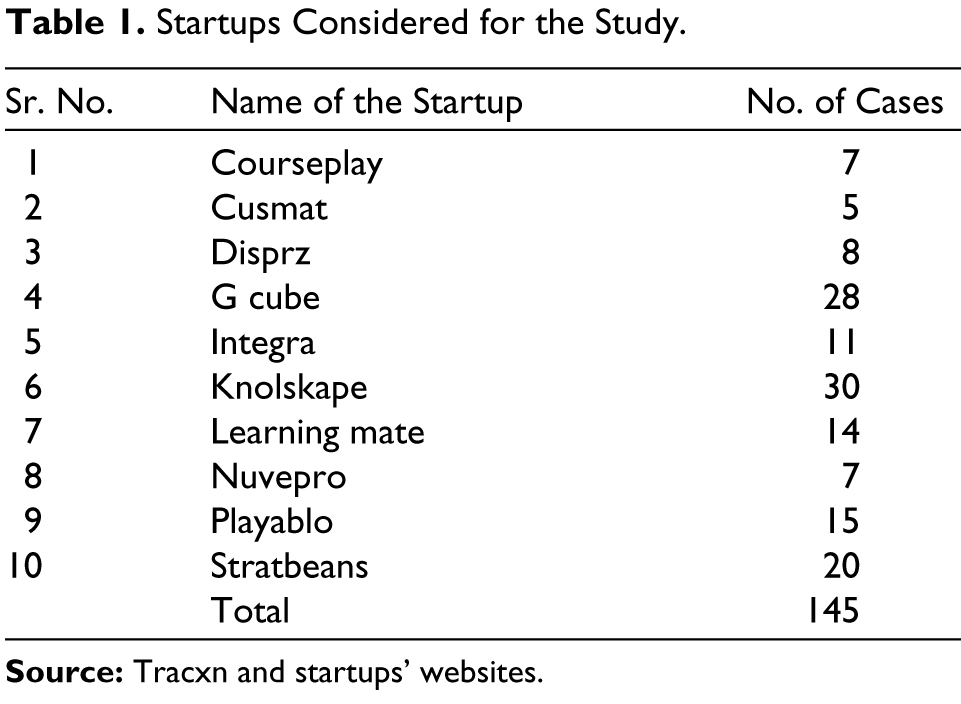
The document analysis, through QDA Miner Lite, has identified the following themes related to the effect of startups on the corporate sector:
Challenges faced by the companies in the absence of technological solutions:
Limitations of traditional didactic learning; High attrition and changing market conditions; On-boarding complexities and costs; and Cost constraints. Solutions provided by the startups:
E-learning and action-based projects; Simulation-based learning—lower errors at work; Enhancement of soft skills; Automation of the onboarding process; and Provision of virtual labs.
Findings
The skill development and online certification market in India is expected to grow colossally in the coming years.
Figure 1 exhibits that the skill development sector is expected to grow from $0.3 Bn in 2022 to $2.5 Bn in 2030. E-learning has been identified as a ‘strategic issue’ as it develops a strategic asset of the company—its human resources. Information is crucial and a faster dissemination of information through e-learning offers a competitive edge to the company over others. E-learning makes content fluid as it is no longer contained in books or folders but changes over time is accessible and can be manipulated by the student as well as the trainer (De Vries, 2005).

In the section below, various themes are discussed that were identified in the document analysis. Figure 2 provides a snapshot of key findings.
Key Findings.
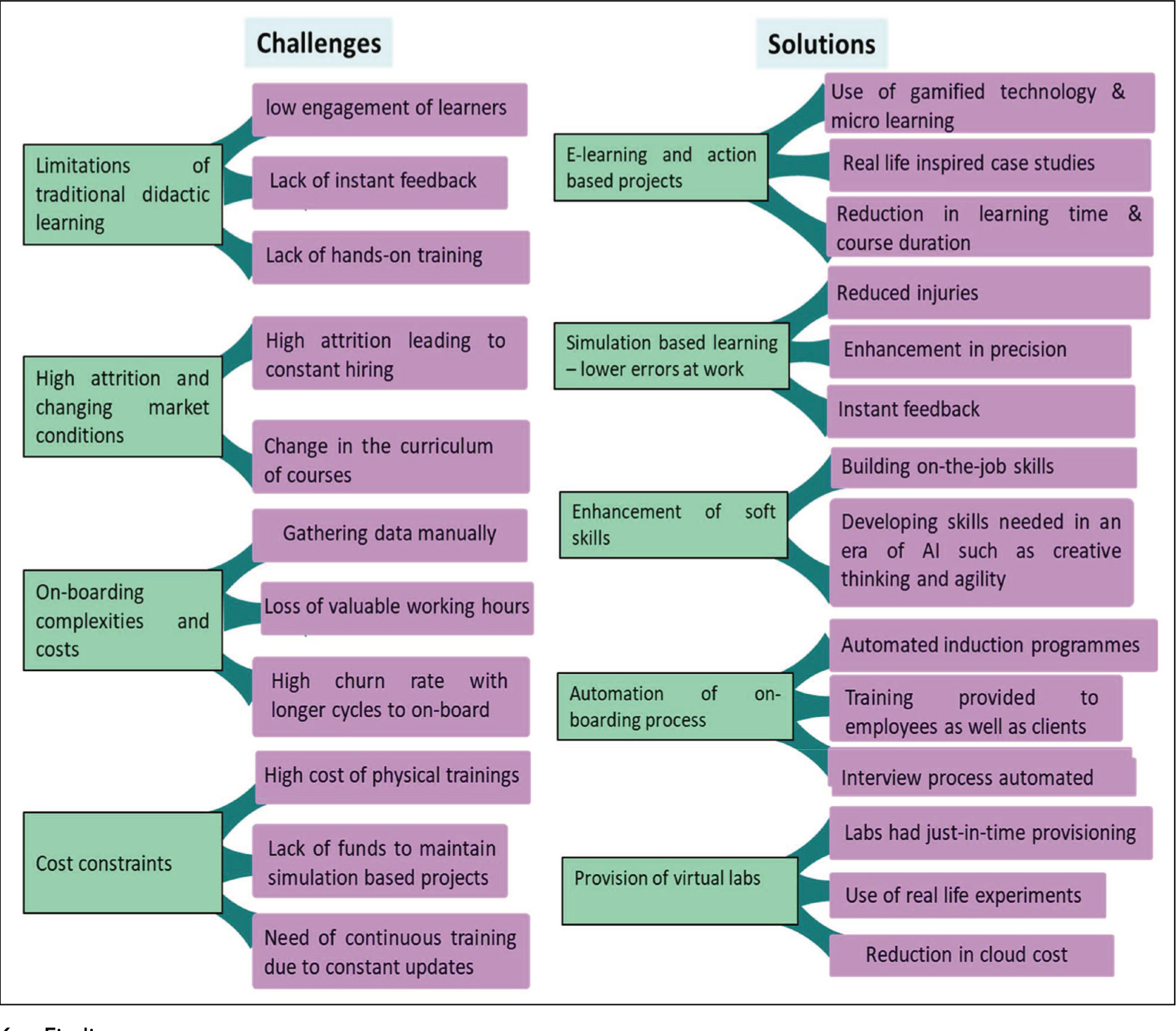
Figure 2 describes various challenges and corresponding solutions provided by edtech startups to the corporate sector. The challenges include low learner engagement, high attrition, costly onboarding process and the need for continuous training amidst changing market conditions. The proposed solutions focus on leveraging technology, such as gamified learning, e-learning platforms, automation and virtual labs to enhance the effectiveness of training, reduce cost and improve employee retention. By adopting these modern solutions, organizations can create a better learning environment that prepares employees for the demands of today’s workforce. The challenges and solutions have been elaborately discussed below.
Challenges Faced by the Companies
The corporate sector put forth numerous reasons for the adoption of technology-based solutions. The classroom-based instructor-led pedagogy was found to be inadequate and not able to engage the learners. Traditional learning works on linear design principles (De Vries, 2005). Linear design is a framework where elements follow a particular order and have a structured arrangement. The traditional learning was more theoretical, concept-heavy and could not provide hands-on-learning. It was not able to provide instant feedback to the participants. The existing learning and development solution was non-scalable and time-consuming. 2 The corporate sector needed self-paced, bite-sized and experiential learning which would train employees for real-life situations. In addition, the workforce of most of the client companies was geographically spread, was functioning in different time zones, had different learning styles and performed different business functions. Accommodating them in a single instructor-led classroom was impossible.
One of the significant reasons identified for the adoption of e-learning is the high attrition rate 3 , 4 caused by poor quality of training and the need for upskilling due to changing market conditions. One of the clients of Stratbeans was experiencing a very high attrition rate and therefore, had to hire a large number of people every month. 5 The company could not have appropriate training quality checks which led to corrupt practices at the bottom. Several other companies, in the dataset, were going through structural changes which necessitated the employees to adapt to change and prepare for the new roles. One of the client companies had to change the curriculum of all the courses ranging from humanities to sciences due to changes in the market conditions. These changing business conditions compelled the employees to assume new roles and exploit e-learning to remain up-to-date.
Yet another gap addressed through e-learning was onboarding complexities and costs. The HR department had to gather candidate’s data manually; co-ordinating candidates, which are in hundreds, was making the onboarding process very tiresome and error-ridden. 6 The on-boarding costs were high with significant opportunity costs in terms of lost hours of work. High attrition rates were prevailing among the companies and constant hiring of workforce and their on-boarding and training required great investment. On-boarding generally consumes three months post-hiring which results in a loss of valuable working hours. The HR department was not able to monitor and track new joiners due to their volume. The companies were facing a high churn rate with longer cycles to on-board a new employee. The HR department was colossally using a lot of bandwidth for repetitive on-boarding tasks. 7 The challenges were being made more acute as companies were legally obliged to train their employees.
The corporate sector wanted skills in real-life projects which the IT department of the client company was not able to provide. In addition, there were budget constraints. The client companies did not have enough funds to create and maintain simulation-based projects. The lab had to be configured as per changing lessons. Different types of hands-on labs were needed. The changes in the software were needed in a short span of time. The trainers were required to be culturally sensitive while training a very diverse audience. The courses on Udemy and Coursera proved futile due to an absence of hands-on training. The courses were MCQ-based with no experiential learning.
Several other challenges were identified in the document analysis. In one instance, training was consuming more than 30% of the operational expenditure. 8 Physical training was becoming expensive day by day due to rising fuel costs. Logistical arrangements were tedious and complicated and were turning into a huge liability. In addition, training records were fragmented as different departments trained employees on different modules. There was a need for content to be available in vernacular languages. The companies were dealing with partners which included delivery persons, truck drivers, retail outlet workers and contract workers for whom English was not a preferred language. Continuous training was required as apps underwent constant updates. The classroom-based method was not able to provide training on a continuous basis. It was not viable when just one employee had to be trained.
The above challenges compelled the corporate sector to look for solutions outside the traditional didactic system and embrace technological solutions which were novel in nature.
Solutions Provided by the Startups
As a solution, the startups provided gamified technology, self-paced courses and micro-learning to their corporate clients. ‘Concept in a minute’ videos were prepared and action-based learning projects were used. For less data consumption, small nuggets were prepared and flip cards were used to assist learning such that one could click on an image and read a short description about it. Case studies influenced by real life were used. The consequence of this was that in one instance, learning time was reduced by 46%. 9 In another instance, an offline course of seven days was reduced to 1.5 hours. 10 In one instance, where doctors had to be trained regarding malpractice litigation, 90% of the physicians agreed/strongly agreed that the instruction was effective. 11 Through data analytics, the startups enabled the companies to make faster decisions and helped participants to identify their strengths and weaknesses and areas of improvement. The software enabled the managers to evaluate the performance of the employees and provide meaningful feedback.
The client companies had expressed a need for hands-on learning which would help to reduce errors at work. Simulation-based training was provided by startups which effectively reduced injuries at work and enabled better handling of machinery and equipment. Employees were able to obtain operator licences after having gone through the training. In another case, simulation-based training helped improve the accuracy of last-mile deliveries. Simulations were also used to study the anatomy of the human body which reduced errors while performing operations. Simulations were optimized to run on lower bandwidths. They facilitated instant feedback exchange which assisted participants to understand the effects of their actions. Simulations were also created for the self-reflection of skills. In one instance, a startup provided skill café simulation which influenced managers to change their behaviours.
A lot of client companies wanted their employees to build on-the-job skills. Psychometric tests were carried out and pre and post-assessment of skills was done. Some of the demanded skills included design thinking, agility, leadership, managerial competencies, collaboration, business acumen, negotiation and customer-centric approaches. For one of the client companies, Knolskape intended to develop skills such as being able to seamlessly transition to managerial positions, dialogic leadership, manoeuvring hybrid and difficult work environments, the art of giving and receiving feedback, managing employee expectations, skilful negotiation, etc. Development of soft skills led to increased dialogue between branch heads and their team members.
The onboarding process was completely automated. The cost of physical training was brought down to zero. The software provided automated induction programmes to new employees and categorized them according to their job roles, abilities and skills. Orientation was provided before the first day of the office. The software kept a record of employees who joined and left the organization. Training was provided not only to in-house employees but also to clients and dealers. The LMS solution helped in the interview process too. Interview scores were categorized by the software. Customized sets of questions were prepared for the shortlisted candidates. Saved time was used to prepare development charts for the new hires. Automated training and hiring processes led to low attrition rates.
The client companies wanted simulation-based hands-on training through virtual labs. The startups spoke with the respective L&D managers to provide customized products/services to the corporations. Customized virtual labs were set up. Challenge labs were designed as per the experience levels of the employees. The labs had a facility for just-in-time provisioning. The users were facilitated with real-life experiments. Lab usage was tracked and lab spin was provisioned in under three minutes. The client’s IT department had to approve only a few URLs. As a consequence, the corporate clients were able to significantly reduce their cloud costs. The fee was charged hourly and lab cost was converted from operational expenditure to capital expenditure. In one instance, through the automation of broken links in documents, a client of LearningMate was able to save 10 minutes–1.5 hours. 12 The chunking of HTML pages saved five minutes–two hours for the client company. There were also cases where the software provided the facility to push product updates immediately so that partner organizations remained up-to-date.
The startups’ services were also used to fulfil compliance requirements. Mobile-based training on behaviours was provided as per client protocols. Training was also provided to comply with industry regulations. In another instance, the client wanted to use training content as a marketing tool to attract customers. Consequently, customized content was provided. One of the client companies wanted to enhance audio-visual content which was based on legacy technologies. The company wanted to migrate the content to new platforms where it could be utilized parallel to LMS. The multi-media content was made engaging and interactive which helped the company in enhanced marketing and promotions. The startups also provided white-label authoring and assessment solutions to a state education department.
Given the findings from the document analysis, the author proposes a framework to study the impact of edtech on the corporate sector.
The author presents Figure 3 as a framework as the impact of startups can be effectively studied through the elements given in the figure. These elements are consequential and must be considered in any comprehensive study that attempts to examine the impact of edtech startups on the corporate sector.
Framework to Examine the Impact of Edtech on the Corporate Sector.
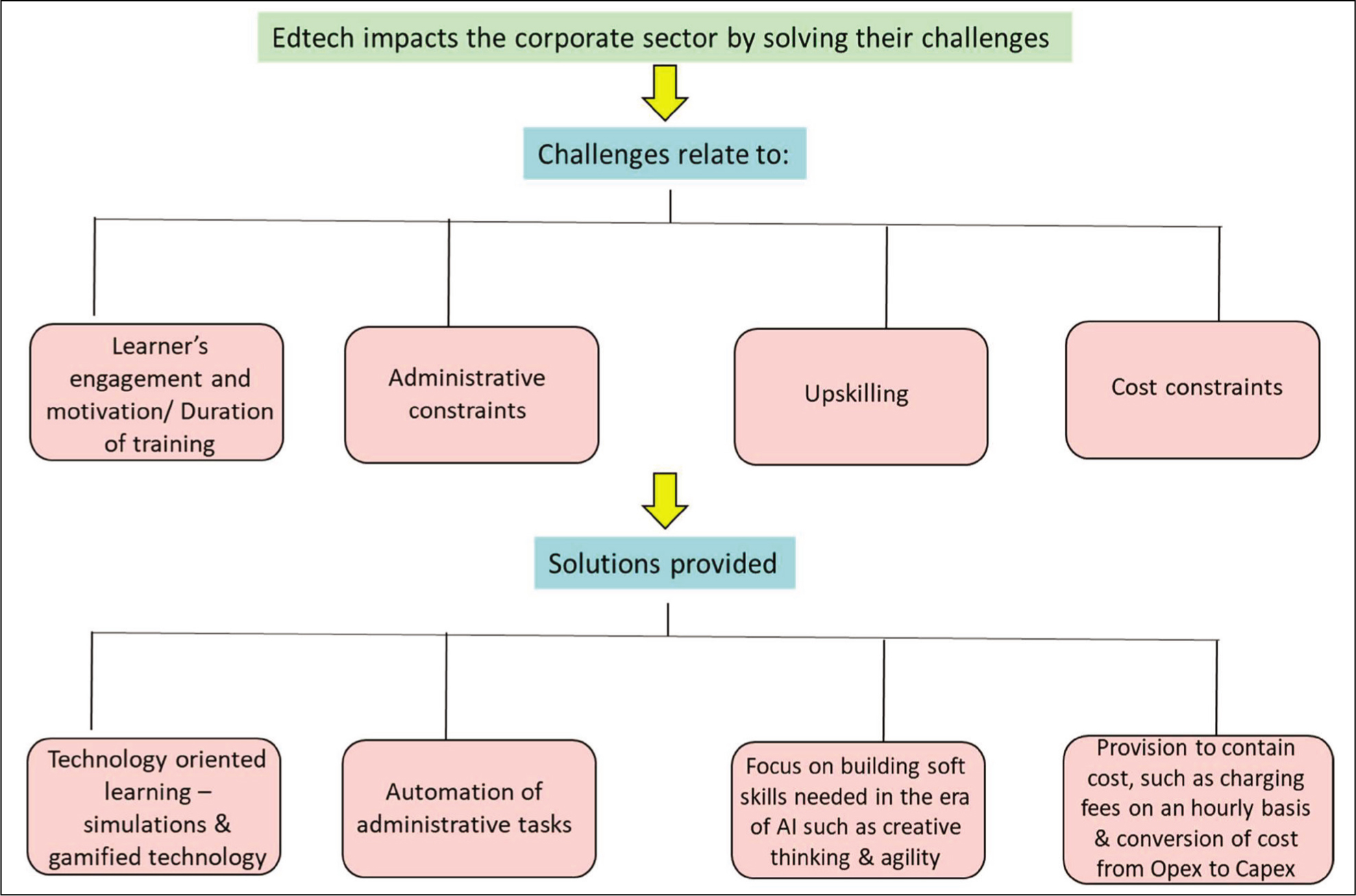
Edtech startups affect the corporate sector by solving their challenges. Traditional didactic learning has not been able to engage learners. Mayer’s (1997) Generative Theory of Multi-media Learning states that learning becomes effective when it is supported by audio and visual content. Since educational technology provides learning through gamification and simulations while also offering adaptive learning experiences, learners are more engaged with the content. Edtech also aids in administrative work. Through technology, companies can automate their administrative tasks making processes more efficient. It helps in upgrading the skills of the employees. Companies can easily develop the soft skills of their employees, even in the virtual environment, for instance through skill café simulation. Edtech startups also aid companies in addressing financial challenges by providing various cost-containment alternatives. While companies encounter various challenges, the above-indicated challenges are the prominent ones. Edtech startups utilize technology in novel ways to tackle the challenges. In addition, training is provided in accordance with the demands and the changes brought by AI. Various facilities are provided to keep the cost low.
The above framework, though not comprehensive, can be applied by corporate decision-makers or educators to examine the impact of edtech on their organization. It provides a clear pathway from identifying challenges to implementing solutions.
Discussion
Mayer’s (1997) generative theory of multi-media learning states that exposure to multi-media enhances learning; learning becomes effective when basic text is accompanied by visual illustrations and animations. Studies have shown that e-learning leads to a 60% faster learning curve (De Vries, 2005) and augments retention by 25%–60% (Bowsher, 1998). Online learning, functioning in more confined spaces, fosters interaction and collaboration (De Vries, 2005), propelling more peer contact, more enjoyment and time spent on assignments and a 20% better performance compared to students taught in the traditional instructor-led setup (Weggen & Urdan, 2000). This analysis exhibited that edtech startups, through the use of game-based and simulation-based learning, endeavour to make learning more engaging and effective.
E-learning has been found to facilitate multi-national companies to train a workforce which is globally spread (Zornada, 2005). A lot of client companies corroborated the usefulness of e-learning solutions to reach employees who are remotely located. Evidence suggests that there are huge economic savings with e-learning. E-learning can be scaled up with a zero increase in the marginal cost. This sentiment has been echoed in this research as well, with companies indicating their capability to provide training for a single employee.
IT companies spend a considerable amount of funds on buying hardware but do not spend on infrastructure, especially, internet connectivity. The startups, by way of a resolution, provide simulations optimized to run on lower bandwidths. Literature states that the e-learning market is immature (De Vries, 2005); there is a lack of customized content which increases the reliance on off-the-shelf products. Edtech startups have stepped in to aid the corporate sector by delivering tailored content to individual clients.
Although edtech startups have greatly benefitted corporate clients, robust positive effects were not found. There was no evidence regarding improvements in the learning outcomes of employees. Pre and post-assessments were carried out only in a few cases but were not robust. Although performance improvements were found in a few cases, significant differences were not assessed. Similar is the case with attrition of employees. The impact of startups on the corporate sector is very elementary and on the surface level.
Taken in concert, LMS is yet to make a larger and significant impact. Blended learning, which is an optimum mix of classroom-based methods and e-learning, was found to be more useful. This analysis shows that at present, e-learning is used to develop capabilities in a narrow sense. It is used to support specific projects and is not widely adopted for training across the enterprise.
Implications of the Study
Theoretical Implications
This study draws implications from various theories which relate to the adoption of technology, organizational learning and human capital development. First, we examine technology adoption theories. The Model of PC utilization (Thompson et al., 1991) examines various factors that affect the use of personal computers. One of the attributes examined is ‘Job Fit’ which is defined as ‘the extent to which an individual believes that using (a technology) can enhance the performance of his/her job’ (Thompson et al., 1991). Ventakesh et al. (2013) found a positive and significant effect of the construct ‘Job Fit’ on the intention of using technology. This implies that if technology enhances performance, its adoption will increase. Since edtech applications are believed to improve performance by our client organizations, evident in their inclination to use education technology, their adoption is likely to increase in future. In another instance, Compeau and Higgins (1995) advanced Social Cognitive theory to the sphere of computer utilization. One of the constructs they dealt with was ‘Outcome expectation’. ‘Outcome expectation’ is defined as the ability of the system to satisfy an individual’s job performance and personal expectations (Venkatesh et al., 2003). Ventakesh et al. (2003) found a positive and significant effect of the construct ‘Outcome expectation’ on the intention of using technology. As edtech applications suffice the needs of upskilling of an employee thereby enabling them to remain competitive and endeavour to improve their performance leading to promotions and rewards, they satisfy individuals’ personal expectations. Given this, the adoption of edtech applications is expected to increase.
Besides the theories concerning the adoption of technology, theories concerning organizational learning and human capital development too, hold significance to our work. The organizational learning theory treats knowledge as a crucial asset and emphasizes the acquisition, interpretation, application and transfer of knowledge. Our findings reflect that companies are making their best endeavour to acquire and maintain knowledge and upskill their workforce with the necessary skills that may help companies stay strategic and have a competitive edge over others. The human capital theory considers human beings as assets the investments in which will improve productive capacity and foster the generation of new ideas. Our client companies, having had this realization, are investing in not only the upskilling but also modern methods of training, thereby investing colossally in human capital. This has been manifested globally too wherein 81% of international organizations want to invest in learning and training on the job (Future of Jobs report) and all believe that within the next five years, 44% of the workers’ core skill sets will undergo a change.
Practical Implications
Given the benefits of e-learning platforms in overcoming the limitations of traditional didactic learning and improving engagement of employees, edtech applications must be adopted and gradually, must be integrated with the in-house enterprise systems. Simulation-based learning, given the benefits, must be made integral to corporate training programmes. Corporations must gradually shift to automation of onboarding processes as they will streamline operations, reduce costs and enhance efficiency. Adoption of virtual labs, with just-in-time provisioning, will save resources and improve training outcomes. Corporations are incessantly compelled to keep pace with technological advancements and industry changes. In the event of this actuality, edtech must be undoubtedly adapted by the corporate sector.
Conclusion
This study assessed the contributions of edtech startups to the corporate sector. Prominent challenges that were identified include limitations of traditional didactic learning, high attrition, changing market conditions, onboarding complexities, the need for upskilling and cost constraints. Solutions provided include technology-oriented learning, through simulations and gamified technology, automation of administrative tasks, upskilling in soft skills needed in the era of AI such as creative thinking and agility, and provisions to control cost. This analysis shows that at present, e-learning is used to develop capabilities in a narrow sense. It is used to support specific projects and is not widely adopted for training across the enterprise.
Footnotes
Declaration of Conflicting Interests
The author declared no potential conflicts of interest with respect to the research, authorship and/or publication of this article.
Funding
The author received no financial support for the research, authorship and/or publication of this article.