



Abstract
Creative destruction originates in successful development and launch of a radically different product/process/market configuration, or radical innovation, by a company. A radical innovation can materialize in a business firm only if autonomy is extended to organizational personnel, towards experimentation with heterogeneous knowledge from outside the organization. In this article, I inquire into conditions that enable the materialization of radical innovation—an important precursor to creative destruction—while affording top management the wherewithal to stay in control. An extended version of March’s computational model suggests that when a radical innovation project initiates with a low level of collective human capital with respect to the new process–product–market domain being considered and the project personnel are provided a certain extent of autonomy to experiment in the new domain, top management can detect a change to organizational outcomes by changing the rate of exploitation. Thereby top management obtains a feeling of being in control of proceedings. This situation is, therefore, conducive to the materialization of creative destruction. The indirect method of control to nurture radical innovation—demonstrated in this research—constitutes an improvement over the autonomy-averse ‘agency’ and ‘transaction cost economics’ approaches that are sub-optimal in open systems characterizing radical innovation efforts in corporate venturing.
Keywords
The fundamental impulse that sets and keeps the capitalist engine in motion comes from the new consumers, goods, the new methods of production or transportation, the new markets, the new forms of industrial organization that capitalist enterprise creates … (I)n (the) capitalist reality… [the] competition which counts [is]… from the new commodity, the new technology, the new source of supply, the new type of organization…competition which commands a decisive cost or quality advantage and which strikes not at the margins of the profits and the outputs of the existing firms but at their foundations and their very lives”. [This process of creative destruction] “…incessantly revolutionizes the economic structure from within, incessantly destroying the old one, incessantly creating a new one.
—Schumpeter (1942/1994)
Introduction
Schumpeter (1942/1994) observes that the real challenge to the survival of a business firm rarely comes from the current set of competitors operating on today’s technology and serving the current needs of consumers. Rather, organizations risk mortality if they are unable to fashion radically new products and processes to serve the future needs of consumers. Schumpeter coined the term ‘creative destruction’ to designate the process of replacing old products, processes and ways of competing by new ones. We note that creative destruction is the outcome of successful launch of a ‘radical innovation’ by a business firm. Success is attributed when the innovative product (or service) attracts large numbers of consumers, perhaps at the expense of incumbent firms.
A radical innovation is a type of innovation that induces fundamental changes—constituting a clear departure from existing practices in the organization (Dominguez-Escrig et al., 2019)—having a high degree of novelty for the company that develops them (Crossan & Apaydin, 2010). Bringing about a radical innovation involves the development of entirely new goods or services that require substantial shifts in product lines, or major changes to the production process (Hall & Soskice, 2001; Witt & Jackson, 2016).
A radical innovation project involves a lot of experimentation and learning-by-doing (Govindarajan & Trimble, 2005; Nonaka, 2007; Nonaka & Takeuchi, 1995 ). Many failures—that are honest mistakes—are inevitable. For this reason, several scholars (e.g., Burgelman, 1983; Chanda & McKelvey, 2020; Levinthal & March, 1993) recommend providing a safety net guaranteeing non-punishment upon failure of innovation-related experimentation. The rationale is that, absent such safeguards, employees and middle managers would be loath to stick their necks out to work on radical innovation—leaving the firm in danger of demise in the wake of other firms’ successful innovations.
Executive tolerance of missteps in autonomous learning and experimentation activities indeed affords a company an opportunity to put up a strong show in the creative destruction race. But this arrangement effectively constitutes top management relinquishing control of the uses of a certain proportion of resources of the company. A credible guarantee is lacking that these resources will always be deployed for useful purposes and not squandered. Top management is unlikely to let autonomous activities continue for long, unless they possess some lever for control of proceedings of the innovation project.
In fact, company management is known to play a less passive role. From time to time, top management exercises its authority by shutting down some projects embodying autonomous strategic activity, and allowing others to continue (Burgelman & Grove 1996). A classic illustration is provided by the fortunes of a couple of corporate entrepreneurship projects in Intel, described in Burgelman (2002) and Burgelman and Grove (2007). In one case—concerning permitting continued manufacture of microprocessors at a time when Intel was predominantly a memory manufacturing company—the top management came out strongly in support of the entrepreneurial engineers behind the microprocessor project. Eventually, the company strategy was updated, and Intel became a microprocessor company in the early 1980s.
In a second case in the late eighties—concerning permitting continued development of processors with reduced instruction set computing (RISC) architecture—the top management shut down the activity. Intel chose to stay on course with its complex instruction set computing (CISC) architecture and went on to dominate the microprocessor market over the next three decades.
The instances above suggest that, in certain cases, senior managers have some reason to feel that they are in control of ongoing activity attempting to birth a radical innovation. These instances constitute fertile grounds for the successful materialization of radical innovation, and by extension, creative destruction. In other cases—where senior management lacks a feeling of being in control and withdraws autonomy to project personnel—creative destruction is likely to get stymied. In this research, I seek to unearth such conditions. It seems worthwhile to inquire: What would be an appropriate mechanism for control of radical innovation in a business firm? The question is important on two grounds.
First, the longer-term survival of a business is intricately linked to its ability to bring about radical innovations. In other words, a firm that fails to periodically bring about radical innovation stands the risk of demise when other firms launch successful radical innovation and take away its market share and revenue. Students of strategic management seek to forestall this negative outcome. This stems from the fact that, for the discipline of strategic management, an important imperative is finding ways and means to enable longer-term survival of the firm (Levinthal & March, 1993, p. 110).
Second, many business firms are handicapped in delivering radical innovation under dominant governance approaches such as agency theory (AT) (Eisenhardt, 1989; Jensen & Meckling, 1976) and transaction cost economics theory (TCE) (Williamson, 1981) that mandate strict monitoring and fulfilment of preset goals derived from past knowledge, through a regimen of sanctions and rewards. Delivering radical innovation becomes difficult or impossible because TCE and AT approaches fail to distinguish between honest mistakes and shirking or intentionally harmful behaviour (Chanda & McKelvey, 2020; Shimizu, 2012) and (therefore) recommend prompt punishment for any deviation from pre-agreed objectives. In contrast, in a radical innovation project, objectives evolve over time as management and personnel gain more knowledge; administering the organization on objectives set on the basis of expired past knowledge is inappropriate (Chatterjee et al., 2018). Hence, businesses can benefit if a mechanism can be found whereby senior managers may exercise control by means other than directly monitoring the actions of organizational members for alignment with preset goals. Thereby autonomy can get extended, enabling far-ranging innovation necessary for creative destruction. Effectively, the research question noted above endeavours to find enablers to the process of creative destruction by seeking enablers to radical innovation.
In this study, I set out to explain under what circumstances ‘creative destruction’ gets supported and otherwise. The theory is based on the computational simulation model in March (1991). March (1991) studied the variation in the level of organizational knowledge (i.e., knowledge that is stored in physical artefacts such as databases, routines, forms and procedures in an organization) attained by varying the rate of learning by organizational members. The model shows the interplay of exploitation (refinement, modelled by rate of member learning) and exploration (experimenting with internal and/or external variety, modelled by enabling the persistence of diverse knowledge in members). In all his experiments, the level of initial collective human capital (CHC) (i.e., knowledge residing in the heads of organizational personnel at the time of commencement of simulation experiments) was the same. CHC refers to the human capital residing in organizational members (Chanda et al., 2018; von Nordenflycht, 2011). Human capital comprises ‘… the knowledge, skills, and abilities a firm’s workers acquire as a result of their learning, education, training, and experience’ (Becker, 1964, quoted in Lee et al., 2015, p. 796).
In a subsequent development, Chanda and McKelvey (2020) show that when an innovation task initiates with no significant misalignment of the CHC to the task at hand (i.e., involve the same moderate level of initial CHC as in the experiments in March, 1991), top management finds it hard to detect changes to organizational knowledge upon changing the rate of exploitation, under conditions where the lower ranks have autonomy. In conditions where autonomy is absent, top management is in a position to readily detect a change in organizational knowledge upon a change in the rate of exploitation. For this reason, top management is likely to be reluctant to extend autonomy. This suggests that radical innovation having the potential to bring about creative destruction is unlikely to materialize under these circumstances.
In this study, I alter March’s model to allow variation of the initial level of CHC in the innovation organization. Specifically, I present outcomes for a situation where a radical innovation task initiates with CHC far out of alignment with the knowledge required for radical innovation, i.e., under conditions of lower CHC (Chanda et al., 2018) than that in the experiments in March (1991). I find that when a certain degree of autonomy is extended to middle- and lower-level employees, relatively large changes in organizational knowledge can be obtained simply by changing the rate of exploitation. Because of this, top management is able to use the rate of exploitation as a lever for control. This finding suggests that management should foster conditions of autonomy. Successful materialization of radical innovation—and, by extension, creative destruction—is feasible under these circumstances.
The elaboration of March’s agent-based simulation model enriches the discussion about the role of exploration and exploitation in organizational outcomes by drawing attention to the crucial roles of autonomy to organizational personnel and control by the top management in the assimilation of heterogeneous new knowledge distinct from that embodied in the CHC of the organization. The simulation findings suggest that ‘creative destruction’ has a greater chance of effective materialization when an innovation organization’s initial human capital is insufficient to cope with demands of the innovation task. Conversely, heightened top management control—in conjunction with denial of autonomy for lower-level employees—is more likely when an innovation organization’s CHC is well-aligned to an innovation task, thwarting creative destruction.
Theoretical Foundations
Radical Innovation as a Precursor to Creative Destruction
A radical innovation by one company changes the technology of a process or product in a way that imposes requirements that the existing resources, skills and knowledge of other companies satisfy poorly or not at all (Abernathy & Clark, 1985). A radical innovation may involve fundamental changes that represent revolutionary modifications in technology (Dewar & Dutton 1986) and serve as the basis for further technical developments (Datta & Jessup 2013). Thereby, radical innovation engenders a redefinition of what is required to achieve a competitive advantage. In cases where the disruption is both deep and extensive, such innovation creates new industries (Abernathy & Clark, 1985). In sum, radical innovation is a necessary precursor to creative destruction. In this research, I focus on what it takes to bring about the materialization of a radical innovation in a business firm.
Difficulties in Bringing about a Radical Innovation
Birthing of a radical innovation in a business firm is a notoriously difficult task. On the one hand, creative people have to be provided autonomy to experiment. On the other hand, top management cannot simply stay put, firm in the belief that such autonomy will be put to good use. Joseph Goldstein, a former vice-president of the RAND Corporation, notes that: ‘The administrator has not only the difficult task of administering research, but also the equally difficult and important job of refraining from administering’ (Goldstein, 1961, p. 4, quoted in Augier et al., 2015, p. 1147). The issue becomes intriguingly difficult even if the flowering of creativity from intellectuals can somehow be fostered: ‘… the flaring of intellectual outliers involves the stimulation of intellectual variety, but successful variation inhibits the further generation of variety. Successful intellectual outliers become the basis of a new intellectual orthodoxy’ (Augier et al., 2015, p. 1152). An endeavour to find a way through these difficulties leads us to inquire into the interplay of autonomy and control.
Control and Autonomy
Drawing from Child (1973) and Tannenbaum (1968), Brenner and Ambos (2013) suggest that ‘control’ may be defined as any process (mechanism, instrument or strategy) applied by an organization to ensure the execution of organizational goals and plans. Three broad classes of control mechanisms used by firms comprise outcome, process and social control (Cardinal et al., 2010; Harzing, 1999; Kirsch, 1996, 1997; Snell, 1992; Turner & Makhija, 2006). When managers use ‘outcome controls’, they merely specify the level of performance expected; they do not lay down rigorous processes regarding how outcomes are to be achieved. ‘Process controls’ are ‘mechanisms that clearly specify the appropriate behaviors and processes in which employees must engage’ (Turner & Makhija, 2006, p. 207). Process controls are ideal when the level of outcome that is attained is not fully in control of the employee; rather, external entities and factors have a big role in determining the final level of the outcome. Finally, ‘social controls’ operate through normative pressure to ensure social obligation and facilitate the sharing of values among organizational members (Lange, 2008).
Several streams of literature discuss autonomy and control as a dichotomous condition (see, e.g., Crilly & Sloan, 2014). Upon inspection of this point of view, it appears that any measure of autonomy gets diminished when some form of control is imposed from on high. However, when nuances regarding a particular kind of control are considered, it may be possible to envisage providing autonomy to employees in aspects orthogonal to the ambit of the matter controlled. Below we take a brief tour of some flavours of control found in the neighbourhood of management literature. Thereafter, I discuss the kinds of autonomy and control suited for materialization of radical innovation that potentially leads to the onset of creative destruction.
The ‘Accounting’ literature prescribes constant monitoring of variances in budget in order to detect deviations from plan and to initiate corrective action. This approach, however, places an unconscionable degree of confidence on estimates concerning potential return on investment, and horizons of inflows and outflows of cash. Estimated numbers are often guesstimates, fashioned from vastly incomplete information. Radical innovations of the nature envisaged for creative destruction rarely entail cash flow characteristics that can be foreseen with the level of accuracy demanded by accounting systems. Therefore, accounting controls accomplish precious little in helping top management obtain a sense of being in control when they allow autonomous functioning encompassing experimentation with heterogeneous new knowledge from outside the organization, for the creation of new knowledge.
Literature originating in ‘Economics’—for example, ‘agency theory’ and ‘transaction cost economics’ theory—recommends that employees be committed to goals ahead of time in as many aspects as can be metered in a cost-effective manner (Jensen & Meckling, 1976; Williamson, 1981). Additionally, constant surveillance of employees and credible punishment upon unfavourable performance variance is deemed necessary, such that situations do not go out of control. These approaches assume that past knowledge can reliably inform on prospect of future success. They are inappropriate for governing situations involving learning by experimentation for the purpose of the creation of knowledge (Chatterjee et al., 2018).
The literature on ‘corporate entrepreneurship’ (e.g., Burgelman, 1983) advises senior managers to tolerate a certain extent of autonomous strategic activity championed by middle managers. To cultivate autonomous strategic activity, the senior management of a company allows a certain proportion of resources to be deployed in projects that do not flow from mandates from the top. An oft-quoted example in this regard is Google Inc. allowing its technical personnel to spend a certain proportion of time on any idiosyncratic project (Edelman & Eisenmann, 2011). Top management extends tolerance because it is aware of the potential of beneficial discoveries in improving the fortunes of the company—viz., getting ahead in the creative destruction race. When discoveries meet with market success, top management updates the company strategy. A question remains though: What provides the top management a sense of being in control, while simultaneously being open to extending autonomy to the lower ranks for experimentation with new knowledge, and what makes top management decide to pull the plug on an innovation effort?
Why Are Radical Innovation Activities Less Amenable to Conventional Ways of Control?
In order to develop new knowledge necessary for bringing about radical innovation, organizational personnel need to experiment repeatedly. Prior to experimentation, it is often not possible to predict whether an experiment will be fruitful and worthwhile for an organization, or otherwise. Several experiments will yield no tangible gain to the organization. Yet they must be carried out. In this context, Thomas Alva Edison (reportedly) remarked that it is the learning from a large number of failures that contributed to his discovery of a functioning filament of the incandescent lamp.
The matter is somewhat more complicated in an organizational situation. Single-actor models as in Edison’s story do not pose problems of monitoring and control, since rewards are contingent to the appropriateness of the quality and degree of effort exerted. In contrast, in a business firm, there is a division of labour. Certain personnel carry out experiments in a bid to fashion innovative products and services. Other personnel—top management—evaluate their contribution.
In any experiment to develop knowledge, failure can originate from two important causal mechanisms. In one case, competent organizational personnel expend honest effort. Yet, a useful solution or breakthrough remains elusive. In another situation, failure is an outcome of either incompetence or shirking or both, by the experimenter(s). The twin possibilities of the origin of failures in learning and knowledge development efforts create an evaluation problem for the top management of an organization.
Top management’s job is to sanction failures arising from incompetence and/or shirking. In the role of a nurturer of a company, they should hold-off from punishing failures that are unavoidable when learning through experimentation. Burgelman (1983, p. 1362) and Levinthal and March (1993, p. 107) advise that top management should provide a ‘safety net’ such that failures in autonomous experimentation are not sanctioned. Otherwise, organizational personnel shall cease to experiment with new knowledge, effectively eliminating the company from the creative destruction race. Thus, in order to nurture efforts involving radical innovation, top management needs to extend autonomy to organizational personnel. In sum, an important imperative in organizational life concerns finding ways and means by which top management can retain a sense of control, even when autonomy is extended to employees and middle managers to experiment with new knowledge, in a bid to bring about a radical innovation.
Towards a Model for Management Control of Radical Innovation
At its essence, a radical innovation takes shape when the CHC of members of an organization, augmented with the learning of heterogeneous knowledge from outside the organization, facilitates the development of organizational knowledge necessary for the materialization of the innovation. CHC corresponds to the sum or average of individual expertise (Barrick et al., 1998; Chan, 1998; Chanda et al., 2018; DeShon et al., 2004, referred to in Pil & Leana, 2009, pp. 1108–1109) of members involved in a radical innovation project. ‘Organizational knowledge’ comprises databases, user manuals, rules, forms, procedures, etc., created by the project team. It is stored in a repository, the ‘organizational code’ (March, 1991). Some examples of organizational knowledge are knowhow regarding sourcing, manufacturing, storage and distribution, standard operating procedure between sub-teams, recipes for inducting and training members, etc. In the computational simulation model (Chanda, 2017; Chanda & McKelvey, 2020; Chanda & Miller, 2019; Chanda & Ray, 2015; Chanda et al., 2018; Gong et al., 2021a, 2021b; March, 1991; Wu et al. 2021a, 2021b), the stock of organizational knowledge is augmented by drawing from the stock of CHC of members. Conversely, the stock of CHC of members is altered when members learn from the organizational code. Importantly, when members are provided autonomy to obtain knowledge from outside the organization, there is an additional flow of heterogeneous knowledge into the stock of CHC of members.
An innovation project either involves developing knowledge that is quite similar to or well-aligned with the initial CHC of members, or it may involve knowledge that is substantially non-aligned with the initial CHC of members. Dierickx and Cool (1989) posit that joint consideration of stocks and flows is necessary to develop adequate theory regarding phenomena. Thus, when an important flow—the rate of members learning from the organizational code (i.e., the rate of ‘exploitation’, as elaborated below)—is varied, differences in the initial level of the stock of CHC may lead to distinctive outcomes. This, in turn, may influence sustained support or abandonment of a radical innovation project.
A key contention of this article is that the top management can use the rate of exploitation as a lever of control to assess change in the extent of new organizational knowledge created by a team engaging in radical innovation. Top management is quite likely to let certain arrangements involving autonomy continue, if they are able to detect significant changes in organizational knowledge levels upon changing the rate of exploitation. Below, I describe the connotations of changing the rate of exploitation and observing the nature of outcomes involved, in various phases of an internal corporate venture.
Increasing the rate of exploitation in an innovation project effectively translates to enhancing the use of existing knowledge and tools to assimilate heterogeneous external knowledge in a bid to fashion novel products or services. Actions towards upping the exploitation rate and checking for enhancement of organizational knowledge give momentum to an idea to move from an abstract concept to a prototype, thence to a model with demonstrable functionality and thereafter to a potentially manufacturable product (or deployable service) for which there is interest from prospective customers, suppliers and distribution partners.
In the early stages of an innovation project, additions to organizational knowledge can be inferred when, at each milestone meeting, assessments are carried out regarding how many assumptions made earlier were found to be valid, and how many were wrong, necessitating framing of fresh assumptions (Govindarajan & Trimble, 2005), and updating of timelines. At the intermediate stages of the project, the extent of newness of functionality and features (with respect to those in the firm’s current offering) provides indication regarding augmentation to organizational knowledge. At advanced stages of the project, evidence regarding the extent of interest from external parties—e.g., prospective customers, potential upstream (supply-side) and downstream (distribution-side) partners, etc.—and evidence regarding manufacturability to scale can indicate further significant augmentation to organizational knowledge.
Top management is quite likely to let an existing organizational arrangement continue, if they find a significant extent of change in organizational knowledge levels upon modulating the rate of exploitation. We note, though, that evaluations for significant changes in organizational knowledge make sense only after a project has been in progress for a certain amount of time, i.e., organizations need to ‘… buffer internal ventures from an immediate market test’ (Kogut & Zander, 1992, p. 393). Hence, top management will need to exhibit a certain amount of ‘strategic patience’ (Iyer & Davenport, 2008; König et al., 2013)—by holding off from evaluating the project for a certain length of time—before making a definitive decision about letting the project continue or stop it.
We note that using the efficacy of varying the rate of exploitation for evaluation represents a departure from measuring progress primarily by financial metrics. Financial measures may be unavailable altogether, since products are mere ideas, manufacturing costs are indeterminable pending further learning, and there is considerable uncertainty regarding prospective customers and their willingness to pay (Govindarajan & Trimble, 2005). Using the rate of exploitation as a strategic control tool helps develop additional insight into the progress of an innovation project, because goals change and new assumptions replace prior ones in successive milestone meetings, a process Argyris (1976) cites as ‘double-loop learning’. We note that replacing financial metrics with metrics suited to double-loop learning requires setting aside ‘strategic rigidity’—connoting a preference for the status quo style and approach (Shimizu & Hitt, 2004).
Simulation Model
The simulation model follows the conceptual specifications (Chanda & Miler, 2019) provided by March (1991). In all, I make two modifications.
For a subset of experiments, I lower the level of the initial CHC in the organization (relative to the level of the initial CHC applicable in March’s experiments) following the method provided by Chanda et al. (2018).
Second, in order to denote the presence of autonomy whereby organizational members are allowed to experiment using heterogeneous knowledge from outside the organization, I allow randomization of a subset of belief dimensions of a subset of the organizational members, following a specification suggested in Chanda and McKelvey (2020). In March (1991), the inflow of heterogeneous knowledge from outside the organization was modelled by allowing randomization of the entire belief strings of a subset of members in any given time step. I use the specification from Chanda and McKelvey (2020) in order to make the model of learning from external sources a bit realistic, viz., by invoking a lower rate of infusion of heterogeneous knowledge from outside the organization. In the paragraphs that follow, I provide details of the simulation model.
The Environment and the Project Organization Attempting Radical Innovation
In the simulation model, the external reality (
A simulation experiment is carried out for T periods (time steps). In a stable environment, the values in
The project organization attempting radical innovation is constituted of N members and one entity, the organizational code
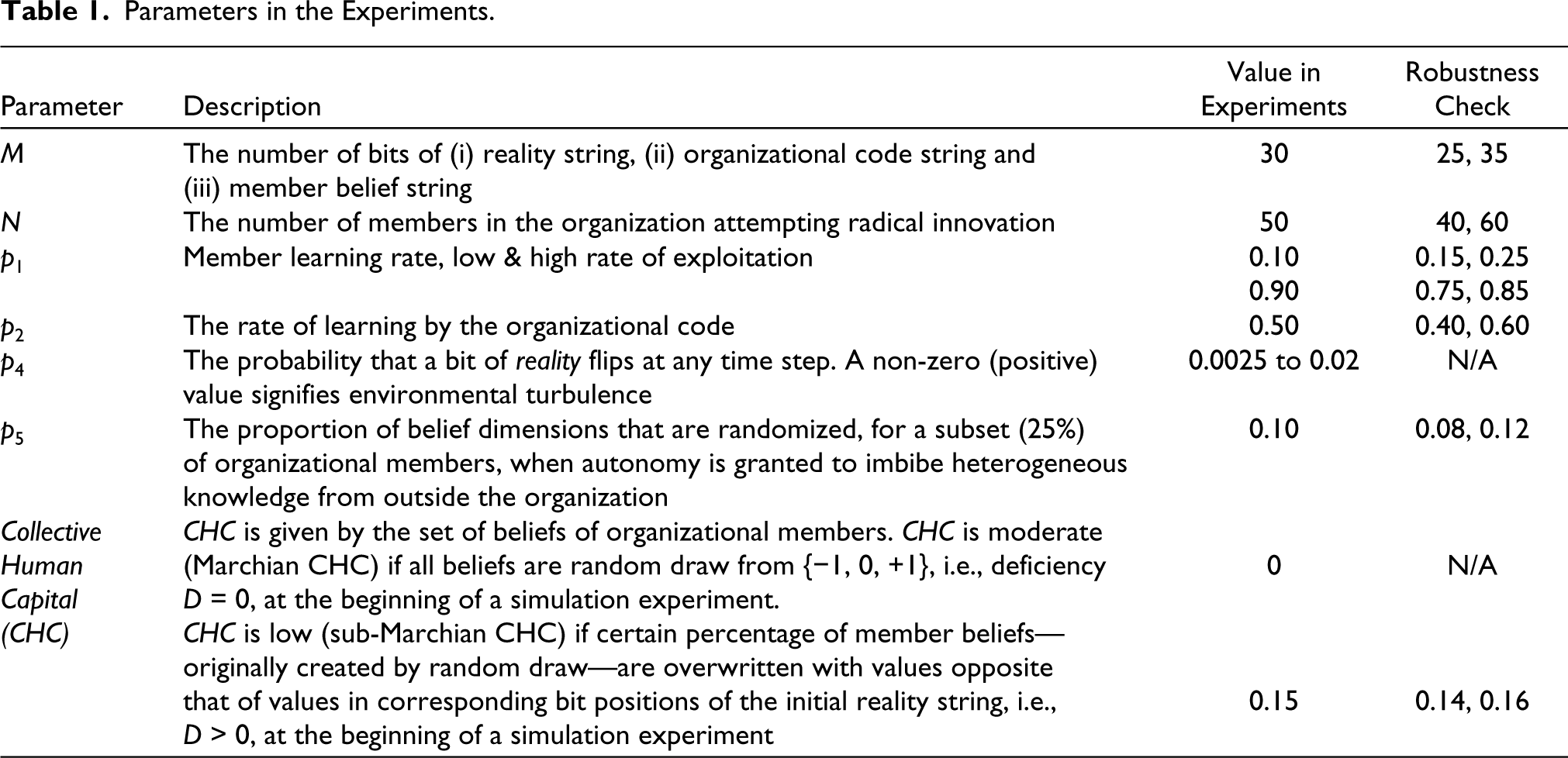
Each organizational member possesses an M-bit belief string. To construct a Marchian population, that is, a population with moderate CHC, the belief string of each member is given a random value from the set S2 = {‘−1’, ‘+1’, ‘0’}, at the beginning of each simulation experiment. Each element of set S2 has a one-third probability of appearing in any member’s belief string. Separate draws are conducted to generate belief strings for N members of the organization. Thus, on average, in a population with moderate CHC, one-third of the belief dimensions of a member contain correct knowledge, and another one-third contain incorrect knowledge, that is, the ratio of incorrect: correct beliefs is 1:1.
To construct a sub-Marchian population (i.e., a population with a low level of CHC with respect to a task at hand) with deficiency D per cent, first a Marchian population is generated. Thereafter, D per cent of member bits are randomly selected. The values in the selected bit positions are overwritten with values opposite that of the value in the corresponding bit positions of the reality string
Learning by the Organizational Code
The organizational code accumulates knowledge by learning from knowledgeable members at a rate given by a parameter p2. The organizational code is assumed to have the ability to identify members who are more knowledgeable about the external reality
Learning by Organizational Members
In each time step, members learn from the instance of the organizational code that existed at the immediate prior period. For each bit position in the belief string of a member, the corresponding value in the organizational code is read. If the organizational code has a non-zero value that is different from the value in the member’s belief string, the member updates his/her value to the value from the organizational code with a probability p1. The parameter p1 represents the rate of member learning. Alternately, I denote an organization as carrying out exploitation at a high rate when p1 is set to a value 0.90. Otherwise, when p1 is set to a value of 0.10, I denote the organization as carrying out exploitation at a low rate.
Autonomy
In situations where autonomy is permitted, there is one additional parameter, p5, signifying the proportion of belief dimensions of a subset (about one-fourth) of organizational members that are randomized as a result of acquiring heterogeneous knowledge from outside the organization. Randomization of a belief-bit is carried out by assigning a value from the set S2 = {‘−1’, ‘+1’, ‘0’} with each element of S2 having a one-third chance of materializing. Absence of autonomy is implemented by setting p5 to a value of zero.
Model Parameters
A given simulation experiment is repeated 10,000 times and the outcomes reported are averages of the experimental runs. On each iteration, the values in the reality string
Parameters in the Experiments.
Results
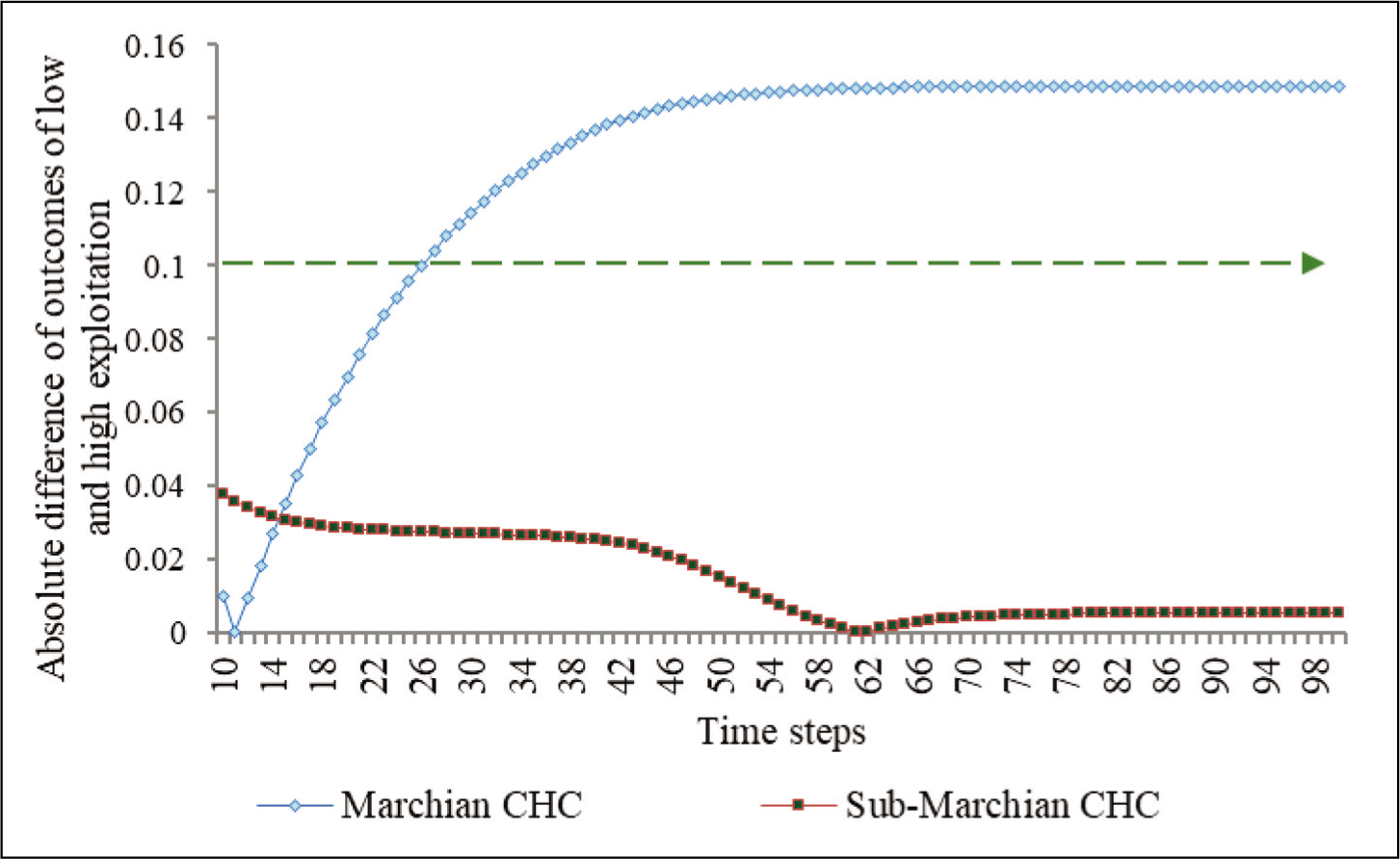
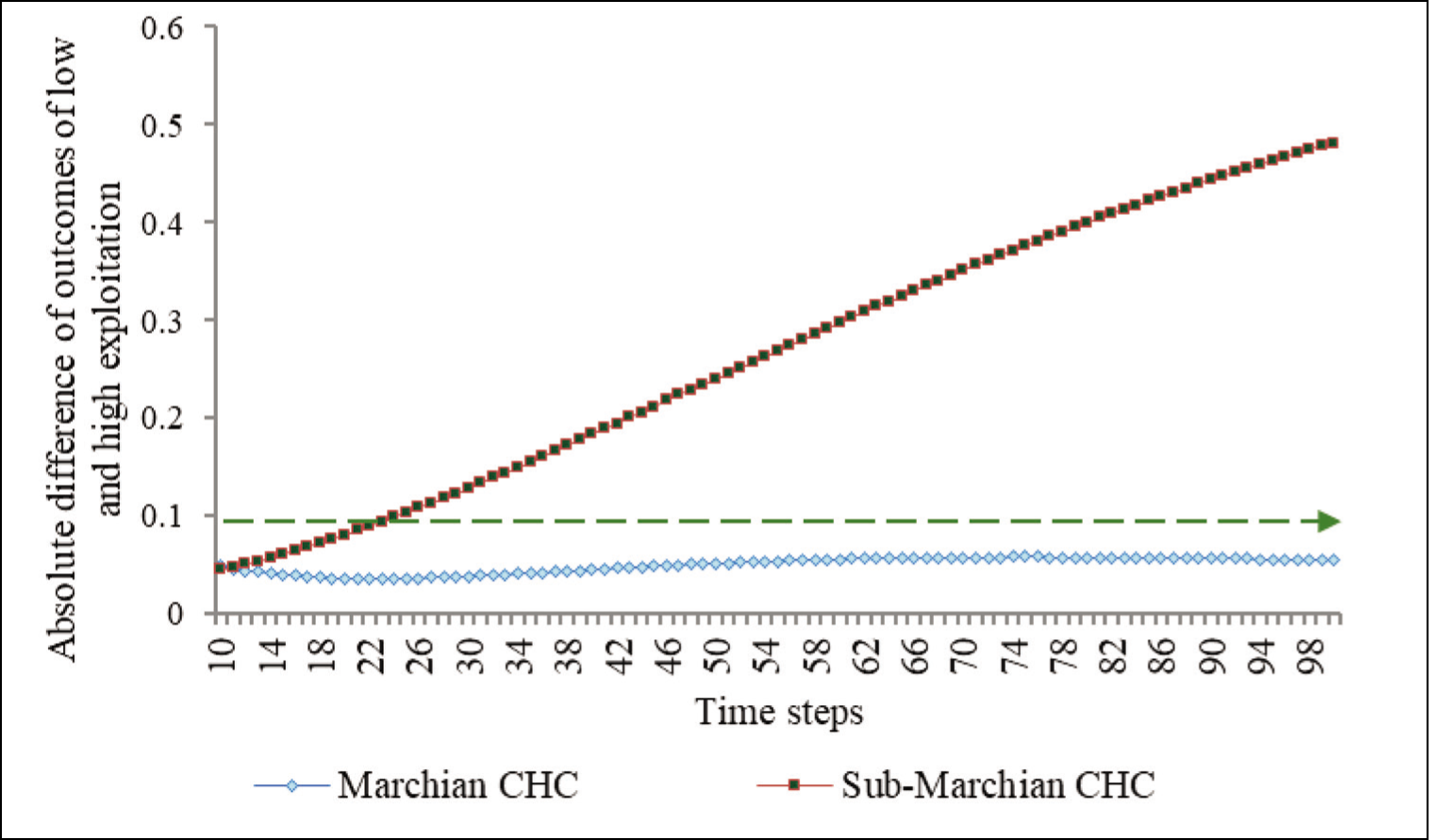
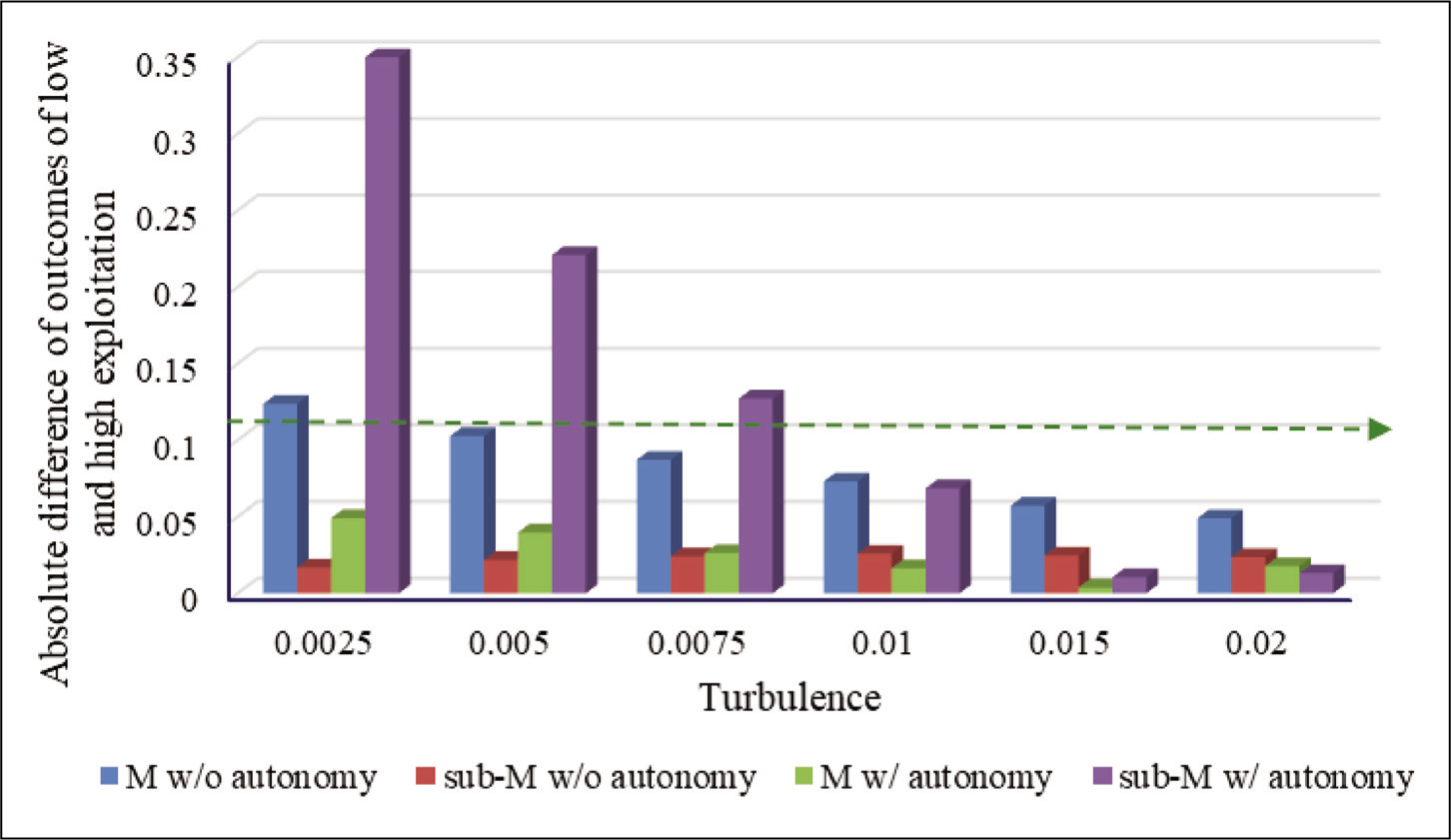
In all the graphical results, the outcome variable comprises the absolute difference in organizational knowledge developed by low versus high exploitation rates. Further, I adopt a convention that if this difference is greater than 10%, top management can readily detect change in organizational outcomes upon changing the rate of exploitation and thereby obtain a feeling of being in control of proceedings in the innovation organization. The qualifying limit of 10% is shown by a horizontal arrow in the graphs presented. When the difference is less than 10%, top management will not be in a position to use varying the rate of exploitation as a lever for assessing control on the innovation project. Absent a feeling of being in control, top management is quite likely to intervene in an adverse manner, for example by withdrawing autonomy or by outrightly shutting down the project.
Further, an innovation organization working with ‘Marchian CHC’ connotes that the innovation project calls for CHC that is close to the existing knowledge base of a company. The instances where the innovation project requires CHC that is vastly different from the CHC currently present in a company are designated as working with ‘sub-Marchian CHC’. I first inquire into the probability of materialization of creative destruction in a stable environment (Figures 1 and 2). Thereafter I consider environments of varying levels of turbulence over the medium and long term (Figures 3 and 4).
Prospects for Materialization of Radical Innovation, Stable Environment
Figure 1 corresponds to a situation where the environment is stable (p4 = 0) and autonomy is not provided to the lower ranks (p5 = 0). We observe that the 10% mark for discernibility of outcomes of low versus high exploitation is met for innovation organizations with Marchian CHC. In this case, top management will, quite likely, let existing arrangements continue. In other words, while it is unlikely that top management will approve proposals for more autonomy to the ranks, it is also unlikely that they will shut down an initiative abruptly. Innovation delivered is likely to be incremental in nature, since the innovation organization works on a project that is aligned with the kind of CHC that is already existing in the company. Thus, we have:
Figure 1 also shows that innovation projects working with sub-Marchian CHC fail to afford a sense of being in control to top management, given that the 10% mark is not attained. These innovation projects, therefore, are unlikely to survive top management scrutiny for long, i.e., they tend to get shut down without producing a tangible outcome. Thus, we have:
Parameters.
Figure 2 corresponds to a situation where the environment is stable (p4 = 0) and autonomy is provided to the lower ranks (p5 > 0). We observe that projects operating with Marchian CHC fail to attain the 10% mark necessary for discernibility by top management for getting a sense of being in control. These projects are, therefore, likely to be shut down. Thus,
Parameters.
Figure 2 further shows that the curve sub-Marchian CHC breaches the 10% mark for discernibility after the initial 20–25 periods and stays above the line for the entire duration of observation (100 periods). Hence, top management can readily discern change in organizational knowledge by varying the rate of exploitation and thereby obtain a sense of being in control. In such cases, top management is less likely to withdraw autonomy or shut down the innovation project abruptly. Thus, we have:
Prospects for Materialization of Radical Innovation, Turbulent Environment
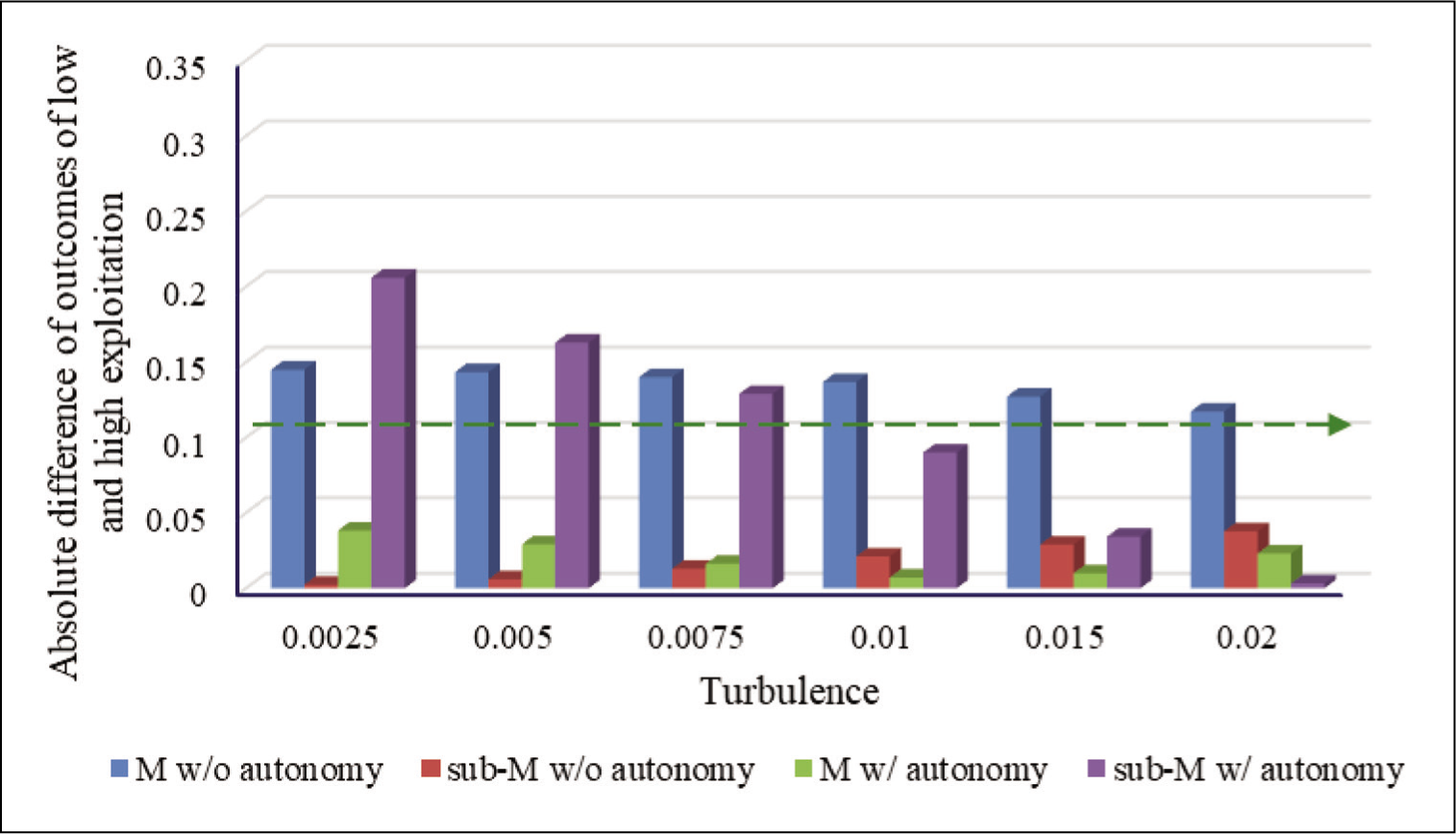
Figure 3 shows outcomes corresponding to absolute differences in organizational knowledge developed by low versus high exploitation, under conditions of varying environmental turbulence (p4 > 0), over the medium term (50 time steps), for the four archetypes consideration: innovation projects involving Marchian versus sub-Marchian CHC, in the presence and absence of autonomy. Figure 4 shows the corresponding outcomes over the longer term (100 time steps). One time step may be considered to signify one month or one quarter, depending on the context of a problem. A low value of environmental turbulence (p4 = 0.0025) signifies that over a longer-term observation period of 100 time steps, the external reality—corresponding to the radical innovation attempted—changes to the extent of 25%. Moderately high environmental turbulence (p4 = 0.0075) signifies that the external reality changes to the extent of 75% in a similar period. Very high turbulence (p4 = 0.02) signifies that the external reality changes to the extent of 200% in 100 time steps. In practice, one rarely encounters this high level of turbulence for an extended period. Over a medium term (50 time steps) the corresponding values of the extent of change of the external reality are about 50% lower (i.e., 12.5%, 37.5% and 100% extent of change in the external reality, for low, moderately high and very high turbulence, respectively).
Parameters.
Parameters.
In Figure 3, we observe that, for innovation projects with sub-Marchian CHC functioning in the presence of autonomy, the 10% mark for discernibility of outcomes of low versus high exploitation is met for environmental turbulence varying from low (p4 = 0.0025) to very high (p4 = 0.02) in the medium term (T = 50 periods). Over the longer term (T = 100 periods) though, we see from Figure 4 that the discernibility criterion is not met beyond a moderately turbulent environment (p4 = 0.0075). Thus, we have:
Summary of Results
In Table 2, I provide a summary of the propositions developed, in the form of a 2 × 2 matrix. These pertain to a situation where a company is functioning in a stable environment, or in an environment characterized by low to moderately high turbulence.
Prospect of Materialization of Radical Innovation, Stable Environment and Environments Characterized by Low to Moderately High Turbulence.

Discussion
The study demonstrates that, when top management extends autonomy to organizational personnel, it is afforded a lever for control in the form of modulating the rate of exploitation only when the innovation project involves CHC vastly different from the CHC already existing in the organization, and not otherwise. Top management, due to its preference for being in control, should extend autonomy in the former case and withhold autonomy in the latter case. The circumstances under which autonomy is feasible constitute conditions suitable for the fructification of radical innovation, a key precursor to materialization of ‘creative destruction’. Likewise, the circumstances under which autonomy is not feasible will, very likely, not see materialization of creative destruction.
We noted that extending autonomy comes at a price—the prospect of opportunistic behaviour by beneficiaries (Shimizu, 2012). Hence, it is likely that the top management of an organization will be reluctant to extend autonomy, unless it has some means for control. In this regard, the top management faces a dilemma in choosing which judgment criteria to use. Criteria fashioned on extant knowledge in the organization may be of little use when an organization sets out to explore domains far from those served by its current capabilities. Irrelevant or idiosyncratic criteria are of no use in effecting control either. In the parsimonious model of March (1991), we are left with just one measure—varying the rate of exploitation—to serve as a lever of control. Indeed, we find that changes upon operation of the lever are readily detectible under autonomy under one condition—when an organization sets out to explore with a low level of human capital with regard to the needs of the innovation project. When an organization explores a domain near to that served by its current capabilities, autonomy has a much lesser chance of being supported or encouraged, given that top management is not afforded a lever of control.
In effect, an intriguing insight from the modelling effort develops as follows. Attempting to do something for which a company has meagre CHC is inherently risky. Exploration of domains far from an organization’s current suite of capabilities is likely to engender a high probability of failure. This is because an organization may, inappropriately, attempt to apply knowledge templates governing existing businesses to the new situation. Such need, in turn, arises from the necessity of top management to exert control on the fledgling initiative. However, if a company can set aside strategic myopia—unwillingness to examine the possibility of extending the corporate strategy to domains far removed from that involved in a company’s current strategy (Tripsas & Gavetti, 2000)—and set out on a path of radical innovation in a domain where personnel have low CHC relative to the needs of the task at hand, conditions can be supportive: top management can have a sense of being in control (given that they can observe change in organizational outcomes upon change in the rate of exploitation), even when they extend a certain extent of autonomy to the lower ranks.
We also note that an organization has a high probability of obtaining success by exploring the neighbourhood of their current capabilities. This is because organizational personnel are in a position to quickly identify similarities and differences between what they know and what is needed for the new effort. This reduces the complexity involved in assimilating new knowledge. Yet, autonomy to the lower ranks, if any, is likely to be short-lived, because, otherwise, if autonomous strategic behaviour is permitted, the outcomes from low and high rates of exploitation are not distinguishable, depriving senior management of a lever for control. The senior management will have a better hang of the strategic significance of their current business efforts and the dangers of drifting away or replacing their current business with another business. They will, most likely, shutter the innovation project, or withdraw autonomy altogether.
Limitations of the Study
This study inquires into conditions within a business organization that are likely to be favourable for giving birth to radical innovation—an important precursor to creative destruction. However, external conditions frequently have a role to play in determining whether the business environment is supportive of fostering radical innovations. The latter is out of scope of this study. Interested readers may consult Stam (2018) to appreciate the impact of industrial policy in fashioning a supportive environment for the materialization of creative destruction. Second, developing sufficient organizational knowledge to bring about a radically innovative product is necessary, but not sufficient for coming into being of creative destruction. The ultimate commercial performance of incumbents and new entrants is determined by the balance and interaction among: (i) investment in developing the new technology, (ii) technical capabilities and (iii) the ability to appropriate the benefits of technological innovation through specialized complementary assets (Tripsas, 1997).
Third, it has been assumed that top management has the wherewithal to alter the rate of exploitation in an innovation organization without incurring prohibitive costs and without derailing the innovation project (as can happen, say, when key personnel leave out of disappointment from insufficient top management support). Fourth, it is assumed that top management can measure in near real-time, the outcomes of its actions (actions pertaining to varying the rate of exploitation), i.e., delays in feedback on action are not vastly significant. Future research may benefit from considering and controlling for these contingencies.
Some Implications
Governance of a business firm by TCE or AT approaches fails to support risky experimentation necessary for bringing out radical innovations. The research presented here suggests an alternative governance approach—whereby top management can extend autonomy to middle- and lower-level personnel and still be in control of the progress of the innovation effort—and highlights the boundary conditions of validity of the approach.
In an internal corporate venturing project, millions of dollars may get spent upfront, with weak or questionable contribution to the progress of the strategic initiative (Chanda & Ray, 2016, 2021; Keil & Mähring, 2010; Montealegre & Keil, 2000). Often, this happens due to paucity of adequate oversight by top management, on account of their lack of familiarity with the novel developments. The research presented here suggests a mechanism whereby top management can remain in control of a corporate venture, even when the extent of novelty is high. Application of the insights developed in this research has significant potential to lower the failure rate of strategic projects involving radical innovation.
The study further suggests that when managers consider shutting down an initiative, they should introspect whether they are doing it because they are uncomfortable with not having control, or because of its poor merit. It is not easy to gauge the merit of a fledgling initiative. Errors can crop up if the judgment criteria—fashioned in some prior context—do not fully apply to the present situation. Organizationally too, top management may wish to avoid infringing existing commitments—to products, to technology, as well as to arrangements with suppliers and customers. Thus, discomfort with a radical innovation initiative may arise from sources other than the lack of a lever for control, namely, political actions by internal and external stakeholders to protect their turf. Departmental heads may, for instance, protest that they are held to demanding standards for financial returns, while the innovation initiative gets all the funding and attention without generating a comparable level or return. The advice from Govindarajan and Trimble (2005) is salient here: A new venture initiative should not be controlled by financial measures (e.g., return on investment); rather, the focus should be on how soon assumptions made at the start of the initiative get verified or replaced by newer assumptions based on organizational learning.
Finally, analysts from financial markets nowadays demand disclosure and explanation of every company action in terms of impact on the next quarter’s earnings (Chanda & Ray, 2015; Rappaport, 2006). This may make managers reluctant to extend autonomy to fledgling efforts, stymieing innovation. Further, in developed financial markets, top managers of business firms are instructed by investors to desist from diversifying risk, on the ground that investors can diversify risk at lower cost by building portfolios according to their individual risk appetite (Porter, 1987). This view alternately manifests as an aversion to allowing unrelated diversification. To investors focused on short-term benefits, a few firms dying on account of not diversifying risk is not a matter of concern, since their portfolio construction activity anticipates such demise(s) (hence the demand for minutia regarding the impact of the company’s action on next quarter’s earnings). One reckons that long term, ‘patient’ investors would prefer to have firm survival emphasized. However, they appear to have less voice. Even regulatory pressure—for example, pressure to comply with the minimum public shareholding regulation in India and associated rules mandating that promoters reduce their shareholding and decision-rights over time—may choke innovation. For example, the founder of Kotak Mahindra Bank in India lamented that regulations forced him to reduce his (promoter) stake to around 20%, effectively stymieing his enthusiasm to nurture the organization to greater heights (ENS Economic Bureau, 2020; Manali, 2020; PTI, 2020; Surabhi, 2021). In sharp contrast, in the United States, the steady flow of major innovation in companies like Google/Alphabet (Arrieche & Drozdovica, 2022), Facebook/Meta (Goldfarb, 2022) and SpaceX (Maidenberg, 2022) appears to be related to concentrated decision-rights the respective promoters are allowed to hold (more than 50% in all three companies cited). Thus, even as this article focuses on managerial control, issues stemming from influence actions by external entities may serve to distort efforts towards radical innovation.
Directions for Future Research
The study suggests some topics for future research. Though success with effecting creative destruction has been long known to contribute to organizational longevity, there has been little research to date on what makes conditions more conducive for managerial control of radical innovation in a business firm. This research adds to the body of literature by a formal modelling demonstration of a means by which top management can extend autonomy to middle and lower-level personnel while retaining a sense of being in control. It follows that research is needed to understand what actions managers take to vary the rate of exploitation and what information signals they pay attention to, in order to assess the direction of movement of outcomes.
Moreover, given that the infusion of heterogeneous external knowledge has a crucial role to play in organizational success, particularly when CHC is low, it would be interesting to investigate the process by which new knowledge overcomes the scepticism of organizational members, so as to eventually become validated organizational knowledge. The recourse probably lies in principles of learning-by-doing, for instance by means of low-cost probes into the future (Brown & Eisenhardt, 1997) or by variation of organizational routines (Feldman & Pentland, 2003), etc. Further research is needed in this area.
We may also note a problem with extant research that considers control and autonomy as a dichotomy. This view equates the act of senior management extending autonomy to organizational personnel with senior management relinquishing control. The study demonstrates that such characterization constitutes an incomplete view. My research highlights specific conditions under which managers can be in control, and concurrently extend a certain degree of autonomy to organizational personnel. Future research on innovation themes should look for avenues that steer clear from considering autonomy and control as an either/or construct pair and invoke an orthogonal conception instead.
Concluding Remarks
In the extant management literature, in order to get around the fact that distinguishing honest mistakes in learning efforts from shirking or incompetence is not easy, AT and transaction cost approaches demand unlimited foresight in senior management. Thereby, swift punishment gets meted out for any failure that is detected in the organization. Such ham-handed prescriptions tend to drive out innovation activities that require risky experimentation by organizational personnel.
Autonomous functioning and risky experimentation materialize only when middle and operational levels are provided leeway to try out their ideas without having to anticipate harsh punishment should certain experimentation not bear fruit. A certain degree of autonomy to middle and operational levels is a pre-requisite for giving birth to radical innovation having the potential to unleash creative destruction. Managers should opt to cultivate external heterogeneity guided by the idea that diversity is the basis for continued order (Burgelman, 1983, 2015; Prigogine, 1980). Success with creative destruction, in turn, is linked to long-term organizational survival. I demonstrate that in situations where senior managers may exercise control by means other than by directly monitoring actions of organizational members for alignment with preset goals, autonomy can get extended, enabling far-ranging innovation necessary for creative destruction.
Footnotes
Declaration of Conflicting Interests
The author declared no potential conflicts of interest with respect to the research, authorship and/or publication of this article.
Funding
The author received no financial support for the research, authorship and/or publication of this article.