



Abstract
This mixed-methods study explores the relationship between BDSM (Bondage, Discipline, Domination, Submission, Sadism, Masochism) practitioners and masculinity. Interview participants spoke about navigating perceived tensions between social expectations of men and enacting a submissive role in BDSM sessions. For some men, BDSM served as a sort of therapy, helping them recover from lifelong socialization into traditionally gendered roles and the demands of stoicism. Surveys revealed cisgender men, especially heterosexuals, were substantially more likely to identify as dominant or sadists than women, and more likely to adopt a BDSM role at odds with hegemonic masculinity norms, such as a submissive, masochist, or “switch” identity, compared to the degree to which women adopted identities at odds with gendered norms, yet more likely to keep this identity a secret. Our findings extend hybrid masculinity theory by showing how BDSM functions as both a site of emotional liberation and covert conformity, particularly for heterosexual men navigating masculine ideals.
Introduction
The colloquial term BDSM—Bondage, Discipline, Domination, Submission, Sadism, Masochism—describes a range of consensual behaviors involving power exchange, often in sexual contexts (Newmahr 2011; Walker and Kuperberg 2025; Weiss 2011). BDSM practices are common; one study estimated that five million North Americans regularly engage in BDSM (Rubinsky 2020). Practitioners draw on gender as a cultural resource, with Dominants typically embodying hyper-masculinity and Submissives evoking hyper-femininity, regardless of gender identity (Barker 2013; Fennell 2023; Lindemann 2012). Some view BDSM as a “safe space” for gender exploration and healing (Bauer 2014; Newmahr 2011; Walker and Kuperberg 2025). Drawing on a broader sample than past research examining progressive urban and queer enclaves (Bauer 2014; Martinez 2021; Newmahr 2011), we examine how hegemonic masculinity ideals shape the identities and experiences of BDSM practitioners. In doing so, we add to scholarship interrogating how BDSM can simultaneously resist and reproduce dominant gender hierarchies (Bridges 2021; Hébert and Weaver 2015; Sorin 2022).
We use hegemonic masculinity to examine how dominant gender norms are enacted and negotiated in BDSM (Connell and Messerschmidt 2005). Rather than a fixed set of traits, hegemonic masculinity refers to culturally and historically specific ideals legitimizing men’s dominance over women and other men. Given that most participants in our sample were White, we treat Whiteness not only as a demographic reality but as an analytic factor shaping how emotion and masculinity are expressed and interpreted in BDSM contexts (Lawrence and Hylton 2022). Emotional expression in men is often coded as deep and introspective when performed by White men but perceived as weak, dangerous, or illegible when expressed by men of color (Collins 2004; Hunter 2011). The predominance of White men in this sample means the forms of “vulnerable dominance” explored here may be more socially permissible and culturally legible than for racialized masculinities.
Drawing on 96 interviews and over 2,000 surveys, we explore how men’s BDSM roles, emotional expression, and disclosure practices reflect and resist traditional gender norms. We ask: How do men use BDSM to explore emotional and gender expressions that deviate from hegemonic norms, while still maintaining ties to dominant masculinity through hybrid configurations? How does BDSM function as a structured context for emotional vulnerability, intimacy, and self-discovery among those socialized into hegemonic masculinity? To what extent do participants’ gender and BDSM roles align with or counter-hegemonic masculinity norms? Do disclosure rates differ when BDSM roles align with or counter-hegemonic gender norms?
Using qualitative and quantitative data, we argue that BDSM provides a structured space where men—especially heterosexual men—can engage in emotional vulnerability, intimacy, identities, and role-play that seem to challenge hegemonic masculinity, but often reinforce it. For many heterosexual men, BDSM is a site of both emotional liberation and covert conformity: rather than subverting dominant gender norms, it operates as controlled deviation that leaves traditional masculinity intact. This study shows how even transgressive subcultures like BDSM may reproduce the gender hierarchies they appear to resist, particularly through hybrid performances that rebrand dominance as emotional depth. We extend hybrid masculinity theory to show how masculine power can be preserved through acts of vulnerability. This pattern reflects what scholars describe as hybrid masculinities, in which men selectively incorporate elements of marginalized or subordinate identities—such as emotional openness—while ultimately preserving existing gender hierarchies (Bridges and Pascoe 2014).
Hegemonic Masculinity and BDSM
Sexual “scripts,” shared norms and expectations for how encounters should unfold, shape sexual expectations (Simon and Gagnon 2003; Walker and Kuperberg 2022). These scripts, influenced by hegemonic masculinity ideals, position men as dominant and link masculinity to conquest and partner accumulation (Alksnis, Desmarais, and Wood 1996; Connell and Messerschmidt 2005; Klein et al. 2019), reinforcing sexual performance and dominance as a core masculine trait. Rather than a fixed identity, masculinity is an evolving ideal pursued through social performance (Connell 2005; Connell and Messerschmidt 2005; Levant and Richmond 2008). Hegemonic masculinity refers to idealized forms and practices varying over time and context but reinforcing men’s dominance over women and other men (Connell and Messerschmidt 2005; Schrock and Schwalbe 2009). In line with contemporary Western hegemonic masculinity ideals, masculinity centers around dominance and emotional control, with status reinforced through athleticism and sexual success (Alksnis et al. 1996; Connell and Messerschmidt 2005; Klein et al. 2019; Messner 1992; Walker 2020; Walker and Lutmer 2023, 2024). Stoicism and heterosexuality are rewarded while emotional expression is stigmatized or regulated (Ezzell 2012; Furman and Dill 2012). When masculinity is threatened, some men react with violence, including domestic abuse and crime (Krienert 2003; Oliffe et al. 2012).
Hegemonic masculinity in the contemporary U.S. context is deeply racialized. Whiteness functions as an unmarked standard against which other masculinities are measured and subordinated, and traits associated with ideal masculinity—such as control, rationality, and emotional restraint—are gendered and tied to White middle-class norms (Bridges and Pascoe 2014; Collins 2004; Connell and Messerschmidt 2005; Hughey 2012). White heterosexual men often frame sexual behavior through detachment, control, and the avoidance of emotional intimacy, reinforcing masculine and racialized norms of dominance and self-containment (Ward 2015b). Maintaining this ideal requires constant performance and self-protection to avoid emasculation (Johnson 2005; Schrock and Schwalbe 2009; Walker 2020). Abelson (2019) demonstrates that these expectations are spatially and socially situated; White men are granted greater flexibility to express controlled emotionality without undermining their masculine status, while men of color face stricter constraints and scrutiny.
Hegemonic masculinity has been expressed through dominance, stoicism, and heterosexuality in many Western contexts, but associations shift across time, space, and subculture and differ at local levels, such as BDSM communities where dominance is ritualized (Connell and Messerschmidt 2005). In BDSM, dominant roles may reflect gender expectations. Yet hegemonic masculinity also legitimates gender inequality through both coercion and consent (Connell and Messerschmidt 2005). Men’s performances of dominance in BDSM may reinforce or subvert broader power structures. In BDSM communities, men may navigate multiple, sometimes competing masculinities. What is subordinated in one setting may be valorized in another. For example, emotional vulnerability or sexual submission may be interpreted as transgressive or masculine in BDSM, while stigmatized in other spaces. This aligns with scholarship on hybrid masculinities, which illustrates how dominant men incorporate elements of marginalized gender performance without undermining broader gender privilege (Bridges 2021; Sorin 2022; see below).
The combination of gender identity and BDSM roles offers a lens for examining how men engage with or resist hegemonic masculinity and hybrid masculinities. While male dominance in BDSM may appear to reflect conformity, the relationship between sexual roles and masculine ideals is more complex. Research on “dude sex” shows nonnormative practices can reinforce hegemonic norms (Ward 2015a). Likewise, BDSM roles are shaped by broader gender scripts and do not neatly map onto conformity or resistance. Dominance may reflect masculine performance, while submission can serve as a strategic negotiation of power. BDSM thus becomes a space where masculinity is not simply affirmed or rejected but negotiated.
Social pressures around masculinity shape the roles and identities individuals adopt, with hegemonic masculinity and patriarchal dynamics persisting in BDSM spaces. Studies show men are more likely to identify as Dominants and women as Submissives (Botta et al. 2019; Walker and Kuperberg 2025; Wismeijer and Van Assen 2013). Some practitioners espouse hegemonic masculinity beliefs, in one study stating that men were natural Dominants while women were natural Submissives (Simula and Sumerau 2019). This division reflects deeply ingrained gender norms. Masculinity promotes dominance in sexual contexts (Connell 2005; Glick 2020), while femininity emphasizes nurturing and submission (Fennell 2023). These roles are reinforced through media, culture, and interpersonal dynamics, making BDSM both a personal choice and a social script (Barker 2013; Lindemann 2012).
Despite these patterns, scholars argue that BDSM can disrupt traditional masculinity and be a site for gender exploration (Bauer 2007, 2014, 2016, 2018). Survey data show cisgender heterosexual men are far more likely than women to identify as Dominants or Sadists, but also more likely to adopt roles that challenge gender ideals (Walker and Kuperberg 2025). Kagan (2020) describes “ballbusting”—the infliction of sensation to the testicles—as a symbolic challenge to masculine power. Practices like cock and ball torture, anal penetration, and fisting reframe vulnerability as strength. Bauer (2014) emphasizes how masculinity becomes a resource in queer and trans play, allowing practitioners to reimagine gender, build confidence, and embody or experiment with alternate identities. Kagan (2020) further describes how these experiences extend beyond play, fostering empathy, emotional awareness, and personal transformation. BDSM, he argues, is both a site of resistance and reinforcement, an ideal context for studying masculinity in flux.
Hybrid Masculinities and BDSM
Again, hybrid masculinities incorporate elements of marginalized identities while reinforcing hegemonic norms (Bridges and Pascoe 2014). In BDSM, men may emphasize consent and mutuality while retaining traditional power roles, making BDSM a site of both emotional liberation and covert conformity. Rather than deviating from gender expectations, male submission is reframed as strength or resilience, repackaging dominance without challenging the patriarchal structures it reflects. These performances may, for instance, include anti-violence advocacy while avoiding self-reflection (Bridges 2010; Masters 2010). Although BDSM participation spans racial groups (Fefferman and Upadhyay 2018; Hill 2022), it does not sit outside broader systems of inequality, and can reproduce patriarchy beneath egalitarian claims (Dunkley and Brotto 2020; Hébert and Weaver 2015).
Our findings show that BDSM provides a vivid stage for hybrid masculinity. Within these scenes, men engage in counter-hegemonic practices—crying, caregiving, expressing fear, or insecurity—yet do so in controlled ways that align with dominant masculine norms. Rather than destabilizing hegemonic masculinity, these performances re-legitimize it by rebranding power as emotional depth. We extend hybrid masculinity theory by showing how BDSM enables emotional vulnerability without threatening patriarchal structures, managing rather than resolving the contradictions of masculinity (Arxer 2011; Dunkley and Brotto 2020; Hébert and Weaver 2015). Recent extensions of hybrid masculinity theory emphasize that such configurations are not benign blends of dominant and marginalized traits but often function as hybrid hegemonic masculinities, a term Bridges (2021) uses to underscore how these gender performances draw on the symbolic capital of marginality while reasserting hegemonic power. In BDSM, this dynamic is visible: emotional openness and vulnerability are framed as radical, yet they reinforce White, middle-class, heterosexual men’s authority, and desirability. Sorin (2022) argues that even anti-violence efforts within BDSM spaces may reassert male authority by casting men as protectors rather than interrogating their dominance. Our findings support this reading: while some men describe emotional expression and caregiving as counter-normative, they retain control over how and when that vulnerability occurs. These performances may appear to challenge hegemonic masculinity but reproduce it through selective, managed displays of openness that leave structural inequalities intact.
Challenging Masculinity, BDSM, and Identity Disclosure
When men’s desires deviate from dominant gender norms, they may view them as deviant and avoid disclosure. Practicing BDSM—especially in submissive roles—can trigger “double stigma” by violating both sexual and gender expectations (Herek 2007; Quinn and Chaudoir 2015; Quinn and Earnshaw 2011; Walker and Kuperberg 2022). While some find support in semi-public BDSM spaces, those with more stigmatized identities manage their involvement through secrecy and selective visibility. Practitioners conceal their identities through selective disclosure or compartmentalization (Simula 2019; Weiss 2011). While this double stigma applied to many participants in our study, stigma is not evenly distributed. Because our sample skews White and middle-class, the forms of deviance described here—especially men’s adoption of submissive or emotionally open roles—must be understood within relative privilege. Emotional expression in men is racialized, and Black or working-class men may not receive the same interpretive leeway in deviating from gender norms (Collins 2004). A poor White queer man or a Black submissive man may experience stigma more acutely, compounded by racism, classism, and lack of cultural scripts that render their practices legible or safe. While we do not have sufficient data to examine this fully, the dynamics explored here may differ across racialized or classed configurations of masculinity.
Sexual orientation shapes how men navigate stigma. Queer men, positioned outside hegemonic norms, may be more willing to disclose BDSM engagement (Connell and Messerschmidt 2005; Walker and Kuperberg 2025). Heterosexuality has historically been central to hegemonic masculinity in Western contexts, but this relationship varies across time and subcultures (Bridges 2021; Connell and Messerschmidt 2005). In BDSM settings—particularly more progressive or queer-inclusive ones—heterosexuality may not define or confer masculine legitimacy. Most male practitioners identify as Dominants; the presence of male Subs and Switches disrupts masculine norms (Barker 2013; Ritchie and Barker 2005). While roles are often gendered—Dom as masculine, Sub as feminine (Connolly 2006; Newmahr 2011)—some participants prioritize BDSM roles over gender identity (Petrella 2020; Simula and Sumerau 2019).
Prior work presents BDSM as a site of liberation or resistance, particularly for women and queer practitioners. These accounts do not always translate to the experiences of cisgender heterosexual men, whose engagement with submission or vulnerability may reflect a different set of cultural pressures. Rather than assume BDSM is subversive or conservative, we follow scholars like Bridges (2021) and Sorin (2022) in treating it as a space where power is negotiated in ways that feel emotionally radical but remain structurally conservative. Our study explores this tension by focusing on how men use BDSM to navigate emotional expression without exiting dominant masculinity frameworks.
The Present Study
Societal expectations often dictate how men should express power and emotion. BDSM allows them to explore roles and identities that challenge these norms, providing a form of emotional release and vulnerability not typically allowed in everyday life. In this way, BDSM serves as a therapeutic outlet for men to confront and heal from the pressures of hegemonic masculinity. However, much of the foundational research on BDSM has focused on queer, feminist, or explicitly progressive communities, many concentrated in urban hubs like San Francisco and New York. These studies have offered key insights into how gender, sexuality, and consent are negotiated in BDSM play, but they may not fully capture the experiences of cisgender heterosexual men navigating emotional expression within traditional masculine expectations. By focusing on this underexamined population, our study adds novel data to debates about whether BDSM enables genuine subversion of gender hierarchies or whether it simply reconfigures those hierarchies in new emotional terms. This study explores how hegemonic masculinity influences men’s participation in BDSM and their adoption of roles that either align with or resist traditional gender norms.
We expand research exploring BDSM and gender by examining the interrelationship of masculine expectations for men and their BDSM practices. We address a critical gap in prior research by focusing on how cisgender heterosexual men navigate hegemonic masculinity within BDSM, offering insights into the interplay of gender, sexuality, and counter-hegemonic identities in intimate subcultures. This article, which focuses on a specific aspect of a much larger study, outlines how these dynamics unfold in practice, illustrating how men’s participation in BDSM reflects hybrid configurations of masculinity that both incorporate emotional vulnerability and maintain alignment with dominant gender norms. For the purposes of this article, we concentrate on one key finding: how BDSM contexts allow men to express and experience more emotionality than in other contexts.
Hypotheses
We hypothesize that in the quantitative data, we will find:
Data and Methods
We collected 96 qualitative interviews and 2,023 surveys with self-identified BDSM practitioners. Interviews explored participants’ BDSM experiences and how those experiences intersected with their everyday lives, centering men who use BDSM to explore emotional expression and navigate gendered expectations, particularly by enacting submissive roles that deviate from dominant masculinity norms. The survey data complement these accounts by showing how gender, sexual identity, and BDSM role identities intersect to reinforce or challenge masculinity norms, and how these roles vary by demographics and disclosure practices. Taken together, these data sources allow us to examine how men narrate emotional experience and how identity and stigma shape participation in BDSM communities.
Due to difficulties recruiting sexual minority populations, especially those engaging in stigmatized practices such as BDSM (Gorman 2003; Hash and Cramer 2003; Sullivan and Losberg 2003), we used multiple outlets for interview and survey recruitment, following IRB approval. Most participants were ultimately recruited through online platforms, primarily Reddit, FetLife, and BDSM-specific forums. This predominantly online sample introduces its own biases. As others have noted, digital BDSM communities are disproportionately White and middle-class in real life. While internet access and digital literacy may further shape who participates, these demographic patterns reflect broader racial and class exclusions embedded in contemporary U.S. kink culture itself. This limits generalizability, though it reflects the reality that much of contemporary BDSM culture is digitally mediated. We recognize that race, class, and geography likely shaped who responded, and that these dynamics matter not only for sampling but for how participants made sense of masculinity, power, and kink in their narratives.
While many previous studies relied on geographically bounded or community-based samples (often drawn from specific BDSM clubs or regions), our mixed-method design allowed us to reach a broader and more demographically diverse set of practitioners across digital platforms. Recruitment occurred both locally (e.g., campus flyers, sex shops, regional kink groups) and online (e.g., BDSM forums, FetLife, listservs), and participants were geographically diverse. Most lived in the United States, but respondents came from a range of regions, including the Midwest, Northeast, West Coast, and Southern states, with a small number based internationally. Although this is not a globally representative sample, it reflects the subcultural diffusion of BDSM through digital platforms, where regional boundaries are often blurred. Given this scope, we do not treat hegemonic masculinity as a singular or static ideal. Instead, following Connell and Messerschmidt (2005), we conceptualize it as a shifting configuration of gendered practices that may take different forms across contexts. This analysis focuses on patterns that emerged across our interviews while recognizing that participants likely navigated different local masculinities in their everyday lives and kink communities. We used purposive sampling to ensure participants met the inclusion criteria, namely that they both experienced the phenomenon under study and were capable and willing to discuss their experiences with us. Participants interested in completing the survey simply followed the link included in the recruitment call. Those willing to participate in an interview contacted us by email.
A total of 2,408 respondents completed at least part of the survey, with the majority recruited from the Reddit group r/BDSM (51.7%), 30.2% recruited from the Reddit group r/Sex, and 18.3% recruited from other venues. Of these, 2,023 responded to questions on gender, sexual orientation, BDSM roles, and other control variables; they are retained in the sample (see Tables 1 and 2 for statistics related to these characteristics). Ninety-six participants completed interviews to achieve saturation, a large sample for qualitative work (Dworkin 2012). Another 46 started but never finished interviews; though this is a common phenomenon in email interviewing (Bowden and Galindo-Gonzalez 2015; Hershberger and Kavanaugh 2017; Lutmer and Walker 2024; Walker 2014a, 2014b; Walker and Kuperberg 2025; Walker and Lutmer 2023, 2024), we discarded those incomplete interviews. We conducted interviews via email or phone (participants’ choice), ensuring confidentiality.
Gender and Sexual Orientation of Sample.
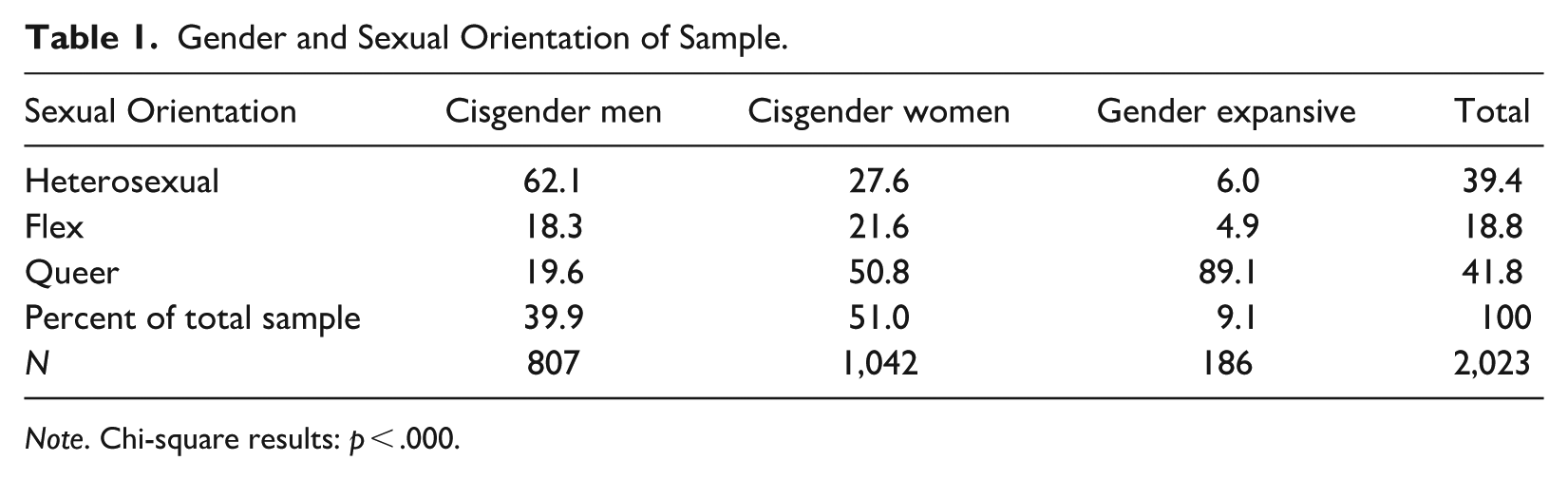
Note. Chi-square results: p < .000.
BDSM Roles by Gender and Sexual Orientation.
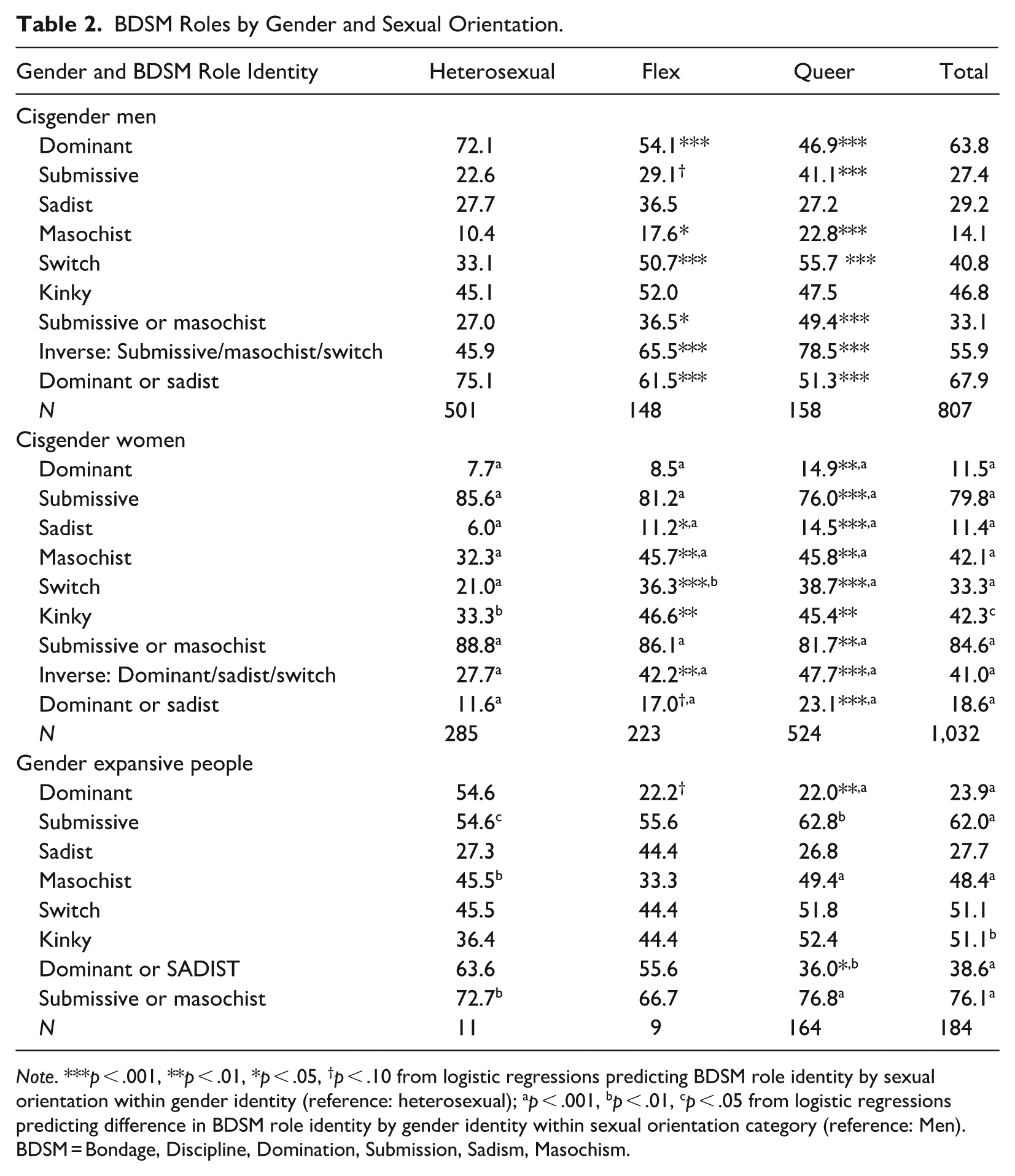
Note. ***p < .001, **p < .01, *p < .05, †p < .10 from logistic regressions predicting BDSM role identity by sexual orientation within gender identity (reference: heterosexual); ap < .001, bp < .01, cp < .05 from logistic regressions predicting difference in BDSM role identity by gender identity within sexual orientation category (reference: Men). BDSM = Bondage, Discipline, Domination, Submission, Sadism, Masochism.
Qualitative Data Collection and Analysis
Participants who expressed interest received a form letter describing the study and an informed consent form. We collected demographic information and assigned each participant a pseudonym. The bulk of respondents opted for email interviewing, which functioned as a virtual conversation. That is, we sent one question at a time via email, and participants responded to the question. Based on the response, we posed follow-up questions. A single interview often took weeks to accomplish. Email interviews self-produced transcripts. We sent those back to the participant for member-checking. Once confirmed, we identified transcripts only by the pseudonym and destroyed the electronic correspondence to ensure confidentiality. Due to the nature of the sample (i.e., given that it contains subsets of groups), assurance of saturation occurred with 86 interviews completed. Ten interviews were already in progress and completed, for a final total of 96.
We asked all interview participants a standardized set of open-ended questions drawn from a semi-structured interview protocol focused on masculinity, emotional experience, sexual identity, and BDSM participation. We asked core questions consistently across interviews, but follow-ups varied depending on participant responses. Interviews conducted via phone typically lasted between 75 and 90 minutes and were audio-recorded and transcribed. We conducted email interviews asynchronously, over a series of exchanges that unfolded over several days to several weeks. Email interviews provide a private, non–face-to-face format that facilitates greater disclosure on sensitive topics, offering participants time for reflection while enhancing anonymity, particularly for closeted or marginalized populations (Bowker and Tuffin 2004; Burns 2010; Kim et al. 2003; McDermott and Roen 2012; Mohebati et al. 2012; O’Quinn et al. 2024; Ramo, Hall, and Prochaska 2010; Ratislavová and Ratislav 2014; Siegel et al. 2011; Walker 2014a, 2014b, 2017, 2020; Walker and Kuperberg 2025).
We analyzed interviews using a thematic approach informed by grounded theory. The first author conducted all interviews and led the coding process. We coded transcripts in two distinct rounds: the first, an open, inductive round where we coded all transcripts broadly to identify core themes; the second, a focused round, where we reread each transcript and coded for content specific to emergent themes. Initial open coding focused on how participants described masculinity, emotional experience, sexual identity, and BDSM practice. Focused coding centered upon key issues of masculinity.
Although diverse in experience, most participants, especially our qualitative participants, identified as White (see “Results” for demographics related to the qualitative and quantitative samples). While our sample is predominantly White, cisgender, and heterosexual, this demographic composition reflects broader patterns within U.S. BDSM communities, which skew heavily White and middle-class (Erickson et al. 2022; Martinez 2021; Newmahr 2011; Oddie 2022; Weiss 2011). Indeed, although there are important exceptions, mainstream BDSM spaces have long been shaped by Whiteness. This shapes the forms of emotional and gender expression available within those spaces. As scholars have noted, emotional vulnerability in men is racialized, read as introspective or “deep” in White men, but often coded as weakness or threat in men of color (Collins 2004; Hunter 2011). Our quantitative data allow limited examination of variation in BDSM role identities by race, although some racial groups had small sample sizes (see “Quantitative Survey Results”). Thus, the kinds of “vulnerable dominance” we document here may be more socially legible and culturally permissible for White men. Future research should examine how race mediates the meanings and consequences of emotional expression within BDSM dynamics. Recall that, though important scholarship—such as The Color of Kink (Cruz 2016)—spotlights Black kink practitioners and theorizes race and power in BDSM, large-scale studies and community surveys consistently find that White people are overrepresented in formal BDSM communities, events, and digital platforms. Our findings should therefore be interpreted with attention to how Whiteness may shape the emotional, psychological, and relational affordances of BDSM described in this paper. More pointedly, this study does not claim to represent the full diversity of BDSM practitioners, particularly in terms of race or ethnicity, and the findings should be understood within the context of White masculinities. Further research with a more diverse sample would be valuable.
This study demonstrates that hybrid masculinities are not only performed in everyday social life but are also actively produced within intimate and sexual subcultures, where they may be especially effective at reconciling emotional expression with the preservation of masculine power.
Quantitative Variables and Analysis
We asked respondents “What is your sex/gender identity? (check all that apply)” with responses male, female, male-to-female transgender, female-to-male transgender, intersexual, genderqueer, genderfluid, bigender, agender, two-spirit, or other with a fill in the blank option; we divided respondents into cisgender women (those who responded female only), cisgender men (male only), and gender expansive people (those who checked yes to any other option). We evaluated sexual orientation based on the question “Which of the following do you feel best describes your sexual preference? (Check as many as apply)” with responses divided into heterosexual (only); those who identified as heteroflexible, bicurious, or unsure/questioning but not a specific queer identity (a category we call “flex” and conceptualize as distinct from heterosexual and queer identities); and those who identified with a queer identity including homosexual (gay/lesbian), bisexual, pansexual, polysexual, or queer. Asexual respondents who did not otherwise identify as heterosexual or with a flex or queer category were also categorized as queer, while those identifying only as asexual and heterosexual or in a flex category were placed within the heterosexual or flex categories. Respondents were also able to identify as demisexual or aromantic, but we did not use these categories when categorizing orientation; most demisexual respondents and all aromantic respondents in each of these three categories also identified with another identity and were not omitted from the dataset. Seven respondents who only identified as demisexual but not any other identity were removed from the data, since we were unable to determine the gender of their typical sexual partners; demisexual respondents were otherwise categorized as heterosexual, flex, or queer according to their responses to the sexual orientation question.
Our third key variable was BDSM role identity, based on the question “What BDSM role do you identify with? (Check all that apply).” Possible responses included dominant; submissive; switch (referring to those who take on both dominant and submissive roles); sadist; masochist; kinky; or other, with the last category excluded from analysis. We examine each identification individually, along with the chance that respondents claimed either a dominant or sadist identity or a masochist or submissive identity. For men we examined the probability of having a masochist, submissive, or switch identity, and for women the probability of having a dominant, sadist, or switch identity, to examine the degree to which cisgender respondents identify with BDSM roles that are at least in part “inverse” to prevailing gendered norms. Given that identities were not mutually exclusive, with many respondents selecting more than one identity, we coded each identity as a dichotomous variable, with 1 indicating they identified with a specific identity and 0 indicating they did not select that identity.
Next, we examined responses to the question “If you identify as ‘Kinky’, ‘BDSM-identified’, ‘B/D’, ‘D/S’, ‘S/M’, in which of the following settings is this identity known to others? (You may select more than one choice).” The possible responses were Only to myself, I’m not open to anyone in any setting; In my home to myself and my partner(s) that I live with; To my children; Among most of my nuclear family; Among most of my extended family (i.e., cousins/nieces/nephews/grandparents); Among a few of my friends; Among most of my friends; Among my primary partner(s); Among some of my partners; Among all of my partners; At my workplace; and In my community (e.g., I display symbols associated with this lifestyle). We asked this question of all who took the survey. We examine those who disclose identities to friends by combining the responses “Among a few of my friends” and “Among most of my friends.” We examine those who disclose their identity to sexual partners by combining the responses “In my home to myself and my partner,” “Among my primary partner(s),” “Among some of my partners,” and “Among all of my partners.” Outcomes were coded as dichotomous variables, with 1 indicating they had disclosed their identity to friends or partners and 0 indicating they had not disclosed their identity to friends or partners.
Some respondents who provided responses on questions about gender and sexual orientation and BDSM role did not provide any response to the disclosure question, which appeared much later in the survey); therefore, the total sample size for our analysis of identity disclosure is 1,858 respondents. To make full use of data, we retain the additional 165 respondents who answered questions about gender, sexual orientation, BDSM roles, and all control variables (described below) but did not answer the question about identity disclosure in the first two tables presented below, which do not include data on identity disclosure, and include the full sample of 2,023 respondents. Control variables in regressions include sexual orientation (heterosexual, flex, queer), race (White, Black, Latino/a, Asian, other, or mixed race), age at survey, religious service attendance (more than once per month, 1–11 times per year, never), education (less than high school, high school, some college, BA, graduate degree) and parents’ highest level of education (same categories as education), if the respondent lived with both biological parents at age 14 (lived with both, did not live with both, at least one parent deceased), and source of data (pre-reddit, reddit r/BDSM, reddit r/sex, post-reddit). Reference categories were cisgender men, heterosexual, White, age 18 to 22, less than a high school degree, parents with less than a high school degree, lived with both biological parents at age 14, never attends religious services, and recruited from r/BDSM. Accounting for these differences in regression analyses allows us to examine whether findings are robust after taking into account other factors that may affect selection into our sample or into specific BDSM identities or disclosure patterns.
Using a series of logistic regressions that controlled for the variables described above (full results not shown, available from authors), we examine whether gender and sexual orientation are related to specific BDSM role identities. Role identity categories were not mutually exclusive, and many respondents selected more than one; therefore, we estimated logistic regressions rather than multinomial logistic regressions to examine outcomes. We next estimated a series of logistic regressions to examine whether disclosure of BDSM identities to friends or partners varied by gender and sexual orientation. Finally, among cisgender men, we examined whether specific BDSM role identities were related to disclosure rates to friends or partners, compared to all those who didn’t carry that BDSM role identity. Results presented in tables include unadjusted percents and p-values from regression analyses. We conducted all analyses using Stata version 18.5.
Survey Selection Bias
While we cannot fully determine the degree to which participants self-select into our sample—a common issue in research on sexual topics—our research design allowed us to examine our survey results separately by the venue in which we recruited participants. We were thus able to examine potential selection bias. We examined differences between those taking the survey who followed the link from the Reddit group r/BDSM, those who followed the link from r/sex (these two groups comprised the large majority of our sample), and those who followed the link from any other venue. The r/BDSM group contained a higher proportion of men and especially gender expansive people, while the r/sex group had relatively fewer gender expansive people. Subjects recruited outside of Reddit contained a higher proportion of gender expansive people and women, and fewer men. Recruitment venues were not related to whether respondents identified as heterosexual, flex, or queer for men. Among women, the r/BDSM group contained a higher proportion of queer women, and the r/sex group contained a higher proportion of those with a heterosexual or flex identity. Subjects recruited outside of Reddit contained a higher proportion of heterosexual respondents. There was no difference by recruitment venue in whether respondents had disclosed their identities to partners, but those recruited outside of Reddit were most likely to have disclosed their identity to friends, while those recruited from r/sex were less likely to have disclosed their identity to friends compared to those recruited from r/BDSM. Regression analyses all control for the source of data (reference: r/BDSM). Another selection factor may be selection into BDSM participation by those with different norms related to masculinity and different levels of emotional openness compared to those who do not participate. While we cannot test for these factors directly, readers should avoid interpreting results as representative of ideas about masculinity and emotionality outside the BDSM community.
Results
Qualitative Results
Qualitative Sample
Of the 96 qualitative participants, 42 (44%) identified as women, 43 (45%) as men, and 11 (11%) as genderqueer or genderfluid. Among role identities, 32 (34%) identified as Submissives/Slaves/Bottoms, 30 (32%) as Dominants/Masters/Tops, and 29 (31%) as Switches. Sixteen (17%) identified as Masochists, 9 (9%) identified as Sadists, and 7 (7%) reported interest in Age Play. Most reported multiple BDSM roles and identities. While roughly two-thirds of BDSM practitioners identify as heterosexual (De Neef et al. 2019), in our interview sample, only 45 (47%) participants did; 50 (53%) identified as non-heterosexual (e.g., bisexual, pansexual, queer, heteroflexible) and 1 as asexual. Participants ranged in age from 18 to 62. Their years of experience with BDSM ranged from 1 to 50 years. Fifty-seven (60%) reported they had a bachelor’s degree or higher. Twenty-five (26%) self-described as married and monogamous; another 14 (15%) reported a polyamorous or open relationship or marriage. Another 23 (24%) self-described as in a relationship (e.g., engaged, living with someone, ongoing monogamous relationship), and 28 (29%) reported singlehood. Only 6 (6%) reported a racial identity other than White, a limitation of these data; our survey data contains a larger proportion and number of people of color. Among the 30 identifying as dominant, masters, or tops, only 8 (27%) were female; only 7 (22%) of the 32 reporting themselves as submissive, slaves, or bottoms were male. The sample included only two female sadists and five male masochists, and only one male participant who reported their interest as age play.
BDSM Effect on Male Emotionality
A central theme that emerged from participants’ narratives was the role of BDSM in shaping and expanding emotional expression, particularly among men. Many participants described BDSM as a structured space where emotions—often constrained by societal gender norms—could be safely expressed, explored, and even redefined. This dynamic was noted by 19 men, 6 women, and 2 nonbinary participants, reflecting a diverse range of experiences across different gender and role identities. Among the men, 12 identified as Dominants, 4 as Switches, and 3 as Submissives. Among the women, 4 identified as Submissives, 1 as a Switch, and 1 as a Dominant. The nonbinary participants included 1 Submissive and 1 Switch. These distributions highlight how BDSM provides a framework for emotional engagement across different positionalities within the practice.
For many participants, BDSM provided a safe space where men could express emotions without fear of judgment or societal repercussions, an opportunity rarely afforded within conventional gender norms. Nick (32, male, partnered, pansexual, submissive, White, six years of BDSM practice) explained: BDSM is a way for me to express my submissive side in a physically and emotionally safe environment. Since submission flies directly in the face of the traditional male gender role, I have to wear a different face in my day-to-day life, and that has a very stressful and cumulative effect on me. Being able to be my true self (even in short bursts) allows me to release some of that stress and emotionally recuperate.
Nick’s experience highlights how BDSM can serve as a form of gendered resistance, offering space to reject emotional restriction often emphasized in dominant gender norms (Levant 1997; Levant and Wimer 2013). These accounts exemplify hybrid masculinity in action: men engage in practices that appear to depart from hegemonic norms—such as emotional openness or submissive positioning—while retaining broader alignment with dominant masculine expectations. However, what constitutes hegemonic masculinity is not fixed. It adapts to context, incorporating new practices so long as they sustain hierarchical gender relations (Bridges and Pascoe 2014; Connell and Messerschmidt 2005). BDSM, then, is a counter-hegemonic space in which men can explore nontraditional expressions of selfhood without the stigma they might face in mainstream social contexts.
Other men echoed this theme, describing BDSM as an emotional training ground, helping them develop forms of expression constrained by dominant masculinity norms. Travis (27, male, divorced, heterosexual, dominant, White, four years of BDSM practice) shared, “I used to be rather stoic, and it’s still difficult for me to express myself in terms of excitement or frustration. This has helped me learn how to improve how I can express with others.” Travis’s account suggests BDSM supports emotional retraining, helping men develop expressive skills that dominant masculinity discourages. It may provide not just an outlet for emotion, but a reimagining of masculinity that includes vulnerability within power dynamics. This aligns with findings from previous research indicating that non-mainstream sexual practices enable participants to access a more authentic and self-affirming mode of emotional expression (Walker 2017). By offering structured, negotiated spaces for emotional and psychological exploration, BDSM communities challenge traditional gender scripts and provide alternative pathways for men to navigate and reframe their relationship to masculinity.
BDSM as an Emotionally Provocative Context
Other men described BDSM as not just a release, but a provocation of emotional responses, an experience that actively challenges traditional masculine norms of emotional suppression. Toby (34, male, married, pansexual, submissive, White, six years of BDSM practice) noted: I’m not a very emotional person normally. As a child, I didn’t cry much, so as an adult I don’t really cry. I don’t have strong emotions towards a lot of things in my life, but the times when I’m most happiest or most sad . . . those things that affect the BDSM lifestyle elicit the most emotion and the most feelings. It just elicits some of the deepest emotions that I’ve ever felt and the most sadness and the most happiness.
Toby’s account illustrates BDSM’s power as an emotional catalyst, especially for men socialized to suppress vulnerability. Rather than simply enabling release, it offers a structured context to access and cultivate emotions that might otherwise remain dormant. BDSM creates conditions that bring suppressed feelings to the surface, making it easier for men like Toby to access and process emotions with which they might not otherwise engage. This finding fits well with scholarship on hegemonic masculinity, which emphasizes how dominant gender norms encourage emotional restriction in men by positioning displays of vulnerability as weakness (Connell and Messerschmidt 2005). By contrast, BDSM offers an alternative framework in which intense emotions—joy, sadness, catharsis—are not only permissible but actively sought after and valued. Within this context, men can engage in emotionally charged experiences that may be difficult to access in conventional settings, creating opportunities for emotional exploration that extend beyond BDSM encounters. Rather than serving as an exception to dominant masculinity, BDSM may function as a corrective experience. In this sense, BDSM does not merely permit but nourishes emotional expression, offering men an alternative space in which emotionality is structured, encouraged, and normalized.
Exploring Emotional Expression Beyond Traditional Masculine Roles
Some participants noted that BDSM provided a context to explore emotional expressions that are traditionally coded as feminine or considered non-traditional within mainstream masculine norms. Wade (23, male, partnered, bisexual, dominant/sadist/masochist, White, three years of BDSM practice) described: There’s a lot of traditionally masculine elements in my life (body type, being in a fraternity), which I don’t mind. However, it was hard to reconcile my self-image with my (not constant, but frequent) desire to express myself in a more feminine/graceful/pretty way, which seemed at odds with how I lived my life. BDSM play has let me feel more comfortable accepting both aspects of myself.
For Wade, BDSM enabled gender fluidity, offering him the ability to embrace both masculine and feminine traits that mainstream norms would frame as contradictory. This suggests that BDSM is both a space of sexual exploration and a context for reworking gender identity outside of binary constraints.
The ability to explore multiple facets of identity without fear of judgment was a common sentiment. Jack (45, male, engaged, heterosexual, dominant/sadist, five years of BDSM practice) added, “Emotionally it has allowed me to open up, be less afraid of expressing feelings. Not being afraid of letting a façade slip or fear of what my partner might think of me or my feelings.” For Jack, BDSM offered emotional freedom, vulnerability without compromising masculinity. This finding comports with research showing how non-mainstream practices challenge rigid gender norms, allowing men to safely reject the emotional constraints of hegemonic masculinity (Connell and Messerschmidt 2005). By providing men permission to explore emotions and self-expression beyond conventional gender expectations, BDSM is a counter-hegemonic space, one that challenges the assumption that masculinity must be defined by emotional restraint and rigid self-presentation.
BDSM Facilitating Emotional Vulnerability
Several participants remarked on increased emotional openness within their BDSM dynamics, illustrating how these relationships can facilitate emotional growth and intimacy that might be constrained in more traditional relational frameworks. Robin (24, androgyne, partnered, asexual, submissive/masochist/sadist/pet/slave, White, 10 years of BDSM practice) noted: [My male BDSM partner] is okay with this and has become much kinder and more affectionate towards me as a result. I think he’s also learning he needs more affection than he thought. Neither of us are as cold and detached as we thought when we got into this, and it’s so much better now that we know that.
Robin’s experience shows how BDSM fosters emotional recalibration, helping partners become more aware of emotional needs and challenge internalized ideas of detachment or self-sufficiency. The structured roles within BDSM, rather than reinforcing rigid emotional boundaries, can instead serve as a gateway to deeper connection, empathy, and mutual care—counteracting dominant cultural scripts that position emotional openness as a sign of weakness, particularly for men. Similarly, Alyx (28, genderqueer, single, heterosexual, little girl, White, six years of BDSM practice) commented, “Being submissive seems to make men comfortable with being emotionally open, since they know I want to lend them support and make them feel secure.” Alyx’s experience highlights how BDSM provides an alternative relational framework in which men feel permitted to express emotions that hegemonic masculinity often suppresses. Again, within traditional gendered scripts, emotional vulnerability is typically feminized and discouraged in men (Connell and Messerschmidt 2005). BDSM structures allow for a reframing of vulnerability not as a failure of masculinity, but as an integral and even valued component of dominance, submission, and relational security.
Accounts in this vein suggest that BDSM can function as an emotional equalizer, a structured context in which individuals can redefine emotional intimacy on their own terms. Rather than reinforcing mainstream assumptions that BDSM is solely about physical power and control, these narratives reveal that BDSM may, paradoxically, foster greater emotional openness and mutual trust than more conventional relationships, precisely because it requires ongoing communication, negotiation, and consent.
Discovering Contradictions in Emotional Expression
BDSM provided men with opportunities to explore emotional contradictions within themselves, challenging conventional assumptions about dominance, masculinity, and emotional detachment. Charlie (25, male, single, bisexual, master/dominant, White, six years of BDSM practice) reflected, “It’s changed me in that I’m a more caring and empathic person now. [I’ve learned] that I have a deeper capacity to care than I thought.” For Charlie, BDSM facilitated the discovery of an emotional depth he had not previously recognized, particularly within the dominant role, which is often culturally framed as controlling or emotionally distant. His experience suggests that BDSM can allow for emotional self-expansion, particularly in giving men the ability to access forms of care and empathy that mainstream masculine norms discourage. By engaging in structured power dynamics that require negotiation, consent, and attunement to a partner’s needs, BDSM enables dominant-identifying men to cultivate a relational style that balances authority with care, rather than positioning them in opposition. Similarly, Trevor (22, male, partnered, heteroflexible, dominant/sadist/master/masochist, White, four years of BDSM practice) said, “I’ve thought about that question a lot of times actually, but besides figuring out what I’m into, the only thing that I have really learned is that paradoxically, I am incredibly sadistic, yet still deeply care about other people and their feelings.” In dominant cultural narratives, sadism is often equated with emotional coldness or detachment. However, within BDSM, the coexistence of sadism and deep emotional care is not only possible but often integral to the practice itself. Trevor’s reflection suggests that rather than reinforcing rigid, one-dimensional expressions of masculinity, BDSM enables men to embrace seemingly contradictory traits—sadism and empathy, dominance, and vulnerability—without invalidating either.
Certainly, it is possible that BDSM does not fundamentally challenge masculinity but provides a controlled outlet for emotions that would otherwise remain repressed. In this sense, BDSM may function as a release valve, letting men can temporarily express vulnerability and emotional depth without disrupting their ability to conform to traditional masculine norms in other areas of life. This aligns with findings that some men engage in nonnormative sexual practices to momentarily relieve the pressures of hegemonic masculinity, only to resume more conventional gender performances elsewhere (Carrillo and Hoffman 2018; Silva 2021). Rather than dismantling dominant masculinity, BDSM may, for some men, offer a structured reprieve that ultimately reinforces their ability to maintain normative masculine roles in everyday life. This tension is central to hybrid masculinities, which operate not through outright rejection of hegemonic masculinity but through its reconfiguration, allowing limited departures that ultimately leave existing power structures intact.
It is also important to reflect on whose emotional complexity is recognized and rewarded in BDSM spaces. The narratives featured here come overwhelmingly from White men, which reflects not only our sample but the demographic skew of many formal BDSM communities (Martinez 2021; Weiss 2011). As Cruz (2016) and Byrd, Cole, and Guy-Sheftall (2009) have noted, BDSM scenes are embedded within broader systems of racial power. The emotional and psychological possibilities BDSM enables—especially those that rebrand male dominance as depth, empathy, or care—may not be equally available or legible for men of color, whose emotional expressions are more likely to be misread or pathologized. This raises critical questions about how race shapes not only participation in BDSM but the meanings assigned to vulnerability and dominance within it.
These narratives challenge traditional expectations of male dominance, which often link power with a lack of emotional connection. BDSM subverts these norms by requiring emotional intelligence, responsiveness, and a deep understanding of a partner’s needs. This is not unexpected, given research on alternative masculinities that suggests that men engaged in nontraditional sexual subcultures often develop more flexible and nuanced approaches to gender and power (Connell and Messerschmidt 2005; Walker 2017). Through BDSM, men can challenge restrictive gender norms that position emotionality and dominance as mutually exclusive, instead forging a masculinity that accommodates both authority and deep relational care, even if only temporarily.
Quantitative Survey Results
Quantitative Sample
Reflecting racial differences in both BDSM participation and reddit use, most (85%) of our survey respondents were White, fewer than 2% were Black (N = 35, including 12 men), 4% were Latino (N = 83, including 30 men) and Asian (N = 82, including 19 men), and around 5% were another race (N = 108, including 32 men). Age ranged from 18 to 69 and experience with BDSM ranged from less than a year to 59 years. Most had attended some college, and almost half had a college degree. Respondents had highly educated parents; over half had a parent with a college degree, and one-third had a parent with a graduate degree. Most lived with both biological parents when they were 14. Just 7% attended religious services at least once a month, and two-thirds never attended religious services. Most respondents were in a romantic relationship; approximately one-fifth were single, one-fifth were living with an unmarried partner, one-fifth were married, and two-fifths were in a romantic relationship but not living with a partner. Table 1 shows the gender and sexual orientations of survey respondents; our sample was diverse on this measure, with 186 gender expansive people comprising 9% of the sample. The majority of cisgender men (henceforth referred to as “men”) identified as heterosexual only, while one-fifth identified with a queer identity; by contrast, over half of cisgender women (henceforth “women”) who responded to the survey had a queer identity, while under 30% identified as heterosexual. More similar proportions of men and women identified with the “flex” category which included those who reported their sexual identity as heteroflexible, bicurious, or unsure; this category comprised around one-fifth of men and women. Almost 90% of gender expansive people identified with a queer identity.
Gender, Sexual Identity, and BDSM Roles
BDSM roles were strongly correlated with both gender and sexual orientation (See Table 2). In line with hegemonic masculinity ideals, men were far more likely than women or gender expansive people to identify as dominant and had significantly higher rates of identifying as dominant compared to women within each sexual orientation category. They were also far more likely than women to identify as sadist. In total, around two-thirds of men identified as sadist or dominant compared to one-fifth of women. While 86% of heterosexual women and over three-quarters of queer or flex women identified with a submissive BDSM role, less than a quarter of heterosexual men, 29% of flex men, and 41% of queer men identified as submissive. Masochist roles were even more rare among men, at 10% of heterosexual men and fewer than one in four queer or flex men, compared to almost one-third of heterosexual women and almost half of queer or flex women. In total, 33% of men and 85% of women identified as submissive or masochist
While roles generally aligned with hegemonic masculinity and traditionally gendered norms, patterns were complex and nuanced. Inverse roles (submissive, masochist, or “switch” for men and dominant, sadist, or “switch” for women) were more common among men than among women, both in total and within specific sexual orientation groups. About 56% of men and 41% of women reported inverse BDSM roles, with these numbers falling to 33% and 19%, respectively, when we remove the “switch” category (those who take on both dominant and submissive roles). For both men and women, inverse roles were more common among queer and flex respondents than among heterosexual respondents, but nearly half (46%) of cisgender heterosexual men identified with a gender-inverse BDSM role at least some of the time. Findings suggest that while roles aligned with hegemonic masculinity expectations, for the majority of men, including nearly half of cisgender heterosexual men, BDSM offered opportunities to break with these norms and take on counter-hegemonic roles. Gender expansive people (a diverse group of trans, nonbinary, and other gender participants) tended to fall between men and women when it came to dominant or submissive BDSM role identities but were closer to women in respect to having a lower proportion dominant and a higher proportion submissive. They were also most likely to identify as a “switch” or “kinky.”
Examining the extent to which BDSM roles varied by sexual orientation revealed kinky or sadist BDSM role identities were not associated with sexual orientation among men but were among women; heterosexual women were least likely to identify with either of these roles. Most other roles were also related to sexual orientation for both men and women, with heterosexuals more likely to take on BDSM roles aligning with hegemonic masculinity and other dominant gender ideals. Dominant roles were more common among heterosexual men, and all other BDSM roles (submissive, masochist, or switch) were more common among flex or queer men. For women, the opposite was generally true for dominant, sadist, and submissive identities, with heterosexual women less likely to identify as dominant or sadist and more likely to identify as submissive. Queer and flex men and women were also more likely to take on inverse BDSM roles that did not align with traditionally gendered norms compared to heterosexual respondents. Flex respondents tended to fall between heterosexual and queer respondents in their role identities.
Identity Disclosure
In Table 3, we examine identity disclosure to friends and the degree to which it varied by gender, sexual orientation, and, for men, by BDSM role identity within sexual orientation categories. Queer men were less likely to have disclosed their BDSM identity to friends than were queer women and gender expansive people, although there were no differences by gender in identity disclosure among those identifying as heterosexual or flex. Heterosexual men and women were less likely to have disclosed their BDSM identity to friends compared to flex or queer people of the same gender. Results also varied for men by BDSM identity. Among all men, those with counter-hegemonic submissive or inverse roles had lower rates of identity disclosure, and those with a dominant, sadist, or kinky identity (with dominant and sadist identities aligned with hegemonic masculinity ideals) had higher rates of identity disclosure. The lower rate of identity disclosure among submissives and those with an inverse identity were primarily driven by heterosexual men; flex or queer men with those identities did not have lower rates of identity disclosure compared to those who were not submissives or who did not have inverse identities. Heterosexual men were also less likely to have disclosed their BDSM identity to friends compared to flex men when they identified with dominant, submissive, submissive/masochist, or inverse roles, and were less likely to have disclosed their BDSM identity compared to queer men when they took on any BDSM role apart from dominant or sadist roles.
Percent Disclosed BDSM Identity to Friends.
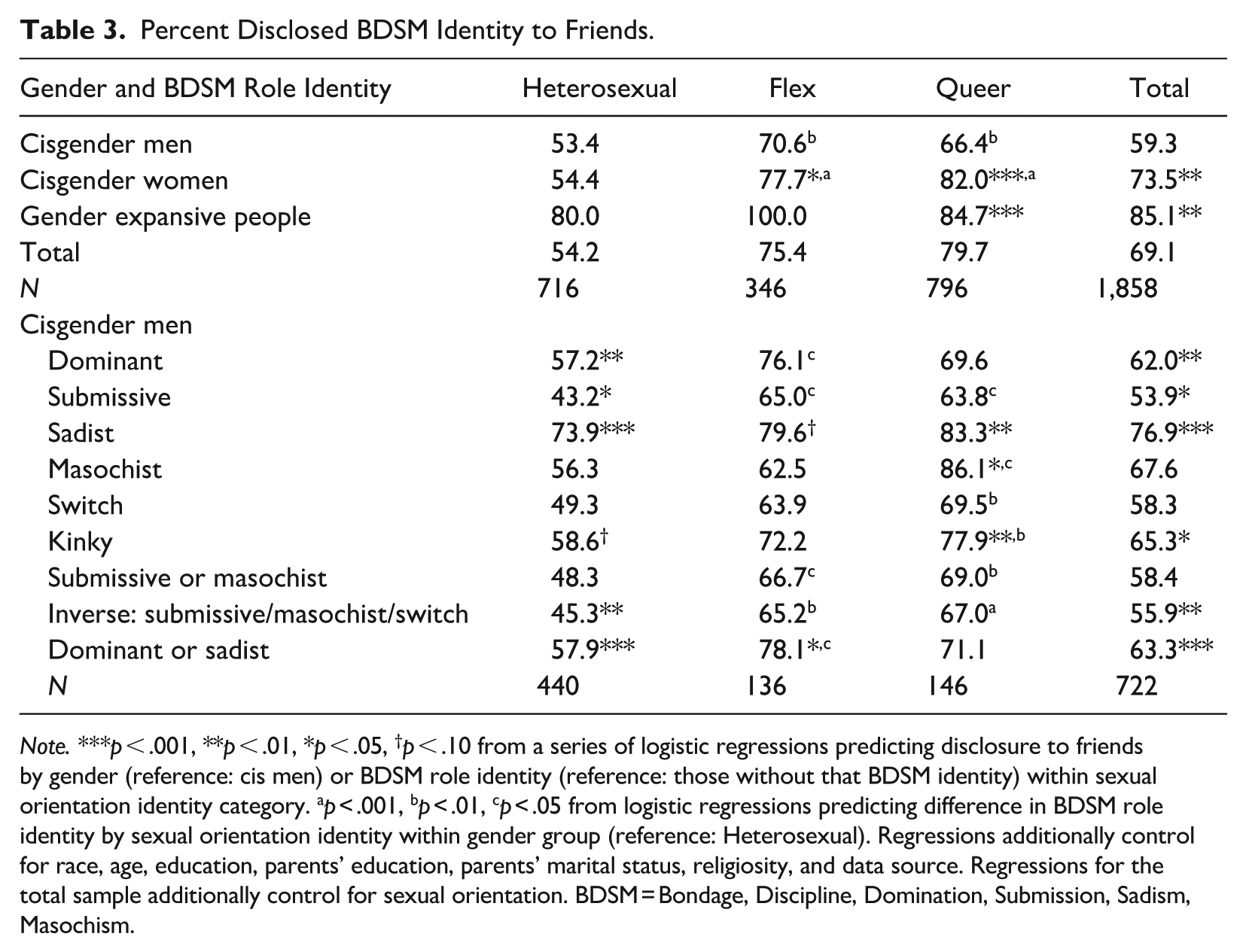
Note. ***p < .001, **p < .01, *p < .05, †p < .10 from a series of logistic regressions predicting disclosure to friends by gender (reference: cis men) or BDSM role identity (reference: those without that BDSM identity) within sexual orientation identity category. ap < .001, bp < .01, cp < .05 from logistic regressions predicting difference in BDSM role identity by sexual orientation identity within gender group (reference: Heterosexual). Regressions additionally control for race, age, education, parents’ education, parents’ marital status, religiosity, and data source. Regressions for the total sample additionally control for sexual orientation. BDSM = Bondage, Discipline, Domination, Submission, Sadism, Masochism.
Table 4 examines BDSM identity disclosure to partners and differences by gender, sexual orientation, and, among men, specific BDSM identity. Respondents were generally more likely to have told a partner about their BDSM identity than they were to have told a friend. As with disclosure to friends, cisgender men were the least likely to have disclosed their BDSM identity to partners compared to those of other genders. Heterosexual, flex, and queer men were less likely to have told their partner(s) about their BDSM identity compared to women in the same sexual orientation groups. But there were no differences by sexual orientation among cis men or women in terms of disclosure of BDSM identity to partners. When examining differences in disclosure to partners by specific BDSM identities, heterosexual men with counter-hegemonic roles were less likely to disclose. Submissive heterosexual men were less likely to disclose their BDSM identity to a partner than heterosexual men without a submissive identity. They also had the lowest disclosure rates of any group examined, although these differences were only marginal. Heterosexual and flex men who identified as sadists were more likely to have told a partner about their BDSM identity compared to those who did not identify as a sadist, while heterosexual and queer men who identified as masochists were marginally more likely to have told their partner(s) about their identity compared to those who didn’t identify as a masochist. There were no differences by sexual orientation within BDSM role identity groups. These patterns allow us to assess whether practices that appear counter-hegemonic at the individual level nevertheless reproduce cis-heteropatriarchal arrangements at the structural level.
Percent Disclosed BDSM Identity to Partners.
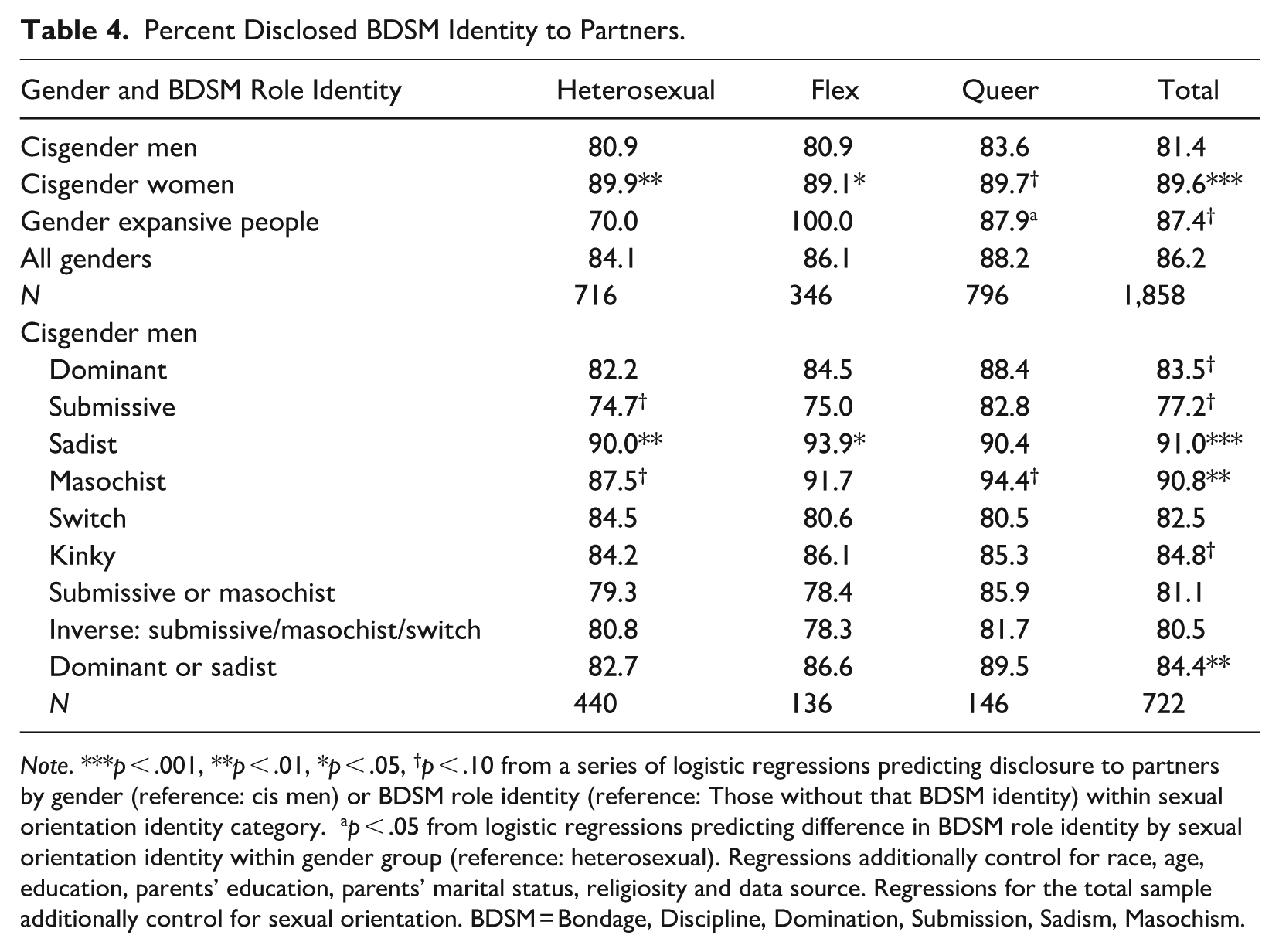
Note. ***p < .001, **p < .01, *p < .05, †p < .10 from a series of logistic regressions predicting disclosure to partners by gender (reference: cis men) or BDSM role identity (reference: Those without that BDSM identity) within sexual orientation identity category. ap < .05 from logistic regressions predicting difference in BDSM role identity by sexual orientation identity within gender group (reference: heterosexual). Regressions additionally control for race, age, education, parents’ education, parents’ marital status, religiosity and data source. Regressions for the total sample additionally control for sexual orientation. BDSM = Bondage, Discipline, Domination, Submission, Sadism, Masochism.
Discussion
Interviews revealed men’s perception of BDSM as a safe space in which to explore and disclose their feelings, a place offering respite from the emotional stoicism of hegemonic masculinity. Men discovered higher emotional capacities than they realized as well as the juxtapositions within their personalities. These findings contribute to hybrid masculinity theory by demonstrating how BDSM simultaneously enables emotional liberation and covert conformity. BDSM participation permitted a fuller range of emotional expression and experience than did the rest of their lives, suggesting BDSM allows men the chance to escape the pressures of hegemonic masculinity faced in everyday life. 1 Men reported these experiences, and some female and nonbinary participants noticed them affecting their male partners as well. BDSM scenes provided relief from the oppressive demands and expectations of hegemonic masculinity.
Survey results showed that BDSM roles were generally aligned with wider societal expectations related to hegemonic gendered roles within sexual encounters, in line with our first hypothesis. Men were more likely than women to explore inverse roles within BDSM contexts, challenging masculinity norms, but queer and flex men were more likely to identify with counter-hegemonic roles than heterosexuals. Heterosexual men were also less likely to disclose their BDSM identities to both friends and partners when they took on BDSM roles at odds with hegemonic masculinity norms, in line with our second hypothesis. These patterns further support a hybrid masculinity framework: while some men adopt roles that appear counter-hegemonic, their overall patterns of identification and disclosure remain structured by dominant masculine norms.
Together, the quantitative patterns—particularly the concentration of dominance among cisgender heterosexual men and their concealment of counter-hegemonic roles—support our argument that, in some contexts, BDSM sustains rather than challenges cis-heteropatriarchal arrangements. Social norms regarding masculinity likely affect both participation and disclosure. These results partially corroborate findings that BDSM practitioners often conform to gendered norms in role preferences (Wismeijer and Van Assen 2013). However, our data reveal a greater willingness among heterosexual men to adopt counter-hegemonic roles than previously documented; it is the disclosure of these identities that remains more limited. This underscores a tension between private identity exploration and public adherence to gender norms, extending work on the navigation of stigma in BDSM (Barker 2013). At the same time, our findings suggest that BDSM offers a rich case for theorizing hybrid masculinities not as stable or unified identities, but as fluid strategies men adopt to reconcile personal desire with public gender norms.
Survey results also revealed that the group we refer to as “flex” (those who identify as heteroflexible, bicurious, or unsure or questioning their sexuality) have BDSM role identifications that differ from both those identifying as strictly heterosexual and those who have an established queer identity. This group constituted a large proportion of our sample and is a group of rising prominence, as a result of people in contemporary society increasingly questioning heteronormative assumptions and becoming open to new sexual experiences. Examining the behavior of this group is therefore of rising importance.
Earlier studies examined gender dynamics in queer and feminist BDSM contexts (Barker 2013; Bauer 2014); this study uniquely contributes by centering cisgender heterosexual men and comparing men of different sexual orientations in their navigation of hegemonic masculinity through BDSM. Our findings extend Bridges and Pascoe’s (2014) critique of hybrid masculinities by demonstrating how BDSM can serve as both a site of emotional liberation and covert conformity, resisting some gender norms while reinforcing broader gender hierarchies. This duality challenges binary understandings of masculinity and highlights the need for further exploration of subcultures as spaces of nuanced gender negotiation. Further, our findings contribute to broader gender and sexuality theory by illustrating how intimate subcultures like BDSM serve as arenas for negotiating, reinforcing, and challenging hegemonic masculinity. By offering men a structured context for emotional expression and nontraditional role exploration, BDSM highlights the fluidity of gender performances and the potential for subverting rigid societal norms. These dynamics also underscore the pervasive influence of heteronormativity, as heterosexual men appear less likely than queer men to disclose counter-hegemonic roles. Societal norms around masculinity and sexuality, it would appear, continue to constrain individual identity expression even in spaces designed for liberation.
While this study focuses on gendered emotion in kink, race—and particularly Whiteness—shapes how that emotion is interpreted and valued. Our survey allowed some examination of racial differences, yet our sample was predominantly White, and some racial groups (particularly Black men) were very small. This is a limitation of the study, as the analysis may not fully capture how race intersects with BDSM practices and masculinity. As noted in previous research on BDSM and race (e.g., The Color of Kink [Cruz 2016]), Whiteness offers men a kind of cultural legibility: their emotional openness in kink scenes is often interpreted as ethical, introspective, or therapeutic. BDSM communities of color may experience and perform gender and power dynamics differently, given that Whiteness structures the aesthetics, scripts, and emotional possibilities of BDSM participation. The emotional intimacy described by White men in this study is, in other words, not universally available. It is made legible and safe precisely because it unfolds in a White-dominant space, among participants whose Whiteness itself is often invisible but powerful. Future work should critically examine how Whiteness not only skews BDSM participation but conditions what kinds of masculinity and emotional expression are seen as legitimate within it. Such studies should also explore how racial identity shapes BDSM, ideally using purposive sampling in communities of color. As Lawrence and Hylton (2022) argue, race should not function merely as a descriptor in research, but as an analytic lens. Examining how Whiteness, as a racial position, enables particular performances of emotional dominance—or vulnerability—in ways that may be unavailable or differently coded for men of color is a fruitful area for future researchers to explore.
Finally, future research should continue examining subcultural contexts as laboratories for understanding how masculinity adapts, fractures, and persists under changing social norms. This paper contributes to the literature on hybrid masculinities by demonstrating how BDSM functions as a structured space of both emotional liberation and covert conformity, where men can engage in emotional vulnerability, introspection, and intimacy—practices often discouraged under hegemonic masculinity—without disrupting their broader gender identity. Rather than rejecting dominant gender norms, many men use BDSM to temporarily step outside them in ways that feel safe, controlled, and affirming. This structured emotional release ultimately sustains, rather than challenges, existing gender hierarchies. Our work extends hybrid masculinity theory by showing how even emotionally transgressive practices can be folded into frameworks that preserve masculine power.
Across both datasets, we find that men’s emotional vulnerability and counter-normative role-play occur within highly controlled, scene-specific boundaries that allow them to retain masculine authority outside the encounter; this boundedness, combined with men’s disproportionate identification with dominant roles and the concealment of counter-hegemonic identities, ultimately sustains rather than disrupts gendered hierarchy. Together, the qualitative and quantitative data reveal the paradox of BDSM participation for men navigating masculinity. Interviews show how men—often in submissive roles—use BDSM as a context for emotional vulnerability, care, and self-discovery. Survey results, however, highlight the limits of that freedom: while many men participating in BDSM take on roles that deviate from hegemonic norms, they are significantly less likely to disclose those roles to friends or partners. Gender expectations deeply constrain action and visibility. Our mixed-methods approach thus allows us to trace not only the emotional richness of these practices but the structural pressures that shape them.
Conclusion
Gender exists as a ubiquitous force shaping our everyday lived experiences and imposing expectations and demands. BDSM operates as a safe space in which to disrupt those mandates. We add to existing research investigating BDSM and gender by examining the interrelationship of hegemonic masculinity and men’s experiences in BDSM. For these participants, BDSM provided a structured release from, not a rejection of, the emotional restrictions of hegemonic masculinity; their nonconforming performances operated as covert conformity. Even in adopting counter-normative roles, men retained control over when, how, and with whom emotional expression occurred. This suggests that BDSM functions less as a radical break from dominant masculinity and more as a managed space wherein men can access vulnerability without disrupting patriarchal power. Put differently, BDSM becomes a site for performing hybrid masculinities that repackage dominance through emotional fluency, ultimately reinforcing rather than dismantling gendered power structures.
A large, diverse sample allowed us to explore BDSM role differences across gender and sexual minorities; we uncovered previously hidden variation among groups. Subsequent research should engage the experiences of men of color and nonbinary practitioners to explore how race and diverse gender identities intersect with BDSM participation and masculinity. Additionally, longitudinal studies could investigate whether participation in BDSM has lasting effects on emotional well-being and gender expression outside of BDSM contexts. Practically, these findings may inform mental health interventions by highlighting the therapeutic potential of alternative intimate practices for addressing issues related to emotional repression and societal pressures around masculinity. Additionally, while this study highlights a potential link between BDSM participation and greater emotional openness among men, it remains unclear to what extent this reflects a transformative effect of the subculture itself versus the self-selection of men who were already more open-minded. Future work should employ longitudinal designs, incorporating both qualitative and quantitative data, to disentangle these possibilities.
Footnotes

Ethical Considerations
Missouri State University’s Institutional Review Board approved the study. The University of North Carolina—Greensboro’s (where Arielle Kuperberg worked at the time) Institutional Review Board approved the study.
Consent to Participate
Informed consent to participate was written for both interviews and surveys.
Consent for Publication
Informed consent was obtained.
Funding
The authors received no financial support for the research, authorship, and/or publication of this article.
Conflicting Interests
The authors declared no potential conflicts of interest with respect to the research, authorship, and/or publication of this article.
Data Availability
It is not possible to share the data as we promised participants that we would never share it or grant access to it.