



Abstract
This paper asks: What kinds of interactions do heterosexual Black women experience along their sexual journeys? And how do these interactions impact their sexual subjectivities? Analysis of intimate life history interviews with Black heterosexual cisgender women (n = 31), ages 34 to 58, indicates that they experienced hegemonic interpellations and subversive interpellations. Hegemonic interpellations describe interactions in which the women’s sexualities were misrecognized as deviant or exploitable. These interactions constrained their sexual subjectivities. This article introduces the concept subversive interpellations to describe interactions in which the women’s sexualities were recognized as acceptable, worth nurturing, or worth knowing. These interactions expanded the women’s sexual subjectivities. Findings suggest that sexual subjectivity is an interactional process shaped by structural racism, sexism, and heteronormativity. Ultimately, the paper argues that subversive interpellations are an important way that people undermine the social order in interaction.
Introduction
During Madison’s (age 49) interview, she reminisced about the sensual evenings spent with a former boyfriend. She shared, “He’d tell me I’m beautiful, my mind is so deep. We would read literary works—Dante’s Inferno, you know. We’re drinking out of these beautiful cognac glasses, talking about the meaning of life. So that took me on another level as a woman to have a man who loved all of me—my brain, my beauty, my body.” Madison was one of many heterosexual Black participants in the Gender Inequality in Sexuality at Midlife Study who talked about the affirming, titillating, and caring experiences they have had along their sexual journeys. These women reflected on how it felt to be seen as worthy sexual people and how being seen as such profoundly impacted them.
Our theories of interpellation cannot adequately explain these women’s reflections, though. Social theorists posit interpellation as a process in which hegemonic subjectivities are imposed onto people. People draw on controlling images of social groups to repeatedly misrecognize others in ways that align with their hegemonic social statuses (Althusser 1971; Butler 1993; Collins 2009; Essed 1991; West and Zimmerman 1987). Thus, interaction can constrain people’s subjectivities and reify the legitimacy of public myths about social groups. Further, critical social theorists assert that people resist misrecognition (Allen 2011; Butler 1993; Muñoz 1999). There has been less consideration, however, of whether people can be recognized in ways that expand subjectivities and resist the social order’s reproduction.
This elision is especially common in the research on Black women’s sexuality. A striking 93.5% of sexuality research on Black women leverages a sex-negative framework (Hargons et al. 2021). This emphasis on negativity places experiences like Madison’s beyond the scope of empirical consideration in sexualities research. While contemporary Black feminist sexologists are changing this (see Hargons et al. 2018; Thorpe et al. 2021; Townes et al. 2021), we still do not know much about what constitutes a positive sexual interaction for Black women, how such interactions expand our sexual subjectivities, and how these interactions relate to social order reproduction. This article fills these empirical gaps and, in doing so, aims to expand sociological understanding of how people subvert the social order in interaction.
I ask: What kinds of interactions do heterosexual Black women experience along their sexual journeys? And how do these interactions impact their sexual subjectivities? Using analysis of intimate life history interviews with Black heterosexual cisgender women (n = 31) who are ages 34 to 58 and not in monogamous romantic relationships, this article presents two archetypes of sexual interactions that the women experienced. Hegemonic interpellations describe interactions in which the women’s sexualities were misrecognized as deviant or exploitable. These interactions constrained their sexual subjectivities. I developed the concept, subversive interpellations, to describe the interactions in which the women’s sexualities were recognized as acceptable, worth knowing, and worth nurturing—which is distinct from hegemonic recognitions of Black sexuality. Subversive interpellations expanded the women’s sexual subjectivities. My analysis shows that sexual subjectivity is an interactional process shaped by structural racism, sexism, and heteronormativity.
These findings expand the empirical dimensions of consideration in sexualities research to include heterosexual Black women’s positive interactions. Beyond this empirical case, the subversive interpellations concept expands our understanding of how people subvert hegemony in interaction. My findings indicate that resistance in interaction goes beyond how one responds to being misrecognized—people also undermine the social order when they do not actively impose it onto others. Specifically, when an interaction contains a humanizing recognition of a person in an oppressed social group, it can expand subjectivities, which undermines the social order. Thus, I broadly define subversive interpellations as interactions that (a) contain recognitions which do not exclusively pull from controlling images of an individual’s social group and (b) meaningfully impact that individual’s sense of self. This concept is useful because while most sociologists acknowledge that not all interactions are predetermined by hegemonic ideologies, we have few analytical frameworks that help us identify and understand the sociological importance of such interactions.
Literature Review
Theoretical Frame: Interpellation
Interpellation (Althusser 1971) is a process through which people come to embody subjectivities that align with their hegemonic social status in interaction. This process is informed by and reinforces the existing social order. I engage scholarship on interpellation, everyday racism, and constructionist theories of race and gender to discuss how this is done. See Figure 1 for a visual representation of the key insights this literature provides.
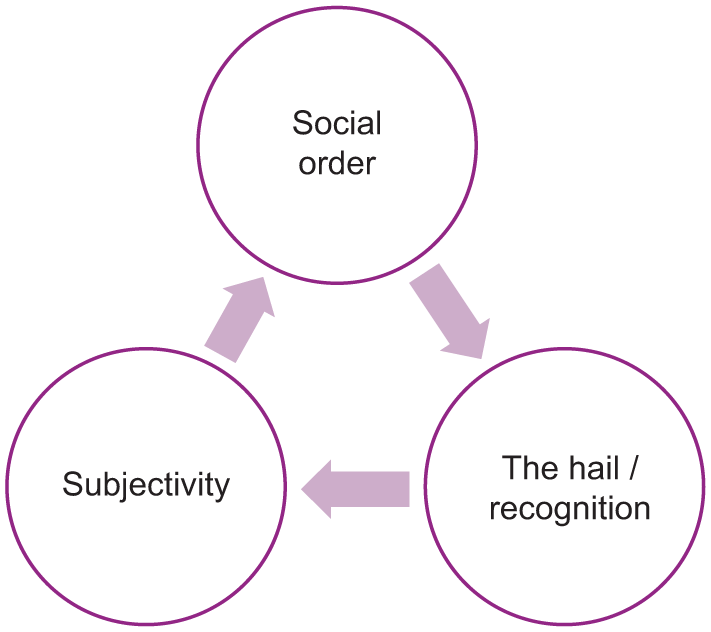
Interpellation theory diagram.
The way people are hailed, addressed, recognized, and seen in everyday interaction reflects their hegemonic social status (Althusser 1971; Bourabain and Verhaeghe 2021; Butler 1993; Essed 1991; West and Zimmerman 1987; Wingrove 1999). Representatives of the state (Althusser 1971; Butler 1993), institutional actors (Allen 2011), and peers (Althusser 1971; West and Zimmerman 1987) recognize people in ways that interpellate them into the social order. It is worth emphasizing that even though people do not always intend to recognize others in ways that reinforce the social order, how we recognize each other in interaction is not random. It is patterned, often traffics in dehumanizing social norms, activates sociopolitical power relations, and is recurrent (Bourabain and Verhaeghe 2021; Butler 1993; Essed 1991; West and Zimmerman 1987).
How we are hailed in interaction also reinforces the social order. Because people are recognized in ways that are informed by controlling images (Collins 2004) of their social group, interaction works to reimpose subjectivities onto people that reflect their social positioning. Feminist political scientist Elizabeth Wingrove (1999) described interpellation as the process through which “individuals—material entities—become subjects—particular and unique beings with particular although not unique capacities . . .—by being named and addressed as such” (878). Being hailed as a particular kind of person impacts people’s selfhood and how we embody our subjectivities, which means how we are hailed impacts the kinds of capacities that our bodies come to possess (West and Zimmerman 1987; Wingrove 1999). The key insight from this scholarship is that how people are repeatedly hailed in interaction is both a product of and works to reproduce the social order. This is because hegemonic interpellations reify public myths that uphold the social order as legitimate and work to impose constricted subjectivities onto people that align with their social positioning.
Critical social theorists have complicated this understanding of how subjectivities are formed by attending to the agency that people exert when they are recognized in hegemonic ways. These scholars assert that it is not only how someone is recognized in interaction that shapes subjectivities—how people respond to being hailed in normative and dehumanizing ways also does (Allen 2011; Butler 1993). Anthropologist Allen (2011) argued that “individual subjects do not always accept this interpellation. They do not always answer the hail, or may do so strategically or with a particular tactical logic to meet short-term or long-term goals” (25). Because the way that a person responds to being hailed impacts the extent to which they embody their hegemonic social status, people’s responses can be acts of resistance. Sometimes people disobey the hail (Butler 1993) and other times people disidentify, or nonnormatively and creatively identify, with it (Barcelos 2020; Muñoz 1999; Sweet 2021). People may also take pleasure in, reclaim, reject, challenge, distrust, ignore, confront, or protest repeated misrecognitions (Ellefsen, Banafsheh, and Sandberg et al. 2022; Francois-Walcott and Stokes 2024; Jones 2019; Miller-Young 2014; Nash 2014). These responses help people resist how they are usually hailed and forge subjectivities that are not entirely predetermined by their social status.
Together, this literature shows how macro-structures are constituted by the recognitions that occur in micro-interactions and asserts that people resist the social order when they respond to hegemonic interpellations in creative ways. But is it always the case that we are recognized in hegemonic ways in interaction? If not, when we are seen as more than our hegemonic social status, does that also powerfully shape our subjectivities? And might such interactions be considered an act of resistance or an interpellation of a different kind? I pose these questions to emphasize that this scholarship presumes that hegemony is what people are interpellated into, thus identifying how we respond to interpellation as the key site of resistance in interaction. To advance our understanding of the connection between interaction, subjectivity, and the social order, this article considers whether people can be recognized as more than their social status, whether we are ever interpellated into more expansive and antioppressive ways of being, and what such interactions could mean for the reproduction of the raced and gendered social order.
Defining Sexual Subjectivity
Broadly, sexual subjectivity describes a person’s sexual personhood and sense of themselves as a sexual being. A key aspect of our sexual personhood is our intimate capacities. Feminist social scientists have most centrally focused on girls’ and women’s capacities to desire, feel deserving of, and use their agency to experience safe and pleasurable romantic and sexual experiences (García 2012; Martin 1996; Montemurro 2014; Tolman 2005). Sociologists and social psychologists assert that sexual subjectivity is not just shaped by our personal psyches—its social, shaped by racism, sexism, class inequities, and other oppressive power structures (Barcelos 2020; García 2012). For example, the concept “thick desire” was developed to foreground an analysis of how the state, social institutions, and policy shape teenagers’ sexual subjectivities and capacities to desire (Fine and McClelland 2006; McClelland and Fine 2014). Additionally, psychologist Deb Tolman (2005) offered the concept “dilemmas of desire” to describe the ways that these macro- and meso-power structures create dilemmas pertaining to sexuality, desire, and gendered subjectivity that girls must navigate during adolescence. Ultimately, this scholarship asserts that the diffusion of structural sexism, and other oppressive structures, in social life systematically thwarts the development of girls’ and women’s intimate capacities.
I build on and depart from this scholarship’s conception of sexual subjectivity to operationalize the term in ways that best speak to my data and the literature on Black women’s sexuality. In this article, sexual subjectivity is a description of the women’s sense of themselves as sexual people and indexes their intimate capacities. I also explore how their sexual subjectivities are shaped by heteronormativity, sexism, and racism. I depart from this literature, because I focus on intimate capacities that are closely related to but still distinct from desire, deservingness, and agency. Sexual knowledge, self-expression, and pleasure are capacities that are prominent in my data and in Black feminist scholarship on sexuality. Thus, when any of these intimate capacities are constrained/expanded, I argue that the women’s sexual subjectivities have been constrained/expanded.
Heterosexual Black Women’s Sexual Interactions and Subjectivities
Here, I explore how key insights from interpellation theory apply to the case of heterosexual Black women’s sexual interactions and subjectivities. I use the phrase sexual interactions to refer to interactions containing talk about sex, sexual activity, or sexual abuse. I’ll review key findings about the social dynamics shaping heterosexual Black women’s sexual interactions, the impact that these interactions have on their sexual subjectivities, and the role such interactions have in reproducing the raced and gendered social order.
Controlling images of Black women’s sexuality inform how people interact with us and have been used to justify our oppression since colonization (Bailey 2021; Collins 2004; Rose 2004). The Jezebel, Mammy, and Sapphire are powerful caricatures of Black women that have transcended time. The Jezebel and Sapphire are “unladylike” caricatures of Black women, representing us as aggressive beings with insatiable sexual appetites. The Mammy depicts an “undesirable” asexual Black woman who exists to create white comfort. Although each image is distinct, Africana studies scholar Tricia Rose (2004) argues that these “stereotypes are defined primarily by their ‘dysfunctional’ sexuality and motherhood” (390). And sociologist Patricia Hill Collins (2009) wrote that in the U.S. “Black hypersexuality is conceptualized as being intergenerational and resistant to change” (140). Other scholars have explored how the Black Lady—which is an image of a Black woman who commits to embodying sexual piety as a form of race work (Rose 2004; Thompson 2012)—emerged as a controlling image intended to discredit hypersexual caricatures of Black women. Because the first three controlling images supposedly represent what Black women are (sexually deviant), the Black Lady represents what we should aspire to be (sexually restrained).
Next, I present key findings about the recognitions that heterosexual Black women’s sexual interactions contain. This literature indicates that Black women’s ordinary and strikingly violent sexual interactions across social contexts tend to contain misrecognitions of our sexualities as deviant or exploitable. Recent research estimated that a staggering 80% of Black women have endured sexual abuse of some kind, including harassment, and one-third have experienced contact sexual abuse (Gómez 2023; Gómez and Johnson 2022). These numbers suggest that many Black women have experienced abusive interactions in which they were misrecognized as sexually exploitable. Rose’s (2004) oral histories show that our sexualities are also misrecognized during nonabusive and mundane sexual interactions. Rose observed that many women “who had been sexually intimate with men or women of other races frequently expressed concern about having been desired as exotic” (12). Other research shows that misrecognitions of Black and brown girls’ and women’s sexualities as deviant occur in formal sex education (Barcelos 2020; Froyum 2010; García 2009), at church (Collins 2004; Lomax 2018), and in reproductive healthcare spaces (Thompson et al. 2022).
The threat of being misrecognized as exploitable or deviant, and actually being misrecognized as such, constrains Black girls’ and women’s sexual subjectivities in mundane and striking ways that contribute to our subordination. Some scholarship explores how the pervasive threat of misrecognition makes it difficult for heterosexual Black women to openly express their desires and needs during sexual interactions (Collins 2009; Dogan et al. 2023; Hammonds 1994; Rose 2004). For example, psychologist Jardin Dogan et al.’s (2023) recent study suggests that heterosexual Black women may struggle to communicate their needs to sexual partners due to concerns that those needs will be disregarded. Collins (2009) explored one reason why Black women sustain some degree of silence around sex. She wrote, “within a U.S. culture that routinely accused Black women of being sexually immoral, promiscuous jezebels [and] in a climate where one’s sexuality is on public display, holding fast to privacy . . . becomes paramount” (135). While this strategy is protective in some ways, it also constrains Black women’s capacity for sexual articulation. Historian Evelyn Hammonds (1994) asserted that “in choosing silence black women also lost the ability to articulate any conception of their sexuality” (133).
In addition to sexual self-expression, experiencing repeated misrecognition constrains heterosexual Black women’s capacities for sexual knowledge and pleasure. For example, qualitative scholarship shows that even when sex educators have protective intentions, because they assume Black and brown girls are at risk for sexual deviance, they ultimately end up constraining the girls’ sexual agency (Barcelos 2020; Froyum 2010; García 2009) and capacities to express their boldest desires (Fine and McClelland 2006). One of the cumulative impacts that being repeatedly misrecognized sexually has on Black girls and women is that knowledge about sex is not made as readily available to us as it could be. A national study estimated that while 83% of teenage Black girls are told to wait to have sex, only 39% of them receive formal instruction on where to get birth control (Lindberg, Maddow-Zimet, and Boonstra 2016). Regarding sexual pleasure, sexologist Candice Hargons (2025) wrote that “many people are . . . contending with cultural recipes that suggest privileged and dominant groups’ pleasure should be prioritized over the pleasure of people who are marginalized” (27). Recent studies suggest that this prioritization of men’s pleasure over women’s persists among some college-aged Black women who have sex with men (Dunn-Gallier 2025; Hargons et al. 2018)
Together, this literature suggests that heterosexual Black women’s sexual interactions across social contexts can contain misrecognitions of their sexualities as deviant or exploitable. Further, these interactions constrain heterosexual Black women’s sexual subjectivities by limiting the development of their capacities for sexual self-expression, knowledge about sex, and pleasure. As interpellation theory would suggest, such interactions do more than misrecognize Black sexuality and constrain sexual subjectivities—they hail heterosexual Black women into their hegemonic sexual status and interpellate them into the white heterogendered social order. These hegemonic interpellations accomplish this by reifying racist sexist public myths about Black women’s sexuality as real and attempting to reimpose sexual subjectivities of constraint onto Black women. As such, many of Black women’s sexual interactions are not only informed by systems of domination—they also reproduce them. Scholars have made this argument about the roles that formal sex education (Barcelos 2020; Froyum 2010; García 2009) and sexual harassment and abuse (Collins 1998; Davis 1983) have in reproducing Black and brown women’s subordination. Thus, when people treat heterosexual Black women as if their sexualities are deviant or exploitable, their actions are guided by and reinforce controlling images, as well as work to constrain their intimate capacities.
A smaller body of research has found that heterosexual Black women do also experience positive sexual interactions that may be expanding their sexual subjectivities. One survey study showed that most Black women felt that their last partnered sexual event was pleasurable and most orgasmed during it (Townes et al. 2021). Another article focusing on heterosexual Black women indicated that most of the women orgasm the majority of the time they have sex and initiate sex as often as their sexual partners do (Thorpe et al. 2021). Beyond their primary focus, two articles report that Black women’s sexual personhood is sometimes affirmed by mothers and sisters during adolescence and by peers who have themselves experienced negative sexual experiences (Crooks et al. 2019; Leath et al. 2020).
Such findings suggest that heterosexual Black women also experience interactions that expand their capacities for sexual pleasure and self-expression. However, sociological understanding of these positive interactions—what they consist of, how they expand Black women’s sexual subjectivities, and how they connect to social order reproduction—is limited. This is notable because what constitutes a negative sexual interaction (i.e., misrecognitions), how negative interactions constrain heterosexual Black women’s sexual subjectivities (i.e., limiting access to sexual self-expression, knowledge, and pleasure), and the impact these interactions have on the social order (i.e., reproducing) is well considered among sociologists.
This article advances understanding of the connections between interaction, subjectivity, and the social order by (a) attending to positive interactions among an oppressed social group and (b) expanding our understanding of how people subvert the social order in interaction. My analysis suggests that sometimes how people are hailed and interpellated in interaction can be subversive. Specifically, I argue that people undermine the social order when they recognize someone in ways that do not pull from controlling images of that person’s social group.
Since these interactions are prevalent in my data, I developed the concept subversive interpellations to foreground the sociological importance of these interactions. Subversive interpellations are interactions that (a) contain recognitions which do not exclusively pull from controlling images of an individual’s social group and (b) meaningfully impact that individual’s sense of self. These interactions are a kind of interpellation because they contain recognitions that impact the recipient’s subjectivity, like interactions that interpellate people into the social order do. Subversive interpellations also work against the reproduction of the social order by interpellating people in oppressed social groups into more expansive subjectivities and subjectivities of worthiness.
Data and Method
This article is based on my analysis of intimate life history interview data collected for the Gender Inequality in Sexuality at Midlife study, led by Elizabeth A. Armstrong. Interviews were collected between 2013 and 2015 by a team of eight researchers, exploring how gender, race, and other dimensions of inequality shape sex and love at midlife for unmarried cisgender white and Black U.S. women (n = 53). I analyzed a subset of this data—the interviews conducted with heterosexual Black women (n = 31).
The research team recruited women who were open to connecting with new partners for love or sex (regardless of whether they claimed existing partners) and sought variation on education and economic security. The team recruited most participants from their extended personal networks and the remaining participants via snowball sampling and social media. The team selected this recruitment strategy to generate a rich dataset that could speak to understudied social processes in women’s intimate lives. Previous literature asserts the utility of personal network recruitment and snowball sampling for building the trust and rapport needed to interview oppressed groups about sensitive topics (Miller 2019; Moore 2019; Owton and Allen-Collinson 2014). Since Black women’s intimate lives have been heavily scrutinized in social science research, the research team believed that this recruitment strategy was especially useful for trust building with these participants.
Most of the Black heterosexual women’s interviews were conducted in-person (25), with the remaining occurring via telephone or videoconference (6). Each participant was offered a $25 gift card. One participant completed a follow-up interview and was provided a second $25. Together, these interviews yielded 80 hours and 23 minutes of interview data, with a median length of 2 hours and 40 minutes. Most of these women were interviewed by a team member who shared their race and/or fell within the project’s age parameters. I did not participate in data collection but do share these women’s race.
The women completed a screening questionnaire collecting self-reported information on race, sexual identity, financial standing, and religion, in addition to other demographic information. The questionnaire also collected information about the women’s five most recent relationships. The interviews were semistructured and covered a range of topics, including messages about love, romance, and sexuality received during childhood and adolescence; sexual and romantic histories; current relationships; and future desires. The interviewers created detailed field notes about the interview setting, participant self-presentation, and the emotional tenor of the interview. These data allow for an examination of the women’s sexual interactions and the impact that these interactions had on their intimate capacities.
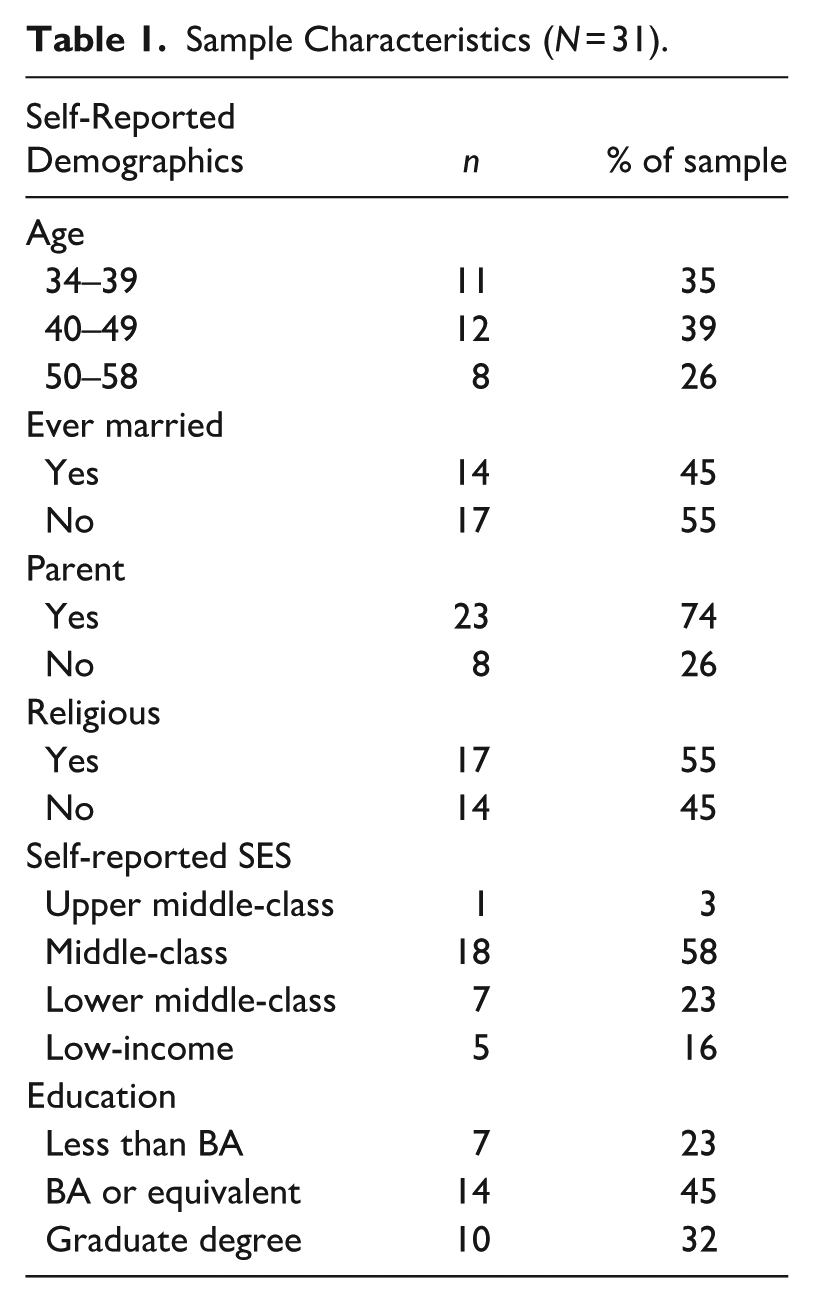
Please see Table 1 for self-reported demographic information from the heterosexual Black women’s screening questionnaire responses. Notably, these women have received more formal higher education than the U.S. population overall. Also, in response to a yes/no question about whether they self-identify as religious, the women were nearly evenly divided between “yes” (17) and “no” (14) responses. And the participants’ ages ranged from 34 to 58, with an average age of 44.
Sample Characteristics (N = 31).
I came to the data with a broad interest in how social life shapes Black women’s intimate lives. After sorting through the questionnaire, interview, and field note data, I identified sexual subjectivity as the article’s central focus. I then did iterative rounds of index coding, analytic coding, and theory refinement (Deterding and Waters 2018). Throughout this process, I referenced field notes to analyze emotional tenor and participant self-presentation data. I used intersectionality as a framework to guide my analysis of how racism, sexism, and heteronormativity as co-constitutive social structures impacted the women’s experiences and subjectivities (Bowleg 2008; Collins 2009; Crenshaw 1989). My analysis was also informed by what sociologist Angela Jones (2025) terms the Black feminist erotic imagination, a framework that calls on sociologists to attend to both misogynoir and pleasure in analysis and theorizing.
Final index codes were: sexual interaction (interaction that involved sexual activity, talk about sex, or sexual abuse) and interaction impact (the women’s reflections about an interaction, including how the interaction made them feel and what they took away from the interaction). Final analytic codes were sexual interaction-misrecognition; sexual interaction-recognition; interaction impact-expanding; and interaction impact-constraining. My analysis indicated that the interactions that contained misrecognitions of the women’s sexualities as exploitable or deviant constrained their intimate capacities. Interactions in which the women’s sexual personhood was recognized expanded their intimate capacities. This second finding led me to develop the concept subversive interpellations.
Given the recruitment strategy and the time at which the data were collected, the specifics of the participants’ experiences may not be generalizable to the current moment. Instead, the social processes that I identified by analyzing this data are intended to be portable, or analytically useful, in future studies examining interaction, subjectivity, and the social order. Ultimately, analyzing intimate life history interviews with middle-aged Black women is a methodological contribution, given that the sociology of sexuality literature has been criticized for its focus on youth sexuality (Armstrong et al. 2024; Montemurro 2014). Even though this article does not advance a life course trajectory argument, this data allowed for an analysis of the ways that Black women negotiate and form their sexual subjectivities across a longer period of time.
In the Findings, I present interview excerpts that are analytically representative of patterns observed across the sample of Black heterosexual women. The presentation of these findings is informed by Rose’s (2004) assertion that “cutting up [Black women’s] intimate stories into bits and pieces repeats a kind of silencing even as it claims to give voice” (6). To balance this ethical consideration with the need to demonstrate that the components of hegemonic and subversive interpellations remain consistent across different sexual interactions, I analyze mid-length excerpts from ten women whose narratives reflect recurring patterns rather than isolated cases.
Findings
Here, I contrast the hegemonic interpellations and subversive interpellations that the women experienced along their sexual journeys. I specify the recognitions of the women’s sexualities that the interactions contained and the impact that these interactions had on their sexual subjectivities, as well as suggest how these interactions relate to social order reproduction. I present a more in-depth analysis of the subversive interpellations since these interactions have been under-considered in the literature.
In the first section, Hegemonic Interpellations: Constraining Interactions, I share my findings that align with previous research about heterosexual Black women’s sexual interactions. These mundane and striking interactions contained misrecognitions of the women’s sexualities as deviant or exploitable and constrained the women’s intimate capacities. Because this first set of interactions legitimized controlling images of Black women’s sexuality and imposed sexual subjectivities of constraint onto the women, they are examples of how heterosexual Black women are hegemonically interpellated in sexual interaction.
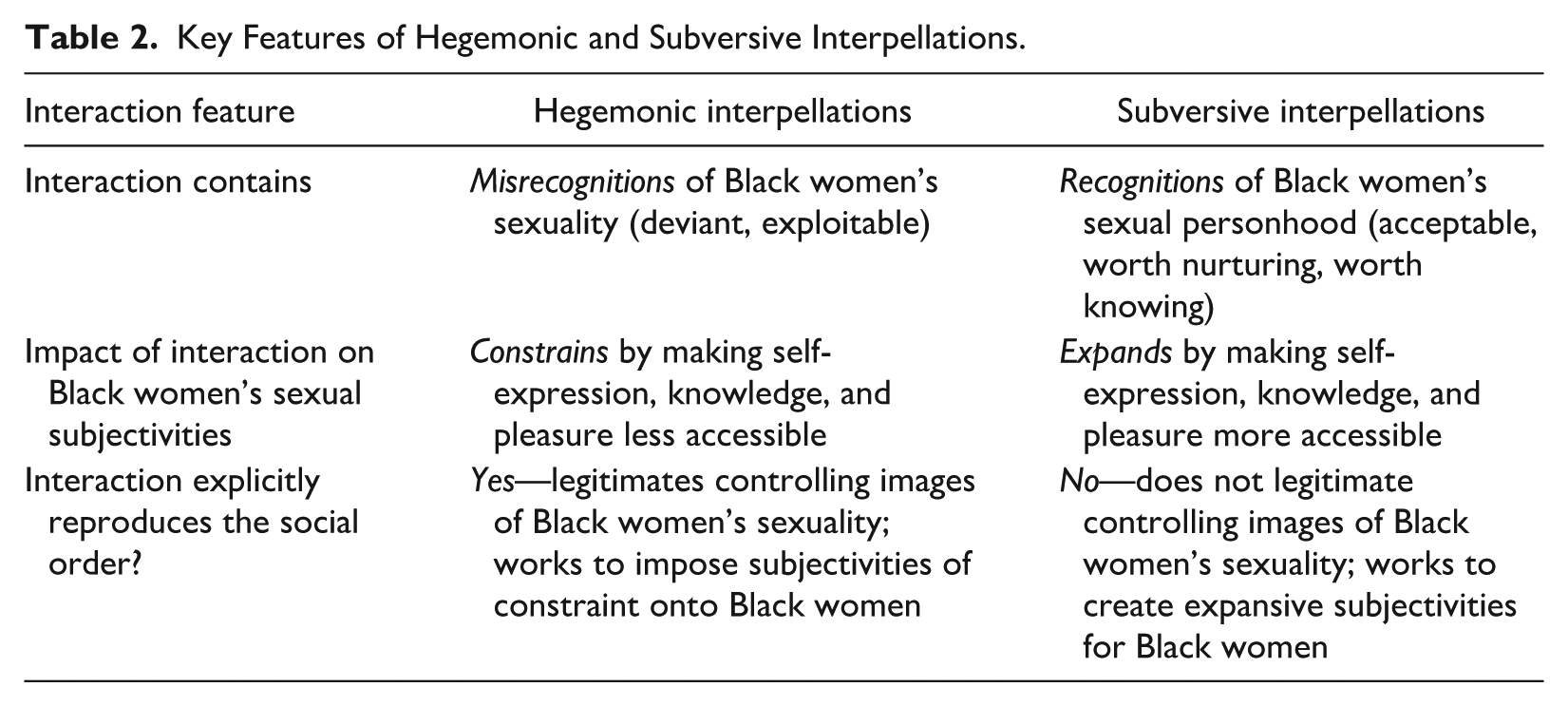
In the second section, Subversive Interpellations: Expanding Interactions, I explore interactions that contained recognitions of the women’s sexualities as acceptable, worth nurturing, and worth knowing, and thus expanded their intimate capacities. As I will show, these interactions did not explicitly leverage public myths about Black women’s sexuality. Instead, these interactions recognized the women’s sexual personhood and expanded their intimate capacities. I describe these interactions as subversive interpellations because they leveraged sexuality in ways that delegitimated the public myths used to justify Black women’s subordination and expanded the women’s sexual subjectivities. See Table 2 for a visual representation of my argument.
Key Features of Hegemonic and Subversive Interpellations.
Hegemonic Interpellations: Constraining Interactions
Here, I analyze the interactions in which the women’s sexualities were misrecognized as deviant or exploitable, as indicated by the treatment they received. These interactions thus constrained the women’s intimate capacities by making sexual self-expression, knowledge, and pleasure less accessible. Because these interactions align with racist sexist public myths about Black women and had meaningful impacts on the women’s sexual subjectivities, they constitute hegemonic interpellations. By connecting the women’s experiences to previous findings about Black women’s sexual interactions, I argue that these interactions worked to reproduce Black women’s oppression in mundane and striking ways.
Desiree’s (age 35) ex-boyfriend misrecognized her as sexually exploitable and this made it difficult for her to experience sexual pleasure. She detailed how, after “beautiful” and “passionate” foreplay, their sexual intercourse was physically painful and emotionally disconnected. She shared:
Twenty minutes into [having sex] I got tears rolling down my face because . . . he is so in his zone, and he is so getting it in and performing, but his performance wasn’t for me. His performance was for him.
During sexual intercourse, Desiree was misrecognized as exploitable—a being from which to derive sexual gratification. She felt that her ex-boyfriend had sex with her for his pleasure, at the great expense of her comfort. This created a relational dynamic in which her ex-boyfriend’s pleasure and desire was centered, while Desiree’s was decentered. She discussed the impact that being repeatedly treated as exploitable had on her capacity for pleasure:
Arguably I think the sex got worse, and I think that the reason that it got worse is because . . . you know, you [her ex-boyfriend] didn’t do anything that made this one any different, so when we do do it, . . . I’m not preparing for pleasure, I’m preparing for pain.
Desiree’s experience of sustaining pain during sex reflects a normalized heterogendered and raced pattern among Black women (Dogan et al. 2023; Townes et al. 2019). Heterogendered sexual scripts are defined by men’s arousal. These scripts also render men sexual actors and women sexual receptors (Bowleg, Lucas, and Tschann 2004). These scripts can intersect with controlling images of Black women as exceedingly strong and immune to pain (Collins 2004; Dow 2015) to create the conditions for repeated painful sexual interactions for women like Desiree. Ultimately, Desiree’s painful and emotionally disconnected sexual interactions—the cultural norms they were informed by and the recognitions of her sexuality that they contained—decreased her capacity for pleasure.
Relatedly, one of Victoria’s (age 35) ex-boyfriends misrecognized her as sexually exploitable when he frequently initiated sex without asking for consent. She explained why she didn’t like this:
The problem is that you [her ex-boyfriend] just assumed that that was what I wanted. You didn’t ask me, or you didn’t even see, you didn’t even pay attention to my mood. You just wanted to satisfy your own self.
Victoria felt that her boyfriend did not see, or ask the questions that would help him see, her full personhood. Instead, she felt that he saw her as someone to derive sexual pleasure from. This suggests that consent is deprioritized among sexual partners who misrecognize Black women’s sexuality. Victoria stressed the negative impact that this pattern of behavior had on her ability to enjoy sex, “You know so to me that’s a problem. That’s a big problem for me. I don’t like it. I don’t. And since I’ve had someone to ask me, it’s so much more enjoyable.” In previous relationships, Desiree, Victoria, and other women in the sample felt that they were misrecognized as sources of sexual gratification, which greatly reduced their capacities for pleasure.
Monica (age 37), a woman with a darker complexion, reflected on how she’s felt repeatedly exoticized in sexual interactions with men. She said, “I always kind of feel like forbidden fruit.” Later in the interview, she shared what she believes men think about her based on how they treat her:
I can give you a compliment, and I can want to sleep with you. I can grab your hair, and I can try to feel on your ass and all these things. But you’re still not quite beautiful enough to walk into a room at an event with me arm and arm.
Instead of Monica’s personhood being seen in sexual interaction, she had been hailed as an exotic other. Colorism compounded the effects that hypersexualized controlling images of Black women can have on Black women’s sexual interactions. Black feminists have explored how media representations of Black women as promiscuous “freaks” influence people to misrecognize us as exotic sexual beings to experience, rather than as sexual people worth knowing (Collins 2004; Rose 2004). Being hailed as a deviant sexual subject gave Monica few opportunities to develop her capacities for partnered sexual pleasure.
When Gwen (age 41) was a teenager, the adults in her life recognized her emerging sexuality as deviant by telling her to disconnect from it and abstain from sex until marriage. She shared, “laughing, I was taught don’t have sex until you’re married because that’s fornication. Don’t involve in loose conduct—anything sexual because loose conduct can lead to having sex outside of marriage.” Gwen’s sexual capacity was misrecognized as risky and deviant—so risky and deviant that she should disconnect from it until marriage. This represents a larger pattern in my sample and in recent studies about the messages about sex that Black girls often receive (Froyum 2010; Leath et al. 2020; Lindberg et al. 2016). One study estimated that Black girls are told to wait to have sex more than girls of other races (Lindberg et al. 2016). This pattern may reflect the sexually constraining respectability politics that some Black Americans adopt as a strategy of resistance to racism. Even when those who under educate Black girls about sex have protective intentions, such interactions constrain Black girls’ and women’s access to sexual knowledge, thereby reducing their sexual autonomy and capacities to know and express their sexual selves (Froyum 2010; Hammonds 1994). For example, when Gwen was asked how she felt about her sexual history, she responded, “At 41 now I’m disappointed. . . . because I didn’t come into my sexual self or understanding until I was 32, so I feel like from 17 to 32 was a lot of wasted sex.” Ultimately, when Black girls are hailed as deviant sexual subjects, these interactions have a constraining impact on their intimate capacities.
Desiree’s, Victoria’s, Monica’s, and Gwen’s stories depict hegemonic interpellations—or interactions that recognize Black women as exploitable or deviant sexual subjects, thus constraining their sexual subjectivities. By repeatedly engaging in painful sex; initiating sex without consent; hypersexualizing the women; and instructing the women to abstain from sex until marriage in adolescence, the people the women interacted with created an interactional space in which their intimate capacities were constrained. I also demonstrated that hegemonic interpellations reproduce Black women’s subordination by working to impose sexual subjectivities of constraint onto them and by reifying cultural myths about their sexuality in both mundane and striking ways.
Subversive Interpellations: Expanding Interactions
Next, I analyze the women’s positive interactions. People also recognized the women’s sexualities as acceptable, worth nurturing, or worth knowing, as indicated by how they interacted with the women. Such interactions expanded their intimate capacities for sexual self-expression, knowledge, and pleasure. Because these interactions contained recognitions that did not align with public myths about Black women’s sexuality and meaningfully impacted the women’s sexual subjectivities, they constitute subversive interpellations. By connecting the women’s experiences to previous findings about heterosexual Black women’s sexual interactions, I’ll argue that these interactions leveraged sexuality in ways that worked against the reproduction of Black women’s subordination.
After experiencing hegemonic interpellations, Darlene’s (age 36) most recent sexual partner recognized her sexual desires as acceptable. She shared that sex with him was “amazing.” When asked why, she responded:
Probably just the time it takes. The fact that he listened to me. . . . like I had a conversation with him. I have learned from having these few relationships I had prior some things I like. A requirement is if you are not the person that goes down on somebody, you shouldn’t touch me because that’s a requirement for me. You know, I . . . just don’t like to be treated like a thot [acronym for “that ho over there”]. Laughing
Darlene’s needs were informed by previous sexual interactions in which she was seen as exploitable, suggesting that she has experienced numerous misrecognitions. Darlene’s last sexual partner engaged in subversive interpellations when he listened to and honored her sexual likes and dislikes. Having her sexual needs and desires recognized as acceptable and worth knowing expanded Darlene’s capacity for pleasure.
Similarly, after being sexually celibate postdivorce, Jackie (age 35) met her next sexual partner, who recognized her sexuality as worth knowing and nurturing. Being recognized in this way created an interactional space in which she could comfortably articulate her sexual desires. Jackie shared, “I was being catered to by a man who cared about my body, cared about me being pleasured, . . . I’m like, yo, this is how it’s supposed to go down? I’ve been waiting my whole life for this.” By caring for Jackie’s body, this sexual partner recognized her sexual personhood in a way that was new for her. Darlene’s and Jackie’s reflections align with previous scholarship, which shows that misrecognitions of Black sexuality are repeated throughout everyday life more than humanizing recognitions. Nonetheless, subversive interpellations are a kind of interpellation because these interactions had meaningful impacts on the women’s subjectivities. For example, even though this relationship of Jackie’s ended, she shared that their interactions helped her expand her capacity for sexual self-expression. She reflected, “We’re still great friends to this day, but he kind of taught me how to speak up for myself and say that, hey, if you don’t like this, then say so. But, yeah, good times.” By asking Jackie to vocalize her sexual dislikes, Jackie’s ex recognized her sexuality as worth nurturing and knowing. Being recognized like this expanded Jackie’s capacities for pleasure and self-expression.
Further, in conversations Jackie had with friends about sex, they also recognized her sexuality as acceptable, and this helped her feel more comfortable articulating her sexual likes and dislikes. She shared:
eventually you get to the age where the subject of discussion can go to sex and nobody’s embarrassed about it, so as I began to talk with close friends and it’s just like, “Oh, you like that, too?” or “That really don’t do it for you?” . . . Having the freedom to have a discussion about it—that’s something. That’s like other-worldly for me . . .
When Jackie and her friends shared their sexual desires, they saw each other’s desires as acceptable and worth knowing. Jackie attributes these freeing recognitions to aging, which reflects previous findings indicating that women become more comfortable in their sexualities later in life (Miller 2019; Montemurro 2014). This suggests that aging can expand Black women’s abilities to recognize each other’s sexualities as acceptable and can make it more possible for them to articulate their desires. Jackie continued to reflect on how these interactions impacted her, “That’s where I get my ideas from—that I’m normal. You know, I know we all got our own little twists and quirks about ourselves.” Jackie’s friends recognizing her sexuality as “normal,” acceptable, and worth knowing made it easier for her to accept and express her sexual self. Thorpe et al. (2023) showed that Black women want more opportunities to talk about sex with friends and feel seen as normal while doing so. Because Black women’s sexualities are often misrecognized as abnormal (Collins 2004), many have sustained silence (Collins 2004; Hammonds 1994) and dissemblance (Hine 1989) as protective strategies. Interactions like the ones Jackie has with her friends foster Black women’s capacities for articulation. Jackie and her friends engage in subversive interpellations when they recognize each other’s sexualities as acceptable, thereby expanding each other’s capacities for self-expression.
Relatedly, Olivia (age 58) explained:
When my husband and I broke up, I had my two nieces come over. Because, um, I’ll never forget, I was 45 and I had been with my husband since I was 21 and I had never used a condom before. So, they came over and they brought a whole bag of condoms and threw them on my bed . . . and they gave me the whole low down.
When Olivia asked her nieces for sex education, their willingness to provide it suggests that they recognized their aunt’s sexuality as acceptable and worth nurturing. This interaction provided her with knowledge that would help her explore her sexuality safely as a divorced woman. Thorpe et al.’s (2023) study found that Black women also want to have more intergenerational conversations about sexuality so that they can benefit from intergenerational wisdom. Conversations that contain mutual recognitions of sexual personhood across generations work against the asexualization of middle-aged Black women and can help fill in gaps in sexual knowledge. By Olivia’s nieces recognizing their aunt’s sexual personhood and meaningfully expanding her intimate capacities, they engaged in a subversive interpellation.
As introduced at the outset of the article, Madison (age 49) described how her ex-boyfriend recognized her sexuality and sensuality as worth knowing, which expanded her capacity for pleasure. She shared the following about their intimate life:
He’d tell me I’m beautiful, my mind is so deep. We would read literary works—Dante’s Inferno, you know. We’re drinking out of these beautiful cognac glasses, talking about the meaning of life. So that took me on another level as a woman to have a man who loved all of me—my brain, my beauty, my body. I think before I thought the physical intercourse was an expression of love, so [my sex life] was mechanical. But for him [it was] the public displays of affection.
Madison adored their time together because of how he saw her body and mind—as beautiful, worth knowing, and worth loving in public. Her sexuality and personhood were recognized together in ways that are less common in heterosexual culture when compared to queer culture (Ward 2020). As this excerpt shows, the interactions Madison had with this ex-boyfriend expanded her capacity for sexual pleasure and her sense of self (“that took me on another level as a woman”) in life-affirming directions.
Reciprocity was emphasized among the women as an indicator that their sexual partners were recognizing their sexualities as worth knowing and nurturing. For example, Tatum (age 42) and Leslie (age 47) both mentioned reciprocity when asked what made the sex in their previous relationships satisfying. Tatum shared:
We just enjoyed each other . . . we were always open to pleasing each other and, you know, it was never a matter of “you want what?,” “you want to do what?” or, you know, no judgment. I think we were just open to always making sure everybody gets—each other was satisfied.
Similarly, when Leslie was asked if she had satisfying sex with her ex, she said, “Definitely, and I’m not just speaking on trying to be funny. I know that because it was very important to me that he was satisfied and very important to him that I was satisfied.” She later said, “And if something wasn’t right, I had no problem saying it to him, and he had no problem saying it to me.” Reciprocal sexual interactions are quite distinct from hegemonic interpellations in which the women were recognized as sources of sexual gratification. Since recognitions of Black women as sexually exploitable are raced and gendered—reflecting and reinforcing the power of controlling images—reciprocal sexual relationships undermine myths about Black women’s sexuality and subvert the social order. In reciprocal sexual relationships, the women were able to practice sexual articulation in interactional contexts that did not carry a high risk of misrecognition. Thus, reciprocal sexual relationships contain subversive interpellations that expanded the women’s capacities for pleasure and self-expression.
Jackie’s, Darlene’s, Olivia’s, Madison’s, Tatum’s, and Leslie’s stories are examples of subversive interpellations—or interactions that recognize Black women as acceptable and worthy sexual subjects, thereby expanding their sexual subjectivities. By engaging in reciprocal sexual dynamics, affirming the women’s desires, listening to the women, being curious about and affirming the women’s minds and bodies, encouraging self-expression, and teaching sexual health practices when requested, the people the women interacted with created an interactional space in which their intimate capacities were able to expand. Importantly, subversive interpellations are analytically distinct from hegemonic interpellations, which contain racist sexist misrecognitions of Black sexuality and reinforce our subordination. Thus, subversive interpellations resist the reproduction of subjectivities of constraint onto Black women and work against the reproduction of Black women’s subordination.
Discussion
This article shows how sexual subjectivity is an interactional process shaped by structural racism, sexism, and heteronormativity. Additionally, the data and analysis expand the empirical dimensions of consideration for Black sexuality and advance interpellation theory. In the case of Black sexuality, subversive interpellations describe interactions (a) in which Black women’s sexualities are recognized as acceptable, worth nurturing, and worth knowing—which is distinct from how our sexualities are normatively seen and (b) expand our sexual subjectivities. Beyond this case, subversive interpellations describe interactions that (a) contain recognitions which do not exclusively pull from controlling images of an individual’s social group and (b) meaningfully impact that individual’s sense of self. Subversive interpellations are sociologically important because they work against the reproduction of the social order and interpellate people into subversive ways of being.
There is very little sex-positive social science research on Black women’s sexuality (Hargons et al. 2021). There is a particular dearth of sociological scholarship that centrally focuses on Black women’s positive sexual interactions. This article not only provides an over-due acknowledgment of these interactions, but parses out what such interactions consist of, the impact they have on our subjectivities, and how they relate to social order reproduction. Since previous scholars have asserted that dehumanizing misrecognitions of Black sexuality reproduce our subordination, I argue that humanizing recognitions of Black sexuality work against our subordination.
Further, social theorists have long presumed that interpellation is necessarily violating. Interpellation has been theorized as a process by which oppressed people come to know their place in a violating and constraining social order. Thus, the key site of resistance in interaction is how we respond to how we’re hailed. This article’s findings lend evidence for the validity of this assertion and, by attending to the various recognitions Black women experience, shows that interpellation can also be subversive. Specifically, when a person does not inflict hegemony onto another in interaction that delegitimates the controlling images used to reproduce the recipient’s oppression and creates room in interaction for the recipient’s subjectivity to expand beyond what the social order suggests it should be. Importantly, my theorization of the varied forms interpellation takes acknowledges that hegemonic interpellations are more powerful than subversive ones at present. Hegemonic interpellations currently have more societal power largely because they are institutionally supported and thus are frequently repeated across social contexts. It stands to reason that subversive interpellations are not commonplace and thus are not yet powerful enough to rupture the social order.
Why are positive analyses of Black sexuality important or useful then? Why should we care about a form of interaction that may not be commonplace? While sociologists of sexuality are beginning to give more sustained attention to oppressed people’s positive experiences (Otter 2024; Shuster and Westbrook 2022), we’ve yet to seriously attend to Black sexuality in this way. Some may say that’s for good reason—Black women are still navigating a disproportionate amount of sexual neglect and harm. Thus, attending to these experiences can help us eradicate them. While this is crucial for realizing intimate justice (Threadcraft 2016), it is insufficient. Scholars and organizers are increasingly asserting that we must attend to the pleasure, flourishing, and aliveness that Black women experience now, even if it is fleeting or uncommon (Auldridge-Reveles and Murphy 2024; Brown 2017; Morgan 2015; Winder and Ota 2025). This is because social justice necessitates both the reduction in unjust outcomes and an increase in just outcomes—however, it can be difficult to increase the prevalence of an outcome that researchers have been slow to identify and understand. By demonstrating that a sample of Black women has experienced subversive interpellations, I’ve identified one kind of sexual interaction that is worth increasing.
Beyond the case of Black sexuality, the subversive interpellations concept delineates an interactionist form of resistance that is not centered around oppressed people’s capacity to be unendingly resilient. Instead, the subversive interpellations concept suggests that all of us can experiment with more honest, complex, and life-affirming ways of hailing people in oppressed social groups. Critically, subversive interpellations should not be confused with the idea that privileged people must save others from the oppression that their unearned privilege necessitates. As my data shows, subversive interpellations are not about privileged people imposing certain subjectivities onto us or telling us what we should desire, say, or take pleasure in. Instead, subversive interpellations offer reprieve from the arduous work that comes with humanizing the self when in the presence of dehumanizing recognitions. Subversive interpellations also lower the stakes of self-expression and being with our pleasure when interacting with others. Ultimately, subversive interpellations create more room in interaction for oppressed people to expand their subjectivities in life-affirming directions.
Limitations and Generative Directions
One limitation is that the data are not representative and were collected over a decade ago. Thus, the experiences presented in the “Findings” may not be generalizable to Black heterosexual cisgender women today. Future research could examine what subversive interpellations of Black sexuality look like contemporarily. Importantly, this article’s intended contribution is not empirical generalizability—its advancement of the sexualities and interpellation literatures, and the portability of subversive interpellation concept are. Additionally, demographic information about the people whom the women interacted with was not consistently collected, as this study was deeply inductive. While this information may have provided readers with additional context for the interactions presented, such details were not central to the analysis done nor the arguments made in this article. This article aims to advance understanding of what constitutes a subversive hail, the impact such recognitions have on the recipient’s subjectivity, and how these interactions relate to hegemony. Future research could interrogate how subversive interpellations that come from people who share the recipient’s social location differ from those that come from people who do not.
The subversive interpellation concept invites additional new directions in inquiry for sociologists interested in social interaction, subjectivity, and interpellation. One direction could be understanding the different kinds of recognitions that subversive interpellations contain for differently situated social groups. For example, it could be useful to know if privileged people experience subversive interpellations that help them resist the embodiment of unearned privilege and forge more antioppressive subjectivities. Another line of inquiry could be to identify the conditions of possibility for subversive interpellations. My analysis suggests that aging may make subversive interpellations more possible. It may also be important to examine whether people experience subversive interpellations from objects such as books, ad campaigns, or social media. And finally, I invite sociologists to examine how subversive interpellations unfold in different social contexts—such as the workplace, healthcare, family, social movements, nightlife, and in erotic spaces.
Footnotes
Acknowledgements
Thank you to the 31 women who generously shared their stories. Many thanks to the journal editors, anonymous reviewers, Karin Martin, Paige Sweet, Elizabeth A. Armstrong, Alford Young, Kayonne Christy, Alexus Roane, Paulina Jones-Torregrosa, and the members of my pre-candidacy writing group, U-M’s Gender & Sexuality Workshop, and Race & Racial Ideologies Workshop for their guidance on this article. Thank you to family and friends for your support and guidance, as well. I’m also grateful to the Gender Inequality in Sexuality at Midlife research team who collected the data and to the study PI, Elizabeth A. Armstrong, for providing data access. Elizabeth A. Armstrong initiated the project in 2014 and was involved in all aspects of creating the dataset used in this analysis. Kelly Giles conducted 22 of the interviews used in this article, while Charity Hoffman and Lisa Larance conducted seven and two interviews, respectively. The author, Maya C. Glenn-Hunt, conducted all data analysis and writing.

Funding
The author disclosed receipt of the following financial support for the research, authorship, and/or publication of this article: Data collection was supported by an internal award from UMOR, summer support from the Rackham Graduate School, and a small research grant from the U-M Library. Analysis and writing were funded by the Ford Foundation, NSF GRFP, Rackham Graduate School, and U-M’s Sociology Department.
Conflicting Interests
The author declared no potential conflicts of interest with respect to the research, authorship, and/or publication of this article.