




Abstract
Scholars of sexual citizenship have articulated two rights—the right to pursue desired sexual activity and to avoid sexual harm—that may conflict when a person expresses romantic or sexual interest in a coworker. Although an advance may yield a desired relationship, it may also cause harm. To what extent is this tension recognized, and how do those who recognize it negotiate it? In interviews with 87 tech workers, only a quarter expressed concern that an advance may be harmful to a coworker. These interviewees resolved the tension through contradictory approaches: the self-restraint approach, in which interest is never expressed; the soft pursuit approach, in which interest is expressed indirectly; and the clear declaration approach, in which interest is expressed directly. This research points to the fragmented moral and normative terrain of romantic or sexual behavior, in which people perceive, weigh, and resolve possible harms in conflicting ways.
The MeToo movement brought attention to the ubiquity of, and harms that may stem from, unwanted romantic or sexual advances in the workplace. Indeed, the movement brought public attention to what decades of academic research had previously documented: experiencing unwanted advances at work can be deeply detrimental to one’s career, health, and wellbeing (Hart 2019; McLaughlin, Uggen, and Blackstone 2017; Saguy and Rees 2021; Welsh 1999; Willness, Steel, and Lee 2007).
Yet not all romantic or sexual advances made in the workplace are unwanted. Indeed, roughly 10 to 20 percent of American couples today met at work (Brown 2020; Rosenfeld, Thomas, and Hausen 2019), including celebrated American couples like Michelle and Barack Obama. And whereas workplaces commonly prohibit certain types of advances—like those between superordinates and subordinates—they rarely prohibit romantic relationships between employees outright. Moreover, employer guidelines about expressing romantic or sexual interest in a coworker tend to be proscriptive rather than prescriptive: they prohibit specific types of advances, but do not provide affirmative guidance on how such advances, when permissible, ought to be made (Cutter and Weber 2024).
In the absence of formal rules, how do people believe coworkers should express romantic or sexual interest in one another? And how do they think the potential harms from such advances should be minimized, if at all? Answering these questions not only fills an empirical gap but also offers insight into how people understand and balance competing moral interests when enacting romantic or sexual behavior. Scholars of sexual citizenship, who study sexual rights as they are conceptualized within a society, have identified both the right to pursue desired sexual activities and the right to be free from harmful romantic or sexual behavior. As I will show, however, in the workplace these rights come into tension. When an individual pursues their right to desired romantic or sexual behavior by expressing romantic or sexual interest in a coworker, even a single, well-intentioned advance has the potential to cause harm to the recipient.
In interviews, I asked 87 Silicon Valley tech workers about how coworkers should express romantic or sexual interest in one another. Most interviewees, I find, saw risks in doing so. In this manuscript, I focus particularly on the 21 interviewees who articulated the concern that a romantic or sexual advance might cause harm to the recipient—that is, those who grappled with competing sexual rights between the prospective initiator and recipient of an advance. These interviewees did not reach a consensus about how best to balance the possible benefits and risks of expressing romantic interest in a coworker. Instead, they advocated three distinct, contradictory strategies designed to limit the impact of possible harms. A few interviewees felt that the risk of harm in making an advance was so great that it should simply never be done. Among those who did advocate making an advance, some advocated doing so subtly, to limit the possibility of an explicit rejection that could fracture the preexisting professional relationship. Others, however, advocated making advances directly, to limit the possible harm of the initiator deceiving the recipient about their motives.
These findings illustrate a landscape of fragmented norms for expressing romantic or sexual interest toward a coworker. The research reveals not only differing recognition of the possible harms of expressing romantic interest in a coworker but also differing views of how such harms should be managed. Put differently, when sexual rights come into conflict, people take distinct—and sometimes contradictory—approaches to manage the tension.
Expressing Romantic or Sexual Interest in the Workplace
When people jointly coordinate interactions with the goal of expressing romantic or sexual interest, they draw upon sexual scripts—that is, cultural instructions about appropriate sexual conduct (Gagnon and Simon 1973). For example, in heterosexual courtship, men have traditionally been—and continue to be—expected to lead the relationship forward, from initiating dates to proposing marriage (Lamont 2020). Sexual scripts provide a shared framework that helps people anticipate, interpret, and coordinate the trajectories of their romantic and sexual relationships (Gagnon and Simon 1973; Tavory and Eliasoph 2013).
Although sexual scripts provide cultural guidance about how romantic or sexual interest may be expressed, the initial steps of courtship—before a romantic or sexual relationship is established—are often rife with ambiguity. Indeed, theorists argue that ambiguity is central to how romantic or sexual interest is initially expressed. Simmel ([1911] 1984) defines flirtation as a duality of simultaneous “refusing and conceding” (139), in which the true intentions of a person engaged in flirtation are uncertain. Thus, the flirt “awakens delight and desire by means of a unique antithesis and synthesis: through the alternation or simultaneity of accommodation and denial; by a symbolic, allusive assent and dissent” (Simmel [1911] 1984:134). Similarly, Tavory (2009) writes that “Perhaps paradoxically, flirtation actually is a well-bounded interaction, defined exactly through the maintenance and management of a specific form of temporal liminality” in which the possibility of shifting the relationship into new roles—romantic or sexual partners—is dangled but not guaranteed (p. 64). For both Tavory and Simmel, then, flirtation is defined by opacity in the interactants’ intent.
The ambiguity inherent in flirtation that Tavory and Simmel highlight is borne out in recent empirical work about the mechanics of flirtation. Flirtation may be carried out not only through overtly romantic or sexual behaviors like kissing or inviting someone on a date but also through what Hart (2021) calls ambiguously sexual interactions: those that may plausibly be either sexually motivated, or not. Such interactions include laughing at someone’s jokes, paying someone a compliment, smiling, making eye contact, or merely demonstrating attention while conversing (Buss 1988; Clark, Shaver, and Abrahams 1999; Egland, Spitzberg, and Zormeier 1996; Kennair et al. 2022; McFarland, Jurafsky, and Rawlings 2013; Wade and Feldman 2016).
These polysemous (i.e., multimeaning) behaviors make it difficult to discern whether or not a person intends to convey romantic or sexual interest in an interaction (Back et al. 2011; Haj-Mohamadi, Gillath, and Rosenberg 2021; Hart 2021; Place et al. 2009). For example, in one study of mixed-gender pairs of heterosexual undergraduates, participants were only able to identify when their interaction partner had been flirting with them 28 percent of the time (Hall, Xing, and Brooks 2015). Moreover, even if it is clear that a person is flirting, this does not necessarily signal an interest in transitioning to a romantic or sexual relationship: people report that they flirt not only to develop romantic or sexual relationships but also to simply be playful or have fun (Henningsen 2004). Thus, scripts about how romantic or sexual interest is initially expressed involve many behaviors with multiple meanings. This prior scholarship offers insight into how romantic or sexual interest is generally expressed, but does not contend with how people make advances—or believe advances should be made—in a situation where advances may bring unique harms: that of the workplace.
It is already well documented that overtly sexual behavior can be harmful in a workplace setting. Experiencing unwanted, persistent advances—alongside other forms of sexual harassment—is associated with negative health, financial wellbeing, and work outcomes (Saguy and Rees 2021; The National Academies of Sciences Engineering and Medicine [NASEM] 2018), and even the normalization of nonharassing sexual behavior in the workplace is associated with elevated employee job dissatisfaction and turnover intentions (Baker 2016; Salvaggio, Hopper, and Packell 2011). Yet as I will show, setting aside sexual harassment or overtly sexual behavior, even less explicit forms of romantic or sexual behavior, like a single, well-intentioned advance from a coworker, may harm the recipient.
Understanding how people believe romantic interest in a coworker should be expressed is particularly important given that the workplace is one of the key ways that couples meet. Even as dating apps have displaced other means of meeting partners, nationally representative surveys of U.S. residents show that work is among the top four modalities through which couples form relationships: roughly 10 to 20 percent of American couples met through work (Brown 2020; Rosenfeld et al. 2019). 1
Workplace romantic relationships are common yet viewed with ambivalence. A nationally representative survey of working Americans found that many have had romantic entanglements with coworkers: 40 percent have flirted with a coworker, 24 percent have gone on a date with a coworker, and 17 percent have been in a romantic relationship with a coworker (Society for Human Resource Management [SHRM] 2023). In the same survey, 75 percent of Americans reported being comfortable with people in their workplace being in a romantic relationship. These statistics indicate that romantic relationships between coworkers are fairly normative in American workplaces. Yet forty percent of American workers view workplace romances as unprofessional, and only 25 percent are open to being in a workplace relationship themselves. Moreover, of those who have been in a workplace relationship, nearly one in five say it negatively impacted their career (SHRM 2023).
Despite the ubiquity of romantic relationships in the workplace, little research examines how these relationships begin, or the scripts through which people are expected to form them. How do people go about forging mutually desired romantic relationships in the workplace, a context in which expressing romantic interest is laden with risk? And what might their approaches tell us about how people recognize and weigh the sexual rights of themselves and of others?
Sexual Citizenship
The sexual rights that are recognized within a given culture are articulated through the expansive and ever-evolving concept of sexual citizenship (Epstein and Carrillo 2014; Richardson 2000b). Although there is no single definition of sexual citizenship, in essence the concept attends to the sexual rights afforded to people within a society (Richardson 2017). Sexual citizenship is historically and culturally particular: ideas about what is owed to members of a society in the domains of sexuality and citizenship depend upon how the underlying concepts are constructed. For example, societal conceptions of intimate relationships have shifted over time: egalitarianism and self-realization have emerged as western ideals only recently (Giddens 1992). Likewise, societal understanding of—and even recognition of—sexual identities has evolved (Foucault 1979; Weeks 1998). Much of the sexual citizenship literature has emerged to interrogate rights withheld from gay, lesbian, and other queer people (Epstein and Carrillo 2014; Mann 2013; Richardson 2017; Weeks 1998), but it has more recently been used as an analytic tool to understand the sexual experiences and rights of heterosexual people as well (Hirsch and Khan 2020).
Broadly, there are three types of rights that characterize sexual citizenship (Richardson 2000a). The right to sexual identity includes the right identify with a sexual orientation, such as being queer, and to do so openly; the right to sexual relationships includes the right to freely choose sexual partners and receive societal benefits afforded to such relationships, such as via marriage. The right to sexual practice describes the right to sexual pleasure and to participate in desired sexual activity (including queer sexual activity that is sometimes proscribed by the state). It also encompasses the right to be free from sexual harm: that is, “the right to engage in sex without fear, whether this be in terms of unwanted pregnancy, sexually transmitted diseases, or male demands and force against one’s wishes, and [this] includes claims to freedom from sexual harassment, violence, abuse and coercion, as well as rights of access to abortion and contraception” (Richardson 2000a:114–115).
Scholars who analyze sexual violence through the lens of sexual citizenship have focused on sexual citizenship as the right to be free from sexual harm (Bones 2020; Hirsch and Khan 2020 2023). In their work on sexual assault on a college campus, Hirsch and Khan (2020) define sexual citizenship as “the acknowledgement of one’s own right to sexual self-determination [that] recognizes the equivalent right in others” (p. xvi). Sexual assault can thus be understood analytically, they argue, as a social phenomenon in which some people feel entitled to enact their sexual desires upon others without recognizing others’ reciprocal right to sexual self-determination (Hirsch and Khan 2020).
At times, the right to be free from sexual harm conflicts with a second component of the right to sexual practice: the right to pursue desired sexual activity. Indeed, it may be in pursuit of one’s own sexual pleasure that a person fails to recognize others’ right to sexual self-determination and perpetrate sexual assault (Hirsch and Khan 2023). In cases of physical sexual behavior, the right to sexual self-determination is given legal primacy over the right to pursue desired sexual behavior: a person may pursue desired sexual contact only with the consent of another, and not doing so constitutes sexual assault.
In another domain, however, the tension between the right to pursue desired romantic or sexual behavior and the right to avoid undesired romantic or sexual behavior is unresolved: that of initial expressions of sexual or romantic interest. It is possible that even a single romantic or sexual advance can be harmful to the recipient; this is particularly the case, as I will show, in a workplace setting. Yet, to forgo such advances entirely denies the initiator (and recipient) of the advance the possibility of a mutually desired relationship. When one person is uncertain of a coworker’s openness to a romantic or sexual relationship, then, how should they weigh the possible harms that may come with seeking to initiate a relationship against the possible benefit of realizing a mutually desired relationship? 2 Put differently, how should a person negotiate the tension between the right to avoid undesired romantic or sexual behavior and the right to pursue desired romantic or sexual behavior in the workplace? And to what extent do people agree about how to resolve this tension?
Methods
This study draws on data from 87 interviews with women, men, and nonbinary people working in the Silicon Valley tech industry. A goal of the study was to understand the range of sexual interactions that play out in the workplace and the nuances of what set apart unwanted, harassing sexual interactions at work from sexual interactions that people consider benign or enjoyable. Therefore, I asked about various types of workplace interactions that had the potential to involve romantic or sexual behavior.
One set of questions about potentially sexual workplace interactions involved efforts to form romantic relationships with coworkers. In initial interviews, I broached this by asking “Have you ever been asked to go on a date at work?” However, I found that many interviewees responded to this question by sharing experiences in which a coworker seemed to convey romantic interest in them, but did so more subtly than by suggesting a date outright. Therefore, I shifted the wording of the question to: “Has anyone at work ever seemed to have a romantic interest in you, or have you had a romantic interest in anyone else?” As I became more interested in the topic, I also began asking about the best-case scenario for expressing romantic interest: “If a person is romantically interested in their coworker, what do you think is the best way for them to express that interest?”
I used a range of recruitment strategies to reach potential interviewees. Most interviewees were recruited with personal invitations to participate in the study via LinkedIn, but I also used snowball sampling, posted study invitations to tech-related listservs, and recruited through my social network. In recruitment messages, I described the study’s focus somewhat vaguely as being about “interpersonal experiences in tech”: my goal in doing so was to recruit people with a broad range of experiences. Because an initial focus of this project was to understand sexual harassment experiences, and women experience sexual harassment at high rates, I initially conducted interviews only with women (N = 30), in late 2016 and early 2017. However, I became interested in how experiences and perspectives on sexual behavior in the workplace varied across gender, so I recruited additional interviewees (22 women, 32 men, and 3 nonbinary people) for interviews in 2019 and 2020.
Interviewees worked primarily in engineering and marketing, in organizations that ranged in size from small startups to giant corporations. Typically, an interviewee was the only person from their workplace in the sample. Interviewees were predominantly Asian or White and were in their 20s and 30s, as is true of the Silicon Valley tech industry in general (Han and Tomaskovic-Devey 2025). More information about interviewees’ demographic characteristics can be found in Table 1. Interviews ran between 30 and 170 minutes, averaging 80 minutes. 3
Descriptive Statistics of the Sample.
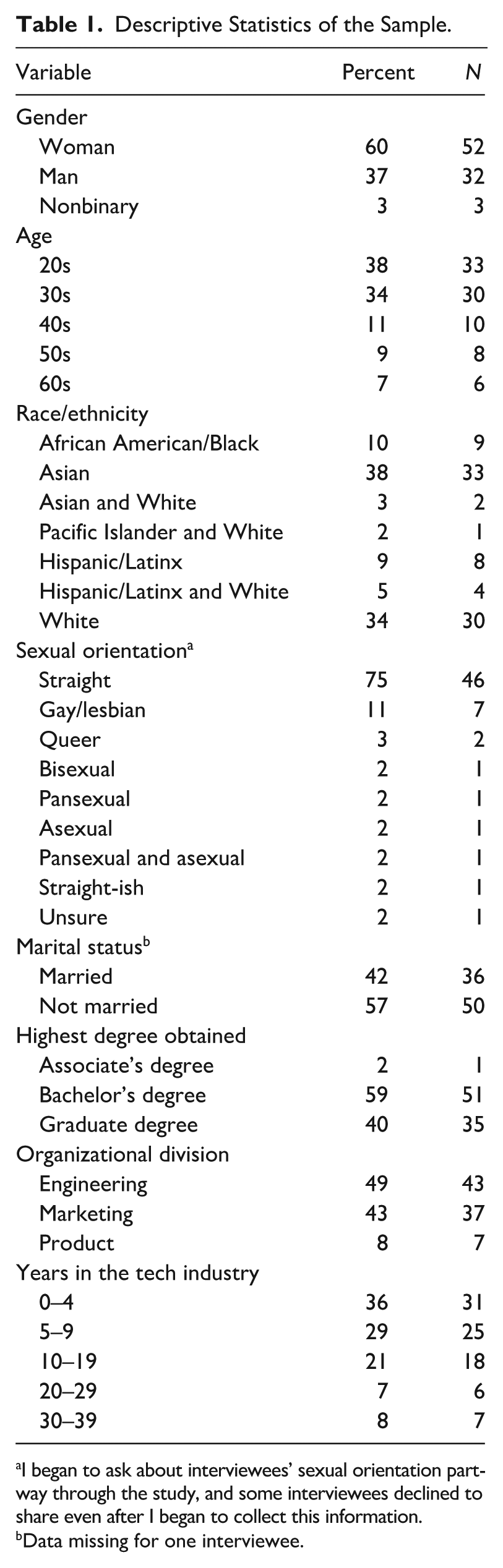
I began to ask about interviewees’ sexual orientation part-way through the study, and some interviewees declined to share even after I began to collect this information.
Data missing for one interviewee.
In my initial interviews with men, I found that some men seemed uneasy, particularly when answering questions about romantic or sexual behavior or sexual harassment. Some made limited eye contact with me throughout the interview or gave terse responses, even when I probed with follow-up questions. While I cannot know the cause of men interviewees’ seeming discomfort with certainty, I suspect that some men felt less comfortable speaking candidly about their romantic or sexual behavior at work with me (a woman), particularly given that, in the wake of the MeToo movement, there was thus a great deal of public scrutiny of men’s romantic or sexual behavior at work. Therefore, after conducting 7 interviews with men, I decided to hire 2 men interviewers who conducted the remaining 25 interviews with men interviewees. 4 I listened to recordings of these interviews and provided feedback iteratively to ensure that these interviews aligned with my own as closely as possible. Overall, men interviewees did seem more comfortable and less often gave clipped responses when talking with men interviewers.
I used the qualitative coding software NVivo to analyze interview transcripts and followed a flexible coding framework (Deterding and Waters 2021). I first read through each transcript in full and indexed any portion of the interview that related to the topic of expressing romantic or sexual interest at work. As I completed this coding stage, I wrote analytic memos about themes that patterned interviewees’ responses within each subcode (e.g., “reading nonverbal cues” was a theme that arose repeatedly in interviewees’ prescriptions for how romantic interest was best expressed). Finally, I reread all of the entries and systematically coded each excerpt with these analytically derived subcodes.
This manuscript is informed by all 87 interviews conducted for this project, but I focus on responses from the subset of 53 interviewees who articulated harms associated with expressing romantic interest in a coworker. Of these interviewees, I attend in particular to the perspectives of the 21 interviewees who identified the potential recipient of the advance as a party who could be harmed—that is, those who grappled with the conflicting rights of the recipient and initiator of a prospective advance. However, I contextualize the approaches of these 21 interviewees among the responses of all 53 interviewees concerned with mitigating any harm when making a romantic advance. This focus allows me to attend to the central question of this manuscript: how interviewees sought to mitigate the potential for a workplace advance to cause harm.
Expressing Romantic Interest in the Workplace
Romantic relationships in tech workplaces were widespread: among those interviewed, a quarter reported that they had been in a romantic relationship with a coworker at some point in their careers, and half had observed coworkers dating. But despite their prevalence, romantic relationships in the workplace were perceived as risky. Indeed, although interviewees were never explicitly asked about the risks of expressing romantic interest in a coworker, 53 interviewees—roughly 60 percent of the sample—observed that initiating romantic relationships in the workplace came with risks.
One obvious risk of workplace romantic relationships is the potential for abuse of power: a supervisor dating a report could exert coercive power over their lower-status partner or favor their partner unfairly relative to other employees. However, interviewees reported that workplace policies banning relationships between supervisors and reports were widespread, and none of the interviewees who shared experiences of workplace romantic relationships indicated that their relationship had been with either a supervisor or report, suggesting that such relationships were relatively uncommon. Thus, interviewees’ discussions of the risks of workplace romantic relationships largely focused on the more common phenomenon of romantic interest between coworkers without such power dynamics.
Broadly speaking, interviewees described three parties who might be harmed by such romantic advances in the workplace. First, the aims of the organization could be undermined, either because such advances—or the rejections, relationships, and breakups that might follow them—could be distracting, create conflicts of interest (even between peers), or raise negative emotions among employees. Second, the person expressing romantic interest in a coworker could experience awkward rejections or reputational costs—most notably the perception that they were engaging in sexual harassment. Finally, as I will detail below, the recipient of romantic advances could feel uncomfortable or unsafe after a coworker’s advance, or experience retaliation from rejecting them.
Notably, interviewees who were concerned about the recipient being harmed by an advance were more commonly women: whereas women comprised 63 percent of the sample as a whole, 71 percent of those who recognized an advance as potentially harmful to the recipient were women. This gender pattern was particularly notable given that all interviews with men took place after the MeToo movement became mainstream in October 2017, which made salient the harms of unwanted advances in the workplace. In contrast, just over half of interviews with women were conducted before MeToo, and women interviewed during both time periods were similarly likely to identify harm to the recipient as a risk. Women interviewees’ greater concern about harm to the recipient could be due to women’s greater likelihood of being the recipients of romantic or sexual advances—particularly those that are persistent and unwanted—as well as other forms of sexual harassment, relative to men (Kearl 2018; Sinclair and Frieze 2005). It may also reflect the marginalized position of women in the Silicon Valley tech industry: women’s outsider status in male-dominated tech workplaces may make them more attuned than men to experiences that jeopardize a person’s reputation, relationships, or sense of safety. In contrast to gender, interviewees’ likelihood of perceiving advances as potentially harmful to the recipient was not markedly patterned by their race or ethnicity.
The Harms of Experiencing an Unwanted Romantic Advance From a Coworker
A core reason that a romantic advance could be detrimental to the recipient was that, if the advance was unwanted, rejecting it could damage the preexisting professional relationship. Sada, an Asian cofounder and engineer in her 30s, described the risk of what she called “ego hurt” following a rejection: “[If] you kind of have to be specifically like no, I’m not really into you, or something like that, then there’s an ego issue, and it definitely hurts your working arrangement.” Indeed, Sada had such an experience with an officemate earlier in her career. Although they had previously had good rapport—she had considered him a “very sweet fun guy”—he became icy after she rejected him romantically.
At some point he was like, “Oh, do you have a boyfriend, I’d like to take you out on a date” or something. And then I said no to that, and then definitely it was like a shut down after that. Like he wouldn’t even really talk to me. He would say no to all lunches, I think he took it as an ego thing. So in the meetings you could see he was more just opposing me for the sake of opposing me. And he even told another friend that, “Oh she thinks too highly of herself, she thinks she’s too beautiful,” like, I wasn’t all that, right? I don’t think I’m too beautiful, I just think I wasn’t into him. But he thought I was very arrogant. [. . .] I know that in my peer review, his main thing was, I was an arrogant person. Right, so it was hard to work with me because I was an arrogant person. If it weren’t for this thing, that would not be his assessment of me.
Experiencing an unwanted advance from her coworker ultimately put Sada in a difficult position: after she was pressed to express that she was not romantically interested in him, he engaged in multiple forms of professional retaliation. His retaliation suggested an underlying sense of entitlement—as though Sada owed him a romantic relationship and deserved punishment for her refusal.
Not all interviewees who had rejected a coworker’s advances experienced retaliation to the same degree that Sada did, but others, too, perceived that declining a coworker’s advance could damage their professional relationship. Avani, an Asian marketing director in her 30s, recalled an instance from her career:
There was one guy Jack who I worked with who, we were really good friends, but then I could tell he started liking me and kind of asked me more questions about dating, and I kind of told him, “Jack, I really like you but I’m just not interested in you that way and I hope this doesn’t affect our friendship.” And of course it did. And we didn’t work together as much [after that].
After romantically rejecting her coworker’s advances, Avani’s professional relationship with him was damaged, despite her explicit efforts to preserve it.
Advances from coworkers could be damaging when they were made explicitly enough that they required direct rejection, but they could also be damaging when they were made subtly. Olivia, a Latina and White software engineer in her 20s, offered a case in which an advance was made so ambiguously that she did not detect it until after accepting a coworker’s invitation:
I was talking about [a music festival I wanted to go to] at lunch and someone says “Oh yeah, do you want to go together?” And I should have asked something like, “Are you planning on going—but I didn’t.” I said “Sure, yeah.” And after three hours of sitting on a blanket listening to music with this person, I realized that he thought it was a date. And then he asked if I wanted to go get dinner afterwards and I said no. And he respected it after that. But yeah just, all of the sudden I realized that all of his body language indicated that he thought it was something more than it was.
Olivia assumed that his invitation to attend a music festival together was platonic, yet her coworker seemed to view her willingness to spend time together outside of work as grounds to consider the interaction a date. This was a jarring realization for her to adjust to in the moment and induced her to explicitly signal her disinterest. When asked how their working relationship proceeded after the unintended date and romantic rejection, Olivia explained:
Bad! I avoided him as much as possible. And I actually, so I needed to get help from his team on something. [. . .] And I ended up I think really straining his female colleague, because I would always ask her questions instead. Because I didn’t want to ask him questions.
Olivia’s case illustrates that an advance from a coworker could be damaging to the recipient (not to mention other coworkers) even when it was initially made ambiguously, rather than explicitly.
Unwanted advances from a coworker were damaging in a different way when they persisted after the recipient had indicated disinterest, because the initiator’s apparent disregard for the wishes of the recipient raised the concern of escalating sexual harassment. For example, Gabrielle, a Black product marketing manager in her 20s, described unrelenting advances from a security guard at her company:
He asked for my Instagram, and was asking me if I had a boyfriend, and asking me if I had a sister when I told him I had a boyfriend, and it was just like, this obviously is uncomfortable. And I gave him my Instagram because I don’t know what to say in those situations but I didn’t accept him or anything. And he did it multiple times, it wasn’t just a one-time thing. When I didn’t accept it he asked me about why I didn’t accept it and asked me if I saw it and I was just like, this is really uncomfortable.
After this series of interactions, Gabrielle began avoiding the security guard, engaging in what Hart (2021) terms trajectory guarding to avoid the possibility of escalating sexual harassment. She explained, “I would have to take a longer way, an inconvenient route. I would sometimes stake out the security guards before walking in to make sure he wasn’t there, and I was just like why? It was just an extra hassle to have to deal with that I shouldn't have to.”
These experiences illustrate that romantic advances from coworkers—even those in which the initial approach appears benign—may amount to more than just awkward interactions in the moment. Whether unwanted romantic advances from colleagues are initiated explicitly or ambiguously, they may result in professional retaliation, damaged working relationships, or concerns about escalating sexual harassment. Put differently, expressing romantic interest in a coworker—even through a single, well-intentioned advance—may impinge upon that person’s right to be free from sexual harm.
Approaches for Expressing Romantic Interest in a Coworker: Balancing Competing Rights
Making a romantic advance toward a coworker carries not only a real risk of harm but also the potential of initiating a rewarding and meaningful romantic relationship. Recall that more than a quarter of interviewees had met romantic partners at work, including, in some cases, spouses to whom they had been married for decades. Thus, making a romantic advance toward a coworker simultaneously represents a threat to that person’s right to be free from undesired romantic or sexual behavior but also the possible benefit of a rewarding relationship. When considering how a person should express romantic or sexual interest in a coworker, how do people reconcile the tension between these two sets of rights?
Importantly, not all interviewees grappled with this question because, as noted above, not all interviewees perceived expressing romantic interest in a coworker as likely to cause sexual harm. For some not concerned about doing harm, the prospect of expressing romantic interest in a coworker was straightforward. Phil, an Asian software engineer in his 20s, was not one of the 53 interviewees who described expressing romantic interest in a coworker as potentially harmful. He explained:
I think if someone were to come along, and I really felt that connection with them, and I wanted to pursue them romantically, I don’t think just being coworkers would be an issue. If it works out, great, if it doesn’t, then, it happens.
From this perspective—in the absence of concern about doing harm—there were low stakes for making an advance toward a coworker.
In contrast, for interviewees who worried that expressing romantic interest in a coworker could bring harm, the impetus to limit harm substantially influenced how (or whether) they thought romantic interest should be expressed. I focus in particular on the 21 interviewees who identified a tension in the rights of two parties—the initiator and recipient of an advance. These interviewees advocated three distinct approaches to limit harm: the self-restraint approach, the soft pursuit approach, and the clear declaration approach. 5 As I will show, despite their shared motivation to limit harm to the recipient, each approach was incompatible with the others.
The Self-Restraint Approach
One school of thought—articulated by three interviewees concerned about doing harm to a coworker—was that one should simply keep romantic or sexual interest in a coworker to oneself and never express it. For example, Siddharth, an Asian marketing manager in his 30s, said:
I am a believer that if you’re working together then you shouldn’t be boyfriend and girlfriend. [. . .] If things go the other way, it’s going to be very awkward to see that person every single day, and that might affect the way she works. And then it might affect me or us, and then at the end of the day if it keeps happening it’s like, he or she has to leave the workplace because it’s awkward all the time.
Here, Siddharth points to two parties who might be harmed by a romantic relationship at work: the recipient (it “might affect the way she works”) and the initiator (“it might affect me”).
Similarly, Ramesh, an Asian marketing and communication lead in his 30s, said: “You never know if the other person is feeling the same way, so why take the chance? And you never know how they can take that information, and in any way it can harm people.” As a result, despite having had coworkers he felt attraction to, Ramesh’s approach was that “I don’t send out any type of vibes that make anyone feel uncomfortable in any way, shape, or form.” For these interviewees, then, the possible harms of expressing romantic interest in a coworker so outweighed the possible benefits that it was not worth making their interest known.
The self-restraint approach was a strategy through which interviewees resolved the tension between a person’s right to avoid undesired romantic or sexual behavior and their right to pursue desired romantic or sexual behavior at work; however, it was also a strategy used to mitigate other possible harms. Four interviewees advocated the self-restraint approach to protect the organization from harm, and five advocated it to protect the initiator from harm.
The Soft Pursuit Approach
In contrast to those who advocated the self-restraint approach, most interviewees who recognized the possibility of harming the recipient of an advance viewed it as a risk that could be managed. Thirteen interviewees addressed this risk by advocating a strategy in which romantic interest was expressed through subtle, polysemous gestures that could plausibly be interpreted either as flirtatious or friendly; more explicit romantic interest was signaled incrementally and only if the recipient seemed to reciprocate initial expressions of interest. This approach, which I term the soft pursuit approach, aligns with empirical flirtation research conducted beyond the workplace, which finds that romantic interest is often expressed through ambiguous, subtle gestures. In the workplace context, interviewees explained that this ambiguity is strategic, because it is designed to allow the recipient of the advance to express disinterest indirectly. In doing so, romantic rejection need never be made explicit, and the preexisting professional relationship can be preserved.
How might romantic interest be expressed subtly? Seth, a White lead generation manager in his 20s, described a scenario where two employees used the soft pursuit approach to subtly and incrementally indicate their shared interest in forming a romantic relationship:
So people become friends and they talk and then they banter in the group chat, the group chat moves to a direct message on Slack where they send each other gifs and stuff. They drink at a happy hour, they have a great time and eventually they go see a movie after work. They get each other’s phone numbers.
Seth explained that the goal of this incremental approach was to mitigate the risk of explicit romantic rejection and the ruptured professional relationship that could follow, which would be harmful to both the recipient and the initiator:
This is not the place for you to take daring risks. If you want to, you need to be sure that it is a connection that you are acknowledging, not just a desire that you’re indulging. Because the second that you voice your attraction to anyone in your office, your relationship is going to be changed irrevocably, one direction or the other.
To Seth, directly expressing romantic interest in a coworker before being relatively certain that the feelings were reciprocated was selfish and risky, because it could damage the preexisting professional relationship.
Courtney, a White software engineer in her 30s, articulated a similar description of, and rationale for, the soft pursuit approach. She outlined the approach this way:
You talk to each other more, and then you talk about more personal things, and then you’re like “Hey do you want to grab coffee?” It just provides more opportunity to say no in a way that doesn’t feel so high stakes. [. . .] Even amongst peers, you have a working relationship that you want to maintain, and you want to be able to say no and not damage that relationship. And so I think going in baby steps helps provide the opportunity to say no without damaging that relationship.
Like Seth, Courtney saw a direct advance as risky, whereas an incremental approach allowed the recipient more subtle, unspoken means of rejection that made it easier to preserve the professional relationship.
Giving the recipient a graceful, indirect way to decline the advances was a core goal of the soft pursuit strategy. Isabella, a Latina and White business intelligence engineer in her 40s, emphasized the importance of framing expressions of romantic interest indirectly by offering the recipient an face-saving way to decline.
I would say to give them an easy, frictionless way to say no. So to orient the question in such a way where saying no is not socially damaging for either party. So, something along the lines of, you know, “It’s a shame we work at the same place, you know, cause if I’d run into you at the bookstore I totally would have asked you out by now.” That gives the other person the option to say, “Yeah, I would never date coworkers. Dating coworkers is such a bad idea, you know, you’re right about that.”
Isabella, like Seth and Courtney, points to the importance of preserving the professional relationship by creating an opportunity for rejection that is subtle, and thus is not, in her words, “socially damaging for either party.” The disruption that romantic rejection poses to a relationship is thus addressed, in the soft pursuit approach, by redefining the interaction in which rejection occurred (Tavory and Fine 2020). While each party may privately understand that a rejection has taken place, as they interact they acknowledge only what has been said at face value (e.g., that a person simply does not date coworkers in general).
The soft pursuit approach was most often advocated as a way to shield the recipient of advances from harm, but it was also advocated as an approach to prevent other harms. Eight interviewees advocated it to protect the initiator from the harm of a ruptured professional relationship after direct romantic rejection; three advocated it to shield the organization from the fallout of romantic rejection between coworkers.
The Clear Declaration Approach
The final approach, the clear declaration approach, contrasted sharply with the soft pursuit approach. The five interviewees concerned about harming the recipient who advocated the clear declaration approach argued that romantic interest in a coworker should be expressed directly and unambiguously. Though the two approaches differed, many advocates of the clear declaration approach, like the soft pursuit approach, were also motivated by protecting the recipient from harm.
Interviewees who favored the clear declaration approach often drew on the language of consent culture—that is, the idea that romantic or sexual desires should be made explicit before they are acted upon. For example, when asked how romantic interest in a coworker was best expressed, Monica, a White communications consultant in her 40s, said: “I’m around a lot of people who are very into enthusiastic consent culture, which I think is a very good thing. And so, I mean I do think like asking explicit questions and getting explicit answers.” Likewise, Whitney, a White product marketing manager in her 30s, explained:
I want to say that it’s the rules of consent, right? I want to say you’re allowed to express your interest very explicitly and kind of be like, “Hey I’m like interested in you as more than a coworker, as more of a friend, is that something that you’ve ever thought about?” and then just kind of acting accordingly from there.
Whitney recognized that this approach could make the recipient uncomfortable: she acknowledged that “if you are not interested and you have to say no, that would still be really weird to deal with.” But to Whitney, the best way to manage this risk was to acknowledge the possibility explicitly, rather than maneuvering around it through unspoken behavior. “I think I would err on the side of really clear expression, with also the acknowledgement of, ‘I promise if you say no there’s no hard feelings, and everything will be exactly the same in my mind’.”
Like Whitney, Andre, a Black software engineer in his 20s, justified the clear declaration approach as one that minimized harm to the recipient of the advance:
You just lead with compassion and be very, very, very careful about making sure that you’re getting consent at every point and they’re fully consenting to everything. They’re consenting to a date. They’re consenting to move forward with anything romantic, and they’re very confident that your suggestions are all coming from that sort of like personal and romantic side and not coming from any work-related side.
This approach, from Andre’s perspective, prevented confusion about a person’s intentions—confusion that could easily arise when the initiator was masking their advances through behaviors that could plausibly be read as gestures of friendship, as advocates of the soft pursuit approach advised.
Whereas the self-restraint and soft pursuit approaches were advocated by interviewees concerned with mitigating a range of harms, the clear declaration approach was tailored almost exclusively to mitigating harm to the recipient of an advance. Only one additional interviewee advocated this approach to protect the initiator of the advance from harm: his advice was to make a direct but respectful advance to avoid becoming the subject of unwanted gossip that might otherwise be circulated by the recipient.
The Three Approaches in Perspective
The three approaches for expressing romantic or sexual interest—self-restraint, soft pursuit, and clear declaration—reflect fundamentally different philosophies about how to balance the competing rights of potential initiators and recipients of romantic advances in workplace settings. The incompatibility of these approaches indicates that there is no consensus on how to ethically navigate expressing romantic interest between coworkers when doing so may benefit the initiator, but may also harm the recipient.
These 21 interviewees were part of a broader subset of 53 interviewees who described romantic advances in the workplace as potentially harmful. The remaining 32 interviewees perceived advances as potentially harmful to the initiator of the advance, or to members of the work organization as a whole. Notably, the approaches that interviewees advocated to mitigate these other harms overlapped with the approaches advocated by interviewees seeking to minimize harm to the recipient. Interviewees who sought to mitigate harm to the initiator also advocated the self-restraint, soft pursuit, and (occasionally) clear declaration approaches, and interviewees who sought to mitigate harm to the organization also advocated the self-restraint and soft pursuit approaches. In addition, some interviewees (predominantly those concerned about preventing harm to the organization) advocated a professional boundaries approach in which coworkers expressed romantic interest outside of the workplace. That interviewees’ approaches also diverge when seeking to protect the interests of other parties points to a broader landscape of complex and unsettled moral terrain for enacting sexual behavior, even beyond those preoccupied with concerns about doing harm to the recipient of the advance. 6
Discussion and Conclusion
Although expressing romantic interest in a coworker may result in a rewarding romantic relationship, it has the potential to cause them harm. This creates a moral quandary: how should an individual’s right to pursue desired romantic or sexual behavior be balanced against the right of the potential recipient of the advance to avoid harm from that advance? In taking up this question, this study contributes to the sexual citizenship literature by examining how people recognize and prioritize sexual rights. I find two notable points of heterogeneity among interviewees in this domain. First, interviewees differed in the extent to which they perceived an advance between coworkers as a potential violation of the recipient’s sexual rights. Of the 53 interviewees who characterized romantic advances between coworkers as potentially harmful, most focused on harms to the initiator of the advance or to the work organization as a whole; fewer than half (21) described advances as potentially harmful to the recipient of the advance. Second, even among those who grappled with the risk of doing harm to the recipient advocated different—and contradictory—approaches to resolving the tension, by expressing interest indirectly, directly, or not at all. There is no consensus, then, on how this moral tension should be resolved.
The fragmented beliefs about how romantic interest in a coworker should be expressed suggest that people may have different standards against which they evaluate romantic or sexual behavior between coworkers as either appropriate or inappropriate. Prior research finds that people vary widely in whether they consider a given romantic or sexual behavior inappropriate (Blakely, Blakely, and Moorman 1995; Garlick 1994; Tinkler 2008), meaning that one person may experience an unwanted advance as offensive—a key criterion for the advance to be considered sexual harassment—whereas another person may experience it as inoffensive. This study offers one reason why such divergences occur: people have different normative beliefs for how an advance from a coworker should be made, suggesting that they may evaluate the appropriateness of advances against different—and sometimes contradictory—standards of conduct.
It is well recognized in the literature that unwanted advances are harmful to the recipient when they persist after the recipient has expressed disinterest: doing so may undermine the recipient’s autonomy and sense of safety (NASEM 2018). Unwanted advances are more likely to be considered sexual harassment in a legal sense if they persist after disinterest has clearly been expressed. Yet, interviewees in this study articulated a less well-recognized harm toward the recipient that may follow an unwanted advance: the damaged professional relationship that can result from the very act of clearly expressing disinterest in a romantic relationship that sexual harassment law encourages. This sometimes played out as sabotage, as when Sada’s coworker became hostile and critical after she declined his advance. At other times, it simply became more awkward to interact with the person, as Olivia and Avani described. The unpleasant aftermath of a romantic rejection between coworkers was harmful enough that the most common strategy interviewees advocated for protecting the recipient was the soft pursuit approach, which focused on mitigating this harm by conveying rejection through indirect communication. Thus, sexual harassment law creates a dilemma: it demands a clear rejection to provide legal protection, yet this very clarity can undermine a professional relationship that the recipient needs to effectively navigate their workplace.
How should organizations manage the possible harms of expressing romantic interest in a coworker? My data do not present a clear picture, because interviewees differently perceived, weighed, and resolved these possible harms. What does seem clear, though, is that organizations should work to limit the professional fallout experienced after an unwanted advance—particularly harm by the recipient, who, unlike the initiator, does not choose to take on the risk of harm. In particular, an organization’s policy about expressing romantic interest in a coworker might specify that the onus is on the initiator to preserve the professional relationship in the wake of a romantic rejection, and that retaliation after romantic rejection is not acceptable.
Because interviewees in this study were those working in Silicon Valley tech workplaces, this study speaks most directly to how people in the Silicon Valley tech industry make sense of the competing rights to pursue desired sexual activity and to avoid harm. 7 However, many interviewees had formative work experiences in other industries (e.g., government, food production, or unions) and regions (e.g., the east coast of the United States, Europe, Latin America, and Asia). Therefore, it is improbable that the approaches they advocated are unique to the Silicon Valley tech industry. It is plausible, though, that in other industries or regions, people may be more or less likely to view an advance in the workplace as harmful to the recipient; it is also plausible that people may resolve this tension with additional approaches not advocated by interviewees in this study. For example, does the normalization of flirting in industries like hospitality (Giuffre and Williams 1994; Good and Cooper 2016) shape how people perceive and negotiate the possible harms of expressing romantic interest in a coworker? Future research should examine how industry norms shape how workers perceive and negotiate potential harms associated with expressing romantic interest in a coworker.
This research illustrates that approaches for expressing romantic or sexual interest in the workplace are often shaped by the desire to mitigate possible harms. But to what extent do concerns about harm shape strategies for expressing romantic or sexual interest beyond the workplace? Do people perceive making a romantic advance in the context of a friendship—where a preexisting relationship could be ruptured but without jeopardizing livelihoods—as potentially harmful? And if so, how do they balance this risk against the potential reward of a mutually desired romantic relationship? When people interact through dating apps or in bars—spaces characterized by limited social ties—do they perceive expressing romantic or sexual interest to be less potentially harmful? And if so, does the diminished risk of harm shape the means through which they believe romantic or sexual interest should be expressed? How people recognize and negotiate sexual rights across these different contexts is an important question for future research.
Footnotes
Acknowledgements
I would like to thank Mustafa Emirbayer, Hannah Wohl, and Allison Daminger for feedback, and Samer Araabi, Thomas Trieu, and Gabriela Nagle Alverio for research assistance.

Funding
The author disclosed receipt of the following financial support for the research, authorship, and/or publication of this article: I thank all of the interviewees who made this research possible by taking time out of their lives to share their experiences. I am grateful for financial support from the Clayman Institute for Gender Research, the Stanford Graduate Research Opportunity Grant, and the Stanford Diversity Dissertation Research Opportunity Grant.
Conflicting Interests
The author declared no potential conflicts of interest with respect to the research, authorship, and/or publication of this article.