




Abstract
This essay argues that Muslim sexuality provides a crucial foundation for a long-overdue postcolonial reckoning in sociology—one made urgent by the intensifying global backlash against feminist values. The global backlash mobilizes reactionary ideologies to distort gender into a terrifying phantasm that mobilizes contradictory yet effective meanings and feelings. To unpack the forces driving this phantasm, we turn to a parallel historical construct—the Muslim phantasm—which is similarly entangled with gender anxieties and offers a critical analytical resource. To this end, we propose two complementary frameworks: sexual projects and sexual formations. These frameworks are ideally suited for deconstructing these phantasms, mapping the affective and discursive landscapes that sustain them, identifying the actors who deploy them, and examining how others navigate their consequences. Applying these frameworks enables scholars to trace connections between local and global sexual formations, analyze Muslim resistance to reductionist representations, and understand how their sexual projects reshape broader sexual landscapes.
Keywords
Introduction
Sociology is long overdue for a postcolonial reckoning. Sexuality scholars are uniquely positioned to lead it. The case of Muslim sexuality (Western thought’s perennial other) is the ideal staging ground. One that offers the best chance for uncovering both (1) the ways sexuality is tied up with domination and stratification at multiple levels—macro, meso, and micro—and, more importantly, (2) how people navigate these systems and modes of domination, sometimes in seemingly contradictory and unexpected ways.
However, significant barriers remain. Sociology’s overwhelming metrocentrism (i.e., a U.S.-centric lens; see Go 2023) has contributed to a general insufficiency among even sex and gender scholars in tackling the transnational (see Parreñas and Hwang 2023; Puri et al. 2025) and in developing the theoretical tools essential for the overdue reckoning. In their absence, we remain ill-equipped to unravel the complex, multiscalar, and often paradoxical intersections and entanglements of contemporary social life, particularly for those at the margins.
Yet, recent political developments underscore the urgency of this task—gains made by feminists have come under jeopardy globally. Connell warns feminist-minded sociologists to prepare for a possible “funeral” of feminist progress (Connell 2023). Butler stresses the urgent need for feminists to respond to the global backlash against “gender ideology,” which seeks to reverse hard-won freedoms from a wide range of humans, including those seeking reproductive justice (Butler 2024). While neither scholar centers Muslims in their analyses, recent global events indicate several reasons why Muslim perspectives are key to developing a more intersectional set of theoretical tools and approaches to whet our analytical abilities and sharpen our capacity for programmatic intervention. These include
The rise in populist politics across the United States, United Kingdom, Europe, and other places propagates racist, xenophobic, and Islamophobic sentiments that can wind up provoking riots, as seen in the United Kingdom (Boukhari and Devakumar 2024).
Ongoing Middle Eastern conflicts exacerbate racism and polarization in Western contexts, as seen in Amsterdam in 2024 (Brown 2024).
The hijab remains a persistent site of contention, sparking racialized debates in multiple regions, including India, Iran, France, Turkey, and Quebec.
Despite these racialized tensions, surprising alliances have emerged in Canada, the United Kingdom, and other Western contexts between certain Muslim groups and radical-right factions, for instance, to oppose sex education in public schools (Wells and Jahangir 2023).
The Case for Centering Muslim Perspectives
The events and trends outlined above reveal the paradoxical position Muslims hold in the ongoing ideological battles over sex and freedom. Long othered on the basis of their perceived sexual deviance, Muslims today are simultaneously vilified as dangerous and deviant outsiders while also courted as useful allies by right-wing groups seeking support with agendas, such as the efforts to suppress Sexual Orientation and Gender Identity education in public schools. This paradoxical positioning as both useful allies and detested others provides Muslims with a unique, “outsider within” perspective (see Collins 1986, 1999) that can be very generative theoretically.
However, Muslim perspectives are not just dual; they are far more multifaceted. For instance, sociologists have found that North American Muslims often draw on an “elsewhere”—global contexts beyond both home and host countries—to frame and evaluate political- and identity-related issues in their adopted nations (Shams 2020). This transnational sensitivity situates Muslims in a complex, contradictory, and unsettled terrain of competing meanings, loyalties, and sentiments. A contested space that simultaneously pressures them to integrate, maintain cultural authenticity, counter accusations of irreconcilable difference, resist right-wing recruitment, and respond to calls for loyalty from the “elsewhere.” How do Muslims navigate these multifaceted and contradictory terrains? And what can we learn by centering their experiences and perspectives?
To address these questions, we focus on a specific case of Muslim efforts to navigate complexity and contradiction that illustrates how Muslim perspectives can deepen and enrich our theoretical models and analytical categories. Specifically, we focus on the case of Canadian Muslim parents grappling with the contentious issue of sex education in public schools while simultaneously striving to belong to multiple identity groups within and outside Canada. This case offers valuable insights into the broader theoretical implications of Muslim experiences, highlighting how these perspectives can challenge and expand existing theoretical frameworks. Springboarding off this case, we introduce two theoretical frameworks that can advance our understanding of the mounting global backlash against feminist ideals of sexual freedom: (1) The concept of sexual projects (see Husain 2020) and (2) the framework of sexual formations.
In what follows, we begin by outlining the case, then explore its potential to drive theoretical innovation, and finally explain why these proposed frameworks are essential for advancing our understanding of the backlash and our responses as feminists to it.
The Case of Canadian Muslim Parents
Since 2015, protestors and counter-protestors have taken to the streets across Canada in defense of their stance for or against the teaching of “gender ideology” and sex education in Canadian public schools. Although protestors come from many racial and religious backgrounds, much of the mediated coverage of the protests has centered visibly on Muslim protestors (Bialystok & Wright 2019), for instance, showing hijab-wearing women encouraging their children to stomp on a Pride flag. Such coverage reinvigorates Islamophobic stereotypes, which suggest that Muslim values around gender and sex are fundamentally out of step with secular, liberal Western values. Accordingly, much of the scholarly work focusing on the sex ed protests has approached this topic from a national rather than a global perspective—examining the implications of the protests for Muslim integration, Islamophobia, and multiculturalism in Canada.
Yet similar protests have also emerged in the United States, the United Kingdom, and Australia. While school curricula may be provincial subjects, the apparent cultural clash between Muslim parents and “liberal” schools appears to reflect a broader, global trend. Framing this conflict solely as a clash between Islam and liberal values not only revives an outdated binary (Islam/modernity) but also overlooks two critical points:
(1) The Trust-Gap Between Muslim Parents and Public Schools
Muslim participation in sex education protests points to a serious problem—A trust gap between Muslim parents and Canadian public schools (see Nagra 2018; Zine 2022). Research suggests that this gap not only undermines the successful implementation of sex education curricula (see Walker 2004) but also compromises an important pathway to integration for Muslim children and their families. This trust-gap stems from multiple factors, including perceptions of racism within the school system, fears about Islamophobic agendas among educators, and the broader climate of Islamophobia in Canada (see Nagra 2018; Zine 2022). These factors, ironically, make Muslims ready targets for recruitment by right-wing groups.
(2) The Co-optation of Muslims by Right-Wing Groups
Muslim parents’ anxieties and mistrust of schools are not only exploited by hate groups to reinforce Islamophobic and anti-immigrant discourses but are also strategically mobilized by right-wing groups aiming to secure Muslim votes. These groups have forged alliances with Muslim communities around various political causes, such as efforts to restrict sex education in public schools. Like the sex education protests, these alliances often transcend national borders, reflecting a broader, transnational pattern of political mobilization (Hajek and Dombrowski 2022; Kuhar and Paternotte 2017).
How can we rethink these dynamics to better understand the intersections of trust, identity, and political mobilization in ways that go beyond traditional frameworks?
The Opportunity
This case offers a unique opportunity to explore how people navigate complex, contradictory, and increasingly global landscapes of meaning and feeling. Key questions include: What are the cultural and structural sources of the trust-gap between Muslim parents and their children’s schools? How do Muslim parents reconcile—or fail to reconcile—the perceived tensions between their religious beliefs and the values they perceive Canadian schools to espouse? Furthermore, how do they understand and explain the alliances they forge with apparently Islamophobic groups in pursuit of their various aims?
Addressing these questions requires the development of two interrelated analytical frameworks. One that focuses on the intricate, fractured, contradictory, and globalized ecologies of meaning and feeling—symbols, discourses, interpretive frameworks, and affective structures—that shape Muslim parents’ perspectives on sex, gender ideology, and public schools. Moreover, a second framework that allows us to understand Muslim parents’ choices and strategies of action without falling prey to simplistic binaries about Muslims and their ostensible incompatibility with westernization/modernization. Such tools would be invaluable for sociologists, allowing them to accomplish several objectives:
(1) By uncovering the diversity of Canadian Muslim perspectives on the issue of gender, sex, and schools, this case can enrich the ongoing feminist effort to dismantle stereotypes about the exceptionalism of Islam as a monolithic entity (see Charrad 2011; Schielke 2022; Sehlikoglu 2018). (2) By highlighting the frameworks Muslims use to understand and respond to cultural conflicts (such as those around sex education), this case can help sociologists to better understand how Muslims navigate barriers to integration in Canada and countries like it. (3) By utilizing a global lens in analysis, this analysis can reveal the connection between local sexual politics and global cleavages around sex, race, Islam, and the West. (4) Most significantly, this approach can help us better understand the ongoing global backlash against feminist values, which interpellate Muslims in complicated ways.
Toward More Nuanced Theoretical Tools
To understand both the ecologies of meaning and feeling Muslim parents inhabit and the strategies they employ in navigating them, we need a complementary set of theoretical concepts. Building on existing research, we propose two frameworks that can guide this analysis while avoiding the pitfalls of metrocentrism and orientalist stereotypes about Muslims: (1) the concept of “sexual projects” (see Husain 2020) and (2) the framework of “sexual formations” (outlined below). These frameworks offer a valuable capacity for unpacking the complexities of identity, belonging, and agency in the context of Canadian Muslim parents. More significantly, they can help illuminate how the broader, global backlash against feminist values is shaped by underlying ecologies of meaning and emotion.
Sexual Projects
The notion of sexual projects was inspired by the work of Hirsh (2014) as well as Omi and Winant’s (2015) “racial projects” framework. In their recent book, Hirsch and Khan (2020) describe sexual projects as “forged in communities,” but “intensely personal” reasons actors may seek a particular sexual experience or interaction (e.g., for pleasure, to deepen a relationship, for children, in pursuit of status; p. xvi). However, as the case of Canadian Muslim parents (and others protesting sex education in public schools) suggests, sexual projects can involve organized efforts to shape community norms and regulate youth access to information about sex. The effort to control another’s sexuality, whether through curriculum restrictions, chastity pledges, or prescribed (or proscribed) veiling, represents another dimension of sexual projects.
This collective aspect is explored in Husain’s (2020) work, which expands the concept of sexual projects beyond the personal and individual dimensions of sexual agency to include the collective, relational, and temporal. Husain examines how middle-class Muslim women in Karachi, Pakistan, navigate the conflicting sexual imperatives of globalization, which push women to simultaneously uphold tradition through sexual modesty but also signal modernity via sexual agency and freedom. To reconcile these competing pressures, Husain finds, young women undertake “halal dating” (legitimate dating), a sexual project that involves multiple forms of agency: relational agency (getting others to act for them), temporal agency (strategically managing time), and interpretive agency (reinterpreting traditional sources of meaning). Together, these three kinds of agency constitute what Husain refers to as “sexual projects”—deliberate, temporally sensitive, collective efforts made on or through sex to resist, uphold, or redefine communal values and aspirations. By approaching women’s strategies through the analytic of sexual projects, Husain reveals unexpected parallels between the Pakistani context and a U.S.-based sexual project: the American hookup.
Like halal dating, the hookup also involves interpretive, relational, and temporal agency, and in both cases, these kinds of agency are deployed in service to similar ends. Both projects rely on fluid definitions of events and actions, with uncertainty around whether they involve intercourse allowing participants to navigate and challenge slut/virgin binaries. Both also require social support—friends may act as chaperones in halal dating and as wingmen in hookups. Finally, both are shaped by a concern with time, as participants engage in sexual projects in ways that align with classed aspirations of professional success.
Hence, the sexual projects framework is valuable not only for analyzing how people’s strategies around sex are shaped by meaning, temporality, and social relationships but also for identifying connections between seemingly disparate cases, thereby challenging binary thinking. This approach is especially useful for understanding how Muslim parents handle the ongoing culture wars where feminist ideals clash with far-right ideologies. Here is why the framework works so well:
The sexual projects framework offers a lens for analyzing collective agency—how individuals mobilize the support of others to achieve various ends—while still accounting for personal aspirations.
Sexual projects unfold over time and are shaped by temporal structures, enabling analysts to examine how actors’ values and aspirations are influenced by considerations of time, such as ideas about the life course, or sacred periods such as Ramadan and Judgment Day.
Finally, the concept of sexual projects captures the relational dimensions of actors’ experiences, emphasizing how the desire to belong to or differentiate from various groups shapes their strategies and aspirations.
In short, the sexual projects framework provides insight into the complex, multidimensional structures that shape how actors navigate significant issues. Figure 1 provides a concise overview of the sexual projects framework.
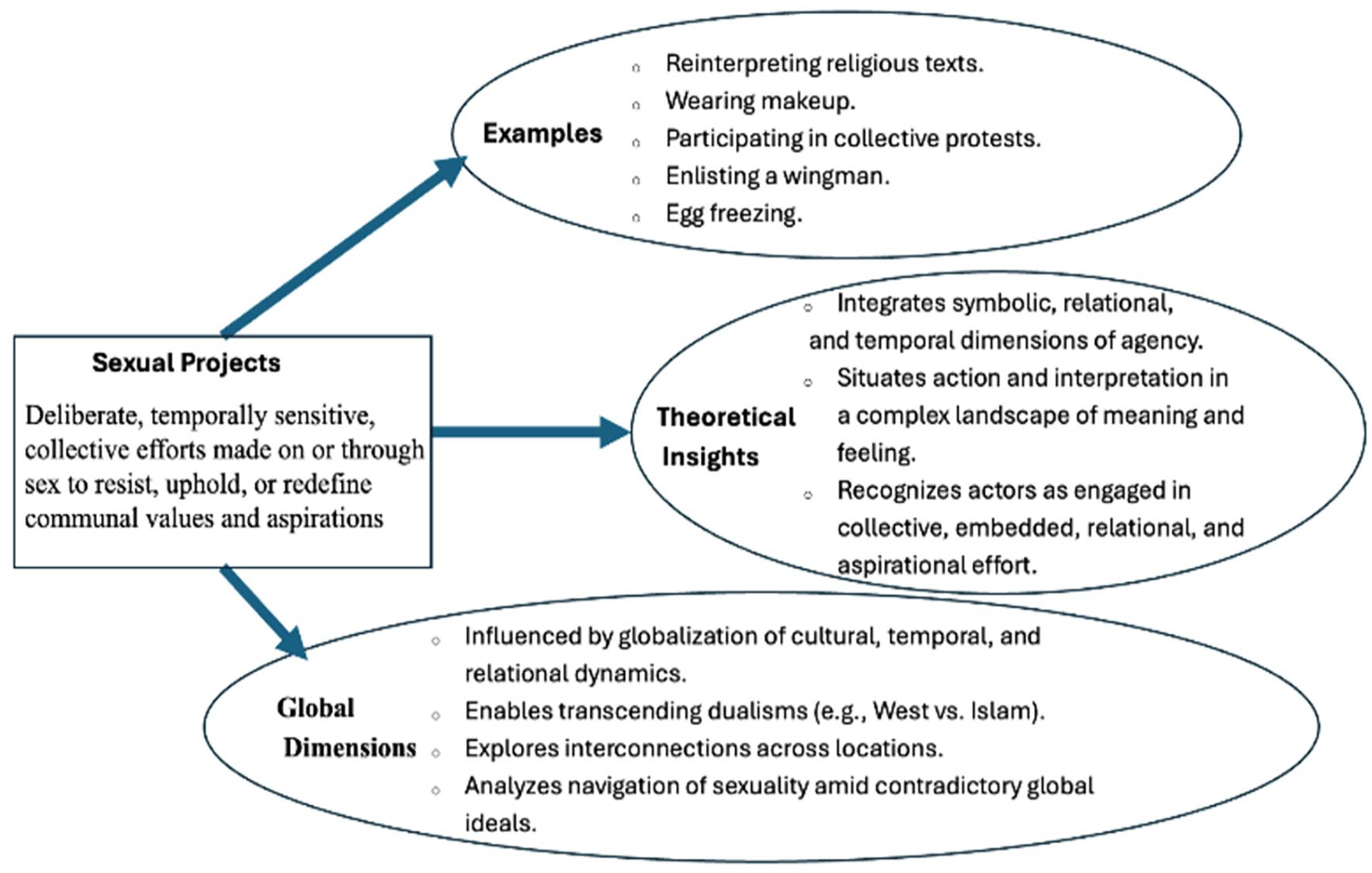
An Overview of the Sexual Projects Framework.
Sexual Formations
In addition to the framework of sexual projects, which are focused on actors, we also require tools for analyzing the terrains upon which action unfolds. Butler (2024) urges us to undertake this critical task. To effectively challenge the growing backlash against feminist values, Butler argues that we must develop both an understanding of the elements fueling this backlash and “a compelling counter-vision that affirms the rights and freedoms of embodied life” (Butler 2024:11). Achieving the first goal necessitates a framework capable of mapping the intricate, contradictory, and multilayered terrain of meaning and emotion that feeds the backlash.
This terrain, in Butler’s telling, is surreal—a complex mix of anxieties, fantasies, conspiracies, and contradictions, interwoven with statistics and seemingly rational schemas. It fuses multiple fears and apprehensions into a single, contradictory construct: gender (see Butler 2024). In Butler’s analysis, gender emerges as a formidable phantasm—an apparition with real social and political effects, nourished by both psychological and social forces, and weaponized as a tool to recruit individuals into fascist, authoritarian, and antifeminist movements. For Butler, the critical question raised by the emergence of this specter is: What is its structure, and what drives it?
As sociologists, our task is to build on Butler’s insights by using the specialized tools of our discipline to map not only the psychosocial dimensions of the phantasms animated by far-right rhetorics but also the cognitive schemas, affective frameworks, and relational dynamics that shape their deployment. To this end, we propose sexual formations, a framework designed to parse the complex terrain underlying the backlash. This framework aims to capture not only the psychosocial elements of the terrain identified by Butler but also its semiotic, affective, and relational structures. While a full elaboration of this framework lies beyond the scope of this essay, we outline its broad contours below.
The Sociological Dimensions of Sexual Formations
Grounded in sociological frameworks, the analytic of sexual formations provides a powerful tool for examining the affective, relational, and semantic dimensions of the backlash terrains. The affective dimensions of these terrains can be illuminated through Arlie Hochschild’s work on emotional sociology. Her concept of the “deep story,” rooted in “feeling rules,” provides a pathway to understanding how individuals navigate sexual formations by making political and social choices driven less by empirical evidence and more by emotional resonance—how they feel, how they think they should feel, and how they perceive the feelings of their political opponents (Hochschild 1979, 1990, 2016). These affective layers are central to the formation and perpetuation of phantasms, including those linked to gender and sexuality.
To analyze the semantic dimensions of backlash terrains, we can draw on Michelle Lamont’s theoretical tools for understanding how people construct and sustain social boundaries. Her work sheds light on how individuals and groups employ moral reasoning and cultural resources to delineate “us” versus “them,” engage in cultural evaluations, and combat the stigma associated with marginalized identities (Lamont 2009; Lamont and Molnar 2001; Lamont, Guetzkow, and Herzog 2016). Within the framework of sexual formations, these processes are crucial for unpacking how narratives about sex, gender, and belonging are framed and contested.
Finally, the framework of sexual formations enables us to capture the relational dimensions of these terrains, particularly the interplay between desires for belonging and mechanisms of exclusion. Relationalities can be examined through sociological studies on solidarity and distinction, such as research on collective identity formation (Anderson 2016), polarization dynamics (Mijs, Bakhtiari, and Lamont 2016), and the emotional labor involved in negotiating belonging and distinction in unequal social contexts (Pugh 2009). These relational structures shape how individuals and groups navigate the contradictory pressures and alliances that emerge within sexual formations.
The sexual formations framework helps sociologists analyze the complex and often surreal landscapes of backlash and contestation by focusing on the affective, semantic, and relational dimensions of these terrains. This approach offers a deeper understanding of the ideological and emotional stakes at play.
Mapping the Multilevel Dynamics of Sexual Formations
Drawing on racial formation theory, we propose that sexual formations be understood as dynamic processes composed of multiple interconnected elements as outlined above (i.e., social structures, psychical elements, schemas and interpretive frameworks, emotional and affective structures, and relationalities). These processes operate across three interconnected levels—macro, intermediate, and micro. Projects undertaken at each level cascade down to the next, but the flow is not one way. The consequences of projects undertaken at a subordinate level can send symbols, strategies, relationalities, discourses, fantasies, paranoias, etc., back upstream (see Figure 2).
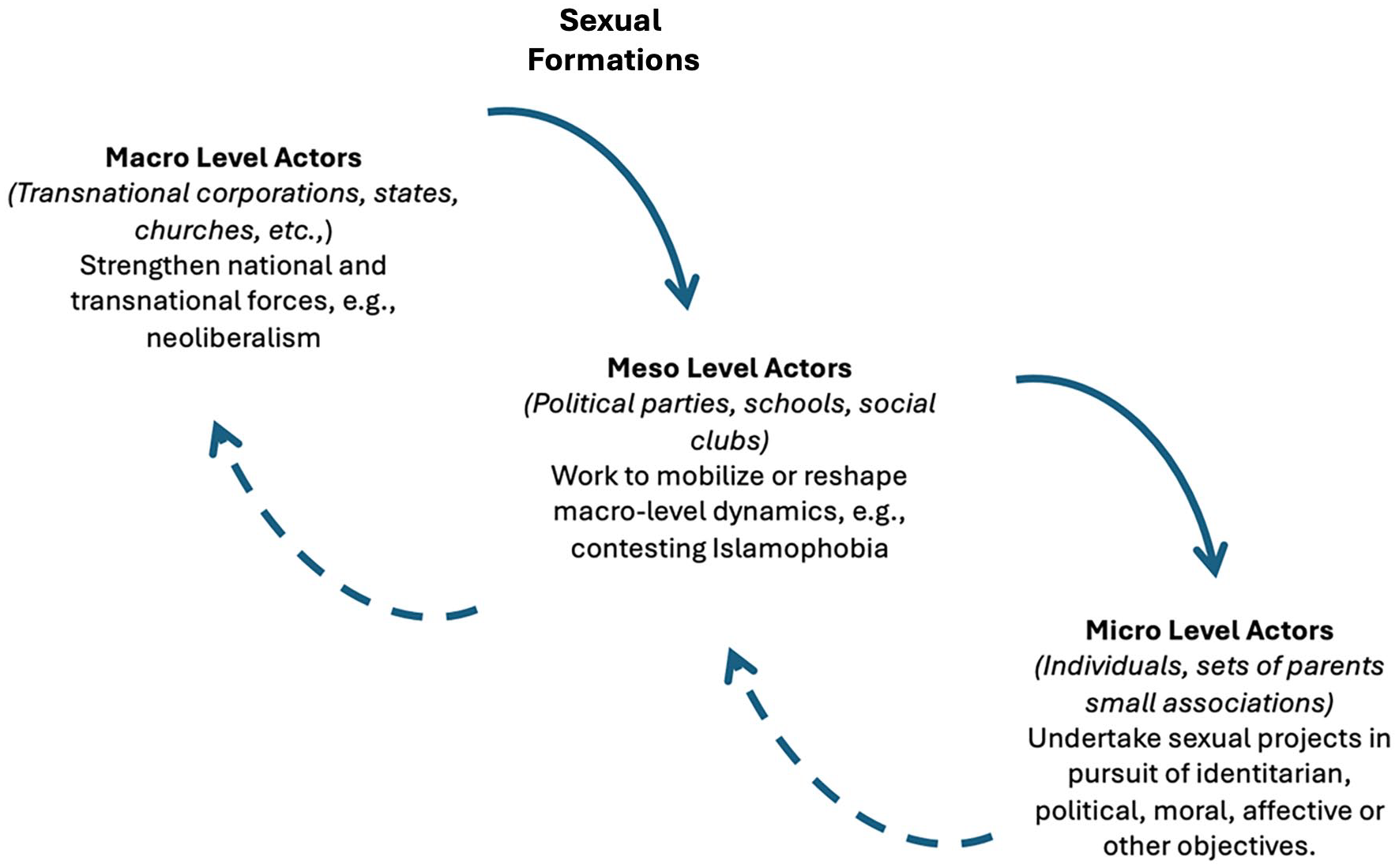
Sexual Formation.
At the macrolevel, sexual formations are shaped by the sexual projects of macroactors, such as states, large multinational corporations, and churches. These projects strengthen transnational forces such as Islamophobia, neoliberalism, and securitization, as well as national ones, such as misogyny via abortion bans.
At the intermediate level, smaller groups and organizations, such as political parties, work to mobilize or reshape macrolevel dynamics. For instance, organizations such as the National Council of Canadian Muslims engage in efforts to combat Islamophobia by raising awareness about its existence and prevalence, lobbying politicians and policymakers, and working to develop counter-narratives to challenge stereotypes about Muslims.
At the microlevel, individuals and smaller groups, such as a set of parents, undertake various sexual projects in pursuit of different identitarian, political, moral, affective, or other objectives. Actors’ sexual projects are shaped by the broader context emerging at the intersection of macro-, intermediate-, and microlevel dynamics (neoliberalism and Islamophobia, public school policies, and the actions taken by other parents). For example, a newly arrived Muslim family, alarmed by misinformation that public schools encourage children to adopt trans identities, stories of racialized bullying, and accounts of racist discrimination by school staff, might choose to homeschool their children. In doing so, they may also form alliances with other families in similar circumstances to share resources and build a supportive homeschooling community. The impact of their decisions at the microlevel will be felt at the intermediate level, as schools become less diverse through the absence of Muslim kids, and at the macrolevel, as Muslim strategies get used as evidence of their inability to integrate into Canadian society.
By examining sexual formations across all three levels, we can gain a more comprehensive understanding of how the backlash is shaped in a multiscalar and multilocational manner. This approach allows us to explore how different scales—local, national, and global—interact and influence each other and how these interactions produce varying expressions of resistance to feminist values in diverse contexts.
Muslims and Sexual Formations
The frameworks outlined above offer a preliminary blueprint that must be further developed through empirical research. Muslim perspectives provide a particularly rich starting point for this exploration, given their unique position not only as participants in sexual formations but also as symbols within them.
The Muslim Phantasm
In addition to the phantasm of gender identified by Butler, the Muslim subject also embodies a phantasmic figure. Like gender representations, depictions of Muslims are imbued with deep-seated anxieties. Muslims are often portrayed as sexually regressive yet hypersexual. Muslim women are framed as passive victims of patriarchal structures yet simultaneously as complicit enablers of men’s excess and symbols of dangerous fertility. Meanwhile, Muslim men are cast as both violent terrorists and hypermasculine sexual predators.
Multiple Levels of Operation
Like the phantasm of gender, the phantasm of the Muslim figure operates across macro, intermediate, and microlevels, intertwining with global-, national-, and individual-level dynamics. At the macrolevel, Islamophobia, a global phenomenon, intersects with various strands of the Islamic revival and regional conflicts, like the ongoing conflict in the Middle East. These conflicts further feed into the global dimension of anti-Muslim sentiment. States reinforce these dynamics through policies such as those that enforce or ban symbols such as the headscarf, while media narratives amplify the sense of Muslims as the stressful other, perpetuating their cultural alienation.
At the intermediate level, fantasies about Muslims are actively mobilized by political and social groups. For instance, Germany’s Alternative für Deutschland (AfD) party once used a billboard depicting a slave market to warn against the imagined threat of Muslim men enslaving white women (Kirby 2017). Such examples demonstrate how these phantasms are weaponized for political agendas, invoking fears tied to both race and sex.
On the microlevel, Islamophobic stereotypes manifest in everyday interactions. Teachers, police officers, and healthcare workers may draw on these distorted representations in both subtle acts of casual racism and more overt forms of discrimination. These individual-level dynamics perpetuate the phantasm, making it an enduring and pervasive force in daily life.
At each of these levels, the Muslim phantasm is deeply entangled with the sexual domain. Muslim women are framed as sexually oppressed yet dangerously fertile, while Muslim men are cast as hypermasculine predators who aim to enslave white women and subvert the supposedly liberal sexual cultures of the West by conspiring to implement Sharia law in these contexts. These portrayals illustrate how anxieties about sex and gender are projected onto Muslim subjects in complicated ways, making their positionality central to understanding broader cultural and political battles over sex, power, and belonging.
Muslim Navigation and Agency
Muslim subjects grapple with these phantasms in complicated ways. They may, as in the case of homeschooling, withdraw from arenas of perceived discrimination, or they may, as in the case of activist groups, work to push back against policies, such as the hijab ban, that restrict their freedom. Muslims may engage in counter-hegemonic projects to contest right-wing politics, or perhaps more unexpectedly, they may ally themselves with right-wing figures or politics in pursuit of specific aims, such as to contest the perceived excesses of sex education in public schools.
The Broader Landscape
Like the gender phantasm, the Muslim phantasm is also animated by a broader socioeconomic landscape or sexual formation. Within this sexual formation, macro-level structures and policies, such as neoliberal capitalism, interact with meso-level dynamics, such as political mobilization by various right-wing groups, as well as the micro-level strategies of individuals who respond to these circumstances.
The case of the Muslim phantasm, then, is a useful entry point for developing a framework that is up to the task of nimbly unpacking multiple levels of the sexual formations, which shape the sexual projects of macro-, meso-, and micro-level actors. By examining how the Muslim phantasm intersects with the gender phantasm from the vantage point of Muslims and working outward, we can begin to map out the ways that sexual formations are structured at the macro-, intermediate-, and micro-levels, and how they are interrelated with sexual projects at the individual and group level.
Conclusion
In this essay, we have argued that Muslim sexuality offers the ideal foundation for a long-overdue postcolonial reckoning in sociology—a reckoning made urgent by the escalating global backlash against feminist values. The backlash is animated by reactionary ideologies that distort gender into a terrifying phantasm by exploiting complex terrains of meaning and feeling in contradictory yet effective ways. Both the phantasm and the forces fueling it require urgent scholarly scrutiny. The tools needed for this work can be whetted through the examination of an older, related phantasm, also intertwined with gender anxieties: the Muslim phantasm.
We have proposed two complementary analytical frameworks—sexual projects and sexual formations—to unpack various dimensions of these processes: the phantasms themselves, the meaning and feeling landscapes that sustain them, the actors who mobilize them, and those who navigate their consequences. Scholars can utilize these frameworks to trace connections between local and global sexual formations, to investigate how Muslims and others resist being reduced to menacing phantasms, and to analyze how their sexual projects reshape the broader landscape of sexual formations. Such inquiries can pave the way for more pressing questions: How can the concepts of sexual formations and sexual projects be leveraged to forge solidarities across movements for gender, racial, and economic justice?
