



Abstract

We are very pleased that the international journal of Design for Augmented Humanity has been launched, adding a new platform for publishing design research worldwide. As artificial intelligence gradually replaces various tasks and technical industries based on repetitive, data-driven logic, one of the few areas that still requires continuous innovation concerns technology centered on human nature or humanity. Design is one such area and is also a profession that best reflects and meets human traits and needs.
At the end of 2021, Professor Hu, Fei, then Executive Dean of the School of Art and Design at Guangdong University of Technology, suggested entrusting me to establish an international academic journal. Consequently, I, along with two postdoctoral researchers (Zou, Yixin and Chen, Tao), began preparations at the beginning of 2022. First, an in-depth investigation was conducted into the research and development directions of well-known universities. The results showed that many prestigious universities’ engineering schools are developing their education and research towards humanities or human-centered directions. For example, King’s College London in the UK focuses on the development of “Digital Humanity,” Princeton University in the US strives towards “Design for Humanity,” and Columbia University is expanding towards “Engineering for Humanity,” which further branches into four subfields: Sustainable Humanity, Secure Humanity, Connected Humanity, and Creative Humanity. At the same time, we also analyzed the trends in higher design education and scientific research development in China. The results indicated that even art academies known for fine arts are beginning to move towards emerging high-tech directions. For examples, the Central Academy of Fine Arts is transforming and developing “Art and Technology,” while the China Academy of Art is shifting towards fields with high technological content, such as “Intelligence & Systematics.” We clearly identified two trends admiring and embracing each other, each becoming the goal of the other. Humanity and Engineering emerge as key words, so we initially positioned this new journal under the concept of “Humanity Engineering.”
Academic journals are not only channels for publishing research findings but should also serve as lighthouse guiding the development of peers. Through the introduction of Professor Cai, Jun, Professor Peter Childs, a fellow of the Royal Academy of Engineering in the UK and former founding dean of the Dyson School of Design Engineering at Imperial College London, was invited to serve as editor-in-chief. Professor Childs envisioned the trends of inter-disciplinary research and the value of design, and thus named the new journal “Design for Augmented Humanity.” The initials of its three keywords (DAH) are pronounced the same as the Chinese word for “Grand,” further highlighting the journal’s disciplinary characteristics—research in “pan-design” (inter-, multi-, cross-, trans-, among others) and the ubiquitous nature of design (such as system design, engineering design, institutional design, and biological design). This journal is structured around four major types of knowledge, with philosophy at its core, interwoven with physics, physiology, and psychology to collectively construct a framework for our future “Grand Design” knowledge system. From this, three main pillars emerged, namely, Augmented Humanity, Design Engineering, and Responsible Development, symbolizing three forces working together to support the development and practice of the “Grand Design” (Figure 1). Three main frameworks of Grand Design knowledge.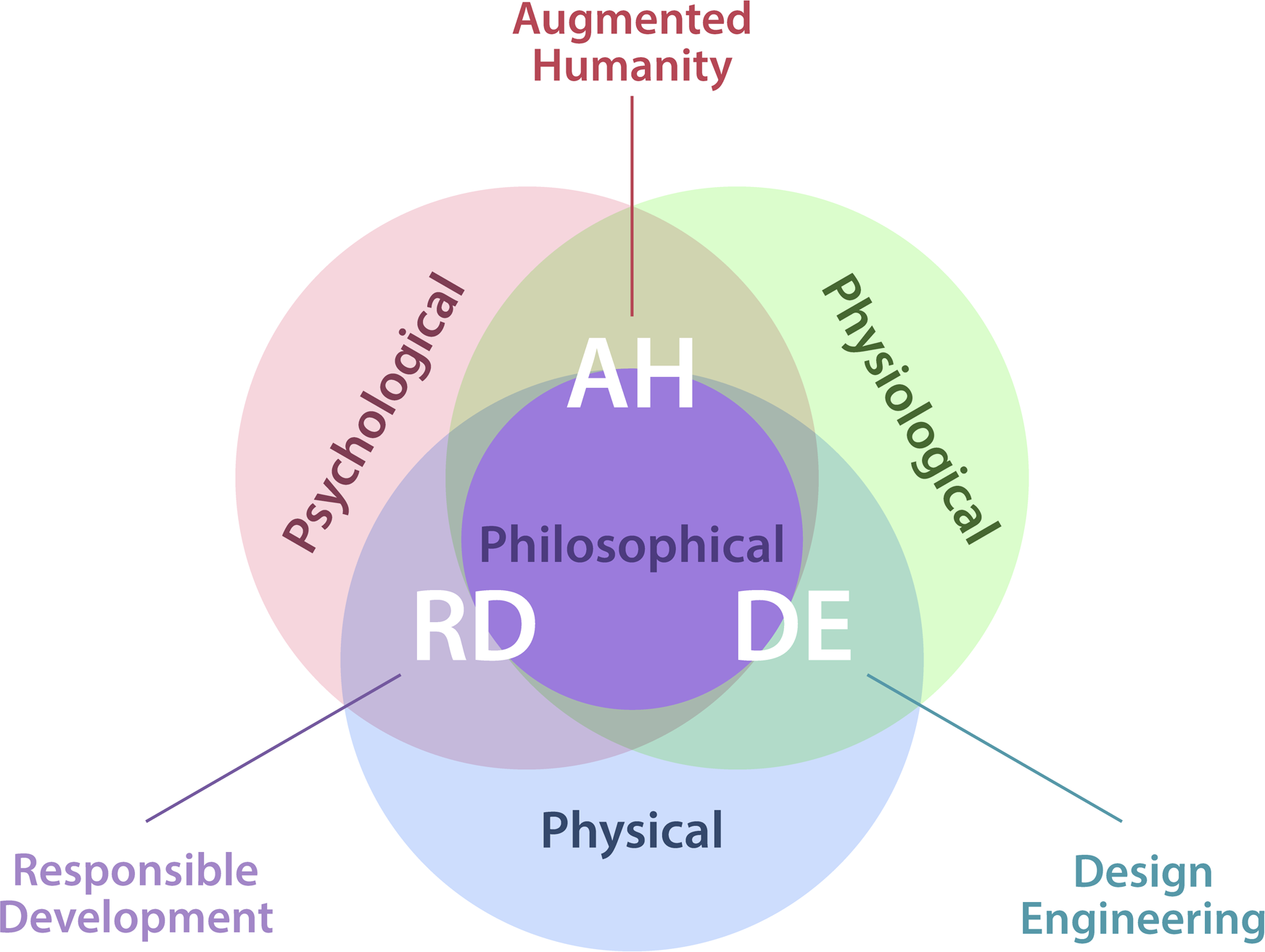
According to statistics from the Ministry of Education of China in 2024, there are 2,513 universities and colleges that offer design-related programs, with 1,941,644 students registered in design-related courses. If we include pan-design education statistics, the number would soar. While China has a relatively large number of students in the design field compared with the rest of the world, there are very few international academic journals that independently express Chinese perspectives and serve the global community. Apart from Tongji University’s journal “She Ji,” which was first published in 2015 just over a decade ago, it was not until the past couple of years that new academic journals in China have been gradually launched, including “Advanced Design Research” (2023) by Northwestern Polytechnical University, “Design and Artificial Intelligence” (2024) by Zhejiang University, and the “International Journal of Innovation and Design” (2026) by Jiangsu University. This new journal ‘”Design Augmented Humanity” will serve as an academic bridge for mutual understanding and exchange, allowing experts around the world to understand design research in China and enabling Chinese researchers to see your latest research findings and vice versa. We hope this journal can become a central platform for the publication and exchange of global design technology and latest knowledge. We also hope that, with the joint efforts of the editorial board, authors, and readers, this platform can elevate design to a prominent discipline, using design wisely to enhance humanity and human nature to their highest perfection.
