




Abstract
In September 2024, parties in South Sudan extended the timeline for implementing the Revitalized Agreement on the Resolution of the Conflict in the Republic of South Sudan (R-ARCSS). This is the fourth extension since the parties signed the R-ARCSS in 2018. How the parties utilize the new two-year extension to prepare the country for the election and implement remaining commitments in the revitalized agreement remains unclear. This article provides an overview of the implementation of the 2018 revitalized agreement based on the Peace Accords Matrix (PAM) methodology. By discussing the potential push and pull of the peace implementation process, this article outlines why the implementation of R-ARCSS should be front and center in the ongoing Tumaini Peace Initiative as a pathway for peace and stability. By reinforcing the significance of elections in attaining post-war peace and stability, when such elections are held after significant milestones in the peace implementation process, this article discusses the significance of ongoing ethnic rivalry, lack of resources, and the need for robust international involvement in implementing the peace. For institutionalizing peace and stability in South Sudan, this article makes two observations. First, peace implementation success is the only pathway to keep the rebel signatories of the 2018 agreement involved in the peace process, manage interethnic rivalry, and pull holdout groups into the successful process. Second, and relatedly, meaningful international accompaniment and resource commitment are necessary for the successful implementation process.
Introduction and Background
Institutionalizing peace and stability in South Sudan is perhaps one of the most complex political undertakings, as the country constantly oscillates between hopeful prospects for peace and the despair of renewed violence. The hope kindled by the originally scheduled December 2024 election turned into dismay because people in South Sudan had to wait for another two years for the country’s first-ever election as the parties miserably fell behind in meeting all the requirements for holding peaceful elections as stipulated in the 2018 Revitalized Agreement on the Resolution of the Conflict in the Republic of South Sudan (R-ARCSS). After failing to meet the implementation timeline established for the pre-transition and transition-related provisions, the signatories of the R-ARCSS renegotiated the implementation timeline for the fourth time in September 2024 (RJMEC, 2025). 1 According to the renegotiated transition timeline, the first general election is now scheduled for December 2026.
While post-war elections are a logical means to consolidate peace and political stability in countries that have ended wars in negotiated settlements (Lyons, 2004), such elections are carefully prepared and sequenced such that the electoral process and election results do not become another contentious issue, triggering the parties to return to violence (Kandeh, 2003; Keels, 2018). Given the peace implementation advances so far and the stalled/ongoing Tumaini Peace Initiative with the holdout group, the December 2026 election in South Sudan has already drawn the attention of both domestic and international stakeholders (United Nations Security Council, 2024). The successful election and the Tumaini Peace Initiative are the litmus test of the resiliency of the R-ARCSS implementation. Is South Sudan on its pathway to implementing peace before the renegotiated transition period ends in February 2027?
Post-war elections are significant milestones in war-to-peace transitions as rebel groups seek to win political power peacefully. Nevertheless, post-war elections are contentious (Lyons, 2005; Reilly, 2002). In Africa alone, Angola’s 1992 election, Liberia’s 1997 election, and the Ivory Coast’s 2010 election are some of the few examples of post-accord elections that did not deliver peace. In South Sudan, two years after a successful independence referendum in 2010, internal conflicts within the ruling Sudan People’s Liberation Movement (SPLM) plunged the new nation into a full-blown civil war (Johnson, 2014). Riek Machar, the First Vice President and an SPLM leader, aimed to succeed President Kiir by challenging him for the party’s leadership and running in the 2015 elections. Amid internal disputes over succession, Kiir dismissed his entire cabinet, including Machar, accusing him of attempting a coup d’état in July 2013 (Johnson, 2014). This rivalry quickly escalated into a civil war, fueling ethnic tensions among the Dinka and Nuer troops in South Sudan’s armed forces, representing both Kiir and Machar (Thiong, 2018). The renewed civil war created severe humanitarian conditions in South Sudan, with an estimated four million people displaced or living as refugees in neighboring countries. According to the UN Office for the Coordination of Humanitarian Affairs, around nine million people in South Sudan needed humanitarian assistance in 2024, many of whom faced severe hunger and malnutrition (OCHA, 2023).
The outbreak of civil war in South Sudan in 2013 led to a quick international response, urging both the government, led by the SPLM, and the opposition group, the Sudan People’s Liberation Movement in Opposition (SPLM-IO), to engage in peace talks. The Intergovernmental Authority on Development (IGAD) mediated these discussions, and the parties signed the Agreement on the Resolution of the Conflict in South Sudan (ARCSS) in August 2015 (Phillip Apuuli, 2015). In accordance with the agreement, SPLM-IO leader Riek Machar returned to Juba in April 2016 to join the national unity government (The Guardian, 2016). However, violence erupted in July 2016, and the SPLM-IO leader fled the country in August (BBC News, 2016).
After the renewed violence in 2016, the national and regional-level peace process efforts led to the establishment of the High-level Revitalized Forum (HLRF) under the auspices of IGAD. The HLRF comprised Djibouti, Ethiopia, Kenya, Somalia, South Sudan, Sudan, and Uganda. The June 2017 HLRF extraordinary summit of heads of state and government on South Sudan provided a pathway for convening negotiating parties to revive the 2015 agreement. In the next 15 months, the SPLM and SPLM-IO negotiated five different agreements, culminating in the signing of the Revitalized Agreement on the Resolution of the Conflict in the Republic of South Sudan (R-ARCSS) on September 12, 2018 (Accord, 2019). Six other groups participated in the negotiation process, but they did not sign the agreement. 2
The agreement provides two concrete implementation timelines: an eight-month pre-transition period focusing on ceasefire, demobilization, disarmament, reintegration of armed forces, the establishment of necessary unified forces (NUFs), and state boundaries, among other priorities. This pre-transition period would lead to the 36-month transition phase, in which the Revitalized Transitional Government of National Unity (RTGoNU) would be established, and necessary institutional reforms would be carried out, including preparing the country for the election and holding elections two months before the end of the transition period. After the election, the democratically elected government resumes its power and functions under the constitution finalized during the transition period.
Therefore, the rescheduled timeline for the first-ever election in December 2026 is a significant milestone for South Sudan to rebuild a stable and peaceful state after the independence referendum in 2011. It is time to evaluate the progression of R-ARCSS’s implementation and question how its success, or lack thereof, should be assessed as the parties have bought themselves an additional two years until February 2027. Using the PAM methodology of identifying provisions negotiated in civil war comprehensive agreements and the implementation of those provisions (Joshi et al., 2015, 2025), this article discusses observed implementation patterns and delves into the state of implementation for the provisions that the signatories expected to advance as a prelude to the first-ever election. Furthermore, this article explains the complexities of the Kenya-initiated Tumaini Peace Initiative, aimed at including the holdout the South Sudan Opposition Movement and Alliance (SSOMA) in a peace process.
Following this introduction, the next section provides a brief conceptual framework suggesting why implementing a peace agreement is foundational for peace and stability in South Sudan. It argues that implementing the R-ARCSS addresses issues specific to bad governance, human rights abuses, competing legitimacy claims, and therefore abuses of responsibility. It also manages rival security forces, creates incentives for other groups to join the peace process, and gives meaningful responsibility to international actors so that war-to-peace transitions and elections in this process would become foundational for sustainable peace. The third section presents a historical overview of peace processes designed to resolve conflict in Southern Sudan. The next section then presents comparative insights on the peace implementation process in South Sudan and identifies several pre-transition and transition-related provisions in the agreement that are critical for holding a successful election but are behind schedule. This section also discusses the ongoing Tumaini Peace Initiative by highlighting that the parties are unclear on how this initiative aligns with the current R-ARCSS implementation process, while arguing that the peace implementation process is instrumental in bringing the holdout groups into the fold of the peace process. The discussion section identifies three key challenges related to the slower peace implementation process in South Sudan. The conclusion section highlights the significance of the post-war election and why South Sudan’s peace implementation process needs significant international support to secure stability and peace.
Conceptual Framework
The causes of armed conflicts in South Sudan are similar to those in Africa and many other developing countries. Studies of Elbadawi and Sambanis (2000) and Collier and Hoeffler (2004) suggest that the armed conflicts and civil wars in Africa correlate to low levels of economic development, stagnant economic growth, and growing dependence on primary commodities. Along with these factors, Elbadawi and Sambanis (2000) suggested that the lack of democratic institutions and the lack of political rights increase the risk of armed conflict. After all, many African countries failed to function as sovereign countries and did not protect their citizens from human rights abuses or humanitarian crises (Deng et al., 1996). Combine these there are compounders of warlords and elites who maintain power by mobilizing underlying grievances based on ethnic identity (Alcorta et al., 2018; Hills, 1997). After all, civil wars and armed conflicts in many countries in Africa, in particular, are fought to eliminate rival ethnic groups and establish control over state power and economic resources (Busumtwi-Sam, 2002; Clapham, 1998; Roessler, 2011). This is well articulated by Deng (1995) and Deng et al. (1996) as an outcome of the disintegration of state authority, law, and political order, which is a regular occurrence in Africa and relates to a sovereign state’s failure to carry out its responsibilities.
Earlier studies suggest various policy reforms and initiatives for resolving armed conflicts in Africa in general and South Sudan in particular. For example, Alcorta et al. (2018) and Hills (1997) suggest the significance of reducing ethnic group-level inequality, which is the primary driver of armed conflicts and civil wars in Africa. Deng (1995) and Deng et al. (1996) emphasize the need for the African states and rulers to carry out the responsibility of the sovereign state and the role of the UN for the reconstitution of the order. In a similar line, the studies by Clapham (1998), Busumtwi-Sam (2002), Roessler (2011), and others suggest institutional reforms and legitimacy of institutions in place so that issues specific to access to political power and economic resources could be resolved and a durable peace could be achieved. Upholding basic principles of power transfer, which is mostly the case for countries emerging from civil wars, becomes even more imperative (Okumu, 2022). Nevertheless, the question of power transfer often faces challenges for a lack of free and fair elections when the peace implementation process does not demilitarize politics by properly managing both the state and non-state armed forces as part of the peace implementation process (Lyons, 2004). As such, the disarmament, demobilization, and reintegration process that upholds “norms, values, interests and institutions of the people and the society in question” becomes an integral part of post-war state-building (Makinda, 2003, p. 310).
Consistent with the above discussion, the key challenge facing peace and stability in South Sudan relates to the abuse of sovereign authority, which Makinda (2017) suggests requires a South Sudan context-specific model of co-governance that directly involves international actors to work to address the issues of bad governance, strengthen economic management, rebuild the war-torn state, and enhance regional security. Consistent with Makinda (2017) and in line with Joshi and Mac Ginty’s (2025) framework that settlement of civil wars in comprehensive peace agreements provides a framework for building a state, I argue that the R-ARCSS identifies institutional reforms, governance reforms, security reforms, and the role of international actors to secure peace and stability in South Sudan after the post-conflict election. Through institutional reform, the agreement aims to establish functioning legislative, executive, and judiciary branches of government, federalism, and identify power-sharing arrangements to navigate the transition process so that one (ethnic) group does not dominate the institution-making process, as the transition period often sees institutional flux. To break the kleptocratic leaders’ hold on power and state resources through control of armed forces, which is the case in South Sudan, the agreement reforms both military and police forces, along with demobilizing, disarming, and reintegrating rebel armed forces. To make the state responsive to the civilians, the agreement reforms governance and ensures civilian protection, the state facilitates the return of refugees and IDPs, and manages and redistributes economic resources. It also calls upon the international community, including IGAD, AU, and other countries, to provide resource support and monitor and verify the agreement.
As peace agreement implementation aims to build the war-torn state by reforming institutions, improving governance, dismantling rival security forces or unifying security forces that are responsible for the security of civilians, in line with Joshi and Quinn (2016), I argue that the implementation of these reforms negotiated is a critical first step for creating incentives to pull in both latent and active groups that are part of a peace process or not. This is particularly because implementation impasse incentivizes groups outside the process to create conditions that sustain the conflict, whereas successful implementation rebuilds the state, holds leaders accountable to their citizens, improves governance, and ensures that civilians do not have to fear the security forces of their own country. Therefore, peace implementation success opens a pathway for keeping peace with the signatory group, managing interethnic rivalry, and pulling holdout groups into the successful process. However, meaningful international accompaniment and resource commitment are necessary for a successful peace implementation process. After all, international actors, through monitoring mechanisms and incentive conditions on compliance, help domestic actors implement the agreement, hold peaceful elections, and reduce repression (Matanock, 2020). The next section delves into the details of the South Sudan peace process.
Decades of Peace Process to Resolve Conflict in Southern Sudan
Before signing a landmark Comprehensive Peace Agreement in 2005, which provided a pathway for the independent South Sudan in 2011, it is important to briefly explore the 50 years of civil war (1956–2005) in Southern Sudan as a prelude to the ongoing challenge to peace and stability in South Sudan. To begin with, British colonial rule directly and indirectly contributed to the outbreak of the armed conflict in Southern Sudan. Until the Juba Conference of June 1947 (Rahim, 1966), the British protectorate, through Egyptians, ruled the predominantly Arab/Muslim North. The British themselves ruled the South, which had mostly African/Christian inhabitants. In the Juba Conference, “a policy of separating Southern provinces from the rest of the Sudan” was abandoned, and a new policy for a unified Sudan was pushed as “it was the wish of the Southern Sudanese to be united with the Northern Sudanese in a united Sudan” (Rahim, 1966, p. 244). While the unified Sudan was seen as a policy shift to rectify the injustices done to the people in Southern Sudan, when Sudan became independent in 1956, the colonial rulers favored Muslim elites in the North, and the dominance of the North over the South started and contributed to the conflict between the North and South (Kebbede, 1997). The forceful integration between the two regions, which are racially, culturally, and religiously different and had economic inequality and dominance of the North contributed to the successionist civil war, which started in 1956 and ended in 1972 with the signing of the Addis Ababa Agreement in 1972 with the Anya Nya movement (Shepherd, 1966; Wai, 2013).
The Addis Ababa Agreement of 1972 gave cultural and religious autonomy to the Southern Sudan, but central authority remained with the North, and the agreement was not implemented. As such, the North continued to maintain its dominance over the South, the economic hardship continued in the South, and the grievances became more serious when Sudan adopted Sharia law in 1983 for the entire country, which the SPLM/Army (SPLM/A) demanded was unacceptable (Scott, 1985). In the same year, the SPLM/A took up arms, and the second Sudanese civil war started. After almost two decades of fighting, the Sudanese government and the SPLM/A reached the Machakos Protocol in July 2002. This framework agreement outlined the principles and substantive issues for future talks, which paved the way for the 2005 Comprehensive Peace Agreement (2005 CPA). The implementation of the 2005 CPA provided a pathway to an independent South Sudan after a referendum in January 2011.
However, the independence did not end all conflicts in South Sudan. It contributed to rivalry between the Dinka and Nuer ethnic groups, which are represented by President Salva Kiir and First Vice President Riek Machar, respectively (Thiong, 2018). Within a couple of years of independence, internal rivalry within the SPLM surfaced. Then the armed forces factionalized between those loyal to Kiir and Machar, and a civil war broke out in 2013. Following the IGAD-led mediation, the SPLM and SPLM-IO signed the ARCSS in 2015, which broke down within a year, and the parties returned to armed conflict. The effort of IGAD helped resume negotiations between the SPLM and SPLM-IO, and the parties signed the R-ARCSS in September 2018 (Accord, 2019). While the 2018 agreement is holding as the parties have avoided open armed confrontation so far, the implementation achievement has been subpar, and the risk of renewed armed conflict has significantly increased. This risk is further heightened because the First Vice President, Machar, and his wife, Angelina Teny—the interior minister in the RTGoNU—were placed under house arrest on March 27, 2025. 3 They were put under house arrest for alleged connections to the White Army and its activities, which the SPLM-IO denied. The White Army, which primarily recruits from the Nuer ethnic group that Vice President Machar belongs to, engaged in confrontations with the South Sudan People’s Defence Forces (SSPDF) and took control of the town of Nasir in the oil-rich Upper Nile State (Agence France-Presse, 2025). As South Sudan’s peace process faces this critical moment, it is important to understand where the peace implementation process stands and how this compares to other peace processes.
South Sudan’s Peace Implementation Processes in Comparative Perspective
Over the last two decades, since the signing of the 2005 CPA, South Sudan-specific academic and policy discussions have centered around resolving armed conflict (e.g., Roach, 2016; Young, 2005), promoting good governance (e.g., Radon & Logan, 2014), and addressing humanitarian crises (e.g., Blanchard, 2014). In these discussions, the implementation of peace agreements is a central theme. This section offers a brief overview of the implementation of the 2018 Revitalized Agreement on the Resolution of the Conflict in South Sudan (R-ARCSS) and compares it with the 2015 ARCSS, the 2005 CPA that SPLM negotiated in Sudan, and comprehensive peace agreements in other countries. The PAM data (Joshi et al., 2015, 2025) are used for this comparison.
The PAM provides data on comprehensive peace agreements negotiated in civil wars or intrastate armed conflicts. The PAM defines comprehensive peace agreements in two dimensions: all major groups with stated incompatibility being part of the negotiation process and all underlying issues of the conflict being on the negotiation table (Joshi et al., 2015). By using this conceptual definition, the most recent version of PAM data identifies a total of 42 comprehensive peace agreements negotiated in intrastate armed conflicts since 1989 (Joshi et al., 2025). PAM identifies 51 different provisions as discrete policy reforms or initiatives (e.g., power-sharing, federalism, electoral/political party reform, demobilization, disarmament, reintegration, and citizenship reform) and collects annualized data on the implementation of each provision for up to ten years. 4 At the provision level, qualitative implementation information is collected, and this information is used to determine if the state of implementation can be determined as not implemented, minimum implementation, intermediate implementation, or full implementation. These data allow researchers to compare CPA implementation processes across cases at the provision level. Finally, the provision-level implementation data are aggregated to generate an annualized peace implementation rate, which can be helpful to compare CPAs and their implementation processes over time.
To begin with, the PAM data suggest that the overall implementation of the 2018 R-ARCSS stands at 50% at the end of the six-year mark or as of December 2023. In the last two years, there has been no significant advancement in implementing the agreement. This becomes evident from the RTGoNU decision in September 2024 to extend the transition deadline by an additional two years (Radio Tamazuj, 2024a). By the sixth-year mark, other peace processes had a significantly higher overall implementation rate. Figure 1 provides an annualized overview of the implementation progress of the R-ARCSS in comparison to the 2005 CPA that the SPLM negotiated with the government of Sudan, the 2015 ARCSS that the SPLM-led government of South Sudan negotiated with the rival SPLM-IO, and CPA implementation processes in other countries since 1989. The figure uses the updated PAM data and shows the implementation rate for up to ten years following the signing of the peace agreement. The bar with a white circle and black dots in the figure represents the average peace implementation rate for all post-Cold War CPAs. The orange solid bar represents the 2005 CPA that the SPLM/A negotiated with Sudan’s government. The bar with a green vertical line represents the 2015 ARCSS, and the bar with a red horizontal line represents the 2018 R-ARCSS.
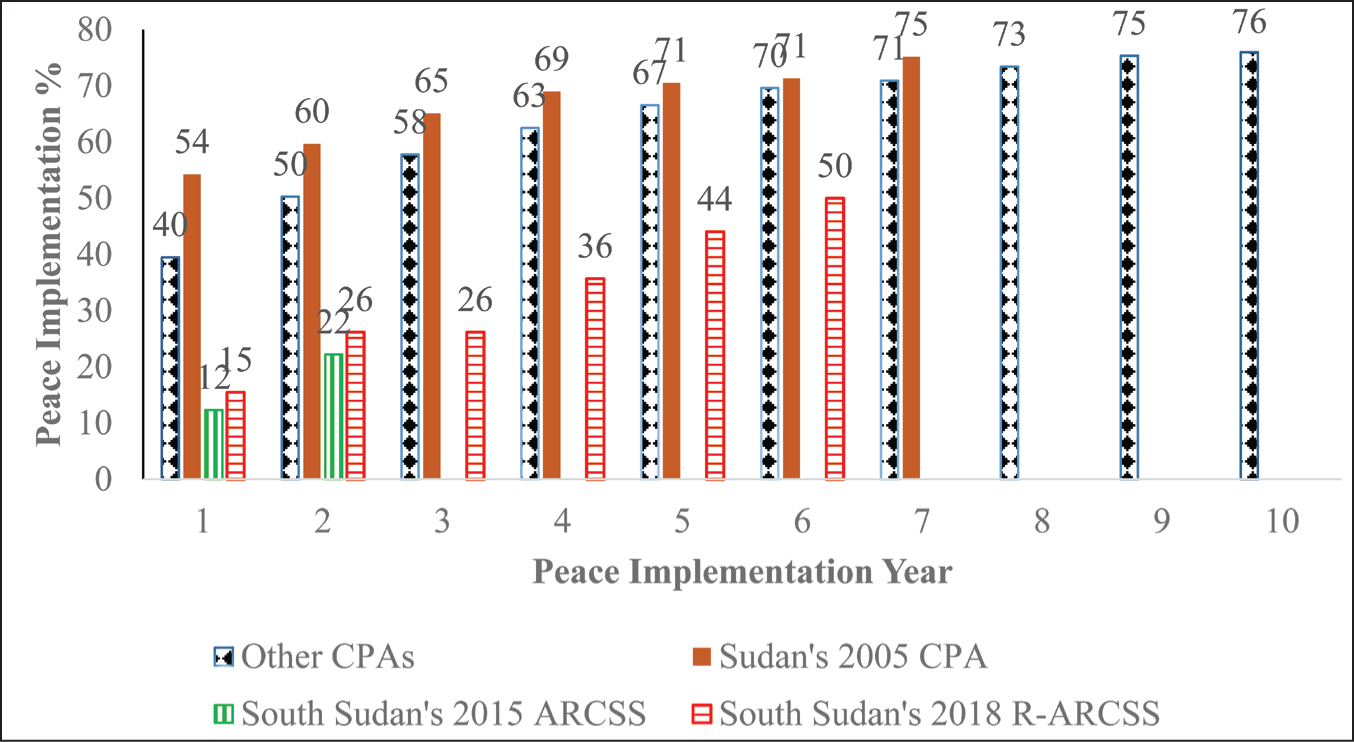
As Figure 1 shows, the R-ARCSS’s overall implementation trajectory is significantly lower than Sudan’s 2005 CPA and the average CPA implementation rate. At the six-year mark (as of December 2023), the overall implementation rate of the R-ARCSS is only 50% compared to 71% for Sudan’s 2005 CPA and 69% for other CPA processes. While the R-ARCSS’s implementation was relatively better than that of ARCSS for the first two years, the overall implementation rate of R-ARCSS at the six-year mark is at least 21% and 19% behind Sudan’s 2005 CPA and the average CPA implementation processes, respectively.
According to the PAM methodology, the 2018 R-ARCSS has 28 provisions (Joshi et al., 2025). These 28 provisions can be summarized under four state-building categories developed by Joshi and Mac Ginty (2025). 5 Out of 28 provisions, only 27 provisions in R-ARCSS can be meaningfully observed for implementation-related benchmarks and events. Among 27 provisions, only five, or 18%, are in full implementation status. Another six (22%) are in the intermediate implementation category. Among the remaining provisions, 14 (52%) of provisions are in the minimum implementation category, and another two provisions are categorized as not initiated. As such, the overall implementation of R-ARCSS has not progressed, and most of the implementation-related achievements are in maintaining a ceasefire, sustaining the power-sharing government, and the verification mechanisms. As can be seen in Table 1, provisions specific to improving governance and building institutions, which are key for post-war peace and stability, are significantly behind.
Summary of the Implementation Status of Provisions in R-ARCSS.
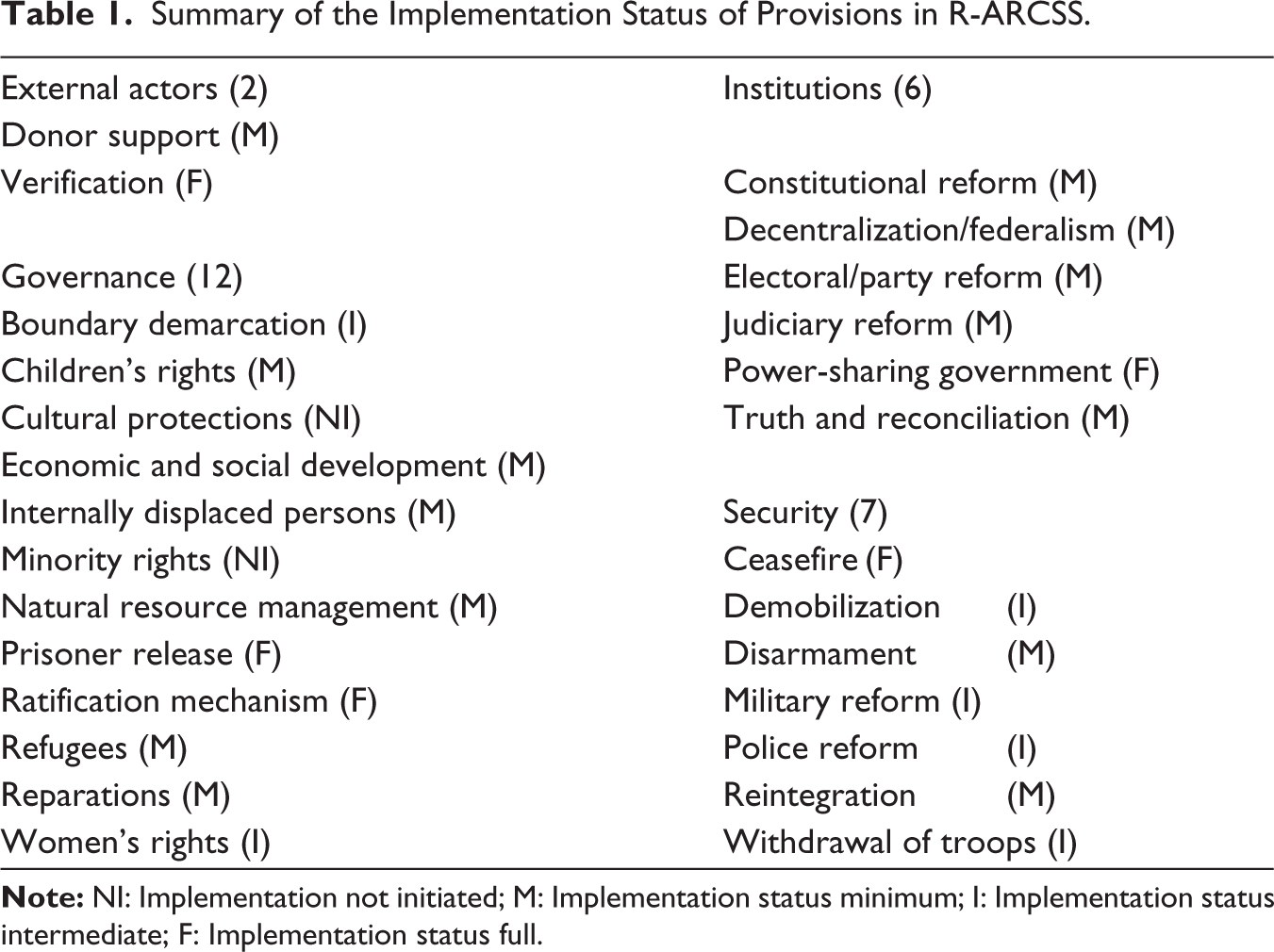
Figure 2, which is adopted from Joshi (2024), provides a different comparative perspective on the implementation status of the R-ARCSS at the provision level. The figure provides information for provisions where the R-ARCSS implementation process is ahead compared to other CPA processes and Sudan’s 2005 CPA (green bar) and where the R-ARCSS process is lagging (red bar) at the six-year mark. As shown in the figure, comparatively speaking, police reform, power-sharing, prisoner release, and verification provisions in the R-ARCSS have a better implementation status compared to average CPA processes. Out of the 27 provisions compared, 20 are behind, and two are at the same level of implementation status. Similar patterns can be observed when compared to Sudan’s 2005 CPA. The R-ARCSS’s provisions specific to boundary demarcation, ceasefire, socioeconomic development, power-sharing, and troop withdrawal are better implemented than Sudan’s 2005 CPA. Eight provisions have similar implementation advancements, and the implementation of 14 provisions is significantly behind.
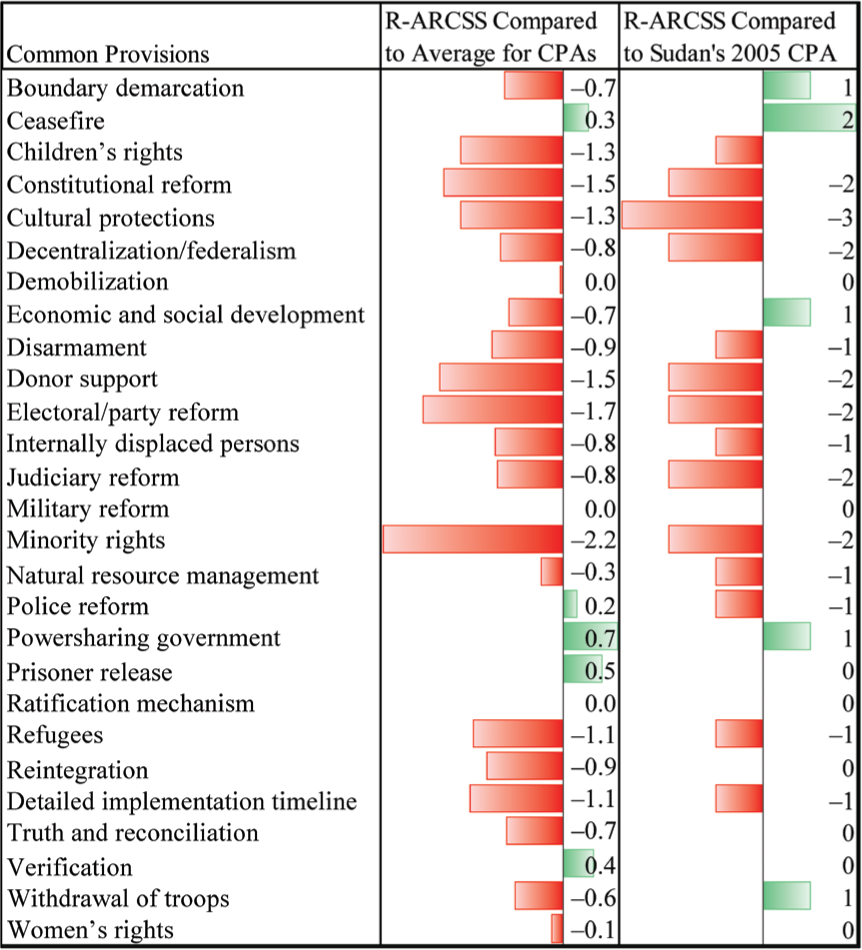
The assessment of the implementation of R-ARCSS in Table 1 and the comparative insights in Figure 2 show several provisions that are behind schedule, directly and indirectly, related to elections, which I summarize below under four different categories, and the significance of the Tumaini Peace Initiative.
Permanent Constitution
South Sudan still uses the 2005 Interim Constitution of Southern Sudan, which was negotiated as part of the 2005 CPA. Therefore, drafting a permanent constitution is one of the key provisions in the 2018 R-ARCSS. Nevertheless, the process of drafting a permanent constitution is behind schedule. It was only in November 2023 that President Kiir reconstituted the National Constitutional Review Commission (NCRC) with 58 members, representing different political parties, civil society, academia, ethnic minorities, the business community, refugees, IDPs, and persons living with disabilities, who took their oaths in December 2023 (Radio Tamazuj, 2024). While the commission was established, it lacked resources. Indeed, the constitution drafting commission appealed to the RTGoNU for providing resources to begin public consultations on the proposed permanent constitution (Radio Tamazuj, 2024b). The Preparatory Sub-committee with the mandate to convene the National Constitutional Conference has yet to be established, and members of the Constitutional Drafting Committee are yet to be appointed. The timely public consultation and a draft of the permanent constitution are critical before elections because of issues specific to several states and state borders, gender representations, cultural rights, the term limits for political offices, and the election itself.
Security Sector Reforms
The implementation of security-related provisions, namely, the disarmament, demobilization, and reintegration (DDR) of combatants, along with reforms in the armed forces and the deployment of NUFs, is not advancing at the pace necessary to signal to civilians and the peace process stakeholders that the remaining issues can be addressed before elections. While an estimated 55,000 combatants in various cantonment camps graduated to join the NUFs, key issues remain, such as the successful deployment of the NUFs. To begin with, several commanders belonging to the SPLM-IO changed their allegiance, which created infighting among the SPLM-IO combatants in different cantonment sites (The City Review, 2023; Sudan Tribune, 2022a). This could carry forward into internal rivalry within the NUFs and is likely to flare up at any point, making the successful unification of armed forces challenging. Another issue is the successful disarmament and reintegration of those combatants who did not qualify to be a part of the NUFs. And most importantly, the RTGoNU has yet to approve funding for the plan that the Decommissioning Commission put forward for various DDR-related activities.
Infrastructure for Elections
Critical institutional infrastructures with election-related tasks are significantly behind schedule. The Political Parties Council, the NCRC, and the National Election Commission were reconstituted in late November 2023 as negotiated in the R-ARCSS and are responsible for voter registration, civic education, voter outreach, and the publication of the voter registry six months before elections, all of which are now postponed. Equally important is the R-ARCSS provision for conducting comprehensive census and housing surveys. Since the 2008 census in Southern Sudan, before the independence referendum in 2011, South Sudan has not conducted any census as an independent state. To ensure free and fair elections, a comprehensive census is important for three reasons. First, the people of South Sudan have yet to elect their leaders since the 2011 independence referendum. A comprehensive census is necessary for citizens of South Sudan to guarantee their right not only to elect their representatives but also to ensure inclusive representation as outlined in the R-ARCSS. Second, one of the critical issues that South Sudan faces is the proposal to allocate public resources for public goods and infrastructure. As the R-ARCSS calls for numerous reform initiatives specific to good governance, the census is also critical for determining equitable resource allocation. Finally, over one-third of South Sudan’s population is displaced either because of the conflict or a natural disaster. According to the UN Refugee Agency, an estimated 2.3 million people are internally displaced, and another 2.4 million are refugees in neighboring countries (UNHCR, 2024). A comprehensive census is critical to ensure the voting rights of displaced people as well.
Transitional Justice
The R-ARCSS includes a comprehensive transitional justice approach with three distinct and related mechanisms. It has a provision for the Commission for Truth, Reconciliation, and Healing (CTRH), the establishment of the Hybrid Court for South Sudan (HCSS), and the Compensation and Reparation Authority (CRA). Following the public consultations in 2022, the CTRH was established in late 2023, and the Compensation and Reparations Bill on establishing the CRA was tabled in the Transitional National Legislative Assembly after the approval of the Council of Ministers (RJMEC, 2024). However, there are no signs of establishing the HCSS. Together, these three mechanisms are integral for establishing the truth on human rights violations, documenting the experience of victims, investigating and identifying perpetrators, providing reparations to conflict victims, and holding those responsible for criminal activities accountable, among other transitional justice-related issues. Without addressing issues specific to justice and accountability, those who were responsible for human rights violations are likely to be leading electoral contenders and may even get elected if the election takes place (Chagutah, 2023). If elected, the possibility of holding perpetrators accountable becomes slim, as was the case in Cambodia, Rwanda, Nepal, and other places where elections took place before holding accountable those responsible for human rights violations during the war.
As negotiated in R-ARCSS, South Sudan’s transition process can only be completed after holding free and peaceful elections. Elections can promote peace and stability when they are carefully sequenced and managed so that the electoral process is credible, political parties participate in the electoral process, and citizens have the opportunity to select their candidates and trust the institution to count their votes. Free and fair elections are foundational for a successful war-to-peace transition and for the peaceful transfer of power. As the only pathway toward a successful peace process in South Sudan is an election at the end of the transition phase, it is imperative to implement the remaining critical tasks outlined in the R-ARCSS. Unfortunately, implementation of those provisions is not progressing even after several extensions of the transition period. In response to the slow implementation process and repeated extension, in July 2022, the South Sudan Non-signatory South Sudan Opposition Groups (NSSSOG) rejected the transition period extension beyond February 2023. They demanded a roundtable discussion of all stakeholders. 6 South Sudan’s President Kiir asked Kenyan President Ruto to mediate between the South Sudanese government and the holdout groups. This request led to the launch of the Tumaini Peace Initiative on May 9, 2024, in Nairobi, the capital of Kenya (Wol, 2024).
The Tumaini Peace Initiative
The Tumaini Peace Initiative is the latest effort to resolve the conflict with the non-signatory parties of the R-ARCSS and integrate them into the peace process. Although the group participated in the initial rounds of negotiations in 2017 and 2018, its members ultimately chose not to sign the R-ARCSS. The initiative, as originally proposed, aims to address concerns of the holdout groups that the R-ARCSS does not cover (Sudan Tribune, 2022b). The participants of the Tumaini Peace Initiative signed a “commitment declaration” on May 16, 2024, which included a substantive agenda and implementation mechanisms as requested by holdout groups (The Radio Community, 2024).
While it appeared to be a significant step initially, the SPLM-IO withdrew from the Tumaini Peace Initiative in July 2024 with a public statement that the “commitment declaration” “establishes alternative institutions, replacing or running in parallel with those in R-ARCSS, besides repeating most provisions in R-ARCSS or existing national laws. The Protocols clearly breach the R-ARCSS and undermine the ongoing peace implementation processes.” The statement also indicates a marginalization of the AU, the UN, the EU, troika countries (the United States, the United Kingdom, and Norway), and IGAD, which have the roles of guarantors in the implementation of the R-ARCSS (Sudan Tribune, 2024). While the withdrawal of SPLM-IO can be argued as stemming from the fear of marginalization or the decline of influence of SPLM-IO within the RTGoNU, the initiative did not offer any solutions to the challenges facing the R-ARCSS implementation process. Further, the initiative was also argued as President Kiir’s plan to undermine the SPLM-IO and divert attention away from the slow implementation of R-ARCSS.
After the extension of the transition period for an additional two years in October 2024, the Tumaini Peace Initiative gained renewed focus as the parties involved in the process are asked to connect “the outcomes of the Tumaini talks and R-ARCSS pending tasks through a concrete and clear development of the implementation matrix with a focus on elections in December 2026” (Radio Tamazuj, 2024c). As of this writing, the negotiations have resumed in Nairobi (Deng, 2024). While the resumption of the Tumaini Peace Initiative is a progress, the holdout groups organized a press conference and informed the people of South Sudan, the region, and international partners that they were dismayed by the new position of the government delegates (Radio Tamazuj, 2024d). In other words, parties are returning to the Tumaini Peace Initiative with their hardline positions on the R-ARCSS, and it will not be surprising if their positions do not converge. As such, those mediating in the Tumaini face the challenge of building on R-ARCSS without undermining the SPLM-IO. Their goal would be to ensure that SPLM-IO remains engaged in the R-ARCSS implementation process. Additionally, they must come up with an implementation road map that addresses the concerns of holdout groups so that they become a part of the peace implementation process and participate in the election in 2026. As such, the initiative significantly diverts much-needed political will and resources away from the already subpar R-ARCSS implementation process.
For durable peace and stability, bringing the holdout groups into the fold of the peace process is essential, and the Tumaini Peace Initiative can prove instrumental in this process. Nevertheless, previous research shows that it is the peace implementation process itself that pulls in groups that remained outside the process into the peace process (Joshi & Quinn, 2016). This occurs because effective peace implementation addresses underlying grievances and delivers necessary reforms, effectively marginalizing holdout groups from their civilian support base. As a result, successful implementation encourages these holdout groups to participate in the ongoing peace process. For example, consider Burundi’s peace process. It was the implementation of the 2000 Arusha Peace and Reconciliation Agreement that pulled in Conseil National pour la Défense de la Démocratie-Forces pour la Défense de la Démocratie (CNDD-FDD) into a peace process, and the CNDD-FDD signed a ceasefire agreement with the transitional government of Burundi in December 2002. South Africa went through a similar process, where the parties agreed on the Accord on Afrikaner Self-determination with the Freedom Front in April 1994. By 1994, South Africa’s peace process was already in the advanced implementation stage with the announcement of the election. Similarly, a lack of or a slow implementation pushes out the groups that are part of the peace process (Joshi & Quinn, 2016). For example, in countries like Angola and Sierra Leone, rebel parties that negotiated peace agreements returned to war because of the slow implementation process. Therefore, the Tumaini Peace Initiative is important to bring the holdout groups into the fold of the peace process, but effective implementation of the R-ARCSS is instrumental for achieving the Tumaini Peace Initiative objective, sustainable peace, and successful elections in South Sudan.
Complexities and Challenges
As comparatively contextualized and discussed in the previous two sections, South Sudan’s ongoing peace implementation process is complex. The challenges and difficulties in implementing this peace process are largely rooted in ethnic rivalries, limited resources, and the involvement of international communities.
Ethnic Rivalry
While the narrative of conflict in Southern Sudan before the succession in 2011 was predominantly about the dominance of the North over the South, which involved Muslim North and Christian South, South Sudan has multiple ethnic groups, with Dinka and Nuer having a conflictual relationship (Jok & Hutchinson, 1999). President Salva Kiir belongs to the Dinka, the largest ethnic group in South Sudan. In the South Sudan Liberation Movement/Army (SPLM/A), Salva Kiir was second in command under John Garang, who was the First Vice President in Sudan representing South Sudan following the 2005 CPA. Following Garang’s death in July 2005, Salva Kiir became First Vice President and a SPLM leader (Young, 2005). Riek Machar belongs to the second-largest Nuer ethnic group. He was a regional military commander. While Machar and Kiir wanted independence from Sudan, Garang wanted equal political and economic rights under a united Sudan. Frustrated with Garang’s authoritarian leadership and different political vision, Machar formed SPLM-Nasir as an alternative rebel movement to the SPLM/A. The Nasir faction received military support from Sudan and was involved in the Bor Massacre, in which thousands of civilians belonging to the Dinka group were killed. This caused ethnic animosity and rivalry, which remains one of the reasons why Riek Machar and Salva Kiir frequently find themselves in open confrontations, leading to the mobilization of armed personnel loyal to each other within South Sudan’s armed forces (see Nyadera, 2018).
Ethnic animosity and rivalry seem to obstruct the implementation of the 2018 agreement as well. There have been multiple attempts to undermine the SPLM-IO and diminish its influence within the RTGoNU. For instance, Salva Kiir and his loyalists have enticed several commanders from the SPLM-IO to join the SSPDF, resulting in infighting among SPLM-IO combatants in various cantonment sites. 7 As pressure to unify the SPLM-IO military under the SSPDF mounted, military leadership positions were divided between the SSPDF, SPLA-IO, and SSOA Sudan Post (2023). This military power sharing contradicts the desires of kleptocratic leaders who currently control state power and access to revenue from natural resources. Therefore, efforts have been underway since June 2023 to undermine the influence of SPLM-IO, now through the Tumaini Peace Initiative, which arguably sought to replace the 2018 R-ARCSS. Therefore, the SPLM-IO rejected the peace initiative, which resumed again in December 2024 as the focus shifted to the remaining peace implementation priorities. While the ethnic rivalry significantly slowed the peace implementation process in South Sudan (Radio Tamajuz, 2024), implementing the peace agreement is foundational to managing ongoing interethnic rivalry and mistrust.
Resource Constraints
One of the primary challenges to achieving peace and stability in South Sudan is the lack of commitment from political leaders to implement peace agreements. Therefore, the R-ARCSS requires the transitional unity government to contribute to a special fund (R-ARCSS, Article 1.4.8). This fund is intended to support activities during the pre-transition period, with ceasefire monitoring and the DDR of combatants being the most expensive programs. Additionally, the agreement mandates that the government contribute $100 million per year to facilitate the implementation of peace for the entire transition period (Article 3.2.7). However, the government has been slow in making funds available.
Resource constraints have been identified as a key factor affecting the overall implementation of both the pre-transition and transition phases of the R-ARCSS. For instance, the fifth report from the RJMEC, covering the period from October to December 2019, highlighted the late and significantly lower-than-expected disbursement of funds. This shortfall affected the security mechanisms for executing the cantonment process and training the NUFs (RJMEC, 2020). RJMEC reports support from the African Union, China, Egypt, Ethiopia, Japan, and Sudan, while Western countries require the South Sudan government to fulfill its commitments before offering funding support to implement the peace. RJMEC, in its quarterly reports published since the signing of the agreement, notes the insufficient and inadequate funding for implementing the agreement, with recent reports emphasizing the need for funding to support various mechanisms involved in carrying out election-related tasks, constitution-making process, and the transitional security arrangements, which include training and redeployment of NUFs (RJMEC, 2025). The shortage of resources for implementing peace in South Sudan can be attributed to two main factors: the insufficient support from the South Sudanese government and the international community’s reluctance to provide funding. The hesitation of the international community, mostly the United States and European countries, is largely due to the lack of visible commitment from the South Sudanese government toward the peace process.
International Community
Following the Kiir and Machar infighting within the SPLM, which led to a civil war in 2013, it would not be wrong to suggest that international communities have mostly shifted their focus to humanitarian situations rather than implementing the peace process. Regarding the involvement of international communities, it is well noted that international communities have not been proactive in South Sudan (United Nations Security Council, 2020). This is because of the repeated cycles of violence that have been producing disastrous humanitarian situations and doubts about the peace process, creating donor fatigue. Therefore, every time the R-ARCSS hits a crisis, international communities, including the troika countries—comprising the United States, the United Kingdom, and Norway—tend to limit their response to issuing press statements encouraging the parties to address the underlying issues through negotiations. In other words, international communities have stopped meaningful involvement in South Sudan’s peace implementation process. As a result, international financial support for implementing the peace has been limited. This is also because the RTGoNU has never provided the committed $100 million per annum to support the peace implementation process.
Conclusion
Post-conflict elections can promote peace when the necessary reforms are implemented to consolidate post-war peace. Elections are the only peaceful solution to contentious ethnic politics, as they facilitate the realignment of ethnic parties (Bormann, 2019). And, this can happen in South Sudan only when the provisions negotiated in the peace agreement are implemented and the elections are held. The only proven pathway for a successful election and post-election peace and stability is to implement the remaining key provisions and tasks in the R-ARCSS.
In South Sudan, there are no other alternatives to implementing the peace agreement for establishing the rule of law, stopping the abuse of sovereign authority, and holding the state responsible for protecting civilians. However, the current pace of peace implementation in South Sudan creates doubts about whether the responsible actors and entities can implement the remaining provisions and tasks in the R-ARCSS before the 2026 election. This is precisely because of the making of the military aristocracy and political elites who have eyes on maintaining the current political configuration in place and expropriating natural resources amidst political instability. In the post-independence years, political elites in South Sudan have found an easy way to remain in power by nurturing the political–military nexus by allocating the national budget to monopolize security forces and distributing political patronage to the represented ethnic groups, with less of a focus on improving governance and delivering public goods, and, for this reason, implementing the peace. Therefore, the recent extension and the Tumaini Peace Initiative can be seen as a strategic move to maintain a kleptocratic grip on power without implementing peace. This pattern is likely to continue until the IGAD, troika countries, and the international community radically change the way they support the implementation of the R-ARCSS. In other words, South Sudan’s peace implementation process needs significant international resource commitment, pressure, and presence on the ground in such a way that such involvement is felt in all peace implementation mechanisms and by all actors responsible for implementing the peace.
The significant pressure and presence from international actors need to be visible in the form of naming and shaming, and a willingness to sanction those actors who create an impasse and cause a stalemate in the peace implementation process. International actors need to demonstrate their credibility by adopting a radical approach in their support for peace in South Sudan. Along with focusing on implementing remaining provisions that are critical for holding free and fair elections and committing resources, the parties must continue implementing provisions concurrent to the Tumaini process. To demonstrate their readiness and dedication to hold elections and post-election peace and stability, the parties in South Sudan can use the Tumaini process to end armed conflict with other remaining groups.
Footnotes
Declaration of Conflicting Interests
The author declared no potential conflicts of interest with respect to the research, authorship and/or publication of this article.
Funding
The author received no financial support for the research, authorship and/or publication of this article.