



Abstract

Introduction
On August 29, 2024, India commissioned its second nuclear-powered ballistic missile submarine (SSBN) of the Arihant-class, INS Arighaat. The submarine, built by the Shipbuilding Centre in Visakhapatnam, is an updated version of INS Arihant and can cruise at speeds of up to 24 knots (44 km/h) when underwater and 12–15 knots (22–28 km/h) on the surface (Padmanabhan, 2024). Arighaat is powered by an 82.5 MW pressurized light water reactor (Free Press Journal, 2024). It has four launch tubes capable of carrying 12 K-15 Sagarika sea-launched ballistic missiles (SLBM) with a range of around 750 km or up to four nuclear-armed K-4 SLBMs with a range of more than 3,500 km. According to a press release by India’s Ministry of Defense, “The technological advancements undertaken indigenously on this submarine (Arighaat) make it significantly more advanced than its predecessor Arihant” (PIB, 2024).
Arighaat’s addition to India’s nuclear force will enhance the robustness and readiness of India’s nuclear retaliatory capabilities. India has a no-first-use (NFU) doctrine in place. Its key components are “massive retaliation” inflicting “unacceptable damage” while maintaining a “credible minimum deterrence” posture (PIB, 2003). An NFU policy is only credible if it is backed by a nuclear force that can survive a bolt from the blue first strike and still retain the ability to strike back massively. Thus, survivability of the nuclear force is at the heart of a NFU doctrine. Given India is squeezed cheek by jowl between two nuclear-armed adversaries, New Delhi could never solely rely on its land and air vector of the nuclear triad. The mobility and discretion of SSBN make it the most survivable and least vulnerable leg of the nuclear triad; thus, Arighaat’s commissioning takes India one step closer to fulfilling the stringent requirements of her NFU doctrine.
However, questions abound over whether, given the limited range of their missiles, these first-generation SSBNs face severe constraints. Not only are they incapable of reaching high-value targets in eastern China from the relative safety of the Bay of Bengal, but they also struggle to strike deep into Pakistani territory with the K-4 SLBM, their primary ballistic missile. This raises a critical question: Can India’s first-gen SSBNs serve as effective deterrents against Pakistan despite their range limitations? This commentary argues that by optimizing Arihant and Arighaat for specific targets and critical infrastructure within range, India can enhance its undersea nuclear deterrence while working within current technological constraints.
Research Design
My core argument is that despite inherent limitations, specifically the relatively short range of its SLBMs, India’s first two Arihant-class SSBNs can be strategically repurposed as effective second-strike platforms against Pakistan. While these vessels may not be suitable for China-centric missions due to their range constraints, they are nonetheless capable of executing precise countervalue and ‘soft’ counterforce retaliatory strikes on critical Pakistani targets. 1 By focusing their operational role on Pakistan, India can realign its overall nuclear posture, enabling long-range, intercontinental assets (such as Agni missiles) to focus on China while securing a credible minimum deterrence against Islamabad.
I further contend that when deployed for dedicated Pakistan-centric missions, the survivability and stealth of these SSBNs render them pivotal to India’s NFU doctrine. This pivotal status is upheld by a robust command-and-control (C2) framework and a clear launch-readiness protocol, both of which have been effectively validated on two occasions—first in October 2022 and again in September 2024—when India successfully test-fired nuclear-capable ballistic missiles from the Arihant-class. 2 The success of this test demonstrated the full operational readiness of the Arihants and its crew; as Admiral Arun Prakash noted in 2022, the drill would have tested the “long-range underwater communications as well as command-and-control procedures of the Strategic Forces Command” (Prakash, 2022).
Ultimately, this operational reliability supports the broader argument that India’s first-generation SSBNs, though limited in range, can meaningfully contribute to the country’s nuclear deterrence. Their allocation for Pakistan-focused missions would allow India to optimize its nuclear posture, dedicating long-range systems like the Agni series to counter threats from China, while ensuring a survivable and credible deterrent posture vis-à-vis Islamabad.
The methodology used in the study combines qualitative strategic analysis with technical evaluation. The study begins by systematically reviewing the major technical specifications of INS Arihant and INS Arighaat to establish a factual basis for the analysis. This technical review is complemented by a doctrinal examination of India’s nuclear strategy, notably focusing on the principles of massive retaliation and the NFU doctrine.
Sea Leg of the Nuclear Triad: Work in Progress
Despite Arighaat’s induction into the nuclear force, the overall credibility of India’s sea-based nuclear deterrence is still a work in progress. Like Arihant, Arighaat suffers from a limited range of its SLBMs. Its primary SLBM system, K-15 Sagarika, has a range of only 750 km or 405 nm. With that range, Arihant class cannot credibly undertake any China-centric mission. Since India’s SSBN program was started with China in mind, work is underway to fix the range issue by constructing two more Arihant-class boats, which will be bigger in size, tonnage, and capability (Rajagopalan, 2022). Codenamed S4 and S4*, these vessels are at various stages of construction and planning. The boats will have a length that is 13 m longer than that of Arihant and Arighaat at 125.4 m of waterline (Bedi, 2021). Each boat will have a tonnage of around 7,000 tons (Bedi, 2021). The extended length of the S-4 will enable it to accommodate a greater number of long-range missiles, namely, eight tubes for the K-4 SLBM, which possesses a range of 3,500 km or 1,890 nm (Bedi, 2021). K-4 has successfully concluded its developmental trials and is currently in the process of serial manufacturing (Pandit, 2023).
Yet K-4 will not solve all of India’s credibility issues attached to its SSBN program. If fired from the heart of the Bay of Bengal, K-4 will not be able to credibly hit high-value targets like Beijing or Shanghai (Figure I). Its reach is limited to Central and Southeastern China. The intermediate range of the K-4 SLBMs will require the SSBNs to venture into the South China Sea and operate in tactically dangerous environments. Though patrolling in close proximity to intended targets offers the capacity to retaliate from unexpected angles, and with little warning, it also exposes an SSBN to the threat of detection and attack from enemy anti-submarine forces (ASW). Indian SSBNs’ survivability may be compromised, consequently, potentially compelling them to either use or lose their missiles during wartime patrols in the region.
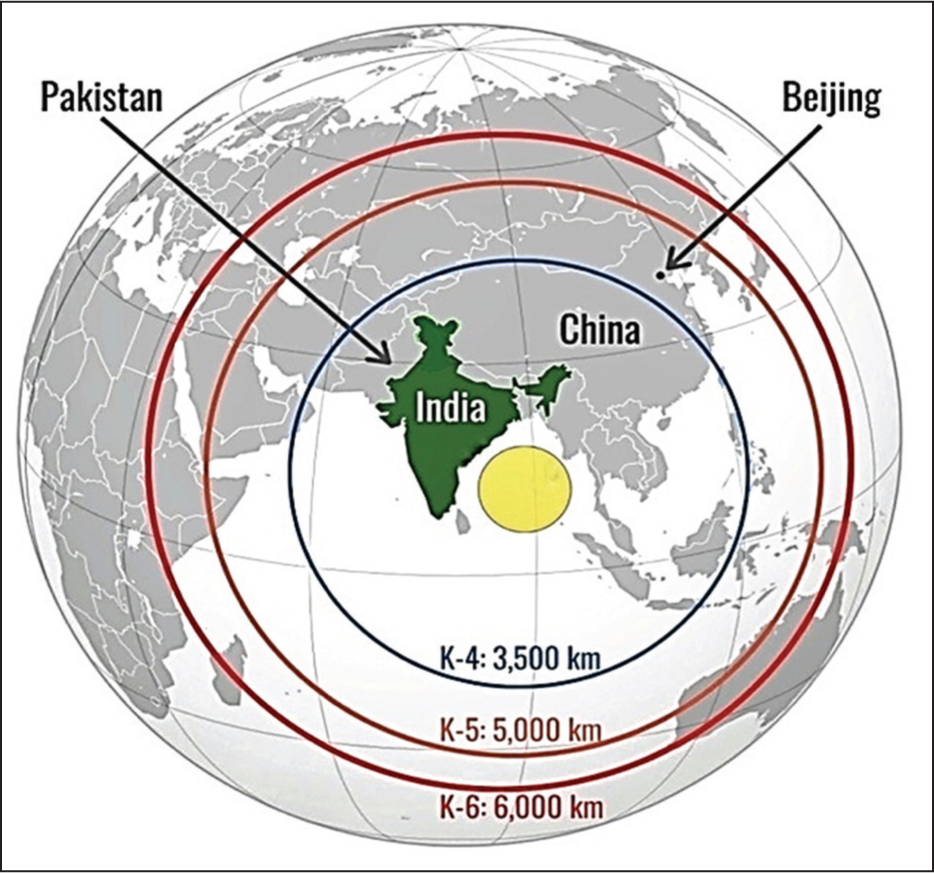
To address this problem, an intercontinental SLBM that can reach all parts of China from the secure waters of the Bay of Bengal is currently under development by the Defence Research and Development Organisation (DRDO) since 2017. Codenamed K-6, it will have a range of over 6,000 km (Kulkarni, 2022). To host the K-6s, India is working on a plan to build 13,500-ton SSBNs with a much more powerful 190 MW reactor (The Economic Times, 2024). Codenamed S5, it is most likely to also host the 5,000 km or 2,700 nm range K-5 missile, another DRDO project initiated in 2015 (Unnithan, 2017). The addition of the S5 SSBN to the existing four Arihant-class boats would address all the current limitations in targeting range of India’s SSBN program.
Nonetheless, the credibility of India’s sea leg of the nuclear triad cannot be evaluated solely on the basis of the targeting range; it must also be considered in terms of its survivability across various maritime environments. Pakistan’s anti-submarine warfare capabilities in the Arabian Sea are quite rudimentary, characterized by a limited fleet of ageing Agosta-90B submarines, insufficient sonar coverage, and a decrepit fleet of old Lockheed P-3C Orion maritime patrol aircraft. China has promised Islamabad eight Type-039 Yuan-class air-independent propulsion submarines, with the first four vessels slated for delivery by the end of 2023, yet none have been delivered to Pakistan as of 2025 (Sen, 2023, p. 3). The delay highlights the limits of Islamabad’s dependence on Chinese yards. Meanwhile, the Chinese Navy is not idle. Beijing is methodically reshaping the undersea environment of the Bay of Bengal. The research vessels of the People’s Liberation Army Navy (PLAN) are engaged in comprehensive bathymetric surveys along the eastern littorals of India, while numerous Chinese underwater drones have been observed conducting mappings of acoustic signatures in both the Arabian Sea and the Bay of Bengal (Panneerselvam, 2022). Once a dedicated Chinese carrier battle group (CVBG) moves into the Indian Ocean in future (Goswami, 2022, pp. 1–3), these initiatives seem to set the stage for a potential combined anti-submarine warfare (ASW) web that may drastically reduce India’s “bastion” waters. To meaningfully offset this risk, India must ensure that at least two SSBNs are on patrol at any given time. The Bay of Bengal’s warm, stratified waters and sharp salinity gradients disrupt sonar performance and complicate acoustic detection—but such oceanographic advantages translate into survivability only if backed by sufficient force. Multiple SSBNs at sea would strain adversary tracking resources, reduce the risk of a decapitating first strike on India’s undersea nuclear assets, and thereby reinforce the credibility of the country’s second-strike posture.
Giving Arihant and Arighaat Exclusive Pakistan-centric Roles
Current limitations of INS Arihant and INS Arighaat do not mean that they are just symbolic national projects or, at best, technology demonstrators. Although not capable of targeting Islamabad even from the coast of Pakistan, Sagarika can comfortably perform countervalue (targets of civilian value) second-strike attacks on Karachi—Pakistan’s most important commercial metropolitan city—from the heart of the Arabian Sea. One could, however, argue that K-4 SLBM can comfortably cover all of Pakistan even from the middle of the Bay of Bengal. However, K-4 is a much bigger SLBM, which means that the additional size of the SLBM would have restricted the four silos of both Arihant and Arighaat from carrying multiple SLBMs (Goswami, 2025, p. 159). Instead of 12 Sagarika SLBMs on each boat, onboarding K-4 would mean Arihant and Arighaat would be carrying only four such SLBMs. This reduction in deployment of nuclear weapons onboard its SSBNs would imply that India would be deploying a far fewer undersea nuclear weapons against Pakistan at any given time.
On November 27, 2024, K-4 was successfully tested from INS Arighaat, marking a significant leap in underwater nuclear capabilities. A Bulletin of Atomic Scientists piece from September 2024 by Kristensen et al. (2024, p. 336) claimed that K-4 is similar to the Agni-III intermediate-range ballistic missile in terms of what it can do. According to an official from DRDO, K-4 reaches “near zero circular error probability” (Kristensen et al., 2024, p. 336). On the other hand, Sagarika demonstrated its effectiveness at its most recent test in October 2022 when it was “tested to a predetermined range and impacted the target area in the Bay of Bengal, with very high accuracy” (PIB, 2022).
With Arighaat’s commissioning, India now has a fleet of 24 K-15 Sagarikas (12 for each Arihant boats) that can be deployed against a range of countervalue and “soft” counterforce targets (targets of military value) in Pakistan. Apart from Karachi, another viable target for countervalue retaliation by Arihant and Arighaat could be Hyderabad, Pakistan’s fifth-largest city and located approximately 160 km off the coast of Karachi (Peerzado et al., 2019, p. 423). Arihant and Arighaat could also be given missions to conduct “soft” counterforce retaliatory strikes on Masroor Air Base outside Karachi and Jinnah Naval Base at Ormara, Balochistan. Both are the largest bases of their respective services. Jinnah Naval Base is likely to host some, or all, Hangor-class diesel electric submarines once commissioned (Khanna, 2024). These boats could have a nuclear role with the Babur-3 submarine-launched cruise missiles (SLCM) (Kristensen et al., 2023, p. 341). Masroor, on the other hand, has multiple Mirage squadrons and subterranean facilities that are assumed to store and handle nuclear warheads for Ra’ad air-launched cruise missiles (ALCM) (Kristensen et al., 2023, p. 335). Therefore, Masroor and Ormara’s significance as a “soft” counterforce targets is immense, and INS Arihant can easily strike both bases from a distance of over 700 km off the coast of Pakistan. Even Shahbaz Air Base at Jacobabad and Khuzdar Garrison in Baluchistan, both located at a distance of over 400 km off Karachi, could be targeted if Arighaat/Arihant positions itself at 300 km from the coast of Pakistan as the direct distance to these targets is approximately 500–600 km. Shahbaz Air Base is suspected to host one squadron of Mirage assigned for nuclear strike missions, while commercial satellites have picked images of Ghauri and Shaheen-II TELs 3 at Khuzdar garrison (Kristensen et al., 2023, p. 336). A combined salvo by Arighaat and Arihant against such targets, 4 one of them being a metropolitan contributing 25% of the nation’s GDP (Subohi, 2024), will cripple Pakistan and jeopardize its viability as a functioning state.
Table 1 summarizes the key points discussed in the previous paragraph regarding India’s undersea nuclear capabilities with INS Arihant and INS Arighaat, their potential targets in Pakistan, and the strategic significance of these targets.
In other words, in a situation of nuclear war with Pakistan, India can now execute its “massive retaliation” policy by primarily deploying its stock of SLBMs, along with short-range land-based missiles following a first strike. Both Arihant and Arighaat may now be deployed to principally take charge of Pakistan-centric missions, which will effectively free India’s long-range land-based missiles to assume the role of a ‘strategic reserve force’ for intra-war deterrence or other contingencies. 5
Potential Targets for Arihant and Arighaat in Pakistan.
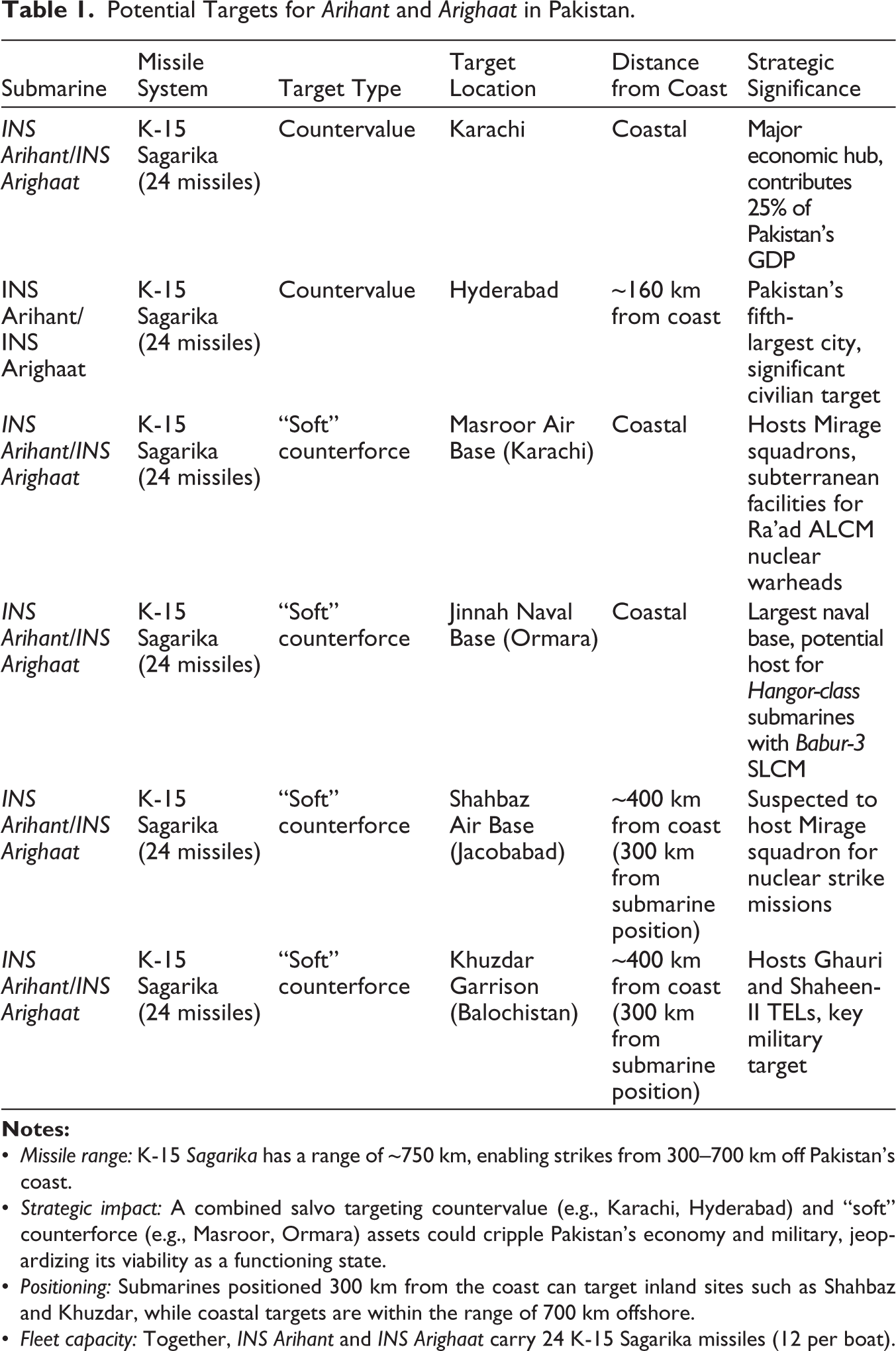
Missile range: K-15 Sagarika has a range of ~750 km, enabling strikes from 300–700 km off Pakistan’s coast. Strategic impact: A combined salvo targeting countervalue (e.g., Karachi, Hyderabad) and “soft” counterforce (e.g., Masroor, Ormara) assets could cripple Pakistan’s economy and military, jeopardizing its viability as a functioning state. Positioning: Submarines positioned 300 km from the coast can target inland sites such as Shahbaz and Khuzdar, while coastal targets are within the range of 700 km offshore. Fleet capacity: Together, INS Arihant and INS Arighaat carry 24 K-15 Sagarika missiles (12 per boat).
Building a ‘Strategic Reserve Force’
Rather than being pre-allocated for immediate countervalue strikes on Pakistan, India’s land-based intermediate-range Agni-III/IV and intercontinental Agni-V missiles assets can now be withheld for intra-war deterrence, signaling, and, crucially, for dissuading escalation in a potential two-front contingency involving China. The psychological salience of a survivable “reserve” capable of ranging Beijing and other eastern seaboard targets would strengthen deterrence credibility vis-à-vis China while avoiding the dilution of finite long-range missiles across two adversaries. Second, the shift would relieve pressure on the Indian Air Force’s dual-capable aircraft, whose sortie generation would be acutely challenged under nuclear conditions. While air-delivered weapons remain useful for flexible response and political signaling, they no longer constitute the backbone of assured retaliation against Islamabad, thus mitigating worries about runway attrition and command-and-control degradation.
Conceptually, privileging the Arihant and Arighaat for Pakistan-centric missions aligns with a rational actor model that seeks to minimize decision time during a crisis. Should Pakistan cross the nuclear threshold, Indian leadership can authorize a submarine launch package already tailored to meet the doctrinal demand for “unacceptable damage” without engaging in a deliberative reassignment of Agni units. Moreover, the SLBM force reinforces India’s NFU pledge by underscoring the retaliatory—rather than pre-emptive—purpose of its SSBN fleet. Because these submarines are optimized for stealthy “bastion” patrols rather than forward presence, they embody a recessed deterrent that becomes visible only upon use, thereby stabilizing crisis dynamics and reducing inadvertent escalation risks.
Operational implementation will, of course, require continued investment in secure communications, real-time intelligence to validate strike orders, and rigorous crew training to uphold tight negative controls. Yet the strategic logic remains compelling: a Pakistan-focused SLBM inventory permits the concentration of scarce long-range missiles on deterring China, while simultaneously assuring that any aggression from Islamabad invites an automatic, massive, and survivable riposte. As India’s undersea deterrent matures—with additional Arihant-class hulls expected in the coming years—the doctrinal balance between land, air, and sea legs will tilt even further toward the ocean. In that prospective equilibrium, the Arihant and Arighaat will not merely complement but will constitute the spearhead of India’s second-strike capability, transforming them from symbols of status into instruments of practical deterrence and strategic stability in South Asia.
Conclusion
The Arihant-class SSBNs are the most survivable components of India’s nuclear triad, making INS Arighaat’s commissioning a step toward fulfilling the requirements of India’s NFU doctrine. At the same time, the successful tests of the Sagarika SLBM and the K-4 SLBM have bolstered India’s undersea nuclear deterrence capabilities against both Pakistan and China. Both Arihant and INS Arighaat possess the capability to execute countervalue and “soft” counterforce second strikes on critical Pakistani sites, including Karachi, Hyderabad, Masroor Air Base, and Jinnah Naval Base. A dedicated fleet of 24 SLBMs just for Pakistan-focused missions would free up India’s long-range land-based missiles for China-centric deterrence and other contingencies. Therefore, it is time Arighaat and Arihant are seen as weapons of first choice for any second-strike mission by India against Pakistan if ever Islamabad were to cross the nuclear threshold.
Footnotes
Declaration of Conflicting Interests
The author declared no potential conflicts of interest with respect to the research, authorship, and/or publication of this article.
Funding
The author received no financial support for the research, authorship, and/or publication of this article.