



Abstract
New Zealand and Sri Lanka neighbor regional powers: Australia and India, respectively. Australia and India wield considerable influence in the Pacific and Indian Ocean regions due to their size, wealth, and resources. The island-states in Australia’s neighborhood are dependent on Australia for trade and security, whereas India’s neighbors engage in trade, have security pacts, and are occasionally influenced in domestic and foreign policy, resulting in both New Zealand and Sri Lanka being in these countries’ direct sphere of influence. Accordingly, this article examines how the geographic proximity of small states to a bigger, more powerful neighbor influences how smaller states manage these relations. The research follows the comparative case study method using two sets of cases: Australia and New Zealand, and India and Sri Lanka. The article develops new insights into the geopolitics of small states and provides a nuanced understanding of interstate relations. It argues that Alan K. Henrickson’s framework on distance in foreign policy could be developed further by explicitly acknowledging the relationship between distance and closeness, and the dynamic interrelationship between different types of distances and proximities.
Introduction
Influence in global affairs is important for states that are neither powerful nor rich. New Zealand and Sri Lanka are such states, but they are also notable in that they are adjacent to much larger states: Australia and India, respectively. Both these larger states consider themselves “powers” in global politics (Grare, 2014; Shekhar, 2010). How, then, do the geographies of these larger states affect the security and foreign policy engagements of their smaller neighbor? This article fills a gap in political geography and international relations by seeking to answer this question. Much has been written about the security of small island developing states (SIDS), 1 but this research applies to neither Sri Lanka nor New Zealand, nor to interstate security 2 ; big state–small state relations have also been examined in Europe, but neither New Zealand nor Sri Lanka has land borders with their large near-neighbor (Goetschel, 1998). This article adds to the recent work on asymmetrical neighbor relations through a political geography lens (Klassen, 2023).
The two authors conducted qualitative desk research from their respective countries. The research follows the comparative case study method using two sets of cases: first, Australia and New Zealand, and second, India and Sri Lanka. Data were gathered from primary sources such as publications from the agencies of foreign affairs, agencies of defense, parliamentary discussions, speeches, and United Nations data repositories. Secondary materials such as reputed publications, journals, and websites provided insights into the different security approaches of the two states.
The analytical framework for this article is Alan K. Henrickson’s four types of distance: physical, attributional, gravitational, and topological (Henrickson, 2002). Each pairing is examined across physical, attributional, and gravitational distance—first New Zealand and Australia, then Sri Lanka and India—with a focus on significant areas of tension and/or cooperation between the pairings. Next, the article unpacks the distances, including topological, between New Zealand and Sri Lanka. The subsequent discussion shows how the interrelationship between the distinct types of distance explains the degree of regional influence each state has. The article develops new insights into small-state security dynamics and provides a nuanced understanding of interstate relations that could be applied to other neighboring state relations. It argues that Alan K. Henrickson’s framework on distance in foreign policy could be developed further by explicitly acknowledging the relationship between distance and closeness, and the dynamic interrelationship between different types of distance/closeness.
Distance
Distance is a prime determinant of interstate relations, be it physical, gravitational, topological, or attributional (Henrickson, 2002). Henrickson argues for “distance thinking” in foreign policy as a tool for smaller states:
Even smaller countries, though they may be located next to or near other countries in relatively compact regions, may have far-flung relationships requiring geopolitical thinking at a distance. (Henrickson, 2002, p. 441)
Attributional distance refers to geographical groupings of “alikeness.” Because this type of distance is about values, it is therefore the least physically geographical and can change comparatively quickly. Gravitational distance refers to the effects of distance on the exercise of political power; in general, the further away a state is, the less its gravitational power (or mass) will be, and the slower change will be. Topological distance is usually created when a number of states are situated between two states, such as in Europe. The more states separating these two states, the greater the topological distance (in general). Change occurs more quickly in this configuration, for it is about the arrangement of spaces rather than the physical geography. Within this frame, distance implies both separation—“space between”—and its opposite—closeness. These concepts form the framework of analysis for the large state–small state pairings in this article, starting with New Zealand and Australia, followed by Sri Lanka and India.
Distance in New Zealand–Australia Relations
Physical Distance
New Zealand’s relations with Australia are strongly influenced by the 2,250 km wide, 2,300,000 sq. km area of the Tasman Sea, which physically separates Australia and New Zealand (Britannica, 2009). An oft-cited New Zealand response to Australia’s invitation to become part of the 1901 Federation of Australian states illustrates this influence:
Nature has made 1,200 impediments to the inclusion in any such federation in the 1,200 miles of stormy ocean which lie between us and our brethren in Australia. (Sir John Hall, cited in Mein Smith et al., 2008, p. 19)
But Sir John Hall continued by expressing an ongoing “community of interests.” This community is evident through the frequent use of the term “Trans-Tasman” for a variety of intergovernmental groups and formal and informal intergovernmental arrangements (Mein Smith et al., 2008). Thus, the Tasman Sea clearly delineates Australia and New Zealand as two distinct states but also connects them politically.
New Zealand has Australia to its west, the vast oceanic island states of the Pacific to its north and east, and Antarctica to its south. The Australian continent, on the other hand, sits between the Indian and the Pacific Oceans. South Asia and Southeast Asia are neighboring regions to its north and west; to its east lies a vast expanse of ocean containing New Zealand and, similarly to New Zealand, clusters of Pacific oceanic states and Antarctica to the south. The Pacific Ocean is a common oceanic connector that has resulted in close cooperation in a wide range of activities and with a range of other states, as elaborated in the next section.
Attributional Distance
New Zealand, currently also known as Aotearoa New Zealand, was colonized initially as a part of the colony of New South Wales, Australia. In 1840, New Zealand became a standalone colony, via the Treaty of Waitangi, a partnership agreement between the British Crown and the indigenous Māori tribes. While imperfectly implemented (e.g., New Zealand colonial governments failed to honor the treaty, instead imposing British law on the Māori people), the Treaty gave Māori a stronger voice than the indigenous nations in Australia (O’Sullivan, 2021). In Australia, successive colonial governments displaced and attempted, in part successfully, to eradicate the continent’s indigenous peoples, enabling full political domination. 3 In both cases, British law was accompanied by the imposition of British-style institutions, creating a strong common bond between trans-Tasman colonies (Mein Smith et al., 2008).
Structurally, the bilateral relationship between New Zealand and Australia reflects this common colonial heritage and the values that came with it. Unusually, the two states’ Departments of Prime Minister and Cabinet jointly facilitate trans-Tasman work programs (Nicklin, 2015, p. 179). The two prime ministers meet annually, and trade, defense, and other ministers also meet regularly. 4 These close connections enable discussions of mutual foreign policy interests, aided by, at a broad level, the same foreign policy aims—promoting the rules-based order to maintain global peace and security, open trade, good governance, and international cooperation. 5
The 1983 Australia–New Zealand Closer Economic Relations Agreement (ANZCERTA) is an example of attributional closeness between the two states. Pertinent to this article is the driver for the agreement. Leading up to ANZCERTA, joint ministerial statements acknowledged the ties that brought the two countries close together and the mutual need for them to get ahead of the changing multilateral trade environment for economic security (Anre et al., 2023). This close trading relationship has been enduring and has deepened over the decade following its signing (Australian Productivity Commission & New Zealand Productivity Commission, 2012).
Australia is New Zealand’s only military ally, formalized through the Australia–New Zealand–United States (ANZUS) Treaty signed in 1951. Up to World War II, New Zealand and Australia had aligned with the United Kingdom. After World War II, Britain’s power had declined while the United States’ power increased. Thus, post–World War II, Australia and New Zealand chose to militarily align with the United States through the ANZUS Treaty to protect against future security threats from Asia (Walters, 2021). In 1986, the ANZUS Treaty was disrupted by the United States. suspending its obligations to New Zealand, while reconfirming its treaty commitments to Australia. This widening of US–New Zealand attributional distance was caused by New Zealand’s impending nuclear-free legislation (passed in 1987), which prevented US naval vessels from entering New Zealand waters. On the other hand, New Zealand’s and Australia’s attributional closeness was not fundamentally affected, meaning the ANZ part of ANZUS Treaty obligations was not affected (Walters, 2021). 6
Despite this formal military connection, New Zealand’s and Australia’s attributional distance from the United States differs in defense. In a partial mending of military relations, United States and New Zealand signed the Washington Declaration in 2012, reducing New Zealand–US attributional distance. Even so, while Australia and New Zealand are closely aligned with each other, Australia is more closely aligned with the United States, while New Zealand and the United States are only “close friends” (Walters, 2021). Notably, Australia is a member of the Indo-Pacific Quadrilateral along with India, Japan, and the United States, but New Zealand is not (Senaratne & Nicklin, 2022). In 2021, Australia also signed the AUKUS security pact—an agreement with the United Kingdom and the United States aiming to “promote security and stability in the Indo-Pacific region” (The White House, 2022). AUKUS provides Australia with nuclear-powered submarines and joint development of advanced military capabilities such as robotics, AI, and cyber and quantum technologies. New Zealand has not been invited to be a part of these strategic security initiatives, although the United States opened the door to AUKUS during the deputy secretary of state’s visit to New Zealand in 2022. Geoffrey Miller (2022) from the Democracy Project 7 argues that New Zealand is ambivalent about AUKUS. New Zealand’s nuclear-free legislation is contrary to the nuclear-powered submarine capability being developed for Australia, but the advanced military capabilities are less problematic and could provide scope for involvement by New Zealand (Miller, 2022). This is a clear difference in defense values that separates New Zealand from its neighbor.
The shifting relations between New Zealand and the United States illustrate that New Zealand and Australian values, while attributionally close, are not the same, especially in relation to China. The Washington Declaration focused on cooperation in the nontraditional area of maritime security in the Asia Pacific, opening the door to the United States, engaging both Australia and New Zealand in power balancing against the rise of China in the maritime domain (Ayson, 2012). Robert Ayson (2012, p. 356) highlighted the current continuation of differences in values:
There is no doubt that Australia and New Zealand both have strong interests in the maintenance of American strategic power in Asia. Beyond that, however, the logic of the argument becomes more challenging.
He was referring to Australia’s and New Zealand’s respective economic interests in China, which have led both states to adopt “yes, and” policies—“yes” to geopolitical positioning towards the United States (Australia more strongly than New Zealand); “and” to the maintenance of productive relations with China to keep trade flowing and growing. Both Australia and New Zealand experience foreign policy challenges in their respective relationships with China because of China’s different values. However, with relations between Australia and New Zealand in a fundamentally stable state 8 with no immediate physical threats, New Zealand can afford to have a more flexible approach to the geopolitical dynamics of the Indo-Pacific, often adopting a position of “constructive ambiguity” (To, 2022). In an environment in which US–China tensions are increasing, Robert Ayson (2012) argues that a space is created for small powers to be useful, which suggests that New Zealand’s differentiated security values are valid.
Nevertheless, the attributional distance between Australia and New Zealand for security is close in relation to the South Pacific, where both states’ values align with those of the United States. For example, New Zealand and Australia, along with the United States, have been strategically aligned over criticizing (either directly or indirectly) the Solomon Islands security agreement with China, signed in 2022. New Zealand’s then prime minister, Jacinda Ardern, made uncharacteristically strong statements against the agreement, stressing the importance of collective Pacific security (Craymer, 2022). 9
Attributional closeness is also evidenced by the Five Eyes intelligence alliance—an informal arrangement comprising Australia and New Zealand in the Oceanic south, and Canada, the United States, and the United Kingdom in the Western north (Public Safety Canada, 2020). All are English-speaking states born of the British Empire, with common values supporting democracy and the rule of law. Since its inception in 1948, this relationship has expanded beyond intelligence and defense to areas of homeland security and justice, reflecting a strong alignment of values over combatting terrorism and transnational crime (Ferrill et al., 2021). Even here, New Zealand displays attributional distance on some issues. One well-publicized difference occurred over China’s security agreement with Solomon Islands mentioned above. New Zealand’s foreign affairs minister refused to support the other four states’ joint statement criticizing China’s action. Wakefield (2022) argues that this difference was more about New Zealand maintaining its independent foreign policy stance than about its economic dependence on China.
Differences in security values also exist around immigration policy, specifically the detention of irregular migrants. Australia’s “Pacific Solution” policy of 2001 excised Australia’s offshore islands from its territory for irregular migrants arriving by sea; it also sent these asylum seekers to offshore facilities in Nauru and Papua New Guinea while their claims for asylum were processed, keeping them in inhumane conditions, sometimes for years (Frelick et al., 2016; Hodge, 2015). These measures were part of a securitizing of immigrants, known as crimmigration. Since 2001, New Zealand has offered to take some of those determined as refugees, and while the two prime ministers came to agreement in 2013, it was not until 2022 that an agreement was actually signed (Neilson, 2022). The New Zealand immigration minister’s reasoning for the agreement is telling:
New Zealand has a long and proud history of refugee resettlement and this arrangement is another example of how we are fulfilling our humanitarian international commitment. (Neilson, 2022)
Faafoi was positioning New Zealand as a good international citizen, invoking quite a different value set from Australia’s securitization of immigrants, including New Zealand citizens deported from Australia. 10 However, the story of New Zealand as a good international citizen has its limits, as demonstrated in the next section.
Gravitational Distance
Even though Australia’s gravitational pull on New Zealanders is evident in almost every aspect of New Zealand society, from sport to familial connections, to work, finance, defense, and trade (Mein Smith et al., 2008), the biggest recent tension between New Zealand and Australia involved a gravitational pull from the smaller state to the larger and the power of the larger state to set the rules. In 2022, the number of Australians living in New Zealand was one-tenth the number of New Zealanders living in Australia (in turn, approximately 15% of New Zealand’s population). 11 The tension arose from the joint 1973 Trans-Tasman Travel Arrangement, which gave citizens of both countries the right to travel, work, and live in the other country without visa and work permit requirements of other foreigners (Australian Government Department of Finance and Administration & New Zealand Ministry of Economic Development, 2007).
When the movement of people from New Zealand to Australia began to outweigh the movement in the opposite direction and create undue welfare costs, the Australian government unilaterally introduced measures to reduce the New Zealand influx. These measures, starting with the requirement for a passport in 1981, escalated to exclude access to welfare support in 2001 and were progressively tightened (Curtin & O’Sullivan, 2023). In short, up to July 2023, 12 it was difficult for New Zealanders to become permanent Australian residents or citizens and thus avoid the uncertainties of being classed as “temporary migrants,” even though they might have been living in Australia for decades (McMillan, 2017). While New Zealanders could freely enter and work in Australia via a Special Category visa issued on arrival, the process for getting citizenship required first getting permanent residency—a process with a higher bar than needed for New Zealanders to live and work in Australia. By contrast, Australians moving to New Zealand faced no such restrictions.
The 2023 resolution of this situation has restored the cordiality of Australia–New Zealand relations. On April 24, 2023, the Australian prime minister announced that New Zealand citizens living in Australia for 4 years would be able to apply for citizenship (“Kiwis in Australia celebrate new citizenship pathway,” 2023; Moir, 2023). This move gave New Zealanders living in Australia a path to the security they had been missing since 2001 and will go a long way to rebuilding New Zealand’s trust with Australia.
A second and related issue has been the deportation of New Zealand citizens from Australia to New Zealand for criminal offending. New Zealanders who consider Australia to be their home but who were destined to the precarious status of “temporary migrant” were liable for deportation if they failed the “good character” test. Known as “501s,” 13 these deportees have often been living in Australia for many years; some have no family or connections in New Zealand (Stanley, 2018). Successive New Zealand prime ministers made repeated attempts to get Australia to soften its policy, without success (Bridie, 2022). Even so, commentators expect the 2023 pathway to citizenship will reduce the number of deportees as New Zealanders get access to social and other services previously denied them (Moir, 2023).
A key factor in the deportation policy is the practice of aforementioned “crimmigration,” for which both countries have been responsible (McNeill, 2021; Stanley, 2018). New Zealand monitors deportees arriving from Australia “to prevent future offending” (McNeill, 2021, p. 310). New Zealand undertakes deportations too, many to the Pacific Islands. These deportations, and the crimmigration policies and practices that accompany them, are a negative consequence of gravitational pull—for New Zealanders, Australia holds the power; for Pacific Islanders, New Zealand and Australia hold the power.
The dynamics of the tensions outlined above illustrate the realities of gravitational pull, which are particularly acute for neighbors but also, in the Australia–New Zealand case, result as much from attributional distance. The resolution of the New Zealand path to citizenship in Australia rested with Australian politicians. The gravitational pull of Australia as a place for New Zealanders to live and work pushed up against different values in relation to immigration. As the smaller party, New Zealand could only persist in presenting its case. Even so, common values of family and reciprocity that signal attributional closeness undoubtedly helped lead to the resolution (Mein Smith et al., 2008).
Distance in Sri Lanka–India Relations
Physical Distance
India and Sri Lanka are separated by the Palk Strait, which is from 64 to 137 km wide and 136 km long (Britannica, 2025), making it easy to cross from one state to the other. Located to the northwest of the island, India is Sri Lanka’s closest neighbor, with the Maldives located approximately 1,000 km to the southwest of the island. As will be seen under gravitational distance, this closeness strongly influences India–Sri Lanka’s bilateral relations.
Bilateral relations are further determined by the two states’ location in the Indian Ocean, as there are no countries south and southeast of Sri Lanka. The two states divide the world’s third largest ocean into the western and eastern Indian Oceans. They, especially Sri Lanka, sit astride global Sea Lines of Communication (SLOCs), thereby connecting and situating them centrally in global and maritime affairs.
Attributional Distance
Two types of attributional distance affect India–Sri Lanka security. First, in the past, northern and southern Indians settled in Sri Lanka from time to time. South Indian kingdoms invaded Sri Lanka during the Anuradhapura and Polonnaruwa eras, causing displeasure among Sri Lankans. Tamils from southern India who settled in Sri Lanka eventually formed their own kingdom in the north of the island (Senaratne, 2021). Therefore, southern Indian states and Sri Lanka are bound by culture and a common heritage. This has resulted in a close affinity between the communities of Tamil Nadu and northern Sri Lanka.
Second, the British colonized Sri Lanka in 1815 when they realized its strategic value and locational importance. In 1796, the Dutch had surrendered Sri Lanka to the British, who, before Sri Lanka’s strategic value became clear, had considered the arrangement as temporary. From 1815, India’s British colonials extended British rule and culture to Sri Lanka but did not eradicate or displace the Sri Lankan populations. They were, however, tactful in dividing the Sinhala and Tamil people.
The British colonial legacy continues to influence Sri Lanka, including through the bicameral parliamentary system and constitution at the time of independence. The pre-independence Donoughmore Constitution (1931–1946) provided universal adult suffrage and enabled general elections for Sri Lankan citizens. This was a milestone for British colonies that would later gain independence. However, the Donoughmore Constitution also drove a wedge between the Sinhala and Tamil communities, as the latter were unhappy with the electoral system. These conditions remained when Sri Lanka implemented the Soulbury Constitution at independence granted on February 4, 1948, contributing to the ongoing tensions between the two communities.
The “British way” of thinking dominated early Sri Lankan political life. D. S. Senanayake, Sri Lanka’s first postindependence prime minister, his Cabinet of Ministers, and even Members of Parliament were educated in Britain. Moreover, these ministers were from the social elite, whose families were constantly interacting with the British. These families gained the trust and respect of the British at the time of independence, resulting in the British being comfortable with transferring their power.
Continuing the colonial legacy, postindependence, Sri Lanka continued to rely on the British to maintain Sri Lanka’s security and foreign relations. D. S. Senanayake signed two agreements on Defense and External Affairs with the British in 1947, coming into effect when Sri Lanka gained independence. As such, up until 1956, Sri Lanka was attributionally closer to Britain than it was to India in the postindependence era.
This changed after 1956 as Prime Minister S. W. R. D. Bandaranaike understood the importance of maintaining friendly relations with India. He did not consider India as a threat to Sri Lanka’s security. Moreover, Sri Lanka did not formally abrogate the defense agreement, but with the withdrawal of the British bases, it became invalid. Therefore, Sri Lanka’s attributional closeness shifted from Britain to India, because Bandaranaike’s views on global issues aligned with Nehru’s, forming the basis of a personal friendship (Gajameragedara, 2011; Jayawardane, 2023).
Gravitational Distance
India’s gravitational pull on Sri Lanka spans both Sri Lanka’s domestic and external security interests and actions. Henrickson (2002, p. 444) states that “distant objects are more difficult to control than ones that are nearby.” Accordingly, India’s interests and its ability to dominate Sri Lanka stem from this physical proximity. As it is, neither India nor Sri Lanka can think of a security strategy excluding each other. In 1945, K. M. Panikkar indicated that Sri Lanka must accept the reality of being in India’s vicinity. In other words, Panikkar expected Sri Lanka to be an integral part of India’s security architecture.
Sri Lanka’s physical proximity has enabled India to exert pressure on Sri Lanka’s domestic policies on numerous occasions. Ladhu R. Choudhary (Senaratne, 2023) contends that India does not engage in or influence the domestic policies of its neighboring states, and instead, India encourages best practices its neighbors can follow. Contrary to Choudhary’s views, the Indian presence was visible in Sri Lanka during the war with the LTTE, in postwar settings, and on numerous commercial matters. For example, when the LTTE fought with the Sri Lankan government during the 1983–2009 war, “India funded and maintained training camps for the Sri Lankan Tamil separatist group” (Bojaria, 2009; De Votta, 1998, p. 462; Senaratne, 2021). In June 1987, India violated Sri Lanka’s airspace and airdropped dropped food to the Jaffna peninsula. Moreover, in July 1987, during J. R. Jayewardene’s presidency, the Indian government coaxed Sri Lanka to sign the Indo-Lanka Accord and devolve provincial powers through the 13th amendment to the Sri Lankan constitution (see de Alwis, 2020; Hubbel, 1987; Matthews, 1987; Ramachandran, 2021; PTI, 2020; The Wire, 2019). Neil De Votta (1998, p. 459) notes: “The manner in which the agreement was forced on Sri Lanka with hardly a stir from the international community indisputably proved India’s regional hegemonic status.” The signing of this agreement also permitted the Indian Peace Keeping Force (IPKF) to enter Sri Lanka in the late 1980s and be involved in the Sri Lankan government’s fight against the LTTE. India’s view is that ethnic connections with Sri Lanka give it a legitimate interest in Sri Lankan minorities (De Votta, 1998). An alternative interpretation is India’s actions were coercive diplomacy toward Sri Lanka.
India sent a government representative to observe the situation in Sri Lanka after the July 1983 riots (Keerawella, 2023, p. 39). Thereafter, India entered Sri Lankan domestic politics as a self-appointed mediator for the Sri Lankan government to negotiate with the Tamil rebels. Accordingly, the proximity between the two South Asian states have led to India’s close monitoring and intervention in Sri Lanka’s domestic policy, resulting in tensions in Indo-Lanka relations.
A maritime security threat to Sri Lanka is Indian breaches to the Indo-Lanka Maritime Boundary, determined in 1974. Due to the narrowness of the Palk Strait, South Indian fishermen encroach on Sri Lankan waters and engage in illegal, unreported, and unregulated (IUU) fishing. 14 There are many reports of this border being breached by the Indian fishermen, involving responses by the Sri Lankan navy (Senaratne, 2021). These fishermen and anyone disguising themselves as fishermen can enter Sri Lanka (Peiris, 2020). For example, during the conflict, the LTTE received supplies, ammunition, and training via this route; this route is used for trafficking contraband to Sri Lanka; during the height of COVID-19 infections in India, southern Indians entered Sri Lanka seeking refuge (see NDTV, 2021). As a result, the Sri Lanka Navy continuously patrols the Palk Strait to stop people and goods from illegally entering Sri Lanka (Sri Lanka Navy, 2022a, 2022b, 2022c). Conversely, there were also concerns of Sri Lankans seeking refuge in India during the recent economic crisis (see Sen, 2022).
South Indian politicians do not hold their citizens accountable and instead urge the Indian central government to act against Sri Lankan law enforcement (PTI, 2021b; Selvachandran, 2021). India, especially South India, continues to pressure Sri Lanka on the fisheries issue despite there being an India–Sri Lanka Joint Working Group on Fisheries that works to resolve interstate fishery issues (Ministry of Fisheries, Animal Husbandry & Dairying, 2020).
India’s gravitational pull on Sri Lanka extends to foreign policy. This pull was influenced in the 1980s by the Indira Doctrine. 15 The doctrine was in turn influenced by the perception that India’s security interests relied on the security of the entire region (De Votta, 1998; Muni, 1993). Therefore, New Delhi has shown a keen interest in Colombo’s foreign policy choices.
One of the primary tactics India uses to influence Sri Lanka’s foreign policy is voicing concern every time Sri Lanka engages other foreign countries within Sri Lanka’s physical borders. As Marshall Singer noted before a US congressional subcommittee, “India sees itself as the hegemonic power in the region and does not like extra-regional countries meddling in the region. They get very nervous about anybody else. They truly tend to view the Indian Ocean as an Indian lake” (cited in the Committee on International Relations House of Representatives, 1996, p. 23). Accordingly, India is suspicious of other countries entering Sri Lanka or engaging with it.
The effects on Sri Lanka’s close rapport with the United States in the 1980s during President J. R. Jayewardene’s era illustrates this suspicion. For example, India voiced its concern when Sri Lanka was to lease the oil tanks in Trincomalee to an American company. It also raised concerns when Sri Lanka permitted the Voice of America (VOA) to establish a transmission tower on Sri Lankan soil (De Silva, 1995, pp. 116–117; see also AdaDerana, 2017) and when it allowed American warships such as USS Cushing and USS Ranger to refuel and replenish in Sri Lanka (Auerchbach, 1981). Jayawardane (1991, p. 197) notes that Indians had referred to Sri Lanka as “being turned into a naval base for the Americans,” due to the increased US presence in Sri Lanka at that time. While there was no threat, perceptions of its possibility influenced India’s actions (De Silva, 1995).
Sri Lanka’s former president J. R. Jayewardene recognized Indian fears and reassured India that he would not permit any extra-regional power that would pose a threat to India to engage with Sri Lanka: “[i]n this region the USA is subservient to India. So are all the other countries” (Sunday Times, 1987, as cited in Jayawardane, 1995, p. 233). These instances illustrate India’s influence over Sri Lanka’s foreign policy.
Any form of foreign collaboration and exchange by Sri Lanka inevitably receives India’s attention and, to a certain extent, its displeasure. Rohan Gunaratna (1993, p. 31, as cited in De Votta, 1998, p. 461) quotes an official from India’s Research and Analysis Wing (RAW) as stating: “[the] induction of [Israel’s] Mossad and the top secret American National Security Agency … has left New Delhi with no option but to escalate the tension on Sri Lanka.” This illustrates how a larger neighbor can manipulate the foreign relations of a smaller state. Hence, even though Sri Lanka is recognized as an independent, sovereign state in the international system, it is unable to or has limits in exercising its independence. This is a vivid example of India’s gravitational pull on Sri Lanka.
The Indian gaze on Sri Lanka, visible in the 1970s and 1980s, continues to have a lasting presence in the early twenty-first century. For example, India is apprehensive of Chinese engagement in Sri Lanka, as Sri Lanka views China as an alternative partner to India (see Senaratne, 2020b).
India’s contemporary apprehension of increased Chinese engagement is visible in foreign investment decisions (PTI, 2021b). In early 2021, the Indian government protested the construction of renewable energy power plants on the Delft, Nagadeepa, and Analthivu islets off the coast of Jaffna awarded to Sino Soar Hybrid Technology, a Chinese company (Aneez, 2022; Farzan, 2021; PTI, 2021a; WION, 2021), arguing that it posed a threat to India’s security. The project to build solar power plants in northern Sri Lanka was granted to the Adani group, which has since withdrawn from the project (Kay, 2022; NewsFirst, 2022; Daily Mirror Online, 2025). The Adani group was awarded the development of the Colombo West International Terminal of the Colombo Port (Marian, 2022).
A second example is the arrival of a Chinese submarine Changzheng-2 and warship Chang Xing Dao at the Colombo Port in October 2014 (Aneez & Srilal, 2014). Sri Lanka permitted this visit as it is usual for foreign vessels to refuel and replenish stocks as well as to provide refreshment for their crews. However, Sri Lanka rejected a similar request from China in May 2017, as it coincided with the Indian prime minister’s visit to Sri Lanka (Aneez & Srilal, 2017). Five years later, in August 2022, India raised similar concerns when the Chinese survey vessel Yuan Wang 5 was to visit the Hambantota Port and asked Sri Lanka to defer the visit. The Indian Minister of External Affairs, S. Jaishankar (2022, as cited in Farzan, 2022) stated, “[w]hat happens in our neighbourhood, any developments which have a bearing on our security obviously are of an interest to us.” Statements of this nature from the Indian bureaucracy illustrate the attention India is giving to activities that take place in Sri Lanka and how it expects Sri Lanka to reconsider its foreign policy choices.
Distances Between Sri Lanka and New Zealand
This section compares the distances and proximities between New Zealand and Sri Lanka, drawing on the analyses above for explanatory clues. It is here that topographical distance becomes relevant and is discussed after physical, attributional, and gravitational distances.
Physical Distance
As has been demonstrated above, New Zealand and Sri Lanka’s physical locations are a significant determinant of their relationships with their closest neighbors. India and Sri Lanka are separated by the Palk Strait, which is much narrower than the Tasman Sea, which separates Australia and New Zealand. In other words, India and Sri Lanka are located much closer than Australia and New Zealand, despite the latter referring colloquially to the Tasman Sea as “the ditch,” implying a much smaller body of water than is actually the case (Nicklin, 2015). The shallowness of the Palk Strait and its many shoals and islets limits sea transport to small vessels. whereas the storminess and breadth of the Tasman Sea requires larger vessels, such as container ships and cruise vessels.
The nature of the watery spaces between each pair of countries creates distinct types of human connections and power dynamics affecting their security. Sri Lanka’s relations with India are determined by the Palk Strait; New Zealand’s relations with Australia are framed by the Tasman Sea, but much less determined by it.
Attributional Distance
A strong attributional connection between Sri Lanka, New Zealand, India, and Australia is their common colonial past. All four states are democracies, past colonies of the British Empire, and members of the Commonwealth. However, the colonial project played out differently in all four countries, resulting in distinct cultural spaces between the two pairings.
Sri Lanka’s post-independence relationship with Britain exemplifies the attributional distance between Sri Lanka and India. Its ideological affinity, reliance on the democratic way of life, and colonial legacies brought Sri Lanka closer to Britain and the United States than to India. The Commonwealth of Nations was a security mechanism Sri Lanka relied on, as the USSR vetoed Sri Lanka’s membership to the United Nations until 1955. However, this changed after 1956 as the prime minister at the time did not consider India a threat to Sri Lanka’s security and interests. Since then, India has played a crucial role in Sri Lanka’s domestic, foreign, and security policies, at times by making their presence felt by force.
New Zealand and Australia’s common colonial roots continue to connect them to this day, not just to each other but to other first world states. Unlike Sri Lanka and India, their colonial origins resulted in largely displacing the indigenous people through large-scale settlement and physical domination of space. Indigenous people were divested of all or most of their lands and were thus disenfranchised and disempowered in a way that Sri Lankan and Indian people were not. 16 This domination resulted in strong, enduring connections with the British Empire that built their economic wealth and developed them into First World states. Because the other First World states are primarily located in the Northern Hemisphere, Australia and New Zealand are included in the United Nations grouping “Western European and Others” rather than Asia Pacific. 17 Their physical distance from these like-minded states has made cooperation between them additionally important for maintaining this attributional closeness.
The postcolonial differences extend into the area of people movements. Refugees and asylum seekers feature in both pairings, but with differences. The primary difference is the visa status of people moving from the smaller state to the larger. New Zealanders can work and live in Australia via a special visa issued on arrival in Australia. They do not have to apply for the visa, and being of “good character” is the only condition; Sri Lankans must apply to travel to and work in India. While Australia worries that New Zealand is a conduit for foreign nationals to get entry to Australia (by getting New Zealand citizenship), their concern is minimal compared with the illegal immigration of Sri Lankans to India and vice versa. Not many Australians travel to New Zealand illegally for work. However, Sri Lanka frequently attracts Indians who enter Sri Lanka illegally for work. For example, according to the Department of Immigration and Emigration (2023, personal communication see also Department of Immigration and Emigration, Sri Lanka, 2021; Deccan Herald, 2012, PTI 2015; PTI 2012), a total of 591 Indians have illegally entered Sri Lanka, while another 915 people have illegally worked in the island.
Gravitational Distance
The close gravitational distance between the larger state in the pairing and the smaller state affects the domestic environments of both Sri Lanka and New Zealand. In both cases, the larger state pulls on the smaller and there appears to be some lack of reciprocity—the smaller state often has little political pull on its neighbor’s policies. However, for Sri Lanka, this pull is overt, while for New Zealand, it is more in terms of a lack of attention; for Sri Lanka, there is no evidence of reciprocity, whereas there are occasions in which New Zealand can exert some influence, such as ANZCERTA and the Nauru refugees. Some of New Zealand’s policies naturally align with those of Australia, but even where they do not, the pressure or considerable influence from Australia for New Zealand to implement certain policies is much less than for Sri Lanka. Even so, such influence is slow to take effect and may depend on the receptiveness of a particular prime minister rather than any sense of wanting to please.
In the Sri Lankan instance, India has a firmer grip and position on how Sri Lanka’s domestic, security, and foreign affairs should be implemented. The Indian position in this regard is clear—Sri Lankan external and internal policies should not be at the expense of India’s security interests. Since Sri Lanka understood this reality, it has taken to keeping India abreast of important decisions that the island made, like eliminating terrorism from Sri Lanka. This was to garner New Delhi’s support. Accordingly, the narrow width of the Palk Strait when compared with that of the Tasman Sea has a huge bearing on the geopolitical realities faced by Sri Lanka. New Zealand, on the other hand, is not so strongly influenced by Australia. Even so, the dynamic of the lack of or unreliable reciprocity in gravitational distance is similar.
New Zealand’s ability to counter the gravitational pull of Australia in the international arena comes in part from its insistence on an independent foreign policy that enables it to operate in a space of constructive ambiguity. While part of the anglosphere, it sidesteps differences in values, seeking to avoid, for example, Australia’s more fraught relationship with China. Sri Lanka, on the other hand, is unable to counter India’s gravitational pull, as the geographical proximity guarantees Indian involvement. This can only be circumvented when Sri Lanka’s head of state maintains a close rapport with the Indian leadership as in the 1960s and 1970s—especially during the Indo-China War and Indo-Pakistan War—when Sri Lanka’s premier Mrs. Sirimavo Bandaranaike could negotiate with then prime minister Jawaharlal Nehru and Mrs. Indira Gandhi, respectively. Moreover, an alternative for Sri Lanka to ensure some degree of independence in its foreign, domestic, and security policies is by keeping India abreast of Sri Lanka’s plans. More recently, Sri Lanka has stood firm in its nonaligned foreign policy regarding India’s apprehensions about China. Thus, both New Zealand and Sri Lanka have attempted to avoid the geopolitical realities of their big neighbor’s relations with that of China.
Topological Distance
The gravitational pull of their larger neighbor creates a topological conundrum for Sri Lanka and New Zealand. Do they need, and is it even possible, to create topological distance from their neighbor? In New Zealand’s case, its oft-cited independent foreign policy stance is one way in which it creates topological distance from Australia. For Sri Lanka, the geographical, gravitational, and attributional closeness makes it much more difficult. However, it is possible to consider the ability of topological space to fold and ripple (Latour, 2007). Both Sri Lanka and New Zealand can fold space and create topographical closeness to other states and international organizations in a complex web of power relations. Sri Lanka and New Zealand leverage their geographical advantages to navigate these power relations (Allen, 2016). Examining these relations in terms of topographical clustering provides useful insights into these relations and how the two states manage the above conundrum.
The regional architectures of the Indian and Pacific Oceans feature strongly in Sri Lanka and New Zealand’s topological distancing. Examining the different configurations is therefore instructive. For example, Australia is a member of the Indian Ocean Rim Association (IORA), along with India and Sri Lanka, whereas New Zealand is not (Indian Ocean Rim Association, n.d.); Australia, New Zealand, and India are members of the East Asia Summit, but Sri Lanka is not; Sri Lanka is again absent from the Pacific Island Forum, although India’s place there is as a Dialogue Partner, whereas Australia and New Zealand are full members. By contrast, all four states are members of the ASEAN Regional Forum, the Commonwealth of Nations, and the United Nations.
Figure 1 provides some insights into topological distance for New Zealand and Sri Lanka. First, India’s and Australia’s membership of the Indo-Pacific Quadrilateral (QUAD) reflects their close topological distance to the United States and Japan. The QUAD is notable because it spans both physical locations and represents an extraordinarily strong value set aimed at countering the rise of China. India and Australia thus have a common topological closeness that is distant from both Sri Lanka and New Zealand. While the United States and Japan are also members of the East Asia Summit and Asia-Pacific Economic Cooperation (APEC), and Dialogue Partners for the Pacific Islands Forum, the QUAD is the only grouping of these four powers alone. Dialogue Partners are not members but are included because they have demonstrated an interest in the organization’s goals and have something to contribute. Their involvement could indicate a desire to close the topographical distance. Not only India but several large Western powers and China are Dialogue Partners in the Pacific Islands Forum. That desire to contribute could also be part of a gravitational distance dynamic—for example, toward China in the Shanghai Cooperation Organization (SCO).
Topological Distance: Regional Compartments.
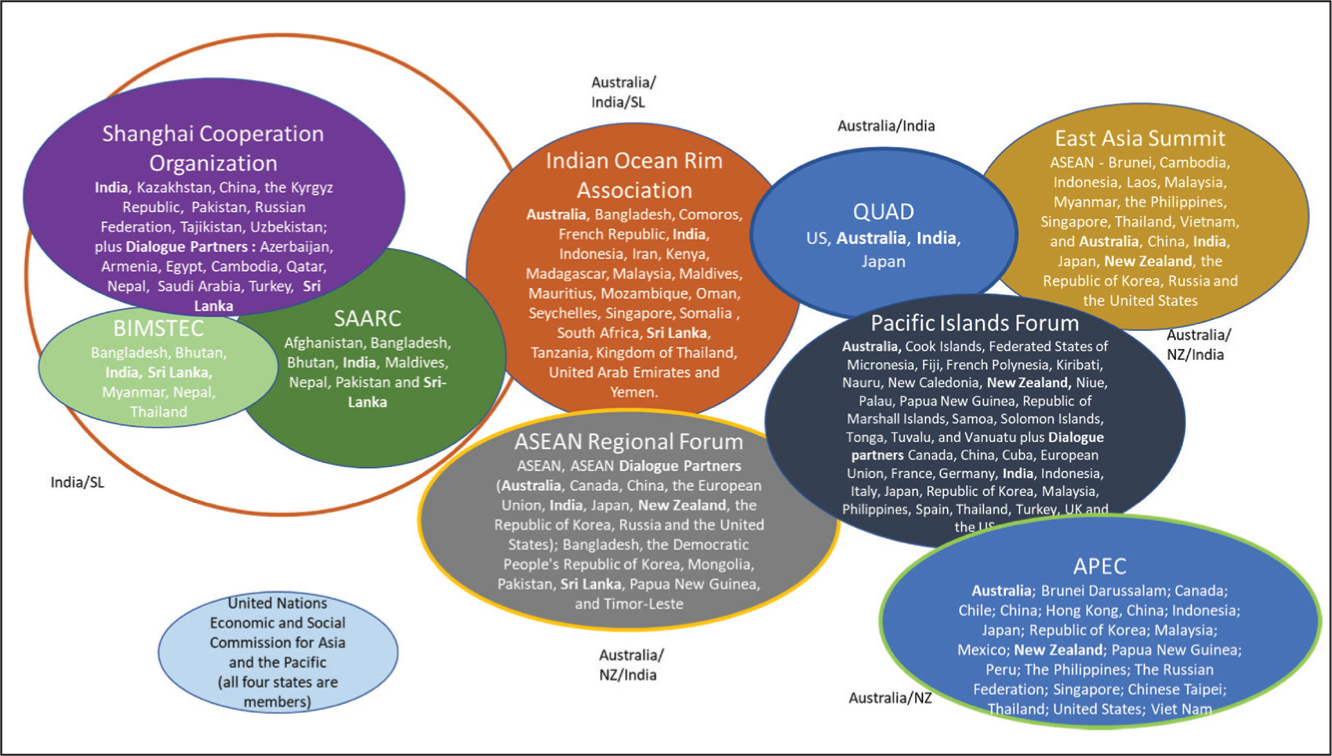
Second, Figure 1 illustrates that Sri Lanka and New Zealand are in different topological subsets, along with their neighbor. The first subset is the SCO/BIMSTEC 18 /SAARC 19 grouping, in which India and Sri Lanka are both present. 20 The second is the ASEAN Regional Forum/East Asian Summit/APEC/PIF grouping, in which Australia and New Zealand are both present. These two subgroupings largely reflect the two pairings’ geographical location—the Indian Ocean and the Pacific Ocean. These locations also reflect a value set—a concern for and interest in each respective ocean area.
What these groupings do not reflect, though, are the relational power dynamics within each group, particularly for Sri Lanka and New Zealand. Sri Lanka is less present in these groupings, but within BIMSTEC and SAARC, of which both is a member state, Sri Lanka has wielded some power. In the 1980s, Sri Lanka played a leading role in the formation of SAARC and in introducing the SAARC Convention on the Suppression of Terrorism. As of March 2020, the secretary general of the SAARC Secretariat was a Sri Lankan national—Esala Weerakon (SAARC, 2020). However, SAARC has been largely inactive since Pakistan was unable to host the biennial summit in 2016, as India refused to participate. Unfortunately, Sri Lanka was unable to sway the Indian decision, and as of 2025, SAARC has not held a summit for nearly a decade. 21 In 2022, Sri Lanka handed over the chairmanship of BIMSTEC after a two-year term (see Senaratne, 2020a). Additionally, Sri Lanka has chaired regional groupings on a rotational basis and headed some subcommittees, such as on terrorism. Similarly, New Zealand is very influential in the Pacific Island Forum and also has influence more widely in the institutions of the Asia Pacific (Patman et al., 2018; Powles, 2021). In trade, New Zealand’s coupling with Australia for the ASEAN–Australia–New Zealand Free Trade Agreement of 2008 magnified the weight of both states (Castle, 2018).
Topological distance for Sri Lanka and New Zealand is, therefore, affected by their wider geographical environment. Each state is primarily enfolded in its own region. Only in larger groupings such as APEC and the United Nations do both the states participate.
Implications
This analysis has three generalizable findings: physical distance matters, small states cannot rely on reciprocity in the gravitational relationship, and the wider geographical environment affects topological relationships. First, physical distance, or as in the case of Sri Lanka and India, physical closeness, will always be a strong factor in interstate relations. Second, one effect of the gravitational pull of their larger neighbor, both Sri Lanka and New Zealand, is a lack of or unreliable reciprocity. In other words, smaller states have to expect to be flexible when wanting something from their larger neighbor. Third, the topological analysis showed a strong correlation between physical location and membership of regional groupings.
However, this analysis also points to developments in Henrickson’s framework in three ways: distance and closeness are intimately related, there is movement within a category, and the categories are interconnected. First, the concept of topological distance is useful when considering the dynamic of the smaller state wanting to exercise its own voice away from its neighbor. However, in terms of the other categories, the authors argue that closeness or proximity more accurately describes the dynamics involved. Second, the examples have shown relationships between states are dynamic, which Henrickson’s framework does not explicitly reflect. Third, these findings suggest Henrickson’s categories do not operate independently of one another. For example, physical and gravitational closeness are intricately linked when considering the power dynamics of larger–smaller state relations; attributional and topological closeness is more conditional and enables much more diverse relations for the smaller partner that can to some extent offset the influence of the larger state. Explicitly examining both distance and closeness and the interactions between them could, therefore, be a more useful analytical tool. Henrickson’s framework implies this relationship but does not make it explicit.
Conclusion
This article set out to answer the question ‘How do the geographies of larger states affect the security and foreign policy engagements of smaller neighbors?’ It did this by comparing the pairing of New Zealand and Australia with that of Sri Lanka and India by way of Alan K. Henrickson’s geographical distance framework. Applying the distinct types of geographical distance has provided a more nuanced picture of the degree of influence and of areas where the two states have been able to make their own voices heard. Extrapolating from the comparison in this article, this framework suggests four interesting dynamics between small states and their larger neighbors.
The first is that larger states do influence their smaller neighbors on matters of security, and that the smaller the physical distance between states, the greater the influence. The second is that the attributional closeness of the two states is in large part mirrored in the regional groupings in which they choose to participate. The third is that smaller states can step out of the shadow of their larger neighbor via these regional groupings, but the degree of independent activity by the smaller state is affected by the physical, attributional, and gravitational distances experienced with their larger neighbors. The fourth is that topological distance can provide a space for smaller states to exercise their own voice, but that it is likely these states will be influenced by the other types of distance in regional groupings—that only in large multilateral groupings such as the Commonwealth of Nations or the United Nations is there more equal space for their voices.
Lastly, this article argues that Henrickson’s framework could be developed by explicitly acknowledging the relationship between distance and proximity, as well as the dynamic interrelationship between the four categories. More research is needed to further explore the dynamics of distance and proximity for small state relations.
Footnotes
Declaration of Conflicting Interests
The authors declared no potential conflicts of interest with respect to the research, authorship, and/or publication of this article.
Funding
The authors received no financial support for the research, authorship, and/or publication of this article.