




Abstract
There is growing interest in how rural transformations due to mega-infrastructure projects in Africa are causing widening inequalities. We examine the impact of Kenya’s Nairobi–Mombasa standard gauge railway (SGR) on land tenure, property rights, and dispossession in Voi town, southeastern Kenya. Drawing from frontier and neo-colonial theoretical perspectives, we argue that large-scale infrastructure projects in Africa facilitate resource extraction and deepen local inequalities through land commodification, speculation, and elite accumulation. Through an ethnographic case-study approach involving fieldwork, interviews, and focus group discussions, the research highlights the complex interplay between infrastructure development and tenure insecurity. By analysing three cases we show how different land tenure systems—private, group, and public land—offered varying degrees of protection and vulnerability. We find that while private titling provides some security, it also encourages speculative sell-outs, exacerbating inequalities. Group land tenure arrangements, including a novel Community Land Trust (CLT) model, offer more robust protection against dispossession and fragmentation. We conclude with policy recommendations for stronger legal frameworks, including proactive land governance frameworks surrounding infrastructure projects, better protection of public land, and education on land rights, while calling for an inquiry into irregular land acquisitions surrounding the SGR itself.
Introduction
At 6
Was it any surprise that this settlement was adjacent to the Nairobi-to Mombasa standard gauge railway (SGR), in Msambweni, Voi town where lucrative investments were planned by the country’s political and economic elites? And was it any coincidence that some of the residents had been on the land for 12 years since it had been acquired by a private developer, the same period of time after which squatters can claim legal rights? And through what process was public land acquired for lucrative developments beyond the compulsory acquisition for the SGR itself?
A wave of scholarly research surrounds the transformations taking place in rural Africa as a result of resource extraction and the mega-infrastructural developments designed to access and transport resources to global destinations, described by some as the “new scramble for Africa” (Carmody, 2017). The neo-colonial dimensions of these transformations and the deepening of local inequalities have both been highlighted extensively (see Enns & Bersaglio, 2019), while frontier theorists point out how the tidal wave of transformation brings with it dispossession, new forms of structural and direct violence, and the rude imposition of new social orders upon resident populations (Schetter & Müller-Koné, 2021). The political and economic maneuvers prompted by the “anticipation” of such projects have been well described (Cross, 2015; Elliott, 2016). Moreover, ethnopolitical tensions and intercommunal conflicts have arisen when various groups try to claim land, for the benefits of compensation, speculation, employment opportunities, and corporate social responsibility projects related to infrastructure developments (Cormack, 2016; Mkutu et al., 2021).
A recurring theme in the literature is the issue of land rights, especially on informally or communally-owned lands in marginalized rural areas, which may be overridden for a host of reasons including legal loopholes or provisions that lag behind the changing context, weak institutions, weak governance, structural inequalities and importantly, predatory elites and their global capitalist networks.
Tenure Security and Dispossession
Rural people across the world rarely have formalized exclusive rights to the lands on which they live and work. Formerly colonized states, particularly those with a history of post-independence conflicts may be struggling to piece together workable land tenure systems amidst inequitable inherited systems, competing claims, and grievances (Almeida, 2018).
Developing states may be in the process of private titling, while several states (particularly in Africa) have chosen systems in which land remains vested in the state, while citizens have lesser user rights which are often collective in nature, and held in trust by representatives at the local level (Lindsay, 2012). Depending on the land tenure system of the country in question, this can leave users rather vulnerable to either private-sector or state acquisitions particularly where high profits or political careers are at stake (Lesutis, 2022). Compensation may be given but is of lower value than that given to private owners, or relocation (an alternative form of compensation) may be to a non-ideal place with added economic losses and intangible social costs incurred on moving there (Lindsay, 2012). With this in mind, privatizing land tenure is often viewed as the best way to secure citizens’ rights since having a title ensures compensation, and also empowers the user in participation processes. However, Lund (2000) argues that tenure security is not always enhanced by private property tenure, particularly because a large number of informal rights-holders and secondary users are often dispossessed of their access to land. Similarly, Andreasson (2006, p. 3) notes that “if property rights produce freedom and prosperity, they do so very selectively.”
Marginalized groups, even those with private titles, face a host of challenges in enforcing their rights, including the challenges of getting their documents from official departments (often with requests for bribes) and then storing them safely, accessing information on upcoming projects, and engaging effectively in participation processes. 1 Moreover, economic needs together with the commodification of rural lands make it tempting to sell land, especially when it becomes more valuable. Rural private landowners with many immediate needs to be met, including the ubiquitous burden of school fees or hospital bills, are extremely vulnerable to being bought out, at relatively low prices and in the words of a local resident near a planned development corridor “being displaced by money” (Elliott, 2016). They frequently fall prey to speculators who may be policy makers or elites or their contacts, who are pre-informed as to the location of projects and who later make enormous profits in compensation or investment returns (Mkutu & Schetter, 2023).
In sub-Saharan Africa, weak controls over communal rural land, along with presumptions that it is lying idle can provide an opportunity for state or regime-sanctioned land grabs (Alden Wily, 2011; Bush et al., 2011). However, privatized tenure systems are particularly vulnerable to a more diffuse form of predation. Privatized land tenure means that there are more actors and middlemen and more opportunities for people to “eat” at the expense of others. This might take the form of requesting a bribe and colluding or favoring political friends and brothers; conflicts of interest are frequently ignored in the pursuit of private gain (Alden Wily, 2011). While helping to secure rights to compensation for some, privatization in Kenya has opened up opportunities for speculation and land grabs, and dispossession of the rural poor through the urbanization and escalating cost of their land (Mkutu & Schetter, 2023).
We investigate the role of property rights in tenure security in Voi town in southeastern Kenya, along the route of the Nairobi–Mombasa SGR which was built from 2013 to 2017. It showcases a variety of different land tenure arrangements, with varying degrees of privatization, with which the SGR project intersected. We consider the processes of land acquisition, the various claims which arose, and the security or insecurity of the citizens. We take as our departure the point made by Lund (2012) that with privatization, the resulting tenure security depends upon which side of the fence you are on. An important point to note in the Voi story is that the biggest losses relate not to the SGR itself but to the commodification of land which prompted speculation, corrupt elite accumulation, and dispossession. We see this as a problem to which Kenya is more vulnerable given that it has a more privatized land tenure system than its neighbors Tanzania and Ethiopia, who have also constructed SGRs in the past decade.
The work takes an ethnographic case-study approach to understand the local dimensions of the SGR in Kenya. It is based on around 10 days of fieldwork in Voi, in which observations, in-depth interviews (19), and focus group discussions (5) were conducted with community members of both genders and various ages, civil society and faith-based organizations, business people including hoteliers, conservation organizations, national and county administrators and politicians. Different sites along the railway were purposively sampled based on prior knowledge (from a local administrator) of the areas most affected by land disputes. Questions were framed around exploring the local dynamics of land acquisition surrounding the SGR. Narratives were examined and triangulated manually, and the different experiences faced at the different sites were compared and contrasted to understand the losses and gains relating to the SGR project.
Land Tenure and Development in Kenya
Land tenure systems in Kenya consist of private land, public land (both alienated for specific purposes or institutions and non-alienated), and community land (formally known as trust land and recognized as the ancestral land of specific ethnic groups). Formal land tenure regimes in most of Africa were introduced during colonialism in the early 20th century and revised following the 2010 Constitution of Kenya. Land tenure became a means of colonial governments extending power into rural areas, often operating via supposedly locally legitimate authorities, who were vested with tremendous power over land (Boone et al., 2021).
In Kenya, British colonial authorities alienated and titled prime land in the early 20th century for settler farms (Okoth-Ogendo, 1991), displacing existing smallholder farmers and residents (who were later invited back as squatters to work on the land) (Furedi, 1989), beginning a formal system of exclusive private property and introducing an important means of social stratification in the process. Land tenure in the “native reserves” was classified largely as Trust land, held in trust for communities by local authorities. These limited rights, barely known by communities and held at such a impractical distance from administrative centers, were practically impossible to exert.
A process of titling in the post-colonial era began with the subdivision and sale of settler farms and other, mostly agricultural areas (Leo, 1989; Okoth-Ogendo, 1991). Trust land was retained and the 1970s saw the introduction of large group ranches with collective titles on some Trust lands, particularly among the Maasai and Samburu pastoral groups. 2 This system, introduced with assistance from international donors, aimed to formalize collective land tenure and provide a basis for credit and integration into the market economy. However well-intended, it was rather restrictive and impractical and the majority of group ranches dissolved and were subdivided among the members, who have slowly been formalized (Lesorogol, 2002; Ng’ethe, n.d.). The subdivision process was often inequitable, with locally empowered group-ranch members ensuring that they received bigger and better parcels of land (Lesorogol, 2002). At the same time, from 1962 to 2016, approximately 530 settlement schemes were created on former colonial ranches to address problems of landlessness, land hunger, and internal displacement, and also to consolidate political support (Boone et al., 2021, p. 1). The Ndung’u Commission, set up in 2003 to investigate illegal appropriation of land, found that over the same period much settlement scheme land and also public land was irregularly grabbed or allocated to reward political cronies (Southall, 2005).
The provisions of the 2010 Constitution and the ensuing legislation (Land Act of 2012 and Community Land Act of 2016) turned Trust land into Community land, and gave landholders the same rights, in theory, as private land although on a collective basis. However, the process of implementation has been slow and boundaries are unclear (Alden Wily, 2018). Another piece of legislation, the Land Value (Amendment) Act of 2019, facilitates rapid acquisition without settling compensation disputes and deems that compensation requires semi-permanent settlement on the land, thereby ignoring pastoral nomadic realities.. Therefore, legal provisions provide only limited protection for the interests of communal rights-holders, while private land tenure is more secure in providing for compensation.
The wave of infrastructure investments in Kenya, and East Africa as a whole, has come at around the same time as these legal changes. However, several large concessions for energy projects, such as oil exploration and extraction in Turkana (Agade, 2017) and the Lake Turkana Wind Power project, were granted while the land was still under the now-repealed Trust Land Act. Hence, financial compensation for community members has been lacking and companies have by default been the ones to negotiate with communities on how to “compensate” them for excised land through CSR and employment opportunities, often leading to significant dissatisfaction and tensions. Regarding the SGR project, to a greater extent, the Nairobi–Mombasa section follows the path of the previous colonial East African meter gauge railway (MGR) which is on public land; hence minimal land needed to be acquired for the railway. The Nairobi to Naivasha section conversely carves a new route down the escarpment into the Rift Valley floor, passing through private and community land.
Dispossessions in Voi Town
The Kenya SGR is a 692 km long stretch of rail linking the port city of Mombasa with Nairobi and on to Naivasha, funded for the most part by loans from the China Export-Import (Exim) bank. The railway was intended to connect to Kisumu and Malaba on the Uganda border but was left incomplete when Exim Bank withheld further funding citing the lack of viability of the project so far (Olingo, 2019). The entire project has been criticized concerning its economic viability (Bagwandeen, 2023; Taylor, 2023) and allegations of grand corruption, including the massive compensation of false owners and elite capture (Alden & Otele, 2022; Dahir, 2022; Taylor, 2023; The East African, 2017).
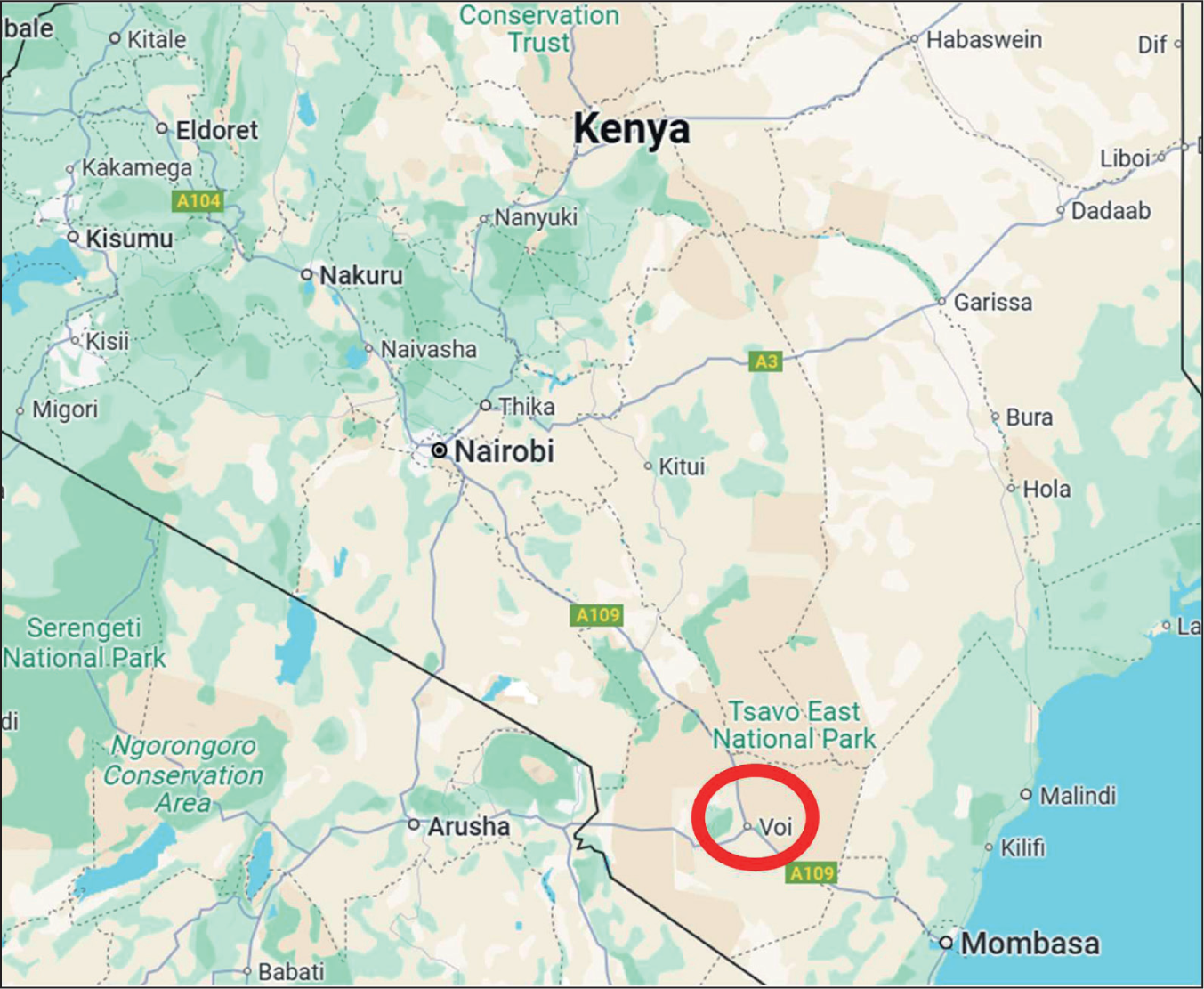
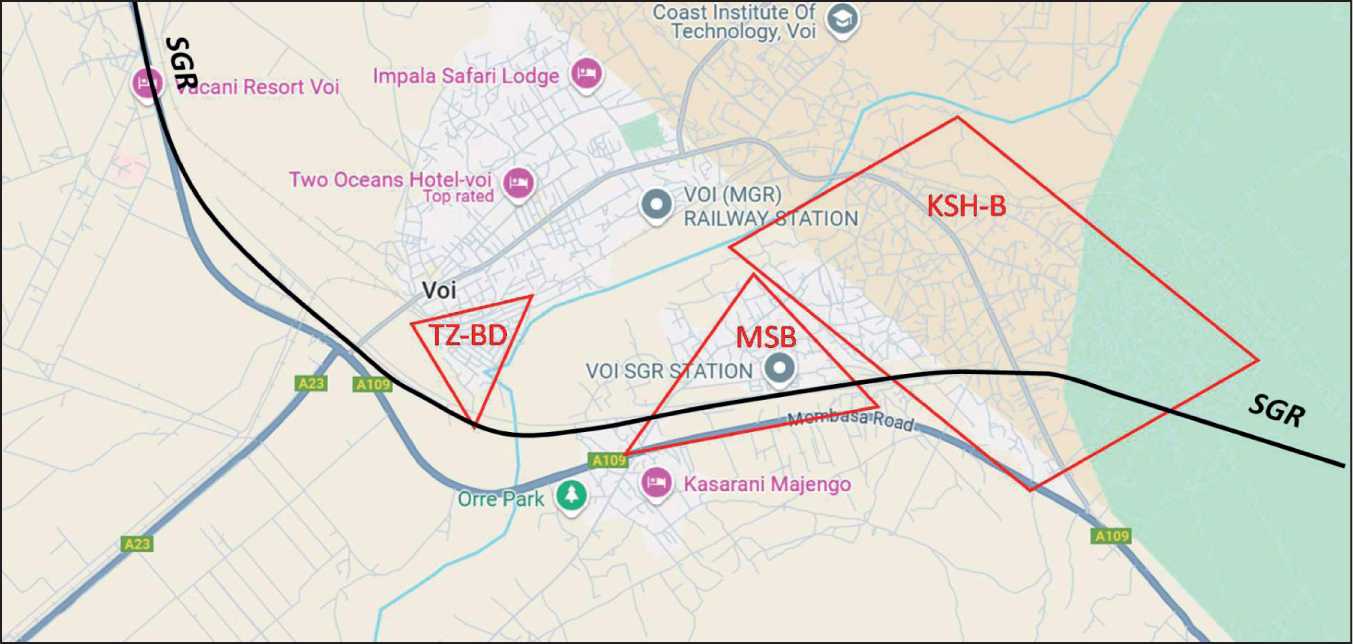
Voi town, with a population of around 50,000 located in Taita Taveta county is a strategic hub as a stopover on the journey from Nairobi to Mombasa, a junction with the road south to Kilimanjaro and Tanzania, and lastly a gateway to two huge national parks, Tsavo East and West (refer to Figures 1 and 2). Accordingly, it is the site of one of the SGR stations. The county is slightly better off than Kenya as a whole with a monetary poverty rate of 32% (36% for all Kenya) and a multidimensional poverty rate of 40% (53% for all Kenya) (Kenya National Bureau of Statistics, 2020). Livelihoods include farming, artisanal and commercial mining of gemstones and construction materials, and urban-based livelihoods (Taita Taveta County, 2023).
Squatters on Public Land: Msambweni
In Msambweni township, a 54.26-hectare plot of public land was leased in 1979 for 99 years by Bata Shoe Company to create a factory. The premium paid was minimal at 8,700 KShs ($68) and the annual rent was only 1,740 KShs ($14) (Government of Kenya, 2021). The acquisition was facilitated by the then Minister of Lands, who came from the area and who explained to the community, who were living informally on the land, the potential benefits for them, such as jobs and services. 3 In their understanding at the time, the total area to be set aside for the factory was three hectares, which they supported. However, the factory was never built, and according to the original agreement, the land ought to have reverted to the government, but the matter was left hanging. Thirty years later, in 2010, the Bata shoe company found themselves in financial difficulty and decided to liquidate the Msambweni plot. It was gazetted and auctioned for 12 million KShs ($94,000) to a company owned by an investor known as Sparkle Properties Ltd. This was done despite a clause stating that the land must not be sold, subdivided, or sub-let. 4 This, community members note, became known to them in 2012, when the investor arrived with an eviction order, just before the announcement of the SGR project and a 2013 environmental assessment conducted by the National Environment Management Agency (NEMA). 5
Sixty-six households had been on the land at the time of the Bata lease and claim to have lived there since 1938. 6 However, in the 30 years since the lease, the population had increased to 500 households, some of whom had been sold the land by the original families at around 50,000 KShs ($390) for 50 × 100 m plots. An investigation by the National Land Commission stated that many of these sales were made after the Sparkle sale, which an administrator explained in this fashion: “They had this mentality that if we were many, we wouldn’t be removed from the land, so they bought [sold] the land in large numbers.” 7 Buyers and others supported this allegation 8 and one noted: “The elders from the village were the ones in charge and even signed the sale agreement.” 9
The legal battle between the community and the investor continued through the years of the SGR construction. The claims of the original families were based on indigeneity and length of stay, with some claiming that the land was ancestral. Locals stated that they had buried people on the land, and had brought in services (water and electricity) and also planted trees. 10 However, the investor claimed that the land was acquired legally and that the community had made it impossible to develop the land. 11 One administrator who supported the investor claimed that the investor attempted to negotiate the resettlement of the original 66 families, but they had refused. 12
In 2018, a judgment was delivered in Sparkle’s favor and several unsuccessful appeals were made. The community was ordered by the judge to pull down their houses, pay general trespass damages of 1 million KShs ($7,800), and the cost of the suit. This judgement was communicated to the community after the window of time for lodging a complaint had expired.
13
The community made further attempts to appeal to the county governor, the Court of Appeal, the Mombasa High Court, the Commission on Administrative Justice, and the National Land Commission. At the same time, the community was internally divided; one buyer explained her belief that the elders had betrayed the community:
People went to court in Mombasa and many of us were not attending, only the elders, but we came to realize that even the elders were making fun of us, there was no case and they were not attending any hearing. There was a village elder who … called for a meeting and demanded every household remove 4,500 shillings ($35) to go to hear the case in Mombasa … I came and told the community they were being lied to. Where were the minutes of the court case and hearings? There were none. It was a big lie to those who bought land. I advised many who were paid by SGR to leave Msambweni.
14
In 2021, the community subsequently took the matter to the Senate Committee. They finally received a vindicating judgement that the sale and transfer of the land to Sparkle Properties Ltd., “reeks of irregularities and fraud and ought to be investigated to establish the true circumstances surrounding the transaction.” The Senate Committee recommended that the Department for Criminal Investigation and the Ethics and Anti-Corruption Commission investigate the matter, that all relevant agencies act to prevent eviction of the residents, and that Sparkle should not receive compensation for the SGR. 15
The horrendous evictions described in the introduction happened despite these recommendations. In Kenya, the law allows squatters on private land to claim ownership rights after residing on property for 12 years (limitation of Actions Act Cap 22, Laws of Kenya). One respondent pointed out this is why the eviction happened in 2024, though the company had tried to negotiate in previous years. 16 According to residents, the demolitions came as a surprise because the specific eviction notice was held by a local administrator and not communicated to them until after it expired. 17 However, the administrator claimed to have not seen it, and believed that Sparkle had been able to influence the police to start the demolitions. 18 Other suspicions were voiced that police, administrators, and MPs had been bought. 19 The Inspector General of Police denied authorization or knowledge and ordered a probe into the incident. However, it was disappointing that the investigative police commander and officer in charge of the station were transferred simply elsewhere. 20 The day after the demolitions, when a contractor arrived to fence the plot, he was beaten by angry community members and had to be hospitalized. 21
The majority of the land acquired by Sparkle was not compulsorily acquired for the SGR. 87 families were directly displaced from the 17 hectares needed for the SGR and were compensated for their structures only from 23,000 KShs ($181) to 2.5 million KShs ($19,700) as per the law. However, Sparkle is set to receive 192 million KShs ($1.5 million) as compensation for the SGR land and remains with a lucrative plot on which is planned a truck stop (an investment by a political family member), residential dwellings, a shopping mall, and a hotel. The remaining 400-plus households now find themselves without compensation for land or houses, which were their investments built with their savings. Some are now seeking to negotiate with the investor, who in a bitter twist has offered them 50 × 100 meter plots costing around 450,000 Kenya shillings ($3,500).
Group Tenure: Tanzania–Bondeni
Tanzania–Bondeni is a 24-hectare area with a settlement of around 20,000 people, 22 located between the SGR and the old railway. Like Msambweni, Tanzania–Bondeni was on partly public land whose tenure was better secured through a novel group land tenure model. Here land is owned jointly under a Community Land Trust (CLT), an idea borrowed from the United States. It is part of a strategy to make land and housing more affordable for low to moderate-income residents (UN Habitat, 2012). It was established under the Small Towns Development Project by the German Development Agency GTZ 23 in 1992 to improve two informal settlements (Tanzania and Bondeni). During the participation process, locals had identified that “some men were drinking and then selling the family land,” hence the strategy proposed protection through group land tenure. 24 One commentator described the feeling of insecurity that preceded the decision: “Their fear of eviction was reflected in the state of their houses, dilapidated and overcrowded with inadequate water supply and lack of proper accessibility.” 25
Local leaders provided community members with a choice of three alternatives, including individual titling and group titling. The latter was promoted by leaders and won the vote overwhelmingly (Bassett, 2007). GTZ broke new ground at the time using legal tools such as the Sectional Properties Act and the Societies Act, placing restrictions on individual sales, and the title was held by a board of trustees. 26 At the time, GTZ negotiated with owners of a neighboring sisal plantation over boundaries, and with Kenya Railways to use some land, already encroached, adjacent to the old railway. 27 Local people gave their labor, roads were created, and plans were left for other social amenities. 28
The main impact for the residents from the SGR was the loss of a school. In the 1990s, the community had released land to the government for a girls’ secondary school on the plot. Later at the time of the SGR planning, the school land was compulsorily acquired, being close to the railway. 29 Many people lamented that they were owed compensation for the school, but that the National Land Commission had dealt only with the school governors and the Anglican Church of Kenya, who they assumed were running the school. 30 Different accounts exist on why the local community could not be compensated with an official claiming that when a government school was planned, a separate title was created and it became public land and therefore no longer belonged to the community: “How come they have never gone to court? Because the school had a separate document. Even the MP wanted to grab that land and we told them not to dare.” 31
Local leaders said that because of various obstacles (including an office fire!) 32 and long delays in formalizing this and converting the allotment letter for the entire land to a title deed, it was difficult to revisit the compensation issues later. 33 Another account is that “somebody somewhere has received that money.” 34 As a testament to the loss, the old school building stands, barely affected by the SGR itself, but empty without doors and vandalized. 35
A new school was built some 12 km away, rather inconveniently for the girls who used to access the old school on foot. This decision was believed to have been influenced by local politicians on whose land it was built, 36 as noted by a local administrator: “The school scenario was pure politics.” 37 An elder said of the new school: “SGR was to give it a bus and it was to be the best in the coastal region, but they built a worthless structure, and everyone wanted to eat the money.” 38
At the same time, another piece of land adjacent to the old railway, initially agreed between Kenya Railways and GIZ to be part of the settlement, has been taken by Kenya Railways and people were told to vacate the houses marked for demolition. It is rumored to have been sold on to an unknown buyer for 500 million KShs ($3.8 million). 39 Residents’ trust in their local authority is low, as one declared: “The county see land to be grabbed.” 40
Former Group Ranch Land: Kishamba B
Birikani village is part of the former group ranch land known as Kishamba B outside Voi town. The group ranch has a title but is in the process of subdivision, so individual members have allotment letters. The National Land Commission was able to award compensation on an individual basis despite lack of full completion of titling because of the presence of a former group-ranch title; however, because of the legal limbo, 30% of the compensation for each member was awarded to the group ranch committee. What happened to the 30% (which totaled 84 million KShs ($650,000) was unclear as the tenure of the group ranch officials ended and they had refused the community members’ request for a meeting. Community protests were met with tear gas by the police. 41
An elder described how difficult it was to challenge the offer by the National Land Commission:
We were told to either accept the amount and sign; if you refuse, step aside [and] sue the government and let the project proceed as you take legal action. The value was imposed on us, and we did not have room to object. So many people signed as they were afraid of losing the land completely because those lands were affected by the rail.
42
On the bright side, the elder noted that he and many others were able to reinvest the compensation money well, starting transport businesses or renovating homes. 43
“Private land”
SGR plans led to intense selling and buying, and the creation of fake titles leading to contesting claims. The National Land Commission had no provision for compensating untitled or contested land. Properties on that land were eligible for compensation, but this became an opportunity for fraud:
It was extreme, but we also did not understand the formula used. Some people were planted here and got compensation and they were paid in millions…. They did not even know where Ndara A was, but they got compensation. Someone with a two-bedroom house here got 9 million and some with a bigger house got less than 1 million … They always knew about the projects; they had the blueprints and sent people to buy land … And remember, this was a bush, we did not see the value, so people sold the land at a throw-away price. They were strangers coming to buy the bushes. We did not know.
44
Valuers acted as brokers and profited too:
People used to come and negotiate, if your house is valued at 5 million ($38,500), they would write 10 and they take the rest. Like me, I got 2.5 million ($19,00) but the form for my neighbor stated 10 million ($77,000) and he was paid 2 million ($15,000) and we used more than that in building the house. So, this was the trend all through.
45
So, you gave them a deposit of 500,000 shillings ($3850) then they put for you a different value, the rest you get later. Some houses would even be demolished and rebuilt again to look expensive to get huge amounts of compensation. We saw a lot of drama, this is Kenya … To be sincere, the government went at a loss on SGR compensation because professionals got greedy. People were looting from the government.
46
It was repeatedly said by locals that those who contested the offer were told they would lose everything, and most could not challenge this in court: “We were threatened and told if we refused this value, forget, it was a one-time offer. So, I did not have a choice, there was an option to sign and appeal later if you had a complaint.”
47
One owner who was among the 87 in Msambweni displaced by the SGR described her losses amidst the urban developments:
Our land was more than 10 acres, I was born here, and SGR displaced me because I lost my home and had to buy a new plot and build again a new home. This new plot is too tiny, I can’t even keep chickens and goats as I used to in my old compound … I live like a squatter and now I have to pay rates to the municipality of Voi. I had fruits, plants, and flowers, I lost everything. I lost my rentals and am now reduced to poverty because I cannot buy land and build rentals again, it’s gone.
48
Some people were unable to reinvest their compensation windfalls wisely. Prostitution, polygamy, and various social vices also soared as noted:
There was no capacity building for the locals before the implementation of the project, so people were not prepared even how to manage the little money they were paid. Families broke up as money went to waste. Many also went to buy cars. So many went back to poverty as soon as they received the money.
49
Many were poor and had never touched or seen that large amount of money. One person here got 38 million shillings ($293,000) and the family assigned him to take care of the properties. He bought a canter (truck) which is now broken. He went around with every woman he could get. Now he is depressed…. Another guy withdrew 2.5 million ($19,000) from the bank, after 30 minutes in a bar with a lady drinking, he was screaming with no shoes and crying. He was robbed, and the land is gone forever. If you see the guy today, he is depressed and drunk.
50
Discussion
We have highlighted the experiences in several trouble spots along the SGR in Voi town and now discuss them. We see various forms of land injustices to different degrees, prompted by the rise in prices of land in a rapidly developing urban locality. We see in the Msambweni case how sloppy land administration allowed for an illegal grab of land by a well-connected businessman. Perhaps unsurprisingly, the case also involves some prominent political elites, implying that the buyer is enjoying some special protection. Another fundamental failing that laid the foundation for future confusion, corruption, and conflict was the neglect by a succession of governments to recognize and formalize the land tenure of the original families, and the failure to protect public land in general against illegal small sales by the occupants.
The original 66 families had some valid informal rights to the land, which should have been recognized, while Sparkle properties had none at all. Yet by a formal title deed, fraudulently acquired, and favorable economic and political connections, Sparkle received massive compensation and state assistance to demolish their homes. Thus, the law has been worthless in this case, giving an appearance of legality when in fact injustice has been done. Therefore, government or public land remains vulnerable to grabbing, and so do squatters who live on it and have few advantageous connections. This recalls the arguments put forward by Schetter and Müller-Koné (2021) and Kimari and Ernston (2020) that in frontier areas, state and entrepreneurial visions based on a logic of “unfettered bounty” are prioritized and many rules and restraints are relaxed or never enforced leading to a “state of exception.” Extraction, accumulation, and violent dispossession are the order of the day in frontiers.
As Basset long ago predicted (2007), the residents of Tanzania Bondeni are in a better position due to a novel group-tenure model on urban land. This, however, did not render them completely invulnerable to legal loopholes, maneuvers by elites, and speculation, where urban land is becoming increasingly more desirable. It remains to be seen whether as the value of the land increases, the group tenure system will continue to protect residents from selling out, and also help them to have more powerful representation. A model like Tanzania Bondeni’s CLT could be effective for protecting residents of informal settlements in other urban planning schemes. At the same time, findings from Kishamba B are similar where, despite legal limbo, a former group-ranch title allowed for compensation of individuals.
Therefore, group tenure systems do offer some security against dispossession and compensation injustices, though compensation values often do not reflect the escalating market prices of land in these areas, making it difficult to replace land. However, the issue of group-ranch subdivision is concerning as these former members will certainly come under pressure to sell their land to investors in the future and may lack the bargaining power and capacity to get a fair market price.
Lastly, the rights of many who had bought land through informal sales could not be recognized in the compensation process, but lost out twice because of corrupt compensation dealings when it came to their property. Informal rights and subsidiary “multiple layers of rights” are not well recognized in compulsory land acquisition and also leave people especially vulnerable to corrupt private land grabs. Lindsay (2012, p. 6) points out that informal occupiers of land are often recognized as having some rights by international organizations, but that national governments may not do this, seeing it as a perverse incentive to break the law. However, he argues: “Informal occupation of land in many settings is not a matter of choice but of necessity, induced by poverty, exacerbated by inaccessible land markets and poorly functioning planning regimes, and in some cases condoned and encouraged by authorities.” And, “a resettlement approach that focuses only on those with formal legal rights to their occupation could have detrimental development consequences.”
We conclude that in the context of rapid development and land commodification, a policy of recognizing only private titling is detrimental to land rights for the poor and incentivizes corruption and greed. It can be argued, along with Lund’s enlightening perspective, that privatization does help to protect interests in land to some extent and for a few, facilitate compensation, but also encourages sales to speculators and investors. Privatization also creates exclusive claims which negatively impact the most vulnerable individuals in society. It also fails to protect many more people whose rights as land users are more informal or indirect, leaving them stranded when development initiatives take place. And given that a private title can be acquired illegally and yet is still worth more than the land rights of families who have informally occupied land for generations, our findings suggest that when infrastructure projects come to town, corruption and structural inequalities also play an important role in deciding who wins and who loses.
Based on this work, we make the following general recommendations. In the context of development and commodification of land occupied by urban poor, private tenure should not be considered as the most suitable option. Group land tenure arrangements should be retained and even introduced because they offer some protection against sell-out and its negative implications, especially to women and children, and help to keep communities intact. They also provide a platform for people to defend their rights. Communities assisted by civil society organizations may consider the merits of pursuing or retaining group land tenure, or associations to protect their land and interests.
Some groups, for instance, squatters, require protection. All people local to infrastructure projects need education on land tenure and land rights, and the dangers of informal land deals in rapidly developing areas. Governments should protect public land, which is a resource for the future, and conversions of public land into private land in the vicinity of planned development projects should be questioned and prevented. This is a concern especially where governments actively pursue private-public partnerships for development. Proactive land governance frameworks should be incorporated into project planning very early in the process, with restrictions upon sales. Lastly, an audit of land compensation and illegal land acquisition surrounding the SGR is necessary, followed by reparations.
Footnotes
Declaration of Conflicting Interests
The authors declared no potential conflicts of interest with respect to the research, authorship, and/or publication of this article.
Funding
The authors received funding from Deutsche Forschungsgemeinschaft (DFG) under grant CRC228 for the research and writing of this article.