



Abstract
The great power rivalry between the United States and China is a regular fixture of international relations writing. Part of that rivalry is competition for the favor of national populations, with a particular focus on the societies of the Indo-Pacific region. Regional favorability ratings of the United States and China have been widely publicized, but these do not allow for the decomposition of attitudes by population segment, or the testing of theoretical models about attitudes. This article uses data from Wave 5 of the Asian Barometer Survey to conduct these kinds of more granular analyses across 15 Indo-Pacific societies, focusing on the effects of nationalist sentiment in determining attitudes toward both the United States and China. Indo-Pacific countries with the most favorable opinion of American regional influence include the Philippines, Vietnam, and India, while Chinese influence is viewed most favorably in Thailand, Malaysia, and Singapore. The biggest disparities are in India, Vietnam and Myanmar, countries whose populations decisively favor Americans over Chinese influence. Across the region as a whole, nationalist sentiment is associated with more negative views toward superpower influence (whether American or Chinese), but patterns differ across societies. Nationalist sentiment is positively associated with pro-US sentiment in Australia and Taiwan, while it is positively associated with pro-China sentiment in Hong Kong and Myanmar.
Introduction and Theoretical Orientation
Ever since the end of World War II, great power rivalry has focused as much on propaganda—on winning “hearts and minds”—as on the projection of brute military strength. Although propaganda has always existed, there was a clear shift between the early twentieth century (when propaganda mainly served as an intellectual justification for war) and the middle twentieth century (when propaganda itself became a primary domain of great power rivalry). This shift coincided with the arrival of decolonization and the emergence of the United States and the Soviet Union as not only military, but also ideological rivals. Beginning with the presidential administration of Harry Truman (1945–1953), American foreign policy prioritized public diplomacy, with a particular emphasis on the emerging nations of the Third World (Hart, 2013, p. 128). The Soviet Union followed suit in the 1950s, eschewing its former focus on specifically communist internationalism to reach out to non-aligned nationalist movements (Donaldson, 1982, p. 313). The result was “a clash of ideological power on a global scale” (Mann, 2013, p. 30).
Some three decades after the collapse of the Soviet Union, a new superpower competition for global “hearts and minds” has arisen between the United States and China. While the United States continues to promote an economic and social model based on private initiative and individual rights, China has countered with a model based on state-led development and the subordination of individual self-fulfillment to national goals. Like Soviet central planning in the twentieth century, this twenty-first “China model” can appeal to nationalists in developing countries even when Chinese communism (as such) does not. Accordingly, twenty-first-century China has centered its foreign policy not around the export of communism, but around the export of the China model (Callick, 2006; Zhou, 2019). Although there is only weak evidence for a popular embrace of the China model around the world (Ambrosio, 2012), what evidence there is suggests that it might be strongest among authoritarian traditionalists in developing countries (Welsh & Chang, 2015).
Recent data from the Asian Barometer Survey (ABS) demonstrate conclusively that most Asians do not view China as a development model for their own societies—in terms of development, “even Chinese do not cite China predominantly, favoring instead the US model” (Tsai, 2021, p. 26). However, the historical example of US–Soviet competition in the Third World suggests that great power ideological rivalry is not so much focused on development models as on broader public diplomacy. In the second half of the twentieth century, many Third World nationalists embraced the Soviet Union’s anti-imperialist rhetoric, whether or not they actually wanted to implement Soviet-style development models in their own countries. In the first half of the twentieth century, it may be that China’s own brand of anti-imperialist rhetoric could appeal to people (particularly to nationalists) in developing countries. Whatever the reality of its actions abroad, China officially promotes a foreign policy doctrine based on “sovereign equality, territorial integrity, anti-hegemony and global harmony” (Yilmaz, 2016, p. 76). Chinese government spokespeople routinely deride the US-centric concept of a “rules-based international order,” criticizing America’s routine use of double standards in cases from wars in Iraq and Afghanistan, through the enforcement of the US dollar exclusively as a major international reserve currency, to more recent threat of leaving the Paris Agreement on climate change (Ministry of the Foreign Affairs, 2023). China professes that countries should instead practice “mutual non-interference in each other’s internal affairs” (State Council, 2024).
Southeast Asia has been a particular focus of US–China great power rivalry. In this region of relatively smaller, less-powerful countries, competition between the United States and China is often perceived as opening opportunities for national policy autonomy (Kuik, 2021). Among international relations scholars, there is a consensus view that “[a]lthough all Southeast Asian nations engage with the United States and China, there has been a noticeable gravitational shift on their part toward China recently” (Shambaugh, 2018, p. 125). Across East Asia more broadly, however, international relations scholars argue that neither the United States nor China “will receive widespread regional endorsement if it chooses to bid for a singular hegemony … [they] will thus seek support from multiple and often overlapping legitimating constituencies” (Loke, 2021, p. 1223). Farther afield in the larger Indo-Pacific, there have also been serious debates about strategic autonomy in the context of great power rivalry in Australia (White, 2013) and India (Pant, 2019). All of this suggests that although populations throughout Asia (and the rest of the developing world) might not want their countries to go down the China path, they very well might welcome great Chinese influence over global affairs. Nationalists, in particular, might see Chinese influence not so much as a threat, but as an opportunity.
International relations debates are generally pitched at the elite level and are often associated with the anthropomorphization of national populations (e.g., “Singapore wants …”; “the Vietnamese believe that …”). But when it comes to public diplomacy, popular opinion is key. Although recent years have seen robust academic debates over the popularity of the United States abroad and public receptiveness to China’s challenge to American hegemony, few scholars have brought professional social survey data to bear on these issues. The Pew Research Center’s annual Global Attitudes Surveys are widely cited, but these surveys provide only headline data on attitudes toward the United States (Wike et al., 2024) and China (Silver et al., 2023), without the ability to test causal models or introduce statistical controls. Moreover, Pew only asks people whether they have favorable or unfavorable opinions of the superpowers and their leaders, not how they feel about American and Chinese influence. Data from Pew do show there has been a trend of increasingly negative evaluation of China among Japanese and South Koreans as was observed in western wealthy countries (Silver et al., 2020, 2023). It is possible that people might feel one way about a superpower in the abstract, but quite differently about that superpower’s levels of influence. There are also good reasons to believe that public attitudes toward American and Chinese influence may differ by demographic characteristics within a given population.
Of specific theoretical interest, there are good reasons to believe that at the individual level opinions about American and Chinese influence should be closely related to nationalist sentiments, and that these relationships might be different in different national contexts. In the twentieth-century ideological competition for the “hearts and minds” of emerging Third World populations, nationalism was at the forefront of the superpower rivalry between the United States and the Soviet Union. In some countries—notably India—nationalists seem to have tilted strongly against colonizers, embracing the anti-imperialist rhetoric that emanated from the Soviet Union (Chatterjee, 2016; Marwah, 2019). In other countries—notably Japan—nationalists seem to have tilted strongly toward the United States, rejecting Soviet rhetoric that they perceived as designed to undermine their own traditional social order. In many other countries, it makes theoretical sense that nationalists would have rejected both American and Soviet influence, perceiving both as unwelcome outside interference in their countries’ affairs. As a result of these potentially competing effects, the aggregate degree of nationalist sentiment within a country might (or might not) have affected that country’s overall position in the US–Soviet great power rivalry.
Taking inspiration from these historical patterns and conjectures, it seems reasonable to propose that nationalist sentiment should also be associated with opinions about American and Chinese influence in the present era. Data are now available from the ABS to support an analysis of the relationships between nationalist sentiment and opinions about American and Chinese influence in 15 Indo-Pacific societies (including China, where only opinions about American influence were surveyed). Prima facie theorization suggests that there should be a main effect observable across most or all countries that is consistent with the idea that individuals who exhibit high levels of nationalist sentiment are likely to view foreign influence in their own countries unfavorably, regardless of whether that foreign influence comes from the United States or China. In countries where either the United States or China is widely perceived to pose a security threat, that particular superpower may also have lower overall support.
These two sets of expectations can be used to generate hypotheses about both slopes and intercepts in the relationship between nationalist sentiment and opinions about superpower influence. For example, in India (which has recently experienced fatal border clashes with China) it might be the case that nationalist sentiment is generally associated with more negative opinions about the foreign influence of any superpower (slopes), while opinions about Chinese influence are more negative than opinions about American influence across all levels of nationalist sentiment (intercepts). In Malaysia, by contrast, where China is perceived as a generous development partner and anti-American sentiment is widespread, it might be expected that opinions about American influence would be more negative across the board than opinions about Chinese influence. In short, prima facie theorization suggests that the slope of the relationship between nationalist sentiment and opinions about foreign influence should be negative, while the intercept should depend on the broader international context of warmer or colder relations between the country in question and each particular superpower.
This general theory does not rule out potential interaction effects. Just as Japanese nationalists strongly supported the United States during the Cold War, it might be anticipated that higher levels of nationalist sentiment in Japan today might be associated with greater support for American influence (and lower support for Chinese influence) in Japan. A similar pattern might be anticipated in countries like Australia and Taiwan, where the United States is widely perceived to provide a security guarantee against a perceived threat from China. A disposition as such might reflect, in the view of the general population, the importance of security ties with the US outweighing other linkages like being trading partners with China. Conversely, in Hong Kong (where the meaning of “nationalist sentiment” is open to debate) it might be the case that strong nationalist sentiment is associated with pro-China, anti-American views.
These anticipated effects are, however, not strongly theorized. In this under-studied area, exploratory analyses are potentially more interesting than the testing of any particular theoretical expectations. In a previous generation of superpower rivalry, the study of international relations had to rely primarily on theory, because high-quality survey data on population attitudes were relatively scarce. Now that the relevant data are available for the study of superpower rivalry (at least for many Indo-Pacific countries), an exploratory and interpretive approach makes the most sense. The focus of this article is thus on what has been called in another context “the discovery of theory from data” (Glaser & Strauss, 1967, p. 1). Wave 5 Asian Barometer data are used to model individual opinions regarding American and Chinese influence across 15 Indo-Pacific societies: Australia, China, Hong Kong, India, Indonesia, Japan, Malaysia, Mongolia, Myanmar, Philippines, Singapore, South Korea, Taiwan, Thailand, and Vietnam. An index of nationalist sentiment is constructed, and the relationship between nationalist sentiment and opinions about superpower influence is explored with the goal of uncovering how this relationship is manifested in different national contexts.
The Asian Barometer Data
Data for our study are drawn from the ABS (
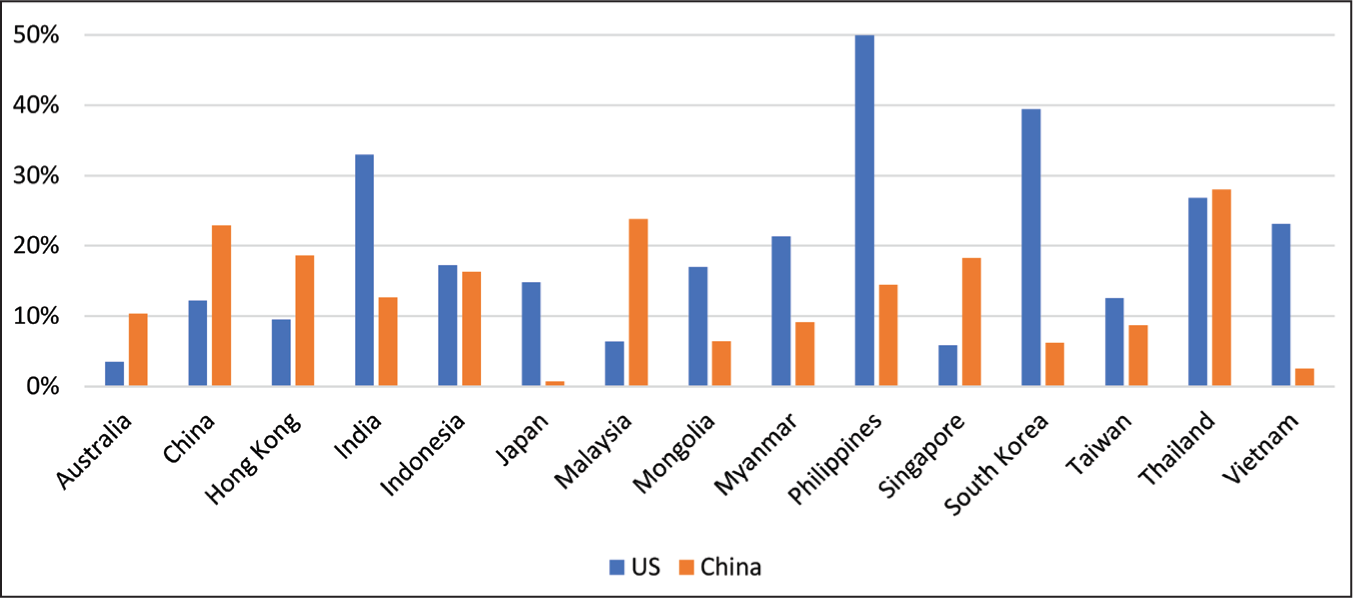
We adopted three measures to assess how favorable attitudes toward the US and China are across Asia and Australia. A fundamental presumption we hold is that in contrast to material power, ideational power plays a critical role in gaining support for global powers among the people from subordinate states (Katzenstein & Keohane, 2007). We use the choice of the US over China as a model of future development as a preliminary indicator to represent this ideational aspect of power. The original question is “Which country should be a model for our own country’s future development?” Choosing a role model, first of all, implies recognition of its formal leadership. Moreover, it reveals the nation or institution the followers desire or aspire to, as well as how they see the world in general and the hegemon in particular. We calculated the percentage who chose the US and China as models for their own societies. Results for this indicator by society are reported in Figure 1.
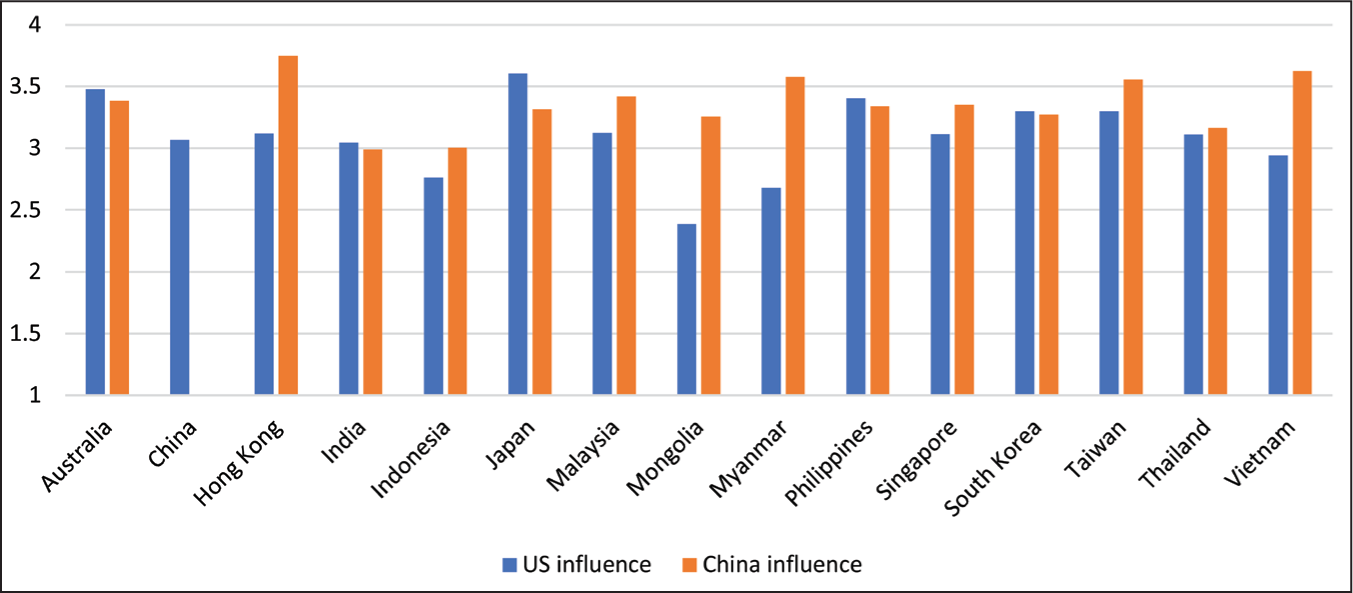
A second preliminary indicator captures the influence of the US and China in each of the surveyed societies. It is a straightforward question concerning the perceived extent of impacts the global powers exert on one’s own society: “How much influence does the United States have on [country]?” The response category ranges on a four-point scale from “a great deal of influence” (coded 4) to “no influence at all” (coded 1). The ABS also asked a similar question with China being a subject and the response categories are designed in the same way. Results for this indicator by country are reported in Figure 2.
Our main focus in this article, however, is on modeling the degree to which people in each Indo-Pacific society hold positive views about the influence of the United States and China in their own societies. The original ABS question is: “Generally speaking, the influence the United States [China] has on our country is…?” The response categories include “very positive” (coded 6 on a six-point scale) to “very negative” (coded 1). This question attempts to capture amiable feelings toward the US/China. Compared to our first preliminary indicator, it focuses on influence directed into the country instead of aspirations directed outward. Compared to our second preliminary indicator, it focuses on attitudes about the desirability of foreign influence, instead of the extent. A number of studies used this question from earlier waves of the ABS to investigate pro-Americanism in this region (Pan, 2020; Tsai, 2021). We use the pair of questions (one on the United States, the other on China) to juxtapose competing great power success in winning “hearts and minds” to their side.
Of course, any great power influence inside a country is still “foreign” influence. An obvious possibility is that nationalism might play a major role in determining people’s attitudes toward foreign influences in their country, whether American or Chinese, good or bad. Nationalism is broadly understood to be a key factor inciting antipathy toward global powers (Mylonas & Kuo, 2017), but there has been little systematic survey research into the relationship between nationalism and attitudes toward foreign great power influence. Empirically, the social science here is not well-settled, and there are multiple approaches to measuring nationalism. A social structural approach gives emphasis to the dynamics of intergroup relationships and focuses on linguistic similarity and cultural legacy in the context of nation or state-making (Smith, 2001). In IR research, scholars have highlighted the element of victimhood nationalism, which exposes forcefully a nation’s history of suffering, oppression and injustice imposed by the hegemonic “West.” Nationalism’s measure therefore should reflect the traumatic lived experiences and memories among the general public to gauge its impacts on beliefs and dispositions on international issues (Hronešová, 2024; Lerner, 2020). Other operationalizations attempt to capture psychological attachment to own country (“emotional nationalism”) vis-à-vis rational civic commitment to it (Huddy et al., 2021; Mußotter, 2022; Tsai, 2013).
In contrast to these strongly theorized but highly normative approaches, we adopt a number of pragmatic indicators to span the gamut of nationalism by focusing on an individual’s policy concern with guarding the nation’s economic and cultural boundaries. This approach implicitly suggests nationalism is often an uncompromising stance to maintain a well-protected national boundary vis-à-vis penetrating foreign goods, thoughts or immigrants attempting to cross the border lines. The first measure is a response to the question “We should protect our farmers and workers by limiting the importation of foreign goods.” The respondents were asked to tick a category out of “strongly agree” (coded 4) to “strongly disagree” (coded 1) on a four-point scale. In contrast to this protectionist attitude toward goods, the second measure is a response to: “Our country should defend our way of life, instead of becoming more and more like other countries” (four-point scale). The third one focuses on the question “Do you think the government should increase or decrease the inflow of foreigners who come to work in our country?” (four-point scale). The average of the three items was calculated to represent an overall nationalist attitude.
Our regression models also include a number of standard control variables. Several demographical backgrounds are included such as gender, age (real age), education (in year), and household income (high, middle and low (=0)). Estimates of these characteristics allow a finer investigation into the difference in supportive attitudes toward great powers within the populations. In addition to controlling for these basic demographic characteristics, we also treat individuals’ appraisals of their country’s economic condition and government efficacy as contextualizing background factors. They both reflect an individual’s evaluative attitude toward a country’s growth momentum and government capability. The original question we used is “How would you rate the overall economic condition of our country today?” The response category ranges from “very good” to “very bad” on a five-point scale. For perceived government efficacy (PGE) the original questions are: (a) “Over the long run, our system of government is capable of solving the problems our country faces”; (b) “Thinking in general, I am proud of our system of government”; (c) “A system like ours, even if it runs into problems, deserves the people’s support”; (d) “I would rather live under our system of government than any other that I can think of”; and (e) “Compared with other systems in the world, would you say our system of government works fine as it is, needs minor change, needs major change, or should be replaced?” The first four questions have four response categories from “strongly agree” (=4) to “strongly disagree” (=1). The last question is also on a four-point scale, ranging from “It works fine, not need to change” (=4) to “should be replaced” (=1). The average score of the five elements was calculated into a summary indicator.
Popular Perceptions of Superpower Regional Influence
In this section, we lay out perceptions of US and Chinese influence in the Indo-Pacific region and in each country. Our first issue is: across this region, how popular is the US chosen as a model state than China is? Figure 1 shows the percentages of choosing the US over China for each country. These results suggest that the US does not appear to be the most favorable choice of model country in the studied area. However, in the paired comparison based only on the two superpowers (i.e., the ratio of choosing the US over China), Japan, South Korea and Vietnam clearly prefer the US over China to be a future development model, followed by India, the Philippines, and Mongolia.
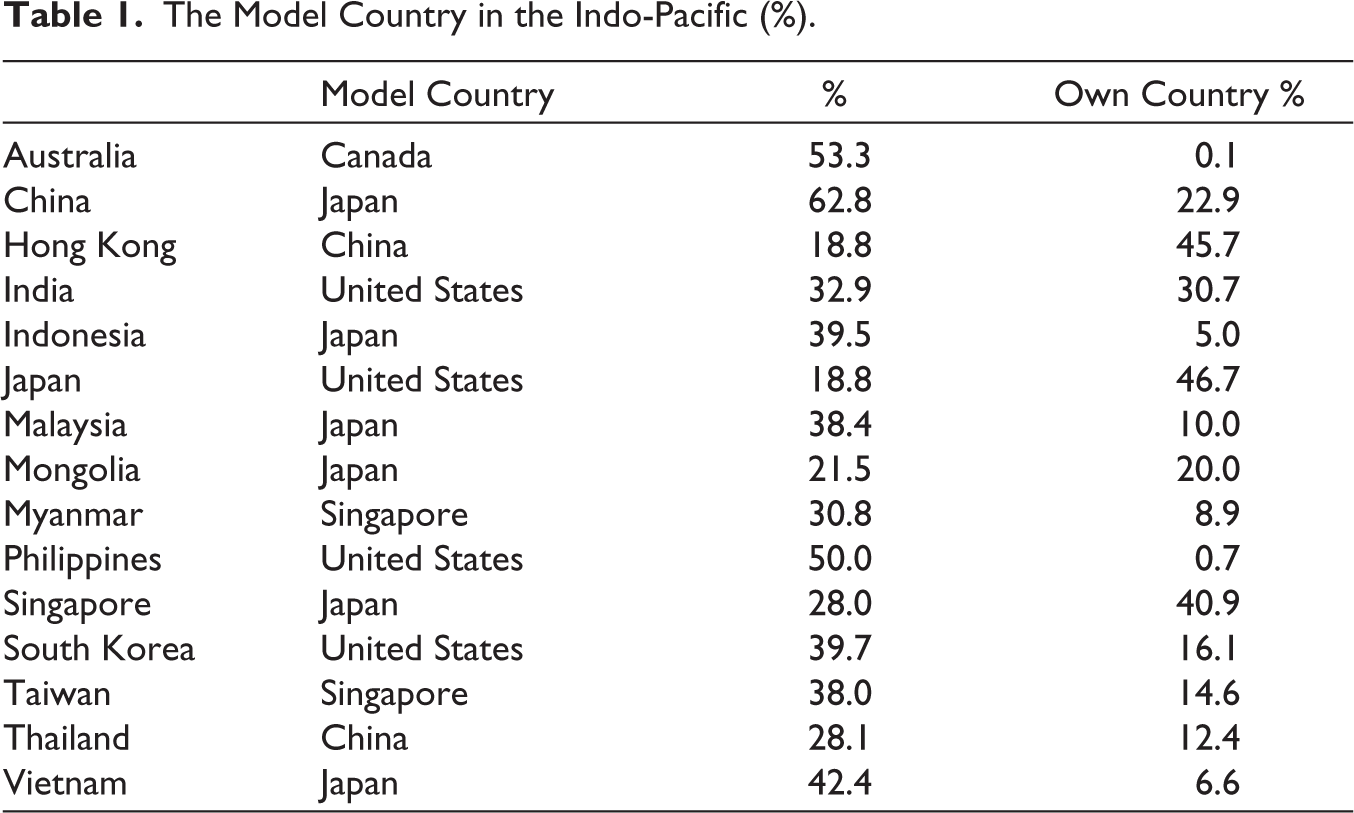
It is likely that neither one is the most favorable model. Indeed, the respondents mainly tilt to favor other models. For instance, in Australia, neither the United States nor China is the preferred development model of the majority (or even a plurality) of the population. To more clearly show the favorite countries in the region, we list them in Table 1, in which the percentage of choosing a model country other than one’s own is reported. It is somewhat surprising that Canada is the most-liked by Australians. For the respondents in China, Japan is appraised highly as the ultimate model country, despite China’s widespread nationalist antagonism against Japan. Yet, for Hong Kongers, China stands out as the model country.
In general, Japan is the most frequently cited as a model country, as six out of 15 populations endorsed it. The United States has four citations and is ranked second. Thailand and Hong Kong both stand alone in choosing China. Table 1 also reveals a phenomenon of self-celebration by choosing own country as a model. Hong Kongers, Japan, and Singapore are typical of this genre, indicating the general public’s strong confidence and high pride in their own legacy or performances.
The Model Country in the Indo-Pacific (%).
The extent of the perceived influence of great powers on the respondents’ country is another proxy for gauging soft power of the US and China. Across the Indo-Pacific, most populations believe that the US exerts less influence over their countries than does China: only five countries have the score of the influence of the US either equal or higher than that of China (see Figure 2). They are Australia, India, Japan, the Philippines, and South Korea. For other 10 societies, China is considered to exert more influence than the US, often far more, as its score tends to have a larger gap with that of the US. Myanmar, Vietnam and Taiwan are particularly aware of China’s influence. Hong Kongers scored a high influence of China. This is unsurprising because it has undergone a deeper “mainlandization” under the sway of Beijing in the past decade and is not able any more to maintain a separate governing system from the rest of China.
Of course, it is not clear whether the perception that a foreign country has a high level of influence in one’s own country is a good thing or a bad thing. Thus, our main focus on this article is on how favorably the influence of the US and China is perceived among the populations of the countries we study. The influence of either great power may be perceived positively or negatively, and indeed the same person may perceive both positively, both negatively, or prefer one over the other. If the two patterns of influence go into opposite directions, the population as a whole can be deemed as US- or China-leaning, while the overall level of hostility toward foreign influence can be gauged from the degree to which any respondents welcome either country.
Figure 3 shows the scores of the perceived favorable influences for the two superpowers across 15 societies. Five societies are “consistent” in perceiving the American influence outweighs Chinese influence in their countries (Figure 2), and also in perceiving American influence more positively than Chinese influence (Figure 3): Australia, India, Japan, the Philippines, and South Korea. In contrast, four societies exhibit the opposite pattern, perceiving stronger Chinese influence and generally viewing this influence more positively: Hong Kong, Malaysia, Singapore, and Thailand. The other five societies are “mixed,” perceiving one great power as having a stronger influence but viewing the other great power more favorably: Indonesia, Mongolia, Myanmar, Taiwan, and Vietnam. In every case, it is Chinese influence that is perceived to be stronger but less desirable.
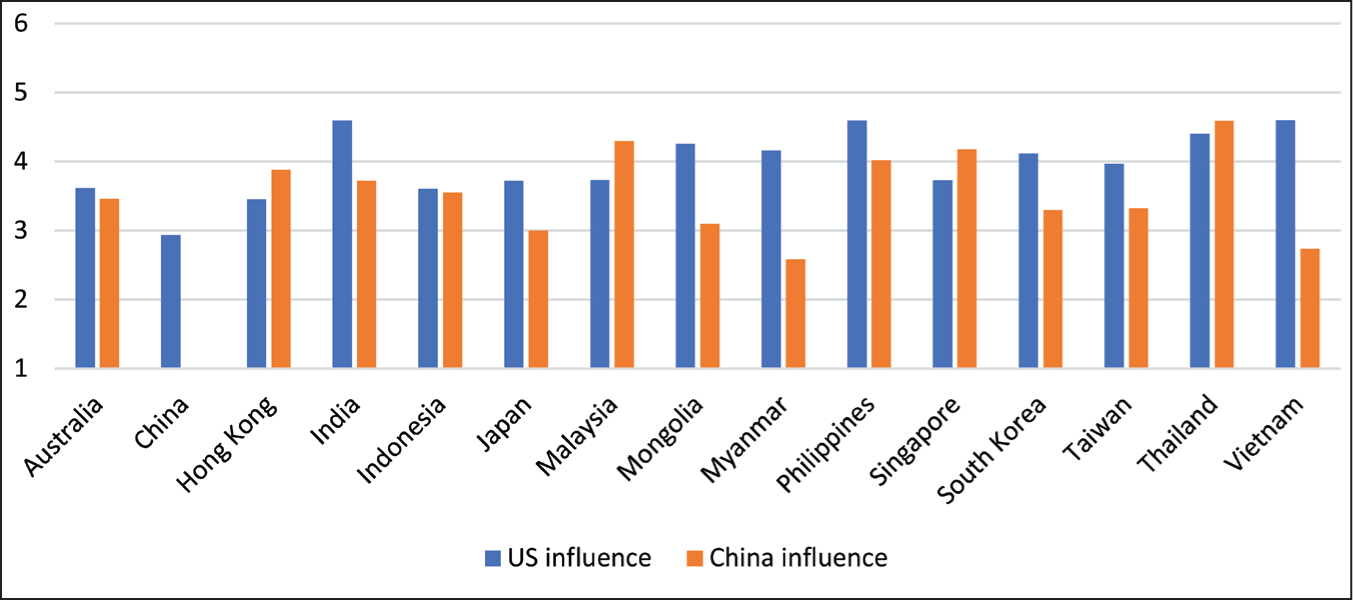
Thus, where American influence is perceived to be stronger, it is generally welcome, while attitudes toward Chinese influence are much more fraught. In five out of nine of the societies where Chinese influence is perceived to be stronger than American influence, Chinese influence is more likely to be viewed less favorably—that is, Indonesia, Mongolia, Myanmar, Taiwan and Vietnam. These countries border China (accepting Taiwan as a Chinese maritime neighbor), and all prefer the United States as a model for their own country (Figure 1). An intuitive interpretation of this result might be that in these five countries, people who exhibit strong nationalist sentiments perceive and resent Chinese influence, but to truly understand the dynamics at play here we must move from the analysis of aggregate results to the analysis of individual survey responses.
Modeling Attitudes Toward Superpower Influence
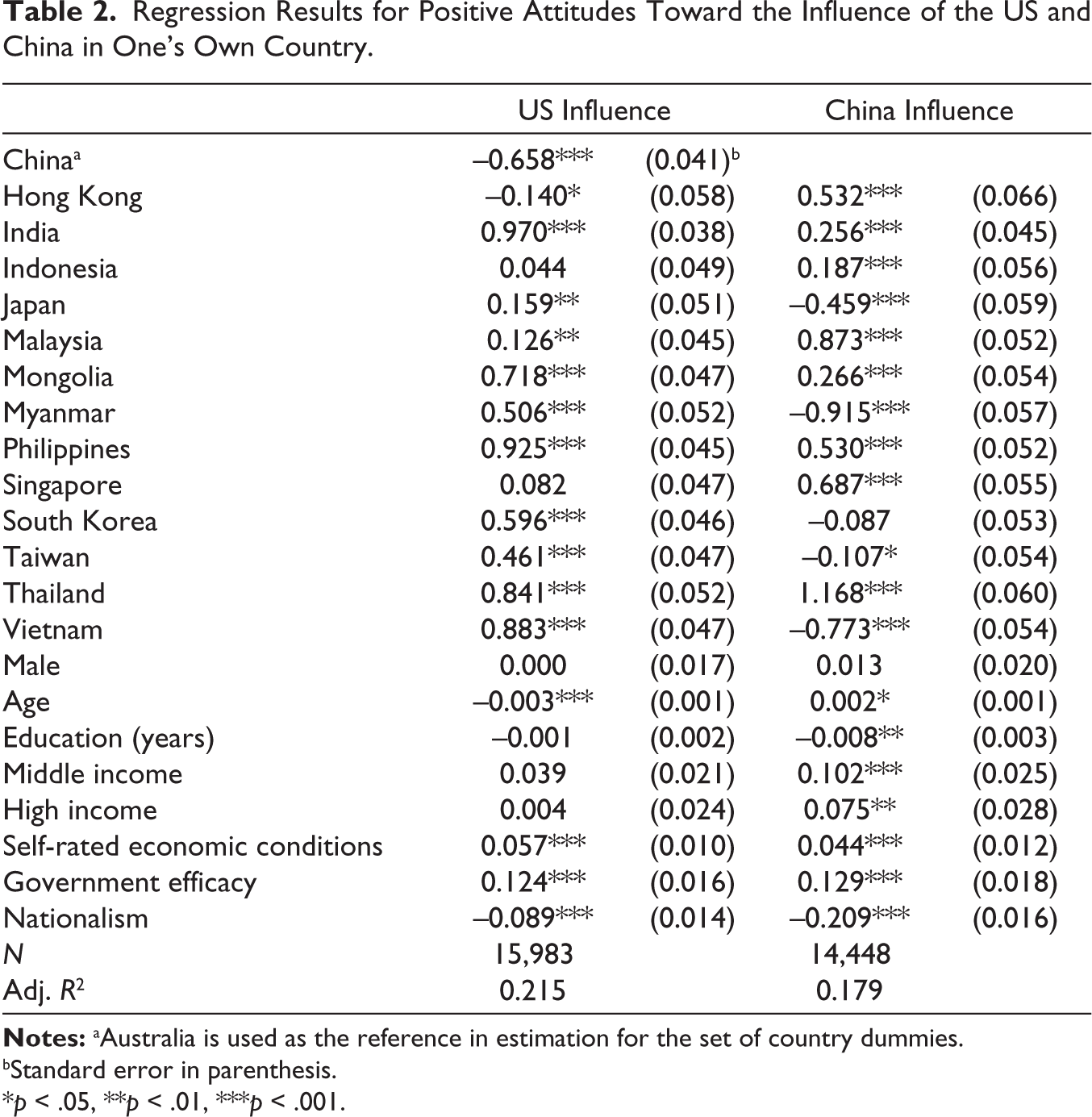
The potential association of nationalism and attitudes toward great power influence in one’s own country at the individual level is examined in Table 2. The dependent variable we focus on is whether great power influence is viewed favorably in one’s own country, with results estimated separately for US influence and Chinese influence. Variables included in the models include the society of residence (using Australia as the reference country), basic demographics, and individual assessments of their own society’s economic conditions and government efficacy. Our models account for an estimated 21.5% of the variability in individuals’ attitudes toward American influence and 17.9% of their attitudes toward Chinese influence, respectively (after adjusting for sample overfitting). With regard to the desirability of American influence, people in most Asian societies have a significantly more positive opinion than is observed in Australia (after controlling for demographics and views about the economy and government), a result that is particularly striking in light of Australians’ already-positive views of America and their country’s very close political and cultural ties with the United States. Only in China and Hong Kong is American influence viewed significantly less positively than in Australia, and only in China is American influence viewed as being absolutely negative (i.e., in Hong Kong, American influence is viewed less favorably than in Australia, but it is still viewed favorably). Populations in Singapore and Indonesia view Chinese influence about as favorably as people in Australia, after adjusting for control variables. In short, most of the Indo-Pacific region views American influence in their own countries positively—although across the region as a whole, nationalists tend to view American influence significantly less positively.
Regression Results for Positive Attitudes Toward the Influence of the US and China in One’s Own Country.
bStandard error in parenthesis.
*p < .05, **p < .01, ***p < .001.
Views on Chinese influence are noticeably more mixed. As seen in Figure 3, Australians exhibit a slightly worse than neutral attitude toward Chinese influence in their country, and in our model for Chinese influence, four countries showed significantly lower popular support for Chinese influence than Australia (after adjusting for control variables): Japan, Myanmar, Taiwan, and Vietnam. All other societies showed significantly more popular support for Chinese influence, except for South Korea, where the difference was non-significant. Perhaps more interesting than the absolute levels of support for American and Chinese influence, however, are the differences within societies in support for the United States versus China. In all five of the countries noted above where Chinese influence is perceived to be stronger than American influence but American influence is viewed more favorably (Indonesia, Mongolia, Myanmar, Taiwan, and Vietnam) a large gap persists even after controlling for levels of nationalism. It may be that nationalists are turning to the US to counter a perceived threat from China, but it seems clear that (in these countries at least) non-nationalists feel the same way. By contrast, only Hong Kong, Malaysia, and Singapore exhibit large preferences for Chinese influence (after adjusting for control variables and levels of nationalism). Considering Hong Kong to be a special case, it seems noteworthy that the other two are non-neighbors of China.
Table 2 also presents the regression coefficients for major factors we proposed in the explanation of cross-national differences in support for foreign superpower influence. As is expected, respondents who see their own country to fare well in economy tend to show a positive response to either power. Perceived government capability also operates as a strong buffer against resentment toward superpower influence in one’s own country. In short, people who feel their own country is doing well (economically and politically) seem to be more likely to welcome international influences, whether American or Chinese. Nationalism, as expected, is negatively associated with receptiveness toward either American or Chinese influence, though the negative relationship between nationalism and favorable attitudes toward Chinese influence is more than twice as large as the relationship between nationalism and attitudes toward American influence. The demographic variables are generally non-significant as predictors of attitudes toward American influence, with the one exception that younger people are significantly more likely to hold unfavorable attitudes toward the United States (a pattern that is not surprising in light of global campus anti-Americanism). The demographic variables seem to matter more as predictors of attitudes toward Chinese influence, with the young, the less educated, and those with higher incomes being significantly more receptive to China.
Nationalism and Superpower Influence at the Country Level
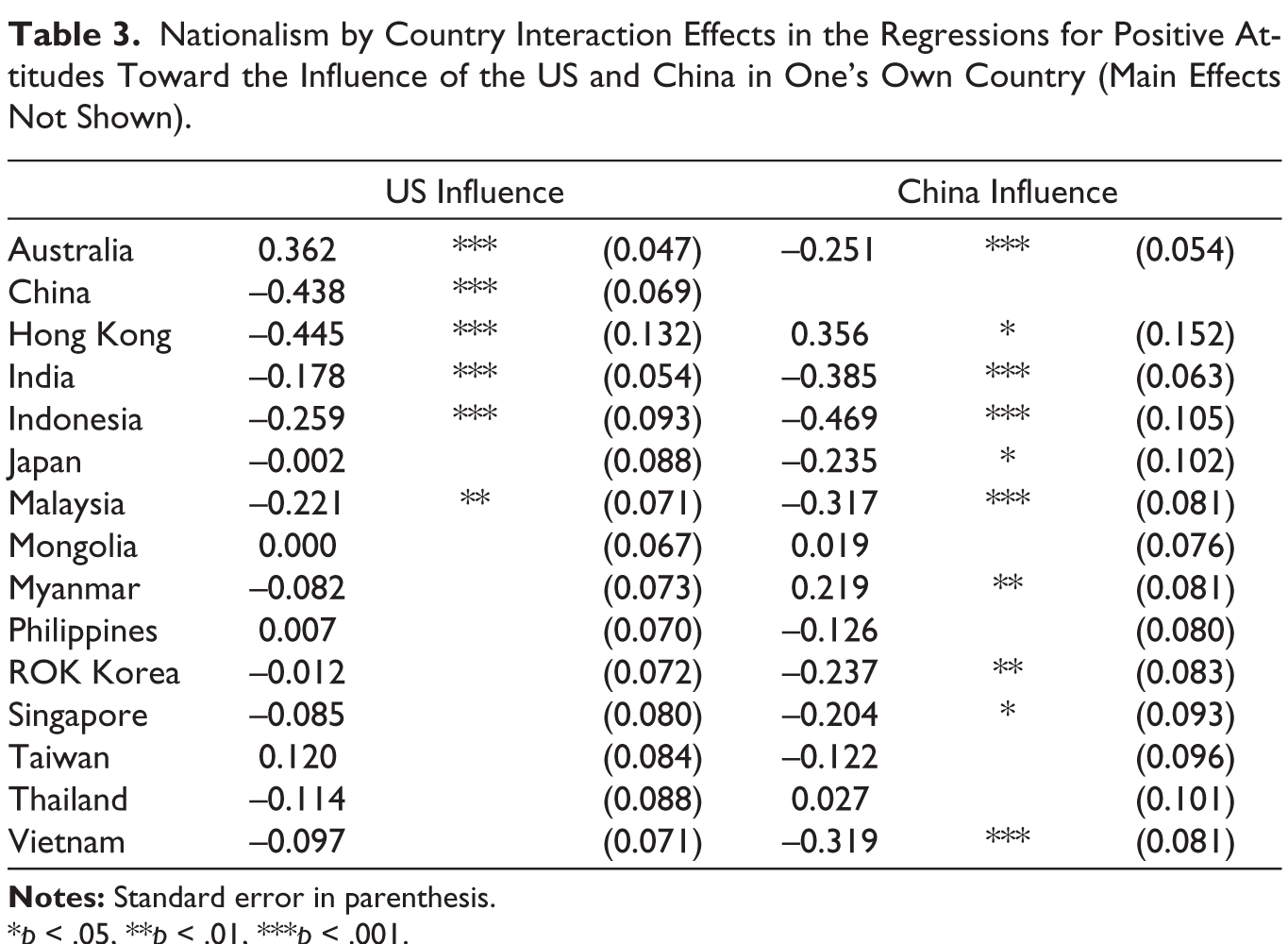
The preceding analysis aims at capturing an overall pattern of association between nationalism and response to great power influence across the entire region, with all 15 populations being pooled together in a single regression model. Obviously, it is quite likely that nationalists in different societies will have different levels of receptiveness to American and Chinese influence. These differences can be captured in an interaction model in which the relationship between nationalism and attitudes toward foreign superpower influence is allowed to vary by country. To construct such a model, each individual respondent’s level of nationalism is multiplied by a country indicator to create an interaction term. The slope associated with each interaction term represents the difference in the slope for the nationalism variable in each respective country versus the slope for nationalism in the reference country (Australia). Each interaction slope can be added to the main effect for nationalism (which represents the slope for nationalism of Australia) to calculate an estimated slope for the relationship between nationalism and attitudes toward foreign superpower influence in the respective country. These estimated slopes are summarized in Table 3. For ease of interpretation, the main effects of the society indicator variables and the demographic and explanatory control variables are not shown. These are not substantially different from the results reported in Table 2.
Nationalism by Country Interaction Effects in the Regressions for Positive Attitudes Toward the Influence of the US and China in One’s Own Country (Main Effects Not Shown).
*p < .05, **p < .01, ***p < .001.
As expected, in most countries, nationalist sentiment is negatively and significantly related to support for foreign superpower influence in one’s own country, no matter whether the external influence comes from the United States or China. Only in Australia are levels of nationalism significantly positively associated with levels of support for American influence (while being significantly negatively associated with support for Chinese influence), while only in Hong Kong and Myanmar are levels of nationalism significantly positively associated with support for Chinese influence. These results are consistent with the general observation that nationalism is negatively related to support for foreign influence across the region (Table 2). It might be understood that nationalists support American influence in Australia and Taiwan (the latter’s coefficient carries a positive sign yet it is not statistically significant), because China is perceived as a threat, while Hong Kong and Myanmar present special cases (the former being controlled by China, and the latter undergoing a civil war in which China is deeply involved).
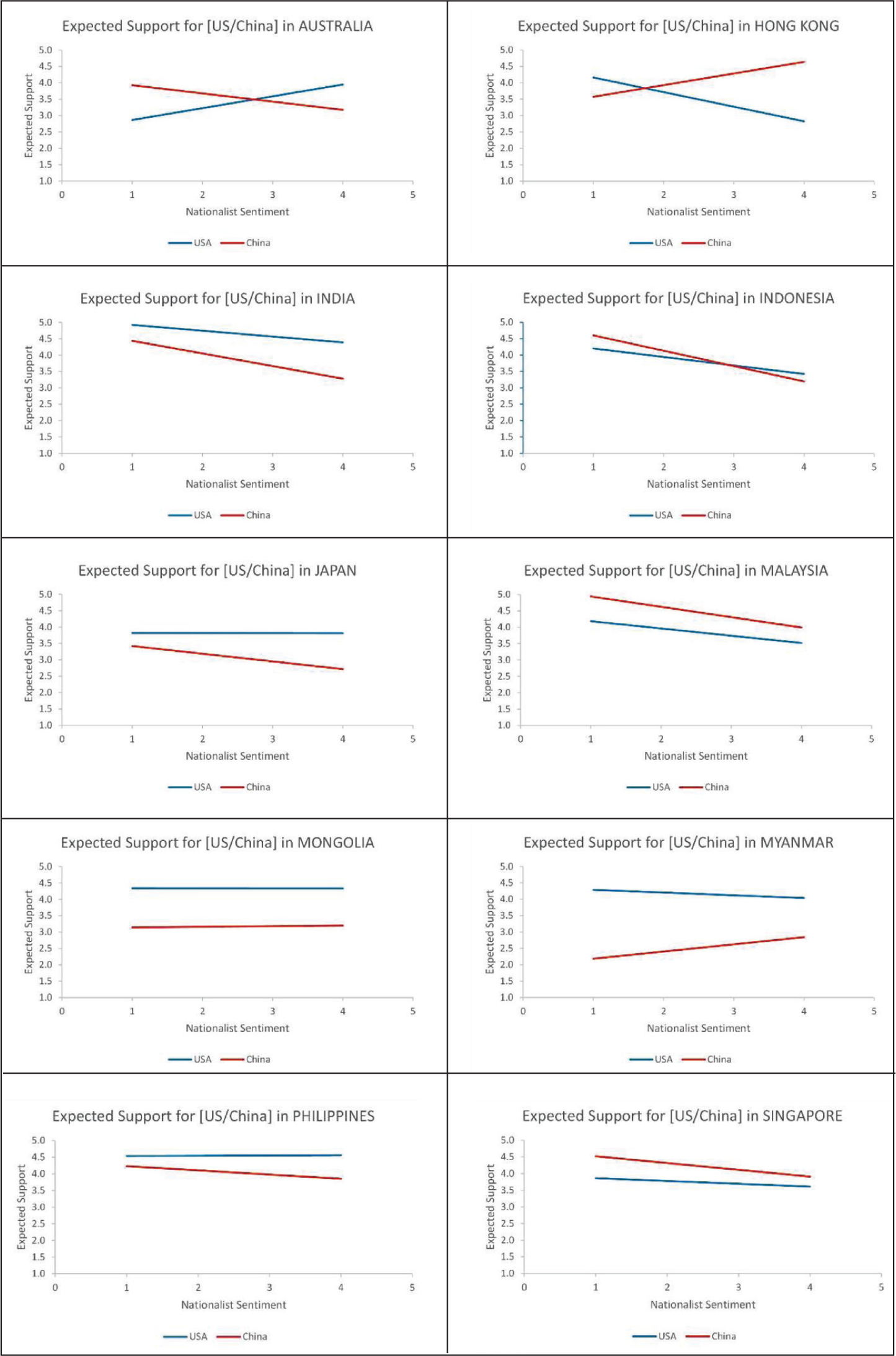
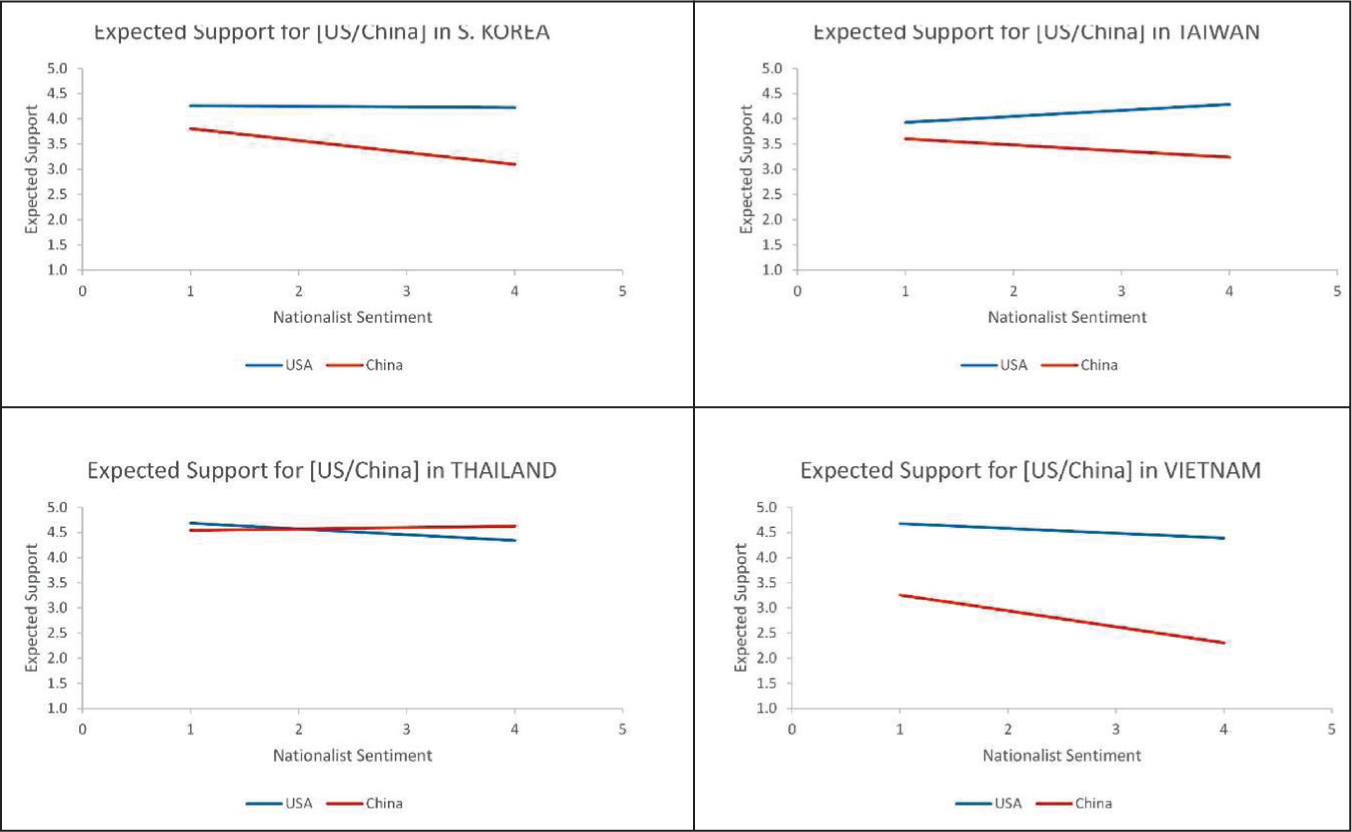
More interesting conclusions can be drawn, however, by juxtaposing the relationship in each country between nationalist sentiment and attitudes toward American and Chinese influence. This can be done by plotting the expected value of support for foreign superpower influence (dependent variable) against levels of nationalist sentiment (independent variable) for each country. In this exercise, the intercept for each chart can be calculated by evaluating all other independent variables at their means, allowing only nationalist sentiment to vary. The results from this exercise are reported in Figure 4. In most countries, these charts show roughly parallel tracks for support for American and Chinese influence. In five countries these tracks show clearly higher levels of support for American influence at all levels of nationalism (India, Japan, Mongolia, Myanmar, and Vietnam), while in two countries the track shows clearly higher levels of support for Chinese influence at all levels of nationalism (Malaysia and Singapore). In two countries the tracks cross: in Australia, at low levels of nationalist sentiment there is stronger support for Chinese influence, while in Hong Kong, at low levels of nationalist sentiment, there is stronger support for American influence. Other countries show roughly equal levels of support (or lack of support) for foreign influence from either superpower, though of course with national variations.
These patterns are consistent with an interpretation that in Australia, nationalist sentiment is aligned with support for the country’s longstanding American alliance, while in Hong Kong nationalist sentiment is aligned with mainland identification. Hong Kong nationalism is a particularly fraught concept, since our nationalist sentiment variable (derived from indicators of protectionism, particularism, and nativism) does not distinguish between what might be called the “Hong Kong nationalism” and “Chinese nationalism” that coexist in the territory. For other countries, although nationalist sentiment may be significantly related to attitudes toward foreign superpower influence, there seems to be little substantive difference between nationalists’ support for the US versus China. The charts depicted in Figure 4 suggest that outside of Australia and Hong Kong, levels of nationalist sentiment are not substantively important determinants of the levels of support for one superpower over another.
Discussion and Conclusion
Cross-national differences in public beliefs regarding global powers have garnered extensive analytical attention, but rather less empirical research. This study focuses on the Indo-Pacific region, examining the extent to which the US and China are viewed favorably by the general public. It also explores how nationalism—our central concern—as well as perceived economic conditions and government effectiveness, influence the acceptance of these powers. The findings provide critical evidence to assess proposed hypotheses about the relationships between nationalism and attitudes toward foreign influence. Interestingly, not all countries follow the general pattern in which nationalism leads to coldness or even antagonism toward hegemonic powers. Some cases reveal paradoxical responses, highlighting a complex narrative of like and dislike that cannot be easily explained by straightforward disapproval.
Our first major finding is that the United States does not appear to be favored as a model for one’s own country in the studied area. Nor is China. Perhaps surprisingly, a Japan-favoring attitude appears widely across the region. Japan’s imperial power and violent aggression throughout the region in World War II appear to be things of the past for most respondents we studied. Even among Chinese respondents, Japan is more admired as a model than the United States, which has long been the most chosen destination for migrants leaving China to build new lives abroad. Japan remains the hub of Asia in terms of soft power among our respondents—though among Australians, Canada is favored as a model for their own country. This may be explained better by cultural affinity than by distance.
In response to what has been advocated via the idea of “China model” (Ambrosio, 2012; Chen & Naughton, 2017), our study shows that there appears to be a limit to its authoritarian diffusion. China’s impact, incurred by its large domestic market and military force, has been experienced in this region. Geographical closeness escalates a concern with its use of economic and political “muscles.” China therefore represents a case of unsuccessful public diplomacy, having Thailand as its sole admirer (not considering Hong Kong, which is now in practice and in law a part of China). Many people in Indo-Pacific countries view China as a better model for their countries than the United States, but few view China as a model for their countries outright. International relations scholars who contrast the China model with the American model might consider that many people do not view this as a binary choice. There are many external examples on which to model one’s country, and for people in most countries, turning their own country into a global superpower on the model of either the United States or China may seem an unlikely and undesirable aspiration.
One possible explanation for Thailand being a fan of China is that it hosts a large community of people of Chinese descent, which the Thai government has long been working to integrate into Thai society. The current junta government also opts for promoting the Sino–Thai “brotherhood” discourse as this allows it to strengthen its legitimacy against domestic opposition for democratization. The Thai business community also engaged in brotherhood discourses to benefit from the Belt and Road project initiated by China (Tungkeunkunt & Phuphakdi, 2018). Indeed, Thailand is the only Southeast Asian country that has no territorial disputes with China. Our finding that China has a large crowd of fans here is well aligned with the intimate Sino–Thai relations as has been evidenced through amiable interactions between the two countries.
Our second major finding is that people living in countries that neighbor China tend to view Chinese influence as being more pervasive and less welcome than American influence. In nine out of the 14 societies surveyed (excluding China itself), China was perceived to have greater influence within the society than the United States. However, in all five countries where American influence was perceived to be stronger, American influence was preferred. By contrast, in five out of eight countries where Chinese influence was perceived to be stronger (excluding China and Hong Kong), American influence was preferred. The only countries where Chinese influence was perceived to be stronger and more welcome than American influence were Malaysia, Singapore, and Thailand, none of which actually border China. In those countries, China may be perceived as posing an economic opportunity that does not pose any realistic military threat.
Our third major finding is that nationalist sentiments (measured pragmatically based on support for protectionism, particularism, and nativism) are significantly associated with hostility toward foreign superpower influence, whether that influence emanates from the United States or China. While perhaps not surprising, this result is nonetheless important. It suggests that the commonplace association of nationalism with a particular side of politics might not travel well outside the English-speaking countries that are the home of the majority of social science theorizing. In fact, the only country we studied (leaving aside the territory of Hong Kong) where nationalist sentiment is strongly and positively associated with support for foreign superpower influence (i.e., the US) is Australia—which is, perhaps not coincidentally, the only English-speaking country in the ABS data. This association cannot be held together solely owing to power dependence or security concerns as is suggested by realist theory. Instead, strong cultural ties appear to play a significant role. In all other countries, nationalist sentiment had either a nondescript or a negative relationship with support for foreign influence, whether American or Chinese.
All in all, we find that although nationalism is in general negatively associated with support for foreign superpower influence, the specifics of this relationship differ by society and superpower. Overall, societal differences in levels of support for American and/or Chinese foreign influence across the Indo-Pacific seem to matter more than the degree to which individuals exhibit nationalist sentiments. That said, the variability among individuals in their views on foreign superpower influence overwhelmingly outweighs any inter-societal differences that can be accounted for by societal indicator variables in regression models. By far the majority of the variability in individuals’ attitudes toward foreign influence is idiosyncratic, captured neither by the societal fixed effects nor by individual-level demographic and policy variables.
This lack of explanatory power may be due in part to the blunt instrument of our dependent variables, for which only relatively course single indicators are available. Our nationalist sentiment variable, though constructed from three distinct indicators, is likely of similarly low measurement quality—and is of questionable conceptual value to boot. While we believe that it is pragmatically reasonable to measure nationalism indirectly in terms of protectionism, particularism, and nativism, it would be preferable to have a more direct measure of the concept. Notwithstanding these limitations, however, the ABS sample size is sufficient to allow us to detect statistically significant relationships for most of our target analyses. Although specific aspects of our conclusions might reasonably be questioned, the overall picture of attitudes toward foreign superpower influence in the Indo-Pacific region painted here seems to be clear, in outline if not in detail.
Perhaps the most important takeaway from the research that underlies this article is that the rest of the world (or at least: people in the Indo-Pacific region) does not necessarily place as much importance on US–China rivalry as does the US-centric international relations establishment. Among countries that border China, there is (naturally enough) evidence of popular discomfort with the outsized influence of their neighboring superpower. Farther afield, Chinese influence is more welcome, presumably because it is less threatening. In Australia, which is very closely aligned both politically and culturally with the United States, nationalists seem to identify with the United States and welcome American influence as a counter to Chinese influence. A similar pattern may pertain in Taiwan, which is the Indo-Pacific country most threatened by China. In most other countries, however, most people (on balance) view all foreign superpower influence negatively, with nationalists opposing foreign influence most of all.
Footnotes
Declaration of Conflicting Interests
The authors declared no potential conflicts of interest with respect to the research, authorship and/or publication of this article.
Funding
The authors received no financial support for the research, authorship and/or publication of this article.