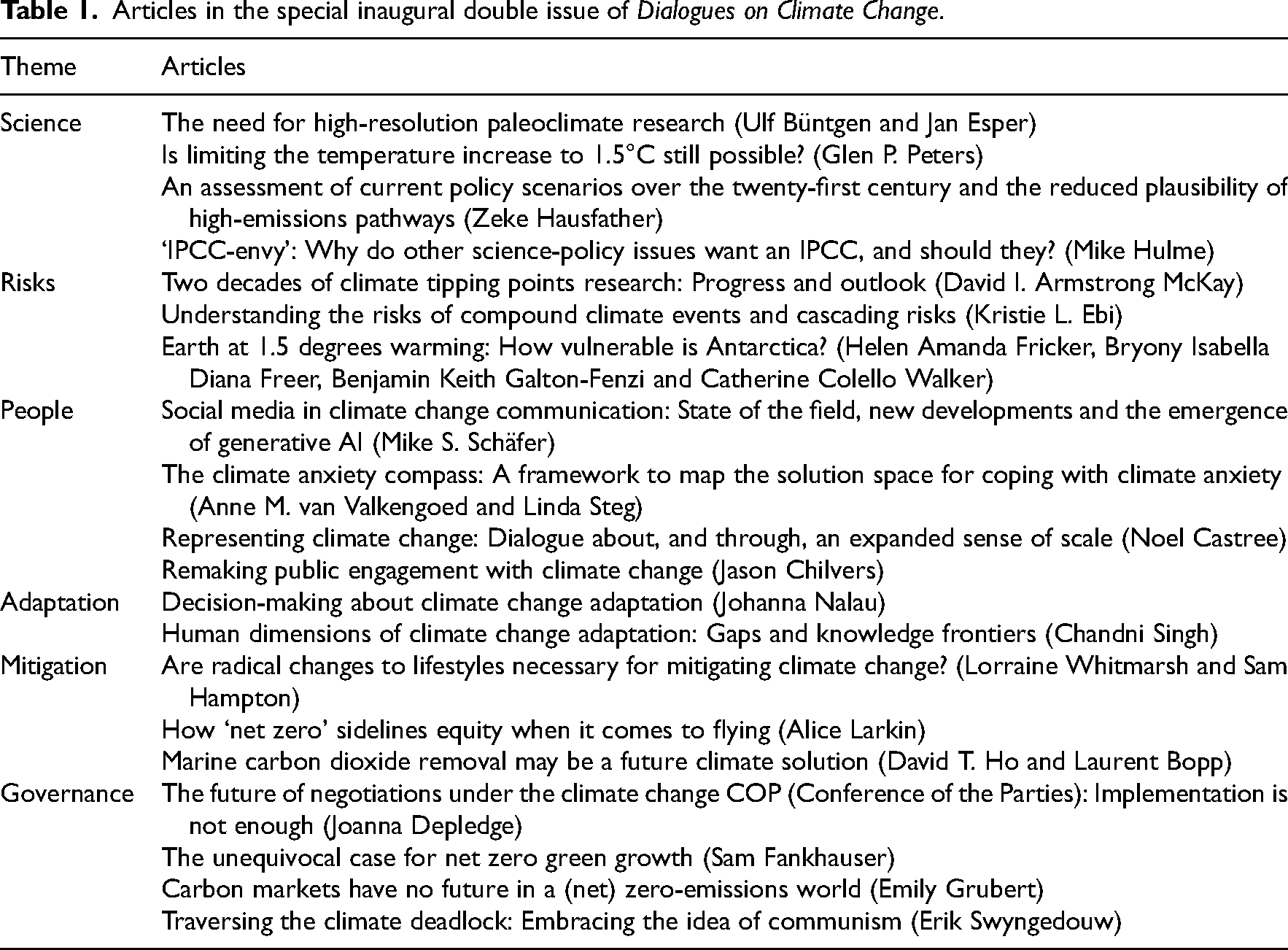
Climate change is a subject that generates significant debate. We debate about the many aspects of climate science that are incomplete or uncertain. We debate about the many ways in which it is and could be affected by human dimensions. And we debate about the many ways in which humans could – or should – respond to it. In this special inaugural double issue of Dialogues on Climate Change, 27 authors from across the natural and social sciences and the humanities address the state of climate change research in 20 articles across a range of hotly debated contemporary topics. This issue sparks a series of critical questions about scientific context, the risks we face, the roles of people, adaptation to impacts, mitigation of causes, and governance models (see Table 1).
We, the editors, are excited to be starting dialogues on climate change with this special inaugural issue and look forward to hearing from you, the readers, about your responses to these articles and your ideas for future issues.
Science
Dendroclimatological research is an important tool for understanding future environmental change and provides a powerful motivator for climate action. In their article, Büntgen & Esper highlight some of the physical and sociopolitical challenges associated with enhancing the value of this paleoclimatological data source, such as a dearth of observations from the tropics and growing bureaucratic hurdles to collecting new samples. They propose strategic uses of existing samples and cooperation to collect new samples.
Peters grapples with the contentious question as to whether limiting global warming to 1.5°C is still possible. He sets out how we lack clear definitions of what crossing 1.5°C means, instead rephrasing the question as to whether it is possible to reach net zero CO2 emissions emitting less than the remaining carbon budget. Considering the steepness of emissions declines needed for this and the implausibility of large-scale carbon dioxide removal or solar radiation management, he concludes that the conversation needs to move towards what is possible given our current circumstances.
Hausfather reviews estimates of the warming implications of current climate policies and discusses the plausibility of high-emissions pathways. He argues that climate policy successes combined with more rapid than expected development of clean energy technologies as well as weaker than expected economic growth, have reduced the central estimate of twenty-first century warming to below 3°C. He argues that while these developments have reduced the plausibility of extreme warming, climate system and carbon cycle feedbacks as well as the potential for continued emissions beyond the twenty-first century mean that warming over 4°C cannot be completely ruled out.
Hulme reflects on calls to establish institutions like the IPCC for other pressing science-policy problems by contending that it may be neither possible nor desirable. He argues the IPCC benefitted from unique conditions that other issues may not benefit from, and that the IPCC suffers from a limited scope, de facto governance of its issue, and mission creep. He concludes that other designs may be more appropriate, and that the IPCC itself may have already exhausted its purpose, while recognising that more IPCC-like institutions could be good for promoting issue pluralism.
Risks
Armstrong McKay takes stock of two decades of research into climate tipping points, charting the emergence and rise of the concept through to future directions for research. He reviews the latest evidence on climate tipping points, including the status of different Earth systems as potential tipping elements, the probability of their being tipped and at what thresholds, their impacts, and our prospects for developing early warnings and mitigation or adaptation measures. He concludes by reflecting on the considerable scientific uncertainties and communicative risks that remain.
Ebi discusses the factors shaping the risks of climate change and how risks of multiple climate extremes are compounding with one another and cascading from one sector or region to others. The risks of climate change are shown not to simply depend on changes to hazardous weather conditions, but also on the exposure and vulnerability of populations and ecosystems to those hazards. She warns that efforts to increase climate resilience are not keeping pace with growing risks and recommends research focuses on identifying effective interventions adapted to local conditions.
As global temperatures approach 1.5°C, Fricker et al. explore how vulnerable the Antarctic ice sheet is. Their overview of the latest science explains the key drivers of Antarctic ice loss, the processes at play, and the substantial uncertainties that make long-term projections of Antarctic ice loss challenging. Given the enormous impacts that Antarctic ice loss could have on coastal communities around the world, they stress that reducing these uncertainties should be a priority.
People
How to communicate climate change has always been in the public eye and it has been extensively researched and practised over the last few decades. But now in the age of social media, the landscape of climate change communication is changing very rapidly and significantly with new opportunities and challenges. Schäfer points out how constantly evolving social media platforms are changing this landscape, for example, through the diminished role of traditional journalism, the emergence of influencers with large followers (most notably, Greta Thunberg) and the more emotional, personalized and sometimes oversimplified (potentially, misleading) style of messaging via short video formats. He argues that the future of climate change communication will likely be filled with more uncertainties and concerns over new types of misinformation as the rise of generative AI could fundamentally transform our engagement with the issue of climate change.
van Valkengoed and Steg respond to the phenomenon of climate anxiety by theoretically structuring the coping strategies available to individuals. They describe problem-focussed actions and emotion-focussed actions that can be further differentiated by their focus on mitigation of or adaptation to climate anxiety, and their being individually oriented or collectively oriented. They conclude by setting a research agenda for measuring the prevalence of different coping strategies, understanding how they reduce anxiety, and the ways in which they can be best introduced.
Climate change is often called a ‘wicked problem’ that is not amenable to a clear definition and a single solution because there are multiple, conflicting framings of what the issue at stake is and how it should be addressed. But then how can we have meaningful dialogues on such a fractious problem with people who have very different understandings of the world? Castree recognizes the challenge of the multi-dimensionality of climate change (that is, climate change is not one thing but many things that exist in different places with various forms and sizes) and suggests that the idea of scale, a key concept in geographical thinking, is useful for grappling with it. He argues that inter-scalar thinking enables us to trace and learn different senses of the reality of climate change, through which we could have deep conversations without the destructive polarization on what the ‘problem’ of climate change means.
Chilvers critiques popular notions that publics have a deficit of understanding about climate change that needs better information and communication, or that there is a deficit of public engagement that needs to be addressed by inviting individual members of the public to participate. He argues that instead the deficit lies in recognising and responding to the diverse ways in which publics are already engaging with climate change, concluding in a need to go beyond invited institution-led processes to encompass uninvited, citizen-led, and mundane forms of participation in everyday life.
Adaptation
Nalau aims to reveal hidden factors that shape adaptation decision-making, and how adaptation is conceptualized more generally, to show areas where future research should focus. She argues that heuristics, like the rule of thumb that ‘adaptation should be local’, should be unravelled; that more research should focus on decision quality and decision processes; that there should be more debate on the role of AI; and that research should look more at the role of imagination in adaptation.
Singh looks at the disjunct between adaptation science and practice, and makes three arguments: that adaptation theory has ossified and may not be fully fit-for-purpose; that adaptation failures are diagnosed but limits to adaptation have not been studied; and that the field is uneven in terms of which scholars and disciplines it engages with. She concludes that adaptation researchers need to focus more on theory-building, pay more attention to the psychology of adaptation, and embrace methods that can go beyond small-n studies and assess adaptation outcomes over time.
Mitigation
Whitmarsh and Hampton confront claims that climate change can be solved through technological change alone by making the case for radical behavioural changes. They recount the limited attention given to tackling demand for energy and resources thus far, a range of impactful options for achieving demand reduction, and people's willingness to adopt them. They conclude that radical changes to behaviour are essential, while recognising that it is the wealthiest who need to change most and the poorest may even increase emissions to reach a basic standard of living.
Larkin takes aim at aviation and, to an extent, shipping as two sectors that have been labelled difficult to decarbonise, but that unlike other such sectors – like agriculture – disproportionately serve the global population. She considers how net zero targets have enabled these sectors to rely on others to reduce emissions on their behalf, or to rely on carbon dioxide removal to counterbalance their emissions. She concludes that governments and those informing decision making need to confront difficult questions around tackling demand management.
Ho and Bopp examine the prospects for marine carbon dioxide removal techniques as future ways of addressing residual emissions from activities that are difficult to decarbonise. They consider different categories of marine carbon removal before reviewing the effectiveness, impacts and acceptability of different techniques. They conclude by challenging preconceived preferences for techniques that rely on biotic processes, arguing that some abiotic techniques are better understood, more predictable, and have greater sequestration potential and storage duration.
Governance
Depledge challenges the view that the rulemaking phase of the climate regime is largely over and that a new phase of technical implementation is about to begin. She argues that the Paris Agreement is struggling to fulfil its logic of generating stronger ambition and action, and considers options for removing constraints on Conference of the Parties that prevent greater influence on domestic policy making and admonishing poor performers. She concludes that renewed rulemaking in the areas of new voting rules and new issue- or sector-specific legal agreements is needed.
Fankhauser grapples with the debate between net zero green growth and degrowth by making the case for the former as the most realistic strategy for stopping global warming. He sets out the conceptual links between carbon emissions and economic activity, before highlighting that many countries have already decoupled the two by having had their emissions peak while continuing to grow their economies. He concludes that while progress has been slow, net zero green growth is the most economically realistic and politically compelling option.
In the climate policy debate, economists often emphasise the importance of carbon pricing – either through taxes or emissions trading schemes – to reduce carbon emissions in a cost-effective manner; but its political effectiveness and feasibility has long been contested by scholars from other disciplines. Grubert argues that carbon pricing based on market mechanisms has no place in the effort towards net zero because a market function, which is driven fundamentally by the maximization of financial profits, is not suitable for determining which residual emissions are socially necessary and thus can be offset by carbon removal methods. She argues that such politically contentious and socially difficult decisions over residual emissions instead require establishing a centralized coordination mechanism by governments with public accountability.
The deadlock on climate change – the gap between knowing and acting – is explained by Swyngedouw as ‘fetishistic disavowal’, or the tendency to fantasize that climate change can be addressed through dealing with carbon dioxide without tackling deep social inequality. Greenhouse gas emissions are a class issue, he argues, and concludes that communism is the political trajectory that can deal with climate change.