



Abstract
The Antarctic Ice Sheet is integral to Earth's climate system, influencing global energy and water cycles, and ecosystems. Enough ice is stored in regions most vulnerable to rapid retreat to cause sea levels to rise by ∼15 m if they completely melted, making their stability a key concern. As global temperatures approach and look to surpass 1.5°C (Box 1) above pre-industrial levels, Antarctic ice loss is accelerating, with the potential to trigger significant climatic shifts. Yet, the complex processes governing its stability in a warming climate remain insufficiently understood, limiting society's preparedness. Given the accelerating rate of ice loss and its profound implications, urgent and coordinated efforts to reduce uncertainties around future Antarctic ice changes are essential for policymakers and society, as the resulting melt will have global consequences, especially for coastal areas already facing rising flood risks.
Antarctica contains Earth's largest ice sheet, holding about 62% of the planet's total freshwater (Shiklomanov, 1993). This vast reservoir of ice plays a critical role in regulating global sea levels and climate, yet its vulnerability to atmospheric and ocean warming remains poorly understood. As the Antarctic Ice Sheet (AIS) responds to a warming climate, it is becoming an increasingly significant contributor to global sea level rise (SLR; Figure 1), one of the most immediate and impactful effects of its ice loss. Understanding how and why the AIS is changing is essential to informing mitigation and adaptation strategies for coastal regions.
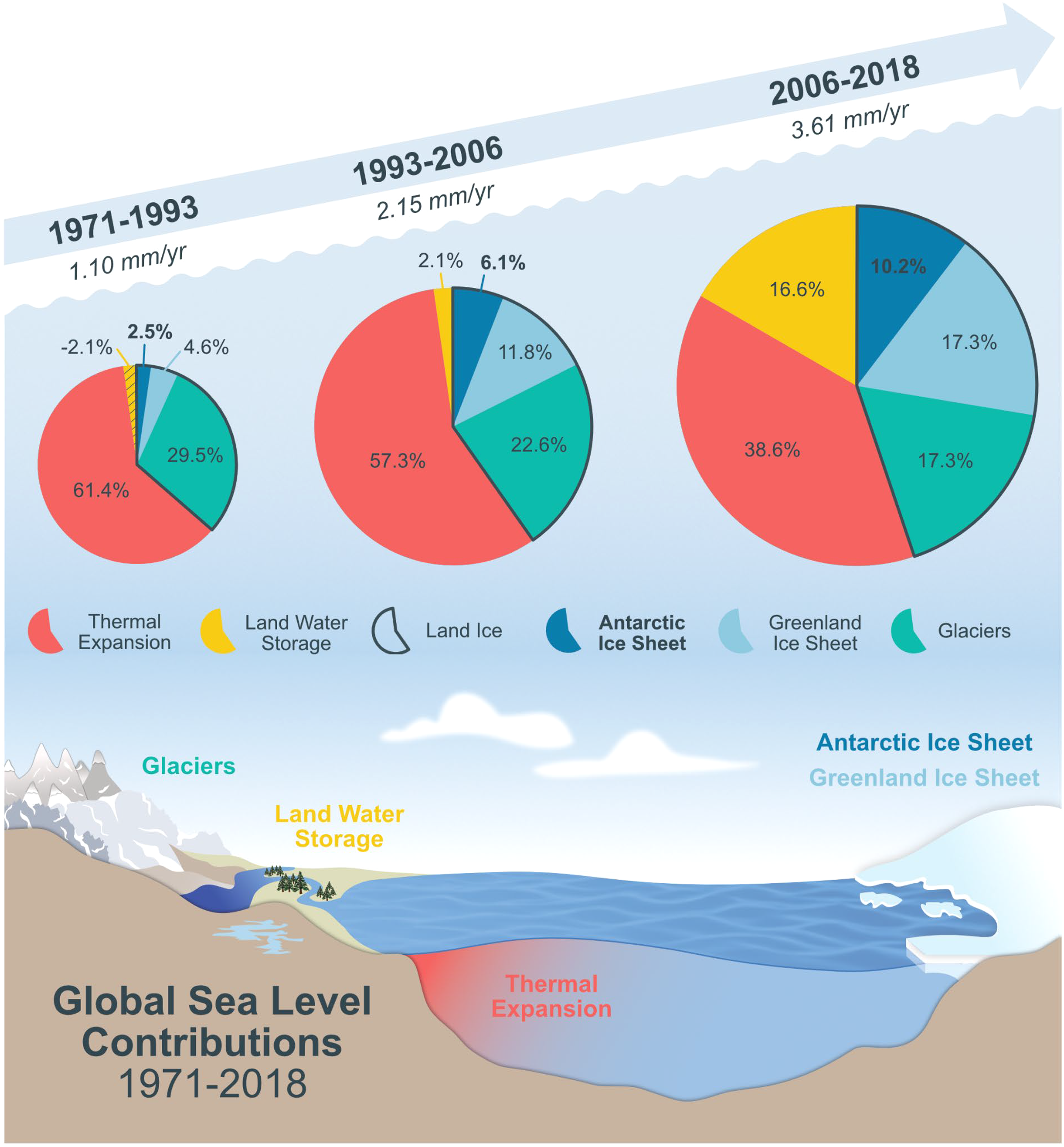
Main components of global sea level rise between 1971 and 2018 (Fox-Kemper et al., 2021). Pie charts show the relative contributions of each component for three consecutive time periods: 1971–1993, 1993–2006, and 2006–2018. The mean rate of SLR in mm per year is shown for each period in italics. Note the negative contribution (−2.5%) of land water storage to SLR in 1971–1993. SLR: global sea level rise.
The AIS is composed of two distinct regions: The West Antarctic Ice Sheet (WAIS) is undergoing potentially irreversible changes (Joughin et al., 2014), while the East Antarctic Ice Sheet (EAIS) is larger and generally more stable (Figure 2). Both the WAIS and the EAIS have been identified as potential climate tipping elements, meaning their responses to warming could drive irreversible changes: the WAIS is likely to reach a critical threshold at around 1.5°C of global warming (Box 1), while the EAIS threshold is 4°C (Armstrong McKay, this issue). The underlying risk lies in their shared vulnerability: both ice sheets contain large areas of ice grounded below sea level (Figure 2(b)), which makes them highly susceptible to melting from warmer ocean waters (Nicola et al., 2023; Rignot and Jacbos, 2002). When ice loss at the edges outpaces replenishment by snowfall, the AIS retreats, contributing to SLR (Figure 1). If the most vulnerable parts of WAIS and EAIS were to melt entirely, global sea level would rise by about 15 m. While complete melting is unlikely, even partial loss would result in significant SLR, with devastating implications for coastal communities worldwide (Box 2).
The impacts of 1.5°C warming.
Global warming is on track to exceed 1.5°C above pre-industrial levels within the next decade (Diffenbaugh and Barnes, 2023; IPCC, 2023; Lamboll et al., 2023) and there is ‘deep uncertainty’ surrounding how the Antarctic Ice Sheet (AIS) will respond (IPCC, 2019; Seroussi et al., 2024). The Intergovernmental Panel on Climate Change (IPCC) highlighted this uncertainty, noting that current models are unable to capture the extent to which a warmer ocean and atmosphere drives ice loss. Staying below 1.5°C warming is unlikely, and even this amount of warming will lead to considerable impacts. Even small increases in global temperatures may bring us closer to tipping points that could trigger irreversible changes (Armstrong McKay, this issue). The deep uncertainty makes it difficult to project how much and how fast the AIS will contribute to sea level rise (SLR) in the coming decades.
The potential for significant impacts is clear; AIS ice loss will continue to accelerate as global temperatures rise, and efforts to limit global warming even to 1.5°C will lead to dramatic changes across Antarctica. For the WAIS, which is particularly sensitive to ocean warming, the threshold for irreversible ice loss may already be close (Naughten et al., 2023). The West Antarctic Ice Sheet (WAIS) could reach a tipping point with 1.5°C of warming (Pattyn et al., 2018; Armstrong McKay, this issue), which could trigger irreversible ice loss and substantial SLR over the next decades to centuries, and perhaps faster if ice shelf collapse occurs (Sun et al., 2020). While the EAIS is not expected to experience the same rapid changes as the WAIS in the coming decades, its stability is of concern over longer timescales, given its inferred response to both atmospheric and ocean warming during previous periods in Earth's history (Wilson et al., 2018).
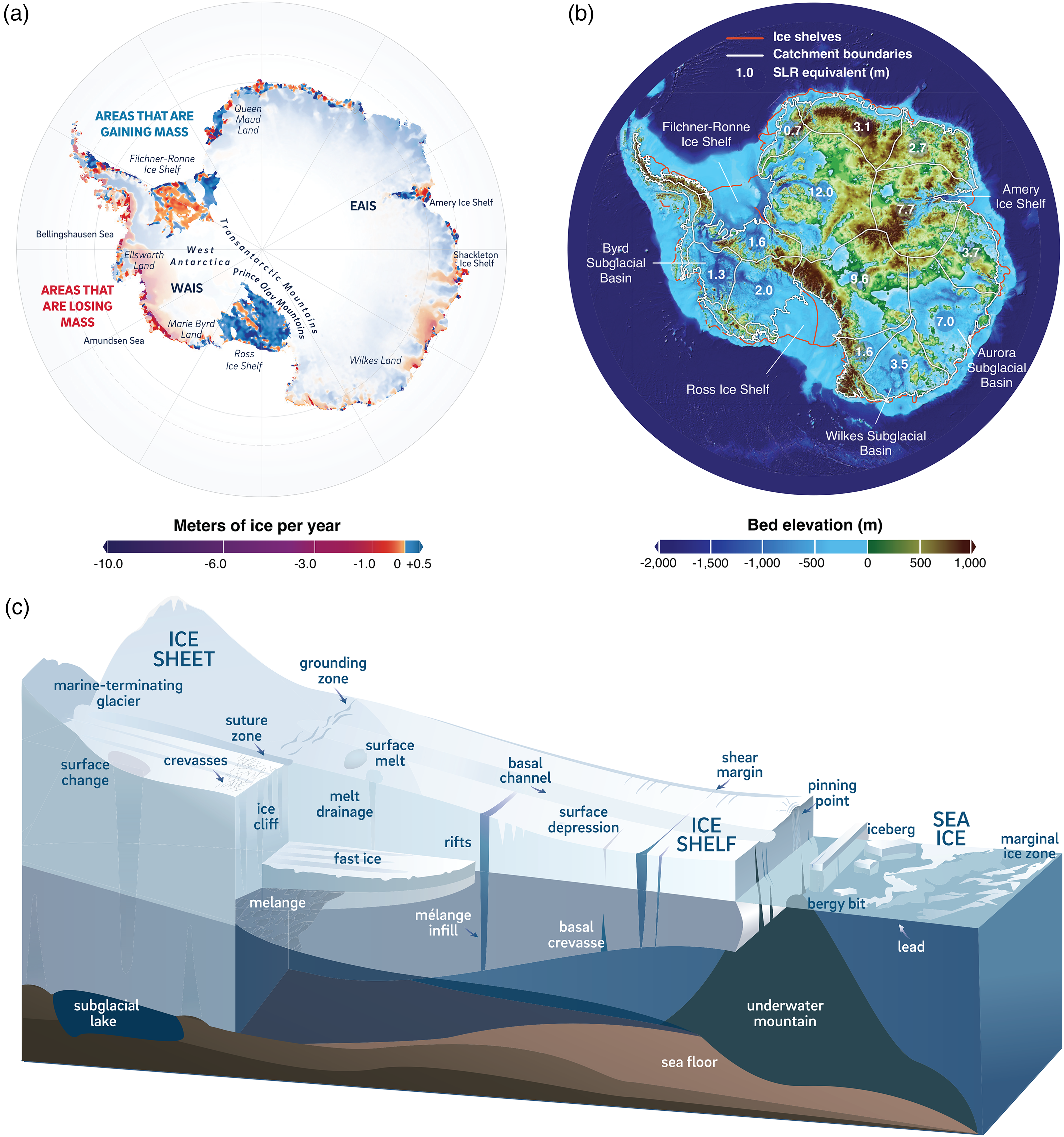
(a) Mass loss from the Antarctic Ice Sheet from 2003 to 2019 (Smith et al., 2020). (b) Potential global sea level rise equivalent (in metres) stored in each of Antarctica's drainage basins (white lines), overlain on bedrock topography (Morlighem et al., 2020) showing vulnerable regions of the ice sheet grounded below sea level (blue), adapted from Galton-Fenzi et al. (2024b); and (c) active ice sheet margin showing features associated with processes related to mass loss. WAIS = West Antarctic Ice Sheet; EAIS = East Antarctic Ice Sheet.
Accelerating ice loss since the 1990s
Since the modern satellite record began in 1992, AIS ice loss has accelerated (Otosaka et al., 2023; Shepherd et al., 2012, 2019). Located at lower latitude,
Coastal impacts of sea level rise. Several factors contribute to global sea level rise (SLR) (Figure 1), with ocean thermal expansion being the largest contributor over the past century, responsible for about 50%. The remaining 50% was from melting land ice – a mix of mountain glaciers and ice caps, and the Greenland and Antarctic Ice Sheets. Global mean SLR accelerated from 1.1 mm/per year (1971–1993) to 3.61 mm per year (2006–2018), with the proportion coming from the AIS increasing from 2.5% to 10.2% (Figure 1; Fox-Kemper et al., 2021). Even modest SLR can have severe consequences for coastal communities, particularly in low-lying areas where flooding, storm surges, and land loss are already becoming more frequent. Major cities around the world are at increased risk of inundation, and the economic costs of adapting to rising seas will be enormous. For vulnerable regions including small island states in the Pacific and Indian Oceans (Sadai et al., 2022), the impacts will be even higher—some of these nations face the prospect of becoming uninhabitable within decades. One of the challenges in adapting to SLR is that it is not uniform across the globe: Regional variations occur due to factors such as ocean currents, gravitational effects from the ice sheets themselves, and local geological processes. For example – and perhaps counterintuitively – areas further from Antarctica may experience more rapid SLR (Mitrovica et al., 2009) as a result of Antarctic ice loss than the global average, exacerbating the risks for certain regions in the central Pacific, and Northern Hemisphere. In addition to SLR, climate change is also increasing the frequency and intensity of storms. This combination of rising seas and stronger storms creates a ‘compound flooding’ risk (Galton-Fenzi et al., 2024b), where even relatively modest storm surges can cause significant flooding damage when combined with higher sea level. Coastal defences such as seawalls and levees will need to be strengthened, and in some cases, communities may need to consider retreating from the coast altogether. Planning must consider the local conditions when developing adaptation strategies that are informed by global changes.
Most of the AIS's SLR contribution has come from WAIS, in particular the Amundsen Sea sector, including the Pine Island and Thwaites glaciers, which have lost ice at unprecedented rates (Scambos et al., 2017). Thwaites Glacier poses significant risk due to its size and its grounding below sea level, making it susceptible to rapid retreat. Its collapse could destabilise WAIS and contribute up to 5.3 m to global sea level over the next few centuries (Morlighem et al., 2020) (Figure 1(b)). Even over the next few decades, retreat of Thwaites could raise sea levels by 10 cm (Fox-Kemper et al., 2021; Holland et al., 2023), increasing risks for coastal communities.
The EAIS has been slower to respond to warming, and increased inland snowfall associated with a warmer, more moisture-laden atmosphere has offset ocean-driven melt at the margins (Otosaka et al., 2023; Smith et al., 2020). However, signs of change are emerging (Lauber et al., 2023; Miles et al., 2016; Smith et al., 2020; Walker et al., 2024), particularly around the Aurora and Wilkes subglacial basins, for example, at Totten Glacier, where warmer oceans are increasing basal melting (Greenbaum et al., 2015; Li et al., 2023). With 10.5 m of ice grounded below sea level, understanding the vulnerability of these basins to ocean-driven melting is critical, as it could shift the balance of AIS ice loss and contribute to global SLR in ways that are poorly constrained in future projections.
Ice shelves moderate rapid ice loss
Antarctica's ice shelves – floating extensions of the ice sheet – stabilise the ice sheet by acting as buttress dams, holding back the flow of glaciers into the ocean (Gudmundsson et al., 2019; Thomas, 1979). Buttressing is reduced through ice shelf retreat (Fürst et al., 2016), thinning (Paolo et al., 2015) or collapse (Scambos et al., 2004), causing glaciers to accelerate (Gudmundsson et al., 2019; Scambos et al., 2004). The Larsen B Ice Shelf collapse (Scambos et al., 2004) on the Antarctic Peninsula, revealed that ice shelf response can be sudden and rapid, which was a turning point in our understanding of Antarctica's vulnerability to warming.
While the collapse of floating ice shelves has a negligible SLR contribution – since the ice is already floating – it triggers a chain reaction where the land-based ice behind the ice shelf flows faster into the ocean, raising sea level. This has been observed on the Antarctic Peninsula and in the Amundsen Sea, where glaciers like Pine Island and Thwaites have shown significant acceleration and grounding line retreat (Milillo et al., 2019; Rignot et al., 2014, 2024) following the thinning of their ice shelves (Paolo et al., 2015). In the EAIS, the first ice shelf collapse occurred in 2022 with the disintegration of the Conger-Glenzer Ice Shelf (Walker et al., 2024). While this event was less dramatic than the collapse of Larsen B, it underscores the vulnerability of ice shelves in the EAIS, which had long been considered more stable. The loss of ice shelves in both West and East Antarctica is a warning sign that the continent's ice dynamics are changing rapidly, and further collapses could have profound implications for global SLR (Naughten et al., 2023).
Projections of AIS evolution with uncertainties constrained well enough to be useful to society are currently out of reach because models miss key processes at dynamic ice margins. This is due to current gaps in knowledge, understanding, or observational constraints (Van De Wal et al., 2022). A major observation gap is at the 100 m to 1 km scale, which is crucial for capturing process-scale features that might play an outsized role in mass loss (Figure 2). These small-scale features, which are central to mass loss and structural stability, often go unresolved in current models (Alley et al., 2019). While these ice dynamic processes drive significant ice loss, a warmer climate will likely lead to increased snowfall over parts of Antarctica, potentially offsetting some SLR by adding mass to the ice sheet. However, it remains uncertain whether this additional snowfall can keep pace with dynamic ice losses at the margins.
Instabilities influencing AIS response to warming
Two hypothesised instabilities could lead to self-sustaining, irreversible changes. With faster flow and enhanced melt, the ice thins and can lead to grounding line retreat. In regions where the bedrock slopes downward inland, called a ‘retrograde slope’, such grounding line retreat can continue unabated, in a scenario known as ‘Marine Ice Sheet Instability’, or MISI (Robel et al., 2019). MISI can be triggered as warmer waters melt the ice shelves faster from below. The marine ice cliff instability (MICI) is another recently posed hypothesis that could compound the effects of MISI. This hypothesis suggests, as ice shelves weaken and disintegrate, towering ice cliffs can be exposed (DeConto and Pollard, 2016). Without support, these cliffs can collapse under their own weight (Bassis and Walker, 2011), rapidly advancing ice loss in a self-sustaining cycle that sends more ice into the ocean.
While some studies have suggested that MISI may be underway (Joughin et al., 2014; Rignot et al., 2014), its impacts on long-term stability are difficult to infer over short observational timescales (Waibel et al., 2018) or may be dampened by other complex feedbacks (Kachuck et al., 2020). MICI has yet to be directly observed in Antarctica. Evidence in the geological record suggests it played a key role in the rapid deglacial ice sheet retreat into Pine Island Bay >12,000 years ago (Wise et al., 2017) and cliff failure may have at least partially influenced the post-collapse retreat of Crane Glacier in the Larsen B embayment (Needell and Holschuh, 2023). The potential role of MICI in ice loss before 2100 remains uncertain and is disputed (Bassis et al., 2024; Clerc et al., 2019; DeConto and Pollard, 2016; Morlighem et al., 2024).
Priorities for research action
The need to constrain future projections of ice loss demands immediate increased and sustained investment in scientific research on Antarctica and its potential impacts on SLR. The economic ramifications of unchecked SLR, projected to reach trillions of dollars globally by 2100 (Catania et al., 2022; Hinkel et al., 2014) far exceed the relatively modest costs associated with enhancing global research efforts aimed at mitigating these impacts. Investing more in research is not only cost-effective but also essential for preventing catastrophic economic and societal consequences.
Enhanced satellite Earth observation missions are vital for gathering key datasets, such as surface elevation and ice velocity, which are crucial for monitoring of AIS mass balance and dynamics. These missions are a cost-effective investment, providing continuous insights into critical ice sheet processes. Increasingly, there are calls to integrate satellite observations more effectively with ground-based measurements, laboratory studies, and simulations to deepen understanding and improve monitoring capabilities (e.g. Cook et al., 2022; Freer et al., 2023; McCormack et al., 2024; Wallis et al., 2023).
High-fidelity coupled models that leverage the latest observations are the central method toproducing accurate future projections. These models can be further enhanced through the development of more accurate and precise parameterisations, increased resolution that capitalizes on rapidly evolving computational platforms, and the integration of constrained observations (Seroussi et al., 2020). Better efficiency and outcomes of simulations and observations may be gained with the use of new analysis techniques such as state-of-the-art machine learning (De Roda Husman et al., 2024) that is showing potential for integrating across methods, to discover new insights into how different factors contribute to ice loss.
Tackling the vast challenges posed by Antarctic ice loss requires unprecedented international collaboration, uniting resources, expertise, and innovation across the globe. The sheer scale and remoteness of Antarctica, and the far-reaching consequences of its ice loss make it clear: no single nation can address this problem alone. Initiatives like the World Climate Research Programme (WCRP) (WCRP Joint Scientific Committee, 2019), and the Intergovernmental Panel on Climate Change assessments (IPCC, 2023) unite scientists worldwide to provide policymakers with the most reliable and up-to-date science on climate change and its impacts. With research rapidly evolving, collaborative efforts can strengthen these assessments, ensuring that the latest scientific knowledge informs decision-making for all nations.
Summary
Antarctica is experiencing significant climate change impacts, with the greatest risks of rapid retreat and tipping points in areas grounded below sea level. The current ice loss is only the beginning, and as global temperatures continue to rise beyond 1.5°C above pre-industrial levels, the losses will continue to accelerate. Improving our understanding of AIS vulnerabilities will be critical for better predicting its future contributions to SLR and guiding efforts to mitigate and adapt. These shifts could have profound global consequences; disruptions to the AIS have the potential to reshape weather patterns, disrupt marine ecosystems, and jeopardise critical resources such as fisheries, on which millions of people rely for food security. Coastal communities will need to build resilience to rising seas, stronger storms, and more frequent flooding which includes strengthening infrastructure, improving early warning systems, and, in some cases, relocating at-risk populations. We urge policymakers and stakeholders to engage with the rapidly advancing science of AIS mass loss and to support critical research into Antarctica's role in the global climate system. The choices made today to reduce emissions and invest in adaptation will shape the extent of Antarctic ice loss, the scale of SLR, and our preparedness for the challenges of a warming world.
Footnotes
Declaration of conflicting interests
The authors declared no potential conflicts of interest with respect to the research, authorship, and/or publication of this article.
Funding
The authors disclosed receipt of the following financial support for the research, authorship, and/or publication of this article: HAF was supported by NASA Cryospheric Sciences award 80NSSC23K0934 and a gift from Eric and Wendy Schmidt. BG-F was supported by the Australian Government by the Antarctic Science Collaboration Initiative Program (ASCI000002) and the Australian Research Council Special Research Initiative, Australian Centre for Excellence in Antarctic Science (SR200100008). CW was supported by NASA Cryospheric Sciences award 80NSSC22K0380 and NASA Physical Oceanography award 80NSSC23K0356). BF was supported by a Natural Environment Research Council (NERC) Satellite Data in Environmental Science (SENSE) Centre for Doctoral Training (NE/T00939X/1) and the Schmidt AI Postdoctoral Fellowship.
ORCID iDs

Correction (February 2025):
This article has been updated with minor textual and style corrections since its original publication.