



Abstract
Comparing recent warming against past temperature changes is crucial for understanding the importance of greenhouse gas emissions for the global climate system. Although tree ring-based temperature and hydroclimate reconstructions form the backbone of high-resolution paleoclimatology, the data used, methods applied, and concepts proposed are far from perfect. Here, we open dialogue on challenges of dendroclimatology and scientific collaboration. We emphasise that temperature signals in tree-ring chronologies are restricted to extra-tropical growing seasons, and that far too little such data exist for the Southern Hemisphere and the Common Era. We notice that the preservation of both, high- and low-frequency information is prone to uncertainties, that investigations of growth-climate relations are hindered by short and spatially inconsistent meteorological measurements, and that geopolitical tension increasingly constrains data accessibility. Finally, we highlight the need for paleoclimate research and funding, with a focus on annually resolved and absolutely dated timeseries for the Holocene.
Keywords
The importance of high-resolution proxy archives
The pace of recent anthropogenic warming has been described as unparallel in the past 2000 years (Esper et al., 2024a; Tejedor et al., 2024), with more projected warming in the pipeline (Hanson et al., 2023), and consequences for ecological and societal systems likely being irreversible (Richardson et al., 2023). Robust investigation of current trends and extremes in the Earth's surface temperature, however, requires high-resolution proxy archives (Jones et al., 2009; Esper and Büntgen, 2021), of which an insufficient number of well-replicated, temperature-sensitive tree-ring chronologies provide annual resolution and absolute dating accuracy over the Common Era and beyond (Figure 1A). Our understanding of past temperature variations and our capacity to disentangle the relative contributions of anthropogenic and natural climate forcing factors hinges on the quality and quantity of temporally precise, seasonally distinct and spatially explicit proxy records that continuously span centuries to millennia and exist on most continents – tree rings.
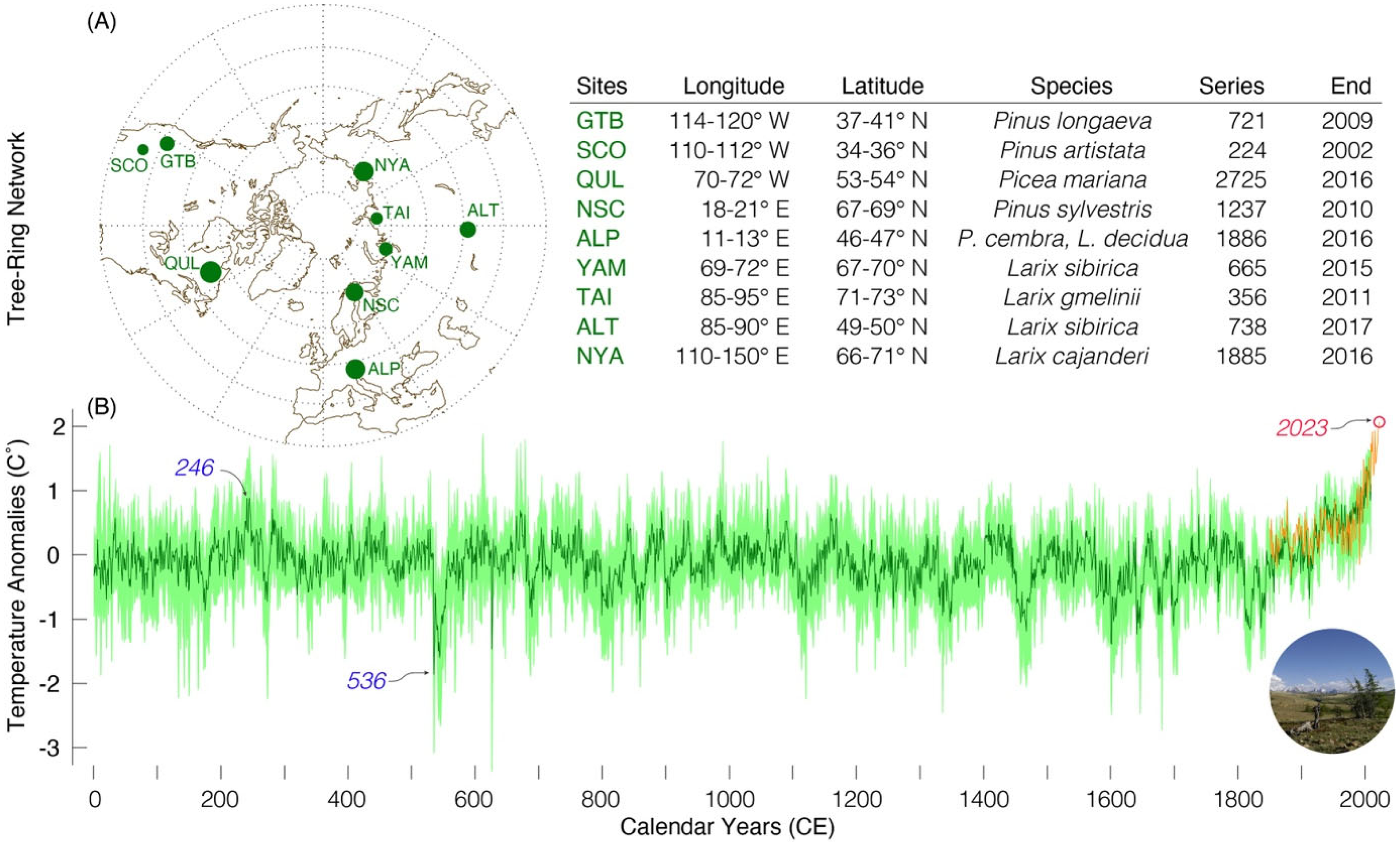
Unprecedented recent summer warming. (A) Spatial distribution of tree-ring width chronologies that reach back to the year 1 CE and have been reported to contain a warm season temperature signal (Büntgen et al., 2020, 2021a). Three datasets are located in North America (GTB, SCO and QUL), two in Europe (NSC and ALP), three in northern Siberia (YAM, TAI and NYA), and one in inner Eurasia (ALT). Ranging from 224 individual series in SCO to 2725 in QUL, dot sizes represent TRW sample replication. The longitude and latitude, species, the total number of series, and last ring of the nine regional tree-ring width datasets is provided on the right side. The inset picture shows the upper treeline ecotone with living and relict Siberian larch wood in the Altai mountains (ALT), Russia (Büntgen et al., 2016). (B) Instrumental June–August (JJA) land surface temperatures (orange; Berkeley Earth) and the ensemble reconstruction mean (green; Büntgen et al., 2021a) with its 95% uncertainty range derived from the variance of the individual ensemble members (light green), scaled from 1901 to 2010 against observations and expressed as anomalies with respect to the 1850–1900 mean (Esper et al., 2024b).
The limitations of tree ring-based temperature reconstructions
Despite their frequent utilisation in archaeology, climatology and ecology for more than a century (Cook and Kairiukstis, 1990; Douglass, 1914: Fritts, 1976; Kapteyn, 1914; Schulman, 1956; Schweingruber, 1996), information extracted from different tree-ring parameters, including ring width, wood density and anatomy, as well as stable carbon and oxygen isotopic ratios, is typically restricted to the plants’ growing season. The length of disjunct growing seasons varies dramatically from only a few weeks between the end of June and early August towards the most northern treelines at around 70° North, where dormancy accounts for more than ten months per year, up to several months across much of the boreal and temperate forest biomes, where the majority of tree-ring chronologies has been developed. Distinct annual growth layers are typically missing in the tropics where trees grow all-year-round.
Dendrochronologists therefore develop warm-season temperature (hydroclimate) reconstructions from sites near species-specific cold (arid) distribution limits. The longest of these records allow recent anthropogenically-induced temperature extremes to be placed into the context of Common Era climate variability (Figure 1B). Reconstructed June-August surface air temperatures identify 2023 as the warmest Northern Hemisphere extra-tropical summer over the past 2000 years (Esper et al., 2024b), exceeding the 95% confidence range of pre-industrial changes by more than 0.5 °C. Comparison of the 2023 warmth against the coldest reconstructed summer in 536 CE at the onset of the Late Antique Little Ice Age (LALIA; Büntgen et al., 2016; Büntgen et al., 2022) reveals a maximum temperature amplitude of 3.93 °C. The warmest pre-industrial summer was in 246 CE towards the end of the Roman Warm Period. Intriguingly, only nine chronologies reach back to the year 1 CE and have been reported to contain a warm season temperature signal (Figure 1A). For the western Mediterranean region, a distinct ‘climate change hotspot’ (Büntgen et al., 2024), both the consecutive summers of 2022 and 2023 exceeded pre-industrial temperature variability since medieval times and reached unprecedented anomalies of 3.6 and 2.9 °C (Tejedor et al., 2024), respectively.
Importantly, though frequently ignored (Anchukaitis and Smerdon, 2022; Esper et al., 2024c), tree ring-based temperature reconstructions are not only seasonally constrained, which may be advantageous and disadvantageous depending on the research question, but also absent for most parts of the Southern Hemisphere, where efforts and resources to conduct large-scale temperature reconstructions are generally sparse (Neukom et al., 2014). Year-to-year and longer-term variability in global annual mean surface temperatures therefore cannot be reconstructed with confidence, nor can information about inter-annual winter climate be extracted reliably (Büntgen and Esper, 2024). This is an important caveat, because the variance of annual mean temperatures is dominated by the much more variable winter conditions, and an empirical lack of the latter biases any whole-year estimate. While the various tree-ring parameters are the only source to empirically place single climate events into long-term context at larger spatial scales, doubt has been raised about the ability of formerly temperature sensitive tree-ring width and density chronologies to track the rapidly rising temperature trend since the 1970s (Briffa et al., 1998). This so-called ‘Divergence Problem’ additionally questions the skill of dendro records to accurately display earlier warm periods and thus capture the full range of past natural temperature variability (Esper et al., 2012). These uncertainties, plus additional error arising from methodological decision processes are still to be resolved (Büntgen et al., 2021a).
One way to compensate for seasonal, spatial and temporal limitations in the tree-ring record are multi-proxy reconstructions (Luterbacher et al., 2016), which combine archives of different resolution and climate sensitivity. Consideration of low-resolution proxy records with dating uncertainty in large-scale network approaches, however, makes it difficult to contextualise the most recent warming extremes against methodologically smoothed trajectories of past temperature ranges (PAGES2K Consortium, 2013), and quantify the role of natural versus anthropogenic climate forcing factors (Hegerl et al., 2006; Schurer et al., 2013). Statements such as “The latest decade was warmer than any multi-century period after the Last Interglacial, around 125,000 years ago” included in the last IPCC report are scientifically incorrect because the mean and variance of intervals of different lengths should not be evaluated and compared statistically (Esper et al., 2024a), and the underlaying data are characterised by declining resolution and variance back in time (Marcott et al., 2013). To avoid confusion within and beyond academia, it is important to communicate the range of limitations and uncertainties in proxy-based reconstructions to a wide audience increasingly concerned with the environment.
The need for better understanding Holocene climates
The Holocene interglacial, beginning approximately 11,700 years ago at the end of the last Ice Age, is the natural benchmark for the Anthropocene. Further to the lack of annually resolved and absolutely dated proxy data, our understanding of Holocene climates is challenged by limited insights into forcing factors and feedback mechanisms that may, or may not, operate on different spatiotemporal scales (Figure 2A). To preserve the full spectrum of naturally forced, inter-annual to multi-millennial variability needed to compare recent anthropogenic changes against past Holocene ranges, Essell et al. (2023) isolated and recombined archive-specific temperature signals to generate a frequency-optimised record of temperature changes for the past 12,000 years (Figure 2B). Average temperature estimates before approximately 8000 years BP and after approximately 4000 years BP were 0.26 °C (±2.84 °C) and 0.07 °C (±2.11 °C) cooler than the long-term mean, whereas the Holocene Climate Optimum from approximately 7000 to 4000 years BP was 0.40 °C (±1.86 °C) warmer. The large uncertainties of these estimates result from a lack of high-resolution proxy data back in time. Similar to the available large-scale, multi-proxy, temperature reconstructions for the Common Era, the Holocene trajectory is biased towards mid- to high-latitude Northern Hemisphere summer temperatures.
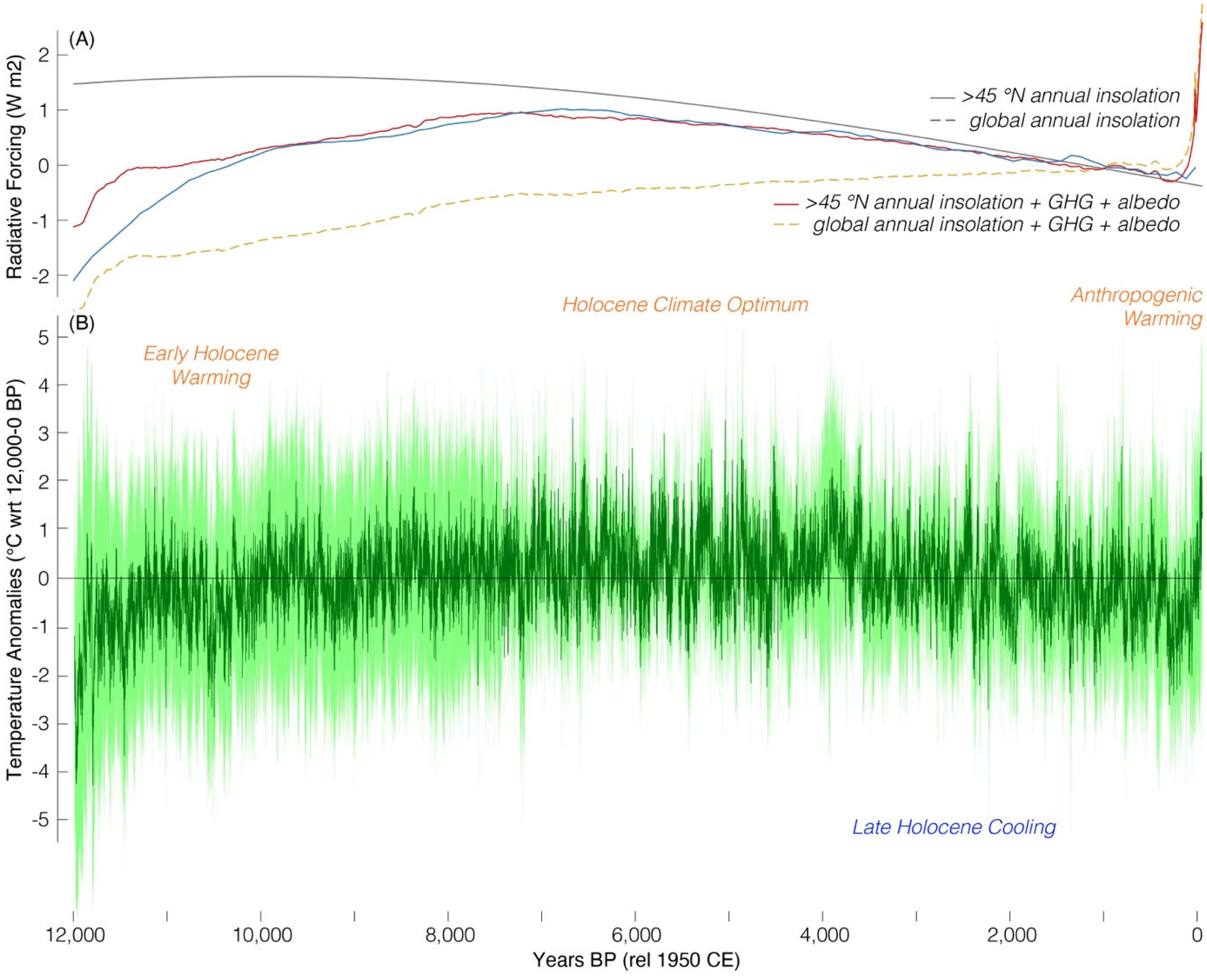
Holocene climate forcing and temperature changes. (A) Comparison of annual mean insolation changes estimated for the northern latitudes above 45° North (solid grey line). Temperature estimates from the summation of annual mean insolation changes estimated for the northern latitudes (red line) and global mean (dashed yellow line) with greenhouse gases (Köhler et al., 2017) and global albedo changes (Marcott et al., 2013), together with the Temp12K-based temperature reconstruction (Kaufman et al., 2020) (blue line). All timeseries are expressed as anomalies relative to the preindustrial last 2 millennia (0–1850 CE). (B) A frequency-optimised temperature reconstruction for the Holocene (Essell et al., 2023), together with uncertainty based on the sum of 95% confidence intervals of 814 temperature trajectories (Kaufman et al., 2020), from which the inter-annual to multi-millennial record was derived back to 7450 years BP, followed by standard deviations from the mean of the simulated high-frequency variability when confidence intervals were absent.
A key to improve temperature reconstructions for the Holocene is to re-visit the longest tree-ring datasets for which ring widths have been obtained so far (Figure 3). Despite the complex infrastructure and high costs needed for measuring wood anatomical features and stable isotopic ratios, doing so for the Holocene would be worth the effort, because these parameters will add new and more nuanced climate and environmental evidence to those classical ring width measurements offer. While quantitative wood anatomy has the potential to increase the strength and temporal resolution of climate and other environmental signals (Björklund et al., 2023; Büntgen et al., 2022; Carrer et al., 2023), carbon and oxygen isotopic ratios from tree-ring cellulose may possibly capture abiotic information well beyond the age of individual trees (Büntgen, 2022). Conceptual re-thinking of the predictive power of different tree-ring parameters for climate reconstruction has been provoked by independent studies that revealed long-term drying trends over the past two and seven millennia in central Europe and monsoon Asia (Büntgen et al., 2021b; Yang et al., 2021), respectively.
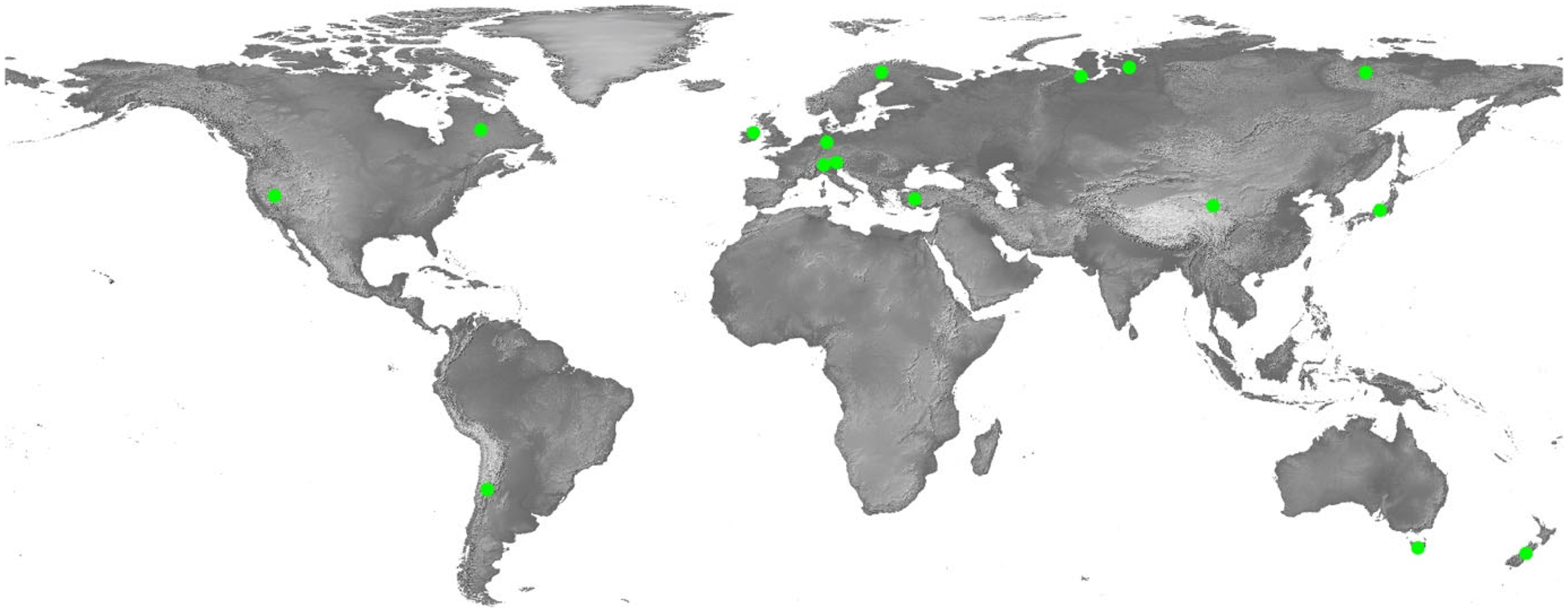
Long tree-ring records. Location of tree-ring width chronologies that reach well beyond the Common Era and hold the potential to develop new wood anatomical and stable isotopic records for much of the Holocene: Bristlecone pine (Pinus longaeva) in the western US, Black spruce (Picea mariana) in Quebec, Patagonian cypress (Fitzroya cupressoides) in Argentina, oak (Quercus spp.) in Ireland and central Europe, larch (Larix decidua) and pine (Pinus cembra) across the European Alps, Scots pine (Pinus sylvestris) in northern Scandinavia, (Quercus spp.) in Turkey, Siberian larch (Larix sibirica) on the Yamal and Taimyr peninsulas and the Lena–Indigirka–Kolyma region, all northern Russia, Qilian juniper (Juniperus przewalskii) along the northeastern Tibetan Plateau in China, Japanese cedar (Cryptomeria japonica) in Japan, Huon pine (Lagarostrobos franklinii) in Tasmania, and kauri (Agathis australis) in New Zealand. The world's longest continuous tree-ring composite chronology combines oak and pine samples from different regions in central Europe and extends back more than 12,000 years (Reinig et al., 2018).
As with the utilisation of stable isotopic ratios from different terrestrial and marine archives in multi-proxy climate reconstructions, plant growth is not a direct derivative of the isotopic composition of CO2 and H2O entering through stomata and roots. In other words, tree-ring stable isotopes primarily reflect the structure of their atmospheric, hydrospheric and/or geogenic resources, but less those of plant physiological factors. This “growth independence” between signal and proxy, which is not the case for ring width and wood density, mainly pertains to stable oxygen (δ18O), and to a lesser extent to stable carbon isotopes (δ13C). Tree-ring stable isotopes do not generally require rigorous age-trend removal (but see Esper et al., 2010; Helama et al., 2015 for different perspectives), and relatively small sample sizes can contain strong signals (Treydte et al., 2024), even if the trees were not growing under extreme site conditions.
A closer look at the spatial distribution of the longest tree-ring records, however, raises concern about present and future data availability (Figure 3). Geopolitical circumstances increasingly hinder fieldwork in, and data exchange with Russia (Rees et al., 2023), as well as many more countries, including China and several regions in northern Africa and the Middle East, all of which are sources of very long tree-ring records and holding the potential for further expansions. While we are calling for intensive sampling campaigns to refine existing and develop new tree-ring chronologies for addressing Holocene climate variability, dendrochronologists around the world are facing more and more bureaucratic procedures and administrative hurdles to cautiously explore sites, non-destructively core trees, and sustainably transport samples. Moreover, there is an alarming tendency towards impertinent costs for all kinds of research data and far too long waiting time for permits. These obstacles are particularly frustrating as scientific infrastructure, and measurements are usually funded by tax income in the first instance.
Conclusions and outlook
Advanced high-resolution paleoclimate reconstructions are needed to improve detection and attribution studies and inform policymakers. Nevertheless, caution is advised when using sophisticated statistical techniques to combine all available proxy data regardless of their spatiotemporal resolution and seasonal signal. Though useful in some respect, large and unspecific proxy compilations bear the risk of inappropriate comparison between high-frequency measurements of anthropogenically-forced temperature extremes against smoothed trajectories of natural low-frequency variability.
This commentary is intended to emphasise the importance of building new and improving existing proxy records. Dendrochronologists are therefore well advised to prioritise tree-ring chronologies that cover much of the Holocene but contain only weak temperature or hydroclimate signals. For these datasets, more samples should be collected and additional parameters measured. Developing and updating well-replicated, multi-millennial-long, high-precision wood anatomical and isotopic records require expert knowledge, specialised laboratories, and adequate funding.
Footnotes
Acknowledgements
The authors are thankful to Ed Cook, and colleagues in Brno, Cambridge and Mainz who stimulated critical thinking and provided useful insights.
Data availability
All data shown in this commentary are freely available.
Declaration of conflicting interests
The authors declared no potential conflicts of interest with respect to the research, authorship, and/or publication of this article.
Funding
The authors received funding from the Czech Science Foundation grant HYDRO8 (23-08049S), the co-funded EU project AdAgriF (# CZ.02.01.01/00/22_008/0004635), the ERC Advanced Grant (# 882727; Monostar), and the ERC Synergy Grant (# 101118880; Synergy-Plague).
