



Abstract
Platforms like WhatsApp form the backbone for everyday communication in the majority world. Extensive scholarship has focused on WhatsApp's role in the spread of mis- and disinformation and on WhatsApp being repurposed for use in educational, gig work, and healthcare settings. And while much of this platform scholarship has examined contexts in which users receive and access information, researchers have yet to pay attention to users’ personal information practices such as receiving, storing, and sharing files like images, videos, and PDFs. Based on an interview and task-based study focused on files and managing personal information (N = 25), we present findings that show WhatsApp—as a platform and superapp—is a key site for link sharing between apps, how WhatsApp's affordances impact users’ perceptions of files, and how superapps shape personal information practices with mobile devices. We discuss the implications of these findings for platform studies research, arguing that platform studies scholars should expand the scope of their studies from top-down governance of data management and information transmission to bottom-up everyday information practices of mobile-first users impacted by platforms.
Introduction
In 2018, news outlets around the world, from The Wall Street Journal to BBC News to IndiaTimes, exclaimed that Indians were “clogging” the internet with billions of group messages sent via WhatsApp messaging groups (IndiaTimes, 2018; Purnell, 2018; Rannard, 2018). The app had updated a feature to group messaging that allowed mass forwards across multiple threads. Many young adults interviewed in the media coverage reported that they received daily greeting messages from older family members (grandparents, aunts, uncles, and parents). At the same time, Android users reported an increase in spam and virus-like symptoms on their devices: Good morning messages from family threads were not only clogging internet traffic, but they were also slowing down mobile phones and making WhatsApp sluggish for users (Birchall, 2018). Popular media coverage explained that these good morning messages, especially embedded images received through WhatsApp, were getting downloaded to users’ smartphone galleries, filling up their storage (Purnell, 2018).
We begin with this framing anecdote because of what it shows about the primacy of WhatsApp in people's lives in India. Group good morning messages on WhatsApp slowing down the internet is also an illustrative example of how information practices are now mobile, networked, and largely governed through apps operated by platforms. While nearly all the coverage discussed how young adults now just simply mute notifications from their family group messaging threads, no media coverage described this curation strategy as a common form of managing personal information. Good morning messages, often shared as images by older adults, are seen as ways for some users to sustain sociality via positive messaging. However, younger adults perceive such messages as inauthentic or trivial (Trillò, 2023). This contradiction can be seen as evidence of intergenerational communication practices and conflicting norms between younger and older adults using group messaging and how information sharing and information management practices are tied up on platforms like WhatsApp. In this article, we examine how platforms like WhatsApp are sites of a diversity of personal information practices for mobile-first users. By using the term “mobile-first users,” we build on literature that has identified mobile phones as the primary computing devices for internet users from countries like India (Govindarajan and Bagla, 2016; Jeffrey and Doron, 2013).
Histories of personal digital assistants (PDAs) and early mobile devices like the BlackBerry concern the ability of people to manage files from work while commuting, at home, and in third spaces (Agar, 2013; Butter and Pogue, 2002; Ito et al., 2006). But as mobile devices and app-driven operating systems begin to become the primary sites for interacting with digital information, it begs the question—how are personal information management (PIM) practices shifting with the ubiquity of mobile devices in everyday life, and how is file management occurring on platform-driven apps? In their sweeping review of file management research in human–computer interaction (HCI), information retrieval, and information-seeking studies, Dinneen and Julien argue that future file management research should concern mobile phones (Dinneen and Julien, 2020: 22). Scant work specifically examines how apps are sites of PIM and how these software technologies are extensions of platforms that aim to enclose services even as users may resist or shape them (Acker and Beaton, 2016, 2017).
The rise of mobile ICTs and platform services has led to an emerging category of “superapps” which aim to bring many different tools into these expansive software-driven mobile experiences (Chen et al., 2018; Steinberg, 2020; Steinberg et al., 2022). Superapps on mobile smartphone operating systems leverage the category of files in particular kinds of ways. We argue that indeed the management of files has increasingly become a part of how some of these apps enroll and engage new users. For example, in 2022, WhatsApp increased the size limits on file sharing for user accounts from 100 MB to 2 GB, noting in the publicity release that the increase in transmission size could support class groups and small businesses (WhatsApp, 2022). Gerlitz et al. (2019) have documented many of the social media logics present in mobile apps, particularly their relationship with platforms. They argue that complex mobile apps, “increasingly resemble, and have even begun to rival mobile operating systems” (Gerlitz et al., 2019). In January 2024, two of the largest superapps, WhatsApp and WeChat, had over 2 billion and 1.336 billion users, respectively (Dixon, 2024). Studying the everyday mobile PIM practices can help us understand the scale and ubiquity of these superapps. This research looks at the unique PIM practices of one of the most popular superapps, WhatsApp, among the fastest-growing group of mobile-first users (young adults aged 20–30). Our research is motivated by the long history of file management on personal digital devices (Bergman and Whittaker, 2016), but it aims to examine how superapps like WhatsApp shape information practices as well. We argue that studying personal information practices such as managing files, sharing GIFs and links, and messaging friends and family helps platform studies scholarship locate how users’ everyday practices shape and are shaped by platforms like WhatsApp (Zhou and DiSalvo, 2020).
Background: Platforms, superapps, and personal information practices
Contemporary personal information practices are increasingly being reconfigured by the platforms, devices, and now superapps that dominate the ways that people communicate. To understand how WhatsApp functions as both a platform and superapp in shaping everyday information practices of individuals, we draw on two interconnected areas of scholarship–platform studies and emerging research of superapps. We begin by discussing the technical integration of platforms into our digital tools and critical infrastructures and then the kinds of “superapps.” We frame our study as part of a longer history of WhatsApp scholarship (Gómez-Cruz and Harindranath, 2020; Johns et al., 2023; Treré, 2020) and show how studies of personal information practices are needed to understand the shape and reach of platforms.
Platform studies scholars have demonstrated how platforms reshape infrastructures, participation, and everyday practices through their technical architectures and economic models of data exchange (Gillespie, 2010; Helmond, 2015; Plantin et al., 2018). As Blanke and Pybus (2020) argue, platforms achieve market dominance not through centralization but instead through technical integration and dependencies created across software development kits for designers. By making services indispensable infrastructure for users and developers, among other stakeholders like NGOs, governments, and public health organizations, platforms enclose many activities of social and public life (Chen et al., 2018; Steinberg, 2020; Steinberg et al., 2022). Our study shows how platforms like WhatsApp do not just govern information between users but fundamentally reshape the infrastructures and practices through which people manage personal information in their daily lives. This technical and social integration occurs through standardizing user actions, metrifying engagement, and creating recommendation systems that intensify platform use (Burgess, 2021; Gerlitz and Rieder, 2018). They don’t just handle information flows and exchange data; platforms structure the everyday routines and habits through which users manage personal information.
We find that WhatsApp shapes what Savolainen (2008) calls the “practical understandings, rules, and teleoaffective structures of information practices—the taken-for-granted ways users organize their digital lives.” Savolainen's framework emphasizes how everyday information practices are structured by routines, habits, and common rituals, like checking your email over coffee or texting a partner on the way home from work. These habits are patterned by the affordances of the technologies used to accomplish these activities. Building on this perspective, we draw on Davis and Chouinard's (2016) theory of affordances to show how these structures are also shaped by the relations between users and technologies. WhatsApp constrains and enables actions, with affordances that allow, encourage, or even refuse particular ways of storing, finding, and sharing information. Affordances can shift too, updating as platforms introduce new features and design updates that shape how users configure (and reconfigure) their personal information practices with WhatsApp. Taken together, Savolainen's focus on social structuring and Davis’ (2020) framework for relational affordances provide a heuristic for investigating how superapps like WhatsApp support what Gibbs et al. (2015) call “platform vernaculars,” the emerging styles of circulating and sharing information dependent on platform design.
In the case of messaging platforms like WhatsApp, this technical integration extends beyond communication into personal information management as users increasingly rely on these platforms to store, organize, and share various types of files, media, and information objects. The platform's permissions architecture and interface design shape how users perceive and interact with files and structured information (such as visiting hyperlinks), while the platform's integration with mobile operating systems and devices impacts users’ ability to retrieve shared content (such as sending and receiving video clips or GIFs). This creates what Blanke and Pybus (2020) call the “conditions for participation,” where WhatsApp's features make users dependent on the platform for managing their personal information and leveraging the storage and functionality of mobile device hardware, too.
WhatsApp's evolution from a messaging app to a key site for personal information management can be understood through the lens of what van der Vlist et al. (2024) call “super-appification” or the process by which apps expand beyond single-purpose functionality to combine multiple services. Superapps are characterized by their integration of seemingly unrelated services within a unified interface; deep embedding in users’ everyday lives and essential activities; region-specific features responsive to local needs and regulations; and offering platform-like characteristics that enable third-party services (Heath, 2021; Salehi et al., 2023; Zhu et al., 2023). As van der Vlist et al. note, WhatsApp exemplifies how apps become “super” by adapting to different regional and cultural contexts, for instance, “WhatsApp, primarily a messaging app in Europe, becomes a super app in Brazil and in India by including shopping and payment services” (van der Vlist et al., 2024: 17). This regional variation in features and functionality reflects how superapps respond to different sociocultural needs and regulatory environments (Chen et al., 2018). Superapp platforms like WhatsApp transform personal information practices by embedding file sharing, storage, and retrieval within their ecosystems. This highlights a shift from standalone applications or tools to integrated platform-dependent practices, which are shaped by platform design, permissions, and affordances of features. WhatsApp bundling previously separate information practices into a unified interface creates new forms of convenience but also makes users increasingly dependent on a single platform for managing diverse types of personal information, from documents to photo albums to messaging histories.
We find that the convergence of platform and superapp characteristics in WhatsApp has profound implications for personal information management practices. As a superapp, it becomes what Gómez-Cruz and Harindranath (2020) describe as a “technology of life” that is deeply embedded in everyday information and communication practices in the majority world. Entrepreneurs rely on WhatsApp for communicating with their customers because they know that “WhatsApp in India is a way of life” (Heath and Ghaffary, 2022). As a platform, WhatsApp's technical infrastructure shapes how users store and retrieve files through its permissions architecture and integration with mobile operating systems.
This dual role as a platform and a superapp is evident in how WhatsApp has been studied by different social science disciplines and appropriated by various stakeholders. Management studies and information studies scholars have examined how WhatsApp enables customer relations and service delivery across sectors like education and agriculture (Agrawal and Mittal, 2019; Thakur and Chander, 2017). At the intersection of healthcare and technology, scholars have explored WhatsApp's potential for healthcare interventions (Ayadi et al., 2023; Maitra and Rowley, 2022). In educational settings, learning science research suggests WhatsApp could improve learning outcomes and bridge gender segregation in classrooms (Malhotra and Bansal, 2017; Maske et al., 2018; Mudliar and Rangaswamy, 2015). Scholarship has also noted how gig workers connect with each other on WhatsApp groups to reduce isolation (Seetharaman et al., 2021).
As a dominant platform, WhatsApp's role in crisis communication further demonstrates its infrastructural characteristics. Communication studies scholars have observed how WhatsApp groups become vital channels for sharing information during emergencies (Bhuvana and Aram, 2019; Deshbandhu and Sahni, 2023). This infrastructural role carries risks, as evidenced by research on how WhatsApp groups can amplify political and religious mis/disinformation (Malhotra, 2023; Mukherjee, 2020; Nizaruddin, 2021; Saha et al., 2021). This is noteworthy given its lack of moderation and end-to-end encryption (Banaji et al., 2019).
While platform studies scholars have extensively examined how platforms govern information and personal data, less attention has been paid to how everyday information management practices are becoming “platformized” through superapps like WhatsApp. For media studies scholars van Dijck et al., “a platform is fueled by data, automated and organized through algorithms and interfaces, formalized through ownership relations driven by business models, and governed through user agreements” (van Dijck et al., 2018: 9). Recent scholarship by Johns et al. historicized WhatsApp's evolution from a “simple messaging app [to a] global communication and business platform” (Johns et al., 2023: 3). This evolution underpins what Maddox and Kanthawala (2023) describe as India's “WhatsApp imaginary,” a technological infrastructure that sustains everyday social life and information practices of individuals.
Our study builds on this prior scholarship by specifically examining how WhatsApp's dual role, as platform and superapp, shapes personal information practices such as renaming a file to share with a coworker or sharing a GIF in a group messaging thread (Mukherjee and Nizaruddin, 2022; Savolainen, 2008). While most studies of WhatsApp feature its group-driven practices of collaboration, coordination, and communication, we argue that these group information practices cannot be understood in isolation from personal practices found in superapps. Individual activities—practices such as managing files, sharing links to social media content, or deleting photos—must be situated within broader processes of platform dependency and super-appification that are reshaping how users receive, store, and share information in their daily lives. Our study aims to shift perspective to show how seemingly mundane features and common practices like file sharing and storage become key sites where platform power and personal information practices meet.
Personal information management, operating systems, and filing practices
Personal information management (PIM) is the process by which “individuals curate their personal data to reassess that data later. Curation involves three distinct processes: how we make decisions about what personal information to keep, how we organize that kept data, and the strategies by which we access it later” (Bergman and Whittaker, 2016: 1). While early PIM scholarship focused on occupational contexts (Barreau, 1995), in recent years researchers have begun to examine the influence of personal information practices in music collections (Lee et al., 2016), personal digital archives (Trace and Karadkar, 2017), activity tracking (Feng and Agosto, 2019), and collecting and digital possessions (Cushing, 2013; Dillon, 2019), among other contexts of digital information and mobile communication. In part, these practices and their examination have been influenced by the rise of smartphones, apps, and mobile wireless networks that allow people to keep their information and communicate across many different contexts supported by cloud architectures (Bergman et al., 2020). Despite considerable research that focuses on new digital contexts of personal information practice, few PIM studies specifically incorporate platforms like WhatsApp as sites to observe the personal information practices people are developing when using smartphones as their primary computing devices (Dinneen and Julien, 2020). Documenting these practices is central to understanding WhatsApp's “embeddedness in users’ everyday lives” (Johns et al., 2023: 76) and tells us about the impact of platforms on individual, personal appraisals of keeping, sharing, and signifying files.
Files and filing practices, both analog and digital, have been significant constructs in PIM research. Common amongst all the empirical investigations mentioned above are how systems allow users to create, manage, and share information objects that are formatted as digital files. Digital photos, emails, presentation slide decks, and music libraries are all kinds of files that make up the digital stuff of our lives (Bergman and Whittaker, 2016). The “file” as a category of abstraction has captivated many of our theories of personal information and practices, whether in paper-driven or digital and networked contexts (Adavi and Acker, 2023). For reasons that will be made clearer in the discussion of our research design, we use the digital file to examine users’ information practices. Studying platforms via actions that can be done with files reveals some that are not often well studied by platform scholars—people's understanding of practices and action.
Research design/methodology
This interview study is part of a multi-year investigation into the impacts of platforms on digital preservation and personal data archiving. Our investigation is focused on the information practices of mobile phone users, as digital preservation and archival approaches for mobile media and information from mobile devices are still emergent (Acker, 2015; Caswell, 2009). The guiding research question for this study is: How do WhatsApp's affordances impact users’ personal information practices like managing digital files with mobile devices?
To answer this question, we conducted an interview and task-based study with 25 Indian students at a large public university in the USA. Through the study, we sought to understand Indian users’ personal information practices with mobile devices and WhatsApp. We recruited participants through mailing lists and WhatsApp groups of international students. The study design and protocol were approved by our university's institutional review board. We interviewed 25 adult participants (gender: 13 men, 12 women). Participants were sampled to ensure a diversity of mobile operating systems across Android (16/25) and iOS (9/25). Study participants identified as “everyday WhatsApp users” and reported having used WhatsApp in India for at least 5 years. While this group of Indians is geographically located in the USA, the average time participants had lived in the USA was less than 15 months. This sampling strategy, while it has limitations in generalizability of WhatsApp usage across Indians, allows for observing how platforms like WhatsApp, WeChat, and Telegram are important communication tools for immigrant groups moving between different countries (Gajjala and Verma, 2018; Nikkhah et al., 2020; Pyo and Gu, 2023). All the interviews were conducted and recorded using Zoom teleconferencing software. Participants consented for the interviews to be recorded. For participating in the study, each participant was given a $20 gift card.
The semi-structured interview protocol consisted of three parts. In the first part, participants spoke about their usage of WhatsApp, different situations in which they share and receive files, and how they access files via WhatsApp. In the second part, each participant performed a series of tasks which involved receiving and handling a PDF file via WhatsApp using their mobile device. The interviewer asked participants to follow a sequence of actions using their phone which involved the PDF file: downloading, searching, renaming, and deleting. The interview protocol can be found at the project's data repository linked in the data availability statement at the end of the article. As participants were completing each task, they were asked to talk-aloud and reflect on each step they were taking (Alhadreti and Mayhew, 2018; Charters, 2003). In the final part of the interview, participants discussed their interactions with different group messaging threads and business accounts on WhatsApp. Interview recordings were transcribed, then coded, and analyzed via ATLAS.ti qualitative analysis software. The research team followed a fixed, template coding process where codes were developed based on a literature review and guiding research questions for the study (King, 1998). This approach was suitable as the team was looking to understand different contexts of WhatsApp usage, for example, personal, professional, or interactions with businesses, alongside understanding interview participants’ familiarity with historically well-established PIM practices such as downloading, searching, finding, and sharing as noted in the literature (Dinneen and Julien, 2020). Examples of codes include Deleting Habit, Platform Politics, Usage: Personal Communication, and Usage: Professional Collaboration Communication. Following the transcript analysis, the research team developed themes based on the corpus of segments generated from each code across the 25 transcripts. The themes allowed researchers to unpack trends and variances observed within segments in each code. The following section reports on three findings formulated from comparing themes within and across each of the codes.
Findings
Participants described WhatsApp as the central messaging platform in their everyday internet use, or as Ayesha 1 put it pointedly, “WhatsApp is like email.” Nearly every interviewee highlighted how WhatsApp was their only way to be in touch with their parents or friends back in India, whether through texting, sharing media, or audio and video calling. As this findings section will demonstrate, an under-discussed aspect of the reliance on WhatsApp is the ability to store and share files of different kinds to keep and find later. In Table 1, we share some excerpted examples of our participants discussing file sharing and storing practices on WhatsApp. These practices span several contexts: personal (with friends and family), professional (with work colleagues), and educational (with classmates at university) contexts, as well as interactions with corporate accounts using WhatsApp for business.
Examples of WhatsApp use shared by participants that involve files.
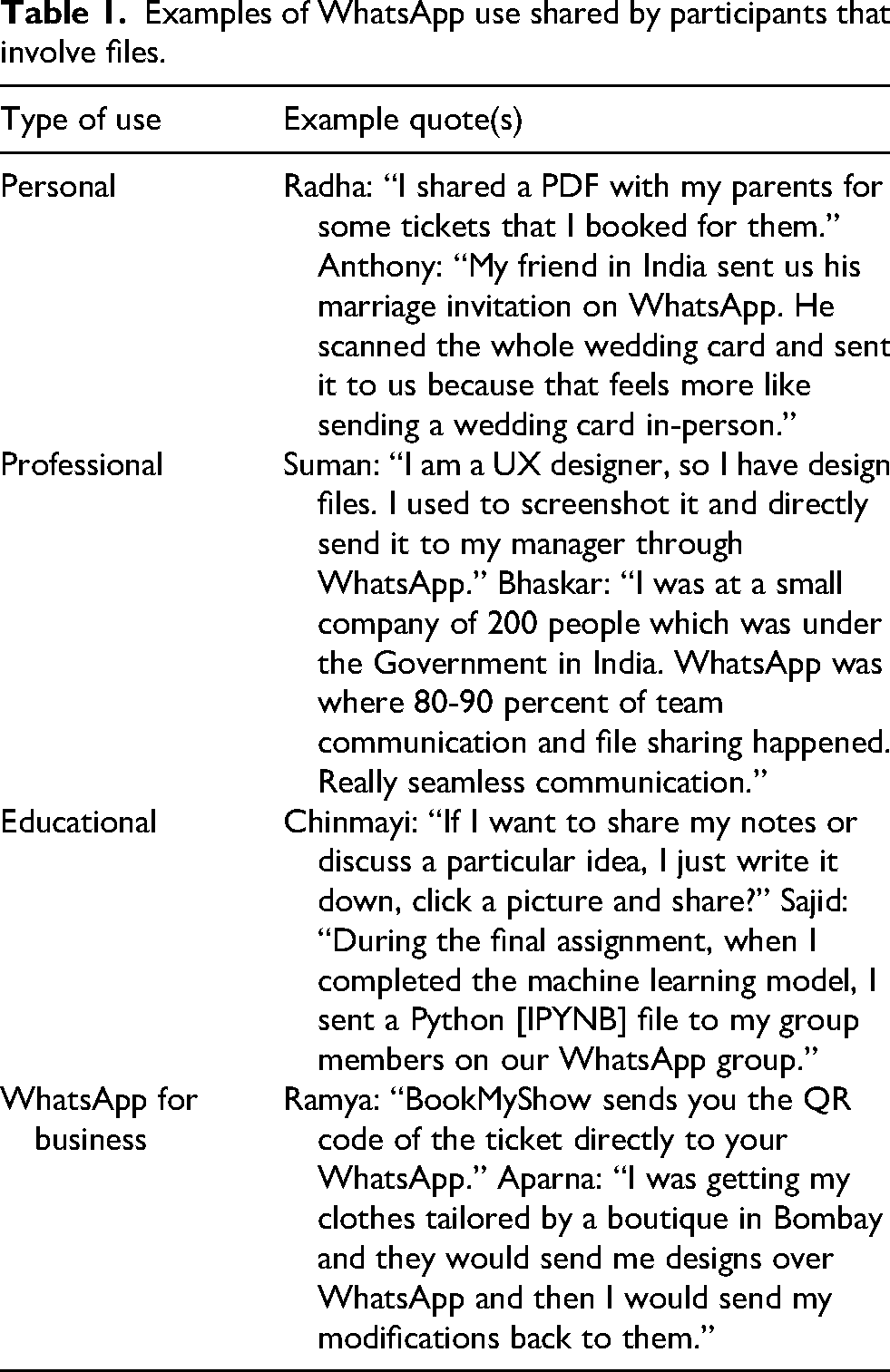
While the cultures or contexts around which WhatsApp is used are often the object of study, for example, in educational or crisis settings (Deshbandhu and Sahni, 2023; Maske et al., 2018), the files involved in these contexts, and how they are managed on apps, have gone understudied. Below, we highlight three aspects: first, how users share and retrieve files on WhatsApp, and how feature changes impact perceptions of files; second, links to external platforms participants reported sharing, receiving, and storing on WhatsApp; and finally, the different WhatsApp Business accounts participants reported interacting with.
WhatsApp's impact on file perceptions
All 25 participants reported having knowledge of file types, and most mentioned image files (such as JPEGs), PDFs, video, and audio files (such as MP3s). See Table 2 for the range of file types reported by participants. When we asked participants about their perceptions of the phrase, “What is a file on WhatsApp,” the most common responses were images, PDFs, and video files, whereas response file formats such as Word files or GIFs were less common. On probing further, some participants discussed how the longevity of WhatsApp influenced their answer: most had used WhatsApp for close to a decade and had been sharing images and videos for as long as they had been using the app, but the addition of GIFs was a more recent feature.
File types mentioned by participants.

Both practices and perceptions of downloading files via WhatsApp reveal a significant dimension about superapp environments: as their designs update over time, the affordances of features shift, expand, or calcify. As apps go through different product development cycles, features are added (or deprecated and removed), and the presentation of the same kind of object might change subtly for users over time. For some participants, there were particular file types or packages of content that had slippages in downloading or retrieval which revealed assumptions about the values of the superapp designers. Mobile file management practices assume a priori constant internet access to support “always on” activities, such as receiving or sharing different kinds of messages. When files are received on mobile phones, they are often received within specific app environments which have different user interface considerations and different download considerations. These distinctions and their connection to what a file is on a phone are seen in our discussion with a former hardware engineer, Anthony: I think other than the text you can say all format files can be considered as files because of accessibility. For example, my phone's default setting has been set to not download anything. When I receive a text message, I see that in an instant. But if I receive an image or a file, I’ll have to download it to view it. So, there's some delay sort of thing on the user interface? Whereas if it's a text I’ll just read that because it's visible out there.
Anthony speaks about features that are specific to the WhatsApp user interface design—text messages appear immediately in the messaging frame, unlike files such as images, videos, or PDFs which are displayed differently depending on format type and size within WhatsApp. Anthony further speaks about app environments and their settings by pointing out that in their individual settings of WhatsApp, they needed to perform the action of clicking on files to download and then access them. For Anthony, a file is thus tied into a combination of format type, presentation of the information object within certain app environments, and whether that object can or cannot be made accessible within that environment for viewing or downloading. WhatsApp's default settings make it such that media is automatically downloaded to the phone's gallery (WhatsApp, 2025). Like Anthony, reflecting on her image-storing practices, Vaishali humorously remarked that she had “auto download off for my grandparents [laughs] because they send me a lot of good morning and good evening messages.” Overall, 12 of 25 participants reported switching off automatic downloading for media objects and files on their WhatsApp (for an illustration, see Figure 1). By explicitly discussing how they have disabled the default auto-downloading feature, Anthony and Vaishali appear to be technologically savvy users of WhatsApp who are proactively managing their phone storage as it is impacted by WhatsApp.

A screenshot of a WhatsApp messaging group. Here, a user must perform a “download” action to watch the video which appears as a distinct object from the text messages already visible on the screen.
Our conversation with Anjali surfaced another important consideration about superapps and perceptions of files over time in messaging threads. The individual's experience of using the app over time shapes the affordances and potentiality of uses (both personal and shared), as changing features impact the perception of different information objects. For the longest time, there was no ability to share PDFs or full-resolution images or any files from your File Explorer onto WhatsApp. There were only two options: sending images in a compressed format that WhatsApp uses or sharing voice notes. Now they announced that you can share any kind of file. So, all those [new] things are considered files in my mental model right now because images and audio were already there [earlier].
Anjali's description of her own mental model of WhatsApp usage captures not only WhatsApp's changing features, but her own relationship with those features has influenced and changed what she perceives to be a “file” within the platform and beyond it. Her comment that “images and audio were already there” shows how certain ways of presentation of information objects within superapp environments can make it so that they are taken for granted, or appear as just another aspect of the app, even if they are accessible, as she notes external to the app in the File Explorer on her phone.
Some participants were hesitant to count GIFs as files, especially in relation to WhatsApp because of how WhatsApp users can search for and share GIFs directly from the app's keyboard. Shreyas noted this, “GIFs are integrated in the keyboard nowadays, so it's not like you’re sending something external? Just like you type a text into the chat box, you’re basically sending GIFs in a very similar way. It's not like you are exporting a file.”
In a similar vein, Pooja argued that GIFs that she downloaded and saved to her gallery which is external to WhatsApp could be compared to files, whereas GIFs when accessed through the WhatsApp keyboard which has “smileys, stickers, and GIFs? In that case, I don’t compare that to a file” (see Figure 2 for illustration).These perceptions of files as being external to the app environment can be perceived as a user expecting ownership, such as through downloading and keeping it on their mobile devices. However, this is something that app developers for WhatsApp might discourage as it impacts engagement or time spent within the WhatsApp environment itself. Meta acquired GIPHY, a GIF search engine company in 2020 and integrated it into WhatsApp, Instagram, and its family of apps. Following an investigation from the UK's antitrust authority, Meta was asked to sell GIPHY because it negatively impacted dynamic competition, and the sale of GIPHY to Shutterstock was completed in 2023 (Sawers, 2023). Our findings point to how superapps’ ambitions to keep adding features in-app can impact how people perceive information objects like GIFs.

The GIF search tab is visible through the WhatsApp keyboard (other options include emoji, avatars, and stickers).
In summary, WhatsApp design features constrain how information objects appear within their environment—this has an impact on how people perceive issues of access and usage which are linked to how people interact with files. Further, the constraining nature of superapps such as WhatsApp over information that is shared and received not only impacts people's perception of files as not fixed or reliably constant: it changes over time as app developers potentially respond to their customers’ changing information needs, including how much information and metadata can be gathered about individuals.
Sharing links across platforms
During our interview, 24 of 25 participants discussed using WhatsApp to transfer and receive information between apps through links. In Table 3, we show counts for the different platforms’ links participants mentioned sharing, and storing on WhatsApp:
Links to platforms shared and stored by participants.

aAll owned by Alphabet; bInstagram is owned by Meta, as is WhatsApp.
Examples include sharing a Google document link to collaborate on an assignment, a Google Maps link to a restaurant recommendation, a Spotify or YouTube link to a song one is listening to at the moment, or passing on a viral meme on TikTok to their friends on WhatsApp. Shruti surfaced the role of WhatsApp as a place to both store and share links, which she did as she was planning a trip with her friends: “There were a bunch of restaurants that I wanted to visit in Colorado. When I looked up these restaurants on Google, you have the option to click to share on WhatsApp. So I saved these to my personal WhatsApp group, and then I looked into all of these restaurants one by one, and then I suggested them to my friends.” Siraj recalled how Google document links were shared in project WhatsApp groups for easy access and retrieval: “Let's say we are collaborating on a particular project, [in the group] you can just share a link to a Google doc saying okay this is where we can make our report.”
In both cases, WhatsApp's role as a messaging platform makes it so that it is the default space where our participants report sharing links to external platforms that they also frequently use. This information practice also reveals how participants expect that their friends or collaborators already have access to those platforms (e.g., such as a Google account to access a shared Google Photos album or a Google Docs link) or are reliant on the external platform being open to access via a link (a YouTube video or a TikTok post). Currently, link sharing to outside platforms relies on WhatsApp allowing for clicks to lead to external platforms and not discouraging users from leaving WhatsApp for an external platform.
Alongside a primary way to share links to platforms and information resources outside of the WhatsApp platform, participants also noted how they received files and links from other platforms that had WhatsApp Business accounts. Table 4 reports the rates of participants receiving files and links via WhatsApp Business accounts. Often, these were businesses that participants had accounts on, but sometimes participants reported that they were being “spammed” by businesses that they either had never signed up for or were receiving unwanted marketing and promotional material.
Business platforms that participants reported receiving links and files from.

Participants reported receiving files (PDFs or images) and links from each of these companies. Prominent examples included receiving a PDF of a flight boarding pass for a booking they made via MakeMyTrip, an image containing a QR code of a ticket to an upcoming movie they booked via BookMyShow, getting a PDF of their bank statement from HDFC, or receiving a link containing the tracking details of their latest ecommerce order from Flipkart. For Shreeyesh, WhatsApp is easier to search than email for finding PDFs containing his flight tickets, something which was important for him during the boarding process at the airport: “So Indigo [Airlines] sent me both a PDF of the boarding pass and a reminder for web check-in as a message. I usually check in only four-five hours before my flight. So Indigo would be like one of the first chats on my WhatsApp? So I just click on Indigo. I click on the PDF and then I just open it directly through WhatsApp and show them at the airport.”
Each of these examples represents a vital and timely piece of information that participants now rely on storing and accessing via WhatsApp. It is worth noting how many of these information objects are documents that are now easily shared file formats on WhatsApp. Participants also noted that businesses would share links alongside the file so that participants, if needed, could click and visit the app or website for additional information. WhatsApp's infrastructural role in economic exchanges in countries like India means that businesses are also reliant on WhatsApp to directly communicate with and reach their customer base. Here, both businesses and customers are reliant on WhatsApp allowing link redirection, and that WhatsApp does not constrain businesses on the kinds of file types they might want to send to their customer base via WhatsApp. By extension, WhatsApp becomes a site where users’ personal information and documents are then linked to a business, just as a business’s information links are then made accessible for ready reference (Johns et al., 2023).
Discussion
These findings show how WhatsApp's features influence participants’ perceptions of different information formats, especially given that the app features change over time. Our interview with Anthony captured these concerns—while certain information objects appear more “in-chat” or flat like texts or emojis, other information objects appear within frames, as distinct objects that can be clicked and downloaded (or not) and opened through the superapp. Our participants reported that they are constantly receiving different kinds of information through WhatsApp. Whether good morning messages in group chats, GIFs, or social media links, participants shared that more and more of their experience of internet-connected services is managed or begins with WhatsApp. Participants also noted how they share and receive links to important information on other platforms through WhatsApp, as if they were file-like objects. Taken together, we argue that our study suggests that when people spend time on their phones, much of the time they spend interacting with mobile apps relates to personal information practices. Superapps operate as infrastructure for managing daily personal tasks, such as file management, link sharing, and archiving. WhatsApp merges communication, storage, and ecommerce capabilities, creating a hybrid space where personal and professional information practices intersect. Drawing on Gibbs et al.'s (2015) concept of “platform vernaculars,” WhatsApp users develop distinct patterns and strategies for managing files and sharing information within the app. These platform vernaculars emerge through the interaction between platform affordances (storage, file system, and system permissions) and users’ everyday practices and routines. Rather than following traditional file management conventions, users develop platform-specific ways of storing and accessing information.
Here, we outline a research agenda for platform researchers to consider as they examine superapps focused on personal information practices. In a world where powerful mobile devices and mobile operating systems have become most people's primary both software and the internet, historic PIM research concerns of creating, controlling, and finding information are now subject to the pressures and infrastructural aspirations of platforms and superapps that mimic much of what operating systems do with desktop machines. But superapps, in their scope and reach, allow people to do things in weird and surprising ways that continue to “clog” the internet and create personal information practices like muting family threads.
These may be user workarounds or market opportunities for app developers, but they may also indicate that documenting these practices is essential to resisting the broader enclosure of platforms in society. Expanding PIM research in platform studies allows us to account for both the influences of platforms on mobile ICTs, as well as the shape of information practice found in mobile contexts. Given the realities of mobile-first users, the task may not be to resuscitate the older, context-driven concerns, but instead, turn towards broader and more inventive user populations and user practices such as studying diasporic users like international students. Gajjala and Verma describe a “WhatsAppified diaspora” noting how platforms like WhatsApp “become a place for emotional archives and affect circulation as people carry their relationships in their pocket as they travel” (Gajjala and Verma, 2018: 208).
Designers of superapps like WhatsApp make decisions for their users under the banner of user interface features that substantially influence their information practices. Much like operating system environments, such as Windows and Macintosh, superapps seek to carry and contain all possible actions that can be accomplished with the hardware of the handset. Here we argue that platform researchers should begin to focus on actions within apps and the affordances of features shaping personal information, broadening the scope to superapps with their techniques of enclosure that give users the impression that all possible actions can (and should) occur within one app. Like operating systems, WhatsApp tries to manage both computer hardware and other software resources through its features. In our study, we investigated issues around how files come to be understood in relation to WhatsApp. We urge researchers to expand this line of examination to other superapps such as WeChat and LINE 2 , possibly with a longitudinal focus. How did those superapps start, what interactions do they afford in the beginning, and how have changes, as the apps expanded, affected the same information format? This is consistent with efforts within platform studies in “studying how platforms change over time, and in challenging any notion of them [platforms] as static entities” (Johns et al., 2023: 11).
An important dimension that impacts people remaining within a single app environment or moving beyond it is the permissions architecture between platforms (i.e., from app to app). Superapps like WhatsApp can configure transitions in ways that encourage enclosure or enable users to move out of the platform. While platform studies often focus on governance and control (Caplan, 2023; Gillespie, 2018), the affordances and constraints of platforms directly shape users’ everyday ability to manage, create, and find personal information. For instance, WhatsApp's encryption policies, storage limitations, and cross-app link-sharing capabilities influence not just how users interact with data but also how they conceptualize and organize information like links as everyday information practices. As Davis and Chouinard (2016) argue, affordances are not static but relational conditions that occur between users and technology as they interact. When WhatsApp supports or discourages particular activities, like playing a YouTube link within a messaging thread, or redirecting outside the thread to the YouTube app, depends on an ecology of platform arrangements and architectural permissions.
We can imagine superapp scenarios where sharing links and the affordances around them are actively shaped by WhatsApp's business priorities. For instance, link previews for outside platforms could be deprecated, or autoplay could be throttled. As Bounegru (2024) found in her analysis of GitHub, platforms configure the visibility and connection of some actions by structuring others as hidden. In WhatsApp, the affordance to share a link is encouraged, but its persistence and retrievability are also governed by features. These considerations are helpful to understand the information practices and platform vernaculars that arise from everyday practices like sharing links or GIFs in group threads.
These platform affordances are important to consider because of how WhatsApp Business and its connections to the larger Meta family of apps (Instagram, Facebook) are seen as important avenues for monetization and diversification of revenue sources for Meta, as discussed by Johns et al. (2023: 153–154). We echo the concerns of van der Vlist et al. who argue, “it is important to monitor whether super apps, particularly those of the Host type, prioritise their own services over third-party complementor offerings, as well as the implications of the growing dependence on apps as social infrastructure, including issues of national infrastructure and potential monopolistic practices” (van der Vlist et al., 2024: 21). Each of these scenarios has significant implications for information practices research, especially how people choose to manage and share their personal information, in which format, and among many possible features of superapps. This concern around link sharing is not without precedent in the larger platform ecosystem. For example, in 2023, several news outlets reported that X (formerly Twitter) was throttling and slowing down access to news sources like The New York Times and competitor social media companies like Facebook and Bluesky. This throttling was lifted, but the incident is illustrative of the importance of free link sharing for the movement of information across platforms (Peters, 2023). These interactions complicate traditional theories of information practices by introducing interdependencies between personal agency and platform governance, such as dependency on WhatsApp's file retrieval architecture across different mobile operating systems.
In the diasporic user population we studied, young adults from India reported that WhatsApp initially begins as a site for personal communication with family but highlighted how its ubiquity and constant presence have led it to be used for work and schooling. Collaborating on assignments, or even full organizations running most of their work and coordination efforts with WhatsApp groups. Our participants also discussed how businesses have been using WhatsApp to have more direct access to their customers. We can envisage a situation where an individual makes decisions about managing a wide variety of their personal information on WhatsApp: messages about their day's work, photos of their friend's vacation, screenshots of code written for class assignments, tickets to a flight, and confirmation for their upcoming vaccine appointment. From the point of view of the designers of superapps, this convergence of contexts is seen as valuable, both as a convenience for a person who can now manage all their information in one place, specifically, with a superapp. However, this has raised concerns about the monopolization of personal data with calls for greater regulation (Ongweso, 2023).
While platform studies frequently analyze top-down governance mechanisms (e.g., data policies and algorithms), examining personal information management allows for the investigation of bottom-up practices where users negotiate, adapt, and repurpose platform affordances to manage personal information. This intersection bridges macro-level platform dynamics with micro-level user behaviors. Scholars studying platformization across sectors, where social media, gig work, or renting economies often prioritize concerns around these platforms’ governance—who controls the data, who has access to it, how is the data analyzed, to what end, and who moderates these platforms and keeps it “clean” or “safe” for its customers (Caplan, 2023; Gillespie, 2018; Helmond, 2015).
There have also been calls from scholars to explicitly “de-westernize platform studies” given that much of platform scholarship tends to focus on US-based companies (Davis and Xiao, 2021). Such platform scholarship is hugely valuable and raises important questions for us to consider in the context of superapps, data management, and personal information practices. For example, when a small business interacts with a customer over WhatsApp who is responsible for keeping that data secure—WhatsApp? The small business? If a customer updates their number or loses their WhatsApp data, how are they expected to recover that interaction? However, taking only this approach may risk inhibiting our knowledge to only a top-down understanding of superapps, from the perspective of the platform policy or business-users’ terms of service.
We argue that alongside this governance-focused attention to effects of platformization, platform scholars must begin to prioritize understanding the everyday, quotidian lifeworlds and information practices that superapps foster from the bottom-up (Mukherjee and Nizaruddin, 2022). Such a bottom-up strand of information practices research can complement and show the everyday effects of different platform governance decisions. Platform firms like WhatsApp make it hard to study individuals because of end-to-end encryption and data privacy (Banaji et al., 2019). Platform-to-platform relationships are hard to study because they are often competing or subsuming each other in a super app marketplace. In effect, there are active hurdles for social researchers, policy makers, and civil society groups to study the impact of these firms. Examining the movement of information objects across platforms (e.g., files across WhatsApp) is one way to study the flows, access, and open standards across communication networks.
Limitations
This study has a few limitations to consider while interpreting the empirical evidence. As students from India studying at a large public university in the USA, these participants are likely to be from the affluent strata of Indian society, and as such, should not be seen as representative of the larger demographic distribution (age, gender, caste, income) of Indian mobile phone users. The findings around changing the default media download settings to avoid potential phone storage clogging lead us to see these participants as technologically savvy users of WhatsApp. Such proactive management practices might be less visible among older adults or less technologically savvy WhatsApp users. Future platform studies researchers can build on this study design to consider different kinds of populations within India and its diaspora.
Conclusion
As superapps like WhatsApp, WeChat, and LINE seek to engage all possible actions with mobile devices while inhibiting experiences of the open web, it is an opportune time for platform researchers to study information practices as they are being shaped and now shaping the possibilities of superapps in society. Critics might argue that studying practices in this way bolsters companies like Tencent and Meta that seek to entrench users and fortify the network effects of superapps by being the dominant points for accessing the internet and networks for the entire world. So it is with caution that we encourage researchers to build research agendas around enclosed software managed by conglomerates. Still, our call to focus on mobile-first users in the majority world is more than a corrective to examine users at the periphery outside the central regions of focus in the USA and Europe. Instead, we argue that diasporic users in their mobility allow us to see the reach and influence of superapps beyond geographic boundaries. As superapps increase network effects on global scales of human populations, it behooves us to develop research agendas with a broad scope and vision towards a future where mobile-first users who carry out most of their digital PIM practices with mobile hardware and their superapps, where software like superapps is core to the management and creation of personal digital information. In discussing these results and presenting a platform perspective research agenda for personal information practices, we challenge researchers concerned with superapps and human information behavior to broaden both sites and subject populations in future research.
Footnotes
Acknowledgments
The authors wish to thank participants and acknowledge the peer reviewers, Aditi Surie, and Nayana Kirasur for their feedback on drafts of this manuscript.

Ethical approval
The Institutional Review Board for the University of Texas at Austin reviewed and approved the study materials (interview protocol, recruitment materials) and determined that the study was exempt from a full review due to low risk to the participants (Study ID: STUDY00002796; Date: 16 May 2022).
Informed consent statements
Participants gave oral consent before the video and audio recording of each interview.
Author contributions
Krishna Akhil Kumar Adavi: Conceptualization, Formal analysis, Investigation, Methodology, Project administration, Writing – original draft. Amelia Acker: Conceptualization, Formal analysis, Funding acquisition, Methodology, Resources, Writing – review and editing.
Funding
The authors disclosed receipt of the following financial support for the research, authorship, and/or publication of this article: This study was made possible in part by the Institute of Museum and Library Services Award RE-07-18-0008-18.
Declaration of conflicting interests
The authors declared no potential conflicts of interest with respect to the research, authorship, and/or publication of this article.
Data availability statement
The interview protocol, codebook, and anonymized transcripts from the study are hosted on the Texas Data Repository under the project title “Investigating Platform Development for Mobile and Social Media Data Preservation.” Link: https://doi.org/10.18738/T8/S1EEJI.