




Abstract
This essay explores how enhancing accountability in the governance and use of data can increase its value as a relational asset within platform economies. With a focus on data intermediaries (entities that collect, curate and process data into products and services), it argues that data does not possess inherent value; rather, value emerges through socio-technical practices and relational exchanges. Drawing on theoretical frameworks from economic anthropology and Science and Technology Studies, this essay examines how intermediaries translate raw data into valuable outputs, often in ways that obscure the agency of data contributors. This opacity limits accountability and ambiguates the connection between those who generate data and those who profit from it. Through a case study of the Superset ecosystem–a decentralized governance infrastructure that combines market incentives, a data trust framework, and participatory enforcement mechanisms–this essay illustrates how designing for accountability has the potential to unlock greater value across the data economy. By integrating data contributors into governance processes, Superset demonstrates a ‘middle-out’ approach to value creation (rather than top-down or bottom-up), where accountability and value are mutually reinforcing. This reframes data not as a static commodity, but as a dynamic, relational form of capital, dependent on participation and platform-enforceable accountability.
Keywords
Introduction
This essay investigates how increasing accountability for data usage at the platform level enhances data as a relational form of value. 1 It focuses on data intermediaries as key actors in platform economies by highlighting their role in producing and distributing value by mediating the flow of data between contributors and consumers. Using a case study methodology, it investigates the early stages of a decentralized data platform experiment, called ‘Superset.'
Value from data
Data does not hold intrinsic value; rather, value emerges through socio-technical processes of exchange and interpretation (Callon, 2007; Appadurai, 1986; Spiekermann and Korunovska, 2017). As a relational asset, data acquires meaning and significance through its circulation within networks of people, institutions and technologies (Munn, 1986; Strathern, 2020). This perspective frames data not as a commodity, but as relational capital, with its value dependent on the social and technical relationships that enable its use. On digital platforms, data becomes valuable when rendered legible and actionable to certain stakeholders, within specific infrastructures. This is often shaped by the business models that platforms support.
In many platform models in the digital economy, valuable data is that which has been processed into a product that helps to generate patterns that improve the quality of predictions, inform decisions and solve business problems to improve performance (Günther et al., 2017; Provost & Fawcett, 2013). Central to this value creation are data intermediaries. These entities that collect and process data into products include personal information management systems, data trusts, cooperatives, unions, marketplaces and sharing pools (Micheli et al., 2023). 2 Acting as bridges between individual data contributors, organizations or machines generating raw data and consumers such as advertisers, intermediaries transform unstructured inputs into structured outputs. In doing so, they also mediate the flow of value within platform economies.
However, this mediation often obscures the agency of contributors of ‘raw’ data, who typically lack control over how their data is interpreted, processed or monetized (Gitelman, 2013). The opacity of these processes undermines accountability by severing the link between the source of data and the value it generates. While many intermediaries prioritize data monetization, they diminish value creation for data contributors by acting as gatekeepers that abstract data away from its source.
In the context of platformization, 3 this insight matters because it challenges the narrative of frictionless efficiency and highlights the social dependencies and accountability gaps embedded in platform infrastructures. Understanding value as relational helps expose how platforms reconfigure social and economic relations: not only by creating new markets, but by reordering who participates in value creation, who is recognized and who benefits.
This essay argues that fostering relational accountability, by involving data contributors in decisions about data use, has the potential to unlock greater value from data for data consumers and data contributors. The design of the Superset ecosystem exemplifies this approach. It employs a ‘middle-out’ governance model that integrates market incentives, 4 a data trust framework and member-driven enforcement. Rather than centralizing control or relying solely on bottom-up models of accountability or legal enforcement (Delacroix and Lawrence, 2019), Superset redistributes governance responsibilities to include contributors, thereby enhancing accountability and generating stronger network effects. In doing so, it demonstrates how coupling accountability with value creation may yield a more equitable and effective data ecosystem (Figure 1).
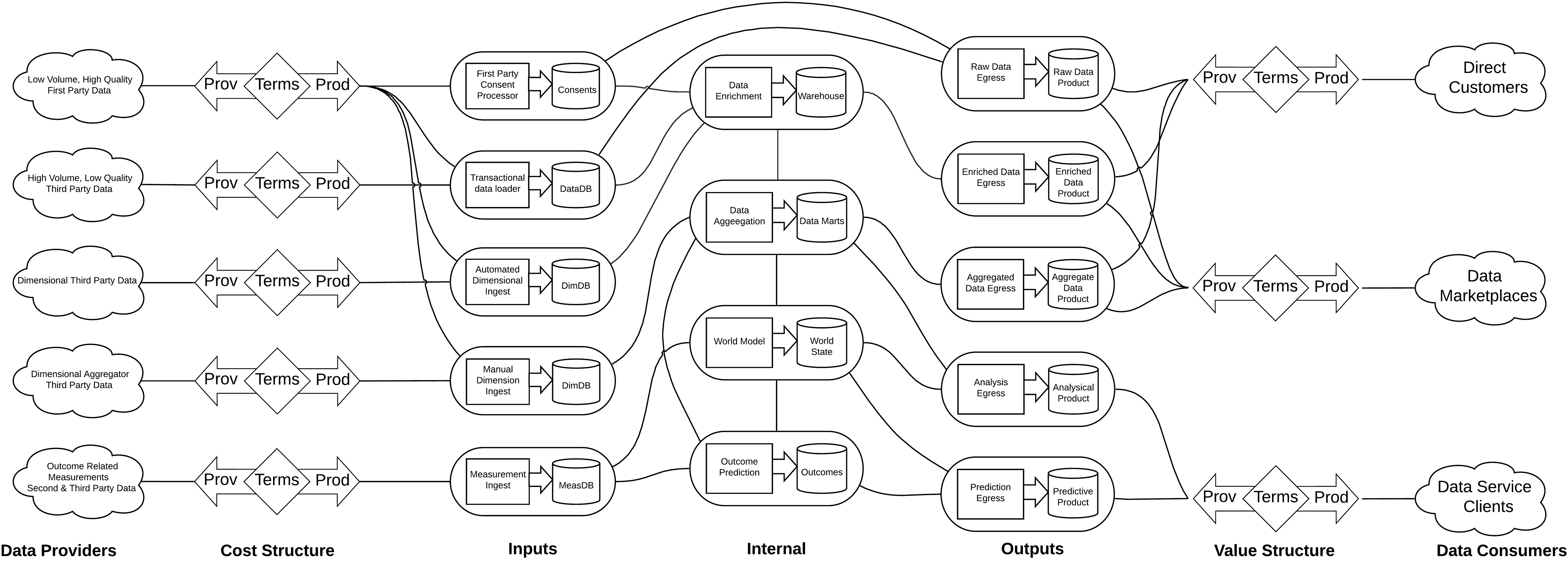
An abstracted illustration of how data flows through a traditional data proce
Models of accountability in digital ecosystems
Accountability refers to the processes and structures through which individuals or entities are held responsible for their actions, decisions or outputs (Bovens, 2007). In social science literature, accountability can take various forms, depending on the context and relationships involved. At least three models of accountability are relevant in digital economies: legal, market-based and algorithmic. Each type of accountability offers a distinct, context-specific approach for how to manage power relations between stakeholders. For example, data trusts are a model explored within the European Union legislative model; market-based approaches are typical to the United States; and digitally native, algorithmic approaches are found in blockchain-based Decentralized Autonomous Organizations (DAOs) and ‘Data Unions’. 5
Legal accountability is the basis for the traditional model, where responsibility is structured vertically, with clear lines of oversight and authority. In this framework, higher authorities – such as government bodies or regulatory agencies – hold entities accountable through compliance, regulation and oversight. In the context of data ecosystems, hierarchical accountability generally manifests in regulatory frameworks relating to the personal processing of data and refers to the criteria of lawfulness, fairness, transparency, integrity and accountability – as, for example, in the case of the General Data Protection Regulation (European Commission, 2023; Regulation 2016/679, Article 5) or in the case of data governance structures, such as data trusts (Delacroix and Lawrence, 2019). In the latter instance, legal frameworks enforce boundaries around data use and privacy. However, this top-down approach is often slow to adapt to the rapid evolution and complexity of digital platforms, where control is distributed across multiple actors. Indeed, the regulatory aspiration of the European Commission is that neutral third-party data intermediaries will facilitate data sharing between individuals and corporate data holders and data users but cannot directly use the data themselves, through enforceable measures (European Commission, 2023).
Market-based accountability operates through the forces of competition and consumer choice. In this model, accountability is enforced through the market, with consumers and stakeholders making decisions that reward or punish actors based on their behavior or performance. This is largely the case in the United States, where primacy is put on the economic and financial benefits accruing to digital platforms over the privacy risks of using market-based models to address personal data challenges (Guay and Birch, 2022; Movius & Krup, 2009). For data ecosystems, this means that platforms might be held accountable by users who demand better privacy practices or by markets that penalize unethical data use. While market-based accountability offers some checks on corporate power, it tends to prioritize the accrual of value via data to the firms, which potentially undermine the interests of data contributors and their claims to the value of their data, particularly in monopolistic or oligopolistic markets.
Algorithmic accountability refers to the responsibility for actions and decisions made by automated systems (Wieringa, 2020). This model is relevant to algorithms that process data and make decisions without direct human oversight, such as data unions or Decentralized Autonomous Organizations (DAOs) (Nabben, 2022). In digital ecosystems, algorithms often mediate the flow of data; influence user interactions; and determine outcomes, such as what content is recommended, how data is categorized, or even how value at the point of exchange – either financial or not-for-profit social good data donations – is distributed across a platform. In the context of data ecosystems, novel approaches to algorithmic accountability are crucial because algorithms frequently operate without platform users knowing how decisions are made (Pasquale, 2015).
While each of these models offers valuable insights into how accountability is structured in different data ecosystems, they also have significant limitations. For example, legal and market-based models often struggle to account for the complexity and distributed nature of digital platforms, where power, data and responsibility are fragmented and shared among multiple actors. Algorithmic models require a relatively high degree of digital literacy and often defer trust to automation and governance to the collective that may not have the necessary experience, capacity or interest to steer and maintain the system. These factors highlight the need for more flexible, participatory and decentralized approaches that are sensitive to the specific interactions and practices of those participating in the ecosystem. According to some perspectives, accountability is enacted through everyday practices, decisions and the relational interactions of exchange between data ecosystem stakeholders to produce value (Suchman, 2002).
Locating accountabilities: relational value production on digital platforms
Suchman's concept of located accountabilities (2002) provides a framework for understanding accountability within complex, distributed socio-technical systems such as data ecosystems. Rather than assume that accountability can be imposed through abstract, external structures – such as laws, markets or algorithmic governance alone – Suchman argues that accountability is inherently situated within the specific practices, relationships and interactions of actors within a system. Platform economies typically lack accountability to data contributors because data is abstracted away from contributors and value is obfuscated in the process from provision to product. Conversely, Suchman's approach places an emphasis on understanding the ‘…sociomaterial connections that sustain the visible and invisible work required to construct coherent technologies and put them into use…’ (Suchman, 2002: 93). Suchman states that ‘…the design of technical systems is a process of inscribing knowledge and activities into new material forms’ (Ibid: 100). According to this view, accountability emerges in context, through the working relations in technology design and production; it therefore cannot be understood in isolation from the situated practices of those involved.
Suchman's framework is consistent with a relational theory of value, which maintains that relations are generative: relations do not merely reflect pre-existing social structures; rather, they actively and constantly create and transform them (Appadurai, 1986; Strathern, 2020). This approach extends to relational forms of value within data ecosystems, accounting for how value is generated through the interactions between data contributors, intermediaries and consumers. A relational approach to value is particularly relevant for digital platforms because it emphasizes the need to understand accountability as a process that unfolds within the specific context of a platform's operation, focusing on the specific practices of actors within the ecosystem. In digital platforms and ecosystems, this requires innovating more context-sensitive mechanisms of accountability that reflect the realities of why and how data is created, formatted, processed and monetized in specific contexts. An example of such an approach is the Superset data mesh ecosystem.
The superset data mesh ecosystem
Superset is a data ecosystem composed of a data trust and a DAO. It has the stated mission of ‘ensuring its members receive a fair share of the value created from their data’ (Superset, n.d.). According to its architects, Superset offers a ‘third way’ of structuring data platforms to create financial or economic value that can also be realized by data contributors. It does so by combining market mechanisms, regulatory structures and enforcement mechanisms to locate accountabilities. The ‘Ecosystem’ page of the Superset website summarizes this point as follows: ‘Superset's participatory data governance model makes a more transparent, accountable, and equitable data economy possible’ (Superset, n.d.; Case, 2023).
The key stakeholders in the Superset data ecosystem are: 1) Delphia, as the instigator, initial funding provider, data contributor and data consumer 6 ; 2) the Superset Trust, a registered special purpose trust in the jurisdiction of Guernsey (Alston et al., 2023); and 3) O'Neil Risk Consulting & Algorithmic Auditing (ORCAA, n.d.), an algorithmic auditing firm that meets requirements of the trust to monitor the outputs of data users, as well as enforce the trust purpose against the trustees, thus fulfilling the obligatory Guernsey trust role of ‘enforcer’. 7 Although the formal data trust component provides an additional regulatory layer to Superset, which is already a regulatory organization, what is significant is that it creates accountability for the practices of data consumers and trustees (Figure 2). 8
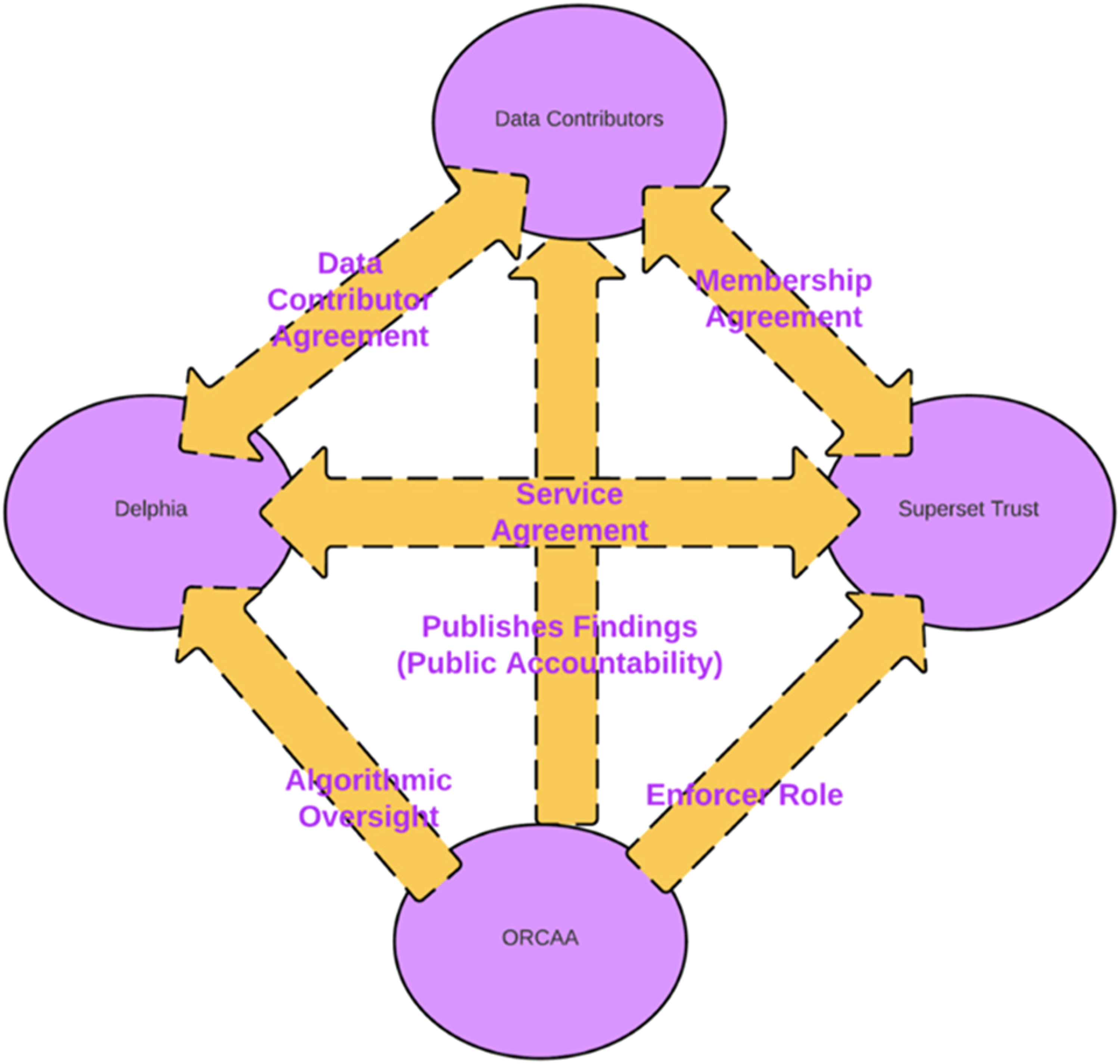
Superset ecosystem stakeholder relationships (Superset, 2023).
The Superset ecosystem demonstrates a pioneering configuration of actors whereby accountability to data contributors is enforceable, providing essential institutional and technical infrastructure for more responsible data stewardship and governance.
In the context of the Superset ecosystem, accountability is instantiated along multiple margins of located, context-specific relationships between stakeholders that are enforceable through multiple regulatory modalities (legal, market and algorithmic). For example, the power of the special purpose trust structure lies in what the Superset trustees call the ‘circuit breaker function’. This allows trustees to revoke data contributor consent en masse (known as ‘batch revoke’) so that data users can no longer utilize the data. In other words, trustees have the legal authority to revoke consent on behalf of contributors if data consumers misbehave. Traditional data markets rely on data contributors being disengaged from data markets. Although the Superset model still relies on standard revenue-oriented motives, the model's architecture lowers the attention cost of member data contributors by removing the need for them to monitor how their data is being used and monetized. Instead, members can benefit from accountability and enforceable action if their data is not used and valued in line with the purpose of the trust.
Trustees in this platform ecosystem can also be held to account. For example, interested trustees must remove themselves from any formal vote that is, or could be, a conflict of interest, as with any traditional board seat. An accountability mechanism scrutinizes the conduct of the trustees if they fail to faithfully represent member data contributor interests within the ecosystem. This ability of member data contributors to remove Superset Board trustees can be enacted via a supermajority vote. If the Superset Trust exists to monitor uses, users and revenue (Superset, n.d.), the challenge is in determining what channels will attract data contributors.
In the Superset model, relational value is produced through dynamic interactions between the constitutive participants of the platform: data contributors (i.e., the DAO), intermediaries (including the data trust and the algorithmic auditor) and consumers of the products that are produced from processing the data. The relational accountability that emerges from the specific interactions and relationships between actors within a system also has the network effect of increasing the investment of data contributors in a data market, and thus the value accrued to those contributors as well as the overall value of the ecosystem.
According to this approach, data is ‘partible’ (Stathern, 2018: 236), meaning that data does not figure as the sole property of data intermediaries to monetize through sale to third parties. Instead, value from data is distributed and shared among the contributors, intermediaries and consumers within the ecosystem. This reflects a more collective and relational understanding of ownership and value. Contributors are not alienated from the data they provide; they maintain a continual relational stake in the platform, shaping the way value circulates and is distributed. In the Superset ecosystem, the relational form of value also extends beyond mere economic exchange. It includes ethical dimensions, such as the rights, responsibilities and powers of contributors, auditors and the trust Board members – all of which relate to transparency in how data is used and governed.
In more technical terms, the Superset ecosystem represents more distributed data architecture at scale, which treats data as a product and decentralizes its ownership to the teams or domains that generate and use it. This is known as a ‘data mesh’ (Dehghani, 2022). The aim of this approach is to decentralize data management to overcome the scalability issues and inefficiencies of traditional centralized systems, especially within large organizations dealing with complex, diverse data sources (Figure 3).
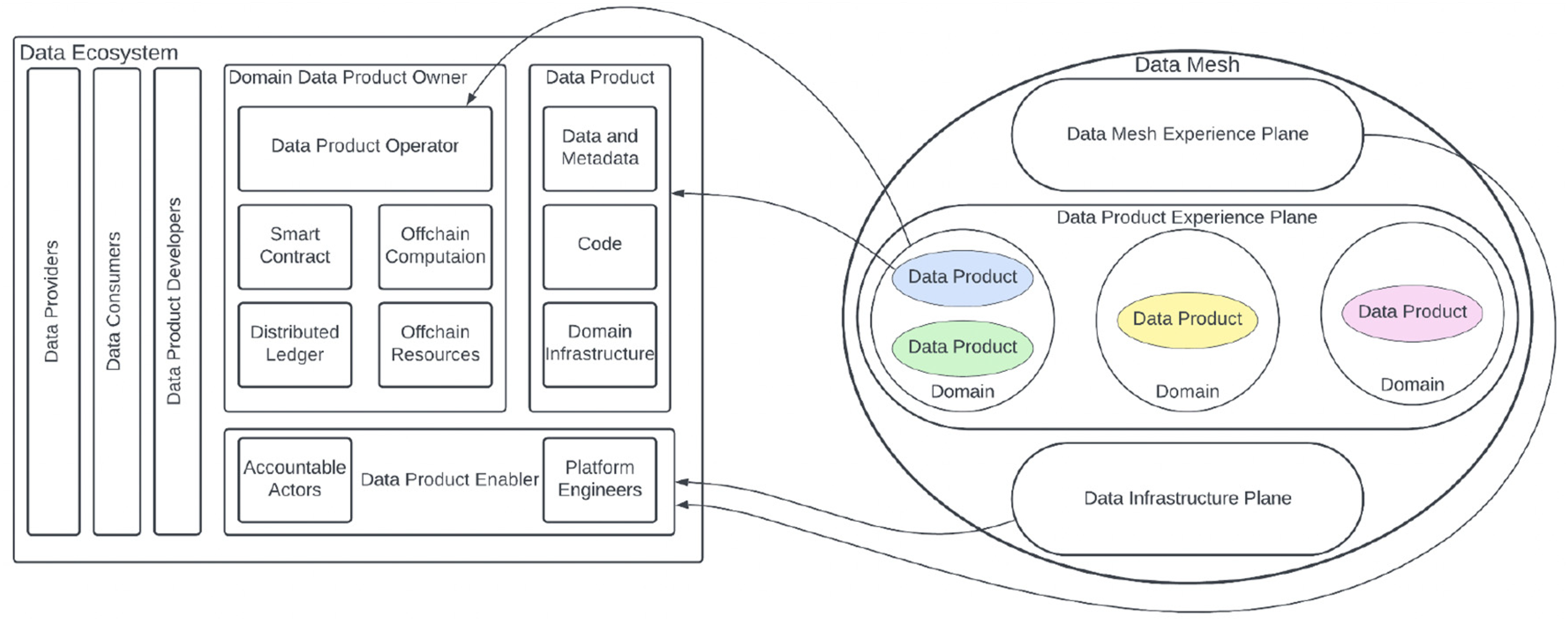
A decentralized data ecosystem (left) that uses data mesh architecture (right) for its functional elements (Sisson et al., 2024, p. 24; Dehghani, 2022, p. 172).
Challenges and limitations
Data accountability requires modes of governance that are tailored to the contextual complexities of data production and usage. Therefore, challenges remain. The construction of Superset was not without numerous considerations related to operationalizing the network data ecosystem of a data intermediary. 9 These challenges included regulatory uncertainty around the launch of tokenized digital assets, the need to create and navigate the constitutional boundaries of the DAO, banking the Guernsey trust in the United States, and evolving the economic model of Superset.
In Superset's case, economic value still matters, but it is not the sole form of value. Rather than operating purely for profit maximization, Superset embeds monetary value creation within a broader set of relational and governance mechanisms that reshape who benefits from data flows, summarized in the goal of ‘exciting and/or productive’ uses (e.g., not-for-profit research) (Superset, n.d.). Superset's model makes visible the multiple forms of value – economic, relational, moral and epistemic – that underpin data ecosystems and reconfigures how they are produced and distributed. While conventional platform models prioritize exchange value – monetizing data through its transformation into predictive products – Superset foregrounds relational and moral value by involving contributors in governance, ensuring transparency and embedding ethical commitments into its data trust framework. This shifts data from being a commodified resource to a form of relational capital, where value emerges through reciprocal obligations and social participation. By enhancing use value for contributors, not just economic returns but influence over how their data is used, Superset demonstrates that accountability is not only an ethical imperative but also a means of amplifying economic value through trust and network effects. These distinctions matter because they shape the incentives, accountability and long-term viability of the data ecosystem itself.
Conclusion
Understanding the relationality of value is essential for analyzing the role of data intermediaries and the broader dynamics of platformization and its alternatives. Rather than treating data as a static commodity, this perspective highlights how value is co-produced through socio-technical relationships and mediated by platform infrastructures. Data intermediaries are not neutral processors but active participants in shaping what data becomes valuable, to whom, and under what conditions. Superset challenges dominant platform logics and offers a compelling vision for more accountable data ecosystems by reconfiguring the relationships between contributors, intermediaries and consumers. The model suggests that embedding accountability and enforceable relational obligations between stakeholders in a data ecosystem into data governance can foster more accountable, and thus more valuable, data ecosystems, as well as that alternative value from data models are worth pursuing. In turn, this essay creates scope for further research into the advantages and limitations of decentralized data economies in various contexts, as well as how such approaches perform and evolve in practice.
Footnotes
Acknowledgements
With thanks to BlockScience (particularly Michael Zargham, David Sisson, and Eric Alston), Delphia, and Superset for interviews and feedback.
Funding
The author received no financial support for the research, authorship, and/or publication of this article.
Declaration of conflicting interests
The author declared no potential conflicts of interest with respect to the research, authorship, and/or publication of this article.