



Abstract
Alcohol use disorder (AUD) is a pervasive and debilitating condition, affecting more than 183 million people worldwide and causing substantial physical, psychological, and social harm. 1 Despite the availability of various treatments, long-term efficacy remains limited; approximately two-thirds of individuals relapse to at least some periods of heavy drinking within 1 year of treatment. 2 Given these limitations, there is a growing interest in alternative therapeutic approaches, including psychedelic-assisted psychotherapy.
Over the past several decades, research has investigated the potential of serotonin 2A (5-HT2A) agonists—hereafter referred to as “psychedelics”—for the treatment of AUD and other substance use disorders (SUDs). Early studies in the 1950s suggested that lysergic acid diethylamide (LSD) could reduce problematic alcohol consumption. 3 More recently, scientific interest in psilocybin—a naturally occurring psychedelic compound—has grown as a potential treatment for SUDs. For instance, a recent randomized controlled trial (RCT) involving 95 adults with AUD compared psilocybin-assisted psychotherapy with psychotherapy plus placebo and found that psilocybin treatment led to significant reductions in heavy drinking days compared with psychotherapy alone. 4
Although the mechanisms underlying the therapeutic effects of psychedelics remain unclear, accumulating evidence suggests that increased connectedness following psychedelic experiences may play a key role. 5 A systematic review of 15 studies found that increased connectedness (with others and with the world/universe) was associated with a higher chance of clinical improvement following a psychedelic experience. 5 Notably, many conventional treatments for AUD, including 12-step programs, explicitly emphasize enhancing connection to self, others, and to a higher power as central to recovery. 6 Taken together, these data suggest that connectedness may be a key mechanism through which psychedelic-assisted psychotherapies improve outcomes in AUD. 7
Psychedelics in Nature-Based Settings
Psychedelic researchers widely agree that the setting in which a psychedelic session takes place can have profound effects on subjective experiences and outcomes.8B9 -11 The use of psychedelics traces back to premodern (“traditional”) spiritual healing practices (including Shamanism), which took place in nature and often used ritual to emphasize and enhance a sense of connection to nature.12,13 In contrast, modern Western psychedelic research is predominantly conducted in controlled indoor settings, often overlooking the potential role of nature in shaping therapeutic outcomes.
Beyond psychedelic research, contact with natural environments has been consistently associated with mental health benefits.12,14,15 Empirical research suggests that natural settings may enhance the positive effects of psychedelics. For example, in a naturalistic longitudinal study assessing mental health outcomes in two samples of adults participating in ayahuasca retreats in different settings, participants who underwent ceremonies in a secluded, nature-rich Colombian rainforest reported greater reductions in stress and anxiety compared with those whose ceremonies took place inside a hotel room or tipi in the Netherlands. 16 Similarly, a study of 100 individuals reflecting on their past recreational psychedelic experiences found that nature elements (e.g., sunshine and trees) were frequently mentioned in participants’ descriptions of positive experiences pertaining to spirituality, universal love, bliss, and ecstasy. 17
Nature Relatedness, Social Connectedness, and Psychedelic Therapies
“Nature relatedness” refers to an individual’s subjective sense of connection to the natural environment. 18 Higher levels of nature relatedness have been associated with multiple aspects of well-being, including more positive affect, 19 vitality,19-21 happiness,15,19 eudaimonic well-being (e.g., sense of purpose, self-acceptance, and personal growth), 22 and lower levels of anxiety. 23 Several studies have found nature relatedness to mediate the effect of contact with nature on well-being,24-26 and higher levels of nature relatedness following contact with nature has been shown to significantly predict life satisfaction, transcendent and awe-inspiring experiences, and to elicit higher valuations of intrinsic aspirations such as personal growth, intimacy, and community. 24
Several studies have documented significant increases in nature relatedness following psychedelic use27B28 -31 and the results of at least two studies suggest that natural settings may enhance this effect.29,30 For example, in a prospective online study of 654 participants intending to use a psychedelic, psychedelic use was found to predict increases in nature relatedness, and the strength of this effect was significantly moderated by participants’ ratings of access to natural surroundings during their psychedelic session. 29 Increased nature relatedness, in turn, was significantly correlated with improvements in participants’ psychological well-being. In another study of 51 individuals participating in an ayahuasca retreat in a nature-rich, traditional Indigenous Amazonian context, nature relatedness was found to significantly increase following retreat participation, and increased nature relatedness significantly predicted decreases in stress. 30 Notably, no such increases in nature relatedness were observed among individuals participating in ayahuasca ceremonies conducted in less biodiverse settings in North America. 32 These findings align with results of a meta-analysis finding that mindfulness interventions administered in more nature-rich environments (e.g., forests or wilderness) have greater positive effects on biopsychosocial outcomes compared with interventions conducted in human-made outdoor environments (e.g., gardens or parks). 33
In addition to nature relatedness, psychedelics have also been shown to enhance social connectedness—defined as feelings of comprehensive social closeness. 34 A qualitative study of 20 adults who received psilocybin for treatment-resistant depression identified enhanced connection to others as a predominant theme when participants were asked to describe the efficacy of their treatment. 35 Similar findings emerged in a study of subjective experiences and outcomes in 11 adults participating in two ayahuasca ceremonies to treat problematic substance use. 36 Analyses revealed that significant reductions in substance misuse were associated with higher degrees of self-reported connection to nature/spirit, self, and others following their ayahuasca ceremonies. Similarly, phenomenological analysis of 13 interviews of adults who received psilocybin for treatment of cancer-related psychosocial distress identified enhanced interconnectedness (including to other people, all of humanity, nature, and even the universe at large) as a frequently mentioned theme. 37 These findings suggest that both nature relatedness and social connectedness may serve as potential mechanisms by which psychedelic-assisted psychotherapies elevate well-being.5,38,39
The Current Study
Given the current lack of RCTs evaluating the effect of natural settings in psychedelic research,9,40,41 we sought to test whether exposure to nature content would differentially affect two forms of connectedness (nature relatedness and social connectedness) among participants enrolled in a pilot trial 42 of psilocybin-assisted psychotherapy for AUD. To minimize variability, we adopted a novel approach by bringing nature into the clinic via a nature-themed video intervention. Our hypothesis that a nature video might be sufficient to enhance nature relatedness was based on prior evidence that artistic displays of simulated nature in hospital settings have potential to improve mental and physical health outcomes, including reduced anxiety, 43 agitation, 44 and blood pressure, 45 as well as increased pain tolerance. 43
The nature video intervention (henceforth referred to as visual healing; see description below) was developed specifically for the previously published pilot study, 42 of which the current report constitutes a secondary analysis. In that initial study, participants in both conditions demonstrated significant reductions in alcohol use following psilocybin treatment; however, those randomized to view visual healing exhibited significantly lower postsession blood pressure compared with participants in the standard treatment setting (body scan meditation; eyeshades and music). 42 Building on those findings, the current analysis tested whether exposure to visual healing would yield differential effects on two forms of connectedness. Specifically, we hypothesized that participants assigned to visual healing would experience greater increases in nature relatedness compared with those in the standard protocol, while social connectedness would increase comparably across both groups.
Methods
Participants with moderate-to-severe AUD [assessed at screening/baseline (Week 0)] were randomized to either visual healing (N = 10) or standard setting (N = 10) and completed two open-label 25 mg psilocybin sessions (at Weeks 3 and 7). Randomization to visual healing versus standard setting only occurred for the first psilocybin session; participants were permitted to choose their own group assignment for the second session. As such, only data corresponding to the first psilocybin session (collected at Weeks 0 and 5) were analyzed in the current study. A full description of the methods and additional results can be found elsewhere. 42
Participants
Twenty adults (age 18 or older) meeting DSM-5 criteria for moderate-to-severe AUD as assessed via the Structured Clinical Interview for DSM-5 (SCID) participated in the study. Participants were eligible if they reported at least 4 heavy drinking days (i.e., five or more alcoholic drinks for males and four or more alcoholic drinks for females on the same occasion) in the past 30 days and stated an interest in stopping or reducing alcohol use.
Visual Healing
The visual healing videos combined time-lapse and slow-motion footage of natural wilderness scenes (e.g., waterfalls, rainforests) and aerial cinematography accompanied by ambient/orchestral music. Videos were free of any narration and were designed to support the typical time course of psilocybin subjective effects and minimize interruption to the internal experience. Participants assigned to visual healing (N = 10) were presented with three nature videos designed specifically for the trial: (1) a 3-min “introductory video” shown at the conclusion of the second predosing preparatory session (which took place 1 week before the psilocybin session) to familiarize participants with the video content; (2) a 42-min “opening video” played immediately after psilocybin administration during the dosing session, and (3) a 15-min “closing video” played following resolution of the “peak” psilocybin effects (approximately 4–5 h postdosing). Participants were instructed to recline on the couch to view the videos, which were presented on an 85-inch high-definition LCD television approximately 6 feet away.
Standard
Participants assigned to standard setting (N = 10) were instructed to listen to a 3-min body scan guided meditation during the second preparation session and wore eyeshades while listening to ambient/orchestral music throughout the psilocybin session. The complete music playlist can be found in the Supplementary Materials in the primary outcome publication. 42
Counseling Sessions
All participants completed weekly counseling sessions with a two-person facilitator team consisting of one physician and one therapist (Weeks 1–5). Two 60-min preparatory sessions (Weeks 1 and 2) were completed to prepare participants for the psychedelic sessions, build rapport with the facilitators, and set a goal of stopping or reducing alcohol use. Facilitators were blind to group assignment during the first preparation session since randomization occurred at the end of Week 1. Priming effects were further minimized by standardizing preparation counseling across groups except for the final 5 min of the second preparatory session during which facilitators introduced and played either the visual healing introductory video or the body scan. All participants were told that the respective video may help them relax and prepare for the upcoming dosing session. Facilitators were trained to be nondirective to avoid influencing participants in their setting of an intention for the upcoming psychedelic experience.
Participants completed three integration sessions beginning the day after Week 3 psilocybin administration through Weeks 4 and 5. Facilitators maintained a nondirective approach in reviewing the psychedelic experience and assisted participants with identifying insights that might be helpful in changing their relationship with alcohol.
Measures
Self-report questionnaires were administered at Week 0 (baseline) and Week 5 (2 weeks following the psilocybin dosing session). The following demographic data were collected: Age, sex, race, ethnicity, employment status, and years of education.
Nature Relatedness Scale (NR-6) 46 is a validated six-item self-report questionnaire assessing nature relatedness. Four of the items assess an individual’s sense of connection with nature and the degree to which nature is an aspect of one’s identity, spirituality, and values (e.g., “My relationship to nature is an important part of who I am”), and two items assess an individual’s tendencies and experiences related to nature (e.g., “I take notice of wildlife wherever I am”). Items are rated on a 5-point Likert scale ranging from “disagree strongly” to “agree strongly,” A total score is calculated by averaging the individual item scores, with higher scores indicating higher nature relatedness. The measure exhibits good internal consistency and temporal stability. 46
Social Connectedness Scale–Revised
The Social Connectedness Scale–Revised (SCS-R) is a 20-item, self-administered questionnaire that assesses social connectedness, that is, “an attribute of self that reflects cognitions of enduring interpersonal closeness with the social world.” 34 Participants are instructed to indicate the extent to which they agree with each statement (e.g., “I am able to connect with other people”) on a six-point Likert scale from “strongly agree” to “strongly disagree.” Negatively worded items are reverse scored and summed with positive items to generate a total score between 20 and 120, with higher scores indicating higher social connectedness.
Alcohol use: Number of drinking days per week was collected with the Timeline Followback. We assessed alcohol use in the past month for baseline and in the past week for subsequent study visits.
Statistical analyses
Treatment groups (visual healing vs. standard) were compared using Kruskal–Wallis tests (for continuous variables) and Fisher’s exact tests (for categorical variables) on demographic and other measures. Change scores in NR-6 and SCS-R were compared between groups using Kruskal–Wallis tests. The significance of pre/post changes on these measures was evaluated using Wilcoxon signed-rank tests. We also examined whether NR-6 and SCS-R scores at Week 5 were significantly different between groups, controlling for scores at Week 0 using analysis of covariance (ANCOVAs). All analyses utilized nonparametric methods due to the small sample size. Furthermore, given that this was an exploratory study and our goal was to minimize false negatives (missing potential signals), we set the significance level at p < 0.05 for analyses.
Results
Characteristics of the sample are summarized in Table 1. The median age of the sample was 50.0 years (range = 22–68), with the majority of participants between 41 and 60 years of age. Most participants were female (60%), White (95%), non-Hispanic (90%), and met the criteria for severe AUD (65%). The median education level was 17.5 years (range = 12–23). There were no differences in baseline scores for nature relatedness or social connectedness between the visual healing and standard groups [NR-6: χ2(1) = 1.23, p = 0.27; SCS-R: χ2(1) = 0.32, p = 0.57]. Furthermore, there were no significant baseline differences in demographics, AUD severity, or number of drinking days between the two groups (p > 0.05). Baseline characteristics for number of drinking days, heavy drinking days, nature relatedness, and social connectedness are included in Table 2.
Demographic Characteristics of the Sample
Level of educational achievement was estimated based on the number of years of education and is provided in parentheses for ease of interpretation.
Descriptive Statistics, Reliability Coefficients, and Observed Spearman Correlations Among Variables at Baseline
Observed Spearman correlations among variables at baseline are listed in the rows. Reliability coefficients (Cronbach’s alpha) are listed in the diagonal.
Correlation is significant at the 0.05 level (two-tailed).
There was a statistically significant between-group difference in change in nature relatedness from baseline to 2 weeks postpsilocybin session [χ2(1) = 5.74, p = 0.02]. Specifically, a significant increase in nature relatedness was observed in the visual healing group [median change in NR-6 = 0.33, range = (−0.17, 0.67), p = 0.01], but not in the standard group [median change = 0.00; range = (−0.17, 0.33), p = 0.50]. Furthermore, median postpsilocybin NR-6 scores were significantly higher in the visual healing versus standard group after controlling for baseline NR-6 scores [F(1,16) = 7.6, p = 0.01]. The groups did not differ in their change in social connectedness from baseline to postpsilocybin [χ2(1) = 0.89, p = 0.35], and postpsilocybin SCS-R scores were not significantly different between groups after controlling for baseline SCS-R scores [F(1,16) = 0.6, p = 0.4]. Furthermore, no significant pre- to postpsilocybin change in social connectedness was found across groups [median change = −1.00, range = (−27, 20), p = 0.90]. Median NR-6 and SCS-R scores for each group at baseline and postpsilocybin session are provided in Table 3. Changes in NR-6 and SCS-R are demonstrated in Figure 1.
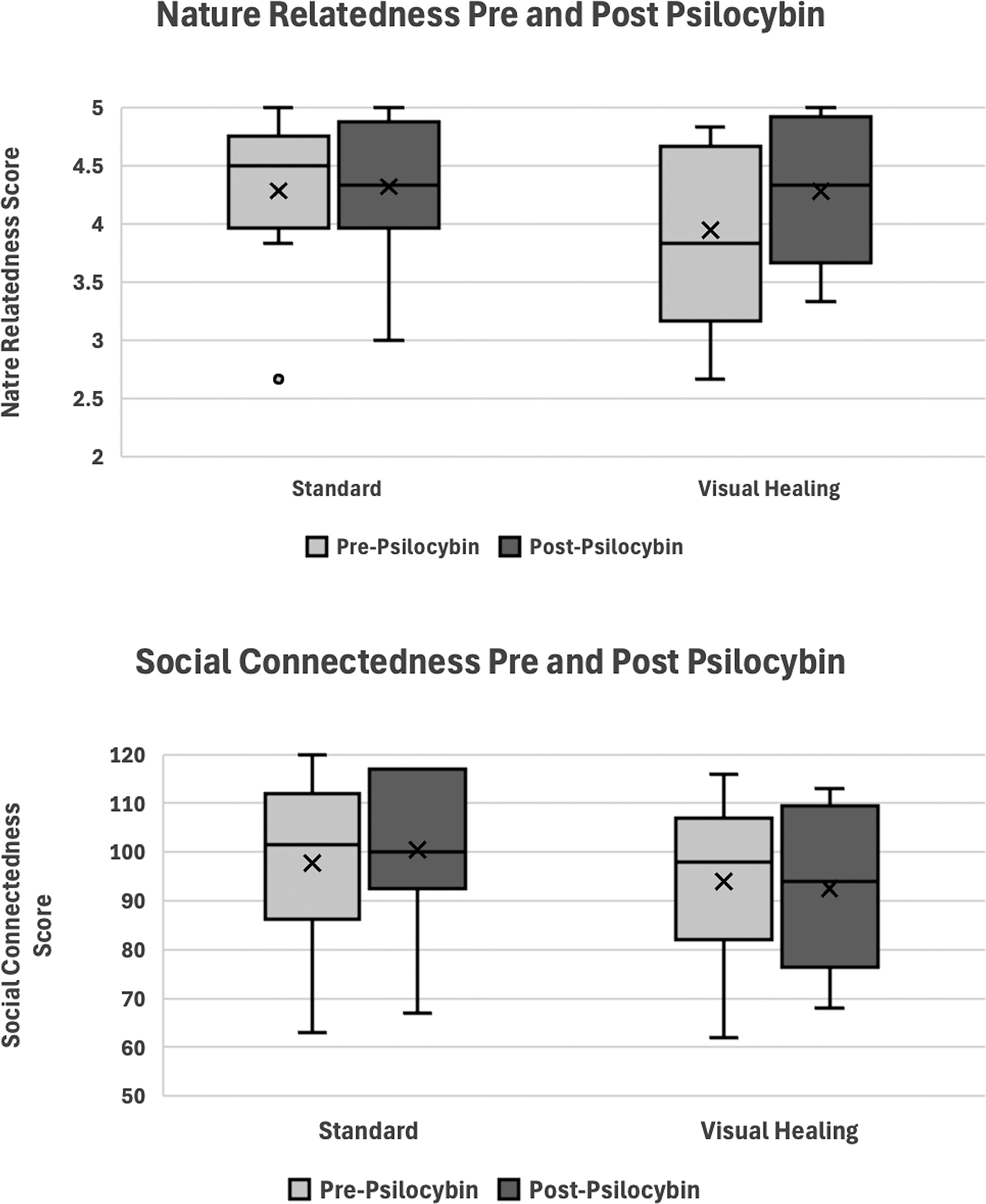
Nature relatedness and social connectedness from pre- to postpsilocybin session by group. Each box represents first to third quartiles. Attached are error bars to show minimum and maximum values. Mean values are indicated by X and median values are indicated by a horizontal line. Outlier points are indicated by a circle.
Medians and Ranges for Visual Healing and Standard Groups on Nature Relatedness and Social Connectedness Pre- and Postpsilocybin
Postpsilocybin session data were missing for one participant.
Discussion
The setting in which a psychedelic session occurs is widely recognized as a key determinant of subjective experiences and therapeutic outcomes. While premodern psychedelic experiences were exclusively embedded in natural environments, modern clinical trials have taken place almost exclusively in indoor clinical settings, neglecting to investigate the influence of nature on subjective experiences and outcomes. This study represents a preliminary effort to address this gap by examining the effect of a nature-themed video intervention on changes in two different forms of connectedness (nature relatedness and social connectedness) among individuals undergoing psilocybin-assisted therapy for AUD.
As expected, participants assigned to visual healing demonstrated significantly greater increases in nature relatedness compared with individuals assigned to standard setting. The observed median increase in NR-6 score (0.33 in the visual healing group) is comparable with NR-6 score increases observed in prior work documenting increases in nature relatedness following psychedelic experiences.27,29,30 Furthermore, changes of this magnitude have been associated with clinically significant improvements in prior studies. For example, a mean increase in the NR-6 score of 0.32 among individuals who participated in an Amazonian-led ayahuasca retreat was accompanied by a statistically significant average reduction of 6 points on the DASS-stress, generally considered a clinically meaningful change. 30 In another study, a more modest mean increase in NR-6 score (0.12) pre/post naturalistic psychedelic use was accompanied by a statistically significant average increase of 3.6 in the Warwick–Edinburgh Mental Well-Being Scale score, which is considered by some experts to be clinically meaningful.29,47
As expected, the visual healing intervention had no significant effect on social connectedness. However, in contrast to our expectations and to the results of prior studies,37,48,49 psilocybin-assisted psychotherapy also did not increase social connectedness across conditions. One possible explanation for our null finding is that our sample had limited room for improvement in the level of social connectedness observed at baseline. Whereas mean scores previously reported for three large samples of college students ranged from 88 to 92, 34 the mean baseline level of social connectedness in our sample was 96, potentially resulting in a ceiling effect. Identifying characteristics of interventions, participants, and measures that predict (and accurately detect) clinically meaningful increases in social connectedness with treatment are important aims for future research.
Our results demonstrate that exposure to nature content during a psychedelic experience has the potential to increase nature relatedness, a construct consistently associated with multiple dimensions of psychological well-being.15,19,20,22,23 It may seem surprising that an intervention as modest as viewing a nature video for less than an hour could meaningfully influence one’s sense of connection to nature 2 weeks after a psilocybin session. However, prior research has shown that even a brief contact with natural environments (5–10 min) is sufficient to enhance psychological well-being and reduce anxiety and stress.50,51 More broadly, extensive research has emphasized that “set” (mindset) and “setting” (environment) contribute substantially to an individual’s response to psychedelic compounds8,38,52—a relationship so well established that psychedelics are often described as amplifiers of an individual’s preexisting thoughts, emotions, and sensory experiences. 53
Our results can be further understood in the context of the psychoplastogen theory of psychedelics. Psilocybin and other classical psychedelics are known to promote neuroplasticity through 5-HT2A receptor activation,38,47,54 resulting in a window of neuroplasticity that begins within a few hours of psychedelic administration and can last for several weeks. 55 It has been hypothesized that these neuroplastic effects explain how a single psychedelic session can lead to enduring adaptive behavioral, emotional, and cognitive changes.56,57 The Relaxed Beliefs Under Psychedelics model proposes that psychedelics first induce a relaxation of internal representations (e.g., beliefs or models), which are then restructured and updated during the plastic state, 58 leading to enduring psychological changes that underlie psychedelics’ therapeutic effects. 52 This relaxation of internal representations is thought to underly the hypersuggestibility that has been observed with psychedelics, in which participants exhibit heightened sensitivity and susceptibility to environmental features during psychedelic use.52-54,58 Heightened neuroplasticity and associated hypersuggestibility to environmental factors may explain why exposure to a nature-themed video was able to produce significant and lasting changes in nature relatedness (but not social connectedness) that persisted for 2 weeks postpsilocybin administration among our study participants.
Limitations and future directions
These findings should be interpreted with caution in light of several limitations. Most notably, the study used a small sample (N = 20), which limited statistical power and the ability to conduct more nuanced analyses. We chose not to apply corrections for multiple comparisons due to the small sample size and the exploratory nature of the study, prioritizing sensitivity to potential effects while acknowledging an increased risk of type I error. Replication in larger samples will be necessary to determine the robustness and generalizability of these findings.
Second, the sample was demographically homogenous (95% White) and limited to individuals with moderate-to-severe AUD. In addition, participants exhibited relatively high baseline levels of nature relatedness compared with previously studied samples. 46 This may reflect a self-selection bias, in which individuals with stronger existing connections to nature are more interested in participating in a research study examining a nature-related intervention. Alternatively or in addition, elevated levels of baseline nature relatedness may be characteristic of individuals participating in psychedelic research, as noted in prior studies.29,30,32
The small sample size also precluded mediation analyses to determine whether changes in nature relatedness may mediate the effect of nature content exposure on clinical outcomes. Future research should aim to replicate and extend these findings in larger, more diverse samples, including individuals from underrepresented racial and ethnic backgrounds, clinical populations without AUD, and individuals with lower levels of nature relatedness.
Other limitations arise from aspects of the visual healing intervention itself. For example, the music accompanying the visual healing film differed from the music played for participants in the standard condition at the beginning of the psilocybin session, although both playlists were drawn from the same genre, and the music played after completion of the visual healing film matched what was played for participants in the standard condition. Evidence that music has the potential to impact outcomes in psychedelic therapies comes from a study of psilocybin for treatment-resistant depression in which participants’ experience of the music significantly predicted the degree of mystical experiences, insightfulness, and reduction in depressive symptoms. 55 As such, it is possible that the variation in music may have contributed to group differences. In addition, the visual healing condition comprised multiple aesthetic, cinematic, and thematic components. The extent to which these different components contributed to the observed between-group differences is unknown. Future dismantling studies may help identify the active ingredients of such nature-based interventions.
It is also possible that the observed results were influenced by expectancy bias related to the nature-themed video intervention. Participants were informed in the consent form that the study aimed to evaluate a nature-themed video in combination with psilocybin. Thus, although participants were blinded to specific hypotheses concerning the visual healing intervention, it is possible that participants who were assigned to the visual healing group (1) were more attentive to the nature content than they would have been if they had been unaware of the purpose of the study and (2) expected to be more influenced by the nature video compared with participants in the standard condition. As it was impossible to blind participants to group assignments, it is possible that this knowledge and expectations led to an overestimation of the extent to which a nature-themed video might influence nature relatedness in real-world settings.
Finally, because the intervention involved simulated nature delivered via video in an indoor clinical setting, the observed effects may underestimate the potential impact of real-life nature immersion. Future studies could directly compare indoor, simulated nature, and immersive outdoor (e.g., wilderness) settings to more fully assess the potential of natural environments to influence psychedelic therapy outcomes. Given that psychological disconnection from nature has been identified as a transdiagnostic vulnerability across many mental health conditions, 56 continued research in this area may have important implications for optimizing psychedelic psychotherapies not only for AUD but also for a broad range of mental health conditions.35,38
This study offers preliminary evidence that nature-themed content presented via video during psilocybin-assisted psychotherapy may enhance nature relatedness, even in a controlled clinical setting. These findings highlight the importance of an environmental context in shaping psychedelic experiences and suggest that nature-based interventions—whether simulated or immersive—may serve as promising adjuncts to psychedelic therapies. Further research is warranted to explore how these interventions might enhance treatment outcomes across a broader range of clinical populations.
Institutional Review Board Approval
This study was reviewed and approved by Providence IRB. The participants provided written informed consent to participate in this study. This trial was conducted in accordance with the local legislation and institutional requirements.
Data Sharing
The raw data supporting the results of this article will be made available by the authors.
Footnotes
Acknowledgment
The authors thank Usona Institute for supplying the psilocybin and technical support for this trial.
Authors’ Contributions
R.R. wrote the first draft of the article. K.L., P.S., and K.H. contributed to article writing. P.S., B.Y., G.M.S., and A.R. performed data analyses. K.G.H., L.S., and D.F.K. conceptualized and designed the study. K.H. wrote the protocol and oversaw all aspects of the study. K.G.H., K.S., and M.L. contributed to the study therapy protocol and administered therapy sessions. All authors contributed to and approved the submitted version of the article.
Author Disclosure Statement
K.G.H., K.S., M.L., and D.F.K. received clinical trial support from Usona Institute. D.F.K. has stock in MindMed, Numinus, and Noetic Fund. K.G.H. is a consultant for MindMed. K.S. is a consultant for Field Trip Health and has stock in Compass Pathways, Field Trip Health, and MindMed. L.S. was employed by company Moving Art.
The remaining authors deny any commercial or financial relationships that could be construed as potential conflicts of interests.
Funding Information
The study was funded by individual donors, the Annenberg Foundation, and support from the Saint John’s Health Center Foundation.