



Abstract
Artificial intelligence (AI) is becoming an increasingly important part of municipal policy and practice. This article analyses how ecosystem and multi-level dynamics influence the uses and governance of AI in municipalities. Based on the case of Quebec, this research is based on a qualitative methodology. It combines the analysis of 57 press articles, 20 municipal documents, 26 semi-structured interviews with ecosystem actors, as well as a network analysis aimed at mapping the actors and their interdependencies. The results show that AI adoption is strongly shaped by structural power asymmetries, partial outsourcing of governance, and intermediation mechanisms dominated by technology companies and intermediary organisations. While flexible forms of coordination encourage experimentation and learning, the absence of operational frameworks and control mechanisms increases the risk of technocentric governance. The article highlights the need to strengthen the governance capacities of municipalities and to rethink AI regulatory frameworks from an ecosystem perspective. This is in order to promote a more responsible and equitable deployment of urban AI.
Introduction
Artificial intelligence (AI) is gradually establishing itself as a key technology in urban governance (Cugurullo et al., 2024). It is used, among other things, to optimise infrastructure management, improve services to citizens, support administrative decision-making and respond to climate issues (Almulhim and Yigitcanlar, 2025; Alsabt et al., 2024; Cugurullo et al., 2024; Cugurullo and Xu, 2025; David et al., 2023; Rodriguez Müller et al., 2025; Yigitcanlar et al., 2024). However, beyond its promises, AI raises major issues in terms of governance, accountability, transparency and equity, particularly at the city level (Jieutsa, 2024; Sanchez et al., 2024).
The existing literature shows that the adoption of digital technologies including AI in cities is based on the interaction of institutional, organisational, financial, technical, ethical and social fact (O'Shaughnessy et al., 2021; Senadheera et al., 2025; Taeihagh, 2021). While this work has made it possible to identify the conditions favourable or constraining for the integration of AI, it nevertheless tends to analyse municipalities as relatively autonomous units. However, AI is a profoundly multi-scale technology (Jieutsa and Koseki, 2025; Jin and Miles, 2025; Roundy and Asllani, 2024). Its development, deployment and supervision are part of ecosystems of actors that go far beyond local administrative borders (Roundy and Asllani, 2024). In this context, few studies look at how ecosystem dynamics concretely shape the uses and governance of AI in municipalities. This gap is all the more problematic because these dynamics can reinforce power asymmetries, promote the outsourcing of governance and increase the risk of a technocentric approach to urban governance (Ciasullo et al., 2020; Kempin Reuter, 2020; Kitchin et al., 2017).
This paper aims to fill this gap by analysing how ecosystem and multi-scale dynamics influence the uses and forms of governance of AI in municipalities. Based on the case of Quebec, this paper mobilises an ecosystem approach and a network analysis to answer the question: how do multi-level ecosystem dynamics (actors, interdependencies, normative frameworks) influence the uses and governance of AI in municipalities?. The results highlight the interdependencies, intermediation mechanisms and power relations that structure the integration of AI in cities. In doing so, the article contributes to renewing the analytical frameworks of urban AI governance.
The contribution of this paper is scientific and practical. It invites urban studies researchers to go beyond city-based approaches and deepen the analysis of power relations and structural asymmetries in innovation ecosystems. On a practical level, municipalities can no longer think of AI governance solely as a technical or administrative matter. For intermediary actors like Non Profit Organizations (NPOs) Regional County Municipalities (RCMs), and municipal associations, this research highlights their key role, but also their increased responsibility in structuring the ecosystem. Finally, for provincial and national governments, the results argue in favour of policies and programs specifically tailored to the municipal context.
Theoretical framework: Ecosystem factors influencing the deployment and regulation of AI in cities
The literature on smart cities, smart governance, and AI in local government has largely identified the factors that condition the adoption of technology by cities. Research shows that the diffusion of technology, including AI, is based on interactions between institutional, organisational, financial, technical, ethical, and social conditions (David et al., 2023; Rodriguez Müller et al., 2025; Senadheera et al., 2025; Taeihagh, 2021; Yigitcanlar et al., 2024). At the institutional level, clear policies, well-defined roles, and effective coordination promote responsible technology adoption (David et al., 2023). However, fragmented authority and regulatory immaturity are important obstacles (Ben Dhaou et al., 2024; David et al., 2023). Therefore, several authors emphasise the importance of formalising digital or AI strategies and dedicated governance structures within local administrations (Ben Dhaou et al., 2024; Ciasullo et al., 2020; Farida et al., 2023; Yigitcanlar et al., 2024).
Financially and economically, budget constraints, uncertainty about the long-term value of technologies, and municipal tax cycles can limit adoption (Gong and Sun, 2024). Grants, public-private partnerships, and phased pilots can reduce risk and demonstrate a return on investment (David et al., 2023; Yigitcanlar et al., 2023). In addition, organisational capacities, including internal skills, leadership and change management, condition the ability of cities to sustainably integrate technologies (Ben Dhaou et al., 2024; Das, 2025; Gong and Sun, 2024). Data infrastructures and technical capabilities are also identified as essential prerequisites for responsible innovation (Allam and Dhunny, 2019; Sanchez et al., 2024). Literature also highlights the importance of ethical and legal frameworks in building trust (Ben Dhaou et al., 2024). In terms of approach, stakeholder engagement and co-creation with citizens are also important factors of accountability (Farida et al., 2023).
Despite the richness of this literature, two limitations appear when it comes to analysing urban AI. Firstly, many of these approaches tend to view adoption as primarily a local matter. However, AI is a deeply multi-level technology that involves various actors, tools, infrastructures, technical standards, and normative frameworks operating at different levels (international, national, regional, etc.) (Jin and Miles, 2025; Roundy and Asllani, 2024; Stahl, 2022). Cities in this configuration act at the grassroots level and are frequently misperceived as deployment platforms. Third, the literature emphasises facilitating factors for adoption, paying scant attention to regulating AI at the urban scale. This cutting-edge technology must also be governed locally (Jieutsa and Koseki, 2025; Sanchez et al., 2024; Yigitcanlar et al., 2022). Urban AI is both a tool and a subject of governance. In this context, this article approaches urban AI, not only in its applications, but also in its management and regulation.
Research on the application of institutional theory reveals the impact of coercive, normative and mimetic factors on public managers’ willingness to adopt AI (Gong and Sun, 2024; Rodriguez Müller et al., 2025; Senadheera et al., 2025; Yigitcanlar et al., 2024). These studies demonstrate that AI adoption is not just a matter of rational decision-making, but also a response to the pressures of institutional and professional expectations. However, even these analyses tend to concentrate on individual viewpoints and the logic of institutional influence. They explain why cities feel incentivised to adopt AI. However, they do not analyse the ecosystem factors that come into play in how cities use and govern AI. Moreover, AI is a complex and multidimensional technology that raises issues such as power, control, sovereignty, regulation, etc. (Courmont and Le Galès, 2019; Sanchez et al., 2024). These multi-scale ecosystem elements all orient in some way the dynamics of its use and governance. To ensure responsible management of this technology at the local level, we must analyse how these ecosystem dynamics affect the governance of urban AI.
This paper suggests integrating the analysis of adoption factors into a comprehensive understanding of the ecosystem and multilevel dynamics of urban AI. Building on the theory of innovation ecosystems, urban AI is conceptualised as the outcome of a complex network of heterogeneous actors and frameworks interconnected by interdependent relationships. This perspective views urban AI as a socio-technical element that is inextricably linked to the ecosystem it helps to shape as a tool and subject of governance. This perspective allows us to understand the relationship between the use of AI and the observed governance mechanisms at the municipal level, and how they fit into the larger ecosystem. This approach is even more important as other scholars such as Choenni et al. (2022) argue that the ecosystem perspective is essential in smart city governance, particularly when it comes to data.
This approach is relevant because the literature on smart cities has shown that the structure of an ecosystem can have a major effect on the tech-centric nature of governance (Ciasullo et al., 2020; Jiang et al., 2022; Kempin Reuter, 2020; Kitchin et al., 2017; Stahl, 2022). Technocentrism refers to an approach where technology is perceived as the sole or main solution to all urban challenges. This has many impacts on privacy, environmental pollution, social inequalities, etc. (Calvo, 2020; Kempin Reuter, 2020). The structure of an ecosystem acts as both a catalyst and a regulator of technocentric urban governance (Calvo, 2020; Ciasullo et al., 2020; Kitchin, 2016). Limiting the impacts of AI in cities while taking full advantage of the benefits means configuring an adapted ecosystem. By carefully designing and managing these ecosystems, urban policymakers can centre technology on the well-being of citizens (Stahl, 2022).
According to Granstrand and Holgersson (2020), innovation ecosystems are dynamic assemblages of actors, activities, artefacts, institutions, and interconnections. These elements collectively influence the innovative potential of an individual or a group of individuals. Gomes et al. (2021) build on this concept by describing the innovation ecosystem as a meta-organisation of autonomous but interdependent actors. These actors are linked by complementary relationships and collaborate in the creation of systemic innovations (Coletto et al., 2024). Applying this perspective to the governance of urban AI, we see that its technocentric nature depends on the structure of the ecosystem. The diversity of actors, the nature of their interdependencies, and the types of activities they carry out influence how AI integrates into public policy (Carrara and Freisinger, 2024; Coletto et al., 2024; Jin and Miles, 2025). Ecosystems dominated by tech companies and public authorities tend toward technocratic approaches that focus on optimisation (Kempin Reuter, 2020; Kitchin et al., 2019). However, more inclusive ecosystems, including universities, NGOs and citizens, promote more reflective, participatory and socially rooted forms of governance (Ciasullo et al., 2020; Skill et al., 2020).
Our analytical framework, presented in Figure 1, seeks to explain how the use and governance of urban AI in municipalities are shaped by their integration into the wider AI ecosystem, rather than by purely local technological choices. This analytical framework is built using the innovation ecosystem approach to analyse two key variables. The first is concerned with the uses of urban AI, while the second focuses on the regulatory framework, encompassing both formal and informal mechanisms that govern and legitimise its implementation. These variables are analysed by six factors that describe ecosystem dynamics. These factors are determined from the work on AI ecosystems and the perspective of scholars such as Carrara and Freisinger (2024) as well as Granstrand and Holgersson (2020) which defines innovation ecosystems as an articulation of actors, artefacts and activities within institutions. Thus, the analysis of urban AI as both a tool and a subject of governance can be done through the structure of actors and power imbalances; institutional governance and organisational capacity; financial resources; technological infrastructure and capabilities; normative, legal, and ethical frameworks; and networks and intermediation mechanisms.

Analytical framework of the research.

Urban AI ecosystem in Quebec (n = 264 nodes; m = 442 edges) built with Gephi 0.10 (ForceAtlas2 layout algorithm, scaling = 1000; gravity = 0.4).

Simplified visualization of Quebec's urban AI ecosystem. The arrow indicates the direction of the relationships written along its length.
Through this theoretical framework, this article argues that the governance of urban AI cannot be explained solely by classical adoption factors. Rather, it is shaped by the involvement of municipalities in complex innovation networks. The network's underlying architecture often influences local government actions. Therefore, the primary focus should not only be on understanding why cities adopt AI, but also in which ecosystems they do so, according to what power relations exist, and with what consequences for urban governance.
This research adopts a qualitative and multi-method approach to analyse the ecosystem and multi-level dynamics that influence the use and governance of AI in municipalities. The data collection combines a literature review, a media scan, semi-structured interviews and network analysis. First, a systematic review of 57 press articles published between 2020 and 2025 was conducted to identify the main municipal AI projects in the Quebec context. Second, we analysed 20 digital or AI strategies, internal policies, action plans and minutes of municipal council meetings to examine the formal governance frameworks, regulatory mechanisms and institutional positioning of municipalities. These first two steps are based on grey literature manually extracted from the websites of companies, organisations, and municipalities specialising in AI, as well as from the Eureka database of Bibliothèque et Archives nationales du Québec, supplemented by snowball searches. This extraction yielded press articles, municipal reports, meeting minutes, and transcripts of radio and television broadcasts on municipal AI. Inclusion criteria required that documents explicitly reference AI-related initiatives, policies, funding mechanisms, or partnerships involving municipal stakeholders in Quebec.
Third, we conducted 26 semi-structured interviews with key players in the ecosystem. These include municipal representatives, AI solution providers, government agencies, intermediary organisations, and AI research centres. These interviews explored decision-making processes, forms of coordination, and power and dependency relationships. Finally, a network analysis was carried out to map the actors and the technological, cognitive and economic interdependencies. Relational data from interviews and documents were coded and analysed using network indicators (centrality, intermediate, density, clustering). This is in order to identify the structuring actors and the dynamics of AI governance at the ecosystem level.
Results
Ecosystem overview
The Quebec urban AI ecosystem illustrated in Figures 2 and 3 is structured as a multi-stakeholder network, with municipalities playing a central role as deployers, funders, and sometimes regulators of technologies. They fall into one of three categories according to Quebec Institute of Statistics: small (under 10,000), medium (10,000–100,000), and large (over 100,000). Medium-sized cities dominate the ecosystem because they have sufficient resources to acquire solutions without having the large internal teams of the metropolises. This makes them the main market for tech companies. Mediation actors gravitate around municipalities. Groups of municipalities (RCMs, metropolitan communities) act as catalysts, launching initiatives, deploying solutions across regions, and organising training and information-sharing sessions. Municipal associations promote this type of horizontal learning by organising awareness-raising, training, and knowledge sharing. They are often supported by companies such as AI providers or companies specialised on trainings. The second pillar is made up of tech companies, mainly local, concentrated in the Quebec region. They develop solutions tailored to the needs of municipalities (chatbots, conversational agents, infrastructure management, mobility, etc.). Large international firms are not very present, except in some large cities, due to costs and guarantees of data security and sovereignty. Research institutions such as Mila, universities, and labs contribute to research and governance. However, their engagement with municipalities is somewhat limited compared to the vibrant Quebec ecosystem. Finally, NPOs play a nodal role in the flow of knowledge and technologies. Government agencies, on the other hand, influence mostly indirectly, through general funding that feeds tech companies and intermediaries, rather than dedicated municipal programs.
Technological, cognitive and economic interdependencies structure power relations within the ecosystem. Technological interdependencies form the backbone of the network, connecting municipalities with technology companies and NPOs. The latter occupy a central position thanks to their ability to produce, distribute and publicize AI solutions. Companies wield considerable influence by controlling the flow of innovation. NPOs reinforce this dynamic by mediating, translating, and legitimising technologies for municipal governments. Cognitive interdependencies, linked to the circulation of knowledge, training, and best practices, play a key role in promoting responsible AI. However, their low density concentrates epistemic power among a few organisations (universities, NPOs, municipal associations), putting municipalities in the position of knowledge recipients. This asymmetry creates cognitive dependency and the risk of a digital divide between cities. Indeed, cities connected to central cognitive actors in the ecosystem will have access to the knowledge and expertise to accelerate the deployment of AI, unlike less connected municipalities. Finally, economic interdependencies are marginal. Financing is mainly based on municipal self-financing and on public subsidies channelled through intermediaries. The result is a polycentric governance where power derives less from financial capital than from the ability to coordinate, connect and standardise the ecosystem.
Urban AI uses and regulation
In this ecosystem, the dissemination of AI is broad but differentiated. It is structured around concrete operational needs and unevenly institutionalised forms of regulation. The applications identified show that AI is first used as a tool for optimising local public action, before being fully considered as a governance subject.
In terms of the uses listed in Table 1, three areas clearly dominate. Firstly, management of infrastructure and roads is the main field of application. This includes solutions for automatic detection of potholes, coordination of snow removal and predictive maintenance of water networks. These applications use relatively mature, low-risk technologies that provide measurable benefits in terms of cost, efficiency and service continuity. Secondly, citizen-focused services, such as chatbots and virtual assistants, are becoming increasingly common. These tools address the issues of administrative overload and information accessibility while requiring minimal investments. Finally, environmental, climate and mobility applications reflect a growing desire to use AI to support the ecological transition and sustainable development, in particular through geospatial analysis and predictive modelling.
Urban AI applications in cities in Quebec.
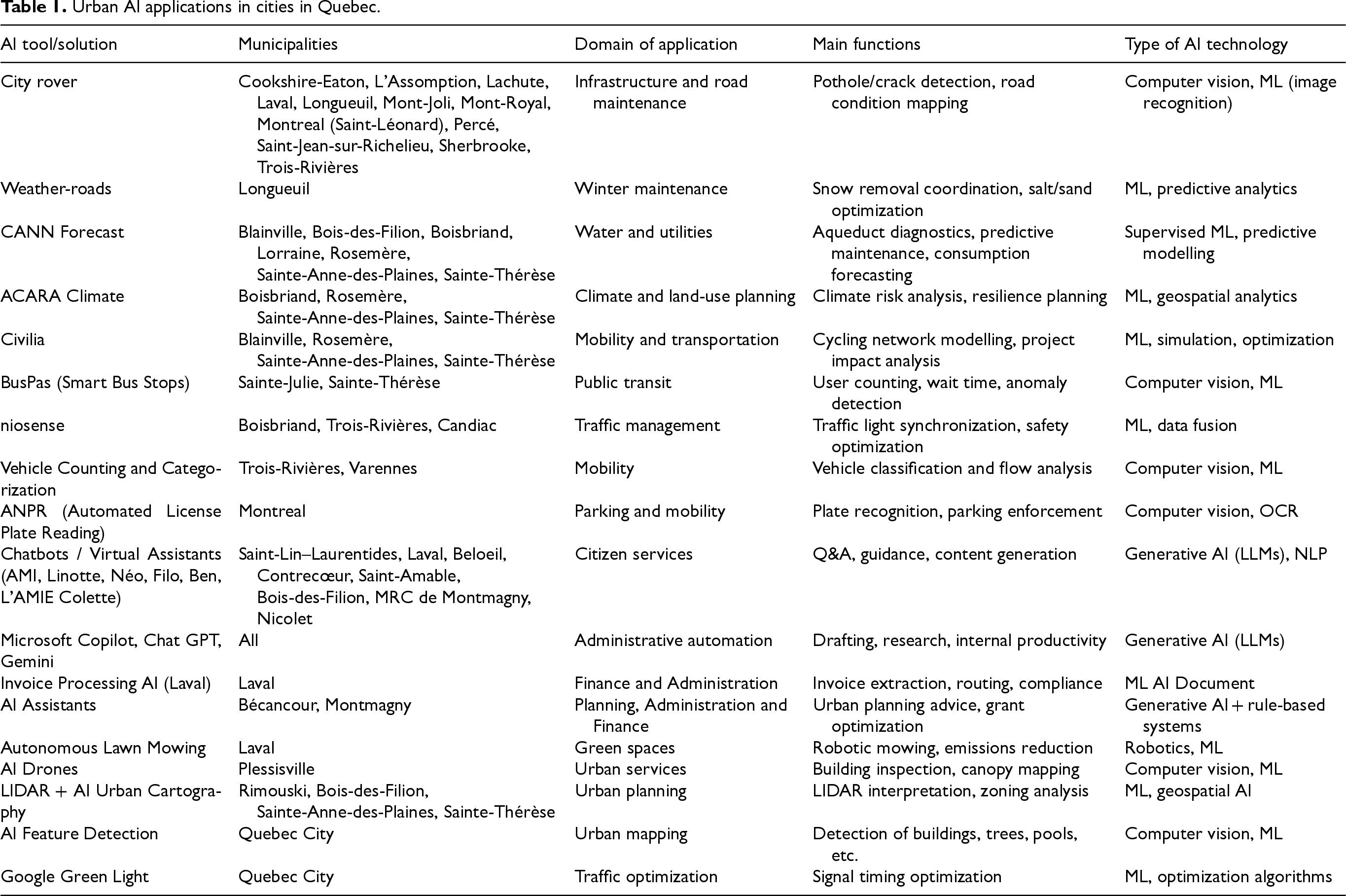
Urban AI applications in cities in Quebec.
At the same time, the forms of AI regulation remain heterogeneous and closely linked to the level of adoption. The most progressive cities, such as Montreal, Rimouski and Varennes, have established explicit guidelines. These include strategic plans, data charters, and AI usage policies that articulate ethical principles, data security, and human supervision. Conversely, many municipalities use AI without a dedicated formal framework. They rely on existing data protection rules or guidelines provided by external partners. This configuration reveals a pragmatic and gradual governance where the framework is built a posteriori, at the pace of the multiplication of uses. As a result, AI is utilised as a tool for management and decision-making within Quebec's municipalities. Its regulation is still being structured, supported by a limited number of pioneering players.
In the ecosystem, cities occupy a predominantly peripheral position. They act as users, partners or testing grounds for technologies rather than as producers or architects of AI systems. With the exception of a few major cities, such as Laval or Quebec City, which develop some of their tools internally, the majority of municipalities lack the required expertise to influence the development or evolution of the technologies they use.
This configuration creates a structural asymmetry of power between AI producers and user municipalities. Companies and research centres primarily determine functionalities, technical models, and innovation trajectories. Cities, on the other hand, have to deal with existing solutions. As a result, the availability of a technological solution often determines the importance of the problem to be solved, rather than vice versa. AI is frequently imported and tailored to the needs of external providers, with a dominant focus on pilot projects and targeted experiments. NGOs serve as catalysts in this dynamic, acting as intermediaries, curators and connectors between municipalities, corporations and research institutions. This pivotal role allows for easier implementation of AI, while also promoting innovation that relies heavily on external city capabilities.
In terms of governance, this structure of actors translates into partial outsourcing of AI governance. This is based on contracts, partnerships and delegated expertise. Municipalities have few upstream control mechanisms. These include transparency requirements, supplier AI fact sheets, or algorithmic auditing capabilities, which limit their ability to guide technology choices. This situation increases the risk of technocentric governance, where AI is used to address the visible effects of complex urban problems. However, the underlying causes are not addressed, and the political capacity of cities to govern AI remains largely constrained by the ecosystems in which they are embedded.
Institutional governance and organisational capacities of cities
AI integration is part of multi-scale governance that mobilises several levels of actors and interdependencies (technological, cognitive and economic). However, many municipalities, particularly smaller ones, struggle to coordinate these efforts due to limited internal capacity. In such cases, external actors often serve as de facto “smart city offices”, providing the necessary expertise and resources. Entities like IVEO, IRIU, or Cite-ID LivingLab offer technology monitoring, strategic guidance, and project development services. Additionally, networks and associations of municipalities play an important role in training and sharing experiences. They also offer more diffuse cognitive support, such as the Conseil de l’innovation du Québec or, in some cases, municipal scientific councils. Despite this abundance of support, coordination remains fragmented. It is often carried out informally by general management, or by department heads, depending on the issue. This fragmentation results in scattered use that may not be very visible throughout the organisation. In this context, AI is used without a global vision, and without sustainable integration into municipal processes.
In contrast, some larger cities and mid-sized municipalities have greater organisational capacity, allowing them to structure their coordination. These cities have dedicated departments or internal units, such as information technology offices in Laval and Trois-Rivières, or the Organizational Performance Department in Gatineau, which has a range of responsibilities, including managing AI projects. This approach fosters a more meticulous selection of uses, aligned with well-defined priorities and specific problems. It enables a more precise articulation of technological uses and governance mechanisms.
Between these two extremes, some municipalities opt for a flexible approach. This is marked by the absence of formal hierarchical structures, but rather a leadership style that fosters innovation and independence among employees. This empowerment logic promotes agility and the exploration of use cases, but only if it is gradually articulated with more explicit coordination mechanisms.
The effects of these configurations are decisive for the governance of AI. In contexts of fragmented coordination, the risk of technological solutionism is high. In these situations, cities may be tempted by tools without a unified vision, initiate a multitude of uncoordinated projects, or even abandon certain initiatives midway. Even if strategies or principles exist, they may remain abstract due to a lack of operationalisation and transparency. Structured coordination, however, can help clarify a vision of AI that focuses on optimising processes rather than the technology itself. This form of governance seems to be more resilient because it remains relevant even as technologies evolve. Finally, flexible coordination provides a foundation for learning and experimentation, but only if it leads to a more robust and coherent framework.
Financial resources and financing instruments
The ecosystem is largely sustained through provincial funding for technology companies and research centres. This is done through innovation programs, research funds, calls for projects and, to a lesser extent, public-private partnerships. This financial support primarily operates as upstream support for technological innovation.
Cities primarily obtain AI through their own financing, acting as both buyers and end users of the solutions. They thus occupy a pivotal position in the economic architecture of the ecosystem. They fund tech companies directly through the acquisition of urban AI tools and indirectly by supporting innovation through provincial grants from these companies and research centres. However, municipal budget limitations significantly shape the nature of the adopted solutions. The tools deployed are mostly low-cost, such as chatbots or conversational agents, whose implementation price is generally between $3000 and $4,000, with limited annual fees. This situation has led tech companies to modify their offerings to stay relevant in a budget-conscious municipal market. This foster standardised, easy-to-deploy, and swiftly profitable solutions. Cities are using provincial funding to advance AI applications through RMCs (Alain, 2023). This multilevel system helps overcome financial hurdles and take advantage of AI benefits.
This financial configuration directly influences the governance of AI, which is mainly organised according to a project-based logic. Funding is typically one-time and tied to particular projects, which restricts municipalities’ ability to invest in infrastructure, skills or long-term governance arrangements. As a result, AI is mobilised through a series of experimental initiatives that do not always lead to a sustainable institutionalisation of uses and rules. This situation also relates to the emerging nature of AI.
In some cases of flexible coordination, some municipalities have implemented innovative financial mechanisms to encourage experimentation while maintaining a certain strategic coherence. The creation of budgets dedicated to AI projects, as in Becancour and Saint-Jérôme, where employees can propose and defend departmental initiatives, demonstrates a form of organisational empowerment. While this type of system promotes agility and internal ownership, it remains dependent on the municipality's ability to articulate these projects with a global vision of AI governance. This is to avoid the proliferation of financially unsustainable, long-term solutions that are isolated.
Data infrastructure and technical capabilities
In the majority of cases, the AI tools used by municipalities depend on external infrastructure and technologies. These tools typically interface with existing platforms and programs, many of which are proprietary. This reliance extends to both data storage and processing facilities, as well as the AI algorithms themselves. They are largely provided by external players and in several cases by foreign companies such as OpenAI, Amazon or Microsoft.
This configuration has a direct effect on the uses of urban AI. Municipalities must adapt their needs and projects to the capabilities of the available infrastructure. As a result, the observed uses correspond mainly to the standardised functionalities offered by platforms such as chatbots, conversational agents, analysis or light automation tools. Very few solutions are tailor-made for specific local needs. The technical infrastructure therefore plays an important role in shaping innovation. Indeed, what is technologically possible tends to define what is deemed realistic and relevant.
In terms of governance, this dependence on foreign infrastructure and models severely restricts the technical governance of municipalities. Cities have little control over the architecture of systems, how data is processed, or how the models used evolve. This raises concerns about cybersecurity and data sovereignty, or more broadly, digital sovereignty. This is especially true when municipal data is hosted or processed outside the territory. Or when technological dependence makes it difficult to be autonomous and to identify responsibilities in the event of an incident. In the absence of alternative infrastructure or insufficient internal capacity, AI governance remains figurative. The possibilities for action are limited to contractual and organisational considerations, which are also not very robust. Without the ability to intervene in shaping technological choices, cities cannot effectively oversee AI. This constraint reinforces the risk of technocentric governance, in which decisions are implicitly dictated by dominant technical architectures rather than by explicit political or social arbitration.
Normative, legal and ethical frameworks
In Quebec, there are several multi-level frameworks, including international principles, provincial strategies, general data protection laws, and ethical guidelines (Attard-Frost et al., 2024). This ensemble creates a dense but unarticulated normative environment at the local level. At the provincial level, in December 2025, the Quebec government adopted measures on the use of generative AI (IA-RI-2025-003-OP). The aim is to establish a framework for the performance of activities and the implementation of security measures in relation to the use of generative AI by public administrations. These measures are a strong political signal, but they do not specifically target municipalities and do not impose specific operational mechanisms at the local level. There is currently a lack of explicit connection between the provincial and national guidelines, on the one hand, and the municipal AI governance systems, on the other.
Faced with this situation, municipalities find themselves immersed in multi-scale normative discourses that they must interpret and translate autonomously. Most cities incorporate the main principles (such as ethics, transparency, data protection and human supervision) in their local AI strategies or internal AI use policies. However, this assimilation often takes a primarily symbolic form. There is no internal or external regulatory framework requiring municipalities to meet specific requirements regarding auditing, algorithmic transparency, or accountability. Furthermore, although there is Bill 25, a bill on the protection of personal information, we have not identified any concrete operational tools to ensure its application, nor for the other AI principles. Additionally, each city is free to define its own rules, which leads to strong heterogeneity in practices.
In terms of use, these frameworks do not have a direct and systematic effect, but they do contribute to a certain technological prudence. Most cities avoid the most disruptive technologies. Nevertheless, contradictions emerge, particularly in the case of the Service de police de la Ville de Montréal, which uses facial recognition technologies, while the city's AI strategy highlights principles of ethics and transparency (Lamontagne, 2025). The lack of public information about the software used highlights the discrepancy between the principles displayed and the actual practices.
The framework for urban AI is mainly based on flexible, non-binding mechanisms that rely on municipal self-regulation. Some cities, such as Bécancour, are implementing specific policies regarding the use of virtual assistants (Bécancour, 2025). However, these initiatives fall under voluntary governance rather than being mandatory. This increases the risk that AI will be governed in a fragmented and unequal way, depending on local capacities and policy choices, rather than a common, operational normative framework.
Networks and intermediation mechanisms
These mechanisms are primarily rooted in horizontal inter-municipal governance, which is characterised by networks of cities, non-governmental organisations, innovation laboratories, and communities of practice. They are pivotal in spreading the use of AI-related technologies, expertise, and governance norms.
Technology companies are playing an active role in these dynamics. They organise training for municipalities, often in collaboration with municipal associations and city networks, such as the Regional County Municipalities (RCMs), the Association of General Managers of Quebec Municipalities or the Union of Quebec Municipalities (UMQ) (Dallaire, 2026). These training courses are important vectors for the dissemination of AI uses, since they raise awareness among municipal stakeholders about the tools available, and help to legitimise certain technological solutions. At the same time, education and research institutions are increasingly including cities as partners in their research projects, which promotes knowledge transfer and the testing of innovative solutions in real-world contexts. RCMs play a particularly strategic role in these intermediation mechanisms. By pooling costs, skills and administrative procedures for AI projects, they allow smaller municipalities to access technologies and expertise (Alain, 2023). This pooling helps to accelerate the spread of AI on a territorial scale and to reduce certain financial and organisational barriers.
In addition, direct partnerships between large and small municipalities are beginning to emerge. This is particularly the case with Gatineau's deployment of a bill processing tool initially developed by Laval, illustrating a form of horizontal cooperation based on the sharing of municipal solutions. These networks promote imitative learning, where cities position themselves by observing and replicating practices that are considered effective or legitimate elsewhere. While this dynamic helps to reduce uncertainty and accelerate the adoption of AI, it can also lead to a convergence of uses and modes of governance. This can sometimes hinder critical reflection on the relevance of solutions in specific local contexts. Therefore, intermediation networks and mechanisms are both catalysts for innovation and potential vectors for standardising practices.
Discussion
The findings of this study, as outlined in Table 2, reveal that the adoption and governance of AI in urban settings cannot be explained solely by internal factors such as organisational capabilities, financial resources, or political will (David et al., 2023; Rodriguez Müller et al., 2025; Senadheera et al., 2025; Taeihagh, 2021; Yigitcanlar et al., 2024). Rather, they must be analysed through an ecosystem approach that takes into account the interdependencies, power imbalances, and intermediation mechanisms that shape the environment in which cities operate. The adoption of AI is not just a matter of internal capabilities or rational choices, but of a set of structural interdependencies, intermediation mechanisms and power relations.
Summary of the results.
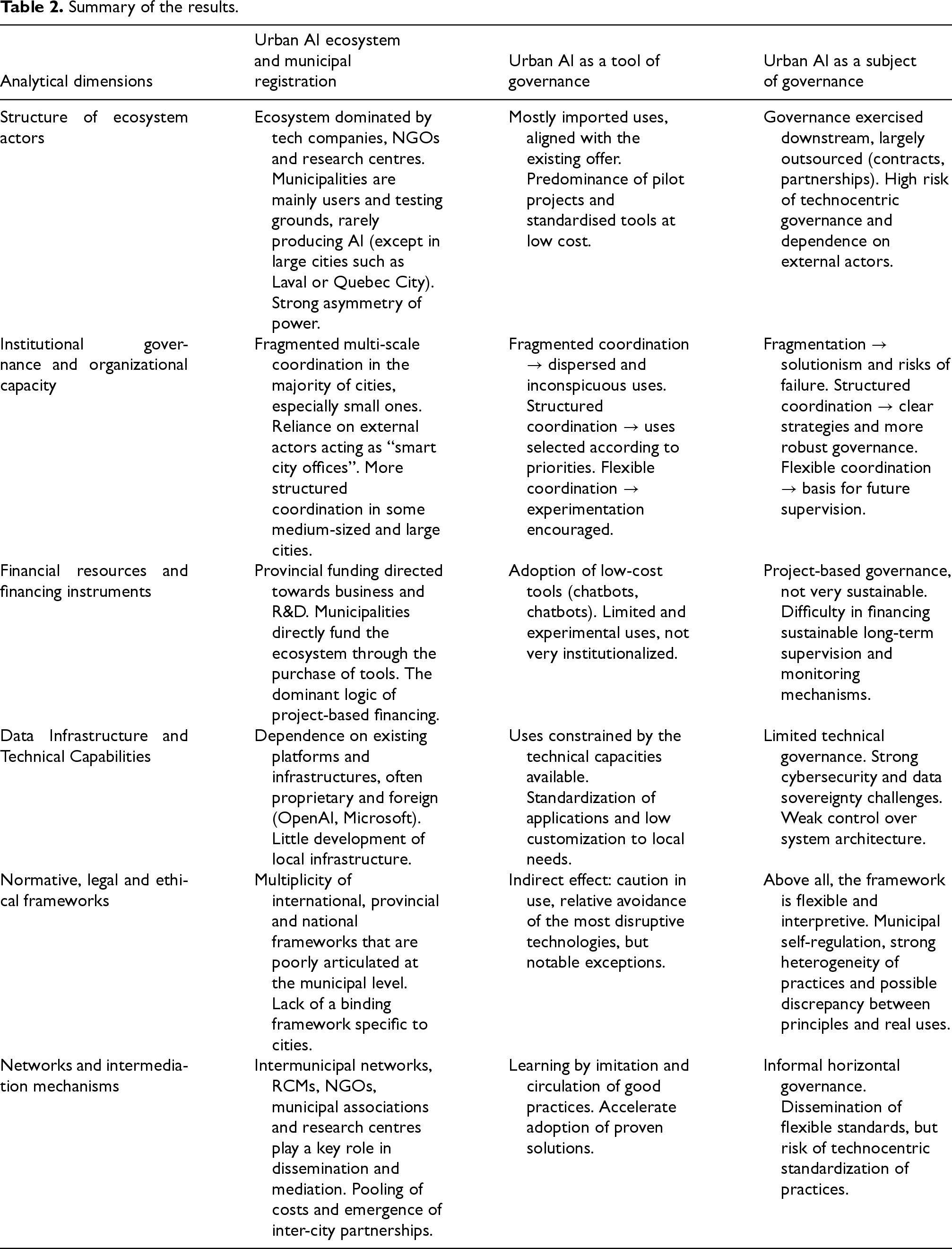
Summary of the results.
The literature highlights the importance of clear policies, well-defined roles, and dedicated governance structures to foster responsible adoption (David et al., 2023). However, our results show that flexible, agile coordination based on the empowerment and network integration can also be effective, particularly in the early stages of implementing new technologies such as AI. This technology has major societal impacts and raises fears, particularly regarding job loss (Sanchez et al., 2024; Yigitcanlar et al., 2023). Agile coordination based on network integration can support learning from a broad ecosystem, identify uses and experiment with dedicated budgets. This allows to reduce resistance and anchor AI in professional practices. However, this institutional flexibility is showing its limits in the longer term. In the absence of structured coordination, the fragmentation of authorities and regulatory immaturity identified by Almulhim and Yigitcanlar (2025) and David et al. (2023) have become obstacles to the sustainable and coherent integration of AI.
In this context, the contributions of institutional theory allow us to specify the nature of the pressures at work (Gong and Sun, 2024; Rodriguez Müller et al., 2025). Contrary to what some literature suggests, coercive pressures appear to be low in the cases studied. There are no binding regulations, policies, or guidelines that explicitly require the adoption or oversight of AI at the municipal level. Bill 25 indirectly influences the protection of personal data, but no specific operational tool has been identified to support its application in the use of AI. On the other hand, normative pressures are a central factor. They mainly come from professional associations, municipal networks and intermediary organisations, and they disseminate benchmarks of good practice and shape perceptions of what is legitimate and desirable. This reinforces the idea that the benefits and risks of urban AI depend closely on the ecosystems in which municipalities are embedded (Ciasullo et al., 2020; Jieutsa, 2026; Jin and Miles, 2025; Stahl, 2022). The influence of mimetic forces is quite strong. The adoption of particular strategies, specifically the use of chatbots, has been rapidly increasing due to the success of early adopters, such as the city of Saint-Lin–Laurentides. This has created a ripple effect where cities observe and reproduce initiatives that have proven effective elsewhere.
On the financial and economic level, the literature highlights budgetary constraints and uncertainty about the return on investment (Gong and Sun, 2024). However, our findings reveal a remarkable adaptability among municipalities, which leverage multilevel fundings and operate within subscription-based business models and benefit from economies of scale (Jieutsa and Koseki, 2025). AI companies adjust their commercial strategies by reducing expenses, aiming to serve a greater number of cities. This is achieved through economies of scale resulting from the abundance of ecosystems. Test and learn approaches dominate. This confirms that pilot projects and progressive experimentation are essential levers for the dissemination of AI, as David et al. (2023) have shown.
Organisational capacities, such as leadership and change management, appear as key determinants (Ben Dhaou et al., 2024). Leadership allows for driving change, reassuring employees and transforming AI into an efficiency tool rather than a threat. Empowerment is essential in overcoming resistance and promoting adoption. Our results show that municipalities rely on multilevel external actors to support reinforce their institutional governance and organisational capacities. In terms of technical capacities, the multilevel nature of AI allows municipalities to take advantage of solutions without having to have heavy in-house infrastructure. Outsourcing computing power and models to companies simplifies the adoption process (Roundy and Asllani, 2024). This dynamic actually exacerbates cybersecurity and digital sovereignty challenges, and contributes to the risk of technocentric governance, where the dominant technical architectures implicitly shape public decisions (Koseki et al., 2022; Sanchez et al., 2024; Slattery et al., 2024).
Finally, the literature emphasises the importance of ethical and legal frameworks and citizen participation in building trust (Farida et al., 2023). Our results, however, reveal a significant discrepancy. Few municipalities have implemented ethical frameworks, and participatory approaches remain largely absent. Uses are mainly oriented towards the optimisation of services. However, they rely on advice from training, multi-level frameworks, and guidelines that have been developed by NGOs, the provincial government, and research institutions in the ecosystem.
The main contribution of an ecosystem approach is shifting the analysis from “how municipalities adopt AI” to “in which ecosystems and under what structural constraints this adoption occurs.” This shift allows for four essential things. Firstly, it brings to light the power imbalances between cities and other actors. Secondly, it distinguishes governance regimes based on the organisational capabilities of municipalities. Thirdly, it illuminates the impact of financial resources, technological infrastructure, and multilevel regulatory systems on shaping innovation. Finally, the ecosystem approach highlights the structuring role of intermediation networks and mechanisms. These networks accelerate the spread of AI, reduce barriers and promote imitative learning. However, they may also result in a uniformity of applications and governance strategies, strengthening the existing dominant dynamics of the system. In this sense, the ecosystem approach shows that the benefits and risks of urban AI depend as much on the ecosystem's configuration as on the local choices of municipalities. This provides a more solid foundation for examining responsible urban AI governance (Stahl, 2022).
This paper highlights several major implications for research on urban AI and the governance of emerging technologies. First and foremost, it emphasises the need to go beyond the municipality-centric approaches to analysing AI adoption and governance. Future work would benefit from explicitly mobilising ecosystemic and multi-scale frameworks, capable of capturing the interdependencies in place. Such a perspective helps us to better understand how the use and regulation of AI are co-produced by configurations of actors, rather than being decided only at the local level. Secondly, this paper invites us to deepen the analysis of power relations and structural asymmetries in urban innovation ecosystems. Future research could explore more systematically how the centrality of firms and intermediary organisations shapes technological trajectories. This also concerns the priorities for public action and the regulatory space available to municipalities, particularly in small and medium-sized cities. Third, this research paves the way for comparative studies of AI governance regimes according to organisational capacity, institutional contexts, and intermediation models. It also suggests the interest of developing empirical indicators to measure the degree of technocentrism, externalisation of governance and cognitive dependence in municipal AI policies.
On a practical level, the results show that municipalities can no longer think of AI governance solely as a technical or administrative matter. They should instead strengthen their internal coordination capacities, even if resources are limited. This will reduce their reliance on outside players and help them make better technological choices. The development of simple but structuring mechanisms such as evaluation criteria for AI solutions, minimum transparency requirements, or internal spaces for coordination can be a first step towards more controlled governance. Embracing flexible coordination methods and employee autonomy can also prove effective in facilitating AI adoption and minimising resistance to change. However, these approaches need to be progressively articulated with more formalised strategies and frameworks to avoid fragmentation and long-term technological solutionism. For intermediary actors (NPOs, RCMs, municipal associations, etc.), this research highlights their key role, but also their increased responsibility in structuring the ecosystem. They can contribute to a more responsible governance of AI by developing shared tools (operational guides, model contractual clauses, transparency standards) that strengthen the capacity of municipalities to act. Finally, for provincial and national governments, the results argue in favour of policies and programs specifically tailored to the municipal context. They must include not only funding technology solutions, but also supporting governance, training, and operationalisation of responsible AI principles. Without such an approach, the benefits of AI are likely to remain unevenly distributed and reinforce existing asymmetries between municipalities.
Footnotes

Ethical considerations
This study was conducted in accordance with the ethical principles of responsible research and innovation, with particular attention to the social sensitivity of studying AI in municipal governance. The project received ethics approval from the Comité d'éthique de la recherche en arts et humanités (CERAH) of the Université de Montréal on 14 March 2025, under certification number 2025-6121.
All research activities involving human participants followed strict ethical procedures. Interview participants, including municipal employees, technology providers, non-profit organisations, and academic experts were fully informed of the aims of the study, the societal issues under investigation, and the potential implications of their contributions. Participation was voluntary, and written or verbal consent was obtained prior to each interview. Participants were reminded of their right to withdraw at any time without consequences.
To protect privacy and prevent any risk of harm to individuals or institutions, personal identifiers were removed from all transcripts, and pseudonyms were used during analysis and reporting. Audio files, transcripts, and consent forms were securely stored on encrypted institutional servers accessible only to the principal investigator. No sensitive data were shared with external actors, and no collected information was used to evaluate or judge the performance of any municipality, organisation, or individual.
Given the societal importance of AI deployment in cities, particular care was taken to ensure that the research did not reinforce existing inequalities, stigmatise specific communities, or misrepresent the practices of the interviewed organisations. The study complies with the ethical commitments of Societal Impacts by prioritising transparency, respect for participants, and reflexivity regarding the social consequences of research outcomes.
Consent to participate
Informed consent to participate was written and participants signed a consent form.
Consent for publication
Not applicable.
Funding
The author received no financial support for the research, authorship, and/or publication of this article.
Declaration of conflicting interests
The author declared no potential conflicts of interest with respect to the research, authorship, and/or publication of this article.