




Abstract
How far do public responses to international illegality vary depending on the international regime involved and the involvement of an international court? Existing experimental studies have commonly identified a public-support-depressing effect from international illegality but have not examined how this may vary across regimes. This paper addresses that question through a survey experiment examining, across two large anglophone jurisdictions, how far public support for a policy is affected by violation of international laws of the human rights and trade regime respectively, as well as examining how far that effect differs where an international court is involved. We report results suggesting that, while publics care about international illegality, this effect does not vary significantly across international regimes. Rather, it is international illegality tout court that matters. However, the support-depressing effect of international illegality is amplified where an international court has confirmed the relevant legal position. We further report results suggesting that, amongst the various mechanisms by which international law is hypothesised to affect states’ political and moral situations, concerns with promising are most salient in explaining the impact of international illegality on public attitudes.
1. Introduction
“International law” is a diverse category, comprising everything from international humanitarian laws regulating armed conflict, to trade and investment laws governing the day-to-day operation of the international economy, to human rights laws protecting individuals from mistreatment by their own governments, to international postal regulations governing the carriage of postal packages across borders. When political scientists theorise the functions of international law and the mechanisms by which it shapes behaviours and outcomes, they tell various different stories, which fit better or worse with different fields of international law. When legal and political philosophers analyse whether, why and under what circumstances states have a duty to comply with international law, they similarly distinguish amongst different international legal regimes. And when international lawyers examine the legal consequences of breach, these too vary across regimes.
Yet in public political discourse, “international law” is frequently invoked as a unified whole, with states and individuals asserting their support for international law, or criticising others for their violation or disregard for international law, or questioning policies on the basis of their compatibility with international law. Sometimes, of course, participants in public debates will emphasise the particular regime that is at stake, but frequently the appeal seems to be to “international law” as such.
This public political discourse towards international law matters because effects on public opinion and public political support are one important mechanism through which international law plausibly affects political action and outcomes. If elites know that breaching international law will cost them political support this gives them an important reason to take that law into account. It therefore matters, in an important and practical way, whether and how publics are sensitive to breaches of international law. This has led a number of scholars (e.g. Carpenter & Montgomery, 2020; Chaudoin, 2014; Chilton, 2014; Chilton & Versteeg, 2016; Cope & Crabtree, 2020; Dill & Schubiger, 2021; Kreps & Wallace, 2016; Kuzushima et al., 2024; Lupu & Wallace, 2019; Sagan & Valentino, 2017; Sheppard & von Stein, 2022; Tomz, 2008) to examine through experiment how far compliance with, or violation of, international legal norms affects the support of relevant publics for international policies. These studies have commonly (albeit not uniformly) found a statistically significant negative effect on public support for a proposed policy across most jurisdictions: voters, it seems, are less likely to support a policy if they know that it breaches international law (For an extensive review of relevant results: Chilton & Linos, 2021. For examples of results pointing the other direction: Lupu & Wallace, 2019; Cope & Crabtree, 2020).
Yet these studies have not examined whether the distinctions that lawyers, political scientists and philosophers draw between international law regimes are reflected in public responses to them. This paper takes that step, examining whether and how publics distinguish between international law regimes. In particular, we examine whether respondents’ attitudes are affected more or less by illegality under the human rights regime or the trade regime, and how far that effect is amplified by the involvement of international courts, looking at respondents across two large anglophone jurisdictions.
Our conclusion is clear: across both the United States and the United Kingdom, there is little evidence that voters, in their responses to international illegality, distinguish between these two regimes. For voters, it appears, it is international illegality that matters, rather than specific international law regimes or institutions. Lawyers, philosophers and political scientists may see significant variance across these regimes, but voters do not. Rather, our results – particularly for our US sample – are strikingly similar across the two regimes. We do find evidence that the involvement of an international court amplifies the support-depressing effect of illegality: voters appear even less likely to support a policy where its illegality has been confirmed by an international court; but again, this effect does not appear to vary meaningfully across regimes. We also report results suggesting the mechanisms that are most salient for voters in understanding that support-depressing effect.
The paper is structured as follows.
Part 2 reviews existing political, philosophical and legal accounts of the causal efficacy and authority of international law and courts, highlighting the extent to which, across disciplines and approaches, we find reasons to distinguish between international regimes, and to expect variance in the social authority of international law and courts across regimes and institutional contexts. It is this fact that motivates the questions investigated in the empirical sections.
Building on the discussion in Part 2, Part 3 describes a number of causal mechanisms that may explain public responses to international illegality, and derives a set of hypotheses about variance across regimes, and in response to pronouncements of an international court.
Parts 4 and 5 describe the design and implementation of our study. We adopt a vignette-based survey experiment, using a hypothetical policy to reduce pharmaceutical costs which raises potential violations of both international trade and international human rights laws to test for variance in public response across regimes, with or without the involvement of courts, and with or without emphasis on the distributive quality of norms.
Part 6 describes and discusses our experimental results. Part 7 concludes by identifying some directions for future research suggested by our results.
2. Theoretical Context
A number of recent experimental studies have examined the impact of international illegality on public support for political actions and policies. 1 These studies are motivated by a concern to examine one plausible mechanism by which international law may affect state behaviour: if voters care about international illegality, then elites who violate international law can expect to pay a political support price for international law violation, providing them with a clear incentive to comply with their international legal commitments. (One study seeking to track this causal mechanism through these various steps is Kim, 2019) The fact that, across a range of scenarios and jurisdictions, these studies commonly (albeit not universally) identify a moderate but statistically significant support-depressing effect from international illegality, is therefore an important result, lending credence to claims about the political significance of international law.
Based on these studies we can assert, with reasonable confidence, that publics in most cases care about international law, and that their support for policies will typically be reduced where those policies violate international law, albeit this effect is subject to modification by various factors. (For studies highlighting variation across countries: Lupu & Wallace, 2019; Madsen et al., 2022. Other studies highlighting the ways that features of respondents, international courts and policy domains may modify this effect include: Cheruvu & Krehbiel, 2024; Cheruvu et al., 2025) However, there remain many unanswered questions about this support-depressing-effect, including the extent to which it varies across contexts. In particular, existing theoretical scholarship across political science, international law and political philosophy prompts us to ask how that effect might vary across international regimes and institutional structures? These are the questions we take up in this study.
2.1. Variance Across Regimes
While existing survey-experimental work has examined different international regimes, including those governing human rights (Chilton, 2014; Kim, 2019; Lupu & Wallace, 2019), armed conflict (Carpenter & Montgomery, 2020; Dill & Schubiger, 2021; Kreps & Wallace, 2016; Sagan & Valentino, 2017), trade (Tomz, 2008; Chaudoin, 2014) and migration (Cope & Crabtree, 2020; Sheppard & von Stein, 2022), and regional regimes including the European Union and ECtHR (Cheruvu & Krehbiel, 2024; Madsen et al., 2022), we are not aware of any study that tests whether the support-depressing effect of international law violation differs across regimes. 2 Yet the diverse mechanisms by which different regimes are hypothesised to affect state behaviour, the differences in formal compliance and enforcement mechanisms, and the different normative judgments we frequently make of these regimes, provide reasons to suspect that this effect might indeed vary.
International relations scholars have developed various approaches to explain the causal efficacy of international law i.e. whether and if so why do states comply with international law? (For an introduction to these questions, Kingsbury, 1998) Rationalist theorists (e.g. Goldsmith & Posner, 2005; Guzman, 2008) emphasise the role of international agreements in facilitating mutually beneficial cooperation, and the importance of reputation in maintaining those schemes. States, on this view, comply with international law because they perceive a long-term self-interest in sustaining specific cooperative schemes, and in preserving their reputation as trustworthy counterparties in the context of other, including future, agreements. Constructivist theorists, by contrast, have emphasised the ways that norms are internalised, constituting standards of legitimate behaviour for agents, including states. (On the intersection between constructivist perspectives and international law, Brunnée & Toope, 2012) Agents come to value compliance with international norms, including international law, for its own sake, independent of instrumental calculations of short- or long-term self-interest, generating a felt “compliance pull” independent of expected effects. (On internalisation Finnemore & Sikkink, 1998; in respect of law in particular, Koh, 1997).
Because rationalist theories focus on mutually beneficial cooperation and long-term self-interest they fit more readily with economic and security contexts, where states accrue clear benefits from cooperation and coordination (See e.g. Simmons, 2000) 3 . Constructivist accounts, by contrast, are more prominent in respect of human rights law, where states expect little if any material benefit from other states’ compliance with treaty commitments. (For an overview, Stubbins Bates, 2014) Admittedly, the distinction is more significant in explaining the reasons for law’s existence, as opposed to for compliance: having committed to a human rights norm, we might expect a state to worry about the reputational effects of violation in the same was as a trade norm; while trade norms, once established, can become internalised in the same way as human rights norms. Nonetheless, it remains the case that explanations in terms of rational self-interest seem more readily to fit other-binding than self-binding norms.
For international lawyers, focussed on the formally binding quality of law, there are not obvious regime-level differences. While we frequently distinguish between “hard” and “soft” law (Shaffer & Pollack, 2010), the former constituting legal obligations and the latter merely hortatory, we find instances of both hard and soft law mechanisms across various regimes. There is however one feature of many economic regimes, including the multilateral trade regime, that is distinctive. While States have hard law obligations in the trade regime, they are not – at least on one interpretation – required to actually comply with the normative standards of that regime (Bello, 1996; Jackson, 1997, 2004; Rosendorf, 2005; Schwartz & Sykes, 2002): rather, the fundamental obligation in the trade regime is to comply or compensate or accept a strictly proportionate withdrawal of concessions. Equally, in the investment regime, states have obligations to compensate investors, but they have no obligation to withdraw measures that violate international investment treaties. (Aisbett & Bonnitcha, 2021) In other regimes, including in particular the human rights regime, the obligation is much more clearly one of conduct. It would not be acceptable for a state, in any human rights forum, to declare that it proposed to continue to violate some protected right, but that it would pay compensation to those affected. 4 There is thus plausibly, even for the international lawyer, a difference in the bindingness of even hard law obligations.
Turning next to the philosophical literature on international law’s authority, we find quite different accounts of how international laws might impose duties on states across contexts. Instrumental accounts like Joseph Raz’s service conception, for example, seem better placed to explain the authority of cooperative and coordinating regimes of the kind found in international economic law than of the self-binding international human rights regimes. (On the variability of the Service Conception across norms, regimes and agents, Tasioulas, 2010). Similarly, fair-play accounts (e.g. Lefkowitz, 2011), emphasising the duty to comply with practices where we have benefited from the like compliance of others, fit better with international economic regimes than with human rights, where it is hard to see how one state benefit’s from another’s compliance. Conversely, accounts emphasising the duty to support just institutions, and those grounding international law’s authority in the moral significance of consent, may better fit international human rights law than international trade law (See e.g. Dworkin, 2013, and, on the limits of consent arguments in the context of economic law: Suttle, 2023). The key lesson here being that, as with the political science and international law perspectives, these literatures recognise the diversity of international law and that its binding force potentially varies across contexts. One specific question arising from the philosophical literature is how distribution affects international law’s authority. Across diverse theories, we find the assumptions required to motivate law’s authority are frequently challenged by distributive rules, undermining their normative legitimacy (Suttle, 2025a, 2025b). International law might have authority in many cases, but not where its norms play a distributive role. (On the political psychology of redistributive policies: McCaffery & Baron, 2005). We therefore make this a specific additional dimension of our inquiry.
2.2. The Role of International Courts and Tribunals
International courts and tribunals have been an increasingly prominent feature of international law over the past three decades. Despite lacking the kind of enforcement capacities typically associated with domestic courts, states have given greater roles to independent judges and arbitrators to determine their legal rights and obligations across areas as diverse as trade, investment, human rights, international criminal law and the law of the sea, and have made international litigation a prominent part of their international political practice.
As with the question of how law itself matters, the questions of why international courts matter, and whether and how far states do and should have regard to their decisions, can be approached from diverse perspectives within political science, international law and political philosophy.
On one rationalist view, establishing, or accepting the jurisdiction of, international courts is understood as a commitment strategy, reducing the opportunities for states parties to agreements to rely on ambiguities in those agreements to avoid their obligations (Simmons & Danner, 2010. For a psychological interpretation of the significance of ambiguity: Shannon, 2000. For evidence that specific legal claims are more effective than more general or ambiguous claims: Reed, 2025). The existence of an international court, and the knowledge that this court may hold against the state, increases the reputational costs associated with violation, including by pre-empting explanations that exploit norms’ ambiguities. For constructivists, by contrast, international courts constitute part of the social context in which states negotiate their own understandings of norms of conduct and appropriate behaviour: compliance with the decisions of courts is itself an important normative commitment for states with strong rule-of-law traditions, while the international court also constitutes a privileged participant in debates about the meaning and content of substantive norms within a given regime (On this discursive quality of international law, Chayes & Chayes, 1993; Brunée & Toope, 2010). And just as with the first question, about how law matters, these accounts of the significance of courts will fit better or worse with different regimes.
For international lawyers, international courts and tribunals serve to clarify or confirm states’ obligations, as well as adjudicating factual questions about the law’s application in specific disputes. Nonetheless, international courts and tribunals are by no means legally uniform, and differences in their legal nature might be expected to affect their social and normative legitimacy. As between the parties to a specific dispute, the decisions of international courts are usually binding, but this will not always be the case, as the ICJ’s advisory opinion jurisdiction illustrates. Further, international courts differ as to the extent to which their decisions bind non-parties, including through informal practices of precedent. International law does not generally adopt a doctrine of binding precedent, but most international courts regularly employ precedential reasoning, making frequent reference to their own and sometimes other courts’ previous decisions. Nonetheless, we can identify in certain regimes a particular reluctance to accord precedential force to decisions. This is perhaps clearest in the WTO where we find the express statement that “[r]ecommendations and rulings of the DSB cannot add to or diminish the rights and obligations provided in the covered agreements” (WTO Dispute Settlement Understanding Art 3.2), providing one focus of US criticism of the Appellate Body. The task of dispute settlement tribunals, this view holds, is to settle disputes between the parties, not to vary the rights and obligations of the membership in general (On the incoherence of this critique, Suttle, 2019).
Political philosophers have interrogated the grounds of international courts’ and tribunals’ legitimate authority, as distinct from the bindingness of the law that they administer (For an overview, Follesdal, 2020). Again, different theories offer different answers: for consent theorists and those emphasising democratic credentials, the existence of international courts whose interpretations of treaty texts diverge significantly from the expectations of the parties may be a challenge to their authority (On consent and the ICJ, Lister, 2011). By contrast, theories emphasising fair-play, deliberative rationality or the instrumental value of particular regimes, including for coordination, may more readily support tribunals’ authority, even where interpretations depart from treaty text and authors’ expectations.
Across disciplines, we thus find various reasons to expect that the involvement of an international court might enhance the perceived authority of an international norm, and hence the support-depressing effect of violation. However, as with the initial question of law violation simpliciter, different accounts of the role of courts fit better with some regimes than with others, prompting the question of whether the impact of court involvement might vary across regimes.
3. Causal Mechanisms and Hypotheses
We have focussed in the foregoing on understanding how both subject matter and institutional form affect the authority of law across international relations, political philosophy and international law. However, this does not directly generate predictions about how publics will respond to violations of those laws. For this, we need an account of public opinion formation in this area.
One approach understands individual material interest as the primary driver of public attitudes towards breach of international law. Publics may be expected to sanction their own governments for violating regime norms where they perceive that violation as being adverse to their interests. An international court, on this view, becomes a trigger for public sanction where the public has, over time, come to trust that court to make decisions that are in their interest. (Carrubba, 2009) This trust-based mechanism may go some way to address the fact (Rho & Tomz, 2017) that public do not typically have the knowledge required to evaluate the economic effects of breach. Another approach emphasising individual material interests reflects the reputational mechanisms described by institutionalist international relations scholars. On this view, publics expect a material cost to themselves where governments renege on their international commitments, and hence are less likely to support policies breaching those commitments (Tomz, 2008, Chaudoin, 2014. Dill and Valentino (2023) subsume these reputational concerns under what they label the Contract Model, and propose a further Cost Model, which includes public expectations of material sanctions).
Another approach emphasises perceptions of fairness and procedural and substantive legitimacy as driving public responses to breach. Departing from a narrowly self-interested perspective, this view assumes that publics value fairness, and will sanction breaches of rules that they perceive as fair or right, whether substantively or procedurally, even if they do not perceive a direct cost to themselves (Madsen et al. (2022) present evidence that support for international courts’ decisions is strongly affected by the substantive content of those decisions and how far it tracks respondents’ policy preferences. Dill and Valentino’s (2023) Moral Proxy Model reflects a similar view). This implies that publics will react differently to different international law breaches, depending on their judgments about both relevant institutions and subject matters. (In fact, it seems plausible that both self-interested and altruistic - including fairness-based – explanations will be relevant to explaining public attitudes in this context. On the ways that preferences over international economic policy reflect equity concerns as well as narrow self-interest: Lu et al., 2012. Cf. Rho & Tomz, 2017).
A related view focuses on norm internalisation, through which individuals come to endorse international norms because they come to perceive them as substantively correct standards of behaviour: “international law changes the range of government actions the public perceives as appropriate” (Lupu & Wallace, 2019). This latter view has been particular prominent in discussions of human rights which, independent of their specifically legal status, are frequently invoked as a common language of international morality. (e.g. Simpson, 2004; Lupu & Wallace, 2019; Kim, 2019) 5 We can talk about norm internalisation at different levels of generality, ranging from “the norm against torture” through “compliance with human rights” to “respect for the rule of law”: how norms are internalised affects how we should expect publics to respond to them.
Yet another approach emphasises political identification. Persons, on this view, may adopt cosmopolitan identities, in addition to or as an alternative to national or other identities. Adopting a cosmopolitan identity leads to greater identification with international norms and institutions, and a consequent reduction in support for policies that conflict with them (Burcu Bayram, 2017). Conversely, those adopting a more narrowly national identification are likely to respond to international norms and their violation less favourably, or at least in more instrumental terms (Madsen et al. (2022) specifically test hypotheses about the ways that nationalists respond to international courts). Other identities that respondents may assume include partisan ones, which may lead them to respond differently to breaches depending on whether they are perpetrated or endorsed by political elites with whom respondents identify. (On ways that partisanship may affect responses to international illegality: Strezhnev et al., 2020; Cheruvu et al., 2025). Partisan identification also seems relevant for other ways that international factors might impact domestic opinion (Kohno et al., 2023). Respondents may alternatively perceive international laws as tracking common international practices: international law describes what states generally do, and those whose cosmopolitan identity leads them to value conformity with international practice will value international law compliance (Kuzushima et al., 2024).
These different approaches have different implications for whether we should expect to see variance in public responses to breach. A cosmopolitan commitment to international law tout court, for example, would presumably produce a similar support depressing effect from international law violation, regardless of the specific regime involved. Similarly, if publics have internalised norms around the rule of law in general, then we might expect similar treatment effects across regimes. We thus take as our null hypothesis the absence of any variation in effect size across regimes. HA0: There is no difference in the effect on public support of a policy based on whether the policy is prohibited by international human rights law or international trade law.
However, theories emphasising norm internalisation may also imply variation, depending on the form and extent to which norms are internalised by relevant publics. Where the norms of a given regime, or in more general terms the normative language of that regime, or that regime’s claim to constitute a relevant normative standard, have been more fully internalised, we would expect to see a greater response to breach of that regime’s norms, compared to others. As noted, discussions of norm internalisation have been especially prominent in respect of human rights, and human rights often function as a normative trump card (Dworkin, 1977) in political discourse, prompting our first hypothesis on this dimension: HA1: Prohibition by international human rights law has a greater support-depressing effect than prohibition by international trade law.
By contrast, theories emphasising material interests suggest that persons will respond differently to breaches of different regimes, whether because those regimes are themselves perceived as more or less beneficial, because breaches are more or less likely to prompt international reputational or direct reciprocal sanctions, or because individuals have developed greater or lesser trust in specific institutions. Material interests and concerns with reputation and reciprocal sanctioning appear more salient in the trade regime, prompting our second hypothesis: HA2: Prohibition by international trade law has a greater support-depressing effect than prohibition by international human rights law.
Finally, theories emphasising fairness and procedural legitimacy suggest that persons are likely to respond differently depending on whether the relevant norms, or the institutions through which they are implemented, meet relevant standards of fairness. This may even hold regardless of whether respondents perceive themselves as benefitting from that unfairness: altruism plays at least some role in these judgments (Rho & Tomz, 2017). This suggests that prompting respondents with specific information about norms’ distributive effects is likely to reduce their support-depressing effect, prompting our third hypothesis: HA3: Prohibition by international law norms that are described as distributive has a lesser support-depressing effect than prohibition by similar norms not described in these terms.
Turning next to court involvement, each of the above approaches, insofar as it suggests a relationship between international law and public opinion, implies a similar, but potentially greater, effect arising from a finding of an international court. If we think persons are concerned about indirect impacts on their material wellbeing from international law breaches, we should expect them a fortiori to be concerned about breaches of norms confirmed by international courts, which are more likely to trigger reputational costs and reciprocal sanctions. If we think specific international norms, or the values of specific regimes, have been internalised, then we would expect tribunals’ pronouncements on the meaning of those norms to add to their weight. If we think persons’ cosmopolitan identities will lead them to value international law compliance in itself, their identification with international institutions will lead them to further disapprove of actions specifically condemned by international courts. Thus, across each of the various causal mechanisms noted, we find reason to expect that a finding of an international court would amplify the relevant effect. Yet, just as the different mechanisms might lead us to expect different consequences from breach of a norm across regimes, they similarly accord greater or lesser significance to the findings of international tribunals across regimes. We therefore propose the following hypotheses in relation to the involvement of courts: HB0: The fact that an international court has found a policy to be unlawful generates no additional support-depressing effect, beyond that arising from the policy’s being unlawful simpliciter. HB1: The fact that an international court has found a policy unlawful has an additional support-depressing effect compared to a situation where a policy is described as unlawful simpliciter. HB2: The support-depressing effects of an international court having found a policy unlawful are greater in the case of international human rights law than international trade law. HB3: The support-depressing effects of an international court having found a policy unlawful are greater in the case of international trade law than international human rights law.
Some caveats are in order at this stage.
First, as noted above, while we connect theories emphasising material interests primarily to the trade regime, and those with ideational theories with the human rights regime, these connections are not exclusive. Norms of the trade regime can be internalised and adopted as standards of right conduct, while voters might perceive threats to their material interests from violations of human rights norms. Nonetheless, we think connections between these different approaches and the different regimes are sufficient to expect that, if these were the dominant mechanisms, we would see some difference in treatment effect across regimes.
Second, because we identify different causal mechanisms pointing in different directions, we cannot exclude the possibility of a null result arising from the operation of two different mechanisms pointing in opposite directions, and to that extent cancelling each-other out. If violations of trade norms predominantly affect support through material interests, and violations of human rights predominantly operate through internalisation, and if the two effects have a similar magnitude, then we would not detect any difference in the support-depressing effects of the two regimes, despite these different mechanisms being in play. However, absent some further explanation, finding the same treatment effect arising from two different mechanisms would at least be a striking coincidence: absent some further evidence the better explanation of an identical treatment effect across regimes is surely that the same mechanisms are operating across both. (Our supplemental analysis of respondents’ views about relevant mechanisms, discussed further below, goes some way to supporting this conclusion).
4. Study Design
To test these various hypotheses, we design an online vignette-based survey experiment, testing respondents’ reported support for a hypothetical policy to address medical costs. By varying the way the policy is described to different respondents, and including separate samples of UK-based and US-based respondents, we test how the hypothesised features affect public support.
Vignette-based survey experiments have become a popular social research tool in recent years, allowing researchers to test respondents’ implicit judgments in ways that traditional surveys might not reveal. The basic method is straightforward: respondents are randomly allocated to two or more groups, and asked to read slightly different prompts or vignettes. They are then asked the same questions. To the extent that the responses to those questions systematically vary across groups, we can attribute the differences to differences in the prompts provided.
Our primary goal is to test whether and how variance across regimes affects respondents’ attitudes to international illegality. A first challenge in designing the study was therefore to isolate the effect of variance in the international regime from other confounding factors. Because international regimes are functionally specialised, with different regimes addressing different issues, we would in most cases expect that the behaviour or policies challenged would vary across regimes, making it difficult to isolate differences attributable to the regime from differences attributable to the different underlying policies. We cannot sensibly compare the support depressing effect of violation of international humanitarian law, in the context of a strategic bombing campaign, with the support depressing effect of violation of international investment law, in the context of the suspension of a public utilities licence. The factual scenarios or challenged policies are too different, and too likely to affect respondents’ reported attitudes, to allow any meaningful comparison across cases.
To address this, we sought to identify a scenario where precisely the same set of facts could plausibly raise international legal difficulties under two different regimes. We are not aware of any previous study that adopts this strategy: existing studies that examine multiple regimes typically test different scenarios across regimes, precluding any test of the regime as an independent variable (See e.g. Kuzushima et al. (2024). One relevant effort is Chilton and Versteeg (2016), who seek to test the relative impact of prohibition of the same conduct under international and constitutional laws. Kuzushima et al. (2025) test the relative effects of policy endorsements from three different international institutions in the same scenario, but do not examine breaches of legal or other norms, or institutions from such different policy areas). Given our aim to test variance across the quite different contexts of the trade and human rights regimes, this limited our focus to scenarios involving interference with property rights, which may (in appropriate circumstances) be protected under both regimes.
We considered two possible vignettes, one involving rent control, and one involving compulsory licensing of medicines. We selected the compulsory licensing scenario on the basis that the underlying issue of medical costs is highly salient in the jurisdictions examined, and related issues (the need to encourage innovation, high development costs of pharmaceuticals, potential profits of pharmaceutical companies, use of compulsory licensing to address public health emergencies) have been widely discussed in recent years in relation to Covid-19 vaccines. We therefore expected that respondents would already have, or be able to readily form, views on the issue posed, independent of the experimental treatment. (A vignette specifically addressing vaccine patents was considered but rejected due to political controversies in relation to Covid-19 vaccines which were expected to complicate results).
Interference with intellectual property rights, in the form of compulsory licensing of medicines, plausibly raises issues under various international human rights instruments including the Universal Declaration of Human Rights 6 , International Covenant on Economic Social and Cultural Rights 7 , European Convention on Human Rights 8 , and the American Declaration of the Rights and Duties of Man. 9 It can also violate obligations under international trade law, including in particular the WTO Agreement on Trade Related Aspects of Intellectual Property Rights (TRIPS Agreement). 10 Of course, compulsory licensing is not strictly prohibited under these instruments, and subject matter experts may have views on whether the particular scenario described in our study in fact violates any or all of these rules. However this is of limited relevance for our purposes. The study seeks to understand the effect of international illegality on members of the general public, who are not expected to be subject-matter experts, and hence not expected to have views on these technical issues. It suffices for our purposes that it be plausible that the proposed policy violate the relevant rules.
It was decided to undertake this study with respondents from two anglophone jurisdictions, the United Kingdom and the United States. 11 While these states have much in common 12 , including culturally, they occupy very different positions in the international system and economy, playing quite different roles in the constitution and operation of key international institutions. Public discourse in relation to key international institutions has also diverged sharply across these jurisdictions over recent years. As a two country study, there are obviously significant limits on how far our results can support generalisable claims. Rather than representing a full comparative test, the value of our two country approach is to try to control for some of the specific experiences in any single jurisdiction. Uniformity, as much as variance, may thus be instructive.
The two countries’ different engagements with the human rights regime raise a potential methodological concern. While the United Kingdom is a party to both the ICESCR and the ECHR, the United States is not a party to any binding human rights instrument that protects property rights, including intellectual property rights. Nor is the United States subject to the compulsory jurisdiction of any international court or tribunal in respect of its human rights record, which might raise concerns about the experimental treatment described below. However, again, the fact that respondents are not expected to be subject-matter experts, combined with the fact that we do not specifically mention any particular human rights instrument, allows us to discount this concern.
5. Study Conduct
Treatment Groups
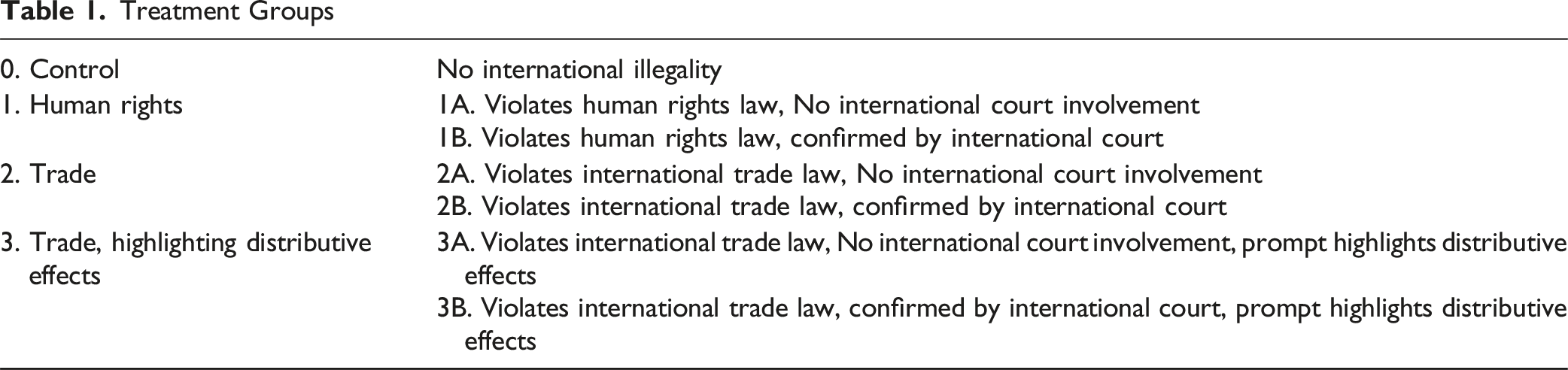
All respondents were asked to read a short vignette (see example in Figure 1), and then answer a series of questions. By varying key details in the vignette read by each group we test the effect of variance in relation to regime, distributive effects and court involvement. The vignette, including elements varied across groups, is set out in Table 2 below. Vignette as Shown in Survey (US Group 2A) Experimental Treatment: Each Respondent Reads the Same Base Vignette (1, Below Left), but With a Different Sub-headline (2, Below Right) and Final Paragraph (3, Bottom) Included, Depending on Treatment Group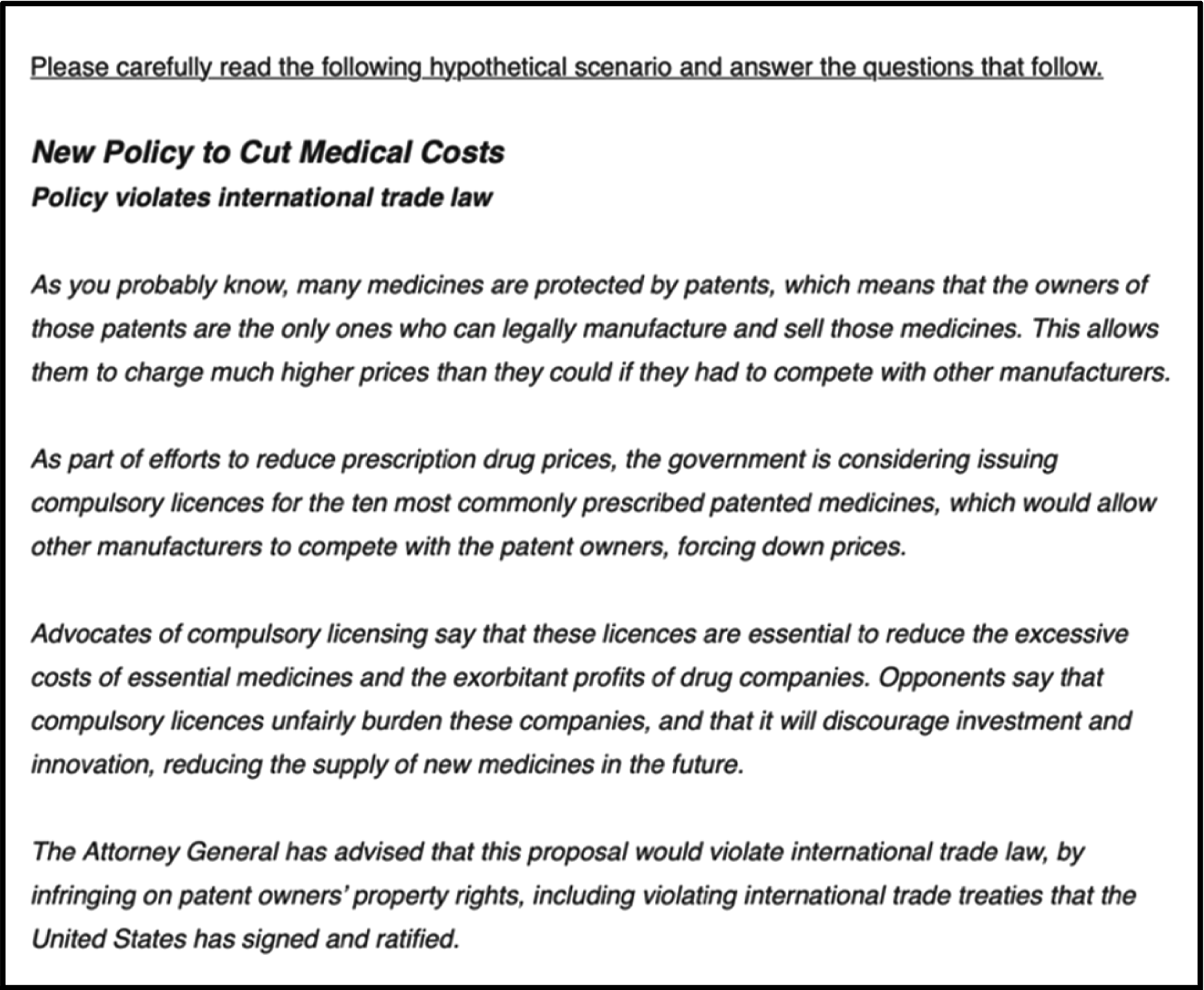
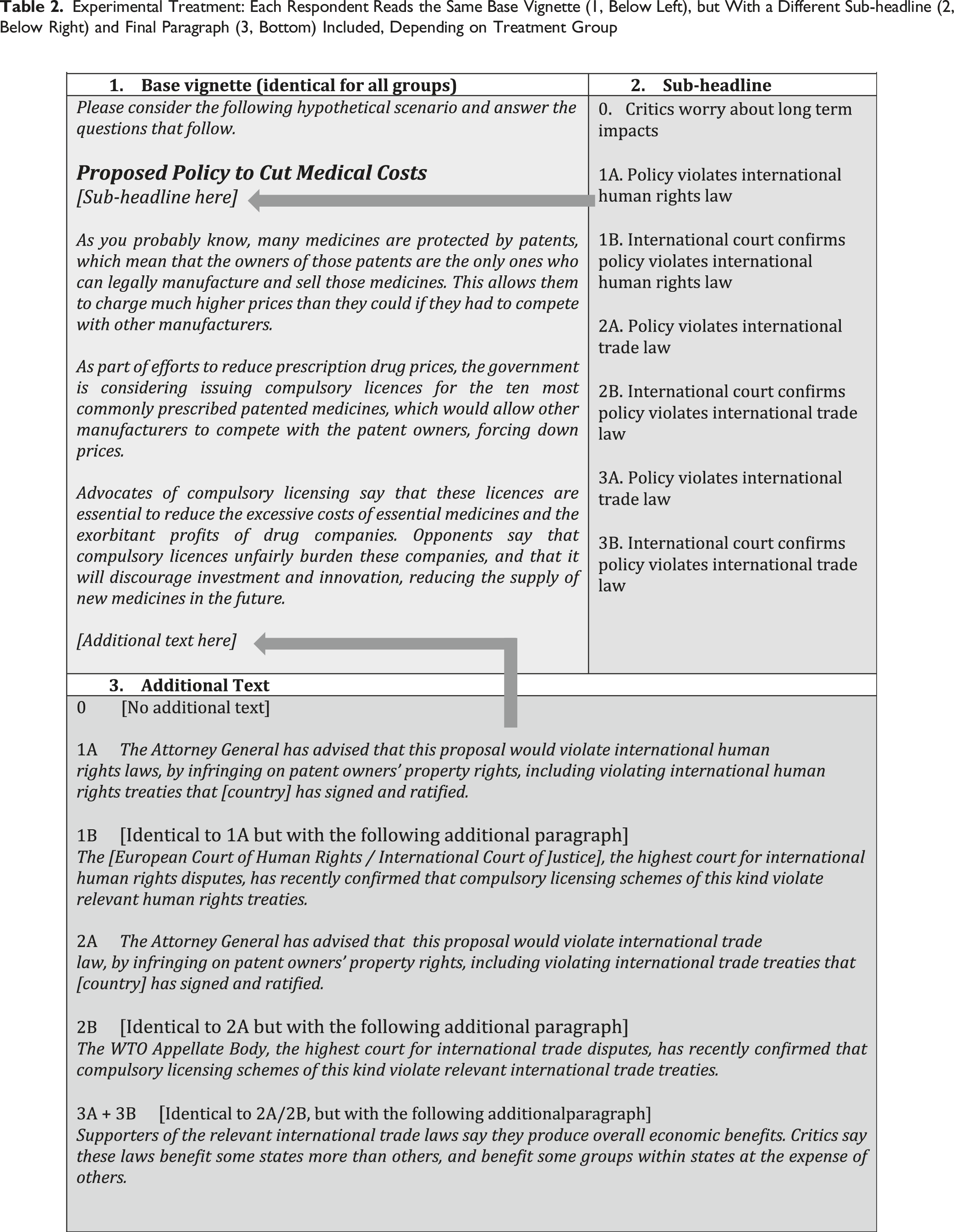
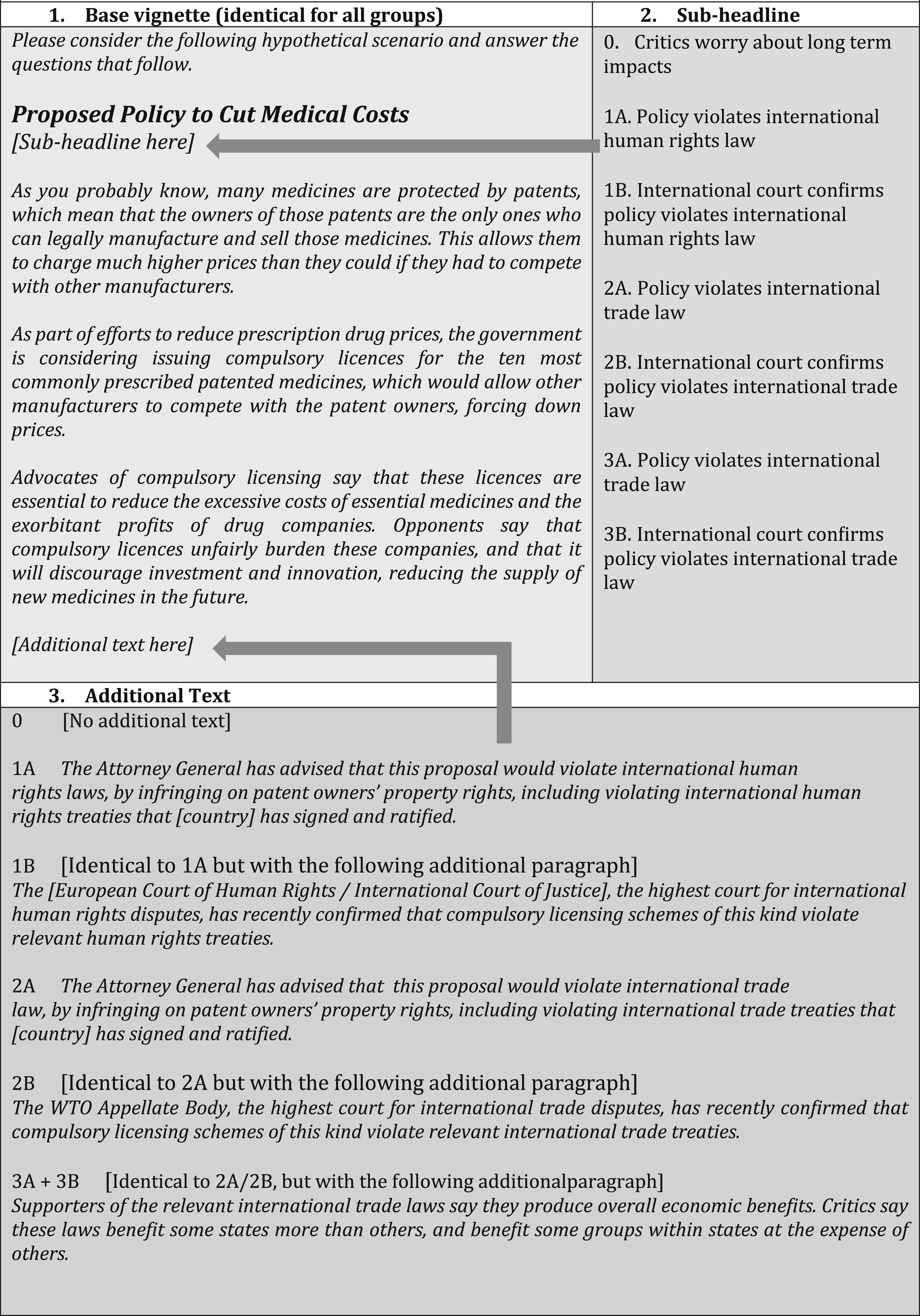
All respondents, regardless of group, read the same base vignette, describing a proposed policy of compulsory licensing of commonly prescribed patented medicines, intended to reduce medical costs. For each respondent, the headline (“Proposed Policy to Cut Medical Costs”) was the same. However the sub-headline (in a slightly smaller font than the main headline, but still larger than the body text – see Figure 1) varied across groups, with the control group reading a sub-headline that “Critics worry about long term impacts”, and treatment groups reading a sub-headline drawing their attention to the most important aspect of that group’s experimental treatment, ranging from “Policy violates international human rights law” to “International court confirms policy violates international trade law”.
Each group also read some additional text at the end of the base vignette describing the relevant international legal situation in more detail. This additional text, together with the sub-headline, constituted the experimental treatment. 14 In the case of the control group, the additional text comprised a statement that “The Attorney General has advised that this proposal does not raise any issues under international law.”. Test groups read that the policy violated either “international human rights law”, or “international trade law”. For two groups (1A and 2A), this was the only additional text. Two further groups (1B and 2B) read a further line, to the effect that similar policies had recently been found unlawful by a relevant international court or tribunal. For UK respondents who had been told that the policy violated human rights, this referred to the European Court of Human Rights. As no international human rights court has jurisdiction over the United States, US respondents saw a reference to the International Court of Justice. For both jurisdictions, those reading that the policy violated international trade law were told that this had been confirmed by the WTO Appellate Body. Finally, two further groups (3A and 3B) read the same text as groups 2A and 2B respectively, indicating that the policy violated international trade law and, for the latter group, that this has been confirmed by the WTO Appellate Body. However, groups 3A and 3B were also told that “Supporters of the relevant international trade laws say they produce overall economic benefits. Critics say these laws benefit some states more than others, and benefit some groups within states at the expense of others.” The purpose of this addition was to specifically draw these respondents’ attention to the potential distributive role of international trade law in general, and international intellectual property protection in particular.
Immediately after reading this vignette, respondents were asked the following multiple-choice question: Based on the scenario you have just read, how strongly would you support or oppose the proposed policy?
(Strongly Support / Support / Slightly Support / Slightly Oppose / Oppose / Strongly Oppose)
How respondents answered this question (referred to below as “Support”) constitutes the primary test of our hypotheses.
Respondents were then asked a series of follow-up questions, which focused on their perception of the importance of international law for their answers, and on the different mechanisms that might explain international law’s importance. 15
First, all respondents were asked the following: On a scale from 1 to 5, where 5 means “Very Important” and 1 means “Not important at all”, how important is international law in affecting your level of support for the proposed compulsory licensing scheme?
They were then asked to rate their agreement (6 point scale) with each of the following statements (presented in randomised order): - If a country breaks international laws this will harm its international reputation and make others less likely to trust that country in the future. - If a country breaks international laws it makes it more likely that other countries will do the same. - International laws provide a good guide to the best policies for each country to adopt. - International laws reflect an international consensus about how countries should behave as members of the international community. - It is unfair for a country to break international laws when other countries comply with them. - When a country agrees to a treaty it makes a promise, and it is wrong to break promises.
These are designed to reflect six prominent accounts, in both political science and political philosophy, of the reasons why states either (i) do or (ii) should comply with international law, as well as tracking a number of the hypothesised mechanisms by which international law breaches are expected to affect public support for policies.
5.1. Limits and Mitigations
A Number of Limits on the Study Should be Acknowledged
First, given the number of responses sought, it was not financially or practically feasible to recruit a nationally representative sample of respondents. (Our survey panel provider, Prolific, could not deliver a representative sample of this size, and even if they could the cost of doing so would have exceeded our available budget). To address this concern, we collected (directly from Prolific rather than as part of the survey) data on the political identification of respondents. This allows us (see Results below) to disaggregate results by political identification, and to identify the extent to which our sample departs from the population along this specific dimension.
Second, a potentially significant error was made in the conduct of the study. For each of the treatment groups the additional text included a reference to “violating international [human rights/trade] treaties that [country] has signed and ratified.” The intention was that “[country]” in this line would be replaced by the name of the relevant state (i.e. “the United States”/“the United Kingdom”). This was done correctly for US respondents. However, an error by the investigator meant that, for UK respondents, the country included here was “Ireland” rather than “the United Kingdom”. 16 This necessarily casts doubt on the validity of the UK results. In particular, we might expect that this error would reduce the treatment effect across all treatment groups, although there is no obvious reason why it would affect one treatment group more than others. The first best response here would be to rerun the UK study, but limited funding and practical constraints (ensuring that participants in any follow-up study did not overlap with those in the initial study) meant this was not possible. Instead, to estimate whether and how far this error may have affected our results we repeated the survey for one UK treatment group (Group 1A Human Rights Law Violation, No Court Involvement), with the correct country name included. Across both Support and each mechanism question, mean results for the corrected sample are very close to the original sample, with differences substantially smaller than the reported treatment effect, and in no case are the differences statistically significant. 17 While this error thus constitutes an important caveat, we conclude that it does not undermine the validity of our overall results. (However we note below one area where we do think this error may be important, namely in explaining differences across jurisdictions in the various mechanism questions).
A third limit applies to survey experiments more generally, including in particular survey experiments on the effect of international illegality. While experiments claim to test the effects of international illegality/beliefs about international illegality, this worry suggests, they can in fact only test the effects of exposure to information about international illegality (Cope, 2023). A respondent presented with the statement that a policy is illegal might not in fact believe this statement. This may be because they have independent beliefs about the international legal situation (unlikely given prevailing public knowledge about the specifics of international law), or because they have strong feelings about the underlying subject matter, or because they identify with the party whose policy or action is claimed to violate international law, or are disinclined to trust the source of the claim that a policy or action is lawful or unlawful (whether that be the researcher conducting the study, or the source described in the vignette). (For an example of partisan identification seemingly affecting whether respondents believe information provided about international illegality, Strezhnev et al. (2020)). If a respondent reads but does not believe the information presented, then we might wonder whether they have in fact received the relevant treatment?
For a number of reasons, we do not believe this concern applies to our design. First, because our main focus is on differences across regimes, rather than the effects of international illegality simpliciter, the possibility that some respondents may disbelieve the information presented will not impact our results, unless we think that this is more likely to occur in the case of one regime rather than the other; and if that effect does indeed vary across regimes, this would be a relevant experimental finding, rather than a source of error. (Suggestive results described below in respect of US Republican and UK Conservative respondents presented with information about specific international courts might be explicable in these terms). Second, our manipulation check specifically asked respondents to confirm the international legal position, and responses from those who failed to do so accurately were excluded from the analysis. We might expect that, to the extent respondents do not believe information about the international legal position, they are more likely to fail this manipulation check, meaning that those remaining in the survey are more likely to have been successfully treated.
This links to a final concern, which relates to the very high failure rate on our manipulation check. Of 6,015 recorded respondents, only 2958 (49%) correctly answered the manipulation check. We considered how to deal with responses failing the manipulation check, ultimately concluding that these should be excluded from the analysis. 18 We might worry that, by excluding so many responses, we risk biasing our sample in various ways, most obviously against respondents with lower educational attainment or socio-economic status. While we do not collect demographic data that would allow us to directly evaluate this risk, we address it by duplicating our principal analyses including all responses, regardless of performance on the manipulation check. This exercise confirms that patterns appearing among respondents who pass the manipulation check remain evident in the larger sample including all responses, albeit effect sizes are smaller, suggesting that those who did not pass the manipulation check were not meaningfully affected by the experimental treatment.
A second concern arising from our high rate of failure on our manipulation check is that the actual number of respondents included in our analysis is only half as large as we had initially intended. Our initial power analysis estimated that we would require approximately 400 respondents in each treatment group to have an 80% chance of detecting a significant treatment effect. 19 However, after removing respondents failing the manipulation check, we are left with an average of around 200 in each group. Were our results more equivocal, we would worry that this lack of power was leading us to miss a significant relationship. However, as outlined below, across almost all questions, we do not think that a larger sample size would have resulted in different results. 20
6. Results and Analysis
6.1. When and How do Respondents Care About International Law?
Our primary experimental focus is the Support question, which asks respondents how strongly they would support the proposed policy.
Figure 2 shows the mean Support (with 95% confidence interval) among US and UK respondents respectively across control and each of the six treatment groups. Mean Support Levels With 95% Confidence Intervals by Treatment Group and National Sample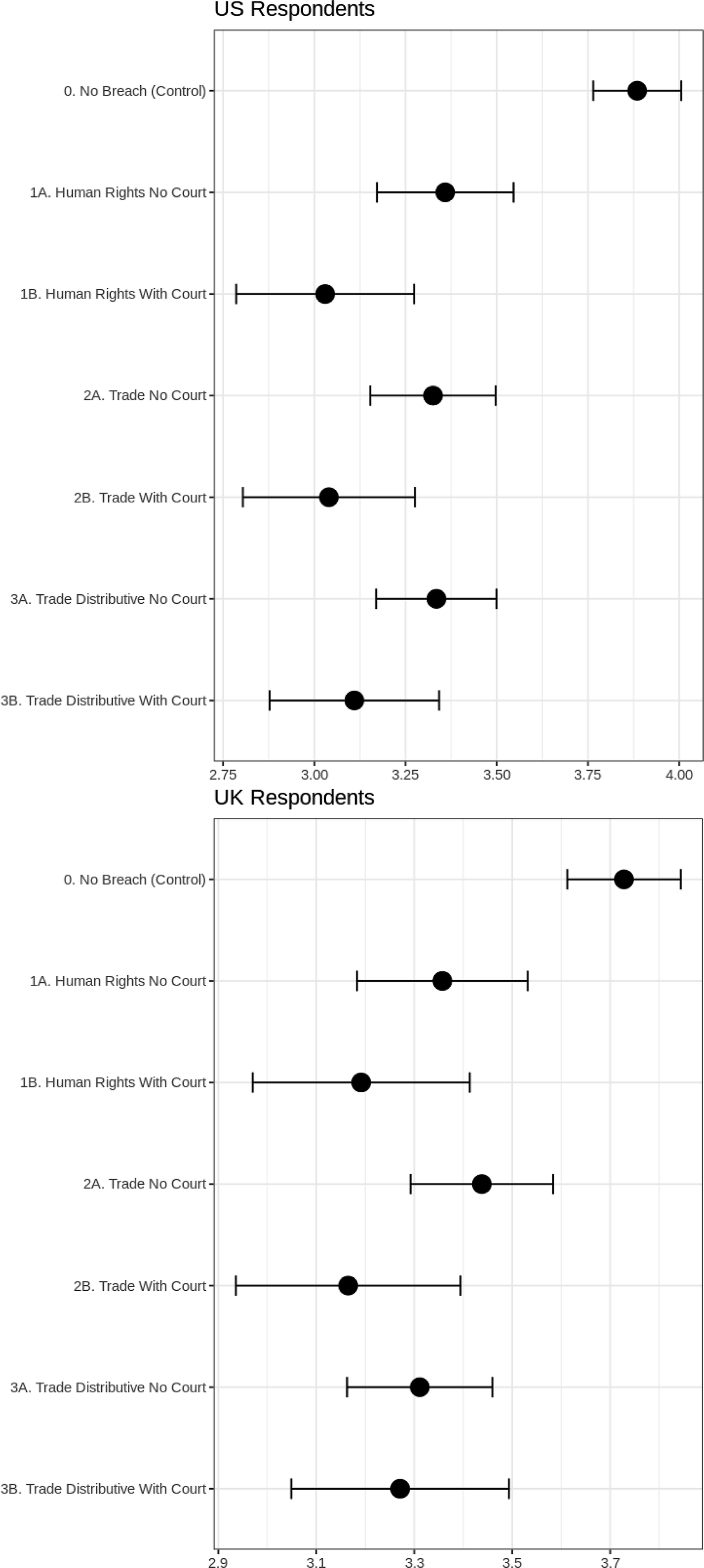
As expected, for both UK and US samples, mean responses are lower for all treatment scenarios (international law violation) compared with the control group (no violation), and in all cases this effect is statistically significant (Games-Howell test, p < 0.05). This accords with the results of existing studies, which have commonly found that international law violation has a moderate but statistically significant support-depressing effect. In our results the magnitude of this effect ranges from 9% (UK, Group 2A) to 22% (US, Group 1B), and is statistically significant in all treatment groups (Games-Howell test, p < 0.05) 21 .
6.1.1. Variation Across Regimes
While we observe a clear effect of illegality, there is little evidence for a difference in the treatment effects across the different regimes. i.e. the support-depressing effect of illegality under the trade regime is almost indistinguishable from the support-depressing effect under the human rights regime, provided other features (nationality, court involvement, distributive emphasis) are held constant. This is especially true in the case of US respondents, where responses across regimes vary by only 0.006 points, but in no case is the difference across regimes statistically significant. 22
We thus cannot reject our first null hypothesis, HA0, that “there is no difference in the effect on public support of a policy based on whether the policy is prohibited by international human rights law or international trade law”, nor do we find any support for our alternative hypotheses HA1-3. In fact, given how closely the treatment effects under each regime track one another, especially in our US sample, the most obvious conclusion from our results is that, while respondents do indeed care about international law violation, they do not distinguish between different regimes in their response. (Amongst UK respondents there is a slight divergence between respondents who are prompted with the distributive effects of trade rules and those who are not, but again this is not statistically significant). Figure 3 presents three OLS regression models, for US and UK Respondents, and for a combined US/UK sample, including treatment groups only, with Regime, Distributive Prompt (Distrib) and Court Involvement (Court) as explanatory variables (plus Country in the case of the combined sample: 0 = US, 1 = UK): again, neither Regime nor Distributive Prompt has a significant effect among any population.
23
Ordinary Least Squares Regression, Support Predicted by Regime, Distributive Prompt and Court Involvement, (Plus Country for Combined Sample), Coefficient Estimates With 95% Confidence Intervals, Heteroskedasticity Robust HC3 Estimator, UK, US and Combined Samples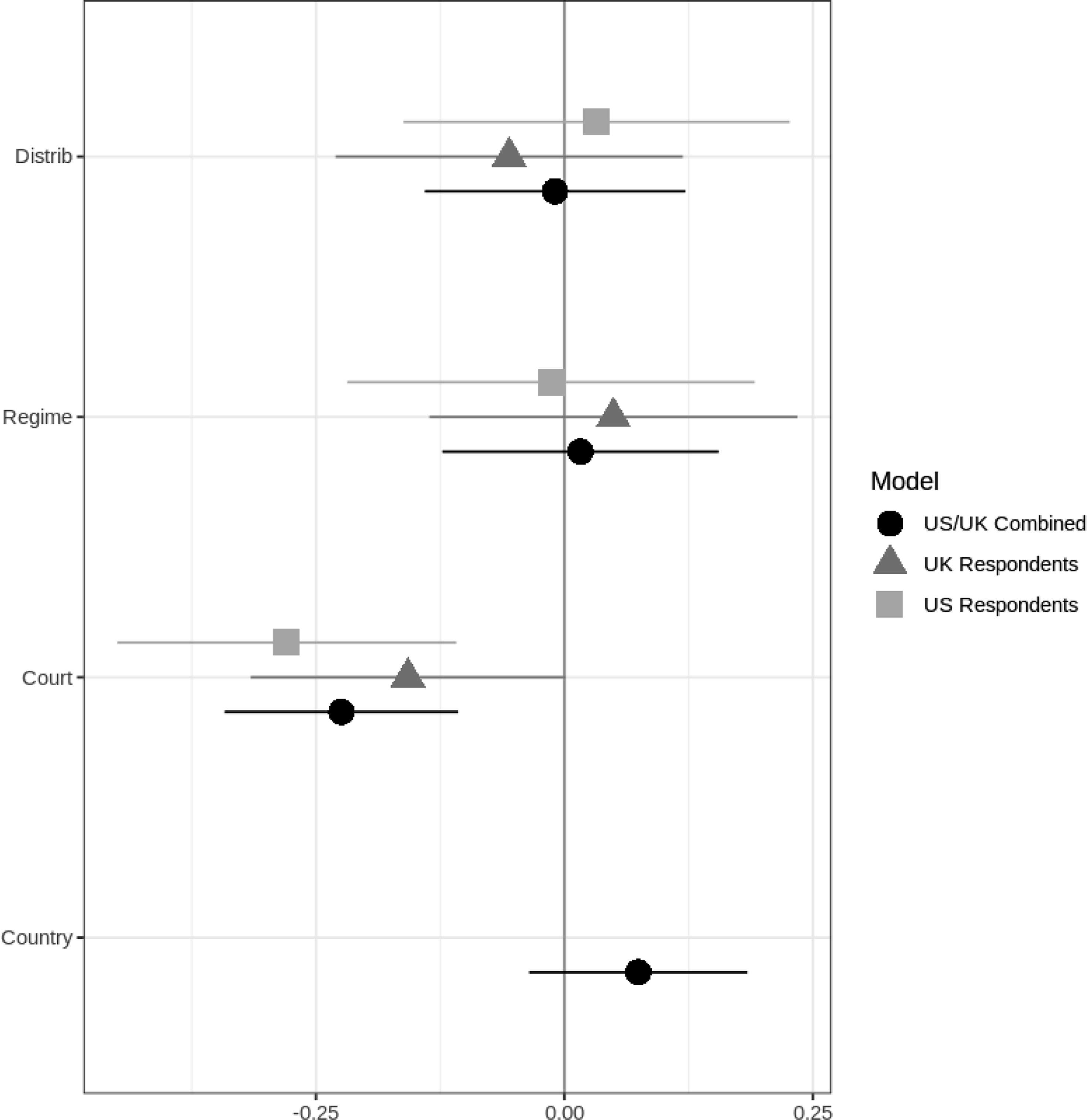
6.1.2. Effect of Court Involvement
Turning to the effect of court involvement, a preliminary inspection of mean responses in Figure 2 shows that, for each respondent cohort, and for each regime, including in the case where distributive effects are emphasised, the support depressing effect is greater in the scenario where a court or tribunal has confirmed the relevant violation, compared to a scenario where the policy is described as a violation but no court is invoked.
This lends support for HB1, that the support-depressing effect of illegality is greater where this has been confirmed by an international court. We confirm this using the Games-Howell test to compare mean responses for all respondents in the court treatment groups (i.e. pooling groups 1B, 2B and 3B) with those in the non-court treatment groups (i.e. groups 1A, 2A and 3A). We find the difference is statistically significant for US respondents, and for a pooled UK and US sample, (p < 0.05), but not for UK respondents (p = 0.12). 24 We therefore reject HB0, at least in respect of our US and pooled samples.
While HB1 refers to the involvement of a court in general, HB2 and HB3 distinguish the effects of court involvement across the two regimes. However our results do not support either of these alternative hypotheses. Within each national sample we find little difference in the impact that a court has on public support across the two regimes, and in particular we find no statistically significant difference between treatment effects of court involvement across regimes. In fact, once we disaggregate our results by regime, our preferred statistical test (Games-Howell) shows no statistically significant difference between the court and non-court groups. 25 Given that we do find such an effect when we combine results across regimes, and that the treatment effects across regimes are very similar, we attribute the lack of a statistically significant result at the level of individual regimes to a lack of statistical power. We expect that a larger sample would confirm the significance of the court treatment within each regime, at least in respect of our US sample, and we also expect (based especially on results of the OLS model in Figure 3 above) that a larger sample would confirm the significance of court involvement in respect of UK respondents. 26 However, we see little reason to think that this would lend any support to either HB1 or HB2, that the treatment effect was greater in one regime or the other.
6.1.3. Variation Across Jurisdictions
We also note that, across each treatment group, the size of the treatment effect is greater for the United States than for the United Kingdom. However we are hesitant to draw any conclusions from this for three reasons: first, because results for the control group are significantly more favourable for the US sample, meaning there is a greater scope for the support-depressing effect to be visible; second, because the difference might be a function of the experimental error noted above; and third, because none of our pre-registered hypotheses anticipated that the support-depressing effect would be greater in the US across all scenarios. 27 So there may indeed be a difference here, but we offer no explanation for it.
6.1.4. The Importance of Political Identification
As noted above, our respondent samples are not nationally representative. On inspection we find our US sample skews Democratic, and our UK sample skews Labour, compared to the national averages. 28 We might expect this to be significant. In particular, recent criticism of the trade regime in the United States has come predominantly (though not exclusively) from Republicans, while in the UK criticism of the human rights regime has been predominantly the preserve of the Conservative party. Research on elite cueing suggests that partisans’ policy preferences and responses may be significantly affected by statements from relevant political leaders (Nicholson & Hansford, 2014; Cheruvu et al., 2025. There is evidence that this mechanism operates in part by changing perceptions about the legality of relevant policies: Strezhnev et al., 2020). Party identification may also matter insofar as our vignette presents the proposed policy as under consideration by the relevant governments: at the time the experiment was conducted, the. US had a Democratic president, while the United Kingdom had a Conservative government. At least some of the differences discussed below may therefore be explained by partisan identification with the relevant governments.
To identify whether and how far partisan differences are important, we fit three separate OLS models for each national sample, using treatment group to predict Support, and disaggregating responses by political identification. Results of these models are presented in Figure 4. Ordinary Least Squares Regression, Support Predicted by Scenario, Coefficient Estimates With 95% Confidence Intervals, Heteroskedasticity-Robust HC3 Estimator, Samples Disaggregated by Political Identification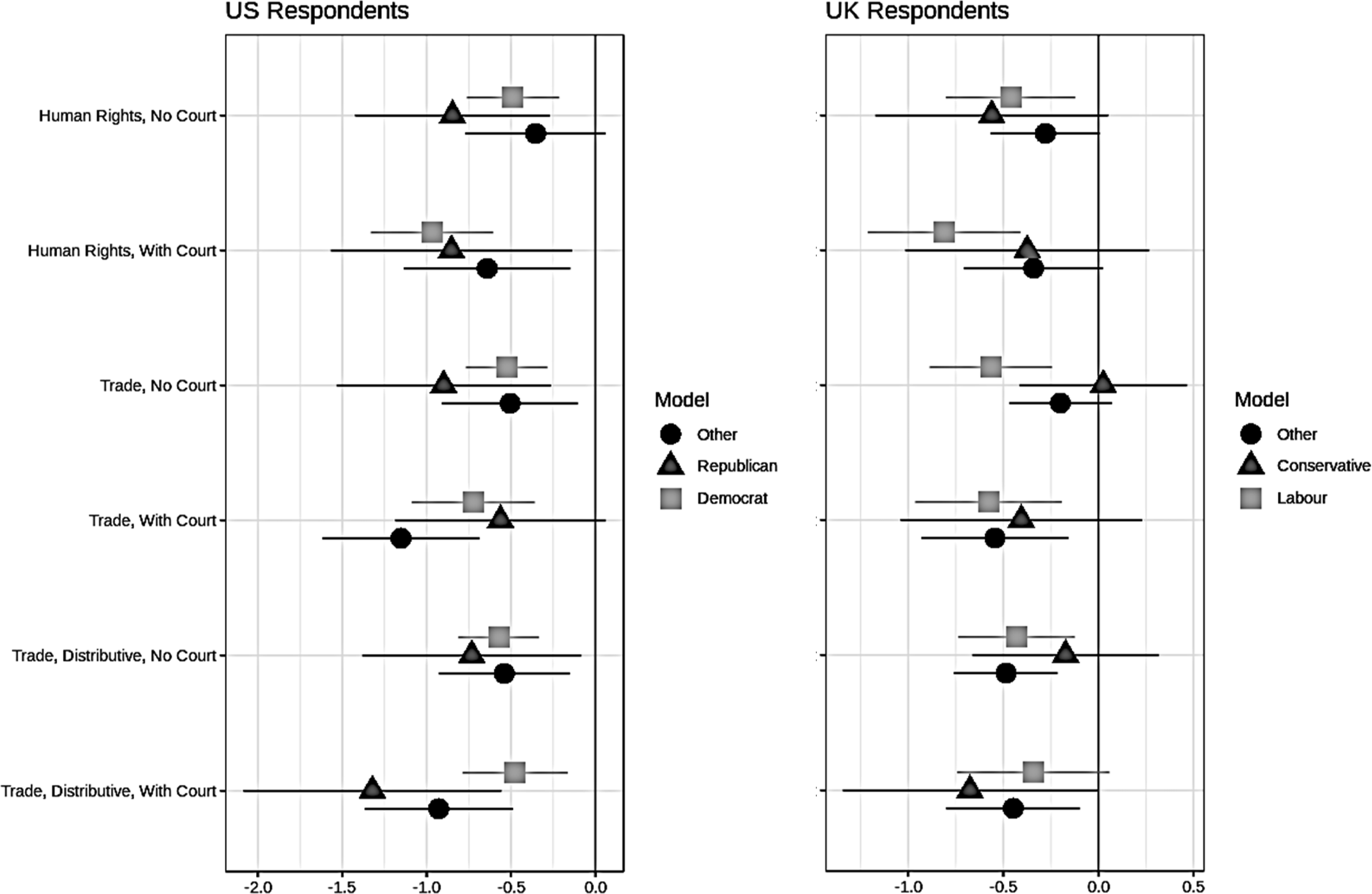
An important caveat at this point is that, as we disaggregate our sample along political lines, the numbers of respondents in each category becomes smaller, and our statistical power falls accordingly. This is particularly important in the case of the Republican cohort in the US sample, and the Conservative cohort in the UK sample. The overall US sample comprises 3,000 respondents. However, once we remove respondents who fail the attention and manipulation checks this falls to 1521, of whom there are 248 Republicans, 780 Democrats and 493 Others. Similarly, a UK starting sample of 3,000 yields 1437 respondents passing attention and manipulation check, of whom 262 are Conservatives, 503 are Labour and 672 are Others. These are in turn divided across one control and six treatment groups, meaning that on average there are only 35 Republicans in each category, and only 37 Conservatives. Such small respondent numbers translate into correspondingly larger confidence intervals, and lesser statistical confidence.
With that proviso, there are a number of points we might make, beginning with the US respondents. First, the apparent concern with international courts is entirely absent amongst Republican respondents across the first four scenarios. Indeed, in the case of trade, the mean treatment effect is actually smaller for those in the court group than the non-court group. This may reflect a different attitude towards international courts in general. Equally, scenarios 2B and 3B are the only ones where the World Trade Organisation is specifically mentioned, so it is possible that negative political commentary on the WTO has affected these results more than others. (On the links between public attitudes towards an institution and support for decisions of its associated court: Voeten, 2013). By contrast, concern for the pronouncements of international courts appears much greater in the case of Democrats in respect of human rights, while in the case of the trade regime the greatest difference is in the “Other” group. Second, in all of the non-court scenarios, the treatment effect is larger for Republicans than it is for Democrats. i.e. at least within our sample group, international illegality, whether under the trade or human rights regime, has a greater support depressing effect amongst Republicans than amongst Democrats or Others. This may strike many readers as surprising, given the apparently greater internationalism in Democratic discourse in recent years. One possible explanation is that, given the Democratic administration in the United States at the time this study was conducted, Republican respondents were more willing to believe that the proposed policy violated international law, and to give this fact greater weight, whereas Democratic respondents were more likely to support their party’s policy, notwithstanding its illegality. (For evidence of such partisan effects in responses to international courts: Strezhnev et al., 2019; Cheruvu et al., 2025).
In the case of UK respondents, by contrast, there is no especially pronounced partisan difference in treatment effects. In some scenarios the treatment effect is greater for one group rather than another, but not so much that we can say that any group is clearly more concerned with international law violations in general. It is certainly noteworthy that, across five of six scenarios, international illegality does not have a statistically significant effect on support amongst Conservative voters, but this is largely (albeit not entirely) explained by the smaller number of respondents in this category and commensurately wider confidence intervals. (Similar to the US case, the fact that the UK had a Conservative government at the time of this study may also have led Conservative-identifying respondents to discount international illegality). It is also noteworthy that, as between the two human rights scenarios (1A and 1B), the introduction of a court leads to a relatively large increase in the treatment effect amongst Labour supporters, while marginally reducing the treatment effect in the case of Conservatives. By contrast, as between the two trade scenarios (2A and 2B) there is almost no change amongst Labour voters, while the treatment effect amongst Conservatives and Others increases substantially. As between the two distributive trade scenarios (3A and 3B), we again see amongst Conservatives a large increase in treatment effect with the introduction of a court, while Labour and Other respondents remain unchanged or fall. These differences may reflect the different political fortunes of the World Trade Organisation and the European Court of Human Rights on the left and the right in the UK.
We did not set out to test any hypotheses relating to political identification. We therefore do not seek to draw any firm conclusions from the results reported in the foregoing paragraphs. However they are suggestive, align to some extent with findings in other research, and point towards some potentially fruitful avenues for future investigation.
Weighted Mean Support and Treatment Effects, Weighted by Political Identification
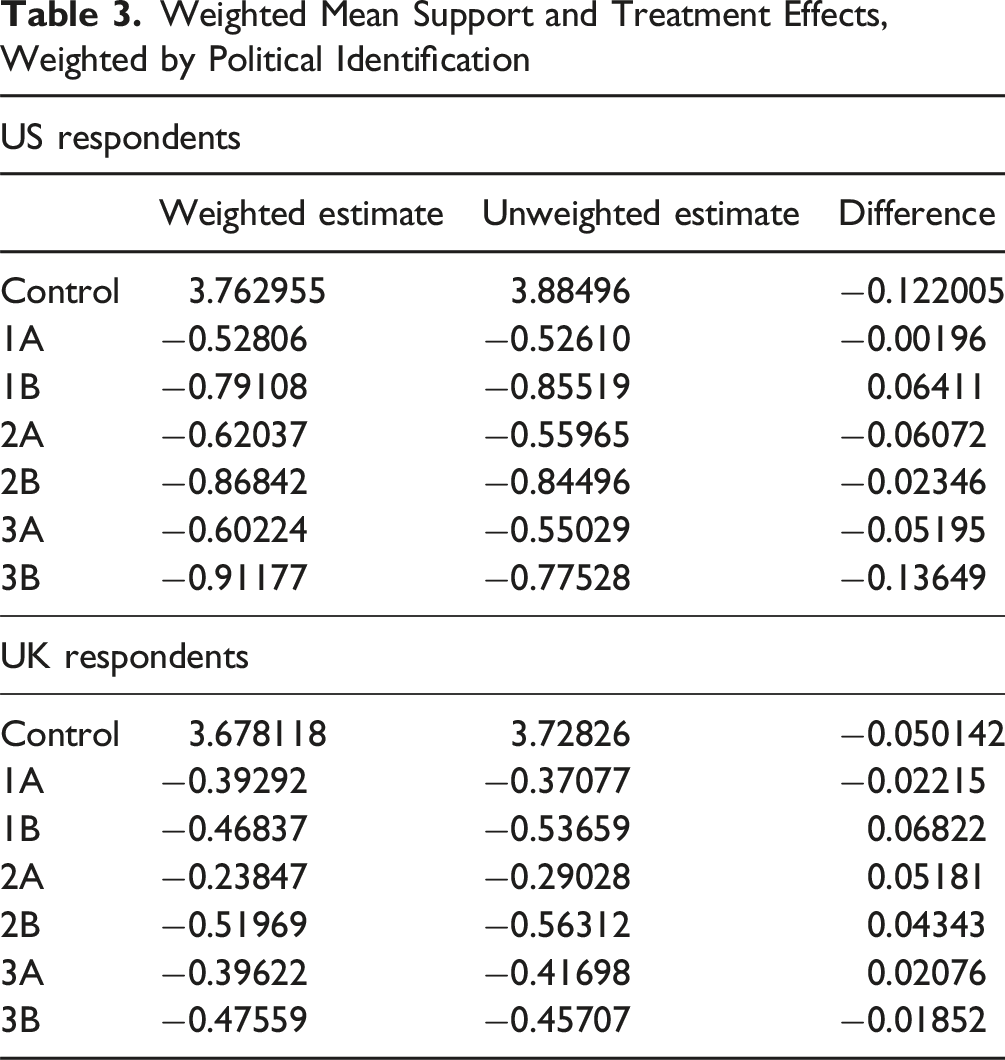
We are reassured based on these results that the non-representative nature of our sample has not significantly affected our overall results, at least along this dimension. While there are differences between the weighted and unweighted estimates, these are in most cases small. In the case of the US sample, the mean support for the policy in the control group appears lower (−0.125), reflecting the fact that this policy was more popular among Democrats than Other or especially Republican respondents. Further, the estimated treatment effect in Scenario 3B (Distributive Violation, with Court) is quite a bit larger (−0.136) in the Weighted than Unweighted Estimates. However in all other scenarios the differences are less than 0.07, and the various patterns identified in the unweighted estimates (larger treatment effects in the case of US respondents, larger treatment effect in the presence of a court, little difference in treatment effects across regimes) remain, albeit in both countries the apparent differences between regimes appear somewhat larger in the weighted than the unweighted estimates. 29
6.2. Why do Respondents Care About International Law?
As well as experimentally manipulating the legal status of the proposed policy, our study sought to directly examine the mechanisms by which respondents thought that international law might matter, and hence how these mechanisms featured in their reasoning. As outlined above, to do this respondents were asked to rate their agreement or disagreement with six statements about international law, each tracking a prominent explanation of international law’s significance in the political science or philosophical literature.
We can analyse responses to these questions in various ways.
Reported Agreement With Various Mechanism Statements. 6 Point Scale, 1 = Strongly Disagree, 6 = Strongly Agree. Mean (95% Confidence Interval)
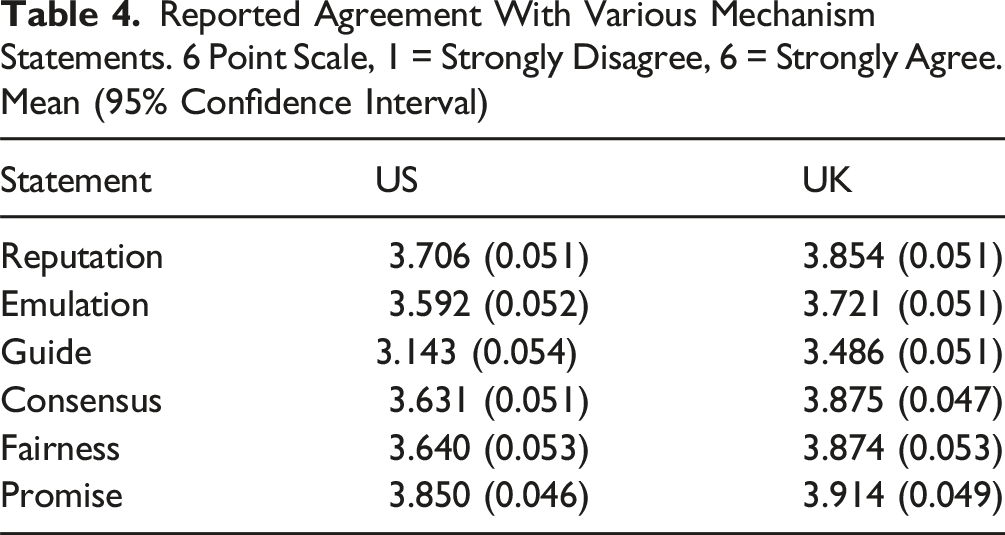
Across both cohorts, respondents were most likely to agree with Promise, followed by (in slightly different orders) Reputation, Consensus and Fairness. In both cohorts, respondents were least likely to agree with Guide, by a relatively wide margin. However, for the most part responses cluster quite closely, with means for all six statements across both countries falling in the range between Slightly Disagree (3) and Slightly Agree (4).
However, the experimental design allows us to go further, asking not just which statements do respondents agree with, but also in relation to which is agreement a good predictor of the extent of the treatment effect for a given group? The thought here is that we may be less interested in whether a respondent expresses agreement with the proposition that, for example, treaties bind as promises, and more interested in whether the fact that they believe treaties bind as promises makes them less likely to support a policy that violates a treaty.
To test this effect, we fit OLS models with Support as our dependent variable, and Reputation, Emulation, Guide, Consensus, Fairness and Promise as explanatory variables. To test whether these effects vary depending on the specific scenario, we create separate models (i) for each of the control and the six treatment groups and (ii) for groups combined as follows, to try to isolate specific relevant features: (a) including all responses across control and treatment groups; (b)combining responses in the six violation scenarios; (c) the two human rights violation scenarios; (d) the two non-distributive trade scenarios, (e) the two distributive scenarios; (f) the three scenarios without the involvement of a court; (g) the three scenarios with the involvement of a court. In each case we fit separate models for the UK and US respondents. The results of these analyses are presented in Figure 5 below.
30
OLS Regression, Support Predicted by Responses to Mechanism Prompts, Samples Disaggregated by Scenario (Individual and Grouped), Coefficient Estimates With 95% Confidence Intervals, Heteroskedasticity-Robust HC3 Estimator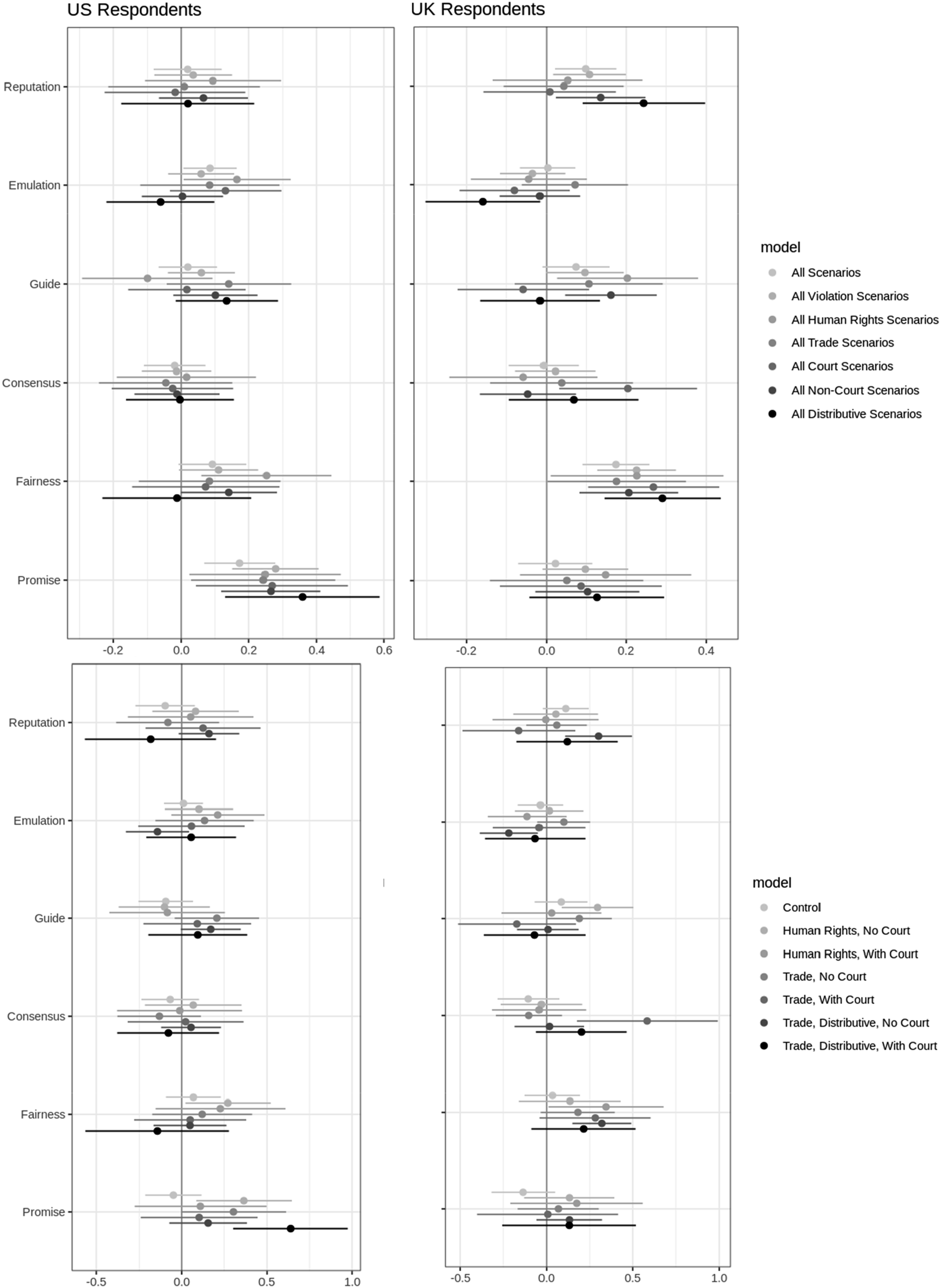
By way of interpreting these results: these models examine how far, across samples and scenarios, agreement with any of the six mechanism statements predicts support for the policy which translates, across all scenarios except for the control, to predicting the mean support-depressing effect of illegality. For example, the fact that, in Scenario 2A, there is a statistically significant relationship between both Promise and Support among US respondents indicates that, amongst those respondents told that the policy violated international trade law, but without reference to an international court, those who agreed with the statement “When a country agrees to a treaty it makes a promise, and it is wrong to break promises.” were less likely to support the policy.
It is important to approach these results with caution. Figure 5 reports a total of 28 separate models, with six explanatory variables in each, for a total of 168 possible relationships. We should therefore avoid attributing significant weight to any individual identified correlation: given the number of tests reported we should expect to find between 5 and 10 apparently significant (p < 0.05) results by pure chance.
However there are two features of these results that are worth highlighting. These are, amongst US respondents, the significance of Promise in 9 of 14 models and, for UK respondents, the significance of Fairness in 9 of 14 models. (Fairness and Emulation also appear significant in two each of the US models, while Reputation, Guide and Consensus appear significant in respectively 5, 4 and 2 of the UK models). While we should not place great weight on any individual result, the recurrence of these relationships across multiple models suggests a genuine relationship.
We might conclude from these results that there is a significant difference in the ways that UK and US respondents think about how international law binds states. For US respondents, the morality of promising dominates, while for UK respondents concerns with fairness are more significant. However, in relation to the UK results in particular, we are hesitant to draw this conclusion. The reason for this goes back to the experimental error noted above. Recall, UK respondents in violation scenarios read a vignette referring to treaties signed and ratified by Ireland, instead of the intended reference to the UK. The fact that no explicit commitment by their own state was mentioned may explain why those respondents who valued promising did not translate this to a reduction in support for the unlawful policy, while those who valued fairness (which is strongly connected with the conduct of other states) did. This hunch is confirmed by a separate OLS model, fitted using responses to our supplementary sample with the correct country name. While results in this sample do not otherwise differ from our main sample 31 , reassuring us that our overall experimental conclusions are not undermined, when we fit a model with Support as our dependent variable and the six mechanism prompts as independent variables, we find that Promise appears statistically significant, while other mechanism responses do not.
It is however worth contrasting results in relation to Promise with those in relation to Reputation. While, amongst US respondents, we see relatively high agreement with both the Promise (3.850) and Reputation (3.706), only Promise is significant in explaining Support. Both Promise and Reputation refer back to commitments that states make, but Promise understands the importance of those commitments in intrinsic terms, while Reputation understands them instrumentally. If Promise is significant in explaining effects on support, but Reputation is not, then this lends support to views emphasising norm internalisation and identity, over those emphasising material interest. (The fact that Guide and Consensus, which more directly correspond to norm internalisation and cosmopolitan identity explanations, are less successful in explaining Support might be read as undermining this explanation. However, we could equally explain this by reference to the content of the norms to which respondents are committed).
We therefore conclude, based on all of the foregoing, that for US respondents, there is a clear and significant relationship between respondents’ views on promising as an explanatory mechanism and the support-depressing effect of international illegality. However we draw no conclusions in relation to the significance of different mechanisms for UK respondents.
7. Conclusions
What, then, do we learn from these results?
The most significant lesson is that, at a population level, there is no statistically significant difference – indeed barely any perceptible difference at all – in the support depressing effect of international illegality depending on the specific regime involved. Respondents are concerned with international illegality, but appear equally concerned regardless of whether the violation is of international trade law or international human rights law. When we disaggregate this result by political identification, we start to see some variation. However the nature of that variation, and indeed the fact that it emerges only once we disaggregate, suggests that it is best explained by specific political experiences, partisan loyalties and elite cues in the relevant jurisdictions, rather than fitting well into any wider account of when and why international law has or should have authority, or how it affects public support.
The second lesson is that respondents are concerned about the pronouncements of international courts and tribunals, and the fact that an international tribunal has confirmed a violation appears to increase its support-depressing effect. While we only report a statistically significant result in relation to court involvement in our US and combined samples, results in our UK sample show a similar pattern, albeit slightly below the threshold of statistical significance. Again, we see differences once we disaggregate by political identification, but these seem better explained by specific political features than by any broader theory.
Finally, the analysis of responses to the mechanism questions strongly suggest that respondents’ views on promising as a relevant moral mechanism are a significant predictor of their attitudes towards violations of international law, while other mechanisms identified in both political science and philosophical literatures are less important. We might tentatively infer from these latter results that respondents’ intrinsic valuing of norm compliance, rather than their instrumental judgments about consequences and self-interest, better explain their attitudes towards rule violation. Again, this latter question is one that merits further investigation in future studies.
Supplemental Material
Supplemental Material - Voters do not Distinguish Between International Law Regimes a Survey Experiment on the Relative Authority of International Law and Courts in the Human Rights and Trade Regimes
Supplemental Material for Voters do not Distinguish Between International Law Regimes a Survey Experiment on the Relative Authority of International Law and Courts in the Human Rights and Trade Regimes by Oisin Suttle in Journal of Law & Empirical Analysis
Supplemental Material
Supplemental Material - Voters do not Distinguish Between International Law Regimes a Survey Experiment on the Relative Authority of International Law and Courts in the Human Rights and Trade Regimes
Supplemental Material for Voters do not Distinguish Between International Law Regimes a Survey Experiment on the Relative Authority of International Law and Courts in the Human Rights and Trade Regimes by Oisin Suttle in Journal of Law & Empirical Analysis
Supplemental Material
Supplemental Material - Voters do not Distinguish Between International Law Regimes a Survey Experiment on the Relative Authority of International Law and Courts in the Human Rights and Trade Regimes
Supplemental Material for Voters do not Distinguish Between International Law Regimes a Survey Experiment on the Relative Authority of International Law and Courts in the Human Rights and Trade Regimes by Oisin Suttle in Journal of Law & Empirical Analysis
Supplemental Material
Supplemental Material - Voters do not Distinguish Between International Law Regimes a Survey Experiment on the Relative Authority of International Law and Courts in the Human Rights and Trade Regimes
Supplemental Material for Voters do not Distinguish Between International Law Regimes a Survey Experiment on the Relative Authority of International Law and Courts in the Human Rights and Trade Regimes by Oisin Suttle in Journal of Law & Empirical Analysis
Footnotes
Acknowledgments
Funding for this study was provided by the Maynooth University Social Sciences Institute. I am grateful for feedback on research design provided by Janina Dill, Kevin Wozniak and Brian Flanagan. Earlier versions of this paper have been presented at the Oslo/Ann Arbour International Legal Theory Seminar, Kings College London Seminar on International Constitutionalism, the Irish Association of Law Teachers Annual Conference, the Maynooth University School of Law and Criminology Research Seminar. I am grateful to participants on each occasion for helpful comments and suggestions. Three anonymous reviewers for this journal provided immensely helpful comments which have significantly improved this paper.

Ethical Consideration
This study was subject to ethics review and approval by the Maynooth University Social Research Ethics SubCommittee.
Consent to Participate
All participants gave informed consent before participating in the study.
Funding
The authors disclosed receipt of the following financial support for the research, authorship, and/or publication of this article: This research was funded by the Maynooth University Social Sciences Institute.
Declaration of Conflicting Interests
The authors declared no potential conflicts of interest with respect to the research, authorship, and/or publication of this article.
Data Availability Statement
All datasets available as Supplementary Materials on the journal website.
Supplemental Material
Supplemental material for this article is available online.
Notes
References
Supplementary Material
Please find the following supplemental material available below.
For Open Access articles published under a Creative Commons License, all supplemental material carries the same license as the article it is associated with.
For non-Open Access articles published, all supplemental material carries a non-exclusive license, and permission requests for re-use of supplemental material or any part of supplemental material shall be sent directly to the copyright owner as specified in the copyright notice associated with the article.
