




Abstract
The assignment of a majority opinion author is a pivotal moment in the judicial decision-making process, yet nearly all our understanding of the assignment decision is drawn from research on the U.S. Supreme Court. The variation across state courts in the method of opinion assignment and other institutional features suggest that this decision may differ across contexts. In this paper, we examine how and when justices on state supreme courts make a particular assignment decision to write the majority opinion themselves. Comparing across different institutional configurations, we ask what drives both chief justices and associate justices to self-assign. Our findings indicate that chief justices, but not associate justices are motivated by certain goals in deciding whether to self-assign. Chiefs seek to avoid self-assignment when they face a peer vote but seek out this assignment in constitutional cases. However, this is mitigated by their time in the position and the administrative burdens of their office.
The power to assign the majority opinion author in most cases is generally thought to be the most influential power associated with the Chief Justice of the United States (Davis, 1990; Maltzman & Wahlbeck, 1996; Murphy, 1964; Slotnick, 1979). In choosing who will write for the majority, a chief justice is deciding who will have the opportunity to shape the policy output of the Court. Chief justices must choose the opinion author carefully, with an eye to their goals as leader of the judiciary. They may use their opinion assignment power to enhance collegiality among the justices or strengthen the coalition to preserve the Court’s authority. Those who favor institutional efficiency can distribute opinion assignments equally among the justices to ensure that opinions are completed in a timely fashion (Maltzman & Wahlbeck, 1996; Segal & Spaeth, 2002). A policy-minded chief justice could assign opinions to their ideological allies on the Court.
Of course, the best way to achieve one’s policy goals is to self-assign the opinion to control the policy outcome in the most important cases the Court hears (Brenner, 1993; Slotnick, 1978). We focus on this particular type of opinion assignment in this paper, and in doing so at the state level, we can address how specific rules that define the power of the chief justice affect one of the decisions they make as chief. Beyond that, we can also consider whether associate justices are more likely to self-assign when they have the opportunity to do so, as they have been found to do at the U.S. Supreme Court (Maltzman et al., 2000, p. 53). The relative dearth of research on opinion assignment in state supreme courts is partly due to data constraints, but also a result of the amalgamation of rules across the states regarding the assignment of the majority opinion (see e.g., Hall, 1990; Hall & Windett, 2016; Hughes et al., 2015). In the majority of states, opinions are assigned randomly or according to a set rotation. Among the remaining courts with discretionary assignment rules, nine allow the chief justice to assign the opinion in all cases, while six mirror the more conditional practice of the U.S. Supreme Court in affording that power to the chief justice only when they are in the majority.
We might expect opinion assignment to resemble the process at the U.S. Supreme Court, at least in these six states, but the opinion assignment rule is just one of several ways in which the position of chief justice varies across the states. Serving as chief justice may be a short-term position, as in Nevada where the chief justice typically changes every eight to twelve months. 1 In contrast, the chief justice position is essentially permanent in other states due to the selection method. Courts like the Louisiana Supreme Court use a seniority rule, while the chief justice position is separately elected or appointed in several other states. Such a setup should insulate the chief justices from the whims of their colleagues more than chiefs who must periodically be reelected by their peers in an internal vote. The combination of institutional constraints and the administrative burdens of leading the state judiciary has led to a reevaluation of our assumptions about the power and prestige of the chief justice position in state supreme courts (Gray & Miller, 2021; Leonard & Ross, 2014; Norris, 2022; Vining & Wilhelm, 2023). Taken together, the parameters of the chief justice position may alter their incentives for self-assignment, as well as the motivations of associate justices when they are able to assign the majority opinion author.
In this paper, we consider how these institutional and political contexts shape the decision of state supreme court justices to self-assign the majority opinion. We expect that some behavior will follow the model of the U.S. Supreme Court, particularly in that chief justices will be less likely to self-assign the opinion than senior associate justices, as chief justices must balance competing interests that come with leadership. In contrast, we argue that the use of the self-assignment power will be shaped by institutional rules unique to the states, as well as the political context within the court. We test our expectations using an original set of data drawn from the fifteen courts where chief or senior justices were authorized to assign the majority opinion during the period of 1990–2015. We find that while very little predicts the self-assignment decision of non-chiefs, chief justices who face a peer vote for the position of chief are less likely to self-assign, though they are more likely to self-assign constitutional cases. The results highlight the minimal role of ideology and the diminishing interest in self-assignment over a chief justice’s career, further supporting the emerging image of the chief justice as an overworked administrator rather than a strategic ideological actor.
1. The Politics of Self-Assignment
What we know about the decision to self-assign is drawn mostly from research on this decision at the U.S. Supreme Court. At the U.S. Supreme Court, the chief justice considers institutional goals in assigning opinions, seeking an even distribution to balance the workload among their colleagues (Maltzman et al., 2000; Maltzman & Wahlbeck, 1996; Segal & Spaeth, 2002). Doing so ensures that the Court’s work is completed in a timely fashion. Also, the chief justice’s policy goals appear to be secondary to their interest in preserving collegiality and the public image of the Court, as exhibited in their reluctance to write a separate opinion or even seek accommodations from the majority opinion author (Corley, 2011, p. 38; Maltzman et al., 2000, p. 84). Chief judges and justices outside of the U.S. Supreme Court have been shown to be similarly averse to writing separately (Hall & Windett, 2016; Hettinger et al., 2006, p. 63; Szmer et al., 2015).
Regarding self-assignment, conclusions have varied depending on the chief justice. In general, chief justices were found to self-assign cases that were seen as more important (Brenner, 1993; Segal & Spaeth, 2002; Slotnick, 1978; but see Maltzman et al., 2000, p. 48). In contrast, associate justices are driven more by personal policy goals when they have the opportunity to assign the opinion. They are more likely to self-assign than chief justices, and failing that, they are likely to assign the opinion to an ideological ally, without regard to balancing the workload (Hall, 2018; Maltzman et al., 2000; Segal & Spaeth, 2002). On the U.S. Courts of Appeals, self-assignment is more likely in salient cases, even though judges in interviews with researchers claimed that self-assignment was based more on their interest or expertise in the area of law than their desire to “reserve for themselves the biggest or most important cases” (Bowie et al., 2014, p. 69). Individual characteristics can also influence self-assignment, as Haire and Moyer (2015, p. 72) find that white women and Hispanic judges are more likely to self-assign than their white male counterparts.
There are likely to be similarities in self-assignment behavior in state supreme courts, though the topic has not attracted substantial scholarly attention. Chief justices, who are responsible for assigning the vast majority of opinions on courts with discretionary assignment rules, occupy a unique position from their colleagues that involves being the head of the judicial branch and being concerned with how the courts are viewed by other actors and the public (see Vining & Wilhelm, 2023). Norris (2022) finds that this is especially true for women chief justices, who place a higher importance on the court’s relationship with the state legislature than building internal consensus within the court. Gray and Miller (2021) explain this tension by noting that the office of the chief justice in the states is not one of substantial power, so chief justices do not have a unique ability to create consensus. The chief justice position may “constrain rather than enable leadership effects” (Gray & Miller, 2021, p. 326). Further, a state supreme court’s chief justice may view their position as one in which they have less ability to seek out their policy preferences than they could as an associate justice because of the added administrative responsibilities. Indeed, Vining and Wilhelm find that “a chief justice is likely to spend as much time (if not more) on managing the state judiciary as on case processing and opinion writing” (2023, 132–33).
In the opinion assignment process, policy outcomes and consensus are not the only considerations an opinion assigner must consider. Christensen et al. (2012) examine this decision from an administrative context, comparing race and gender bias in opinion assignment across courts with random, rotational, and discretionary opinion assignment rules. This discretionary assignment, they argue, has little ability to constrain the assigner, and can introduce race and gender bias into opinion assignments. 2 In a subsequent study, researchers find similar evidence of bias, as women and Black justices are less likely to be assigned complex cases, and women justices more likely to be assigned opinions in cases on “women’s issues” (Kaheny et al., 2020).
2. Chief Justices in the States
Chief Justice Selection Methods and Term Lengths (as of 2015).
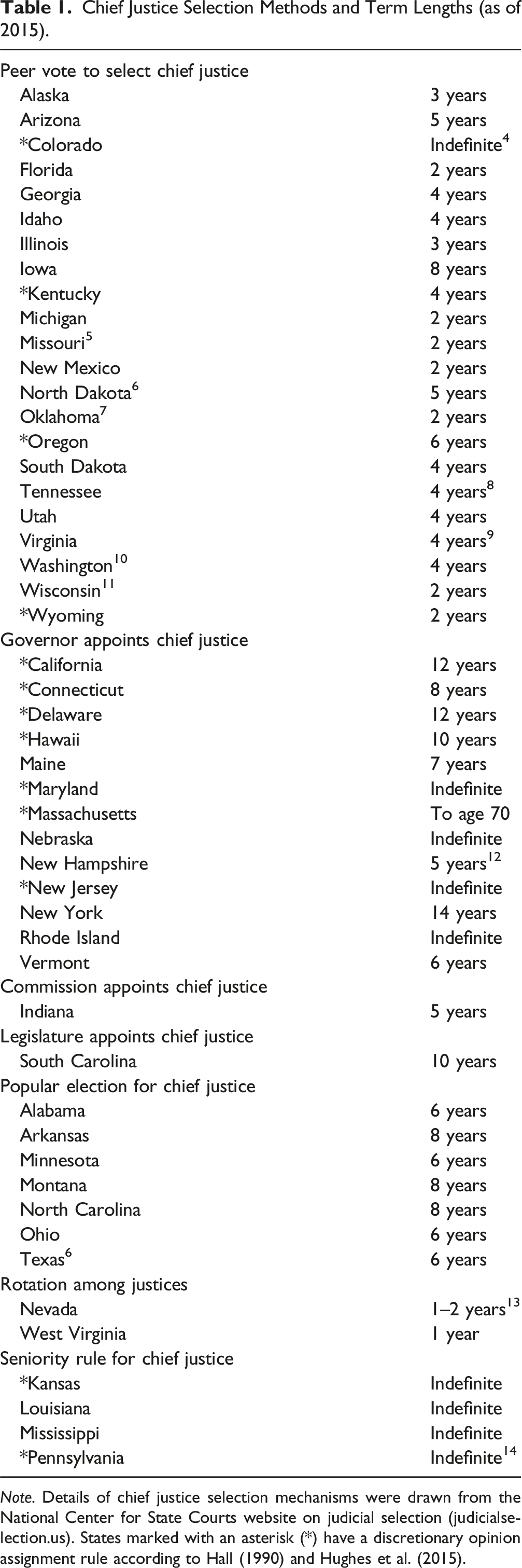
Note. Details of chief justice selection mechanisms were drawn from the National Center for State Courts website on judicial selection (judicialselection.us). States marked with an asterisk (*) have a discretionary opinion assignment rule according to Hall (1990) and Hughes et al. (2015).
Chief justices with opinion assignment power are assumed to be more influential in mediating the opinion-writing process. Assignments may be made as rewards or sanctions to facilitate consensus and strengthen the court’s position relative to the other branches of government, though evidence of such influence is somewhat mixed (Brace & Hall, 1990; Leonard & Ross, 2014; Slotnick, 1977). There is some evidence that the extent to which the assignment power aids the chief justice in building consensus is conditional on the institutional context and the resources afforded to other justices (Boyea & Farrar-Myers, 2011; Hall & Windett, 2016). Yet, other research finds no evidence of an effect of chief justice leadership on the building of consensus, finding instead that court rules affect the likelihood of dissents (Gray & Miller, 2021; see also Norris 2021; Leonard & Ross, 2020).
The range of methods used to select a chief justice is also displayed in Table 1. The justices themselves choose a chief justice through a peer vote in 21 courts, while 23 courts have a chief justice who is separately elected or appointed to that position. The remaining 8 courts use an automatic seniority or rotational rule. While some scholars have suggested that courts with a peer vote selection will select a chief justice strategically depending on whether the chief justice has the power to assign the majority opinion author (Langer et al., 2003; but see Norris & Tankersley, 2018), a more recent study has found that peer selection of chief justices often defaults to a seniority rotation (Fife et al., 2021). Individual factors seem to have little influence on the selection of the chief justice, though frequent dissenters are at a disadvantage. Any effects on the selection method on consensus remain unclear in the literature. 15
Largely absent from the literature is any consideration of the length of the chief justice’s term. If we expect that a chief justice’s power and influence are conditional on their ability to assign the majority opinion or the method of selection, it seems that the length of the term should also be part of the discussion. The chief justices who have the opinion assignment power have terms that range from as short as two years to a permanent appointment for as long as they serve. A chief justice who serves on a quasi-permanent basis because they are elected or appointed separately or are chosen through a seniority rule may view their role differently than a chief justice who serves only briefly as a result of a peer vote or a rotation system (see e.g., Norris, 2022). One way such a difference may manifest is that short-term chief justices will self-assign more opinions because they are more invested in pursuing their policy goals than the institutional goals traditionally associated with the position. It is also possible that chiefs with shorter terms in a peer-vote system will be more concerned with how their assignments could affect their standing with their colleagues than those with the protection of a longer term.
3. A Theory of Self-Assignment
At its core, an assignment of the opinion to oneself grants the ability to have the most control over the policy outcome within the opinion. The majority opinion writer must certainly consider the ideology and feedback from the other members of the majority when writing the opinion, but the writer sets the tone in the first draft and ultimately makes the decisions about accommodating other justices’ views. If writing the opinion was a costless activity, we would expect self-assignment in most, if not all, cases. Writing the majority opinion requires time and effort, however, so the chief justice or most-senior justice must be selective in using this power, self-assigning at certain, particularly advantageous and predictable times.
3.1. All Assigners
Given the importance of ideology in opinion writing, we expect that ideology will be at the forefront of the decision to self-assign for both chief and most-senior justices. We argue that writing the opinion will be less desirable as the assigner becomes more ideologically distant from the majority coalition, because it will be more challenging to maintain an outcome closest to one’s ideological preferences without losing the support of or engendering bitterness among the other justices in the majority.
16
H1: Assigners are less likely to self-assign the more ideologically distant they are from the majority coalition
Since the opinion author is likely to have the greatest influence over its final content, the desire to write the majority opinion should be greater in cases that they expect will be legally or politically consequential for the court. For example, a case involving a constitutional question may have a greater impact on the law and be of broader interest to other judges and officials than other cases the court is deciding. Both chief and most-senior assigners should be motivated to self-assign the opinion in such a case as they seek to have an impact on the law. H2: Assigners are more likely to self-assign opinions in cases presenting constitutional issues, as compared to those that do not present a constitutional issue.
Fundamentally, we expect that self-assignment is most likely when an assigner has fewer opportunities to exercise that power, and when there is the chance for increased policy impact in a particular case. This may be because the assigner is the most-senior justice, or the chief justice position is more precarious than in other states.
17
Accordingly, we expect senior associate justices to behave differently than chief justices when they can assign the opinion because they rarely will exercise that power. In the data we have here, chief justices assign about 90% of the opinions, meaning most-senior self-assigners have a much smaller opportunity to use this power to their policy advantage. Policy goals should be paramount for these most-senior justices, as compared to chief justices who must balance or even subsume their policy goals in favor of institutional maintenance. H3: The likelihood of self-assignment increases when the assigner is not the chief justice but the most-senior justice in the majority.
3.2. Chief Justice Assigners
Applying this logic to chief justices, we expect chief justices in states with a short-term, rotating chief justice position to prioritize their policy goals for the brief time that they may be in a position to have greater influence than their colleagues. Those priorities should manifest in more frequent self-assignment decisions for short-term chief justices, while those serving longer terms are more concerned with preserving collegiality and their other institutional goals than short-term ideological influence.
18
Additionally, those chief justices who only assign when in the majority should be more likely to self-assign than those who are guaranteed to assign the opinion in every case.
19
H4: Chief justices are more likely to self-assign in states where the chief justice serves for a shorter term, as compared to states with longer terms for the chief justice. H5: Chief justices who only assign when they are in the majority are more likely to self-assign than chief justices who always assign the opinion.
Those who hold the position of chief justice will also have other motivating concerns when assigning the opinion. Chief justices in many states must be concerned with keeping their position both as chief justice and on the court more generally. It is possible that the personal goal of continued service on the court can take precedence even over an individual’s policy goals, similar to expectations for all justices who must seek reelection, retention, or reappointment (Brace & Hall, 1993; Langer, 2002; Leonard & Ross, 2014). When the chief justice chooses to self-assign an opinion, they are denying other justices the opportunity to write the opinion. From the perspective of an associate justice pursuing their policy goals, missing an opportunity to write a majority opinion could engender discontent with the chief justice, similar to what has been reported about Warren Burger’s relatively aggressive self-assignment tactics (Brenner & Spaeth, 1986; Maltzman & Wahlbeck, 1996). For that reason, a chief justice may not want to self-assign when they are out of alignment with the majority ideologically, as that could further antagonize the other justices. Of course, a chief justice who is secure in their position may not need to be as concerned with their colleagues’ perceived slights from a self-assignment, but one whose continued service as chief is reliant on the support of their colleagues may need to be wary. While the public is unlikely to be paying attention to opinion assignments, a chief justice’s peers will be keenly aware of this behavior. As a result, we expect that chief justices selected through a peer vote will be less likely to self-assign than those who are separately elected or appointed to the position, or who reach the position by a rotation or seniority rule. H6: Chief justices are less likely to self-assign in courts where the chief is selected through a peer vote, as compared to other selection mechanisms.
Aside from institutional differences that might influence the assignment decision, case-level factors may also make a self-assignment more attractive to a chief or senior justice. As chief justices prioritize the court’s relationship with other political institutions, they should be more likely to take the responsibility of writing the opinion for cases that are of interest to external actors. Specifically, chief justices may want to self-assign cases with participation from the state government or from third parties as amici curiae because they may present greater risk for the court as an institution. H7: Chief justices are more likely to self-assign opinions for cases that have one or more briefs filed amicus curiae, as compared to cases without any such participation. H8: Chief justices are more likely to self-assign opinions for cases in which the state attorney general or solicitor general are a party, as compared to cases without any such participation from the executive branch.
4. Data and Methods
To test these hypotheses, we use an original dataset drawn from more than 7000 cases decided by all state supreme courts during the years 1990–2015 in the areas of employment discrimination, environmental law, and search and seizure. We select cases across three policy areas to be certain that our conclusions are not an artifact of the policy area selected. These three areas typically differ in their salience to other actors and to the public, as well as the level of ideological contentiousness central to the issues at hand. This variance should make our conclusions more generalizable to civil and criminal cases across other issue areas (for more on case selection, see also Leonard & Ross, 2020). The cases were identified and downloaded from Westlaw and the relevant information for each case was scraped from the text of the opinions using OutWit Hub. We then hand-coded the opinion behavior of each justice and identified the justice responsible for assigning the majority opinion in each case. 20 Included in this analysis are cases from fourteen states where the chief justice (and sometimes the most-senior justice in the majority) has the power to assign the opinion, a total of 2231 observations. 21 Of these decisions, 363 or 16.3% were self-assignments. The states that allow some version of chief justice assignment are Arizona, California, Colorado, Connecticut, Delaware, Hawaii, Kansas, Kentucky, Maryland, Massachusetts, New Jersey, Oregon, Pennsylvania, and Wyoming. 22
There are two categories of assigners in the data. One is chief justices, who are responsible for over 90% of the assignments in the data, and the other is the most-senior justice in the majority. Only six states allow the most-senior justice to assign the opinion when the chief is not in the majority, similar to the rule used at the U.S. Supreme Court: Arizona, Delaware, Kansas, Maryland, New Jersey, and Pennsylvania. The chief justice always has the power to assign the opinion in the other eight states included in our data. Across all models, the dependent variable is 1 if the assigner assigned the case to themselves and 0 otherwise. 23 The data is structured as case-level observations nested within the fifty states. The correlation within the states must be accounted for, as cases heard by the state supreme court in a state are not fully independent from each other. To test our theory, we include a series of random effects logistic regression models to account for case-level assignments nested within states. We do not use fixed effects because several of our variables of interest are state-level effects and, therefore, do not vary within a state.
5. Independent Variables
5.1. Chief Justice Institutional Rules and Roles
We first consider institutional rules and contexts that may affect when a chief justice self-assigns an opinion. First, we compare chief justices who always have the power to assign and those who only assign if they are in the majority. We expect those in the latter category will be more likely to self-assign. The second of these rules is the length of the term of the chief justice. In the states considered here, this term length ranges from two years in Wyoming to life in states like Massachusetts and those with a seniority rule. We argue that chief justices with longer terms should be less likely to self-assign the majority opinion than short-term chief justices because they are more concerned with preserving collegiality and their other institutional goals than their policy goals. To account for these differences, we measure this variable as continuous, setting the term for life tenure courts to be equal to the longest set term in the data, 12 years.
Next, we consider our expectation that the way a chief justice obtains their position should affect their decision to self-assign. We focus on those who are voted in by their peers because the assignment of the majority opinion is an internal decision to the court. Theoretically, we would not expect opinion assignment to have any effect on maintaining one’s position in states with other methods of selection for a chief justice (seniority, a direct public election, or an appointment). 24 The states included in this analysis where there is a peer vote are: Arizona, Colorado, Kentucky, Oregon, and Wyoming. Peer vote is measured as a dichotomous indicator.
Finally, we look beyond the institutional rules to contextual factors that indicate different roles a chief justice may take on in leading the state judiciary. We control for three factors that could affect the balance between a chief justice’s goals as an administrator and as a policy-seeking member of the court. First of these is the caseload in the state, assuming that larger caseloads will require more work from all of the justices to complete the opinions on their docket, making self-assignment less attractive in general. Using data from the National Center for State Courts we include a measure of the number of cases filed at the state’s highest court each year. 25 Second, a chief justice’s interest in administrative versus policy goals may shift over their time in that leadership role, so we include a variable in our models for the number of years served as chief at the time the case is decided. Third, we consider a more direct measure of the administrative burden of being chief justice, the total number of requests the chief justice makes in their State of the Judiciary message each year (Wilhelm et al., 2020). We expect this could indicate the extent to which the chief justice prioritizes their administrative role and how divided their attention may be in that area.
5.2. Case Salience & Ideology
Since any justice can only write a limited number of majority opinions with the resources they have each term, we must also consider case-level factors that might make an opinion more appealing for justices to write. There are several ways to consider the related, but distinct concepts of case importance, complexity, and salience. Previous scholars have looked to the presence of an amicus brief (Szmer et al., 2015); the involvement of a cross-appeal and the number of issues in a case (Hettinger et al., 2006; Kaheny et al., 2020); the number of Westlaw headnotes (Haire et al., 2013); the affirmance of a lower court decision, the participation of the attorney or solicitor general, and the raising of a constitutional issue (Leonard & Ross, 2020). Following this literature, we include three such factors in our analysis. First, is whether the case raised a constitutional issue, assuming that justices would prefer to write opinions in these cases that may have a more lasting impact on the law. If there is a constitutional headnote in Westlaw, the case is coded as 1 and 0 otherwise. Second, is a count of the number of amicus briefs filed in a case, as amicus briefs are an indicator of increasing case importance to audiences external to the court. This variable ranges from 0 to 21 in the data used here. Third, is whether the state attorney or solicitor general participated in the case, which is coded 1 if those offices participated either as a party to the case or as amicus curiae, and 0 otherwise. Both amicus briefs and the participation of the state attorney general or solicitor general are signals to justices of the attention the case may receive, potentially heightening tensions between the court and other actors in the state government. Finally, a fourth case factor is included as a control for the time that might be required to write an opinion: whether the court affirms the lower court’s decision in full. In such cases, the opinion author may need to expend fewer resources than they would for a case in which the justices must explain why the lower court’s determination was flawed, even in part (see Leonard & Ross, 2016).
One thing that is a near certainty in understanding judicial decision-making is that the ideology of the justices will affect the decisions they make. To account for ideology, we use the Bonica and Woodruff (2015) CF scores. We measure ideology as the distance between the justice responsible for assigning the opinion and the ideological median of the majority opinion coalition, to test the expectation proposed in H1. We also account for the gender of the assigner and include controls for the different issue areas in the data. 26
6. Descriptive Statistics & Results
Descriptive Statistics.
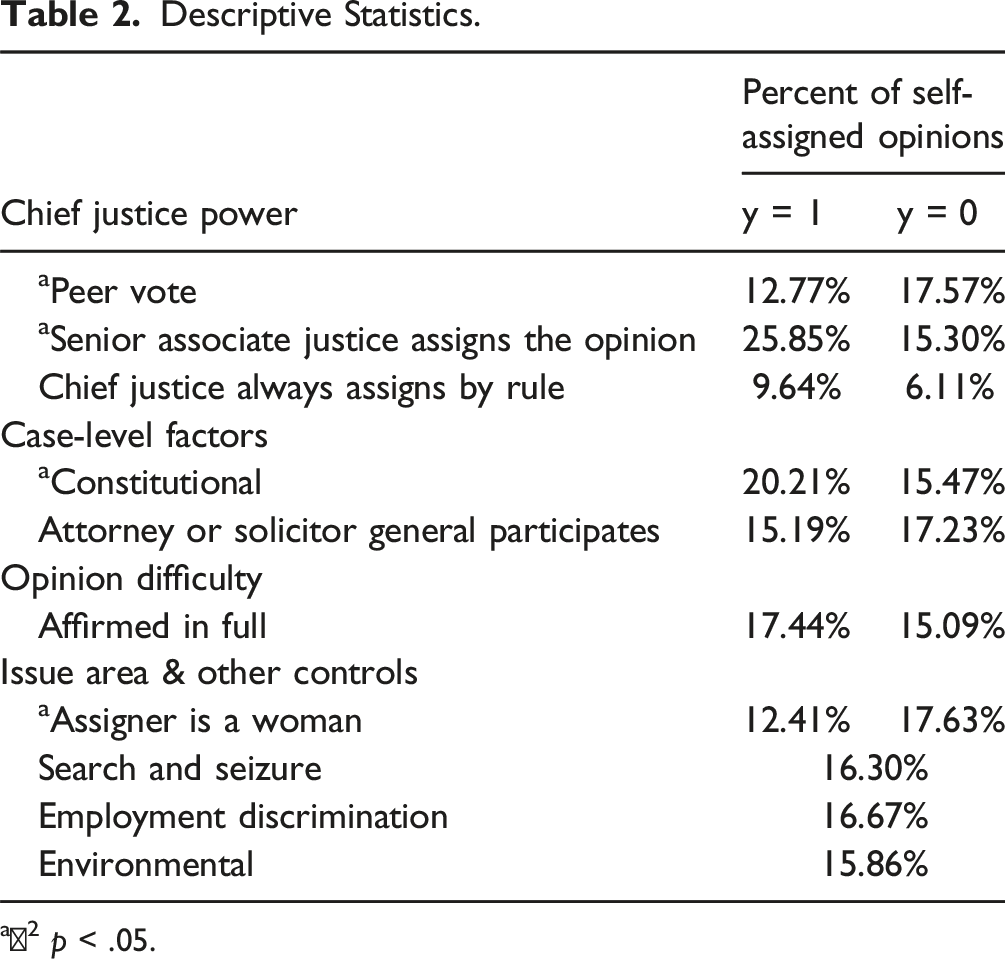
aΧ2 p < .05.
It seems that opinion assigners consider the importance of a case and the difficulty of writing the opinion in deciding whether to self-assign. Specifically, assigners are more likely to self-assign constitutional cases which we argue are more consequential or difficult opinions to write. There is also a gender difference, as men are significantly more likely to self-assign than women opinion-assigners.
Random Effects Logistic Regression: Self-Assignment.
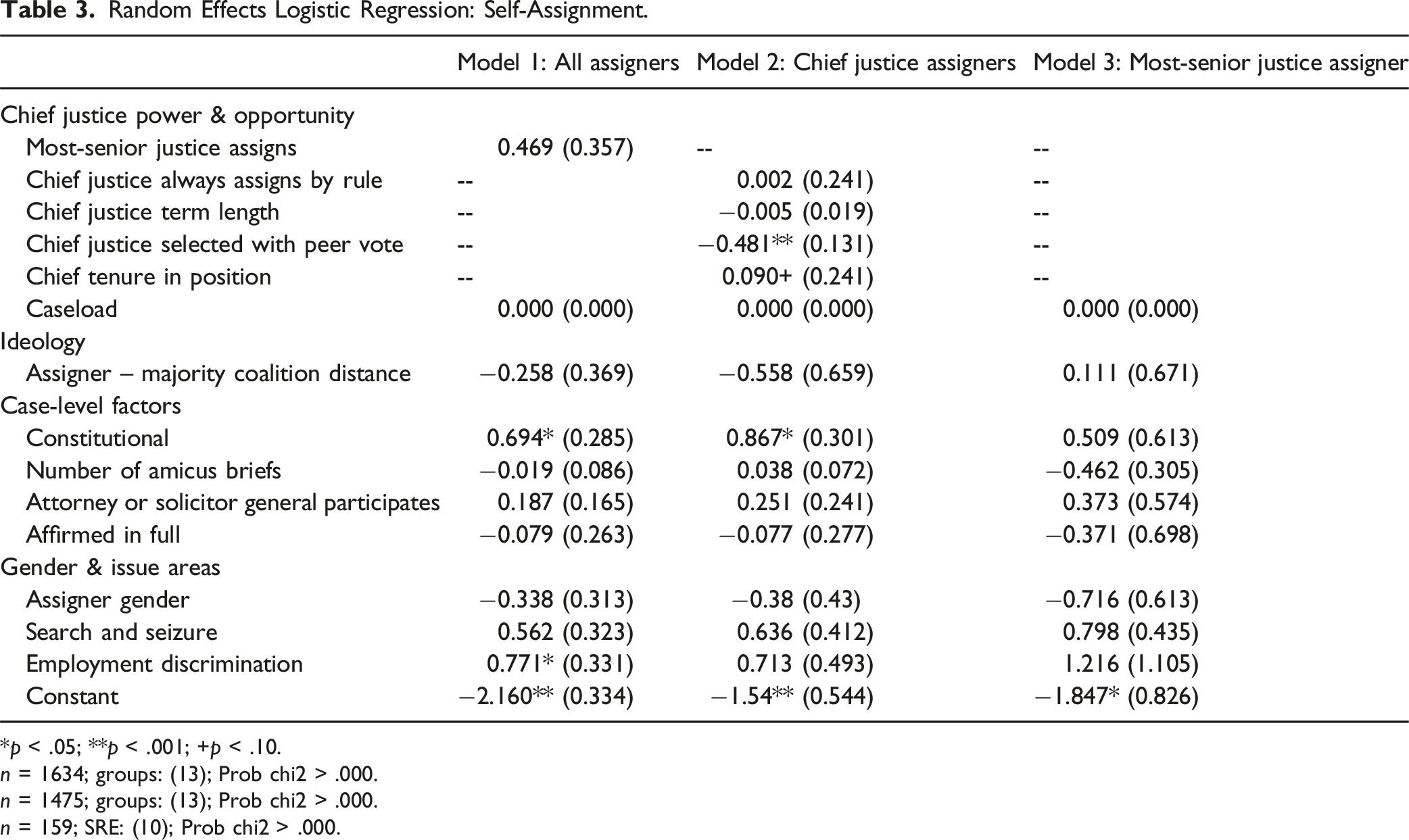
*p < .05; **p < .001; +p < .10.
n = 1634; groups: (13); Prob chi2 > .000.
n = 1475; groups: (13); Prob chi2 > .000.
n = 159; SRE: (10); Prob chi2 > .000.
In Model 2 we look to those cases where the chief justice assigns the opinion to determine whether or not the rules that define the position affect how the chief decides to self-assign. The results demonstrate support for H6, that when the chief justice is selected by peer vote, they are less likely to self-assign. The probability that a chief self-assigns decreases by more than 5% in states where they are selected by peer vote. However, their term length and the ability to assign all opinions has no effect on this decision, providing no evidence to support H4 or H5.
Across Models 1 and 2 there is consistent evidence that assigners seek to assign themselves constitutional cases, lending support to H2. In Model 2, we find that the likelihood of self-assignment increases by almost 10% when a case deals with a constitutional issue. This result does not hold for most-senior justice assignments, however. Thus, it is chief justices who seek opinion control through self-assignment in some of the most important cases that come in front of their courts.
In Model 2 we take into consideration the number of years the chief justice has been in the position. While H4 considers that chief justices who are in the position for a shorter term as determined by the institutional rule itself, we look to the actual number of years the individual chief doing the assignment has been in the position. The results graphed in Figure 1 provide intriguing evidence that the chief justice changes how they self-assign over time. When a justice first gets to the chief position, they use the self-assignment power the most. Indeed, the likelihood of a self-assignment is as high as 20% in the first year as chief, a number that decreases steadily with each year of service. By the fifth year in the position, the likelihood of self-assignment is 15%, and by year 10 that number drops below 10%. The use of the self-assignment power continues to slow over the rest of the years in office, even as the statistical significance erodes after 15 years in the position. Probability of self-assignment by years in the position.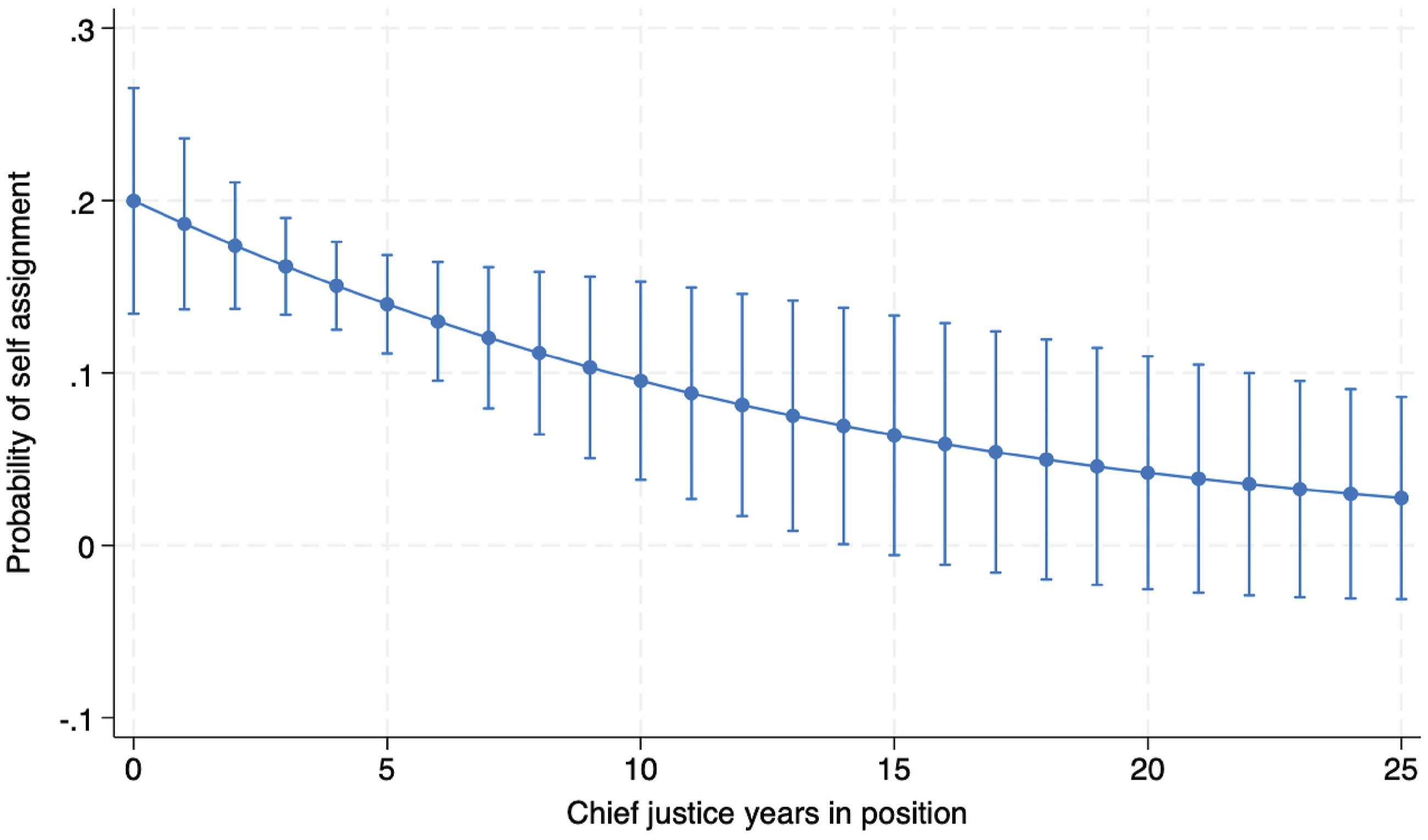
We have additional hypotheses that were unsupported in these results. We expected that chief justices would be more likely to self-assign cases as the number of amicus briefs increased and when the state attorney general or solicitor general are party to a case. Here we expected that chiefs may want more control when outside actors have a vested interest in the case. We found no support for H7 or H8. 28 In Model 3 we further parse out what might affect the decision to self-assign for most-senior justices when they have the limited opportunity to do so. We find no support for our expectations that they would consider ideology or constitutional issues. Indeed, nothing consistently or significantly predicts the decision for most-senior justices to self-assign.
Random Effects Logistic Regression: Self-Assignment.
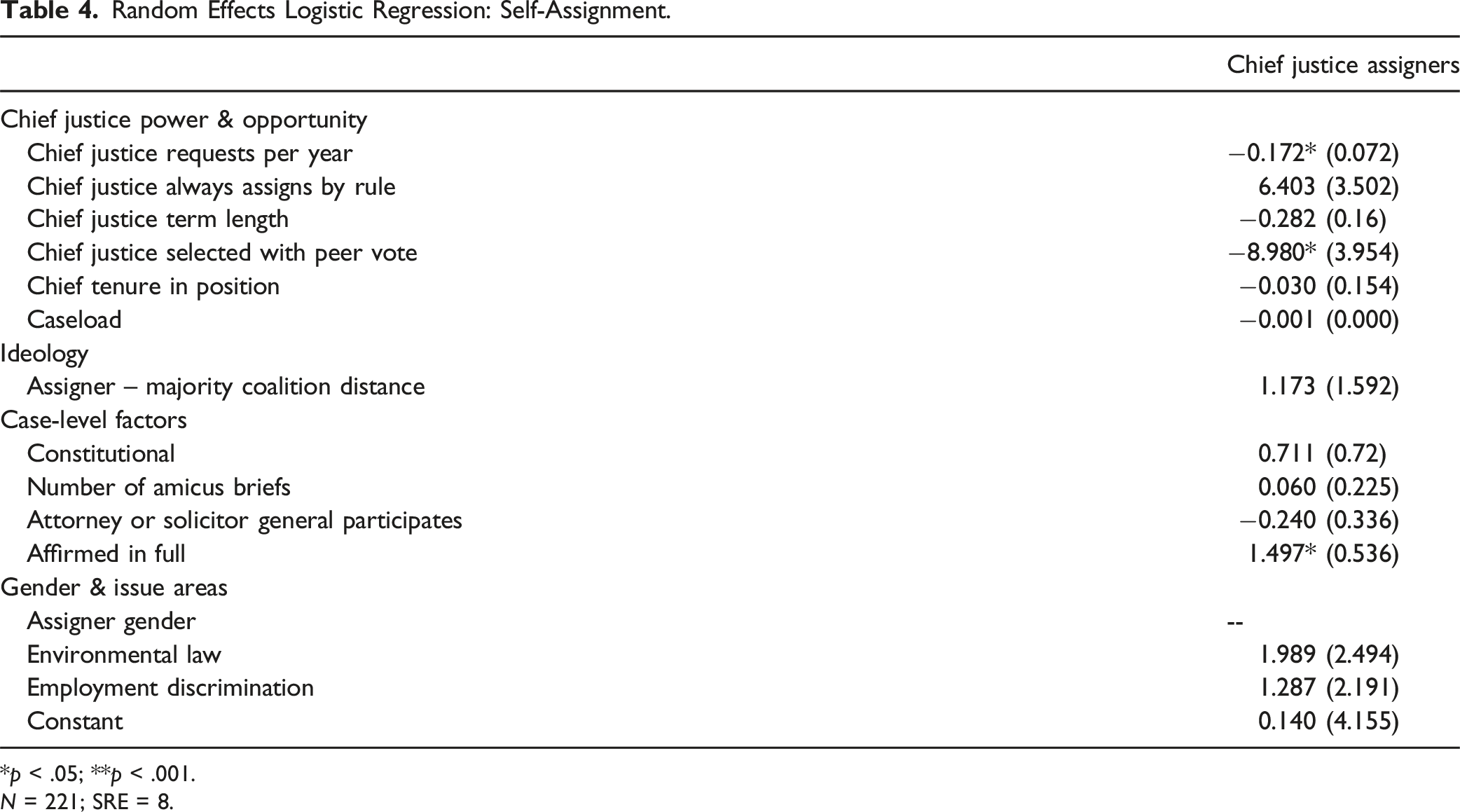
*p < .05; **p < .001.
N = 221; SRE = 8.
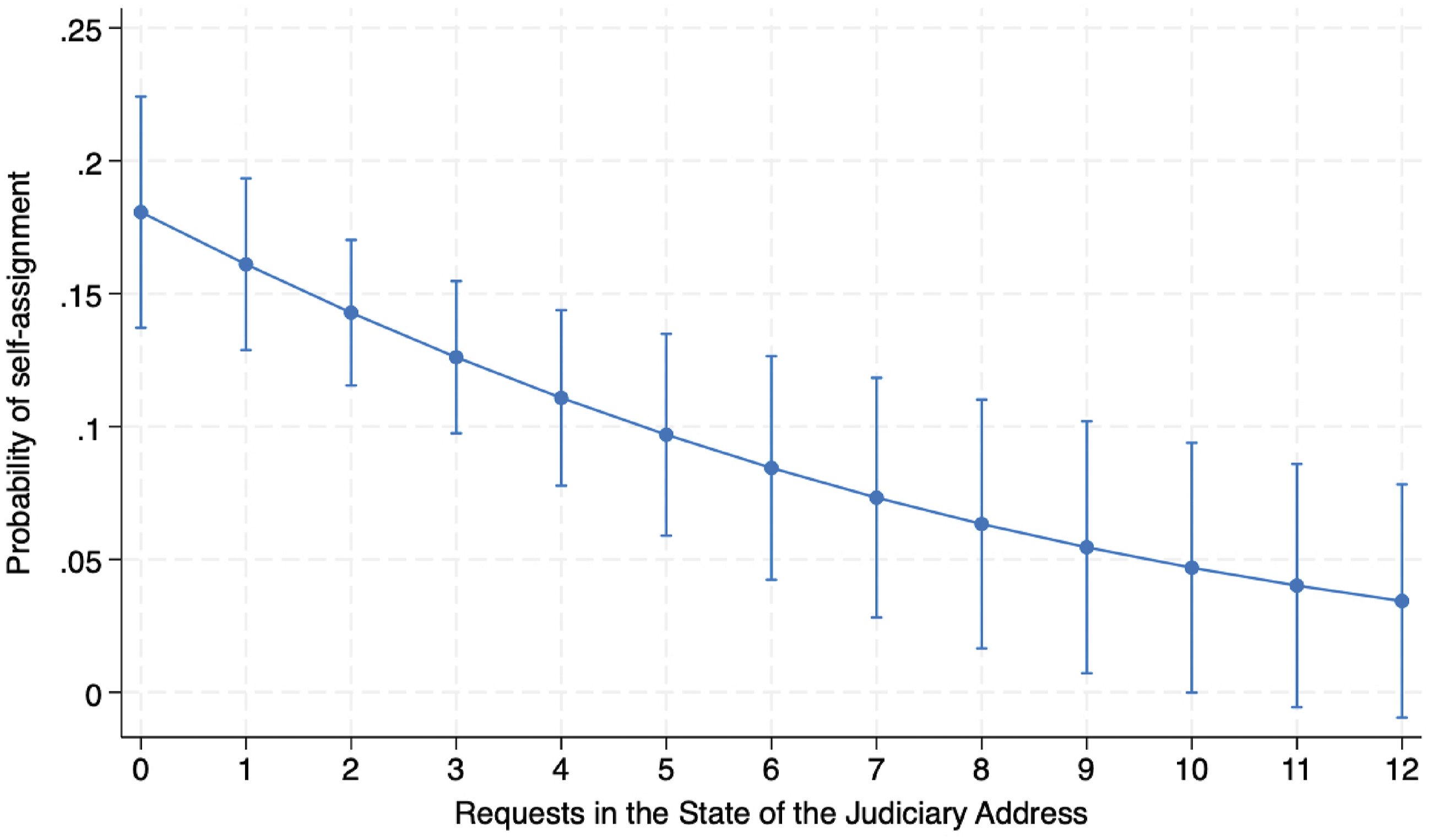
Chief justice probability of self-assignment by requests in the State of the Judiciary Address.
7. Discussion and Conclusion
The assignment of the majority opinion author is a critical moment in the decision-making process on collegial courts. From that point on, the opinion author will have the most influence over the content of the opinion, which is the policy output of the court. How that author is selected is essential to our understanding of the opinion-writing process and judicial decision-making more generally. There are plenty of assumptions about how opinions are assigned and how chief justices behave at this stage, but the evidence at the state level has been rather limited. This is especially true with regard to the decision to self-assign the opinion, which is potentially the most aggressive or conciliatory action a chief justice can take. We have sought to fill this theoretical and empirical gap in this paper, by developing and testing a theory of self-assignment in state supreme courts.
In the models above we find some evidence that the decision to self-assign is affected by the rules under which a chief justice derives their power. We find that these effects differ based on the institutional context, highlighting the importance of considering these institutional variations when studying chief justices. For example, chief justices are less likely to self-assign the majority opinion when they must maintain the support of their colleagues on the court, providing some insight into the way institutional rules may constrain a chief justice’s policy goals to avoid conflict with their colleagues. Irrespective of the rules of the position, the time in office and the associated burdens of administration decrease the use of the self-assignment power. In contrast to much of the literature on judicial behavior generally, we find no role for ideology in this particular decision made by the chief justice.
Central to our expectations is the institutional variation we observe across the states in the position of chief justice. The opinion assignment power is the most studied of these differences, but the method of selection and term length could also shape the way a chief justice conducts themselves as the leader of the court and the state judiciary, as well as how the chief justice views their role as the chief administrator of the state judiciary. In testing our expectations, we found some notable differences in self-assignment behavior. For chief justices, there is also some indication that self-assignment is more common in cases that raise a constitutional issue, which we would expect to be more consequential opinions both politically and doctrinally. These results demonstrate that chief justice selection rules can also shape decision-making behavior by remining the chief they needed the support of their colleagues to reach that position. The fact that chief justices are less likely to self-assign opinions as they make more administrative requests to the legislature and as they serve longer in the position is further evidence of shifting priorities for chief justices as they take on a larger administrative role.
Given that self-assignment is shaped by institutional constraints at the state level and individual priorities, rather than ideology, these results contribute to a growing literature reassessing the conventional wisdom about the power of the chief justice position in the states. Chief justices in the states may be selected based not on their ideology, but more on seniority (Fife et al., 2021), and they seem to have little ability to effect consensus (Gray & Miller, 2021; Leonard & Ross, 2020) or perhaps even interest in doing so, compared to their other responsibilities interacting with the other branches of government (Norris, 2022; Vining & Wilhelm, 2023). Far from an ideologue seeking to use the position to push their policy preferences, the chief justice in a state supreme court appears to be an administrator first. The results presented here further this idea that chief justices are not necessarily the ideological power brokers they are sometimes assumed to be.
Footnotes

Funding
The authors disclosed receipt of the following financial support for the research, authorship, and/or publication of this article: This research was funded by the National Science Foundation, Law and Social Sciences. Award No: 1654934.
Declaration of Conflicting Interests
The authors declared no potential conflicts of interest with respect to the research, authorship, and/or publication of this article.