




Abstract
The American public has high levels of support for various types of judicial reform, and in this article, we show using survey evidence that the public’s perception of the U.S. Supreme Court’s actual decision-making process and their normative preference for what SHOULD influence that process strongly affect support for six different judicial reforms. We confirm the conventional wisdom that those who perceive the Court as politicized have higher levels of support for reform. In addition, we show that those who desire a more representative court and support the doctrine of legal pragmatism also exhibit high levels of support. We argue that judicial reform advocates should design their campaigns to appeal to those who desire a more representative and pragmatic court, as that could expand the coalition of reform supporters beyond those who disagree with the policy of a Court they see as politicized.
The public’s confidence in the U.S. Supreme Court is at record low levels (Brenan, 2023; Franklin, 2024), leading to increased calls for judicial reform. If the Court’s legitimacy and public support is primarily based on the process that it uses to make decisions (Gibson & Nelson, 2014; Gibson, 1991), judicial reform can improve the Court’s standing by changing how the public perceives that process. Traditionally, the public is thought to desire a legalistic court that is independent from politics and public opinion, and if that is the case, reforms should be designed to fix a broken court seen as too political and return it to its proper legalistic character.
However, there is evidence that a substantial portion of Americans do not desire a legalistic court but instead desire a representative court that follows the doctrine of popular constitutionalism (Parker & Woodson, 2020; Woodson & Parker, 2021). For legal scholars, popular constitutionalism is a nuanced and complex judicial doctrine involving the rejection of judicial supremacy (Friedman, 2003; Kramer, 2004; Kramer & Tribe, 2001; Pozen, 2010). The version of popular constitutionalism supported by the mass public is much simpler and represents the vague notion that in a democracy the people should decide matters of public importance. For popular constitutionalists, this applies to the decisions of the U.S. Supreme Court as much as it does to laws passed by Congress. Importantly, many popular constitutionalists will have never heard of that term and would not be able to define it. However, when asked whether they think the Court should be representative and respond to public opinion, they emphatically answer yes.
For these popular constitutionalists, support for judicial reform is not about a backlash against a court perceived as overly politicized, but rather stems from their affirmative desire for a representative court. If this is the case, reforms meant to make a court more mechanically legalistic may backfire, further reducing support. This group prefers reforms that make the Court more representative and gives the public more influence over its decisions. Furthermore, this group may desire these reforms to make the court more representative regardless of their level of agreement with its decisions. Designing reform campaigns to appeal to popular constitutionalists offers a way to expand the coalition of reform supporters beyond those who disagree with a court they see as politicized.
This paper utilizes survey data asking respondents about their normative preferences for how the U.S. Supreme Court should decide cases, their perceptions of the actual process the Court uses, and support for six different judicial reforms – three of which involve direct representation (multi-candidate elections; retention elections; overturning court decisions through public referendum) and three lacking direct representational mechanisms (18-year term limits; mandatory retirement age; supermajority requirement to overturn laws). Our data shows a substantial difference between the two categories of reforms. Support for reforms involving direct representation is more associated with a desire for a more representative court while support for reforms lacking direct representational mechanisms is more associated with a backlash against a politicized court.
We also measure support for a variety of judicial doctrines besides popular constitutionalism and traditional legalism. Support for the two judicial doctrines most often discussed amongst politicians and the mass public – original intent and the living constitution – have small inconsistent effects on attitudes toward judicial reform. Rather, the doctrine with the most consistent effect across both categories of reform is support for the doctrine of legal pragmatism (Posner, 2004). Those members of the public who believe judges should be concerned with the consequences of their rulings as opposed to trying to implement an objective, mechanical interpretation of the law have high levels of support for all six reforms.
Past research on support for judicial reform has concentrated on how concerns over the policy output of the Court affects support for judicial reform. Agreement with high-profile decisions (Bartels & Johnston, 2020; Gadarian & Strother, 2023) or supporting the party proposing a reform (Albertus & Grossman, 2021; Black et al., 2023; Clark & Kastellec, 2015) influences support for curbing the Court’s power and other judicial reforms. Our study builds on this research by connecting respondents’ views regarding the Court’s decision-making process to their support for various judicial reforms. While existing research shows the public is more likely to support court curbing when they perceive the Court as politicized (Gibson & Caldeira, 2011), we provide evidence that a person’s views concerning popular constitutionalism or legal pragmatism has a larger effect than politicization perceptions, especially for reforms involving direct representation.
1. Support for Judicial Reform
The public exhibits widespread and bipartisan support for a wide variety of judicial reforms. In polls from 2023, 74% supported mandatory retirement ages for U.S. Supreme Court justices (Pew, 2023), and 65% supported term limits (Navigator, 2023), with majorities in each party supporting the two reforms. When moving to a more radical option like electing U.S. Supreme Court justices, support is somewhat lower with only 48% supporting judicial elections, but since only 32% supported the current system using presidential appointment and Senate confirmation, elections are still the more popular option (Ipsos, 2015).
Scholars have spent considerable time and effort examining whether reforms like term limits, retirement ages and elections improve the functioning and legitimacy of the judiciary (Geyh, 2019; Huber & Gordon, 2004; Opeskin, 2015; Pozen, 2008), but what scholars have generally left unstudied using empirical data is the question of why the American public supports judicial reform. We know of only a few studies that have examined that directly. Two studies examine the determinants of support for term limits for federal judges (Clark & Kastellec, 2015; Black et al., 2023). Both manipulate whether the term limit proposal is described as a Democratic, Republican, or nonpartisan proposal, and their data shows that partisans express more support for a proposal coming from their own party. In addition, Black et al. (2023) found that subjective ideological disagreement increases support for term limits. Albertus and Grossman (2021) show across four different countries, including the United States, that those who support the incumbent president are more likely to support court-packing proposals. Braman (2023) examined support for judicial reform using Prospect Theory as the theoretical framework. She found that the greater a person’s expected benefits from the decisions made by the Court in the future, the less they support electing judges, term limits, and adding justices to the Court.
In addition to those studies, the voluminous literature on the question of whether displeasing policy decisions decreases the perceived legitimacy of the Court offers insight into this question. The most-used measure of judicial legitimacy comes from Gibson et al. (2003). They describe the measure as assessing the degree to which people want to make fundamental changes to the institution. Questions in that scale ask about reducing the power of the Court to make controversial decisions, removing the Court’s power of judicial review, and getting rid of the Court altogether. Bartels and Johnston (2020) argue that the Gibson et al. (2003) measure of legitimacy perceptions also functions as a measure of support for court-curbing, which is a form of judicial reform that reduces the power of the court. If, like Bartels and Johnston (2020), we treat Gibson’s legitimacy measure as a measure of support for judicial reform, the empirical evidence from Bartels and Johnston (2020) supports the finding from Black et al. (2023) that subjective ideological disagreement increases support for judicial reform.
All of these studies propose and show that support for reform is based on policy considerations. Bartels and Johnston directly measure ideological disagreement. Braman’s (2023) concept of future or prospective benefits measures the degree to which the respondents think they will approve of future court decisions. The partisan manipulations in Black et al. (2023) and Clark and Kastellec (2015) presumably work because a person thinks that a reform endorsed by their party will change the court to provide decisions more favorable to that party. While policy evaluations may have an effect on support for reform, legal scholars generally do not base their arguments regarding the merits of judicial reform on the policy output of a court. Rather advocates for reform generally concentrate on process considerations and how judicial reform changes the actual process used by a court and how the public perceives that process.
Process can have multiple meanings in the context of court decisions. It can mean the fairness (Gibson, 1991) or efficiency of the procedures used to make a court decision. Nelson and Driscoll (2023) show that when a court-packing reform is framed as an attempt to increase the efficiency of the judiciary politicians proposing it garner more support than when it is framed as an effort to change the judiciary’s ideological orientation. We do not dispute this type of process perception influences evaluations of the judiciary, but the current study concentrates on a different type of process perception - the public’s perception of what influences court decisions.
In discussions by legal scholars, much of the time judicial reform is framed as a way to fix a broken court that has become too politicized. For example, Epps and Sitaraman (2019, p. 170) argue that any judicial reform should “be designed to preserve the Court as an institution that is not partisan.” Voorhees (1975) argued in support of the merit selection system on the grounds that politics and ideology should not be involved in the confirmation process. These two papers exemplify one type of argument on behalf of judicial reform that emphasizes the need to return a court seen as too politicized to an idealized legalistic court that is neutral and separated from politics.
A court being seen as overly political is not the only justification scholars propose for judicial reform. Doerfler and Moyn (2021) argue in “Democratizing the Supreme Court” that the purpose of reform should be to give more power to the public and popular majorities. Calabresi and Lindgren (2006, p. 813) argue on behalf of judicial term limits because they help bring “some degree of a democratic check on the Court.”
These two groups of scholars above show two different ways that process can matter. For some, they support judicial reform because they want to return the Court to an idealized past when the Court was neutral and separated from politics. We call this the Political Backlash hypothesis because public support for judicial reform is caused by the public’s backlash against a court seen as too political.
As legal scholars like Doerfler and Moyn (2021) emphasize, not everyone desires a legalistic court that is separated from politics. Some people want to democratize the judiciary to give the public more influence over the U.S. Supreme Court. For this group of popular constitutionalists who want the public to influence judicial decisions, the purpose of judicial reform is not to make the Court more legalistic, but to change the Court into a more representative institution. We call this the Popular Constitutionalism hypothesis in which people support judicial reform because of their support for the doctrine of popular constitutionalism and their desire to make the Court’s policy decisions more representative of the mass public.
An important difference between the political backlash and popular constitutionalism hypotheses involves the distinction between normative preferences and process perceptions. Normative preferences are a person’s preferences concerning what SHOULD influence a court’s decisions. Process perceptions are a person’s view of what ACTUALLY influences a court’s decisions. The popular constitutionalism hypothesis involves normative preferences, as the reason for supporting reform is to make the Court more representative to match that person’s preference. The political backlash hypothesis involves process perceptions. For this hypothesis, reform support is caused by someone perceiving the Court’s actions as overly influenced by politics.
2. Normative Preferences and Process Perceptions
Multiple studies have shown that the public makes a distinction between a representative court and a politicized court, and this distinction changes their evaluations of the court and its decisions. Woodson and Parker (2021) and Parker and Woodson, (2020) measured the public’s normative preferences for what should influence decision-making on the U.S. Supreme Court. The study included multiple items measuring the degree to which public opinion should influence the Court. It separately measured ideological decision-making and politicized decision-making as conceptualized by Gibson and Caldeira (2011) 1 and included items measuring the degree to which individuals thought the Court should use only legalistic criteria when making decisions.
In an exploratory factor analysis, two factors emerged. The items measuring the degree to which the public wants the court to follow public opinion loaded onto one factor, and the items measuring the desired level of politicized, ideological and legalistic decision-making loaded onto the second factor. Importantly, those who support popular constitutionalism use different criteria to evaluate the court than those who desire a legalistic court. The use of social science in decisions (Woodson & Parker, 2021) and the presence of dissents (Parker & Woodson, 2020) increase support for a court among those who desire popular constitutionalism while reducing support for those who desire a legalistic court.
The studies from Woodson and Parker (2021) and Parker and Woodson, (2020) are experiments using non-representative samples, and thus cannot be used to determine how widespread support for popular constitutionalism is among the mass public. However, two existing studies include items that measure the degree to which the public prefers a court that follows public opinion. Scheb and Lyons (2001) includes an item in a nationally representative survey that asks how much impact majority public opinion should have on the decisions of the U.S. Supreme Court. 32% states it should have a large impact, and an additional 36% stated it should have some impact. Gibson and Caldeira (2009) includes an item that assesses how important people believe it is that the Court represents the majority, with 36% stating it is very important and an unknown additional percentage stating it is somewhat important. Based on those two polls, it seems that approximately 1/3 of the American people strongly supports popular constitutionalism, 1/3 somewhat supports it, and 1/3 are against the doctrine.
The studies from Woodson and Parker (2021) and Parker and Woodson, 2020) showed that for normative preferences the public makes a distinction between a politicized and a representative court, and that distinction changes how they evaluate the Court. Woodson (2018) did the same for process perceptions. It shows using an exploratory factor analysis that items measuring the degree to which the Court is perceived as politicized load onto a different factor than items measuring the degree to which the Court is perceived as being influenced by public opinion. In addition, Woodson (2018) showed that for those who perceived the Court as politicized, displeasing policy decisions decreased legitimacy perceptions. For those who perceived the Court as following public opinion, displeasing policy decisions had no effect on legitimacy perceptions.
2.1. Interaction Between Popular Constitutionalism and Process Perceptions
The above discussion treated normative preferences and process perceptions as two independent constructs, but especially when considering their effect on support for judicial reform, we expect that a person’s support for the doctrine of popular constitutionalism (normative preferences) should interact with their view of whether the court is actually following public opinion (process perceptions). The purpose of judicial reform is to bring the Court’s decision-making process closer to a person’s idealized version of that decision-making process, and when the Court is already making decisions using that idealized process, the desire for reform will be reduced.
In our data analysis, we will examine the interaction between a person’s support for popular constitutionalism and their view of whether the Court is already being influenced by public opinion. The effect of supporting popular constitutionalism on supporting judicial reform should be largest for those who perceive the Court as ignoring public opinion. For this group, judicial reform is a way to make an unaccountable Court more accountable. However, for those who view the Court as already following public opinion, the effect of supporting popular constitutionalism should be smaller. For this group, the Court is already making decision in their preferred manner, and thus should have less motivation to change how the Court is operating.
2.2. Ideological Disagreement and Reform Support
A variety of studies show that people are more likely to support reforming a court if they disagree with the court’s policy decisions (Bartels & Johnston, 2020; Black et al., 2023; Braman, 2023; Gadarian & Strother, 2023). We do not dispute that contention, but instead propose that normative preferences – especially supporting the doctrine of popular constitutionalism – also matter. In addition, we propose that supporting popular constitutionalism increases support for judicial reform, even among those who already agree with the Court. If popular constitutionalism only increases support for judicial reform among those who disagree with the Court, that poses problems for our theory.
Prior research has shown that rather than the public evaluating process and policy independently, much of the time motivated reasoning causes policy views concerning Court decisions to drive perceptions of process (Badas, 2016; Strother & Gadarian, 2022). When people like the policy outcome of a decision, they generally will also like the process used to make the decision. When they dislike the policy outcome, they will generally dislike the process. Of course, our main hypothesis concerning popular constitutionalism involve normative preferences rather than process perceptions, but the possibility of reverse causation still exists. Disagreeing with the Court’s policy could cause people to both support judicial reform and popular constitutionalism. If that is the case, those popular constitutionalists who support judicial reform are not actually motivated by the desire to create a representative Court. Most likely, while they state they want a representative Court, they really just want a Court that will represent their preferred policy viewpoints.
However, if supporting popular constitutionalism still increases support for judicial reform among those who agree with the Court, that provides evidence that popular constitutionalists still support reform when it could result in policy they disagree with. In that case, reform is not about changing the policy of the Court, but truly about process and wanting a representative Court. To examine this, we will include a model that interacts support for popular constitutionalism and ideological disagreement with the Court. However, we do not necessarily expect that interaction to be statistically significant because if support for popular constitutionalism increases reform support among both those who agree and disagree, the interaction would be insignificant. Rather, the key finding that supports our theory is that the effect of popular constitutionalism is not isolated to only those who disagree with the Court.
2.3. Other Judicial Doctrines
While this paper concentrates on the attitudes toward popular constitutionalism, we also want to examine whether support for other judicial doctrines influences support for judicial reform. Debates about the judiciary among pundits and during confirmation hearings are frequently structured around the competing philosophies of originalism and living constitutionalism. Originalists argue that the Constitution should be interpreted based on the original meaning and intent of the Founders, as derived from an analysis of meaning of text at the time it was written. Importantly, the commands of the Constitution remain static over time unless the document is amended. Living constitutionalists, on the other hand, believe that the interpretation of the Constitution should evolve over time to fit the changing needs of society and to allow the law to adapt to address modern conditions. A third, related, philosophy, is that of legal pragmatism, which argues that the law is a social tool, and as such judges should be concerned with the consequences of their rulings as opposed to trying to implement an objective, mechanical interpretation of the law (Posner, 2004).
As with popular constitutionalism, these are legal theories that the general public may not be able to describe at length but can intuitively understand. For example, the differences between these approaches are prevalent in debates surrounding the second Amendment. While the originalist argument from the majority opinion in DC v. Heller (2008) stated that the scope of the right to bear arms should be determined by the meaning of the words of the amendment at the time they were written, the dissenters argued that this made little sense in a modern context where firearms are far more deadly than they were in the 1790s. Legal pragmatists further point out that by ignoring the evolution of firearms and the increasing levels of gun violence, an originalist interpretation will result in policies that allow for more deadly shootings. But in NYSRPA v. Bruen (2022) Justice Thomas’s majority opinion stated that the consequences of gun regulations are irrelevant to the constitutional analysis of the second Amendment. All that matters is whether a gun regulation is analogous to regulations that existed during the founding era and the 1800s.
If asked to explain the judicial philosophies originalism or living constitutionalism most people would not be able to do so. However, they are broad approaches the public can understand when explained in layman’s terms, as in the above examples regarding the second Amendment. Krewson and Owens (2023) find that respondents have preferences between a judge that “considers what the words in the Constitution meant at the time those words were crafted” and a judge that “looked to the evolving views and values of the American public when interpreting the Constitution.” They also found that respondents were more likely to trust hypothetical judges that utilized the respondent’s preferred judicial philosophy, even when they disagreed with the policy outcomes of the judge’s ruling. While there is a partisan divide in support for originalism and living constitutionalism (Krewson & Owens, 2021), partisans and ideologues do not hold stronger preferences for judicial philosophies than independents or moderates (Krewson & Owens, 2023). This suggests that the public does have somewhat meaningful preferences for judicial philosophies that are not simply being driven by cues from partisan or ideological elites.
We include items measuring support for originalism, living constitution, and legal pragmatism in our models to determine whether support for reform reflects a sense that the Court’s decisions are either not accurately reflecting the intent of the Founders, or, alternatively, are ignoring changes in modern society and the practical consequences of legal decisions. As with the studies above, our items describe these judicial philosophies in non-legalistic terms rather than asking about them by name, making it more likely that respondents will understand them and have an opinion about them.
3. Summary of Hypotheses
This paper will examine multiple hypotheses regarding the determinants of support for judicial reform. The political backlash hypothesis states that those who view the Court’s decision-making process as politicized will be more supportive of judicial reforms. The popular constitutionalism hypothesis states that support for judicial reform should be associated with the respondent’s normative preference of whether the Court SHOULD be influenced by public opinion, with those more supportive of the doctrine of popular constitutionalism more likely to support judicial reform regardless of their views toward the Court’s actual decision making.
In our survey, we measure support for six different judicial reforms, and we split those reforms into two different groups. The first group of reforms involve direct representation and give the public control over the Court’s policy output through voting on either Court membership or policy. The second group of reforms do not involve direct representation for the public. The political backlash and popular constitutionalism hypotheses should not apply equally to the two different types of reforms. Support for reforms involving direct representation should be more closely related to a person’s support for popular constitutionalism than to their view of whether the Court is politicized. Popular constitutionalism involves giving the public more direct influence over Court decisions, and that category of reforms give the public the most control.
On the other hand, reforms lacking direct representation should be more closely associated with the political backlash hypothesis. Those who see the Court as too political do not necessarily want a Court that is more responsive to the public. This group contains people who prefer a legalistic Court, so their motivation for reform should be more about limiting the influence of political judges rather than increasing the influence of the public over the Court’s decisions. As a result, when compared to his or her support for popular constitutionalism, a person’s view of whether the Court is politicized should be more closely related to support for reforms lacking direct representation.
In addition, we will examine how both ideological disagreement and whether people view the Court as actually following public opinion moderates the effect of supporting popular constitutionalism on judicial reform support. We expect popular constitutionalism to affect support for reform among both those who agree and disagree with the Court, and that people believing the Court is already following public opinion will decrease the effect of supporting popular constitutionalism.
4. Study Design
The 838 respondents that completed the survey between October 6 and October 12, 2023 were provided by the Qualtrics online respondent pool. The respondents are given points for completing the survey that can redeemed for a variety of goods and services. An online appendix shows the full text and distributions for all the survey items used in this study.
4.1. Support for Judicial Reform
We measure support for six different judicial reforms. The three that do not involve a direct representational mechanism are 18-year term-limits, a mandatory retirement age, and a super-majority requirement to declare a law unconstitutional. The three that involve direct representational mechanisms are elections with multiple candidates, retention elections, and decision-recall referendums. With the exception of the election with multiple candidate item, the respondents were asked whether they support or oppose those reforms on a five-point scale. The election item is a dichotomous item and gave the subjects the choice between the current presidential appointment/senate confirmation selection system and electing the Justices.
4.2. Normative Preferences and Process Perceptions
We separately measure the respondent’s normative preferences concerning how they believe the Court SHOULD make decisions, and their perception of the process the Court uses to actually make decisions. Henceforth, these will be referred to as normative preferences and process perceptions. We use the scale developed in Woodson and Parker (2021) to measure four sub-components of normative preferences and process perceptions. One subcomponent measures the degree to which the public believes that public opinion should (normative preferences) or does (process perceptions) influence the decisions of the Court. A second measures the desired or perceived degree of legalistic influence, or whether the Court does little more than interpret the law. The third measures the desired or perceived level of political influence, as defined by Gibson and Caldeira (2011) as judges acting like politicians who exhibit strategic and self-interested decision-making. The fourth measures the desired or perceived degree of ideological influence, or whether judges make decisions based on their personal policy opinions. We use an exploratory factor analysis to replicate the finding from Woodson and Parker (2021; Woodson, 2018) that for both normative preferences and process perceptions two separate factors emerge. One factor measures the degree of desired or actual public influence. The second ranges from legalistic decision-making at one end to politicized or ideological decision-making at the other.
For both normative preferences and process perceptions, the subjects are presented with a statement and then asked whether they agree or disagree with the statement. An example of an item assessing normative preferences is “In an ideal world, the U.S. Supreme Court would be able to overrule the will of the people.” All the normative preference items begin with the words “In an ideal world” to emphasize that the question concerns how the respondent thinks the Court should operate, not how they think it actually operates. The process perception items instead ask about how the respondent thinks the Court actually operates. For example, one items states “The U.S. Supreme Court often overrules the will of the people.”
The survey includes 5 items measuring the subject’s normative preference for a representative court, 3 items measuring whether they desire an ideological court, 3 measuring whether they desire a political court, and 3 measuring whether they desire a legalistic court. The process perceptions scale had the same 5/3/3/3 breakdown between representative, ideological, political and legal influence. The direction of the question wording for the items varied so that agreement with an item did not always correspond with support for the same normative preference. See the online appendix for the full text of every item.
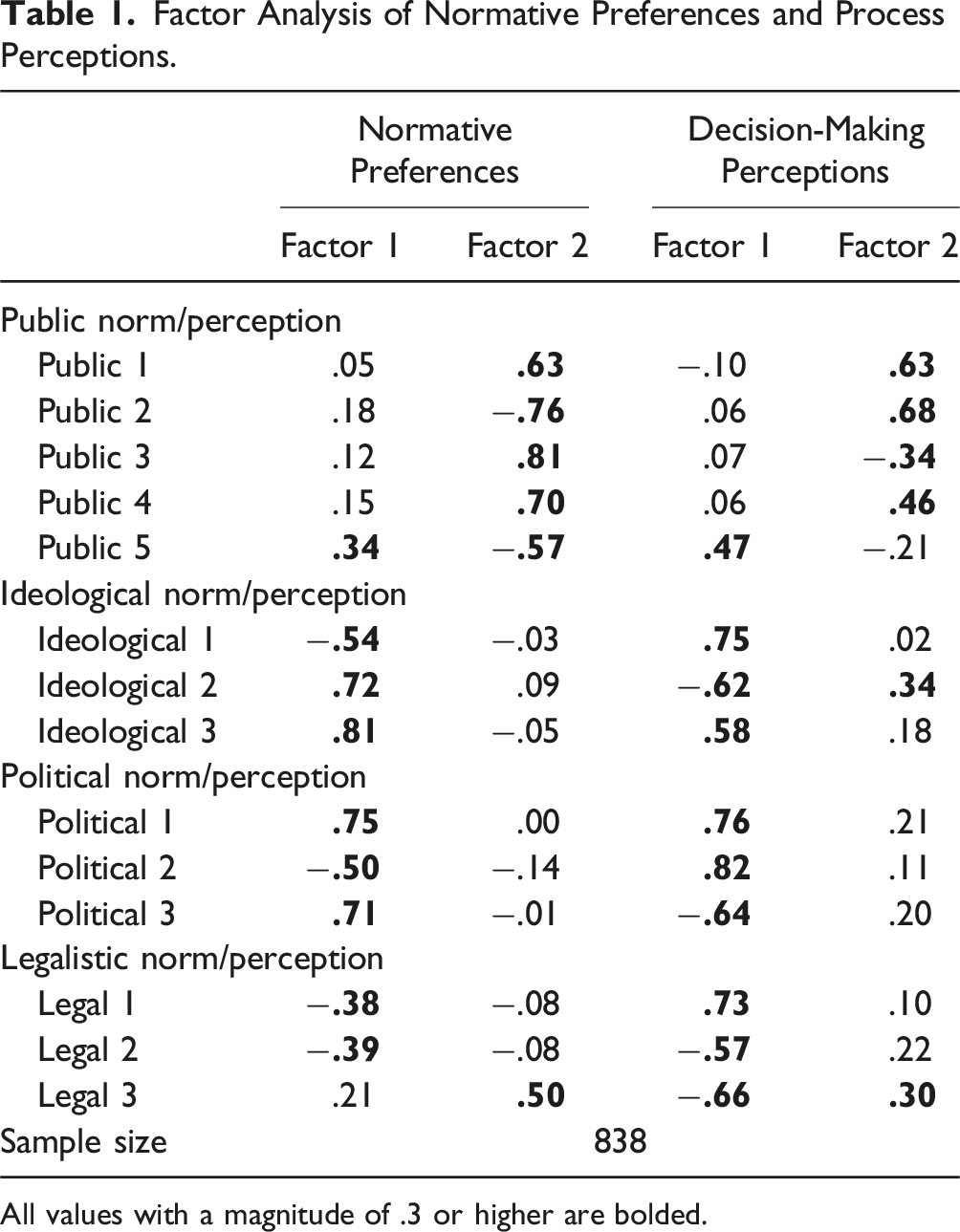
Factor Analysis of Normative Preferences and Process Perceptions.
All values with a magnitude of .3 or higher are bolded.
The first column shows the results for the normative preference items. All five public norm items load onto the second factor with the magnitude of the loadings at .57 or larger. With the exception of public norm item 5, the public norm items have low loadings on the first factor. The ideological, political, and 2 out of the 3 legal norm items load onto the first factor, with a magnitude of at least. 38. The third legal norm item loads onto the second factor. This analysis replicates the finding from Woodson and Parker (2021) that the public makes a distinction between their desire for a representative court and their desire for a political court. They do not make a distinction between an ideological court and a political court.
The scale for the public’s normative preference for the degree of public influence on the court will be an additive index of all five public norm items. This will be called the public norm scale and can be thought of as measuring a person’s support for the doctrine of popular constitutionalism, with higher numbers indicating more support for a representative court. The other normative preference scale will be an additive index of the 3 political norm, 3 ideological norm, and the first 2 legal norm items. This scale will be called the political/legal norm scale, with higher numbers indicating more support for a political court. The third legal norm item is excluded from the scale since its factor loadings on the second factor was considerably larger than its loading on the first factor. The fifth public norm item is included in the public norm scale because while it had considerable loading on the first factor, its loading on the second factor was much larger.
The results for the process perception items are in the second column. For those items, four out of the five public perception items load onto the second factor, with a minimum magnitude of .34. The fifth public perception item has a higher factor loading on the first factor than the second and was not included in the public perception scale. The public perception scale is an additive index of the first four public perception items, with higher numbers indicating more perceived public influence. All three political perception, ideological perception and legal perception items strongly load onto the first factor, with a magnitude of at least .57. The political/legal perception scale is an additive index of those nine items, with higher numbers indicating more politicized perceptions. 2
4.3. Other Normative Preferences
In addition to the public norm scale and the political/legal norm scale, we measure three additional types of normative preferences. We included three items that assess the public’s support for the doctrine of legal pragmatism (Posner, 2004). They ask whether the respondents agree or disagree that the Court should “be more concerned with how a decision affects people than about intricate legal arguments and philosophies”, whether the Court should “interpret legal provisions so that the law provides the greatest benefit to society”, and whether the Court should “take into account evidence about the effect of their decision and avoid making decisions that lead to harmful outcomes.” All three items load onto a single factor with loadings of at least .6. The additive scale of these three items will be called the legal pragmatism norm scale. The legal pragmatism norm scale has a high correlation with both the public norm scale (r = .67) and the political/legal perception scale (r = .41). It seems that desiring a representative court and a court following the doctrine of legal pragmatism tend to trend together, and to a lesser extent those who have those two normative preferences also tend to see the Court as politicized.
We include one item that measures the public’s support for the living constitution doctrine that asks the respondents whether the Court should “take into account the changing nature of society when interpreting the Constitution.” The item assessing the public’s support for originalism asks whether the Court should “interpret the Constitution based on the original intent of those who wrote the Constitution.”
4.4. Other Variables
We measure the respondents’ subjective ideological disagreement with the Court using an item that asks whether the Court is “much too liberal”, “somewhat too liberal”, “just about right”, “somewhat too conservative”, or “much too conservative.” The subjective ideological disagreement variable is coded so that the “just about right” option is at the bottom of the scale, the “much too” liberal/conservative option is at the top of the scale, and the “somewhat too” liberal/conservative option in the middle.
The respondents’ knowledge about the Court is measured using three factual questions that ask about the minimum number of justices needed to grant cert, the number of cases the Court decides, and the identity of the Chief Justice. The knowledge scale is the number of correct responses.
The subject’s partisanship was measured using a seven-point scale that differentiates between strong and weak partisans, leaning independents, and true independents. Higher numbers indicate stronger democratic identification.
The respondents support for the rule of law was measured using two items that ask whether it is “necessary to obey a law you consider unjust” and whether “it might be better to ignore the law and solve problems immediately.” These two items are added together to form the rule of law scale, with higher numbers indicating greater support for the rule of law.
The respondents’ education was measured on a five-point scale. The respondent’s age was also included. Every independent variable used in the subsequent model has been transformed so that their minimum is 0 and their maximum is 1. The only exception to this is the age variable which was divided by 100.
5. Data Analysis
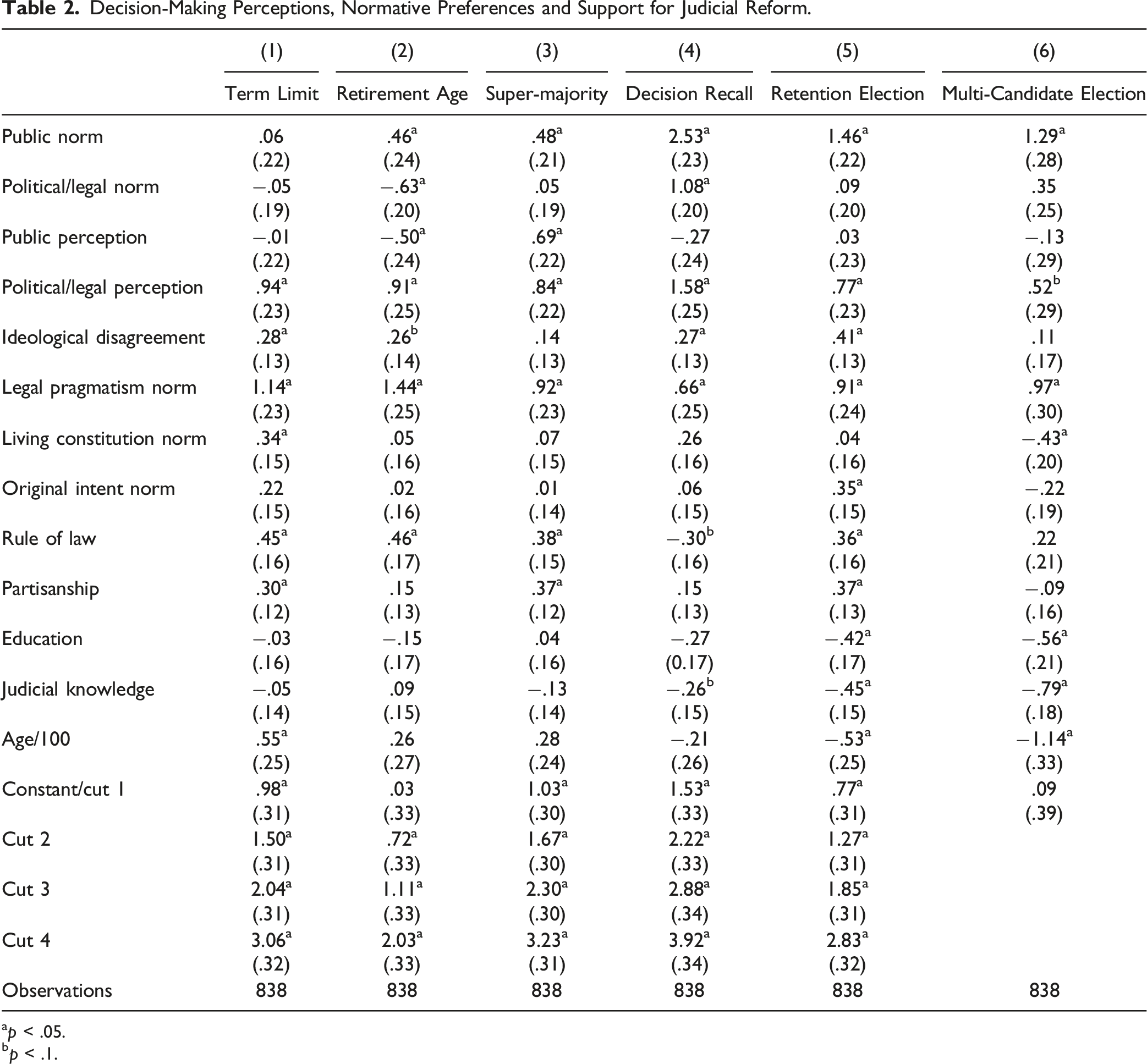
Decision-Making Perceptions, Normative Preferences and Support for Judicial Reform.
ap < .05.
bp < .1.
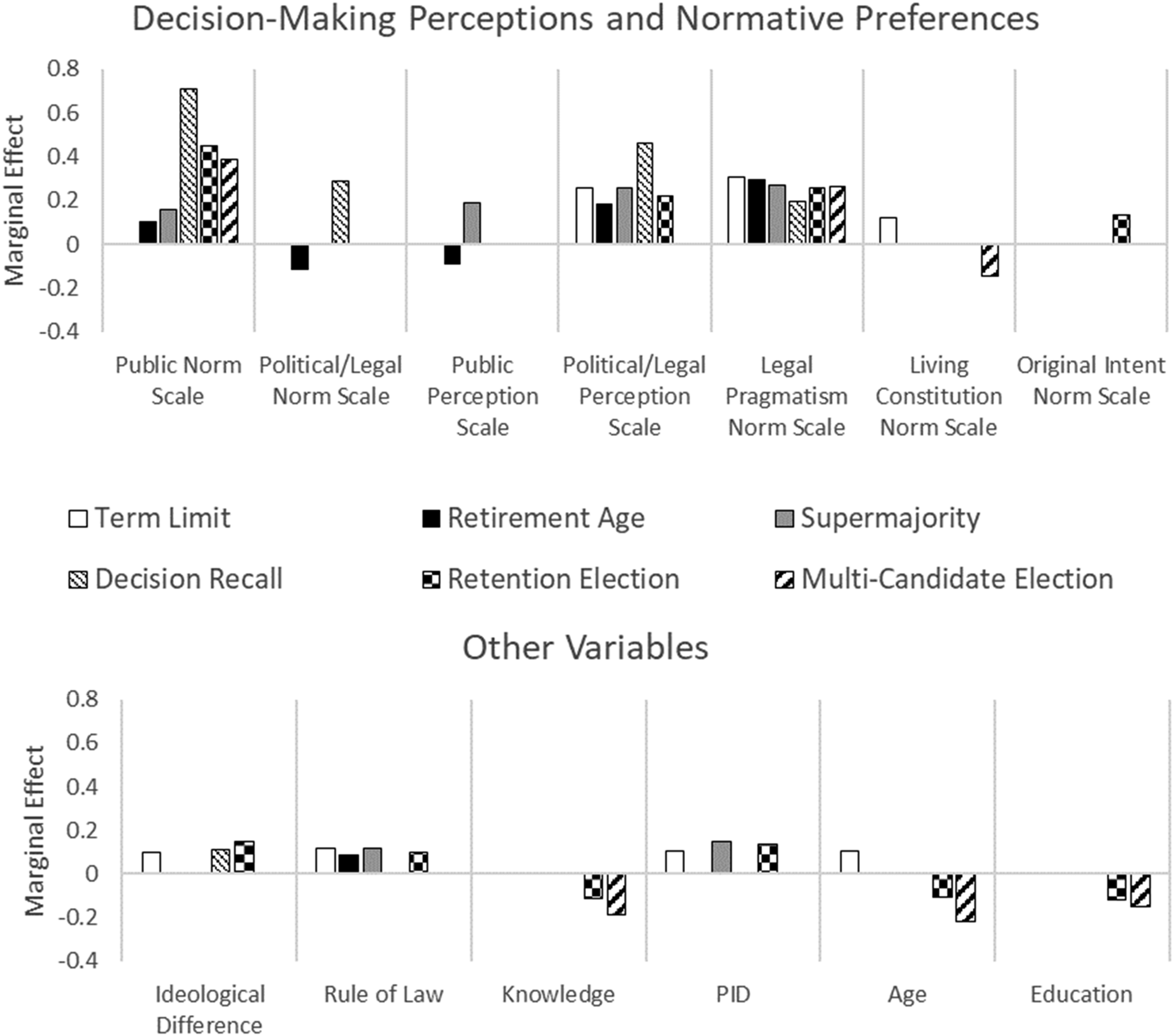
Marginal effects on support for judicial reform grouped by independent variable.
Figure 1 groups the marginal effects based on the independent variable rather than the dependent variable. In addition, only those marginal effects that are statistically significant at p < .05 are included in the figure. This format clearly shows which variables have a consistent effect across the different types of judicial reform, and which variables only affect a small number of reforms.
5.1. Decision-Making Perceptions and Normative Preferences
The first thing to note from Figure 1 is that three variables stand out as having the largest and most consistent effect across at least five of the judicial reforms - the legal pragmatism norm scale, the public norm scale, and the political/legal perception scale.
With the exception of the decision-recall referendum, the magnitude of the statistically significant effects for the political/legal perception scale are relatively consistent, ranging from .18 to .26. The decision-recall referendum is the largest at .46. The political/legal perception scale did not have a significant effect at p < .05 on support for multi-candidate elections. These results support our hypothesis that the public perceiving the Court as acting in a politicized manner causes a backlash that increases support for judicial reform.
The public norm scale had a statistically significant effect at p < .05 on support for all the reforms, except term limits. This supports our hypothesis that people who desire a more representative court are more likely to support judicial reforms, even when controlling for perceptions of a politicized court. In addition, the public norm scale has a larger effect on reforms involving direct representation than those without. The marginal effects for the three reforms involving direct representation were .39, .45, and .71. The public norm scale did not affect support for term limits, and the marginal effects on the other two reforms lacking direct representation were much smaller at .1 and .16. 4
We also hypothesized that support for reforms with direct representation should be more closely related to the public norm scale than the political-legal perception scale, and for reforms lacking direct representation, we expect the opposite pattern. The data support that hypothesis. The marginal effect of the public norm scale is larger than the marginal effect of the political-legal perception scale for all three reforms involving direct representation. 5 For each reform lacking direct representation, the pattern is reversed, with the political-legal perception scale having the larger marginal effect. 6 In addition, both the public norm scale and the political-legal perception scale only significantly affect 5 of the 6 reforms, with the one reform not affected being one lacking direct representation for the public norm scale and one with direct representation for the political-legal perception scale.
5.2. Other Normative Preferences
In addition to the public norm scale, we included four other types of normative preferences in our models – the political/legal norm scale, the legal pragmatism norm scale, the living constitution norm scale, and the original intent norm scale. We also included a second decision-making perception scale assessing the subject’s perception of how much public opinion influences Court decisions. The only one of these variables to have a consistent effect across the various reforms was the legal pragmatism norm scale. These effects were also substantively important, ranging in size from .2 to .3. Emphasizing the importance of the legal pragmatism scale, it had the largest effect of any variable for the three reforms lacking direct representation. It was also the only variable to have statistically significant effects at p < .05 for all six judicial reforms.
The other four variables mentioned in the previous paragraph significantly affected at most two reforms, and of those that affected two, they all increased support for one reform while decreasing support for another. The political/legal norm scale increased support for the supermajority requirement and decreased support for the mandatory retirement age. The living constitution norm scale increased support for term limits and decreased support for multi-candidate elections. The original intent norm scale significantly affected only one judicial reform, increasing support for retention elections. The public perception scale increased support for the supermajority requirement and decreased support for a mandatory retirement age.
The positive effects of legal pragmatism on support for all judicial reforms suggest a desire for a process that limits both political and rigidly legal interpretations of the Constitution. While legal pragmatists do not desire a representative court in the way that popular constitutionalists do, the reforms with direct representation can be seen as beneficial in that they allow the public to check a court that may be out of touch with the needs of society. The strong support of legal pragmatists for the reforms lacking direct representation can also be seen as a way to limit the influence of a small number of justices, particularly those who have served for long periods of time and may have calcified views regarding contemporary issues in society.
These effects, combined with the limited and inconsistent effects of the original intent and living constitutionalism variables, suggest that respondents are more concerned with the practical effects of decisions than the judicial philosophy applied in those decisions. Originalists mildly support retention elections, which could be seen as a way to ensure rogue justices that depart from the original intent of the Founders can be removed. That they do not support any other reforms may reflect their lack of support for public influence in legal decisions, though it could also be that originalists see little need to reform a court that currently has a super majority of originalist justices. But given the current dominance of originalists on the Supreme Court, it is notable that support for original intent does not lead to significant opposition to court reform.
Similarly, it makes sense that living constitutionalism should lead to support for term limits so that there is regular turnover on the court to bring in fresh perspectives on the law. Opposition to electing judges also highlights that living constitutionalism is a normative preference distinct from popular constitutionalism. However, as with original intent, it is notable that there is not greater support for other reforms given a current court controlled by originalists. The fact that the effects of these legal doctrines on support for reform are rarely significant, and are substantively small when they are significant, further highlights respondents’ lack of concern with broad judicial philosophies when evaluating the Court. 7
5.3. Interactions with Public Norm Scale
In our theory we proposed testing two different interactions with the public norm scale – ideological disagreement and the public perception scale. In the above analysis, we examined the six judicial reforms separately, but for the interactive analysis, we will take a different approach to avoid analyzing 12 separate interactions. We create an additive index measuring support for reforms with direct representation and another additive index measuring support for reforms lacking direct representation. The three items measuring support for reforms lacking direct representation range from 0 to 4 and are added together to form an index ranging from 0 to 12. Two of the items measuring support for reforms with direct representation also range from 0 to 4, but the item measuring support for multi-candidate election is dichotomous. To put that item on the same magnitude scale as the other two items, it is recoded to be 0 for those opposing and 4 for those supporting. That item is then added together with the decision-recall and retention election item to form a scale that ranges from 0 to 12. Following the previous models, an ordered probit model is used.
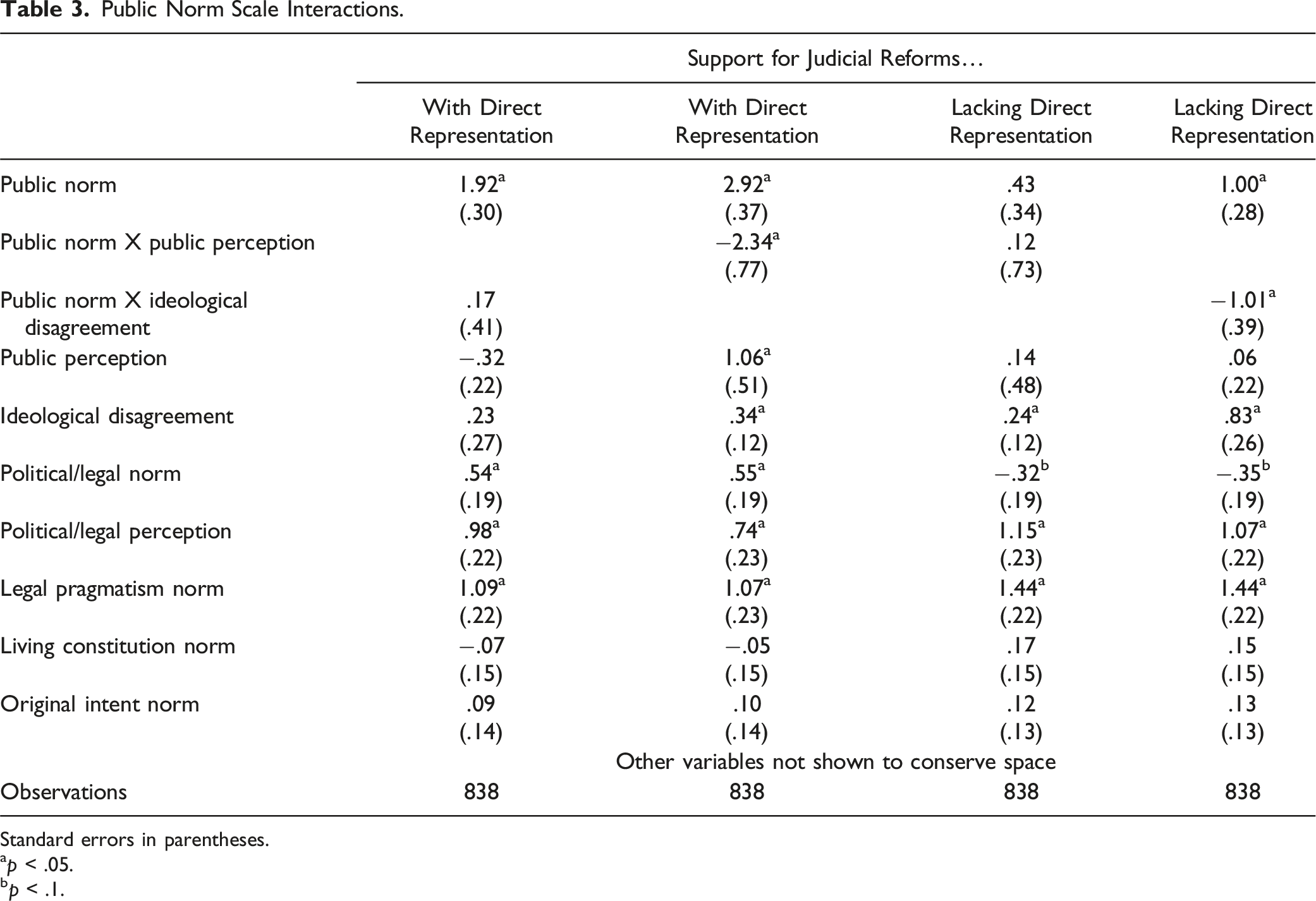
Public Norm Scale Interactions.
Standard errors in parentheses.
ap < .05.
bp < .1.
Figure 2 provides further insight into these results by showing the predicted probability of consistently supporting this category of reforms for both those at the fifth percentile and 95th percentile of the public norm scale, across the complete range of the public perceptions scale.
9
A respondent is considered to be consistently supporting this category of reform if they score 10 or higher on the additive index of support for reforms with direct representation. A score of 10 represents someone who somewhat supports the two reforms with four-points scales (decision-recall referendum and retention elections) and supports multi-candidate elections. Public norm, public perception and reforms with direct representation.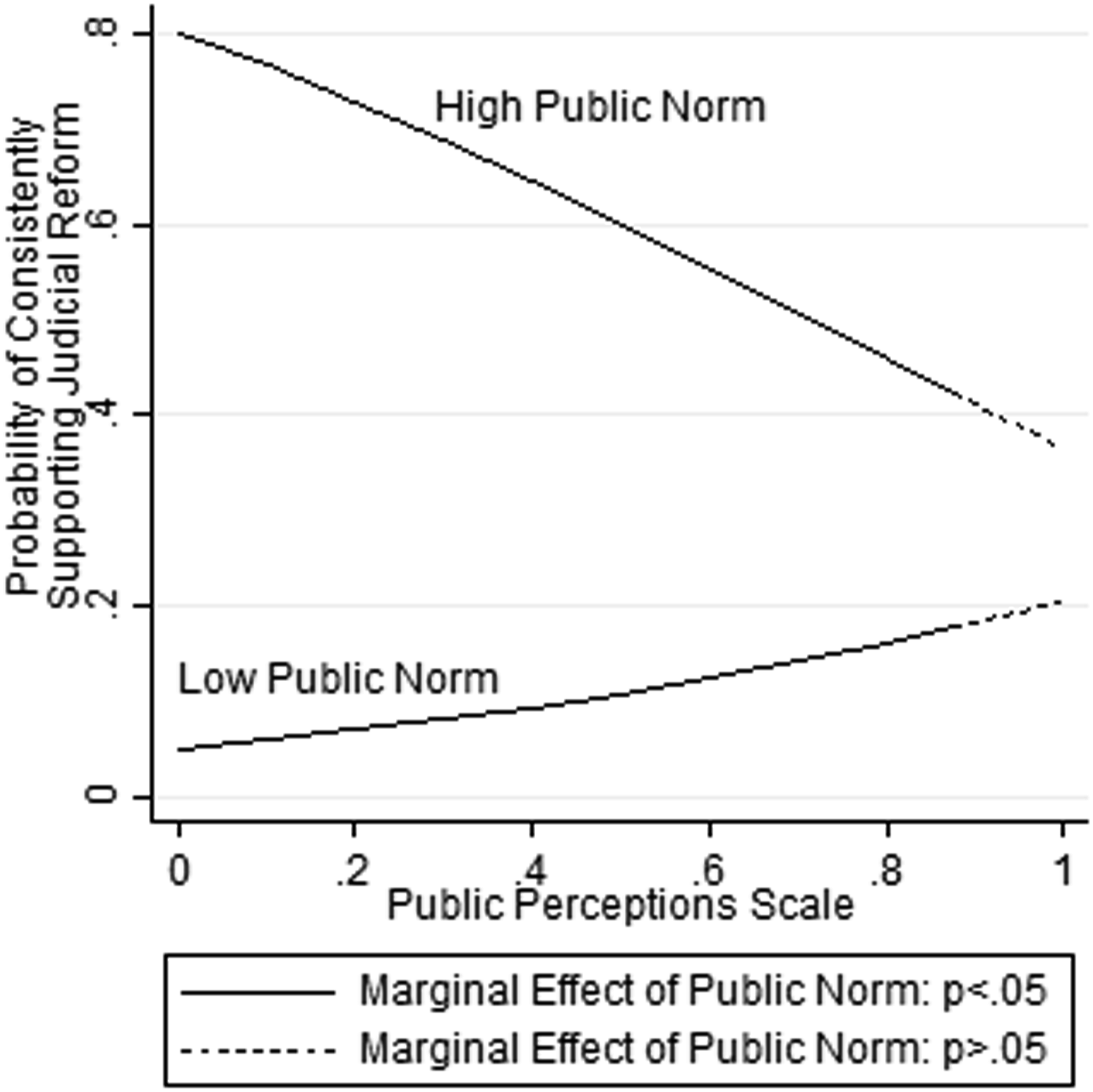
The figure shows that when the public perceives the Court as not following public opinion the public norm scale has a large and statistically significant effect on support for this category of reforms. For those scoring 0 on the public perception scale, the predicted probability of consistently supporting reform is 5% at the fifth percentile of the public norm scale and 80% at the 95th percentile. At the highest level of the public perception scale, the marginal effect becomes statistically insignificant, shifting from 20% at low levels of the public norm scale to 37% at high levels. However, the distribution of the public perception scale is skewed, with only 6% of the respondents scoring higher than .69 on that scale. When the public perception scale is set at .69, the predicted probability of consistently supporting reform moves from .14 at low levels of the public norm scale to .51 at high levels.
These results confirm two important aspects of how the public norm scale affects support for reforms with direct representation. First, the public norm scale affects support regardless of whether someone generally agrees or disagrees with the Court. The centrality of process concerns is reemphasized by the results from the second interaction between the public norm scale and the public perceptions scale. While the public norm scale has a positive effect for virtually everyone, the magnitude of that effect decreases the more someone perceives the Court as already following public opinion. This finding makes sense as someone who already perceives the Court as following public opinion would be less motivated to pass reforms to change a Court that is already to some degree following their preferred process. However, as will become important in the discussion below, even at the high end of the distribution for the public perception scale (.69), slightly more than half of those at the high end of the public norm scale were predicted to consistently support judicial reform.
We now shift to examining the two interactions in models with support for reforms lacking direct representation. Column 3 contains the model that interacts the public norm scale with the public perception scale. Since the interaction coefficient is insignificant that means the marginal effect of the public norm scale is consistent and positive across all levels of the public perception scale. Column 4 contains the model with the interaction between the public norm scale and ideological disagreement. The interaction is negative and statistically significant. This when combined with the constituent terms indicates that the marginal effect of the public norm is positive and statistically significant for those at 0 and .5 on the ideological disagreement scale. It becomes insignificant (p > .05) for those at 1 on the scale. 10 The contrasting patterns of statistical significance for the interaction coefficients between the two categories of reform once again show that the public evaluates them using different criteria.
Figure 3 provides further insight into the interaction between the public norm scale and ideological disagreement, showing the predicted probability of someone consistently supporting this category of judicial reform across all three levels of the ideological disagreement variable at 5th and 95th percentile of the public norm scale.
11
The first point to note is the relatively flat slope of the line for those high on the public norm scale, with the predicted probabilities ranging between .56 and .61. The difference between these predicted probabilities is insignificant with p > .1, showing that for strong supporters of popular constitutionalism support for this category of reform is unaffected by whether someone agrees or disagrees with the Court. For those low on the public norm scale – that is those who prefer a legalistic court – ideological disagreement has a strong effect that is significant at p < .05. When someone agrees with the Court, the predicted probability of consistently supporting reform is .28, and that rises to .56 for those at the highest level of disagreement. Public norm, ideological disagreement and reforms lacking direct representation.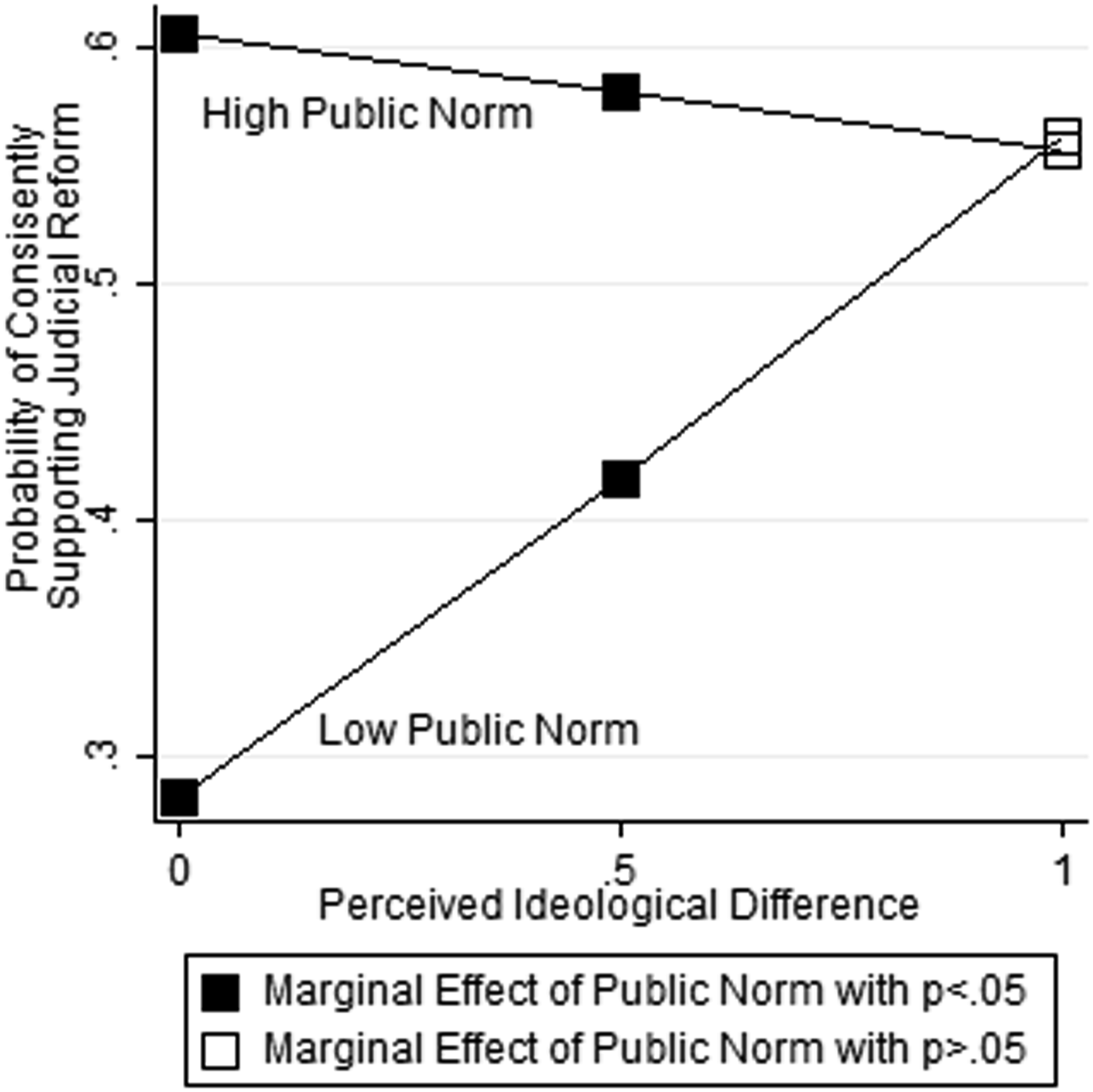
The interactive models in Table 3 allow two conclusions to be drawn about the relationship between popular constitutionalism and support for judicial reform. First, the effect of the public norm scale is not concentrated among those who disagree with the Court’s policy, showing that popular constitutionalists have sincere views on process that are not the result of reverse causation in which people disagree with the Court and that causes them to both support reform and desire a more representative Court. For the reforms involving direct representation, the interaction between the public norm scale and ideological disagreement was insignificant, indicating the effect of the public norm scale was similar for both those who agree and disagree. For the reforms lacking direct representation, the results were more striking, with ideological disagreement having no effect for those high on the public norm scale, showing that popular constitutionalists are more concerned about process than policy. Ideological disagreement increased support for this type of reform only among those desiring a legalistic Court.
Second, those high on the public norm scale supported all types of reforms but had the highest level of support for reforms with direct representation when they perceived the Court as not following public opinion. These popular constitutionalists consistently supported reforms lacking direct representation between 56% and 61% of the time. One potential explanation is that those who desire a representative Court will always have some base level of support for reforming a Court whose members virtually always portray it as a legalistic institution. The predicted probability only rises above 61% when all three of the following conditions are met: someone is high on the public norm scale, the reforms provide direct representation, and that person perceives the Court as not following public opinion. This is exactly what we would expect to find if popular constitutionalists are supporting these reforms to bring the Court more in line with their preferred normative expectations concerning the Court’s decision-making process.
6. Conclusion
The existing research on why the public exhibits consistently high levels of support for judicial reform concentrates on how displeasing policy decisions (Bartels & Johnston, 2020), or the expectation of them (Braman, 2023; Black et al., 2023; Clark & Kastellec, 2015), cause the public to support judicial reform. We do not dispute that conclusion but rather present evidence that process matters as well. That the process Justices use to make decisions influences support for judicial reform should not be surprising. Scholars and activists have long advocated for judicial reform based on calls to depoliticize the Court (Epps & Sitaraman, 2019; Voorhees, 1975). The strong association between support for judicial reform and the political/legal perception scale in our analysis provides the first direct empirical evidence confirming the conventional wisdom that the public also desires reform to fix what they perceive as a broken, overly politicized Court.
Other recent studies have shown that diffuse support for the Supreme Court has become polarized along ideological lines (Davis & Hitt, 2024; Strother & Gadarian, 2022), and that policy agreement with high profile decisions about the Affordable Care Act and abortion affects support for curbing the Court’s authority (Gadarian & Strother, 2023). But in asking respondents about their preferences for and perceptions of the Court without priming them to think about a specific issue, our study taps into more ingrained attitudes towards the Court and support for judicial reforms that go beyond a reaction to a specific decision.
Support for reform though is not based solely on the perception that the Court is doing something wrong - whether making displeasing decisions or acting in a politicized manner. Support is also based on a person’s normative preference for the process the Court should use to make decisions. The strong association between the public norm scale and support for reform shows that those who support the doctrine of popular constitutionalism desire reform as a means to make the Court more representative, even when controlling for perceptions of a politicized court. The analysis revealed a sharp distinction between those reforms involving direct representation – decision-recall referendum, retention elections, and multi-candidate elections – and those lacking direct representational mechanisms – term limits, mandatory retirement age, and super-majority requirement. The public norm scale had a much stronger effect on support for reforms involving direct representation, providing further evidence that popular constitutionalists desire reform as a means to make the Court more representative. Importantly, this desire for reform is not based on backlash towards the Court’s decisions, as popular constitutionalists support reforming the Court even when they do not perceive the Court as being ideologically incongruent.
The other normative preference with a consistent effect is the doctrine of legal pragmatism, which was the only variable to significantly affect all six reforms. In desiring a Court that considers the effects of their rulings rather than relying on abstract judicial philosophies, legal pragmatists may be signaling the desire for a Court that operates more like the other political branches. This explains why they support a variety of reforms to restrict the behavior of judges in ways that are similar to the restrictions placed on the political branches. The lack of consistent effects for the more salient legal doctrines like living constitutionalism and originalism reinforces the notion that the public is generally not concerned with the details of the legal philosophies utilized by the Court. Rather, what concerns the public and induces them to support judicial reform is the desire to see a representative Court that makes pragmatic policy decisions that provide the most possible benefit to the country.
These findings are important for understanding how to attract public support for judicial reforms. Democratic politicians have recently advocated for reforms to the judiciary in response to the constitutional hardball played by Republicans during recent Supreme Court nominations and a series of conservative rulings overturning precedent by the current Supreme Court (Lillis & Schnell, 2024). According to our results, this type of rhetoric should be effective in building support for reform, but may have limited utility beyond the partisan bases of each party. Pro-reform arguments accusing the Court of being overly politicized almost necessarily involve saying the Court favors one side or the other. This is similar to how any arguments for reform based on the displeasing policy decisions almost always involve an ideological and partisan dimension. For example, many Democratic politicians currently argue for reform by saying the Court has become too partisan and ideological, but these calls for reform will certainly be seen by Republicans and others as attempt to politicize the Court and move it in a liberal direction. This could help explain why expanding the size of the Supreme Court remains unpopular despite the fact that a majority of polling respondents feel the Court is out of touch and support other types of reforms (Monmouth Poll Reports, 2022).
Arguments centered around the Court representing the public, worrying less about strict legal doctrines, and doing what is best for the country have a better chance to build broad support for reform that crosses party and ideological lines. These arguments do not involve accusations of a partisan court favoring one side of the political spectrum. Instead, they are based around an aspiration for a different type of Court that represents the public, and evidence shows substantial portions of the public desire that type of Court (Gibson & Caldeira, 2009; Scheb & Lyons, 2001). Reforms meant to appeal to them could expand the coalition of reform supporters beyond those who strongly disagree with the policy of a Court they see as politicized to include a new group of people. These popular constitutionalists may be ambivalent about the Court - or even ideologically agree with it - but still support reform because of their desire for a more representative and pragmatic Court.
Supplemental Material
Supplemental Material - Popular Constitutionalism, Legal Pragmatism, and Support for Judicial Reform
Supplemental Material for Popular Constitutionalism, Legal Pragmatism, and Support for Judicial Reform by Benjamin W. Woodson and Christopher M. Parker in Journal of Law & Empirical Analysis
Footnotes
Acknowledgments
We would like to thank the attendees of a panel at the 2024 Annual Meeting of Midwest Political Science Association for their thoughtful comments on a previous version of this paper.
Declaration of Conflicting Interests
The author(s) declared no potential conflicts of interest with respect to the research, authorship, and/or publication of this article.
Funding
The author(s) disclosed receipt of the following financial support for the research, authorship, and/or publication of this article: This project was funded through a Bernarndin and Haskell Research Development Grant from the University of Missouri-Kansas City.

Supplemental Material
Supplemental material for this article is available online.
Notes
References
Supplementary Material
Please find the following supplemental material available below.
For Open Access articles published under a Creative Commons License, all supplemental material carries the same license as the article it is associated with.
For non-Open Access articles published, all supplemental material carries a non-exclusive license, and permission requests for re-use of supplemental material or any part of supplemental material shall be sent directly to the copyright owner as specified in the copyright notice associated with the article.
