



Abstract
Although research suggests that countries’ colonial experiences are associated with a range of contemporary outcomes, the link between colonial experiences and the substance of countries’ laws remains unclear. We explore this question while making four improvements over past research. First, we use more detailed data on both countries’ colonial experiences and contemporary substantive laws. Second, we directly assess whether countries’ shared legal origins—that is, whether they had a common law or civil law system—or their colonial origins—that is, which country had previously colonized them—are more associated with differences in their contemporary laws. Third, we use a research design that makes it possible to assess the relationship between countries’ colonial experiences across different areas while accounting for differences in the measurement and coding of those laws. Fourth, we explore how the evolution of these relationships over time. We find that countries with shared colonial experiences have greater agreement in the substance of their contemporary laws compared to countries without shared colonial experiences; however, the effect is roughly twice as large for countries with shared colonial origins compared to those with shared legal origins. Moreover, this relationship is largely consistent across types of legal origins and groups of former colonies.
Introduction
The vast majority of independent countries in the world today were, at one point, colonized by other countries (Klerman et al., 2011). Those colonizers usually imposed their legal systems on their colonies. These imposed legal systems supplanted indigenous institutions and laws, and they primarily served the colonial powers’ interest in controlling local populations.
A large body of research has argued that countries’ “colonial experiences” 1 have had long-lasting and profound effects that can be readily observed in a range of contemporary outcomes. 2 For example, research has suggested that the initial institutions that settlers brought with them put countries on diverging paths that continue to have significant consequences (Acemoglu et al., 2001; Xu, 2019). Another body of research has argued that the legal system exported by the British—the common law—is associated with better outcomes than the legal system exported by other European colonizers—the civil law (Botero et al., 2004; Djankov et al., 2002, 2003a, 2003b, 2008; La Porta et al., 1997, 1998, 1999, 2000, 2004; Mulligan & Shleifer, 2005a, 2005b). And yet another line of research has shown that the very act of “transplantation” of entire legal systems has long-term negative consequences (Berkowitz et al., 2003a, 2003b; Pistor, 2002).
But despite these prominent lines of academic research suggesting that countries’ colonial experiences have had long-lasting consequences, it remains unclear whether countries’ colonial experiences are actually associated with one important modern outcome: the substance of their contemporary laws. This is unclear, in part, because there are widely documented facts that are consistent with the possibilities that the substance of countries’ contemporary laws would, and would not be, associated with their colonial experiences. 3
On the one hand, it is widely observed that countries’ laws can be divided into distinct legal groupings (David & Brierley, 1985; Garoupa & Pargendler, 2014; Glendon et al., 1994; Pargendler, 2012; Zweigert & Kötz, 1998), 4 and that the determinants of these groupings are in large part past colonization. 5 Research in this vein thus suggests that colonization could have created path-dependencies that could lead countries with shared colonial experiences to have similar contemporary laws.
On the other hand, former colonies have had the opportunity to revise their laws, and many important contemporary sources of law—including constitutions, statutes, or court cases—were adopted or decided after colonization ended. Moreover, many areas of law—like antitrust law—largely emerged after most colonization efforts ended. Additionally, there have been increasingly prominent movements to “decolonize” legal systems in the Global South (e.g., Xavier et al., 2021). Moreover, some have speculated that with the rise of international law and supranational organizations, countries have converged upon the same global models (e.g., Boli-Bennett & Meyer, 1980; Glenn, 1993; Markesinis, 1994; Zweigert & Kötz, 1998). It is thus not obvious that countries with similar colonial experiences would have similar contemporary laws.
An empirical literature has explored the relative strengths of these two lines of argument, but it has produced conflicting results. Some studies have found an association between countries’ colonial experiences and their contemporary laws. For instance, Siems (2008) found that countries’ legal families are associated with differences in their shareholder protections (see also Siems, 2016); Chilton and Versteeg (2023) found differences in the numbers of legal rights and duties that common law and civil law countries commit to in their constitution and international legal agreements (see also Law & Versteeg, 2011); and Cope et al. (2022) found that how countries incorporate international law in their domestic legal orders flows from whether they are “monist” or “dualist”, which, in turn, associates with the countries’ colonial experiences.
However, other studies have found that countries’ colonial experiences are not associated with differences in contemporary laws. Most notably, research has suggested that the claimed relationship between having common law legal origins and the substance of countries’ corporate laws, which gave rise to the legal origins literature, is due to errors in coding (Roe, 2006; Spamann, 2009a). Relatedly, Bradford et al. (2021) find that the distinction is relevant for property law, but it does not explain countries’ antitrust laws. Finally, comparativists who study the distinction between civil and common law systems have conjectured that the differences between them lay more in attitudes toward law rather than the substance of the legal rules themselves (Merryman & Pérez-Perdomo, 2007). Thus, even if legal origins matter, it is far from obvious that they explain modern-day legal rules (Spamann, 2024).
In this article, we study the relationship between countries’ colonial experiences and their contemporary laws while improving on existing research on the topic in four ways. The first way is that we use more extensive data than previous research on this subject. Notably, our research takes advantage of the recent empirical turn in comparative law, which has produced detailed coding of a number of substantive areas of law for a wide range of countries (e.g., Spamann, 2015). Our analysis specifically explores nine different areas of contemporary laws: Antitrust Law; Constitutional Rights; Constitutional Core Provisions; Corporate Law; Criminal Law; Foreign Relations Law; Labor Law; Property Law; and Trust Law. 6 These nine areas include both newer and older bodies of law, and they span both public and private law.
The second way we improve on prior research is that we directly explore two hypotheses for why countries’ colonial experiences could be associated with differences in their contemporary laws. 7 The first is the legal origins hypothesis. It holds that the long-term legacy of colonialism lies in whether former colonies received common law or civil law legal system. The different logic of these two systems, in turn, could ensure ongoing similarities, even in newer areas of law. The second is the colonial origins hypothesis. It suggests that the long-term legacy of colonialism tracks colonial lines more closely rather than the broad contours of the civil-common law divide. It suggests that laws are similar among groups that share the same colonizer, and it predicts differences between different civil law systems that had different colonizers. It moreover suggests that such similarities might endure well after the collapse of colonial empires because colonialism created long-term formal networks through which legal information is exchanged.
The third way we improve on prior research is by using a research design that allows for a more direct assessment of the association between colonial experiences and substantive laws. The method used by early studies to test the relationship between countries’ colonial experiences and their legal rules was measuring whether countries with the same type of legal origins had similar scores on a composite index designed to measure the degree of regulation a country had in place in a particular area of law (e.g., La Porta et al., 1997). Bradford et al. (2021) argued that a downside of this approach is that countries could have similar scores on the index, but actually have made very different choices about their laws. 8 Bradford et al. (2021) thus argued for using a method developed in the comparative law literature to measure legal similarity across countries (Bradford et al., 2023; Bradford et al., 2019; Elkins et al., 2008; 2009; Law & Versteeg, 2012). More specifically, Bradford et al. (2021) advocated for studying pairs of countries—which are typically referred to as “dyads”—and then calculating the degree of similarity in each dyad’s substantive laws. We improve on this approach by using by normalizing the coding from multiple datasets coding substantive laws, which makes it possible to change the level of observation from the dyad-level to the dyad-law-level. 9 By doing so, we can directly test whether dyads with the same colonial experiences have higher levels of legal agreement across areas of law.
The fourth way we improve on prior research is by exploring how these patterns have evolved over time. Prior research has focused on exploring these relationships at a particular moment in time. However, we leverage several time-series datasets and variations in when countries gained independence to be able to move beyond only examining cross-sectional differences in colonial experience and substantive legal rules.
Using this data and approach, we find that there are enduring relationships between countries’ colonial experiences and their contemporary laws. For instance, we find that countries with shared legal origins have roughly a 0.4 standard deviation greater agreement in the substance of their contemporary laws compared to countries without shared legal origins. But although the association between legal origins and legal substance is substantively large, we find an even greater association with countries’ colonial origins. Notably, we find that countries with shared colonial origins have roughly a 0.7 standard deviation greater agreement in the substance of their contemporary laws compared to countries without shared colonial origins. These results thus provide initial support for the idea that the colonial origins hypothesis may be a better explanation of any correlation between countries’ colonial experiences and their contemporary laws.
To further explore the relative support for the legal origins and colonial origins hypotheses, we follow Klerman et al. (2011) by taking advantage of the fact that many countries with the same legal origins do not have the same colonial origins. We thus break down countries into four categories: (1) countries with neither shared legal origins nor shared colonial origins; (2) countries with shared legal origins but without shared colonial origins; (3) countries without shared legal origins but with shared colonial origins; and (4) countries with both shared legal origins and colonial origins. When breaking out countries in this way, we find that countries with only shared legal origins have roughly a 0.3 standard deviation higher level of legal agreement than countries without either kind of shared origins, but that countries with only shared colonial origins have roughly a 0.7 standard deviation higher level of legal agreement than countries without either kind of shared origins. In other words, shared colonial origins are associated with a roughly two-and-a-half times greater level of agreement than shared legal origins. This supports the colonial origins hypothesis and suggests that the connection between a country’s colonial experience and its contemporary laws may be attributable to ongoing relationships with former colonizers and fellow colonies (e.g., Spamann (2009b), rather than the type of legal systems imposed during colonization.
After documenting these basic patterns, we next explore how these results differ across areas of law and over time. We first explore differences in these associations across the nine substantive areas of law included in our data. For instance, for constitutional rights, property, and foreign relations law, we find that countries with shared colonial origins have notably larger levels of agreement on contemporary laws than countries without shared colonial origins. In contrast, contemporary legal agreement among countries with shared colonial experiences is much lower for other areas of law, like labor law or antitrust law. That said, the correlation between countries’ colonial experiences and their contemporary criminal law (primarily measured by the severity of criminal sanctions) is also low, which is perhaps surprising given that it is an older area of law like property law. More research is needed, however, to fully explore the drivers of any differences between colonial experiences and legal substance by specific legal areas.
We then explore how these relationships have evolved over the second half of the twentieth century. To do so, we leverage the fact that four of the legal datasets—Antitrust Law, Constitutional Rights, Constitutional Core Provisions, and Foreign Relations Law—were collected as panel datasets. When pooling these four datasets, we again find that shared colonial origins are a larger predictor of legal similarity than shared legal origins throughout the second half of the twentieth century. However, this overall result masks important differences across legal areas. For instance, countries with shared colonial origins have more similar Constitutional Rights and Foreign Relations Laws across all years, but countries with shared colonial origins did not have more similar Antirust Laws throughout much of the post-war period. In addition, we also show that countries that have had independence from former colonies for longer periods of time have lower levels of legal agreement with their former colonies, and that countries that gained independence closer in time have higher levels of legal agreement. These results suggest that legal convergence or divergence across countries is more complicated than a simple story that legal regimes have become more similar over time, and by doing so highlight the need for greater research into how legal regimes evolve.
The next part provides background on how countries’ laws may be influenced by their colonial experiences while outlining the two competing hypotheses described above. Then we describes the dataset compiled and how we transformed it for this project, which is followed by a part that reports our results showing the relationship between countries’ colonial experiences and their contemporary laws. The penultimate part explores how these relationships differ across areas of law and across time. Finally, we discuss the results and conclude.
Competing Hypotheses
The goal of our project is to build on existing research exploring the relationship between colonial experiences and contemporary legal substance. As we noted above, however, even if countries’ colonial experiences are associated with differences in their contemporary laws, there are at least two competing mechanisms that could explain that relationship. First, a major legacy of colonialism is whether countries have a common law or civil law legal system, and countries could have similar contemporary laws due to the nature of their legal systems. 10 Second, the legacy of colonialism could more closely track relationships with specific colonial powers, and countries could have similar contemporary laws due to ongoing relationships with former colonizers and fellow colonies. Below we explain these two hypotheses and the existing support for them.
The Legal Origins Hypothesis
According to one line of thought, an important thing colonial powers carried with them that could lead to similar contemporary laws is their type of legal system. This is what we call the “Legal Origins hypothesis.” Specifically, the British exported the common law legal systems to their former colonies, while the French, Spanish, Dutch, Belgians, and Portuguese exported the civil law legal system. A key starting point of the legal origins hypothesis is that there are important differences between the common law and civil law legal systems. A simplified (though arguably a caricature) description of those differences is as follows.
In the civil law tradition, the primary source of law is the civil code enacted by the legislature (Merryman & Pérez-Perdomo, 2007). In this tradition, not only is law formally codified, civil law legal codes tend to have a somewhat revolutionary character: they seek to supplant all law that preceded the adoption of the civil code (Hayek, 2000 [1960]). This civil code is rationally designed and intended to be complete, so judges do not have to make law while interpreting it (Legrand, 1996, p. 66). As a result, precedents are typically not recognized as a de jure source of law in the civil law tradition. Judges merely apply the law, and, as a result, their decisions are typically short and typically do not include dissenting opinions. Instead, there is an important role for legal scholars in explaining how different judicial decisions fit together. What is more, the civil law tradition is based on a strict hierarchy of sources: each source of law must trace its authority to a higher source of law, with the constitution (or international law) at the top of the hierarchy (Kelsen, 1960a, 1960b).
By contrast, common law is first and foremost judge-made. Unlike civil law, where civil codes are designed in a single act by the legislature, the common law emerges gradually, one set of facts and one decision at a time. Common law also does not try to anticipate all circumstances in advance. The key figure in the common law tradition is judges, who make sure law is not arbitrary by providing well-reasoned decisions that build on prior precedents. The legal reasoning judges are meant to engage in is based on empirical facts and analogies, not generalizations and classifications without regard to the specific facts (Legrand, 1996). As the American Justice Oliver Wendel Holmes put it, “the life of the common law has not been logic; it has been experience” (Holmes, 1881). For these reasons, the common law tradition has been described as more “empirical,” or based on evolution, not revolution (Hayek, 2000 [1960]; Legrand, 1996).
Of course, sophisticated lawyers know that the picture is substantially more complicated than these brief descriptions suggest. Common law countries also have codes, and civil law countries do, in fact, recognize prior judicial decisions, even when judicial decisions themselves do not indicate so (Roe, 2006). It is not clear that civil law judges in fact reason and decide differently (Spamann et al., 2021). And in some areas of law, the distinction may not have much relevance at all. For example, it is a commonly held sentiment that constitutional law transcends the traditional common law-civil law divide (e.g., Chang & Yeh, 2012; Hirschl, 2014; Weinrib, 2007). In the same vein, it is not obvious why the distinction would matter to other areas of law that emerged post-colonization, like labor law, corporate law, or antitrust.
Nonetheless, because of these inherent differences between these two legal systems, there may be substantively similar rules within the two traditions and different rules between them. Legrand (1996, p. 65), for example, observes that the radically different modes of making and interpreting the law between common law and civil law countries means that “the obligations, a law of property or a public law can never mean in England what it does on the Continent.” Legrand (1996) speculates that it is because the common law approach is based on analogies rooted in facts rather than ex-ante abstract categories. In a similar vein, Posner (1973) argued that the judge-made common law will produce different and more efficient legal rules than the code-based civil law (see also Chang, 2023a; Niblett, 2017; Niblett et al., 2010). Importantly, the core of the claim in these arguments is that different ways of “doing law” will lead to different substantive legal rules. 11
This line of argument also suggests that these differences will continue to matter over time. The intrinsically different logics of the common law and civil systems mean that these systems will find their own solutions to new legal questions, meaning that similarities will persist within legal families and differences will continue between them. As Legrand (1996, p. 65) puts it, the “irreducible differences” between common law and civil law systems mean that “a lawyer brought up within a system of judge-made law has a legal outlook utterly different from one who has grown up within a codified system.” For this reason, Legrand (1996) suggests that common and civil law legal systems are unlikely to converge. Instead, they will each continue on their own paths.
The Colonial Origins Hypothesis
A competing hypothesis is that the enduring legacy of colonialism tracks the identity of the specific colonial occupier more closely than the broad-brush distinction between common law and civil law systems (Klerman et al., 2011). The idea here is that there are relevant differences in the colonial experiences of civil law countries that were colonized by different colonial powers. In other words, although the French, Spanish, Portuguese, Dutch, and Belgian all share the French civil law system, there are important differences in how they administered their colonies and their continuing relationships with their former colonies.
One reason for this relationship is that civil codes, which spread in Europe through Napoleon’s conquest, are different for different European powers. Consistent with this reality, legal scholars have increasingly challenged the description of the French civil code as the “continental model code” (Masferrer, 2018). The difference between the revolutionary French civil code and Von Savigny’s more historically oriented German code has been well-documented, to the point that the legal origins literature has created a separate category for German legal origins. But legal scholars have pointed out that there were also important differences between other countries’ civil codes. For instance, unlike the French civil code which attempts at full legal unification, the Spanish civil code gives primacy to regional laws and recognizes prior custom (Masferrer, 2018). Likewise, while the Dutch civil code was undoubtedly influenced by the French, Dutch lawmakers made many changes to accommodate prior Roman-Dutch law (Meijer & Meijer, 2002).
In other areas of law, the differences might have been even more pronounced. The French Constitution and Spanish Constitution during the colonial era were far from identical, and when constitution-making commenced in former colonies, drafters looked to the former colonizer for inspiration. Post-independence, Latin American constitution-makers were heavily influenced by the 1812 Spanish Cadiz constitution and subsequent constitutional developments in Spain (as well as the United States) (Billias, 2010; Elkins, 2009). By contrast, constitution-makers in Francophone Africa borrowed extensively from the 1958 French Constitution, adopting institutions wholesale like the Gaullist system of government with a strong president or the limited form of judicial review through a Constitutional Council. Thus, constitution-making followed a world of empire, more than that it tracked the civil law or common law (Go, 2003).
The same is true for the status of international law in the domestic legal order. Latin American countries again not only borrowed from Spain, but they also borrowed from the United States (Cope et al., 2022). Specifically, they blended the Spanish approach to treaty ratification with the U.S. Supremacy clause that gave ratified treaties direct effects. Former French colonies again borrowed from France, including its approach to requiring parliamentary approval for certain types of treaties but also its requirement that the Constitutional Council can review the constitutionality of treaties before they enter into force (Cope et al., 2022). Thus, while both former French and Spanish colonies were broadly monist in their approach to international law, there were differences between them.
That said, the laws that were initially exported to the colonies did not necessarily match those of the former colonizer itself. Or, put another way, there was a wide persistence of legal pluralism in imperial legal expansion (Burset, 2019). 12 For example, Britain did not export their legal institutions homogenously around the world (Burset, 2023). Instead, not all former British colonies were subject to the common law in the same degree of importation or transplantation (Daniels et al., 2011). The degree of transportation of the common law system depended on resources, geography, local population, costs of colonization, and previous institutions (Burset, 2019). 13 As a result, some colonies were fully common law legal systems in the British tradition, while other colonies experienced a blend of common law with other local traditions or strategic innovations (Cairns, 2022). 14 Similarly, legal pluralism also exists in the context of former French, Dutch, Belgian, Portuguese, or Spanish colonies. 15 Although these European imperial powers were largely defeated by the British Empire at different points in time, they inevitably engaged in legal pluralism as a function of their distinct colonial strategic challenges and specificities (Miller, 2011).
To illustrate the previous point, consider the following experience: the British were heavily involved in the writing of the independence constitutions of most of their former colonies (Parkinson, 2007). As part of that process, they drafted a boilerplate bill of rights that was inserted in Nigeria’s independence constitution and all former colonies that became independent afterwards (Chilton & Versteeg, 2020; Parkinson, 2007). These independence constitutions also gave courts the power of judicial review based on this bill of rights. The legal export was notable, as the British themselves had neither a bill of rights nor judicial review.
There are also important reasons to believe that these colonial relationships continued to be important post-independence. Notably, scholars have observed that colonial relationships produced lasting networks through which legal information is exchanged. Spamann (2009b) points at the importance of formal legal aid organizations that provide legal advice and draft model laws and legislation. These organizations track colonial lines. Common law countries interact in the Commonwealth, which has several formal settings for the exchange of legal information, most notably the Privy Council. Commonwealth countries further receive legal development assistance from the British Institute of International and Comparative Law (BIICL) and its “commonwealth legal advisory service” (Spamann, 2009b, p. 1846). By contrast, Francophone African countries are assisted by the “Organisation Internationale de la Francophonie” which disseminates legal information, while the French National Magistrates School trains about 3000 judges annually from former French colonies (Spamann, 2009b, p. 1847). The influence in Latin America is more mixed, with a range of European organizations as well as the United States exerting influence.
Legal education also plays an important role in facilitating diffusion along colonial lines. Spamann (2009b), in a quantitative analysis of transnational student flows, finds that colonial origins have the largest effect on student flows, more so than legal origins. Specifically, Spamann (2009b, p. 1851) observes that, after controlling for legal origins, “students from former colonies are twenty-five times more likely to study in a university of the former colonizing power than elsewhere, holding the attraction of host countries fixed.” In the area of international law, Anthea Roberts has argued that the nature of international legal practice is to an important extent shaped by legal education, and that this tracks colonial lines (Roberts, 2017, 2022). Roberts takes issue with Oscar Schachter’s famous description of the professional community of international lawyers as an “invisible college” that is “dispersed throughout the world” but engaged in continuous “communication and collaboration.” Showing data on transnational student flows, Roberts (2022, p. 437) observes that student flows follow linguistic and colonial lines, resulting in “multiple cores and peripheries—an anglophone core, a francophone core, a russophone core, and so forth.”
Substantive legal rules may thus continue to track colonial lines because of such professional networks and legal education. For instance, Spamann (2009b) studies the formal diffusion in corporate law—that is, of citations to foreign sources in statutes and treatises—and confirms the ongoing importance of colonial networks. Specifically, Spamann (2009b) finds that Francophone African countries rely almost entirely on French legal materials in developing their corporate law, while Commonwealth countries rely on the United Kingdom. But Latin American countries’ corporate law reflects a mix of influences, from the U.S. as well as different European countries, including Portugal, Spain, and France. Spamann (2009b) further speculates that these professional networks are likely to correlate with the diffusion of substantive legal rules. 16
Taken together, these insights suggest that even if countries’ legal origins are correlated with their contemporary laws, the mechanism driving any correlation may be due to the specific colonial power and not the nature of the legal system. In other words, countries’ colonial origins—and the ongoing diffusion it facilitates—might be a better explanation for current-day legal similarities than their legal origins.
Data and Methods
To assess the relationship between countries’ colonial experiences and their contemporary laws, we collected data on these topics from a range of sources for as many countries as possible. 17 Below we describe the data we collected for this project and how we transformed that data to create the sample we use for our analysis.
Data Sources
Legal Origins Data
To code countries’ legal origins, our initial starting point is the classifications made by Klerman et al. (2011). We choose to use the classifications from Klerman et al. (2011), rather than the commonly used classifications from La Porta et al. (2008), because their data corrects a number of coding errors that were made in earlier datasets and because it includes two categories of legal origins—Islamic law and Mixed Legal Origins—that were not included in the origins LLSV coding. However, we supplemented the Klerman et al. (2011) data by coding an additional 15 countries that were not included in their dataset. These coding decisions, as well as Klerman et al.’s, are reported in Appendix A. 18
Figure 1 reports countries’ legal origins using this data. As Figure 1 illustrates, we use six types of legal origins initially identified by Klerman et al. (2011) for our analysis. Of those six, the most common is French civil law (with 93 countries), followed by English common law (with 47 countries), German civil law (with 22 countries), Mixed legal origins (with 19 countries), Islamic law (with 7 countries), and Scandinavian civil law (with 5 countries). Legal Origins by Country. Notes. This figure reports countries’ legal origins using the coding methods described in Section 3.1. We specifically rely on Klerman et al. (2011), but then updated their coding to include all countries in our dataset.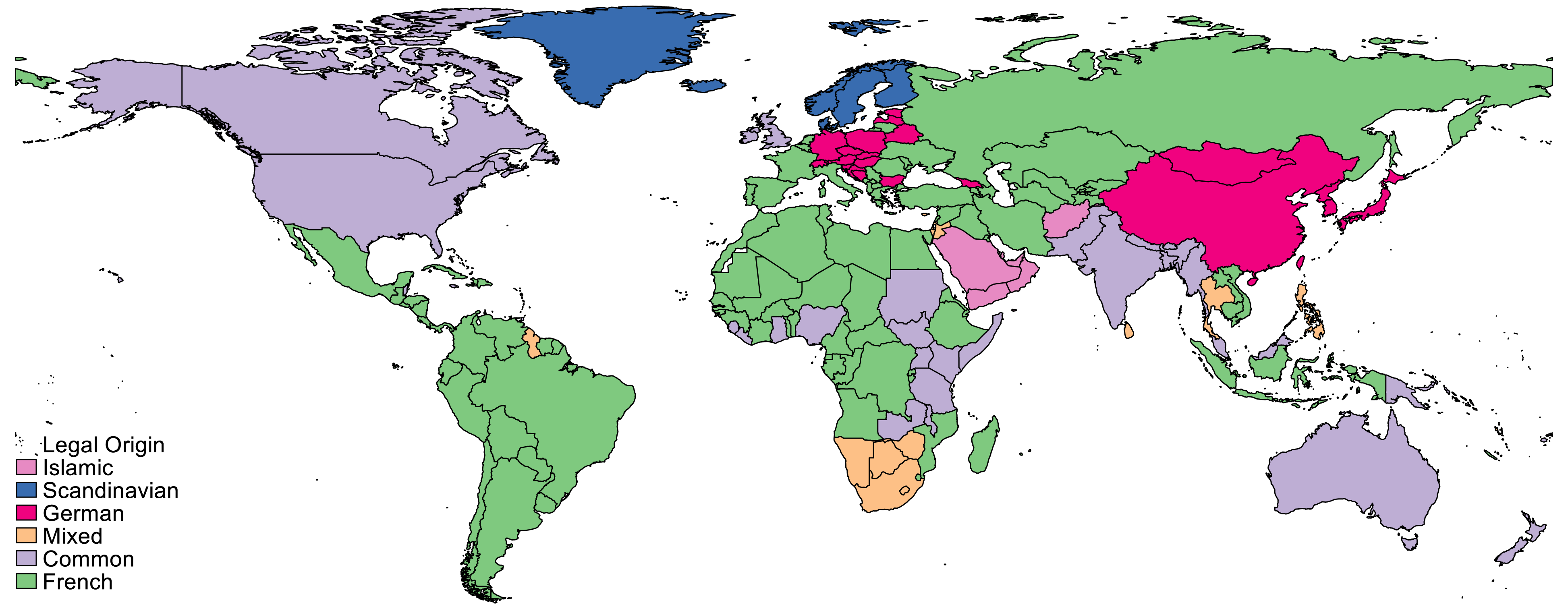
Colonial Origin Data
To code countries’ colonial origins, our initial starting point is also the classifications made by Klerman et al. (2011). However, we built on the data from Klerman et al. (2011) in two ways. First, like with countries’ legal origins, Klerman et al. (2011) did not code the colonial origins of every country. 19 We consulted several sources, primarily Wimmer and Min (2006), to code the colonizers of countries not included in their dataset. Second, Klerman et al. (2011) included a category called “Other French Civil Law.” After consulting Wimmer and Min (2006) and other sources, we re-coded the countries in this category as being colonized by Belgium, Italy, the Netherlands, Portugal, Russia, Spain, or Turkey. 20 By further breaking down countries in this way, our data on countries’ colonial origins is more granular than what has previously been used to study this question. These coding decisions are also fully reported in Appendix A.
Figure 2 reports countries’ colonial origins using this data. As Figure 2 reveals, among the 193 independent countries that appear in our data, 28 countries have not been colonized. Of the countries that have been colonized in the past, the most common former colonizer was England (with 51 countries), followed by France (with 28 countries), Spain (with 20 countries), Russia (with 15 countries), Turkey (with 15 countries), Portugal (with 7 countries), and Austria-Hungary (also with 7 countries). Colonial Origins by Country. Notes. This figure reports countries’ colonial origins using the coding methods described in Section 3.1. We specifically rely on Klerman et al. (2011), but then updated their coding to include all countries in our dataset and also further divided their data on “other French civil law” colonies to identify the specific colonizer.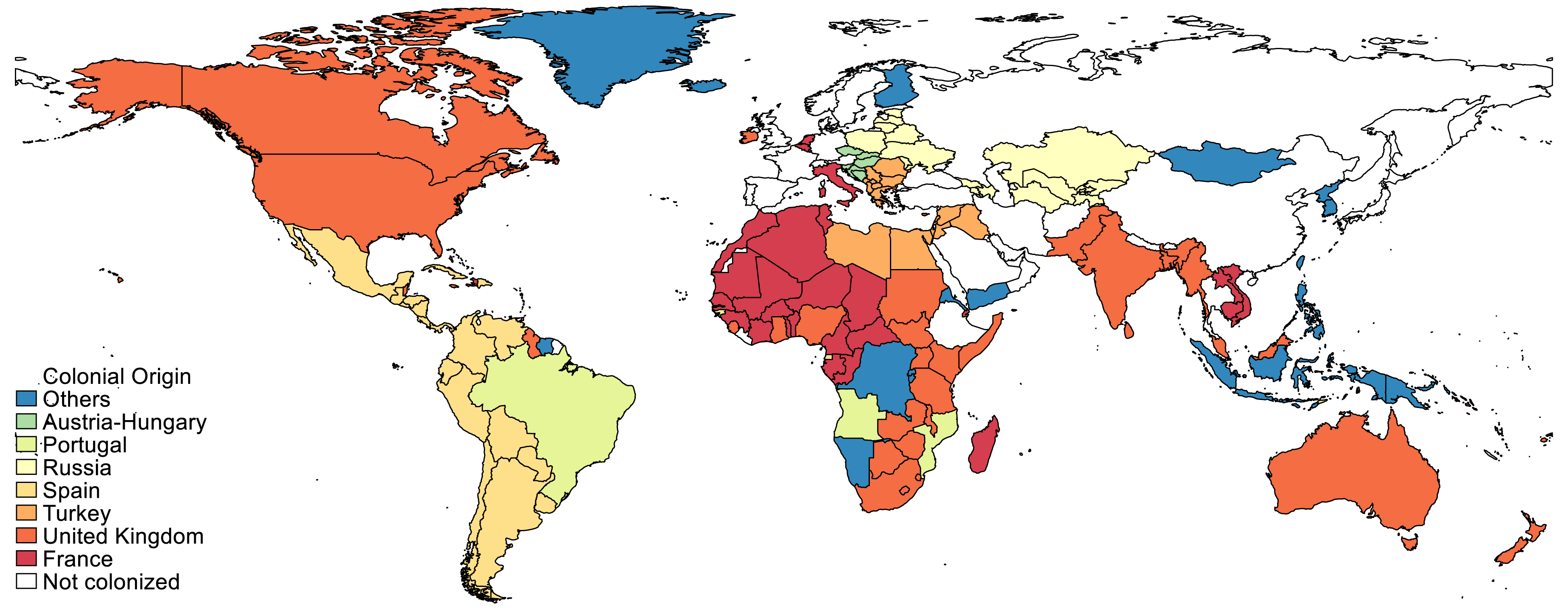
Other colonizers, including Japan, Belgium, China, Denmark, Italy, the Netherlands, and the U.S., colonized three or fewer countries. For graphical clarity, these small-scale colonizers are lumped into the “others” category in Figure 2, but in other regression analyses, these colonizers were treated separately—that is, only if both countries in the dyad have been colonized by Japan will the dyad be coded as sharing colonial origin, and a former Japanese colony and a former Chinese colony will be coded as not sharing colonial origin. 21
In addition, several other countries had multiple colonizers, while some countries’ colonizers cannot be easily simplified. Figure 2 also groups these into the “others” category. We did not simplified their colonial history; thus, in our regression analysis, they were treated as if they had not been colonized. These countries take up a tiny fraction of our data set; thus, our decision is unlikely to change the outcome.
Substantive Law Data
Our goal when collecting data on countries’ substantive laws was to identify any publicly available dataset that offers detailed coding on a specific substantive area of law for a wide range of countries. For this exercise, we made the somewhat arbitrary decision to define detailed coding as including at least 10 unique variables on the substance of a single area of law and to define a wide range of countries as at least 40 countries. We were able to identify datasets on nine areas of substantive law that meet these criteria: Antitrust Law, Constitutional Rights, Constitutional Core Provisions, Corporate Law, Criminal Law, Foreign Relations Law, Labor Law, Property Law, and Trust Law. Appendix B provides complete information on the scholars who coded these datasets and the academic works that draw on them.
Overview of Datasets on Substantive Legal Areas.
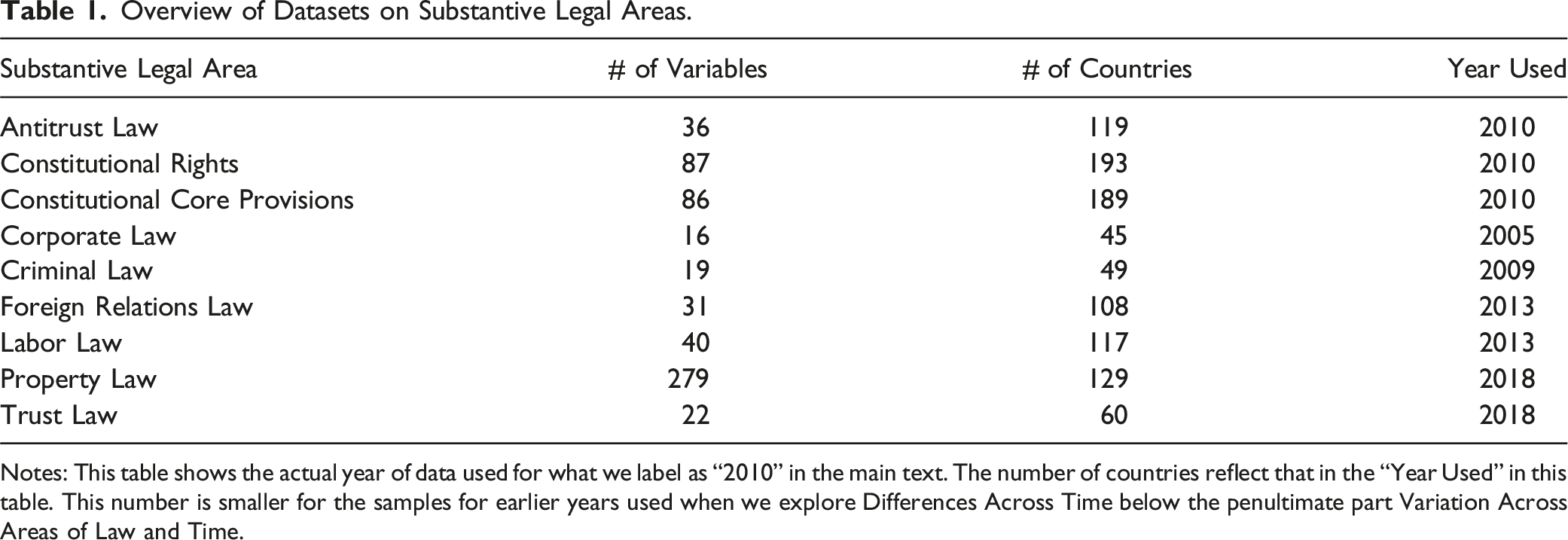
Notes: This table shows the actual year of data used for what we label as “2010” in the main text. The number of countries reflect that in the “Year Used” in this table. This number is smaller for the samples for earlier years used when we explore Differences Across Time below the penultimate part Variation Across Areas of Law and Time.
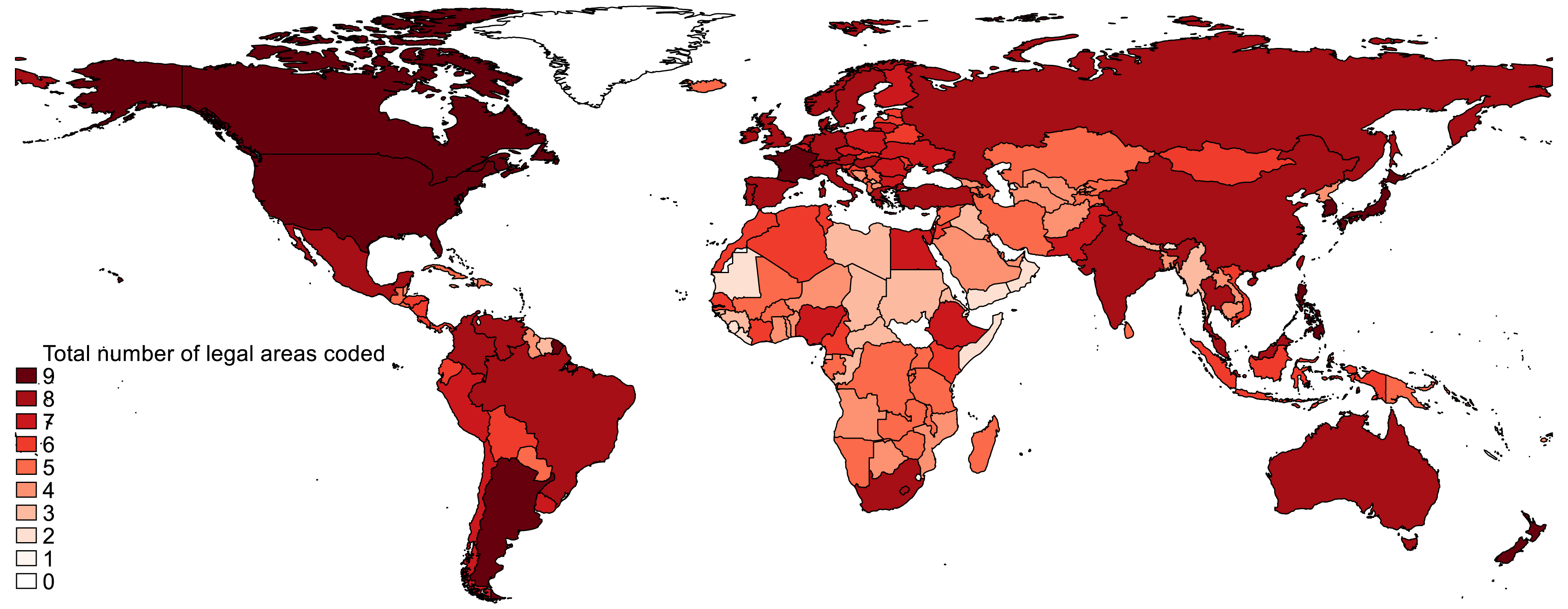
Number of Legal Areas Coded by Country. Notes. This figure reports the number of areas of law substantive law data from Table 1 that are available for each country.
Other Data Sources
In addition to these variables, following Bradford et al. (2021), we also collected six control variables that we use in some of our regression specifications. Four of these control variables are measured at the dyad level: 23 Distance, 24 Contiguity, 25 Common National Language, 26 and Common Ethnic Language. 27 For a few dyads that have missing values in the original data sources, we supplemented the coding based on our own knowledge. The other two control variables are ratios of two variables measured at the country level: Population and Nominal GDP (we specifically calculate the ratio of these two variables by dividing the smaller population by the larger population for each dyad and dividing the smaller GDP by the larger GDP for each dyad). 28
Data Transformation
After compiling this dataset, we had information on the colonial experiences of 193 countries and on 1009 country-laws across the nine substantive legal areas (by country-laws, we mean that Germany’s Antitrust Law is one country-law, Germany’s Property Law is another country-law, and so on). The method we use to assess the relationship between colonial experiences and contemporary laws builds on Bradford et al. (2021). More specifically, we compare pairs of countries’ levels of legal agreement, and we then assess whether these levels of agreement are greater for countries with shared colonial experiences. To make this analysis possible, we used a six-step process to transform our data.
First, we transformed our dataset from having observations at the individual country level to having observations at the pair of country level. This structure is typically referred to as the “dyad-level.” For instance, in this dataset, instead of having observations for China, France, and Germany, it has observations for the dyad of China-Germany, the dyad of China-France, and the dyad of France-Germany. Given that our dataset includes 193 countries, transforming it to the dyad level results in 18,528 ((193*192)/2 = 18,528) observations.
Second, for each dyad, we coded whether they had the same legal origins and the same colonial origins. To do so, we coded dyads as having shared legal origins if both countries in the dyad had the same coding for our data shown in Figure 1, and we coded dyads as having shared colonial origins if both had the same colonial origins reported in Table A.1. Additionally, we also coded any colonizer-colony relationship as having the same colonial origins. For instance, although France is shown as not being colonized in Figure 2, we coded any dyad that included France and a former French colony as having shared French colonial origins.
Third, for the data on the country’s substantive laws, we transformed all non-binary variables into binary variables. For six of the substantive areas, all of the variables were already binary. 29 For the Criminal Law data, however, all but three of the variables are continuous. For this data, for each variable, we re-coded values above the median as 1 and re-coded values at, or below, the media as 0. 30 While transforming continuous variables to binary variables loses information, not transforming them renders the legal agreement variable at the dyad level taking the value of 0 most of the time. For Labor Law and Trust Law, many of the variables were on an ordinal scale. For these variables, we first normalized them to fall between 0 and 1, and we then re-coded values that are 0.5 or larger as 1, whereas those that below 0.5 are re-coded as 0. We did not use the median as the cutoff because some variables’ median is 0 while others is 1. If we consistently use the median as the cutoff and re-classify the value at the median at 0 or 1, some recoded variables become constants (all 0 or all 1). We did not use the mean as the cutoff because the distributions of the values are also skewed, and thus using the mean to re-code an ordinal variable that takes the value of 0, 0.33, 0.67, and 1 may result in recoding the latter three values as 1 (because the original variable has many 0 and thus the mean < 0.33). We read the codebooks of the original data sets and determine that using the midpoint as the cutoff is more reasonable.
Fourth, we calculated the level of agreement for each of the nine substantive areas of law for each dyad. To do so, we calculated the percent of variables for a given substantive area of law when the two countries had the same coding for the variables. For instance, the Property Law dataset contains 279 binary variables. As a result, if China and Germany have the same coding for 200 of those 279 variables (i.e., both are coded as “1” for having a certain property doctrine as part of their law or both are coded as “0” for not having a certain property doctrine as part of their law) and disagree in the remaining 79 variables (i.e., one country has a certain property doctrine while the other does not), the China-Germany dyad’s percentage of agreement in property law is 71.7% (200/279 = 0.717).
Fifth, for each of the nine substantive areas of law, we standardized the percentage of agreement variables we calculated in the previous step of our transformation process. 31 The reason for doing so is that, as Table 1 revealed, the nine datasets coded radically different numbers of variables. For instance, the Corporate Law dataset coded 16 variables while the Property Law dataset coded 279 variables. It is thus possible that there could be differences in the levels of agreement across datasets simply due to the nature of the variables coded (for instance, if a dataset had dozens of variables with very low variation, it may seem like there is a greater agreement in that area of law when there was simply a choice to code more topics without much variation). After we standardized the variables, the mean for each of the nine substantive areas is zero, a value of 1 reflects a one standard deviation higher level of agreement, and a value of −1 reflects a one standard deviation lower level of agreement.
Sixth, after we had calculated the levels of agreement for the nine substantive areas of law at the dyad level, we transformed our dataset so that the unit of analysis is the dyad-law. In other words, each dyad was duplicated so that there is one observation for each area of law that we have coded for both countries in the dyad. For instance, for the China-France dyad, we have one observation for China-France-Antitrust, another observation for China-France-Property, and so on. We made this final transformation so that we can have a single variable—the level of (standardized) legal agreement—that we can use in our analysis. That said, as Table 1 revealed, not all substantive law datasets are available for all countries, such that not all dyads contain the percentages of legal substance agreements in all legal areas. For instance, Germany does not have a trust law, so China-Germany-Trust has a missing value for the percentage of agreement variable. We thus would not have an observation for this dyad-law area. In total, there are 67,897 dyad-law observations in our final dataset.
Results
We now turn to assessing the association between countries’ colonial experiences and the substance of their contemporary laws. We begin by assessing the relationship between countries’ shared legal origins and similarities in their contemporary laws. We then examine the relationship between countries’ shared colonial origins and similarities in their contemporary laws. We then take advantage of the fact that some countries have different legal and colonial origins to compare the relative strength of the two hypotheses. Finally, we evaluate these differences across areas of law.
Legal Origins
We first explore the impact of legal origins on whether countries continue to make similar substantive legal decisions. Figure 4 reports the distribution of dyads’ level of legal agreement broken out by whether they have shared legal origins. To be more specific, Figure 4 is a histogram that plots the level of agreement for all 67,897 dyad-law observations in our complete sample. However, it reports these results separately for the 48,055 dyad-law observations that do not share legal origins and the 19,842 dyad-law observations that do share legal origins. Legal Agreement by Shared Legal Origins. Notes. This figure reports the distribution of legal agreement at the dyad-law level using data on all nine areas of law. These distributions are reported separately for the dyads that do not share legal origins (which are depicted with white boxes with black borders) and for dyads that do share legal origins (which are depicted with pink, shaded boxed without borders). The dashed (black) vertical line reports the mean value for dyads that do not share legal origins and the solid (pink) vertical line reports the mean value for dyads that do share legal origins.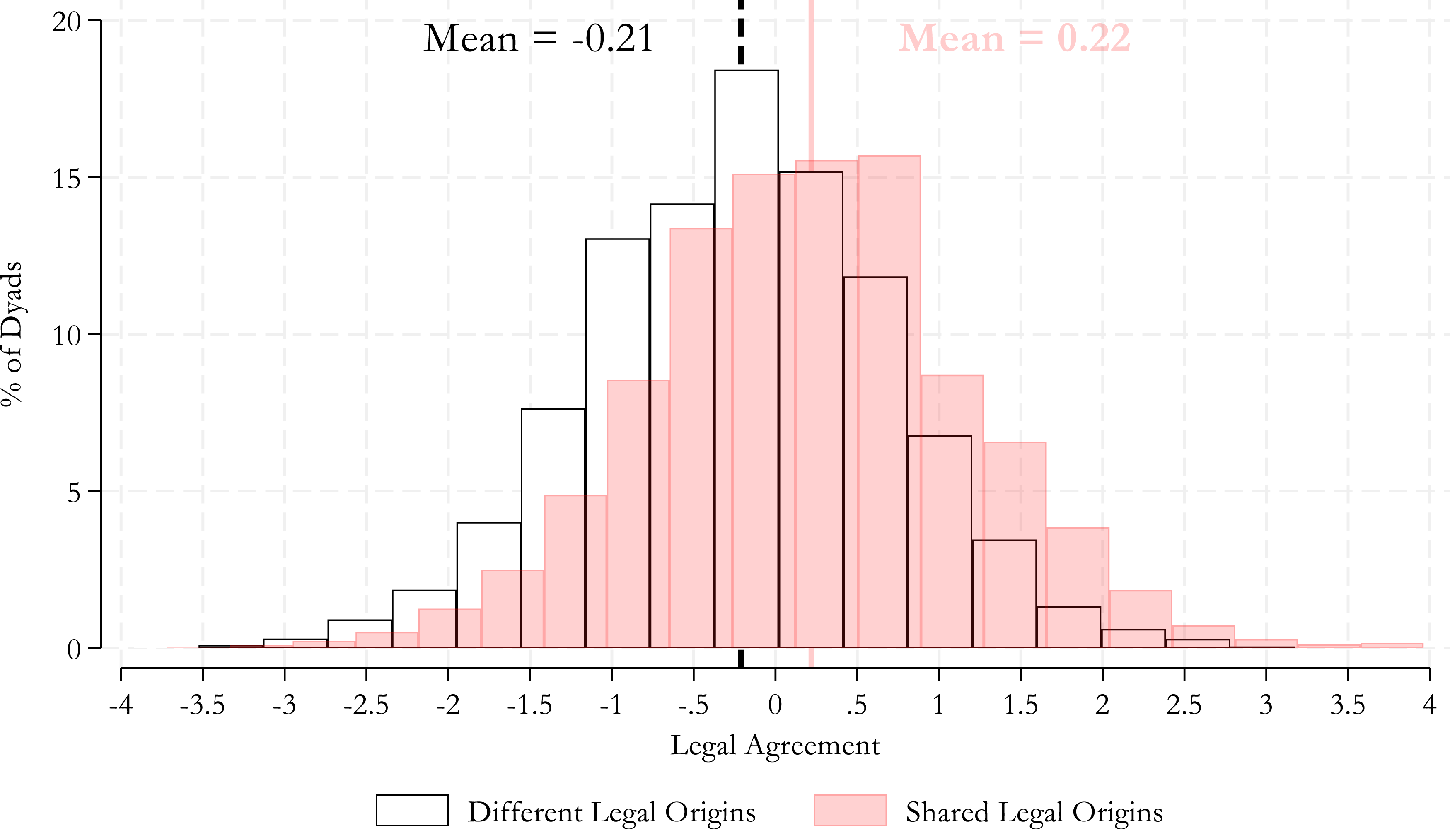
Figure 4 reveals that the dyad-law observations without shared legal origins have an average level of legal agreement of −0.22, but that dyad-law observations that do have shared legal origins have an average level of legal agreement of 0.22. Because our measure of legal agreement is standardized, this difference translates into a 0.44 standard deviation higher level of legal agreement for observations with shared legal origins.
Standard Deviation Change and Corresponding Changes in Legal Agreement.
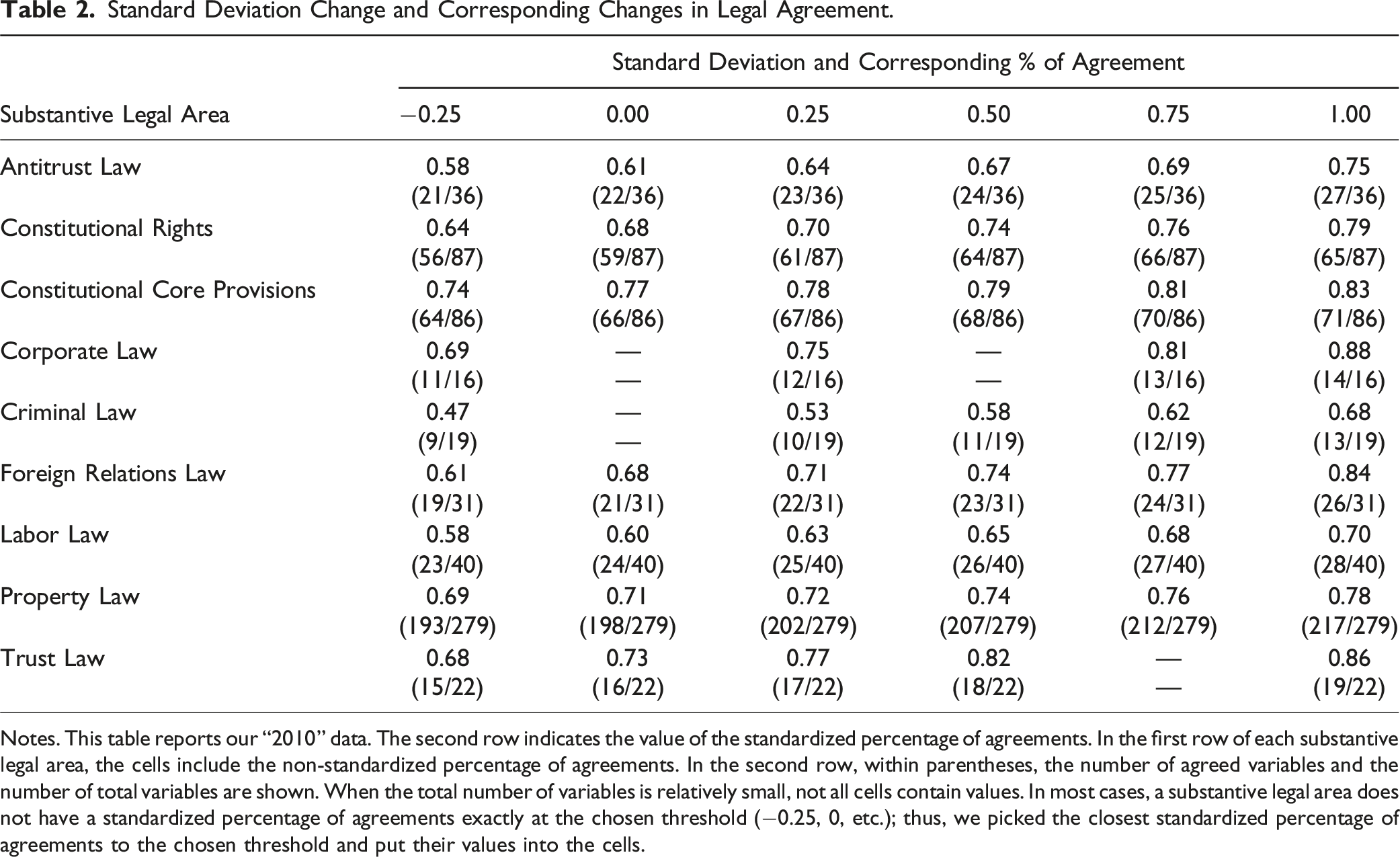
Notes. This table reports our “2010” data. The second row indicates the value of the standardized percentage of agreements. In the first row of each substantive legal area, the cells include the non-standardized percentage of agreements. In the second row, within parentheses, the number of agreed variables and the number of total variables are shown. When the total number of variables is relatively small, not all cells contain values. In most cases, a substantive legal area does not have a standardized percentage of agreements exactly at the chosen threshold (−0.25, 0, etc.); thus, we picked the closest standardized percentage of agreements to the chosen threshold and put their values into the cells.
Regression Results - Legal Agreement and Shared Legal Origins.
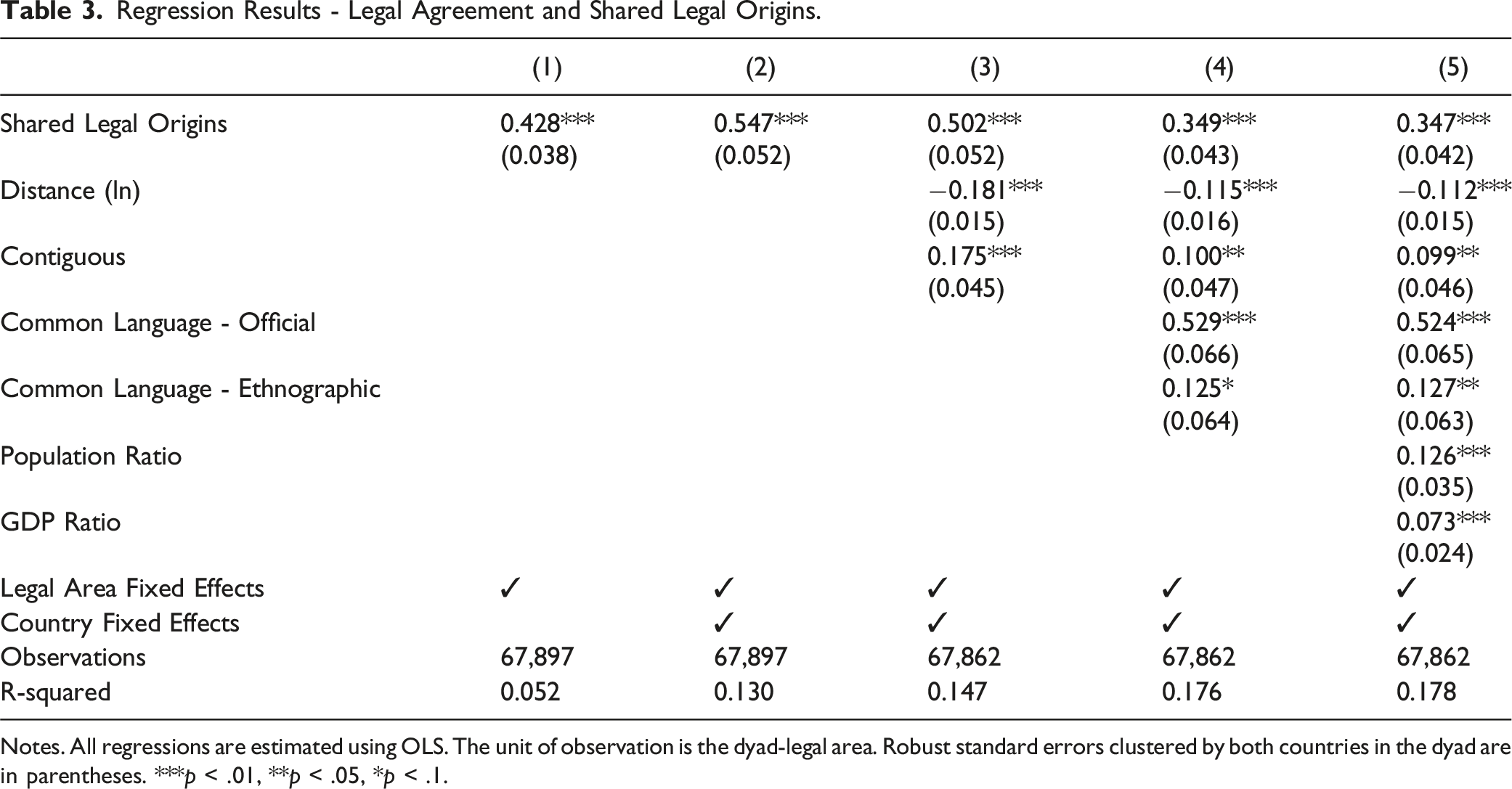
Notes. All regressions are estimated using OLS. The unit of observation is the dyad-legal area. Robust standard errors clustered by both countries in the dyad are in parentheses. ***p < .01, **p < .05, *p < .1.
Across all five specifications in Table 3, the estimates for shared legal origins remain highly statistically significant (p < .01), and the effect sizes range from roughly a third of a standard deviation higher legal agreement (Column 5) to more than a half of a standard deviation higher legal agreement (Column 2). These results are consistent with the hypothesis that countries with shared legal origins have more similar contemporary laws than those without shared origins.
Figure 5 further explores the legal origins hypothesis by breaking out the sample by type of shared legal origins. It reveals that pairs of countries that share any of the six types of legal origins have higher levels of legal agreement than pairs of countries without shared legal origins. It also reveals differences across types of shared legal origins. Notably, countries with shared English common law legal origins have a higher level of average agreement (0.43 standard deviation increase in agreement) than French civil law (0.16 increase), German Civil Law (0.31 increase), and mixed legal origins (0.22 increase). But the two types of legal origins shared by the fewest countries have the highest levels of agreement: Islamic law (0.62 increase) and Scandinavian civil law (1.04 increase). Legal Agreement by Type of Shared Legal Origins. Notes. This figure reports the distribution of legal agreement at the dyad-law level. For each panel, the clear distribution with black borders is the same and reports dyads that do not share legal origins (their mean is −0.13, as reported in Figure 4). The shaded distributions report the values for dyads that have a particular kind of shared legal origins. The vertical line reports the mean for the group with the specific kind of shared legal origins.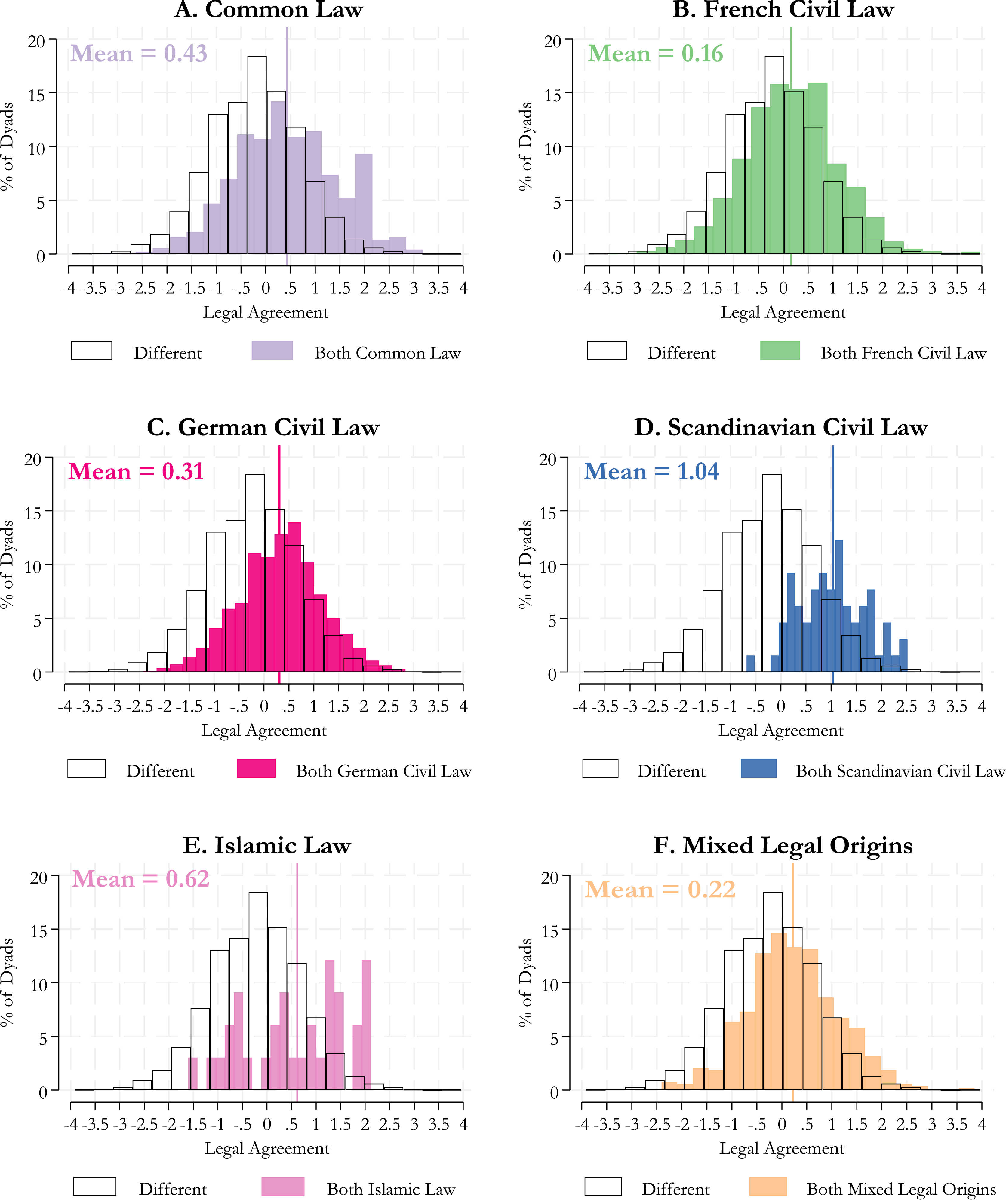
Colonial Origins
We next explore the impact of colonial origins on legal agreement. Figure 6 reports these results separately for the 59,691 dyad-law observations that do not share colonial origins and the 8206 dyad-law observations that do share colonial origins. Figure 6 reveals that observations without shared colonial origins have an average level of legal agreement of −0.18, which is similar to the −0.22 average level of agreement for the dyads that do not have shared legal origins (Figure 4). Additionally, Figure 6 reveals that observations that do have shared colonial origins have an average legal agreement of 0.54, which is notably higher than the 0.22 average level of agreement for the dyads that do have shared legal origins that was reported in Figure 4. Overall, the difference revealed in Figure 6 between dyads without shared colonial origins and with shared colonial origins is 0.72 standard deviations in average legal agreement. This is roughly two-thirds larger than the average legal agreement for observations with shared colonial origins (Figure 4). Shared Colonial Origins and Legal Agreement. Notes. This figure reports the distribution of legal agreement at the dyad-law level. These distributions are reported separately for the dyads that do not share colonial origins (which are depicted with white boxes with black borders) and for dyads that do share colonial origins (which are depicted with green, shaded boxed without borders). The dashed (black) vertical line reports the mean value for dyads that do not share colonial origins and the solid (green) vertical line reports the mean value for dyads that do share colonial origins.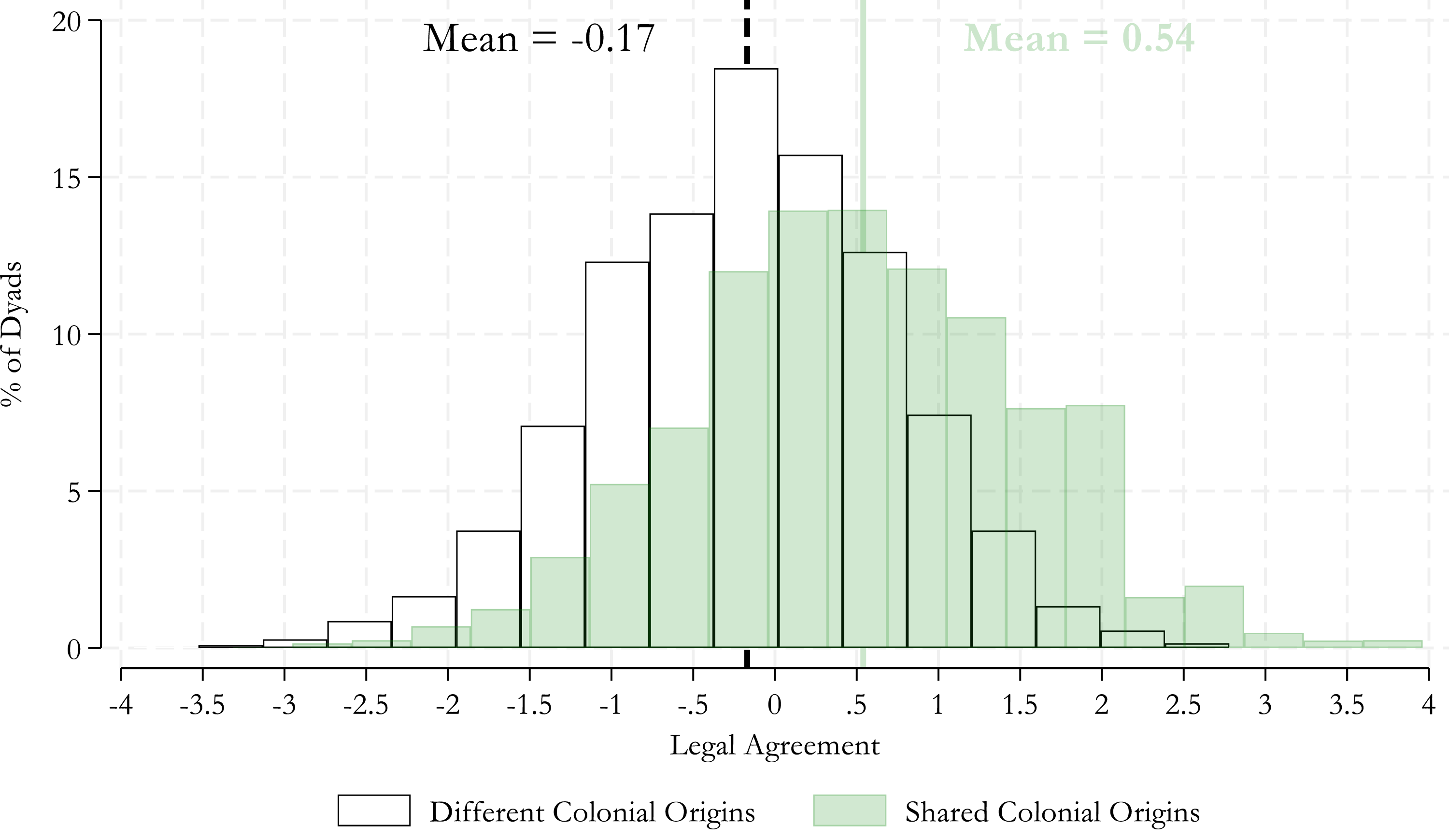
Regression Results - Legal Agreement and Shared Colonial Origins.
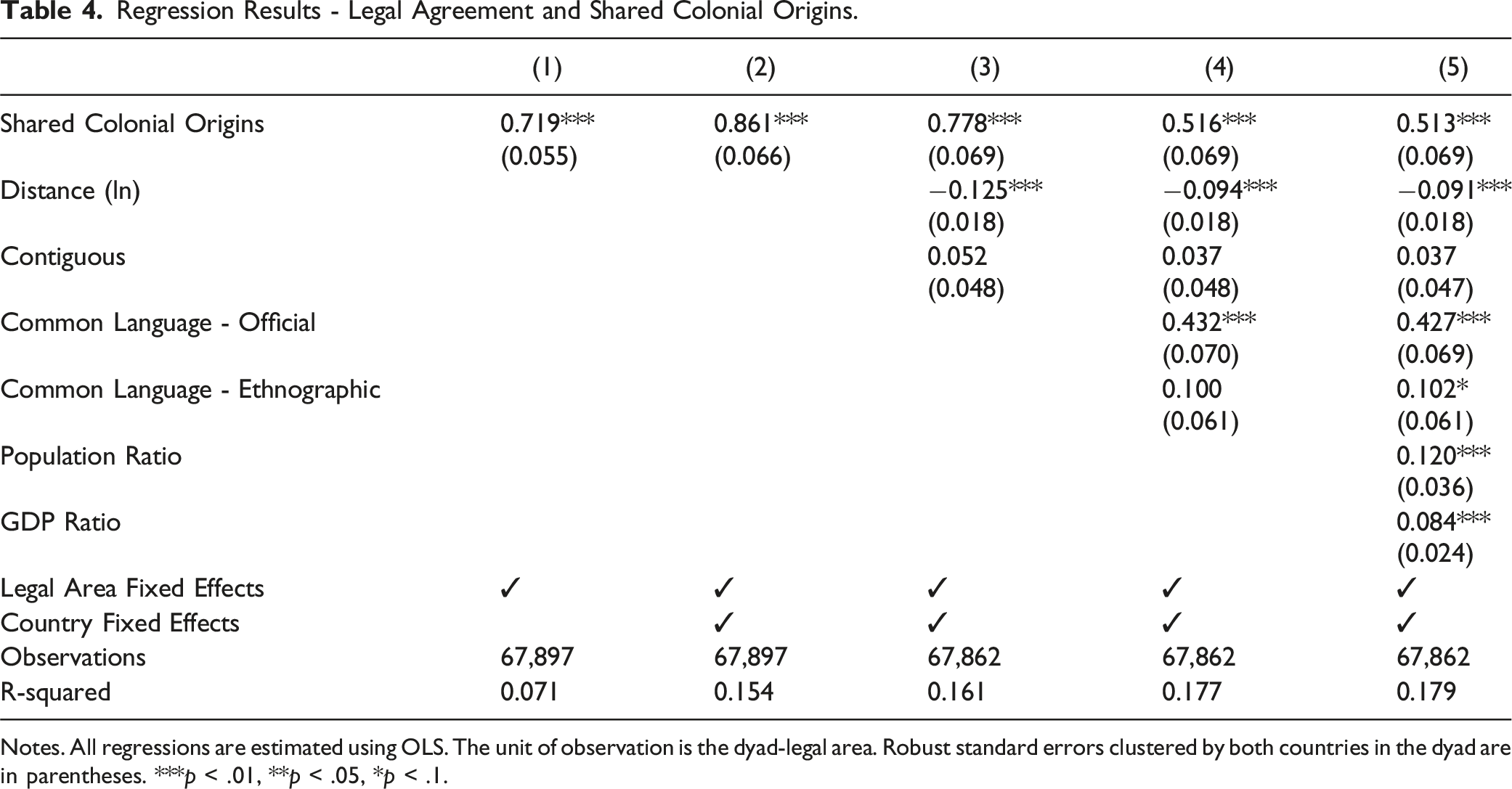
Notes. All regressions are estimated using OLS. The unit of observation is the dyad-legal area. Robust standard errors clustered by both countries in the dyad are in parentheses. ***p < .01, **p < .05, *p < .1.
Figure 7 further explores the colonial origins hypothesis by breaking out the sample by type of shared colonial origins. In doing so, we take advantage of our new coding of colonial origins that breaks down countries further than the classifications previously used by Klerman et al. (2011). The results in Figure 7 reveal at least three patterns in the relationship between colonial origins and contemporary legal similarity. Type of Shared Colonial Origins and Legal Agreement. Notes. This figure reports the distribution of legal agreement at the dyad-law level. For each panel, the clear distribution with black borders is the same and reports dyads that do not share colonial origins (their mean is −0.17, as reported in Figure 6). The shaded distributions report the values for dyads that have a particular kind of shared colonial origins. The vertical line reports the mean for the group with the specific kind of shared colonial origins.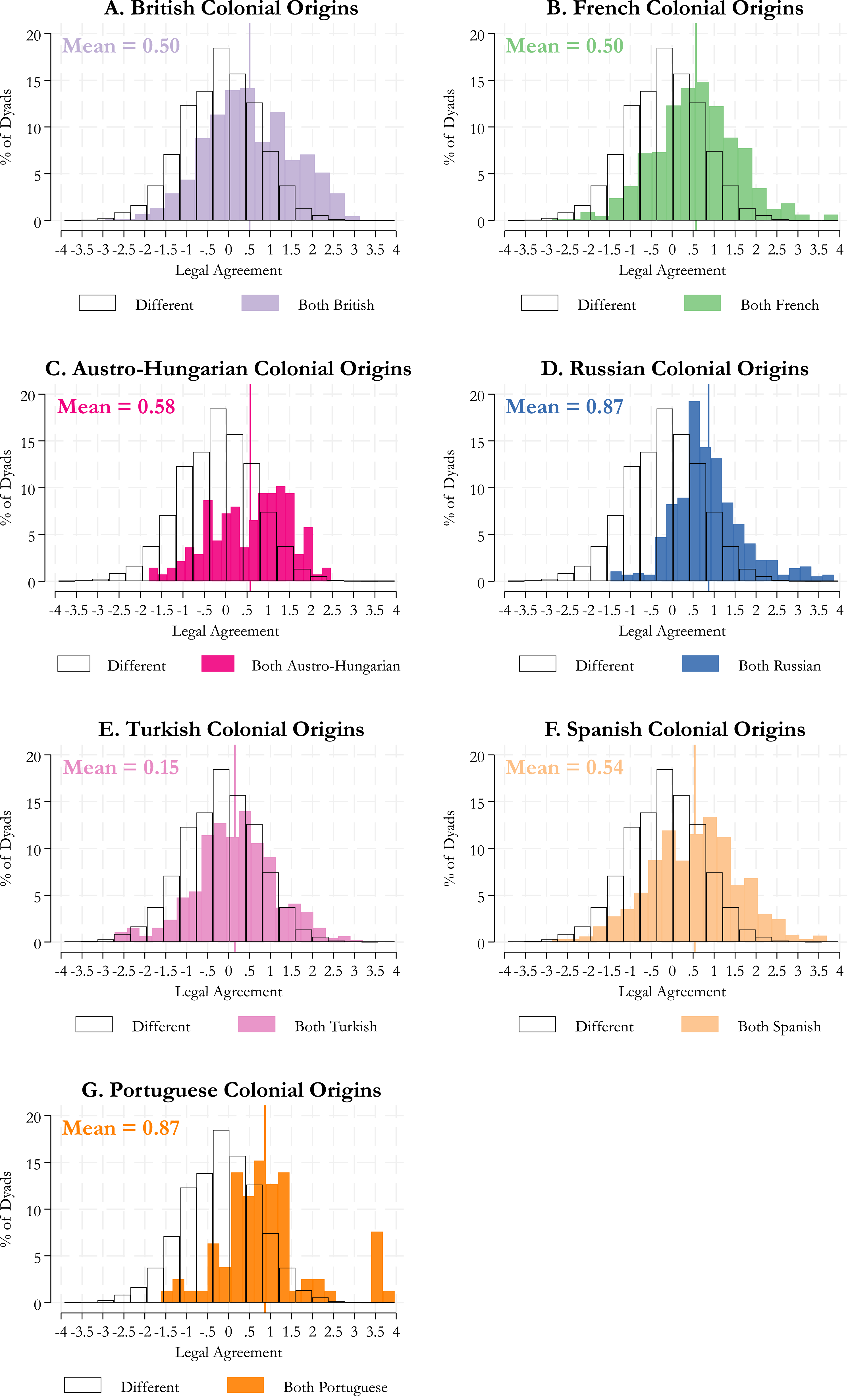
First, the average level of legal agreement for dyads with shared colonial origins is quite high. In fact, for six of the seven categories of colonial origins, the average level of legal agreement is higher than the average level of legal agreement for countries with shared legal origins (Figure 4). The exception is countries with shared Turkish colonial origins, which have an average level of legal agreement of 0.15. Although this is notably higher than countries without any shared colonial origins (−0.17), it is still far behind the other categories groups. This perhaps reflects the fact that countries with Turkish legal origins includes countries in areas like North Africa and southern Europe that had remarkably different experiences after the end of the Ottoman empire.
Second, the average level of legal agreement for dyads with shared British colonial origins (0.50) is roughly the same as the average level of legal agreement for dyads with shared English common law legal origins (0.43, see Figure 5). This is surprising, in part, because there are considerable differences in these samples of countries. Notably, of the observations in our dataset for dyads that have either shared English common law legal origins or shared British colonial origins, only 43% of them (2170 of 5054 observations) have both shared colonial experiences. 32 The result is that the samples include a range of different countries, but the average level of contemporary legal agreement is still similarly high for both sets of countries.
Third, the average level of legal agreement for dyads with shared French colonial origins (0.50) is more than three times higher than the average level of legal agreement for dyads with shared French civil law legal origins (0.16, see Figure 5). This finding likely reflects the fact that many countries that shared French civil law legal origins actually had very different colonial origins (e.g., Klerman et al., 2011). For instance, some countries with French civil law legal origins were, of course, French colonies, but others were Spanish colonies, Portuguese colonies, Russian colonies, or Turkish colonies. This suggests that the lower levels of contemporary agreement for countries that share French civil law legal origins may not actually be due to anything about the nature of French civil law itself.
Figure 8 further explores these relationships by directly assessing the relationship between former colonial powers and their former colonies.
33
The results in Figure 8 reveal that most of the former colonizer still have high levels of average legal agreement with their former colonies. These levels are typically higher than those for countries that simply have the same shared legal origins. For instance, Figure 5 revealed that countries with shared French legal origins have a 0.16 standard deviation higher level of legal agreement, and Figure 8 reveals that France and its former colonies have 0.80 standard deviations higher levels of legal agreement. A notable exception to this pattern revealed by Figure 8 is also Turkey, which only has a 0.10 standard deviation higher average legal agreement (which is lower than the 0.15 standard deviation higher average legal agreement for all dyad-law observations with shared former Turkish colonial history revealed in Figure 7). Results by Direct Colonial Relationships. Notes. This figure reports the distribution of legal agreement at the dyad-law. For each panel, the clear distribution with black borders is the same and reports dyads that do not share colonial origins (their mean is −0.17, as reported in Figure 6). The shaded distributions report the values for dyads where one of the countries is a specific former colonizer. The vertical line reports the mean for the group where one dyad is the specific former colonizer.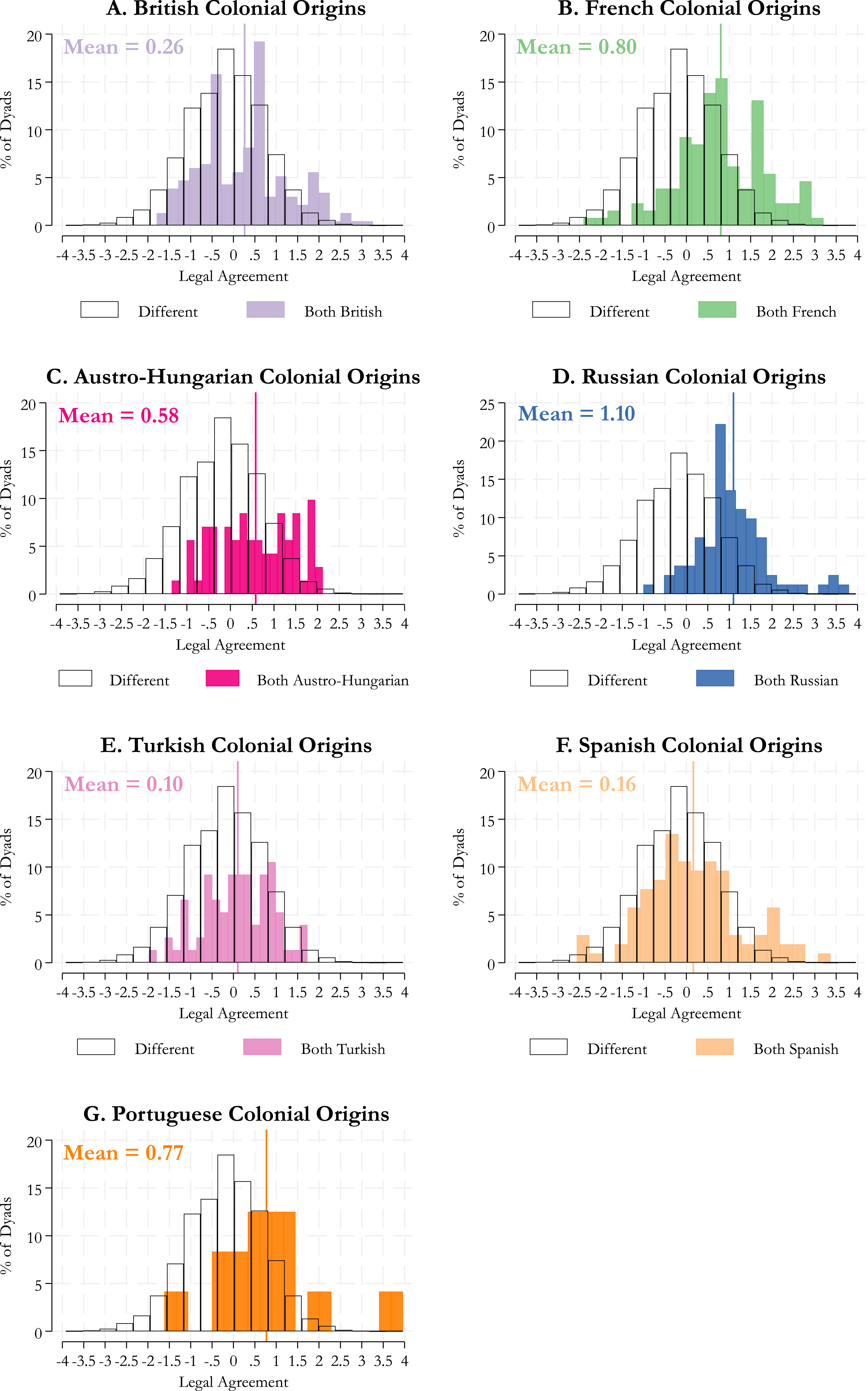
Comparing the Two Hypotheses
The results thus far have revealed that countries with shared legal origins do have more similar contemporary laws than countries without shared legal origins, but the results have also revealed that the similarities are even higher for pairs of countries have shared colonial origins. To test the relative support for these hypotheses more directly, we now take advantage of the fact that, as Klerman et al. (2011) documented, many countries have legal origins that differ from their colonial origins. For example, of the 67,897 dyad-law level observations in our final dataset: 45,333 observations (67%) are from dyads that have neither shared legal nor colonial origins; 14,358 observations (21%) are from dyads that have only shared legal origins; 2722 observations (4%) are from dyads that have only shared colonial origins; and 5484 observations (8%) are from dyads that have both shared legal origins and colonial origins.
Figure 9 reports the results broken out by these four categories. The results reveal that the dyad-law observations with no shared colonial experiences have an average legal agreement of −0.25. The average level of legal agreement increases to 0.07 for dyad-law observations with just shared legal origins. That said, the average level of legal agreement for dyad-law observations with just shared colonial origins is six times higher (0.42 compared to 0.07) than those with just shared legal origins. Finally, the results also reveal that having both shared legal and colonial origins is associated with the highest level of average agreement (0.60). Results by Type of Shared Colonial Experiences. Notes. This figure reports the distribution of legal agreement at the dyad-law level using data on all nine areas of law. Each panel reports the distribution for a different, mutual exclusive set of dyads: Panel A reports the distribution for dyads that do not share legal or colonial origins; Panel B reports the distribution for dyads that do share legal origins but do not share colonial origins; Panel C reports the distribution for dyads that do not share legal origins but do share colonial origins; Panel D reports the distribution for dyads that share both legal origins and colonial origins.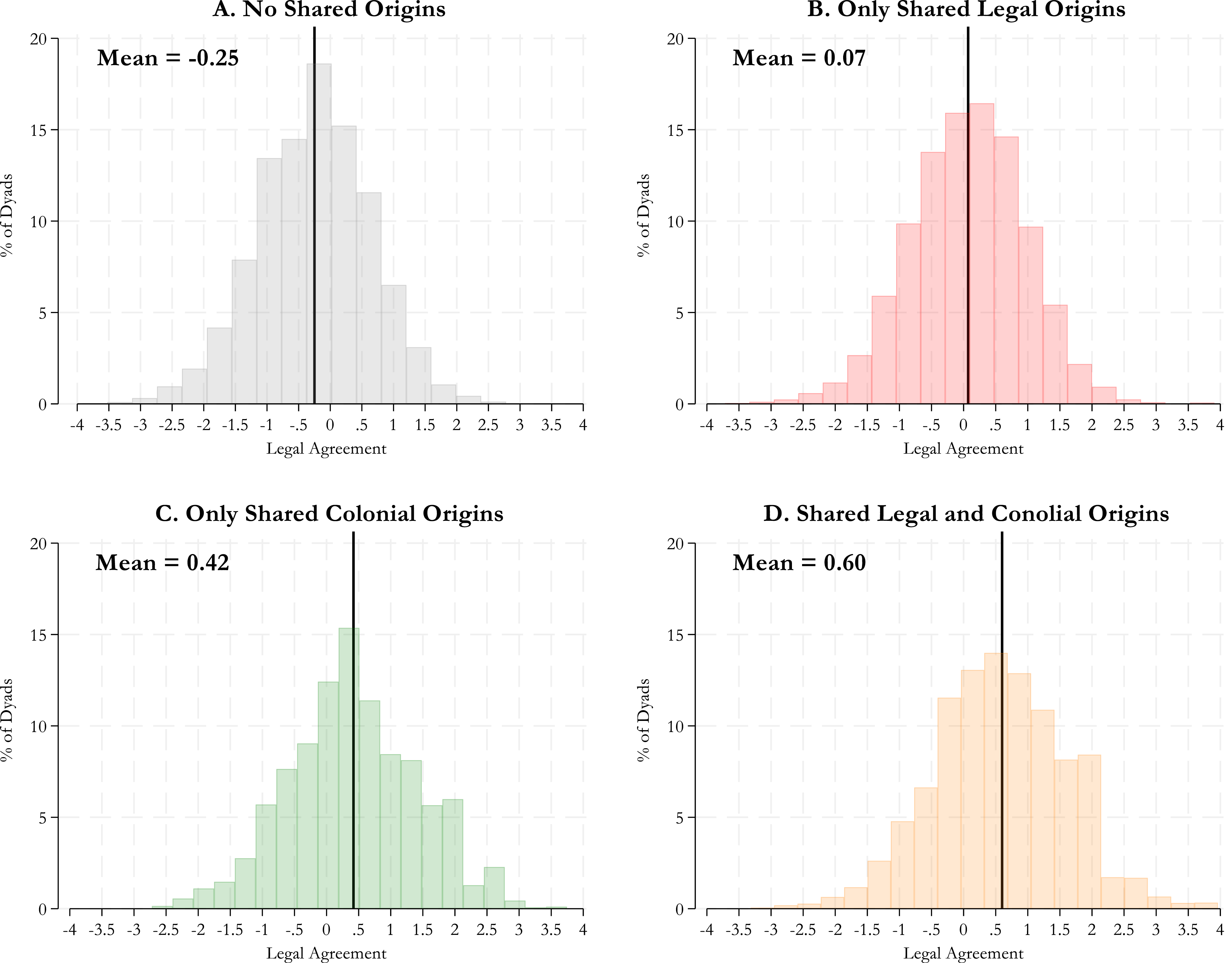
Regression Results - Legal Agreement and Shared Colonial Experiences.
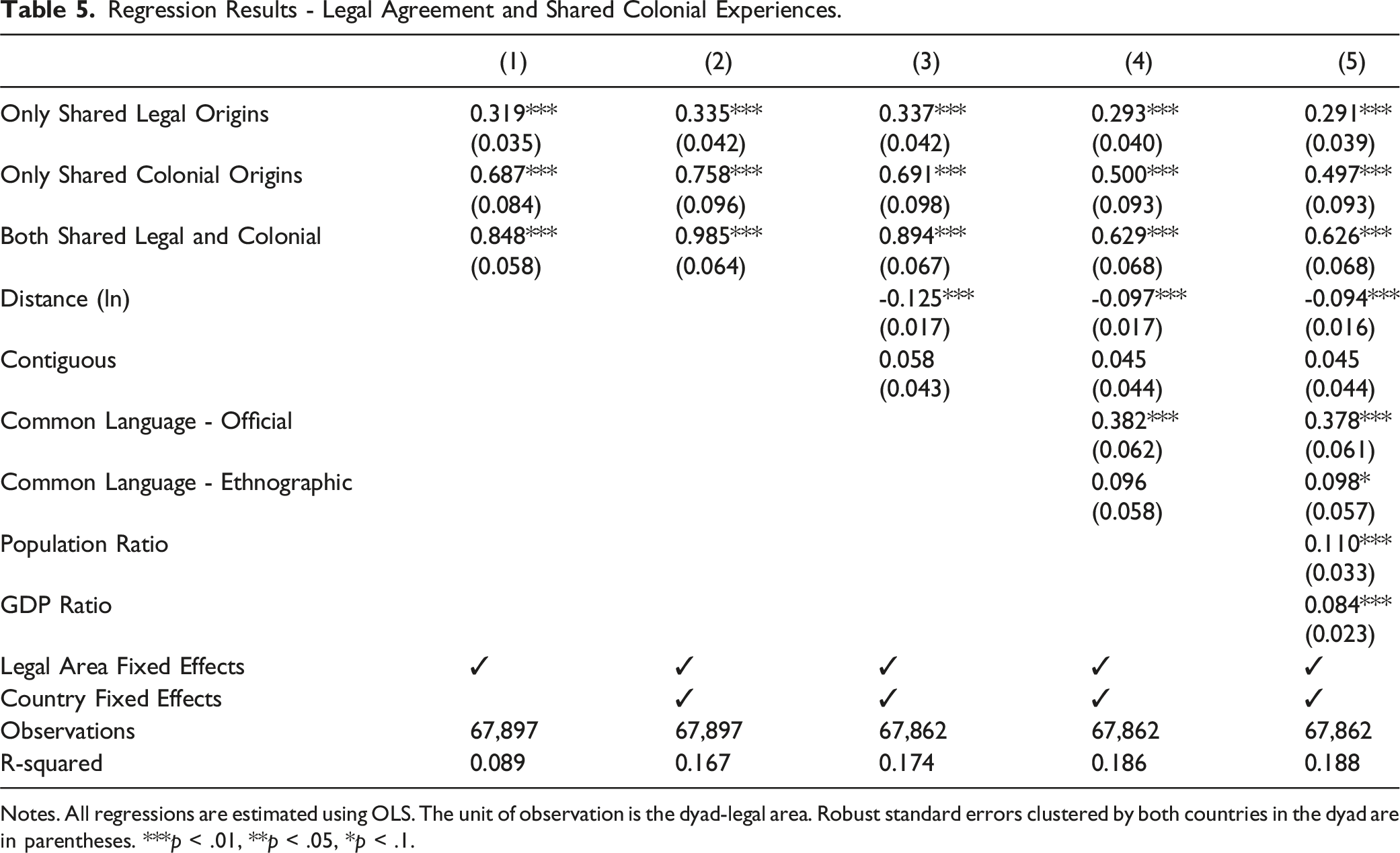
Notes. All regressions are estimated using OLS. The unit of observation is the dyad-legal area. Robust standard errors clustered by both countries in the dyad are in parentheses. ***p < .01, **p < .05, *p < .1.
Robustness Checks
We further explored the robustness of our results comparing the two hypotheses in three ways. First, one concern with our results is that they may be driven by small differences in some of the substantive legal datasets, and these small differences may be magnified by our decision to standardize the agreement variables by converting them into z-scores. To investigate this possibility, we re-estimated the primary results testing our two hypotheses—which were reported in Figure 9 and Table 5—while using a version of the level agreement that has not been standardized as our dependent variables. These results are reported in Appendix C in Figure C. 1 and Table C. 1. When doing so, the size of the coefficients decrease, but the relative magnitudes of the coefficients do not change. In other words, we still find that only having shared colonial origins is associated with roughly twice as high an association as only having shared legal origins and that having both shared legal and colonial origins is associated with the highest levels of agreement.
Second, another possible concern with comparing shared legal origins and shared colonial origins in this way is that the categories are not equally refined. More specifically, dyads with shared legal origins include many countries grouped into the French legal origins category (see Figure 1), whereas dyads with shared colonial origins only includes countries when they have more specific colonial relationships (see Figure 2). As a result, it could be the case that the greater legal agreement for countries with shared colonial origins reported in Figure 9 and Table 5 is driven by the fact that shared legal origins groups together a more heterogenous set of countries, and not because colonial relationships have greater ongoing influences on legal developments.
To test for this possibility, we conducted a robustness check where we re-coded countries as having shared legal origins if either both countries in the dyad had common law legal origins or both countries in the dyad did not have common law legal origins, and we re-coded countries as having shared colonial origins if either both countries in the dyad had British colonials origins or both countries in the dyad had any one of the other colonial relationships in Figure 2. 34 When reconducting our primary results using this approach, we still find that dyads with shared colonial experiences have notably higher levels of legal agreement than dyads with shared legal origins. (We elected to “level-down” by reducing the categories in this way, as opposed to “leveling-up” the number of categories, because it is not feasible to add to the kinds of legal origins). These results are reported in Appendix C in Figure C. 2 and Table C. 2. For instance, the regression results in Column 5 in Table C. 2 (the specification corresponding to that Column 5 in Table 5) still suggest that only having shared colonial origins is associated with roughly four times as high a legal agreement as only having shared legal origins.
Third, the most similar prior work to our own is Bradford et al. (2021), which found that shared legal origins had roughly the same explanatory power as shared colonial origins. Although that paper did not focus on explaining the differences between these two competing hypotheses, and only used data on property and antitrust, we have attempted to directly explore the difference in results. Notably, Bradford et al. (2021) used colonial origins coding from Klerman et al. (2011), whereas our analysis expanded the coding of colonial relationships in the way described in Section 3.1. Additionally, Bradford et al. (2021) analyzed a smaller number of dyads than our current project. It is thus possible that the difference is attributable to either differences in coding of countries’ colonial origins or due to differences in the sample.
To investigate this discrepancy, we first re-estimate our results from Table 4 using the original Klerman et al. (2011) coding of colonial origins. These results are reported in Appendix C in Table C. 3. When doing so, we find that shared colonial origins have similar explanatory power to shared legal origins (compare Table C. 3 to Table 3). We next re-estimate our results from Table 4 when using our own coding of colonial origins but using the same, smaller sample that is possible to use with the Klerman et al. (2011) data. These results are reported in Appendix C in Table C. 4. When doing so, we find that colonial origins does have greater explanatory power than shared legal origins (compare Table C. 4 to Table 3). Taken together, this suggests that the difference between the Bradford et al. (2021) finding (suggesting that shared legal and shared colonial origins have roughly similar explanatory power on contemporary legal agreement) and our current finding (suggesting that shared colonial origins has greater explanatory power) is likely due to our more refined coding of shared legal origins and not due to differences in the paper’s sample.
Variation Across Areas of Law and Time
Our analysis thus far has pooled together all nine areas of law and looked at the last year of available data. However, this overall pattern may mask differences across substantive legal areas or differences across time. We thus next break down our results in these two ways.
Differences Across Areas of Law
We next explore whether the impact of shared legal and colonial origins on contemporary laws across areas of law. To do so, we estimated the regression specification from Column 1 of Table 5 separately for each area of law. Figure 10 then plots the coefficients of interest and their 90% confidence intervals for the regressions from each of the nine different areas of law. Legal Agreement by Shared Colonial Experiences Estimated Separately by Substantive Areas of Law. Notes. This figure reports the results from nine separate regressions. We specifically estimated the regression specification from Column 1 of Table 5 separately for each of the nine legal areas. We then graphed the coefficients and 90% confidence intervals for the three coefficients of interests from each regression. The excluded category in the regressions are dyads that do not share legal or colonial origins.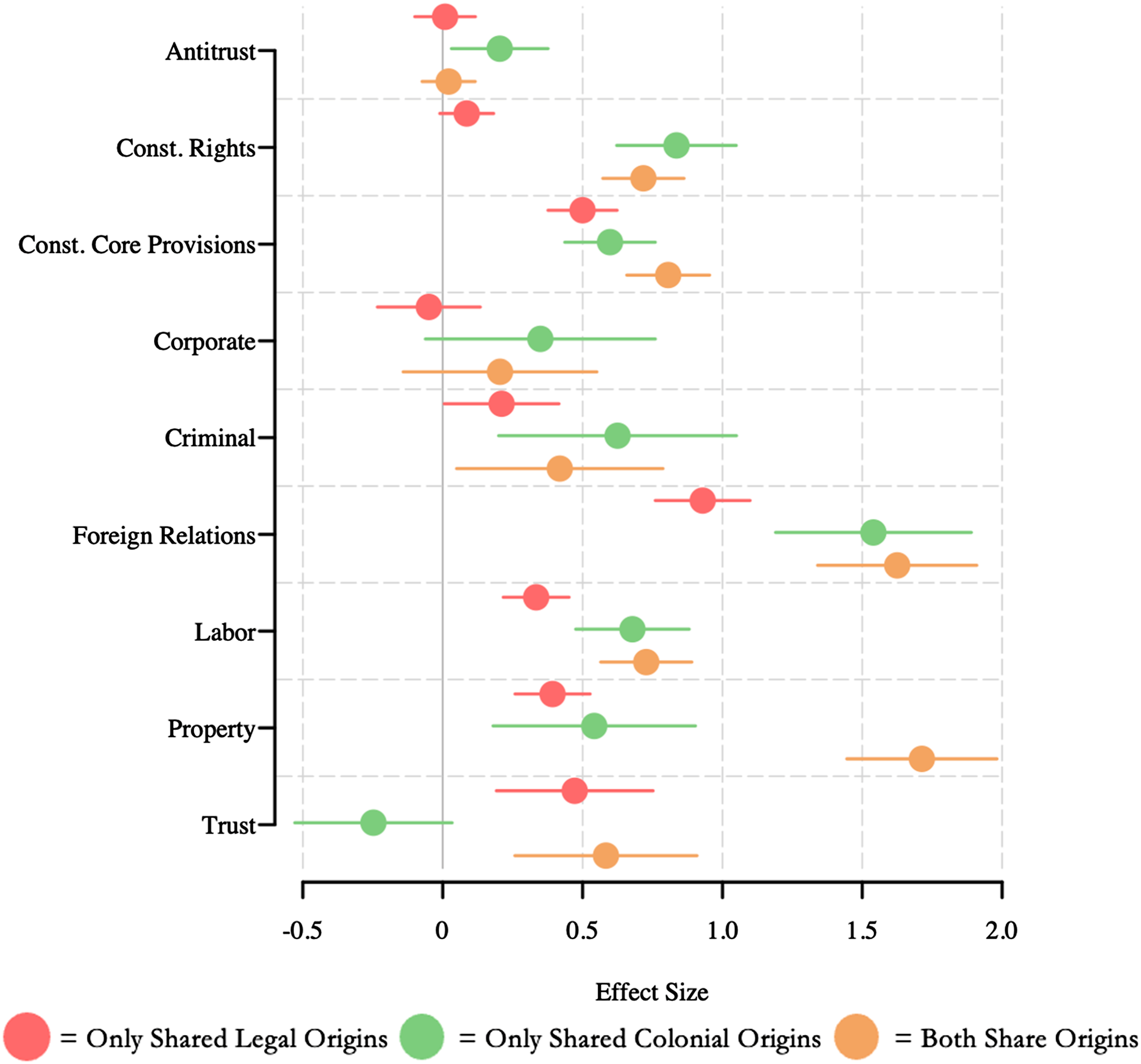
The results in Figure 10 reveal several noteworthy results. Importantly, across all nine substantive areas of law, the effect of the different kinds of shared colonial experiences are always associated with either null results or statistically significant positive results. Additionally, there is considerable heterogeneity across legal areas. For instance, contemporary legal agreement is highest for property law, foreign relations law, and constitutional rights, and constitutional core provisions. For each of these, the impact of shared colonial origins or shared colonial and legal origins is over 0.5 standard deviations higher than that for countries without shared origins. Notably, these are all older bodies of law, adopted either prior to independence or right after independence. While countries have been free to change these laws, we find notable correlations between colonial experiences and their contemporary laws.
By contrast, the agreement is much lower for newer areas of laws like antitrust or corporate law (see also Bradford et al., 2021). 35 A notable exception to this finding, however, is the results for criminal law. Despite criminal law being an older area of legal regulation, our findings suggest that countries’ shared colonial experiences may only be associated with moderately higher levels of similarity. More research is needed to explore this result, and we only offer a few conjectures. First, the coding of the data is driving the result. Eight of the 19 variables in the criminal law data are count variables (on the number of crimes and that with life sentences), and the other eight of the 19 variables are continuous variables capturing the lower bound and upper bound of the length of imprisonment. Such codings may obscure the underlying similarities in the criminal code—which could occur, for instance, (1) if some countries may prohibit the same conduct through more expansive criminal positions—or artificially suggest differences in the criminal code; and (2) if some countries have more severe sentences on the book but instead impose more lenient sentences in action, making them in fact similar to other countries which have lenient sentences both on the book and in action. Second, criminal law is an area with greater consistency in views on how it should be properly regulated than other areas of law (e.g., Levmore, 1986). Third, colonial empires (especially the British) used colonies as laboratories for criminal justice reform (and as sites of greater oppression). 36
Trust law is a peculiar case, as it has ancient roots in the common law while being fairly new in the civil law, and some civil-law countries still do not have trust law at all. Perhaps as a result, trust law is the only field in which the effect of shared legal origin is significantly higher than that of shared colonial origin. While we know that certain countries do not have trust law, our methodology has difficulty assigned an appropriate value for similarity of trust law for such countries vis-à-vis countries with trust law.
Differences Across Time
Our analysis has thus far followed prior research by looking at these patterns cross-sectionally. This is largely due to necessity: five of the nine datasets we examine were only coded to reflect the substance of countries law at a specific moment in time. However, four of the legal datasets that we used—Antitrust, Constitutional Rights, Constitutional Core Provisions, and Foreign Relations Law—were coded as time-series that coded countries’ laws over time. For these four datasets, it is possible to go beyond prior research and explore how these patterns have evolved over time.
Figure 11 plots the mean values of agreement by the four categories used in Section 4.3—No Shared Origins, Only Shared Legal Origins, Only Shared Colonial Origins, and Both Shared Legal and Colonial Origins—for the years 1950, 1960, 1970, 1980, 1990, 2000, and 2010.
37
The patterns in Figure 11 are broadly consistent with the cross-sectional results in Figure 9: countries without any kind of shared colonial experiences had the lowest levels of agreement in every year, and countries with both shared legal and colonial origins had the highest levels of agreement in every year. Moreover, countries with only shared legal origins have lower levels of agreement than countries with only shared colonial origins (an exception is 1960 when these sets of countries had roughly the same levels of legal agreement). Evolution of Legal Similarity by Colonial Experiences. Notes. This figure reports the average legal agreement over time for the four areas of law where panel data is available: Antitrust, Constitutional Rights, Constitutional Core Provisions, and Foreign Relations. The results are averages across all four areas. The averages are calculated separately for five sets of dyads: “Both” = dyads that share both legal origins and colonial origins; “Only Colonial” = dyads that do not share legal origins but do share colonial origins; “Only Legal” = dyads that do share legal origins but do not share colonial origins; “All Dyads” = all dyads in the dataset (which is created by combining the other four categories in the graph); “Neither” = dyads that do not share legal or colonial origins. The data for the year 2010 does not necessarily reflect 2010, but instead corresponds to the last year of available data for each area of law as reported in Table 1.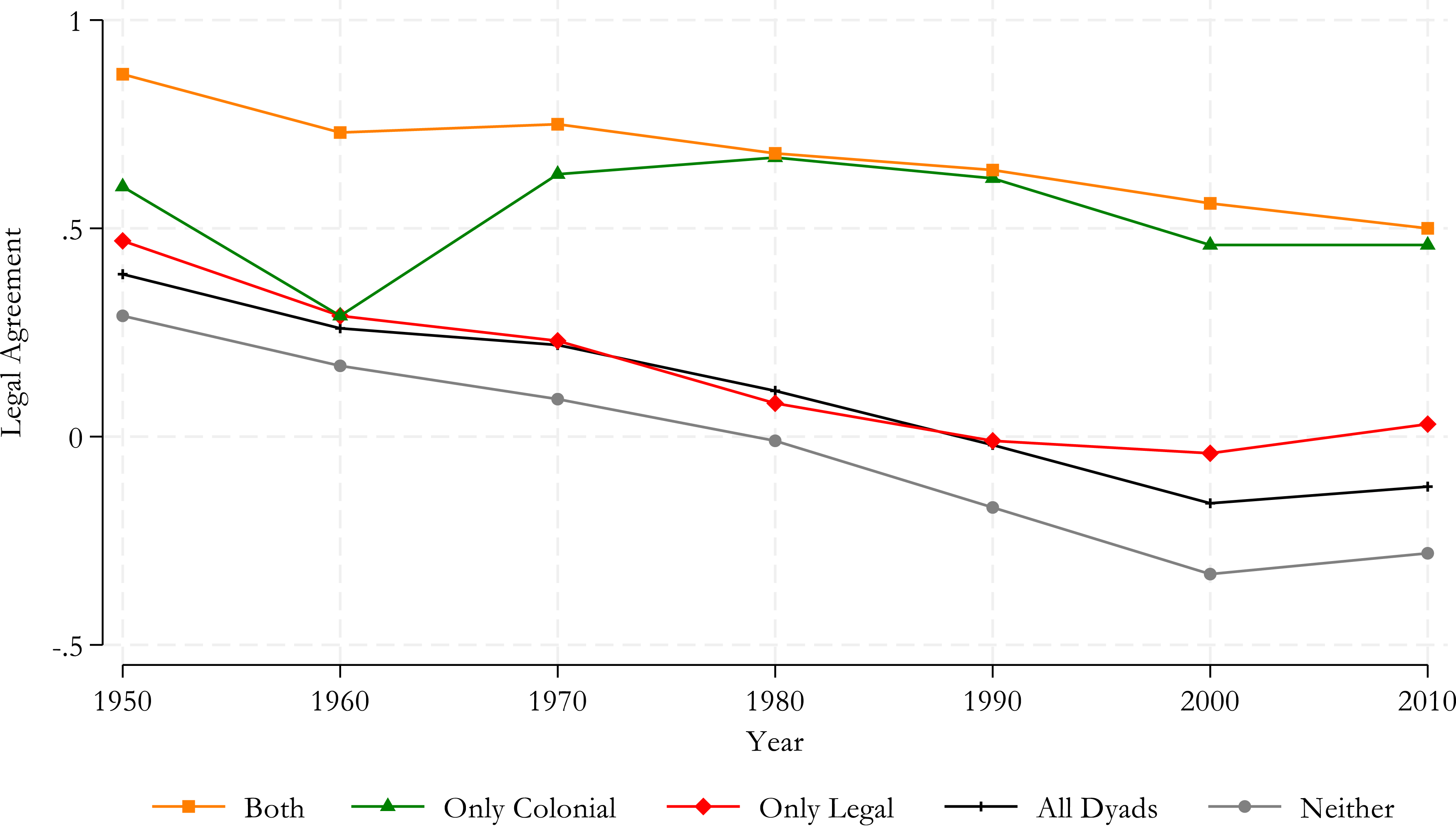
In addition, Figure 11 also includes a line that reports the trend when aggregating the average agreement for all dyads in the sample. This line suggests that, for all dyads, legal similarities have been decreasing since 1950s, though they slightly rebounded in 2010. Although more research is needed to further explore these patterns, this suggests that there may be overall legal convergence over the last several decades (e.g., Bradford et al., 2019), but that was not necessarily been the trend throughout the twentieth century.
To further explore the trends over time, Figure 12 breaks out these time-series by type of law.
38
It reveals differences across the four areas of law, but the patterns for three areas—Constitutional Rights, Constitutional Core Provisions, and Foreign Relations Law—are broadly consistent with the overall patterns from Figure 11. Evolution of Legal Similarity by Colonial Experiences Estimated Separately by Substantive Areas of Law. Notes. This figure reports the average legal agreement over time for the four areas of law where panel data is available: Antitrust, Constitutional Rights, Constitutional Core Provisions, and Foreign Relations. The results are calculated separately by legal area. The averages are calculated separately for four mutually exclusive sets of dyads (which correspond to the results reported in Figure 9): “Both” = dyads that share both legal origins and colonial origins; “Only Colonial” = dyads that do not share legal origins but do share colonial origins; “Only Legal” = dyads that do share legal origins but do not share colonial origins; “Neither” = dyads that do not share legal or colonial origins. The data for the year 2010 does not necessarily reflect 2010, but instead corresponds to the last year of available data for each area of law as reported in Table 1.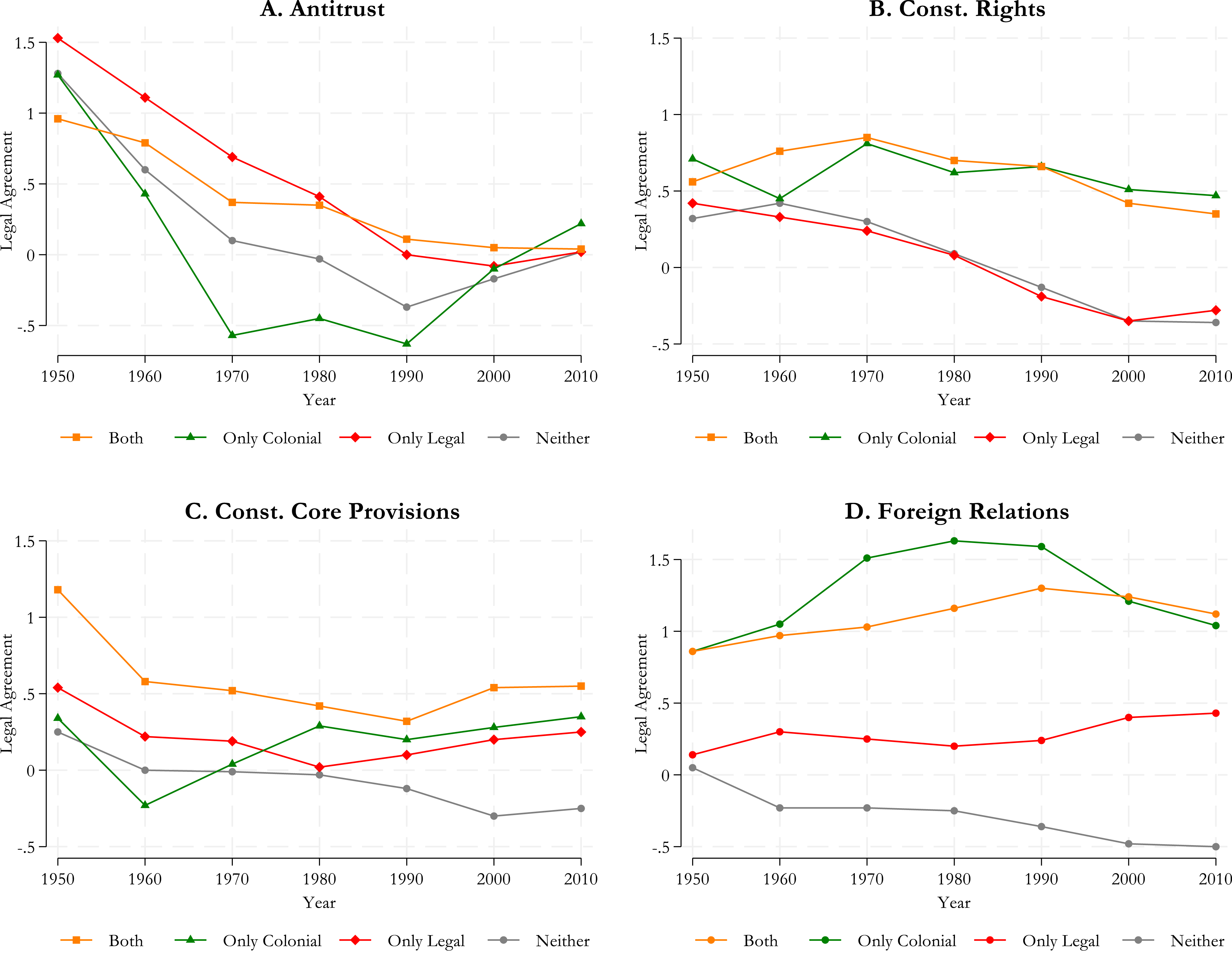
The notable exception is antitrust law, where countries that share only legal origins, rather than direct colonial ties, exhibited higher levels of legal agreement for much of the post-war period. This pattern suggests that shared legal experiences and practices played a significant role in shaping antitrust regulations in these countries. The alignment likely stems from the foundational principles of these legal systems, which influenced how countries approached market regulation, competition, and monopolistic practices. Shared legal frameworks provided a common ground for developing antitrust legislation, resulting in higher levels of legal agreement among countries with similar legal origins.
By the year 2000, however, the influence of shared legal origins on antitrust law had diminished. At this point, legal origins no longer served as a predictor of higher levels of legal agreement, even for countries with overlapping colonial experiences. This shift is consistent with prior research, particularly the work of (Bradford et al., 2019), which highlights the convergence of antitrust laws around global regulatory models. Increasingly, countries have adopted international best practices and standards for market regulation, influenced by global institutions, economic globalization, and transnational legal networks. This trend toward harmonization suggests that the global diffusion of antitrust norms has outweighed the role of legal origin, leading to a more standardized approach to competition law across diverse legal and historical contexts.
As a final analysis, we examine how the timing of independence influences the evolution of legal similarities between former colonies and their colonial powers. Using differences in when countries gained independence, Figure 13 focuses on direct colonial relationships (as previously shown in Figure 8) assesses whether legal agreement is higher for countries that received independence earlier. The results reveal a slightly negative trend, indicating that countries which have been independent for a longer period tend to exhibit less legal similarity with their former colonizers. This suggests that legal divergence may increase as the post-colonial period extends, possibly due to legal reforms, domestic developments, or shifts in external influences over time. Legal Agreement and Years Since Independence From Former Colonizer. Notes. This figure reports a binscatter plot of the number of years since countries received independence and their average legal agreement with their former colonizer. The sample for this analysis is exclusively dyads that include a colony and its former colonizer. The binscatter plot reports the results in ventiles (i.e., the averages for 20 equally sized groups of observations).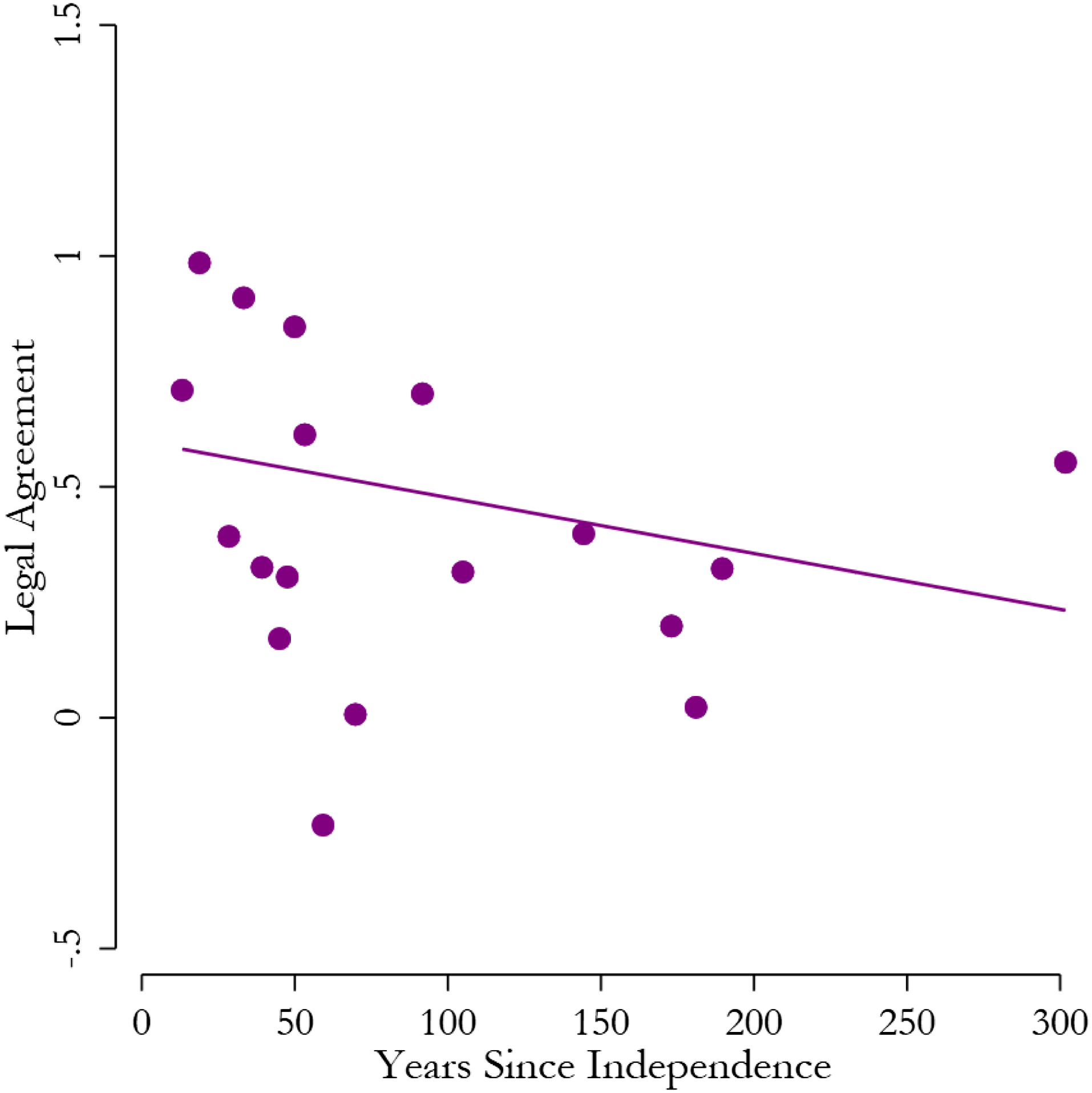
Figure 14 broadens the scope to include all former colonies, and compares their levels of agreement based on how many years have passed since independence. Again, the analysis shows a mildly negative trend, with countries that gained independence at the same time displaying slightly more legal similarity than those that became independent at different points in history. These findings suggest that the temporal dimension of colonial independence plays a subtle but notable role in shaping legal systems. Countries with overlapping decolonization timelines may share legal frameworks due to similar external influences during key periods of legal formation, while differing timelines lead to greater divergence as they experience unique post-colonial legal trajectories. Legal Agreement and Years Between Independence. Notes. This figure reports a binscatter plot of the numbers of years between when the two countries in a dyad received independence and their average legal agreement. The sample for this analysis excludes dyads that have never been colonized. The binscatter plot reports the results in ventiles (i.e., the averages for 20 equally sized groups of observations).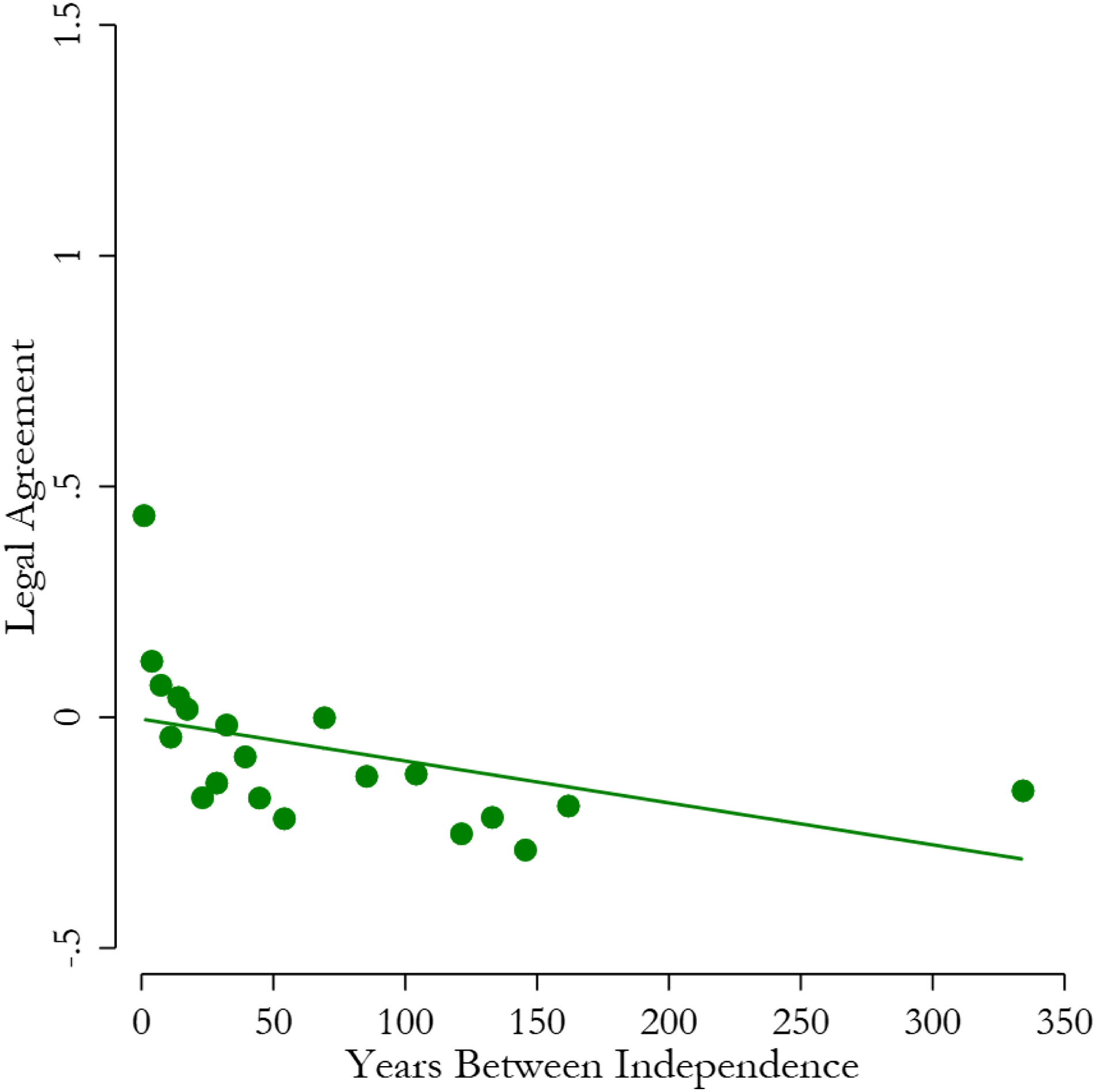
Conclusion
Scholars and legal reforms from a wide range of perspectives have taken seriously the idea that countries’ colonial experiences have important influences on their current legal systems. For instance, many scholars in the Global South have drawn attention to the colonial legacies in their legal systems, and there is a growing movement to “decolonize law” (see, e.g., Xavier et al., 2021). Others have accepted the validity of the prominent finding from the legal origins literature suggesting that common law systems produce superior economic outcomes, and some reformers have even proposed transitioning countries towards common law legal systems as a result (see, e.g., Economist, 2023).
In this article, we reported consistent evidence suggesting that countries’ colonial experiences continue to be associated with differences in their substantive laws. When investigating the nature of these associations, we found that specific colonial relationships are associated with more modern-day legal similarities than conventional legal origins (that is, having received a particular legal system from a former colonizer or invader). Specifically, shared colonial origin was associated with about twice the increase in legal agreement than shared legal origins. Moreover, this effect is similar across different colonizers. This may suggest that the connection between a country’s colonial experience and its contemporary laws could be attributable to ongoing relationships with former colonizers and other former colonies (e.g., Spamann (2009b), rather than the specific type of legal systems imposed during colonization.
We end with some important caveats about our analysis and results. Notably, while most of our findings are based on an exploration across nine areas of law, we also found that there are important differences in the relationship between colonial experiences and contemporary laws across legal areas. We cannot be sure whether this reflects true differences across different areas of law, or whether this might result from different approaches to coding the data. As noted, some datasets included in our analysis are more granular than others, which might explain some of the differences. Our analysis further includes different years for different countries. Exploring the differences across different areas of law is an important avenue for future research.
Supplemental Material
Supplemental Material - Colonial Experiences and Contemporary Laws
Supplemental Material for Colonial Experiences and Contemporary Laws by Yun-chien Chang, Adam Chilton, Nuno Garoupa, and Mila Versteeg in Journal of Law & Empirical Analysis
Footnotes
Author’s Note
Previous drafts of this paper were presented at 2024 ALEA at the University of Michigan Law School; Law & Economics Workshop at the University of Texas and Georgetown University; Empirical Legal Studies in the Sinophone Region Conference held at Cornell Law School; 2024 AsLEA at Cheng Kung University in Tainan, Taiwan; 2024 Law & Economics Forum in China, Faculty Workshop at Peking University School of Law; Cornell Law School’s Winter Faculty Workshop; 2023 Empirical Legal Studies Workshop at Institutum Iurisprudentiae, Academia Sinica, Taiwan; Law, Courts and Judges in Comparative Perspective Annual Conference at the University of Hong Kong; Faculty Workshop at Institute of European and American Studies, Academia Sinica, Taiwan; 2024 Barcelona GSE Summer School; Legal and Institutional Origins of Economic Development Arthus Lewis Lab Conference at the University of Manchester; a talk at Duke Law School; and CEAPS seminar at the Faculty of Economic Sciences, University of Warsaw. For helpful research assistance, we thank Phil Chang. For helpful comments, we thank one anonymous referee, the editor in charge (Dan Klerman), Julian Arato, Benito Arruñada, Elliot Ash, Jianjun Bai, Scott Baker, Christian Burset, Kai-Chih Chang, Yi-Ying Chao, Marx Chen, Wei Chen, Yi-Fan Chen, Xin Dai, Dhammika Dharmapala, Keng-Wei Fan, Yunsong Ge, John Golden, Fernando Gómez, Chi-Hsing Ho, Han-Wei Ho, Duol Kim, Ian Kysel, Mitch Lasser, Shao-Man Lee, Bing Ling, Yi-chen Lo, Patrick Chung-Chia Huang, Sung-Mao Huang, William Hubbard, Ji Li, Sida Liu, Ben Liebmann, Zhuang Liu, Kasia Metarzyna-Szaniawska, Shitong Qiao, Jeff Rachlinski, Weijia Rao, Stewart Schwab, Yung-Djong Shaw, Henrik Sigstad, Holger Spamann, Jed Stiglitz, Maciej Switala, Norman Teng, Lei Wang, Adrian Warsinski, Deborah Weiss, Konrad Werner, Abe Wickelgren, Eleanor Wilking, Crystal Wong, Wenming Xu, Jun Xue, and Hong Zhao.
Declaration of Conflicting Interests
The author(s) declared no potential conflicts of interest with respect to the research, authorship, and/or publication of this article.
Funding
The author(s) received no financial support for the research, authorship, and/or publication of this article.

Supplemental Material
Supplemental material for this article is available online.
Notes
References
Supplementary Material
Please find the following supplemental material available below.
For Open Access articles published under a Creative Commons License, all supplemental material carries the same license as the article it is associated with.
For non-Open Access articles published, all supplemental material carries a non-exclusive license, and permission requests for re-use of supplemental material or any part of supplemental material shall be sent directly to the copyright owner as specified in the copyright notice associated with the article.
