




Abstract
For many decades, researchers sought to understand whether courts influence public opinion and what factors moderate or intensify such influence. In this study, we elucidate these questions with an original longitudinal survey experiment (N = 920) conducted before and after a major U.S. Supreme Court decision addressing freedom of religion and nondiscrimination law. We focus on three key factors and their influence in the short and longer term: the perceived breadth of the decision; whether the decision is congruent with the background law; and the decision's congruence with individuals’ ideology. We triangulate and extend our findings with data from a representative cross-sectional survey conducted by an independent research institute (N = 16,761). Our findings lend mixed support to the theory that narrow decisions can curb the public impact of the Supreme Court and expose a relationship between judicial minimalism and background laws. We discuss the implications for Supreme Court strategy and for the research on Supreme Court impact on public opinion.
Keywords
Introduction
What factors shape the public impact of the Supreme Court? For many decades, researchers sought to understand whether supreme courts influence public opinion. Equally important, and perhaps more relevant for judicial strategy, is the question how these effects come to be and what factors moderate or intensify the influence of the court on public attitudes and perceptions.
The influence of supreme courts on the public was the subject of numerous empirical studies. In the past few decades, researchers amassed empirical evidence showing that courts can play a significant role in influencing public opinion (Clawson et al., 2001; Hoekstra, 1995). Supreme Court opinions were linked with changes in personal attitudes (Ofosu et al., 2019), the perception of social norms (Clark et al., 2024; Tankard & Paluck, 2017), and the behavior of market players (Barak-Corren, 2021; Barak-Corren & Berkman, 2024). However, much is still unknown about when and why courts influence public opinion, attitudes, and perceptions.
First, although scholars tend to research high profile decisions on issues that attract public interest (e.g., Ofosu et al., 2019; Tankard & Paluck, 2017; Linos & Twist, 2016; Barak-Corren, 2021), not every study documents change following a major judicial opinion (e.g., Bishin et al., 2016; Marshall, 1987, 1989). Previous studies raised the possibility that the effect occurs only for novel issues (Johnson & Martin, 1998; Stoutenborough et al., 2006) or that it is limited to changes in social attitudes as opposed with personal preferences (Tankard & Paluck, 2017). Second, the direction of the Court’s influence on public opinion might not be uniform. Decisions could increase support for the policy affirmed by the court (e.g., Ofosu et al., 2019; Tankard & Paluck, 2017; Linos & Twist, 2016) or shift public opinion in the opposite direction, creating a backlash (Lipset & Raab, 1970; Ofosu et al., 2019; Stoutenborough et al., 2006, but see Bishin et al., 2016). 1 In several instances, backlash was documented among groups who opposed the ideology that the new policy promoted (Barak-Corren et al., 2018; Franklin & Kosaki, 1989). In general, the interaction between ideology and opinion change, including following major legal developments, was the focus of numerous studies. Researchers studied the role of personal ideology (Bishin et al., 2016; Braman & Fontana, 2012; Franklin & Kosaki, 1989; Tankard & Paluck, 2017), ideologically biased media consumption (Linos & Twist, 2016), and more recently, ideological social environment (Barak-Corren, 2021; Gelman & Margalit, 2021).
Less focus has been given to legal factors that could shape the public impact of the Supreme Court. One key factor is the breadth – or minimalism – of the decision. Minimalism is arguably one of the main tools that courts can apply to restrain the potential impact of their decisions, especially in heated cases (Sunstein, 1999). Justices are often cautious about how broad or far to go with their decisions, fearing that overly expansive decisions might provoke conflict (see, e.g. Ginsburg, 1985, p. 385) or generate inadvertent consequences (see, e.g., Obergefell v. Hodges, 2015; Barak-Corren, 2021, p. 318). Yet this theory – that a narrow decision can restrain the public reverberations of a decision better than a broad decision – is hard to test as the court writes only one binding decision at a time (notwithstanding any dissents, that present further complications). In addition, the court is not in full control when it comes to the public perception of its decisions. Ultimately it is the media and various stakeholders who communicate the decision to the public, and in doing so frame it as narrow or broad. These framing effects were the focus of scant empirical work, primarily because until relatively recently, “media coverage of court activities [has been] largely apolitical with little or no discussion of the underlying rationale for the decisions it renders.” (Baird & Gangl, 2006, p. 598). The growing coverage of judicial politics and the explosion of social media, to which stakeholders take to interpret, comment, and frame judicial decisions, might complicate a judicial attempt to convey a narrow ruling to the public.
Another important factor is the law itself. In a country as legally varied as the United States, a Supreme Court decision is likely to have a different effect in different jurisdictions. Specifically, the decision is likely to have a different impact in jurisdictions where it modifies the law as compared with jurisdictions that are already aligned with the decision. Surprisingly, there has been little research on this factor, as most studies of the Court do not link jurisdictional differences with participants’ attitudes (see, e.g., Bishin et al., 2016; Braman & Fontana, 2012; Linos & Twist, 2016; Tankard & Paluck, 2017). A notable exception is recent work by Barak-Corren (2021) and Barak-Corren and Berkman (2024) who studied the effects of Court decisions that pitted religious freedom and marriage equality against each other, Masterpiece Cakeshop v. Colorado (2018) and Fulton v. City of Philadelphia (2021). The studies respectively examined how the decisions affected the pertinent markets—wedding vendors in Masterpiece and foster care agencies in Fulton—and found, among other findings, greater impact in jurisdictions where the Court decision directly modified the background law. However, no study thus far has examined the interaction of background laws and a court decision on public opinion, or the relationship between judicial minimalism and background laws.
In this study, we seek to elucidate these longstanding questions via an original longitudinal survey experiment we conducted before and after Fulton v. City of Philadelphia, a high-profile 2021 United States Supreme Court decision. 2 Fulton began when Philadelphia terminated the contract of a Catholic foster care agency that refused to serve same-sex couples. The city argued that this policy violated its antidiscrimination laws; the Catholic agency responded that it was the City which violated its First Amendment rights. 3 The Supreme Court unanimously agreed with the agency, ruling that it should have been granted a religious exemption from the City’s antidiscrimination rules. 4 The Fulton opinion limited its holding to the interpretation of Philadelphia rules and contracts and avoided setting a broad framework for deciding religion-equality conflicts. 5 Yet even though Fulton was portrayed by the Court itself, 6 as well as by some stakeholders (e.g., Vasquez, 2021), as minimalist and narrow, religious advocates celebrated what they saw as a sweeping victory for religious liberty (e.g., Tong & Gomez, 2022; Kao, 2021).
We exploited this greatly anticipated decision for a deep-dive investigation into the factors that shape the impact of the Supreme Court on public attitudes. Over severak months leading to June 2021, we fielded a pre-decision survey that measured baseline support for religious service refusal to same sex-couples, as well as various dimensions of ideology (including media consumption habits, ideologically tilted social circles, religiosity, and more), and we mapped and coded the background laws in each state. After Fulton was handed down, we fielded a follow up survey that examined whether the decision changed participants’ opinions. Here, we incorporated a randomized experiment to the design. Participants who did not previously hear about Fulton were randomly allocated to read a narrow frame of the decision, or a broad frame, or nothing at all (control group). We then compared the three groups to participants who were naturally exposed to Fulton outside of the survey, as well as to their prior selves. This comparison allowed us to investigate the effect of narrow and broad decision frames in an experimental setting; compare them to the real-life results of natural exposure; and examine how different exposures are further shaped by ideology and background laws. We fielded a final follow up survey 10 weeks after the decision to examine effects in the longer term. Lastly, we triangulated and expanded our original survey with data we obtained from a large-scale cross-sectional survey conducted by an independent non-profit institute. While that survey did not track exposure to Fulton and hence lack both our precise identification and experimental treatments, it lends general support to our findings of a main Fulton effect on support for religious service refusal. It also reveals that the decision’s effects spilled to broader settings.
Our research provides several important contributions. First, we conduct the first experimental test of the effects of judicial minimalism (as framed) on public opinion. Thus far, only a few studies examined framing effects in the context of Supreme Court proceedings, and their focus had been on the effects of framing on trust in the court, rather than on the substantive issue at stake; and on frames that vary the appropriateness of the proceedings and methods applied by the Court (such as political give-and-take on the bench, unethical judicial behavior, and more) rather than frames that vary the substance of the decision (Baird & Gangl, 2006; Braman & Easter, 2014; Magalhães et al., 2023; see also Wedeking, 2010, who studies framing in Supreme Court briefs). Our study is thus the first to put to the test an influential legal theory and a common judicial strategy – judicial minimalism. Furthermore, our design allows us to discern differences between the effect of narrow and broad decision frames over time, across legal regimes and ideological divides.
Second, our study elucidates the relatively neglected topic of the relationship between supreme court decisions and background laws. This relationship is inherent to every federal system wherein a national court holds the power to intervene in the sub-national units. In the United States, the Court-states relationship has become increasingly important in recent years due to growing polarization and legal differentiation across state lines (Grumbach, 2018; Hoekstra & Segal, 1996; Masket, 2019). Until now, there was almost no evidence on how such jurisdictional differences shape the impact of the Supreme Court on public opinion. Our study provides both evidence and methodological guidance for future studies on this topic, which we predict will be of growing importance in years to come.
Third, our study contributes to the growing literature on the relationship between public opinion and ideology, particularly in the context of the Supreme Court. Our primary contribution here is methodological: different studies typically employ only one measure of ideology when studying its effect on public opinion (see, e.g., Linos & Twist, 2016; Braman & Fontana, 2012; Tankard & Paluck, 2017). Common measures include self-reported ideology (Bishin et al., 2016; Braman & Fontana, 2012; Tankard & Paluck, 2017) and quasi-behavioral measures, such as ideologically biased media consumption (Linos & Twist, 2016) and ideologically tilted social circles (Gelman & Margalit, 2021). Our study is unique in including all these measures in addition to religiosity, which has been strongly linked with conservative ideology in recent decades (Bishin et al., 2016), allowing for a comparative evaluation of the role of various dimensions of ideology in shaping the Court’s effects on public opinion. We reach the potentially surprising conclusion that these various measures are interchangeable when it comes to discerning the relationship between ideology and public opinion, at least in this context.
Our results provide empirical nuance to the theory of judicial minimalism. We find that in the short term, all types of exposure to the decision significantly increased public support for religious service refusal, in line with the decision. In the longer term, the effect persisted among participants who were exposed to the broad decision frame and those who were naturally exposed to the decision, but not among those exposed to the narrow frame of the decision. We also find that the narrow frame is particularly effective in jurisdictions where the decision modified the law, but with time this effect fades. Interestingly, we do not find a clearly different effect on participants whose ideology aligns with the decision (who are, regardless of the decision, more supportive of religious service refusal). Overall, these results lend mixed support for judicial minimalism as a practical strategy. On one hand, the public impact of a narrowly framed decision appears to dissolve relatively fast, supporting the notion that narrow decisions can restrain their social effects better than broad decisions (though, as it turns, they are not able to eliminate these effects entirely). On the other hand, it seems that the Court cannot instill the perception of minimalism in the court of public opinion. The opinion change of those who were naturally exposed to Fulton was consistent with exposure to a broad decision frame. While naturally exposed participants were probably not representative of the general public, their reaction captured how the decision was perceived outside the experiment by those attuned to hearing about it. We argue that these results confirm that efforts to reframe the breadth of Supreme Court decisions, and merits the investment of efforts on the part of the Court to communicate its actual holding effectively to the public.
Judicial Minimalism and Narrow versus Broad Decisions
Can supreme courts limit the effects of their decisions by writing them narrowly? The argument for narrow, case-specific and minimal decisions is longstanding (Sunstein, 1999). Narrow decisions arguably avoid raising social contestations, introduce changes to law in a more incremental and modest fashion, and minimize the conflictual social effect of judicial decisions in heated cases. The extent to which the Supreme Court practices minimalism is somewhat disputed and depends on how scholars define and operationalize judicial minimalism (Anderson IV, 2009 vs. Siegel, 2004), though it seems that the theory captures how influential justices think and act (e.g. Ginsburg, 1985; Anderson IV, 2009).
Corroborating the empirical aspirations of judicial minimalism is another story. First, drawing comparisons between the effects of narrow and broad decisions is almost never possible, as the Court decides every case only once. Although the Court addresses similar cases sometimes, they are typically separated by years apart and decided against different social settings. In addition to measurement difficulties, recent studies casted doubt on the proposition that narrow, case-specific holdings have little social effect. One example is a recent field experiment that examined the impact of the Masterpiece Cakeshop decision, wherein a religious baker sought the right to refuse service to same-sex weddings (Barak-Corren, 2021). The Court avoided a broad ruling and focused on seemingly narrow procedural grounds in awarding the baker a victory. Despite that, the ruling was found to reduce wedding vendors’ willingness to provide service to same-sex couples, even in markets that had no legal relevance to the decision. Similar results were found in a nationwide field experiment by Barak-Corren and Berkman (2024) that investigated the effect of the Fulton decision on foster care agencies and their treatment of same-sex and opposite-sex couples before and after the decision. Fulton was considered to be a legally minimalist decision, including by lawyers who represented in the case (Barak-Corren & Berkman, 2024). Yet Fulton was found to have increased sexual-orientation disparities in jurisdictions where it modified the law, as well as in some jurisdictions that were not supposed to be affected by the decision. In addition, the decision shifted the behavior of non-religious and public agencies that were not entitled to religious exemptions in any event. Finally, the researchers found that parties and courts in Fulton-like litigation have interpreted the decision broadly and resolved all (100%) of pending and ongoing disputes in favor of the refusing agency, despite the seeming irrelevance of the (minimal) decision. Barak-Corren and Berkman (2024) suggested that the Court’s narrow and case-specific approach has substantially broader consequences than what appears on the face of the decision.
These studies leave open an important question for minimalist courts: what is the role, if any, of the framing of the decision as narrow or broad on how the Court’s audience understands and applies it? Wedeking (2010), who studied strategic framing by the parties in Supreme Court briefs, writes: “Issue frames are important because they structure expectations… and establish a common language around which discussion takes place…. How we think about any particular issue, and more importantly, what we think about, depends on how the issue was framed in previous discussions.” (internal citations omitted).
How decisions are framed can therefore shape what we think about the issue they address and the topic they cover (Chong & Druckman, 2007; Nelson et al., 1997). Yet we have very little evidence on framing effects of Supreme Court decisions. Previous studies focused on framing effects in the context of Supreme Court proceedings, but their focus had been on the effects on trust in the court, rather than on opinions regarding the substantive issue at stake; and on frames that vary the appropriateness of the proceedings and methods applied by the Court (for example deciding by law or by politics), rather than frames that alter the substance of the decision (Baird & Gangl, 2006; Braman & Easter, 2014; yet see Bartels & Mutz, 2009; Mondak, 1990, 1992).
Careful framing could, in theory, curb the social effects of the Court. A narrow decision frame signals limited applicability to future cases and thus could depress the public from changing attitudes or taking action. In contrast, a broad frame typically signals general applicability that could encourage attitudinal and behavioral change. If different frames have different effects on public opinion, the implications could be substantial. Yet Court strategy could be complicated by the fact that narrow decisions could be framed as broad, and vice versa. Such framing could be accomplished by the Court, by the media, or by interested stakeholders, potentially defeating an important goal of a minimalist court – to minimize the public impact of its decisions. Fulton presented an opportunity to investigate this question by allowing us to observe both the natural occurrence of exposure to the decision and the controlled outcomes of randomly allocating narrow and broad decision frames to members of the public.
Background Laws and Their Relationship with Judicial Decisions
Every judicial decision concerns a certain legal matter and is handed against a particular legal background. Does this background shape the public impact of the Court decision? This is a particularly important question in federal countries like the United States, where the Supreme Court applies its decisions to 50 different legal regimes. Specifically, a Supreme Court decision is likely to have a bigger public impact in jurisdictions where it directly changes the law, as compared with those that already conformed with the decision.
Previous studies of the Court’s public impact have mostly refrained from examining this question (see, e.g., Bishin et al., 2016; Braman & Fontana, 2012; Linos & Twist, 2016; Tankard & Paluck, 2017), although numerous studies examined the effects of legislative change on social outcomes across state lines (Recent examples in close contexts include Barak-Corren et al., 2022; Mackenzie-Liu et al., 2021; Raifman et al., 2018). For example, Raifman et al. found that states that enacted religious exemption laws permitting the denial of services to same-sex couples saw a substantial increase in the proportion of sexual minority adults reporting mental distress as compared with states that did not enact these laws. Such evidence gives rise to the hypothesis that a national shock—a new federal law, regulation, or a Supreme Court decision—would meet different state-level realities and, consequentially, could have different effects in each state. In recent years, two field experiments around high-profile Supreme Court decisions provided a window into a potential interplay between state laws and a federal judicial decision (Barak-Corren, 2021; Barak-Corren & Berkman, 2024). The two studies examined the effect of the Masterpiece Cakeshop and Fulton decisions, respectively, in different jurisdictions and found greater impact in jurisdictions where the decision directly modified the law. While both studies documented changes in behavior, and both studies also documented change in other jurisdictions, it remained unclear whether these changes arise from changes in opinion and attitudes or from other sources. To date, no study has examined the role that background laws play in shaping the impact of the Supreme Court on public opinion and the extent to which different jurisdictions may be differentially impacted by a narrow or broad judicial opinions. No state likes a Supreme Court interference with its policy; it is thus plausible that jurisdictions that are subject to intervention would prefer a minimalist to a broad intervention. Does it entail that the public in such jurisdictions would be more likely to change attitudes following a minimalist decision? Currently, we have no answer for this question.
In the Fulton context of equality-religion conflicts in foster care, states vary along two legal dimensions: First, whether they have anti-discrimination rules protecting prospective LGBT+ parents, and second, whether they provide religious exemptions to foster care agencies. The 50 states are practically divided into four jurisdictional groups of unequal sizes, as shown in Figure 1: (1) Three states that enacted both antidiscrimination rules and religious exemption rules; (2) Thirty-two states that enacted only sexual orientation antidiscrimination rules (and no religious exemption rules); (3) Eight states that enacted only religious refusal rules (and no antidiscrimination rules); and (4) Eight states that enacted neither type of law (Barak-Corren & Berkman, 2024). Legal differentiation in foster care rules prior to Fulton.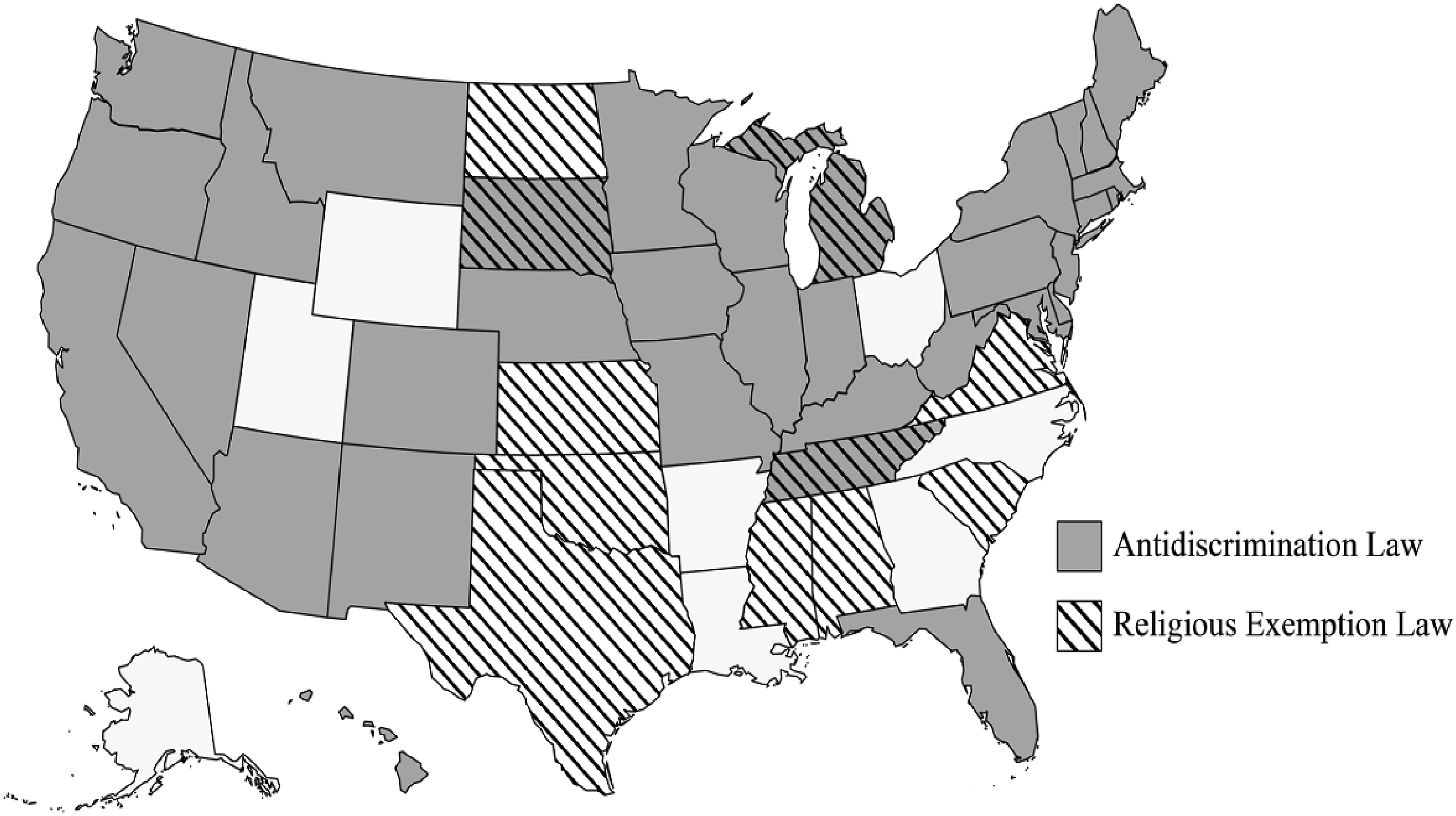
As different legal regimes are typically associated with different norms, attitudes, and behaviors, the state of the law is inevitably intertwined with social, political and demographic characteristics of the political community and cannot be easily untangled from those. Background laws thus stand not only for plain law, but for a socio-legal environment. Investigating their current role in shaping public opinion can yield no conclusions about causality. Nonetheless, understanding how the Court influences public opinion in different legal regimes matters greatly, as the ongoing legal differentiation between states (Grumbach, 2018; Masket, 2019) is likely to translate into differential effects of Supreme Court decisions across state lines.
Ideology and Associated Preferences
Ideology is a key factor shaping the response to law in general and to Supreme Court decisions specifically. Indeed, previous studies found that people holding opposite ideological commitments often respond to the same decision in opposite ways (Braman & Fontana, 2012). Ideology has many manifestations: it pertains to and could be measured as a belief, an identity, a behavior (for example biased media consumption or church attendance), or as a social phenomenon (as the level of interaction with ideologically similar others). Each of these dimensions is informative in its own right and could be at the focus of different research questions. One innovation of the current study is that we collected information on multiple such dimensions of ideology. As we explain later, we ultimately found that these measures are highly correlated with each other and had the same effect on public opinion, so we compounded them into a single construct of ideology. We briefly explain these dimensions in what follows.
The most prevalent measure of assessing ideology is self-identification on a simple liberal-conservative scale. Unsurprisingly, strong correlations were found between conservative identity and conservative opinions on matters addressed by the Supreme Court (e.g., Bishin et al., 2016; Tankard & Paluck, 2017). Yet another important dimension is social environment. A longstanding hypothesis spelled that the Court’s influence on individual attitudes depends on the response of the social environment to the decision and predicted that individuals will mostly shift in the direction of the social norm of their environments (Franklin & Kosaki, 1989). Recent work found that though the Court may affect individuals’ perceptions of the social norm, this shift does not necessarily translate to a change in personal attitudes. Studying the effects of Obergefell v. Hodges, a decision that constitutionalized same-sex marriage nationwide, Tankard and Paluck (2017) found that the ruling increased the perception that society supports same-sex marriage but did not shift personal attitudes on the subject. Clark et al. (2024) found the same discrepancy between personal attitudes and social perceptions in their study of the Dobbs decision, which retracted the constitutional right for abortion. Only this time, Clark and her colleagues found a shift in the opposite direction from the Court’s opinion, as individuals thought that more Americans supported legalized adoption than before. Reflecting on the contradictory patter of results from both studies, Clark, Paluck, and their colleagues suggested that individuals’ perceptions of the social norm might be more influenced by the reaction to Supreme Court decisions than by the decisions themselves.
However individuals perceive the social norm after a Court’s decision, it is still unclear whether and how individuals’ social environment – and its norms – shape the Court’s effect. While no study had directly examined this question thus far, a recent methodological development facilitates a test. Gelman and Margalit (2021) studied the influence of individuals’ social penumbras—whether they personally know, for example, conservatives, progressives, gays, and/or people with traditional beliefs about marriage—on attitudes concerning such groups. The researchers found that entering a group’s penumbra leads to a shift in attitudes concerning policy questions related to that group. Their findings raise the hypothesis that being in the social penumbra of a group affected by the Court’s decision could moderate the Court’s effect on one’s attitudes.
Another dimension where ideology could shape the Court’s effects on public opinion is media consumption. Recent studies observed a vicious cycle by which political polarization is increasingly reflected in mass media, leading to mass partisan-ideological sorting, which yields further political polarization (Davis & Dunaway, 2016). Against this backdrop, an ideologically-biased media diet is likely to be associated with more ideological-biased views. Linos and Twist (2016) investigated the impact of ideologically-biased media coverage of two split Supreme Court decisions and found heavy ideological bias in both conservative-leaning and liberal-leaning media. In general, channels were likely to present positive one-sided coverage on ideologically-congruent decisions and present mainly negative but not entirely one-sided coverage on ideologically-conflicting decisions (Linos & Twist, 2016). Participants exposed to (positive) one-sided reports shifted in favor of the upheld law more than those exposed to (negative) two-sided reports of the ruling (similarly, see Stoutenborough et al., 2006).
Religiosity is yet another ideological dimension that could shape the Court’s effects, especially in the context of Fulton, a decision concerning religious claims. For example, Barak-Corren (2021) study of the behavioral effect of Masterpiece Cakeshop found the largest change in vendors’ behavior in more religious areas. In a subsequent study of the effects of Fulton on foster care agencies, Barak-Corren and Berkman (2024) found that religious agencies responded to the decision in jurisdictions wherein it expanded their rights, but not so where religious exemptions were already available to them. However, the decision’s effect was not limited to religious agencies and was also manifested among non-religious agencies, despite the fact that these are not entitled to religious exemptions.
With respect to all these dimensions, previous literature suggests that the Court is likely to have a larger impact among audiences who lean in the ideological tilt of the decision—whether because they or their friends stand to benefit from the decision, or because they consumed media supporting the decision, or because the decision simply validates their priors. On the same token, we hypothesized that ideology would enhance the effect of a congruent judicial decision. Perhaps surprisingly, we did not find this effect, but we are able to compare the different dimensions of ideology as we investigated this question.
The Durability of the Effects of the Supreme Court
If and when the Court influences public attitudes, what is the durability of this effect? Most studies measure the Court’s effect immediately after the decision was handed down and present little to no evidence on long-term effects (Barak-Corren, 2021; Hoekstra, 1995; Tankard & Paluck, 2017; Linos & Twist, 2016). While this design choice is necessary for causal inference—the multiplicity and accumulation of intervening events over time disrupt causal attribution—the lack of data leaves open questions about the durability of the effect of judicial decisions and the conditions that amplify or attenuate the Court’s effect over time.
In an exceptional study, Kugler and Strahilevitz (2017) measured the long-term effects of the Riley v. California decision, which unanimously stated that a warrantless mobile phone search during arrest is unconstitutional, and the Burwell v. Hobby Lobby Stores, Inc. decision, which held, in a split decision, that a for-profit corporation was entitled to a religious exemption from providing contraceptive coverage to its female employees. In the immediate term, the researchers found that public views shifted slightly in the direction of both Supreme Court rulings. One year following the decision the effect disappeared and the measures returned to their pre-decision levels. Notably, the researchers recruited new cohorts of participants in each wave and did not repeatedly measure the same participants on multiple time points. In addition, they did not have any measurement of public views between one week and one year after the decision; and of all of the factors potentially shaping the Court’s influence over time, the only one they measured was conservativeness.
Other studies suggested that Supreme Court decisions can have long-term effects on public opinion. Marshall (1987) found that unanimous decisions have a long-lasting effect and Ofosu et al. (2019) found long-term effects, including backlash effects, after the Supreme Court decision in Obergefell v. Hodges. Based on longitudinal public opinion data, Ura (2013) proposed a nuanced model that suggested that in the short term, the public resists decisions that appear to disrupt the existing order. However, the short-term backlash is followed by a gradual shift towards the ideological position taken up by the Court. Notably, Ura’s model examines the cumulative impact of the Court’s high-profile decisions in a specific term, and does not isolate the effects of a single Supreme Court ruling.
Our study of one Supreme Court decision obviously cannot fill all gaps of knowledge with respect to the effect of the Court over time. Nevertheless, our design provides an opportunity to obtain further clarity on this question by combining a repeated measurement of the same participants over multiple time points, in which the role of three key factors – minimalism, law, and ideology – is examined. This allows us to inquire whether specific factors shape the durability of the effect over time.
The Study's Research Questions
We set out to examine the factors shaping the public impact of the Supreme Court in the context of the Fulton decision, which allowed us to test several important open questions. First, the question of minimalism: do narrowly framed decisions yield a different impact than broadly framed decisions? Second, the legal differentiation across states in the existence of antidiscrimination rules and religious refusal rules allowed us to test whether background legal rules moderate the Court’s effect on public opinion. Third, the collection of multidimensional data on ideological inclination (self-identification; biased media consumption; ideologically titled social circles; and religiosity) facilitated a more robust examination of the role of ideology in shaping the Court’s public impact, which is absent from earlier studies that typically focus on one or two such measures. Finally, our design created a more nuanced examination of the durability of the Court effect than previous studies (compare with Kugler & Strahilevitz, 2017; Ofosu et al., 2019). The combination of a longitudinal panel survey with an experimental component and the systematic study of factors potentially moderating the effect over time created the most detailed setting to date to examine longer term effects of Supreme Court decisions. Finally, we triangulated several sources of data – our original work as well as an external dataset – to answer this question.
The Original Fulton Longitudinal Survey Experiment
Methods
Sample
We recruited a total number of 1386 participants to the pre-Fulton survey in three batches collected in early April, May, and June 2021. This method allowed us to monitor potential opinion change throughout the pre-Fulton period and we found none. Notably, while the Court issued multiple decisions in the weeks leading up to Fulton, none addressed issues of religious liberty and sexual orientation equality. Participants were recruited through Prolific, an online survey platform, in exchange for payment, in keeping of a balanced sample of conservatives, liberals, and moderates using research quotas. 7 We pre-registered the project in aspredicted.org. 8
Demographically, 49.5% of the participants were female and 49% male. The average age ranged between age groups 25–34 and 35–44, slightly leaning towards the older age group. The sample was politically balanced, with the average political leaning being 3.9 (SD = 1.9) on a scale between 1 = very progressive and 7 = very conservative. Participants consumed news frequently, on average between “Daily” and “4–5 times per week”, leaning towards daily. Roughly 45.7% of the participants reported that they consume news through television, 54% through daily newspapers and news websites, 67.5% through social media and 16% through the radio. Participants’ geographic distribution was roughly representative, with 14.9% of the participants hailing from California, 8.6% from New York, 8.3% from Florida, 7.6% from Texas and 4% from Pennsylvania. The mentioned states are the five states with the highest representation among the survey participants.
After Fulton was handed down on June 17, 2021, all participants were invited to participate in two additional surveys, one week and ten weeks after the decision. Nine-hundred and twenty participants completed the first post-Fulton survey, and 727 participants completed both post-Fulton surveys. The analysis is thus based on two datasets. The first includes 920 participants with two observations each - one before and one after Fulton. The second dataset includes the 727 participants who answered all three questionnaires – one observation prior to the decision and two after the decision. Despite the natural attrition that occurred between waves, the demographics of the sample remained roughly the same during the three measured periods. 9 This finding shows that attrition did not bias our dependent variable.
We also analyzed the characteristics of drop-outs (participants who completed a pre-Fulton survey but did not complete a post-court survey; and participants who completed two waves versus those who completed three waves) and found that they did not differ significantly, demographically, politically, or in media consumption habits, from participants who remained in the sample. It seems that drop-out reflects general or natural turnover among the Prolific panel, as retention rates were highest for the third pre-Fulton batch (76%), lower for the second batch (65%) and lowest, though still very high, for the first batch (57%).
Procedure
The pre-decision survey focused on collecting a broad range of demographic and attitudinal measures, including information on participants’ media consumption habits.
10
The second survey, conducted a week post-Fulton, measured participants’ attitudes following the decision and was designed as a survey experiment.
11
Participants were asked at the beginning of the survey whether they heard about various events that occurred in the days leading to the survey, including the Fulton decision (described as “Supreme Court rules on a Catholic foster agency that excludes same-sex couples”).
12
Participants who were not exposed to the decision were randomly assigned to one of three groups: (1) A control group that received no information on the decision (n = 223)
13
; (2) A broad decision framing treatment, in which participants read a news vignette describing Fulton as a major win for religious liberty and applicable to additional cases involving religious liberty claims; this treatment used the language of religious liberty advocates in their public comments following the decision (n = 199), emphasizing the unanimity of the decision and calling it “huge victory” (see Figure 2); (3) A narrow framing treatment, in which participants read a news vignette describing the decision as case-specific and contingent on the foster care agency being willing to refer same-sex couples to other agencies; this framing also cited one line from the 110-page Fulton opinion that alludes to same-sex couples’ right to equality (n = 211) (see Figure 3). The broad decision frame treatment. The narrow decision frame treatment.
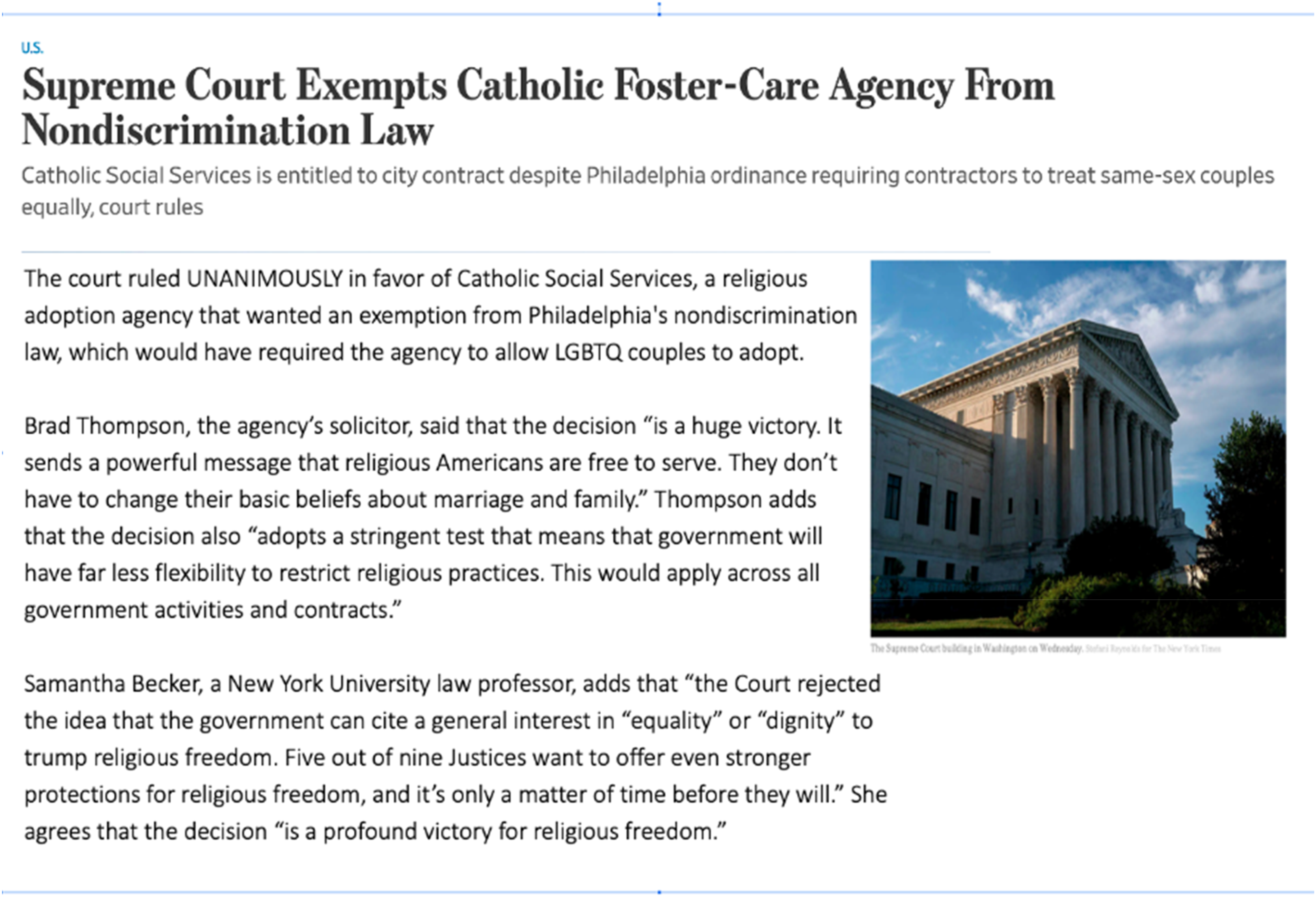
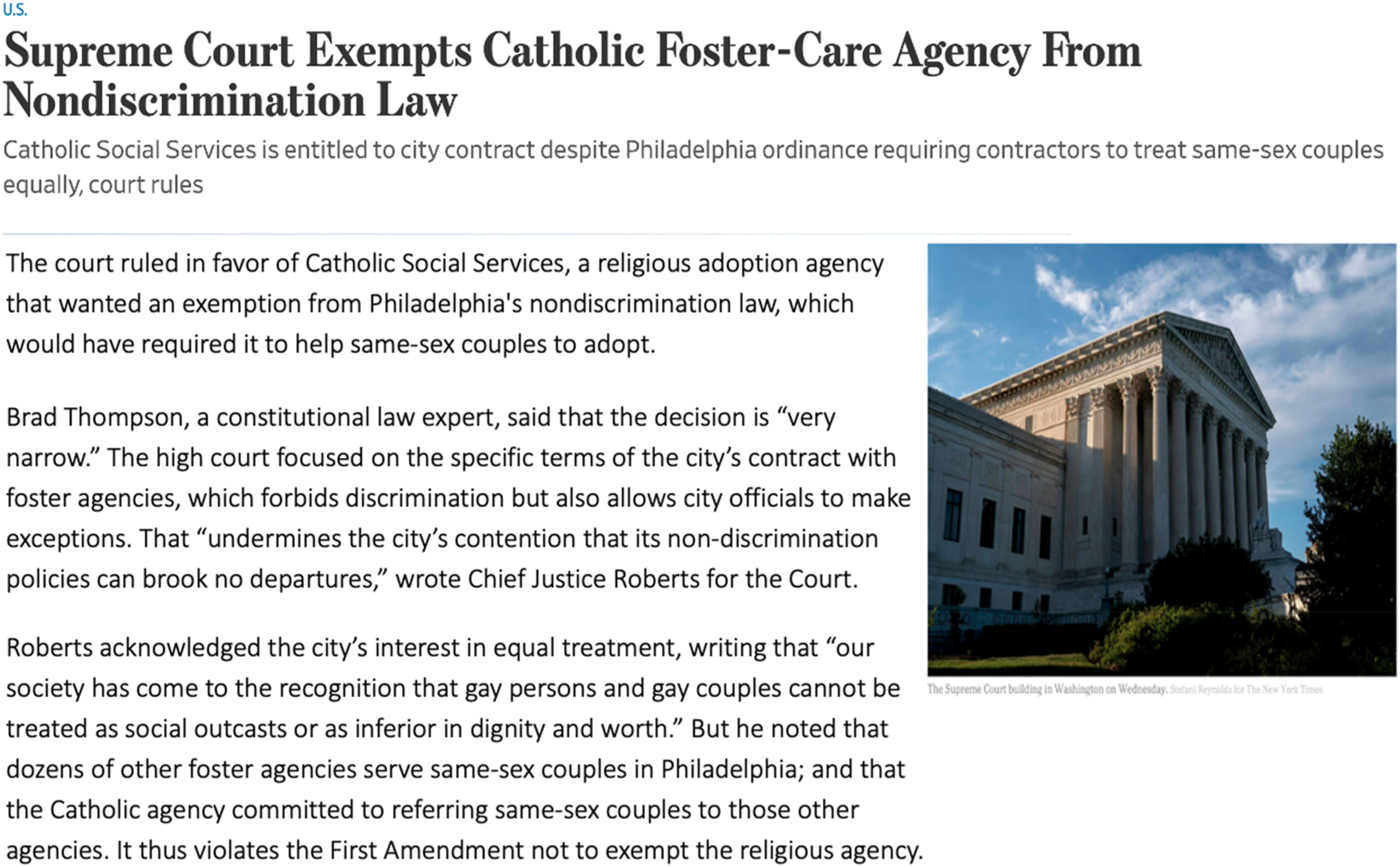
Participants in all four groups – natural exposure, no exposure (control), broad frame exposure and narrow frame exposure -- proceeded to answer the same follow-up questions in the same order.
The third survey, conducted 10 weeks post-Fulton, included only re-measurement of the attitudinal measures. The goal of the third survey was to examine whether exposure to the decision (naturally or experimentally) had long-term effects. Its data was compiled together with the data from early waves. Figure 4 provides the overall structure of the study. The procedure of the longitudinal survey experiment.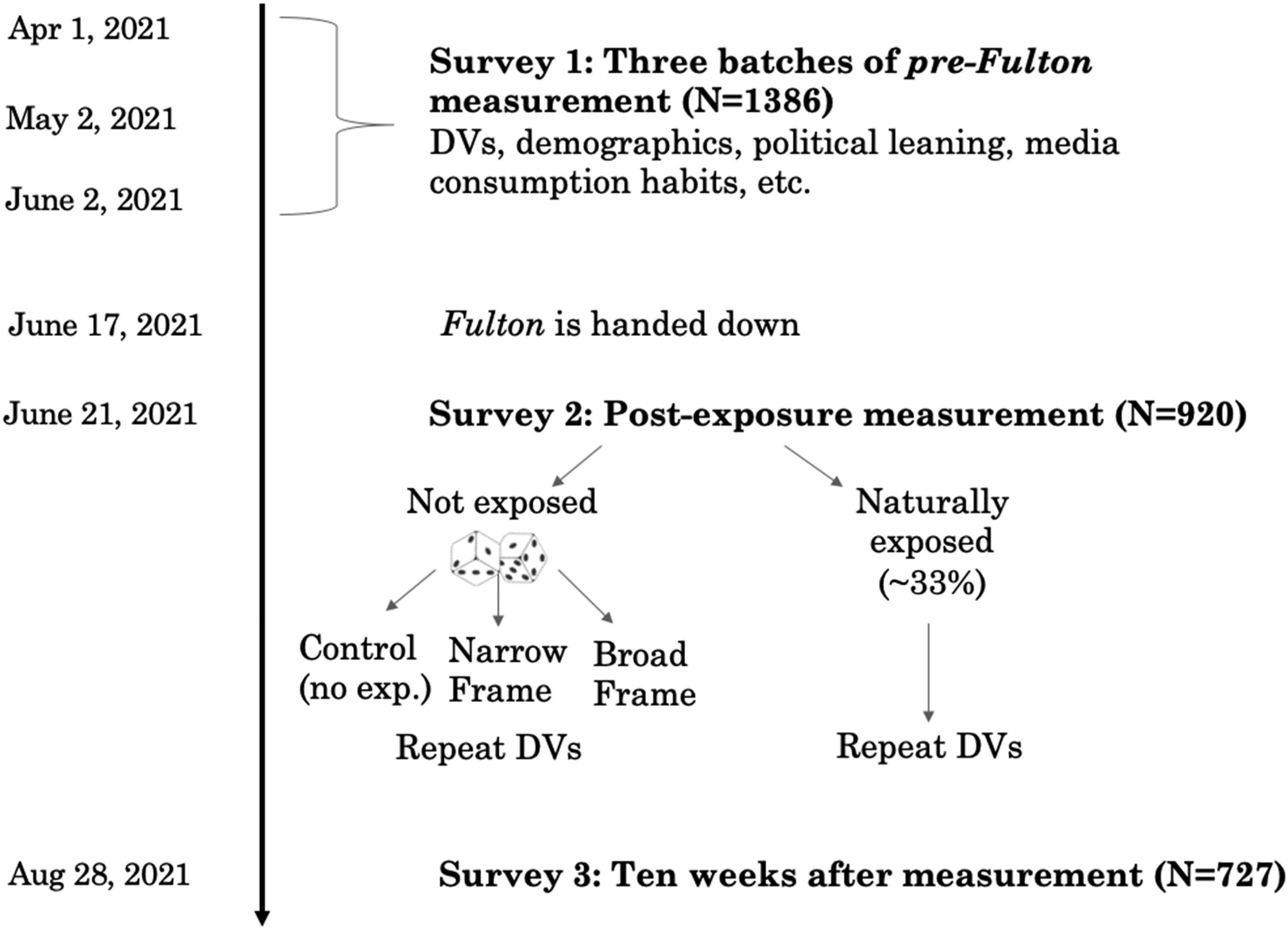
Variables
Dependent Variable
Given prior work on Supreme Court effects on public opinion, and particularly prior work on the effects of Courts providing religious exemptions, we hypothesized that Fulton will impact public support in religious service refusal. The primary goal of the study was to discern the effect of a Supreme Court decision on public attitudes with respect to the issue at stake: refusal to provide service to gay couples. Our main DV was therefore “To what extent do you oppose or support allowing foster care and adoption organizations, with traditional beliefs about marriage, to deny service to gay couples?” (1 = strongly oppose, 9 = strongly support). 14
Moderating Variables
Our interest centered on the role of background laws and ideology in moderating the effect of exposure to the Court decision.
Our measurement of background laws relied on Barak-Corren et al. (2022), who collected data on the applicable laws in each state. Based on participants’ state of residence, we coded whether they reside in a jurisdiction that prohibits discrimination on the basis of sexual orientation in foster care and whether their jurisdiction provides religious refusal rights to foster care agencies. 15 As Figure 1 shows, there is little overlap between the categories and some states enacted neither rule.
We constructed an overarching measure of ideology from participants’ self-identification along the conservative-liberal scale; a measure of biased media consumption that relied on participants’ reports of their go-to news sources; 16 a measure of ideologically-tilted social environments, that relied on participants’ reports of the number of conservatives, progressives, gay people, and people with traditional beliefs about marriage among their social circles (adapting the measures of Gelman & Margalit, 2021); 17 and importance of religion. While we initially analyzed each of these measures in separate, we combined them into a super construct of conservativism after observing that they are highly correlated, and each affects the dependent variable in the same direction. 18 The conservativism super-construct is a weighted average of its components and has high internal reliability (Cronbach alpha = 0.66).
Preliminary Checks
In addition to examining the patterns of attrition from the study (see above), we also examined whether participants from the Naturally Exposed group differ from participants in other groups. We found no differences with respect to most demographic variables and most attitudes. Most importantly, prior to Fulton the naturally exposed group did not differ from the other groups with regard to the main dependent variable – support for religious refusal. However, as expected, naturally exposed participants tended to consume news more frequently than other participants. On a scale of 1–6 (1 = multiple times a day; 6 = never), the average among the exposed group was 1.73 – between multiple times a day and once a day, and among those that were not naturally unexposed was 2.29 – between once a day and 4–5 times a week (p < .001). Naturally exposed participants also differed with regard to the sources that they consume news from – a higher percentage of naturally exposed participants consumes news from daily newspapers (66.79% of naturally exposed vs. 46.07% of unexposed) and from radio and podcasts (39.11% of naturally exposed vs. 25.58% of unexposed), while a lower percentage of naturally exposed participants consume news from social media (58.67% of naturally exposed vs. 67.03% of unexposed). Reflecting on these differences, we do not claim that the naturally exposed group represents, or indeed should have represented, the general population. Those exposed to Supreme Court decisions are likely to have unique characteristics and there is no gold standard to compare them to. Table 3 comparing the two groups is included in our Appendix.
Results
We analyzed the impact of the exposure to the Supreme Court Fulton decision on individuals’ support for religious service refusal both immediately after the exposure and ten weeks after the exposure. All of our analyses include within-subject controls and survey fixed effects.
The Impact of Type of Exposure to the Decision: Natural Exposure, Broad Decision Frame, and Narrow Decision Frame
Personal Attitudes before and after Fulton. 19
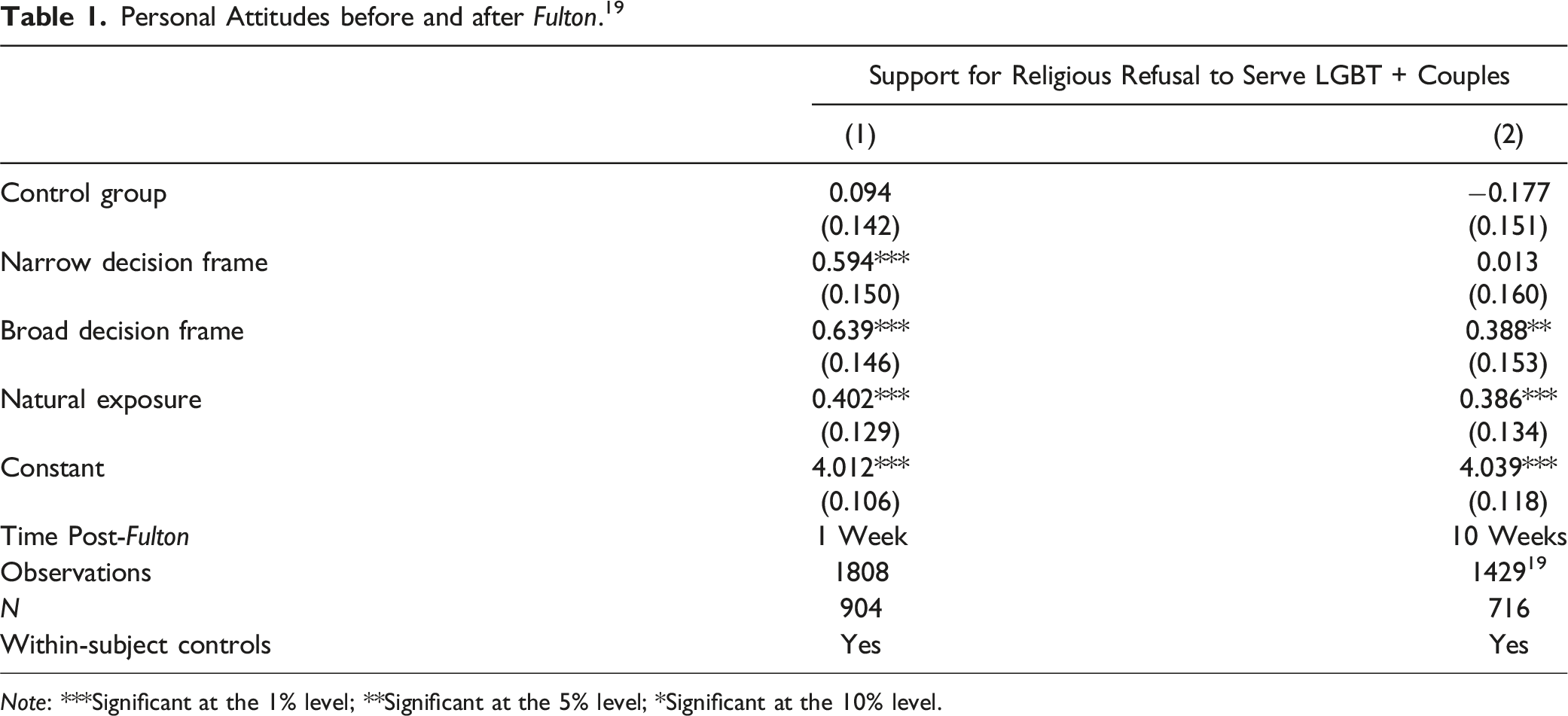
Note: ***Significant at the 1% level; **Significant at the 5% level; *Significant at the 10% level.
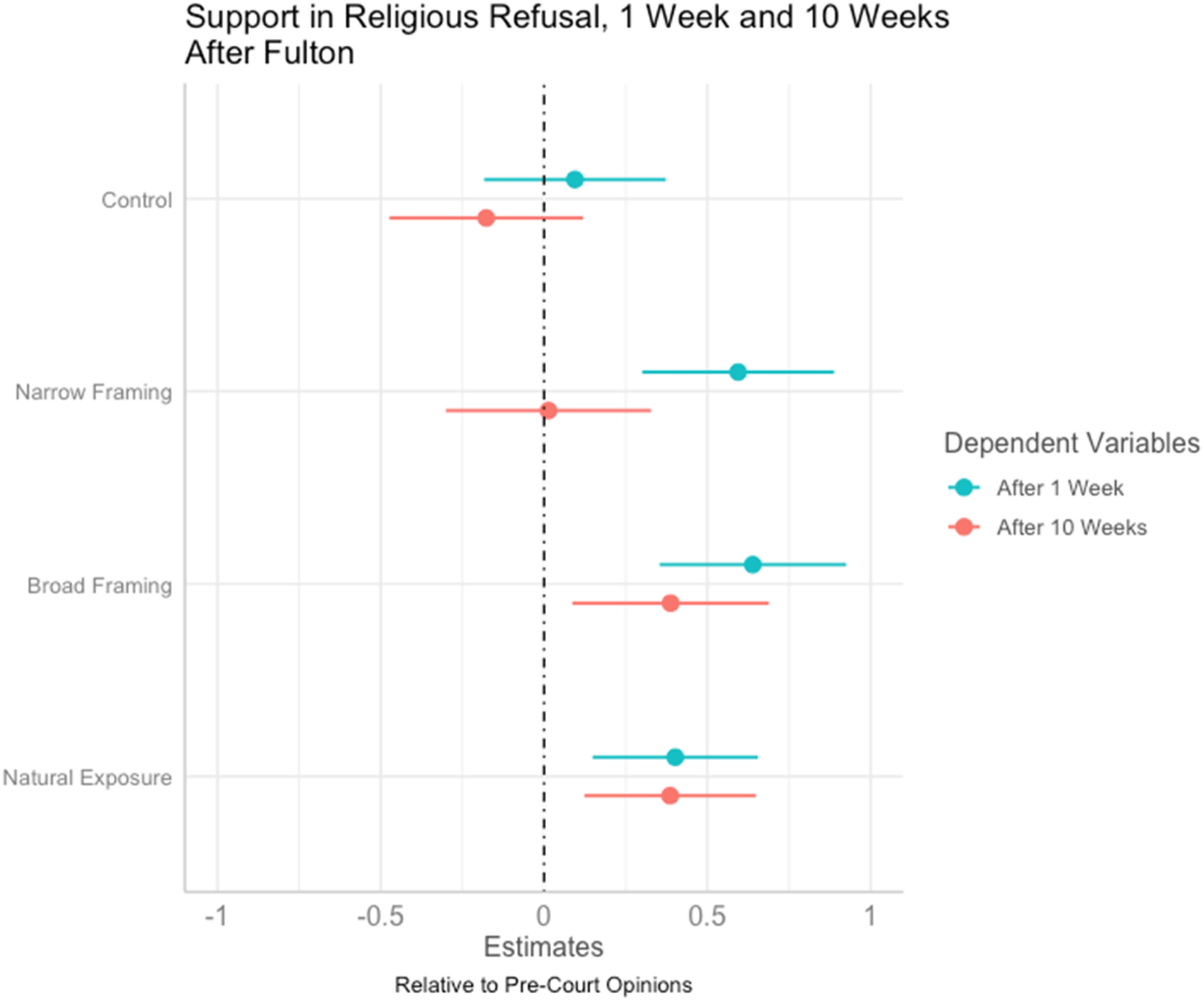
Support in religious service refusal one week and 10 weeks after Fulton by natural exposure, narrow framing, and broad framing of the decision.
Ten weeks after the decision, the effect remained significant in two of the three exposure groups: among participants who were exposed naturally to Fulton and among participants who were experimentally exposed to the broad framing of the decision (broad framing: 0.388, p < .05; natural exposure: 0.386, p < .01). Participants that were exposed to the narrow decision frame returned to their pre-Fulton opinion levels.
The Role of Background Laws
Participants’ support for religious refusal varied at baseline between the four legal regimes. Support was lowest in Antidiscrimination Law Only regimes (Mean = 3.79, SD = 3.10) and highest in states that enacted neither an antidiscrimination law nor a religious exemption law (Mean = 5.02, SD = 3.27). These differences were statistically significant (after one week: −1.068, p < .01; after 10 weeks: −1.070 p < .01); the three regimes whose laws were not directly impacted by Fulton had statistically indistinguishable levels of support in religious refusal both before and after the decision. 20 We focus the analysis on the effect of Fulton in the Antidiscrimination Only regime, both because this is the only regime were the decision actually modified the law and because the three additional regimes had much smaller Ns, resulting in few participants per regime-exposure type cell and an underpowered test. 21
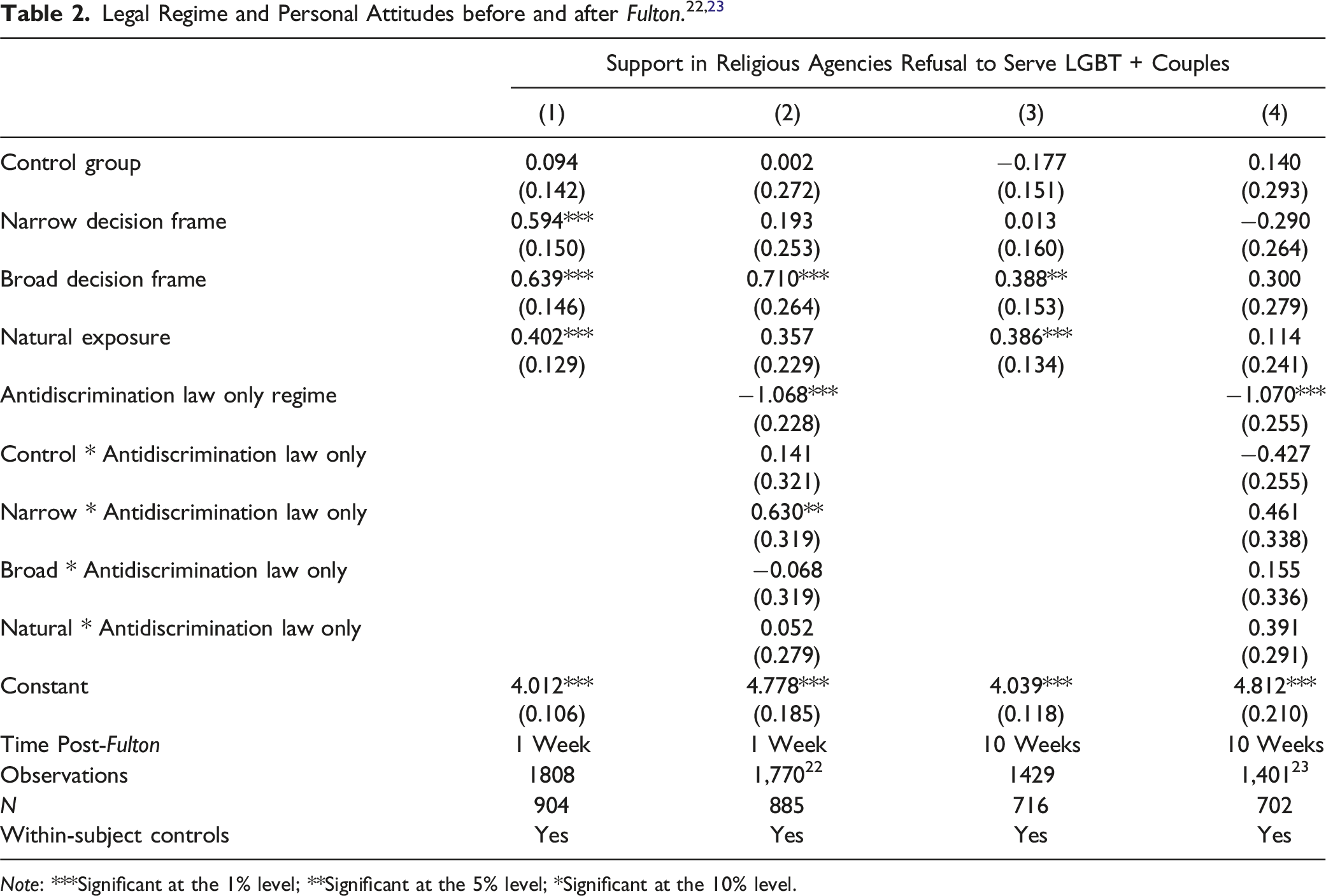
Note: ***Significant at the 1% level; **Significant at the 5% level; *Significant at the 10% level.
Ten weeks after the decision, with a smaller sample, the legal regime analyses seem insufficiently powered, as the addition of the legal variables detract from the significance of the main effects without revealing statistically significant interactions and the coefficients become noisy. Nevertheless, the direction of both the main effect and the interaction effects remains the same as they were one week after the decision. Notably, at the 10-week marker we also see a non-significant decline in support in religious service refusal in the control group in Antidiscrimination Law Only regimes; importantly, the control group does not remain “controlled” 10 weeks after the decision, as by that time participants might have consumed information about the decision. Support in religious service refusal one week and 10 weeks after Fulton by exposure type and legal regime.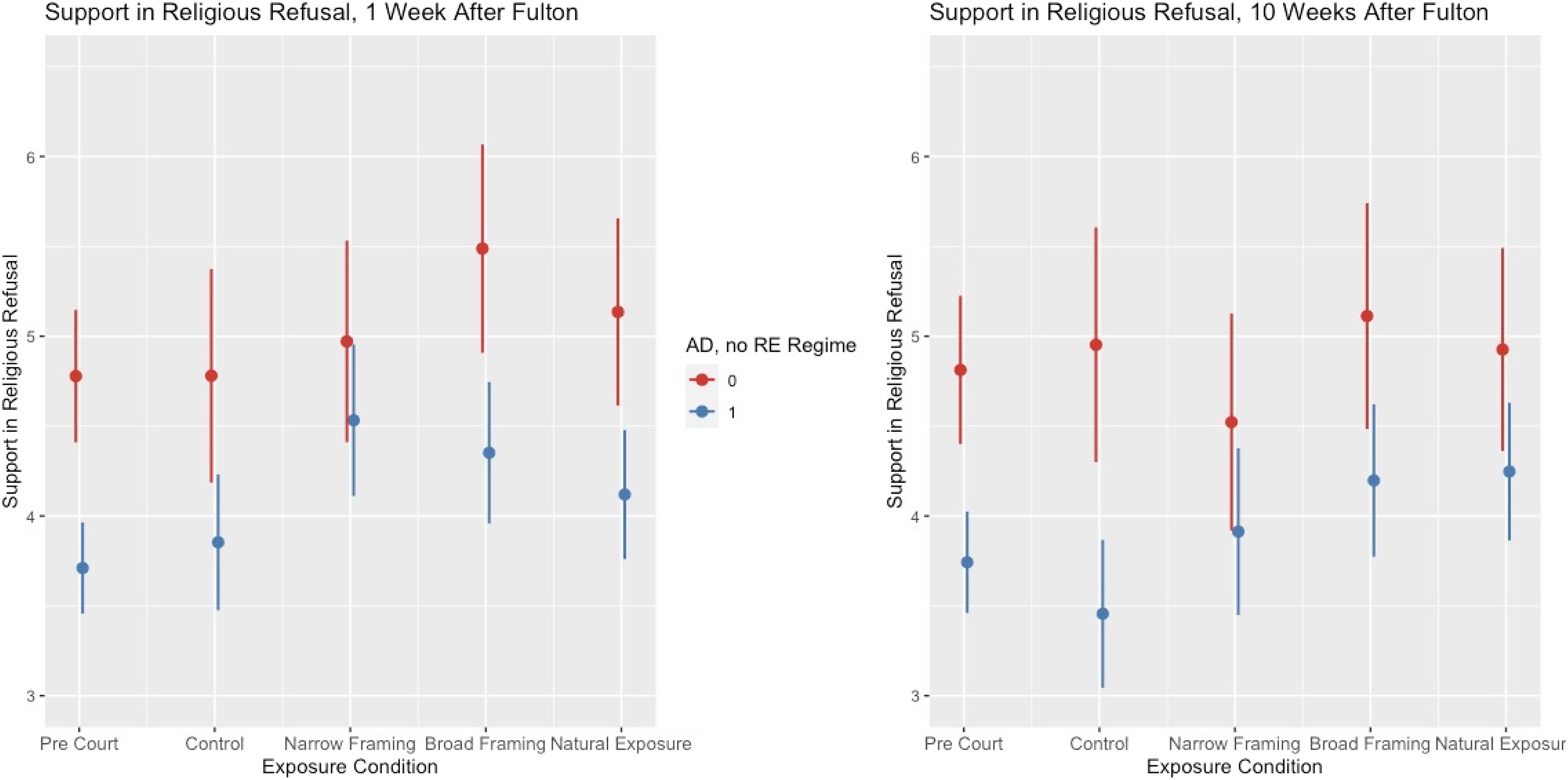
The Role of Ideology
Personal Attitudes before and after Fulton. 24
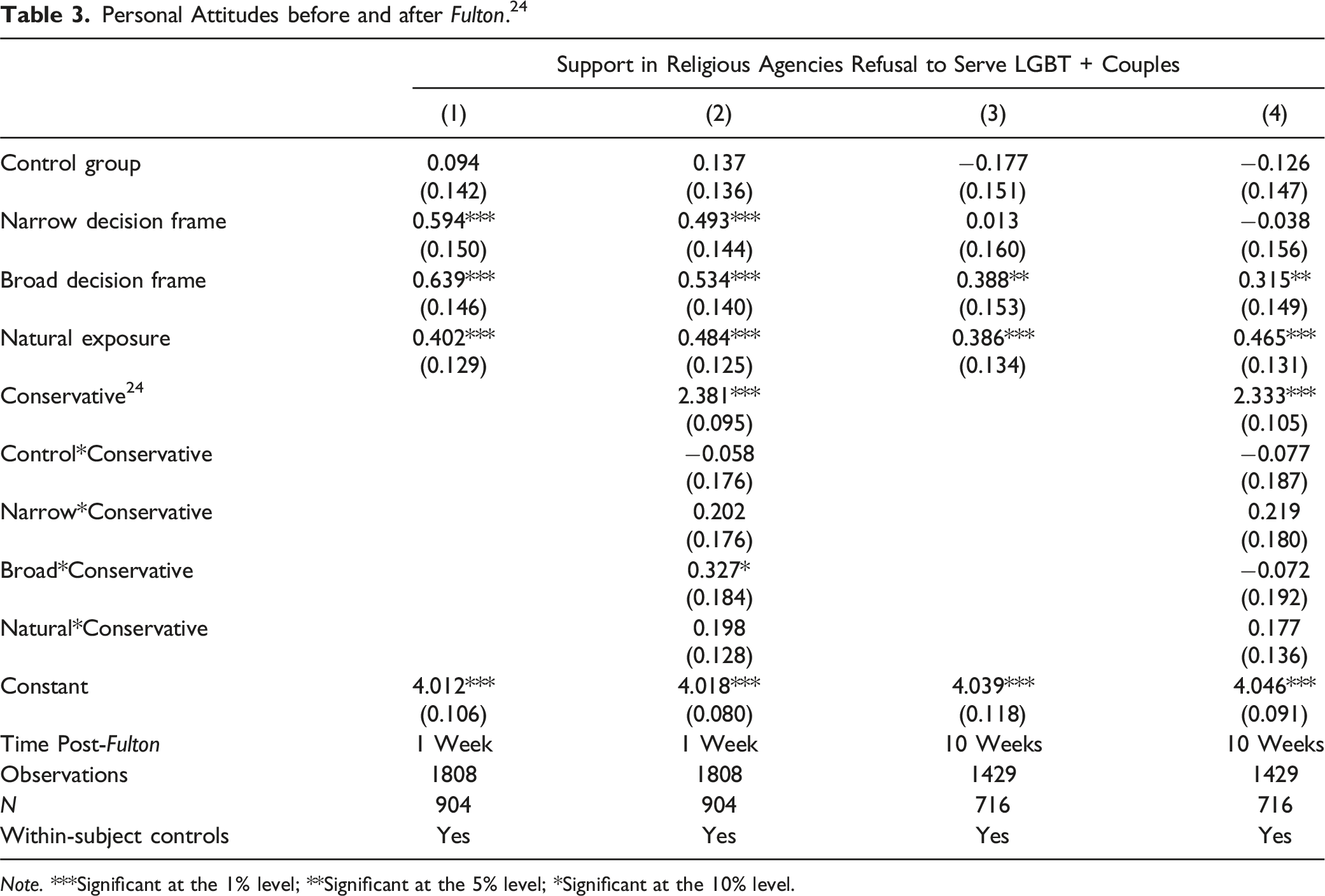
Note. ***Significant at the 1% level; **Significant at the 5% level; *Significant at the 10% level.
The Cross-Sectional PRRI Data
In this section we triangulate and expand our data with public opinion data collected by PRRI, a nonprofit organization that conducts independent research in issues of religion, culture, and public policy. This examination allows us to examine our results against another source of data which includes is demographically representative and much larger than ours (N = 22,612). In addition, the PRRI survey allows us to examine the effect of the ruling over a longer period than we have examined independently.
Methods
In 2021, PRRI collected data from 22,612 adults (age 18 and up) living in the United States. Interviews were conducted online over four waves: (1) March 8–30, (2) June 7–23, (3) August 9–30, and (4) October 18-November 9, 2021. Respondents were recruited using an address-based sampling methodology from the Delivery Sequence File of the USPS – a database with full coverage of all delivery addresses in the U.S. As such, it covers all households regardless of their phone status, providing a representative online sample. The initial sample drawn from the KnowledgePanel was adjusted using pre-stratification weights so that it approximates the adult U.S. population defined by the 2019 American Community Survey (ACS). Next, a probability proportional to size (PPS) sampling scheme was used to select a representative sample. 25 The data differs from our attitude survey in that the interviews were directed to different subjects in each wave (a cross-sectional study, similar to Kugler and Strachilevich, 2017), while we returned to the same participants in all three surveys (a panel study). Unfortunately, we could not use PRRI’s second wave data, as Fulton was handed down in the midst of this wave and the data file we obtained from PRRI did not include the exact dates of the interviews. Excluding the second wave left us with 16,761 participants overall.
The closest question for our dependent variable asked participants to rank their level of support in “Allowing a small business owner in your state to refuse to provide products or services to gay or lesbian people, if doing so violates their religious beliefs” (1:strongly oppose; 4: strongly favor). 26 Notably, this item measures support for service refusal by for-profit entities along contexts much broader than the foster care setting that stood at the heart of Fulton—and our own study. Thus, any effect for Fulton on this measure reflects substantial spillover from the foster care and nonprofit agency setting to unrestricted commercial settings. We used PRRI’s measurement of the participants’ conservativeness (“In general, do you think of yourself as…”: 1 = Extremely Liberal; 7 = Extremely conservative).
Based on PRRI’s raw data, we created two new variables: 1. A dummy variable called “Post-Fulton”, indicating whether the interview was conducted before (Post Fulton = 0) or after Fulton was decided (Post Fulton = 1). Accordingly, Wave 1 observations received Post Fulton = 0, and waves 3 and 4 received Post Fulton = 1. 2. Dummy variables coding legal regime based on participants’ state of residence, which was available as part of the data. The categorization of states to legal regime was based on the same categorization used for our survey.
Results
Personal Attitudes before and after Fulton in PRRI Data. 27
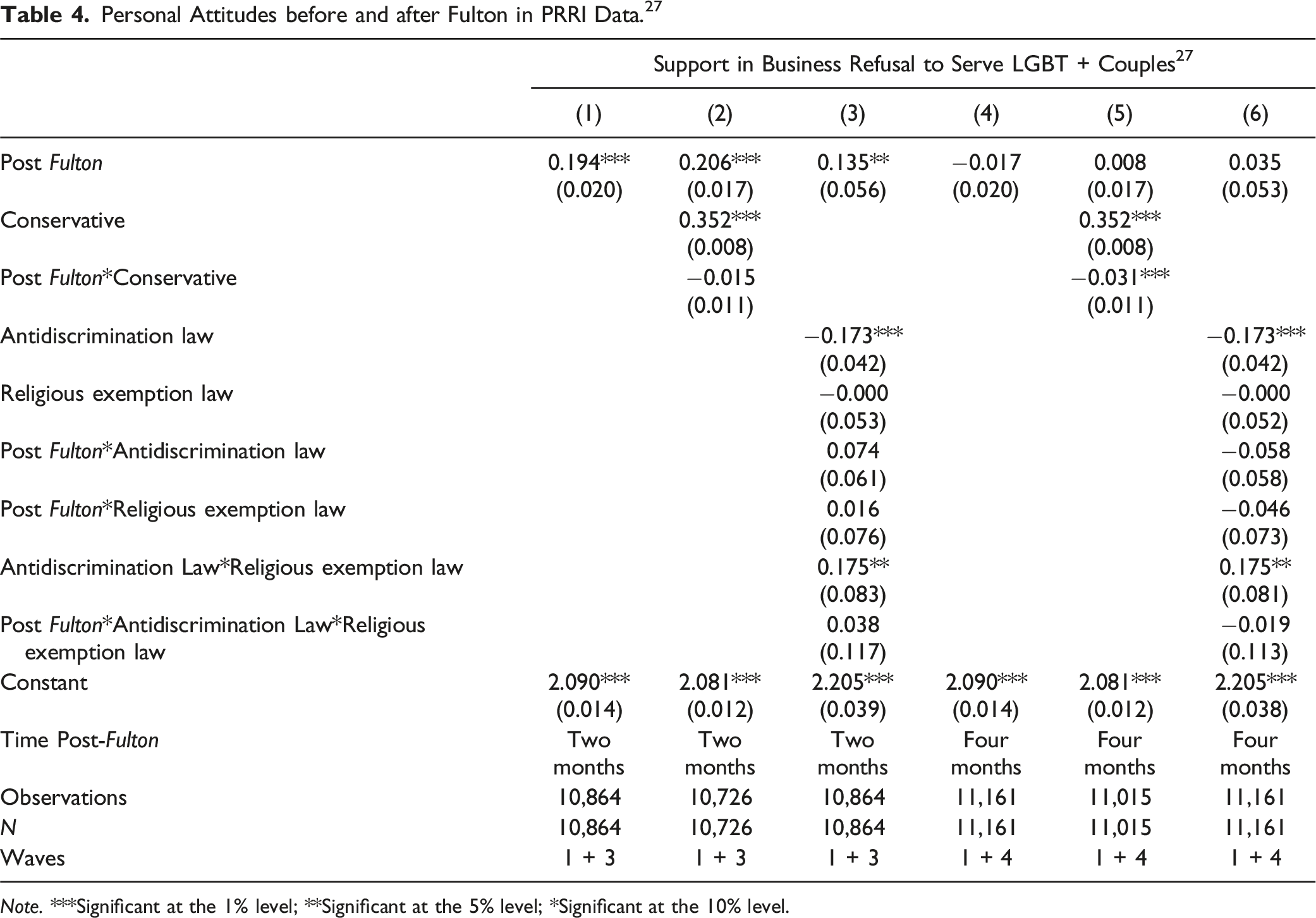
Note. ***Significant at the 1% level; **Significant at the 5% level; *Significant at the 10% level.
Next, we explored the role of legal regime and conservativeness.
The Role of Legal Regime
Our results with respect to legal regime consisted of a correlational relationship between Antidiscrimination Only legal regimes and (lower) support for service refusal; and a causal interaction effect between these regimes and the narrow decision frame, which led to heightened support for service refusal under the narrow frame immediately after the decision. Given that the PRRI survey did not include a framing experiment, our analysis of its data could not replicate our causal finding of a relationship between legal regime and narrow decision frame.
Therefore, we focused our analysis on replicating the correlation between legal regime and support for service refusal. Here, our original analysis was limited due to the uneven distribution of laws across the United States. The PRRI data, with much larger sample size, allowed for a full test of the relationship between the different types of legal regime and religious service refusal.
First, we find that living in states that enacted an anti-discrimination law without religious exemptions is associated with lower support for religious service refusal (−0.173, p < .01) (column 3). This replicates our original finding. Second, we find that this relationship is flipped for states that enacted both antidiscrimination laws and religious exemptions. In these states, support for religious service refusal is significantly higher than all other legal regimes (0.175, p < .05). This finding is new, as we did not have sufficient sample size to examine this relationship in our original study.
The Influence of Ideology
We added conservativeness and its interactions with post-Fulton to the model, and found that two months after the decision, both Fulton and conservativeness have a positive effect on support for religious service refusal (post-Fulton: 0.206, p < .01; conservative: 0.352, p < .01). In line with our original study, the PRRI data did not show a significant interaction between Fulton and conservativeness (column 2). The four-month analysis showed a non-significant effect of Fulton and a negative and significant, albeit very small, interaction with conservativeness (−0.031, p < .01) (column 5). Notably, the analyses that include conservativeness in columns 2 and 5 in Table 4 has slightly fewer participants as not all participants in the PRRI data answered this question.
General Discussion
Narrow Decisions, Broad Consequences?
We studied the impact of the Supreme Court decision in Fulton v. City of Philadelphia on public opinion under different conditions of exposure to the decision: natural exposure to the decision, consisting of participants who heard about the decision before entering the post-Fulton survey; a broad decision frame, wherein participants were randomly assigned to read a description of the decision as a broadly applicable holding; a narrow decision frame, wherein the decision was described as case-specific and narrow; and a control group, whose members were not exposed to any information about the decision. Note that while the naturally exposed group is not random, it captures a real phenomenon—people who are exposed to the Court decision on their own—and provides valuable information on how natural exposure construes the scope of the decision.
In the short term, we found that all three types of exposure—natural, narrow, and broad—led to a statistically significant increase in support for religious service refusal, in line with the bottom line of the decision – in comparable magnitude. In the longer term, however, the effect faded in the narrow decision frame but persisted among those who were exposed naturally or to the broadly framed decision. Furthermore, the PRRI data indicates that the decision effect might have spilled to broader legal and market contexts, increasing support in religious service refusal to same-sex couples in commercial settings.
This pattern of results shows that even when the Court attempts to produce a minimalist holding, it might not be able to restrict the decision’s public impact. These survey findings are in line with the behavioral results that Barak-Corren and Berkman (2024) obtained in their investigation of the real-world impact of Fulton, where they discovered that foster care agencies became less responsive to same-sex couples after Fulton and that courts and parties to litigation resolved all Fulton-resembling disputes in favor of the religious party after the decision, despite the seeming irrelevance of the Fulton holding to other cases. Namely, real-world results support the findings that Fulton was perceived and applied broadly.
These findings expose the inherent challenges of trying to restrict the effects of Supreme Court decisions. The Fulton Court’s minimalist strategy did not prevent the shift in public attitudes and behavior among naturally exposed participants; and did not prevent the spillover to broader legal and market contextsthat was found among the large-N and representative PRRI sample. It is possible that the Court effects faded in the long term as the PRRI data shows little effect four months after the decision. Yet it is hard to conclude that with certainty, given that the PRRI data captures a spillover effect and not the directly relevant opinion measure that we analyzed in the main study.
Notwithstanding the failure of the minimalist strategy in practice, our experimental findings demonstrate that a minimalist strategy can evade (at least) the long-term change in public attitudes if effectively communicated to the public. This should not be impossible to accomplish, as our experimental design of the narrow decision frame was constructed of real elements in the Fulton decision. The fact that these elements, once highlighted, diminished the decision’s effect over time, should provide some encouragement for minimalist courts. However, reality is not a controlled experiment and courts do not have full control over the framing of their decisions. In reality, natural exposure to Fulton was akin to exposure to a broad rather than narrow frame of the decision.
The discrepancy between the decision and its public image is not surprising given the various stakeholders that seek to leverage Supreme Court decisions to their benefit. Indeed, impact litigation groups, NGOs, politicians, agencies, and market players all have stakes in coloring the Court as siding with their interests. Shortly after Fulton was decided, the ACLU tweeted that “It’s a very narrow ruling” and tied the result to “language in this specific contract,” (see also Esseks, 2023) whereas the Becket Foundation for Religious Liberty, that represented the foster care agency, tweeted the ruling with interpretation that “The First Amendment protects the rights of religious organizations to serve those in need without giving up the religious beliefs that motivate their ministry.” (See Appendix 7). Our experimental results show the effectiveness of these framing attempts and highlight the difficulty of checking the public impact of a high-stakes judicial decision.
What can a minimalist court do in the face of this challenge? One straightforward implication is that courts should invest great care in communicating the holding to the media and to the public. The Fulton decision consisted of more than 100 pages and buried its narrowing elements in a few lines towards the middle. Even though the decision aimed to achieve a legally minimal outcome (and was criticized for this minimalism by some of the concurring justices), it did not seem to communicate this minimalism effectively. If the Court is serious about minimalism, it must invest in highlighting and emphasizing its minimalism. One way to do so would be through press releases and briefings that emphasize the points that the Court wishes to express to the public. While nothing can inoculate a decision from manipulations by interested stakeholders, the more a court invests in framing its decisions the more it can be expected to succeed in shaping the narrative around it and keeping it aligned with the actual decision. In practice, this might require adding a spokesperson function or reshaping the tasks of offices that currently handle communication with the press. For example, the public information office of the Supreme Court of the United States is tasked today with updating the media on the Court’s schedule, coordinating access to reporters, and issuing notices of retirements, passings, appointments, and so on. It is not concerned with an effective communication of the Court’s decisions. A more deliberate communication approach could require reshaping these tasks or adding new functions that would help the Court to communicate more effectively with the public.
The Public Effect of the Court and Jurisdictional Differences
Our study examined the relatively neglected topic of the relationship between Supreme Court decisions and background laws. This relationship has become increasingly tense in the United States in recent years, due to growing polarization and legal differentiation across state lines (Grumbach, 2018; Masket, 2019; Kugler & Strahilevitz, 2017; Mackenzie-Liu et al., 2022). Until now there was almost no evidence on how such jurisdictional differences might shape the impact of the Supreme Court on public opinion. Our study provides both evidence and methodological guidance to future studies on this topic, which we predict will be of growing importance in years to come.
At baseline, we find considerable and expected differences in public opinion between jurisdictions. In terms of interaction with the Court, our findings are modest. We find that the short-term effectiveness of the narrow decision frame comes primarily from jurisdictions where the decision modified the law, but over time this effect fades away. This suggests that jurisdictions that suffer the brunt of federal intervention might be more receptive to narrow decisions, perhaps because such decisions are more likely to ‘split the difference’ or signal that notwithstanding the intervention, the Court still respects the commitments that guided the jurisdiction to adopt its policies in the first place.
Methodologically, our study suggests that future studies need to collect very large samples to detect interaction effects between different exposure types and different legal regimes. This is due to the fact that the population is not evenly distributed across the different regimes, as some policies are more popular and widespread than others. This limitation should be actively considered by future researchers who seek to design studies sufficiently powered to detect an effect, particularly in rarer regimes.
The Public Effect of the Court and Ideological Differences
Our study included multiple measures of ideology, including self-definition, media consumption, religiosity, and social penumbras. Ultimately, we found that ideology—however measured and constructed—plays a big role in shaping individuals’ baseline attitudes, but relatively little role in interacting with the effect of the Supreme Court. Our main substantive finding is modest: we find that participants whose ideology aligns with the decision are perhaps slightly more influenced by the broad decision frame. However, for the vast majority of our analyses we see no moderating or intensifying effect for conservativeness when it comes to opinion change following the decision.
Methodologically, our results contribute to the growing literature on the relationship between public opinion and ideology in the context of the Supreme Court. Our study is unique in including and comparing various ideological measures. Our primary contribution here is the finding that the various measures of conservativeness produce similar relationships with legal attitudes; we found no differences between the results of self-reported ideology and religiosity and quasi-behavioral measures, such as biased media consumption (Linos & Twist, 2016) and social penumbras (Gelman & Margalit, 2021). The comparative evaluation shows that, at least with respect to predicting socio-legal attitudes in our context, these measures are interchangeable.
The Durability of the Supreme Court Influence
A final contribution of our project is in expanding the small pool of studies that measure the durability of the effect of the Supreme Court. As we acknowledged throughout this paper, there are considerable methodological limitations to this investigation. Intervening events are inevitable and accrue over time. This complicates the ability to attribute the results of late measurements to the original Court decision. The effect might increase or decrease due to events other than the decision, and separating the effects is often impossible.
Our study investigates the effect of Fulton in several points in time – immediately after the decision, two months/ten weeks after the decision, and four months after the decision – using a combination of a longitudinal panel survey (our original study) and a cross-sectional large-N survey (PRRI data). This analysis accomplishes two important contributions. First, it triangulates findings across different methods and provide additional confirmation to our results. Second, our findings indicate that the long-term effect of the Court varies according to the framing of the decision. On average, the effect of the Court appears to decay over time, consistent with previous results (Kugler & Strahilevitz, 2017). However, broad frames of a decision appear to have a more prolonged effect than narrow frames.
Limitations and Future Studies
This paper examined for the first time the empirical effects of judicial minimalism, immediately and over a longer period and as it interacts with background laws and ideology. Our results are limited by a few factors: first, we were limited in our ability to fully examine the interaction between minimalism and background laws due to sample size and statistical power. Second, while our study incorporates three different time points, we are left with open questions about the durability of the effect of the different frames beyond the 10-week marker. In addition, our operationalization of the judicial minimalism theory invites additional questions and concerns. For example, future research may seek to distinguish between framed minimalism and substantive minimalism; and between minimalism appraised as negative and minimalism appraised as positive (e.g., “this is broad and bad” vs. “this is broad and good”). Furthermore, one may explore whether minimalism has a different impact when applied by the judicial majority versus the dissent, and what the effect of the Court’s own framing might be – for example, when some of the justices frame the Court opinion as overly broad or overly narrow. For example, consider the critique of Justice Alito in his concurrence in Fulton that the majority penned a too-narrow decision, or the critique of Justice Sotomayor in 303 Creative v. Elenis (2023) that the majority penned a too-broad decision. Furthermore, it is possible that the effects of those various frames vary among different constituencies. In this study we focused on public opinion. Other studies may seek to examine the effect of judicial minimalism specifically on legal audiences, including lawyers and other judges. A final valuable approach moving forward is to compare the durability of the effect among various audiences or groups. For instance, the impact of a court decision might diminish more quickly in less engaged groups or jurisdictions, while persisting or even strengthening among those with a greater stake in the outcome.
As with every study of one Supreme Court decision, however consequential on its own, questions remain about generalizability. Our finding that Fulton shaped public opinion is consistent with most studies conducted on the effect of high-profile Supreme Court decisions. Its most important contribution, however, is in exposing effects that have not been discussed in depth thus far, and in laying out avenues for future research that could elucidate the impact of nuanced judicial strategies on public opinion. As such, the study lays out a research agenda and practical paths that courts should pursue to better communicate their decisions to the public.
Supplemental Material
Supplemental Material - Minimalism, Law, Ideology, and the Public Impact of the Supreme Court
Supplemental Material for Minimalism, Law, Ideology, and the Public Impact of the Supreme Court by Netta Barak-Corren and Noam Shlomai-Kunitz in Journal of Law and Empirical Analysis
Footnotes
Acknowledgments
The authors thank Yonatan Arbel, Yona Becker, Shoham Chosen-Hillel, Hajin Kim, Tamar Kricheli-Katz, Mike Gilbert, Kim Lane Scheppele, Pratap Mehta, John Morjin, Shelley Robinson, Wojciech Sadurski, Max Stearns, Shiraz Sultan, and the anonymous reviewers for their helpful comments, and Shiraz Sultan, Yona Becker, and Shelley Robinson their superb research assistance. Barak-Corren acknowledges with gratitude the support of Israeli Science Foundation individual research grant no. 19/1497.
Declaration of Conflicting Interests
The authors declared no potential conflicts of interest with respect to the research, authorship, and/or publication of this article.
Funding
The author(s) disclosed receipt of the following financial support for the research, authorship, and/or publication of this article: This work was supported by the Israel Science Foundation (19/1487).

Supplemental Material
Supplemental material for this article is available online.
Notes
References
Supplementary Material
Please find the following supplemental material available below.
For Open Access articles published under a Creative Commons License, all supplemental material carries the same license as the article it is associated with.
For non-Open Access articles published, all supplemental material carries a non-exclusive license, and permission requests for re-use of supplemental material or any part of supplemental material shall be sent directly to the copyright owner as specified in the copyright notice associated with the article.
