



Abstract
Whether constitution-making should be constrained has long been debated, but little is known about whether it is possible. We make several contributions to this question. We start by providing a typology of three types of constraints on constitution-making: Substantive, Procedural, and Institutional. We next develop a positive theory of when these constraints are likely to influence drafters’ behavior. We then use a mixed-methods approach to explore these ideas in the context of Chile’s constitutional reform process. In a survey experiment conducted in Chile before citizens voted on the draft constitution, we find that most respondents supported constraints in the abstract, but that they also supported a popular policy initiative—nationalizing mines—that violated these same constraints. This suggests that popular opinion may not enforce constraints on constitution-making. However, in fieldwork conducted in Chile, we found evidence that Chilean political parties did rein in constitution-makers who wanted to ignore constraints. This suggests that constitution-making constraints may be more likely to be effective when enforced by political parties.
Introduction
Countries frequently debate establishing constitutional assemblies to re-write their constitutions (Elkins et al., 2009; Eisenstadt et al., 2017). There can be powerful reasons for wanting to call a constitutional assembly, including regime change, social unrest, or simply a desire to improve democratic governance. But there are also strong reasons to resist establishing a constitutional assembly. Notably, a common concern is that, once a constitutional assembly is established, its members will take actions inconsistent with the wishes of the political actors that allowed its creation. These actions could include jettisoning parts of a political system that are working well, cutting deals that entrench the power of the groups holding the pen during the drafting process, or removing checks and balances from the political process to ensure the implementation of their agenda (Landau, 2013b).
To capture the benefits of establishing a constitutional assembly without the risk of a runaway drafting process, there is growing consensus that constitution-making processes should be constrained (e.g., Arato, 1995, 2016; Colón-Ríos, 2013; Scheppele, 2020). Indeed, in recent years, there have been several high-profile constitution-making processes where constitutional assemblies were supposed to be bound by prior rules, such as peace agreements, existing constitutions, or interim constitutions (Arato, 2016, 2017). But it is not clear if it is in fact possible to constrain constitutional assemblies. Throughout history, there are many examples of constitutional assemblies that were established with clear constraints on their authority, only for the members of the assembly to explicitly ignore them and assume additional powers (Elster, 1995; Negretto, 2018).
In this paper, we use qualitative and quantitative data from the constitution-making process that occurred in Chile between 2019 and 2022 to explore whether and when constraints are likely to rein in drafters. While the Chilean process ultimately failed, an enduring legacy of the process is that it represented a constitution-making exercise characterized by notable constraints. That is, when political elites agreed to re-write the constitution, they sought to constrain the process by amending the existing constitution to stipulate detailed rules for its replacement. These amendments authorized the writing of a new constitution, but they also imposed constraints on the constituent assembly.
We make several contributions toward answering the question of when constraints are likely to rein in drafters. We start by providing a typology of three types of constraints on constitution-making. Drawing on a large body of literature, we identify three types of constraints (cf. Fasel, 2022). First, substantive constraints place limits on the content that can be included in the new constitution. In Chile, these constraints included requiring the new constitution to respect ratified international treaties, the decisions of final and enforceable court rulings, and the state’s republican and democratic character. Second, procedural constraints impose rules on the reform processes. In Chile, these constraints included requiring the constitutional assembly to make decisions by a two-thirds supermajority. Third, institutional constraints stipulate the powers constitutional drafters are allowed to assume. In Chile, these constraints included requiring the constitutional assembly to stick to writing a new constitution, without taking on additional powers like the power to legislate or to (re)compose other institutions.
We next develop a positive theory of when constraints on constitution-making are likely to be effective. When the members of a constitutional assembly would prefer to violate existing constraints, those constraints are only likely to change their behavior if ignoring them carries political costs. We consider two ways those political costs could be imposed. One way is public opinion. Simply put, if constraints are violated, a constitution-making process could lose popular support. But although citizens often have a say over the final constitution through a referendum, and can thus directly act as a veto player, they are unlikely to value compliance with constraints over substantive policy preferences they share with the assembly. As a result, we hypothesize that public opinion is unlikely to be the channel that creates compliance with constraints. Another way is through established political parties. Political parties are repeat players who may be willing to give up some short-term policy preferences to maintain the integrity of constitutional democracy. Specifically, they may believe that ignoring constitutional constraints can result in a runaway assembly that ends up undoing core features of constitutional democracy. Since their own survival depends on constitutional democracy, they will be incentivized to preserve it. Thus, we hypothesize that when political parties are close to the drafting process, they may end up enforcing constraints on constitution-making.
Finally, we use a mixed-methods research design to explore the plausibility of our theory. To test our hypothesis on the likely role of public opinion, we surveyed over four-thousand Chileans in the run-up to their national referendum on their draft constitution. By embedding experiments in a survey focused on high profile events in the country, we can directly test if violating constraints is likely to change public opinion on the process. Our key finding is that a majority of the Chilean public wanted the assembly to honor the constraints in the abstract, but when asked about the proposal to nationalize mines, which was contrary to the substantive constraints imposed upon the assembly, respondents were willing to ignore these constraints, even when they had initially said that they supported them.
To test our hypothesis on the likely role of political parties, we conducted fieldwork in Chile. We specifically interviewed Chilean legal and political elites from a range of ideological backgrounds to understand better the inner workings of the Constitutional Convention. We found that some assembly members made serious attempts to ignore the substantive and procedural constraints placed upon them. Ultimately, however, the Convention ended up complying with the constraints. Our fieldwork suggested that this was mostly due to the role of political parties. Notably, the constitution-making exercise commenced after an agreement between most major political parties, which established certain limits on the Convention’s power. Throughout the process, members of the Convention from political parties that were members of this agreement—regardless of their political leanings—enforced these boundaries against the non-signatory members of the Convention that sought to ignore them.
Background
The Academic Debate
There is a long-running debate over whether constitutional drafting should be constrained. The idea that constitution-making should not be constrained by the existing legal order can be traced to a pamphlet titled “What is the Third Estate?” written by Emmanuel Joseph Sieyès in the wake of the French Revolution. Sieyès argued that when citizens act together as the “Third Estate”, they have the pouvoir constituant—or the original constituent power—and can write the constitution without being bound by the existing legal order (Sieyès, 1789). Sieyès contrasted this power with the pouvoir constitué, or the constituted power, used by ordinary politicians and lawmakers that govern under the constitution. Because the pouvoir constituant is the highest manifestation of popular will, the argument is that it should not be constrained by prior law. The distinction between the pouvoir constituant and the pouvoir constitué has since become a foundational idea in constitutional theory (Tushnet, 2015; Yack, 2001).
Scholars have also offered pragmatic arguments for why constitution-making cannot be constrained by the existing legal order. For instance, Carl Schmitt observed that “[t]here cannot be a regulated procedure, through which the activity of the constitution-making power would be bound” (Schmitt, 1928, p. 130). Elster (1995) gives many examples, such as the American Federal Convention of 1787, where drafters ignored the instructions put upon them and created a new constitution with a modified ratification process. Similarly, Negretto (2018) documents a range of recent constitution-making processes, specifically in Latin America between 1990 and 2010, where the powers of the drafters were regulated by other sources of law.
Scholars have also argued that if constitution-makers were bound by a prior order, it could be impossible to change unjust systems (Colón-Ríos, 2020). For instance, if constitution-making in Myanmar were bound by the existing constitution, it would give the military a veto and prevent a democratic transition. Democratization, then, may require unbound assemblies. Even outside of the context of regime change, setting aside the rules of an existing constitutional order might be necessary to escape from the straitjacket of an unduly rigid constitution.
In contrast to these arguments, many scholars have argued that constitution-making ought to be constrained. Writing after WWII, Hannah Arendt argued that states should avoid the “vicious circle of pouvoir constituant and pouvoir constitué” and place constraints on constituent assemblies (Arendt, 1963, p. 166). The core concern motivating this position is that unconstrained constituent powers are prone to abuse. Would-be autocrats can simply argue that the “people” that they represent retain a right to replace the constitution with one that increases executive power. To illustrate, Venezuela’s Hugo Chavez successfully used the strategy to write a new constitution that re-engineered the existing electoral rules in his favor and ultimately allowed him to shut down the existing legislature and the Supreme Court (Landau, 2013a). The same strategy has also been used by Rafael Correa in Ecuador, Evo Morales in Bolivia, and, in some form, by Viktor Orban in Hungary (Landau, 2013a, p. 206).
Given these prominent examples of constitution-making processes running wild, many scholars now argue that constitution-making should be engineered to include effective constraints. This scholarship in support of more constrained constitution-making episodes is complex; some of it works within the constituent power tradition, while other scholarship is critical or that tradition, or even rejects it. For example, Colón-Ríos (2020) and Arato (2017) both argue that some forms of constraint are inherent in constituent power theory itself. Both authors suggest that what Arato calls “double differentiation,” where the constitution-making body is kept separate from the legislature and is unable to usurp legislative functions for itself, is a part of the theory, properly understood. Scheppele (2020) also argues that constituent power can itself be improperly invoked if it does not truly represent a sufficient showing of popular will. Fasel (2022) argues that the creators of constituent power theory, including Sieyès, intended a version of the theory that includes both procedural and substantive constraints drawn from natural rights, including that the Assembly receive a sufficient popular mandate and that it enact rules according to the common interest. In contrast, Verdugo (2023) argues that these refinements (and others) cannot save the constituent power theory from abuse, and instead suggests that it be abandoned for alternative approaches that make constraints easier to justify.
The Chilean Reform Process
The Chilean constitutional reform process illustrates how constraints may work in practice. In October 2019, an increase in metro fares in Santiago, Chile set off nationwide protests. After nearly a month of civil unrest, an agreement was reached among most of the major political parties, with the notable exceptions of the Communist Party and parts of the Frente Amplio, to draft a new constitution. The “Acuerdo por la Paz Social y la Nueva Constitución” (hereinafter “the Agreement”), proposed amending the existing constitution to allow a directly elected constitutional assembly (referred to in the Chilean context as the “Constitutional Convention”) to draft a new constitution.
In December 2019, the Chilean Congress adopted a series of constitutional amendments which, among other things, established that a referendum would be held on whether a new Constitution ought to be written and the type of body that would write it (with a choice between a specialized Constitutional Convention, Congress, or a mixed body). The amendments also stated that, if voters were to opt for an assembly, that assembly would have to honor several constraints placed upon its power. These constraints included substantive limits on what could be written into the constitution, procedural limits on how the assembly had to reach decisions, and institutional limits on the assembly’s power.
In October 2020, Chileans voted to establish a constitutional assembly to re-write their constitution. The elections for the assembly, held in May 2021, produced surprising results. A majority of the 155 representatives elected were at least nominally independent of the main political parties, and a substantial number of the representatives were true independents with no clear partisan affiliation (Issacharoff & Verdugo, 2023; Larrain et al., 2023). Additionally, the pivotal assembly member was well to the left of the median voter found in the Chilean Congress. 1 The independent delegates, for example, were overwhelmingly left-wing (Alemán & Navia, 2023).
A Typology of Constraints
Three Types of Constraints
When Chile’s newly elected constitutional assembly met in July 2021 to begin drafting, its powers were limited by the recent amendments to the existing constitution. To clarify the types of constraints placed on the Chilean process—and that could be placed on any drafting process—we build on existing work and suggest that there are three types of constraints: (1) substantive, (2) procedural, and (3) institutional (see also Fasel, 2022). We will discuss each in turn.
Substantive Constraints
Substantive constraints are explicit rules that impose specific limits on what can be included in a new constitution. Examples include rules that the new constitution must be democratic in nature or that it must respect certain existing political bargains. In South Africa, for example, the 1994 interim constitution included a set of 34 basic substantive principles that the 1996 final constitution had to abide by (Klug, 2010). These principles included commitments to democracy, fundamental rights, the separation of powers, and decentralization. The South African Supreme Court initially rejected the draft, and only approved it after the Parliament made changes.
In Chile, the constitutional amendments imposed several substantive constraints on the assembly. This included requiring the text of the “New Constitution” to “respect the republican character of the State of Chile, its democratic regime, final and enforceable court rulings, and international treaties ratified by Chile and which are in force.” 2 Put simply, the amendments stated that the directly elected constitutional assembly could not include provisions that were undemocratic, that contradicted existing court rulings, or that undermined existing treaty obligations (Fermandois Vöhringer, 2021). 3
These kinds of substantive constraints on the final constitutional text could be viewed as impositions or limitations on the constituent power. Colón-Ríos (2014), for instance, argues that substantive constraints might be justified in the name of international law. Fasel (2022) suggests that some substantive constraints might also be implicit in at least some variants of constituent power theory, which might for example limit the proper exercise of constituent power to the achievement of certain ends. Indeed, Stacey (2011) contends that even Carl Schmitt would recognize “constraints of substance that ensure the protection of certain basic rights.”
Procedural Constraints
Procedural constraints impose rules on the constitutional reform process. These constraints can include things like restrictions on how the assembly should vote internally or limits on how much time it has to produce a constitution. In Bolivia, for example, the process of drafting the country’s 2009 constitution included a range of procedural constraints, such as requiring that the text be approved by a two-thirds vote of the constitutional assembly and be approved in an exit referendum to be called by Congress (Landau, 2013b).
In Chile, the constitutional amendments imposed procedural constraints by stating that the assembly “shall approve the norms and the regulations for voting on the same by a quorum of two-thirds of its members in office”, and that the “Convention may not alter the quorum or procedures for its operation and the adoption of agreements.” 4 Requiring the assembly to approve all provisions by a two-thirds supermajority had a moderating effect because it prevented some of the more radical proposals from getting adopted (Couso, 2022). This occurred because left-wing independents made up a majority, but not a supermajority, of the assembly.
Creating these kinds of moderating effects are one of the key reasons these kinds of procedural constraints are adopted. Indeed, by imposing procedural constraints that required a supermajority vote, the drafters of the rules attempted to ensure that the constitutional rules would reflect the views of a broad swath of political actors. This is consistent with scholars who have argued that procedural rules ensuring a sufficiently broad consensus are implicit in theories of constituent power (Fasel, 2022; Scheppele, 2020).
Institutional Constraints
Institutional constraints are rules that limit the authority that a constitution-drafting body can assume while doing its work. This can include rules that the drafting body cannot pass legislation or act as an executive branch while convened. For example, the tradition of constitutional replacement at the state level in the United States has been pointed to as an example of the successful imposition of institutional constraints. When states replace their constitution, they call specialized constitutional conventions that explicitly lack any power to usurp any legislative or other powers outside of their mandates. These institutional constraints have also sometimes been enforced by U.S. state courts (Partlett, 2017).
In Chile, the constitutional amendments imposed institutional constraints by stating that the assembly “may not intervene in or exercise any other function or attribution of other bodies or authorities established in this Constitution or in the laws.” 5 Additionally, it states that the “Convention, any of its members or a fraction of them, will be prohibited from claiming the exercise of sovereignty, assuming other powers than those expressly recognized by this Constitution.” 6 Most notably, this means that the Convention could not interfere with ordinary legislative powers, for example by shutting down the Congress, replacing members of the Congress, or enacting laws by itself.
The authors of these institutional constraints were reportedly influenced by events in the region, as other recent constitution-drafting bodies had assumed broad authority while convened. Indeed, Verdugo and Prieto (2021) argue that the Chilean process was marked by a “dual aversion” towards the 1980 Chilean constitution and the 1999 Venezuelan constitution alike. Additionally, the logic of these constraints follows what Arato (2017) calls “double differentiation”: the idea that a constitution-making body should be able to act freely within its proper sphere of activity, but that it should not be able to take on ordinary legislative or executive functions (see also Colón-Ríos, 2020).
Enforcing Constraints
Given that constitution drafters may want to ignore constraints on their power, many reform processes also include provisions designed to enforce them. Jon Elster (1995) characterizes these as “downstream constraints” (while the constraints imposed on the drafting process discussed above can be thought of as “upstream constraints”).
There are three commonly used downstream constraints. The first downstream constraint is a popular referendum. Elkins et al. (2009) note that, as of 2007, more than 40% of constitutions require public ratification. The second downstream constraint is empowering a court to scrutinize the final document for its consistency with the upstream constraints. The judicial review of the South African Constitution is a notable example. The third downstream constraint is giving a legislature the power to ratify the new constitution. For example, the highly participatory constitution-making process in Iceland failed because the final document was not approved by the legislature (Landemore, 2020).
The Chilean reform process included the first two of these downstream constraints. Notably, the amendments to the existing constitution required the final draft to be approved through a national referendum. 7 But those amendments also carved out a limited role for the Supreme Court by stating that by signature of one-fourth of the members of the Convention, “[a] complaint may be lodged in respect of a breach of the rules of procedure applicable to the Convention,” 8 but that no complaints can be made “about the content of the texts being drafted.” 9 Considering they limited the court’s involvements to procedural questions, it appears that amenders viewed the referendum as the main enforcement mechanism for upstream constraints.
A Positive Account of Constraints
Public Opinion
A natural starting point for thinking about how constraints could influence constitution-making is through public opinion. Sieyès observed that the pouvoir constituant would be guided by public opinion as it represented “the sum of individual wills of the nation, determined by a majority in the case of disagreement” (Scheppele, 2020, p. 157). If members of a constitutional convention were to try to reflect popular opinion this way, and the citizens wanted constraints to be followed, then those constraints could obviously influence the drafting process.
However, this straightforward view of how public opinion could lead constitution-makers to comply with constraints is likely naïve. Unlike ordinary legislators, constitution drafters are often not usually up for re-election. Moreover, constitution-making is often seen as an exercise that requires deliberation in the name of the public good (Ackerman, 1991). For these reasons, constitution-makers may not always feel pressure to simply follow public opinion.
But even if constitution-makers do not see themselves as beholden to public opinion, the existence of downstream constraints could compel drafters to take account of public opinion. Notably, if the constitution must be approved by a referendum (as it was in Chile), and the public cares enough about honoring constraints to vote against a constitution that ignores them, then this would be potentially a powerful mechanism to force constitution-makers to honor these constraints. Additionally, public opinion could influence the behavior of other veto players. For instance, if a draft constitution has widespread support, it may be politically costly for either a Supreme Court or legislature to invalidate the draft for ignoring upstream constraints.
However, there is reason to think that the public may not believe it is important to punish constitution-makers that violate constraints. A growing body of experimental literature has found that people often strongly support compliance with the rule of law and related values in the abstract; but that when these abstract values contradict specific policy preferences, they will prioritize the specific policies. For example, research has found that people claim to support democracy in the abstract, but they will vote for candidates that share their policy preferences even when those candidates do not hold democratic values (e.g., Svolik, 2019; Graham & Svolik, 2020). Other research has found that, although people consistently claim to care about upholding the constitution, they are unwilling to give up their policy when it conflicts with the constitution (Chilton & Versteeg, 2016, 2022). And in the same vein, studies have found that people claim to value institutional norms such as federalism or the separation of powers in the abstract, but in practice care more about the policy outcomes that are reached than whether the proper institutional body did so (e.g., Fontana & Braman, 2012). Posner and Sunstein (2016) call these dynamics “institutional flip-flops.” That is, many people express great support for specific rules of democratic politics but are willing to completely reverse their position when those rules hinder their political party.
The same might be true for constraints on constitution-making. If people “flip-flop” on issues like the importance of democracy or constitutional enforcement, they might likewise flip-flop on constitutional constraints when supporting constraints would prevent the achievement of specific policy goals. If so, constitution-makers will likely figure out quickly that certain substantive policies may be more important to many people than adherence to the rules.
This experimental evidence, of course, does not mean that the public will never be willing and able to enforce constraints on constitution-making bodies. For example, popular views about the competence of a constitutional assembly and its impact on substantive policy outcomes might interact in complex ways, such as where the public perceives a constitution-making body that bursts its banks as a dangerous institution that will also threaten existing entitlements and interests of voters. Moreover, when the proposed constitution is subject to a popular referendum, the constitution-makers may be particularly concerned about public opinion while drafting. But the existing evidence suggesting that substantive views are typically prioritized over procedure preferences does give us some reason for skepticism that public opinion will create pressure for compliance with drafting constraints.
Political Parties
But public opinion is not the only mechanism that may lead to the enforcement of constraints on constitution-making. Vested political interests, like established political parties, may also create pressure for compliance when they value guardrails on a constitution-making process. Notably, Hudson (2021) finds that where strong parties are involved in constitution-making, the impact of popular participation on constitutional substance decreases. In the same vein, we may expect that, even if the public is not inclined to honor constraints, the presence of political parties may lead to the enforcement of them.
This claim is consistent with the conventional wisdom that vested interests can play a role in enforcing the constitution. It is commonly argued that, even though there is no external enforcer of the constitution, constitutions can become self-enforcing when constitutional violations carry high political costs (Goldsmith & Levinson, 2009; Hadfield & Weingast, 2014; Weingast, 1997). One way this can happen is when vested interests have the incentives and means to punish actors that deviate from the agreed-upon rules (Levinson, 2011). For example, when a federal government encroaches upon state powers, states will do what they can to defend their rights under the constitution (de Figueiredo & Weingast, 2005; Madison, 1788; Wechsler, 1954). Similarly, mass membership organizations can also raise the political costs of constitutional violations (Chilton & Versteeg, 2020). To illustrate, religious groups have a vested interest in enforcing and protecting religious freedom and political parties have an interest in enforcing and protecting party rights. These organizations are not necessarily channeling the views of the median voter; instead, they represent organized interests that are powerful enough to punish actors that violate the constitution.
The same logic applies to the enforcement of the constraints placed upon constitutional assemblies. In general, there is no external actor to enforce these constraints. Indeed, the absence of a higher body with the power to enforce these constraints is exactly why many constitutional theorists conclude that constitution-making is unconstrained. But, as with constitutional enforcement in general, vested interests like political parties can make non-compliance costly.
Parties also have incentives to enforce these kinds of constraint. Political parties are repeat players, and they have a stake in the constitutional system as a whole (Stokes, 1999). They may believe that they benefit from these constraints in the long-run, even when that means giving up certain policy preferences in the short term. Once a constitutional assembly starts ignoring certain constraints, it could end up ignoring more constraints, and imperil stable democracy in the long run. And it is not in the interest of parties to undo basic democratic rules, as these rules are necessary for them to compete for power.
We are not the first to note this basic logic. Others have observed that even though the public may change their view on the importance of respecting rules, like the right to filibuster, the second power changes hands (e.g., Posner & Sunstein, 2016), a political party in power may keep the filibuster in place because they will anticipate being the minority power again in the future. A similar story is frequently told about independent courts. In competitive political systems, parties may refrain from interfering with judicial independence when they are in power because the judiciary can act as a valuable form of insurance when they are out of power (Ginsburg, 2003; Stephenson, 2003). In the same vein, we may expect parties to want to play by the rules of the constitution-making process, as it may improve their ability to operate in the long run.
It is important to note that for parties to be able to constrain a constitutional assembly, they would need to have either a direct or indirect role in it. When they do, they may be able to use their negotiating clout to block assembly members trying to ignore constraints. To illustrate, in Chile, the main political parties made the initial bargain to re-write the constitution subject to constraints; and, while there was a significant presence of independents in the Convention, the parties were sufficiently represented to use their political clout to help enforce these constraints. But we also note that, for this basic logic to hold, there has to be some degree of political fragmentation. If a single party enjoys an absolute majority, it might just want to undo basic democratic institutions to entrench its own rule (Ginsburg, 2003).
Survey Experiment
Survey Design
The goal of our survey was to elicit information about whether the respondents support constraints on constitutional drafting, and then to test whether they are consistent in their views when those constraints may conflict with their policy objectives.
The survey had five parts. 10 The first part of the survey asked respondents about their support for Chile’s constitutional process: specifically, whether they believed the process had been successful and whether they intended to vote for the constitution. We started with these questions to gauge respondents’ views on the process before they were influenced by later questions.
The second part of the survey gave respondents some background on the ongoing constitution-making process and then asked respondents about their views on substantive, procedural, and institutional constraints. We asked about the three constraints, one at a time, and in random order. After being told about a constraint, we asked two questions about them: (1) whether they agree that the Convention is bound by the constraints and (2) whether they believe that following the constraints while drafting the constitution would be good for Chile.
This part of the survey included an experimental manipulation. For each type of constraint, we randomly assigned respondents to one of six treatment groups that varied the information they were provided about it. For instance, for substantive constraints, all respondents were told: “One thing that the amendments to the current Constitution do is list
Information on Substantive Constraints Provided by Treatment.
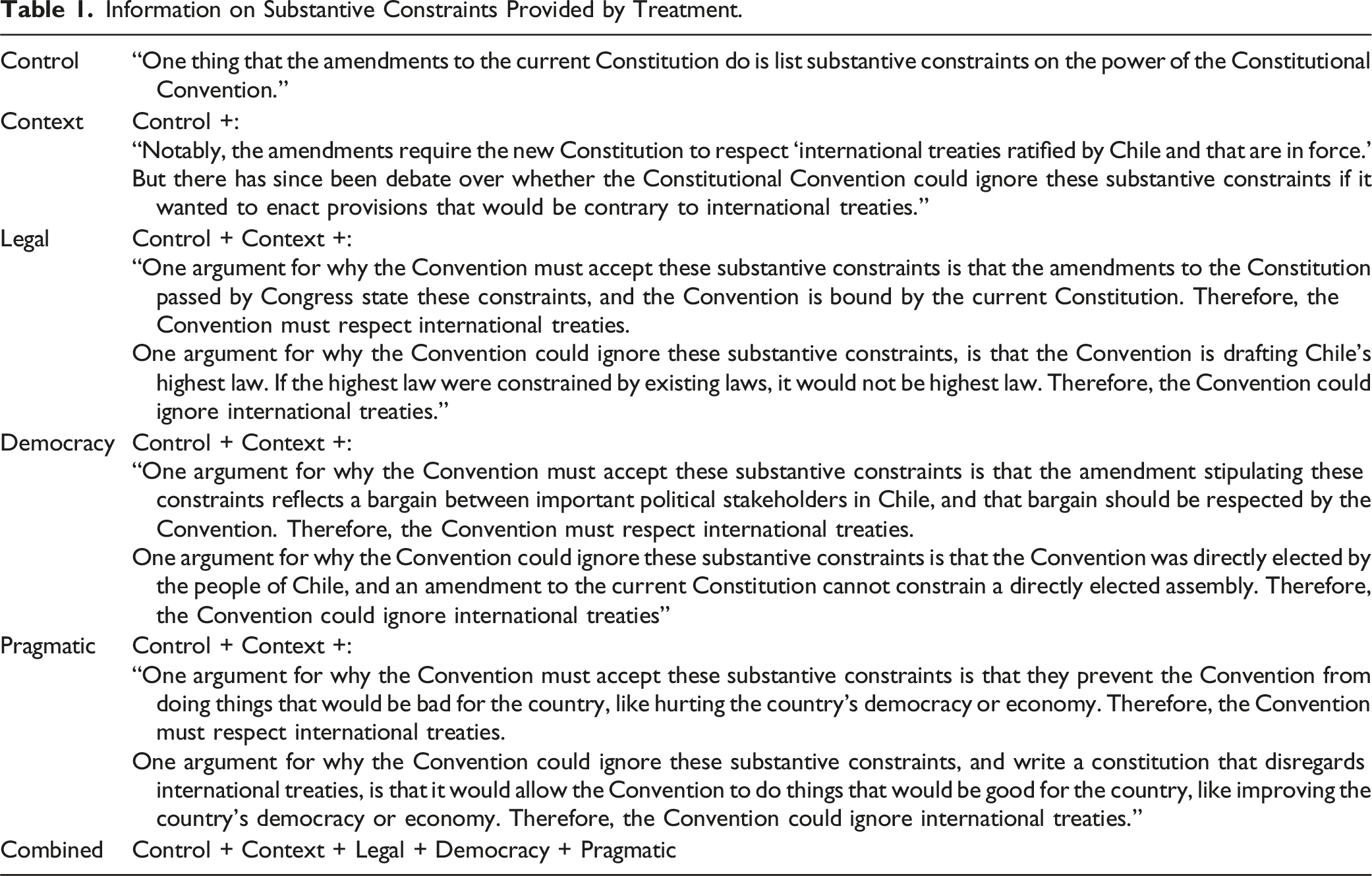
The third part of the survey asked respondents about what should occur if each type of constraint is violated. We specifically asked respondents to state their support for two ways of enforcing these constraints: (1) through the Supreme Court declaring parts of the new constitution unconstitutional and (2) through the people voting against the new constitution in a referendum.
The fourth part of the survey asked several questions that explored why people believe that constraints should be followed. Specifically, we asked respondents whether they agree with the following statements: (1) Always following legal rules is important; (2) Change to political institutions should occur slowly and gradually, (3) In a democracy, the views of minority political groups should be respected, and their core interests must be protected, (4) Chile’s current Constitution is illegitimate, (5) Chile needs to make major changes to its government.
The fifth part of the survey tested whether respondents’ views on constitutional constraints impact their policy preferences. To do so, we told the respondents about a proposal that was made during the assembly deliberations that violated substantive constraints: the nationalization of mining enterprises without compensation. Respondents were told that, on the one hand, “it would ensure that Chile’s national resources benefit Chileans and allow the government to use the nation’s resources to implement social welfare programs”; but also that, on the other hand, it “can scare away foreign investors, which would hurt the economy.”
This inquiry included an experimental manipulation: only half of the respondents were told that the proposal would violate international law, and thus the substantive constitution-making constraints. Doing so allows us to explore whether respondents support a proposal that violates substantive constraints, and whether reminding them that the proposal violates international law changes their views.
In addition to these questions, our survey asked respondents about their demographic background, political ideology, and knowledge of Chile’ constitutional system.
Survey Administration
Our survey was originally drafted in English and then translated into Spanish by two Chilean lawyers with knowledge on comparative constitutional law. The survey was IRB approved and the research design was pre-registered. 11 The survey research firm Cint recruited the Chilean respondents and directly compensated them. 12 The survey was administered from August 16–17, 2022, when deliberations on the constitution were in full swing, but before the national referendum on September 4, 2022.
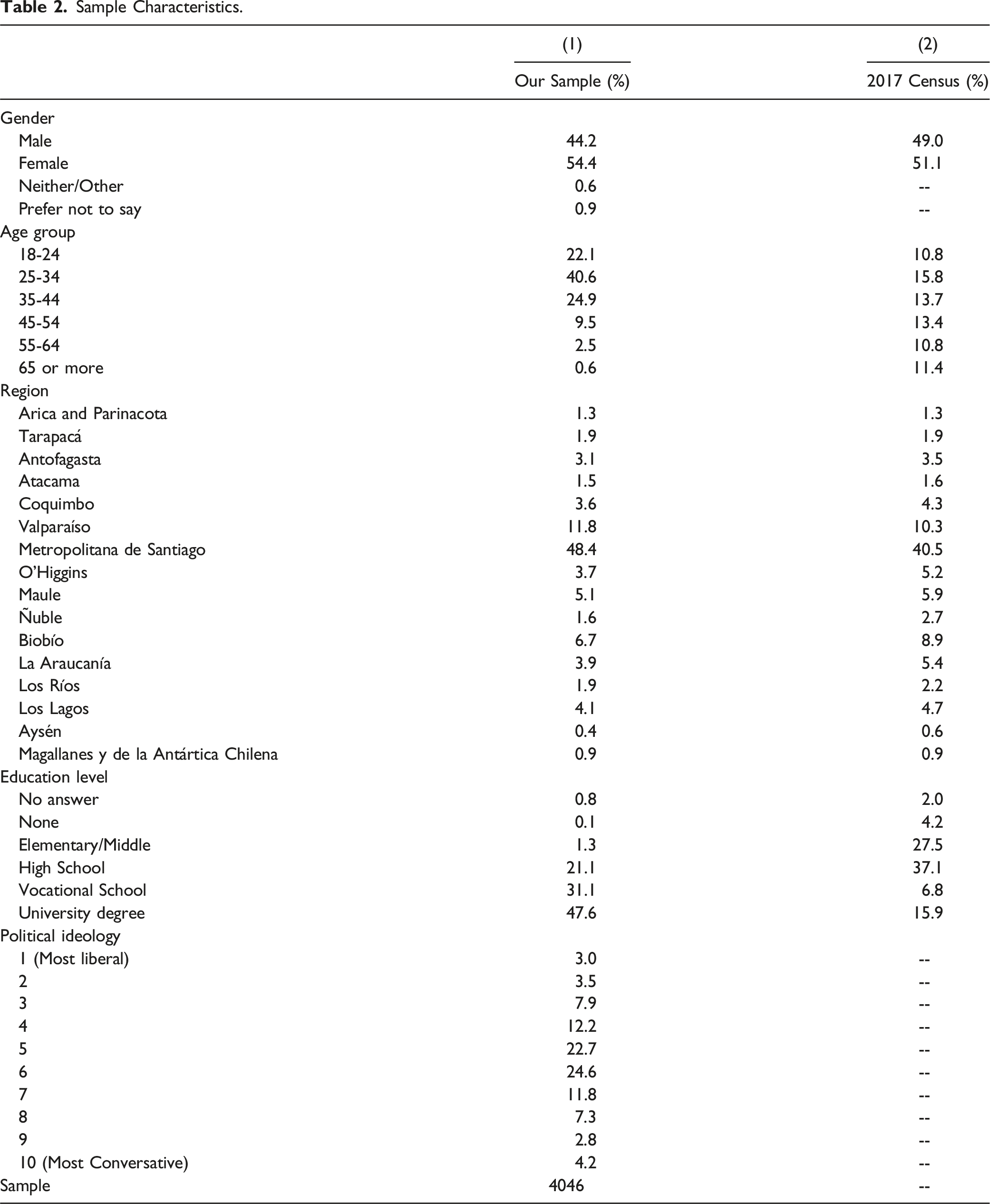
Survey Sample
Sample Characteristics.
Survey Results
Support for the Reform Process
Figure 1 reports the results of the two questions asked to gauge support for the constitutional reform process.
13
It reveals that 32.1% of respondents agreed that Chile’s drafting of a new constitution had been successful, and 43.7% of respondents indicated that they intended to vote for adopting the new constitution. Approval of the Chilean constitutional reform.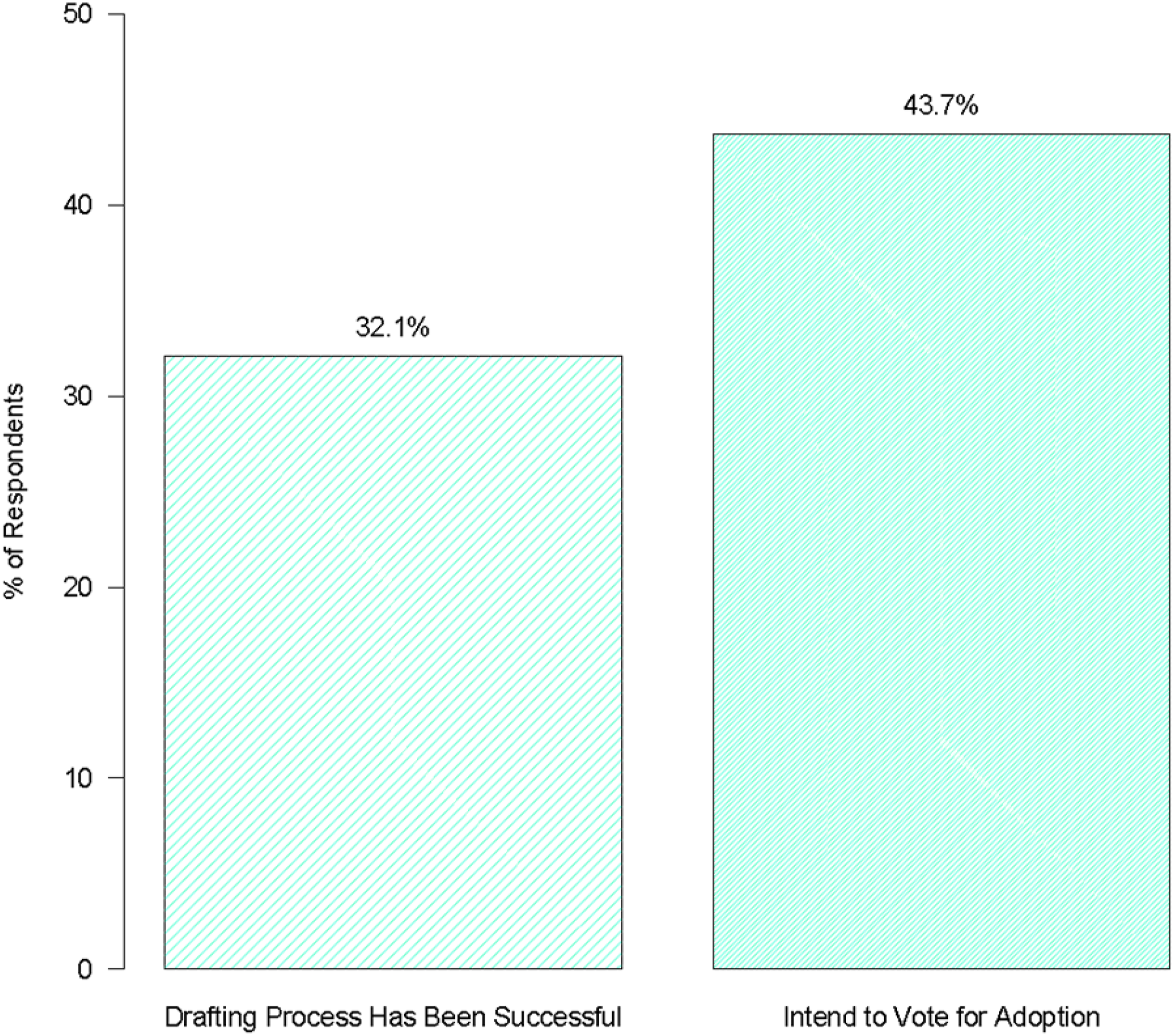
To put these results in context, we collected information from other sources on public support for the new constitution. While we did not find surveys asking about support for the process, we identified 91 surveys conducted between January and September 2022 asking Chileans about their intention to vote for the new constitution. Figure 2 plots the results of these surveys chronologically, along with the results from our survey. Although our respondents were more likely to say they intended to vote for the new constitution than average, our responses were well within the distribution of public polling on the referendum. They are also broadly reflective of the outcome of the final referendum, held two weeks later, in which 38% voted for the constitution. Polling on intended votes in the Chilean constituitional referendum, chronological from January to September 2022.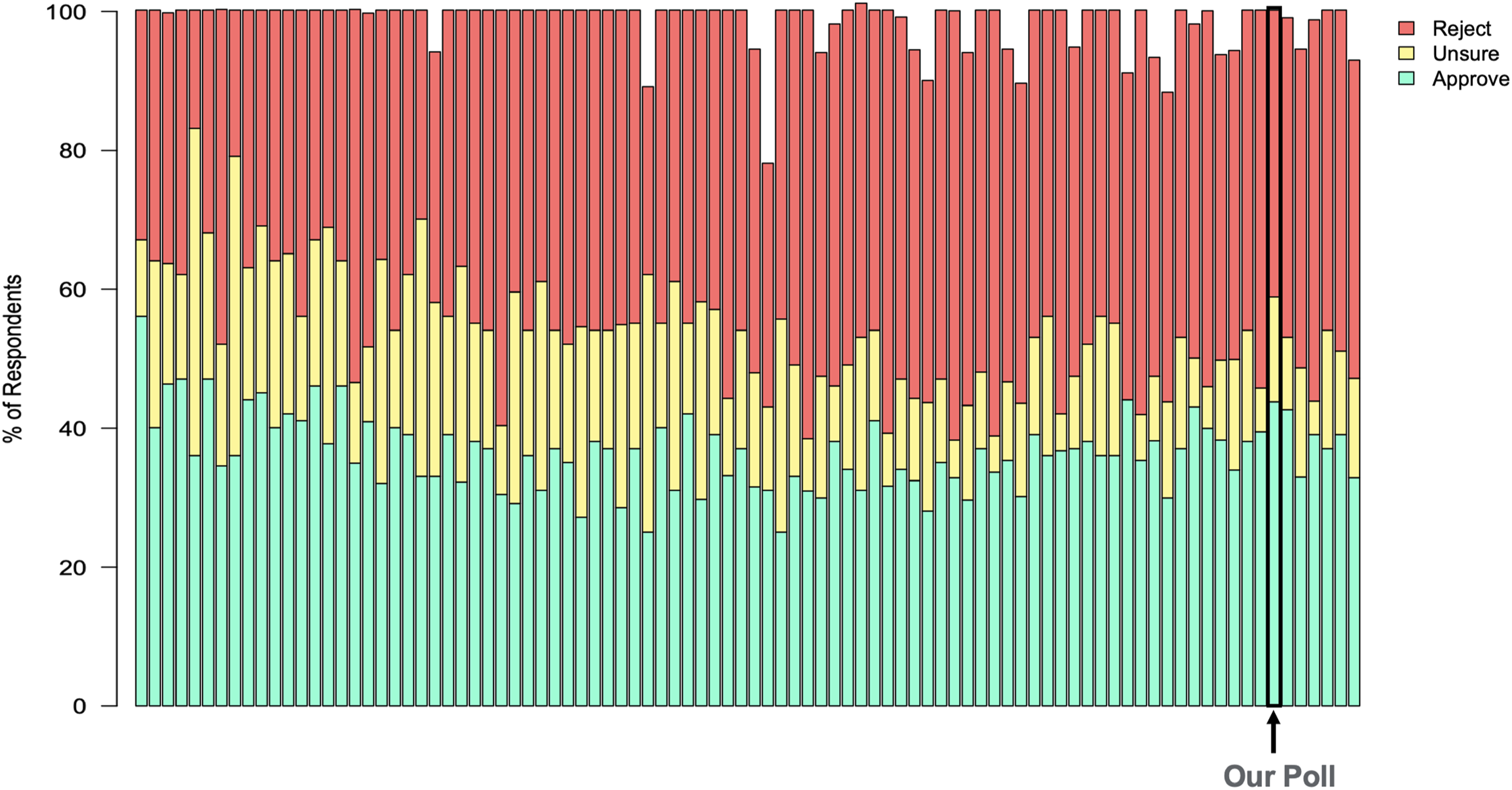
Support for Constitutional Constraints
Figure 3 explores support for constraints on constitution-making. Panel A reports the share of respondents (and 90% confidence intervals) that agreed that each type of constraint should be binding on the assembly. It shows that support was highest for substantive constraints, which were supported by 68.7% of our sample. By comparison, 55.0% agreed that the procedural constraints should be binding, while 60.6% did so for institutional constraints. Panel B reports the share of respondents that agreed that following these constraints would be good for Chile. It reveals a similar pattern. Support is again highest for the substantive constraints: 74.4% of respondents agreed that the substantive constraints are good for Chile. By contrast, only 41.1% did so for the procedural constraints, and 51.7% for the institutional constraints. Support for constraints. (a) Agreement that constraints are binding. (b) Agreement that constraints are good for Chile.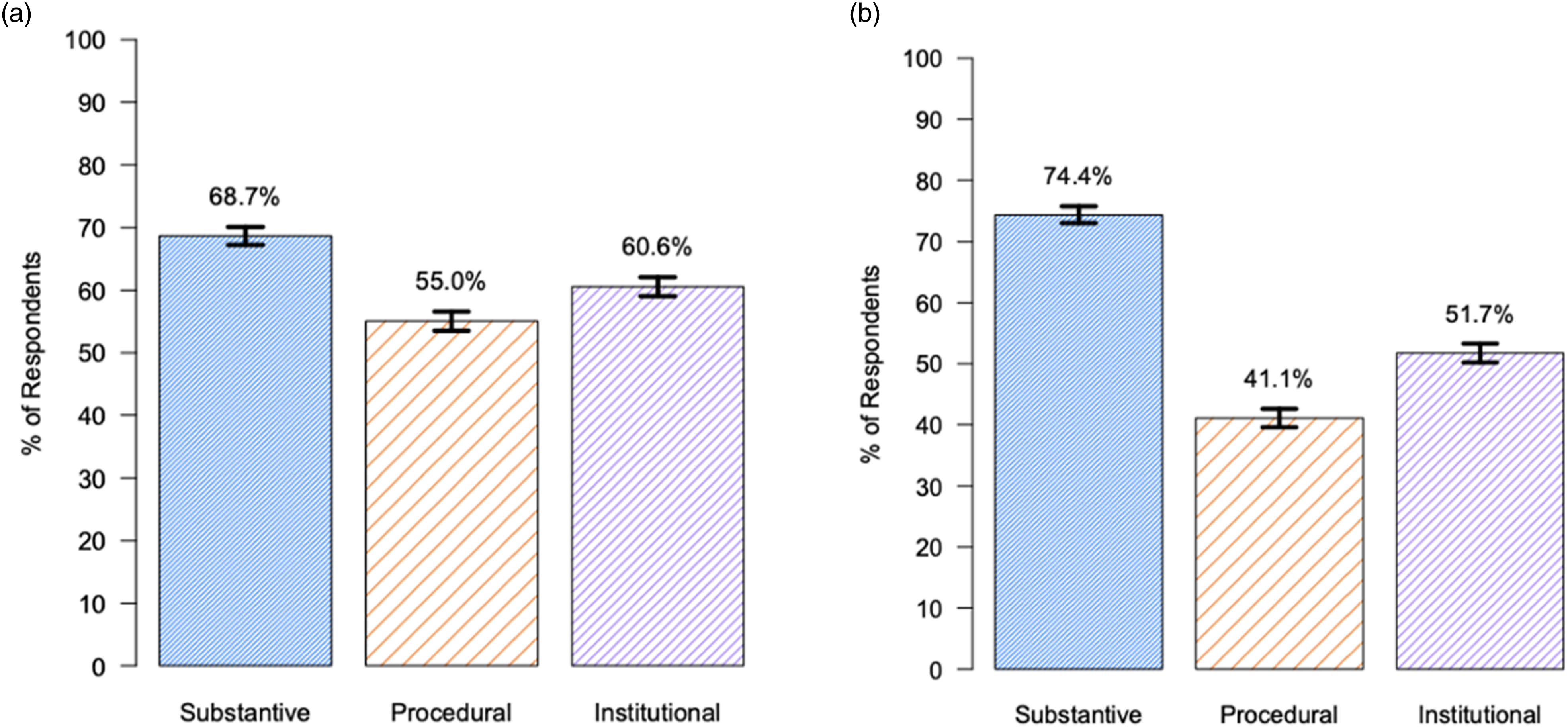
Figure 4 breaks out these results by treatment group. Recall that, for each constraint, respondents were randomly assigned to one of six treatment groups that varied the arguments in favor and against based on democratic, legal, and pragmatic considerations. The results in Panel A of Figure 4 reveal no statistically significant differences in respondents’ beliefs across the treatment groups that the constraints should be binding, and Panel B reveals no statistically significant differences in respondents’ beliefs that the constraints were good for Chile. The respondents’ views on constraining constitution-making thus did not change based on the type of argument they were presented with. Support for constraining constitutional drafting by treatment group. (a) Agreement that constraints are binding by treatment group. (b) Agreement that constraints are good for Chile by treatment group.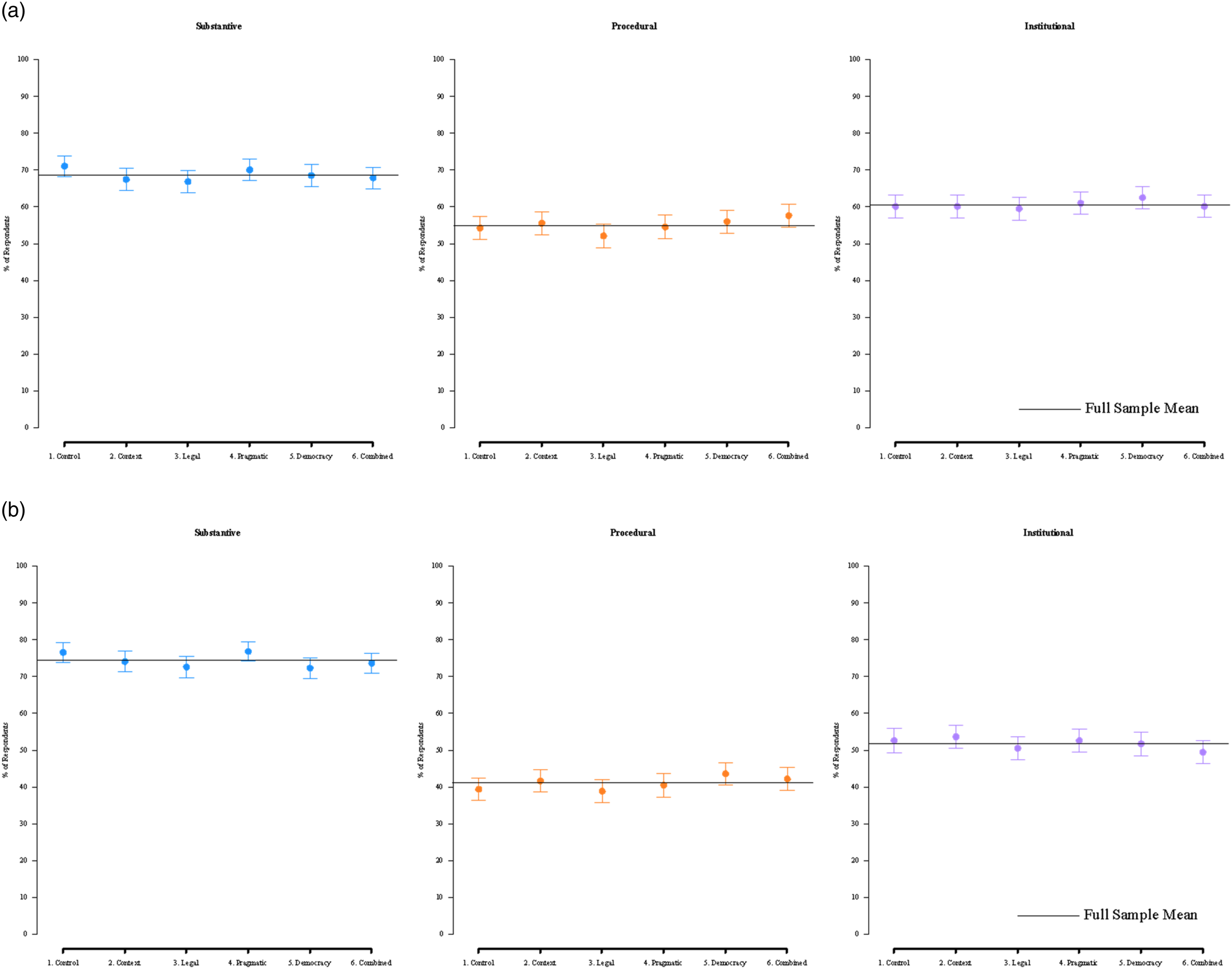
Support for Enforcing Constraints
Figure 5 reports support for enforcing the constraints. Panel A reveals that a majority of respondents agreed that the highest court should invalidate parts of the constitution when it violates constraints: 64.8% supported the court doing so for substantive constraints, 56.0% for procedural constraints, and 55.8% for institutional constraints. Panel B reveals that a majority of respondents agreed that citizens should vote against the constitution if each type of constraint is violated: 62.0% for substantive constraints, 54.6% for procedural constraints, and 54.6% for institutional constraints. Support for rejecting constitution if constraints are Violated. (a) Courts should strike down constitution over violations. (b) Citizens should vote down constitution over violations.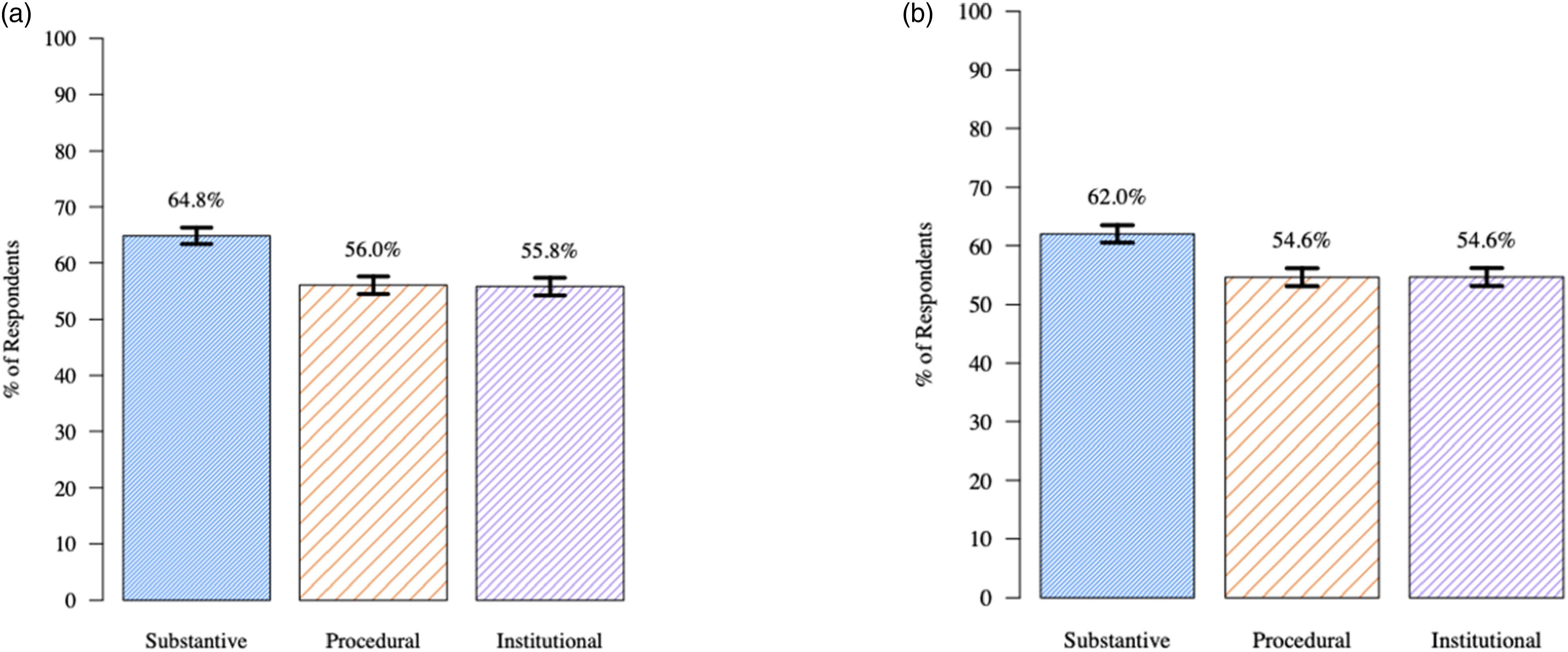
Responses to Mechanisms Questions
Figure 6 reports the results for the five questions designed to assess why respondents hold the views they do about constraints. It shows that 83.9% of respondents agreed that always following legal rules is important; 59.4% agreed that changes to legal institutions should occur slowly and gradually; 67.3% agreed that the views of minority political groups should be respected and their core interests must be protected; 35.8% agreed that Chile’s current constitution is illegitimate; and 82.1% agreed that Chile needs to make major changes to its government. Perhaps the most important of these results to highlight is that an overwhelming majority of respondents agreed that the law should always be followed. This is exactly the proposition we put to the test in the experiment we discuss next. Agreement with potential mechanisms.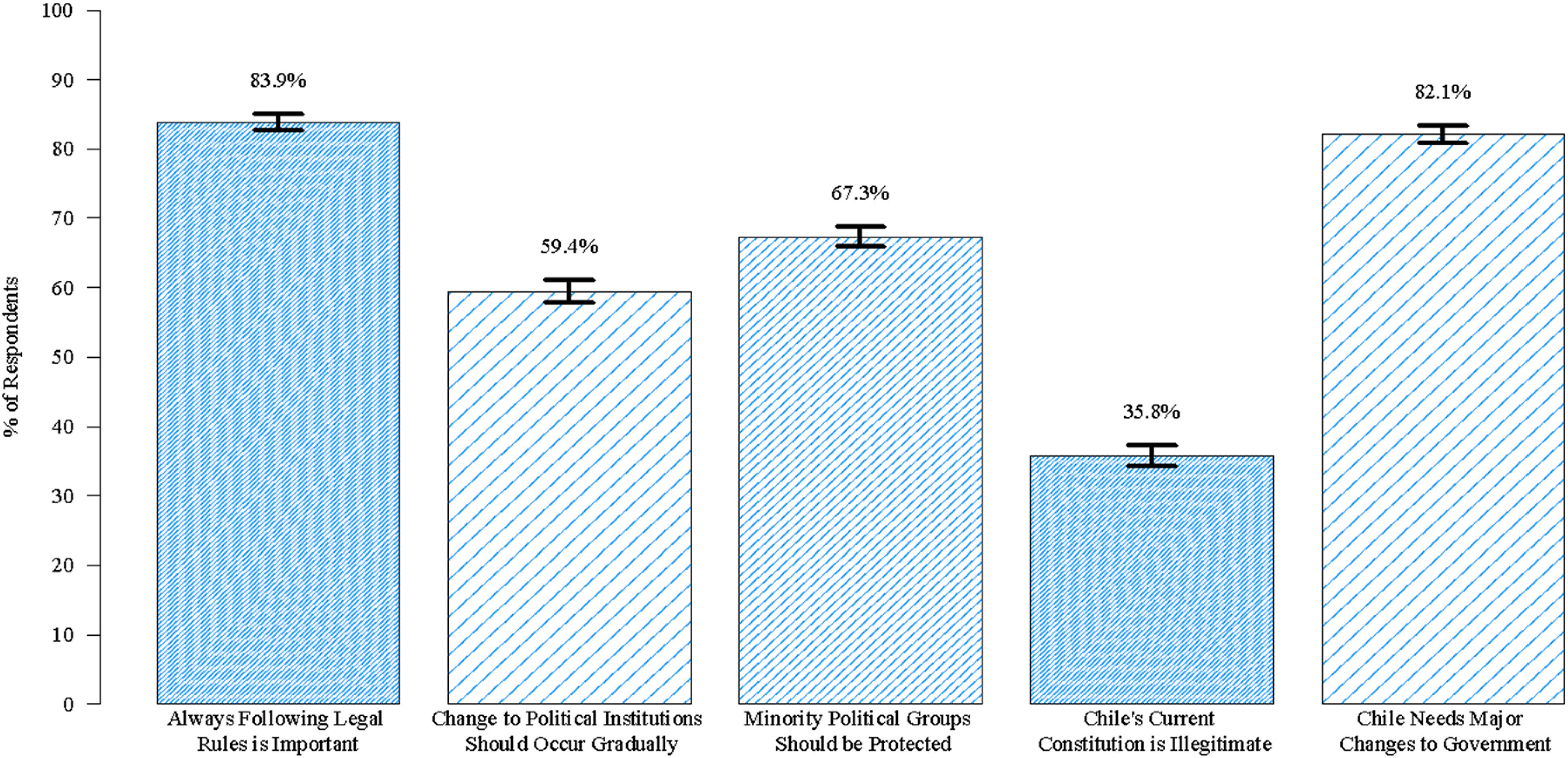
Consistency in Views
The results reported thus far are promising for the enforcement of constraints on constitution-making: respondents overwhelmingly support constraints and their enforcement. But for public opinion to be a viable channel for enforcement, the public would have to prioritize the enforcement of these constraints above specific policy goals.
Our survey thus included an experiment that asked respondents whether they supported including provisions in the constitution to allow for the nationalization of Chile’s mines. We asked about this issue because several proposals on nationalizing mines were made by assembly members, even though they violated the process’ substantive constraints. Specifically, nationalizing mines would contradict Chile’s obligations under international investment treaties and would also disturb existing judicial decisions. Moreover, polling data suggests that nationalizing mines has long been popular with the Chilean public. For example, a 2013 nationwide poll found that 83% of Chileans supported nationalizing copper mining, and that support for this ran across different age groups, political ideologies, and economic classes (Centro de Estudios Públicos, 2013).
We asked respondents about their support for nationalizing mines while including an experimental manipulation where half of the respondents were reminded that nationalization would “violate Chile’s commitments under international treaties, and the amendments to the current Constitution state that the Constitutional Convention should respect international treaties”, while a control group was not given this information.
Figure 7 reveals that a majority of respondents—56.6% in the control group and 54.6% in the treatment group—supported nationalization of mines. The difference in support between these two groups is not statistically significant. This is perhaps unsurprising: proposals to nationalize mines received substantial media attention, so it is likely that many respondents were aware that this policy would violate substantive constraints. As a result, the treatment contained limited new information, such that it would be reasonable to expect there would not be differences between the treatment and control group (Cope & Crabtree, 2022). Support for nationalization of mines.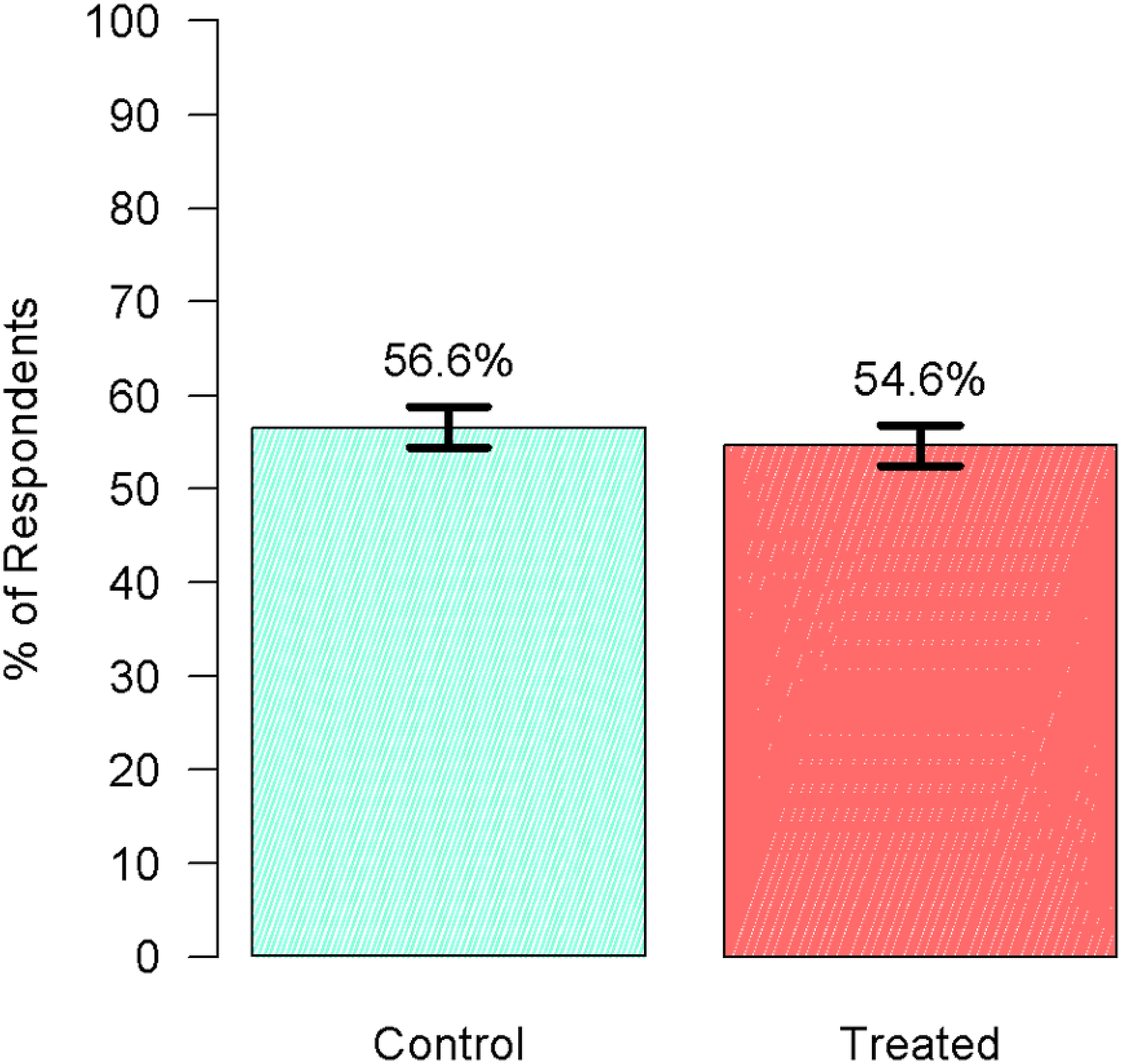
Our main goal, however, was to test if respondents were consistent in their views. We therefore explore whether support for nationalizing mines differs based on support for substantive constraints. To do so, we move to a regression framework in which we explore whether support for constraints explains support for the mining proposal.
Figure 8 reports regression coefficients and 90% confidence intervals from 56 regressions that explore support for nationalizing mines using a linear probability model.
14
Panel A uses support for constraints and their enforcement (see Figure 3 and 5) as the independent variable, and it is the main test for whether respondents are consistent in their views. But in addition, we also explored whether answers to the mechanism questions (see Figure 6) explain support for nationalizing mines (Panel B) and whether knowledge of the constitution and ideology explain support for nationalizing mines (Panel C). For each regression, we estimate sub-samples for respondents in the treatment group and the control group. We then estimated two versions of each regression: one that only includes a variable indicating substantive constraints and one that includes a variable indicating substantive constraints and the demographic variables in Table 2. Support for nationalizing mines. (a) Support for nationalizing mines by views of substantive constraints. (b) Support for nationalizing mines by views on mechanisms. (c) Support for nationalizing mines by political opinions & knowledge.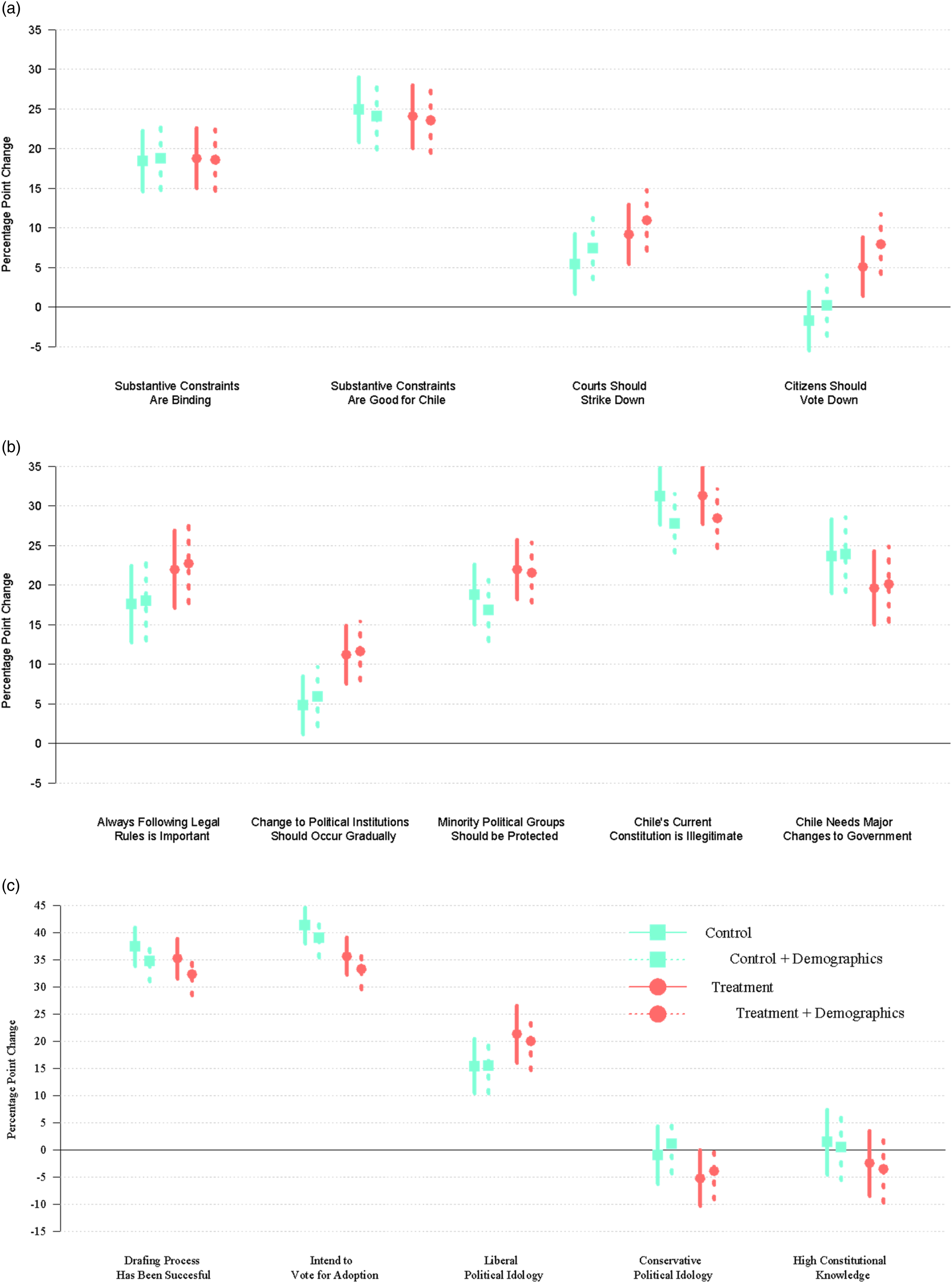
Figure 8 reveals that there is no consistent difference between the respondents in the control group and the treatment group. Additionally, there are no systematic differences between the regressions that included demographic controls and the regressions that did not. This suggests that results are not driven by demographic imbalances in the sample, which is reassuring considering that our sample was not perfectly representative.
More substantively, the results reveal that those who previously stated support for constitution-making constraints are no less supportive of the proposal to nationalize mines than those who did not support constraints. In fact, respondents who think substantive constraints are binding and good for Chile (Panel A, Plots 1 and 2), respondents who believe following legal rules is important (Panel B, Plot 1), respondents who believe the current constitution is illegitimate and the system needs overhaul (Panel B, Plots 4 and 5), and respondents who support the drafting process (Panel C, Plot 1) are all substantially more supportive of nationalizing mines. For example, respondents that had previously stated that they believe that the substantive constraints are binding, are roughly 20 percentage points more likely to support nationalizing mines than respondents that did not think the substantive constraints are binding.
How can we make sense of these findings? We first note that there is overlap between the views explored in Figure 8. For instance, all of the variables explored in Panel A are highly positively correlated. In other words, all these questions get at support for the constitution-making process and rule-of-law values. Additionally, the respondents that support the constitution-making process are more likely to be on the left of the political spectrum. For instance, 55% of liberal respondents supported the drafting process, compared to 28% of all other respondents. And those on the left of the political spectrum typically support nationalizing mines. The nationalization of mines is therefore a good test to explore the consistency of their views. But the results clearly indicate that these respondents are not consistent. As noted, this subset of respondents is actually more likely to support nationalizing mines, meaning that, when they conflict, their substantive policy preferences outweigh their support for constraints.
One concern with the validity of these results is that the respondents may not have understood the questions we asked about the constraints on the constitution-making process. Although the three types of constraints we developed in your typology may be common in recent practice and theoretically relevant, it is very possible that they are not easy for the average citizen to fully understand. To explore this possibility, we used information on how long respondents spent on parts of the survey presenting information about the substantive, procedural, and institutional constraints on constitution-making. In an exploratory analysis, we sub-set our sample to respondents that spent at least 30 seconds on all three of the screens presenting these arguments. Appendix 4 reports the results for this sample of respondents. Relevantly, these respondents were less supportive of the reform process in general (see Appendix 4, Figure A1), and they were more likely to agree that the substantive and institutional constraints were binding and good for Chile (see Appendix 4, Figure A3 and A4). Notably, the experimental manipulation explored in Figure 7 did have a statistically significant effect on these respondents (see Figure A7), suggesting that information on international law and the substantive drafting constraints reduced support for nationalizing mines for these respondents. That said, among this set of respondents, the respondents who thought constraints were binding were no more or less likely to support the nationalizing of mines (see Figure A8). In other words, even for this set of respondents, we still found that support for substantive constraints was not associated with changes in policy preferences.
Qualitative Case Study
The survey results suggest that the public may put their support for specific policies ahead of their support for constitution-making constraints, suggesting that public opinion may be an unlikely mechanism for compelling compliance with them. But compliance could also be driven by political pressure from vested interests like political parties.
To explore why the assembly ended up honoring the constraints on its power, three of us traveled to Chile during 2022. Our trips occurred in the period before and after the referendum on the Constitution. We interviewed Chilean politicians, activists, academics, and lawyers that were directly or indirectly involved with the constitutional reform process. Our aim was to understand why constraints were imposed on the constitutional drafting process, whether those constraints were respected, and why they were respected.
Below we provide a case study exploring efforts to violate the substantive and procedural constraints that occurred during the Chilean reform process (there were not any notable efforts to violate the institutional constraints). Our discussion of these events is informed by our interviews and our own reviews of the relevant constitutional proposals.
Overall, we reach three broad conclusions based on our interviews and research on the assembly. First, there were several instances in which a significant number of assembly members wanted to exceed the constraints placed on their powers. Second, the assembly ultimately complied with virtually all the constraints. And even when they arguably breached the constraints, they did so in a way that ultimately supported their broader spirit. Third, while the majority of the process was controlled by far-left independents, who primarily negotiated with the center-left parties and coalitions, sidelining the right-wing (Alemán & Navia, 2023; Issacharoff & Verdugo, 2023; Larrain et al., 2023), in the specific cases in which efforts were made to disregard constraints, it was the parties to the Agreement—irrespective of their position on the political spectrum—that acted as veto players and reigned in those that sought to ignore them. Thus, while we generally agree with other analysts who find that parties were relatively weak at the Constitutional Convention (e.g., Issacharoff & Verdugo, 2023), we nonetheless find that they played a key role in enforcing limits on the Convention’s powers.
Background
To appreciate the role of independents and parties, we first map the coalitions in the assembly and their ideological divides. The election for the assembly, held in May 2021 produced the following results: 27 members (17.4%) of “Lista del Pueblo”, a left-wing coalition of independents; 28 members (18.1%) of “Apruebo Dignidad”, a left-wing list made up of six different parties; 25 members (16.1%) of “Lista del Apruebo”, which comprised six center-left parties; 11 members (7.1%) of a center-left coalition of independent candidates “Independientes por la Nueva Constitución”; 37 members (23.9%) of a right-wing coalition which encompassed three parties; 17 independent representatives (10.9%) of indigenous peoples (who had reserved seats); and 10 independents (6.5%) who run outside of any coalition. 15
Delegates by Political Collective. 16
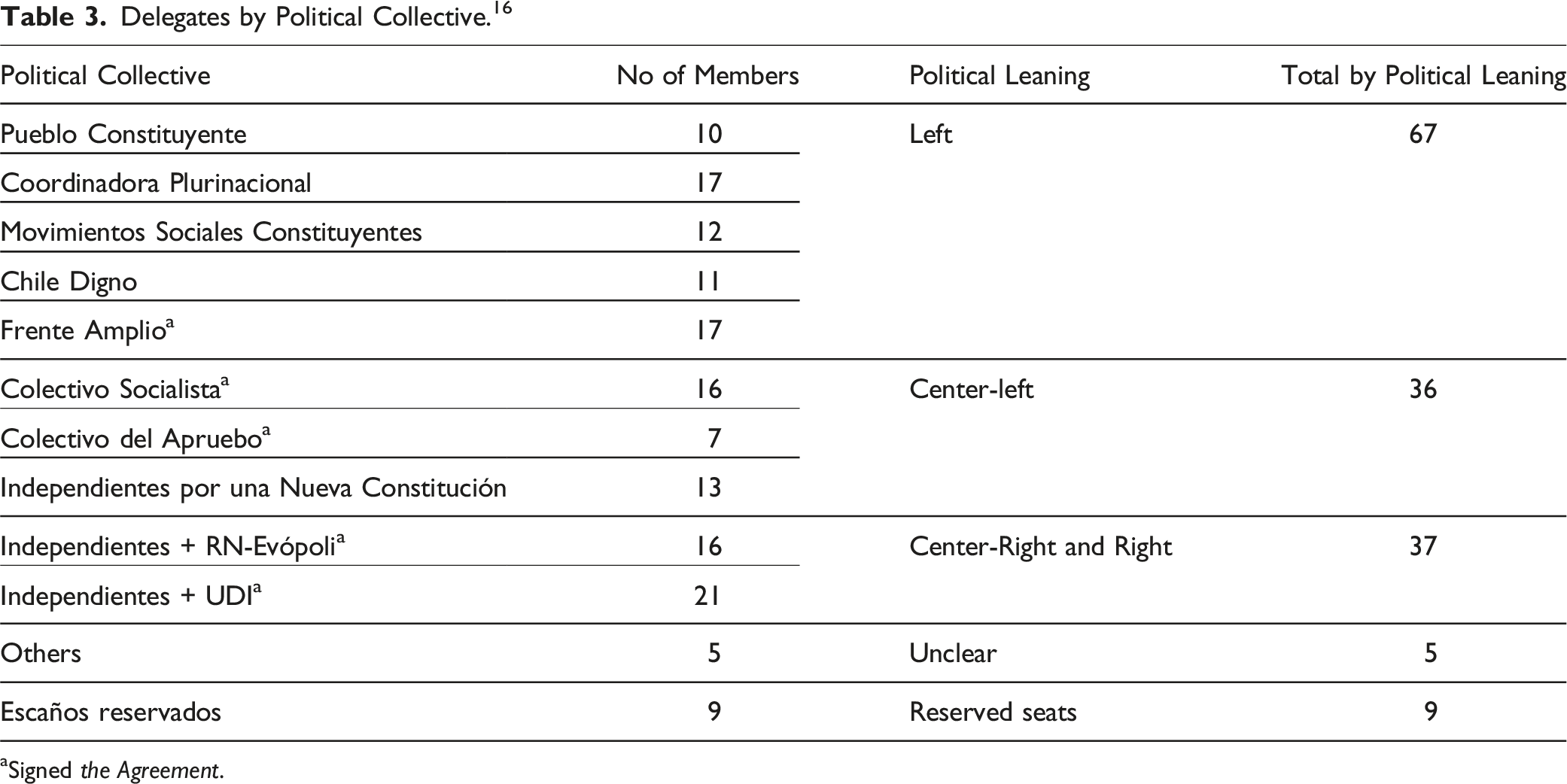
aSigned the Agreement.
Number of Delegates by Collective and Candidacy Type. 17
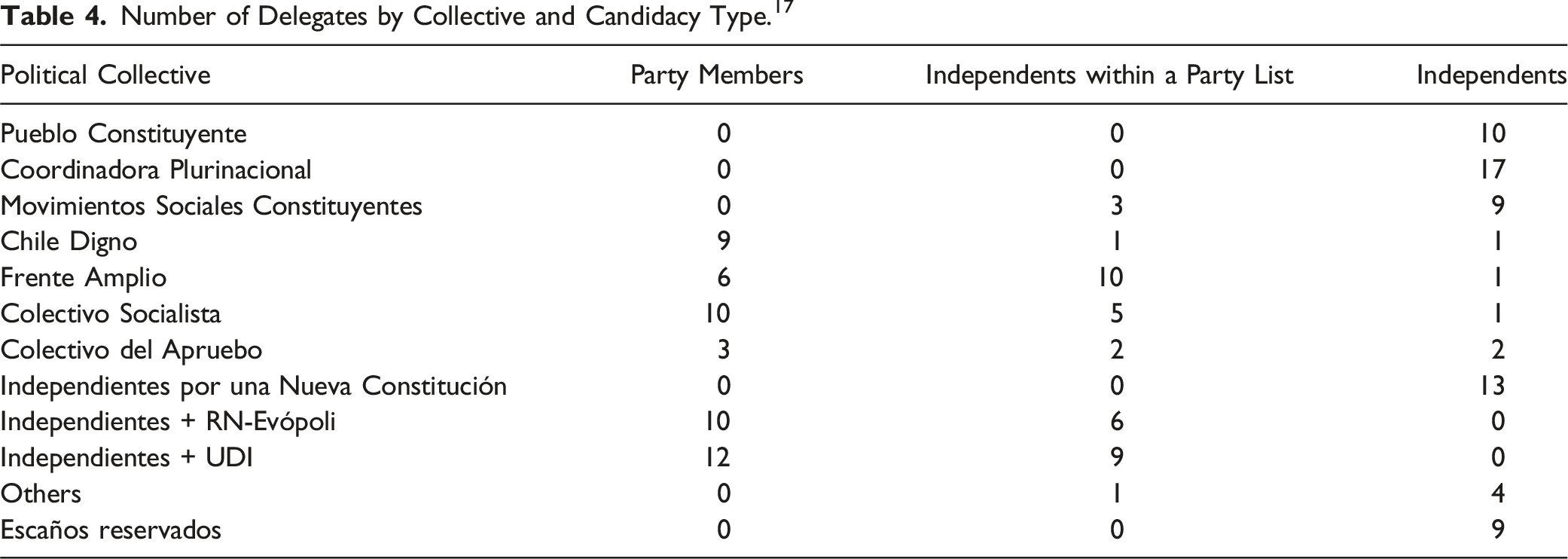
However, this trend was considerably less pronounced when it came to other collectives. For example, on the left, 81.8% of Chile Digno’s members belonged to a party while, in Frente Amplio, 35.3% were party members and 58.8% ran on a party list. Similarly, in the center-left, Coletivo Socialista had 62.5% delegates from the Socialist Party and 31.3% independents that ran on that same party’s list, and Colectivo del Apruebo had 42.9% party members. On the right, all 37 delegates were either party members (59.5%) or ran on party lists (40.5%).
Second, the large presence of independents “following single-issue or partial agendas” (Issacharoff & Verdugo, 2023, p. 50) led to a Convention that, as noted above, became significantly fragmented within a few months, especially on the political left (Larrain et al., 2023). This fragmentation produced an array of challenges, as it weakened the Convention’s capacity to effectively negotiate complex issues (Alemán & Navia, 2023), resulting in an increasingly confrontational process, which impeded the creation of a coherent constitutional draft (Ginsburg & Álvarez, 2023), and caused some marginalized groups to focus their efforts on attacking the draft rather than helping to shape it (Piscopo & Siavelis, 2023).
However, amidst what Piscopo and Siavelis (2023) termed “Chile’s Constitutional Chaos”, the diversity and fragmentation observed among different collectives did not undermine the internal cohesion of each of these groups in terms of their voting behaviors. An interdisciplinary group analyzing the Chilean constitutional process called “C22” 18 calculated Nominate Scores (Poole & Rosenthal, 1985) for each delegate based on all the votes they cast during the process. Delegates received a score between −1 and 1, positioning them on a spectrum where scores below 0 indicate a left-wing political orientation, while those above 0 suggest a right-wing political orientation (Mascareño et al., 2022; Ruz et al., 2022).
Nominate Scores by Collective and Candidacy Type.
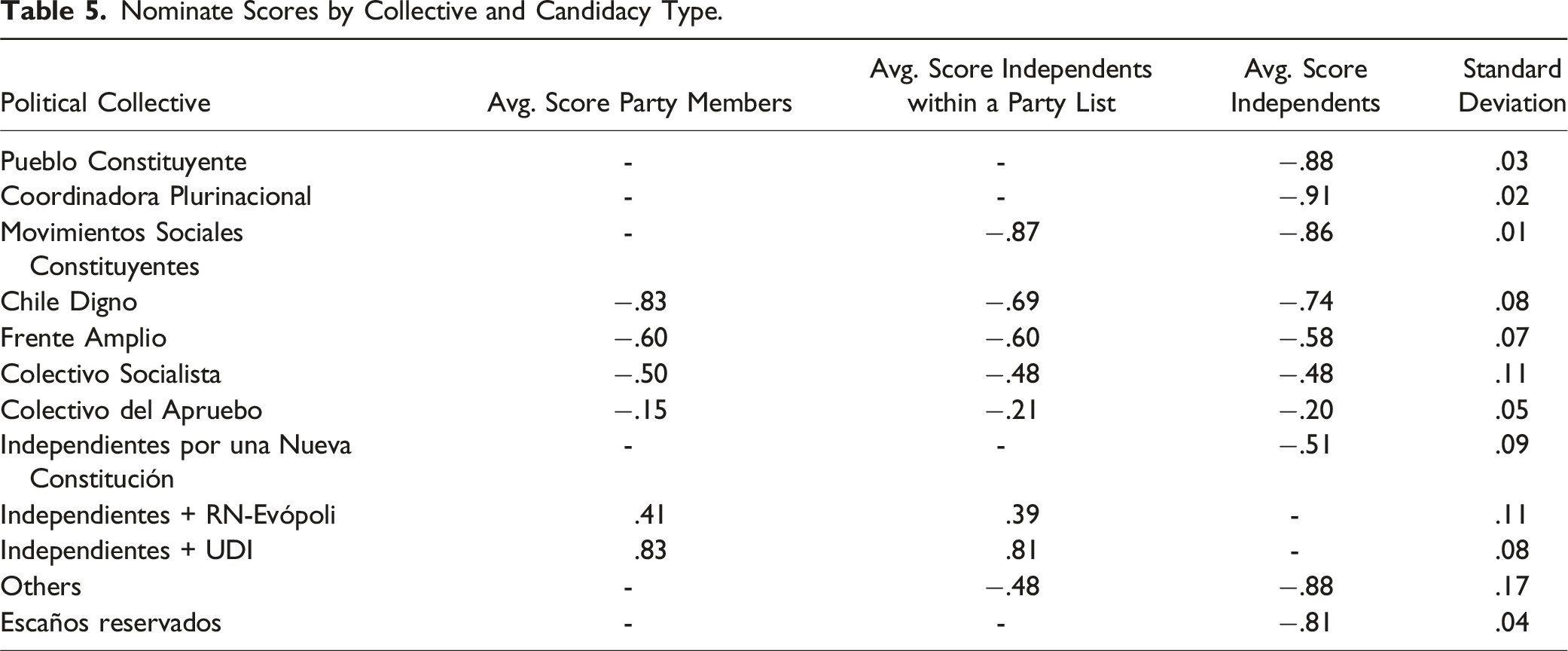
Third, the far-left achieved significant electoral success in the Convention, securing 43.5% of the seats, while the center-left gained 23.4% of the seats. In stark contrast, the right-wing fared poorly, garnering only 24% of the seats, well below the 33% + 1 required for veto power. This distribution laid the groundwork for a Convention in which the far-left and center-left collectives led the discussions and drafting of the new constitution, leaving the right-wing largely marginalized (Alemán & Navia, 2023; Larrain et al., 2023; Piscopo & Siavelis, 2023). This divide is captured by the Nominate Scores, which show that while the average scores of all far-left (−.80) and center-left (−.44) delegates differ, the gap was relatively narrow (.36). In contrast, the gap between the center-left (−.44) and right-wing (.64), was dramatically larger (1.08).
However, as we explain below, the prevailing left-right divide in most of the Convention’s proceedings shifted when attempts were made to overlook the constraints placed on their power. In these critical situations, parties from across the political spectrum that had signed the Agreement stepped in to stop violations.
Attempts to Ignore Substantive Constraints
There were several proposals made during the Convention that were arguably contrary to international law or existing court decisions. To identify them, we reviewed all 1444 proposals made to the Convention. Of these proposals, 1092 were made by members of the constituent assembly (“Iniciativa Convencional Constituyente”), 274 were popular indigenous initiatives (“Iniciativa Popular Indígena”), and 78 were popular initiatives (“Iniciativa Popular Constituyente”). 19 Our review revealed eight proposals that potentially violated substantive constraints on constitution-making. 20
There was one proposal to radically change the nature of Chile’s government. Iniciativa Convencional Constituyente N° 720-1 would have violated the democratic and republican character of the state by dissolving the executive, legislative, and judicial branches of government and replacing them all with a “Plurinational Assembly of the Workers and the Peoples.” This new body would have 600 members, elected through popular assemblies that represent different sectors of the economy. This proposal immediately received substantial negative press coverage and was broadly opposed within the assembly. Jaime Bassa (Frente Amplio), the then-Vice President of the Convention, denounced the proposal as “contrary to the spirit of redistribution of power and deconcentration of power” that guides the constituent process (Schüller Gamboa, 2022). Just one day after being presented, the proposal was rejected by the Committee on the Political System in a unanimous 25-0 vote, with even one of the proposal’s sponsors voting against it (Reyes, 2022b).
There were seven proposals to nationalize mining companies. If adopted, these proposals would have violated the substantive constraints on the process in two ways. First, they would have violated obligations that arise from bilateral and multilateral investment treaties, such as rules relating to compensation. Second, they would have violated standing court decisions since, under Chilean law, mining concessions can only be granted or terminated by judicial decision. 21
One of these seven proposals was initially approved by the Convention’s Committee on the Environment (Said, 2022). But after the Plenary rejected relevant parts of the report by a large margin, the Committee eventually amended its report to eliminate successor versions of the proposal. Nonetheless, in subsequent floor debates in May 2022, three different proposals seeking nationalization were considered. In the floor debates, arguments opposing nationalization were varied, and often emphasized pragmatic considerations like the impact on foreign investment and the economy. But delegates and others did note the substantive limits on their powers as a reason to oppose the proposals. For example, during the Committee on the Environment debates in February 2022, when the mine nationalization proposal was initially approved, right-wing delegate Bernando Fontaine (Renovacion Nacional) argued that the proposal exceeded the Convention’s powers because it violated international law, and that the only way to cure that problem would be to provide full indemnification for all the expropriated mines, which would be costly (Reyes, 2022a). His colleague Rodrigo Alvarez (UDI) similarly referred to the “grave international responsibilities” implied by the proposal (Peña & Carrasco, 2022). The president of the Mining Chamber of Chile, Manuel Viera, opposed related proposals of the Committee in a press release that argued that they would violate both judicial decisions and international treaties ratified by Chile, thus expressly exceeding the substantive limits on the Convention (Bustamante, 2022).
The Plenary ultimately held three separate votes on three related proposals (two on May 7, 2022 and one on May 14, 2022). In each of these votes, the proposals were rejected by wide margins. The first proposal had 36 votes in favor, 89 against, and 22 abstentions; the second had 42 votes in favor, 76 votes against, and 26 abstentions; and the third had 64 votes in favor, 57 against, and 22 abstentions. 22
Although there were slight differences, all three votes had a similar pattern. Supporters of nationalization were primarily left-leaning independents, as well as the Communist Party—all of whom were non-parties to the Agreement. On the other hand, the parties that signed the Agreement—ranging from the left-wing Frente Amplio to the right-wing UDI—largely opposed the nationalization proposals.
It may be worth noting that the Frente Amplio—itself a relatively diverse and heterogeneous collection of political actors and parties—had the most complex position towards the Agreement of any political group. Many key parties and leaders, including future President Gabriel Boric, signed the Agreement or supported it. But some other parties and leaders rejected the Agreement and sought a fully sovereign Constituent Assembly instead. Appendix 6 provides a thorough assessment of Frente Amplio’s position towards the Agreement.
Attempts to Ignore the Procedural Constraints
Arguably the most controversial constraint placed on the assembly was the two-thirds voting rule. In fact, independents and left-wing parties expended substantial effort to change it. Early in the Convention, the Communist Party presented a document titled “Considerations on the Right of the Constitutional Convention to Define its Quorum” in which it concluded that the assembly could override the two-thirds requirement established by Congress (Partido Comunista de Chile, 2021, p. 4). Notably, the Communist Party was not a member of the Agreement.
The question of whether the two-thirds rule must be respected became a major topic of debate during the drafting of the assembly’s procedural rules. In this debate, a divide emerged not along left-right ideological lines, but rather between parties that were members of the Agreement and those that were not. Notably, the Socialist Party and the Frente Amplio coalition—the two biggest collectives on the center-left with members who signed the Agreement—developed a plan to foil the Communist Party’s attempt to reduce the two-thirds requirement (Gómez & Sánchez, 2021). As Marcos Barraza, the leader of the Communist Party delegates, put it: “The two-thirds rule, established in the November 15th agreement, has been the subject of controversy and difference between those who signed that agreement and those who did not sign it” (El Mostrador, 2021c). The press likewise observed that those members who favored maintaining the two-thirds rule in the Committee on Regulations were affiliated with the parties who had signed the Agreement, while those opposed were independents and members of the Communist Party who had not signed it (Córdova, 2022). Leading academics also highlighted this tension between signatories and non-signatories of the Agreement in relation to the two-thirds rule (Prieto & Verdugo, 2021, p. 287).
The assembly members trying to undo the two-thirds rule made various arguments for their position, mostly relating to democracy and legitimacy. For example, the far-left independent delegate Alondra Carrillo opposed maintaining the two-thirds rule by referring to a “democratic orientation to not subordinate ourselves to terms that have been previously imposed”, and she argued that the two-thirds rule served to “negate the participation of the people” and “only bring a power of veto to minority groups” (Córdova, 2022). Another far-left independent delegate from a reserved seat, Natividad Llanquileo, argued that the Agreement imposing the restriction was invalid because groups that had been “abandoned historically”, such as indigenous Chileans, were not present at its signing, and that “sovereignty should rest in the peoples, that is the mandate that we have” (Andrea, 2021). Barraza (of the Communist Party) stated the original constituent power position most clearly: “What is in discussion today is whether the sovereign power mandated by the people lies within this Convention or whether this power is limited by the elites and privileged who are also part of this Constitutional Convention […] I think that here there cannot be restrictions on the sovereignty of the constituent people” (El Mostrador, 2021b).
In contrast, delegates associated with parties that signed the Agreement defended the constraints. Right-wing UDI delegate and law professor Constanza Hube spoke in rule of law terms: “the quorum must be respected whether we like it or not” (El Mostrador, 2021b). Likewise, left-wing delegate Amaya Álvez (Frente Amplio) indicated that “we understand that as a Constitutional Convention, we do not have the ability to change that quorum as it is established in the current Constitution, in Article 133, and any modification to the quorum must be processed with a constitutional reform law”, adding that “the political agreement of November 15, which is of course not perfect and may have many shortcomings, was supported by the Frente Amplio, and it is the agreement that allows us to have a constituent process today with an approved general regulation, a constitutional norm-creation procedure, and real possibilities of transformation” (Cisternas, 2021). In a similar vein, Jaime Bassa, also from the Frente Amplio, argued that “the two-thirds rule is part of the conditions that made it possible for us to be where we are today” so “it would be a mistake to change that from the Constitutional Convention” (Cooperativa, 2021). And Christian Viera (Frente Amplio) pointed out that “The two-thirds rule, which is present in the current Constitution that is on its way out, is a rule that, whether we like it or not, is in force. Therefore, as it is in force, we cannot change it ourselves” (Martínez, 2021).
Other members of the major center and left-wing parties spoke of the importance of a broad consensus. To illustrate, Elisa Loncón—President of the Convention at the time and one of the few representatives of the indigenous peoples who voted against the proposal to get rid of the two-thirds rule—observed that “[t]he two-thirds vote was a difficult vote for me, but I voted conscientiously as President of the Convention” because “here we respect our word and the Constitution” (El Mostrador, 2021c). She further observed that “[m]y vote is a call to build large, plural and diverse agreements within the Convention […] The country demands that we build from the heterogeneity of perspectives” (El Mostrador, 2021c).
Others made a practical argument based on the political makeup of the Convention. For example, delegate Fernando Atria, of the Frente Amplio, stated that “[t]he criticism that existed regarding the two-thirds quorum was that the right-wing was going to have a third and that this would allow it to veto […] but that problem […] was resolved by the people on May 16th, so the right is no longer in a position to veto” (Diario UChile, 2021).
Finally, on September 29, 2021, the Convention rejected a proposal—brought forth by far-left independents along with members of the Communist Party and the Federación Regionalista Verde Social—aimed to reduce the quorum to approve constitutional norms from two-thirds to three-fifths. The proposal received 63 votes in favor, 90 votes against, and 1 abstention. Notably, as was the case with the proposals to nationalize the mining industry, every left-wing coalition that was a non-signatory of the Agreement voted in favor of reducing the two-thirds rule (together with the representatives of the indigenous peoples), while all parties that had signed the Agreement—regardless of their position on the ideological spectrum—opposed changing the voting rule (Convención Constitucional, 2021). 23
But although the two-thirds voting rule to approve constitutional norms was maintained, the body arguably broke the two-thirds rule once. The amendments to the Constitution required that the Convention’s internal “voting Regulations” be also approved by a two-thirds vote. Yet the assembly decided on September 14, 2021, that its Regulations could be approved by a simple majority, rather than a two-thirds supermajority (El Mostrador, 2021b). However, only a few days later, the article of the internal Regulations that established a two-thirds quorum to approve constitutional norms, was itself approved by a majority that did not meet the two-thirds threshold—96 votes to 54 (El Mostrador, 2021c). Thus, paradoxically, violating the two-thirds rule in regard to the Convention’s Regulations, ultimately helped to preserve the two-thirds rule for approving constitutional norms.
A second controversy involving the two-thirds rule erupted over an agreement between the center-left and center parties—who had signed the Agreement—and the Communists and independent left—who had not. The Communists and independent left favored allowance of a “settling plebiscite” that would allow the Convention to call a national popular vote on provisions that failed to reach the two-thirds supermajority threshold but achieved a simple majority of the delegates present and voting in the Convention (Caro & Reyes P., 2021). This reflected these actors’ preferences for an unconstrained assembly that would exercise original constituent power (Issacharoff & Verdugo, 2023). The major center-left collectives who had signed the Agreement, particularly the Socialists and the Frente Amplio, eventually agreed to this proposal. But they changed it in two crucial ways: requiring a three-fifths supermajority of the delegates in exercise to trigger the referendum 24 and requiring Congress to amend the current Chilean Constitution before any such referendum could be held. 25 After these two changes, the proposal passed and became part of the Regulation, by a 107 to 42 vote, with 4 abstentions (El Mostrador, 2021a).
The right unanimously opposed the proposal, and many members of the right-wing parties argued the proposal violated the constraints on the Convention by evading the two-thirds voting rule. As UDI delegate Carol Bown said, the change meant that “the 2/3s is a dead letter, the terms of the Agreement for Peace, which was ratified by referendum, have been violated” and “the rules have been changed in the middle of the game” (El Mostrador, 2021a). The center-left and centrist parties who had voted for the provision, in contrast, defended their decision by arguing that because they wrote the norm to require congressional action (and probably a constitutional amendment), they had not breached the two-thirds rule. The Frente Amplio delegate Ignacio Achurra, for instance, argued that the Convention “will transfer this discussion to Congress, which is the power of the state that has the power to make a constitutional reform and give viability to the settling plebiscite” (Follert, 2021).
The dispute over the “settling plebiscite” split the signatories of the Agreement and came close to testing the limits of the assembly judicially. Right-wing parties wanted to trigger the provision allowing review of compliance with procedural limits by the Supreme Court, and they attempted to do so. However, they fell short of the 39 delegate signatures needed to activate review (Higuera, 2021). The Congress never acted to amend the Constitution to create the legal framework for the “settling plebiscite”, and no such plebiscite was ever held.
Motivations of Parties to the Agreement
This discussion suggests that the political parties that were members of the Agreement enforced the constraints placed on the Convention. Why did they do so?
Ideologically, the non-signatory members from the left tended to emphasize the sovereignty of the Convention and portrayed the constraints as illegitimate attempts to restrict the power of the people. In contrast, members from parties that were signatories of the Agreement stressed the need to abide by the constraints. They also noted that the public overwhelmingly approved the constitution-making process in the entry referendum. Moreover, they also stressed the value of reaching broad compromises, which the rules would help facilitate, and they turned to the rules as a way to lower the temperature during contentious debates. Likewise, it may be that members of the signatory parties were playing a longer-term game because of their institutional position, one where defections from the Agreement were undesirable because they could impact future political negotiations. Some of the actions of the center-left parties to the Agreement, such as their attempt to punt the controversy over settling plebiscites to the Congress, may support such an interpretation.
But these institutional and ideological motivations in favor of protecting the Agreement are frequently mixed with more pragmatic, partisan considerations. For instance, the signatories to the Agreement may have opposed the nationalization of the mining industry on the merits, while the nationalization proposals tended to be favored by the Communists and independent leftists who were further to the left on the political spectrum. So, while signatories were protecting the Agreement by voting against those proposals, they were also voting in a way that was consistent with their own political interests.
This might have been particularly true in the case of the right-wing parties that were signatories to the Agreement, who have historically been wary of state involvement in the mining industry (Guajardo & Division, 2007, pp. 22–23). However, this argument becomes less persuasive regarding the center-left and left-wing parties that endorsed the Agreement. For instance, the Frente Amplio, during its strategic congress in early October 2019—mere days before the nationwide protests that sparked the constitution-making process—had resolved to advocate for the nationalization of resources including water, lithium, and copper (El Mostrador, 2019). In a similar vein, at its 2018 national conference, the Socialist Party had committed to an agenda that supported the nationalization of natural resources such as water and copper, and the establishment of a state-owned entity focused on the exploitation of lithium (Martínez, 2018).
Furthermore, there are additional reasons to believe that the Frente Amplio and Socialist Party’s votes against the nationalization of the mining industry did not align with their immediate political interests as, given their history and position within the ideological spectrum, they were bound to receive backlash for such voting choices. For instance, in April 2022, when Socialist delegates opposed a report from the Committee on the Environment that included amongst its provisions the nationalization of mining companies, they faced severe criticism. Left-wing delegates that were not signatories of the Agreement labeled them as “traitors” and the Confederation of Copper Workers expressed dismay over their decision to reject the nationalization of mining resources, indicating that “it strikes us even more powerfully that, while brandishing the title of ‘socialists’, they are burying a crucial part of President Allende’s legacy” (Diario UChile, 2022).
The procedural debates have a similar valence. Right-wing parties, who had signed the Agreement, had an obvious incentive to retain the two-thirds rule, as a lower threshold would have likely shifted policy outcomes further to the left. This rationale, however, was less obvious for the center-left Socialist Party and the left-wing Frente Amplio as, on ideological grounds, it was unlikely that they would have opposed a shift towards more left-leaning policies. Moreover, these two groups predictably faced criticism from non-signatory delegates for their reluctance to modify the two-thirds rule.
For example, María Rivera (Coordinadora Plurinacional) asserted that “the Frente Amplio gives power to the right and the former Concertación to halt the deep changes we need. The Frente Amplio is becoming the main ally of the Chilean and foreign bourgeoisie in defending their economic model” (Cisternas, 2021). Similarly, Hugo Gutiérrez (Communist Party) stated that “[t]he right-wing, Frente Amplio and Socialist Party celebrate the ratification in the Convention of the ‘Agreement for Peace’ with the approval of the 2/3 quorum. Let’s see how long that alliance lasts!” (Gutiérrez, 2021).
In any case, this mixture of institutional and partisan interests is common in politics, but it raises an analytic problem. The constraints on the Convention may not have truly tested the members of the Agreement, in that none of the proposals strongly pitted their ideological and institutional interests in maintaining the Agreement against short-term political calculations. Had such a conflict arisen (for example, if the right had won more seats in the Convention, making the two-thirds threshold more threatening to the center-left), parties to the Agreement may have faced more pressure to defect.
Conclusion
We developed a typology of three kinds of constraints on constitution-making processes: substantive, procedural, and institutional. We hypothesized that public opinion is unlikely to drive compliance with these constraints, but that vested interests may create pressure for compliance. We then explored whether and how these constraints had proven effective during the recent Chilean constitution-making episode. Our survey results indicate that a majority of respondents expressed some support for all three types of constraints in the abstract, but this support seemed to erode in the face of a popular issue that would have violated the constraints. Our case study demonstrated that the constraints nonetheless were respected because the parties who signed the Agreement that started the process acted as enforcers of those limits during the Convention.
Our findings, of course, are contextual, and should be taken as raising questions that can be further explored in future work. But they may have implications for understanding when constraining constitution-making processes may be viable. Our key finding is that political parties that have a stake in the process may be able to enforce constraints. Yet, the configuration of strong and durable parties supporting constraints on constitution-making may be less likely in many circumstances where such processes are undertaken, such as in new democracies. Thus, our findings here should not be read as implying that constrained modes of constitution-making will be effective across all conditions. Still, our relatively contextual findings still suggest that a constrained model of constitution-making, belied as a theoretical or practical impossibility by traditional constitutional theory but increasingly viewed as desirable by modern social science and constitutional thought, may be workable.
Supplemental Material
Supplemental Material - Constraining Constitution-Making
Supplemental Material for Constraining Constitution-Making by Adam Chilton, Cristián Eyzaguirre, David Landau, and Mila Versteeg in Journal of Law and Empirical Analysis
Footnotes
Acknowledgments
We thank the Russell Baker Scholars Fund and the Hans Zeisel Endowment for Empirical Research in the Law at the University of Chicago, and the Bankard Fund for Political Economy at the University of Virginia for research support.
Declaration of Conflicting Interests
The author(s) declared no potential conflicts of interest with respect to the research, authorship, and/or publication of this article.
Funding
The author(s) disclosed receipt of the following financial support for the research, authorship, and/or publication of this article: This work was supported by the Bankard Fund for Political Economy at the University of Virginia. It was also supported the Russell Baker Scholars Fund and the Hans Zeisel Endowment for Empirical Research in the Law at the University of Chicago
Supplemental Material
Supplemental material for this article is available online.
Notes
References
Supplementary Material
Please find the following supplemental material available below.
For Open Access articles published under a Creative Commons License, all supplemental material carries the same license as the article it is associated with.
For non-Open Access articles published, all supplemental material carries a non-exclusive license, and permission requests for re-use of supplemental material or any part of supplemental material shall be sent directly to the copyright owner as specified in the copyright notice associated with the article.
