




Abstract
The allocative efficiency outcome predicted by the Coase theorem critically depends on the assumption that, barring high transaction costs, parties will bargain after litigation and misallocated entitlements by courts will be re-allocated through voluntary exchanges. Ward Farnsworth’s 1999 small-scale survey lent credence to the claim that parties do not bargain after litigation because of the endowment effect and the animosity created by litigation. Farnsworth’s sample is small and statistically biased. Yet no other article has tested whether parties in the real world would systematically fail to exchange for behavioral reasons. This paper combines seven different data sources to shed light on this issue. We survey 1511 practicing attorneys, who reported that a substantial minority of their clients settled with the other litigating party after courts had rendered decisions. We also examine over 300 hand-coded Taiwanese cases in which the landowner sued the illicit possessor for building a structure on the plaintiff’s property. Real estate transaction records of the land in dispute show that in 6% of the cases, the landowner registered a sale of property to the possessor after the litigation. Evidence from Google Street View and satellite pictures taken by the Taiwan government suggests that the exchange rate is higher than 6%. Logistic regressions suggest that post-litigation bargaining dynamics are at least partly rational — allocative efficiency and transaction costs (conventionally defined) still matter. To the extent that the pro se status proxies for animosity incurred during litigation, Farnsworth’s thesis is also supported.
Introduction
The Coase theorem, re-interpreted from Coase (1960), states that if transaction costs are low enough, an efficient use of resources results from private bargaining, regardless of the legal assignment of property rights (Cooter & Ulen, 2012, p. 85). 1 There are a number of challenges to the invariance version of the Coase theorem, such as the wealth effect, the endowment effect, etc. (Shavell, 2004, pp. 103–106). The logic of the Coase theorem, so formulated, is that even if legal entitlements are assigned to the wrong party, post-assignment negotiations will redress the inefficiency. When transaction costs are high, which, as Coase is very well aware, is the ordinary case, inefficiency may persist.
What is the role of emotion in this process? Farnsworth (1999), based on interviews with attorneys in 20 nuisance cases, finds that due to animosity incurred during litigation, individual parties did not even attempt to bargain after litigation. As entitlements are often (re-)allocated in litigation, if litigation itself is a deal-breaker, the Coase theorem is much less useful in our world. Efficiency-minded judges should try harder in achieving allocative efficiency, as parties will make no such attempts.
Does litigation-generated animosity always stand in the way of post-litigation Coasean bargaining, even when transaction costs are low? Empirical evidence is surprisingly scant. Farnsworth (1999) has had a huge impact. Within a year, Farnsworth’s article was collected in a volume on behavioral law and economics edited by Sunstein (2000). The article/book chapter has since been cited more than 290 times. Interestingly, Farnsworth’s empirical findings have been cited as evidence for several different claims. First, many scholars have cited this work as evidence that feuds, animosity, or emotions in general created during litigation may hinder ex post bargaining. 2 Second, behavioral law and economics scholars have gone one step further, drawing on Farnsworth’s results as evidence that the endowment effect (on the party who wins the litigation) hinders ex post bargaining. 3 Note that Farnsworth (1999, p. 394) discusses and ultimately does not endorse the endowment effect as the explanation for the observed no-bargaining phenomenon. The literature, however, now has a life of its own. Third, many other scholars are less committed to the psychological explanations offered by Farnsworth and his followers; instead, they have simply cited Farnsworth’s work as evidence that people may not bargain after litigation. 4
Farnsworth interviewed attorneys representing nuisance cases; thus, his article has a particularly strong impact on property scholarship. (It is, however, worth emphasizing that the Coase theorem is not just about nuisance or property doctrines, but is broader; otherwise Coase (1960) would not be the most cited legal article ever.) The no-bargaining result has been used to support the claim that the liability rule is superior to the property rule. 5 Property scholars, who tend to favor the property rule over the liability rule, 6 in contrast to scholars in other fields, have emphasized that Farnsworth’s finding is not indicative of deficiency of the property rule (see, e.g., Lewinsohn-Zamir, 2001, pp. 232–233). Given the stakes involved in property scholarship and beyond, this article will empirically test the no-bargaining hypothesis in the trespass context.
To date, Farnsworth’s article remains the only research that empirically examines whether litigation itself obstructs bargaining. A few studies, however, explore further the post-litigation bargaining dynamics. 7 Rosenthal (2007) provides a detailed historical account of a famous nuisance case in England in the second half of the 19th century, finding that bargaining took place between the parties for decades after the litigation. Shmueli (2015b), in interpreting an observational study on post-divorce litigation in Israel, 8 finds that litigation does not stop highly emotional couples from bargaining with each other. Nevertheless, as Shmueli (2015b, pp. 1201–1211) recognizes, the institutional environment of Jewish family law (and divorce procedure in particular) is very different from that of nuisance law. Given the import of this issue, there should be more studies on the role of animosity in post-litigation bargaining.
Farnsworth’s article has invited several methodological critiques. 9 The first defense by rational choice theorists is that perhaps courts in those nuisance cases assign the entitlements correctly, and thus there’s no need for litigants to strike a deal (Huang, 2000, p. 469; R. Posner, 2001, pp. 283–284). In addition, Farnsworth looked into concluded appellate cases, whereas it is rational for parties to negotiate before, not after, the conclusion of appeal procedures to save expenses (R. Posner, 2001, pp. 283–284). Farnsworth’s interviewees are most likely a convenience sample, and thus the generalizability of the finding is questionable (Ayres & Madison, 1999, p. 52; Huigens, 2001, p. 555; R. Posner, 2001, pp. 283–284). Moreover, other interview-based studies and anecdotes show that parties do sometimes successfully bargain after litigation. 10 More importantly, Farnsworth’s tiny sample suffers from selection bias. That is, people who are strongly averse to bargaining away their entitlements are the ones who litigate to a reported appellate judgment (Laycock, 2011, p. 33). It is well known that most disputants settle before bringing the dispute to courts. Hence, the hurdle to post-litigation bargaining (or the reason for the sheer lack of any bargaining) is not the animosity created by litigation itself but the (selectively few) parties’ pre-existing tendency not to bargain.
This article sets out to examine whether parties negotiate after litigation with improved methods and more fine-grained data. Three empirical strategies are adopted. First, we surveyed 1511 practicing attorneys, asking them how often their clients bargain with the other parties after litigation. Two rounds of nationwide surveys that ask attorneys to report average pre- and post-litigation settlement rates is a significant upgrade from Farnsworth’s approach of asking 20 attorneys for outcomes in one case. When asked about their experience in civil disputes in general in the first survey, more than half of the surveyed attorneys (weighted by attorney population) reported that their clients have settled with the other party after litigation. Many of them indicated that their clients did so quite often. When asked about their experience in property disputes in particular in the second survey, a minority of the surveyed attorneys reported that their clients have settled with the other party after litigation. The settlement rate is substantially lower than that in contract disputes in the same survey. This suggests that in the property context, including nuisance and trespass, parties’ reaching agreements after litigation is less frequent, and yet not unheard of.
Second, we matched trespass lawsuits (in which trespassers built a building partially or entirely on others’ land 11 ) with land registration records. Post-litigation deals are hard to keep track of, as they are usually confidential and not in public records. Taiwan adopts the Torrens registration system, and every plot of private and public land has been surveyed and included in the registration system (Chang et al., 2022, p. 33). Transfers of property rights have to be registered to be legally valid. Thus, if the losing party acquires ownership or a use right of the land from the winning party, 12 the transactions will be on public records, and readily identifiable by us. By dividing the number of sales by the number of trespass lawsuits, we get a lower-bound estimate of the post-litigation deal rate. This underestimates the real deal rate, because contracts between parties are not observable to us, and because the denominator includes allocatively efficient judicial decisions, which should not lead to any deal. We find the post-litigation sale rate is 6%. To ameliorate the limitation of using land registration records, we resorted to Google Street View and satellite pictures as additional informational sources. They suggest that after many lawsuits that do not lead to sales, parties have reached other kinds of deals.
The third strategy is more ambitious and admittedly more precarious: logistic regression models — nonetheless, those concerned with this strategy should not distrust the first two strategies. Knowing that land sales follow some but not all litigation, one naturally would like to know what explains successful negotiations. A regression framework also enables us to examine further which competing theory has more explanatory power, though not in a causal way. We find that allocatively inefficient decisions are more likely to lead to sales, which is consistent with the rational Coasean bargaining paradigm. Farnsworth’s animosity account also finds support in our regression results. When both parties are represented by attorneys during litigation, as compared to other scenarios (especially when both are pro se), they are more likely to consummate land sales afterwards. Represented parties need not show up in the courtroom, and their attorneys make “cold” legal arguments, while pro se parties often exchange emotional words. In the latter scenario, animosity may arise and hinder ensuing negotiations. Granted, alternative theoretical interpretations of these variables are plausible. Given our research design, we only claim that this finding is consistent with Farnsworth’s theory.
The rest of this article proceeds as follows: Part II summarizes relevant laws in Taiwan, and in particular, highlights the institutional differences between Taiwan and the U.S. Parts III to V elaborate our three empirical strategies, the data used, and our findings. Part VI concludes.
Institutional Settings
This article sets out to test a theoretical claim, but every empirical study has to be conducted in a specific institutional setting. Here it is Taiwan. This part gives an overview of the institutional settings in Taiwan’s private law, civil procedure and judicial system, particularly those that are different from the American ones. While some Taiwanese features may sound unfamiliar to English readers, we contend that no feature of the Taiwanese system makes our findings ungeneralizable to other countries.
Separate Land and Building Ownership
The key legal feature in this study is that in Taiwan (like in China and Japan), ownership of land and ownership of buildings are separate (Chang, 2023). Owners of buildings (be it a one-family house or a factory) do not necessarily have property rights over land. Landownership does not extend to buildings in accordance with the accession principle (Merrill, 2009). In the sampled court cases, the de jure landowners sue the trespassing possessors who have de jure or de facto ownership of the building. 13 Owning the building, possessors can legally demolish their own buildings upon moving out. Possessors can take away the brick, mortar, and scrap metal from the demolished buildings, the value of which is negligible. If landowners sue possessors in order to use the buildings, after litigation, possessors can credibly threaten to tear down the buildings if landowners do not offer side payments or sell possessors the land. If landowners sue possessors to recover land and use it in other ways, the former can request that the latter demolish the buildings, as they stand on land without titles to use.
Land registration is mandatory, while building registration is optional. Among the 365 observations in our litigation data set, we are sure that 178 buildings (49%) are not registered, while 12 (3%) are. We do not know whether the buildings in question are registered in the remaining cases. The possessors failed to register the buildings either because they did not know that they could do so or because they were unable to, as they could not present a certificate of the right to use the land to the registry, which is one of the required documents. 14
What Kind of Persons Trespassed?
Why do people become unauthorized possessors? As judges do not need to ascertain whether the possessors are acting in good faith or bad faith to resolve the case, there is scant information on this matter. Nonetheless, from the court transcripts we know that many trespassers claim that there were agreements between parents or ancestors of the two parties, and such agreements form the basis of their land use. (This legal argument is untenable, as contracts do not run to third parties.) In some cases, former tenants or borrowers stayed on the land after their contracts with the owners expired. Several examples of building encroachment cases are included as well. 15 Among the 166 observations in which the length of possession is available, the median time of possession is 14 years (standard deviation: 16).
Why Didn’t Parties Settle?
The entitlement held by the landowners is clear under the Taiwan Civil Code and the court jurisprudence. Plaintiffs can prove land ownership by presenting the official registration certificate. Defendants who cannot establish their contractual or property use rights will be evicted and ordered to pay unjust enrichment to the plaintiffs, as the possessors have used the land for free. (In all the sampled cases, plaintiffs/landowners prevailed. 16 ) The possessors in these cases all own buildings on top of plaintiffs’ land. Thus, the restitution duty of the evicted possessors would also include demolishing the building, if landowners so request (98% of our sampled plaintiffs did). If defendants refuse to do so, court marshals will tear down the construction upon plaintiffs’ application and demand that defendants reimburse plaintiffs for the expense.
Since rational parties bargain under the shadow of the law (Mnookin & Kornhauser, 1979), one would wonder why parties did not settle when the outcome is predictable. Multiple reasons may be at work here. First, among the 333,848 civil disputes applying the ordinary procedure in the courts of first instance in 2010–2018 in Taiwan, only 31% of the defendants hire attorneys (in our data, 41%). Pro se defendants may not realize that they do not have a case. In other words, defendants and plaintiffs have divergent expectations (Gould, 1973; Landes, 1971; Posner, 1973; Priest & Klein, 1984) and asymmetric information (Bebchuk, 1984; Reinganum & Wilde, 1986). Negotiation after the court of the first instance renders a decision (the context we study) is feasible probably because defendants, especially pro se ones, finally realize that they indeed do not have the land use rights. This ignorance explanation is not just a wild conjecture. In reading the court decisions, we find that defendants may genuinely believe that they have a right to possess due to their lack of legal training. For instance, a defendant would counter that her parent was allowed by the plaintiff’s parent to use the land in question. Legally speaking, the contract does not bind the plaintiff, but since the distinction between in rem and in personam is Greek to most laymen, the defendant may genuinely believe that she has a case. This could also explain why parties could not reach an agreement beforehand, but some of them worked out a transaction after courts have handed down a decision.
Second, the unjust enrichment compensation to be ordered by courts is lower than market standard (Chang et al., 2023). For possessors who have market-level use value, it makes financial sense for them just to be sued and to stay on the land during the litigation. Losers in Taiwan do not have to compensate winners their attorney fees (Chang & Klerman, 2022). Thus, losing may not be particularly expensive for defendants.
Third, being sued is not only low-cost but also potentially gainful. Even if possessors are sure to lose, the winning landowners may still be willing to pay possessors to induce the latter to go quietly, as court marshals consider using force to evict trespassers as the last resort—enforcement of the court verdicts would thus take precious time. Defendants keep their bargaining chips by grinding plaintiffs down.
Additionally, if the land in question is located within an urban renewal zone and the illicit buildings are old enough, possessors have even higher bargaining power even if they lose the lawsuit. Urban renewal laws in Taiwan give developmental right bonus (extra floor-area ratios) if owners of old buildings demolish them and build anew. Through a trespass lawsuit, landowners can at most demand that possessors demolish their buildings, but the bonus will be gone. Hence, possessors can threaten to do what is ordered by the court (tearing down the building), costing landowners millions of US dollars. Landowners thus would have to give side payments to possessors in exchange for the latter’s transferring (de jure or de facto) ownership to the former. Therefore, possessors may first fight the landowners in court and rest assured that even if they lose in court, they can still bargain a good deal out of court.
Finally, we cannot rule out the possibility that possessors, being infringers of others’ property rights for a long period, may not be the settlement type.
Transaction Costs of Sales
Transaction costs of land in Taiwan are not low, and vary greatly. Real estate agents usually charge 5%–6% of the total sale prices. As the litigating parties are only transacting with each other, they may not hire any agent and may thus save this kind of fee. The stamp duty and registration fee combined is about .1% of the sale price. Sellers of land have to pay land value increment tax. The tax rate is as high as 20%, 30%, or 40%. The tax base is the difference in two taxable values (about 70% of the market value; see the explanation of the concept of ACLV in Chang (2009)). The first taxable value is the taxable value the last time the land in question was sold, whereas the second taxable value is the current taxable value. Thus, how much land sellers have to pay depends on when they bought the plot. Hence, possessors as potential buyers have to value the land much more than landowners to overcome the steep price tag. That is, in this context, allocative inefficiency will not necessarily be redressed, because transaction costs are high.
To give the readers more contextual knowledge of what happened in those trespass cases, we summarize the facts and legal reasoning of two typical cases in online Appendix A.
First Strategy: Nationwide Attorney Survey Shows Frequent Deals
One of us surveyed all practicing attorneys in Taiwan twice. The 2016 nationwide survey, described in full in Chang and Tu (2020), was conducted in an effort to understand attorneys’ attitude on mandatory legal representation in civil lawsuits, a policy under consideration by the government. The answer to the post-litigation bargaining question has no direct bearing on the policy debate. Hence, while the attorneys who sent back the survey questionnaires are not representative, they have no particularly strong reason to manipulate their answers to this question.
More specifically, the attorneys were asked how their represented cases in 2013–2016 have been closed. 17 The four categories given are “settlement before going to court”, “settlement after going to court”, “court adjudication and no bargaining afterwards”, and “settlement after court adjudication.” The last category maps onto the research question here. By computing the percentages of cases that fall into the final category, we know from another angle whether parties bargain with each other after litigation.
The 2018 nationwide survey was conducted on-line by scholars without official support from the court, though both courts and bar associations helped disseminate the information of the survey. Again, there was no policy debate on civil settlements. The surveyed attorneys were asked how their represented cases in 2016–2018 have been closed. The same four categories were used, but the 2018 survey asked attorneys to answer regarding three fields—property, contract, and torts, and in particular the survey question regarding property disputes use the specific type of cases studied in this article—trespassers constructing buildings on another’s land—as the driving example.
The attorneys who responded to the surveys are not likely to be a representative sample of the attorney population. Using sampling weights acquired from Hsu et al., 2024, we present population-weighted statistics below.
As Figure 1 shows, a majority (52%) of the surveyed attorneys in 2016 reported that some of their clients in all kinds of civil disputes reached a deal with the other party after court rulings. By contrast, only 14% of the surveyed attorneys in 2018 reported that some of their clients in property disputes (excluding co-ownership partition) reached a deal with the other party after court rulings. The 2018 survey also asked attorneys for the same information regarding contract disputes (excluding consumer loan) and tort disputes (excluding medical malpractice). Unreported graphs show that in property disputes, as compared to contract and tort disputes, among attorneys whose clients at least once reached a deal in post-litigation settlement, 47% of the attorneys reported a lower settlement rate in property disputes, while 25% reported a higher settlement rate in property disputes. These surveys suggest that consummating agreements after property litigation is not the norm, and it appears to be more infrequent in property disputes than in contract and tort disputes. Frequency of cases represented by attorneys ending in post-litigation settlement. Notes: The 2016 survey includes 783 attorneys, whereas the 2018 survey contains 728 attorneys. One attorney, one observation but population-weighted. The “percentage of disputes ending in post-litigation bargaining” was first rounded to the first decimal point and then multiplied by 100. The bar width is thus 10 and centered on the numbers labeled on the Y-axis. For instance, the second bar, 10, represents 5%–14%. Source: Chang 2016 and 2018 Taiwanese Attorney Survey Data Set. On file with author.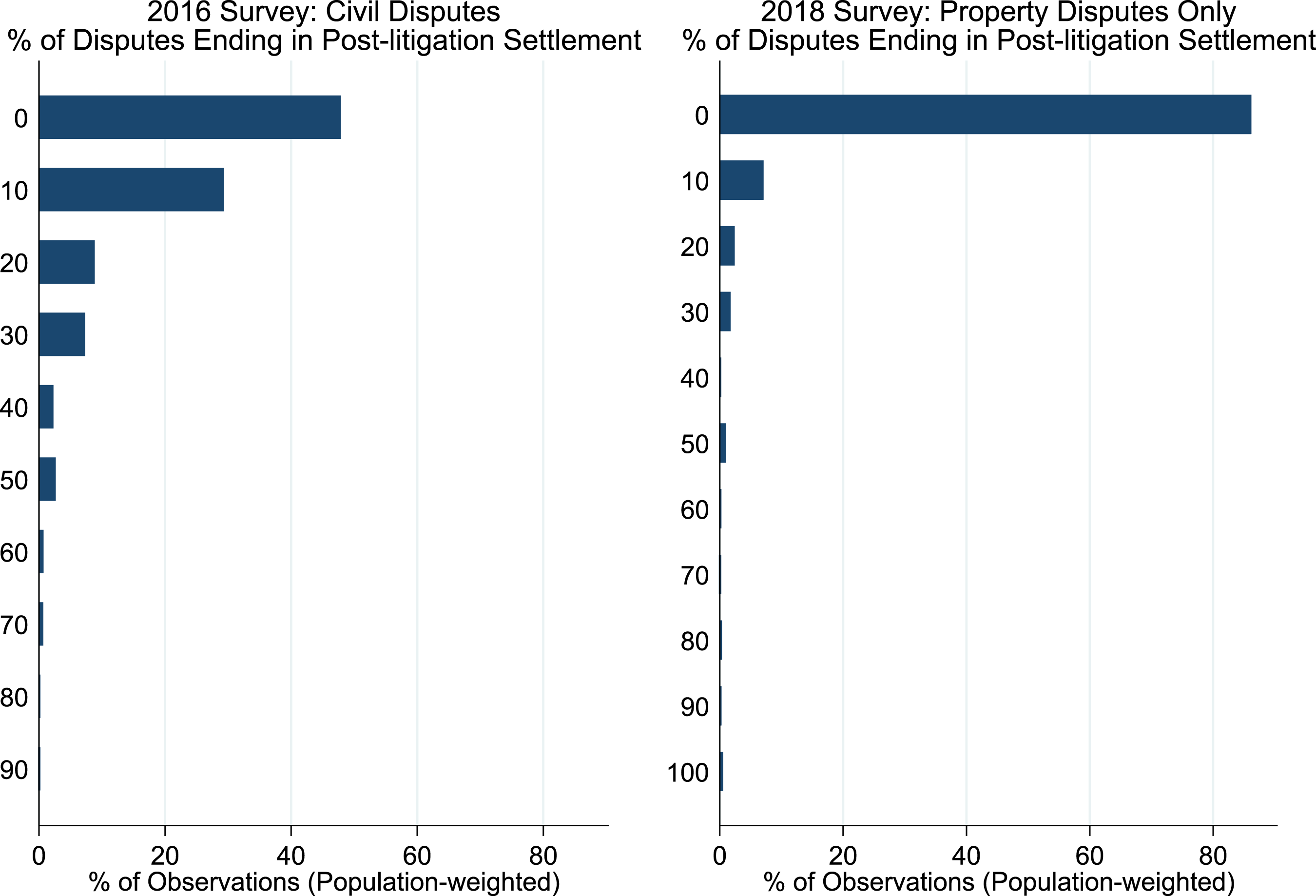
We can further look into the post-litigation binary choices of litigants: stay with the court ruling or settle out of it. The latter is used as the numerator, whereas the summation of both is used as the denominator to compute the percentages of settlement choices. Figure 2 shows that approximately 40% and 60% of the surveyed attorneys in 2016 and 2018, respectively, reported that once there is a court ruling, their clients never settle. Yet 19% and 17% of the surveyed attorneys in 2016 and 2018, respectively, answered that, given a court adjudication, their clients still opted for settlement more than or equal to 50% of the time. Frequency of cases represented by attorneys ending in post-litigation settlement rather than court rulings. Notes: The 2016 survey includes 681 attorneys, whereas the 2018 survey contains 239 attorneys. One attorney, one observation but population-weighted. The “percentage of disputes ending in post-litigation bargaining rather than court ruling” was first rounded to the first decimal point and then multiplied by 100. The bar width is thus 10 and centered on the numbers labeled on the Y-axis. For instance, the second bar, 10, represents 5%–14%. The “percentage of disputes ending in post-litigation bargaining rather than court ruling” on the Y axis is computed by [(Percentage of Cases Represented by Attorneys Ending in Post-litigation Settlement)/(Percentage of Cases Represented by Attorneys Ending in Post-litigation Settlement + Percentage of Cases Represented by Attorneys Ending with Court Rulings)]. This figure has fewer observations than the previous figure, because some attorneys reported that if their clients had ever settled, they did it before there was a court ruling. Therefore, the denominator and the numerator in our formula are both 0. Source: Chang 2016 and 2018 Taiwanese Attorney Survey Data Set. On file with author.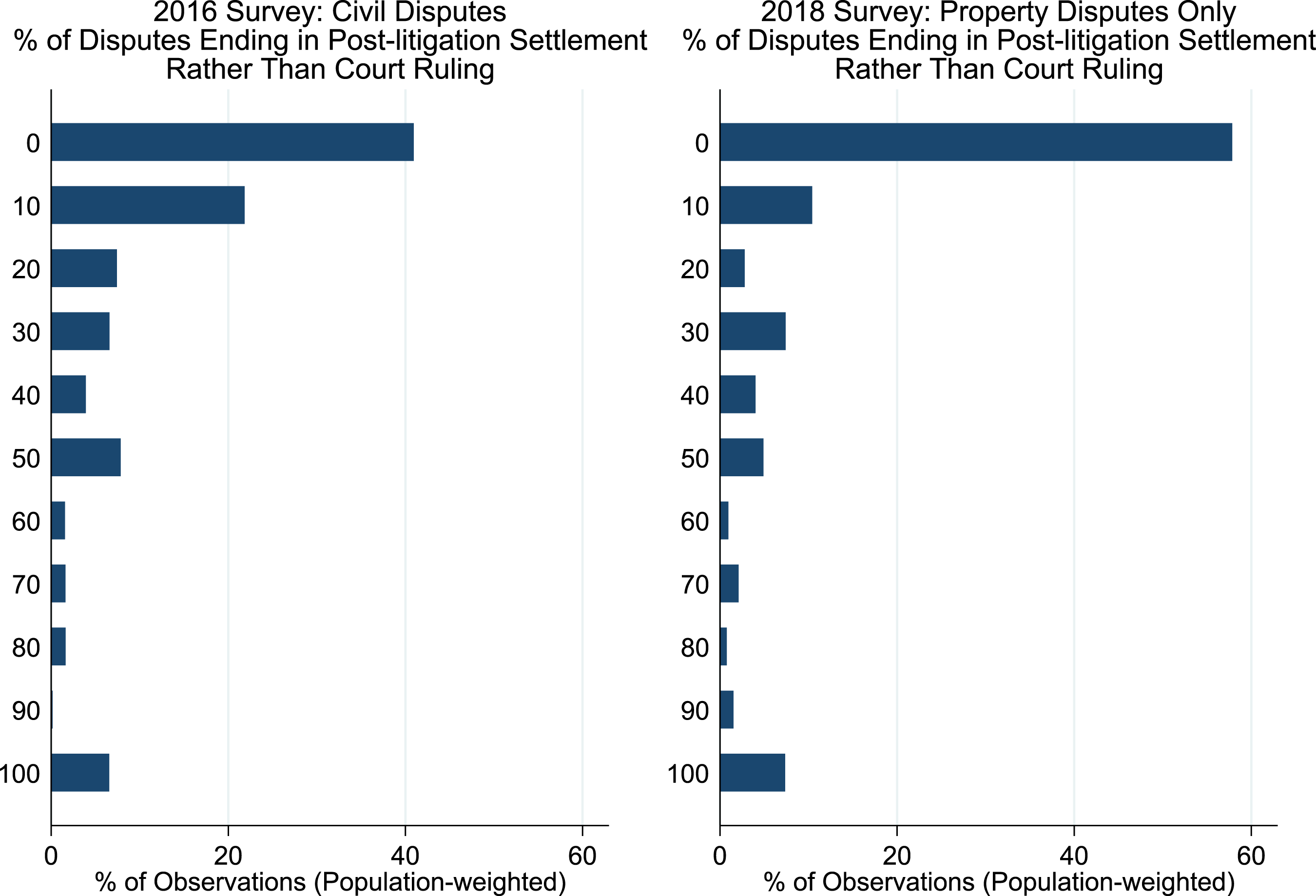
While one should not read too much into the exact percentages reported by attorneys, as the surveys required them to answer from memory, for our purpose, attorneys are unlikely to have reported a positive or even a high settlement rate if settlement never happened in the past three years. Without knowing whether there is room for Pareto-superior deals (i.e., the court rulings were allocatively inefficient), it is hard to assess whether efficient trades have been barred. From surveys, neither can we ascertain whether the lack of deals is due to transaction costs or animosity. That is why we adopt the following two empirical strategies to further tease out the core issue. That said, as summarized above, although one strand of the literature cites Farnsworth (1999) as evidence that parties do not bargain after litigation, our large-scale surveys qualify this empirical claim of complete lack of bargaining and enrich our understanding of the big picture and should be at least a useful complement to Farnsworth’s small-scale albeit in-depth interviews.
Second Strategy: Simple Tallying
Our surveys use an attorney as an observation and ask the attorneys to summarize three years of practice experience. The constraint is well-known. The second and third strategies look closely at individual property disputes. This part uses observational data to again examine the descriptive claim of no post-litigation bargaining. More specifically, it explores how often the two litigants were engaged in sales of the land in question after litigation.
Method
Without contending which judicial decisions are ex post allocatively inefficient, we matched the court case data with the real estate registry data (described below) to examine the frequency of successful land sales. A drastic 0% would be strong evidence for Farnsworth’s thesis, whereas, say, a 50% successful bargaining rate would suggest that court decisions are often allocatively inefficient and litigation itself at most infrequently stops parties from striking deals. A moderate result would be hard to interpret without context and would call for further analysis.
Ideally, we would be able to single out allocatively inefficient cases and focus on whether those cases led to successful bargaining. After all, there are no economic or behavioral reasons to expect that the litigating parties would change efficient allocation by the court afterwards. Nevertheless, the economic values (also called reservation values) of the two parties are unobservable; thus, we cannot judge with certainty whether the courts’ rulings are allocatively inefficient. As discussed in Third Strategy: Logit Models, we rely on proxies. In addition, due to lack of detailed hedonic characteristics of the buildings under dispute, we are not able to estimate their market value accurately. Thus, we are hesitant to declare any case allocatively efficient and exclude it from analysis. This constraint forces us to include all cases, allocatively inefficient or not, in the denominator in the computation of land sale rates, which are surely underestimated.
Court Decision Data
The following protocols were used to identify trespass cases with the factual pattern needed. All judicial decisions regarding property disputes in Taiwan are published online, available for free to everyone. Lawplus, the Westlaw of Taiwan at the time, downloaded cases from the official website of the court and used advanced text-mining techniques to analyze and categorize these cases. From Lawplus, our keywords 18 yield hundreds of cases from the courts of first instance between January 1, 2011 and December 31, 2013. 19
During the hand-coding process, several types of cases were excluded: 1) One of the parties is a corporation, a common-interest community board, or a government agency, as entities may be less subject to the animosity of litigation and human bias and heuristics (Cf. Arlen & Tontrup, 2015); corporations may change names or use subsidiary or affiliated corporations or foundations to purchase the rights instead; government agencies have more than monetary concerns; and corporation managers and government officials may have personal goals that they put in front of the entities’ interests. 2) The defendant/trespasser did not build anything permanent on the land. Without buildings owned by the trespasser, it is difficult to compare the (proxies for) economic value of the trespasser with that of the landowner. We also expected that trespassers without an immovable property on the land who lose the eviction lawsuit could easily pack and go. That is, trespassers generally lose very little even if they do not bargain with the winning landowners. Land is also generally more valuable than fixtures affixed to land. 3) Cases involving complicated fact patterns (e.g. multiple illicit possessors built multiple buildings across multiple plots owned by different persons), as the court decisions do not provide sufficient information for us to break such cases into several observations (i.e., some key variables would be missing).
Eventually, we coded 335 cases, producing 365 observations. 20 One observation represents one “bargaining occasion” — the typical case being that one illicit possessor (or co-possessors) negotiates with one landowner (or co-owners) to preserve the former’s building on said land. In two scenarios, one case produces multiple observations: (1) When a landowner or multiple co-landowners in one case sued multiple illicit possessors who occupied separate parcels, every parcel is one observation. Here, possessors clearly can bargain with landowners individually over the latter’s separate real properties. (2) When a landowner or co-landowners in one case sued one illicit possessor whose multiple buildings occupied separate parcels, every building is one observation, as possessors need not bundle the bargaining of the multiple buildings together. In other words, although there is only one possessor, she could decide to bargain for land use rights for one building but not others; thus, there is more than one bargaining occasion.
Summary Statistics of Key Variables From Court Cases and Land Registration Records.
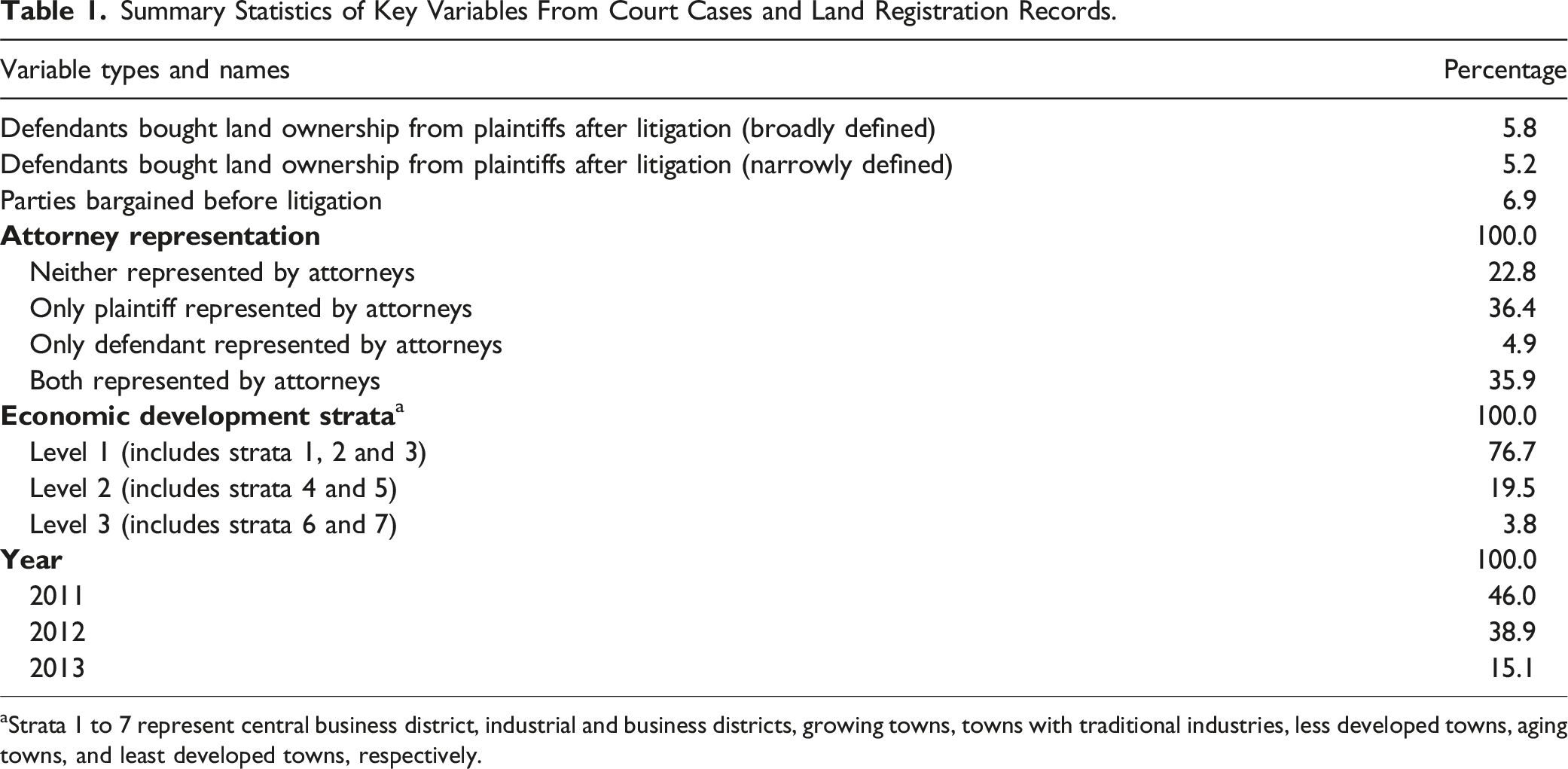
aStrata 1 to 7 represent central business district, industrial and business districts, growing towns, towns with traditional industries, less developed towns, aging towns, and least developed towns, respectively.
Data on Registration Records
Taiwan adopts the Torrens registration system. A unique land identification number chronicles information regarding legal rights. That is, if one knows the land ID number, she can go to a land registry office or commercial website authorized by the land registration office to look up the property right information of that parcel. To protect privacy, the competent agency in 2014 decided to redact certain personal information when a random person requests the information. As researchers working in public institutions, we were able to acquire copies of “land ownership certificates” and “transaction records” with all critical information un-redacted. Most importantly, the full names of the current and former owners (or superficies holders) enable us to ascertain whether, when, and through what kind of transfer the losing defendant/illicit possessor acquired certain property rights from the winning plaintiff/landowner. The land ownership certificates also chronicle, among other information, the land size.
Data from Google Street View and Satellite Pictures
To find out whether there might be contractual exchanges other than the observable property exchanges, we turn to data sources that, to our knowledge, have not been used in law-and-economics research before: Google Street View and publicly available satellite pictures taken by the Taiwan government (NLSC, available at https://maps.nlsc.gov.tw/). Pictures in Google Street View (see Appendix C) were taken twice in Taiwan, first around 2008–2010 and second around 2014–2016 (a few pictures of our studied land were taken in between). Recall that our research period is 2011–2013, right between the two rounds of picture taking. This enables us to examine the conditions of the land in disputes before and after the litigation, particularly comparing by visual inspection whether the building on the land looks the same. We also used NLSC, the Taiwan government’s own version of Google Earth and Google Maps, which is our starting point in ascertaining whether any building stood on the land as of April 2017.
We utilize these two picture sources in the following ways. If there was a building on the land before litigation, and the land became vacant after the litigation (or a different building sat on the land), it is highly likely that the trespassers and the landowners did not reach a deal. It is possible (though not very likely) that the possessors now rent from the landowners and have built (or are going to build) a more permanent building instead. By contrast, if the buildings were the same before and some years after litigation, either possessors rented from landowners (suggesting that there was a deal), or landowners kept the building (perhaps temporarily) after possessors left (suggesting that there may not have been a deal).
Land Registration Records Reveal a 6% Land Sale Rate
Among the 365 observations in our dataset, in 21 observations (6%), defendants successfully acquired land ownership after the lawsuit.
21
It is worth emphasizing again that the
Second, as noted above, the landowners may have leased the land to the possessors. The term “lease” is worth more explanation. In the U.S., leasehold is a form of property with in rem effect. In Taiwan, the functional equivalent of American leasehold is superficies, a use right with full in rem effect. Superficies has to be registered to be effective, so it is observable from our data source, though it just so happened that there was none between the litigating parties. There is also the contractual form of lease with limited third-party effect. It does not have to be registered, so it is not observable by us.
Third, only consummated land sales are observable. Attempted but failed bargaining is not. Nonetheless, such attempted bargaining is also evidence of the lack of animosity at least in one party.
Finally, the denominator in the 6% includes allocatively efficient and inefficient decisions. Using regression results in Part V, we find that when the estimated building value is larger than or equal to the estimated land value, the sale rate increases to 9% (N = 110). When the former is more than twice as valuable, the sale rate increases to 14% (N = 56). This suggests that including allocatively efficient adjudications leads to underestimation of the true post-litigation sale rate following allocatively inefficient adjudications.
Some documented land sales deserve more explanation. In three observations, the plaintiffs and defendants are also co-tenants, and the two parties after the trespass litigation partitioned the land by voluntary agreement, mediation, and settlement. 23 As these partition agreements are voluntary, these three observations are counted as successful bargaining. 24 There are two borderline observations. In one of them, the plaintiff sold the title to the defendant’s attorney, whose last name is the same as the defendant’s. The attorney may be the defendant’s escrow, or perhaps the attorney saw the value of the land while handling the case. In the other observation, the plaintiff sued on behalf of all the other co-tenants, and the defendant bought the share of one of the co-tenants not named as the plaintiff in the case. In the regression analysis reported in Part V, we report the same regression model with or without counting the two borderline cases as an exchange.
Google Street View Suggests Deals Are More Frequent
Evidence From Satellite Pictures and Google Street View.
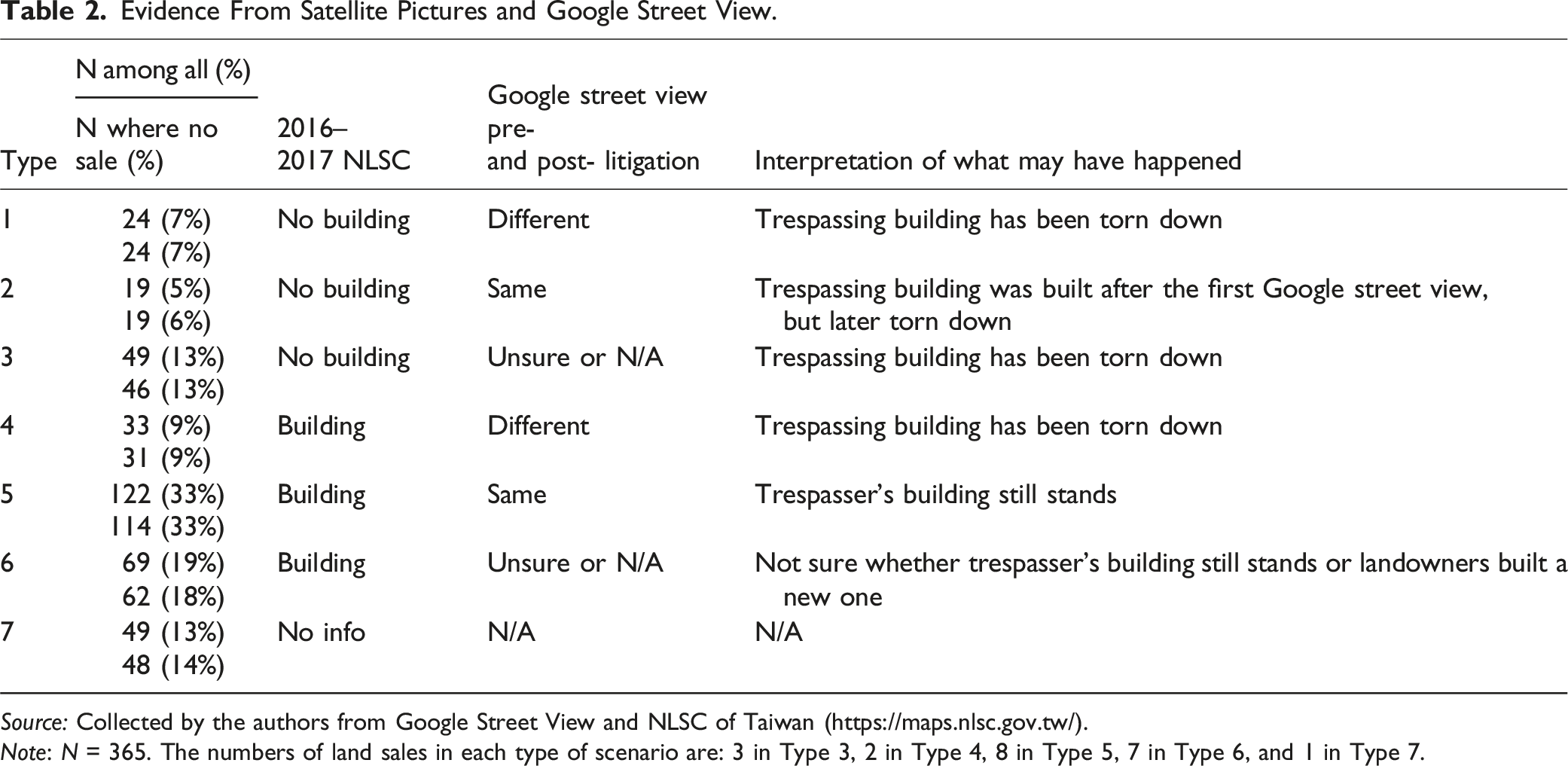
Source: Collected by the authors from Google Street View and NLSC of Taiwan (https://maps.nlsc.gov.tw/).
Note: N = 365. The numbers of land sales in each type of scenario are: 3 in Type 3, 2 in Type 4, 8 in Type 5, 7 in Type 6, and 1 in Type 7.
Third Strategy: Logit Models
Logit regression models can tease out factors that capture critical elements in the theories of traditional law and economics and behavioral law and economics, and thus provide suggestive evidence in support of or inconsistent with the competing theories. Causal relations cannot be identified.
To test the competing theories, ideally we would know the reservation values of both parties, the level of animosity on each side, and the amount of all relevant transaction costs. With these three variables, we could figure out whether the lack of post-litigation sales should be attributed to high transaction costs, the allocative efficiency of the adjudication, or animosity. Unfortunately, no accurate information on any of the three variables is available.
Our logistic regression models instead use proxies for the aforementioned three key variables. Transaction cost is proxied by the number of parties on each side. The proxies for allocative inefficiency are further explained with a simple bargaining model in Section A. Lack of legal representation is our proxy for animosity, as discussed in Section B. The three key variables, if statistically and practically significant with the expected sign, shed light on the theoretical difference between the traditional rational choice paradigm (Coase) and the behavioral paradigm (Farnsworth).
The rest of this part is structured as follows: Section C defends the position of not taking into account the endowment effect. Section D lays out the complete specification of the logistic regression models. Sections E and F report and discuss the findings.
A Simple Bargaining Model
Land sales will only take place when (1) a possessor’s willingness to pay (or her economic value) is not less than the sale price, and (2) the sale price is not less than a landowner’s willingness to accept (or her economic value). Due to transaction costs and information asymmetry, land sales are more likely to be consummated when the possessor’s willingness to pay is much higher than the landowner’s willingness to accept (Myerson & Satterthwaite, 1983, pp. 276–77). We use the following simple transaction model that starts with these conditions, and conclude that market value of the land and building in question can serve as proxies that help predict the probability of land sales.
Let
After litigation, if there is no successful bargaining, the possessor owns nothing (since the building has to be torn down), and the landowner owns 
By summing up these two inequalities side by side

Here, we further assume that
Animosity When Pro Se
The existence and level of animosity are almost impossible to measure directly in observational studies. Our experience of reading tens of thousands of court decisions that usually excerpt the transcripts of both parties’ claims and debates in open court suggests that pro se parties often resort to compassion and commonsense justice, and their debates are usually heated. By contrast, represented parties focus on legal matters and are thus relatively cool-headed. If our personal observation is generalizable, cases with parties represented by attorneys are less likely to create animosity than those with pro se parties. Perhaps the role of defendant attorneys is more important, because defendants are always the losing parties in our data set, and thus pro se defendants may tend to defend themselves more vigorously with extra-legal arguments than represented ones who speak through the mouths of professionals. We do not claim that the effect of lawyers is one-directional (i.e., calming clients down and preventing clients from firing up). Some attorneys are combative and may antagonize the clients. That said, overall speaking, we do believe that attorneys qua agents serve to debias (Arlen & Tontrup, 2015), ameliorate the effect of negative emotion, and prevent the growth of enmity. This is an empirical question that is worthy of future research.
Attorney representations are endogenous decisions made by the litigants, which might confound the results of successful post-litigation bargaining. 29 What kinds of litigants in Taiwan choose to seek attorney representation? Chang and Tu (2020), using 2016 survey data on 2705 litigants throughout Taiwan in logistic regression models, find that experienced litigants and male litigants were less likely to be represented; income, among other demographic characteristics, is not statistically significant. Moreover, official judicial administrative data in 2010–2015 (unreported) show that attorney representation rates are positively correlated with the amount at stake. Except when the stakes are in the bottom 30% of all cases (not the high-stake cases studied here), attorney representation rates in relatively rich and poor regions are similar.
Given the aforementioned pattern of legal representation in Taiwan, we contend that confounders regarding legal representation are unlikely to be the whole story in this particular study. Stakes (in the form of land values and building values) are controlled in our regressions. Parties are unlikely to be experienced in our cases, unless they are repeated trespassers on others’ land or landowners who constantly fail to safeguard their own vacant properties. Even if they are experienced, the most plausible reason why experienced litigants (proxied by being represented) are more likely to strike a deal after litigation is that they have learned not to take the litigation process personally and to do rational cost–benefit analysis in dealing. In other words, either experienced litigants are less prone to sense animosity spawned by the litigation process, or they do not let animosity stand in the way of rational calculus. Finally, we are not aware of any economic or behavioral reason for litigants’ gender to affect their inclination to bargain after litigation.
Another challenge is more straightforward: perhaps some litigants hire attorneys in litigation so that they are more likely to strike a deal afterwards. At least in the case of Taiwanese litigants, this hypothesis is not very convincing. Huang (2008), using official judicial administrative data in 1996–2006, argues that Taiwanese disputants will not hire lawyers unless they are determined to pursue the matter in court. That is, when settlement is not a preferred option, disputants retain attorneys. Based on the empirical evidence, it is unlikely that Taiwanese litigants will hire attorneys to boost the success rates of future settlements. If attorney representation is confounding at all, it should make representation less likely to be associated with post-litigation land sales.
Endowment Effect Not Present
As noted in the Introduction, one strand of the literature uses the endowment effect to explain the lack of negotiation. We agree with Klass and Zeiler (2013) and Zeiler (2018) that the endowment effect as known in the legal literature is better called the “endowment theory,” which posits that “ownership sets one’s reference point, the movement from which triggers either a perceived gain or loss, and that people perceive the transfer or sale of endowments as losses” (Klass & Zeiler, 2013, p. 4). The trespass litigation setting studied in this article does not trigger a perceived gain on the landowners’ side. As mentioned above, all the plaintiffs/landowners won the lawsuits we studied, thanks to the accurate and legally binding Torrens registration system. They knew all along that they clearly had title, and the court agreed. There might be a small uncertainty in some cases as to whether defendants might be entitled to possession. We suspect that the effect would be, at most, weak (and in any case, we do not know how to quantify the endowment effect). In other words, even if the endowment theory is right (this is contested by Zeiler, 2018), landowners’ willingness to accept would have been increased at the time they became owners, not after litigation. Moreover, even if landowners’ willingness to accept does increase again after courts confirm their title, generally this shows up in all cases we study, and the lack of variation makes it unnecessary to model it in the regression. Surely, the extent of changes in willingness to accept may differ, but there is no way for an observational study like this to measure it. Therefore, in this empirical study, we do not examine the role of endowment.
Model Specifications
We ran a logistic regression model, clustered by case, with robust standard errors. The dependent variable equals one if plaintiffs sold ownership to defendants after litigation, and is zero if otherwise. The independent variables include the aforementioned theoretically interesting factors and other controls. Only observations with buildings under dispute are included in the regression. In other words, observations with other constructions such as fences are excluded, as our proxy for building values would be far off the mark when the construction is e.g. tombs, fishponds, or parking facilities. The logistic regression model takes the following form:
One may be concerned with the mere 21 successful post-litigation sales and the small degree of freedom the ordinary logistic regression model has. The power issue is particularly acute when a null result is found, though this is not what we face. Still, the maximum likelihood estimator of logistic model has asymptotic bias, which becomes substantial when the number of rare events decreases. To account for the potential problem of infrequent post-litigation land sales, we conducted robustness checks by running our models with the following three methods. King and Zeng (2001b, 2001a) propose the bias-corrected estimator, which is widely applied in political studies. It is available in Stata under the command relogit. Alternatively, Firth (1993) provides an approach by utilizing the penalized maximum likelihood method with a penalty term, which is sensitive to the small number of rare events and sample size. It is available in Stata under the command firthlogit. By Monte Carlo simulation, Leitgöb (2013) further shows that the method of King and Zeng tends to overcorrect the bias, while the estimates from the penalized maximum likelihood method seem unbiased. We report the results from both methods. Moreover, we fit the data in a complementary log-log model (cloglog in Stata), as our final robustness check.
Finally, one may be concerned that our dependent variable is measured with error in favor of the zero condition—that is, we do not always observe successful bargaining. While we have reiterated this point as the reason for underestimation in our second strategy, this should not be a problem for our regression model.
Sales Occur When Transaction Costs are Low and Resource Allocation Is Allocatively Inefficient
Traditional rational-choice law and economics can aptly explain part of the findings. As the regression results reported in Figure 3, Figure 4, and online Appendix D show, land value has a negative coefficient and is statistically significant at the 95% or 99% level, as our transaction model predicts. Building value has a positive coefficient but is not statistically significant at the 90% level. This variable has the expected signs, but perhaps due to the smaller variance, building value turns out to be statistically insignificant. As for the practical effect, we use the logit model as an example. The average marginal effects in the two models reporting the logit regression results are similar. Under column 1 of Table D1, the average marginal effect of land price (natural log-transformed) is −.025, whereas that of building price (natural log-transformed) is .011. This means that when the untransformed land (building) price increases by 2.71828 times (2.71828 being the approximate value of nature, e), the probability of a successful deal decreases (increases) by 2.5 (1.1) percentage points. Regression coefficients (successful deal broadly defined). Notes: The thinner lines show the range of the 95% confidence interval, whereas the thicker lines show that of the 90% confidence interval. The vertical line shows coefficient at 0. Regression Coefficients (Successful Deal Narrowly Defined). Notes: The thinner lines show the range of the 95% confidence interval, whereas the thicker lines show that of the 90% confidence interval. The vertical line shows coefficient at 0.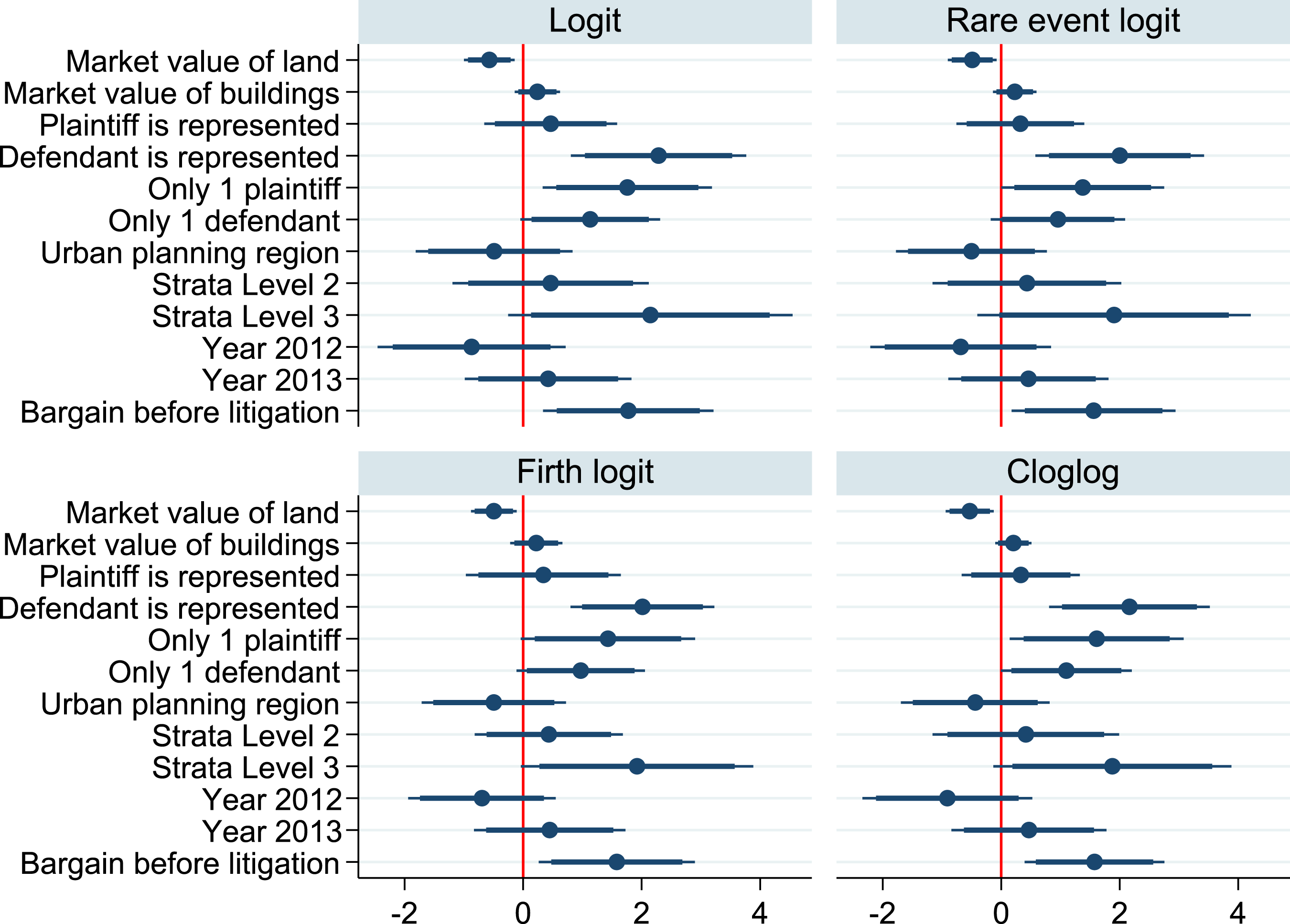
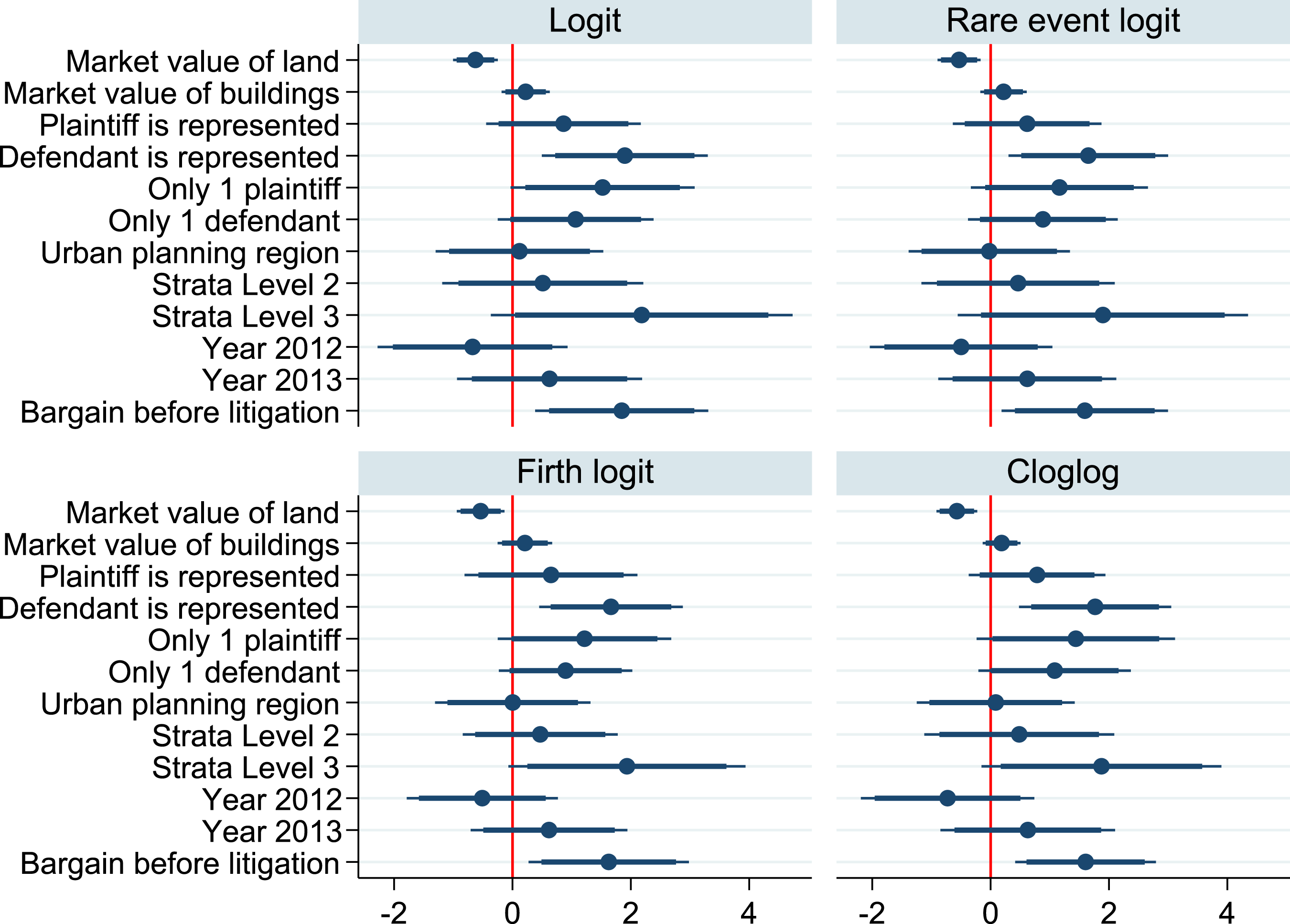
In addition, the single plaintiff dummy variable is often statistically significant at the 95% or 90% level, in particular in Figure 3. The single defendant dummy variable is often statistically significant at the 90% level. The positive signs of both variables are also as expected. Transaction costs are lower when one person alone on the buying and selling side can make the call.
Finally, the dummy variable on pre-litigation bargaining is statistically significant at the 95% or 99% level. This suggests that parties who are open to negotiation in the first place are also prone to bargaining after litigation. This finding is consistent with the critique by rational choice theorists that parties do not bargain after litigation because they are not open to bargaining since the very beginning. In other words, their inclination not to bargain is not a result of animosity created during trial, but a result of their own personality.
No Deals Is Partly Emotional
Our findings can also be interpreted as consistent with Farnsworth (1999)’s claim that animosity hinders post-litigation bargaining. The dummy variable capturing whether defendants are represented by attorneys is statistically significant at the 95% or 99% level. The dummy variable capturing whether plaintiffs are represented by attorneys, while not statistically significant, has positive signs. As argued above, increasing the probability of post-litigation land sale is probably not the reason parties choose to be represented, but attorney representation changes the way the trial is conducted, thus indirectly affecting the parties’ chances of reaching deals afterwards.
More concretely, represented parties do not have to attend the trial, and their attorneys try to win their case by solid legal arguments. By contrast, pro se parties would attend the trial and often make non-legal arguments. As mentioned above, debates in the pro se cases are often heated. In other words, attorneys usually make the case less personal, and more legalistic. They realize that in trespass cases handled by professional judges, emotion is useless in winning. Pro se parties, without legal expertise, conduct emotional debates that breed animosity, leading to lack of negotiations afterwards.
We further conjecture that whether defendants are represented is more important (perhaps the reason why the defendant representation variable is statistically significant). As pointed out above, plaintiffs as the record landowners only need to show judges land registration records to establish their claims — they can remain emotionally cool. Defendants, by contrast, face an uphill battle and, if they do not retain attorneys, are more likely to show emotion.
A few caveats, however, are in order. First, overly aggressive attorneys might be a source of animosity, 34 but we are unable to observe whether attorneys were aggressive in court; neither can we observe and compare the level of animosity across cases. Second, attorney representation is not random. It may be the (unknown) reasons that lead to the parties’ hiring an attorney in the first place that make a successful deal possible. Nonetheless, as argued above, we do not think that parties hired attorneys because they were thinking ahead about post-litigation bargaining. Rather, post-litigation exchange is the side effect of attorney representation. Finally, we are not aware of rigorous psychological studies on attorney representation and reduction of animus. We arrived at this explanation upon reading hundreds of sampled court decisions. In some scenarios, such as nuisance, animosity may exist before parties go to court. In our trespass context, by contrast, parties may know each other only shortly before meeting in court. One can imagine that animosity may be generated before trials start and become intensified over the course of the litigation. Due to the constraints of the data and our research design, our conclusion in this regard is thus tentative and serves as an invitation to more research in the future.
Conclusion
Farnsworth (1999)’s influential article has been cited in different ways. It has been used as evidence that litigants do not bargain after lawsuits. If this were true, the Coase theorem would lose its most important appeal. Entitlement allocation, by courts or by other institutes, instead would matter a great deal for economic efficiency. Our observational study on trespass lawsuits in Taiwan shows that litigating parties do, at least occasionally, reach deals after litigation. A substantial minority of the 1511 surveyed practicing attorneys in Taiwan reported that their clients have settled with the opposing party after judges rendered decisions. Our finding qualifies the strong version of the claim that litigating parties do not bargain after litigation.
Still, our finding shows that post-litigation deals are infrequent. How does that tell us whether Coase or Farnsworth is right, or whether both sides are right to a certain extent? Our regression models suggest that when litigants did reach deals, allocative inefficiency was an important factor. Coase and the countless papers relying on his insight are right to have some faith in people’s rationality in redressing inefficiency by themselves.
On the other hand, to the extent that attorney representation is a good predictor of less heated debates between parties themselves, but not confounders, animosity did stand in the way of post-litigation negotiation. Farnsworth is thus also right in calling to attention the potential role of mutual negative emotion in post-litigation bargaining. Scholars have also used Farnsworth (1999) as a springboard for advancing behavioral law and economics theory. Our results suggest that it is a useful hypothesis, and our empirical exercise provides some support.
The fair assessment of the Coase theorem versus the Farnsworth theory should be that neither of the extreme interpretations of their theories can be supported: transaction costs are not all that matters after entitlements are assigned, as animosity counts, while animosity is not an absolute deal breaker—given enough money at stake, some parties would overcome their emotion and make the efficient move. Going forward, scholars should use field experiments and lab experiments to tease out the conditions under which litigation gives rise to animosity and the extent to which animosity stalls post-litigation bargaining. We are heading in this direction (Chang et al., 2024). Stay tuned.
Supplemental Material
Supplemental Material - Do Parties Negotiate After Trespass Litigation?An Empirical Study of Coasean Bargaining
Supplemental Material for Do Parties Negotiate After Trespass Litigation?An Empirical Study of Coasean Bargaining by Yun-Chien Chang, and Chang-Ching Lin in Journal of Law and Empirical Analysis
Footnotes
Acknowledgments
Valuable comments were provided by the editor Eyal Zamir, two anonymous referees, David Abrams, Lisa Alexander, Ronen Avraham, Ian Ayres, Douglas Baird, Bernard Black, Emiliano Catan, Jinhua Chen, Weicheng Chen, Adam Chilton, Kevin Clermont, Libor Dušek, Elliott Fan, Ward Farnsworth, Susan Fortney, Michael Frakes, Bruno Frey, Nuno Garoupa, Jonah Gelbach, Paul George, Fernando Gómez, Andrew Green, Michael Green, Valerie Hans, Maxine Harrington, Michael Heise, Yotam Kaplan, Hui-wen Koo, Lewis Kornhauser, Ming-jen Lin, Kate Litvak, Glynn Lunney, William Magnuson, Thomas Mitchell, Anthony Niblett, Vanessa Casado Pérez, Katharina Pistor, Jeff Rachlinski, Giovanni Ramello, Mark Ramseyer, Barak Richman, Emily Satterthwaite, Stewart Schwab, Henry Smith, Franklin Snyder, Holger Spamann, Alois Stutzer, Michael Trebilcock, Wehn-Jyuan Tsai, Wei-Che Tsai, Saurabh Vishnubhakat, Joseph Wang, Ming-Li Wang, Arnold Weinrib, Tsong Min Wu, Albert Yoon, and Kathy Zeiler. We thank Yu-ting Hung, Jian-Hua Lai, Li-Min Lin, Yu-june Tseng, Sang-Wei Yang, and Tien-hsin Wang for helpful research assistance.
Declaration of conflicting interests
The author(s) declared no potential conflicts of interest with respect to the research, authorship, and/or publication of this article.
Funding
The author(s) disclosed receipt of the following financial support for the research, authorship, and/or publication of this article: This work was supported by the Institutum Iurisprudentiae, Academia Sinica and Department of Economics, National Cheng Kung University provided initial research funding.
Author’s Note
A draft of this paper has been presented at the 2022 Empirical Legal Studies Workshop at Institutum Iurisprudentiae, Academia Sinica; 2017 American Law and Economics Association Annual Conference at Yale Law School; 2016 CELS held at Duke Law School; the Berger talk series at Cornell Law School on Jan. 26, 2017; the Law and Economics Workshop at the University of Toronto on Nov. 15, 2016; Faculty Speaker Series at Texas A&M Law School on Feb. 15, 2017; the 2016 Comparative Law and Economics Forum held in Taipei, Taiwan; 2016 EALE Annual Conference held in Bologna, Italy; the Economic History Workshop at National Taiwan University Economics Department; the Faculty Workshop at the Graduate Institute of Industrial Economics at National Central University; and 1st CELS in Asia held at Academia Sinica in Taipei, Taiwan; and the 2016 Annual Meeting of the Italian Law and Economics Society.
IRB Protocol
The Ministry of Science and Technology provided a research grant (MOST 105-2410-H-001-024). This research project has been approved by the IRB at Academia Sinica (AS-IRB-HS-16020) when Chang worked there as a Research Professor.
Supplemental Material
Supplemental material for this article is available online.
Notes
References
Supplementary Material
Please find the following supplemental material available below.
For Open Access articles published under a Creative Commons License, all supplemental material carries the same license as the article it is associated with.
For non-Open Access articles published, all supplemental material carries a non-exclusive license, and permission requests for re-use of supplemental material or any part of supplemental material shall be sent directly to the copyright owner as specified in the copyright notice associated with the article.
