



Abstract
Handheld laser-induced breakdown spectroscopy (LIBS) was applied to two studies of archaeological material at excavation sites in the Orvieto (Umbria), Italy geographic region. The short analysis times and wide range of detectable elements, covering both metals and nonmetals, achievable via LIBS played a central role in successfully exploring research questions specific to the analyzed artifacts. For one study, associations among Roman terraced walls at the Coriglia excavation site were established through comparisons among lime mortar elemental compositions measured in situ. New conclusions regarding construction phases were achieved, and agreement between handheld LIBS and handheld X-ray fluorescence (XRF) spectrometry results was established. Secondly, Etruscan bucchero pottery was examined to explore relationships among fabric color (gray and black), excavation site (Cavità 254 and Crocifisso del Tufo), and elemental composition. Differences were found and are discussed as they relate to ceramic production and object purpose. Principal component analysis was applied for data analysis in both studies.
This is a visual representation of the abstract.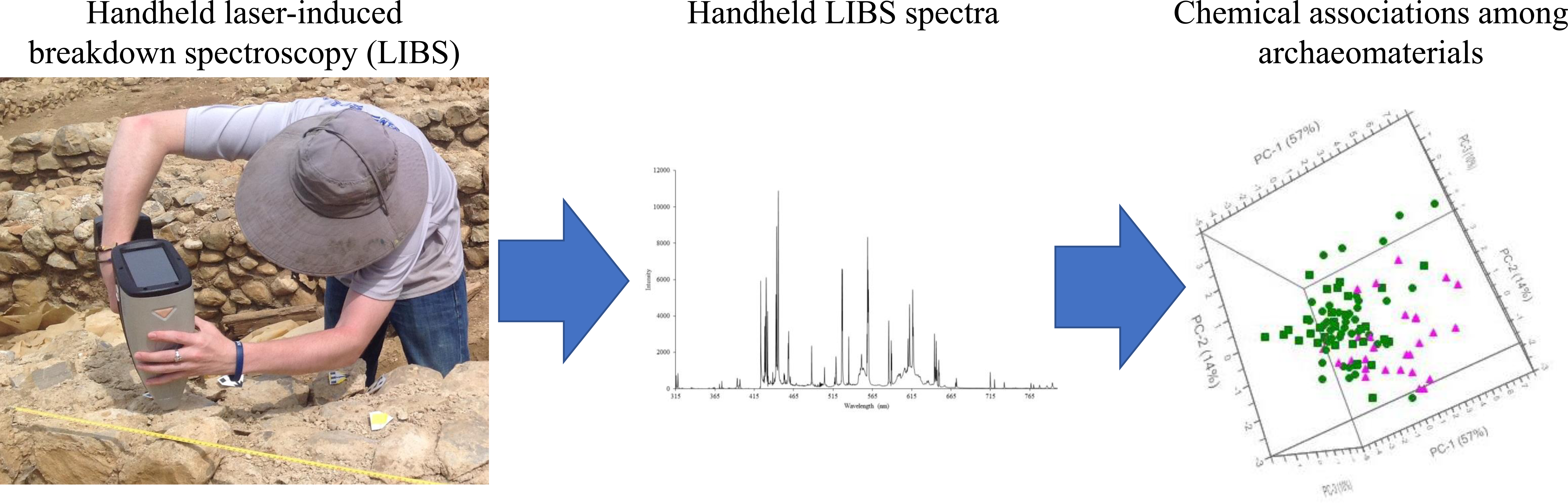
Keywords
Introduction
As the availability of miniaturized spectroscopic instrumentation for applications outside the laboratory continues to expand,1,2 researchers in the cultural heritage analysis field are benefiting from the availability of those devices. Portable and handheld versions of spectrometers once found only on benchtops, including Raman spectrometers, Fourier transform infrared spectrometers, and X-ray fluorescence (XRF) spectrometers, are now essential tools to those seeking to gain chemical information and/or develop conservation strategies for precious objects including those found in museums, at archaeological sites, or at locations of cultural significance. A number of informative reviews on portable instrumentation that include applications to cultural heritage are available.3–7
Laser-induced breakdown spectroscopy (LIBS) is one analytical technique increasing in use for archaeological and cultural heritage object analysis. 8 XRF spectrometry has certainly been the more commonplace choice for elemental analyses of these often-precious samples considering its nondestructive nature. LIBS has some advantages over XRF spectrometry, however, including better detection limits for many of the lighter elements and significantly shorter analysis times. LIBS could therefore be considered a complement to XRF spectrometry or, for certain applications, the preferable choice. For the short campaign times often provided to cultural heritage researchers, the opportunity to collect larger data sets is impactful and can lead to higher confidence in results and the conclusions drawn from those results.
An obvious disadvantage of LIBS is the minimally destructive nature of the technique, not ideal for one-of-a-kind objects of significant value. With careful choice of analysis location and instrument settings, however, LIBS can successfully be applied to many sample types with no visible damage or permissibly minimal damage. Recent studies using LIBS for elemental characterization of wall murals,9–11 glass, 12 coins, 13 construction materials, 14 and a large copper alloy assemblage 15 demonstrate the potential of the technique for archaeological materials.
The handheld LIBS studies reported in this paper focus on elemental characterization of two different material types, Roman wall mortars and Etruscan ceramics. In both cases the materials are man-made with their compositions related to the raw materials and processes used in their production, thus providing an opportunity to establish artifact groups based on chemical similarities. All analyses were performed during one campaign season conducted in the Orvieto (Umbria), Italy, geographic region. The Roman wall mortars were discovered at Coriglia, Castel Viscardo, an archaeological site that is centered on several natural springs and associated structures, most notably a bath complex. The site was first occupied by the Etruscans around the sixth century BCE, reached its peak during the Roman period, and continued to be inhabited through the medieval era. The mortared walls form a series of north-facing terraces and were previously studied both in situ and ex situ using handheld X-ray fluorescence (XRF) spectrometry. 16 The Etruscan bucchero sherds are from two locations, Cavità 254, which dates to approximately the fifth century BCE, and Crocifisso del Tufo, which dates to at least the sixth century BCE. Cavità 254 is a human-made pyramidal cave located under the city of Orvieto that is believed to have been used as a quarry. The space was filled in at the end of the fifth century BCE with various materials associated with the Etruscan occupation of Orvieto, including both gray and black bucchero, a type of typical Etruscan ceramic.17,18 Crocifisso del Tufo is an Etruscan necropolis consisting of chamber-type tombs organized in a street-like system with family names inscribed on each tomb's lintel. Objects such as vases, pots, jewelry, and urns were placed in the tombs along with the dead. Both of these assemblages have been the focus of research due to the complexity and volume of the material, including this study.
The goals of the two studies were threefold: (i) evaluate the practical utility of handheld LIBS for field archaeology; (ii) analyze the LIBS data using multivariate statistics to determine possible associations or groupings among samples to draw conclusions regarding the archaeology; and (iii) compare the conclusions from the LIBS work to those from previously reported studies.
Methods and Materials
The mortar on a total of 23 loci was examined using handheld LIBS. Locus (singular) and loci (plural) are archaeological terms used to designate discrete, definable actions, such as structures or deposits, uncovered at an archaeological site. Loci are numbered as they are unearthed. Some loci may appear visually to be part of a singular structure, a wall for example, but because they were excavated or constructed at separate times, they are indicated by different locus labels, in this case, numbers. Trench, another archaeological term, is used to designate a specific section of a site being excavated; trenches are commonly designated by letters in alphabetical order from earliest to most recently opened area. Mortar on each wall locus within Trench C was analyzed at 12 to 40 different locations distributed as evenly as possible across the wall's length and height, with duplicate analyses at each location. A total of 752 mortar analyses were conducted over the course of 13 days. Figure 1a is a digital image of Locus 22 with two scale arrows indicating where handheld LIBS analyses were conducted. Previously reported handheld XRF results are available for comparison to the handheld LIBS data for eight of these loci analyzed ex situ and for 15 loci analyzed in situ. 16

Digital images of (a) Roman wall mortar Locus 22 and (b) pottery sherds in gray (left) and black (right).
In a separate study, 58 bucchero pottery sherds were investigated using handheld LIBS of which 24 were identified as gray by visual inspection and 34 were identified as black. For the gray samples, four were from the Crocifisso del Tufo excavation site and 20 were from Cavità 254. Seven of the gray Cavità 254 sherds have inscriptions. For the black samples, 25 were from Crocifisso del Tufo and nine were from Cavità 254. Digital images of select sherds, one gray and one black, are provided in Fig. 1b. Each sherd was analyzed at three separate locations along cut edges; three samples that were more intact and had bases, as well as bowls, were analyzed at more than three locations. Cut edges were selected as the preferred locations for analyses considering the decreased visibility of the resulting small laser craters compared to the inner and outer surface areas of the pottery. A total of 185 sherd analyses were conducted over two days.
The handheld LIBS system used in both studies was a SciAps Z-500ER (Massachusetts, USA). This instrument has multiple modes of operation. Geochem mode, designed for small analysis areas and based on an average spectral signal calculated for a multilocation grid, was used for this work. The pulsed laser in the LIBS was operated at 5–6 mJ/pulse with a 50 Hz frequency and a 1 ns pulsewidth. The instrument is capable of monitoring wavelengths using four different spectrometers with the following ranges: 180–255, 255–315, 315–420, and 420–860 nm. Measurements with the Z-500ER can be conducted with an argon purge gas, which increases the instrument's sensitivity, but due to the limited argon supply transported to the excavation site, this study was conducted without argon purge. Data for each analysis location were collected in a 4 × 3 grid pattern with four cleaning shots followed by three analysis shots at each of the 12 spots in the grid; these data then were averaged to produce one spectrum per analysis location. Each analysis required about 6 s and was approximately 2.5 × 1.5 mm in size. Specific, detailed data collection protocols used by our research team for in situ data collection have been described elsewhere. 19
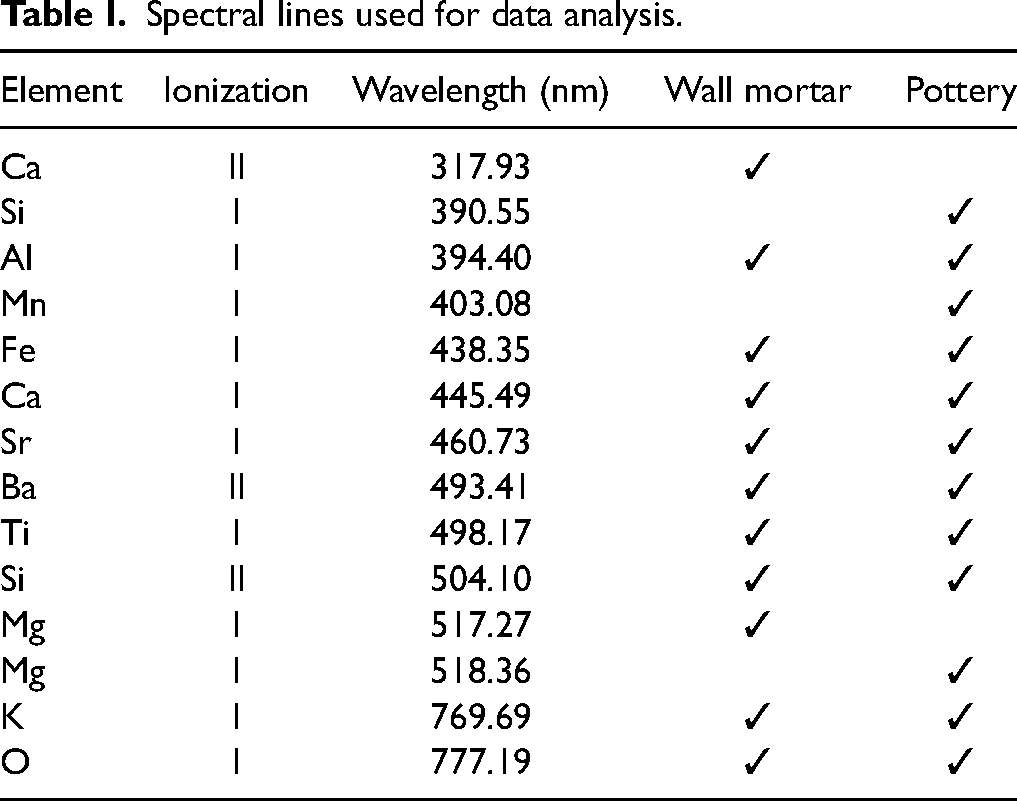
The intensity data of each spectrum was analyzed with the SciAps Utility application to identify elements present in samples. The emission wavelengths and corresponding elements selected for each study are listed in Table I. Sodium and lithium were identified in many samples but were attributed to soil contamination and thus are not included in the table nor included in subsequent statistical analyses. All spectra were five-point Savitzky–Golay smoothed, integrated, and normalized. Elements for normalization were selected, in this case, calcium for the mortar spectra and silicon for the pottery spectra, based on the presence of that element in all samples and the availability of strong emission lines within each spectrometer wavelength range for that element.
Spectral lines used for data analysis.
The normalized integration results were then imported into The Unscrambler chemometrics software (Aspentech, USA). Within The Unscrambler, data were evaluated with principal components analysis (PCA) with random segmented cross-validation. For each PCA, data were mean-centered and divided by standard deviation weighting was used for each variable.
Results and Discussion
Utility of Handheld LIBS for Field Archaeology
Considering the pervasiveness of XRF within archaeometry research, a comparison to LIBS and a discussion specific to field applications is warranted. Physical dimensions, weights, battery life, cost, and general ease of operation are fairly comparable among commercially available handheld LIBS and XRF instruments. For safety considerations, XRF requires care regarding radiation exposure, whereas laser safety is important with LIBS operation. Most consumables and general supplies specific to fieldwork can be easily transported. The handheld LIBS used for these studies has an argon purge option that requires small, compressed gas cylinders; these cylinders cannot be transported via air travel together with other supplies. Analysis times are much shorter with handheld LIBS at a few seconds for a single analysis compared to handheld XRF at typically 30 s to a few minutes per analysis. Using the same data collection protocols for in situ measurements, on average over three times the number of analyses, or approximately 150 analyses per day were performed using handheld LIBS compared to about 40 analyses per day using handheld XRF. This difference is significant and provides archaeology researchers the opportunity to collect more LIBS data within one study and/or conduct more studies within one excavation season compared to XRF.
Accounting for LIBS’ minimally destructive nature, care and planning must be taken when using this technique for culturally valuable objects. Choice of analysis location and instrument settings are vital to avoid unintended damage to archeological materials. With care, a single ablation spot can be undetectable by the naked eye, and, similar to laser ablation inductively coupled plasma mass spectrometry, the application of LIBS for cultural heritage and archaeology is widely accepted by researchers in the field. 20 As was the case in the two studies presented here, minimal surface damage from laser precleaning shots followed by LIBS analysis was allowed and likely led to improved elemental analysis data compared to surface-based analysis using XRF. LIBS spectra are more complex and require more analysis time compared to XRF. Calibration for quantitative work is a challenge for both techniques often requiring matrix-specific standards.
Lastly, a significant advantage to LIBS is its ability to detect more elements than XRF. In addition to the detection of transition metals for which it is ideal, LIBS is highly sensitive to low atomic mass elements such as Li, Be, C, O, N, Na, Mg, and Al, which are challenging or impossible to detect using XRF.
Roman Wall Mortars
A representative handheld LIBS spectrum of Trench C mortar with labeled emission lines for all identified elements is provided in Fig. 2. Elements found to be present in the Coriglia Trench C wall mortars are typical of ancient Roman mortars.21–23
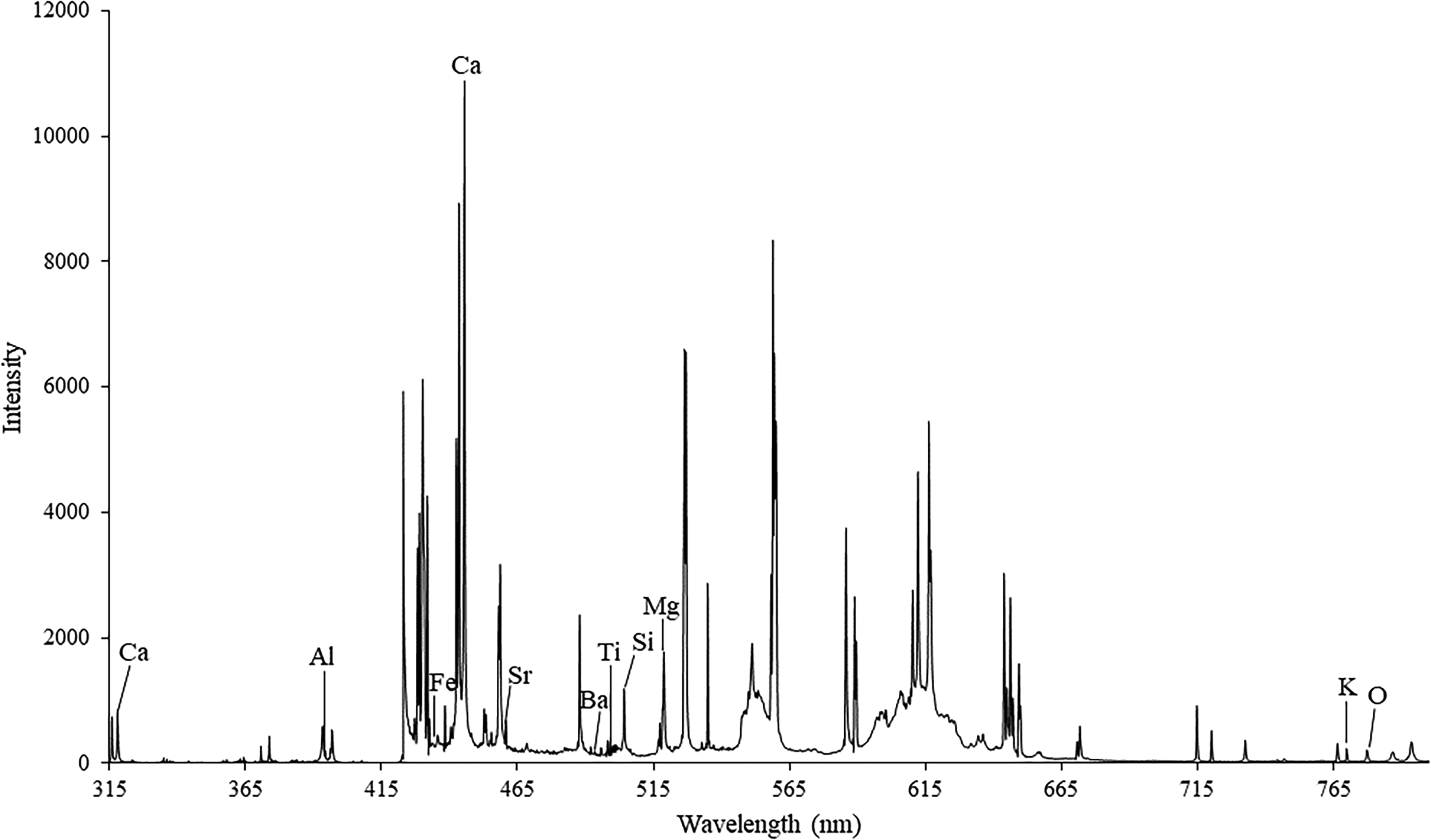
Representative handheld LIBS spectrum for wall mortar.
The PCA of the entire mortar data set (750+ analyses) was unsuccessful in that no clear groupings among loci were found. A similar observation was made with previous mortar phasing work using XRF data and was remedied by instead selecting a data subset based on the physical location in the trench. PCA of eight loci in the eastern section of Trench C was performed next with the resulting two-dimensional score plot in Fig. 3a together with a labeled trench map in Fig. 3b indicating the locations of all loci included in the analysis. This model accounted for 73.6% of the variance in the data within the first two principal components (PCs).

Examination of the eastern section of Trench C: (a) PCA score plot and (b) trench map with labeled loci.
The cluster along the upper half of Fig. 3a consists of a majority of the data points for loci 149, 36, 25, 22, and 3 with Si and Fe identified as markers for these loci based on loading plot results; these wall sections, consisting of three parallel walls and their corresponding perpendicular attached walls, are shaded blue in Fig. 3b. Si is likely associated with quartz sand mixed into the lime mortar as aggregate. Elevated Fe in mortars is associated with a hydraulic character from volcanic pozzolan. 23 The chemical similarities among loci 149, 36, 25, and 22 were previously established with handheld XRF analyses 16 and are now further supported by the handheld LIBS data. The addition of locus 3 to this grouping establishes a more complete construction picture for this section of the trench in that the mortars for complete rooms are demonstrated to be associated. The cluster along the bottom half of Fig. 3a consists of a majority of the data points for loci 579, 270, and 30 and is shaded in pink in Fig. 3b; examination of the loading plot indicates Sr and Ba as markers for these loci. Sr is likely associated with dendric material in the aggregate 24 and has been reported to show great variation in relative concentrations across different mortar samples. Ba may be associated with feldspars. 23 Loci 579 and 270 form an “L” at the northern edge of the trench, while locus 30 is part of a drainage system that bisects the trench.
Although the grouping of loci 579 and 270 with each other and separate from the other eastern wall loci is in agreement with the handheld XRF findings, the association of locus 30 with the loci 579 and 270 grouping is not in agreement. While the significantly higher number of analysis locations achieved with handheld LIBS compared to handheld XRF may play a role in this finding, the elements detectable only with LIBS in the mortars and the integration of surface precleaning laser shots within data collection procedures are likely more significant factors. Al, Ba, Ti, Si, Mg, K, and O are unique to the LIBS data set. The construction of the drainage trench using a chemically similar mortar to that of the terraced wall northern expansion is a new finding. While this had been hypothesized based on visual analysis, the chemical analysis confirms and supports these conclusions, strengthening the understanding of the construction phases at Coriglia, one of our major research questions.
A number of additional wall associations for loci in the western section of Trench C, shown in Fig. S1 (Supplemental Material), were established through an examination of the handheld LIBS data. PCA score plots supporting these conclusions are provided in Figs. S2 and S3 (Supplemental Material). The associations of locus 127 with locus 139 and locus 125 with locus 239 were previously established using handheld XRF analyses, further demonstrating the utility of handheld LIBS for phasing at an archaeological site. As was the case with the drainage trench and northern expansion, these associations had been hypothesized, but only with this additional analysis could these connections be more confidently confirmed. Through this study, our understanding of the use and development of the bath complex has been enhanced. It is now possible to identify with relative certainty at least four separate phases of the structure (see Fig. S1, Supplemental Material). There is a first initial phase identifiable in the walls running north to south representing the earliest currently identified phase of construction. A second phase of construction is seen in the walls running east to west that have the same mortar, added after the initial construction of the structure. A third phase of repair and redivision of the space is clear in the analysis, both chemically and visually, in the walls on both orientations. A fourth and possibly final phase can be identified by the addition of an apse to the southeast corner of the complex, either built concurrently with the previous phase of repair using a different mortar mix or more likely as a separate aggrandizing renovation. Overall, this aligns with our understanding of the monumentalization of the site, with the bath complex growing, changing, and adapting through the centuries. Through this analysis, when paired with our other research, we can achieve a clearer picture of the construction occurring on site, even when all the materials are sourced locally and appear similar in visual analysis.
Bucchero Pottery
Previous studies that included bucchero chemical composition measurements identified many of the elements identified in our study although with some variation depending on analytical technique, most commonly XRF,25,26 and research focus such as trace elements only. 27 Considering some elements identified in these Orvieto bucchero sherds, namely Si, Al, Mg, K, and O, are more challenging or impossible to detect using XRF, this LIBS-based study adds a new view to prior published work in the field.
A PCA of the data set was performed with the resulting three-dimensional score plot in Fig. 4. This model accounted for 80.1% of the variance in the data within the first three PCs. Three conclusions were made from the examination of the score plot. First, the data points for the Crocifisso del Tufo bucchero in the upper left of the plot form a cluster separate from those of the Cavità 254 data points at the bottom right of the plot. This indicates ceramics from the two sites are chemically different and likely produced from different raw material sources. The LIBS spectral overlay in Fig. 5 illustrates this difference, showing higher levels of Ca and Sr in the Cavità 254 bucchero compared to those from Crocifisso del Tufo, and higher levels of Fe and Mg in the latter compared to the former. These chemical differences are an interesting finding considering the proximity of Cavità 254 within the walled city of Orvieto to Crocifisso del Tufo just outside Orvieto along the base of the wall. Secondly, no distinct separation of data points is observed for gray versus black bucchero from Crocifisso del Tufo suggesting all ceramics from this site were produced using the same clay source and possibly by the same workshop; the visual color differences therefore are not attributed to chemical composition, but rather choices made during the production of the ceramics. The color of bucchero results from the red iron oxide clay used in production being reduced to ferrous oxide upon firing in an airtight kiln under low-oxygen conditions with organic material present within the kiln. 28 Shades of black and gray likely were achieved by varying firing conditions with elemental carbon from the organic matter as the main source of the black color. 29 A tendency toward lighter-colored bucchero over time has been observed with suggestions that color can be used for dating, although this is an oversimplification and may be further complicated by color changes caused by long-term burial in soil. 30 Lastly, looking instead at the Cavità 254 data points, all gray bucchero whether inscribed or not inscribed form one overlapping group at the top right of the score plot indicating the same raw material source likely was used for their production. Interestingly, about half of the Cavità 254 black bucchero data points overlap with this Cavità 254 gray bucchero cluster whereas the other half of the Cavità 254 black bucchero data points instead group separately toward the bottom of the score plot. These chemically different Cavità 254 black bucchero sherds may have been produced by a separate workshop, possibly for a different purpose. Etruscan bucchero was produced for several purposes, including utilitarian, votive, and funerary. 31 It is possible that separate pottery workshops existed in Orvieto (Etruscan Velzna), each producing products for different uses. More elaborate pieces, unusual shapes, and inscriptions are often associated with votive and funerary bucchero. 31 Considering all analyzed Cavità 254 black bucchero were small fragments, the original forms are not known and thus no confident conclusions can be drawn regarding the purpose for the select black bucchero samples that correspond to the data points at the bottom of the score plot.

PCA score plot of Bucchero pottery data.

Average silicon-normalized LIBS spectra for Cavità 254 bucchero (red) and Crocifisso del Tufo bucchero (black).
Examination of the PCA loading plot revealed that Ca and Mn are markers for the combined Cavità 254 gray and black bucchero whereas Sr is a marker for the separate Cavità 254 black bucchero. Looking instead at the Crocifisso del Tufo bucchero, Mg and O are markers for both gray and black. A number of these differences are evident upon examination of Fig. 5. A two-way analysis of variance of sites and marker elements statistically supports a chemical difference between Cavità 254 bucchero and Crocifisso del Tufo bucchero (p < .001).
Conclusion
The utility of handheld LIBS for field archaeology is clearly demonstrated through the two applications presented in this paper. LIBS can be used as a complement to XRF as shown in the Roman mortars study, or as a singular analytical method from which to draw conclusions as was the case with the Etruscan bucchero sample. Adding this type of analysis to other forms of analysis strengthens the conclusion and increases the speed at which research questions can be answered in the field. Future handheld LIBS work will include additional analyses of bucchero from different sites and of different colors to better understand observed chemical differences such as possible connections between elemental carbon and color.
Supplemental Material
sj-docx-1-app-10.1177_27551857231175847 - Supplemental material for Handheld Laser-Induced Breakdown Spectroscopy for Field Archaeology: Characterization of Roman Wall Mortars and Etruscan Ceramics
Supplemental material, sj-docx-1-app-10.1177_27551857231175847 for Handheld Laser-Induced Breakdown Spectroscopy for Field Archaeology: Characterization of Roman Wall Mortars and Etruscan Ceramics by Mary Kate Donais, Luke Douglass, William H. Ramundt, Claudio Bizzarri and David B. George in Applied Spectroscopy Practica
Footnotes
Acknowledgments
The authors would like to express their sincere appreciation to Sci Aps Inc. for the generous lending of the handheld LIBS to conduct this work and to Brendan Connors for his time and guidance in using the instrument.
Declaration of Conflicting Interests
The author(s) declared no potential conflicts of interest with respect to the research, authorship, and/or publication of this article.
Funding
The author(s) disclosed receipt of the following financial support for the research, authorship, and/or publication of this article: This work was financially supported by the Institute for Mediterranean Archaeology.
Supplemental Material
All supplemental material mentioned in the text is available in the online version of the journal.
References
Supplementary Material
Please find the following supplemental material available below.
For Open Access articles published under a Creative Commons License, all supplemental material carries the same license as the article it is associated with.
For non-Open Access articles published, all supplemental material carries a non-exclusive license, and permission requests for re-use of supplemental material or any part of supplemental material shall be sent directly to the copyright owner as specified in the copyright notice associated with the article.
