




Abstract
Most organizations make promotion decisions based on employees’ prior performance. Despite the prevalence of this performance-based promotion strategy, its validity remains unclear. With this constructive replication, we extend past research by testing competing hypotheses on the relationship between employee performance and future leader performance as derived from three theoretical perspectives (i.e., performance requirements perspective, follower-centric perspective, and Theory of Expert Leadership). We examined our hypotheses in the context of the National Basketball Association (NBA) and gathered data on the entire career of all NBA coaches until 2020 (N = 329), including their prior performance as basketball players. We tested our hypotheses using Bayesian structural equation modelling with latent variables. Overall, our analyses indicated a weak relationship between employee (i.e., player) and leader (i.e., coach) performance that remained stable over time. Overall, our results are in line with the performance requirements perspective. Hence, we recommend to reconsider the use of the performance-based promotion strategy.
‘A player who makes a team great is better than a great player’.
John Wooden (former player and coach of the NBA)
How do employees become organizational leaders? Most organizations promote employees to leader positions based on their prior performance as an employee (see Church et al., 2015; 2021). In turn, it is no surprise that leaders typically attribute their promotion to their own previous employee performance (EP) (Gallup, 2014). Hence, performance-based promotion is essential to employees’ career progression and, more generally, organizational life.
Despite its prevalence, however, the validity of the performance-based promotion strategy—the extent to which EP predicts later leadership performance (LP)—is inconclusive. Different theoretical approaches lead to contradictory assumptions regarding this strategy, which is mirrored in divergent empirical findings. Whereas some studies reported positive links between EP and LP (e.g., Goodall & Pogrebna, 2015), the majority of studies did not find a substantial link between EP and LP (e.g., Schleu et al., 2024), and yet other studies even reported negative relationships (e.g., Benson et al., 2019; for an overview, see Schleu & Hüffmeier, 2021). Furthermore, the long-term validity of this strategy (i.e., how long EP is predictive for later LP) has been mostly neglected (for an initial test of temporal changes, see Schleu et al., 2024). Since performance-based promotion determines who is selected as a leader (and, as such, has a long-term impact), knowing about the long-term validity of this strategy is crucial. Altogether, the validity and, hence, the actual utility of this pervasive promotion strategy remains elusive. Since leaders and their behaviours have a huge impact on organizations (i.e., employee health, motivation, and performance; see Li et al., 2021; Montano et al., 2017), selecting unsuitable leaders comes with high costs (Cronbach & Gleser, 1965; Schmidt & Hunter, 1998).
To gain further insight into the validity of this promotion strategy, we build on, and extend, a recent study that tested the predictive validity of EP for LP in the professional soccer context (i.e., the German Bundesliga; Schleu et al., 2024). Schleu et al. (2024) did not find a systematic link between EP and LP, both initially after promotion and over time. In addition, they examined a moderation effect of relevance (i.e., the relevance of performance requirements in employee positions for leader positions), which was not supported in their study (Schleu et al., 2024). With our research, we conceptually replicate and extend this initial study by providing a more comprehensive test of three competing theoretical approaches (i.e., performance requirements perspective, follower-centric perspective, and Theory of Expert Leadership [TEL]). Specifically, we improve upon the initial study, first, by investigating a central proposed mechanism (i.e., functional leadership) of TEL. Second, we conduct a more robust analysis that allows us to reliably capture and estimate potentially non-substantial relationships (i.e., using Bayesian modelling). Third, in our conceptual replication, we leverage a particularly suitable context to study the relationship between EP and LP: The National Basketball Association (NBA). In comparison to the professional soccer context that was studied by Schleu et al. (2024), the NBA context is better suited due to (a) the high number of points (versus low number of soccer goals) leaving less room for noise (i.e., law of large numbers); (b) basketball coaches having more opportunity to influence the game (e.g., possibility for timeouts and more exchanges); and (c) regulations that keep competition between clubs more balanced (see below for further elaboration).
With our research, we test competing hypotheses as derived from three theoretical perspectives, that is the performance requirements perspective (Zaccaro et al., 2018), the follower-centric perspective (Uhl-Bien et al., 2014), and TEL (Goodall & Bäker, 2015). In doing so, we examine the validity of performance-based promotions over time and provide the first test of a potential explanatory mechanism.
In summary, we take a closer and unique look at the highly prevalent yet hitherto unclear validity of performance-based promotion. First, we advance theory and research by providing a competitive test (Kraimer et al., 2023) of the three outlined perspectives on performance-based promotions (see also Schleu et al., 2024; Schleu & Hüffmeier, 2021). Thereby, we are directly answering this special issue's call ‘for the evaluation of competing theories’ (Brouer et al., 2024, p. 132), and we provide a constructive replication (Köhler & Cortina, 2021). Among other improvements, we are conducting more robust and suitable analyses (i.e., Bayesian modelling). Furthermore, we consider whether and how the validity of performance-based promotions changes over time, by examining the EP–LP link initially after the promotion to a leader position (i.e., LP at T1) and across longer time spans (i.e., the link between EP and LP at T2 and T3).
Second, we are the first to test whether the EP–LP link can (partly) be explained by functional leadership (e.g., the optimal use of team resources to compose a functioning team; Morgeson et al., 2010)—a central mechanism proposed by TEL (Goodall & Bäker, 2015). Doing so allows for a more comprehensive test of TEL's assumptions compared to prior studies. Third, as noted above, we constructively replicate initial insights regarding the validity of performance-based promotions in a particularly suitable context (i.e., the NBA). By being explicit about our research context, we also follow recent related calls (Cruz, 2021; Johns, 2006), as the context can strongly impact leadership (Osborn et al., 2002) and as such can help explain inconsistent findings. Finally, our research facilitates evidence-based decision making in practice.
Overview of competing theories and their assumptions on the validity of performance-based promotion
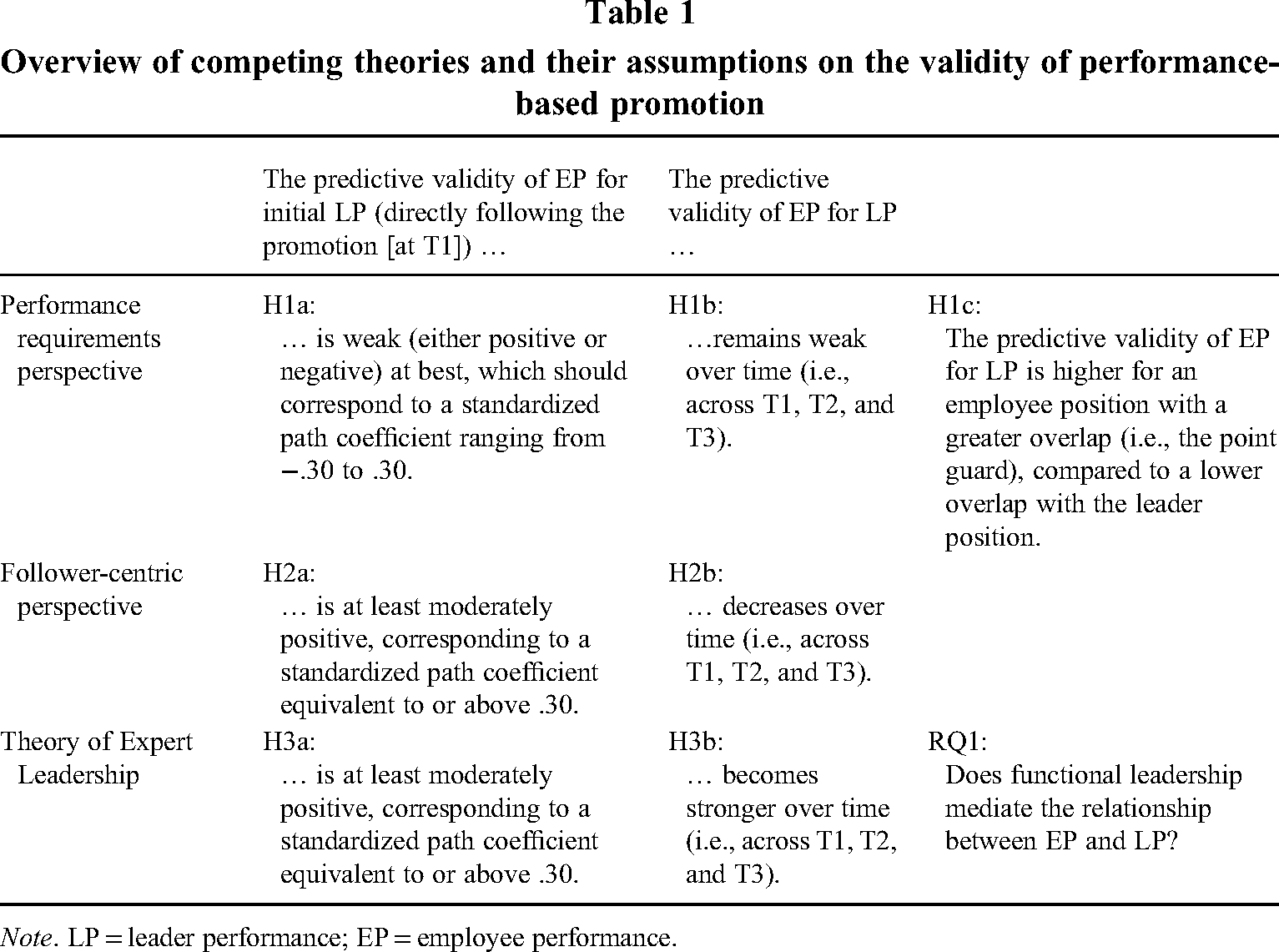
Note. LP = leader performance; EP = employee performance.
Present research
Research on performance-based promotions has waxed in the last 20 years, but findings remained inconclusive (Schleu & Hüffmeier, 2021). A review (Schleu & Hüffmeier, 2021) identified potential moderators to explain the varying results, including temporal changes and the relevance of performance requirements in employee positions for leader positions, yet initial findings did not yield support (Schleu et al., 2024). Following previous research (Schleu et al., 2024; Schleu & Hüffmeier, 2021), we consider three theoretical perspectives with divergent predictions about the EP—LP relationship, its potential moderators, and temporal changes to provide a competitive and in-depth test of the validity of performance-based promotion (see Table 1). Before presenting the theoretical perspectives, we discuss the advantages of our research context.
Research context
The NBA is a highly relevant occupational context. In 2024, the NBA teams’ revenue surpassed $11.3 billion, with the total valuation exceeding $132 billion (Somoggi, 2025). Moreover, the NBA has around 20,000 employees (National Basketball Association, n.d.) and is an organization with highly visible, and increasing, societal engagement and impact (e.g., visibly supporting the widely known Black Lives Matter movement; see Deng, 2020). In comparison to professional soccer or other sports, the NBA seems to be a more suitable context to examine the potential link between EP and LP: First, due to the law of large numbers, (team) performance and game results are less affected by luck or ‘noise’ in basketball. Whereas a single goal can be a game-changing event in soccer, with typically around three goals per game in total (Statista, n.d.), teams competing in a regular NBA game often end up having achieved around 100 points each (Basketball Reference, n.d.). This reflects the relatively high pace and number of plays in basketball games, which also allows for a larger variance in (leader) performance. Thus, NBA game outcomes provide comparably accurate estimates of the team performance—by comparison, a single goal can easily decide a soccer game, even if it was achieved with luck.
Second, an NBA head coach (i.e., the leader) as compared to a head coach in professional soccer has more opportunity to exert substantial influence on the game: A head coach in soccer can mostly intervene before a game takes place. This is due to their physical distance to the players on the relatively large field, and also due to the fact that 11 players are on the field simultaneously. As such, the head coaches’ attention is divided by a relatively large number of players. Moreover, in soccer, coaches cannot take time-outs, and there are limited opportunities for exchanging players. By contrast, an NBA head coach is in relatively close proximity to the team during the game, as a basketball field is smaller. Moreover, a basketball team consists of only five players who are active on the field simultaneously, and basketball coaches can take multiple time-outs and exchange players regularly (Deutscher Fussball-Bund, n.d.; National Basketball Association, 2018). Altogether, an NBA coach appears to have much better chances to influence the course of the game, and this difference in the head coaches’ more or less influential role should shape their LP (i.e., wins).
Third, competition in the NBA is typically more balanced in comparison to professional soccer, due to the salary cap and other league regulations (i.e., the draft system). These regulations in professional basketball are designed to limit lasting inequality between teams, thereby ‘levelling the playing field’. In turn, a comparably level playing field should increase the relevance of individual coaches and their decisions (see above). In summary, our research benefits from examining performance-based promotions in the context of the NBA, due to more accurate measures of key constructs and greater chances for coaches to intervene. Thus, our NBA context should increase the chances of observing a link between prior EP and later LP (cf. Denrell & Liu, 2012), if it exists, and it offers a suitable opportunity for a constructive (i.e., improved) replication (Köhler & Cortina, 2021).
Performance requirements perspective
Based on the underlying logic of performance-based promotions, EP (presumably) indicates who is the best employee. The implicit assumption, then, is that the best employee will also be the most capable leader—and therefore should, over time, receive more responsibility and be promoted to a leader position. However, following the performance requirements perspective, this logic would have merit only to the extent to which EP actually indicates the KSAOs relevant for the leader position. Although high EP can certainly indicate essential KSAOs for the employee position, this does not necessarily generalize to the KSAOs that are essential for the subsequent leader position. Hence, to achieve a high validity of performance-based promotion, the overlap between KSAOs for the employee and leadership position also needs to be high (see Asher & Sciarrino, 1974; Zaccaro et al., 2018).
However, when comparing general work taxonomies (e.g., Bartram, 2005) to managerial taxonomies (Borman & Brush, 1993; Tett et al., 2000), it becomes apparent that the tasks of employees and leaders vary greatly. There are several tasks that are unique to leader positions, such as motivating employees (see Borman & Brush, 1993; Tett et al., 2000), whereas employee positions typically centre around rather technical work (Bartram, 2005). According to research on work sample testing, increasing point-to-point correspondence (Asher & Sciarrino, 1974; Robertson & Kandola, 1982; Wernimont & Campbell, 1968) between a work sample and the respective position (e.g., task specificity and bandwidth of tasks) ensures the test performance becomes a better predictor of subsequent performance on the respective position.
Considering central performance requirements for leader positions, intelligence, for instance, has a higher predictive validity for LP (i.e., a more complex position) than for EP for most positions (see Salgado & Moscoso, 2019). Moreover, recent work by Wilmot and Ones (2021) suggested a lower predictive validity of personality facets for LP than for performance in most employee positions. Job knowledge acquired as an employee might be helpful when becoming a leader, yet only for some contexts (e.g., in creative domains; see Day et al., 2009).
Altogether, the performance requirements perspective can explain positive to negative links between EP and LP. More specifically, the relationship between EP and LP could be (1) positive (in case of a high overlap in performance requirements), (2) null (in case of a very low or nonexistent overlap in performance requirements), or even (3) negative (if the performance requirements of the prior employee position impair LP). Generally speaking, due to these different possibilities, EP should not be a good predictor for LP.
As explained, however, the overlap between performance requirements of employee and leader positions, and, therefore, the predictive validity of EP for LP, likely depends on the particular context (Johns, 2006). As such, we compare the typical performance requirements of employee and leader positions in the NBA. We investigate the transition from the role of NBA player (i.e., employee position) to NBA head coach (i.e., leader position).
The performance of a professional basketball player is largely determined by the ability to score (e.g., by scoring oneself or by ‘assisting’ team mates to score) and/or to hinder the opposing team to score. Hence, EP partly depends on immutable physical characteristics (e.g., height or wingspan; Ackland et al., 1997; Zarić et al., 2020), mutable physical characteristics (e.g., anaerobic capacity; Riezebos et al., 1983; see Ostojic et al., 2006), as well as trainable physical skills such as shooting accuracy (see Okazaki et al., 2015) or vertical jumping (see Pehar et al., 2017). Tactical and technical knowledge (see Pehar et al., 2017) is also beneficial in professional sports, just like being disciplined and emotionally stable (Jones et al., 2001).
In contrast, the performance of an NBA head coach is largely reflected by how well the own team ranks in the competition (while controlling for available resources). As a framework for relevant performance requirements, we draw on the Multidimensional Model of Leadership in Sport (Chelladurai, 1987), which conceptualizes coaching effectiveness as the result of congruence between situational demands, athlete needs, and the coach's actual behaviours. To meet situational demands, head coaches need to, among others, select suitable players and co-trainers (Rogers et al., 2021), manage them, and balance short-term gains (e.g., winning a game) and long-term development (e.g., sustainable player development). Further, coaches need to develop a strategy for each opponent, game, or even particular game situation (see Moreno & Lozano, 2014). As we mentioned above, the latter aspect is particularly relevant for a fast-paced game that involves taking time-outs, such as basketball. To meet athletes’ needs, the head coach's ability to train and motivate them, both individually and as a team, is crucial (Fort et al., 2008). Supporting emotional regulation and clear communication is beneficial, too.
Comparing the positions of NBA player and NBA head coach, the degree of overlap between performance requirements is typically limited. For instance, as an NBA head coach, a high shooting accuracy, an athletic physique (as a former player), or good performance under physical pressure (e.g., contact or fatigue) is not an advantage in developing players and, hence, leading a team to win. Still, the tactical and technical knowledge gained as an NBA player (see Pehar et al., 2017), as well as some personal characteristics (e.g., being disciplined and emotionally stable; Jones et al., 2001), can have a positive impact on both player and coach performance. In summary, the performance requirements of the employee position and the leader position should overlap to a small extent. Hence, we propose:
Hypothesis 1a: The predictive validity of EP for initial LP (directly following the promotion [at T1]) is weak (either positive or negative) at best, which should correspond to a standardized path coefficient ranging from −0.30 to 0.30.
1
Over time, given the low overlap of the performance requirements of both positions, high EP still does not indicate the KSAOs required for the subsequent leader position. As there is no reason to expect EP (and related performance requirements) to become more relevant for LP over time, we expect the link between EP and LP to remain weak. So, we propose:
Hypothesis 1b: The predictive validity of EP for LP remains weak over time (i.e., across T1, T2, and T3).
Moderator: Degree of overlap between EP and LP
The greater the overlap between the performance requirements of the employee and leader positions, the stronger the EP—LP link should be (Asher & Sciarrino, 1974; Zaccaro et al., 2018). Hence, we consider the type of employee position (i.e., player position) as a moderator of the EP—LP link. Applied to our context, we focused on the point-guard position, because it should have a greater overlap with a head coach position (e.g., Grijalva et al., 2020; Rose, 2013). The point guard is typically considered to be the ‘coach on the floor’ (cf. Rose, 2013), since the point guard is involved in the strategic build-up of the game, ‘initiating the offensive and defensive plays’ as well as setting ‘the tone for the other players’ (Grijalva et al., 2020, p. 17). Doing so requires strategic awareness (e.g., reading defenses and anticipating plays), play-calling, as well as communication and decision-making under pressure (e.g., adjusting offensive sets in response to opponent tactics). These behavioural and cognitive requirements parallel key responsibilities of head coaches, who hold responsibility for developing the overall game strategy. Consequently, EP should be a better predictor for LP among former point guards, in comparison to other player positions. Altogether, if we observe supporting evidence for the performance requirements perspective, we aim to test this follow-up hypothesis:
Hypothesis 1c: The predictive validity of EP for LP is higher for an employee position with a greater overlap (i.e., the point guard), compared to a lower overlap with the leader position.
Follower-centric perspective
Another relevant perspective focuses on follower processes (see Steffens et al., 2021; Uhl-Bien et al., 2014). When an employee gets promoted to a leader position due to their excellent performance in their previous role, followers can perceive this leader as a role-model (Hogg, 2001) and as prototypical for their team (see Schleu & Hüffmeier, 2021), because they share central attributes with their leader (e.g., being an NBA player). In turn, being perceived as prototypical can facilitate identity leadership (Steffens et al., 2014). Identity leadership is defined as ‘a recursive, multi-dimensional process that centres on leaders’ capacities to represent, advance, create, and embed a shared sense of social identity for group members’ (Steffens et al., 2014, p. 1002). Consequently, identity leadership increases the credibility of, and the support for, the leader (Uhl-Bien et al., 2014), so that followers might accept their identity leader more, follow their lead, and ultimately perform better (Steffens et al., 2021; Stevens et al., 2019; Van Dick et al., 2018). Altogether, based on the follower-centric perspective, leaders who performed well previously (i.e., high EP) are initially expected to experience more follower support and, hence, achieve higher LP (i.e., team performance; cf. Field, 1989).
The proposed EP—LP link might be even stronger in the NBA compared to other occupational contexts because former NBA players—especially high performing players—are often idolized by the public and younger players (e.g., Kim & Makadok, 2022; Thomas, 2021). Hence, follower-related processes might be especially prominent in the context of the current study. Therefore, we propose:
Hypothesis 2a: The predictive validity of EP for initial LP (directly following the promotion [at T1]) is at least moderately positive, corresponding to a standardized path coefficient equivalent to or above 0.30.
As outlined above, perceptions of prototypicality and subsequent identity leadership might initially result in a positive EP–LP link. However, maintaining identity leadership likely requires additional action over time (Steffens et al., 2014). In particular, leaders need to show high engagement for the team (e.g., advance team goals and empower team members) to be continuously perceived as identity leaders—and profit from follower support (see Haslam et al., 2011; Steffens et al., 2014). The follower-centric perspective, however, does not propose a link between former EP and subsequent engagement for the team. Consequently, we expect the initial effect of EP and related prototypicality on identity leadership to diminish over time, as the initial effects related to identity leadership might become less relevant and as other components of identity leadership (i.e., actual engagement for the team; Steffens et al., 2014) should gain greater weight. Hence, a team's support for the leader might decrease over time, resulting in lower LP (Haslam et al., 2011; Steffens et al., 2014). Consequently, we predict:
Hypothesis 2b: The predictive validity of EP for LP decreases over time (i.e., across T1, T2, and T3).
Theory of Expert Leadership
TEL (Goodall & Bäker, 2015) centres around ‘expert leaders’ who obtained their knowledge as employees through their high performance, practice, and technical education; thus, they are prior high-performing employees. In particular, TEL proposes the following mechanisms to explain how better LP arises. First, building on expertise research (see Ericsson et al., 2006), TEL proposes that expert leaders (compared to non-expert leaders) process information more holistically and consider longer time-frames (i.e., sustainable rather than short-term success) when making decisions. Thus, they are able to make better strategic decisions (cf. Guthrie & Datta, 1997; Nahavandi & Malekzadeh, 1993). Second, as expert leaders have, by definition, garnered expertise in a similar employee position, they can share their background and knowledge with their employees while understanding their employees’ motives and struggles. Consequently, they should be able to create a productive work environment, set realistic goals, and assess their employees’ performance realistically, which, overall, should facilitate good team performance as reflected in high LP (Goodall & Bäker, 2015). Third, as expert leaders likely select employees similar to themselves—presumably also high-performing employees—they are proposed to make better selection decisions (i.e., hiring employees with great potential; Goodall & Bäker, 2015). Fourth, due to their expertise, expert leaders are assumed to have a signalling function, such that they signal the strategic orientation of an organization (Goodall & Bäker, 2015). Although TEL acknowledges other factors to be relevant as well, it assumes that expert knowledge gained as an employee distinguishes successful leaders from those who are unsuccessful. Notably, proponents of TEL claim that this theory applies to the context of this study (i.e., NBA; Goodall et al., 2011) and propose a link ‘between brilliance as a player and the (much later) winning percentage or playoff success of that person as a coach’ (Goodall et al., 2011, p. 267). Altogether, TEL suggests:
Hypothesis 3a: The predictive validity of EP—indicating expert knowledge—for initial LP (directly following the promotion [at T1]) is at least moderately positive, corresponding to a standardized path coefficient equivalent to or above 0.30.
Following the logic of TEL, most of the outlined processes (e.g., strategic decision making, creating a good working environment for employee, and better personnel selection) primarily unfold over time. In particular, TEL assumes expert leaders to make better strategic decisions. However, the full impact of those strategic decisions should only be observable over time. Similarly, better personnel selection decisions are unlikely to produce immediate effects (i.e., better team performance), but will only have an impact after some time (e.g., after an orientation phase). Thus, following TEL we propose:
Hypothesis 3b: The predictive validity of EP—indicating expert knowledge—for LP becomes stronger over time (i.e., across T1, T2, and T3).
Functional leadership
TEL proposes several mechanisms to explain the link between EP and LP, such as leaders making better decisions, creating a better work environment, thereby facilitating team performance, and selecting better personnel (i.e., recognizing talent). In the context of our research, this would translate to, for instance, better strategic decision-making of head coaches (e.g., on how to develop their players or to select the right players for a game or game situation), better team formation (e.g., putting together a well-performing five-player unit), and creating an environment in which players perform at their capacity. These processes can be summarized as functional leadership (i.e., the optimal use of team resources to compose a functioning team; Morgeson et al., 2010). Hence, TEL suggests that functional leadership mediates the EP–LP link, at least partly. Hence, in our study, we ask:
Research question 1: Does functional leadership mediate the relationship between EP and LP?
Method
We utilized archival data, sampled in a longitudinal format. Specifically, we gathered performance data over the course of careers (i.e., head coaches who have been players) from the NBA (US). In line with previous research, we relied on sports data to investigate our hypotheses and research questions (see also Grijalva et al., 2020; Wolfe et al., 2005) because this context enables a clean test of predictions, given the standardized setting (due to consistent rules and shared goals) as well the availability of objective performance data. Due to the objective nature of the performance measures (see below), our data are less prone to biases as compared to subjective performance evaluations (Murphy & Cleveland, 1995) and show higher reliability (Quińones et al., 1995; Sturman, 2007). Our pre-registration, data, and syntax can be found on the OSF: https://osf.io/ytqka/overview?view_only=7c7e3b5780554877ac247940d3eb3b91.
Participants
Our dataset includes the population of NBA head coaches between 1947 and 2020 (N = 329). Since we collected data on the whole population, we did not conduct an a priori power analysis. On average, they worked as a head coach for M = 5.61 (SD = 6.04) seasons (N = 1,845 coached seasons in total). Subsequently, we gathered the head coaches’ previous player performance, if they had previously played in the NBA (N = 157; N = 387 seasons). The median for the number of coached seasons per coach (i.e., tenure) was MMedian = 3, which, together with the original study by Schleu et al. (2024), informed our cut-off for our main analyses. We collected our data from the websites https://www.basketball-reference.com (for all NBA head coach and player performance data) and http://www.82games.com (data for the mediator were only available from 2004 until 2019, which included N = 92 coaches, with M = 4.62 [SD = 3.62] coached seasons, and a total of N = 425 coached seasons). A graphical representation of how the number of coaches and coached seasons per coach changes over the considered period for previous players and non-players can be found in Figure 1.
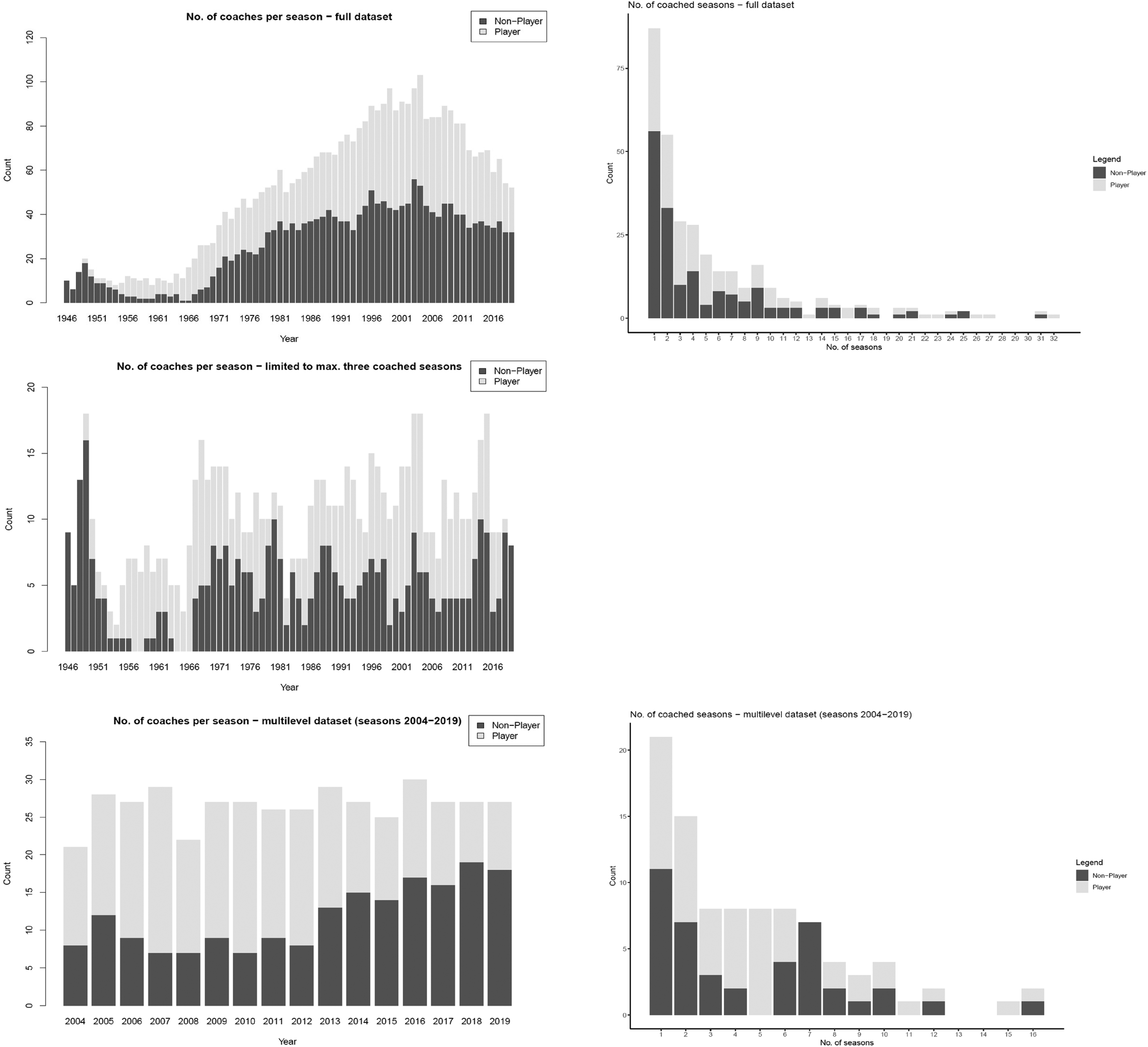
Visualization of the Included Seasons
Measures
Employee performance
Following Campbell (1990), we define EP as an employee's ‘behaviors or actions that are relevant to the goals of the organization’ (p. 704). Our three operationalizations of player performance (i.e., the predictor) were (1) minutes played, (2) efficiency rating, and (3) win share. First, the overall minutes played in the NBA are relevant because usually only the best-performing players of a team are selected to play due to the competitive character of professional sports. While there might be some noise in this measure (e.g., players receiving so-called ‘trash time’), this should not happen overly extensively due to the high-performance context. Consequently, we do not expect ‘trash time’ to affect our measure strongly. Second, we consider a player's overall efficiency rating (PER; i.e., a measure of per-minute production standardized, such that the league average is 15), which accounts for accomplishments (e.g., field goals) and negative results (e.g., missed shots) of players during their career. Third, we consider the player's win shares per 48 min, the duration of one game, aggregated over the career (WS/48; i.e., an estimate of the number of wins contributed by a player per 48 min; league average is approximately 0.100).
Employee experience
To operationalize employee experience, we differentiated between head coaches who had been professional NBA players before their coaching career (N = 157) and those that had not (N = 172), using a dummy variable (yes vs. no).
Leader performance
We operationalized LP (i.e., the criterion) with different measures for head coach performance per season. Our three LP measures reflect established (see DeRue et al., 2011) leadership measures: (1) The number of coached NBA games, which reflects satisfaction with the leader; (2) the rank of the coached team in the NBA; and (3) the number of wins of the coached NBA games, which reflect team performance. We opted for team performance measures, since it is the core task of the coach to ensure that the team is performing well. Doing so, we also followed recommendations from Fischer et al. (2017).
Our first measure, the number of coached NBA games (as a head coach), as already outlined, is an indirect measure of satisfaction with a leader. Suboptimal results (e.g., results not meeting a manager's expectations) oftentimes are not accepted and can result in coach succession (Cannella & Rowe, 1995). This holds particular true in the NBA, due to the highly competitive and publicly visible environment. Our second measure was the rank of the coached team in the NBA (i.e., either at the end of the season or the end of the leader's appointment—depending on what happened first). Our third measure, the number of wins of the coached NBA games, conceptualized LP as a more detailed performance measure. We also ran our analyses with win percentage as an alternative operationalization of team performance 2 (see S9-S10).
Mediator
We operationalized our mediator, functional leadership (i.e., to identify and compose the best functioning team), with the best performing five-player floor units. This statistic is concerned with the 20 most frequently employed five-player units and their performance. To evaluate the head coach's ability to identify and compose the best performing five-player units from the available team members, we relied on the following compound measure (Del Giudice & Gangestad, 2021), which was measured per coached season: The mean of the most frequently composed five-player floor units’ winning percentage (i.e., wins vs. losses), weighted by the minutes each unit was playing (i.e., weighted mean). 3 While, the influence of head coaches on hiring decisions varies based on the interplay between the manager and the head coach, the coach has authority to decide who (from the available players) will get how much playing time and form a five-player unit.
Overlap of the employee and leader performance requirements
We proposed a greater overlap of player and head coach positions—and subsequently performance requirements—for the point guard position in comparison to the other player positions, since the point guard position arguably is more complex and more involved in the strategic process (see Grijalva et al., 2020; Rose, 2013). Hence, we contrasted the point guard position to the remaining player positions (i.e., dummy variable; point guard vs. other positions).
Control variables
We considered the following potentially relevant control variables (see also Schleu et al., 2024): (1) The quality and resources of the coached team, operationalized as the team's rank before the head coach took over; 4 (2) the height of the head coaches because it might correlate with previous player position, and has been shown to predict leadership emergence (Judge & Cable, 2004); (3) the continued employment of a head coach with a franchise (i.e., a continuous leadership), because longer time intervals could influence coach performance positively as compared to shorter intervals (i.e., dummy variable: continued employment vs. change in employment since the previous season); (4) whether the head coach had worked as an assistant coach prior to their first head coach appointment; and (5) whether the head coach had played at the same franchise as the one where the head coach position was assumed. 5 In line with recent recommendations (Becker et al., 2016; Bernerth & Aguinis, 2016), we analyze and report the influence of control variables in separate models (see Table S1 and S2 for descriptive statistics).
Analytical strategy
We used Bayesian structural equation modelling 6 (BSEM; Muthén & Asparouhov, 2012) to investigate Hypotheses 1a–3b. To analyze the influence of EP on LP over time, we prepared the data in a long format. We included the first three seasons per head coach (T1–T3) because only a few coaches held a head coach position for more than three seasons (N = 158; with only n = 85 with a professional player background). We chose this approach because the inclusion of more seasons per coach would have resulted in a strong increase of missing data (for a comparable approach, see the original study by Schleu et al., 2024, that we aimed to replicate). For our main analysis, we included data from 157 coaches with N = 387 coached seasons in total in our BSEM model to test the effect of EP on LP over time. We examined the predictive validity of EP over time by comparing a model with equality constraints for the relations of EP with LP at T1–T3 with an unconstrained model. 7 Additionally, we included autoregressive effects for LP to control for LP of the previous season.
For RQ1, we used Bayesian multilevel structural equation modelling (BMSEM; Depaoli & Clifton, 2015). As data for the mediator were first available in the NBA season of 2004, we excluded data from all prior seasons. The dataset has been prepared in a multilevel format (i.e., wide-format) with seasons (Level 1) nested within head coaches (Level 2). An advantage of the BMSEM approach is that the sample sizes per Level 2 unit (i.e., head coach) can differ. Thus, we were able to consider all seasons per head coach. EP has been included as a Level 2 predictor variable, whereas the ability to compose a functioning team (i.e., the mediator) and LP have been measured at Level 1 resulting in a 2-1-1 mediation model (see Preacher et al., 2010).
EP and LP were modelled as latent constructs in the main analyses for H1a-H3b and RQ1. To account for different metrics, all measures were standardized prior to model estimation. The analyses were run with Mplus 8.10 (Muthén & Muthén, 1998–2017).
We evaluated Bayesian model fit and MCMC convergence by consultation of posterior predictive p-value (PPP), posterior predictive checking (PPC), potential scale reduction (PSR), as well as trace and autocorrelation plots for all estimated model parameters (see recommendations by Depaoli & van de Schoot, 2017). Additionally, we calculated the comparative fit index (CFI), the root mean square error of approximation (RMSEA), and the Bayesian information criterion (BIC), which have so far only been implemented for BSEM in Mplus (Asparouhov & Muthén, 2021). Settings for the model estimation were held equal for all tested models. We used 1,000,000 MCMC iterations with two independent Markov chains, whereas the first 500,000 iterations served as burn-in. Due to a notable degree of autocorrelation for some parameters, we thinned the posterior distributions by including only every tenth iteration (see Depaoli & van de Schoot, 2017). Except for the measurement part of the models, we used uninformative priors (i.e., Mplus default prior specifications). For the measurement part of the models, we relied on Muthén and Asparouhov (2012) for the specification of the model priors. Based on their recommendations, we implemented a normal-distributed prior of N(|1|, 0.1) for the factor loadings and an inverse-Wishart prior of IW(1, 15) (for the BMSEM we used IW(1, 8) for the Level 1 and IW(1, 11) for Level 2) for the residual variances for the indicators. For the residual covariances between the indicators, we specified a small-variance prior of IW(0, 15) (for the BMSEM we used IW(0, 8) for the Level 1 and IW(0, 11) for Level 2).
Results
Tables 2 and 3 present descriptive statistics and intercorrelations. As the examination of RQ1 required a different data structure (i.e., multilevel structure, see above), we provide two tables for the descriptive statistics. As a preliminary analysis, we ran two BSEM models with a dichotomous predictor (previous player experience: yes vs. no) to test the influence on LP in the first three seasons as head coach. In the first BSEM, we modelled LP as a latent variable and included equality constraints to examine whether the effect of player experience on LP changes over time. This constrained model had a satisfying fit (PPP = 0.59, PPC 95% CI using chi-square = [−25.72; 20.25]; PSR < 1.01; CFI = 1.00, 90% CI [0.99; 1.00]; RMSEA = 0.00, 90% CI [0.00; 0.03]; BIC = 3917.33) and showed that player experience had no effect on LP (βconstrained = 0.05, 95% CI [−0.02; 0.12]). As the unconstrained model had a comparable fit (PPP = 0.53, PPC 95% CI using chi-square = [−24.67; 22.74]; PSR < 1.01; CFI = 1.00, 90% CI [0.99; 1.00]; RMSEA = 0.00, 90% CI [0.00; 0.05]; BIC = 3928.77), this effect remained constant over time. In a second model, we used the number of games as head coach per season as alternative operationalization of LP. The constrained model (PPP = 0.42, PPC 95% CI using chi-square [−13.06; 15.28]; PSR < 1.01; CFI = 1.00, 90% CI [0.49; 1.00]; RMSEA = 0.00, 90% CI [0.00; 0.08]; BIC = 2185.76) exhibited a weak effect of player experience on LP (βconstrained = 0.09, 95% CI [0.01; 0.16]). Given the comparable fit of the unconstrained model (PPP = 0.48 PPC 95% CI using chi-square[−14.16; 15.86]; PSR < 1.01; CFI = 1.00, 90% CI [0.51; 1.00]; RMSEA = 0.00, 90% CI [0.00; 0.13]; BIC = 2194.32), this effect remained constant over time. Summarized, the effect of previous player experience on LP is weak at most.
Descriptive statistics and intercorrelations for longitudinal dataset
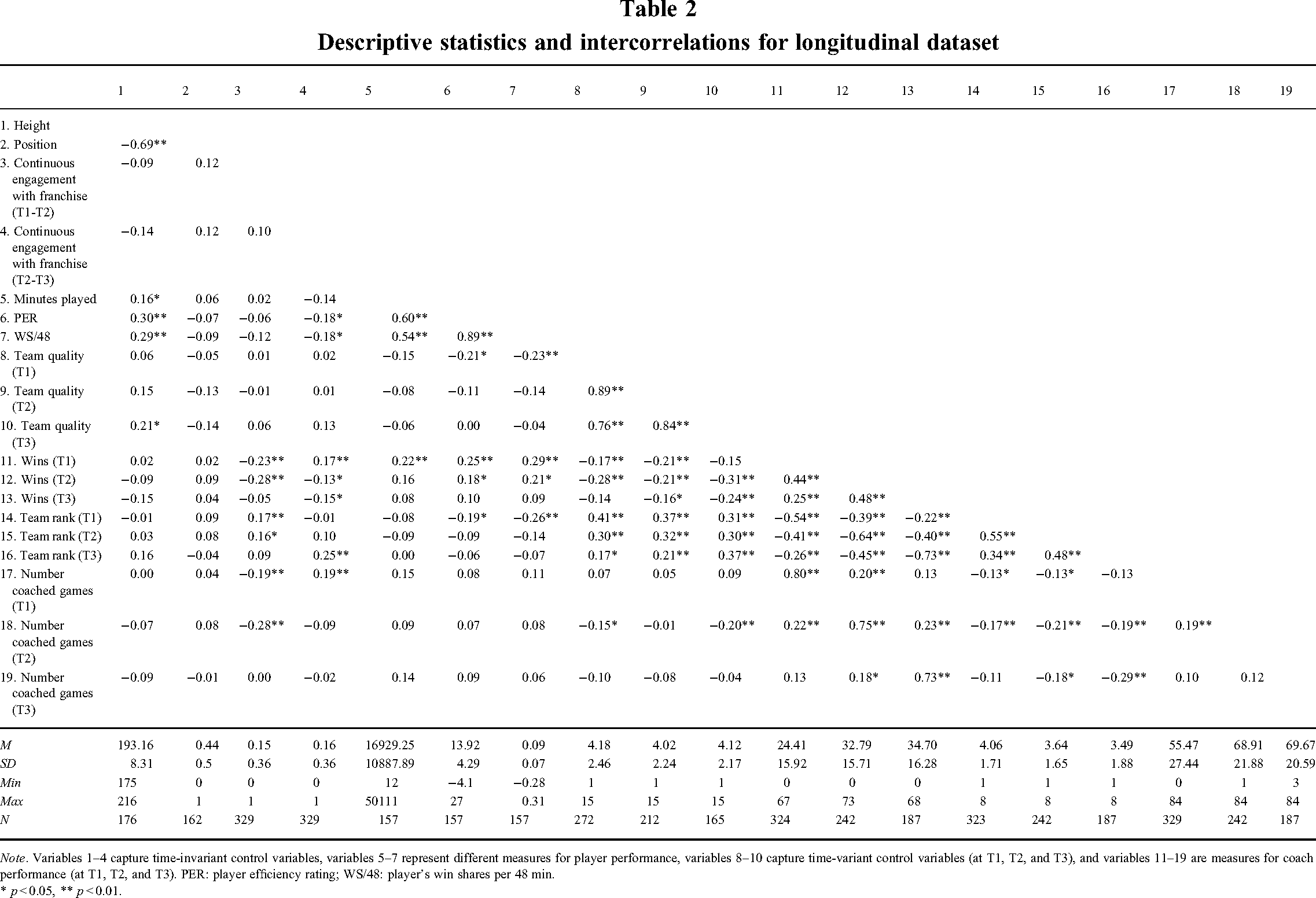
Note. Variables 1–4 capture time-invariant control variables, variables 5–7 represent different measures for player performance, variables 8–10 capture time-variant control variables (at T1, T2, and T3), and variables 11–19 are measures for coach performance (at T1, T2, and T3). PER: player efficiency rating; WS/48: player's win shares per 48 min.
* p < 0.05, ** p < 0.01.
Descriptive statistics and intercorrelations for multilevel dataset
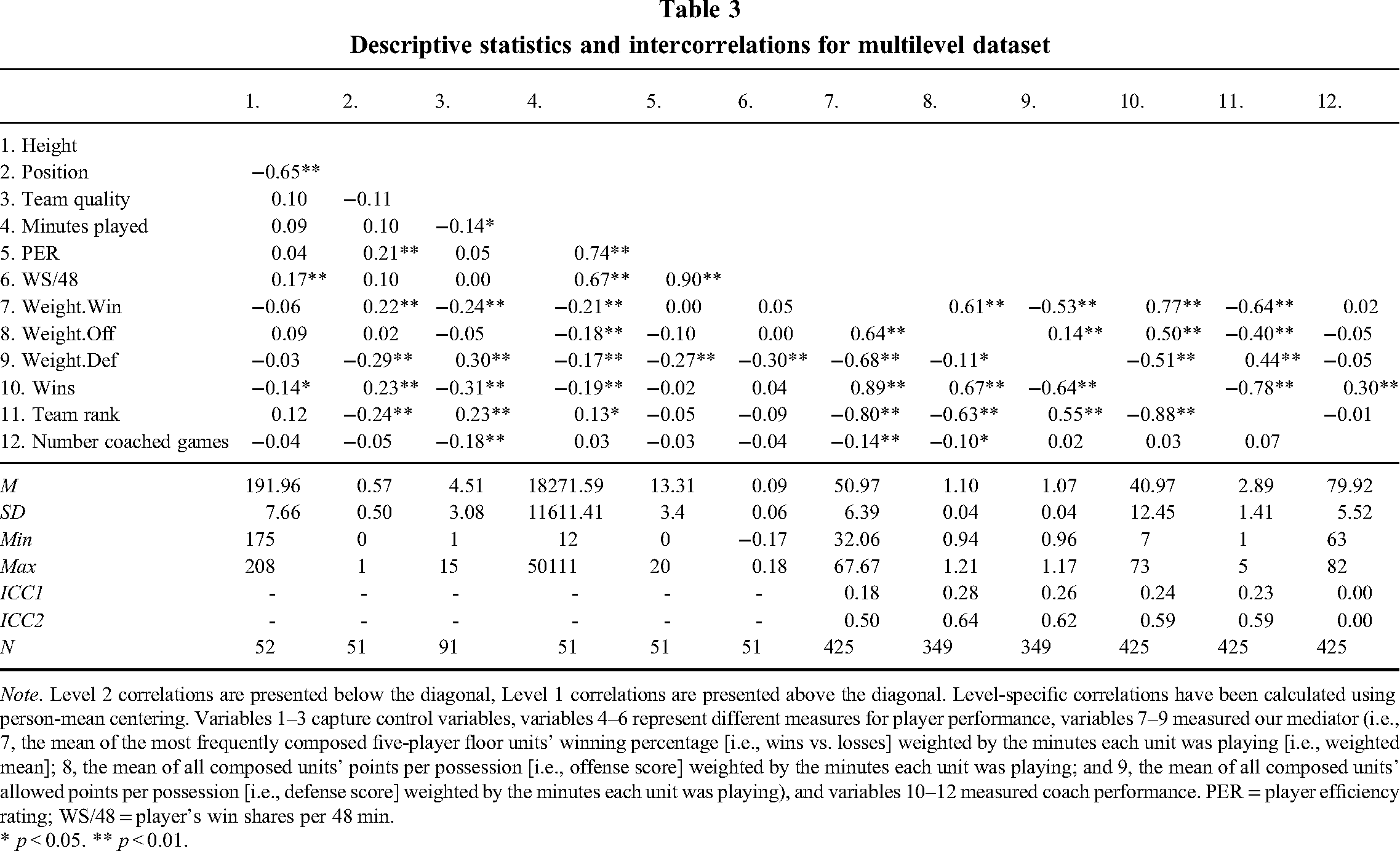
Note. Level 2 correlations are presented below the diagonal, Level 1 correlations are presented above the diagonal. Level-specific correlations have been calculated using person-mean centering. Variables 1–3 capture control variables, variables 4–6 represent different measures for player performance, variables 7–9 measured our mediator (i.e., 7, the mean of the most frequently composed five-player floor units’ winning percentage [i.e., wins vs. losses] weighted by the minutes each unit was playing [i.e., weighted mean]; 8, the mean of all composed units’ points per possession [i.e., offense score] weighted by the minutes each unit was playing; and 9, the mean of all composed units’ allowed points per possession [i.e., defense score] weighted by the minutes each unit was playing), and variables 10–12 measured coach performance. PER = player efficiency rating; WS/48 = player's win shares per 48 min.
* p < 0.05. ** p < 0.01.
Main analyses
The results for Hypotheses 1a–3b are presented in Table 4. The model fit for the unconstrained model was satisfying (PPP = 0.47; PPC 95% CI using chi-square [−32.34; 33.41]; PSR < 1.01; CFI = 1.00, 90% CI [0.99; 1.00]; RMSEA = 0.00, 90% CI [0.00; 0.05]; BIC = 3224.11). As we examined whether the effect of EP on LP changed over time, we included equality constraints for the effects between T1–T3. This model received a similar fit with a slightly better BIC compared to the unconstrained model (PPP = 0.33 PPC 95% CI using chi-square [−26.90; 39.72]; PSR < 1.01; CFI = 1.00, 90% CI [0.98; 1.00]; RMSEA = 0.00, 90% CI [0.00; 0.07]; BIC = 3222.31). Hence, the effect of EP on LP remained constant over time. The results indicated a weak and positive effect of EP on LP across T1–T3 (βconstrained = 0.13, 95% CI [0.02; 0.25]). These first results are consistent with the performance requirements perspective. However, the interaction effect of LP and the degree of overlap (i.e., considering the player position as a moderator) between employee and leader position at all three measurement occasions was likely zero (i.e., the posterior distributions included zero as plausible value). Therefore, a central moderator of the performance requirements perspective was not supported. In summary, the results provided support for Hypothesis 1a and 1b. By contrast, Hypotheses 1c and 2a–3b received no support, as the effect of EP on LP was weak and stable over time.
Results from BSEM with equality constraints and autoregressive effects for LP
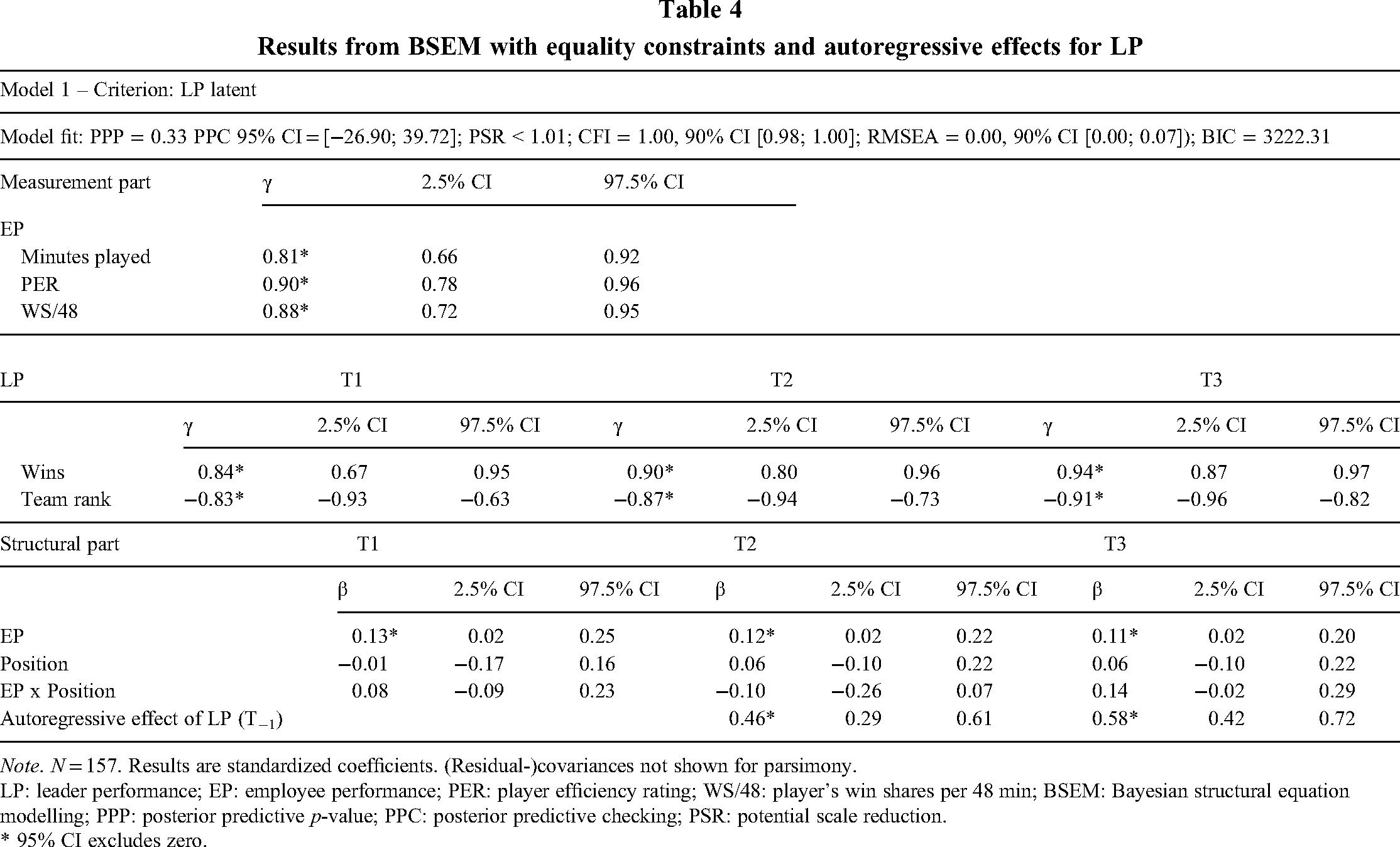
Note. N = 157. Results are standardized coefficients. (Residual-)covariances not shown for parsimony.
LP: leader performance; EP: employee performance; PER: player efficiency rating; WS/48: player's win shares per 48 min; BSEM: Bayesian structural equation modelling; PPP: posterior predictive p-value; PPC: posterior predictive checking; PSR: potential scale reduction.
* 95% CI excludes zero.
Research question 1
The results regarding RQ1 are presented in Table 5. The Bayesian model fit was good (PPP = 0.39; PPC 95% CI using chi-square [−21.87; 27.93]; PSR < 1.01). Functional leadership (i.e., the mediator) was strongly related to LP on Level 1 (β = 0.84, 95% CI [0.78; 0.95]) and Level 2 (β = 0.98, 95% CI [0.88; 1.04]). Yet, EP was not associated with the mediator (β = −0.04, 95% CI [−0.47; 0.38]), and, thus, the results did not indicate an indirect relation between EP and LP via the ability to compose a functioning team (βind = −0.02, 95% CI [−0.26; 0.22]).
Results from BMSEM
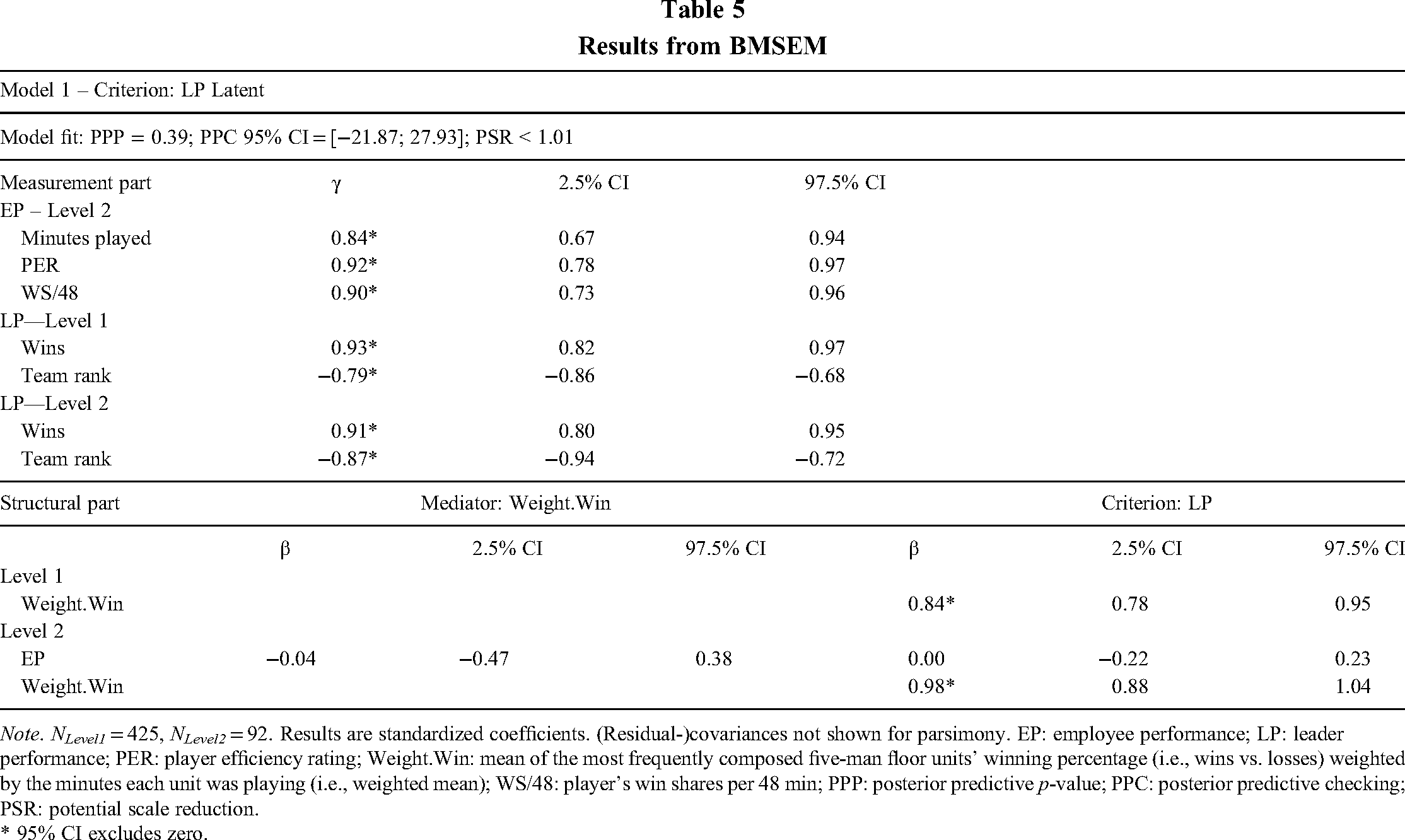
Note. NLevel1 = 425, NLevel2 = 92. Results are standardized coefficients. (Residual-)covariances not shown for parsimony. EP: employee performance; LP: leader performance; PER: player efficiency rating; Weight.Win: mean of the most frequently composed five-man floor units’ winning percentage (i.e., wins vs. losses) weighted by the minutes each unit was playing (i.e., weighted mean); WS/48: player's win shares per 48 min; PPP: posterior predictive p-value; PPC: posterior predictive checking; PSR: potential scale reduction.
* 95% CI excludes zero.
Supplementary analyses
Regarding the alternative operationalization of LP (i.e., number of games as head coach per season), the statistical analyses revealed a similar pattern (see Table 6). Bayesian model fit was good for the unconstrained model (PPP = 0.44; PPC 95% CI using chi-square [−22.87; 24.69]; PSR < 1.01; CFI = 1.00, 90% CI [0.97; 1.00]; RMSEA = 0.00, 90% CI [0.00; 0.07]; BIC = 2248.72), but slightly better for the model with equality constraints for the relation between EP and LP over time to which we refer hereafter (PPP = 0.50; PPC 95% CI using chi-square [−24.09; 23.05]; PSR < 1.01; CFI = 1.00, 90% CI [0.97; 1.00]; RMSEA = 0.00, 90% CI [0.00; 0.06]; BIC = 2238.86). EP was weakly positively related to LP, and the magnitude of the relation remained constant over time (βconstrained = 0.11, 95% CI [0.01; 0.21]). Thus, the results again provided support for Hypotheses 1a and 1b. By contrast, Hypotheses 2a–3b received no support.
Results from BSEM with equality constraints and autoregressive effects for alternative operationalization of LP
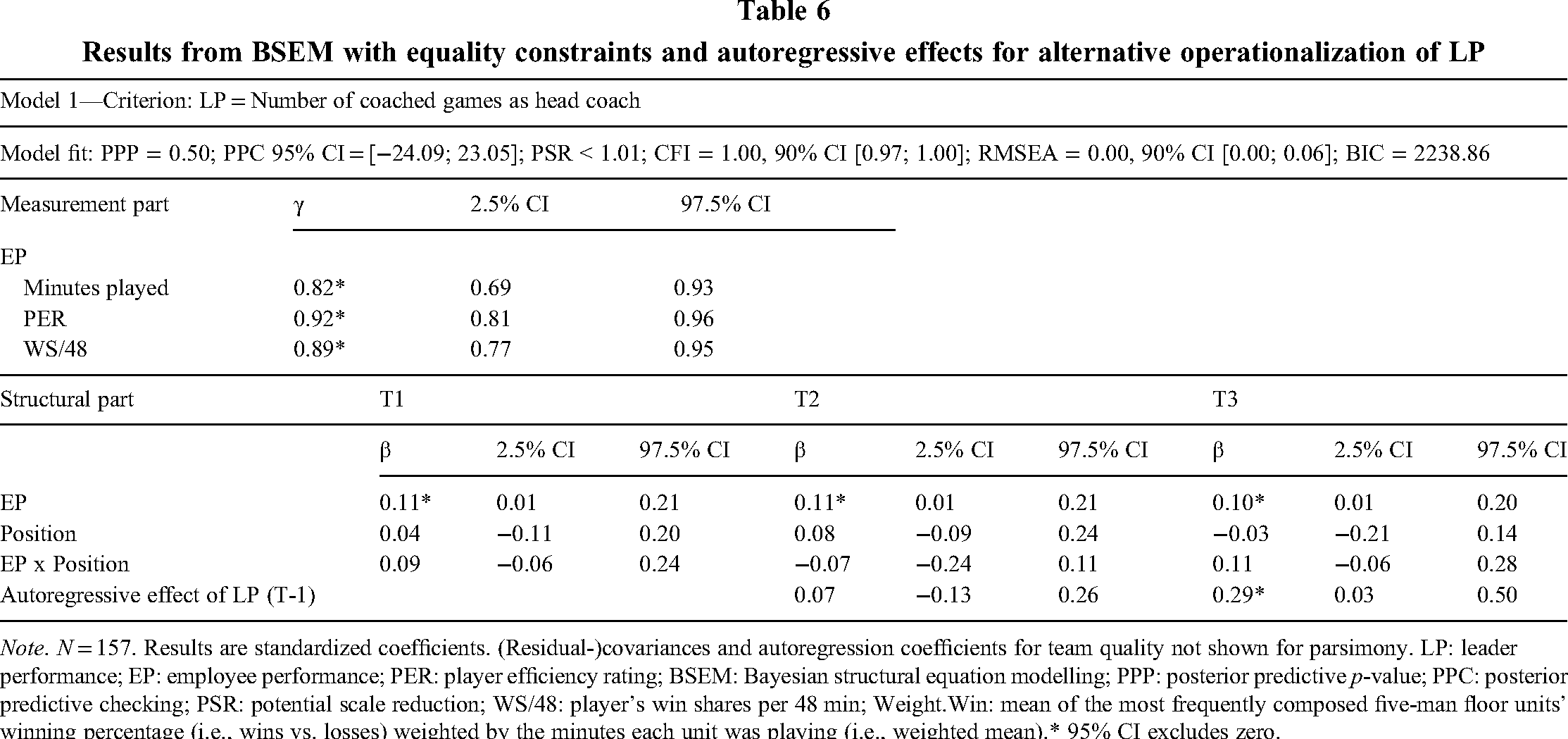
Note. N = 157. Results are standardized coefficients. (Residual-)covariances and autoregression coefficients for team quality not shown for parsimony. LP: leader performance; EP: employee performance; PER: player efficiency rating; BSEM: Bayesian structural equation modelling; PPP: posterior predictive p-value; PPC: posterior predictive checking; PSR: potential scale reduction; WS/48: player's win shares per 48 min; Weight.Win: mean of the most frequently composed five-man floor units’ winning percentage (i.e., wins vs. losses) weighted by the minutes each unit was playing (i.e., weighted mean).* 95% CI excludes zero.
Regarding Hypothesis 1c, results did not indicate an interaction between EP and the degree of overlap between the employee position and the leader position, as the posterior distributions of the interaction effects covered zero. Thus, Hypothesis 1c also received no support when considering our alternative operationalization for LP.
Examining RQ1 with the alternative operationalization of LP revealed the same pattern (see Tables S7 and S8 as part of the online supplement), as EP was unrelated to the mediator (i.e., functional leadership; β = −0.02, 95% CI [−0.45; 0.40]) and the 95% CI of the indirect effect included zero (βind = 0.00, 95% CI [−0.05; 0.05]).
In line with recent recommendations (Becker et al., 2016; Sturman et al., 2022), we analyzed the influence of control variables in separate models (see Table S1 and S2 for descriptive statistics). The full results from these analyses are presented in the Online Supplement (see Tables S3, S4, S6, and S8). In general, the inclusion of control variables did not change the pattern of results, and the differences in the obtained parameter estimates were only very small. The Bayesian model fit indicators became worse compared to the models without control variables, but still were acceptable (see Table S5). Regarding the models to test Hypotheses 1–3, only team quality, prior LP, and height were notably related to LP. In the multilevel model to examine RQ1, none of the control variables, except for team quality at Level 1, were related to LP. In summary, the results were not affected by the inclusion of controls.
Furthermore, to test Hypothesis 3b specifically, we conducted the outlined analyses with the subsample of head coaches who coached the same franchise for several seasons (N = 115). Again, the model with equality constraints for the effect of EP on LP across T1–T3 had a better fit (especially indicated by the differences in the BIC values of 2345.09 vs. 2353.33 for the models without control variables) rendering the effect of EP on LP to be constant over time (βconstrained = 0.20, 95% CI [0.06; 0.34]). Additionally, even in the unconstrained model, the effect did not increase over time (βt1 = 0.27, 95% CI [0.07; 0.46]; βt2 = 0.09, 95% CI [−0.15; 0.31]; βt3 = 0.16, 95% CI [−0.07; 0.38]). This pattern of results could also be observed with the alternative operationalization of LP as number of coached games as a head coach. Hence, these analyses provided further evidence against Hypothesis 3b.
Discussion
We considered three theoretical perspectives and their competing predictions concerning the validity of performance-based promotions. In particular, we examined temporal changes of the EP–LP link. Furthermore, we examined the overlap of employee and leader positions as a moderator. Our findings indicated partial support for the performance requirements perspective (Hypotheses 1a–1b) because the EP–LP link was weak initially (i.e., at T1), and did not change over time (i.e., remained weak at T2 and T3). When comparing our findings to past research examining the link between EP and LP in professional soccer (Schleu et al., 2024), we find a descriptively stronger EP–LP link. As argued above, our study context, the NBA, should be more suitable to find a potential relationship between EP and LP, as coincidences do not affect the game outcomes to the same extent (due to the law of large numbers) and coaches have comparatively more chances to influence the game and consequently their teams’ performance (cf. Deutscher Fussball-Bund, n.d.; National Basketball Association, 2018). The proposed moderation by the overlap of employee and leader positions (Hypothesis 1c), however, was not supported. Further, our results neither indicated support for the follower-centric perspective (Hypotheses 2a–2b), nor for TEL (Hypotheses 3a–b). The result patterns held for different operationalizations of LP and even when restricting our sample to head coaches with continuous employment with one franchise for all three time points (i.e., a potential boundary condition of the follower-centric perspective and TEL). When comparing LP from previous NBA players to non-players, previous NBA players performed significantly better (i.e., below the threshold of a small effect) concerning two of our three operationalizations for LP. In addition, we investigated whether functional leadership (RQ1) mediates the relationship between EP and LP—a central prediction of the TEL (Goodall & Bäker, 2015). Although our analyses indicated a strong link between the mediator functional leadership and LP, we found no link between EP and functional leadership. So, at least for our study context, this central proposed mechanism of TEL did not explain a potential EP–LP link.
Theoretical implications
In the current research landscape, there is a plethora of leadership theories and styles (see Antonakis, 2017). Hence, our constructive replication aims to thoroughly test existing leadership theories (cf. Köhler & Cortina, 2021) by examining central predictions as derived from three competing theoretical perspectives. Providing empirical evidence (Carsten et al., 2023; Obenauer, 2024) can help refine the tested theoretical perspectives. As such, our findings contribute to the consolidation and advancement of existing theories about promotion strategies in leadership research and informs future empirical research, allowing for more nuanced testing of theory.
Specifically, our research indicates that performance-based promotion is not necessarily a particularly valid approach to select leaders. Regarding our competitive test of three theoretical perspectives, our results point towards the importance of the performance requirements perspective. In our study context, the physical attributes of NBA players, for instance, are particularly important to their player performance, but rather irrelevant for their later performance as an NBA head coach. Hence, the EP–LP link was proposed (and found) to be rather weak (initially and over time). However, the proposed moderator (i.e., relevance of performance requirements in employee positions for leader positions) was not supported (in line with prior findings; Schleu et al., 2024). A possible explanation for this pattern may be that the increase in the overlap in requirements was not big enough to produce a meaningful effect: While a point guard often is more involved in the strategic build up during a match, this activity might still be different from developing strategies for a team over the course of a season. Future studies would profit from conducting detailed job analyses to compare the performance requirements of prior employee positions with later leader positions, which would provide a more comprehensive test of this perspective. As the degree of overlap is a central element of the performance requirements perspective, a more comprehensive test of this moderation effect is crucial to explain the EP–LP link—and also to potentially improve upon the validity of performance-based promotion.
Our research provided no support for the follower-centric perspective (see Steffens et al., 2021; Uhl-Bien et al., 2014) regarding the validity of performance-based promotion. In this respect, however, please note that our research relied on objective though indirect proxies (i.e., the coaches’ former EP), rather than direct measures of, for instance, followers’ perceptions of the prototypicality of the leader (e.g., Uhl-Bien et al., 2014). As such, our approach is more in line with a status-based account (see Ridgeway, 2003) and addresses current critiques of leadership research (Banks et al., 2023; Fischer et al., 2023). Still, we suggest to broaden the scope of future research on performance-based promotion with regard to mediator and outcome variables to explicitly consider perceptions. Moreover, it would be interesting to examine coaches’ prior EP in relation to followers’ direct evaluation of their leaders’ prototypicality and identity leadership (Uhl-Bien et al., 2014), as well as the subsequent relation to extant LP. It would also be interesting to consider additional outcome variables, such as satisfaction with the leader or team climate. Such variables might be more sensitive for identity leadership or effects related to being a prototypical leader (i.e., follower-centric mediators) in comparison to LP. Finally, as both the follower-centric perspective and the performance requirements perspective aim to explain the relationship between EP and LP, future research is needed to disentangle the relative importance of both perspectives, for instance, by examining all proposed mediators and moderators. Such an approach has the potential of resolving previous inconsistent results.
Our research also provided no support for TEL (Goodall & Bäker, 2015) because the initial EP–LP link was small and did not increase over time. As discussed by Schleu et al. (2024), it might be necessary to limit our sample to continuously employed leaders to test the predictions of TEL because the proposed mechanisms, such as functional leadership (e.g., better personnel selection), might only unfold within an organization, but not across organizations. To test this idea, we included only leaders with continuous employment for the included three measurement points. Yet, these findings were in line with our main results and, consequently, did not support the predictions of TEL (see Goodall & Bäker, 2015).
Limitations and future research
First, we could not control the circumstances of the observed performance data. Still, to limit the risks for endogeneity-related issues (see Antonakis, 2017; Antonakis et al., 2010), we (1) relied on objective performance measures to avoid confounding biases in performance ratings (see Ciancetta & Roch, 2021; Kossek & Buzzanell, 2018), (2) included control variables (e.g., team-quality measure) to reduce the risk for omitted variable bias, (3) gathered longitudinal data (see Mackey, 2008), and (4) collected data on the full population of NBA head coaches.
Second, we could not examine all proposed mechanisms of the three theoretical perspectives directly. While our research incorporated a central mechanism proposed by TEL, future research would benefit from a more comprehensive evaluation of proposed mechanisms (e.g., required KSAOs for the performance requirements perspective, perceived prototypicality for the follower-centric perspective, see van Knippenberg & Lee, 2023). For instance, additional studies could be run in other organizational contexts and consider richer performance data. Likewise, future studies could include job analyses to empirically assess the actual overlap in performance requirements, just like a survey among employees about their leader's perceived prototypicality and identity leadership (Van Dick et al., 2018).
Third, we call for future research on contextual moderators to examine the generalizability of our findings. As our sample is composed of only men, research is needed to examine more diverse samples and other occupational settings. While we adapted our theorizing to the study context and relied on panel-like data from different organizations (i.e., all NBA franchises) to ensure external validity (see Cruz, 2021), researching additional contexts will further our understanding of the validity of performance-based promotions. Notably, the following aspects could be boundary conditions: (1) The NBA is a high-performance context, which could limit the generalizability of our findings to more typical organizational contexts, as the range of performance might be more restrained in a high-performance setting. Future research would benefit from systematically examining contextual moderators, such as high versus regular performance context, to capture related variance. (2) While our performance measures for both EP and LP are rather objective, this is rather uncommon (cf. Fonti et al., 2023). Hence, our findings might not be replicated when more subjective measures are used, as they are comparably prone to biases. For instance, the observed relation between EP and LP could be inflated, due to similarity biases or self-serving biases supporting the promotion decision (van Dijk et al., 2020). On a related note, our research builds on a sample of men, and there could be systematic differences in the relationship between EP and LP due to gender-related biases in performance evaluation in studies using subjective measures (see van Dijk et al., 2020). (3) The career trajectory of professional athletes is specific and the transition to a coach role is usually only considered towards the end of the own playing career (please note, however, the occurrence of player-coaches in our data, n = 40). In comparison, in other, perhaps more typical organizational contexts, employees commonly aspire to a leadership position earlier, sometimes even from the beginning of their career. This could result in a different candidate pool aiming for a leader position.
Finally, we see potential in further examining the trajectories of performance (see Reb & Cropanzano, 2007). While we focused on evaluating the validity of performance-based promotion and, as such, were not particularly concerned with EP trajectories, doing so in the future might provide interesting insights. In particular, it would be interesting to examine to what extent change in EP could predict later change in LP. In doing so, it could be worthwhile to consider, for instance, early performance, peak performance, late performance, or trends (e.g., consistent performance vs. trends; Alessandri et al., 2021) of both EP and LP, as those change trajectories might serve as (indirect) proxies for people's learning ability or personal development (e.g., responses to set backs).
Practical implications
Our research indicates a weak link between EP and LP, which we found to be stable over time. Consequently, performance-based promotion strategies hold only limited merit, at least in our study context. In light of our findings, the ongoing prevalence of performance-based promotions (47.7% of all NBA head coaches) is particularly remarkable because the NBA is run like an organizational venture (i.e., with a strong focus on economic interests) and performance can be easily monitored.
Poor leader selection comes with high costs, as leaders and their behaviours have a huge impact on organizations (i.e., employee health, motivation, and performance; see Li et al., 2021; Montano et al., 2017). Based on our findings—a rather low validity of performance-based promotion—and prior research on personnel selection (Asher & Sciarrino, 1974; Robertson & Kandola, 1982; Wernimont & Campbell, 1968), we advise practitioners not to exclusively focus on prior player (employee) experience and performance. Instead, we recommend to include employees in the candidate pool who have shown good performance in (initial) leadership and management tasks (such as being a successful head coach in a lower league or in professional leagues abroad). We also recommend to consider overlap between the performance requirements of the prior employee position and the later leader position, and only to consider relevant performance aspects when making promotion decisions. Such an approach would benefit from conducting systematic job analyses of both the employee and the leader position (cf. Chang & Kleiner, 2002), as it allows to focus on previous EP components as a criterion (i.e., in case of a strong overlap), or not (i.e., in case of a weak overlap; see Wernimont & Campbell, 1968). To improve leader selection, organizations could complement the performance-based promotion strategy with additional assessments focusing on required KSAOs not indicated by prior EP (e.g., personality or general mental ability test; see Schmidt & Hunter, 1998).
In addition, it would be worthwhile to further consider the context in which a leader is promoted—in our research, the NBA. While winning naturally is the overarching goal for all NBA teams, some teams can be in developmental phases (e.g., rebuilding their team), whereas others can be in contention phases (e.g., aiming to win a title). Head coaches (leaders) who are not familiar with the specific context (e.g., without a professional player background) likely need to learn more initially to become successful coaches, in comparison to coaches (leaders) who are already familiar with the specific context. Hence, ‘unfamiliar’ leaders might experience more of a challenge when starting in a contention phase or, more generally, mid-season. Previously high-performing players (employees), similar as experienced NBA head coaches (leaders in the domain), might have the advantage of already being familiar with the context (e.g., high tactical expertise) and possibly, based on the follower-centric perspective, start with more support from the team. Thus, they likely need less time to become operational. We encourage future research to further investigate this point.
Furthermore, a recent paper (Erkal et al., 2022) showed that an opt-in promotion strategy (i.e., when employees need to proactively apply to be considered for leader positions) compared to an opt-out strategy (i.e., when employees need to take action if they do not want to be considered for being promoted to leader positions) reduced the gender gap in leader selection (i.e., more women stepped up to become a leader). As diverse leadership teams can have a positive impact on organizational performance (Hoogendoorn et al., 2013), this strategy not only could improve leader selection, but also reduce discrimination (van Dijk et al., 2020). In sum, this strategy contrasts with performance-based promotion, as there is no performance threshold limiting the pool of potential candidates to fill a leader position.
Conclusion
Performance-based promotion strategies are prevalent and appear face-valid, yet their actual validity seems to be low, at least for some contexts. Our research mostly supported the predictions of the performance requirements perspective (Zaccaro et al., 2018), showing a small link between EP and LP, both initially and over time. To improve the validity of leader selection, we advise organizations to pay more attention to the actual performance requirements of the vacant leader position, rather than the candidates’ past accomplishments.
Supplemental Material
sj-docx-1-msr-10.1177_27550311261438046 - Supplemental material for From star player to star coach? The longitudinal validity of performance-based promotion in the National Basketball Association
Supplemental material, sj-docx-1-msr-10.1177_27550311261438046 for From star player to star coach? The longitudinal validity of performance-based promotion in the National Basketball Association by Joyce Elena Schleu, Kai N. Klasmeier, Jens Mazei and Joachim Hüffmeier in Journal of Management Scientific Reports
Footnotes
Acknowledgements
We would like to thank Maximilian Huber, Tabea Johanna Steins, and Tabiha Gabriele Handel for their help with the data collection.
Author's note
Kai N. Klasmeier is affiliated with the Chair for Industrial and Organizational Psychology, University of Hamburg, Germany and Joachim Hüffmeier is affiliated with the Department of Sport Science and Physical Education, University of Agder, Kristiansand, Norway
Declaration of conflicting interests
The authors declared no potential conflicts of interest with respect to the research, authorship, and/or publication of this article.
Funding
The authors received no financial support for the research of this article. They would like to thank Radboud University for covering the open access fees to publish this article, as per their R&P deal with Sage.

Supplemental material
Supplemental material for this article is available online.
Notes
References
Supplementary Material
Please find the following supplemental material available below.
For Open Access articles published under a Creative Commons License, all supplemental material carries the same license as the article it is associated with.
For non-Open Access articles published, all supplemental material carries a non-exclusive license, and permission requests for re-use of supplemental material or any part of supplemental material shall be sent directly to the copyright owner as specified in the copyright notice associated with the article.
