



Abstract
We examined the phenomenon of linguistic ostracism—instances where a focal workgroup member perceives other members of their workgroup have rejected and/or excluded them by using a language they cannot comprehend. In a 2021 article, Fiset and Bhave observed that linguistic ostracism was related to two dimensions of job performance (interpersonal citizenship and deviance) and that disidentification served as an explanatory mechanism for the linguistic ostracism–job performance relationship. We constructively replicate and extend their work in several ways. First, we replicate prior effects on interpersonal citizenship and deviance and extend their work to focus on a third dimension of job performance: task performance. Across two studies, we find that linguistic ostracism was associated with lower task performance. Second, we identify an additional mechanism for the linguistic ostracism–job performance relationship: belongingness need satisfaction. Third, we observe that sinister attributional tendencies moderated the indirect effect of linguistic ostracism on performance via belongingness need satisfaction and disidentification. The pattern of this moderated-mediation effect indicated that employees with high (vs. low) sinister attributional tendencies tend to exhibit decreased performance. Our findings thus offer three extensions to Fiset and Bhave’s work and highlight the need for organizations to recognize linguistic ostracism and proactively manage language diversity at work.
Keywords
At its essence, language serves to connect people and enable clear communication and information exchange (e.g., Cooren et al., 2011). The inability to be a part of conversations in an unfamiliar language may be merely a source of minor discomfort in everyday life. However, when working in a linguistically diverse workgroup (Bordia & Bordia, 2015), the inability to engage in conversations because of a non-mutually understood language is likely to have more potent consequences (Fiset, 2023; Fiset et al., 2024). Language could drive a wedge within a workgroup based on members’ comprehension of the language spoken and elicit strong affective reactions (Hinds et al., 2014). Furthermore, the use of a non-mutually understood language could place informational boundaries between employees and hinder workgroup collaboration (Hinds et al., 2014). In response to this possibility, many organizations (e.g., Microsoft, Rakuten, SAP) have enacted lingua franca policies that institute a common language—generally English—across the entire organization (Bordia & Bordia, 2015; Neeley, 2012).
Now, consider the following scenario: An organization, where some employees speak different languages such as German, Finnish, and Portuguese, has mandated English as its common language, a language in which all its employees are fluent. Consistent with this corporate mandate, all workgroup members converse in English during their meetings. Doing so ensures that there are no informational boundaries placed between workgroup members, and collaboration is not affected. During a break in the meeting, however, some of the German-speaking workgroup members switch to speaking German. They begin discussing the recent football match between two rival teams in the Bundesliga (the professional football league in Germany). In this instance, the language switch (from German to English) is intentional, but the intent to exclude non-German speaking coworkers from the conversation is not. How will workgroup members who do not understand German feel when their colleagues have switched from a language they understand (i.e., English) to one that they do not understand (i.e., German)? Will they dismiss it as an innocent private conversation between their German-speaking colleagues? Or will they perceive it as disrespectful and distancing? Scholarship in the domain of microlevel language processes (e.g., Lecomte et al., 2018) considers this as an instance where English-speaking workgroup members have likely experienced linguistic ostracism (Dotan-Eliaz et al., 2009; Fiset & Bhave, 2021).
Linguistic ostracism occurs where focal employees “perceive that others at work have rejected and/or excluded them by using a language that they do not comprehend” (Fiset & Bhave, 2021, p. 431). There are some key elements in the scenario presented above that distinguish linguistic ostracism from other related constructs. First, the information exchanged between two or more German-speaking employees pertains to an innocuous topic (football), which should not impact the collaborative process and performance of the workgroup.
Second, the German-speaking workgroup members are not intentionally excluding their English-speaking colleagues from the football conversation; the German speakers may not even be aware that their English-speaking colleagues are feeling excluded. As such, organizational research considers linguistic ostracism to be generally nonpurposeful and attributionally ambiguous (e.g., Ferris et al., 2017; Robinson et al., 2013) 1 .
Despite the nonpurposeful nature of linguistic ostracism, research reveals that it could affect employees’ job performance. Specifically, Fiset and Bhave (2021) observed that linguistic ostracism adversely affected two (discretionary) dimensions of performance: interpersonal citizenship and interpersonal deviance (Rotundo & Sackett, 2002). They observed that linguistic ostracism was associated with a lower enactment of interpersonal citizenship behaviors and a higher enactment of interpersonal deviance behaviors. Importantly, Fiset and Bhave (2021) did not examine a third critical dimension of job performance—task performance—which is highly valued by supervisors (Rotundo & Sackett, 2002), is less discretionary, and reflects behaviors that are central to formal job expectations (Borman & Motowidlo, 1997; Campbell, 1990). Given the importance of this performance dimension, and because one way to make “theoretical progress” is to “predict a broader set of outcomes” (Kraimer et al., 2023, p. 9), we examine the relationship between linguistic ostracism and assess all three performance dimensions: task performance, interpersonal citizenship, and interpersonal deviance.
Integral to investigating the linguistic ostracism—task performance relationship is to understand why it could occur. Given that language is a salient identity marker, identification processes are integral to the experience of linguistic ostracism (Kulkarni, 2015). Accordingly, the relationship between linguistic ostracism and interpersonal citizenship and interpersonal deviance behaviors, Fiset and Bhave (2021) identified disidentification (the act of intentionally distancing oneself from a group, Matschke & Sassenberg, 2010) as the focal explanatory mechanism. In the broader ostracism literature, however, the primary explanatory mechanism for the ostracism—performance relationship is belongingness need satisfaction (the necessity to establish and maintain sustainable relationships with others, Baumeister & Leary, 1995; Deci & Ryan, 2000; Ferris et al., 2008; Williams, 2007). These two literatures seemingly offer alternative accounts for the effects associated with ostracism: one grounded in identity processes (based on ethnolinguistic identity theory; Giles & Johnson, 1981, 1987) and the other in motivational need-based processes (grounded in need to belong theory; Baumeister & Leary, 1995; Deci & Ryan, 2000).
However, Robinson et al (2013) clarified that linguistic ostracism is viewed as a specific form of ostracism within the broader construct of workplace ostracism. As such, need to belong, a focal theory in the workplace ostracism literature (Baumeister & Leary, 1995; Ferris et al., 2017), also offers a relevant conceptual framework to explain the linguistic ostracism—job performance relationship. That is, linguistically ostracized employees will perceive their belongingness needs as unmet, which could then trigger subsequent performance decrements. The unfulfillment of belongingness need satisfaction could provide an alternate—and overarching—explanation for why linguistic ostracism could result in lower performance whereas disidentification offers a more specific reason. Investigating the role of these two mechanisms, which are not mutually exclusive, but operate at different levels of specificity, is an additional objective of the study.
Furthermore, because of its inherently ambiguous nature (i.e., focal employees may perceive linguistic ostracism even though it may not be their coworkers’ intention to exclude them from the conversation; Fiset, 2022), people will differ in their interpretation of such ambiguous events. As such, sinister attributional tendencies, or “tendency for social perceivers [employees] to overattribute a lack of trustworthiness to others” (Kramer, 1998, p. 262), could serve as a critical boundary condition that could influence the two aforementioned mediational pathways. Specifically, we reason that employees with high sinister attributional tendencies will interpret ambiguous social cues associated with linguistic ostracism in a negative light; they will be suspicious of their coworkers’ actions and consider them as deliberate efforts to exclude them from the conversation and direct their cognitive resources toward this threatening—from their perspective—situation (Chan & McAllister, 2014). This redirection of cognitive resources will adversely impact employees’ belongingness need satisfaction and disidentification, which will subsequently impair their performance. Thus, guided by considerations of generalizability (Köhler & Cortina, 2023), and theory clarification (Kraimer et al., 2023), we suggest that employees’ sinister attributional tendencies could adversely amplify the impact of linguistic ostracism on the two focal mediators—belongingness need satisfaction and disidentification—exacerbating its detrimental effects on job performance.
Overall, we embark on a study that focuses on constructive replication by considering three different dimensions of performance and testing two mediational pathways, as well as focusing on generalizability by assessing a relevant boundary condition. Köhler and Cortina (2023) categorize studies that aim to fulfill aims of both constructive replication and generalizability as generalizability replications. Furthermore, we also endeavor to provide a constructive replication from a methodological standpoint (Köhler & Cortina, 2021, 2023). Specifically, Fiset and Bhave (2021) findings are based on cross-sectional field studies. Although they used time-separated and multisource data, these studies still face concerns regarding internal validity (Shadish et al., 2002). Methodologically, we strengthen confidence in causal inferences by incorporating an experimental study conducted in a controlled laboratory setting using a well-established social psychology protocol (Dotan-Eliaz et al., 2009). Figure 1 depicts our theoretical model. We conduct two complementary studies to test the research questions. In Study 1 (Canada), we utilize a controlled laboratory setting to assess the relationship between linguistic ostracism and task performance. In Study 2 (United States), we employ time-separated survey data from a large sample of employees with a goal to test the relationship between linguistic ostracism and the three performance dimensions, assess the mediating role of belongingness need satisfaction and disidentification, and the moderating role of sinister attributional tendencies. Furthermore, in conducting these studies, we also undertook an additional pilot study that we report below.
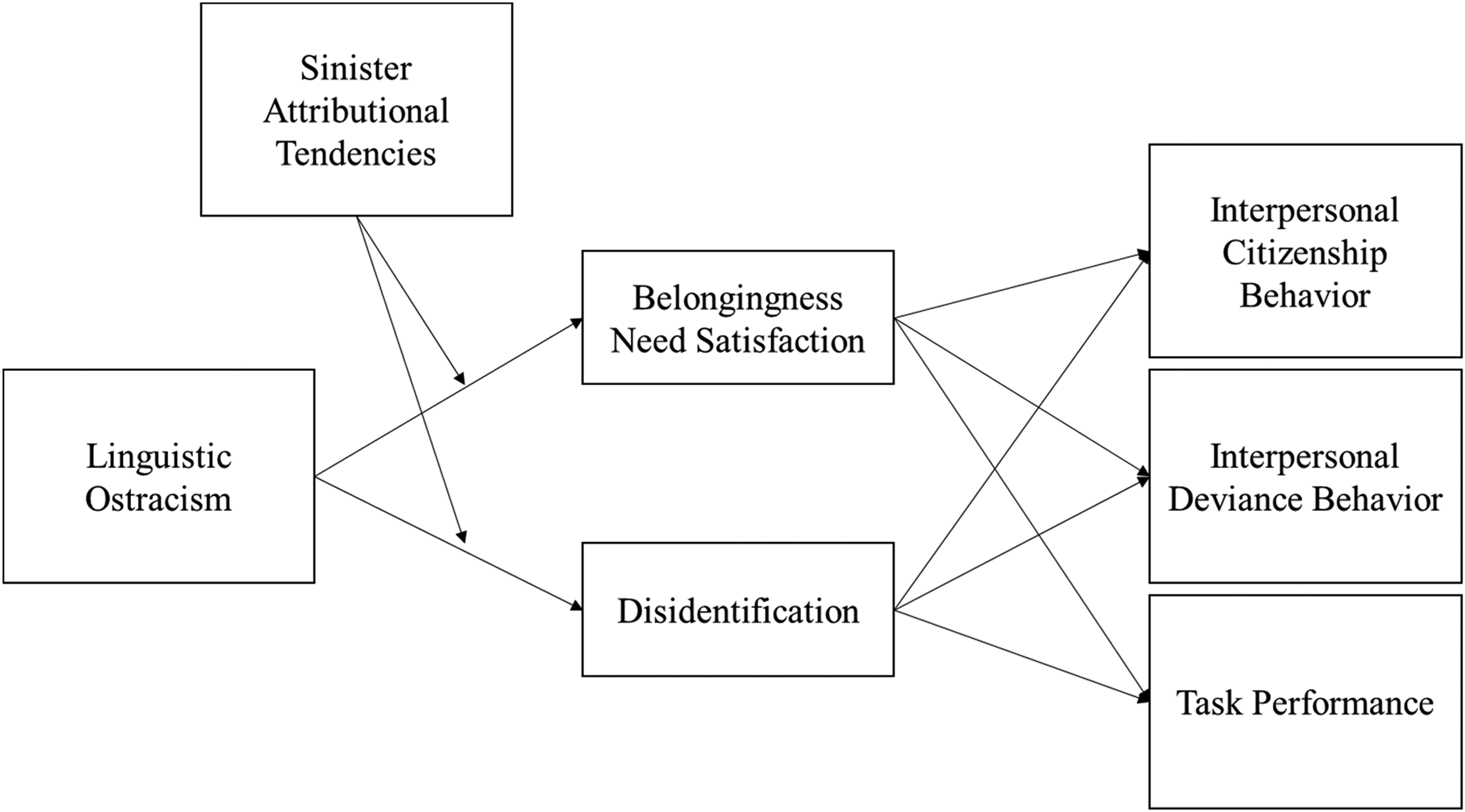
Theoretical model
Constructive replication and extension: Assessing the linguistic ostracism—Job performance relationship
Need to belong theory (Baumeister & Leary, 1995), emphasizes the primacy of interpersonal relationships, and the criticality of close relational bonds (Baumeister & Leary, 1995; Williams, 2007). Belongingness need satisfaction is widely recognized as the core psychological mechanism linking the broader workplace ostracism literature to work outcomes (Ferris et al., 2017; Williams, 2001, 2007). Needs motivate, and when the need to belong is unmet, employees experience less intrinsic work motivation and reduced energy for performance (Deci & Ryan, 2000). The fulfilment or frustration of the need to belong (also referred to as belongingness need satisfaction) plays an essential role in people's daily lives (Gagné & Deci, 2005; Grant, 2008). When people have satisfying interpersonal connections, they experience happiness, health, and greater life fulfillment (e.g., Bhave & Lefter, 2018; Lambert et al., 2013; Tay & Diener, 2011). Employees’ work tasks are generally interdependent with those of their colleagues, and therefore their interpersonal connections with other workgroup members are an important source for the fulfilment of their belongingness needs (Kim et al., 2013; Peltokorpi & Zhang, 2020). From a motivational perspective, when belongingness is unmet at work, intrinsic motivation and available energy decline, which reduces effort devoted to job performance (DeWall et al., 2008).
Linguistic ostracism—even though it is nonpurposeful—is likely to be an unsettling experience for focal workgroup members because it creates an interpersonal distance with their colleagues. According to need to belong theory, when focal employees perceive such ostracism, their belongingness needs are unmet (Baumeister & Leary, 1995). This lack of belonging functions as a strong motivator to seek re-inclusion (Leary, 1999), and so focal workgroup members are likely to become increasingly attuned to social cues of approval and disapproval within the workgroup (e.g., facial displays, vocal tones, etc.; Pickett et al., 2004). Importantly, the attention given to such social cues is higher when people perceive that they are being ostracized (Gardner et al., 2000).
The aftermath of a linguistic ostracism experience could therefore trigger the allocation of attention to social cues, which is costly because attentional focus is essential for performance. As Beal and colleagues (2005) observe “To the extent that attention…is focused on the work, performance will be facilitated…To the extent that attention and resources are focused elsewhere, performance will suffer…This is a simple but important idea” (p. 1056–1057). That is, when focal employees perceive linguistic ostracism, this unmet need lowers intrinsic work motivation and makes work feel less enjoyable but also redirects energy toward reestablishing interpersonal connections and developing re-inclusion strategies (Baumeister et al., 2002; Vaara et al., 2005). In doing so, however, they divert their attentional focus away from focusing on the task at hand, and their performance deteriorates (Beal et al., 2005; Dalal et al., 2014). Thus, we propose the following hypotheses:
Linguistic ostracism is related to lower task performance.
Belongingness need satisfaction mediates the relationship between linguistic ostracism and task performance.
Hypotheses 1 and 2 focus on the task performance, the dimension of job performance that Fiset and Bhave (2021) did not consider in their work. We begin by testing these two hypotheses using experimental methods. In Study 1, we used a controlled laboratory design and replicated the protocol employed by Dotan-Eliaz and colleagues (2009).
Study 1
Method
Participants. We recruited eighty-three undergraduate (48 female) students enrolled in an introductory management course at a large Canadian university (Concordia University IRB UH2012-032) situated in a bilingual English–French city to participate in this study. Participants first completed a background survey, which we administered one week before the experimental portion of the study. In the background survey, we asked participants to provide demographic details including information about their language ability. We excluded prospective participants who spoke Italian from this study (n = 2; see related details below) for a final sample of eighty-one participants (47 female). The average age of the participants was 21.98 (SD = 4.79) years, and they were able to effectively communicate using an average of 2.93 (SD = .92) languages, reflecting the linguistic diversity of the sample. Given the bilingual nature of the city (a majority speak both English and French), most participants were accustomed to hearing and using multiple languages in everyday life.
Procedures. When participants entered the research lab, the experimenter informed them in English that they were taking part in a study on teamwork. After receiving informed consent, the experimenter then asked participants to sit at a table where they were joined by two confederates, (see Dotan-Eliaz et al., 2009) 2 . In the first task, the focal participant and two confederates were asked to work together as a newly formed team to build an elaborate structure using a set of building blocks. The experimenter asked all workgroup members (including the confederates) to introduce themselves, informed participants that they had 15-min to complete the task and then exited the room.
We provided confederates with a high-level script to interact with the focal participant (see Appendix for additional details). We asked confederates to spend the first few minutes discussing the task with the focal participant and plan the structure they intended to build. During the ensuing conversation, the two confederates “discovered” their mutual Italian heritage.
In the linguistic ostracism condition, we instructed confederates to discuss their Italian heritage in Italian for with approximately one-third of the time. Of note, the conversation between the confederates pertained to their shared Italian heritage; it was not related to the experimental task. While working on the experimental task, confederates spoke to the focal participant and to each other in English. These aspects are consistent with the conceptualization of linguistic ostracism.
In the control condition, we instructed confederates to have similar conversations focused on their mutual Italian heritage while speaking to each other in English. This is an active control condition because the focal participant could still perceive to be left out of the conversation (Boot et al., 2013). While working on the experimental task, confederates continued to speak to each other and the focal participant in English. For both conditions, we asked confederates to respond to any direct questions posed by the participant in English and avoid behaviors that could be perceived as overtly intentional and exclusionary (e.g., avoiding eye contact).
After 15 min, the experimenter re-entered the room and informed the workgroup that their second task involved completing a short survey and then solving a series of 12 identical puzzles in separate rooms. The experimenter informed participants that they had unlimited time to complete the task, and that each correct answer by each workgroup member provided the collective with a ballot towards one of 10 randomized draws of $50. The experimenter directed the focal participant to stay in the room and ushered the confederates ostensibly to other rooms to complete the second task.
Focal participants were first asked to respond to manipulation check items consisting of an equal number of perceived inclusion and ostracism items, with the inclusion items (i.e., included, welcomed, accepted) serving to reduce demand characteristics (Fiedler et al., 2021). Following this, participants completed a measure assessing belongingness need satisfaction before proceeding to solve the puzzles. After focal participants had worked on the puzzle for 25 min, the experimenter returned and had participants to complete a short-distractor task (see Dotan-Eliaz et al., 2009). This was to ensure that participants spent about the same time in the study (in line with our protocol we had to keep the entire experiment within one hour). Participants were then debriefed and thanked for their participation. Prize draws were distributed evenly across the two conditions.
Measures
Task performance. We assessed task performance using the number of correct solutions that participants could generate out of a set of 12 pentomino puzzles. Pentomino puzzles consist of twelve unique shapes, each made up of five connected squares (Yang & Chen, 2010). Similar puzzles have been used to assess performance in the literature (e.g., Stephens et al., 2012).
Belongingness need satisfaction. We assessed belongingness need satisfaction using a modified version of Van den Broeck et al. (2010; α = .89) six-item measure. Each item was measured using a 5-point scale 1 (totally disagree) to 5 (totally agree). An example item is “When working with my teammates, I felt part of the group.”
Perceived ostracism. As a manipulation check, we assessed participants’ perceived ostracism using Gómez et al.'s (2011; α = .87) three-item measure on a 7-point scale 1 (totally disagree) to 7 (totally agree). An example item is “members of my team made me feel rejected.”
Results
Table 1 presents the descriptive statistics, reliability estimates, and bivariate correlations.
Study 1: Descriptive statistics, reliability estimates, and study variable intercorrelations
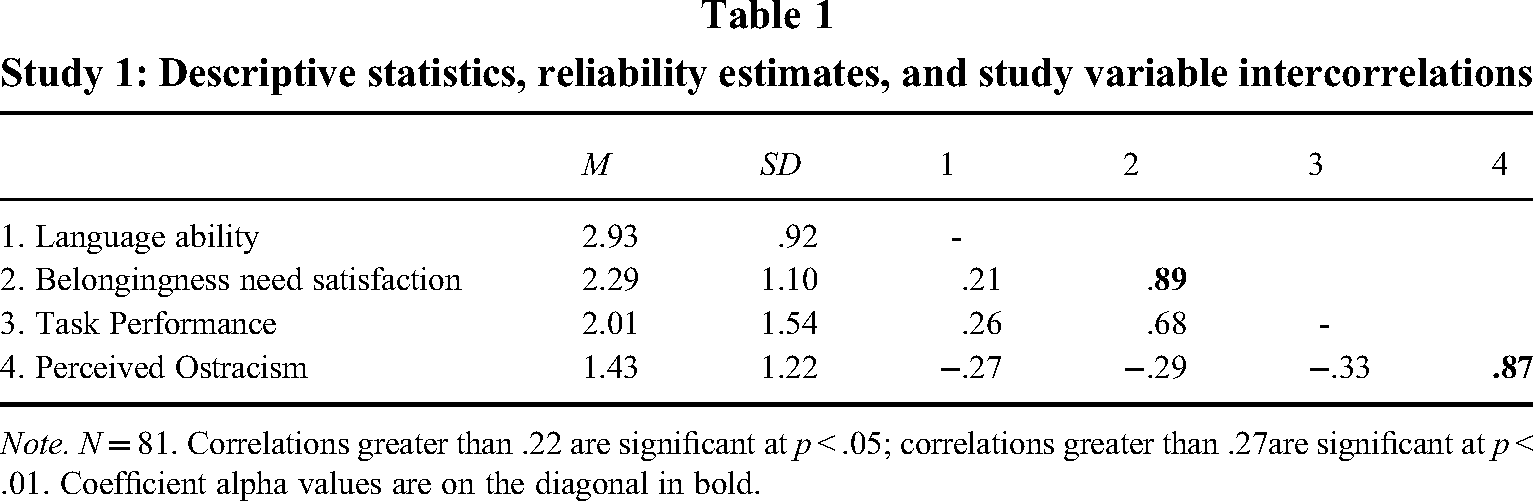
Note. N = 81. Correlations greater than .22 are significant at p < .05; correlations greater than .27are significant at p < .01. Coefficient alpha values are on the diagonal in bold.
Manipulation check. Participants in the linguistic ostracism condition reported feeling higher levels of perceived ostracism (M = 2.97, SD = 1.20) than participants in the control condition (M = 1.88, SD = .97); (t(79) = 4.49, p = .001, d = 1.09), which provided evidence for the effectiveness of the linguistic ostracism manipulation.
Hypotheses testing. Participants in the linguistic ostracism condition performed worse (M = 1.24, SD = 1.39) compared to those in the control condition (M = 2.78, SD = 1.29); (t(79) = −5.13, p = .001, d = −1.34, see Figure 2), providing initial support for Hypothesis 1.
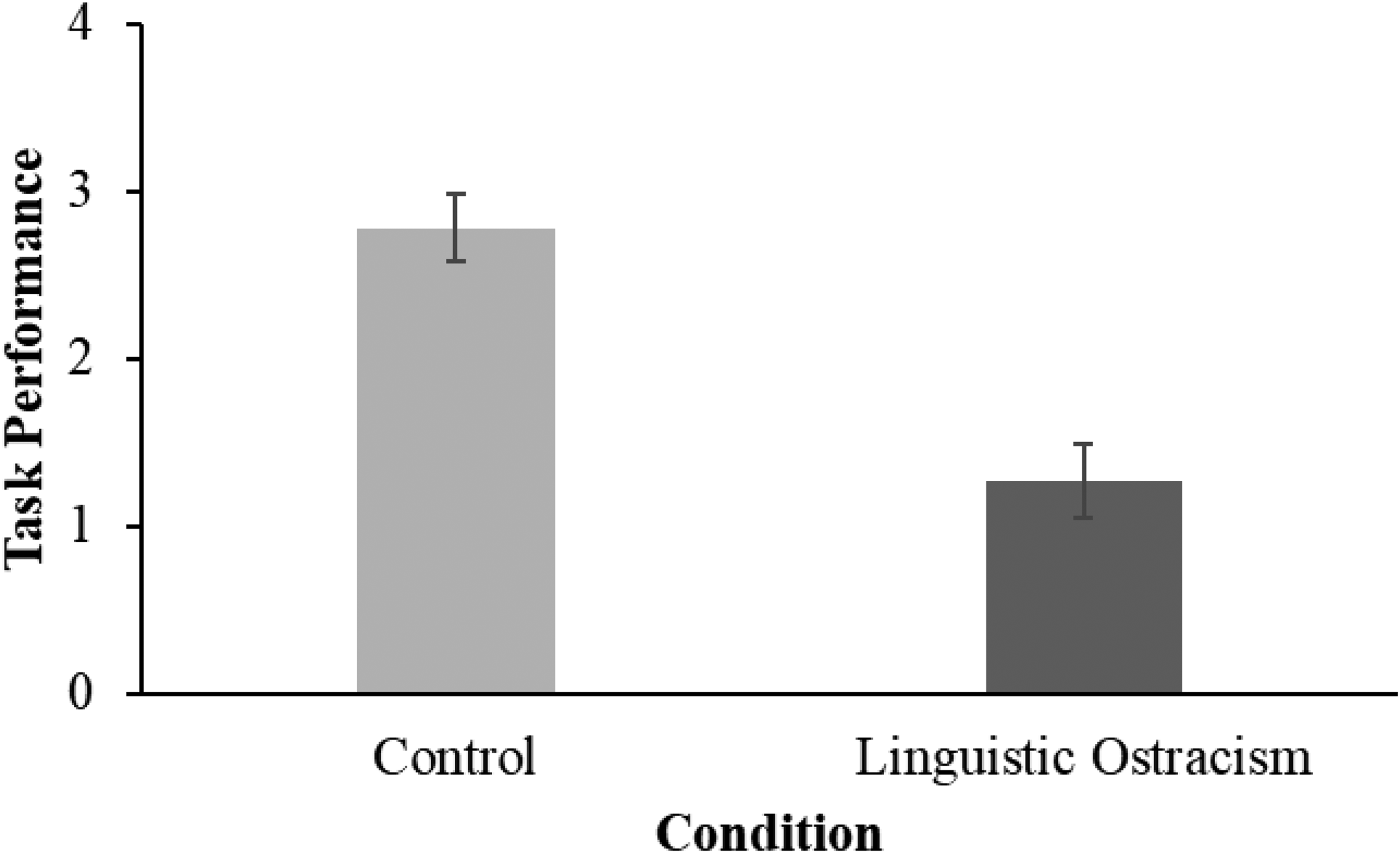
Study 1: Performance differences by experimental condition
Using procedures outlined by Hayes (2013), we assessed whether belongingness need satisfaction mediated the relationship between linguistic ostracism and task performance (H2). We assessed mediation based on 95% bias-corrected confidence intervals (CI) using 5,000 bootstrapped samples (PROCESS, Model 4). Results revealed a statistically significant indirect effect of linguistic ostracism on task performance via belongingness need satisfaction (point estimate = −.64, SE = .21, CI95% [−1.076, −.269]). These results provide support for Hypothesis 2.
Discussion
In Study 1, we conducted a real-time experimental manipulation of linguistic ostracism and assessed participants’ individual task performance on a complex activity. Results revealed that participants in the linguistic ostracism condition performed worse—they solved only about half the number of puzzles—compared to participants in the control condition. Despite being situated in a bilingual English–French city where participants were accustomed to hearing and speaking multiple languages, exposure to an unfamiliar language (Italian) still triggered perceptions of linguistic ostracism. In addition, we observed that the belongingness need satisfaction mediated the effect of linguistic ostracism on task performance.
Notably, the results of Study 1 are bolstered by integrating methodological best practices. First, we adopted an established protocol (i.e., Dotan-Eliaz et al., 2009) and also incorporated an active control condition rather than a neutral one (Boot et al., 2013). As noted above, in the control condition, the two confederates discussed their mutual Italian heritage but conducted this conversation in English. That is, even in the control condition participants could potentially perceive ostracism because they were not part of the conversation with the confederates. This possibility to perceive ostracism even in the control condition makes it an active control condition (in contrast, in a neutral control condition confederates would not have any discussions about their mutually exclusive heritage). Using an active control condition enhances the rigor of the study design and strengthens internal validity by ensuring that performance effects are attributable to linguistic ostracism rather than to the general perception of being ignored or excluded; an active control also reduces the likelihood of placebo effects (Boot et al., 2013; Simons et al., 2016). Overall, the use of an active control condition provides greater confidence in these findings.
Second, we explicitly ensured that the manipulation could not be construed as a general form of ostracism. Consistent with our instructions, confederates collaborated with participants during the task, continued to make eye contact with them, and responded to any questions directed to them by the participant in English (see Dotan-Eliaz et al., 2009). Furthermore, because the study design focuses on isolating the effects of linguistic ostracism that focal workgroup members could perceive even when it is nonpurposeful, it explicitly aligns with how the phenomenon of linguistic ostracism occurs and is conceptualized (Ferris et al., 2017; Robinson et al., 2013).
Based on the experimental design, there are two limitations of this study. First, we mimicked a workplace situation where team members come together to complete a work task. However, it is plausible that for participants meeting for the first time (as was the case in the experiment) belongingness need satisfaction may not be salient as it could be for full-time employees. Second, although participants were asked to complete a task, their performance in this experimental setting could still be considered discretionary because there were no formal assessment or reward procedures. To address these limitations and build on existing research, we sought to extend the study beyond the laboratory context.
Fiset and Bhave (2021) drew on samples of full-time employees and observed that disidentification mediated the relationship between linguistic ostracism and interpersonal citizenship and interpersonal deviance (two other dimensions of job performance). Based on that work, we extend our investigation and examine disidentification as a potential mechanism underlying the relationship between linguistic ostracism and task performance. By assessing the mediating role of belongingness need satisfaction and disidentification for the linguistic ostracism—task performance relationship we engage in competitive theory testing (Tierney et al., 2020).
Constructive replication and extension: Disidentification as a competing mechanism underlying the relationship between linguistic ostracism and task performance
Disidentification is “an active separation from a group and thus a negative self-defining relation to a relevant group” (Matschke & Sassenberg, 2010; p. 892). According to ethnolinguistic identity theory (Giles & Johnson, 1981, 1987), an offshoot of social identity theory (Tajfel, 1978; Tajfel & Turner, 1979), the language used in the workgroup can spark the formation of ingroups and outgroups (Hinds et al., 2014; Steyaert et al., 2011). Because language is an in integral component of one's social identity (Bordia & Bordia, 2015; Giles & Byrne, 1982) and clear communication and information processing are essential to task performance (Volk et al., 2014), focal employees may become more aware of their language-based membership status when they are unable to understand the language spoken in their workgroup.
This distinction could prompt employees to be more cognizant of their language-based membership status (ingroup = comprehend the language spoken by workgroup members; outgroup = not able to comprehend the language spoken by workgroup members; Giles & Johnson, 1981, 1987). Being a part of an outgroup could trigger negative emotions such as anger and sadness, and increase perceptions of exclusion (Chow et al., 2008; Dotan-Eliaz et al, 2009). In accordance, Hinds et al. (2014) noted that focal employees who were not fluent in German felt isolated when they were left out of meetings or when their German-speaking colleagues conversed in German in their presence.
In disidentifying from an undesirable social group (i.e., they consider it an outgroup), employees lose their connection to their work colleagues, which increases the likelihood of interpersonal and task conflict in the workgroup (Chung, 2015; Miscenko & Day, 2016). Employees will need to direct their attention to redress and cope with greater conflict in their workgroup. In doing so, however, their attentional focus to fulfill job responsibilities is comprised, which could decrease their performance (Beal et al., 2005; Dalal et al., 2014). Thus, we propose:
Disidentification mediates the relationship between linguistic ostracism and task performance.
Generalizability: The moderating role of sinister attributional tendencies for the relationship between linguistic ostracism and job performance
Linguistic ostracism is distinct from other constructs in the ostracism literature because it is considered attributionally ambiguous, generally nonpurposeful, and requires the formation of an emergent group comprising at least two people (Fiset, 2022; Fiset & Bhave, 2021; Robinson et al., 2013). Importantly, this distinguishes linguistic ostracism from language-based exclusion, which captures more explicit forms of social rejection where language itself is the basis for exclusion (e.g., intentionally switching to a language one's coworker does not understand to exclude them from the conversation; Kulkarni & Sommer, 2015). Research, however, suggests that how people make attributions plays a pivotal role in how they respond to ostracism experiences (e.g., Liu, 2019). Given the ambiguity inherent in linguistic ostracism, individual differences in attributional tendencies are likely to shape employees’ perceptions of linguistic ostracism and influence their subsequent reactions.
One such trait that may influence these perceptions is sinister attributional tendencies (i.e., an inclination to excessively ascribe malicious intentions to others’ actions, Kramer, 1998). This belief is particularly salient in scenarios involving ambiguous behavior, such as linguistic ostracism because it prompts employees to interpret their coworkers’ actions in a negative light (Kramer, 2001). Focal employees with sinister attributional tendencies are more likely to overpersonalize ambiguous social events, extrapolate beyond available data when inferring others’ intentions, and disregard evidence that contradicts their fears (Freeman et al., 2002; Haselton & Nettle, 2006; Kramer, 1998).
For focal employees, linguistic ostracism is an ambiguous event that could heighten levels of suspicion (Harzing et al., 2011; Hitlan et al., 2016). However, this experience is likely to be interpreted by employees high in sinister attributional tendencies as a deliberate effort to exclude them (Freeman et al., 2002). The inclination to excessively personalize an attributionally ambiguous act (i.e., linguistic ostracism) consumes substantial cognitive resources to identify and comprehend threats, whether real or perceived (Chan & McAllister, 2014). This tendency could become self-reinforcing and make people more likely to redirect mental energy toward detecting and deciphering (perceived) situational threats. Sinister attributional tendencies could thus influence how employees interpret their experience of linguistic ostracism, which could have downstream implications for their performance (Al-Atwi et al., 2021; Thoroughgood et al., 2017).
As we reasoned earlier, perceptions of linguistic ostracism could hinder the fulfilment of belongingness needs and spur disidentification from the workgroup. Employees high in sinister attributional tendencies are likely to magnify and overpersonalize their linguistic ostracism experience and self-reinforce that their work colleagues’ treatment was intentionally harmful, which could diminish their fulfillment of belongingness needs. Employees high in sinister attributional tendencies have a heightened sensitivity to perceived slights (Kramer, 1998) and could extrapolate beyond available data when inferring others’ intentions and interpret their work colleagues’ actions as malicious (Kramer, 2001). Linguistically ostracized employees high in sinister attributional tendencies are then likely to use this as evidence of their outsider status and disidentify from their workgroup (Fiset & Bhave, 2021).
Taken together, we expect that sinister attributional tendencies will alter the effects of linguistic ostracism on belongingness need satisfaction and disidentification, thereby moderating both mediation pathways. Specifically, we propose that when sinister attributional tendencies are high, the indirect effects of linguistic ostracism on our focal performance outcomes via belongingness need satisfaction, and disidentification will be stronger. Therefore, we expect that sinister attributional tendencies will operate as a first-stage moderator of the conditional indirect effects of linguistic ostracism on task performance. Thus, we propose:
The conditional indirect effect of linguistic ostracism on task performance via belongingness need satisfaction will be stronger when sinister attributional tendencies are high.
The conditional indirect effect of linguistic ostracism on task performance via disidentification will be stronger when sinister attributional tendencies are high.
In Study 2, we focus on the twin goals of a constructive replication and generalizability, which Köhler and Cortina (2023) refer to as a generalizability replication. Specifically, we test the two competing pathways of belongingness need satisfaction and disidentification. Furthermore, for theory clarification, we assess the role of sinister attributional tendencies and test the complete model by considering all three performance dimensions: task performance, interpersonal citizenship behaviors, and interpersonal deviance behaviors. Additionally, following the principles of constructive replication (Köhler & Cortina, 2021, 2023; Lykken, 1968), we tested our hypotheses in real-world settings using a sample of employed individuals who have encountered linguistic ostracism at work. Prior to doing so, to assess prevalence of linguistic ostracism we conducted a pilot study (please see the Online Supplemental Material for additional details).
Study 2
Method
Procedure and participants
We collected data using Prolific, an online platform (Saint Mary's University IRB 21-006). We first conducted an initial pre-screening survey to identify participations who: (a) were employed full-time, (b) were a part of a workgroup that interacted on a daily basis with their colleagues, () worked on-site at a workplace at least part of the week, (d) were a resident of the United States of America, and (e) had experienced linguistic ostracism at work (for a similar procedure, see Pugh et al., 2011).
We invited 1,538 eligible participants to take part in this study, which involved completing surveys in English at three timepoints, each separated by three days. We received 1,096 (71%) responses for the Time 1 survey, 992 (91% of Time 1) responses to the Time 2 survey, and 907 (91% of Time 2) responses to the Time 3 survey (we excluded participants who had missing data on relevant variables or missed attention checks; Meade & Craig, 2012). Participants were compensated for completing each survey. In addition, they received a bonus of 1 GBP for completing all three surveys. The average age of employees in our sample was 39.07 years (SD = 11.85), their average organization tenure was 7.09 years (SD = 6.68), and approximately 50% were women (456 female, 441 male, 10 prefer not to say). On average, participants could effectively communicate in 1.34 languages (SD = .66), representing 56 unique languages in addition to English. The most common languages were Spanish (90), French (34), and Mandarin (33), highlighting the linguistic diversity of the sample. To mitigate the possibility of common method variance (Podsakoff et al., 2012), we assessed linguistic ostracism (the independent variable) and sinister attributional tendencies (the moderator) in the Time 1 survey, the mediators of belongingness need satisfaction and disidentification in the Time 2 survey and the dependent variables of task performance, interpersonal citizenship behaviors, and interpersonal deviance behaviors in the Time 3 survey. To aid compatibility, we used the same items for linguistic ostracism, disidentification, interpersonal citizenship behaviors and interpersonal deviance behaviors that Fiset and Bhave (2021) used.
Measures
Linguistic ostracism (Time 1). We assessed linguistic ostracism using a five-item measure on a 5-point scale 1 (never) to 5 (all of the time) (Fiset & Bhave, 2021; α = .93). An example item is “Workgroup members hold informal discussions in a language you do not understand.”
Sinister attributional tendencies (Time 1). We assessed sinister attributional tendencies using the five-item (α = .93) scale developed by Thoroughgood et al. (2017). Participants indicated the extent to which the items described their thoughts at work on a 7-point scale 1 (not at all true of me) to 7 (extremely true of me). An example item is
Belongingness need satisfaction (Time 2). Similar to Study 1, we assessed belongingness need satisfaction using the same six-item scale from Van den Broeck et al., 2010; α = .88).
Disidentification (Time 2). We assessed disidentification using a six-item measure on a 5-point scale 1 (strongly disagree) to 5 (strongly agree) (Kreiner & Ashforth, 2004; α = .93). An example item is “I am embarrassed to be a member of this workgroup.”
Task performance (Time 3). We adapted four items from Williams and Anderson's (1991; α = .86) to measure task performance (see Lyubykh et al., 2022 for a similar approach). Employees indicated their task performance at work on a 5-point scale 1 (strongly disagree) to 5 (strongly agree). An example item is “I perform tasks that are expected of me.”
Interpersonal citizenship behaviors (Time 3). We used Lee and Allen's (2002; α = .84) 8-item measure to assess interpersonal citizenship behaviors. Employees indicated the extent to which the focal employee engaged in interpersonal citizenship behaviors on a 5-point scale (1 = strongly disagree to 5 = strongly agree). An example item is “I help others who have been absent.”
Interpersonal deviance behaviors (Time 3). We used Bennett and Robinson's (2000; α = .86) 7-item measure to assess interpersonal deviance behaviors. Employees indicated the extent to which the focal employee engaged in interpersonal deviance behaviors using a 7-point scale (1 = never to 7 = daily). An example item is “I cursed at someone at work.”
Control variables. Consistent with Fiset and Bhave (2021), we controlled for employees’ tenure, language ability, and workplace ostracism (Ferris et al., 2015; Howard et al., 2020). Tenure was measured by the number of years the employee had worked at their organization. Language ability was assessed by asking employees how many languages they could converse in fluently. In addition, we assessed workplace ostracism using the 10-item Workplace Ostracism Scale (Ferris et al., 2008; α = .92).
Results
Table 2 presents the descriptive statistics, reliability estimates, and bivariate correlations. As a first step, we performed a series of confirmatory factor analyses (CFA) using Mplus 8 to assess the distinctiveness of the constructs in the study. The default five-factor model was composed of linguistic ostracism, workplace ostracism, belongingness need satisfaction, disidentification, and sinister attributional tendencies, with each construct loaded on separate factors.
Study 2: Descriptive statistics, reliability estimates, and study variable intercorrelations
Note. N = 907. Correlations greater than .07 are significant at p < .05; correlations greater than .10 are significant at p < .01. BNS = belongingness need satisfaction; SAT = sinister attributional tendencies; OCB-I = interpersonal citizenship behaviors; DEV-I = interpersonal deviance behaviors. Coefficient alpha values are on the diagonal in bold.
This model provided a good fit to the data: (χ2 (454) = 1,908.02, p = .001, CFI = .94, TLI = .94, RMSEA = .06, SRMR = .04). We compared this model to alternative models through chi-square difference tests. A four-factor model in which belongingness need satisfaction and disidentification were combined into a single factor with linguistic ostracism, workplace ostracism, and sinister attributional tendencies each represented as separate factors, yielded a worse fit to the data (Δχ2 (4) = 1,724.72, p = .001, χ2 (458) = 3,632.74, p = .001, CFI = .87, TLI = .86, RMSEA = .09, SRMR = .08). A separate four-factor model in which linguistic and workplace ostracism were combined into a single factor, with belongingness need satisfaction, disidentification, and sinister attributional tendencies each represented as separate factors, yielded a worse fit to the data (Δχ2 (0) = 1,786.57, p = .001, χ2 (458) = 5,419.31, p = .001, CFI = .79, TLI = .78, RMSEA = .10, SRMR = .11). Finally, a model in which all constructs were collapsed onto one factor also yielded a worse fit to the data (Δχ2 (53) = 6,667.92, p = .001, χ2 (405) = 11,997.23, p = .001, CFI = .48, TLI = .44, RMSEA = .18, SRMR = .16). These results provided evidence of the distinctiveness of the constructs.
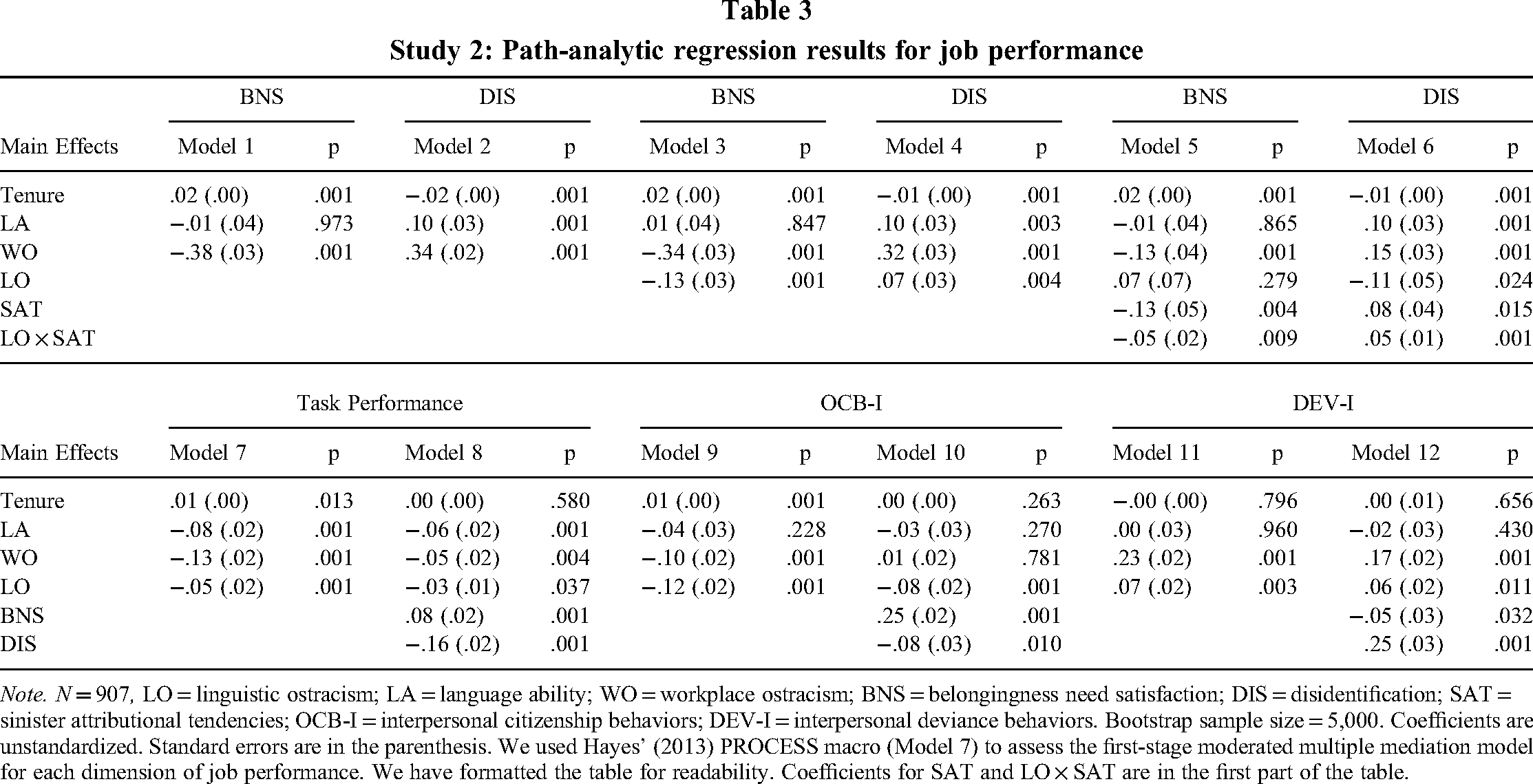
To begin with, we retested Hypothesis 1. Results indicated that after controlling for employees’ tenure, language ability, and workplace ostracism, linguistic ostracism was negatively related to task performance (b = −.03, SE = .01, p = .037), which supported Hypothesis 1 (see Table 3, Model 8). Results are similar after excluding control variables (Bernerth & Aguinis, 2016). We conducted multiple mediation analysis based on 95% bias-corrected confidence intervals (CIs) constructed through 5,000 bootstrapped samples using PROCESS (Hayes, 2013) to test Hypotheses 2 (belongingness need satisfaction) and Hypothesis 3 (disidentification).
Study 2: Path-analytic regression results for job performance
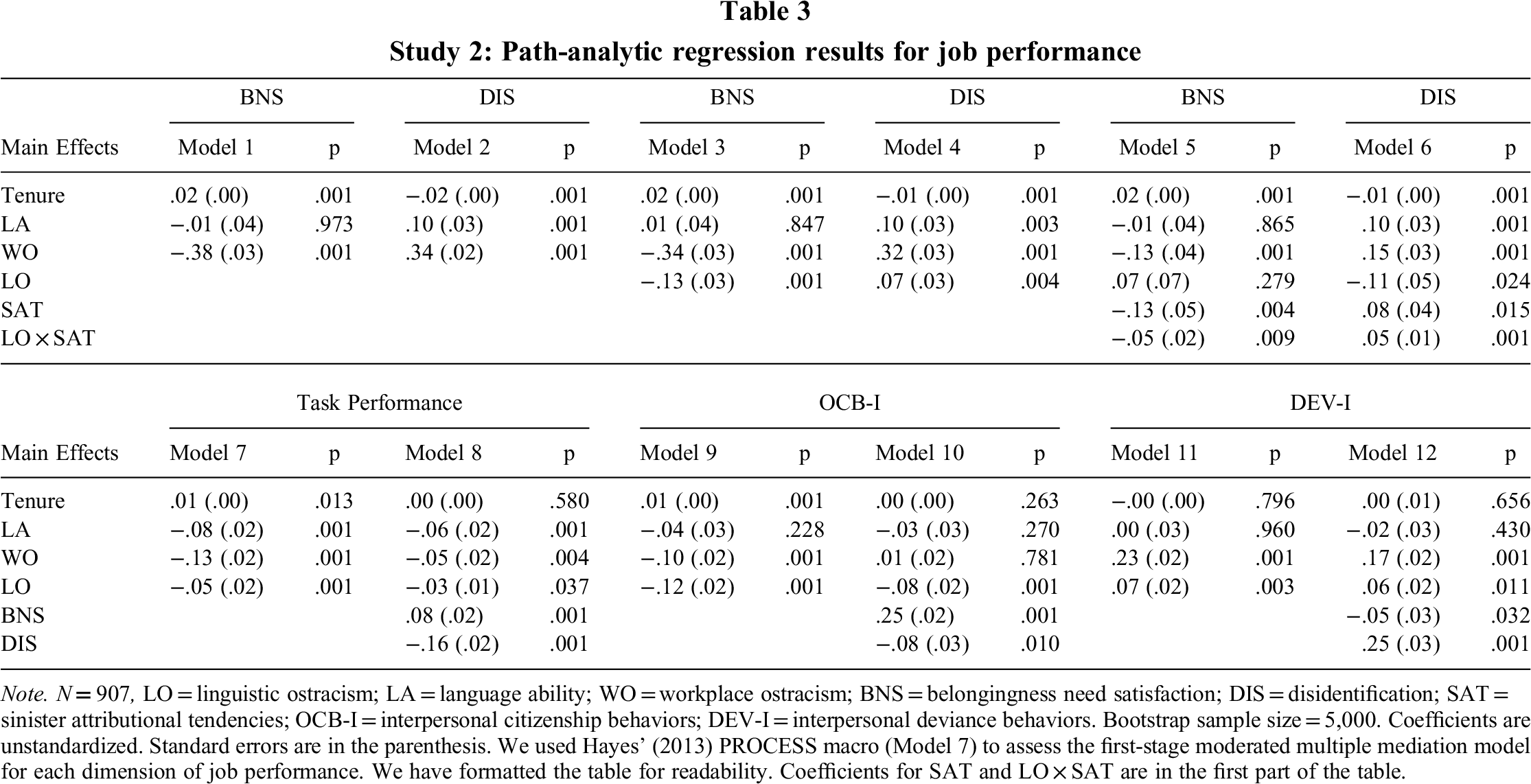
Note. N = 907, LO = linguistic ostracism; LA = language ability; WO = workplace ostracism; BNS = belongingness need satisfaction; DIS = disidentification; SAT = sinister attributional tendencies; OCB-I = interpersonal citizenship behaviors; DEV-I = interpersonal deviance behaviors. Bootstrap sample size = 5,000. Coefficients are unstandardized. Standard errors are in the parenthesis. We used Hayes’ (2013) PROCESS macro (Model 7) to assess the first-stage moderated multiple mediation model for each dimension of job performance. We have formatted the table for readability. Coefficients for SAT and LO × SAT are in the first part of the table.
Results indicated that the indirect effect of linguistic ostracism on task performance was statistically significant for both mediators: (indirect effect via belongingness need satisfaction = −.01, SE = .00, 95% CI = [−.017, −.003]) and (indirect effect via disidentification = −.01, SE = .00, 95% CI = [−.025, −.002], see Table 4). These results provide support for Hypotheses 2 and 3. Furthermore, a pairwise contrast of the two indirect effects indicates that the indirect effect through disidentification is not significantly different from the indirect effect through belongingness need satisfaction (raw difference contrast effect = .00, SE = .01, 95% CI = [−.008, .020]). This indicates that both mediators play a comparable role in explaining the relationship between linguistic ostracism and task performance.
Study 2: Indirect effects and indexes of moderated mediation
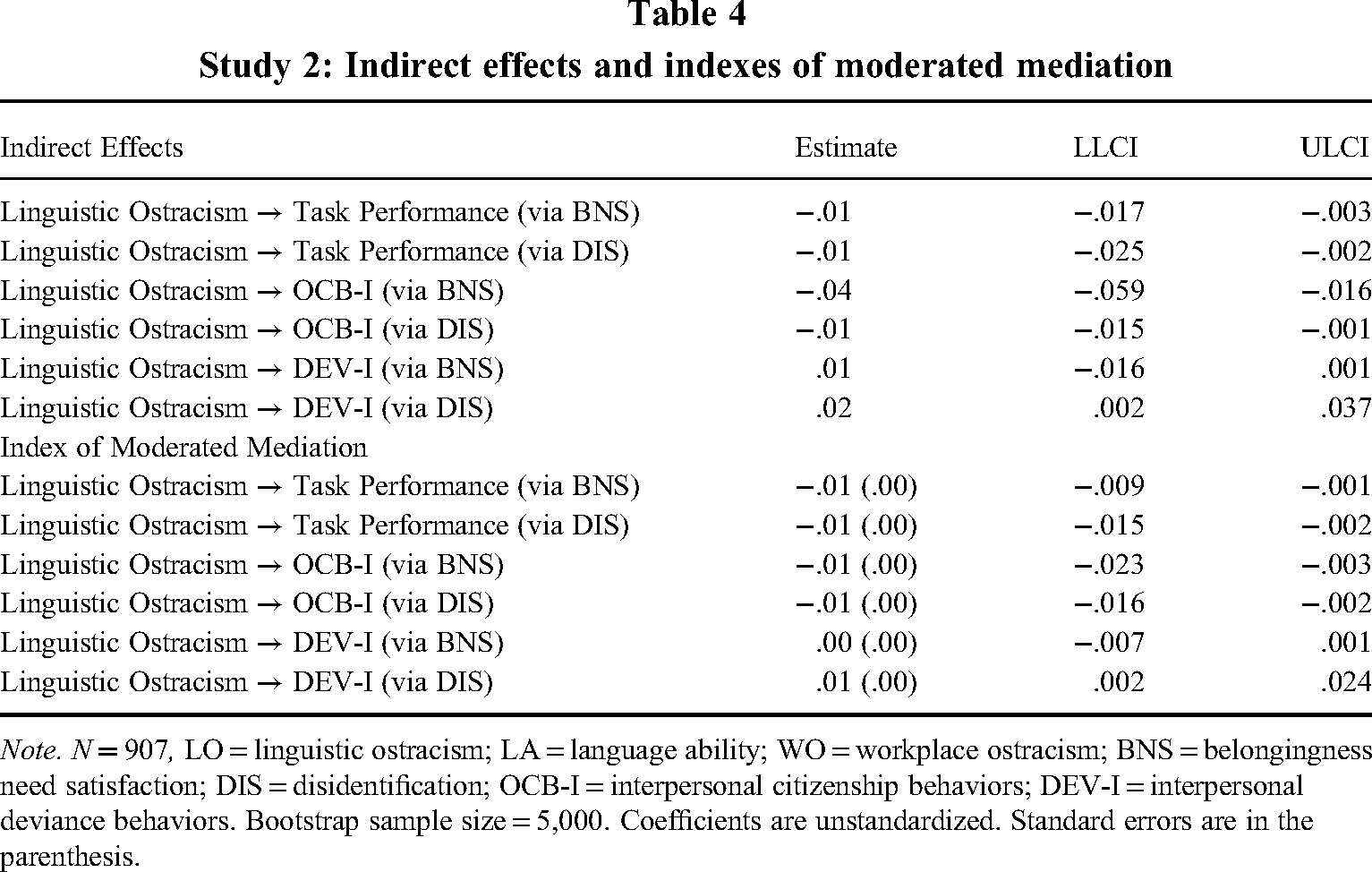
Note. N = 907, LO = linguistic ostracism; LA = language ability; WO = workplace ostracism; BNS = belongingness need satisfaction; DIS = disidentification; OCB-I = interpersonal citizenship behaviors; DEV-I = interpersonal deviance behaviors. Bootstrap sample size = 5,000. Coefficients are unstandardized. Standard errors are in the parenthesis.
In Hypotheses 4 and 5, we proposed that the indirect effect of linguistic ostracism on task performance via belongingness need satisfaction, and disidentification, respectively, is stronger when sinister attributional tendencies was high than when sinister attributional tendencies was low. We used Hayes’ (2013) PROCESS macro (Model 7) to assess the first-stage moderated multiple mediation model. Results indicated that the interaction term of linguistic ostracism and sinister attributional tendencies was statistically significant for belongingness need satisfaction (b = −.05, SE = .02, p = .009, see Table 3, Model 5) and disidentification (b = .05, SE = .01, p = .001 see Table 3, Model 6). To elucidate the pattern of these interactions, we followed the suggestions of Aiken and West (1991) and performed a series of simple slopes tests. For belongingness need satisfaction, results indicated that there was a stronger negative relationship between linguistic ostracism and belongingness need satisfaction when sinister attributional tendencies were high (b = −.15, SE = .04, p = .001) than when sinister attributional tendencies were low (b = −.01, SE = .05, p = .801; Figure 3). Similarly, for disidentification, results indicated that there was a stronger positive relationship between linguistic ostracism and disidentification when sinister attributional tendencies were high (b = .10, SE = .03, p = .001) than when sinister attributional tendencies were low (b = −.05, SE = .04, p = .125; Figure 4).
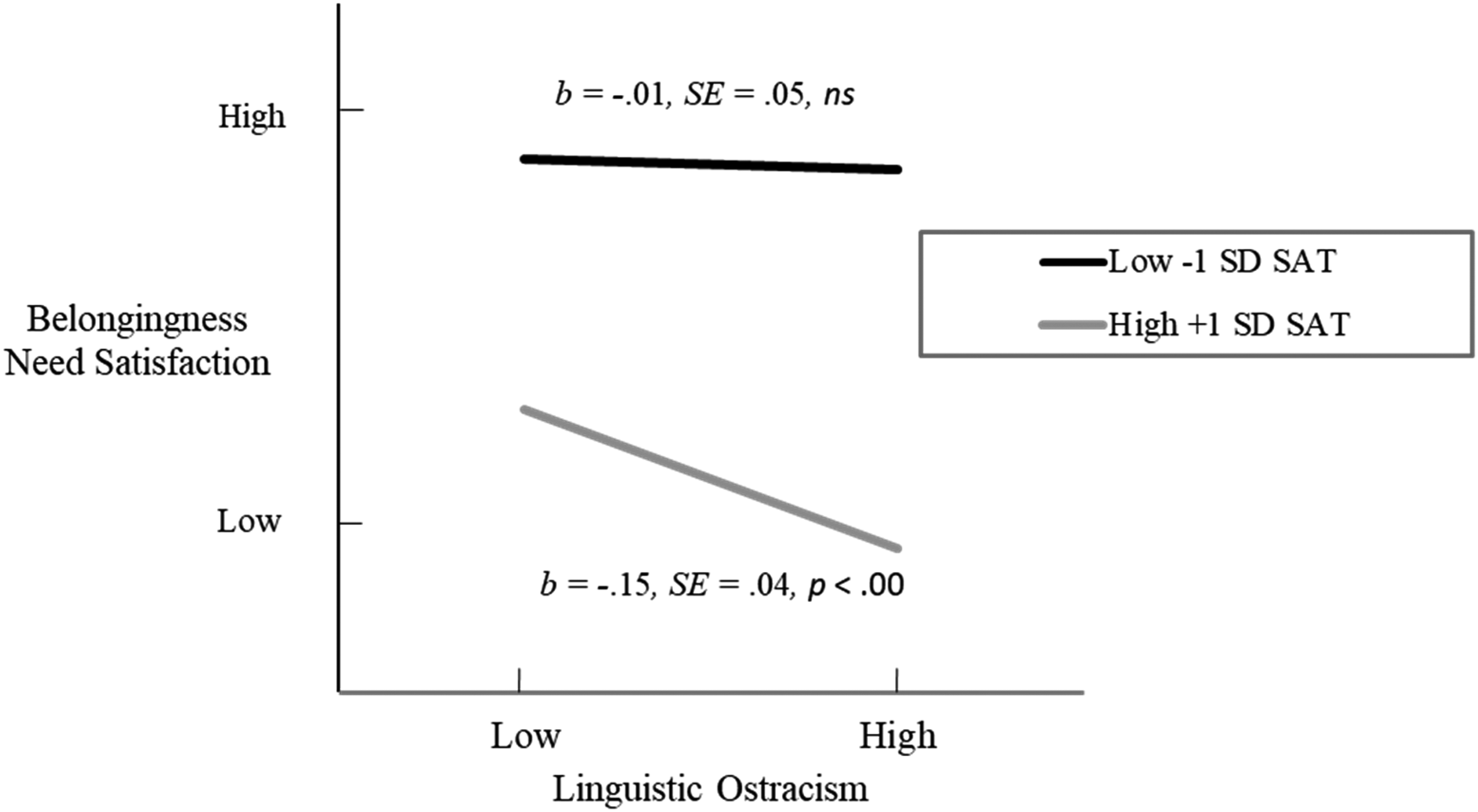
Study 2: The effects of linguistic ostracism on belongingness need satisfaction as a function of sinister attributional tendencies
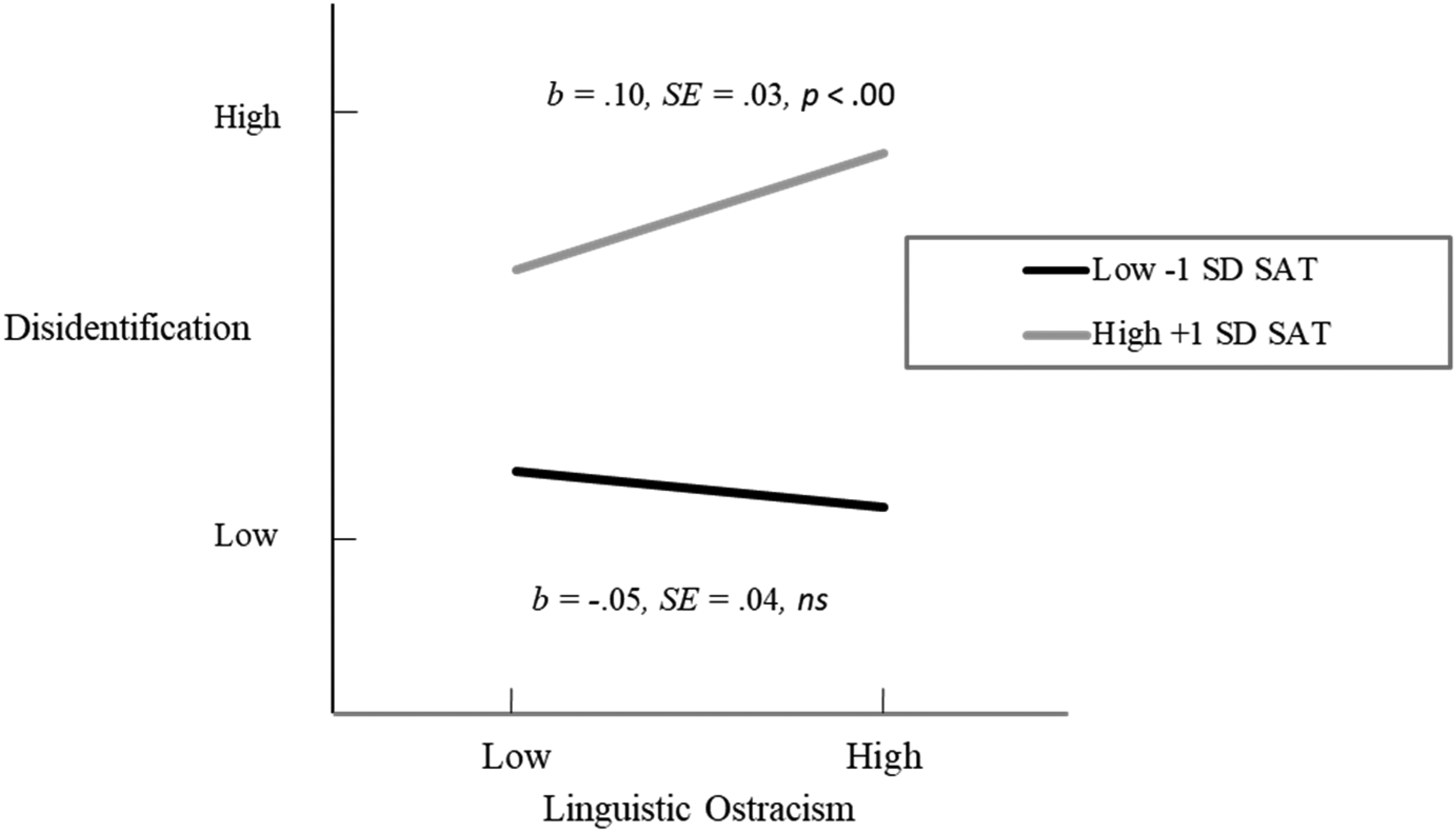
Study 2: The effects of linguistic ostracism on disidentification as a function of sinister attributional tendencies
As a second step, the conditional indirect effect of linguistic ostracism on task performance via belongingness need satisfaction was statistically significant when sinister attributional tendencies were high (+1 SD, indirect effect = −.01 (.00), 95% CI = [−.021, −.004]) compared to when sinister attributional tendencies were low (−1 SD, indirect effect = .00 (.01), 95% CI = [−.006, .009]). The conditional indirect effect of linguistic ostracism on task performance via disidentification was statistically significant when sinister attributional tendencies were high (+1 SD, indirect effect = −.02 (.00), 95% CI = [−.034, −.002]) compared to when sinister attributional tendencies were low (−1 SD, indirect effect = .01 (.01), 95% CI = [−.004, .022], see Table 4) 3 .
Finally, we referred to the index of moderated mediation, which evaluates whether there is a statistically significant difference between two values of the conditional indirect effect at varying levels of the moderator (Hayes, 2015). The index of moderated mediation provided supportive evidence for conditional indirect effect of linguistic ostracism on task performance via belongingness need satisfaction (Δ indirect effect = −.01 (.00), 95% CI [−.009, −.001]), and disidentification (Δ indirect effect = −.01 (.00), 95% CI [−.015, −.002], see Table 5) at different levels of sinister attributional tendencies. Thus, Hypotheses 4 and 5 received support and highlight that both mediational pathways could explain the relationship between linguistic ostracism and task performance.
Study 2 estimates and bias-corrected bootstrapped 95% confidence intervals for the conditional indirect effect of linguistic ostracism on task performance (via disidentification and belongingness need satisfaction) at ±1 standard deviation of sinister attributional tendencies
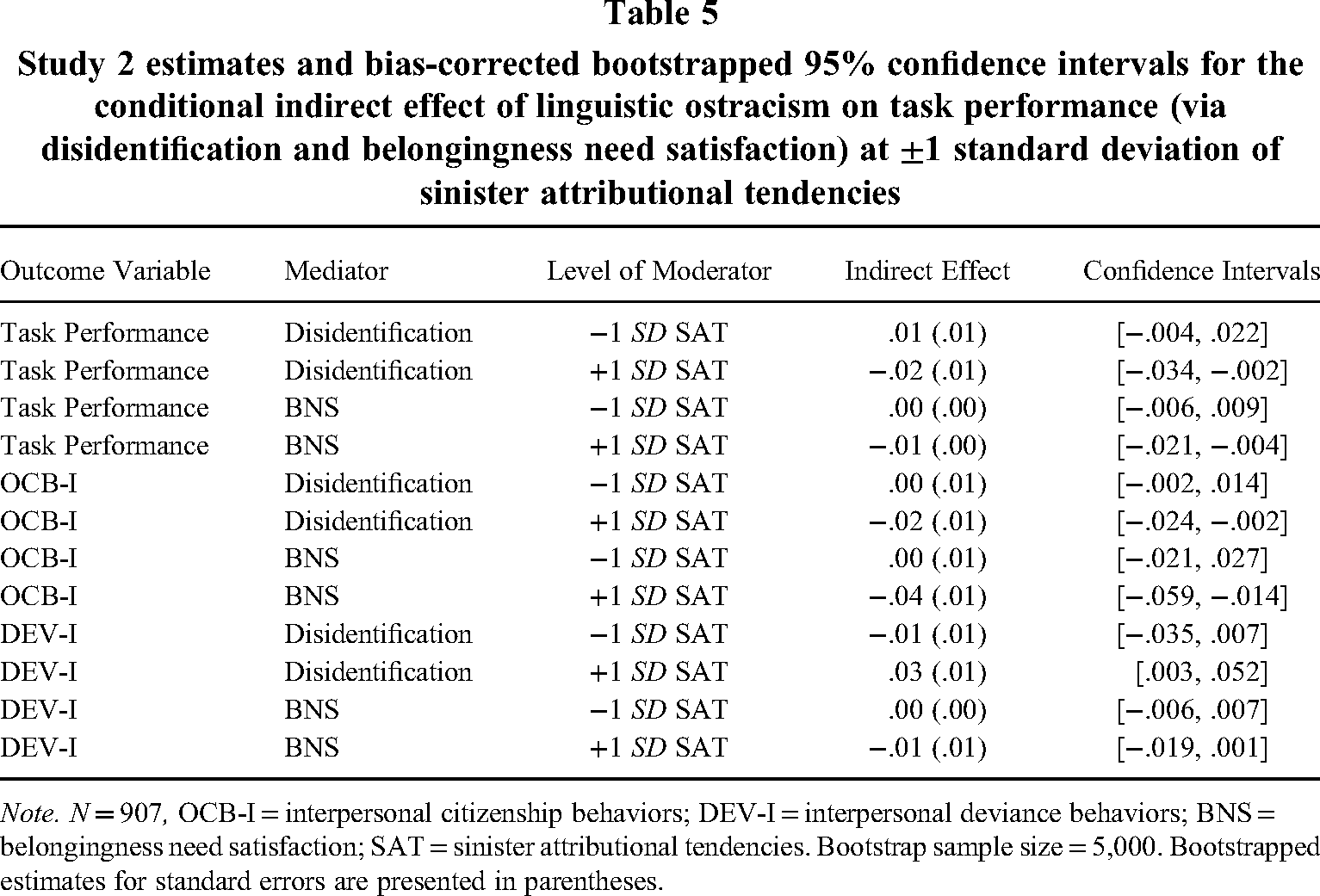
Note. N = 907, OCB-I = interpersonal citizenship behaviors; DEV-I = interpersonal deviance behaviors; BNS = belongingness need satisfaction; SAT = sinister attributional tendencies. Bootstrap sample size = 5,000. Bootstrapped estimates for standard errors are presented in parentheses.
Supplemental analysis
To replicate Fiset and Bhave's (2021) results and assess the robustness of our findings, we conducted supplemental analyses for the two other performance dimensions, interpersonal deviance behaviors and interpersonal citizenship behaviors. Results indicated that after controlling for employees’ tenure, language ability, and workplace ostracism, linguistic ostracism was negatively related to interpersonal citizenship (b = −.12, SE = .02, p = .001) and interpersonal deviance (b = .07, SE = .02, p = .003) (see Table 3; results excluding control variables were similar). Results of multiple mediation analysis indicated that the indirect effect of linguistic ostracism on interpersonal citizenship behaviors was statistically significant for both mediators: (indirect effect via belongingness need satisfaction = −.04, SE = .01, 95% CI = [−.059, −.016]) and (indirect effect via disidentification = −.01, SE = .00, 95% CI = [−.015, −.001], see Table 3). The indirect effect of linguistic ostracism on interpersonal deviance behaviors was not statistically significant for belongingness need satisfaction (indirect effect = .01, SE = .01, 95% CI = [−.016, .001]) but was statistically significant for disidentification (indirect effect = .02, SE = .00, 95% CI = [.002, .037], see Table 4).
Furthermore, a pairwise contrasts of the two indirect effects for both outcomes indicates that for interpersonal citizenship behaviors, the indirect effect through belongingness need satisfaction was significantly stronger than the indirect effect through disidentification (raw difference contrast effect = −.03, SE = .01, 95% CI = [−.044, −.001]). In contrast, for interpersonal deviance behaviors, the indirect effect through disidentification was significantly stronger than the indirect effect through belongingness need satisfaction (raw difference contrast effect = .02, SE = .01, 95% CI = [.005, .049]). Overall, these results indicate that the indirect effect of linguistic ostracism on interpersonal citizenship behaviors via belongingness need satisfaction was significantly larger than the indirect effect via disidentification, whereas for interpersonal deviance behaviors, the indirect effect via disidentification exceeded that via belongingness need satisfaction.
The conditional indirect effect of linguistic ostracism on interpersonal citizenship behaviors via belongingness need satisfaction was statistically significant when sinister attributional tendencies were high (+1 SD, indirect effect = −.04 (.01), 95% CI = [−.059, −.014]) but not low (−1 SD, indirect effect = .00 (.01), 95% CI = [−.021, .027], see Table 4). The conditional indirect effect of linguistic ostracism on interpersonal citizenship behaviors via disidentification was statistically significant when sinister attributional tendencies were high (+1 SD, indirect effect = −.02 (.00), 95% CI = [−.024, −.002]) but not low (−1 SD, indirect effect = .00 (.01), 95% CI = [−.002, .014], see Table 4).
The conditional indirect effect of linguistic ostracism on interpersonal deviance behaviors via belongingness need satisfaction was not statistically significant when sinister attributional tendencies were high (+1 SD, indirect effect = −.01 (.01), 95% CI = [−.019, .001]) nor when sinister attributional tendencies were low (−1 SD, indirect effect = .00 (.00), 95% CI = [−.006, .007]). However, the conditional indirect effect of linguistic ostracism on interpersonal deviance behaviors via disidentification was statistically significant when sinister attributional tendencies were high (+1 SD, indirect effect = .03 (.01), 95% CI = [.003, .052]) compared to when sinister attributional tendencies were low (−1 SD, indirect effect = −.01 (.01), 95% CI = [−.035, .007], see Table 5).
The index of moderated mediation provided supportive evidence for conditional indirect effect of linguistic ostracism on interpersonal citizenship behaviors via belongingness need satisfaction (Δ indirect effect = −.01 (.00), 95% CI [−.023, −.003]), and disidentification (Δ indirect effect = −.01 (.00), 95% CI [−.016, −.002]), at different levels of sinister attributional tendencies. For interpersonal deviance behaviors, the indirect effect emerged through via disidentification (Δ indirect effect = .01 (.00), 95% CI [.002, .024]), but not belongingness need satisfaction (Δ indirect effect = .00 (.00), 95% CI [−.007, .001], see Table 4), at different levels of sinister attributional tendencies. Overall, these results indicate that the effect of linguistic ostracism on interpersonal citizenship behaviors was shaped by both mechanisms, whereas the effect on interpersonal deviance behaviors was driven primarily by disidentification.
General discussion
With over 7,000 languages worldwide (ISO, 2023), managing linguistic diversity is increasingly critical for organizations (Triana et al., 2021). Accordingly, employees around the world are increasingly asked to interact and collaborate with linguistically diverse colleagues (Tenzer et al., 2021; Tenzer & Pudelko, 2015). As language at work functions as a conduit that enables workgroup members to form important relational bonds it also has the potential to alienate and exclude those who do not understand it (Tenzer et al., 2014), and manifest as linguistic ostracism. We focus on the phenomenon of linguistic ostracism and identify its effects on job performance. There are three motivations for this study that build on Fiset and Bhave (2021): (a) assess the effects of linguistic ostracism on task performance, (b) assess alternate mechanisms (i.e., belongingness need satisfaction and disidentification) of the linguistic ostracism—job performance relationship, and (c) strengthen causal inferences by utilizing an experimental design and incorporate a boundary condition.
To begin with, we find that the likelihood of linguistic ostracism is moderately high—about half of those surveyed experienced linguistic ostracism over a one-month period (see the Online Supplemental Material). This is noteworthy because in Study 1, using a controlled laboratory design, we observe that linguistic ostracism threatens participants’ belongingness need satisfaction, which then likely diverts their attention to identify strategies to reintegrate with the workgroup. A consequence of this attentional diversion toward fulfilling thwarted belongingness needs, instead of accomplishing work tasks, is that task performance decreases (Baumeister et al., 2002; Wesselmann et al., 2013). These results complement the results of Fiset and Bhave (2021) who observed the adverse effects of linguistic ostracism on two other dimensions of performance that are more discretionary: interpersonal citizenship behaviors and interpersonal deviance behaviors.
In Study 2, we assessed the role of a different mechanism identified by Fiset and Bhave (2021)—disidentification—and pitted it against the mechanism of belongingness need satisfaction. These two mediators are grounded in distinct theoretical frameworks—need to belong theory and ethnolinguistic identity theory, respectively, allowing for competitive testing (Tierney et al., 2020). By directly comparing these mechanisms, we sought to determine whether one mechanism offers a more comprehensive account of the linguistic ostracism—job performance relationship or whether they capture complementary aspects of this phenomenon. Of note, the bivariate correlation between linguistic ostracism and belongingness need satisfaction is negative (r = –.24) and with disidentification is positive (r = .24) and was of the same magnitude. Results indicate both mediational mechanisms play a comparable role in explaining the linguistic ostracism—task performance relationship. However, results also indicate that the indirect effect of linguistic ostracism on interpersonal citizenship behaviors via belongingness need satisfaction was significantly larger than the indirect effect via disidentification, whereas we observed the opposite pattern for interpersonal deviance behaviors.
Although we did not hypothesize these differences, this pattern may reflect differences in self-construal processes, which concern how individuals define themselves in relation to others (Ashforth & Schinoff, 2016). Employees experience of linguistic ostracism thwarts the fulfilment of their belongingness needs diminishing a sense of oneness with their workgroup, which shapes their affiliative responses (i.e., lower interpersonal citizenship behaviors, Wu et al., 2016). In contrast, disidentification involves defining oneself in opposition to a particular group (Kreiner & Ashforth, 2004). This distancing heightens sensitivity to exclusion cues (Matschke & Sassenberg, 2010) and can elicit defensive or retaliatory responses (i.e., interpersonal deviance behaviors, Vadera & Pratt, 2013). Additionally, we observed that sinister attributional tendencies moderate the indirect effect of linguistic ostracism on all three performance dimensions, but the specific mechanisms differ. Overall, given that linguistic ostracism is embedded within the broader construct of workplace ostracism (Robinson et al., 2013), need to belong theory remains pertinent to understand the effects of linguistic ostracism on work outcomes. However, ethnolinguistic identity theory helps to sharpen theorizing and offers more nuanced predictions regarding the effects of linguistic ostracism on work outcomes.
In comparing our results to Fiset and Bhave (2021), we replicated the results for the linguistic ostracism—interpersonal citizenship behaviors and the linguistic ostracism—interpersonal deviance behaviors relationships via disidentification. Furthermore, we conducted a post hoc comparison of the correlations between focal variables: linguistic ostracism, interpersonal citizenship behaviors, and interpersonal deviance. For example, Fiset and Bhave (2021) reported that the correlation between linguistic ostracism and interpersonal citizenship behaviors was –.32 (p = .001) compared to –.26 (p = .001) in the current study. Similarly, they reported that correlation between linguistic ostracism and interpersonal deviance behaviors was .16 (p = .001) compared to .21 (p = .001) in the current study. These pattern correlations among the focal variables are relatively similar across studies, which suggest that the effects of linguistic ostracism are robust across different samples and contexts. Collectively, through these studies we undertake a generalizability replication (Köhler & Cortina, 2023) that extends findings from Fiset and Bhave (2021).
Limitations and future directions
One limitation of the current study lies in the use of a self-reported task performance measure in Study 2. This use of self-reports to assess performance, which is susceptible to leniency in ratings, has been reported in prior work (e.g., Heidemeier & Moser, 2009). To strengthen inferences, future research could therefore incorporate alternative sources of performance ratings, such as supervisor-reports or objective performance assessments. Nevertheless, to alleviate these concerns, we assessed task performance using a validated measure and maintained a temporal separation between independent and dependent variables (Podsakoff et al., 2003). Furthermore, results of Study 1 were based on an experimental design where we also utilized objective measures of task performance. The converging pattern of findings across the two studies provides greater confidence in the results. Nonetheless, future research could employ alternative research designs, such as qualitative and longitudinal studies, and integrate other-reports or objective task performance data.
In addition, we were unable to explore whether participants exposed to linguistic ostracism over extended time periods may habituate themselves to this experience. It is thus plausible that the perceived level of linguistic ostracism will diminish for employees over time (e.g., Zajonc, 2001). There is, however, the possibility that time will compound the negative effects. If focal workgroup members experience linguistic ostracism for a prolonged period, it could deplete their ability to cope as they limit their interactions with their workgroup, and thus worsen performance (see Williams, 2007). Future research could assess the long-term effects of linguistic ostracism on employees’ performance. Another limitation is that we did not collect data on the specific languages through which participants felt linguistically ostracized. Doing so can help examine whether certain language pairings or the relative societal status of a given language within a specific context (for example, German in a German subsidiary of a global firm versus German in the headquarters of the same firm located in the United States), are more likely to trigger perceptions of linguistic ostracism (Neeley, 2013; Neeley & Dumas, 2016).
Practical implications
Given the detrimental impact of linguistic ostracism on employees’ task performance, our findings suggest that organizations need to adopt a multi-level approach that targets both employees and leaders. At the employee level, providing language and cultural sensitivity training has been shown to reduce cultural and language barriers in educational (Schwarzer et al., 2003) and healthcare settings (Lie et al., 2011). Integrating such training into existing workplace diversity programs can further decrease resistance to training and enhance job satisfaction (Ciuk et al., 2023; Roberson et al., 2003). It will be essential for such training to consider contextual factors (e.g., if the corporate language differs from the language primarily spoken in that country, consider status differences between languages, etc.; Neeley & Dumas, 2016). Complementing these efforts, organizations can also provide professional interpretation and translation services to help alleviate language barriers and reduce perceptions of linguistic ostracism (Harzing et al., 2011).
At the leadership level, organizations should focus on training managers to develop the skills needed to shape how multilingual teams experience linguistic diversity. Leadership practices such as moderating language switching, emphasizing shared objectives, and expressing gratitude to all members (Tenzer & Pudelko, 2015) can be cultivated through targeted training. Equipping managers with these skills reinforces the benefits of employee-focused language and cultural sensitivity programs by mitigating negative emotions associated with linguistic ostracism, fostering a more inclusive climate, and enhancing overall team performance.
Beyond training and leadership interventions, our study also suggests an additional avenue to reduce the negative effects of linguistic ostracism: dampen disidentification and boost belongingness need satisfaction within the workgroup. By devising ways to enhance interpersonal connections within teams (Grant, 2007) and to create norms around the benefits of linguistic diversity at work (Ahmad & Barner-Rasmussen, 2019), organizations can help counteract the negative consequences of linguistic ostracism. Overall, our results highlight that managers of multilingual workgroups will need to skillfully balance the benefits of linguistic diversity with the potential costs of linguistic ostracism.
In closing, our study draws attention to an important phenomenon—linguistic ostracism—that widely prevails in linguistically diverse workgroups. Even though linguistic ostracism is generally nonpurposeful, it has clear consequences for employees and organizations. By extending the results of Fiset and Bhave's (2021) work, we demonstrate that when employees experience linguistic ostracism, they feel a reduction in belongingness need satisfaction, and disidentify themselves from their workgroup, which ultimately adversely affects their job performance. These effects are especially prominent for employees with higher sinister attributional tendencies. Our study underscores the importance of organizations recognizing the potential impact of linguistic ostracism on job performance and taking steps to address it within increasingly diverse workplaces.
Supplemental Material
sj-docx-1-msr-10.1177_27550311251399174 - Supplemental material for The effects of linguistic ostracism on job performance: A replication and an extension
Supplemental material, sj-docx-1-msr-10.1177_27550311251399174 for The effects of linguistic ostracism on job performance: A replication and an extension by John Fiset and Devasheesh P. Bhave in Journal of Management Scientific Reports
Footnotes
Declaration of conflicting interests
The authors declared no potential conflicts of interest with respect to the research, authorship, and/or publication of this article.
Funding
The authors disclosed receipt of the following financial support for the research, authorship, and/or publication of this article: This study received financial support from Singapore Management University's Internal Research Grant (C207/MSS23B008).
Supplemental material
Supplemental material for this article is available online.

Notes
Appendix: High level script for Research Confederates (Study 1)
References
Supplementary Material
Please find the following supplemental material available below.
For Open Access articles published under a Creative Commons License, all supplemental material carries the same license as the article it is associated with.
For non-Open Access articles published, all supplemental material carries a non-exclusive license, and permission requests for re-use of supplemental material or any part of supplemental material shall be sent directly to the copyright owner as specified in the copyright notice associated with the article.
