




Abstract
We test the fundamental assumptions that people experiencing a stronger sense of calling invest more effort in their work tasks, and find those tasks more enjoyable, than people with a weaker sense of calling. Both assumptions have been expressed theoretically, yet received limited empirical support. Among 2,839 workers in a crowdsourced marketplace, we found that people with a stronger calling toward their work completed more of a relatively unengaging work task and enjoyed the task more than those with a weaker calling. The calling-effort relationship was particularly strong when there was no financial incentive for effort (i.e., paid a fixed amount), highlighting the risk of exploitation for strong-calling employees. People with stronger callings nonetheless responded to financial incentives—they completed more work when offered additional pay to do so. The relationship between calling and enjoyment of the task was particularly strong when there was a financial incentive for effort (i.e., paid piece-rate), indicating that extrinsic rewards did not “crowd out” intrinsic rewards. Our findings are thus consistent with research about the presence of multiple motives for behavior. Our empirical support for these assumptions using more appropriate, rigorous methods paves the way to further develop novel calling theory.
Keywords
Common career advice is to “find your calling,” with a host of book titles boasting phrases such as Find Your Calling, Love Your Life; Find Your Calling and Feed Your Soul; and Do What You Love, The Money Will Follow (Askinosie & Askinosie, 2017; Finney & Dasch, 1998; Sinetar, 1989). When people feel a strong calling toward their work, they experience it with a sense of meaningfulness, passion, and deep fulfillment (e.g., Bunderson & Thompson, 2009; Dobrow & Tosti-Kharas, 2011; Wrzesniewski et al., 1997). Academic research on callings has burgeoned over the last two decades, demonstrating that callings are related to both subjective and objective indicators of success in work and to “the good life” (Dobrow et al., 2023; Hall & Chandler, 2005; Schabram et al., 2023; Thompson & Bunderson, 2019).
Why does calling relate to these myriad important outcomes? Theorizing on calling generally takes as a starting point the assumption that people experiencing strong callings work harder—that is, that they expend more effort on tasks related to their callings (Cho & Jiang, 2022; Hall & Chandler, 2005). However, this fundamental assumption that people with a strong calling invest more effort lacks solid empirical support. This is true both because it is typically assumed rather than tested, and because when it has been tested, methodological limitations dampen the strength of the resulting evidence (e.g., Cho & Jiang, 2022; Praskova et al., 2014). However, given that a link between calling and effort underpins most “downstream” theorizing about the effects of calling on other outcomes, such as performance, subjective career success, and societal contribution, the lack of empirical support is problematic (Bryant et al., 2023; Hall & Chandler, 2005; Kim et al., 2018).
A second fundamental assumption about calling is that for those with a strong calling, high effort is less unpleasant than for those with weaker callings. This sentiment is captured in the adage: “Do what you love and you’ll never work a day in your life 1 ,” which suggests that even if people with strong callings work harder than their peers, their work will be more enjoyable and, so, not feel effortful. Empirical support for this idea is also weaker than one would think, perhaps because enjoying work is part of a foundational view of calling, both conceptually and operationally (Wrzesniewski et al., 1997). However, research has not yet established whether people who come to their work tasks with a strong sense of calling toward that work actually find their tasks more enjoyable than those with weaker callings. For instance, do people with a strong calling toward being a professor find even mundane tasks that are part of this occupation, like data entry of grades or class attendance, less unpleasant? If not, prescriptions to “find your calling” in order to enjoy your work would be better stated as “find something you enjoy doing, and it can become your calling.”
Both of these fundamental assumptions may be affected by how people are compensated for their work. In the workplace, the primary form of compensation is monetary, which may interact with people's callings in various ways. A view that people with strong callings are affected by intrinsic, but not extrinsic, rewards dates back to the initial conceptualization of the “calling orientation,” presented as the conceptual and empirical opposite of the “job orientation,” whereby people viewed work primarily as a means to a financial end (Bellah et al., 1985; Wrzesniewski et al., 1997). While it was long believed that the introduction of extrinsic rewards would undermine intrinsic motivation (Cerasoli et al., 2014), more recent evidence suggests that multiple simultaneous motives—both intrinsic and extrinsic—may be complementary, giving people additional reasons to expend more effort on a task and enjoy what they are doing more (e.g., Chemolli & Gagné, 2014; Shaw & Gupta, 2015; Wrzesniewski et al., 2014). Therefore, we examine pay as a potential boundary condition of the calling-effort and calling-enjoyment relationships. Specifically, we test whether the structure of pay for work tasks, in terms of being paid a flat amount for assigned work (fixed pay) versus receiving additional pay for additional work completed (piece-rate pay), affects the core relationships we study.
We use rigorous and valid measures to test the fundamental assumptions that people experiencing stronger callings toward their work invest more effort in their work tasks, and find those tasks more enjoyable, than people experiencing weaker callings. To undertake this novel test of theoretical assumptions (Kraimer et al., 2023), we analyzed data from 2,839 workers participating in a crowdsourced labor marketplace. This context allows us to examine the real-time relation between workers’ callings toward this work and the observable effort they invest in a calling-relevant task as well as their enjoyment of that task. It also allows us to explore as a boundary condition of these relationships the structure of how workers are compensated for the task. Our findings advance research on calling by empirically testing two fundamental assumptions in the calling literature, which, if confirmed using appropriate and rigorous methods, would provide a solid foundation for theory and research on callings as well as on effort and enjoyment.
Calling, effort, and enjoyment
Originally conceptualized in a religious sense as a calling from a higher power to perform one's work, in organizational psychology research calling is secular (Bunderson & Thompson, 2009; Hall & Chandler, 2005), and has been defined as a “consuming, meaningful passion people experience toward a domain,” such as the specific job or occupation the person is performing (Dobrow & Tosti-Kharas, 2011, p. 1003). Research has established links between calling and a variety of important work and life outcomes (see Dobrow et al., 2023; Thompson & Bunderson, 2019 for reviews), including higher satisfaction with work and life (Wrzesniewski et al., 1997), work engagement (Hirschi, 2012), zest for work (Peterson et al., 2009), career-related self-efficacy and insight (Dobrow & Tosti-Kharas, 2011), and lower absenteeism (Wrzesniewski et al., 1997). Yet for all of the research on calling and why it matters to employees and organizations, fundamental assumptions underlying these relationships remain untested. Failing to examine these assumptions in a direct and rigorous manner will compromise our ability to draw legitimate conclusions as well as to conduct downstream theorizing.
First fundamental assumption: Calling predicts more effort on calling-relevant work
The assumption that strong callings lead to more effort on work related to the calling is foundational to the calling literature. It is helpful to provide a definition of effort. A recent review suggested that although definitions of effort are often vague and may differ across disciplines, most people have an intuitive sense of what it means to invest effort (Thomson & Oppenheimer, 2022). The authors note that “holding constant the demands of a task, exerting more effort would be expected to increase time spent and improve performance” (Thomson & Oppenheimer, 2022, p. 7; also see Bettman et al., 1990; Faber et al., 2012), within a reasonable amount of time, and assuming the time spent is productive. Thus, we use time spent on specific work tasks as an operational definition of effort.
Multiple theoretical models of calling have specified—either explicitly or implicitly—an effect of calling on effort, including proposing links between calling and greater effort in pursuit of career-relevant goals (Hall & Chandler, 2005), meaningful work activities (Elangovan et al., 2010), making a societal contribution through work (Bryant et al., 2023), and accordingly better performance at work (Duffy et al., 2018). Because callings toward one's work imbue that work with a sense of meaningfulness and purpose, scholars theorize that those with strong callings will focus on goals that reflect their purpose. They will exert effort in the direction of fulfilling these goals—and therefore exert effort toward their callings (Hall & Chandler, 2005).
A few empirical studies supporting these models exist. One, for instance, showed that young adults with strong callings reported more work effort six months later (Praskova et al., 2014). In two others, callings were related to both self- and supervisor-reported in-role performance (Kim et al., 2018) and to supervisor-reported extra-role performance aimed at helping the organization (Xie et al., 2017), results that reflect greater effort expended on work.
Ultimately, however, the empirical evidence that calling shapes effort invested on specific organizational tasks is scant, which is surprising in light of the overall number of studies on theorized effects of calling and the fact that most such effects are implicitly “downstream” of effort and multiply determined. That is, outcomes such as performance and pay—outcomes with clear practical importance that have also been measured in studies of calling—are influenced by effort but also by factors such as talent, expertise, and managerial perceptions (e.g., Cho & Jiang, 2022). Thus, studies which link calling to performance or pay do not necessarily show that calling shapes effort. Instead, this link is often taken for granted. For instance, so ingrained in the literature is the notion that calling and effort will be linked that scholars, seeking a more conservative test of the effect of calling orientation on pay, controlled for a measure of effort—the number of hours worked—in their analysis, with the explanation that “exerting more effort at work can be an instantiation of having a calling orientation” (Cho & Jiang, 2022, p. 1360). Despite how central the link between calling and effort is in the literature, findings do not yet provide direct, strong evidence for an effect of calling on effort.
Moreover, the impact of existing evidence is weakened by virtue of the typical methods employed when effort has been measured. First, most studies rely on self-reports (e.g., Praskova et al., 2014). Such reports are necessary for internal psychological states like the experience of a calling toward work. However, they must be interpreted with skepticism when it comes to an external behavior like time spent on a task (Schwarz, 1999). Self-reports have the potential for various biases, including those due to social desirability, self-enhancement, and the retrospective nature of most measures (Brenner & DeLamater, 2016), as people typically want to view themselves as hard working, good performers (e.g., Dumas & Sanchez-Burks, 2015; Reid, 2015). As noted above, a few studies instead have asked supervisors to rate employees’ effort (or related outcomes), an approach generally preferred in organizational behavior research to avoid spurious correlations due to single-source bias. However, supervisorial ratings may not accurately capture work effort. For instance, research has shown that even when no difference between employees actually existed, employees with strong callings were misperceived by their managers to be more committed and better performers, which drove outcomes such as pay and promotion (Cho & Jiang, 2022).
A second methodological characteristic that limits the strength of evidence for fundamental assumptions about calling and effort is the timing of measurement. Previous studies on calling have typically measured calling and relevant outcomes concurrently, such as by asking people to recall and report their typical effort at the same point in time they report their sense of calling (Kim et al., 2018; Lobene & Meade, 2013). Such research cannot establish the direction of causality. For instance, it may be the case that people who believe they have invested a great deal of effort at work come to feel a stronger sense of calling toward that work—or at least to report such a sense, as a justification—rather than that experiencing a strong calling leads people to expend more effort, as theorized (Hall & Chandler, 2005).
In this study, we improve upon the methods used to test this important relationship in several ways. First, we measure effort behaviorally—as the actual number of tasks performed—rather than via self-report. This measure should provide a more accurate representation of the effort people put forth at work, which would ultimately affect subsequent outcomes such as performance and calling-related goal achievement. We note additionally that we examine effort toward a relatively mundane, low-level task that nevertheless relates to the calling domain. This design provides a conservative test of this fundamental assumption, because it captures not the prototypical engaging tasks one might picture when thinking about callings, but rather the tasks that are not glamorous but still required in most occupations. For example, medical residents described both providing lifesaving care in the operating room and also what they referred to as “menial tasks” and “grunt work” like writing up special meal orders (Pratt et al., 2006). Testing whether calling predicts effort on the menial tasks is a conservative test of this fundamental assumption. Second, we assess calling and effort sequentially. Our design first captures participants’ calling toward their work before they then perform the behavioral effort tasks, which require effort in the moment, rather than a retrospective reflection on effort exerted over some past period of time.
Second fundamental assumption: Calling predicts more enjoyment of calling-relevant work
The second fundamental assumption about calling—that people with a strong sense of calling toward their work find that work more enjoyable—has a similarly weak base of evidence, although for partially different reasons. This assumption may not seem in need of testing, because it is almost definitional. For instance, early calling research suggested that people with a calling orientation viewed their work as a purposeful end unto itself, focusing on internal rewards rather than the extrinsic rewards characteristic of a job orientation (Steger et al., 2006; Wrzesniewski et al., 1997). Indeed, supporting this assumption, a recent review of research on work orientations found that viewing the calling and job orientations as opposite ends of the same spectrum appears justified given empirical results (Schabram et al., 2023). Calling researchers have taken care to show that callings are distinct from, yet related to, intrinsic motivation (Dobrow & Tosti-Kharas, 2011); however, some common measures of calling do include items tapping into a holistic sense of enjoying work (e.g., Dobrow & Tosti-Kharas, 2011: “I enjoy [doing my work] more than anything else”). It is therefore not surprising that callings toward work are correlated with global measures of the need for enjoyment, such as, “What matters most to me is enjoying what I do” (Shea-Van Fossen & Vredenburgh, 2014).
These empirical findings leave open the question of whether people who approach their work tasks—even those that are mundane—with a strong sense of calling toward the work actually find this work to be more enjoyable than those with a weaker sense of calling. In fact, research has found that those who experience strong callings are more particular about how they spend their time at work and more likely to disengage from mundane, rote tasks that they perceive as lacking meaning (Bunderson & Thompson, 2009; Schabram & Maitlis, 2017). Calling-oriented employees tend to devote their efforts to initiatives that are important to them personally, rather than those seen as important by their managers or organizations (Park et al., 2016; Schabram & Maitlis, 2017). In sum, it is not clear that calling does predict greater enjoyment of specific work tasks (particularly mundane or menial tasks), and a strong test of this fundamental assumption is key to further developing theory on these issues.
Boundary condition: Pay structure
An important element to consider in the relationships between calling and both effort and enjoyment is how people are compensated for their work. Again, those with strong callings are thought to be motivated more by the intrinsic rather than extrinsic rewards of working (Wrzesniewski et al., 1997), although we note that, as with intrinsic motivation, calling and extrinsic motivation have been found to be both positively related and still conceptually distinct (Dobrow et al., 2023). The implication for our fundamental assumptions would then be that both the effort spent on a task and the enjoyment of that task, when associated with a strong calling, should persist regardless of extrinsic rewards. Yet, the structure of incentives has been shown to influence the strength of the relationship between intrinsic motivation and performance. Specifically, a meta-analysis found that, “In a ‘crowding out’ fashion, intrinsic motivation was less important to performance when incentives were directly tied to performance and was more important when incentives were indirectly tied to performance” (Cerasoli et al., 2014, p. 980)—with “crowding out” being the term for when the introduction of extrinsic rewards weakens intrinsic motivation for a task.
In a workplace context, this implies that the predictive relation of calling to both effort and enjoyment should be stronger when pay is not linked to the amount of work done, and weaker when it is. For instance, in a salaried pay structure, where the amount of pay is fixed upfront, calling should be a strong predictor of effort and enjoyment. However, a piece-rate compensation system, where employees are paid per unit, could dampen the relation of calling to effort, as the financial incentive gives those with weaker callings a reason to invest effort, too, and to enjoyment, as the salience of extrinsic rewards “crowds out” enjoyment of the task.
Despite having intrinsic reasons to invest effort, people with strong callings may still respond to financial incentives. That is, people who are highly intrinsically motivated can also be extrinsically motivated, such as by recognition and pay (Amabile, 1997; Amabile & Pratt, 2016), and are often motivated to do a task for multiple reasons (Chemolli & Gagné, 2014; Wrzesniewski et al., 2014). Intrinsic motivation is a medium-to-strong predictor of performance even in the presence of financial incentives (Cerasoli et al., 2014), and performance on interesting tasks can be boosted by financial incentives (Kim et al., 2022). Keeping in mind that performance, particularly on skilled tasks, is not synonymous with effort, such findings imply that people with strong callings could still, simultaneously, be motivated by financial rewards. Thus, it may also be the case that a piece-rate pay structure enhances the relationships between calling and both effort and enjoyment by giving people additional reasons to work hard and enjoy what they are doing. Given the potential for the structure of how people are compensated to affect our fundamental assumptions, and the lack of clarity around the direction of this possible impact, we explore pay structure as a moderator of these relationships.
Our approach
In this study, we provide a rigorous, appropriate test of the two fundamental assumptions about calling. We leveraged a large dataset in which we measured calling, effort, and enjoyment. As mentioned above, our study design addresses the methodological weaknesses from previous research in several important ways. First, we employ a more accurate behavioral measure of effort rather than relying on self-reported estimates. Second, we assess calling and effort sequentially rather than concurrently (as described in full below) to better establish the directionality of the relationship and guard against bias due to respondents’ lay theories (i.e., about how calling and enjoyment might relate) that can influence cross-sectional reports (Podsakoff et al., 2003).
Further, our dataset contains variation in a potential boundary condition of the fundamental assumptions about effort and enjoyment: the structure of pay for the work task. To reflect the dominant pay structures in the labor market at large, some of our study participants received a fixed rate of pay (akin to salaried pay) while others were paid more for completing more tasks (piece-rate pay). Our study therefore allows us to examine whether people who experience a strong calling toward their work still respond to the presence of financial incentives, and if so, to which type.
Method
Study context
We designed a simple, low-level task requiring no specific expertise to be performed in a real labor market. We used one of the most popular crowdworking platforms, Amazon's Mechanical Turk (“MTurk;” Howcroft & Bergvall-Kåreborn, 2019). Much has been written about the motivations and expectations of MTurk workers, or “Turkers,” as well as their suitability for psychological research (e.g., Buhrmester et al., 2011). Studies tend to find that both intrinsic and extrinsic factors motivate Turkers to perform their work; yet, findings are divided as to which form of motivation is more important: intrinsic, usually in the form of enjoying the work (Buhrmester et al., 2011; Kaufmann et al., 2011), or extrinsic, usually in the form of making money (Litman et al., 2015). Further, just as in any occupation, regardless of pay or status, we can reasonably expect that Turkers will experience the full range of calling strengths, from weak to strong, toward their work on MTurk (e.g., Wrzesniewski et al., 1997). A recent study of crowdworkers found that among the elements of the work that enabled their callings was freedom to choose meaningful work, flexibility in how they spend their time, and the ability to help others through their work (Affolter et al., 2023).
Our unskilled task provides a clean measure of effort, and we could easily adjust pay structures to explore this potential boundary condition. These features make MTurk ideal for “experimenter as employer” studies, such as this one (Chandler & Kapelner, 2013). There are other ways in which work on MTurk is similar to that in other occupations. For example, callings are often measured toward job roles or occupations—someone's calling to be a musician, lawyer, or zookeeper, for instance (Bunderson & Thompson, 2009; Dobrow & Tosti-Kharas, 2011). Most occupations and professions require both low-level tasks that require little expertise (e.g., a lawyer tracking billable hours) in addition to more skilled tasks that benefit from differential expertise (e.g., preparing legal arguments). Similarly, work on MTurk can involve mundane tasks like those in our study or more skilled tasks like answering surveys about political opinions, current events, and “jury duty” studies where people evaluate evidence from a court case (see Appendix A for some of the things Turkers in our study reported made their work particularly meaningful). Also, one can “be a lawyer” by working at any of a number of different employers, an arrangement increasingly common given the gig economy (Spreitzer et al., 2017); therefore, pursuing one's calling need not entail staying with the same employer, which mirrors the various employers offering tasks on the MTurk platform.
Sample and procedure
We leveraged data from four different unpublished samples (Table 1). Collected over the course of five years, these samples were originally intended as part of a larger line of research that aimed to explore ways to experimentally manipulate the sense of calling toward work; however, we were unsuccessful in this manipulation (see Appendices A and B). Thus, we have repurposed these data here to test our fundamental assumptions. The final sample used in the present study consists of this set of four samples, aggregated for analysis (hereafter referred to as the aggregate “sample” and the four “subsamples”).
Key characteristics of the subsamples
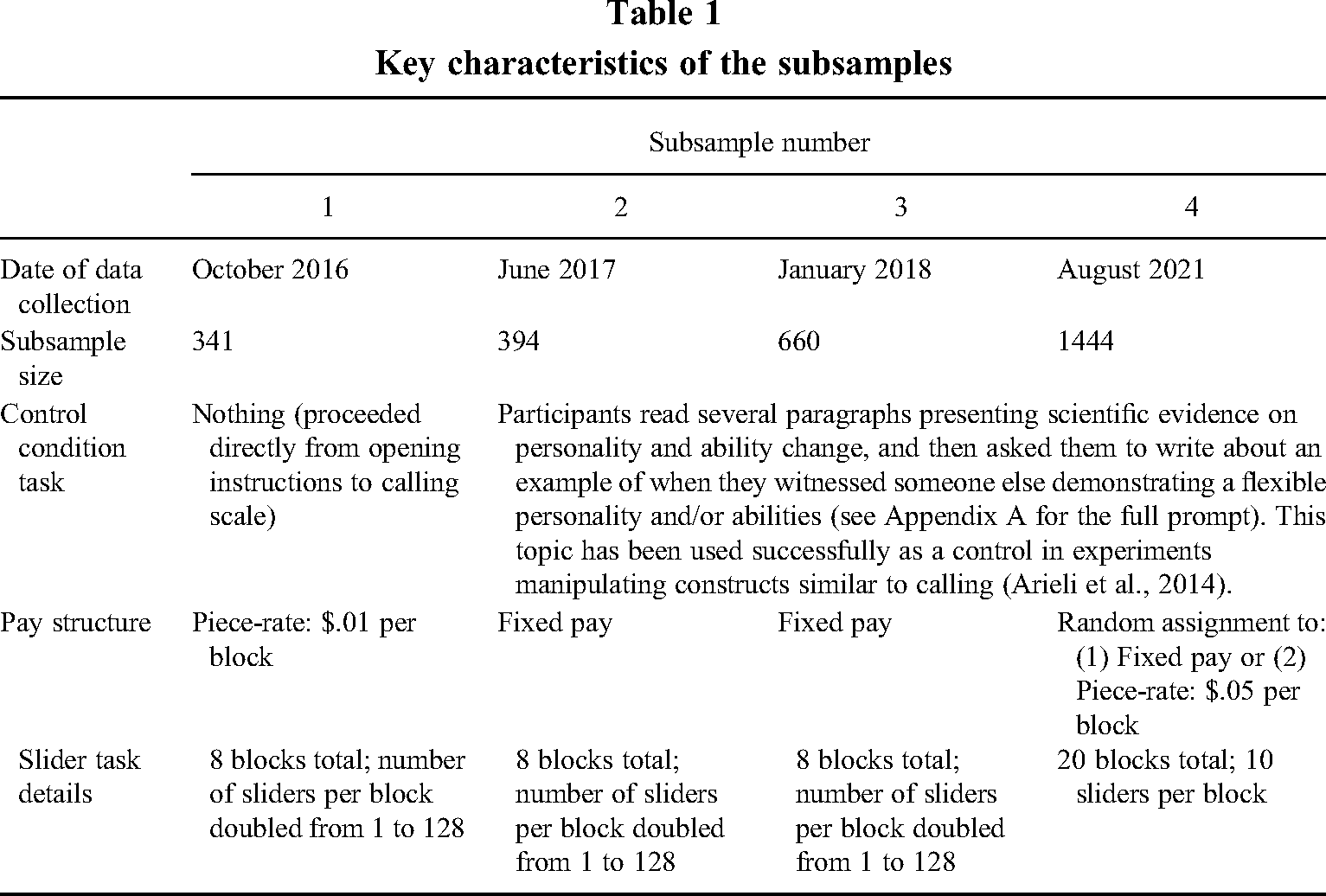
All participants completed study materials online, having been recruited via the MTurk platform. The studies were approved and monitored by the first author's Institutional Review Board (title for all protocols: “The Cost of Calling: Mixed-Method Investigation of the Financial Impact of Pursuing Meaningful Work;” approval numbers: 542 (Subsample 1), 546 (Subsamples 2 and 3), and 916 (Subsample 4)). We stated upfront payment ranging from $.75 to $1.00 per HIT, or task, and in some cases awarded bonus pay to test pay structure as a boundary condition. We required that participants be located in the United States and be at least 22 years old, with HIT approval rates greater than or equal to 95%, and at least 1000 prior approved HITs to ensure that they had sufficient experience on the platform during which to have potentially developed a sense of calling toward MTurk. We excluded the very few respondents who failed an instructed-response attention check item. The final sample included 2,839 participants; descriptives for variables including demographic characteristics are in Table 2. All participants reported their level of calling toward work on MTurk before deciding how much of an effort-based “sliders” task to complete, and subsequently reporting their enjoyment of that task.
Descriptive statistics and correlations between measured variables
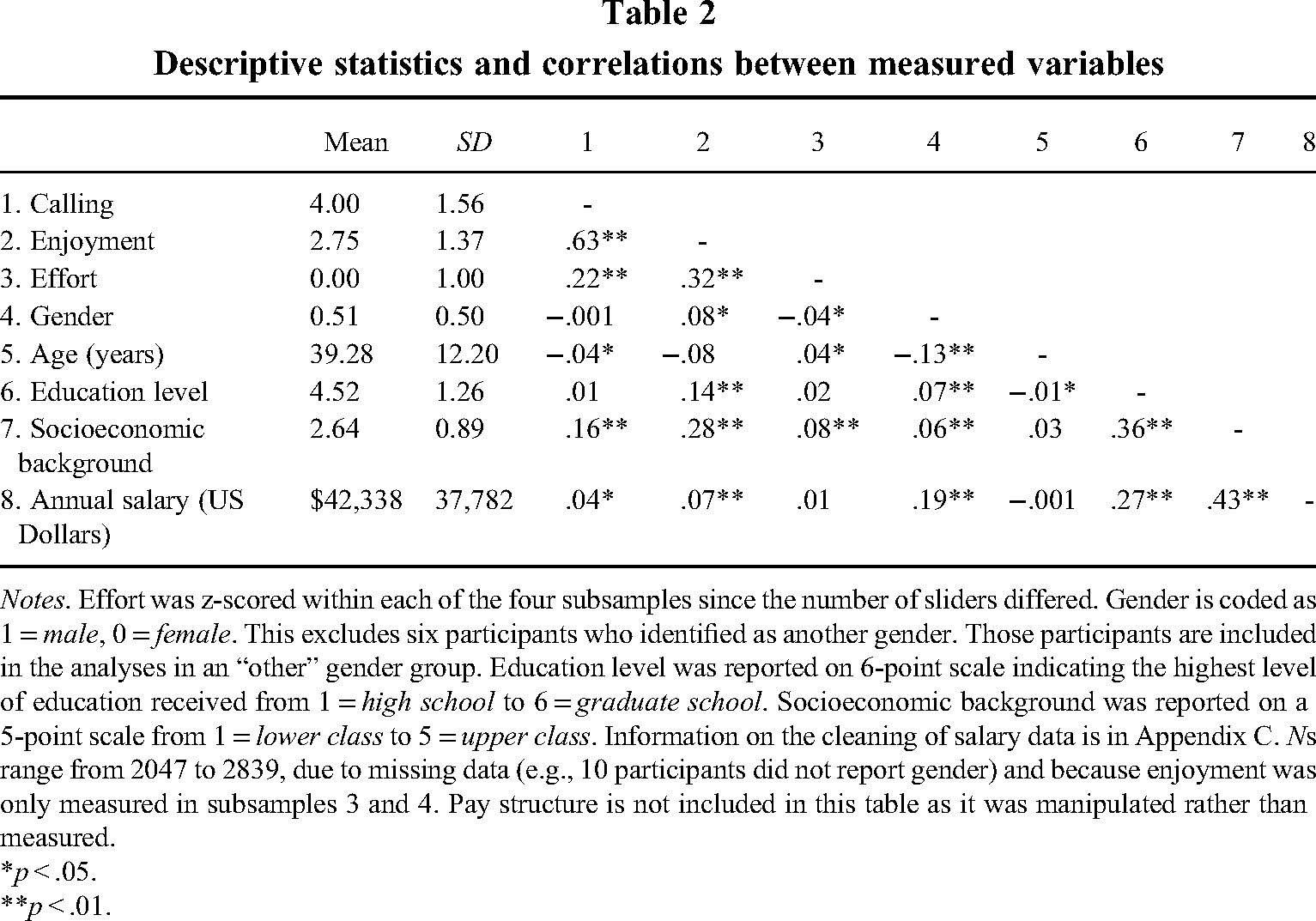
Notes. Effort was z-scored within each of the four subsamples since the number of sliders differed. Gender is coded as 1 = male, 0 = female. This excludes six participants who identified as another gender. Those participants are included in the analyses in an “other” gender group. Education level was reported on 6-point scale indicating the highest level of education received from 1 = high school to 6 = graduate school. Socioeconomic background was reported on a 5-point scale from 1 = lower class to 5 = upper class. Information on the cleaning of salary data is in Appendix C. Ns range from 2047 to 2839, due to missing data (e.g., 10 participants did not report gender) and because enjoyment was only measured in subsamples 3 and 4. Pay structure is not included in this table as it was manipulated rather than measured.
*p < .05.
**p < .01.
Reflecting the original experimental approach of our larger line of research, participants in each subsample were randomly assigned to one of three conditions in a between-subjects design (strong calling, weak calling, control; see Appendix A for the calling manipulation text). However, the effects of the calling manipulation on calling scores were negligible (see Appendix B for these results). However, we realized the data collected could be useful to address the equally important question of how people's level of calling relates to their effort on and enjoyment of a mundane calling-relevant task. In testing the fundamental assumptions in the present study, we largely ignore experimental condition. We include it only as a control variable in our robustness analyses, and our primary focus is instead on how effort and enjoyment are predicted by a self-reported calling scale. Using this measure of calling, versus manipulated calling condition, has the additional advantage of being consistent with most quantitative calling research to-date (Dobrow et al., 2023).
Due to space limitations and fit with this study's focus, we do not describe all measures collected. However, the full text of all materials is publicly available at: https://osf.io/csqg3/?view_only=97752494c44c4bb38593ffc9e915c0ae, along with all of our data and analysis scripts. The sample sizes were determined ahead of time and in some cases (especially those occurring later in time) preregistered. In only one instance were additional observations collected after an initial check of the data, to balance sample sizes across the three conditions. The fundamental assumptions and analyses described here were not preregistered because the data were originally collected as part of a different line of research, as described above.
Materials and measures
We collected measures in all four subsamples, except where noted.
Calling. We used Dobrow and Tosti-Kharas’s (2011) 12-item scale, adapted to be about work on Mechanical Turk specifically, to measure calling (α = .96). Participants used a 7-point Likert scale (1 = strongly disagree, 7 = strongly agree) to rate items such as: “I am passionate about my work on MTurk,” “My existence would be much less meaningful without my involvement in my work on MTurk,” and “I would sacrifice everything to be a Turker (i.e., one who performs work on MTurk).” Calling scale scores, calculated as the mean response to the 12 items, ranged from 1 to 7 (M = 4.00, SD = 1.56).
Effort. We told participants they had reached the final section of the survey, and that in the remaining time their task was to position sliders. Participants did this by clicking the mouse to slide a circular cursor along a horizontal bar from one end (zero) to a specified number value between 1 and 100 (Figure 1). We gave them an example before starting and told them they could stop the task at any time by leaving the page. In Subsamples 2–4, to emphasize the meaningful nature of the task, we adapted the instructions used by Ariely and colleagues (2008) and told participants that their responses would be reviewed by the researchers, also reminding them that completing the survey was helping to advance social scientific research.
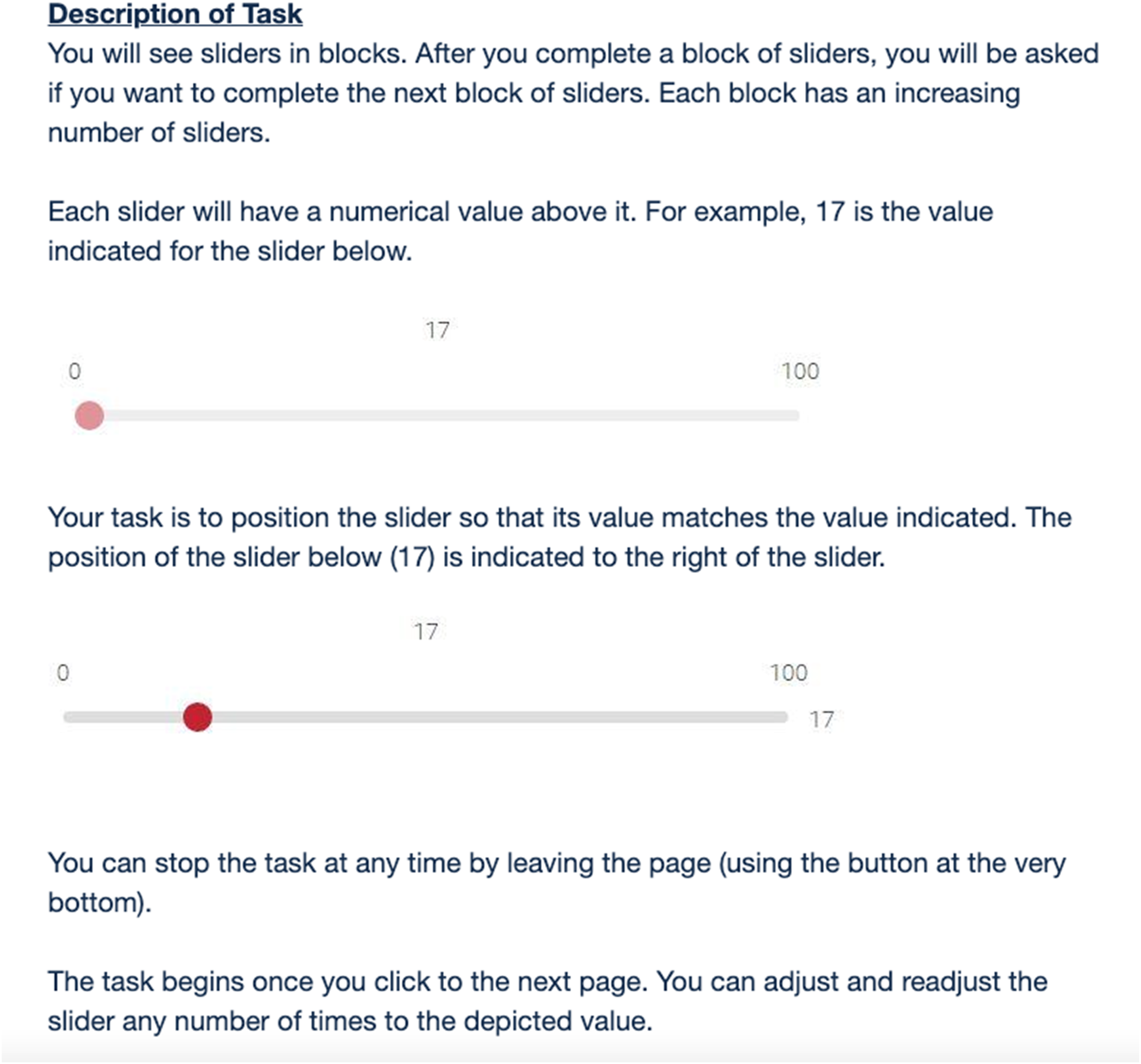
Effort measure: description of slider task provided to participants
Sliders were batched into “blocks” presented on one screen at the same time. When participants completed one block, they could advance to a new screen with an additional block or could exit the task. The number of blocks as well as the number of sliders per block varied between subsamples (see Table 1). Our dependent variable in all instances was the number of slider blocks attempted, which ranged from 0 to 20 slider blocks (the maximum was eight in Subsamples 1–3 and 20 in Subsample 4), M = 3.06, SD = 2.72. We standardized this variable within each subsample to account for these differences. Participants could stop completing the slider task at any time. Once they indicated that they did not want to complete more sliders, they were directed to the final section of the survey, which included demographic questions, and were given a unique code to enter into MTurk to be compensated.
Enjoyment. In Subsamples 3 and 4, immediately after the sliders task, we asked: “How much did you enjoy the sliders task?” (1 = not at all, 5 = extremely).
Pay structure. Participants were either paid a flat amount for completing the study (fixed pay) or received additional pay for additional slider blocks (piece-rate pay). The piece-rate pay condition included participants paid $.01 per block, with blocks of increasing size such that the number of sliders doubled with each new block (Subsample 1; see Table 1) as well as participants paid $.05 per block, with blocks of identical size, in this case 20 sliders each (half of Subsample 4). The pay structure was explained to participants before they began the task, and in Subsamples 2–4 their understanding was verified with three Yes/No questions (e.g., in the fixed pay condition, one such question was: “I understand that I will not be paid anything extra for additional blocks of sliders I complete”) which had to be answered correctly before the task was initiated. We explore whether pay structure changed the relation of calling to effort and enjoyment, thereby acting as a boundary condition of these relationships. That is, in our study design, participants had the option to continue to invest effort on the task we provided, via completing additional blocks of sliders, even though they had already fulfilled their responsibilities and were entitled to pay.
Control variables. Because we used self-reported (rather than manipulated) calling as the predictor variable, we controlled for demographic variables that could have affected participants’ calling, their effort expended, and the enjoyment of their work: gender (two dummies: 1 = female, 0 = other; 1 = male, 0 = other), age (in years), education level (1 = high school to 6 = graduate school), socioeconomic background (1 = lower class to 5 = upper class), and self-reported annual salary (in US $; see Appendix C).
Results
Means, standard deviations, and correlations between variables are in Table 2.
Tests of fundamental assumptions
We tested the two fundamental assumptions using hierarchical regression analyses, one for each of our two outcome variables. Step 1 is the base model, comprised of control variables only. In Step 2, we added the main effects of calling (mean-centered) and pay structure (0 = fixed, 1 = piece-rate). Lastly, we added the interaction of calling and pay structure in Step 3. We estimated these models with listwise deletion, such that those participants with complete information across models were included in the analyses. Specifically, this means that, because enjoyment was collected in Subsamples 3 and 4, only participants from those subsamples could be used to test the second fundamental assumption.
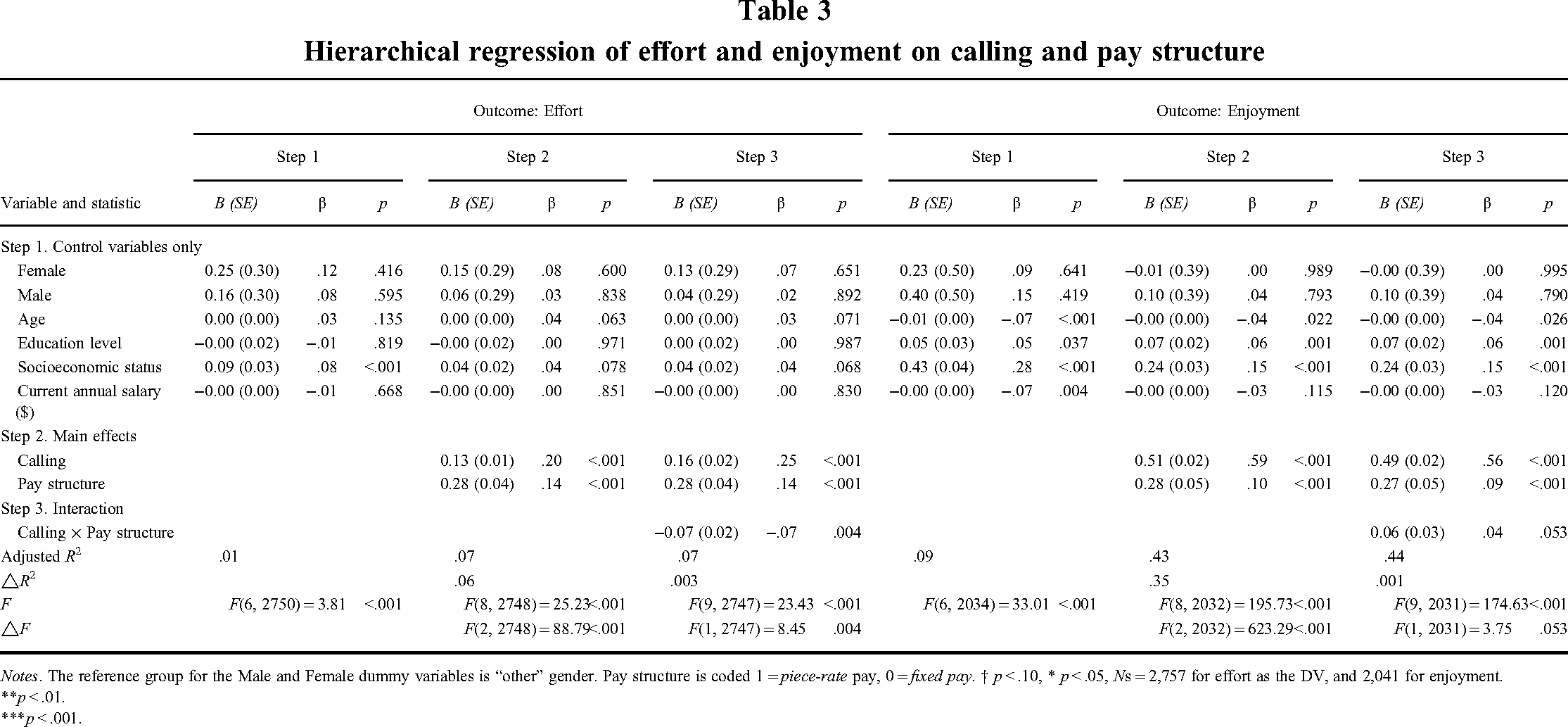
Calling and effort. Supporting the first fundamental assumption that calling predicts more effort on calling-relevant tasks, there was a large positive main effect of calling (standardized ß = .20, p < .001; see Table 3, Step 2). Testifying to the incentive value of pay, there was also a main effect of pay structure (standardized ß = .14, p < .001; see Table 3, Step 2). Fitted values are displayed in Figure 2, showing that participants with an average level of calling attempted about a third of a slider block more under piece-rate pay than under fixed pay.
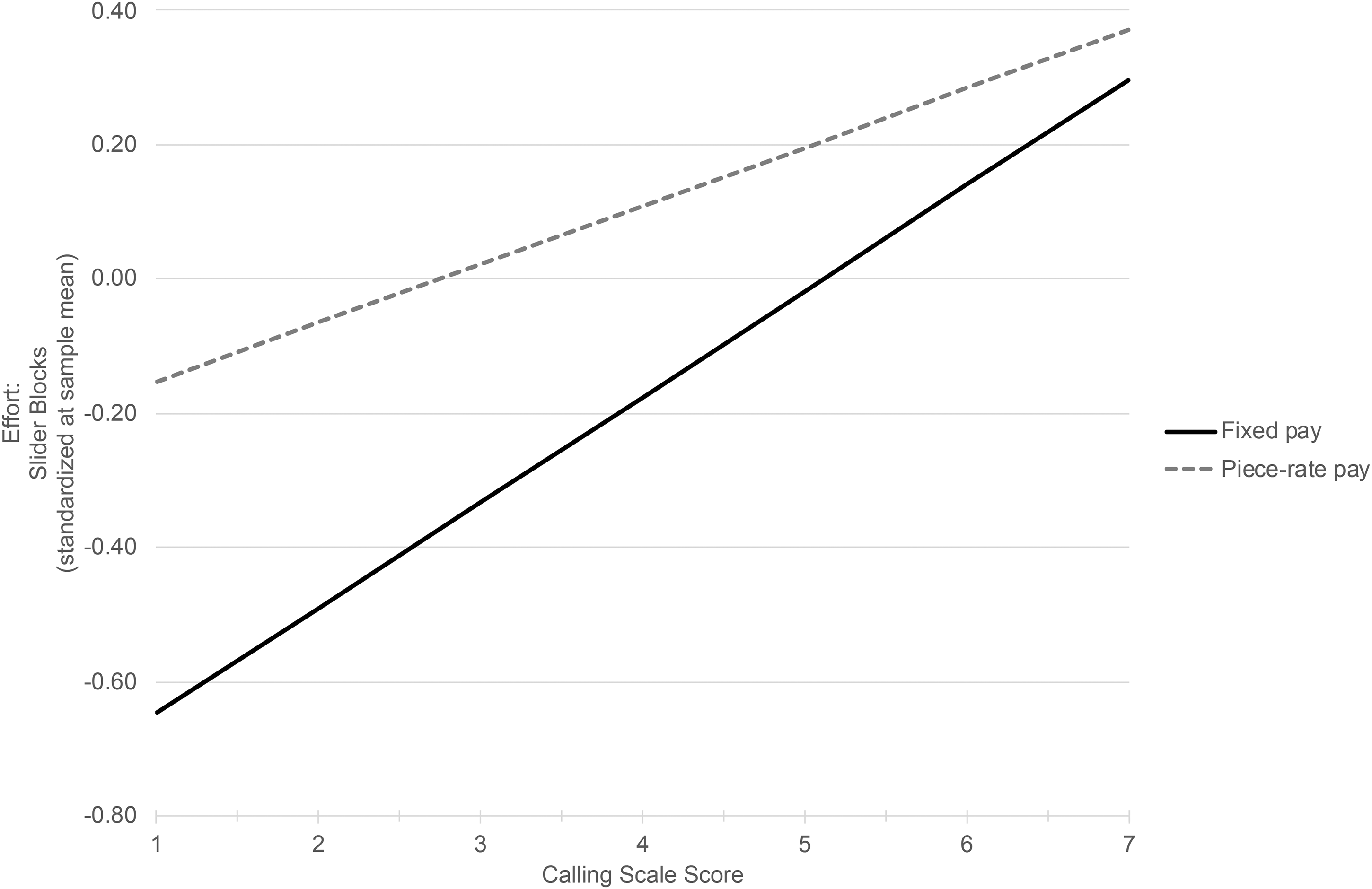
Fitted values of effort (number of slider blocks completed) as a function of calling and pay structure
Hierarchical regression of effort and enjoyment on calling and pay structure
Notes. The reference group for the Male and Female dummy variables is “other” gender. Pay structure is coded 1 = piece-rate pay, 0 = fixed pay. † p < .10, * p < .05, Ns = 2,757 for effort as the DV, and 2,041 for enjoyment.
**p < .01.
***p < .001.
We had wondered whether the calling-effort relation would be present even under piece-rate pay; if not, it would imply that pay structure acts as a boundary condition of the calling-effort relationship. Indeed, we found a significant interaction of calling and pay structure (standardized ß = −.07, p < .01; see Table 3, Step 3). The link between calling and effort was stronger under fixed pay (β = .25, p < .001), than under piece-rate pay (β = .14, p < .001; when the model is run with the pay structure dummy set as 0 = piece-rate pay, 1 = fixed, rather than the coding used in Table 3), as visualized in Figure 2. However, the weaker predictive relation of calling to effort under piece-rate pay was still significantly different than zero, testifying to a continued role of calling in guiding effort even in the presence of financial incentives.
Calling and enjoyment. Supporting the second fundamental assumption that calling predicts more enjoyment on calling-relevant tasks, there was a significant effect of calling (standardized ß = .59, p < .001; see Table 3, Step 2), indicating that overall, participants with a stronger sense of calling found the slider task more enjoyable. There was also a significant effect of pay structure (standardized ß = .10, p < .001; see Table 3, Step 2), indicating that participants who were paid for each slider block found the task more enjoyable.
Evidence that pay structure changed the link between calling and enjoyment was weaker than for effort; the interaction effect of calling by pay structure (standardized ß = .04) had a p-value of .053. Because this value is close to the common threshold of .05 for statistical significance, and because statisticians have cautioned against interpreting nonsignificant effects as equivalent to null effects (Hoekstra et al., 2006; Regina, 2014), it is worth considering what the findings suggest about the possible pattern of results in the larger population from which we sampled. First, the nature of the interaction is different for this outcome measure than for effort. Under fixed pay, calling was a strong predictor of enjoyment (β = .56, p < .001), but under piece-rate pay, the link between calling and enjoyment was even stronger (β = .63, p < .001, when the model is run with the pay structure dummy set as 0 = piece-rate pay, 1 = fixed pay, rather than the coding used in Table 3). Fitted values are displayed in Figure 3.
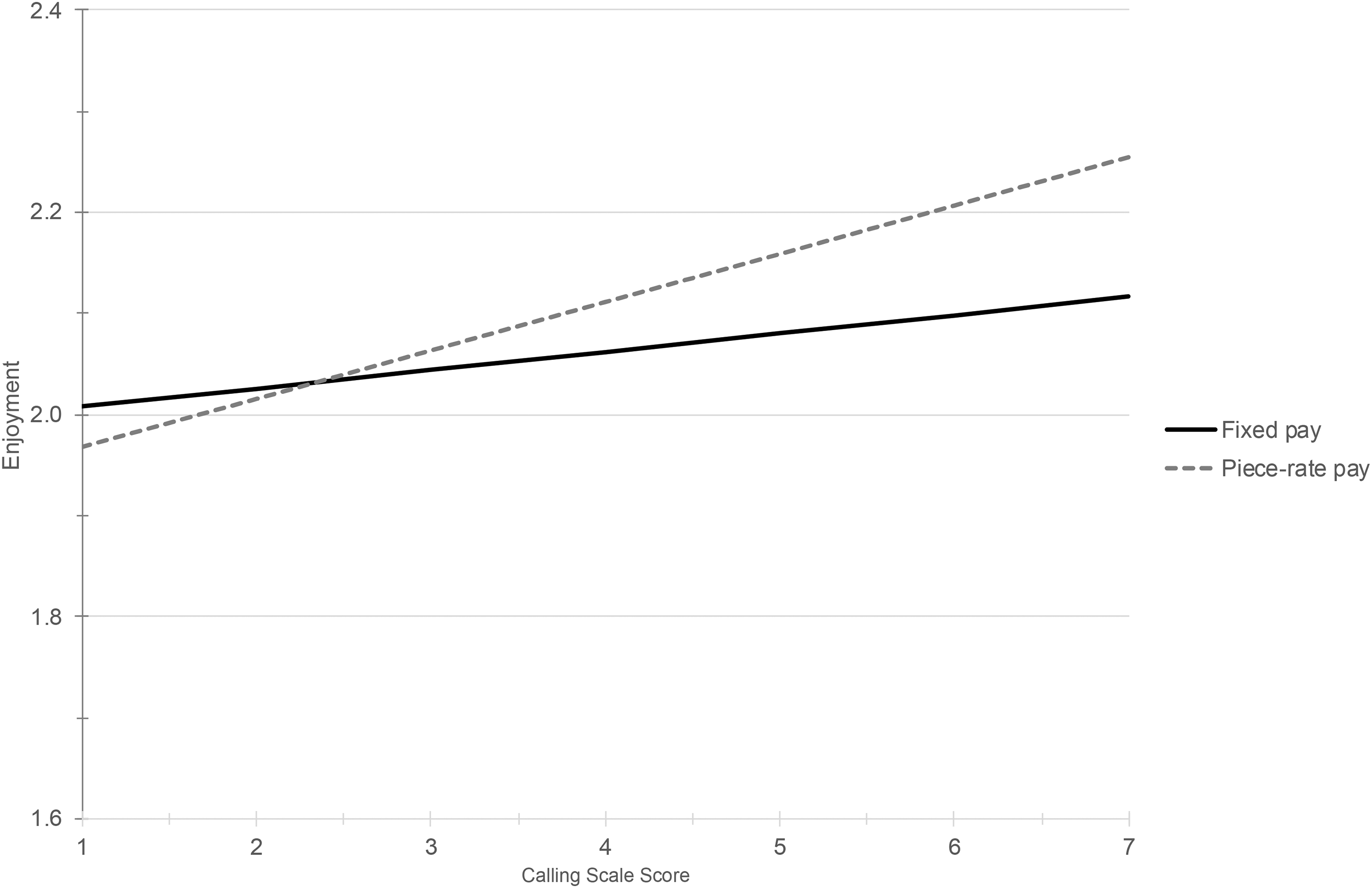
Fitted values of enjoyment as a function of calling and pay structure
Second, however, our results suggest that the magnitude of any interaction effect on enjoyment is small relative to the main effect of calling. The top end of the 95% confidence interval on the unstandardized regression coefficient for the interaction effect (.12) is much less than the low end of the 95% confidence interval for the unstandardized coefficient for calling (.45). Thus, our results imply that even if pay structure was to change the link between calling and enjoyment—which we have little evidence of, given the p-value on the interaction coefficient—it would leave the overall effect of calling present and only subtly changed.
Taken together, our analyses indicate that financial incentives are not a boundary condition for the calling-effort and calling-enjoyment relationships; both links were present under both fixed and piece-rate pay. However, our analyses do provide evidence that pay structure moderated the first of these relationships, such that calling positively predicted effort more strongly under fixed-rate pay. We return to these findings in “Discussion.”
Supplemental analyses
Our analyses use subsamples in which we attempted to manipulate respondents’ current feelings of calling. As discussed above, the effect of the manipulation on calling was small and inconsistent, leading us to repurpose the subsamples to test the fundamental assumptions discussed here. However, to verify that this approach was appropriate, we repeated our focal regression analyses (as displayed in Table 3), adding manipulated calling condition as a predictor. The weak calling condition dummy variable was significant in Step 1, predicting both less effort (β = −.05, p = .02) and less enjoyment (β = −.05, p = .04) than the control condition, whereas the strong calling condition dummy variable was not significant. Once calling itself (scale scores) was added in Step 2, neither condition dummy variable was a significant predictor nor other regression coefficients and significance levels were largely unchanged from our focal analyses. This suggests our use of the subsamples is appropriate.
As an additional robustness check, we repeated our focal analyses separately in each of the different subsamples comprising our full dataset (Table 1). We report these analyses in Appendix D (Tables D1–D4). We were able to test the first fundamental assumption in all four subsamples and found strong support: calling predicted more effort on calling-relevant tasks over and above the control variables in each subsample. We could test the second fundamental assumption only in the two subsamples where enjoyment was measured (Subsamples 3 and 4; see Tables D3 and D4), and again found similarly strong and consistent support for these effects within these individual subsamples. Because pay structure only varies within one of the subsamples (Subsample 4; the other variation we leverage is between subsamples; see Table 1), we could test the effect of pay structure and the interaction effect of calling by pay structure in this single subsample. Consistent with our focal results, the interaction effect of calling by pay structure was significant in predicting more effort. However, this interaction was not a significant predictor of more enjoyment (see Table D4). Overall, these consistent results across subsamples—collected with some methodological differences and at different points in time (e.g., both before and during the COVID pandemic)—lend further confidence to our results.
Discussion
The adage, “Do what you love and you’ll never work a day in your life,” implies that people with strong callings find their work effortless, and that employers can benefit from these employees’ resulting tendency to do more work. We found that people with strong callings did put in more effort on calling-relevant tasks, as demonstrated by completing more tasks. Our results thus provide empirical evidence for this first fundamental assumption, which has been expressed in the literature from both the perspective of individuals’ own callings (Hall & Chandler, 2005) and managers’ perceptions of their employees’ callings (Cho & Jiang, 2022). Our support for this basic tenet of theorizing about calling via a behavioral measure of effort in a real labor market paves the way for further theoretical advances. Interestingly, although prior research has shown that people with strong callings can be particularly selective about how and where they expend their effort (Bunderson & Thompson, 2009; Schabram & Maitlis, 2017), our study found a positive relationship between calling and effort even though the effort task itself, while still relevant to the calling, was mundane and not inherently engaging. It is possible that both patterns of findings exist, in that people with strong callings may indeed spend less effort on more mundane tasks as compared to more engaging tasks, thus making our study a conservative test of the calling-effort relationship. The extent to which a task is particularly meaningful and/or calling-relevant may thus be a moderator of the calling-effort relationship, such that this relationship may be weaker when the task is more mundane and stronger when the task is more meaningful.
Establishing a clear link between calling and effort makes an important contribution to calling research. This relationship has been assumed in the literature, referenced in terms of driving downstream outcomes, but rarely tested outright. For example, effort is often assumed as a key driver of performance, which in turn links calling to objective indicators of career success, such as pay and promotions (Cho & Jiang, 2022). Scholars have theorized effort as an important part of people's ability to meet their calling-relevant goals, which then in turn influences both their objective and subjective career success (Hall & Chandler, 2005). Finally, the effort required to complete work that benefits others is assumed to be part of our ability to contribute to society through our work, affecting not just the individual worker but the wider world (Bryant et al., 2023). Prior to our investigation, these important relationships were based on a link between calling and effort that was widely assumed to be true, but the evidence for which was tenuous at best.
Our results also provide empirical evidence for the second fundamental assumption. Compared to those with weaker callings, people with stronger callings enjoyed even the mundane yet calling-relevant task in our study more than those with weaker callings. This finding is particularly striking because those with stronger callings also spent more time doing the task. Our findings raise the intriguing possibility that people with strong callings may be able to handle, or even cope with, a wide range of work tasks because their strong callings lead them to enjoy these tasks more—that is, their tasks may not “feel” like work. On the other hand, our results concurrently raise the possibility that these employees may be treated unfairly and even potentially exploited for their tendency to enjoy these work tasks, all else equal, compared to their coworkers (Bunderson & Thompson, 2009; Cech, 2021; Kim et al., 2020).
We also sought to explore potential nuance around the two fundamental assumptions by understanding how pay structure might serve as a boundary condition. For the first assumption, we found that the calling-effort relationship was stronger under fixed compared to piece-rate pay. However, it is worth noting that those with strong callings were nevertheless motivated by financial rewards. This finding is important because one could speculate that people with strong callings actually disengage when offered financial incentives; that such extrinsic rewards are off-putting or demotivating to those with strong callings. We tested whether piece-rate pay would emerge as a boundary condition; however, this was not the case. Rather, people with stronger callings put in more effort than those with weaker callings under both pay structures. Yet, even given this result, we still cannot definitively conclude that piece-rate pay is not a boundary condition, because there may be an amount of pay at which the relation would no longer hold. As a thought experiment, if participants were paid $20 per slider block, participants would probably complete all available blocks, leaving no variance in effort to be explained by calling. Our Subsample 4 is the only one in which participants were presented with an incrementally increasing (as opposed to doubling) number of slider blocks with associated incremental increases in pay. In Subsample 4, the average number of slider blocks completed was 3.38 (SD = 3.39) of a possible 20, which amounted to only $.15–.20 additional bonus pay, or 15–20% of the $1.00 base pay. This indicates not only that people expended additional effort to earn some extra pay but also that they stopped well before reaching the maximum amount of bonus pay. This finding, coupled with the reality that we cannot tell how long each slider block took to extrapolate an hourly wage, suggests that more work needs to be done to establish the extent to which a given level of bonus versus baseline pay will serve as a boundary condition. Future research should explore this threshold further.
For the second assumption, we have no evidence, using the common statistical threshold, that pay structure affected the calling-enjoyment relationship. Coefficients observed in empirical samples represent the best estimate of the true population effects. If the population from which we sampled does have a moderation effect—that is, if in this population pay structure changes the way calling relates to enjoyment—then the point estimate for the coefficient that we observed suggests that the nature of this moderation is such that calling predicts higher enjoyment even more strongly under piece-rate pay than fixed pay. This would be consistent with motivation research, which has now debunked the notion that intrinsic and extrinsic motivation “crowd out” each other (e.g., Derfler-Rozin & Pitesa, 2020), instead finding that the two types of motivation are positively correlated with work contexts. Consistent with this line of thinking, we found that money did not crowd out enjoyment for those experiencing a strong calling (i.e., either it had no effect or it actually enhanced enjoyment). Put another way, of the two main reasons someone would invest effort on this task—its meaningful nature, in the form of calling, and its financial rewards—both had an effect on enjoyment. We hope this finding lays the groundwork for more research on the simultaneous presence of multiple motives for behavior (e.g., Chemolli & Gagné, 2014; Wrzesniewski et al., 2014) and the effects for employees and employers.
Study limitations and future directions
One limitation of our approach is the potential for common method bias in the results, which could be partially attributable to respondents’ lay theories about the relationships of calling to effort and enjoyment, which, per the two fundamental assumptions, are typically assumed to be strong and positive (e.g., Cho & Jiang, 2022; Dobrow, 2006). We view our use of an objective, behavioral measure of effort, rather than a self- or other-reported measure (e.g., Kim et al., 2018; Praskova et al., 2014), as a key strength of our research design that helps guard against this concern. Further, our large sample (N = 2,839) is rare in calling research and should build confidence in the robustness of the reported results.
At the same time, our study only assessed behavioral indicators of effort, when in fact effort contains both behavioral and cognitive components. Future research should seek to address whether the relationships reported here hold with a broader measure of effort. In a similar vein, our study design, in which we tested the relationship between calling and subsequent behavior, speaks to the causal relationship between the two variables, but cannot definitively establish it. Further, our study design does not allow us to assess whether calling and effort might have a reciprocal and reinforcing relationship with each other, which future studies could be designed to address.
In addition, our study was limited in that this sample was drawn exclusively from a crowdsourced labor market, which is similar to other contract or contingent labor markets, but might not generalize to other types of work. We encourage future research to examine different types of workers, including those working in a variety of industries, pay schemes, and job roles. We provided a strong test of the fundamental assumptions by designing a task that was inherently so mundane that people with strong callings might disengage from it and not expend additional effort or enjoy it. Effort and enjoyment on more inherently meaningful tasks might be even more strongly linked to calling; but, such tasks, which benefit from differential expertise and interest, also create more noise. We note that, because participants in this study had the option to end our task and switch to another task to make additional money, rather than a design where there is no such alternative, the test of effort might be a conservative one.
Practical implications
In showing that employees with stronger callings put in more effort than their weaker-calling counterparts, we provide evidence for a common managerial assumption—one that may result in those with strong callings being paid more and promoted more frequently (Cho & Jiang, 2022). It would therefore be tempting to advise employees to develop and pursue their callings, and employers to hire those with strong callings. However, we found that those with strong callings put in more effort even when they did not stand to gain financially, consistent with the danger of exploitation by employers (Bunderson & Thompson, 2009; Kim et al., 2020). In our study context, any additional time participants opted to spend on our effort task (i.e., completing more sliders) are time they could have chosen to spend doing other tasks for pay on their crowdworking platform. Our participants’ choices to continue completing sliders without additional pay, particularly in the subsamples where each subsequent block required double the amount of work, were nontrivial. This paradigm is echoed on a larger scale in salaried work, where the amount of pay is typically negotiated up-front and on an annual basis, creating a real concern about equitable treatment for those who put in more effort despite being paid the same amount as those who do not (Bunderson & Thompson, 2009; Cech, 2021). Those with strong callings have been found to make irrational career decisions, in some cases blocking out even well-intentioned career advice (Dobrow & Tosti-Kharas, 2012), which might apply to the effort they expend as well. Strong callings may also be linked to chronic burnout, poor sleep quality, and exhaustion (Clinton et al., 2017). Such observations make the ethical treatment of employees, and the fear that employers may gain at employees’ expense, more salient.
There is one additional practical implication of our findings: the effort gap between weaker and stronger calling participants was much smaller when the financial incentive was piece-rate than when pay was fixed (see Figure 2). That is, weaker-calling participants behaved similarly to stronger-calling participants when they were paid more for doing more work. Indeed, of the two pay structures we examined, the piece-rate pay structure yielded the highest overall effort. It is worth keeping in mind that a strong sense of calling is not the only route to high effort.
Conclusion
Phrases like “do what you love and you’ll never work a day in your life” highlight fundamental assumptions that people who feel a strong calling toward their work will both work harder and enjoy it more. These assumptions have had staying power within both academic research and the popular press, yet they are built on scant empirical evidence. In this study, we refine calling theory by using appropriate and rigorous methods to test the relationship of calling to effort and enjoyment. We also extend this theory by finding that pay structure moderates these relationships. These insights thus set the stage for future research to further explore the ways in which people with strong callings filter and even change their experiences of their work, in terms of cognitions and behaviors, as well as the multiple motivations people experience to perform their work.
Footnotes
Acknowledgments
The authors would like to acknowledge several people and groups whose feedback considerably shaped and advanced this paper. Specifically, the authors thank Amy Colbert, Adam Grant, Danny Heller, Francesca Manzi, Jeff Thompson, Amy Wrzesniewski, the attendees of the 2014 and 2019 May Meaning Meeting, and the London School of Economics Behavioural Science Paper Club.
Declaration of Conflicting Interests
The author(s) declared no potential conflicts of interest with respect to the research, authorship, and/or publication of this article.
Funding
The author(s) received no financial support for the research, authorship, and/or publication of this article.
