



Abstract
This study presents a multilevel investigation of neurodivergence in relation to psychological safety, relationship quality, and team identification. Moreover, it examines the influence of awareness and social acceptance of neurodiversity on these relations. Utilizing a sample of 70 teams, we disentangle within-group and between-group effects and discuss the differences. Our findings indicate that neurodivergent individuals report lower perceived psychological safety, leading to diminished team identification and relationship quality. However, teams with a high proportion of neurodivergent members report higher psychological safety at the group level, suggesting that neurodiverse teams, on average, experience higher psychological safety, relationship quality, and team identification.
Keywords
Introduction
Modern organizations employ diversity management practices to enhance their inclusivity by implementing various measures, such as policies, employee networks, and training programs, to support diverse workforces (Hennekam & Follmer, 2024). While traditionally these practices focused mainly on surface-level diversity characteristics such as race and gender (Herring, 2009; Mahto et al., 2022), recent years have shown growing attention to neurodiversity, a particular form of deep-level diversity that encompasses the natural range of distinct ways in which human cognition processes information (Goldberg, 2023). As a result, neurodiversity has increasingly become an integral part of diversity-management policies and practices. These practices range from top-down measures, such as mandatory neuro-inclusiveness training for managers and coworkers (Hennekam & Follmer, 2024), to bottom-up initiatives driven by employees, including neurodiversity networks that support neurodivergent employees in work environments (van Rijswijk et al., 2025a), serving as both a safe haven and advocacy mechanism for neurodiversity (van Rijswijk & Curşeu, 2025a). These practices aim to foster greater awareness of neuro-inclusivity and of the position of neurodivergent employees. Neurodivergent employees are individuals who meet, to some degree, the diagnostic criteria for one or several neurodevelopmental conditions (autism, attention deficit hyperactivity disorder (ADHD), dyslexia, etc.), whether formally diagnosed or not (Apperly et al., 2024; van Rijswijk & Curşeu, 2025b). These individuals often face difficulties participating in work processes because the expectations held by colleagues and managers do not match the way their neurodivergent cognition functions. Despite the increased attention of companies to neurodiversity policies, the participation of neurodivergent people in work processes remains a structural problem. This is reflected in high unemployment rates, such as the estimated 72%–86% among individuals with autism in the United States, Canada, Australia, and European countries (Bury et al., 2024; Mahto et al., 2022), as well as high burnout rates linked to masking behaviors (Hazlett, 2025; Tomczak & Kulikowski, 2024). Although scholars have shown that neurodivergent employees, due to their uniquely wired brains, can benefit organizations in many ways and offer a competitive advantage (Krzeminska et al., 2019; van Rijswijk et al., 2024a, 2024b), this occupational minority still often faces problems such as social marginalization and various relational challenges at work.
The concept of neurodiversity reflects the composition of a social system (group or organization) with respect to the neurocognitive profiles of its members or as a differentiation between neurotypical and neurodivergent employees (Apperly et al., 2024; van Rijswijk et al., 2024a, 2025b). Scholars describe neurodiversity as a double-edged sword (Goldberg, 2023), referring to the benefits and challenges associated with integrating neurodivergent employees into work processes. This duality raises the question of what factors can promote an inclusive work environment in which neurodivergent employees feel safe to take interpersonal risks and capitalize on their cognitive advantages while minimizing the relational challenges. Psychological safety has emerged as an important construct in this discussion, as the study of McIntosh et al. (2022) suggests that psychological safety not only predicts the proactive disclosure of neurodivergent conditions but also enables employees to thrive at work. In addition, the recent study of McDowall et al. (2025) shows that psychological safety, together with other factors, positively influences career satisfaction and reduces neurodivergent employees’ turnover intention. These findings suggest that psychological safety is a critical enabler for neurodivergent talent to flourish in work contexts. To date, however, the concept of psychological safety has only been limitedly investigated in neurodiversity research. Most of the neurodiversity studies that discuss the role of psychological safety exclusively focus on organizational or individual-level policies and practices (Hennekam & Follmer, 2024; Szulc et al., 2021), with minimal attention to these factors at the team level. Van Rijswijk et al. (2024a) mentioned that the scarce team-level neurodiversity research has been exclusively conducted among students, and since that publication, new team-level research regarding neurodiversity is mainly focused on group composition, group hierarchy, and leadership instead of emergent states (e.g. Praslova, 2025; van Rijswijk et al., 2025b). Consequently, the association between neurodivergence and relational group constructs, such as team psychological safety and its impact on team identification and team satisfaction, still remains a “black box.”
In this study, we take the first step to explore this gap in understanding the role of psychological safety in neurodiverse teams by answering the following research question: “What is the effect of neurodiversity on psychological safety, and to what extent does this impact group identification and relationship quality in teams?” We build on the notion that psychological safety captures a work climate perceived to be interpersonally safe (Edmondson & Bransby, 2023) to test a theoretical model in which psychological safety mediates the association between neurodivergence on the one hand and identification with the team and relationship quality on the other hand. Moreover, we explore the moderating role of awareness of neurodiversity in the association between neurodivergence and psychological safety, as well as the moderating role of social acceptance in the association between neurodivergence and both team identification and relationship quality.
Our paper is pioneering in its analysis of neurodiverse group dynamics, employing multilevel analysis on intact workgroup data to evaluate both within-group and between-group effects of neurodiversity on psychological safety, relationship quality, and team identification. This methodological approach allows for a more nuanced and comprehensive understanding of how neurodiverse teams function, considering the nested nature of individuals who work together in groups. By employing multi-level analysis, we show that what is experienced at the neurodiverse team level does not necessarily align with the experiences of neurodivergent individuals and vice versa. We offer, thereby, valuable insights into the dual nature of the impact of neurodiversity on team dynamics and the intricate interaction of mechanisms at the individual and group level. Our paper is among the first to examine emergent states in neurodiverse groups, and it responds to the call for more research on the relational impact of neurodiversity in teams (van Rijswijk et al., 2024a). Moreover, it extends our understanding from earlier individual-level investigations of psychological safety in neurodiverse contexts (McDowall et al., 2025; McIntosh et al., 2022) by relating this construct to organizational identification and relationship quality among team members.
Theory and Hypotheses
The concept of neurodiversity refers to recognizing neurological differences among people emerging from natural evolutionary processes as a form of social differentiation with broad implications for group functioning and effectiveness (Goldberg, 2023; van Rijswijk et al., 2024b). Within this concept, two primary subcategories or terms are generally distinguished. On the one hand, there are neurodivergent individuals, occupational minorities who (whether formally diagnosed or not) identify with one or several neurological conditions such as autism, ADHD, and dyslexia (Dwyer, 2022). Studies indicate varying percentages of neurodivergence in the labor market, but the consensus among scholars is that around 15%–20% of the workforce is neurodivergent (Rollnik-Sadowska & Grabińska, 2024). Many of these employees never receive a reliable formal neurological diagnosis because employees tend to avoid the risk of stigmatization, the substantial costs associated with obtaining a formal diagnosis, and the complexities of navigating through the healthcare system (Fellowes, 2024). On the other hand, as an occupational majority, neurotypical employees are characterized by a neurologically “typical” cognitive functioning (Dwyer, 2022). These employees set the social norms, and the work contexts and processes are often shaped to their needs and expectations. As a consequence, integrating neurodivergent individuals into work processes can be challenging due to their different needs regarding social interactions and working methods, frequently resulting in significant stress, masking behaviors, burnout, and low levels of well-being for neurodivergent individuals (Cage et al., 2018; Pryke-Hobbes et al., 2023).
Although different neurodivergent conditions deviate in various ways from the neurotypical norm and, therefore, to some extent are likely to exert differentiated effects on team collaboration, recent studies show that these conditions share essential commonalities. Traditional diagnostic frameworks, such as the Diagnostic and Statistical Manual of Mental Disorders, Fifth Edition (DSM-5), have for decades categorized neurodevelopmental conditions as stand-alone clinical entities with fixed boundaries, but in recent years, this assumption has been increasingly questioned. For example, a study by Apperly et al. (2024) shows that there is a significant similarity between the characteristics and experiences of neurodivergent individuals. As visualized in Figure 1, the social, cognitive, and emotional similarities among neurodivergent individuals, identified using a broad range of psychometric instruments, were labeled as “the N-factor” (Apperly et al., 2024). Drawing on these empirical findings, an increasing body of research supports a transdiagnostic approach that emphasizes mechanisms extending across diagnostic boundaries. This shifting paradigm, described by Astle et al. (2022) as a “transdiagnostic revolution,” responds to persistent problems with the traditional diagnostic approach, such as arbitrary thresholds for diagnoses, high variability within the traditional diagnostic categories, and the significant overlap between diagnoses. Therefore, as Fletcher-Watson (2022) described, a move to a transdiagnostic paradigm is inevitable to utilize the possibility of uncovering genuine new insights, along with meaningful effects on practice, impacting people's daily lives. Based on such a transdiagnostic approach, we consider neurodivergence as a broad category of social differentiation. Because of the transdiagnostic similarities across different forms of neurodivergence (Apperly et al., 2024; Astle et al., 2022) and because neurotypical group members are likely to broadly categorize neurodivergent individuals as being different (in terms of their social, cognitive, and emotional functioning), we conceptualize group neurodiversity as group differentiation in terms of the neurotypicality of its members.

A trans-diagnostic approach based on the “N-factor.”
In this article, we focus on neurodiversity in teams. During group interactions, shared perceptions, attitudes, and emotions emerge while interaction processes unfold, and these epiphenomena of team interactions are labeled as group emergent states (Marks et al., 2001). In line with a complex adaptive systems perspective on teams, these emergent states reflect the team as a whole; therefore, they are part of global team dynamics that co-evolve with the local and contextual dynamics (interaction between team members and the team environment) (Curşeu, 2006) and serve as critical determinants of effective collaboration and, ultimately, team success and well-being (Kozlowski & Ilgen, 2006; Mathieu et al., 2008; Reinert et al., 2024). Emergent states are thus global, ostensive, coherent, and novel characteristics that are multilevel in nature and are influenced by the local dynamics shaped by team composition (Curşeu, 2006; Waller et al., 2016), yet the literature to date has not explored their occurrence and interplay in neurodiverse teams. Such emergent states are shaped by individual cognitive evaluative processes, as well as by group-level interpersonal interactions, and joint sense making (Rapp et al., 2021; Waller et al., 2016). van Rijswijk et al. (2024a) argue in their (neuro)cognitive group diversity framework, on the one hand, that various neurotypes (neurotypical vs. neurodivergent) are likely to experience psychological safety in teams differently, while, on the other hand, at the team level, neurodiverse teams often face relational dissolution processes in which negative team emotions, relationship conflict, and minority domination negatively impact cognitive-affective states such as psychological safety, team identification, and relational climate. Team identification refers to the extent to which individuals perceive themselves as belonging to a team, considering the team's failures and achievements as at least partly their own (Gwinner & Swanson, 2003; Shamir & Kark, 2004). In line with the key tenets of social identity theory (SIT, Ellemers & Haslam, 2012), team identification is fostered by perceived interpersonal similarity with the other group members and the extent to which the group is perceived as a safe interpersonal haven. Therefore, team identification can be endangered by social categorization processes in teams that reinforce group faultlines, making neurodivergent minorities feel less supported by their neurotypical peers (Homan & van Knippenberg, 2014; Santuzzi et al., 2014). Neurodivergent team members often think and behave differently compared to their neurotypical peers, stimulating their perception of “being different” and sometimes even leading to masking behaviors as they control their natural behavioral tendencies in order to fit into social groups (Pryke-Hobbes et al., 2023). We expect that such self-categorization, along with actual differentiation in their ways of thinking and behaving, may lead to reduced social integration and lower team identification for neurodivergent individuals compared to their neurotypical counterparts. Additionally, increased team conflicts, often associated with diverse teams, can further erode the relationship quality and perceived team identification (Dahlan et al., 2023; Srikanth et al., 2016). Relationship quality among team members is characterized by mutual supportive interactions based on trust, respect, and understanding (Szostek, 2019; Szostek et al., 2023) and is compromised by miscommunication and strong group faultlines. We summarize the different positive and negative group processes on emergent states in Figure 2.

The multilevel model of neurodiversity in relation to psychological safety, team identification, and relationship quality.
Based on this, we expect that the relative number of neurodivergent team members negatively impacts the beneficial group emergent states of team identification and relationship quality, and therefore, we hypothesize the following: H1: Neurodivergence is negatively associated with team identification and relationship quality.
One of the most important emergent states for team outcomes is psychological safety (Frazier et al., 2017; Newman et al., 2017), defined as a shared belief among team members that the team is a safe place for taking interpersonal risks (Edmondson, 1999). Beyond interpersonal comfort, psychological safety is widely understood as a key factor in promoting shared growth, reducing errors, and fostering innovation, as it allows members to contribute ideas and speak openly about challenges without fear of negative consequences (Edmondson & Lei, 2014). In line with the taxonomy of emergent states presented by Rapp et al. (2021), psychological safety is an affective state that is shaped by team composition, and as such, group members may vary in their perceptions of safety (Waller et al., 2016). In the case of neurodivergent team members, regardless of whether they have shared their neurodivergent condition with colleagues or not, two factors may affect psychological safety both at the individual and team levels. First, several neurodivergent conditions involve challenges in interpreting or dealing with social interactions (Baron-Cohen, 1997; Lauder et al., 2022) that can cause feelings of exclusion and negatively impact an individual's sense of psychological safety. Second, neurodivergent team members often face negative social categorization processes that also lead to marginalization and alter their perceptions of psychological safety (Johnson & Joshi, 2016). However, when neurodivergent individuals perceive psychological safety within their team, they experience a relational space where they feel valued and understood and a cognitive space where they can (safely) fail and learn (Edmondson, 1999; Edmondson & Lei, 2014). In line with the key tenets of SIT (Ellemers & Haslam, 2012), psychological safety reflects a group climate that is attractive for members to identify with and to establish and maintain close interpersonal relations. This sense of interpersonal security promotes more cohesive interpersonal relationships (Roberge & van Dick, 2010; Shore et al., 2011) that foster identification and the positive perceptions of the interpersonal group climate. Hence, we argue that safety perceptions are primary affective reactions (Rapp et al., 2021) that emerge from interpersonal differences and similarities in neurodiverse teams and ultimately shape the level of team identification and the perceptions of relational climate in teams. In other words, we argue that psychological safety is a central mechanism that translates the experiences of neurodivergent team members into several positive emergent states at the group level. This leads us to our second hypothesis: H2: Psychological safety mediates the association between neurodivergence on the one hand and team identification and relationship quality on the other hand.
Awareness about neurodiversity among team members refers to the recognition and understanding of the neurodivergence features that eventually (but not inherently) can lead to supportive practices and mitigate the relational challenges that neurodivergent individuals sometimes face during social interactions (Bruyère & Colella, 2023; Buder et al., 2021). Gafoor (2012) describes awareness as a state of being cognizant, informed alert, and knowledgeable conscious. Although awareness, unlike acceptance, does not necessarily involve fully embracing differences among group members, it is an important step for reaping the benefits of neurodiversity, especially in terms of cognitive and relational resources (Janssen & Bodemer, 2013). Despite the fact that awareness of neurodiversity has not yet been studied in depth in teams at work, several organizational-level studies show an important contribution in fostering safe and neuro-inclusive work environments, and conversely, that a lack of awareness is detrimental to neuro-inclusion (Doyle, 2020; Khan et al., 2023). Interventions such as neurodiversity awareness training programs and approaches based on communities of practice can be instrumental in developing such awareness (Schuck & Fung, 2023; Zahir et al., 2024). On the practical side, in the case of benevolence among team members, increased awareness can lead to adjustments in work processes that eliminate some barriers for neurodivergent individuals. This includes the (in)formal redistribution of tasks within a team, helping members feel more comfortable in relation to their teammates and their responsibilities. Awareness of the diverse cognitive profiles of team members can lead to more effective task allocation by leveraging the cognitive strengths of neurodivergent individuals while minimizing their exposure to tasks that align with their areas of difficulty. Ultimately, such supportive practices stemming from an elevated neurodiversity awareness alleviate the detrimental effects of social categorization and enhance psychological safety in teams (Edmondson & Lei, 2014), leading us to the following hypothesis: H3: Awareness of neurodiversity reduces the negative association between neurodivergence and psychological safety in teams and, therefore, attenuates the indirect association with team identification and relationship quality.
Neurodiversity awareness and social acceptance reflect different degrees of engagement. Feeling valued by teammates is crucial for an individual's identity and self-esteem (Leary, 2001). Social acceptance, encompassing the appreciation of team members’ unique ways of participating and contributing to social team settings, is an important determinant of team dynamics and outcomes (Curşeu & Schruijer, 2023; Curşeu et al., 2017). In order to secure social acceptance and avoid negative stereotyping or prejudices, neurodivergent individuals often cover their “true identity” to colleagues, hindering the development of both self-acceptance and social acceptance in working groups (Cook et al., 2024). Embracing neurodiversity at work promotes positive social interactions and integration, enhancing overall emotional well-being and reducing social categorization processes, discrimination, and marginalization (Cage et al., 2018). Social acceptance is a social and emotional mechanism that impacts, in particular, emergent states with a strong emotional component, such as relationship quality and team identification (DeWall & Bushman, 2011). These positive effects, in turn, contribute to the emotional bonding within teams. Therefore, while we expect that, in general, neurodivergence negatively impacts these group emergent states, we expect that social acceptance of neurodiversity will positively mitigate this effect, and we hypothesize the following: H4: Social acceptance of neurodiversity attenuates the negative association between neurodivergence on the one hand and team identification and relationship quality on the other hand.
Emergent states in groups are epiphenomena of interpersonal interactions and comprise cognitive, emotional, and social states that are global, ostensive, coherent, and radically novel, meaning they cannot be reduced to the experiences of individual group members (Waller et al., 2016). Recognizing that individual interactions lead to emergent group states, developing a comprehensive picture of how these dynamic group states evolve requires a multilevel study approach (Rapp et al., 2021). Emergent states arise from the initial stages of team formation and can gradually stabilize as shared beliefs and understandings develop among group members (Edmondson & Harvey, 2018; Harvey et al., 2019). Studying these complex phenomena at both individual and group levels allows scholars to distinguish individual behaviors from group behaviors, but more importantly, it reflects how individual attributions aggregate towards and influence group behavior, and thus enriches theoretical knowledge on group dynamics as it provides a more nuanced picture of the role of social interactions (Cronin et al., 2011). From this perspective, we distinguish within-group and between-group neurodiversity effects in our study. Within-group effects capture the impact of being neurodivergent on subsequent perceptions of emergent states, whereas between-group effects capture the impact of the relative proportion of neurodivergent team members on group-level differences in emergent states. By differentiating within and between group effects, we acknowledge that team emergent states are not just a sum of individual behaviors but arise in dynamic interactions among group members.
Methods
Data for this study was collected as part of a broader survey investigating neurodiversity and cognitive diversity in teams. A snowball technique was used to recruit participants, starting with initial contacts who then referred one or more teams to participate. We aimed at collecting data on intact teams, and the final sample has a diverse representation of teams as it consists of 357 individuals nested in 70 teams, spanning 19 different Dutch organizations across seven different sectors: construction industry, banking, pensions and insurance, employee recruitment, IT, education, and healthcare. To protect the anonymity of participants, we limited our demographic data collection to two key variables: educational level and team tenure. These variables were selected as they are essential for our analysis while minimizing the risk of identifying individual participants. The study was reviewed and approved by the Ethical Review Board of the Open Universiteit, the Netherlands.
Results
The means, standard deviations, and correlations are presented in Table 1.
Means, Standard Deviations, and Correlations.
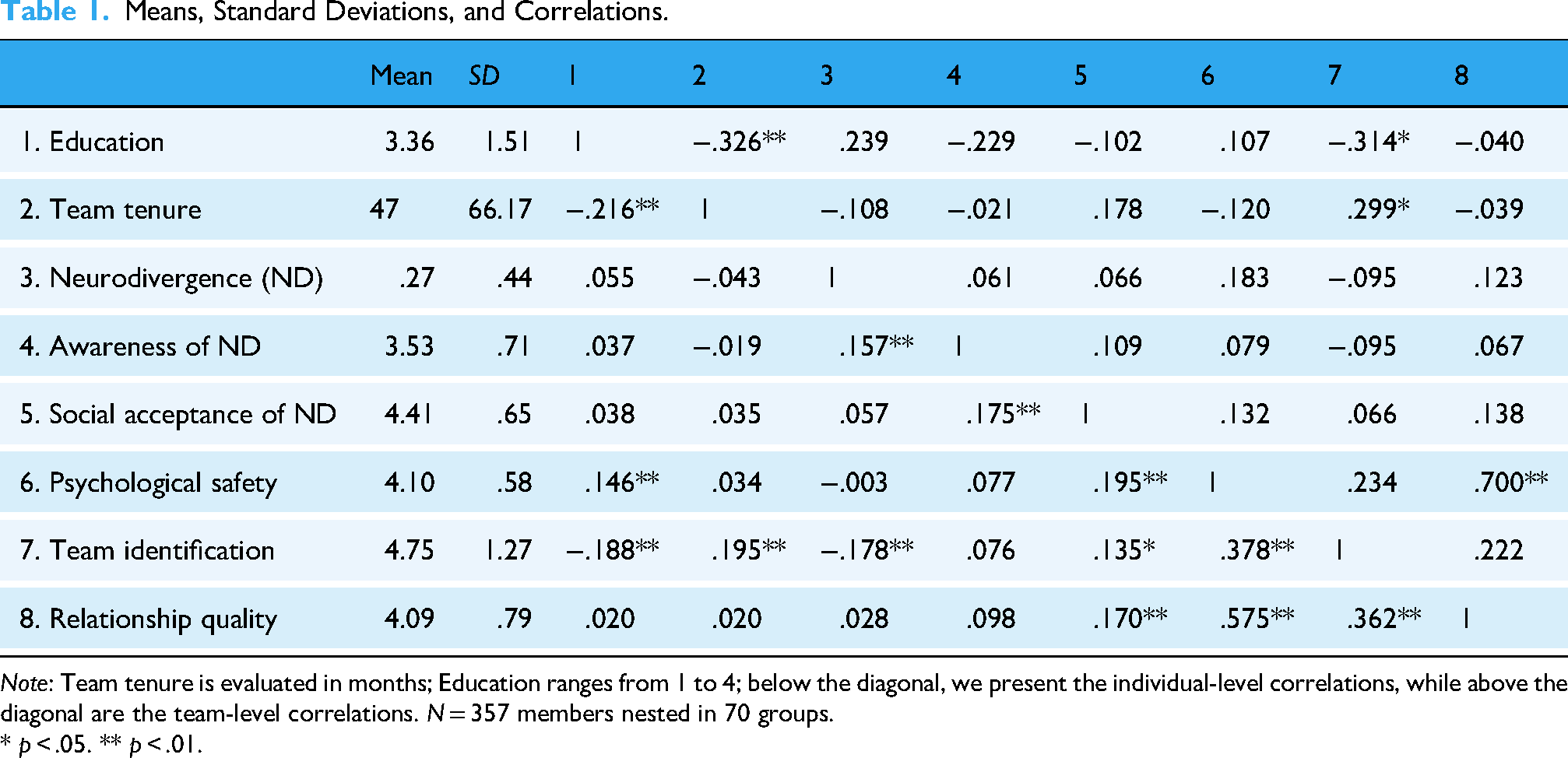
Note: Team tenure is evaluated in months; Education ranges from 1 to 4; below the diagonal, we present the individual-level correlations, while above the diagonal are the team-level correlations. N = 357 members nested in 70 groups.
* p < .05. ** p < .01.
We collected data from employees nested in teams, and therefore, we used multilevel analyses to analyze the data. We first carried out confirmatory analyses within and between groups to check whether the data fit the theoretical measurement model. We have tested several models, including a model with a single underlying factor, to check the extent to which common method bias raises significant concerns. The results and the short description of the models are presented in Table 2.
Results of the Confirmatory Factor Analysis Within and Between Groups.

Note: The five-factor model included all items associated to their respective scale as indicated by the theoretical measurement model, the two-factor model included all items evaluating emergent states in a single factor and the other items in a different factor, while the five-factor model with one latent variable included checked the extent to which CMB raises concerns for our study; in models with covariates, the latent variables were allowed to co-vary, while in the models without covariates, the latent variables were not allowed to co-vary. df = degrees of freedom; CMIN/df = minimum discrepancy divided by degrees of freedom; RMSEA = root mean square error of approximation; CFI = comparative fit index; TLI = Tucker–Lewis index; NFI = normed fit index; AIC = Akaike information criterion; BCC = Browne-Cudeck criterion; CMB = common method bias.
As indicated in Table 2, the best-fitting model is the five-factor model with a covariate, and although the between-fit indices are lower due to a smaller sample size (Dyer et al., 2005), all fit indices reflect a good fit between the measurement model and the data. Moreover, the within-group agreement indices, as well as the ICC scores reported for each of the scales, support multilevel analyses.
Because we hypothesized an indirect effect, we used the MLMed macro Beta 2 Version for SPSS developed by Rockwood and Hayes (2017), an analytical procedure that disentangles the within-groups from between-group effects. In line with the theoretical grounding of emergent states as multilevel phenomena (Rapp et al., 2021), the multilevel modeling allows us to understand the association between neurodiversity and the emergent states across groups (group level effects) as well as their interplay across individuals (within-group effects). With respect to neurodivergence, within-group models capture differences between neurotypical and neurodivergent group members in their perceptions of emergent states, while the between-group models capture the group composition effects on the group-level scores for the same emergent states. All continuous variables were grand mean-centered before the analyses (Enders & Tofighi, 2007). In order to check the robustness of our findings, we have tested the hypotheses using two models, the first one with no control variables and the second including education and team tenure as control variables. The results of the multilevel mediation are presented in Tables 3 and 4.
Results of the Within-Between Multilevel Analyses Predicting PS.

Note: Unstandardized coefficients are presented in the table with SE in parentheses; ND = neurodivergence coded as a dummy variable with 1 = neurodivergent group member and 0 = neurotypical group member; PS = psychological safety.
* p < .05. ** p < .01.
Results of the Within-Between Multilevel Analyses for the Dependent Variables.

Note: Unstandardized coefficients are presented in the table with SE in parentheses; ND = neurodivergence coded as a dummy variable with 1 = neurodivergent group member and 0 = neurotypical group member; TI = team identification; RQ = relationship quality.
p < .10. * p < .05. ** p < .01. *** p < .001.
From the control variables, team tenure had a positive within-group association with psychological safety (B = .001, SE = .0005, p = .02), as well as a between-group association with identification with the team (B = .006, SE = .002, p = .002). Education had a negative within-group association with identification with the team (B = −.17, SE = .05, p = .001), as well as a negative association between groups (B = −.16, SE = .07, p = .03). Concerning the moderating variables, awareness of neurodiversity had a positive between groups association with psychological safety (B = .16, SE = .06, p = .01), revealing that groups reporting a higher average of neurodiversity awareness also report higher levels of psychological safety compared to groups scoring on average lower on awareness of neurodiversity. In terms of hypothesized relations, neurodivergence had only a significant negative within-groups association with team identification (B = −.48, SE = .15, p = .002), showing that neurodivergent group members tend to report generally lower team identification than neurotypical group members, which offers partial support for Hypothesis 1. The mediating effect of psychological safety in the relation between neurodivergence and team identification was negative within groups (B = −.12, SE = .06, 95% CI [−.25; −.005]), as well as positive between groups (B = .35, SE = .18, 95% CI [.03; .75]) because the confidence intervals did not include zero. These results provide initial support for Hypothesis 2, yet the two indirect effects are different, as the within-group indirect association was negative, while the between-group association was positive, following the differences observed by the main effect of neurodivergence on psychological safety. The other indirect associations between neurodivergence and relationship quality within groups were also significant, as the 95% confidence intervals did not include zero. The indirect association between neurodivergence and relationship quality was negative within groups (B = −.09, SE = .05, 95% CI [−.19; −.004]), as well as positive between groups (B = .36, SE = .18, 95% CI [.03; −.73]), lending additional support for Hypothesis 2. The interaction between neurodivergence and awareness of neurodiversity was not significant for psychological safety, as all confidence intervals included zero; therefore, Hypothesis 3 was not supported by the data. The interaction between neurodivergence and social acceptance of neurodivergent group members was significant within groups for team identification (B = .83, SE = .27, p = .003). The interaction effect is presented in Figure 3, and it is aligned with the hypothesized attenuation effect of social acceptance for the negative association between neurodiversity and team identification, as specified in Hypothesis 4. The interaction effect between groups was not significant, as the 95% confidence intervals included zero; therefore, Hypothesis 4 was supported only within groups for team identification, showing that, in general, the identification of neurodivergent group members with their team is fostered by the degree of social acceptance of neurodiversity in their constituent teams. Figure 4 presents an overview of the significant results reported above.

Interaction effect between neurodivergence and social acceptance of neurodivergent team members on identification with the team.

Overview of the significant results of the multilevel mediation and moderation.
The association between psychological safety, team identification, and perceptions of relational quality as emergent states in groups is rather complex, and clear directional associations are rather difficult to establish (Edmondson & Bransby, 2023). We embedded the theoretical arguments for the directionality of the paths tested in our model in SIT, yet in order to cross-check the robustness of the indirect associations reported earlier, we conducted a reverse mediation test with psychological safety as the outcome and team identification and relational quality as mediators. Only one significant indirect association was observed within groups, namely the indirect association between neurodivergence and psychological safety via team identification (B = −.10, SE = .03, 95% CI [−.17; −.05]), while the other three indirect effects were not significant as the confidence intervals included zero. All in all, these reverse mediation tests lend additional support for Hypothesis 2.
Discussion
This study explores the association between neurodivergence and psychological safety in organizational teams, and how these influence group identification and relationship quality. In what follows, we discuss our results, beginning with the impact of neurodivergence on psychological safety. Next, we dive into the role of neurodiversity awareness in shaping this relationship. We then turn to the influence of neurodiversity acceptance on the relationship between team identification and relationship quality. Finally, we discuss our multilevel moderating-mediation model, focusing on the mediating role of psychological safety in the relationship between neurodivergence and both team identification and relationship quality. For each result, we discuss how the effects align or differ within groups (individual level) and between groups (team level).
One of our most important findings, which clearly shows the added value of using multilevel analysis to understand the impact of (neuro)diversity on group dynamics, is the contrasting within-group and between-group effects of neurodivergence on psychological safety. At the within-group level, our results reveal a negative association, meaning that neurodivergent individuals feel less psychologically safe in their team compared to their neurotypical peers. However, at the between-group level, we found a positive association, with teams having a higher proportion of neurodivergent members reporting, on average, higher psychological safety than those with few or no neurodivergent members. The negative within-group association between neurodivergence and psychological safety is in line with our hypothesis, revealing differences in personal experiences of interpersonal risk, with neurodivergent team members reporting more barriers related to psychological safety. These barriers may stem from the social marginalization that is often experienced by occupational minorities (Legault et al., 2021; Szulc, 2024), but can also arise from other factors, such as marked differences in social expectations (Colombo-Dougovito et al., 2021) or in communication styles (Krzeminska et al., 2019; Ullman & Pullman, 2015). The contrasting positive between-group association between neurodiversity and psychological safety, that contradicts our hypothesis, reveals group-level adaptation processes triggered when a critical and supportive neurodivergent mass emerges within teams. The association between neurodiversity and psychological safety in teams reflects a paradoxical combination of individual-level vulnerability and emergent group-level resilience. In what follows, we provide several explanations for such paradoxical mechanisms, rooted in individual perceptions of interpersonal risk and emergent group-level adaptation processes. First, neurodivergent employees may experience significant minority stress (Curşeu & Schruijer, 2023; Curşeu et al., 2017) arising from group norms that are calibrated to neurotypical ways of thinking, while at the group level, a critical neurodivergent mass can engage in adaptive norm creation, revising interpersonal expectations, normalizing differences and increasing the salience and shared awareness of neurodiversity (van Rijswijk et al., 2025a), ultimately fostering a safer group climate. Second, neurodivergent team members may interpret ambiguous social cues or accommodation attempts from their colleagues and leaders as signs of interpersonal risk, while at the group level, a critical neurodivergent mass can establish clearer and more explicit communication norms, clearer role expectations and reduce attributional ambiguity (van Rijswijk & Curşeu, 2025a; van Rijswijk et al., 2025a), elevating perceptions of psychological safety. Third, neurodivergent team members frequently bear higher cognitive demands than neurotypical members, due to masking or compensatory interpersonal strategies they deploy at work (van Rijswijk et al., 2025a), while at the group level cognitive heterogeneity encourages creative problem solving to design complementary tasks structures and workflows supporting overall clarity and coordination (Krzeminska et al., 2019; van Rijswijk et al., 2024a, 2024b), thereby reducing (cognitive) workload and increasing perceptions of safety. Finally, from a social network perspective, lone neurodivergent team members occupy peripheral network positions reducing their access to social support (van Rijswijk et al., 2025a), while as neurodivergent representation in teams increases, social network ties tend to become more distributed and less dominated by a central neurotypical core, increasing mutual support for neurodivergent members (van Rijswijk & Curşeu, 2025a), and thus the collective perception of psychological safety. Together, these mechanisms highlight how the interplay between individual cognitive appraisal and emergent group processes can (paradoxically) produce divergent within- and between-group effects. They also underline the importance of studying psychological safety as a multilevel emergent construct, rather than one reducible to either individual experiences or aggregated perceptions alone.
In line with these arguments, our results also indicate that neurodiversity awareness in groups exerts a positive main effect on group-level psychological safety. While Edmondson (1999) conceptualizes psychological safety without explicitly linking it to a group's awareness of individual differences, our results are among the first to unveil such an association. By indicating the beneficial impact of a group's neurodiversity awareness on psychological safety, we contribute to a better understanding of the mechanisms that support or constrain psychological safety in team processes. Recent studies of Woods et al. (2024) and Ip et al. (2025) suggest that diversity-management practices such as awareness initiatives are important determinants in fostering psychological safety in groups. The development of neurodiversity awareness can be viewed, in positive terms, as a diversity management practice that focuses on increasing awareness within groups of the cognitive differences between colleagues, thereby fostering open task conflicts and supporting interpersonal risk-taking in teams. However, contrary to our initial hypothesis, our results indicate that neurodiversity awareness does not significantly reduce the negative impact of neurodivergence on team psychological safety. These results suggest that while neurodiversity awareness can enhance a group's psychological safety, it does not mitigate the lower psychological safety experienced by neurodivergent team members. This could be explained by the fact that awareness alone is insufficient to address the deeper relational issues that shape how neurodivergent individuals perceive psychological safety. Unlike acceptance, just awareness of neurodiversity does not necessarily change group behavior toward neurodivergent members. Deep-seated prejudices and biases may persist even when such awareness is present. In fact, some empirical evidence indicates that heightened awareness can even, in certain cases, inadvertently reinforce stereotype threat, diminish acceptance, and foster discriminatory behaviors such as microaggressions (von Hippel et al., 2026). Our explanation of the awareness results is in line with prior research that shows that awareness alone does not create an inclusive environment (Clouder et al., 2020; Dobbin & Kalev, 2016); active interventions, such as skills development and training, are needed to change individual behaviors and an organization's culture. Moreover, it highlights the complexity of improving psychological safety in the context of neurodiversity in work groups. In sum, awareness is beneficial and necessary for enhancing psychological safety in groups, but it is not enough to mitigate the low psychological safety experienced by neurodivergent group members.
In contrast to neurodiversity awareness, our results show that social acceptance moderates the association between neurodivergence and team identification such that neurodiversity acceptance fosters team identification, although this effect does not seem to extend to the group level. These findings suggest that social acceptance reduces the social marginalization perceived by neurodivergent individuals, stimulating identification with the team. This enhanced team identification is likely due to a collective adaptation process that generates a more inclusive and supportive environment that acknowledges and values their unique perspectives and contributions. These result align with previous studies showing that a work context in which all individuals are socially accepted improves the integration and well-being of marginalized minorities (Colombo-Dougovito et al., 2021; Fujimoto & Uddin, 2022), as well as with social identity theories that emphasize the importance of perceived acceptance for team identification (Ellemers & Haslam, 2012; Gaertner et al., 1993). A plausible explanation for the not significant group-level effect is that social acceptance operates primarily as an interpersonal mechanism, influencing individual experiences rather than shaping shared team-level norms. Group-level emergent states require collective sense-making, which may not arise from isolated acceptance (Curşeu et al., 2017), and consequently, the aggregation of individual acceptance does not automatically mean a coherent, inclusive team climate.
Our results indicate a mediating effect of psychological safety on the association between neurodivergence and team identification (see Figure 4), as well as on the association between neurodivergence and relationship quality. More specifically, the mediating effect of psychological safety on team identification and relationship quality hinges on the previously discussed discrepancy between the negative within-group and positive between-group effects of neurodivergence on psychological safety. Within groups, the negative indirect effect suggests that neurodivergent team members experience less psychological safety than their neurotypical peers, subsequently reducing their identification with the team and relationship quality. This phenomenon may be attributed to the long-lasting effects of marginalization as well as communication and social interaction challenges that neurodivergent individuals commonly face within group settings (Szulc et al., 2021), thereby impacting their experienced psychological safety and sense of belonging within the team. Conversely, on the positive side, teams with more neurodivergent members reported, on average, higher levels of perceived psychological safety. This positive effect suggests that neurodiverse teams with a higher proportion of neurodivergent individuals may benefit from a more inclusive group climate, reflected in perceived psychological safety, that ultimately positively impacts overall team identification and relationship quality. This effect could be due to increased emphasis on clear communication and support mechanisms that team members and leaders often implement to accommodate diverse cognitive styles (Bruyère & Colella, 2023; Driver, 2003).
In summary, while neurodivergent individuals may experience lower levels of psychological safety and, thereby, team identification and relationship quality with peers, we also found at the group level the opposite effect, namely that neurodiverse teams report higher levels of these factors compared to homogenous neurotypical teams. Our results are consistent with and contribute to studies that emphasize the complicated role of psychological safety in enhancing team performance and cohesion in teams (e.g. Edmondson & Lei, 2014), as well as the broader literature on cognitive group diversity that mentions several (mainly task-related) positive group-level effects of cognitive heterogeneity (e.g. Aggarwal et al., 2023; Aggarwal & Woolley, 2019). This study is one of the first reports that reveal that the contributions of neurodivergent team members extend beyond positive task-related outcomes like creativity and financial performance (van Rijswijk et al., 2024a), as these contributions also enhance teams’ emergent states.
Practical Implications
Our findings indicate that neurodiversity awareness alone does not significantly alleviate the impact of neurodiversity on psychological safety in groups. While organizations invest substantial resources in diversity-management initiatives such as neurodiversity awareness training and keynote speakers, our results suggest that simply creating awareness is insufficient for reducing the negative association between neurodivergence and psychological safety in neurodiverse teams. Awareness does not equate to acceptance or the implementation of substantive adjustments for neurodivergent individuals. Therefore, organizations should move beyond the awareness stage and prioritize strategies that promote sustainable neuro-inclusive practices. For example, long-term team coaching, where group behaviors are monitored and reflected upon collectively in dedicated sessions, can be an effective method to drive lasting changes in (unconscious) behaviors and stimulate actual neuro-inclusive environments. Furthermore, our findings suggest that while neurodivergent team members might struggle with psychological safety, the presence of multiple neurodivergent individuals within a team can positively transform group dynamics and foster the collective emergence of psychological safety. This dichotomy emphasizes the need for organizational policies that not only support individual neurodivergent employees but also promote diverse team compositions to maximize psychological safety and improve group emergent states such as team identification and relationship quality. Additionally, we recommend that organizations, especially those striving for high levels of team identification, actively pay attention to fostering the social acceptance of neurodiversity when forming neurodiverse teams. Since the acceptance of minorities involves changing personal biases, it is unlikely that such a change can be achieved through a one-time, brief intervention (Devine et al., 2012; Dovidio et al., 2002). Instead, it requires long-term guidance and the self-reflective capacity of team members. Organizations can facilitate this process by implementing a series of interventions over an extended period. We believe these interventions should highlight neurodiversity from various perspectives and promote open dialogue within the team. Examples of possible interventions include individual training sessions, team dialogue sessions, talks with experts by experience, and team coaching.
Limitations and Future Research
Our findings should be interpreted in light of some limitations. While our dataset was suitable for multilevel analysis, to ensure broader applicability, future research could use larger sample sizes and include other demographics, such as gender and age, as control variables. Larger datasets also provide the opportunity to investigate the impact of differences between groups with varying proportions of neurodivergent members and differences between various neurodivergent conditions. Additionally, by analyzing interaction effects, we minimized the risk of significant overestimation due to common method bias (Siemsen et al., 2010). However, it is important to acknowledge that this risk cannot be eliminated entirely, given the cross-sectional nature of our study design.
Our study does not explore cultural influences. Given that group dynamics are culturally sensitive (Stahl et al., 2010), caution is warranted when generalizing our findings beyond the specific context studied here. Similar research in other cultural contexts may yield differing results, and the identification of cultural variations could offer additional insights into the exploration of team neurodiversity. Furthermore, our results did not support the hypothesized moderating role of neurodiversity awareness, and although its main effect on psychological safety is aligned with our expectations and the CFA supported the validity of our measurement model, the validity of the newly developed measure of neurodiversity awareness could have influenced the results. Future research could expand on these findings and replicate our results.
Our within-groups and between-groups findings emphasize a nuanced role of psychological safety in mediating the relationship between neurodivergence and various group emergent states. Future research could explore the mechanisms underlying these effects, such as determining the critical mass of neurodivergent individuals within a group necessary for the described between-group effects, as well as other factors, including demographics, team tenure, and the role of organizational culture in shaping psychological safety in groups. Besides that, examining how organizational practices and policies can be optimized to foster psychological safety in neurodiverse groups would help promote inclusive and effective team environments. For a deeper investigation of what factors stimulate psychological safety in neurodiverse teams, scholars might draw upon the thirteen enablers of psychological safety at the organizational, team, and individual levels identified by O'Donovan and McAuliffe (2020). Finally, as we set one of the first steps in examining group emergent states with respect to neurodiverse teams, we encourage scholars to expand this research direction by investigating other emergent states, such as team trust and team confidence (Fyhn et al., 2023).
Conclusion
This study explored the complex relationships between neurodivergence, psychological safety, team identification, and relationship quality in teams. Our multilevel analyses reveal a nuanced picture, as neurodivergent team members often experience lower psychological safety within their teams compared to their neurotypical peers. At the same time, teams with a higher proportion of neurodivergent members report higher levels of perceived psychological safety compared to homogenous neurotypical teams. Moreover, our findings highlight the mediating role of psychological safety in explaining the effect of neurodivergence on team identification and relationship quality. The dual mediation effect (negative within groups and positive between groups) illustrates the complexity of neurodiversity's impact on group emergent states. Our insights contribute to the broader understanding of how neurodivergent individuals can positively influence team environments beyond task-related outcomes by enhancing group emergent states. We encourage scholars to investigate this relationship further, uncover the underlying mechanisms, and investigate the impact of neurodivergence on additional emergent states.
Footnotes

Funding
The authors received no financial support for the research, authorship, and/or publication of this article.
Declaration of Conflicting Interests
The authors declared no potential conflicts of interest with respect to the research, authorship, and/or publication of this article.