




Abstract
Background
Primary school classrooms are busy multi-sensory environments where children engage in important formal learning. Evidence suggests that sensory features of classrooms can negatively impact engagement and learning. This may be particularly important for neurodivergent children with sensory differences, especially autistic children. Some sensory features of the classroom are under teachers’ control, that is, displays.
Aims
To systematically investigate the impact of sensory classroom features (classroom displays and classroom noise) on engagement by testing the impact on task engagement for autistic and neurotypical children.
Sample
There were 25 autistic (8–11 years) and 22 neurotypical children (6–11 years).
Methods
An experiment in which two groups of children (autistic and neurotypical) completed classroom tasks (self-directed reading comprehension) under four experimental sensory conditions (baseline, visual [displays present], audio [classroom noise], and visual and audio) in a ‘mini-classroom’. Task behaviour was video-recorded and coded for analysis.
Results
Experimental evidence showed that displays can have a detrimental impact on engagement, leading to more off-task behaviour, especially for autistic children. Evidence of the negative impact from classroom noise was not found here, but is discussed in relation to the experimental context.
Conclusions
This evidence has significant implications for optimising learning for all children, but especially for autistic and neurodivergent children with sensory differences.
Lay Abstract
Classrooms are really important physical spaces within which children do most of their learning at school. We need to understand how these spaces should be designed and organised to support learning. This is important for all children, but it may be even more important for autistic and neurodivergent children, as they often have attentional differences and sensory issues. In this study, we created a mini-classroom, within which we ran an experiment with autistic and non-autistic children, to look at how classroom sensory features (visual displays and classroom noise) impacted the amount of time children spent engaged in a reading comprehension task, or ‘off-task’. We video recorded the participants while they completed a reading comprehension task in four different conditions (no displays and no noise, displays visible, classroom noise, and displays and classroom noise). We found that off-task behaviours were greatest in the two conditions where the displays were on the walls. This effect was much greater for the autistic children. We did not find an effect of noise, which was surprising, but we think this is because it is hard to replicate the unexpected noises that happen in a classroom that cause the most impact for autistic children. We think these results have implications for how teachers should decorate their classrooms, in order to avoid negative effects for autistic and neurodivergent children with attention and sensory differences.
The Effect of the Classroom Sensory Environment on Engagement for Autistic Pupils: Classroom Noise, Classroom Displays, and Teacher Display Practices
The school classroom is the place where we expect pupils to engage in some of their most important formal learning. Typically, school classrooms are busy, complex, and multisensory environments. For example, they are often decorated with bright, detailed, and colourful displays. They can also be noisy environments due to the number of people working in them. Our senses provide the information needed to organize and process incoming information from the world around us (Dunn, 1997). Sensory processing is the mechanism by which the central nervous system receives input from the senses and integrates this information to produce an adaptive behavioural response (Dionne-Dostie et al., 2015; Dunn, 1997). Sensory demands in the classroom are often complex – listening to a teacher while also looking at visual information on the blackboard/whiteboard or in a textbook, all of which is done against a backdrop of additional complex sensory input (noise from others, colourful and busy classroom displays, the feel of wearing a uniform or sitting on classroom chairs). Understanding the impact that sensory features of the classroom can have on engagement and learning is important, not least because some of these are under the teacher's control, but also because sensory processing is something that can vary considerably between learners (Mallory & Keehn, 2021). For example, neurodivergent learners (ND; especially autistic learners) are known to experience significant sensory differences in everyday life (e.g. MacLennan et al., 2023), including in school, and these can lead to difficult experiences (Adams et al., 2025). Research shows that 45%–95% of autistic children exhibit sensory differences, including both hyper-reactivity (e.g. extreme sensitivity) and hypo-reactivity (e.g. diminished reaction; Ben-Sasson et al., 2009, 2019; Scheerer et al., 2021). Hyper-reactivity to sensory input is a particular defining feature of sensory responsivity for autistic people, and may differentiate autistic people from those with other neurotypes, including neurotypical people, in terms of sensory processing (Ben-Sasson et al., 2019). With evidence-based practice, small changes to the sensory classroom environment could lead to positive gains for learners, especially autistic learners (cf. Adams et al., 2025).
Impact of Sensory Classroom Features for Neurotypical Learners
A small number of studies have looked at the impact of the classroom environment on engagement and learning. For example, Barrett et al. (2015) investigated the impact of the classroom environment on children's academic progress over one year. One hundred and fifty-three classrooms across 27 schools in the UK were surveyed for evidence of Naturalness (Light, Temperature and Air Quality), Stimulation (Complexity and Colour), and Individualization (Ownership and Flexibility). Academic progress was assessed by comparing UK National Curriculum levels in Reading, Writing and Mathematics at the beginning and end of the academic year. Sixteen percent of the variability in academic achievement was accounted for by seven design features, including light, temperature, air quality, ownership, flexibility, colour, and complexity, showing how the classroom environment can contribute to academic progress (Barrett et al., 2015). Notably, however, the relationship between complexity, defined as ‘the degree to which the classroom provides appropriate visual diversity’ (Barrett et al., 2015, p. 12), and academic progress was curvilinear. Thus, suggesting that there is an optimal amount of visual stimulation in the classroom, with both too little and too much negatively impacting academic progress (Barrett et al., 2015). This is interesting because the use of visual displays in the classroom is one of only a handful of sensory elements that are directly under the control of the teacher.
Highlighting that too much visual stimulation can adversely impact children's learning and engagement is the work of Fisher et al. (2014). In this experimental study, a teacher read stories for 5–7 min in a mock classroom to children (N = 24, mean age=5.37 years) in two conditions where the level of visual stimulation was systematically manipulated: decorated and sparse. In the sparse condition, lessons took place with minimal displays and colour whereas, in the decorated condition, walls were covered with highly stimulating displays. Children were video-recorded and their on/off-task behaviour coded using an event-based methodology. To assess learning, children completed workbooks at the end of each lesson. Children spent 10% more time off-task in the decorated relative to the sparse condition. Off-task behaviours differed between conditions, as children were significantly more engaged in Self and Peer Distraction in the sparse condition and significantly more engaged in Environmental Distraction (looking at the walls) in the decorated condition. Moreover, a mediation analysis demonstrated that more off-task behaviour in the decorated condition was associated with poorer learning outcomes compared to the sparse condition. These findings emphasize that visual stimulation is an important driver of off-task behaviour with implications for learning for NT children.
To take these findings into the classroom, Godwin, Leroux, et al. (2022) conducted an observational study of specific aspects of visual classroom environments and looked at how these related to measures of off-task behaviour in class. Using panoramic photographs of 58 classrooms, they assessed the amount of visual noise, display quantity and colour variability in classrooms, and separately they measured primary school-aged children's on- and off-task behaviour using live observations within the classrooms (there was a time lag between the taking of photos and recording of observations). They found that children showed less on-task behaviour in classrooms with more visual noise and colour variability. Specifically in relation to displays, they found that both too many displays (over 30%) and too few (< 20%) were associated with less on-task behaviour. These findings corroborate the idea that the visual classroom environment matters for how neurotypical learners engage in classroom tasks, and emphasise that too much visual noise, colour variability, and visual displays can have a negative impact, but that a moderate amount of displays may not be detrimental to task engagement (Barrett et al., 2015).
While negative effects of high levels of visual displays on attention and learning have been consistently shown, as in the studies reported above, a key question relates to whether children habituate to the presence of displays and thus the negative impact in a real classroom might be reduced. A further study by Godwin, Leroux, Seltman, et al. (2022) examined potential habituation effects. First, with 43 kindergarten-aged children (mean age 5 years), they replicated the design of Fisher et al. (2014), but here there was repeated exposure to the same visual environment over a two-week period (five lessons in the sparse as baseline, and 10 lessons in the decorated condition). They found partial habituation, in that rates of off-task behaviour decreased over the two-week period. However, they never returned to baseline, and remained significantly higher in the decorated condition compared to the sparse condition. In a second study, using live observational coding with children in six primary school classrooms, and repeated measurements over a 15-week period, they found that primary school-aged children showed no decline in off-task behaviour (defined as looking at the visual classroom environment). Collectively, these findings provide evidence that children do not fully habituate to the negative effects of visual displays on task engagement, both in the lab and in real classrooms.
These studies emphasise that visual displays can impact task engagement and learning for NT children of various ages, highlighting negative impacts from high levels of stimulation (but note Barrett et al. (2015) and Godwin, Leroux, et al. (2022) on optimal level). They also mirror findings from experimental studies of extraneous visual stimulation during cognitive tasks (Rodrigues & Pandeirada, 2018), but key questions remain. For example, what is the relative impact on task engagement from visual displays compared to classroom noise? Classrooms are often noisy places, with noise coming from other people speaking in the room (speech babble), as well as a range of background noises (such as from people moving around in the room, moving chairs, noise from the adjacent corridors, etc., traffic noise from outside). Children are particularly susceptible to negative impacts from noise, from both speech and non-speech stimuli, across a range of cognitive and academic/learning tasks (Gheller et al., 2023). In a review of studies on the impact of noise on executive function and academic skills, Gheller et al. (2023) find that both speech and non-speech noise generally have a negative impact on memory and attention tasks as well as overall learning activities. Non-speech noise – such as traffic or aircraft noise – has been shown to impair children's performance in academic tasks, including reading, mathematics, and writing (Klatte et al., 2017; Papanikolaou et al., 2015). Speech noise appears to be especially detrimental, though its effects have primarily been studied in relation to verbal working memory and attention (Howard et al., 2010; Osman & Sullivan, 2014; Sullivan et al., 2015).
Of course, in a classroom, there tends to be a mix of different kinds of noise, both speech and non-speech. In a key experimental study looking at the impact of typical classroom noise on reading, spelling and arithmetic, Dockrell and Shield (2006) compared the performance of primary school-aged children (six classes of year 3 children from three schools, N = 158 in total) on literacy and speeded arithmetic tasks under one of three different noise conditions. Using a between-groups design, whole classes were randomly assigned to either the base condition (normal classroom condition with children working quietly), the babble condition (speech noise, 65 dB) or the babble with environmental noise condition (babble played with intermittent noises at random intervals, such as from sirens or lorries, <=65 dB). Performance on all tasks was lower in the babble compared to the base condition, but there was a differential impact of noise according to the type of academic task being completed by the child. Crucial to the current study, it is worth noting that children with special educational needs 1 were differentially negatively affected by the babble condition, which has an even bigger impact on reading and spelling in this group than their neurotypical peers.
Therefore, an emerging body of evidence highlights how sensory features of the classroom can impact task engagement and learning for neurotypical children. Too much visual stimulation from a high level of displays is detrimental, as it is too much noise, especially babble from other students (although we note the finding from Dockrell and Shield (2006) regarding babble plus environmental noise). However, no study has yet looked at experimentally manipulating both visual and auditory inputs systematically, and looking at the impact on the same group of children. Indeed, very little research has focused on neurodivergent learners for whom sensory differences are common and impactful in everyday life. The impacts for ND learners, especially those who experience sensory and attentional differences (e.g. autistic learners), must be understood.
Impact for Neurodivergent Learners
There is considerable evidence that autistic learners underachieve academically (Mallory & Keehn, 2021), and there is a pressing need to understand contributing factors. Ashburner, Ziviani, and Rodgers (2008) have suggested that sensory differences have a critical role in autistic pupils’ academic achievement. Supporting this, a correlational study by Marcham and Tavassoli (2024) on the links between sensory reactivity (as measured by the Sensory Assessment for Neurodevelopmental Differences; SAND, Siper et al., 2017) and classroom behaviours (as measured by the Behavior Assessment for Children–Second Edition Student Observation System; Reynolds & Kamphaus, 2004), found that more sensory reactivity differences were related to more behaviours that impeded learning in the classroom, and fewer behaviours that facilitated learning. Interestingly, in terms of sensory subtypes, these links were not found between sensory hyper-reactivity or sensory-seeking, but they were found between sensory hypo-reactivity and classroom behaviours. This emphasises that greater levels of hypo-reactivity were related to classroom behaviours that were not helpful in terms of learning. However, the sensory features of classrooms are not considered in this work, and there is no consideration of environmental sensory impact on engagement and learning for groups known to have sensory differences.
Qualitative research has also informative for revealing the impact of sensory differences on learning for autistic pupils. Howe and Stagg (2016) used a questionnaire to understand sensory experiences at school with 16 autistic pupils attending mainstream secondary schools. The questionnaire asked about auditory, tactile, olfactory, and visual experiences in the classroom and how these experiences impacted learning. Auditory differences were perceived to be most disruptive, followed by tactile, olfactory, and visual differences. Participants explained that sensory differences impacted learning by disrupting concentration, causing anxiety, and creating physical discomfort (Howe & Stagg, 2016). These findings mirrored those of interviews with 20 autistic pupils by Humphrey and Lewis (2008) and are supported by reports from teachers and parents on the negative impacts of sensory experiences at school (Jones et al., 2020). Parents and teachers in Jones et al. (2020) reported that sensory differences (especially visual, auditory, and tactile) affected learning, caused distraction, distress, and anxiety. Furthermore, teachers interviewed by McDougal et al. (2020) reported sensory differences to be a major barrier to learning for autistic pupils, especially when considered in relation to heightened anxiety and attentional challenges.
Very few studies have looked specifically at the impact of classroom sensory features for autistic learners. In an experimental study designed to test the impact of classroom visual displays on attention and learning, Hanley et al. (2017) used eye-tracking to measure attention allocation while children watched videos of a teacher delivering 5-minute lessons. The background of these videos was manipulated to be completely sparse or to include lots of educational visual displays (cf. Fisher et al., 2014). To assess learning, children completed worksheets. Although visual displays impacted attention for all children (they all looked more at the background when displays were present), this effect was significantly greater for autistic children. Furthermore, the strongest predictor of learning for all children was the proportion of time spent looking at the background. This illustrates the need to understand the impact of displays, especially for autistic pupils.
In a related study, using the same paradigm but without the assessments of attention, Remington et al. (2019) looked at whether having displays that were related to learning could enhance learning for autistic and non-autistic children (aged 7–14 years). Video lessons either had no displays in the background, displays that were relevant to the lesson, or displays that were irrelevant to the lesson (same as those by Hanley et al., 2017). Children answered questions to test learning as well as questions to test recall of information from the displays. Here, there was no learning decrement when displays were present for any group, neither was there an enhancement when relevant displays were present in terms of learning scores. All children remembered information from the displays. The only group difference was for the irrelevant displays, where autistic children remembered more information about these displays than non-autistic children. There was no measure of attention allocation during this study, and thus it is not possible to tell what impact displays had on attention (as by Hanley et al., 2017). Although there was no learning decrement as a result of displays, the autistic group remembered more about the irrelevant displays, which is in line with Hanley et al. (2017), suggesting that this kind of information may capture attention differently for autistic compared to non-autistic children.
There has been little empirical research into how audio/audio–visual stimulation affect the ability of autistic children to stay on-task, yet qualitative and quantitative insights suggest that autistic children may be particularly vulnerable to the effects of classroom noise (Al Qutub et al., 2024; Ashburner et al., 2008; Robertson & Simmons, 2015). Autistic young people, parents and teachers have reported classroom noise to be a considerable source of distraction and distress (Howe & Stagg, 2016; Jones et al., 2020). There is evidence to suggest that more noise in a classroom is associated with more repetitive behaviours by autistic children (Kanakri et al., 2017). Experimental work by Keith, Jamieson, and Bennetto (2019) supports the idea that classroom noise may be especially stressful for autistic children. They examined the relationship between classroom noise, task complexity and autonomic arousal with autistic and NT adolescents (12−17 years). Participants were asked to complete a forward and a backward digit span task in both a quiet and a classroom noise condition (intermittent broadband noise, ∼75 dB), while measures of sympathetic reactivity were recorded. While both groups achieved greater scores on forward-digit span in noise and poorer performance on backward digit-span in noise, they differed substantially in sympathetic reactivity. When completing the more demanding cognitive task in noise, autistic adolescents demonstrated continuous increases in heart rate, at the detriment to task performance (Keith et al., 2019).
Current Study
The aim of this study was to develop a novel paradigm to experimentally investigate the impact of visual and auditory input on task engagement for NT and autistic children. A major focus here is the impact of classroom displays, as a sensory feature of the classroom under the teacher's control, but we also examine the impact of auditory stimulation. To the authors’ knowledge, this is the first study to experimentally manipulate both visual and auditory inputs systematically. Moreover, while there has been discussion in the literature about the experiences of difficult sensory inputs, including at school for autistic learners, very little research has systematically studied the effects on classroom-relevant behaviour for this group. There is a timely and pressing need to do so, given the current educational context both in the UK and further afield, with a move to greater inclusion of pupils with additional learning needs at school in mainstream provision (Department for Education, 2026). Evidence on the impact of the classroom environment, especially for learners who have sensory and attentional differences, is urgently needed in order to guide educational practice. Although relevant to all school types/levels, the focus here is on primary school settings. In the UK, primary school children spend most of their school day in the same classroom and with the same teacher, over the course of the school year, which is very different to secondary schools. The methodological approach adopted involved striking a balance between ecological validity and systematic control, and as such, we designed a bespoke mini-classroom. The first question was whether audio and visual sensory classroom features effect task engagement/task behaviour for autistic and non-autistic learners? It was predicted that both visual and auditory inputs would have a negative impact, leading to more off-task behaviour for both groups, but to a greater extent for autistic children. Secondly, the study analysed the nature of off-task behaviour and whether this changed depending on the condition for both groups. Based on previous literature (e.g. Fisher et al., 2014; Hanley et al., 2017), it was predicted that more ‘environmental distraction’ would be observed in conditions where visual displays were present.
Method
Participants
Twenty-three NT children and 31 autistic children were recruited. NT children aged 6–11 years were recruited through local links with mainstream schools and social media advertisements. Parents of NT children confirmed the absence of neurodevelopmental diagnoses. Autistic children aged 8–11 years were recruited through teacher networks and local links with Special Educational provision schools, mainstream schools with Enhanced Provision, and specialist schools for autistic pupils in England. Autistic children with co-occurring diagnoses such as ADHD were eligible to participate, and parents reported any co-occurring diagnoses.
To be included in the final analysis, children needed to be able to complete at least 4 min (half) of each condition (see Experimental Setup and Stimuli) to ensure they were engaging with the task in a similar way across conditions. Three autistic children were excluded from analyses as they were unable to complete 4 min of each condition. Two other autistic children, both with co-occurring ADHD, were excluded as one was unable to work independently, and the second refused to complete the task. One NT child was excluded due to data becoming corrupted on the camera memory card. One autistic child was excluded as their FSIQ (measured by the WASI II; Wechsler, 2011) fell outside the normal range.
The final sample included 25 autistic and 22 NT children. Autistic children (M = 9.6 years, SD = 1.15) were older than NT children (M = 8.3 years, SD = 1.34), t(45) = 3.389, p = 0.001, with a large effect size Cohen's d = 1.05. This group difference in age was solely related to recruitment. At a group level, although autistic and NT children had IQ scores within the average range (see Measures for details of IQ assessment), autistic children had significantly lower FSIQ (M = 96.12, SD = 13.2) compared to NT children (M = 109.82, SD = 6.86), t(36. 817)= −4.517, p < 0.001, with a large effect size, Cohen's d = −1.27. In terms of verbal mental age, while NT children (M = 10.02, SD = 1.91) and autistic children (M = 9.08, SD = 2.8) were not significantly different at a group level t(45) = −1.322, p = 0.09, Cohen's d = 0.39, we note the small to medium effect size and the trend towards significance. Therefore, we cannot say that the groups were not different for verbal mental age. We note that it was not a requirement that the groups be matched for age or verbal mental age, as the reading comprehension tasks the children completed in the mini-classroom were matched to each child's verbal mental age ability on a case-by-case basis, so all children completed tasks at the appropriate level for their verbal mental age. In terms of co-occurring diagnoses, five autistic children had additional co-occurring diagnoses (two ADHD on medication, Dyslexia, Sensory Processing Disorder).
Measures
The Wechsler Abbreviated Scale of Intelligence – Second Edition (WASI 2)
The WASI 2 is a standardized assessment of estimated intelligence suitable for individuals aged 6–90 years. To obtain full-scale IQ (FSIQ-4; Wechsler, 2011), four subtests, Similarities, Vocabulary, Block Design and Matrix Reasoning, are administered. Raw subtest scores are converted to T scores, which are then converted to age-standard composite scores. Strong psychometric properties have been demonstrated, including excellent internal consistency (0.96) and excellent concurrent validity (0.92; Wechsler, 2011).
Experimental Setup and Stimuli
Children were asked to complete a reading worksheet in a square open-topped mini-classroom (160 × 150 × 180 cm) made using an aluminium frame, with four white curtain panels (Figure 1). Full details on the reading worksheets can be found in the Supplemental Material. Children were each given one workbook, aligned to their verbal mental age, which they worked through across the four experimental conditions. In the Baseline condition, the curtains were bare, and the child was asked to complete the task in silence. In the Auditory condition, the curtains remained bare, but classroom sounds were played from a Muzili Wireless Speaker, placed on the floor directly behind the front-curtain panel. Classroom sounds were sourced for free from ‘Ambient Worlds’, an organization specializing in creating auditory stimuli on YouTube (see link https://www.youtube.com/watch?v=ApYyTBsn2K0). This soundtrack was cut and edited to an 8-minute track and included the sounds of multi-talker babble, furniture moving, and children working. Noise exposure varied from 50 to 76 dB, with an average of 62 dB across the eight-minute period. In the Visual condition, children completed the task in silence, and the curtains were configured to display an array of educational posters and children's work on the front, left, and right panels. Posters included illustrations of the solar system, times tables grids and names of fruits and animals. Examples of children's work were donated from a local primary school and included stories, drawings, and pamphlets. In the Audio-visual condition, classroom noises were played, and curtains were configured to display the educational posters. The children completed these conditions in a counter-balanced order. There were four counterbalanced orders (1 – Baseline/Audio/Visual/Audio–Visual; 2 – Audio–Visual/Baseline/Audio/Visual; 3 – Visual/AV/Baseline/Audio; and 4 – Audio/Visual/Audio–Visual/Baseline). The spread of children within each counter-balanced group in the final analysed dataset was autistic (1 N = 7; 2 N = 7; 3 N = 5; 4 N = 6) and non-autistic (1 N = 6, 2 N = 6, 3 N = 5; 4 N = 5).

Illustrating the mini classroom in Baseline (top left), Visual condition (bottom right), and the configuration for the setup (right).
On/Off Task Behaviour and Coding Strategy
Full details of methods for recording and coding children's behaviour while engaged in the tasks are found in the Supplemental Material. Table 1 details each coding category and what is represented.
On/Off-Task Behaviour Categories.

Procedure
Informed consent was obtained from parents, and assent was obtained from all children. There were slight differences in the procedure dependent on whether testing took place in school or at the Psychology Department. All children in the autistic group were tested in school. Half of the non-autistic group was tested in school, and half were tested in the Department of Psychology. Most notably, testing was split across three sessions across three separate days if done at school (aim here was to minimize the amount of time a child was out of a lesson); for testing in the Psychology Department, this was split across two sessions, across two separate days with the WASI 2 included in Session 1 (minimise number of trips needed to Department). Aside from these, the procedure remained the same across both settings. 2
Having completed the WASI 2 (Wechsler, 2011), children were provided with a workbook appropriate for their mental age and introduced to the mini classroom. Completing the WASI assessment first meant that all children had some familiarity with the researcher before engaging in the experimental task. Children were asked to work through the workbook independently for eight minutes and informed that there would be a short break after this period. The researcher was sat outside the arena but positioned themselves to be observable to the child. Although children were encouraged to work independently, they were told that if they could ask for help if needed. In such instances, the researcher would offer support, ensure the child was on-task and then leave the arena. Children completed two conditions on the first day with a break in-between, and two conditions during the next testing session.
Results
Full details on the data analysis strategy can be found in the Supplemental Material.
Descriptive Statistics – Task Behaviour
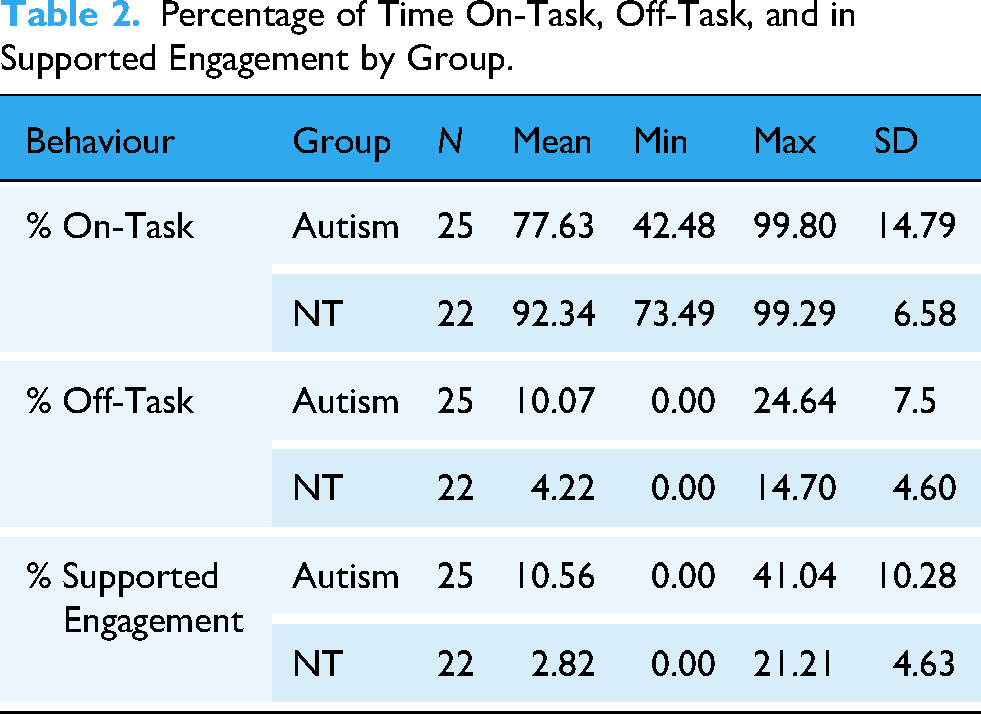
Table 2 shows the percentage of time autistic and NT children spent on-task, off-task and in supported engagement, averaged across the four conditions. The mean scores do not sum to 100% because the period from when the experimenter entered the mini-classroom (to offer support) and walked towards the desk to offer the child support was not coded. Typically, this was 1 or 2 s.
Percentage of Time On-Task, Off-Task, and in Supported Engagement by Group.
Does the Classroom Sensory Environment Affect the Percentage of Time Autistic and NT Children Spend Off-Task?
The first aim was to examine whether the percentage of time autistic and NT children spent off-task differed between sensory conditions. As shown in Table 3, autistic children spent a greater percentage of time off-task in each condition compared to NT children. Both groups spent the greatest percentage of time off-task in the Visual condition (Autism M = 16.84% and NT M = 8.16%), followed by the Audio–Visual condition (Autism M = 12.77% and NT M = 4.51%).
Percentage of Time Autistic and NT Children Spent Off-Task in Each Condition.

To test the hypothesis that the percentage of time spent off-task would differ significantly between sensory conditions, and to examine potential group differences, a mixed model ANOVA was undertaken using ‘difference scores’ (difference scores were the difference between off-task behaviour in each condition and baseline; see Figure 2). There was a within-subject factor of condition (Audio, Visual, and Audio–Visual) and a between-subject factor of group (Autism and NT). Although predictions were made about the effect of visual and audio inputs on task behaviour, due to the novelty of the paradigm, predictions were not made about the combined audio–visual condition. It was expected to impact task behaviour negatively, but it was unclear whether there would be an additive impact (due to both inputs being present) beyond the impact of audio or visual alone.

Violin plot showing mean Difference Scores (and range) for both groups for off-task behaviour in the audio, audio–visual (AV), and visual conditions.
There was a significant main effect of condition F(2, 90) = 8.555, p < 0.001, ηp2 = 0.160, with a large effect size. There was also a significant main effect of group F(1, 45) = 6.057, p = 0.018, ηp2 = 0.119, with a medium-to-large effect size. As hypothesized, in comparison to baseline off-task behaviour, autistic children (M = 7.55%) spent a significantly greater percentage of time off-task compared to NT children (M = 2.57%). There was no significant interaction between condition and group F(2, 90) = 0.943, p = 0.393, ηp2 = 0.02.
To unpick the main effect of condition, post-hoc pairwise comparisons (with Sidak adjustment applied for multiple comparisons) were conducted. Compared to baseline, there was a greater percentage of off-task behaviour in the Visual (M = 9.56%) and Audio–Visual (M = 5.6%) conditions compared to the Audio condition (M = 0.467%), p < 0.006 for both. However, there was no significant difference in the percentage of time spent off-task in the Visual condition (M = 9.32%) relative to the Audio–Visual condition (M = 5.37%), p = 0.361.
In summary, autistic children spent a significantly greater percentage of time off-task relative to their NT peers in all conditions, and both groups evidenced a similar pattern of off-task behaviour across conditions. That is, both groups spent the greatest percentage of time off-task in the Visual and Audio–Visual condition, and the smallest percentage of time off-task in the Audio condition. However, on average, both groups were engaged and on-task for at least three quarters of the time.
Does the Nature of Off-Task Behaviour Differ Between Sensory Conditions and Are There Differences Between Groups?
The second aim was to investigate whether the types of off-task behaviour evidenced by children differed between sensory conditions and groups. Table 4 shows the percentage of total task-time children spent evidencing each of these off-task behaviours. In line with Fisher et al. (2014), as children spent < 2% of task-time engaged in Self-Distraction, Motor-Fine, Motor-Gross or Experimenter Distraction, no further analyses were undertaken on these three off-task behaviours. Analysis, therefore, focused only on Environmental off-task behaviours.
Percentage of Task-Time Engaged in Off-Task Behaviours by Group and Condition.

Environmental Off-Task Behaviours
A 4 × 2 mixed model ANOVA was first undertaken to investigate if the percentage of time spent engaging in Environmental off-task behaviours differed between sensory conditions and groups. There was a within-subject factor of condition (Baseline, Audio, Visual, and Audio–Visual) and a between-subject factor of group (Autism and NT). Equal variances were not assumed as Levene's Test for Equality of Variances was significant for the Audio condition, F(1, 45) = 6.756, p = 0.013 and AV condition, F(1, 45) = 17.527, p < 0.001. Mauchly's Test of Sphericity was also significant, W(5) = 0.041, p < 0.001; therefore, the Greenhouse-Geisser correction was applied.
There was a significant main effect of condition F(1.511, 68) = 13.574, p < 0.001, with a large effect size ηp2 = 0.232. There was also a significant main effect of group F(1, 45)= 6.851, p = 0.012, with a small effect size ηp2 = 0.12. Autistic children spent a significantly greater percentage of time engaging in Environmental off-task behaviours compared to NT children. There was, however, no significant interaction between group and condition F(1.511, 68) = 1.903, p = 0.166, ηp2= 0.041.
To unpick the main effect of condition, pairwise comparisons (Sidak adjusted for multiple comparisons) were examined. There was no significant difference in the percentage of Environmental off-task behaviours between the Audio (M = 0.908%) and Baseline (0.751%) conditions (p = 0.995). However, children spent a significantly greater percentage of time engaging in Environmental off-task behaviours in the Visual condition (M = 10%) and Audio–Visual (5.5%) conditions compared to the Baseline condition (M = 0.75%; p's < 0.001), and also compared to the Audio only condition (M = .908%), p's < 0.002. There was no significant difference in the percentage of time engaging in Environmental off-task behaviours between the Visual (M = 10%) and Audio–Visual (M = 5.5%) conditions, p = 0.293. In summary, autistic children spent a significantly greater percentage of time engaging in Environmental off-task behaviours relative to NT children. Both groups evidenced significantly more Environmental off-task behaviours in the Visual and Audio–Visual conditions relative to Baseline and Audio.
Discussion
For the first time, this study reports findings from a systematic experimental investigation of the effects of classroom sensory features on task engagement for autistic and NT children. Using this novel paradigm, it is possible to see that even over the course of a brief classroom activity (<10-minute reading comprehension task), classroom sensory input impacts behaviour for all children, but to a greater extent for autistic children. Although we expected both auditory and visual inputs to effect off-task behaviour, we found minimal impact from noise, but clear impacts of the presence of visual displays, especially for autistic children. These findings have significant implications for classroom practice around the use of visual displays as well as for supporting autistic learners at school.
Most children found it relatively easy to stay focused on the reading task over the course of each 8-minute condition; however, significantly more off-task behaviour was observed for autistic children in all conditions (10% on average; individual differences discussed later). Irrespective of group, off-task behaviour differed significantly according to the sensory condition. Although there were minimal differences between the baseline and the auditory conditions, the presence of visual displays in both the visual and audio–visual conditions led to a significant increase in off-task behaviour for all children. Drilling down into these data showed this was primarily driven by children spending more time engaged in ‘environmental distraction’ in these two specific conditions, that is, they were spending more time looking at the physical environment (the displays on the walls). These findings parallel those of Fisher et al. (2014), Godwin et al. (2022a), and Hanley et al. (2017) and, for the first time, extend this evidence to a real scenario with children engaged in a self-directed task, and with autistic children. The findings may also relate to the irrelevant background condition on Remington et al.'s (2019) visual attention task, whereby autistic participants remembered more of the irrelevant visual information in the background than non-autistic participants, implying greater attention capture from background details for this group. They also parallel the findings from qualitative research where parents, teachers and autistic young people have identified classroom visual input as distracting (Jones et al., 2020; Howe & Stagg, 2016; Humphrey & Lewis, 2008). Here, we show this manifested through increased off-task behaviour.
The findings relating to auditory input were not as predicted. Classroom noise has been reported as one of the most difficult and distracting sensory inputs for autistic pupils (Howe & Stagg, 2016; Jones et al., 2020), and yet we found minimal effect on task engagement. Although we tried to recreate a real classroom experience by selecting a soundtrack of classroom noise with variable decibel levels, replicating classroom noise is challenging in an experiment for several reasons. First, by its nature, it is unpredictable, and it is often loud, sudden noises that create the most distraction. The classroom noises used here involved sounds of multi-talker babble, furniture moving, and children working. This may have been more like background noise and may have been easier to filter out than someone speaking loudly out-of-turn, or loud sudden noises. Indeed, although the balance of evidence indicates that children are particularly susceptible to negative impacts from noise, noise does not have consistent negative effects (Gheller et al., 2023). Indeed, in the study by Dockrell and Shield (2006), although babble had negative effects on reading comprehension and spelling accuracy, babble and environmental noise had positive effects. More work is needed to explore the impact of classroom noise, and the best way to achieve this is by conducting the research in real classrooms.
Regarding individual differences, it is important to recognise the considerable variability in task engagement and off-task behaviour in both groups. There were both autistic and NT children who spent the entire time fully engaged on task, and equally, children in both groups who spent up to 40% of their time engaged in off-task behaviour. This study was not powered sufficiently to look at the links between individual differences in cognition and behaviour in relation to off-task behaviour and the sensory manipulations. This requires future research. The central reading task was mapped to the participants’ verbal ability and linked to their school year (with the worksheets linked to each school year), however it is acknowledged that the autistic group was older and had lower FSIQ scores, and this needs to be considered within the results interpretation and limitations. Future research with larger samples should explore links between age and cognitive ability in relation to the impact of classroom sensory features on task engagement. Understanding the mechanisms that drive the ability to stay on-task in real classroom activities has significant implications for supporting learning and achievement for all children.
We found that the effect of visual displays was greater overall for a group of children known to have sensory and attentional differences, which highlights these aspects of functioning as likely related mechanisms. A small amount of evidence has already linked attentional abilities to lesson engagement, learning, and distraction from displays (Erickson et al., 2015; Fisher et al., 2014; Hanley et al., 2017), suggesting that children with better attentional abilities (e.g. sustained attention) engage in less looking at displays/less off-task behaviour (Hanley et al., 2017). There is also work that links the impact of sensory differences to the ability to pay attention, especially for autistic and ND people with sensory differences (Howe & Stagg, 2016; Jones et al., 2020). Indeed, there are other factors that may influence task engagement, which might be impacted by sensory features of the classroom, namely anxiety. There is good evidence that heightened sensitivity to sensory stimulation (e.g. visual and auditory) can lead to anxiety, particularly for autistic people (Green et al., 2012; Verhulst et al., 2022), and that the combination of differences and difficulties with attention, sensory arousal, and anxiety may be particularly impactful for autistic children and young people in busy school classrooms (referred to as Triple-A by Hanley et al., 2025). Future research should seek to explore these factors in relation to classroom sensory features, but not only in autistic children. Many neurodivergent children who are not autistic also experience these issues (e.g. children with ADHD; Ghanizadeh, 2011). It is important for future research to explore whether the impact of sensory features of the classroom depends on the type of neurodivergent diagnosis, or whether the effects are different according to whether children have one or multiple specific diagnoses. It would be particularly interesting to look at groups where attention, sensory arousal, and anxiety are known to be considerable challenges, but where the relative challenges with each of these might be different [e.g. autism – high sensory needs; high anxiety, but also associated with attentional differences; ADHD – high attention challenges, but also associated with some sensory and anxiety challenges (Mimouni-Bloch et al., 2018; Ghanizadeh, 2011); sensory processing disorder – high sensory needs but where anxiety and attention are less well understood (Crasta et al., 2020; McMahon et al., 2019); Williams syndrome – high attention challenges, high sensory needs, high anxiety (Glod et al., 2019)].
We note that there is significant overlap in attention and executive function (EF; Bavelier & Green, 2019); that autistic and ND children are known to have differences and challenges with aspects of EF compared to NT children (Zelazo, 2020) and that a wealth of literature exists that looks at how EF from preschool onwards predicts learning and academic outcome (Bull et al., 2008; Follmer, 2018; Pascual et al., 2019). An in-depth discussion of this is beyond the scope of this paper, but future research probing underlying mechanisms should also probe the role of EFs, especially those necessary to support task engagement (e.g. inhibition and working memory).
We also need more research on practice – for instance, might different types of displays be more distracting than others (e.g. decorative compared to instructional)? Might there be an optimal level of displays which stimulates but does not lead to significant distraction? In their observational study of classrooms, Barrett et al. (2015) and Godwin et al. (2022a) noted that both too much and too little visual complexity (relevant to displays) led to poorer learning outcomes across one year. These are important questions to which the current study provides the impetus for further research, not least because this is something under the teacher's control. Indeed, we have so far focused on the negative or distracting impacts of displays, but what about potential positives – for instance, do learners engage with displays in a way that supports aspects of learning (e.g. using ‘working walls’). Can displays have positive impacts related to promoting confidence and self-esteem (e.g. through celebrating children's work). Are there optimal ways to use displays in terms of where they are placed, how long they are visible for, and what the nature of the content is? Preliminary evidence from a study of elementary school-aged children in the US (from grades 1, 2, 4, and 5, mean age 9 years) suggests that aligning displays to the content of a lesson can benefit learning, especially for younger children (Godwin & Kaur, 2021).
There is also the question regarding habituation − would children simply get used to the displays and thus their effects change over time? In this study, children were exposed to each sensory input twice, and order was counterbalanced. Although we cannot say for sure, based on our data, whether habituation effects would lessen the impact of classroom displays over time, we can draw on important findings from elsewhere, (a) in Barrett et al. (2015), the effect of visual complexity on academic progress related to the period of one year; (b) the findings of Godwin et al. (2016) showed off-task behaviour in real classrooms increased over the course of 1 school year, especially off-task behaviour directed towards the environment (looking at classroom walls), and (c); the compelling evidence from the studies by Godwin, Leroux, Seltman, et al. (2022) which showed only partial habituation to displays over a 2-week period in an experimental study in a lab classroom, followed by no evidence of habituation in real classrooms over a 15-week period. These examples speak to habituation over the short and long-term, both from systematic lab-based studies and observational studies in real classrooms (e.g. Fisher et al., 2014; Hanley et al., 2017). For these reasons, it seems unlikely that habitation to displays would stand up as an argument to completely undermine the effects reported here.
This study provides the first experimental evidence of the impact of visual displays for autistic children during a classroom task, and it is the first to test experimental manipulations of sensory classroom features with autistic and non-autistic children in a real setting. It therefore provides an important impetus for future work to investigate these issues with larger samples, enabling questions about individual differences and underpinning mechanisms to be explored. This is particularly timely given the pressing issues in relation to inclusive education that are being debated in the UK and elsewhere (Education Committee, 2025; Hongcai et al., 2025; Thom-Jones et al., 2025).
Although the findings provide important evidence on the impact of classroom visual displays, we must recognise the limitations. The first is that this study was modest in scale. Recruiting children, especially autistic children, can be challenging – especially where the testing involves multiple sessions. While the repeated measures nature of the design was a strength, the modest sample size was a relative limitation. This impacted the achieved power for a minority of the statistical analyses. As such, caution in interpretation is warranted, particularly for the interaction effects reported. Other potential limitations include the length of time for the tasks and the fact that this was not in a real classroom (with other pupils and teaching staff). The fact that the tasks were only 8 min each could be seen as a limitation, in that they may not reflect the behaviour of children in a typical school day, where lessons are usually longer. Of course, the alternative argument is that we have evidenced these effects even within this short time (supporting previous literature; Fisher et al., 2014; Hanley et al., 2017; Rodrigues & Pandeirada, 2018), and the effects may be even greater in a real classroom over the course of days, weeks, and months. Therefore, our study contributes to an emerging evidence base on short- and longer-term impacts of visual displays on off-task behaviour in the classroom.
To conclude, the studies in this article present converging evidence on the impact of classroom displays, especially speaking to negative impacts from distraction, and the effects on autistic children. We need to do more to unpick the underlying mechanisms of this effect in relation to individual differences, as this has important implications for educational practice and the support of learning for all pupils. Clearly understanding the sensory classroom environment is in everyone's interest, so that we can avoid it negatively impacting engagement and learning, but rather so that we can harness it to support positively.
Supplemental Material
sj-docx-1-ndy-10.1177_27546330261443570 - Supplemental material for The Effect of the Classroom Sensory Environment on Engagement for Autistic Pupils: Classroom Noise and Classroom Displays
Supplemental material, sj-docx-1-ndy-10.1177_27546330261443570 for The Effect of the Classroom Sensory Environment on Engagement for Autistic Pupils: Classroom Noise and Classroom Displays by Elizabeth Jones, Mary Hanley, Jessica Rose Hirst, Emily McDougal and Deborah Michelle Riby in Neurodiversity
Footnotes
Acknowledgments
The authors would like to thank all children and teachers who took part in these studies, and all schools who supported data collection. We would like to acknowledge the work of Calum Hartley in assisting with the data collection and video coding for study 2. The research reported in Study 2 was supported by funding from the Economic and Social Research Council [grant number ES/J500082/1]. For the purpose of open access, the author(s) has applied a Creative Commons Attribution (CC BY) to any Author Accepted Manuscript version arising.
Author Note
Correspondence concerning the article should be addressed to Mary Hanley, Department of Psychology, Durham University, South Road, Durham, DH13HN. Email: mary.hanley@durham.ac.uk; Telephone: 0191 3343239. Materials and data are available by emailing the corresponding author. This study was not pre-registered. For the purpose of open access, the author(s) has applied a Creative Commons Attribution (CC BY) to any Author Accepted Manuscript version arising.

Funding
The authors disclosed receipt of the following financial support for the research, authorship, and/or publication of this article: This work was supported by the Economic and Social Research Council (grant number ES/J500082/1).
Declaration of Conflicting Interests
The authors declared no potential conflicts of interest with respect to the research, authorship, and/or publication of this article.
Data Access Statement
Due to the terms of participants’ consent, the anonymised data cannot be made publicly available, but can be made available to bona fide researchers upon request. Data are available on request from the corresponding author following approval of a data access proposal.
Supplemental Material
Supplemental material for this article is available online.
Notes
References
Supplementary Material
Please find the following supplemental material available below.
For Open Access articles published under a Creative Commons License, all supplemental material carries the same license as the article it is associated with.
For non-Open Access articles published, all supplemental material carries a non-exclusive license, and permission requests for re-use of supplemental material or any part of supplemental material shall be sent directly to the copyright owner as specified in the copyright notice associated with the article.
