



Abstract
Objective
XXY, or Klinefelter Syndrome (KS), is a common chromosomal variation impacting neuropsychological development, including executive function (EF). This study explored everyday EF challenges, experiences in cognitively demanding contexts, and how individuals overcome difficulties.
Method
Eighty-two adults (aged 19–81; M = 48.00, SD = 15.28) with KS/XXY completed a mixed-methods online survey including the Executive Skills Questionnaire, and Occupational Self-Efficacy Scale. Open questions asked about strengths and challenges with EF, EF-related experiences in education and employment, and the ways they overcome challenges.
Results
EF difficulties ranged from minimal to severe, with 75% reporting frequent challenges in at least one domain. Challenges were more common in organisation and time management than other areas, higher in those unemployed than those employed, and inversely related to occupational self-efficacy among employed individuals. Themes highlighted the nature of cognitive and interpersonal challenges, emotional and practical consequences, and mixed success with compensatory aids and interpersonal support.
Conclusions
While EF challenges are not universal in KS/XXY, their impacts on everyday functioning, particularly in cognitively demanding settings, can be severe. Many struggle to find effective solutions, emphasising the importance of identifying effective support approaches in future research and practice.
Lay Abstract
Some people are born with unusual genetic patterns, such as the XXY variation, often known as Klinefelter Syndrome (KS/XXY). KS/XXY can affect how the brain and mind develops, especially in terms of mental organisation. This study explored the types of challenges people with KS/XXY have with mental organisation, how these affect their experiences in environments like school or work, and the strategies they use to manage them. Eighty-two adults with KS/XXY completed an online survey. Questions measured everyday mental organisation skills and confidence at work. Participants also shared their strengths and challenges in mental organisation, how their time in educational and work settings was affected by their abilities, and explained how they coped with any difficulties. While experiences varied, findings showed three quarters of those we asked had challenges in at least one area of mental organisation – especially organisation and time management skills. Those with stronger mental organisation skills tended to be more confident they could do their job well, and on average, people who had a job had stronger mental organisation skills than those who did not. Participants described mental organisation challenges with attention and memory especially and explained how these affected their emotions, interactions with people around them, and life outcomes. Some found tools like memory aids, or support from others, helpful, but success was mixed. This tells us KS/XXY can cause problems with mental organisation that make everyday life more difficult. It is important that future research and clinical help focuses on finding effective and practical solutions.
Introduction
The presence of an additional copy of the X chromosome in XY individuals (most commonly the 47, XXY karyotype; Swerdlow et al., 2005) is often referred to as Klinefelter Syndrome (KS) or XXY. Affecting approximately 1 in 660 people assigned male at birth (Bojesen et al., 2003), KS/XXY is one of the most common chromosomal variations. While it can impact physical and hormonal development (e.g., tall stature, reduced muscle tone, small testes, reduced facial and body hair growth, longer to reach pubertal maturity, low testosterone, infertility) there is heterogeneity in presentation. KS/XXY can also affect neurocognitive development; at group level, IQ scores are at the lower end of the typical range (Boada et al., 2009), while learning disabilities, particularly affecting speech, language and literacy (Tragantzopoulou & Giannouli, 2024), and neurodivergent diagnoses, such as Autism Spectrum Disorder (ASD) and Attention-Deficit/Hyperactivity Disorder (ADHD), are common (Green et al., 2019).
KS/XXY remains undiagnosed in up to 75% cases (Zhao et al., 2022) and diagnosis often occurs late, when undergoing assessment for infertility (Abramsky & Chapple, 1997). However, with expansions of non-invasive pre-natal screening and genomic testing in private and national health services (HM Government, 2020), diagnosis is set to happen earlier and more often. It is, therefore, a critical time to improve our understanding of the neurocognitive impacts of KS/XXY.
Executive function and KS/XXY
Executive Function (EF) refers to the mental processes that coordinate basic sensory information and facilitate goal-directed interactions with our environment. Cognitive models (e.g., unity/diversity model; Miyake et al., 2000) describe three core EFs: Working memory (or updating; the ability to store information in short term memory while engaging in other related or unrelated cognitive processing), task switching (or cognitive flexibility; the ability to adjust attention or actions dynamically based on changing requirements) and inhibitory control (the ability to withhold inappropriate and/or prepotent responses when the situation demands). EF also describes a wider range of important everyday processes, including verbal fluency, planning and organisation.
Several studies in KS/XXY adults demonstrate difficulty across a range of EFs (Boone et al., 2001; Kompus et al., 2011; Skakkebæk et al., 2014; Van Rijn et al., 2009), with performance differences relative to non-KS/XXY groups tending to be largest in verbally oriented EF tasks (Boone et al., 2001; Fales et al., 2003). Yet not all studies demonstrate group-based differences (Bender et al., 2001; Wallentin et al., 2016), and evidence of EF difficulty is more mixed in paediatric KS/XXY samples (Tragantzopoulou & Giannouli, 2024). This may, in part, stem from individual differences in the KS/XXY population, but may also reflect the way that EF is assessed.
EF is traditionally measured by assessing performance on tasks that aim to isolate specific components. This isolation of individual EF components may underestimate the challenges individuals experience in real-world situations where co-ordination of multiple abilities is required (Gardiner et al., 2017). In recent decades, self- or proxy- report measures of ‘everyday EF’ (EEF) have been developed to overcome these issues. While some argue they measure somewhat different constructs (Eycke & Dewey, 2016) and performance-based and rating scale measures of EF are, on average, only weakly correlated (r = .19; Toplak et al., 2013), importantly, EEF scales assess abilities in settings where individuals are expected to complete complex and cognitively demanding tasks, such as in education or work (Strait et al., 2020).
EEF scales have rarely been used in studies of KS/XXY. Lee et al. (2015) compared ratings of EEF in 6-to-18-year-olds with an extra X chromosome (+1X; including both XXY and XXX trisomies) with those with Down Syndrome and those without genetic diagnoses, finding that the +1X group had significantly greater difficulties in all areas of EEF. Janusz et al. (2020) assessed the profile of EF difficulties in 8-to-18-year-olds with KS/XXY using both performance-based tasks and rating scales. Difficulties (relative to population norms) were large for parent-rated attention and EEF (behavioural regulation and metacognition), and performance-based measures of attention. Difficulties on performance-based measures of working memory, switching and problem solving/planning, were moderate. Moderate difficulties for parent-rated hyperactivity/impulsivity were also found, yet difficulties on performance-based measures of inhibitory control were negligible. To date, studies have not examined EEF skills in KS/XXY outside childhood and adolescence, nor how KS/XXY impacts experiences in settings with high EF demands.
Cognitively demanding settings
While difficulties with EF may impact daily activities (e.g., cooking, hygiene routines, travel arrangements, attending appointments) they are likely to have the most notable impacts on outcomes in settings where cognitive demands are high; for example, where individuals are required to complete complex tasks within specified timeframes, such as in education and employment. Studies have linked KS/XXY with poorer educational, income and employment outcomes (Herlihy et al., 2011; Ridder et al., 2023), yet there is little detailed research into why, or exploring how these outcomes may link to EF difficulties. Quantitative evidence demonstrated associations between EF difficulty and poorer academic achievement in school-aged boys with KS/XXY (Jordan et al., 2023), and longitudinal research found educational underachievement was domain-general (not restricted to the verbal domain), with performance gaps relative to peers widening through the educational period (Rovet et al., 1996). This widening gap may reflect increasing executive demands of learning and assessment tasks, which become more complex later in education. Correspondingly, the impact of EF challenges is unlikely to be limited to time in education.
Qualitative findings show that both employment problems and ‘learning disabilities’ are prominent issues arising in discussion of the ways KS/XXY affects people across their lifespan (Turriff et al., 2017). Moreover, active employment status is associated with increased wellbeing and self-esteem in KS/XXY (Herlihy et al., 2011). Yet although studies of adults with Down Syndrome (Tomaszewski et al., 2018) and those born at preterm gestations (Kroll et al., 2017), provide evidence that people with lower EF are less likely to be employed, studies have not yet explored the impact of EF problems on the employment experiences in KS/XXY. Considering the demands a workplace may place on EEF, and that difficulty managing daily challenges can undermine self-efficacy (Cushman et al., 2022), it stands to reason that EEF may impact occupational self-efficacy (OSE); that is, the belief an individual has in their ability to perform job-related tasks competently. OSE predicts job satisfaction and security, and promotes better job performance by encouraging persistence and motivation to undertake effortful tasks (Rigotti et al., 2008). Not only does it affect wider workplace wellbeing and productivity, but it may also be a viable target for intervention among populations with ongoing EF difficulties (Soeker, 2017).
Given that clinical management typically focusses on testosterone replacement therapy (TRT) and genetic counselling rather than cognitive difficulties, understanding the experiences of those with KS/XXY in cognitively demanding contexts, and how challenges can be overcome, may inform clinical practice and future research.
The current study
This study aimed to assess the nature of EEF challenges in adults with KS/XXY, and their EF-related experiences in cognitively demanding settings, employment and education. Those with greater difficulty in EEF were expected to be less likely to be in employment and to feel lower OSE. Importantly, the study explored the ways people with KS/XXY described overcoming their EEF challenges to offer insight into the formal and informal approaches individuals have found helpful.
Method
Study design and sample recruitment
This convergent-parallel mixed-methods online survey study was advertised through the mailing list of a UK-based support charity, Klinefelter Syndrome Association (KSA), and closed KS/XXY support groups on the social media platform Facebook. The survey incorporated recommendations from the KSA Trustees (individuals with KS/XXY and their advocates) to increase inclusivity.
Measures
Further information regarding these measures (e.g., psychometric details) is provided in Supplemental Materials.
Everyday executive functioning
The Executive Skills Questionnaire-Revised (ESQ-R; Strait et al., 2020) provided an ecologically valid measure of the EEF skills that are important in real-world settings. The 25 items (rating how often behaviours are a problem on a scale of 0, never or rarely, to 3, very often) reflect performance in five domains; plan management, time management, organisation, emotional regulation and behavioural regulation. Higher scores reflect more challenges.
Occupational self-efficacy
The occupational self-efficacy Scale-Short Version (Rigotti et al., 2008) provided a measure of confidence individuals have with their ability to fulfil expectations at work. The six items (rating agreement, on a scale of 1, not at all true, to 6, completely true) are part of one unitary domain. Higher values reflect greater OSE.
Bespoke questions
Open-format bespoke questions (see Table S1 in Supplemental Materials) asked respondents to describe, in their own words, the EF-related strengths and challenges they experienced in daily life, in cognitively demanding settings (education and, if they were employed, in the workplace), and support or strategies they used to overcome EF challenges.
Analysis
Quantitative and qualitative analyses were conducted separately to address partially distinct, but overlapping and complementary purposes. To facilitate comparison, quantitative and qualitative data relevant to each domain being assessed were reported in an interleaved manner, allowing some conceptual triangulation between corresponding quantitative and qualitative findings, and use of the qualitative themes to complement and extend beyond the quantitative observations. In each domain, statistical analyses of the patterns observed in our sample were reported first, providing contextual evidence as to the frequency, severity and variability of experiences and traits of interest, and understanding of relationships between them. Qualitative themes are then reported, to offer insights that expand on, and go beyond, the quantitative patterns described.
Statistical analysis
For descriptive analyses of the ESQ-R, in line with the interpretation guidance in the assessment manual (ESQ-R Self-Report Assessment Tool), subscale mean scores were coded corresponding to response options, such that <2 reflected a domain that was ‘rarely’ challenging, and not problematic; 2 to 3, ‘often’ challenging; and 3, ‘very often’ challenging. Mean scores were computed for the OSE and ESQ-R scales, and each ESQ-R subscale, for use in continuous inferential analyses. Examination of the boxplots, Q-Q plots and histograms variables indicated that the data were normally distributed without outliers. Analyses of variance assessed whether ESQ-R scores differed (i) within subjects depending on EF domain, and (ii) between those with different levels of qualifications (Supplemental Material); independent samples t-tests assessed differences in ESQ-R scores between those who were and were not employed; and correlations assessed the relationship between ESQ-R and OSE scores. Assumptions of homogeneity of variance were met, while Greenhouse-Geisser -adjusted values are reported where the assumption of sphericity was violated. To assess possible confounding effects of Age, we conducted covariate-adjusted analyses. No significant correlations with Age were observed, Age had no significant effects or interactions in any analysis, and its inclusion in analyses did not alter the pattern of findings. Results, therefore, report unadjusted analyses. Post hoc analyses (see Supplemental Material) were conducted to assess whether patterns remained consistent when those with diagnosed learning difficulties were excluded, and in those who did or did not obtain university-level qualifications.
Qualitative analysis
A framework thematic analysis approach was adopted (Parkinson et al., 2016; Ritchie & Spencer, 1994; see Supplemental Material) to allow effective management of a relatively large dataset, and exploration of both pre-defined domains of interest and unanticipated themes that emerged. Together with a team of four research assistants, who each took responsibility for one domain, the lead researcher developed the final thematic structure through the steps of familiarisation, indexing, charting and mapping. Although a formal reliability analysis was not performed, the lead researcher reviewed and verified the indexing and charting, and conducted the final mapping process. At each stage, group meetings were held in which qualitative interpretations were posed and discussed reflexively, with discrepancies examined through further review of the qualitative and, where relevant, quantitative, data until agreement was reached. Indicative quotes reflecting the main themes are reported in the main text, while tables with quotes reflecting the subthemes are available in Supplemental Material.
Results
Sample characteristics
The sample included eighty-two self-selected participants aged between 19 and 81 years (M = 48.00 years, SD = 15.28 years). Approximately 44% reported diagnosis or assessment for a difficulty affecting their learning (including dyslexia; ADHD, inattentive ADHD in particular; ASD; dyspraxia; and language disorder; Table 1).
Descriptive Statistics of Sample Characteristics and Quantitative Measures.

ESQ-R = Executive Skills Questionnaire-Revised; OSE = occupational self-efficacy.
Technical qualifications
Technical qualifications such as HNCs, Foundation Degrees or Associate Degrees (n = 3) were considered Higher Education rather than Further education, as they are equivalent to the first year of a degree, and are awarded by both HE and FE institutions.
n = 58 for occupational self-efficacy scale.
Executive functioning difficulties
Everyday executive functioning
Figure 1 shows that the proportion of participants in our self-selected sample rarely experiencing challenges in each domain varied from 50% (organisation) to 80% (planning). However, 75% of our sample, reported experiencing challenges often or very often in at least one domain (21% in one or two subscales, 15% in three subscales, 13% in two subscales and 5% in all five subscales).

Stacked bar chart demonstrating the proportion of the sample experiencing challenges rarely, often or very often, for each executive functioning (EF) domain.
Total ESQ-R scores indicated that, within our self-selected sample, on average EEF challenges were modest (8 to 73; M = 38.78, SD = 14.18; Table 1). The level of challenge reported varied significantly across domains, F(3.25, 262.89) = 4.00, p = .007, ηp2 = 0.047. Challenges in organisation and time management were highest. Sidak-corrected pairwise comparisons indicated that these scores did not differ from one another, but were significantly greater than those in plan management (organisation vs. plan management p = .008, d = 0.385; time management vs. plan management p = .001, d = 0.446). Scores for emotional and behavioural regulation subscales did not differ significantly from those in any domain.
Perceived strengths and challenges
Narrative descriptions of the strengths and challenges in EEF were provided by 59 participants (Table 2 and Table S3). At their worst, EF challenges caused significant difficulty, captured by the phrase ‘like living life in a constant state of mind panic’ (P67, aged 40–59, moderate overall EF challenges). The themes (Figure 2(a)) mapped well onto theoretically established domains of EF, with subthemes offering further insight into the experiences of the sample.

Thematic diagrams of themes and subthemes within the domains of (a) executive functioning (EF) strengths and challenges, (b) experiences in employment and (c) overcoming EF challenges.
Indicative Quotes for Main Themes in Strengths and Challenges of EF.

Note: Right column shows participant ID, age group, level of EF challenges (low/moderate/high EF challenges from tertiles of ESQ-R score). EF = executive function; ESQ-R = Executive Skills Questionnaire-Revised.
A theme of heterogeneity cut across EF domains, confirming the variability observed in the quantitative data, with some individuals reporting relative strength in areas that others described as challenging. For example, while most references to attention and cognitive flexibility described challenges, two participants described concentration as a strength, and there were reports of developing strengths in task-switching. This should be kept in mind when interpreting the other, more challenge-focussed themes.
The leading theme reflected the regularity of difficulties sustaining attention (n = 37), a domain not explicitly covered by the quantitative ESQ-R scale. One subtheme linked difficulties to distractions, while another associated them with fatigue. The final subtheme revealed difficulties sustaining attention were often context-specific: Six participants described experiencing hyperfocus; for some, this was a problem but others were able to harness it strategically. Another six explained they can only sustain attention when topics interest them.
A second prominent theme, present in more than half of the narrative responses (n = 29), was consistent with working memory impairment. One subtheme demonstrated the way such issues frequently affect conversations – even causing participants problems maintaining their own views in memory during exchanges, and causing frustration. Similar frustrations were expressed in relation to a subtheme of inability to remember to action tasks. Responses described forgetting even things ‘of high importance’ and were often linked to being distracted. Although the ESQ-R includes an item around forgetting to do other things when engaged in a task as part of the Time Management ESQ-R subscale, it should be noted that this theme does not align specifically to any of the domains quantified.
Difficulties in organisation (n = 23) were another important theme, divided into subthemes of difficulties with goal setting and those with time and task management supporting the high frequency of challenges in the corresponding domains of Organisation and Time management in the ESQ-R. Participants described finding goal setting ‘hard’ or ‘impossible’ and repeated negative experiences with goal setting made it feel pressurised and demotivating. Time and task management challenges included reports of procrastination and problems ‘keeping track’.
While the theme of difficulties with inhibitory control was less prominent (n = 15), aligning with relatively lower frequencies reporting difficulties with Emotional or Behavioural Regulation in the ESQ-R domains, accounts of the ‘trouble’ they caused illustrates their negative impact. Subthemes show how such challenges differed in nature. Difficulty inhibiting inappropriate verbal responses affected interpersonal relationships, causing individuals to say things they regretted or feel they spoke too much, while limited behavioural inhibition resulted in concrete violations of societal norms, including frequently walking out of difficult situations (n = 2), stealing (n = 1), and addictive behaviours (n = 3).
The final theme in the EEF domain captured difficulties with cognitive flexibility (n = 15). These aligned most to the items in the ESQ-R domain Plan Management, a domain where relatively few people in our sample reported difficulties, mirroring the limited number of references to cognitive flexibility in qualitative reports. Distinct subthemes of problems disengaging from one task to switch to something new, and difficulties returning to an earlier task emerged. Although not ubiquitous across this self-selected sample, the capacity for such issues to severely impact daily life was epitomised by a response describing an episode where an individual struggled with returning to the task of vacuuming after repeatedly getting distracted by writing down other household chores; ultimately it took three hours to vacuum, and they needed to pay for a taxi to get to work on time.
Executive functioning and employment
Employment, EEF and occupational self-efficacy
Sixty-two (75.6%) participants in our self-selected sample were employed and 17 (20.7%) were not (3.7% did not disclose; Table 1). Overall EEF difficulties were significantly greater in those not in employment than those who were, t(77) = 3.02, p = .001, d = 0.83. This pattern was mirrored in all EEF domains, with a large effect observed in plan management (t(77) = 3.05, p = .002, d = 0.83), a moderate effect in organisation (t(77) = 2.01, p = .024, d = 0.55), and a smaller effect in time management (t(44.70) = 2.12, p = .020, d = 0.43). Comparisons for emotional and behavioural regulation did not meet the significance threshold (emotional regulation t(77) = 1.65, p = .052, d = 0.45; behavioural regulation t(77) = 1.36, p = .089, d = 0.37). Results remained similar when excluding those who reported diagnosed learning difficulties (see Supplemental Material).
OSE was moderate on average (M = 25.55, SD = 7.52), ranging from 8 to the maximum possible, 36. Higher OSE was associated with significantly fewer EEF difficulties overall (r(58) = −.28, p = .016), and fewer difficulties in plan management in particular (r(58) = −.39, p = .001), but difficulties in other EEF domains did not relate to OSE (all ps > .1). Excluding those without learning difficulties produced a similar pattern of results, although, in spite of coefficients of a greater magnitude, the two correlations were only marginally significant (overall EEF difficulties r(26) = −.37, p = .065; plan management difficulties r(26) = −.38, p = .056; see Supplemental Material), which is likely due to a drop in statistical power.
Experiences in employment
Of the 59 qualitative responses from employed participants, only seven indicated that KS/XXY challenges did not impact their current work. Of these, three considered this to be due to the nature of the job they had chosen, (e.g., working alone to avoid interpersonal communication), and another clarified that past jobs had been impacted. Themes regarding experiences in employment (Table 3 and Table S4) largely mirrored those identified in educational settings (Supplemental Material). Key themes offer insight into how functioning at work was affected by cognitive challenges in the EF domain and beyond, as well as KS/XXY-related interpersonal challenges. These led to feeling emotionally and physiologically drained, as well as practical consequences, and the final theme of changes over time (Figure 2(b)) recognises that impacts at work were dynamic.
Indicative Quotes for Main Themes in Experiences in Employment.

Note: Right column shows participant ID, age group, level of EF challenges (low/moderate/high EF challenges from tertiles of ESQ-R score). EF = executive function; ESQ-R = Executive Skills Questionnaire-Revised.
Some of the cognitive challenges affecting work experiences could be grouped into a subtheme of the ways difficulties characteristic of attention and executive function impairment (n = 29) compromised completion of work duties. One participant remarked that at work ‘executive function is [their] downfall’ (P65, aged 60+, high overall EF challenges), while another described feeling like ‘mentally … wading through mud’ (P82, aged 18–39, high overall EF challenges). Specific issues caused by difficulties with working memory, and concentration were commonly discussed, alongside other EEF skills that are important in workplaces, like organisation, time management and prioritising. Other cognitive factors that impacted the working lives of those with KS/XXY were less clearly linked to EF, revealing a separate subtheme of broader neurodivergence. Taking unconventional approaches to work-related tasks was considered an advantage by some, but also adversely affected functioning and collaboration in structured settings. Some felt they processed information, especially verbal, more slowly than colleagues, or required explanations to be simplified.
While four participants felt that their high empathy was an interpersonal strength in their workplace, a theme of interpersonal challenges (n = 26) was prominent. One of the two subthemes reflected frequent descriptions of communication difficulties, such as ‘understanding banter’ (P60, aged 18–39, moderate overall EF challenges), and including feeling exploited, feeling that frequently misunderstanding colleagues ‘makes me look stupid’ (P35, aged 60+, moderate overall EF challenges) and social withdrawal. Communication difficulties also reduced participants’ ability to articulate health and cognitive difficulties, compounding problems. A separate subtheme centred around reports of inadvertently becoming involved in conflict, including expressing frustration towards colleagues, inadvertently causing offence, or reacting aggressively when stressed or condescended to.
Within the theme of feeling emotionally and physiologically drained when working with KS/XXY, a subtheme of fatigue was apparent (n = 13). Some explained that TRT ameliorated fatigue, but this was not the case for everyone. A second subtheme regarded the emotional consequences on mood and self-esteem, with low levels of confidence and self-esteem described (n = 7), as well as reports of depression, anxiety and stress (n = 8). Poor emotion-regulation, such as being easily frustrated, was also discussed (n = 6).
Under the theme of practical consequences of challenges at work the subtheme changes to employment (n = 6) emerged. These included burnout, self-initiated changes such as taking early retirement due to increasing fatigue and low OSE, and also employer-initiated changes such as reduced responsibilities, disciplinary proceedings, and job loss. Another subtheme of being misunderstood by colleagues was present among responses from 8 participants. Sometimes, these linked to cognitive challenges, but one participant also mentioned prejudice due to gender non-conformity. These descriptions of practical consequences of challenges at work offer some qualitative insight into possible factors that may explain, at least partially, the quantitative observations that EEF difficulties were greater in those not employed, and related to lower OSE in those who were.
There were two subthemes within the theme of changes over time (n = 19). The first described how fatigue or energy fluctuations (n = 5), frequently linked to TRT, changed how KS/XXY affected them at work – for both the better and the worse. Other time-contingent changes described experience- or understanding- related improvements (n = 14) at work. These included reports of improvement in specific skills, such as emotional regulation, task switching, and interpersonal communication, but also, more generally. One individual remarked on how it was easier to overcome their EF challenges when they started working in jobs they enjoyed, and there was discussion of how diagnosis or disclosure increased understanding and acceptance of difficulties and how to work around them. Yet even where change was seen as positive, it sometimes resulted not from overcoming the challenge itself, but from learning to mask.
Overcoming executive functioning challenges
Themes emerging in relation to overcoming EF challenges (Table 4 and Table S5) demonstrated use of trial-and-error to find solutions. Solutions varied from compensatory aids, to interpersonal support from those around them, to developing individualised personal strategies (Figure 2(c)). Of concern, one theme was being unable to overcome challenges. Fourteen respondents either declared that they had no effective solutions (n = 12), or did not respond to these questions despite providing responses to other free-text questions (n = 2).
Indicative Quotes for Main Themes in Overcoming EF Challenges.
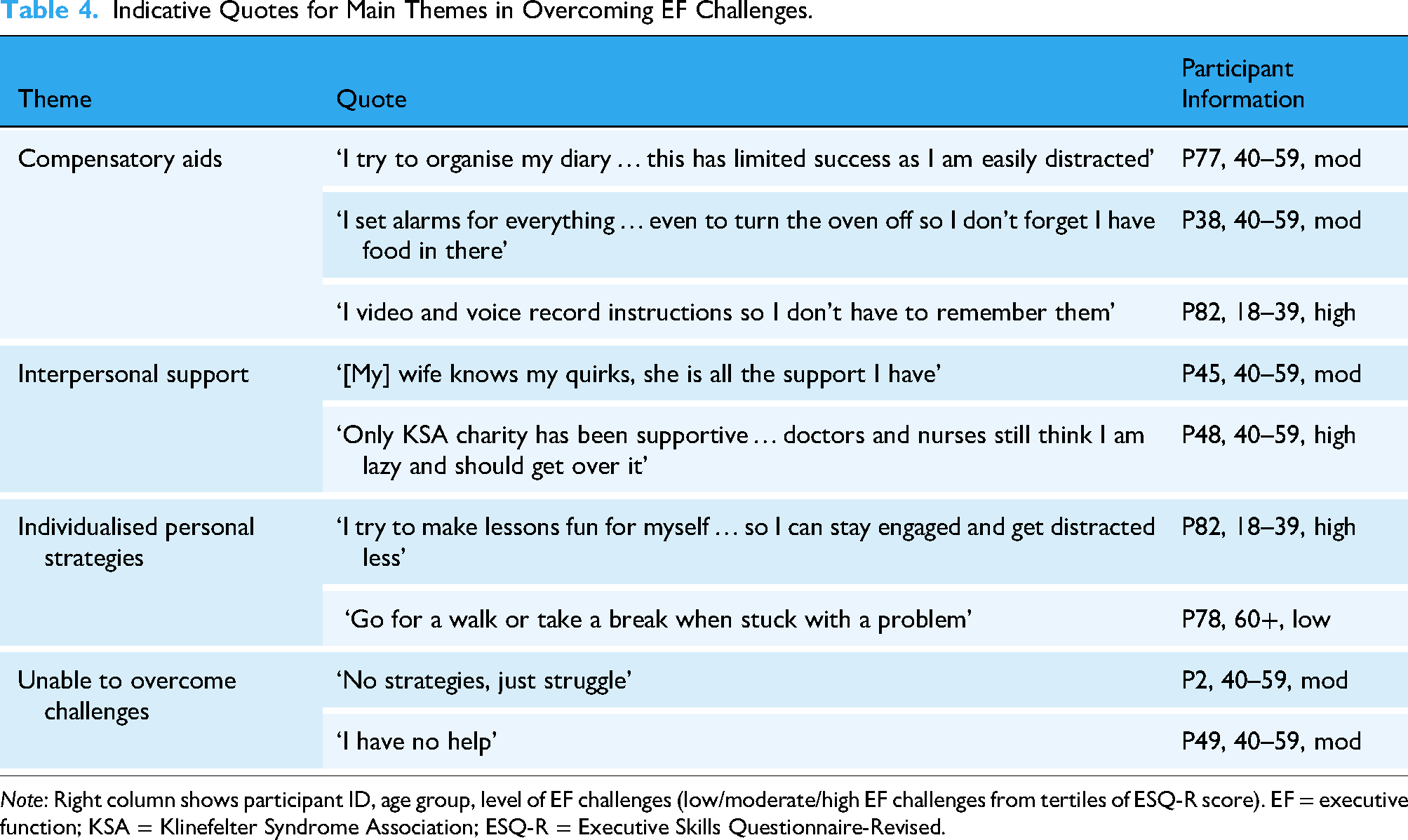
Note: Right column shows participant ID, age group, level of EF challenges (low/moderate/high EF challenges from tertiles of ESQ-R score). EF = executive function; KSA = Klinefelter Syndrome Association; ESQ-R = Executive Skills Questionnaire-Revised.
Traditional compensatory aids (n = 19) a subtheme of compensatory aids, captures efforts to use to-do lists, reminders and notebooks to help individuals remember, monitor and prioritise tasks. There was a sense that it was beneficial to ‘get things out of [one's] head’ (P68, aged 40–59, moderate overall EF challenges), although some found their EF challenges reduced how effective traditional aids could be. Aids less reliant on memory or sustained attention, e.g., whiteboards, were described as helpful because they stayed visible.
Technological solutions was the second subtheme (n = 7), with computer and phone-based notes or screenshots, diaries and alarmed reminder applications used at work, and beyond (e.g., while cooking). Some mentioned using technology (e.g., emails, grammar-checking software, video/audio capture of information, diagrams) specifically to compensate for verbal difficulties.
Four subthemes emerged within the interpersonal support theme. First, was absence, which reflected the way some (n = 5) found people close to them did not offer support, or sometimes actively undermined them further. Positive support from loved ones like family (n = 9) and friends (n = 6) was more common, exposing another subtheme. Gratitude was often expressed in responses, which sometimes described specific examples of active assistance to overcome cognitive limitations (e.g., remembering to action tasks, managing money), and also more generally described, for example, how helpful their partners’ intimate knowledge of their strengths and challenges was. A third subtheme acknowledged the role of colleagues (n = 10). While support from colleagues was not ubiquitous, some participants described senior colleagues supporting them by breaking tasks down, goal setting and prioritising, or other colleagues checking, correcting, or stepping up to take on tasks that they were relatively better at. In relation to the final subtheme of diagnosis-specific support, participants (n = 10) discussed interactions with professional and informal services after their KS/XXY diagnosis. There was some passionate expression of the value of connecting with diagnosis-specific community groups (n = 3), yet professional services were rarely mentioned, and were considered inadequate by two participants. In only two cases were positive remarks made about professional KS/XXY support for psychological needs, including ‘invaluable’ telephone support from a psychologist via a specialist KS clinic, and referrals from a GP to local support groups. Other professional support mentioned positively tended to relate to secondary diagnoses, such as depression (n = 1) and speech and language difficulties (n = 1), or was sought privately (e.g., hypnotherapy, neurolinguistic programming).
Individualised personal strategies (n = 7) were also regularly used, splitting into subthemes of either compensatory strategies, or self-care. Compensatory strategies involving taking additional steps to prepare optimal conditions when anticipating difficulty with upcoming tasks, including; eliminating distractions, allowing extra time, advance planning for appointments, working on one task at a time, asking for extra information, disclosure of difficulties, using designated locations to store things by category, and using repetition to reduce miscommunication. Behavioural strategies more aligned to the concept of self-care included: avoidance of challenging tasks; avoidance of substances which may exacerbate their difficulties (alcohol and tobacco); creative or active past-times (DIY, exercise, art, photography, walks); relaxation techniques (breathing, meditation, fidget stone); and more passive activities (listening to music, reading). For some, these helped promote wellbeing and reduce negative mood, while others felt that, for example, music supported concentration, or walking helped with problem resolution.
Discussion
Key findings
EF challenges affect the everyday lives of many with KS/XXY. Consistent with findings of impaired EF in lab-based tasks in adults with KS/XXY (Boone et al., 2001; Fales et al., 2003; Kompus et al., 2011; Skakkebæk et al., 2014; Van Rijn et al., 2009) we found that three quarters of this self-selected (non-representative) sample experienced frequent challenges in at least one domain of EEF, most commonly in organisation and time management. Qualitative findings emphasised how challenges were characterised by prominent, and often context-specific, problems with attention, as well as difficulties with memory and cognitive flexibility, similar to other neurodivergent populations (e.g., Ginapp et al., 2022), and regularly impacted completion of everyday activities.
As hypothesised, among this self-selected sample, higher EEF challenges were observed in those who were not employed compared with those who were, and were associated with lower OSE. Individuals described how cognitive differences, as well as related interpersonal challenges, negatively impacted performance, mood, energy, self-esteem and outcomes in cognitively demanding settings. While this echoes findings in other neurodivergent groups (Ginapp et al., 2022), there was evidence that EEF challenges interacted with other KS/XXY-associated characteristics, such as physiological fatigue, verbal processing difficulties and physical appearance, compounding negative experiences.
Participants primarily sought their own strategies to overcome their EF challenges, using technological or traditional aids, or relying on help from partners and colleagues. Approaches focused on compensating (as observed in ADHD; Kysow et al., 2017), or masking differences (as observed in ADHD and ASD; van der Putten et al., 2024), and success was mixed. Together with the limited reference to professional support with EF problems, these findings highlight the need for future research and practice to develop effective evidence-based solutions.
Implications
Nature of EF challenges
Findings support the growing consensus that neurodivergence occurs frequently in KS/XXY, but may affect individuals in different ways, emphasising the value of integrating assessment and monitoring for EF needs and neurodivergence into care pathways. However, publication of norms for the ESQ-R, and recruitment of representative samples of those with KS/XXY would be required to provide context regarding the extent of such challenges.
Themes describing experiences of hyperfocus and the importance of interest to staying on-task, align with the ADHD literature (Ginapp et al., 2022; Groen et al., 2020). Neuroscientific research suggests the context-specificity of attention problems in inattentive populations may reflect a dynamic interaction between intrinsic motivation and arousal regulation (Champ et al., 2023; Retzler et al., 2025), and theories of ADHD emphasise the importance of arousal regulation in sustaining attention (e.g., Cognitive-Energetic Model; Sergeant, 2005). In KS/XXY, physiological fatigue, thought to stem from disrupted endocrine function, is common, thus the role of poor arousal regulation in underpinning difficulties with EF and attention may be particularly worthy of exploration. Interventional research is assessing whether early hormone replacement therapy to promote hormonal balance prior to puberty has positive preventative neurocognitive outcomes for KS/XXY (Tran et al., 2019), but associations between endocrine function and EF development in adolescence (Chaku & Hoyt, 2019; Foland-Ross et al., 2024) are not yet well understood. Research is needed to fully understand the aetiology of EF challenges in this population and how best to support them.
EF challenges in cognitively demanding settings
Our findings, while cross-sectional, offer explanations for factors that may contribute to the increased likelihood of poor socio-economic outcomes in KS/XXY (Herlihy et al., 2011; Ridder et al., 2023). Not only were difficulties with time management and organisation common, but these skills were lower in those not employed, signalling their value in obtaining and maintaining jobs. While only 20% of our self-selected sample reported frequent challenges with plan management, this domain differed the most between employment status groups and was the only EEF domain to relate to OSE, suggesting difficulties in planning can substantially impact workplace functioning. Moreover, our findings suggest OSE-focussed occupational interventions, which have shown potential among individuals living with EEF difficulties following traumatic brain injury (Soeker, 2017) may be worthy avenues for future research into ways to improve workplace wellbeing and productivity among those with KS/XXY.
In line with research showing how ‘learning disabilities’ can adversely impact life with KS/XXY (Turriff et al., 2017) and evidence that KS/XXY-related EF difficulties can affect learning outcomes (Geschwind et al., 2000) participants in all age groups reported negative experiences in cognitively demanding settings like education and employment. Reports were consistent with the longstanding recognition of challenges affecting the verbal domain especially (Boada et al., 2009), but it is promising to see that some adults found technological solutions (e.g., preferential use of email or video vs. spoken) successfully compensated for verbal difficulties in employment settings.
The emergence of themes concerning interpersonal challenges in a study focused on EF is consistent with evidence EF and social cognition are interrelated and may be functionally dependent (Moriguchi, 2014). In KS/XXY, research suggests EF may underpin socio-cognitive skills such as emotion regulation (van Rijn & Swaab, 2020), and the presence of autistic traits (van Rijn et al., 2012). Our narrative descriptions provide examples of how cognitive difficulties can directly or indirectly lead to miscommunication, or being misunderstood, victimised or involved in conflict, particularly when others misattribute difficulties as disinterest or idleness. The importance of reducing stigma, increasing understanding, and finding ways to support EF difficulties in KS/XXY was emphasised by the sense that cognitive challenges can trigger a cascade of negative events, resulting in disciplinary action or failure, and impacting on self-esteem, wellbeing and motivation, and/or social difficulties. Interpersonal challenges also sometimes made it hard for individuals to articulate their needs, compounding the EF problems.
Recognition of, and provision for, neurodivergence in educational settings likely improved across the decades that our sample would have been in compulsory education following the release of the Salamanca Statement (United Nations Educational, Scientific and Cultural Organization, 1994) and findings (see Supplemental Results) of higher EEF problems in those who received additional support at school relative to those who did not, suggest access to support for at least some of those who would have benefitted from help – yet recollection of victimisation from peers and teaching staff, even among our young adults, highlights the continued need for progress. Likewise, we know there are gaps in evidence around successful workplace adjustments for neurodiversity (Weber et al., 2024). In KS/XXY, identification and support of EF needs is likely further complicated by the low and late diagnosis rates. Indeed, diagnosis was reported to be transformative, and one participant commented ‘if I had had the diagnosis in childhood maybe I would have had the necessary support … to meet the challenges in life’, suggesting some individuals with KS/XXY believe there could be psychological benefits associated with increased use of early screening.
Overcoming EF challenges
Findings showing participants sought out solutions to EF challenges through trial-and-error, or felt they did not have effective solutions, highlight a key service gap. Those receiving help with secondary diagnoses (e.g., ASD), or workplace adjustments, generally had positive experiences, but otherwise, remarks about professional provision for EF challenges were rare, while themes around being misunderstood and unsupported recurred.
Interpersonal support, most commonly from friends, family and colleagues, was linked to some of the most positive responses. However, reliance on others is not always feasible – particularly where individuals can also struggle with interpersonal relationships. Even where it is, such reliance may conflict with a preference not to disclose the diagnosis (Turriff et al., 2017) or otherwise go against the desire for autonomy and independence.
The limited success of compensatory aids/strategies highlights how such approaches can, themselves, be cognitively demanding; our findings suggested that independent efforts to ‘cognitively offload’ may be ineffective for those with the most severe EF challenges. Preferences for digital alarmed reminders suggest some approaches may be better than others – but no responses discussed formal training. A pilot study of social management training, psychosocial support of EF in adults with KS/XXY, has shown some promising early outcomes (Martin et al., 2023), albeit improvements were not observed across the full EF spectrum. Meanwhile, in ADHD, cognitive behavioural therapies teaching strategies to overcome EEF challenges (e.g., effective to-do list use; reducing distractibility; chunking) were shown to reduce the clinical impact of ADHD and secondary symptoms of depression and anxiety (Safren et al., 2005). Together, this suggests research into such interventions, especially KS/XXY-specific programmes that account for the complex interplay of physiological and neurocognitive challenges, may offer hope.
Strengths, limitations and future directions
This study provides the first investigation of EEF in adults with KS/XXY and offers an in-depth exploration of how challenges are experienced. Recruitment to an online survey through charity mailing lists and social media support groups provided access to a relatively high number of adults. However, the limitations of this approach should be noted. The sample includes only individuals self-reporting a diagnosis who have engaged with KS/XXY support groups, and while it converges with a growing body of research into KS/XXY-related neurodivergence, the sample were self-selected and should not be considered representative of the wider KS/XXY population. It was evident from our data that there is heterogeneity across the population and issues with population validity should be taken into consideration. Given the cross-sectional design and convenience sampling approach, longitudinal studies with more representative samples and comparison groups are needed to investigate the causality and specificity of such patterns. This study was powered to detect medium-to-large effects, therefore the absence of statistically significant effects (e.g., differences in the emotional and behavioural regulation subscales based on employment status; correlations between EEF subscales and OSE) should be interpreted with caution. A larger sample would offer more statistical power to detect small effects, although it should be noted small effects may be limited in their practical or clinical implications.
Moreover, due to differences in the level of detail participants provided about diagnoses affecting learning, and because data concerning hormonal treatment status, time since diagnosis or wider co-occurring diagnoses were not collected, it is not possible to fully characterise the diagnostic profile of the sample. Despite engaging with the KSA and using simplified language to reduce the cognitive burden on participants, some participants struggled with the demands of the survey itself. Future research should consider alternative approaches to data collection. As with any self-report measures, we can measure only individuals’ perceived abilities or traits, and it may be that some individuals, particularly those with lower self-esteem, or experiencing low mood or fatigue, overestimate their difficulties. In addition, use of measures for which norms are available would be useful for supporting interpretation as to the extent of the difficulties experienced by those with KS/XXY relative to other groups. Finally, themes identified in the qualitative data (e.g., everyday difficulties with working memory) suggest the ESQ-R may not cover all domains of executive skills that are impacted, thus studies wishing to quantify the range and extent of EEF difficulties in this population may benefit from considering other measures.
Conclusions
The nature of EEF challenges in KS/XXY is heterogeneous, but they can severely impact daily functioning, particularly in cognitively demanding contexts. While experiences of KS/XXY-associated EF difficulties mirror those in other neurodivergent conditions, ADHD in particular, descriptions of the interplay with physiological characteristics of KS/XXY suggest some challenges may be specific to this chromosomal variation. Many individuals struggle to manage EF difficulties successfully, emphasising the importance of including psychoeducation around EF difficulties into care pathways, and a focus on identifying effective support approaches in future research and practice.
Supplemental Material
sj-docx-1-ndy-10.1177_27546330261441716 - Supplemental material for ‘Like Living Life in a Constant State of Mind Panic’: A Mixed Methods Exploration of Living with and Overcoming Everyday Executive Functioning Challenges in Adults With Klinefelter Syndrome/XXY
Supplemental material, sj-docx-1-ndy-10.1177_27546330261441716 for ‘Like Living Life in a Constant State of Mind Panic’: A Mixed Methods Exploration of Living with and Overcoming Everyday Executive Functioning Challenges in Adults With Klinefelter Syndrome/XXY by Jenny Retzler in Neurodiversity
Footnotes
Acknowledgments
This paper would not have been possible without the contributions of Elizabeth Sullivan, who supported the survey design and collection of data as part of her undergraduate degree, and the Klinefelter Syndrome Association, who provided feedback on the survey questions and materials and distributed the invitation to their community. Likewise, I am grateful to the administrators of KS support groups on Facebook for their support distributing the survey, and to Katie Pennington, Nicole Taylor, Joseph Walsh, and Sadia Hussain, who provided input to the thematic analysis during the course of their undergraduate degrees.

Ethical considerations
Ethical approval was granted through institutional review and research was performed in accordance with the Declaration of Helsinki.
Consent to participate
All participants provided written informed consent.
Consent for publication
Not applicable.
Author contributions
JR was responsible for the conceptualisation, methodology, supervision of data collection, data curation, formal analysis, writing of the original draft and subsequent edits.
Funding
The author received no financial support for the research, authorship, and/or publication of this article.
Declaration of conflicting interests
The author declared no potential conflicts of interest with respect to the research, authorship, and/or publication of this article.
Data availability
We do not have consent from participants to share the data, which includes sensitive information, with other researchers.
Supplemental material
Supplemental material for this article is available online.
References
Supplementary Material
Please find the following supplemental material available below.
For Open Access articles published under a Creative Commons License, all supplemental material carries the same license as the article it is associated with.
For non-Open Access articles published, all supplemental material carries a non-exclusive license, and permission requests for re-use of supplemental material or any part of supplemental material shall be sent directly to the copyright owner as specified in the copyright notice associated with the article.
