



Abstract
According to estimates, the prevalence of various forms of neurodivergence is much higher among musicians than in the general population. Despite this fact, we know very little about the lived experiences of neurodivergent (ND) musicians in professional settings, such as educational institutions and places of employment. The lack of information leads to a lack of understanding, appropriate support, and inclusion of ND personnel in these spaces; therefore, it is crucial to gather accurate information directly from the population.
A Participatory Action Research (PAR) study was planned and organised by ND musicians, which consisted of an in-person event and online follow-up conversations, where members of the community (ND musicians, music educators, music researchers, and neurotypical allies) were invited to discuss various aspects of their vocational education and professional lives. In alignment with the guiding principles of PAR, all participants were invited to contribute to the outputs to ensure their autonomy and utilise their unique expertise to the fullest. Given the quantity and richness of the data and the limited space, detailed discussions about the findings will be published separately. Here, we opted to focus on the methodological approach and procedure to provide a template for using PAR with adult ND communities.
Lay Abstract
There are more neurodivergent (ND) individuals among musicians than in the general population, yet we know very little about their experiences in musical settings, such as music schools or orchestras. This lack of information can potentially lead to a lack of support. In order to provide appropriate help for ND musicians to fulfil their artistic potential and support their wellbeing, we need to gather information directly from them. In this study, we (ND musicians, music educators, music researchers and neurotypical allies) organised a day-long event and online conversations to discuss our experiences, lives as musicians, and our support needs. All our conversations were recorded and analysed, and everybody was invited to contribute to the resulting manuscript. Here, we provide an initial report of the process of organising and running these conversations, to provide a roadmap for those who want to conduct research together with the community. We hope that our work will amplify the voices of ND musicians in this community and will inspire further research and policy change.
Keywords
Introduction
The notion of neurodivergent (ND) individuals contributing to the discourse of neurodiversity research would have been inconceivable a few decades ago. Forms of neurodivergence, such as autism, ADHD, dyslexia, and dyspraxia, have been studied from a deficit-based, pathologising, and even dehumanising perspective for most of their history (Botha et al., 2022; Chown et al., 2017). For example, it was claimed that autistic people do not have epistemic authority (Botha et al., 2022; Hens et al., 2019), i.e. they are not able to contribute to the scholarship about themselves due to their cognitive differences (see Frith & Happé, 1999). This well-established power imbalance between the researcher and their participants was further aggravated by the fact that the majority of studies are heavily biased towards child and adolescent ND populations (Baldwin & Costley, 2016); as a consequence, very little is known about the developmental trajectory of ND individuals beyond childhood. A further limitation of past research is that ND individuals were systematically excluded from the research process, and little consideration was given to their lived experience. Additionally, there are specific groups which were consistently overlooked in research, such as autistic women and girls (O’Connor et al., 2024) (given that autism was understood as a primarily male experience; see, e.g. Baron-Cohen, 2002), and people of colour (Jones et al., 2020), excluding a large population from diagnosis and support. Unsurprisingly, there is limited evidence that this type of research generates change in social dynamics and benefits the ND populations (Chown et al., 2017).
In recent years, however, there has been a significant increase in publications which take a participatory, emancipatory, and translational approach to understanding ND individuals’ experiences (e.g. Botha et al., 2022; Oswald et al., 2022) and suggestions for ethical practice (Chown et al., 2017; Fletcher-Watson et al., 2019). Fundamentally, this ethical and methodological shift is based on the ideals of social and epistemic justice and promotes strength-based models of understanding the ND experience. Additionally, acknowledging the fact that forms of neurodivergence are innate and lifelong, the experiences of the previously neglected population of ND adults have also generated a lot of interest lately (McDonald, 2020). In short, there is a significant effort being put towards incorporating the views of ND individuals into the research process, from the selection of the targets of inquiry to the generation and dissemination of new scholarship (Dwyer 2022; Fletcher-Watson et al., 2019; Sonuga-Barke et al., 2024) with the hope of catalysing cultural change and influencing policy.
The present report embraces this paradigm shift, and its primary goal is to share our experiences with organising and executing our Participatory Action Research (PAR) with ND musicians, including developing methodological frameworks, establishing effective communication channels, conducting a collaborative analysis, and producing outputs based on the data. Participation, engagement, and democratic discussions were at the heart of this project, as we aimed to tap into the experiential knowledge and lived experience of the members of the community, and to map out problems which directly impact ND musicians in educational and occupational spaces. Additionally, with this article, the intention is to provide a template for those who are interested in using PAR methodology with ND communities to produce participatory and translational scholarship.
Music and neurodivergence
The participatory approach to research into neurodivergence is a relatively new but rapidly expanding area. It has been successfully used to explore identity and identity formation in autistic adults (Botha et al., 2022; Botha & Gillespie-Lynch, 2022), experiences of previously under-diagnosed and under-represented groups, such as female autistics (Baldwin & Costley, 2016), and the intersectionality between neurodivergence, race (Frizell, 2025), and gender identity (Kadir, 2023). When it comes to music and neurodivergence, however, the existing literature largely focuses on music therapy for ND children (for a comprehensive overview of the literature, see Shi et al., 2016 and Whipple 2004) or musical savants on the autism spectrum (Pring, 2005; Treffert, 2014). One of the notable counterexamples to this trend is Bakan's (2018) book, Speaking for Ourselves: Conversations on Life, Music, and Autism, which presents the personal narratives of ten autistic individuals and their relationships with music. Some more recent explorations into how autistic adults use music (Allen et al., 2009; Korošec et al., 2024, 2025) provided a useful insight into ND adults’ lives and connection to music; however, still very little is known of the everyday experiences of adult professional ND musicians, including education, employment, and navigating occupational environments. As an example, between 1994 and the present, there are merely four empirical studies which look at dyslexia with explicit relevance to music professionalism (Bishop-Liebler, 2008, 2015; Ganschow et al., 1994; Nelson & Hourigan, 2016). The literature on musicians with ADHD is similarly scarce: the topic, to the best of our knowledge, was only examined by two doctoral theses (Alfaro, 2024; Hoffman, 2020), and no peer-reviewed journal articles are available on the topic. In terms of autism, the only aspect of music making which was systematically studied is savantism (e.g. Treffert, 2014), giving the false perception that musical engagement is limited to a handful of autistic individuals with extraordinary skills. The lack of any substantial literature is underpinned by the assumption that this is a small population; however, according to the U.K. Music Diversity Report (2024), 16.5% of musicians are ND, compared to the estimated 1% of autistic people and 5% of people with ADHD in the general public, showing a significantly higher prevalence.
Heaton (2025), in her recent book The Psychology of Music and Autism, presented a set of case studies of ND musicians and their unique experiences and approaches to music and their musical careers. In this work, it becomes clear that, as young musicians, some of these individuals did not fit in or function well in the traditional structures of music education and professional settings, despite their obvious talents. They experienced and engaged with music differently from their peers, and the instructions they were given did not always serve their development. This underscores the importance of understanding the ND experience during music education and engaging with music professionally throughout the lifespan, including the diverse ways of thinking, hearing, practising, and performing.
Music as an occupation
It is generally acknowledged that music-making enhances wellbeing, social connections, and quality of life (MacDonald et al., 2012); however, when it comes to making music as an occupation, these benefits seem to disappear (Musgrave 2023). Musicians and music students experience mental health problems, such as depression and anxiety, much more frequently than the general population (Kegelaers et al., 2021; Vaag et al., 2016), which is aggravated by the constant public exposure, resulting in a strikingly high prevalence of performance anxiety (Herman & Clark, 2023). These difficulties stem from the unique psychosocial environment, its demands and expectations (Herman & Clark, 2023; Musgrave, 2023), alongside the poor acknowledgement of the musicians’ efforts, lack of control over their work, lack of support, and family–work conflicts due to unusual working hours (Détári et al., 2020).
Furthermore, the long hours spent on practising and performing, inappropriate rehearsal spaces and equipment, toxic belief systems about coping with pain and injury, poor health literacy, and limited provision of specialised medical support lead to an alarming frequency of performance-related physical injuries (Jacukowicz, 2016; Kok et al., 2016; Zão et al., 2024). Approximately two-thirds of music students experience serious injury during their studies (Cruder et al., 2020), while, depending on the definition of performance-related injury, the reported prevalence among professional musicians is as high as 86% (King & Macdonald, 2025).
In the past decades, researchers have consistently emphasised the considerable occupational hazards associated with being a performing musician (Bruyneel et al., 2024; Cahalan et al., 2025; Kok et al., 2016; Musgrave, 2023; Zão et al., 2024); however, there is no real understanding of how ND musicians cope with these occupation-specific problems in these settings (King & Macdonald, 2025). If we consider these risk factors in the light of the well-documented mental health, physical health, and social difficulties of ND individuals, it is reasonable to hypothesise that they may face heightened susceptibility for a wide variety of difficulties in this specialised context.
Positionality
Our work is firmly rooted in the neurodiversity paradigm, namely that forms of neurodivergence such as autism, ADHD, dyslexia, and dyspraxia, are naturally occurring variations rather than psychopathologies (Pellicano & den Houting, 2022). Understanding these forms of neurodivergence as part of the spectrum of human experience also invites the recognition and celebration of the unique strengths and skills of ND individuals and stresses the value of cognitive diversity as an essential dimension of collective human potential. Conversely, within this paradigm, the origin of the arising challenges is considered to be the social, occupational, and educational environment, which privileges certain cognitive styles over others.
Additionally, in acknowledgement of the shortcomings of the frequently used, categorical diagnostic criteria, which do not account for the heterogeneity of the samples and the significant overlaps between different forms of neurodivergence (Astle et al., 2022; Germanò et al., 2010; Joshi et al., 2017), we use the term ND, rather than specific and restrictive labels. This umbrella term has been defined and employed in various ways: some researchers include forms of neurodivergence that are acquired (e.g. depression, dementia) (Doyle 2020); however, in this report, when referring to forms of neurodivergence, we are only discussing innate neurological differences to achieve conceptual coherence. By nature, developmental neurodivergence differences influence identity formation from early childhood, while acquired neurodivergence suggests an adaptation to later-life change, leading to different implications in everyday functioning.
PAR, and its application to ND musicians
Fine and Torre (2021, p. 3) define PAR as ‘a framework for engaging research with communities interested in documenting, challenging, and transforming conditions of social injustice’. The emphasis is on ‘with’: opposing traditional research methodologies, where there is a defined hierarchy between the researcher and the ‘researched’, in PAR, the experiential knowledge and active participation of members of the community take the centre stage. The aim is to decentralise control and disable power inequalities between those with academic research training and participants with the lived experience by involving them in every stage of the process, including the design, data collection, analysis, and dissemination.
PAR targets ‘concrete human and social problems’ (Cornish et al., 2023, p. 16) and uses systematic inquiry to gather the experiential knowledge of the participants in order to generate or inspire action. This action can take many forms, including scholarship, self-expression through various media, education, and advocacy (Cornish et al., 2023; Fine & Torre, 2021). To ensure that pragmatic outputs are created, addressing the real needs of the population, critical reflection on the social reality of the community is essential (Baum et al., 2006). Thus, the doxa (Bourdieu, 1977; Deer, 2013), i.e. the rules and beliefs embedded in the culture of a social group, need to be interrogated through the lens of the lived experience. Additionally, critical reflection aids the constant examination of the potential power inequalities between participant and researcher (Fine & Torre, 2021). The resulting method is ‘an epistemological, ethical, and methodological critique and transformation of research’ (Fine & Torre, 2021, p. 3), which has a positive impact on the community while maintaining the scientific rigour in terms of data collection, analysis, and dissemination.
Coined by MIT Professor Kurt Lewin (1946) in 1946, PAR was further developed in the 1970s and 1980s, and employed in anti-colonial research in the Global South (Fine & Torre, 2021). Since then, it has been used in work with various groups of people, such as people in prison, victims of violence, immigrants, and LGBTQIA+ and neuroqueer young adults (Fine & Torre, 2021; Oswald et al., 2022). The most common denominator between these groups is that they are usually marginalised, have little influence over the decisions made about them and few outlets to voice their concerns and opinions about the systemic problems they face.
The intersectionality of being ND and a musician represents the convergence of two distinct social realities. Historically, ND voices have been systematically suppressed, their epistemic authority questioned, and their neurotypes pathologised, and this ableist narrative continues to saturate the scientific literature (Botha & Cage, 2022). These research practices are ethically questionable, lead to inaccuracies in our understanding, and have detrimental real-life consequences for the members of the community (Bottema-Beutel et al., 2023).
Musicians, as articulated above, are at high risk of both physical and mental health problems due to a host of systemic issues associated with their occupation (Musgrave, 2023), and are generally not in an empowered position to speak up about their difficulties. Their desire to achieve the highest levels of excellence in their performance and careers is exploited to silence them and to cope with their difficulties individually. For example, speaking up about discomfort and performance-related pain might result in the loss of job opportunities (Ackermann, 2017; Rickert et al., 2014); therefore, many musicians continue playing with pain (de Kock et al., 2023). Additionally, occupational spaces, including educational institutions, appear to operate based on power hierarchies and unspoken rules, resulting in a constant ‘struggle for position’ (Perkins, 2013, p. 199), which further discourages musicians from exercising agency and speaking up about their issues.
The majority of the research about musicians’ problems follows non-participatory methodologies and routinely develops narratives which blame the musicians for their issues, infantilise them, and explain the prevalence of disorders with individual traits, such as maladaptive perfectionism and other psychopathologies, over-practising, or unhealthy behaviours (Herman & Clark, 2023; Liley, 2019). Being both ND and a musician creates a compounded effect of multiple associated risk factors; as articulated above, many of these stem from systemic issues and give rise to epistemic injustice. Thus, PAR's focus on challenging social injustice and engaging with the community ‘across lines of power and difference’ (Fine & Torre, 2021, p. 5) offers a solution to begin to understand this unique population, undo decades of repeated false assumptions and stereotyping, and critically examine the influence of the psychosocial environment, traditions, and social expectations on ND musicians’ experience.
Procedure
The present PAR study aimed to discuss and systematically document the experiential knowledge of ND musicians, music researchers, music educators working in professional environments, and neurotypical researchers and practitioners with significant experience in researching and supporting ND musicians in these spaces. Invitees who took part in the research will be referred to as ‘participants’ in the following sections; however, opposing the ‘traditional’ participant role (i.e. providing data in a framework and mode established by the researcher), their participation encompassed various types of engagement, including decision-making about the topics of conversations, providing feedback on the data analysis, and collaborative writing. Details of this collaborative work are provided in the following sections.
In PAR, the systematic knowledge generation is achieved by constant dialogue in Participatory Contact Zones (PCZ) (Torre, 2009), inviting all opinions, harnessing diverse ideas, and empowering the participants to exercise agency through collaborative work. We will now present how we organised, participated in, and collected data from these PCZs, and how we set up communication channels to collaboratively analyse the data and disseminate the findings, creating an empowering and participatory experience for all our invitees. We will describe the procedure following the PAR framework developed by Cornish et al. (2023), which consists of six key steps:
Building relationships Establishing working practices Establishing a common understanding of the issues Observing, gathering and generating materials Collaborative analysis Planning and taking action
The steps of this process are further illustrated in Figure 1. Before the process could begin, however, we had to obtain ethical approval to allow us to start communications with the community. This approval could only be granted if we supplied enough information about the study, including research questions, schedules, and procedures, which, while being a valid request from the ethical committee's part, placed constraints on the community's agency. To negotiate this conflict, we attempted to keep the content-related and procedural elements in the ethics application as open and flexible as possible, while thoroughly considering ethical implications. The approval was obtained from the Research Ethics Committee of the Royal College of Music, and all participants provided informed consent before the data collection.

The process of the PAR study, shown in alignment with Cornish et al.’s (2023) framework.
Building relationships
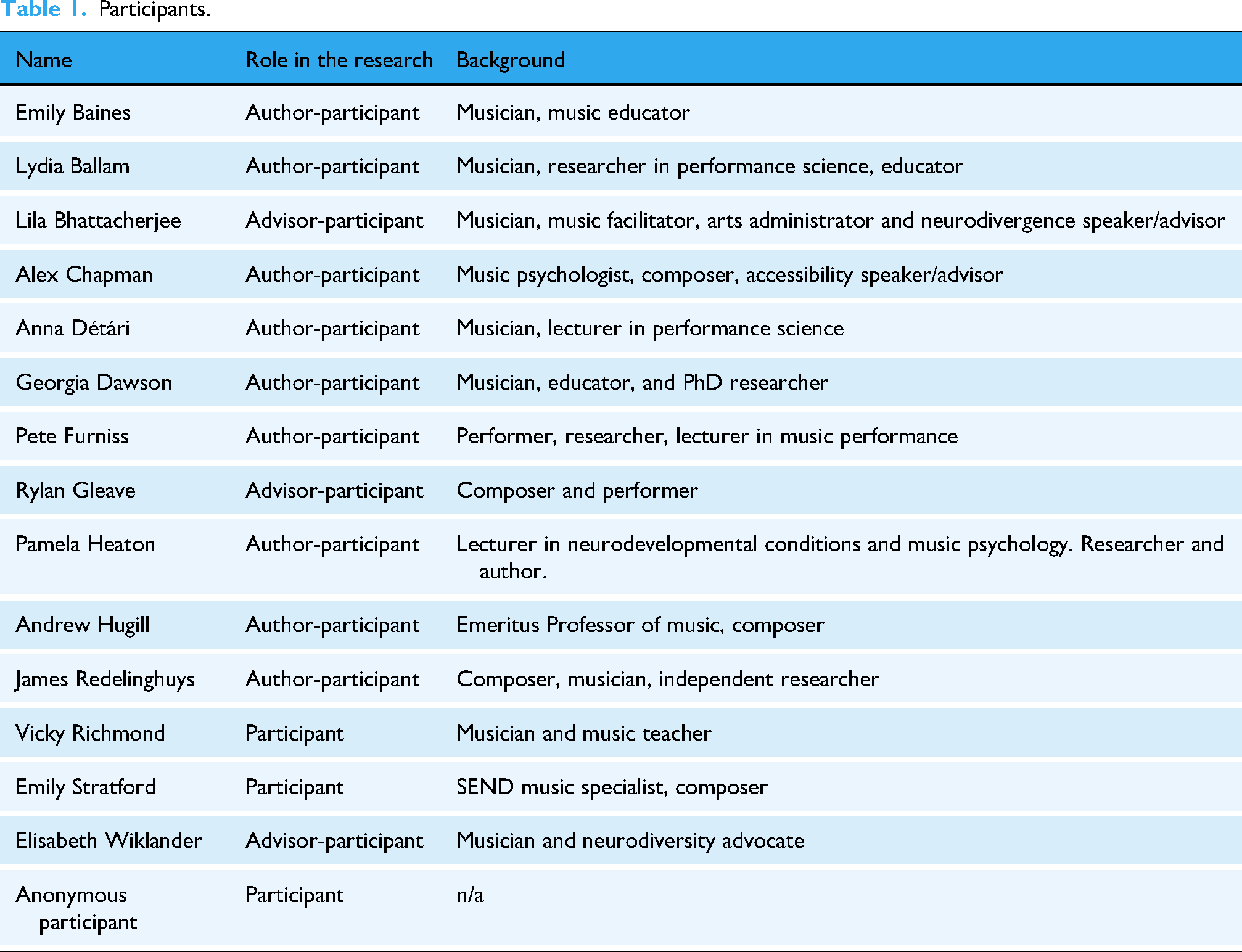
In order to identify our participants, we started by using purposive sampling (Campbell et al., 2020): invitees were identified based on published materials relating to the intersection of their neurodivergence and music profession (e.g. personal statements, opinion pieces, advocacy work, academic publications) or relating to their work or educational experience in the context of music and neurodivergence. After the first round of contacts, the snowballing sampling technique was used (i.e. interested participants suggested further potential invitees) (Noy, 2008). Out of the 27 invitees, 13 (11 identifying as ND, two as non-ND) agreed to participate (see Table 1; note: most participants waived anonymity – see explanation in the collaborative analysis section). The first and second authors (listed in the table of participants), who organised the event and led the research and also equally participated in the conversations, both identify as ND. They also underwent professional music training, thus occupying an ‘insider status’, which helped to make connections with the members of the community. The potential biases associated with this position were mitigated by ongoing reflective practices, and the design of the research, i.e. the data collection, analysis, and the dissemination of the findings were all completed collaboratively (see the establishing working practices and collaborative analysis sections).
Participants.
During the sampling, we did not differentiate between clinical diagnoses and self-diagnoses. We considered self-diagnosis an expression of self-knowledge and self-expertise (Sarrett, 2016) in addition to acknowledging the systemic, historical biases related to gender and socioeconomic status, which prevent individuals from obtaining a diagnosis (McDonald, 2020). The participants were invited to join either in person at our primary ThinkTank event, which consisted of four 90-min-long discussion blocks, or in subsequent Zoom conversations.
We started building a relationship with the individual participants via email conversations. Those who expressed interest in participating in the in-person ThinkTank were sent an information pack about the event, including the participant information sheet, consent form to be signed (including the consent to be recorded), and ideas for the schedule. Additionally, we (the organisers) generated and shared short videos of the road to the venue and the spaces where the meeting was held to reduce potential anxiety around entering an unfamiliar space. As Feekery (2023) articulated, when planning a PAR study, it is important to recognise that the community members might be vulnerable and need accommodations to enhance their experience and their ability to participate. In this case, we (the organisers) considered our own experience with engaging with strangers in an unfamiliar setting and chose this method to alleviate anxiety. Based on the feedback received from the participants later, this approach was successful in making them more comfortable.
Invitees were also forewarned that they would be asked to introduce themselves and share their thoughts and experiences as an ND musician. They were invited to bring any medium (video, pictures, etc.) if they wished to help communicate their experience. These early phases of the PAR process are called methodological release points by McClelland and Fine (2008) and are designed to invite and enable the sharing of the lived experience without specific direction or restrictions. As Fine and Torre (2021, p. 24) put it, it is important to ‘hold collective space and take time […] to explore the full range of experiences, expertise, and gifts in the room’.
However, we also considered that not all the participants might be comfortable with speaking up in front of a group, and feeling safe was crucial to ensure that the event presented ‘opportunities for learning and growth’ (McNiff & Whitehead, 2009, p. 19) rather than psychological discomfort. Therefore, in these email exchanges, participants were given the opportunity to bring a written summary to be read by the welcoming team or skip the introduction altogether in case they felt uncomfortable with the format. They were also asked to articulate their accessibility needs, preferences, comments, and ask their questions. Relationship building continued on the day of the discussions, and in the synchronous and asynchronous online spaces.
Establishing working practices
The email conversations provided a platform to plan the schedule and outline the way we aimed to run the discussions. Due to the open-ended nature of our inquiry, we initially drafted only very broad topics (e.g. lived experience as an ND musician, support needs of ND musicians, goals for advocacy and research), allowing ideas to emerge organically from the discussions, and continuously refining our focus throughout the day. The organising authors assumed the role of participants, rather than leading researchers in the conversations, apart from introducing housekeeping rules, answering practical questions, timekeeping, and occasional moderation to ensure that everyone who wished to contribute had the time and space for doing so.
On the day of the ThinkTank, in the first discussion block, we negotiated and established a set of ground rules, i.e. we discussed what we needed from the space and from each other. In PAR, the question of power and empowerment is central to the investigation (Baum et al., 2006); it is crucial that the process remains democratic, and the space is safe for people to voice their opinions. In our case, participants articulated their need for clear language and a non-judgmental space, and some shared their personal sensory triggers and stimming patterns. We also talked about creating space for respectful disagreement and how to discuss challenging critical reflections. Additionally, the participants were introduced to the Mental Health First Aiders supporting the event and, considering potential sensory differences, shown the allocated quiet spaces, which they could retire to anytime during the day. They were also directed to our anonymous ‘virtual sticky note’ platform. This platform was put in place to provide an additional safe space for those who felt less comfortable speaking up in front of the group and was open and displayed on a screen in the room, allowing the participants to submit comments, observations, topic suggestions, keywords, and reminders throughout the day. The written consent to be recorded was repeated verbally, and we agreed on the use of devices for the day, such as notifying everyone in the room when the device was about to be turned on.
Similar working practices were established for the subsequent Zoom conversations with participants who chose not to attend the live event: first, we agreed on the schedule for the meetings via email, asking the participants about their needs for breaks and their preference for the length of each session. With both groups, we had approximately 3 h of conversation; with the first group, this was accomplished by two 90-min-long meetings with a small break in the middle of each session, and with the second group, three 60-min-long meetings were organised. At the beginning of each call, we established ground rules for each conversation: we agreed in both groups that we would signal our intention to speak with the ‘raise hand’ feature of the software, and that the organising researcher would act as a moderator to determine the order of speakers. We also agreed that anyone can turn their cameras off or leave the conversation at any point, and all participants were notified when the recording was turned on.
Establishing a common understanding of the issues
In the ThinkTank, we had four 90-min-long blocks to share and discuss our lived experiences, our ideas and suggestions, and identify common problems. The first discussion block was spent with introductions, with each participant sharing their experiences. None of the participants opted for skipping the introduction or providing written material; all spoke up in the allocated time. Cornish et al. (2023) stress that identifying the problems has to be a communal effort because the scientific interest based on the literature or preconceived hypotheses might not align with the priorities of the community. With this in mind, at the conclusion of the sharing circle, we invited everyone to pinpoint the topics which seemed the most important to them for further exploration. We supported this process by drawing on the shared experiences and notes from the virtual platform and identified three main areas: experiences with specialised music education, ‘beyond tuition’, i.e. transferring to and participating in professional work, and ‘ND musical bodies’, i.e. the embodied experience of being an ND musician.
In the second discussion block, the participants selected one of these three areas, and we split into groups to continue and deepen the conversation around the identified topics. One member in each group was asked to operate a provided recording device and record the conversation in alignment with our previous agreements. After 60 min of group discussions, we reconvened and spent the last 30 min of the second block sharing the most important insights with each other.
We agreed that after sharing experiences and thoughts about difficulties in the occupational space, the third discussion block should be spent on identifying long-term goals for activism, advocacy, and research. We considered the emerging ideas from the first two blocks about support needs, occupation-specific problems, and barriers to successful participation in music making in higher education institutions and professional environments in order to explore possible solutions.
In the last discussion block, we formed two groups again to discuss the most important pieces of information which need to be shared and potential action steps. The first group addressed what and how to communicate with ND musicians, while the second compiled information to share with institutions, organisations, staff, and non-ND peers. We reconvened again at the end of the event to share our insights relating to these topics and final thoughts. The summary of the topics and the structure of the blocks in the live event are shown in Table 2.
Discussion topics in the ThinkTank event.

In the following online conversations, we recreated some of this structure in a much shorter format, due to the much smaller number of participants (two to three participants in each call). We started by sharing our lived experiences and made communal decisions about the selection of topics from the conversation for further discussion. Instead of the separate online ‘sticky note’ platform, we used the software's chat function to note keywords, ideas, and suggestions. We aimed to identify shared problems and plan both long-term goals and action steps, similarly to the in-person event's structure.
Observing, gathering and generating materials
We recorded the conversations in both PCZs, the ThinkTank and the subsequent online conversations, which resulted in approximately 15 h of audio recording. We also harvested data from the virtual ‘sticky note’ platform and follow-up email conversations to ensure that we represent every idea and opinion in the outputs. Additionally, after the synchronous events, an online space was created for further communications (see the next section).
Collaborative analysis
In PAR, the interpretation of the data, i.e. the process of ‘sense-making’, must be completed with the members of the community (Baum et al., 2006; Fine & Torre, 2021) to avoid inflicting the researchers’ biases and preconceived ideas onto the meaning communicated by the participants and to completely dismantle the hierarchical barriers between participants and researchers. Considering the level of expertise required for the analysis, which would have required training and funding which we did not have at our disposal, alongside the considerable time commitment involved in working with such a rich dataset, led to the practical decision that the first two academically trained authors would undertake the transcription of the audio recordings and conduct the initial thematic analysis. Such processes of negotiating the workload and the sharing of the tasks based on availability, practical considerations, and expertise are a usual practice in PAR; some stages of the process might be more participatory, while others might be more research-led and blending these approaches appropriately leads to an output which is both participatory and scientifically rigorous (Vaughn & Jacquez, 2020).
The first two authors divided the materials between them and first familiarised themselves with the transcripts by reading them multiple times. Then, in alignment with the recommended steps of thematic analysis (Braun & Clarke, 2006), they systematically coded the interesting features and arranged these codes into meaningful groups. At this point, the authors swapped the transcripts and reviewed each other's work to ensure all the important information was considered in the process. Following this process, during in-person and online meetings, they collated the codes and groups into potential themes and gathered further relevant data for each theme by revisiting the transcripts. This step resulted in further refinement of the themes.
This analysis yielded two overarching themes with two main subthemes in each, and a meta-theme titled Action steps (see the planning and taking action section). After completion, the data were uploaded to a secure server, including the audio recordings, the coded transcripts, documents describing the themes and subthemes supported by quotes, and the theme summary documents, and shared with the whole participant group. To ensure that all of those who were part of this exploration fully agreed with the authors’ analysis and generated framework, participants were invited to engage with the generated materials and share further insights about the discussed topics. Moreover, the participants were encouraged to comment on the analysis and the way the first two authors constructed the meaning and distilled the topics from the transcripts.
After allowing ample time to engage with the documents, the participants could decide the level of involvement with the subsequent steps;
they could take up an active role in writing the reports as co-authors take up an advisory role in developing the report and be listed in the acknowledgement section. not be involved in the production of the manuscript, but named as participants. not be involved in the production of the manuscript and remain anonymous.
Nine participants decided to actively engage as authors on subsequent outputs, including this methodology report; three took up an advisor role, two opted to be represented as named participants, and one as an anonymous participant. Offering various ways to be involved reinforced the participants’ agency, reaped the benefits of their individual knowledge (both practice-based and academic), and kept the production of the outputs completely transparent.
After we established the list of authors, we organised online meetings to discuss the refinement of the analysis and the dissemination of the materials. We agreed that the richness of the data does not allow us to share all the emerging themes and ideas in a single publication; therefore, the communal decision was made to write a series of reports about the event.
We began with the first two of these outputs and determined the topic and the initial structure of the subsections. To each subsection, two or three co-authors were assigned, and after the completion of the sections, an initial draft was generated, shared with the group, checked for repetition of ideas, and amended for clarity. This amended draft was then forwarded to the advisors, amended further following their advice, and then shared with every participant for final checks.
This complex process presented some challenges: firstly, finding a way to communicate with the authors and advisors in a way which encouraged engagement but was not overwhelming required constant reflection. Some participants stressed that they would welcome multiple reminder emails and prompts, articulating that potential disengagement might happen not due to the lack of interest but their busy work schedules. Moreover, some shared that their cognitive styles, particularly differences in memory function or difficulty with switching between tasks and creating time and space to engage with the topic, might delay their responses. Our solution for this was to individualise the way we engaged with the participants after asking their preferences for the frequency of communications.
Secondly, organising the complex procedure of co-writing required a more centralised oversight; even though we aimed to maintain a completely democratic process, some elements of the writing and publication process had to be led by the organising researchers. As an example, feedback from reviewers initiated structural changes to how the material was presented, which required a prompt response due to external deadlines. Additionally, the varying levels of expertise in qualitative analysis and academic writing led to different levels of engagement with the process at this stage. Regardless, we kept the communication with the group transparent, asking for short comments from everybody when more detailed discussions could not take place due to time constraints.
The present publication is the first of these outputs, reporting primarily on the design and processes of our PAR study. The detailed analysis and findings will be disseminated in subsequent publications (Dawson et al., forthcoming; Détári et al., forthcoming a; Détári et al., forthcoming b); however, in the following paragraphs, we present a short description of the identified preliminary themes.
Preliminary themes
The preliminary themes from the discussions were the following:
The musical ND experience
Internal experience in a musical setting Relational experience of participating in music as an occupation The musical environment
One-on-one learning and engagement Institutional/organisational environment around the ND musician Action steps
While engaging in the conversations and with the data, we found that we had very similar experiences in institutional and occupational settings, which pointed towards systemic problems with how ND musicians are being taught, evaluated, assisted, and supported in these unique social environments.
The first overarching theme describes the experience of being ND in a musical setting from two different aspects, internal and relational. The cognitive differences of ND musicians seem to greatly impact engagement with daily practice and performances; on the other hand, physiological differences potentially put them at increased risk of performance-related pain and injuries. Participants recounted their inability to understand the hidden, implicit social rules, which led to feelings of ‘misfitting’ and missed performance and job opportunities. They also recounted intense feelings of grief over their unexploited musical potential.
As for the second overarching theme, the musical environment, participants shared that their relationships with their primary instrumental/singing/composition teacher, who is often described in the music education literature as a ‘musical parent’ (Creech & Hallam, 2003), often proved to be difficult, compromised by communication problems and unclear expectations. Similarly, relationships with peers and other staff were not effortless: participants recounted bullying, ableist language, and feeling isolated. Support provided by the institutions and organisations was ineffective or non-existent, and the strict traditions associated with the field hampered unconventional ways of expression and musical engagement. We also concluded that there remain a lot of open questions about the lived experience of ND musicians in these settings, which warrants further investigation, and identified long and short-term goals for advocacy and research (see the ‘planning and taking action’ section). As mentioned above, the process of the analysis and the detailed findings will be published separately (Dawson et al. forthcoming; Détári et al. forthcoming b).
Planning and taking action
Gaffney (2008) calls PAR ‘Group problem solving’, meaning that the goal of PAR is not merely documenting the experiences, but to inspire and generate meaningful change for the community. The last discussion block of our ThinkTank event, and a significant time in the online conversations, was dedicated to identifying action steps. In addition to that, ideas about potential solutions for identified issues saturated the conversations throughout. In this sense, ‘Action steps’ can be understood as a meta-theme in the data, integrating and, at the same time, transcending all the identified themes, but also fulfilling PAR's central goal of initiating change.
Some of these action steps came from personal experience (e.g. sharing stories about receiving support, which was helpful), while others were the result of a collective reflection and deliberation. As an example, we highlighted the need to provide mentoring for ND music students not only in music-related topics. The skills to successfully navigate a musical career, such as networking and self-advocacy, need to be actively developed. It was also stressed that training for educators and stakeholders (e.g. institutions, organisations, teaching and support staff) about the needs of the population is equally important, and the information must come from the ND community. Moreover, encouraging cross-communication between ND and non-ND personnel was also highlighted. The suggestions for action steps and the full list of recommendations will be published separately as a journal article (Détári et al., forthcoming a); additionally, plans have been made to communicate them directly to stakeholders to implement change.
Limitations
The present study presents the opinions and discussions of a small group of ND musicians and neurotypical allies; a notable shortcoming is that we could only invite those people who, in one way or another, made themselves ‘visible’ through advocacy work, publications, social media or other mediums. Thus, we can only claim to have gathered and documented the viewpoints and experiences of those who have an awareness of their neurodivergence and are empowered to speak for themselves. Considering the data provided by the U.K. Music Workforce Diversity Survey in the United Kingdom (2024), the prevalence of forms of neurodivergence among musicians is 16% percent, and it is reasonable to suggest that not all of them are in similarly autonomous positions. Some might keep their neurodivergence a secret, potentially due to fear of stigma or loss of opportunities. Others might share it with their immediate environment and/or student services to acquire support, but they choose not to acknowledge it publicly. Therefore, further work is necessary to identify ways to reach and empower this population and invite them to join the conversation, while respecting their choices about disclosure. Nevertheless, this PAR study is a first step towards exploring this neglected intersection of musicianship and neurodivergence, which can have further implications for ND participation in other art forms and professional educational institutions.
Conclusions
ND musicians are a chronically under-studied population, which, while signalling a lack of knowledge and interest, also provides an opportunity to construct this new scholarship in a participatory and emancipatory manner within the paradigm of neurodiversity rather than outdated and ableist medical frameworks. The active involvement and enthusiasm of community members showed that PAR is a feasible and useful tool to begin this process. We (the organising authors) found building relationships with the community productive and rewarding, and several friendships and professional relationships were formed as a direct result of the events. Given that many participants were sharing their stories about feeling isolated, having musicians with similar experiences in the same room was an empowering and agency-enhancing experience. We aim to broaden this community in the future and include less empowered musicians in subsequent participatory research.
The present study signals a starting point for the development of new scholarship about ND musicians by ND musicians. The subsequent publications will provide the first guidelines for institutions, organisations, teachers, and ND musicians themselves in terms of support, empowerment, and building nurturing educational and professional environments. This methodological report, however, aims to inform and inspire music researchers to employ participatory methods in their work, particularly when they work with vulnerable populations. Moreover, the model of collaboration, self-reflection, interrogating traditional practices, and verifying and confirming shared understanding could also inform teaching practices to make them more inclusive and accessible for ND music students.
Footnotes

Author's Note
Alex Chapman is also affiliated with Drake Music Scotland, Edinburgh, UK.
Funding
The authors received no financial support for the research, authorship, and/or publication of this article.
Declaration of conflicting interests
The authors declared no potential conflicts of interest with respect to the research, authorship, and/or publication of this article.