



Abstract
Focused interests are characterised by high attention and focus, and are commonly experienced by autistic people. While some research frames these interests as inflexible and non-social, other research has highlighted many positive impacts for autistic people. Research also shows that cultural activities, such as museum and art gallery visits, can facilitate and promote health, including mental health, in the general population. This study used an online mixed-methods survey to explore relationships between focused interests, motivation, museum/gallery attendance, and wellbeing for 45 autistic and 44 non-autistic participants. Findings include (a) both autistic and non-autistic participants reported having focused interests, which had a similar nature and served similar purposes for both groups; (b) exploring focused interests in museums/galleries related to more positive emotions during visits for both groups, but autistic individuals more frequently raised sensory and accessibility concerns; and (c) autistic participants reported significantly lower wellbeing, but focused interests, motivation, and museum/gallery attendance did not significantly impact wellbeing. Our findings highlight the deep meaning and positive impact of focused interests on autistic lives, the potential of galleries and museums to provide opportunities for the meaningful exploration of focused interests, and the importance of minimising accessibility barriers for autistic people in these spaces.
Lay Abstract
Some research says that focused interests – meaning interests to which people dedicate a lot of attention, time, and focus – are bad for autistic people, but other research indicates that focused they can be good in many ways, like helping in careers or education. Visiting galleries and museums can be good for human wellbeing, but we do not know if that works in the same way for autistic people specifically. This study looked at whether focused interests, motivation, and museum/gallery attendance contributed to better wellbeing for autistic adults. We also checked if non-autistic people had focused interests, and if there were any differences in autistic and non-autistic people's interests. We looked at the different experiences and needs of autistic and non-autistic people when visiting museums/galleries. To do this, we asked 45 autistic and 44 non-autistic adults to complete an online survey including ratings on scales and open text boxes. We analysed participants’ scale ratings using statistics, and their open answers using content analysis, which helps researchers find the most frequent categories in text. Autistic people's focused interests, motivation, and museum/gallery attendance did not impact their wellbeing in the statistical analysis, but some participants wrote that they used their focused interests to help their wellbeing and mental health. Autistic people reported focused interests more frequently than non-autistic people, but the content and purpose of their interests were similar. Both groups talked about good experiences in visiting museums/galleries and exploring their focused interests there, but autistic people specifically complained about environments that were not accessible. Our findings show that being able to explore focused interests in galleries and museums can lead to positive feelings, while barriers in the environment and accessibility issues can stop autistic people from enjoying their visits and exploring their interests.
Introduction
Autism is a lifelong neurodevelopmental difference that influences an individual's way of communicating, socialising, and pursuing interests (Association, 2021). The diagnostic criteria for autism include the presence of focused interests, which are interests pursued with high intensity and focus (Jordan & Caldwell-Harris, 2012). It has been reported that most autistic people have focused interests (Klin et al., 2007), and the high level of focus that characterises them has been associated with the concept of ‘monotropism’ – a cognitive style where attention is highly focused on fewer stimuli (Wood, 2021), in contrast to a ‘polytropic’ cognitive style which explores a broader range of interests with less intensity and focus (Murray et al., 2005).
Focused Interests – Different Framings and Findings in Research
The theory of monotropism frames the difference in cognitive functioning between autistic and non-autistic people in a value-neutral way. However, the broader autism literature has traditionally described focused interests in a negative light, arguing that they interfere with daily activities and are harmful to autistic people's social and behavioural development (see Cho et al., 2017; Klin et al., 2007; Turner-Brown et al., 2011). Focused interests have also been described in ways that imply impairment and deficit (Wood, 2021), with the use of terms like ‘restricted’, ‘dysfunctional’, ‘obsessive’, and ‘non-social’.
Focused interests have also been viewed as a potential target of intervention, and there have been attempts to extinguish them. Boyd et al.'s (2007) study, for instance, paired focused interests with neutral stimuli to reinforce more socially desirable behaviours, ultimately aiming to extinguish the focused interest itself. In similar negative connotations, researchers have argued that autistic people's interests are less socially oriented than non-autistic peoples’ interests (Anthony et al., 2013), being generally focused on ‘non-social’ aspects of the world (e.g. mechanics, physics, the functioning of objects and vehicles), as opposed to the more ‘social’ aspects like culture and relationships (Baron-Cohen & Wheelwright, 1999; South et al., 2007). Autistic interests have also been described as rigid and inflexible, being limited to a very narrow domain, and immutable across the lifespan (see Turner-Brown et al., 2011).
In contrast, other research has found that autistic people may not display solely ‘stereotypical’ interests, also reporting what would be considered very ‘typical’ interests (Cho et al., 2017), including themes such as art, culture, psychology, belief systems, and history across studies (see Grove et al., 2018; Jordan & Caldwell-Harris, 2012). Autistic participants also reported having changed their topics of interest throughout time (Koenig & Williams, 2017), indicating that focused interests are not necessarily ‘rigid’. Recent qualitative research (Lizon et al., 2023) includes accounts of autistic people saying that their interests held personal meaning and allowed them to communicate and connect with others, providing context and structure to social interactions – which contradicts previous research arguing that focused interests are ‘non-social’.
Autistic respondents to a survey study by Koenig and Williams (2017) also reported that focused interests led to decreased anxiety, were used to engage others in conversation, and in professional/vocational pursuits. This has an important impact, when various researchers have identified higher levels of anxiety in autistic people when compared to non-autistic people (e.g. Kent & Simonoff, 2017). Similarly, Milton and Sims (2016) found that the most significant factor contributing to autistic people's sense of personal fulfilment was the ability to engage in pursuits of interest. Autistic individuals have also demonstrated more enthusiasm when talking about their interests, showing what researchers considered to be ‘improved’ communication and more motivation (Winter-Messiers, 2007; Wood, 2021).
Motivation, in fact, is another key factor in understanding the role of focused interests. Grove et al. (2018) found that autistic people tended to be more intrinsically motivated in their pursuits of interest compared to non-autistic people. Intrinsic motivation, driven by enjoyment and satisfaction rather than external rewards, contributes to the development of autonomy and competence (Ryan & Deci, 2000), and has been linked to improved wellbeing in autistic adults (Grove et al., 2018). Autistic individuals face increased risks of anxiety, depression, and suicidal behaviour (Cassidy & Rodgers, 2017; Stewart et al., 2006), making it important for research to explore factors contributing to autistic wellbeing.
It is possible that the contrasting perspectives and findings on the nature of focused interests are related to the differing views, biases, and dispositions of researchers within the autism scientific establishment. A longstanding issue in autism research is the framing of autistic behaviours through a neurotypical lens, which often leads to pathologising differences rather than a more neuro-affirming autistic lens to understand autism (Kapp et al., 2013). This has contributed to the widespread assumption that autistic functioning and sociality are inherently deficient, framing focused interests as detrimental.
Autistic scholarship, such as Milton's (2012) Double Empathy Problem theory, challenges these assumptions by suggesting that the perceived social deficits in autistic individuals are not due to an inherent lack of empathy, but rather stem from a mutual misunderstanding between autistic and non-autistic people. Framing this problem as a ‘two-way’ process, this theory shifts the narrative of autism being an inherent obstacle, calling attention to the responsibility of people, spaces, and other ecological aspects in perpetuating this dynamic. There is a body of literature demonstrating the Double Empathy Problem in practise. For instance, an experiment conducted by Crompton et al. (2020) indicated that autistic participants effectively shared information with each other, but less effective transfer happened in cross-neurotype interactions. Jones et al. (2023) conducted an experiment where non-autistic observers detected and demonstrated the Double Empathy Problem, evaluating non-autistic interactions most positively and perceiving mixed-neurotype interactions as the least successful. Similarly, Foster et al. (2025) found that all-autistic groups reported rapport as good as (or better than) all-non-autistic groups, and that autistic participants’ rapport dropped as more non-autistic people were added to the group. These findings challenge the idea that autistic people have inherent socialisation deficits, corroborating the theory that a ‘mismatch’ in cross-neurotype communication happens both ways.
Focused Interests, Wellbeing, and Museum/Gallery Attendance
Attending recreational and cultural activities is associated with good health, good satisfaction with life, and low anxiety and depression scores in the general population, indicating that cultural spaces, such as museums and art galleries, can play a crucial role in promoting public health (Cuypers et al., 2011). There is also evidence of museum and art gallery engagement contributing to improved wellbeing, including reduced stress and enhanced mood (Dupuy et al., 2024; World Health Organization, 2019).
In the general population, museums and galleries are a common form of leisure. Reports issued by the UK Government indicated that 43% of adults in England reported visiting a museum or gallery between 2023 and 2024, with participation highest among younger adults and lowest among those aged 85 and over (Department for Culture, Media and Sport, 2024a). Most reported reasons for visiting were interest in the subject matter and spending time with family and friends (Department for Culture, Media and Sport, 2024b). However, disabled adults (which includes autistic people) were less likely to visit than non-disabled adults (37% vs. 46%) (Department for Culture, Media and Sport, 2024c).
Research about autistic peoples’ museum and gallery attendance is scarce and mostly focuses on the experiences of parents and families). Parent reports indicate that autistic children participate in museum activities about one-third as often as their peers, and report negative emotions three times more frequently (Antonetti & Fletcher, 2016). However, accommodations and adaptations can make a difference: Fortuna et al.'s (2024) study interviewing families of autistic children showed that pre-visit materials, such as social stories and accessibility maps, can be useful in facilitating more meaningful and accessible engagement. Langa et al. (2013) found that the main motivation for museum attendance in families with autistic children was related to pursuits of interest, as museums were a good way to encourage children to engage with their interests and share their enthusiasm for learning.
Concerning adults, a study by Billstedt et al. (2011) found that the only variable positively correlated with good or very good quality of life in autistic people was having regular recreational activities, which allow for the exploration of interests. However, a qualitative study by Bagatell et al. (2022) showed that sensory processing differences significantly shaped autistic adults’ choices about community activities, with participants stressing how environments with intense sensory stimulation can be overwhelming. Regarding museums specifically, a recent co-design initiative highlighted that incorporating an autistic perspective in the design of museum facilities can lead to significant improvements in the experiences of autistic visitors and their families, with participants stressing the usefulness of autism-friendly resources and environments (Watchorn et al., 2025). A recent doctoral thesis (Fletcher, 2025) exploring neurodivergent adults’ experiences in museums found that autistic people would go to museums more often if they were more accessible to their needs, highlighting a range of barriers (e.g. inaccessible sensory environment and lack of neurodiversity understanding), which could be addressed with often straightforward actions.
These findings indicate that museums and galleries could play a role in promoting wellbeing for autistic adults by allowing them to meaningfully engage with their topics of interest, but mitigating barriers and providing access to environments and resources that support their needs is crucial. The present study aims to investigate the relationships between focused interests, museum attendance, motivation, and wellbeing among autistic adults. Additionally, it seeks to compare the experiences of autistic and non-autistic individuals regarding their focused interests and museum attendance. Specifically, this study explores the following research questions (RQs): RQ1. Are focused interests unique to autistic people? If not, do autistic and non-autistic people's focused interests differ in nature, content, and/or purpose? RQ2. Do autistic people who have focused interests report better wellbeing? RQ3. Is museum/gallery attendance linked to higher wellbeing for autistic people? RQ4. Are autistic people more motivated in their pursuits of interest, particularly in terms of intrinsic motivation, compared to non-autistic people? RQ5. Is higher intrinsic motivation related to better wellbeing in autistic individuals? RQ6. Is being able to explore focused interests in museums/galleries related to more positive feelings during visits? RQ7. How do the experiences and needs of autistic and non-autistic people differ in museums and galleries?
Methods
Recruitment
We aimed to recruit an even sample of both autistic and non-autistic adults living in the United Kingdom, allowing for the exploration of differences across both groups which were relevant to our research questions. Because we wished to understand various factors related to museum in/attendance, including both positive and negative experiences, we indicated in our recruitment materials that we were interested in the perspectives of people who visited/enjoyed visiting museums, as well as those who did not. We also indicated that self-diagnosed autistic people were eligible to take part. Including self-diagnosed participants is an increasingly common practice in autism research, with researchers arguing that these groups can bring a diversity of views and experiences to research samples, as many autistic people may wish not to pursue diagnosis or may not have access to it due to systemic barriers – especially those who are intersectionally marginalised (see Ardeleanu et al., 2025). We have, however, included a non-diagnostic measure of autistic traits in the survey (see the Data Collection and Analysis section), and all self-diagnosed participants have scored above the cut-off score.
Participants
Eighty-nine adults (45 autistic and 44 non-autistic) participated in an online mixed-methods survey hosted on ‘Qualtrics', which was advertised on the social media platform X and in flyers distributed to visitors in various museums and galleries in Central Scotland. The mean age of participants was 39.11 years (SD = 15.5; range 18–79). The autistic group included 32 females (66.5%), 7 males (15.5%), and 6 people identifying as other gender identities (e.g. non-binary and genderqueer). The non-autistic group consisted of 26 females (59.1%), 17 males (38.7%), and 1 non-binary individual. Most participants were white, with 75.6% of the autistic and 61.4% of the non-autistic group identifying as ‘English, Welsh, Scottish, Northern Irish or British’. In terms of socioeconomic status, 42.2% of the autistic and 52.3% of the non-autistic group identified as working class.
Data Collection and Analysis
Data was collected through a mixed-method online survey hosted on 'Qualtrics', which included demographic questions, pre-established quantitative scales, and open-ended questions. Quantitative data obtained from participants' ratings of the scales were analysed through statistical analyses using the SPSS software. Participants’ qualitative responses to the open-ended questions were analysed using qualitative manifest content analysis (Bengtsson, 2016). The following domains were included in the survey:
Why do you go to museums/galleries? Can you give an example of a visit to a museum/gallery in which you could explore your focused interests? How did the visit go? What could museums or galleries do to improve your overall experience?
Results and Findings
Focused Interests
Quantitative Results
In regard to RQ1, most autistic participants (93.3%, n = 42) reported having focused interests, with only three reporting no focused interests. Within the non-autistic group, 30 participants (68.2%) reported having focused interests, while 14 participants (31.8%) reported no focused interests. Chi-square analysis confirmed a significant group difference between autistic and non-autistic groups and the presence of focused interests (χ2 (1) = 9.108, p = .002), indicating that autistic people reported focused interests significantly more frequently than the non-autistic group.
Qualitative Findings
Sixty-eight (n = 68) participants, of whom 40 were autistic and 28 were non-autistic, reported their topics of interest. Twenty categories were identified within the answers through content analysis. Five of those categories (‘animals’, ‘social issues and activism’, ‘people’, ‘belief systems’, and ‘focused interests as dynamic’) were unique to the autistic sample; and one category (‘gastronomy’) was unique to the non-autistic sample. The most frequent categories of interest within the autistic sample were ‘History and Archaeology’, ‘Art and Culture’, ‘Animals’, ‘Sciences’, ‘Creative activities and crafts’, ‘Music’, and ‘Psychology’. The most frequent categories of interest within the non-autistic group were ‘Art and Culture’, ‘Sciences’, ‘Music’, ‘Sports and Physical Activities’, and ‘History and Archaeology’. The categories identified, their frequency, and examples of answers can be found in Table 1.
Topics of Focused Interests Reported by Autistic and Non-Autistic Participants.
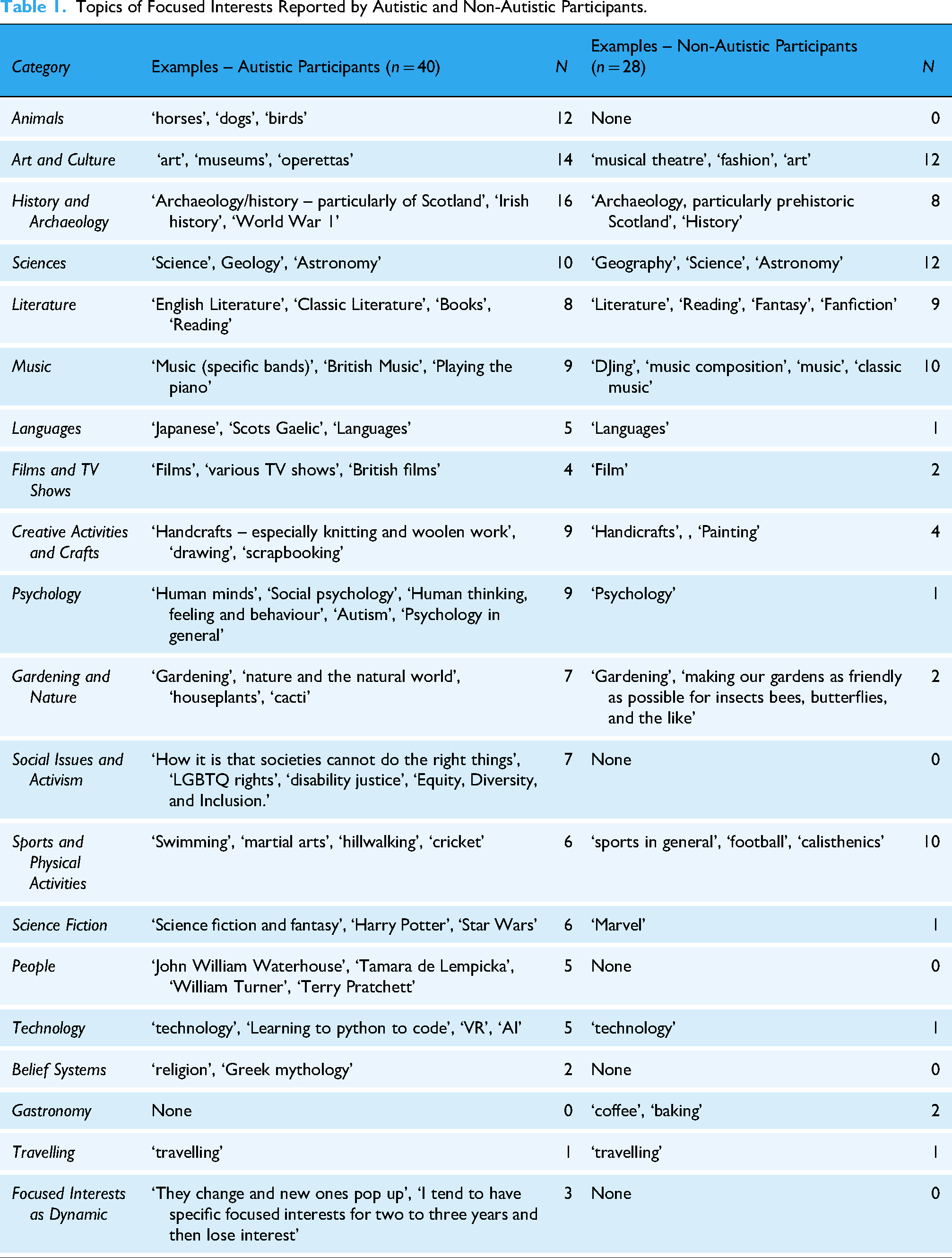
When asked what focused interests meant to them, sixty-eight (n = 68) participants, of which 40 were autistic and 28 were non-autistic, contributed answers. Five overarching categories were identified in both autistic and non-autistic participants’ responses, as described below:
Wellbeing and Motivation
Quantitative Results
Regarding RQ2, a two-way ANOVA demonstrated a significant effect of autism (F (1, 84) = 7.755, p = .007) on wellbeing, showing that overall autistic participants (M = 38.58, SD = 8.11) reported lower rates of wellbeing than non-autistic participants (M = 43.76, SD =7.60) However, there was no significant effect of focused interests on wellbeing (F (1, 84) = 0.215, p = .644), and no significant interaction between autism and focused interests on wellbeing (F (1, 84) = 1.523, p = .221).
To answer RQ3, participants who reported attending museums/galleries ‘three to five times’ or ‘more than six times’ in the 6 months prior to the survey were combined into the group ‘high attendance’, and participants who answered ‘not at all’ or ‘one or two times’ were combined into the group ‘low attendance’. A two-way ANOVA demonstrated no significant effect of museum attendance on wellbeing (F(1, 84) = 0.547, p = .462) and no significant interaction between autism and museum attendance on wellbeing (F(1,84) = .725, p = .397).
In response to RQ4, an independent samples t-test demonstrated that non-autistic participants (M = 74.10, SD = 11.97) reported higher total motivation (t(70) = 3.090, p = .003) compared to autistic participants (M = 64.21, SD = 14.29), but primarily due to higher extrinsic motivation (t(70) = −3.873, p < .001) in the non-autistic group (M = 43.53, SD = 10.24) compared to the autistic group (M = 33.35, SD = 11.48). Intrinsic motivation scores had no significant difference between groups (t(70) = .258, p = .781), and mean scores were similar between autistic (M = 30.85, SD = 5.52) and non-autistic participants (M = 30.56, SD = 3.24). In answer to RQ5, linear regressions demonstrated that extrinsic motivation scores were not significant in predicting wellbeing for neither the autistic (t = −.668, β = −.115, p = .509) nor the non-autistic group (t = 1.416, β = .301, p = .169); and intrinsic motivation scores were also not significant in predicting wellbeing for neither the autistic (t = .909, β = .157, p = .369) nor the non-autistic group (t = −.195, β = −.041, p = .847).
Qualitative Findings
Autistic (n = 43) and non-autistic (n = 40) participants shared personal motivations for visiting museum and gallery spaces, with four overarching categories being identified in their responses. These are described below:
a. b. c. d.
Museum Experience
Quantitative Results
In regards to RQ6, a two-way ANOVA indicated a significant main effect of exploring focused interests in museums/galleries on the Positive Affect Scale scores (F(3, 67) = 14.693, p < .001), and repeated contrasts using Bonferroni analyses showed only significant differences between the groups reporting the levels ‘not at all’, ‘a little’, and ‘quite a bit’ of being able to explore focused interests, but no significant differences between the groups ‘quite a bit’ and ‘a lot’. There was no significant effect of autism (F (1,67) = 0.536, p < .467) and no significant interaction between exploring focused interests in museums/galleries and autism on the Positive Affect Scale scores (F (1,67) = 1.811, p < .155). This shows that both autistic (M = 9.69, SD = 4.22) and non-autistic (M = 17.45, SD = 3.45) groups experienced more positive feelings during their visits to galleries and museums, which happened if they were able to explore those interests to some extent – not necessarily ‘a lot’.
Testing whether the reverse was also true – that is, if no/little exploration of focused interests in museums/galleries related to more negative emotions during the visit – a two-way ANOVA demonstrated no significant effect of exploring focused interests in museums/galleries on Negative Affect Scale scores (F (3, 67) = 0.659, p = .580). However, there was a significant effect of autism (F (1, 67) = 15.699, p < .001), with autistic participants reporting overall more negative emotions while visiting museums/galleries. There was no significant interaction between exploring focused interests in galleries/museums and autism on the Negative Affect Scale scores (F (3, 67) = 17.125, p = .301), suggesting that autistic participants (M = 9.69, SD = 4.22), overall, reported more negative emotions than non-autistic participants (M = 6.54, SD = 2.42) while visiting museums/galleries, but that the level of exploration of focused interests in those spaces was not a significant factor involved in the negative emotions experienced.
Qualitative Findings
When asked about what museums/galleries could do to improve the experience of autistic visitors, 7 non-autistic people who reported having autistic family members and 15 autistic people contributed answers. Alternatively, 29 non-autistic people without autistic family members answered the question ‘what could museums/galleries do to improve your overall experience?’. Participants' answers were divided into the two overarching categories: ‘it is already good’ and ‘implement changes’:
To gain a deeper understanding of the impact that exploring focused interests can have on people's experiences in museums/galleries, participants were asked to talk about a visit to a museum/gallery in which they could explore their focused interests, with 37 autistic and 21 non-autistic participants answering this question. Two overarching categories were identified in the answers: ‘not able to explore focused interests in museums/galleries’, and ‘able to explore focused interests in museums/galleries’. Within this last category, the subcategories ‘good experiences and/or positive aspects of the visit’, ‘disappointing experiences and/or negative aspects of the visit’, and ‘neutral experiences’ were identified.
II.
Discussion
The present study aimed to test whether focused interests, motivation, and museum/gallery attendance were associated with better wellbeing in autistic adults. We also aimed to identify whether non-autistic people had focused interests, and, if that was the case, to understand the differences in the content and purpose of autistic and non-autistic people's focused interests. Additionally, we hoped to understand the differing experiences and needs of autistic and non-autistic people when visiting museums and art galleries, investigating whether the extent to which participants were able to explore their focused interests would impact on their feelings during visits to those spaces. Finally, we also aimed to see if autistic people would show higher motivation to engage with their focused interests compared to non-autistic people, with higher rates of intrinsic motivation specifically.
We found that autistic participants showed significantly lower rates of wellbeing than non-autistic participants, and the presence of focused interests, the levels of motivation for focused interests, and the rates of museum attendance did not have a significant effect on wellbeing for autistic participants. This points to the complexity of the issues impacting on autistic peoples’ wellbeing. For example, there is scope for minority stress (Botha & Frost, 2018). Botha and Frost argue that autistic people must deal with an additional stress burden that stems from constituting a social minority group, frequently dealing with stressors such as inaccessible spaces, everyday discrimination, and stigmatisation, which are harmful to wellbeing. In that sense, it is possible that the variables analysed in this study were not impactful enough to predict wellbeing in autistic people in the face of the complex stressors faced daily by this population.
Statistical analysis did not indicate a significant relationship between having focused interests and better wellbeing. However, qualitative accounts of autistic participants included mentions of focused interests assisting in maintaining and promoting better wellbeing and mental health, as well as helping in coping with negative emotions. These contrasting findings could be a product of the limitations of using a measure of wellbeing that was not developed for autistic people specifically – for example, there may be unique domains of autistic wellbeing which were not encompassed in this measure, but which may be enhanced by engaging with focused interests. This also indicates that the relationship between focused interests and wellbeing may be more complex and nuanced than our methodology allowed us to tap into. This complexity is echoed in the findings a of mixed-methods study by Bross et al. (2022), where participants extensively described in qualitative responses how focused interests had several positive impacts to their lives, including managing trauma, developing social skills, and fostering positive emotions such as calm and joy. However, they also reported ‘masking’ or hiding their interests to avoid shame and lack of acceptance from others. More than half of the participants in Bross et al.'s study reported experiences of bullying related to their focused interests, with quantitative results indicating that those reporting more interest-related experiences of bullying had higher depression and anxiety scores. Additionally, participants who did not have support from others in their pursuits of interest had higher stress levels than those who did.
It is possible that occasional visits to galleries and museums may not have effects on wellbeing that are long-lasting, especially if autistic people must consistently navigate the harmful and pervasive effects of minority stress described by Botha & Frost (2018). However, it is also possible that the many environmental and sensory barriers reported by autistic participants in museum/gallery spaces are hindering the potential of these spaces to be beneficial to their wellbeing. As autistic participants also reported more negative feelings during their visits than non-autistic visitors, which may be related to the also frequently reported environmental barriers, we wonder if museum/gallery spaces would have an unlocked potential for promoting autistic wellbeing if they addressed these barriers and became more accessible spaces.
In terms of focused interests, we found that most non-autistic people also reported having them. Autistic people, however, reported having focused interests at a significantly higher rate, with only three autistic participants reporting no focused interests. This is consistent with previous findings indicating that the largest part of autistic people has focused interests, but that it is not necessarily the case for every autistic individual (Klin et al., 2007). Different from the findings of Grove et al. (2018), autistic people did not show higher intrinsic motivation for focused interests in comparison to non-autistic people. However, non-autistic people showed significantly higher extrinsic motivation than autistic participants, indicating that they were overall more motivated by external factors (e.g., financial rewards, peer approval, and external feedback) than autistic people in their pursuits of interest. It is possible that autistic individuals find such external rewards less compelling or motivating than non-autistic individuals do.
Our qualitative findings contradict previous research indicating that autistic people's topics of interests are stereotypical, non-social, or inflexible (Cho et al., 2017; Turner-Brown et al., 2011), as autistic participants often mentioned many interests that could be considered ‘typical’ (e.g. art and culture, and music), often discussed the dynamic nature of their focused interests, and indicated more often than non-autistic people that they use their interests as a means of socialising and connecting with others. Additionally, our findings are compatible with previous research showing that focused interests are of high importance to autistic adults (Attwood, 2003), with participants in the present study describing them as meaningful, important, and essential to a good life. Furthermore, consistent with the findings of a study by Koenig and Williams (2017), in which autistic participants emphasised the positive and calming effects of focused interests, autistic participants in the present study also viewed their interests positively – mentioning the many ways in which they were beneficial to their lives, and frequently discussing positive subjective effects of engaging with their interests.
Similar to the findings of Milton and Sims (2016), who identified that autistic people often reported a feeling of satisfaction for being able to share their interests with others, many autistic participants in the present study also mentioned using their focused interests as a means of social connection. It is possible that previous research describing autistic interests as non-social or socially isolating were adopting neurotypical understandings of sociality as a standard. Recent research indicates that autistic people socialise in different, autistic ways, and often build meaningful social connections with people who understand their communication and socialisation style. Moreover, compatible with the possibility suggested by Klin et al. (2007) that autistic people may use focused interests as a means to navigate the demands of everyday life, autistic participants in the present study often mentioned how focused interests helped them make sense of the world and manage life better.
Being able to explore focused interests in museums and galleries at a higher rate was significantly related to more positive emotions experienced by both autistic and non-autistic people during their visits to those spaces. Similarly, a study by Grove et al. (2018) had previously found that autistic adults who have focused interests scored significantly higher in the satisfaction with leisure activity scale, also pointing to the potential benefits of connecting focused interests with leisure/recreational contexts. Interestingly, the opposite effect was not observed, and less or no exploration of focused interests in museums/galleries was not associated with more negative emotions during visits for autistic people. In fact, autistic people reported negative feelings more frequently than non-autistic people in museum/gallery spaces, and our qualitative results indicate that many autistic adults experienced environmental barriers and sensory concerns in their visits, often describing how elements such as noise and crowds can generate negative experiences. These findings reflect those of the Sensory Street project (MacLennan et al., 2023), which has sought to understand the experiences of autistic people in public spaces and the impact that the sensory environment can have. MacLennan et al. (2023) found that the sensory environment can be disabling to autistic people and that, by addressing these barriers, it could enable greater access to these spaces and improve autistic people's quality of life. Thus, it is possible that the negative emotions experienced by autistic people when visiting museum/gallery spaces are more related to sensory concerns and accessibility-related barriers, which in turn makes it harder to engage with the content of the museum and reap the benefits of potentially exploring focused interests.
Accordingly, when asked about what museums/galleries could do to improve people's experiences in those spaces, autistic participants most often mentioned the physical and sensory environment of museums/galleries, recommending the minimisation of sensory overload. Despite the often commented upon sensory concerns, many participants, autistic and non-autistic, reported at least one museum/gallery visit in which they could explore a focused interest, and commented on mostly positive experiences and good aspects of those visits. Moreover, when asked about the reasons why they go to museums/galleries, most participants’ (autistic and non-autistic) answers were coded into the category ‘because I have a positive experience there’. Most frequently commented upon by autistic people were the positive feelings generated in their visits, such as states of calm. This is consistent with the growing body of research pointing to the general benefits of cultural attendance (Camic & Chatterjee, 2013), which should be further explored in research focusing on autistic people specifically.
Conclusion – Including Strengths and Limitations
To our knowledge, this is the first study to investigate the wellbeing outcomes associated with motivation, museum/gallery attendance, and focused interests in both autistic people and non-autistic people. However, there are significant limitations – some measures used in this study were not formulated for autistic populations, potentially assuming neurotypical stances that efface cross-neurotype and individual nuance. Similarly, more research is needed to include a wide variety of autistic people, as this study's sample lacked diversity in terms of gender, level of education, ethnicity, and only included autistic people with access to, or ability to engage with, online written communication. Future research should aim to include a more diverse sample of autistic people, especially with diverse communication needs, in more accessible formats like ‘easy-read’ text or using research methods that do not rely solely on verbal or written communication. Nonetheless, we believe that this study offers a novel insight into autistic people's experiences with focused interests and museum/gallery attendance, indicating that there is a potential benefit in exploring those factors together. By displaying content aligned with topics of interest in an accessible and inclusive way, museums and galleries can promote positive emotions during visits and minimise stress stemming from environmental barriers, such as sensory overload.
Footnotes
Acknowledgements
The authors would like to acknowledge and thank Dr Eilidh Cage for the guidance and advice.

Ethical Approval
This study received ethical approval from the University of Stirling General Ethics Panel (GUEP).
Authors’ Contributions
SD conceptualised this study, collected and analysed the data, and wrote the original manuscript for publication. AF contributed thorough feedback to the study design – including reviewing the ethics materials and survey questions – and contributed to editing the final manuscript for publication.
Funding
The authors received no financial support for the research, authorship, and/or publication of this article.
Declaration of Conflicting Interests
The authors declared no potential conflicts of interest with respect to the research, authorship, and/or publication of this article.