



Abstract
Individuals who experience subjective sensory sensitivities can experience aversion, discomfort or distraction in the presence of sensory stimuli such as loud noises, bright lights, or strong smells. This qualitative analysis took a diagnosis-independent approach to understand the lived experience of sensory sensitivities in 713 individuals. Participants’ descriptions of the effect of their sensitivities on their daily lives were multi-faceted. Themes derived using template thematic analysis centred on sensitivities as limiting social and functional capabilities, creating challenges in personal relationships, and being described as effortful and exhausting. Diverse coping mechanisms were explained, including limiting sensory input, sensory stimulation, self-regulation and the role of others. Participants also described exacerbating factors that were both situational (e.g. focused tasks and crowds) and internal (e.g. stress and fatigue). Physical locations described as challenging were also identified to provide targets for sensory accommodations; these included schools, workplaces and shops. This work underscores the diverse and clear impact subjective sensitivities can have and highlights a need to acknowledge sensory differences outside of diagnostic silos to support wellbeing.
Lay Abstract
Many people feel overwhelmed by things like loud noises, bright lights, or strong smells; this is known as sensory sensitivity. It is common but we know relatively little about how much these experiences can affect daily life. In this study, 713 people shared their personal experiences with sensory sensitivities. By analysing their answers, we found that sensory sensitivities can make it harder for people to socialise, study, work or do everyday tasks like shopping or cooking. People described how these sensitivities often lead to them feeling exhausted or needing time alone to recover. People also told us that their reactions to sensory input could cause tension in their relationships. Some situations made these experiences worse. For example, being tired, stressed or in busy, unpredictable environments. People used different strategies to cope, such as wearing earplugs or sunglasses, avoiding certain places, using calming techniques like deep breathing, or seeking support from people around them. People said that places like schools, workplaces and shops could be particularly difficult for them to be in. Importantly, this study showed that sensory sensitivities can be experienced by many different people, including those without any diagnoses or areas of neurodivergence. By listening to their voices, we can better understand what makes environments difficult and how we might make public spaces more comfortable and inclusive for everyone.
Introduction
Subjective sensory sensitivities refer to aversion or discomfort in response to sensory information (Ward, 2019) and describe affective responses to sensory input (He et al., 2023). Common precursors to the experience are loud noises, bright lights or strong smells. Sensory sensitivities are common and reported in a range of conditions, including sensory processing disorder (Galiana-Simal et al., 2020), anxiety disorders (Engel-Yeger et al., 2013; Isaacs et al., 2020), neurodevelopmental conditions (Rani et al., 2023), eating disorders (Bell et al., 2017; Saure et al., 2022), neurovestibular (Powell et al., 2020) and neurological conditions (e.g. migraine; Price et al., 2021; Robertson & Simmons, 2018) as well as in the general population (Robertson & Simmons, 2013). Thus, subjective sensory sensitivity is a pervasive and trans-diagnostic experience (e.g. Price et al., 2025; van den Boogert et al., 2022)
Sensory sensitivities are clearly impactful for autistic individuals, for whom most existing studies have been focussed. For example, in qualitative work with autistic adults, sensitivities are described as having diverse consequences, including affecting mood, increasing stress and anxiety, and being experienced as painful. This is found across diverse methodologies, including focus groups (Parmar et al., 2021; Robertson & Simmons, 2015), first-hand descriptions (Doherty, 2025; Jones et al., 2003) and qualitative survey responses (MacLennan et al., 2022a). For example, following thematic analysis of written responses, MacLennan et al. (2022a) report how autistic adults describe diverse consequences of sensitivity for their mental health, including self-harm and eating disorders. As well as being painful, participants described implications for physical health such as inability to sleep or eat.
There are also suggestions that sensitivities impact daily life and wellbeing in studies beyond autism. For example, in adolescents with persistent pain (Sinclair et al., 2019) or with migraine (Genizi et al., 2019, 2020), sensory sensitivities associate with decreased emotional, social and school-related quality of life; while for individuals with affective disorders, sensory sensitivities have been associated with decreased mental wellbeing and increased bodily pain (Engel-Yeger et al., 2016). Survivors of stroke or other acquired brain injury (Alwawi et al., 2020; Marzolla et al., 2024), and individuals with vestibular disorders (Smith et al., 2024), similarly describe how sensitivities affect their participation in daily activities, making them feel fatigued, frustrated and anxious. Sensory sensitivities (or sensory processing disorder) in children also help to predict future anxiety disorders (McMahon et al., 2019), even when accounting for concurrent anxiety and autism (Carpenter et al., 2019; Green et al., 2012; Schwarzlose et al., 2023). Sensory sensitivities have also been associated with quantitative measures of reduced social functioning, poorer physical health and lower mental wellbeing in the general population (Kinnealey et al., 2011; Lee, 2012).
However, much of the existing literature is condition-specific, limiting understanding of how sensory sensitivities are experienced across diagnostic boundaries or in individuals without a condition or neurodivergence. Here, we use a thematic analysis to investigate the association between sensory sensitivities and wellbeing in people's day-to-day lives in a large general-population sample (with and without self-identified clinical diagnoses). We sought to explore what aspects of life are affected, what factors exacerbate sensory challenges, and the ways people cope with or manage their sensitivities. We take a diagnosis-independent approach focussing on the characteristics and consequences of sensory sensitivity as an experience, which also allows us to capture the perspectives of those who face sensory difficulties yet fall outside established diagnostic frameworks. For instance, a recent qualitative study in new mothers highlights how sensory stimuli associated with caring for a baby felt overwhelming (Pirmohamed, 2023). Finally, given that research is beginning to consider how sensory aspects of the built environment can be adapted to be more accommodating (e.g. Finnigan, 2024; MacLennan et al., 2022a; Mostafa, 2019; Mostafa et al., 2024; Weber et al., 2022), we also explored coping strategies and identify the locations participants spontaneously describe as challenging. This could provide insight into common features which are difficult, as well as providing clear targets for adapting public environments to improve access.
Methods
Participants
Participants were recruited via two methods. The first involved 591 undergraduate students at Cardiff University, who completed the online survey in exchange for course credit. The second involved posting the survey link on different support and information forums on social media (Facebook, Reddit and Twitter), found by searching the condition name (e.g. ‘ADHD’) and selecting associated groups or pages. Prior to distribution, the study's aims were clearly explained, and approval to post was sought from forum administrators or moderators. These participants (n = 174) were not compensated for participation. Only participants who provided qualitative responses were included (24 participants removed from the student sample and 28 from the online sample). Ethical approval was obtained from Cardiff University's School of Psychology.
Demographic information is shown in Table 1.
Self-Identified Gender Identity and Age for Student and Social Media Participants, and the Final Combined Sample, Provided as Percentages.

The most frequent gender identities among those self-reporting as ‘Other’ included: gender queer, gender fluid, non-binary and agender.
Design
A qualitative approach was used for this study, involving data collection using an online survey with open-ended questions. This approach was chosen over focus groups or interviews for several reasons. Online surveys allow for collection of data across diverse individuals, who may be limited geographically, or in their willingness or time to commit to an in-depth interview or focus group (Braun et al., 2017). An online survey allows participants to take part when it is convenient, for as long as they choose, in their chosen tone. These reasons allow us to collect a large sample, to capture the diverse and varied experiences which we sought, with a level of focus in responses which can sometimes surpass that of interviews (Braun et al., 2021). Online surveys also allow a greater level of anonymity to participate which may increase their comfort in discussing difficult experiences associated with their sensory needs (Braun et al., 2021).
Materials
All questionnaires were delivered online via Qualtrics. Demographic information was collected (age and self-reported gender), along with self-reported diagnosis of or identification with clinical conditions. Space was provided to indicate conditions not pre-specified. Of 713 participants, 297 individuals reported no diagnosis or self-identification with clinical conditions or areas of neurodivergence. Details of reported diagnoses by the remaining participants are provided in Supplemental material.
The survey began with four qualitative questions presented as follows:
“These questions are about your experiences with different sensory stimuli. Sensory stimuli can be anything in your environment which you can touch, see, smell, taste, or hear. It can also be things that might affect your movements or balance. We are interested in your reactions to these sensory stimuli. These reactions might be physical or emotional and can be positive or negative. There are no right answers – everyone responds differently to sensory stimuli, and we would like to hear about your individual experience (perhaps think of your different senses in turn). Please answer the following questions in as much detail as you feel comfortable with
1. Can you describe the kind of reactions you have or behaviours related to sensory stimuli? These might be positive or negative. Please also provide any examples of particular types of sensory stimuli, scenarios, or environments which make you react this way. 2. Do you find yourself having to cope with or manage these reactions or behaviours? In what ways do they impact your day-to-day life, if at all? 3. Do you feel you are more or less sensitive to your environment than other people seem to be? What makes you think this? 4. [displayed if clinical diagnosis or area of neurodiversity reported] Do you feel your behaviours or reactions to sensory stimuli are related to your condition or neurodiversity? If so, how?”
Quantitative measures of sensory sensitivities were also included in the survey but are not relevant to the current analyses.
Analysis
To better understand the sensory experiences of our participants, with a particular focus on impact and wellbeing, coping mechanisms and exacerbating factors, template thematic analysis (TA; Braun & Clarke, 2021; Brooks et al., 2015) was used to define themes in our open-ended text responses. The approach has been previously used for data of this kind (Evans et al., 2020), and was selected due to its structured approach, with flexibility to meet the needs of specific research aims (Brooks et al., 2015). Initial themes were developed based on existing theory and knowledge of the field. In acknowledging the participant as best placed to describe their own sensory world and its implications, a posteriori themes were also added following initial coding of the data and remained provisional throughout. That is, if an excerpt was not adequately represented by an existing theme, and had clear relevance to the research questions, themes were created or refined (Brooks et al., 2015). The use of both deductive and inductive approaches allowed us to be flexible in our understanding of the data, taking lead from the participants themselves in identifying meaning whilst also meeting specific information needs (e.g. identifying ways in which individuals cope with or manage their sensitivities). All themes, and any ambiguities, were discussed amongst coders and the wider research team.
Throughout analysis, the epistemological approach was one of critical realism (see Braun & Clarke, 2013), which acknowledges the role and influences of the researcher, but maintains that phenomena exist independently of the coders and can be observed and described using the research process. Coders (authors A.P. and R.O.) consistently reflected on how their own sensory world, and experiences of clinical diagnoses and neurodivergence, influenced their interpretation and analysis of the data. Although a critical realist approach does not vilify this subjective lens, in some circumstances we felt it was possible that the experiences of the coders might impact the meaning which could be derived from the text; for example, the research team discussed how our own experiences of subjective sensory sensitivities might create a baseline from which we interpret the experiences of others. Active efforts were therefore made to remain open to participants’ own accounts of their sensory world.
We chose not to utilise a content analysis approach in this initial analysis as we sought to focus on the varied and nuanced ways in which sensitivities can affect daily lives, without assigning prevalence to them or assuming magnitude. However, to better understand which specific physical environments are challenging, count variables of locations described as uncomfortable by participants were also derived. Instances were coded if a specific location was mentioned, rather than descriptive terms referring to the difficult characteristics of some locations. For example, ‘pub’ and ‘school’ would be coded under locations, whilst ‘crowded spaces’ and ‘warm rooms’ would not. This ensured we could identify settings where sensitivities may be challenging, with a view to informing adaptations. It is important to note that participants were not specifically asked to identify locations (see Materials), and therefore these instances were reported spontaneously.
Results
Conceptual Framework
The conceptual framework presented in Figure 1 highlights the main findings from our thematic analysis, in the context of previous literature. Heightened sensory sensitivity exists both in clinical diagnoses and areas of neurodivergence (Baranek et al., 2006; Kimball, 2023; van den Boogert et al., 2022), and in the general population (e.g. Panagiotidi et al., 2018; Powell et al., 2020; Robertson & Simmons, 2013, 2018). Beyond this, the framework highlights findings from the current analyses, including exacerbating factors (with feed forward and bidirectional relationships highlighted), as well as locations identified as challenging. Coping mechanisms and impacts on quality of life are also highlighted. The framework provides a unified view of the varied outcomes of heightened subjective sensitivity for an individual. A detailed description of our thematic analysis is provided below.
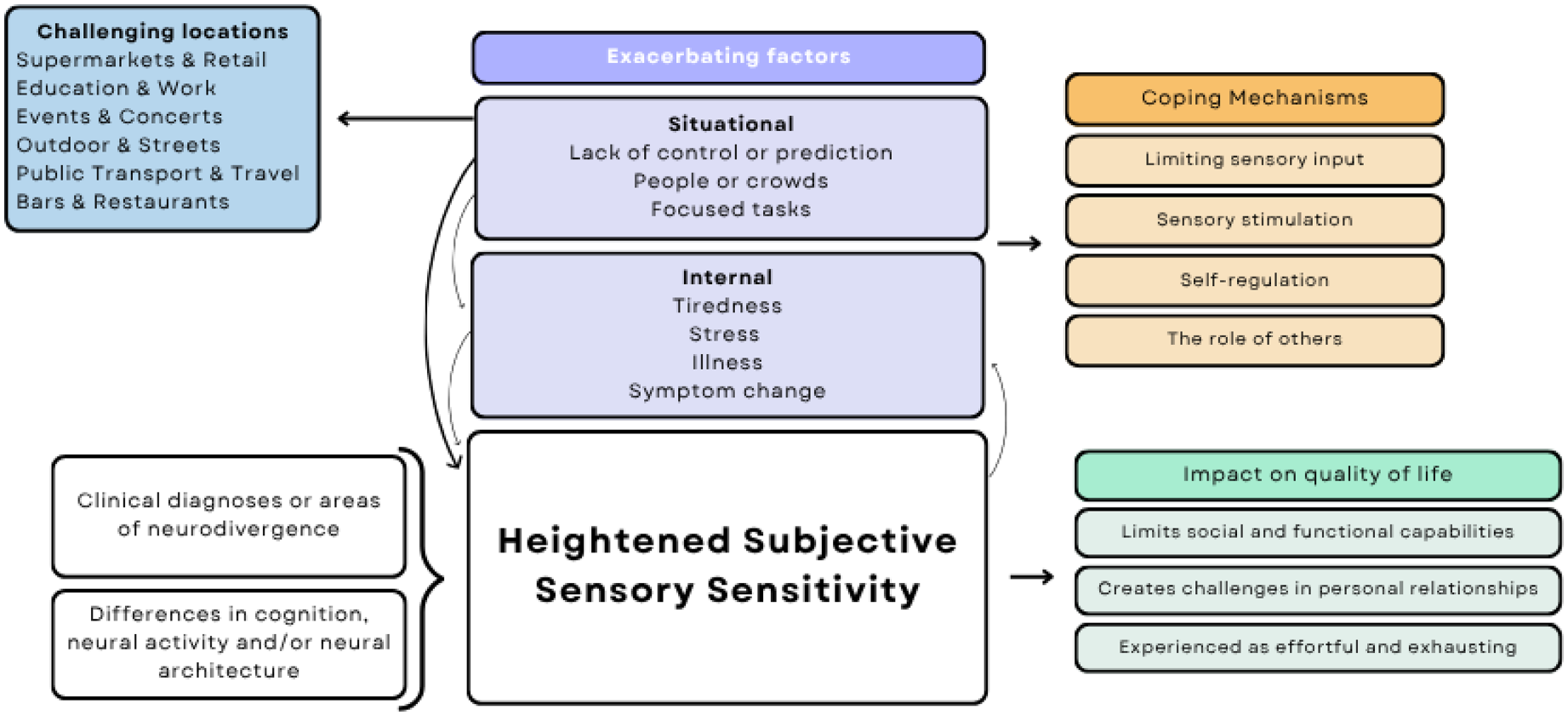
Conceptual Framework of the Main Findings From Our Thematic Analysis (Blue, Purple, Yellow, and Green) in the Context of Existing Understanding of What Gives Rise to Heightened Subjective Sensory Sensitivity.
Part 1: Thematic Analysis
What is the day-to-day impact of subjective sensory sensitivities?
Our participants’ descriptions of the impact of their sensitivities were multi-faceted, with developed themes centring on sensitivities limiting social and functional capabilities, creating challenges in personal relationships, and being described as effortful and exhausting.
Sensitivities limit social and functional capabilities
Sensitivities were perceived as barriers to engaging in social or personal activities. Specific insights included sensitivities impacting participants’ perceived ability to socialise, either through being unable to interact with other people once overstimulated, or being unwilling to expose themselves to social settings which present sensory challenges (e.g. nightclubs, concerts, restaurants and pubs; see Part 2 of analysis). Participants often expressed a desire to attend these events, but an inability to do so. Specific reference was also made to environments where social events usually happen for the individual, and the challenges these create:
“Usually when I am in a situation thats overstimulating my senses I find it difficult to socialise and interact with other. I can't focus and feel uncomfortable until I come back to my space.” [ID98]
“It makes it hard to go out in public. Communicating is like trying to figure out a new language each time. Crowds, loud noises, and too much movement makes me really uncomfortable or unsafe-feeling” [ID301]
Sensitivities were also perceived as barriers to gaining and maintaining work or study. Participants often described how sensory challenges such as lighting, sounds or smells contributing to difficulties in the workplace or at university, to the extent where work was not completed, or academic attainment was affected. Specific references were frequently made to a lack of concentration or ability to focus, which may underlie these consequences for productivity:
“In school during my GCSE's I got very internally irritated and angry because I couldn’t focus and could only here the shuffling of people's feet and clothing and their pens/pencils tapping against the table” [ID43]
“I don't go out much, but when I do I always bring sunglasses and ear plugs or headphones. I get overstimulated very easily and it's very taxing for me to try and hold down a job. For this reason, I don't work.” [ID39]
Participants described how daily tasks were made challenging due to sensitivities. Participants’ ability to sleep, drive and complete other functional tasks (e.g. shopping and using public transport) was described as limited by their sensitivities either directly due to the sensory challenges they present, or indirectly via the physical and emotional outcomes of experiencing hypersensitivity (e.g. tiredness):
“I avoid environments that trigger strong negative reactions, such as my kitchen. I try not to go in directly after someone else has used it to avoid the smell of food, and I try to use it alone to avoid hearing talking at the same time as the other uncomfortable stimuli. I struggle to wash the dishes, load or unload the dishwasher, look for food in the fridge, and cook complex meals because of this.” [ID48]
“I have to avoid many overwhelming situations just to get by, but many cannot be avoided and leave me exhausted and barely able to do basic activities of living for the rest of the day.” [ID20]
Sensitivities create challenges in personal relationships
Differences in sensory experience can create tension in relationships. Participants described how other people in their lives responded to their sensory reactions or needs, often referring to how others did not understand their experiences, or felt their responses were unwarranted.
“I turn off lights because I hate them, that drives my Father insane and he yells at me all the time for turning off lights.” [ID15]
“I didn't realise I was different growing up, so when I'd tell my parents the radio presenter was making me sick, they'd think I was being dramatic.” [ID257]
It was reported that other people could be a sensory challenge. Tension in relationships was described where specific individuals, often in the home, were the source of difficult sensory experiences. Participants also discussed how having to withdraw from these situations or individuals caused guilt.
“My husband doesn't get it, takes it personally when I ask him to at least eat with his mouth shut but I get so so angry with him” [ID32]
“My relationship with my partner and daughter is sometimes affected. It has been challenging to cope with sensory overwhelm with a small child. I have had lots of guilt over needing space from my child once overwhelmed.” [ID2]
Participants discussed the interpersonal consequences of feeling overwhelmed. They referred to how their responses to sensory stimuli impacted their relationships with others. For example, becoming irritated and angry in response to sensory challenges and this affecting their subsequent interactions.
“It can cause me to want to cry or to want to yell at people.” [ID1]
“Repetitive noises cause extreme emotional fluctuations that… cause me to lash out unfairly at people” [ID142]
Sensitivities as effortful and exhausting
Beyond functional and occupational impacts, consistent references were made by participants to the way that managing their sensitivities made them feel. Participants described the effort involved in planning to engage with, exposing themselves to, and recovering from sensory challenges, and how this made them feel drained or fatigued. Individuals described feeling tired after experiencing a difficult sensory environment, to the extent where they would withdraw to places of low sensory stimulation and high levels of control (e.g. their bedroom), to ‘recharge’. Participants described the unrelenting nature of these experiences, often discussing how much of their energy and time was taken by managing their sensory needs.
“they impact my life daily and greatly. I'm usually not being able to force myself to go through it - and when I do, it takes a huge toll on me and my well-being and I need a lot of time to recover.” [ID28]
“sensory stimuli take up a lot of space in my everyday life and it can be a battle to try and not to feel pain, illness, or get overstimulated by everyday sensory inputs” [ID68]
What do people feel are exacerbating factors for their sensory sensitivities?
Exacerbating factors were grouped into those that related to internal factors (e.g. changes within an individual's body) and situational factors (e.g. those relating to the outside world).
Situational Factors
Several participants discussed how they felt more impacted by the sensory environment when they experienced a lack of prediction or control over it. For some individuals this was a distinction between being at home (a highly predictable environment) versus being in public spaces. However, the sudden (and thus unpredictable) onset of specific stimuli, or the desire to control it, was also reported:
“Loud noises I can't control (ie irregular patterns) and don't know the source of are the most annoying to me.” [ID200]
“It is worse if the noise is a surprise. I am often frightened by loud cars, people dropping things etc It can take me 15–20 minutes to calm down afterwards, and my response to similar or smaller noises in that time will be much more pronounced.” [ID59]
Engaging in focused tasks led participants to feel more distractable or irritated by sensory information. This is particularly relevant to the impact of sensitivities on work and study. If sensory stimuli were specifically described in relation to this, they tended to be auditory:
“For example, when I am studying, completing an assignment or reading I tend to need complete silence to ensure I remain fully concentrated.” [ID103]
However, references were also made to decision making (a form of focused task) in intense visual environments:
“I shut down in places with too much visual input when I need to make a decision based on the information in that visual onslaught - this has happened when trying to order from a chaotic wall menu at a restaurant and while shopping for gifts at the mall” [ID15]
Sensitivities were described as heightened when with other people or in crowded environments (e.g. supermarkets, shops):
“I get agitated and get overwhelmed by stimuli especially if they are all at once, if I am around a lot of people during this time then it makes it feel a lot worse.” [ID272]
“Regarding the mall/shop environment, I just leave the place immediately as the longer I stay there the more negative reactions will occur. It doesn't really impact my every day life, however in large crowds it may make me feel more uncomfortable.” [ID25]
Internal factors
Participants described how tiredness or lack of sleep led them to feel more sensitive to sensory input:
“…voices, when I'm particularly tired feel like they're grating my skin. In a similar way, when I'm particularly tired some kinds of fabrics against my skin feel like they're scraping it” [ID64]
“If I am outside of a migraine period and have less sleep, I can start crying on places like the Tube, a crowded shop, or the grocery store.” [ID161]
Similarly, participants frequently noted that they experienced greater sensitivity when experiencing stress. A possible bidirectional relationship was also described, whereby feeling overwhelmed by their sensory environment further contributed to participant's ongoing stress.
“As an adult I started to notice a pattern. If I am stressed or overwhelmed, sensory sensitivity is much worse and can lead to a mental shutdown or outburst at home.” [ID2]
“I find the material of certain clothes (such as denim) uncomfortable but this [doesn’t] really have much of an effect unless I'm already having a bad day due to something else, like if I'm somewhere loud” [ID133]
Participants also described how a symptom change could be related to a change in their experience of sensory sensitivity. This was in relevance to specific clinical diagnoses or traits (e.g. anxiety and depression). Often, as clinical symptoms increased, so did sensory sensitivities:
“My anxiety affects my reaction to light as my vision tends to weaken as my anxiety peaks meaning that bright lights have even more of a harsh impact and I tend to feel more nauseas when I am anxious which leads me to have more of a reaction to potent smells.” [ID69]
“I feel I am more sensitive to the environment because of my OCD, but when I am coping well with the condition I would say I'm slightly less sensitive to the environment because my thoughts aren't too invasive.” [ID277]
How do people cope with their sensory sensitivities?
We developed four themes representing the main ways in which participants coped with their sensory sensitivities: limiting sensory input, providing counter sensory stimulation, self-regulation, and the role of others.
Limiting sensory input
Participants discussed how limiting sensory input took two forms. The first involved reducing sensory input through specific coping mechanisms including ear defenders, sunglasses and cutting tags out of clothing:
“I wear sunglasses when driving, pretty much all of the time during daylight hours unless it's overcast and raining! I also only use low lighting and lamps at home as bright will give me nasty headaches.” [ID5]
“To cope with … overwhelming sounds I hear everyday [from] everyday objects and people I cope with having in earplugs almost all the time, even when Im alone in my home.” [ID24]
The second method of limiting sensory information was avoidance of the situation or stimuli completely:
“I like to be in quieter places and prefer my friends who speak quietly and are not ostentatious.” [ID300]
“When I was little I would refuse to wear socks with the glittery material on as I found it very itchy on my feet and would take them off quicker than they were put on” [ID43]
Sensory stimulation
Participants frequently discussed using other sensory input to cope with the negative feelings that arise from their sensitivities. For example, using fidget toys or stimming:
“When in an overwhelming sensory environment- i.e., loud and busy- I tend to touch my hands in various ways: wringing them, clicking fingers etc.” [ID58]
Similarly, participants reported using enjoyable sensory stimuli (most commonly music) to distract or mask uncomfortable input:
“I use music when I am out running as this gives me something to distract from the feel of the pavement under my feet” [ID97]
Forms of counterbalancing were also described; for example, where a participant might strike one side of their body in response to being struck on the other. Participants also described balancing intense sensory environments by not further contributing to them:
“I am not a fan of loud sounds, I usually get very quiet as my attempt to help the situation. I feel by not making any noise or auditory responses, I am not worsening the situation.” [ID98]
Self-regulation
Participants described a number of self-regulation strategies used to deal with their negative sensory reactions. These included trying to be accepting of their negative feelings, or using mindfulness and breathing techniques:
“I also had to learn some breathing techniques and how to calm myself so i dont completely freak out if i find myself in a situation with loud music or sounds that i can't escape.” [ID167]
Several participants also reported taking breaks from sensory challenges to manage their reactions or withdrawing from the environment completely. Distraction or immersion in video games, mobile phones, conversation, or other sensory stimuli (e.g. visually following something) were also frequent:
“I may mindlessly follow someone ahead of me in order to feel safer having something to lock onto so I can get through a crowd while being somewhat distracted.” [ID301]
Control and prediction were also relevant to coping with sensitivities. For example, through using structure or routine to maintain a predictable their sensory world, or considering the outcome of stimuli before they occur:
“I sometimes think of the outcome a different stimuli can have before I am exposed to it, therefore preparing myself” [ID272]
Finally, negative health behaviours were also reported self-regulation strategies, such as skin picking, digging fingernails into their body, or using alcohol:
“I have managed much more successfully since I began treating my anxiety and depression, but before SSRIs I self-medicated with alcohol so I could tolerate places that would otherwise cause sensory overload” [ID15]
The Role of Others
Other individuals were reported as a source of support in managing sensitivities. For example, participants reported discussing their sensory needs with those close to them (e.g. friends, housemates, family and employers) and receiving support or accommodations as a result:
“My roommates and friends are very accommodating when it comes to my noise sensitivity so it is not impacting me much.” [ID45]
Many participants reported suppressing their reactions in front of other people, citing concerns around how they would appear or how their reactions would affect others:
“I have a strong urge to cover my ears around loud noises but normal people don’t do that so I suck it up.” [ID16]
Some participants also reported improvements in their ability to cope following professional therapy (e.g. exposure therapy).
Part 2: Problematic locations
A total of 213 locations were identified during the coding process. These were then categorised according to the type of environment they referred to. As shown in Figure 2, participants reported varied locations which were challenging for their sensory sensitivities. Over half of coded instances related to Supermarkets and Retail (e.g. shopping centres), Education and Work (e.g. school and staff room) or Events and Concerts (e.g. live music or sports, parties, festivals). The difficulty with public environments more broadly was captured by the Outdoor and Streets category, which contained phrases like ‘city’, ‘street’, and ‘public’. Public Transport and Travel included environments such as trains or tubes, and train stations, as well as driving and being in a car. Bars, Pubs and Restaurants were given a separate category to Nightlife, as the latter specifically related to nightclubs (‘club’ and ‘clubbing’). Our sampling method may have contributed to the specific occurrence of this category.

Percentages of Total Instances Which Contained a Specific Location (n = 213) Attributed to Each Category.
The 9% ‘Other’ category represented in Figure 1 refers to four categories which constituted < 10% of instances. These were: Indoor Public Spaces (3%, e.g. ‘public bathrooms’, ‘lifts’ and ‘corridors’), Homes (3%, ‘kitchen’ and ‘bathroom’), and Cinemas (2%), Recreation (1%, ‘Gym’, ‘Playground’).
Theme Contribution Analysis
We examined the relative contributions of autism diagnosis or self-identification to the emergence of each qualitative themes and problematic locations, given the already-well-known relevance of sensory sensitivities to autistic experience. Specifically, we calculated the proportional contribution of quotes to each theme from individuals with diagnosis/self-identification of autism, diagnosis/self-identification of any other condition or neurodivergence, or no reported condition/neurodivergence. Individuals reporting autism represented a maximum of 30% of individuals contributing to a theme. Further details are provided in Supplemental material.
Discussion
Our participants reported examples of sensory sensitivities affecting almost all facets of daily life, including personal wellbeing, relationships, function and occupation. Common coping mechanisms included avoidance of challenging sensory environments or situations, which may further contribute to impact (Robertson & Simmons, 2018) and reductions in social quality of life (Sinclair et al., 2019). Our themes broadly align with previous work with autistic people, as discussed below. Importantly, contribution analysis confirmed themes were not primarily influenced by our autistic participants. This trans-diagnosticity converges with results from Price et al., 2025 which found the nature of visual sensitivities (i.e. triggers) to be largely comparable across diagnostic and neurodivergent groups (although reported with highest severity in autism, fibromyalgia and chronic central dizziness).
In terms of impact and quality of life, sensitivities were described as limiting social and functional capabilities, creating challenges in personal relationships, and being effortful and exhausting. Existing quantitative work aligns with these themes; sensory sensitivities have been associated with reduced social functioning (Kinnealey et al., 2011) and quality of life measures (Genizi et al., 2019; Lee, 2012). Our findings expand this work, capturing the mental load associated with sensory sensitivities and their management (e.g. planning and responding), guilt over inability to socialise or complete functional tasks, and feelings of shame or embarrassment about sensory reactions, suggesting the mechanisms through which heightened sensitivities affect wellbeing go well beyond the established links with anxiety (e.g. Engel-Yeger & Dunn, 2011).
Factors exacerbating sensitivities included both situational and internal circumstances. One key internal factor was a change in mental health or neurological symptoms (e.g. anxiety, depression, OCD and migraine). Both causal directions were highlighted; a change in symptoms worsened sensitivities, or sensitivities worsened symptoms (e.g. anxiety and panic). Previous work has often emphasised the latter causal direction (e.g. Tseliou et al., 2025).Other internal factors included stress, echoing the ‘Sensory Avalanche’ described by individuals with Asperger syndrome (Smith & Sharp, 2013), a cycle in which stress increases sensitivity, which increases stress, which further enhances sensitivity. Aligning with these qualitative reports, levels of cortisol have been associated with sensory experience in children with autism (Corbett et al., 2009), with specific increases in both cortisol and sensory sensitivities found in response to novel peer interaction (Corbett et al., 2016). Stress has also been associated with subjective sensitivities in general population groups (Redfearn et al., 2020). Longitudinal investigation of how ongoing fluctuations in stress, or the effects of stress reduction techniques, upon subjective sensitivities would be valuable in understanding the specificity of these effects.
A third factor with bidirectional causal reports was tiredness or fatigue, described both as an exacerbating factor and a consequence of sensory overload (see theme: Sensitivities as effortful and exhausting). Convergently, the same bidirectional relationship has been described by individuals with acquired brain injury (de Sain et al., 2023).
External exacerbating factors included focused tasks, lack of control or prediction, and crowds. These echo previous work with autism (MacLennan et al., 2022a, 2022b; Robertson & Simmons, 2018; Smith & Sharp, 2013). There are theoretical associations with the role of control and predictability and causal accounts of sensitivity, which centre around the idea that individuals high in sensory sensitivity are poorer at predicting their sensory world (e.g. Pellicano & Burr, 2012; Ward, 2019). Under this theory, a reduced ability to predict unexpected aspects of the sensory world creates anxiety, and may drive a desire to control it, as described by our participants also in terms of coping mechanisms.
Our participants use a range of different coping mechanisms, some of which converge with reports for autism (MacLennan et al., 2022a), neurodevelopmental diagnoses (Wada et al., 2023), sensory processing disorder (Goodman-Scott et al., 2020) and hyperacusis (Greenberg & Carlos, 2018), including reducing or avoidance of sensory information (or avoiding certain situations), using enjoyable sensory experiences (akin to the stimming theme here), and support from significant relationships (the role of others). Beyond these, our participants also reported self-regulation strategies including mindfulness and breathing techniques, distraction, counterbalancing or immersion (e.g. in conversation and in games). Some also reported negative health behaviours (e.g. alcohol). The presence of additional strategies may be due to the increased sample size and/or clinical diversity of our sample (i.e. a broader range of diagnoses, and inclusion of individuals without them). It may also reflect increasing awareness and accessibility of some of these strategies in recent years (e.g. mindfulness).
The comparative efficacy of different coping mechanisms cannot be established by this work. For example, avoidance of sensory challenges was commonly reported in our participants, but consequent exclusion from certain environments (especially social) was also reported to impact wellbeing. Within anxiety disorders, recent evidence suggests that behavioural reactions to feelings of anxiety (i.e. avoidance) may be more central to predicting quality of life than the presence of anxiety itself (Kirk et al., 2019). If applied to sensory sensitivities, it is unclear whether continuing to engage with the stimuli and using a different method of coping (e.g., stimming, mindfulness), where possible, would be more beneficial to wellbeing than avoidance. Furthermore, for hyperacusis (aversion to sounds), it is recommended that direct avoidance (e.g. via ear plugs) is used sparingly because chronic reduction in auditory input can make aversive sensitivity worse (Henry et al., 2022).
Limitations
Although the impact of sensitivities and coping mechanisms were explicitly prompted in our qualitative questions, exacerbating factors were not. Many participants spontaneously described circumstances affecting their sensory experiences, and it thus felt important to capture this insight within the thematic analysis. It is possible that if prompted, additional participants would have described exacerbating factors, potentially diversifying the resultant themes. This could be explored in future study.
The diagnoses reported by our participants were not confirmed by medical records or assessment, so their veracity cannot be determined. There are advantages as well as disadvantages for accepting self-reported diagnoses. It is more inclusive for those unable to access care and receive formal diagnoses, particularly as some diagnoses can be difficult and time consuming to obtain (Hezel et al., 2022). It also aligns with recent moves towards self-identification in neurodivergence research (Angulo-Jiménez & DeThorne, 2019; Hswen et al., 2019; Pavelko & Myrick, 2015). Within the context of dimensional models of psychopathology (Watson et al., 2022), self-identification with a diagnosis or neurodivergence, even if not confirmed, may reflect experience of subclinical symptoms which are still relevant to experiences of sensory sensitivity. Thus, findings presented here provide valuable insight but should be interpreted in the context of self-reported diagnosis.
Finally, aspects of our sample are demographically specific, since a proportion were recruited on social media via forums and pages relating to a clinical condition or neurodivergence. The remaining participants are predominantly young female students of Psychology at a UK university. This does not invalidate the reported impacts, exacerbators and coping mechanisms, as our approach valued understanding the realities of sensory sensitivities in the context in which they are provided (Braun & Clarke, 2021). However, the specific nature of our participants provides an important backdrop upon which these findings should be considered.
Implications
Easing the burden of sensory sensitivities can take many forms, two of which will be discussed here. The first involves sensory alterations to existing public environments. Challenging locations identified by our participants included schools, universities, workplaces, supermarkets, shopping centres, restaurants and bars. Specific factors such as lighting, sounds or smells contributed to difficulties with concentration in the workplace or at university, to the extent where work was not completed, or academic attainment was affected. There is limited research on reduced productivity due to sensitivities beyond autism (Kirchner & Dziobek, 2013; Landon et al., 2016) and ADHD (Schreuer & Dorot, 2017), but it seems plausible that relatively minor changes would help many of our participants, such as adjustable blinds or reducing aversive sounds, or the provision of recovery spaces (MacLennan et al., 2022a). Adjustments may be idiosyncratic in some circumstances and may need to be discussed at an individual level, but the recurring themes reported here could be a beneficial starting point. For example, the importance of control and predictability could be supported by means to control environmental stimuli (e.g. blinds, music and lighting), and by prior information about crowded events. These recommendations align with existing work in autistic adults (Al-Harasis et al., 2025; MacLennan et al., 2022b; Mostafa, 2019, 2021) and those with ADHD or dyslexia (Finnigan, 2024), highlighting the need for recovery, the importance of predictability, the role of other people, and the impact of crowded spaces. However, common themes do not establish that accommodations will suit every individual with sensory sensitivities. Individual voice and co-design remain important; focus groups or interviews may be a useful tool for seeking feedback on sensory adaptations, for example. This would provide the option of probing and clarifying answers which is not possible in online surveys.
Other types of intervention can assist individuals in building emotional resilience to challenging multi-sensory environments that cannot be modified. For example, mindfulness-based skills of emotional regulation, self-awareness, and focused attention could be beneficial for individuals experiencing sensory distress, as has been noted in previous work (Hebert, 2016). Some participants already report using mindfulness techniques, and others reported negative impact to which mindfulness could readily apply (e.g. irritability affecting others and an inability to concentrate). However, the efficacy of mindfulness for supporting sensory differences still requires investigation.
Summary
We provide a theoretical framework which underlies our findings in Figure 1. Our participants reported varied impacts of their sensory sensitivities upon quality of life, including disruption to work or study, completion of daily tasks, and creating challenges in personal relationships. Exacerbating factors appear to create detrimental cycles, with sensory sensitivities causing exhaustion, stress and anxiety, while these same factors exacerbate sensory sensitivities. Several themes echo existing findings in autism, suggesting that a trans-diagnostic approach to sensory experience is fruitful and that ongoing efforts to improve the accessibility of challenging sensory environments (Davidson, 2010; MacLennan et al., 2022b) could create positive change for a wider range of individuals than already appreciated. The common nature of sensory experiences additionally highlights a potential need to acknowledge sensory differences in the clinical management of a wider range of diagnoses, including consideration of how sensitivities might be affecting wellbeing and social or occupational participation.
Supplemental Material
sj-docx-1-ndy-10.1177_27546330251383024 - Supplemental material for “They Impact My Life Daily and Greatly”: A Qualitative Exploration of How Subjective Sensory Sensitivities Are Experienced, Exacerbated, and Coped With
Supplemental material, sj-docx-1-ndy-10.1177_27546330251383024 for “They Impact My Life Daily and Greatly”: A Qualitative Exploration of How Subjective Sensory Sensitivities Are Experienced, Exacerbated, and Coped With by Alice Price, Rebecca Oates, Petroc Sumner and Georgina Powell in Neurodiversity
Footnotes
Acknowledgements
The authors would like to thank all the participants who participated in the studies, and Dr Abhay Ghaiwal for his contributions to this work.

Ethical Approval
Ethical approval was obtained from Cardiff University's School of Psychology. Informed consent was provided by all participants.
Funding
The authors disclosed receipt of the following financial support for the research, authorship, and/or publication of this article: AP was funded by Wellcome [108891/B/15/Z]. PS was funded by Wellcome grants [104943/Z/14/Z] and [097824/Z/11/Z] for part of this research. GP was funded by Health and Care Research Wales [SCF-18-1504].
Declaration of Conflicting Interests
The authors declared no potential conflicts of interest with respect to the research, authorship, and/or publication of this article.
Data Availability
Data will be made available upon request.
Supplemental Material
Supplemental material for this article is available online.
References
Supplementary Material
Please find the following supplemental material available below.
For Open Access articles published under a Creative Commons License, all supplemental material carries the same license as the article it is associated with.
For non-Open Access articles published, all supplemental material carries a non-exclusive license, and permission requests for re-use of supplemental material or any part of supplemental material shall be sent directly to the copyright owner as specified in the copyright notice associated with the article.
